An Early History of the Mystery Novel

By K.P. Gresham

Believe it or not, the mystery novel is considered a “young” form of literature. Yep, that’s right. Mystery fiction didn’t exist before 19th century England. Many suggest two reasons why this was the case. First, the ability to read was now reaching “below” the upper class educated citizens. Farmers and factory workers and children were being taught to read. Secondly, back then, most towns relied instead on constables and night watchmen. No centralized police forces existed.

So what happened that caused the change in policing? The public’s morbid national obsession with murder.

Two cases in particular were instrumental in beginning this fixation on crime, according to Lucy Worsley, chief curator at the Historic Royal Palaces, the independent charity responsible for maintaining the Tower of London, Hampton Court Palace, Kensington Palace State Apartments, and more.

In her BBC four-part series, “A Very British Murder” (2013), Worsley suggests that the first murder, known as The Radcliffe Highway Murders, took place in 1811. Only a constable was available to the poor maid who realized something dreadful had happened when she returned to the home of her employers only to find the door locked, and a woman screaming inside. The newspapers hyped the crime, stirring the public into a frenzy.

Sussex Advertiser | 16 December 1811

Then, less than a week later, a second family was attacked and murdered. Sensationalism reached a fever pitch.

Star (London) | 20 December 1811

Eventually John Williams was arrested and charged with the crimes. He committed suicide in his jail cell before the trial, though his trial was carried on without him. It was speculated that this was done to calm the public’s fear.

The second case, “The Red Barn Murder”, took place in 1826. Here a woman was found dead in a barn, apparently the victim of an elopement gone wrong. Again, the public fixated on the murder to the extent that a very macabre execution took place. On 11 August 1828, the convicted murderer, John Corder, was taken to the gallows and hanged shortly before noon in front of a large crowd. One newspaper claimed that there were 7,000 spectators, another as many as 20,000. But that wasn’t all. The body was taken back to the courtroom at Shire Hall, where it was slit open along the abdomen to expose the muscles. The crowds were allowed to file past until six o’clock, when the doors were shut. According to the Norwich and Bury Post, over 5,000 people lined up to see the body.

So now the British public was ripe to read anything that would feed their fascination with murder. All it needed was a writer to satiate their thirst.

Enter Edgar Allen Poe and his short story, “The Murders in the Rue Morgue” which was published in Graham’s Magazine in 1849. It has been described as the first modern detective story and featured the world’s first fictional detective, C. Auguste Dupin. Though Baltimore-born Poe was known in America for his literary critiques (several of which named Henry Wadsworth Longfellow a plagiarist), he was much more popular in Great Britain where he became well-known as an author.

(It should be noted that two books are also considered early mysteries but had little following due to their foreign languages. The first may have been Voltaire’s Zadig written in 1747, and Das Fraulein von Scuderi by E.T.A. Hoffmann in 1819.)

And the floodgates opened. Wilkie Collins’ novel The Woman in White was published in 1860. Arthur Conan Doyle published his first Sherlock Holmes mystery, A Study in Scarlet, in 1887. Doyle’s series is credited with being singularly responsible for the huge popularity of the mystery genre.

Mystery novels have gone far beyond the private detective motif. The genre now covers romantic suspense, noir, cozies, thrillers, traditional, etc.: even comic books, graphic novels and web-based detective series now carry on the mystery tradition.

I read mysteries, watch mystery movies, (probably have most of the Basil Rathbone Sherlock Holmes movies memorized line by line), and write mysteries. However, I had no idea I was entertained by such a “young” form of literature.

So, whodunnit next?

***

Note: Sources for this blog included Lucy Worsley’s BBC’s four-part series, A Very British Mystery, and the Biblio Blog “What Exactly is a Mystery Book”.

***

K.P. Gresham, Author

Professional Character Assassin

K.P. Gresham is the award-winning author of the Pastor Matt Hayden Mystery Series as well as several stand-alone novels.  Active in Sisters in Crime and the Writers League of Texas, she has won Best Novel awards from the Bay Area Writers League as well as Mystery Writers of America.

Click here to receive K.P.’s newsletter and a get a free short story!

Website: http://www.kpgresham.com/

Waking or Sleeping?

by Helen Currie Foster

This week out here on the creek I was iced in, with no power.

I was sitting by the fireplace wrapped in a blanket, when I came upon an unfamiliar word: HYPNOGAGIA. “Hypnagogia is the transition between wakefulness and sleep. During this state, it’s common to experience visual, audio, or other types of hallucinations. It’s also common to experience muscle jerks and sleep paralysis.” https://bit.ly/3YhrbZ6

Some people purposefully try to induce to hypnagogia to stimulate creativity. Id. According to Allison Eck, Harvard Gazette (Autumn 2022), hypnagogia is “widely thought of as a sweet spot for creativity.” https://hms.harvard.edu/magazine/sleep/behind-veil-hypnagogic-sleep. Eck describes the experience of scientist August Kekulé in the mid 1800’s during his search for the structure of the compound benzene, as he dozed before his fireplace in Ghent. “[A]s he dozed, images hinting at its structure appeared in his mind’s eye. He later wrote that he saw dancing atoms beaded together along an invisible string, ‘twisting in snake-like motion.’ The atoms morphed into an ouroboros” (another new word for me: a snake eating its own tail). Kekulé realized benzene’s structure was a ring  of carbon atoms, each attached to a hydrogen atom.

Scientists and innovators like Einstein and Edison, and writers like Vladimir Nabokov, “have transited this cerebral pathway in search of solutions to problems.” Id.

Have you experienced hypnagogia? I think I have, a few times, in mystery-writing, most recently in my newest, Ghosted. https://www.amazon.com/Ghosted-Alice-MacDonald-Greer-Mysteries/dp/1732722927/ref=tmm_pap_swatch_0?_encoding=UTF8&qid=1675707798&sr=8-1

On each occasion I’ve gone to bed with my mind on a plot problem, or a scene that needs to take shape. Preliminary requirements appear to include being ensconced under the covers, on my left side, envisioning a possible scene as I slide into sleep—then watching the scene begin to unfold. I try to remind my brain to remember this solution. While most dreams fly away with sunrise, these solutions have come back in the morning. If I could make this happen whenever I want (so far, no dice), a book would get finished so much faster!

This occasional experience may be “lucid dreaming,” the state of being aware that you’re dreaming. “When you wake up from a lucid dream, you actually have a more positive mood in the morning,” writes researcher Michelle Carr, Department of Psychiatry at the University of Rochester, in Aeon. https://aeon.co/essays/in-sleep-the-body-is-a-channel-to-communicate-with-the-dreaming-mind. Carr describes herself as a dream scientist: “I want to uncover ways to repair nightmares and, in their place, engineer dreams for healing.”

Hypnogagia is a big topic these days. A team of engineers and scientists at the MIT Media Lab developed a glove-like tool to help decipher dreams. Researchers are testing whether the glove may allow people to manipulate their hypnagogic experiences, which could help sufferers from PTSD and nightmare disorders feel a stronger sense of control.  Again, as Eck puts it, “…[A]t the very least, drawing attention to our hypnagogic personas may bring us newfound ideas that we can act on when we wake.”  Id.

Charles Dickens, inveterate insomniac, walked the streets of London at night and used dream states in his books, including, famously, A Christmas Carol. https://www.frontiersin.org/articles/10.3389/fpsyg.2021.700882/full

Could we term it “lucid dreaming” when Scrooge is shown visions—then decides to change the dreadful outcomes by his future actions? He begs the Ghost of Christmas Yet to Come, “Assure me that I yet may change these shadows you have shown me, by an altered life?” He promises, “I will honour Christmas in my heart, and try to keep it all the year. I will live in the Past, the Present, and the Future…” Then Scrooge sees the phantom’s hood and dress collapse into his bedpost, scrambles out of bed, repeating that last sentence––and heads out to buy the prize Christmas turkey for the Cratchits.

Vladimir Nabokov kept a dream diary, and in his autobiography, Speak, Memory, wrote about the procession of  what he called “hypnagogic mirages,” images he would see ‘just before falling asleep,” often accompanied by “a neutral, detached, anonymous voice which I catch…”

He emphasizes he is still aware during “the visions that pass before my closed eyes. They come and go, without the drowsy observer’s participation, but are essentially different from dream pictures for he is still master of his senses” (emphasis added). Lucid dreaming? https://www.loa.org/books/8-novels-memoirs-1941-1951?gclid=Cj0KCQiA54KfBhCKARIsAJzSrdotSuqt8CbUDCbTtegLG4hvxHker5ZZVuIwntp0lTzrNsY0PD5UeA8aAmQyEALw_wcB

Tolstoy’s notes show he envisioned characters in such visions. For a deeper dive, see https://ciaotest.cc.columbia.edu/olj/socsci/socsci_99pev01.html

(Side note––in Speak, Memory Nabokov also describes his synesthesia, where each letter of the alphabet appeared in its own color—depending on the language. In English a long “a” was the tint of weathered wood, but in French was polished ebony. Other letters were green, blue, yellow and so on. He also could not bear the sound of music. An unusual brain!) https://www.google.com/search?gs_ssp=eJzj4tLP1TcwTjMxr8gxYPQSKMtJTMnMzSxSyEtMys_OLwMAiy0J6w&q=vladimir+nabokov&oq=vladimir+n&aqs=chrome.1.69i57j46i131i433i512j0i512l2j46i512j0i512l3j46i512.8717j0j15&sourceid=chrome&ie=UTF-8

We mystery writers can mine hypnagogic moments for ideas on character and scenes––but the genre suggests a limit.

A good mystery offers the reader the chance to solve a puzzle. As set forth in the original rules of London’s Detection Club, “The detective must not light on any clues which are not instantly produced for the inspection of the reader.” Nor can the detective solve by “an unaccountable intuition.” https://murder-mayhem.com/the-detection-club-rules

Meeting of the Detection Club in 1936.

 Indeed, is there anything more irritating to a mystery reader than the tardy mention of a clue? No! Mystery readers are entitled to all clues, as soon as that clue is found, and clues are facts. The mystery writer offers a collaboration to the reader, in which the detective and reader are on the same page—fact-wise. We readers want evidence. A character’s dreams may offer insight into a character—but not evidence.

Besides—while most of us are at least mildly interested in our own dreams, unless we’re also therapists we’re not usually too interested in the dreams of others. Do you remember your interest level the last time someone began describing a dream to you? I confess my eyes can begin to glaze. Of course it’s hard to convey dreams with the color and speed and power the dreamer experienced. But in the world of mysteries, we are greedy for facts. In Martin Walker’s “Bruno, Chief of Police” series, set in a small town in the French Dordogne, Bruno’s activities are fascinating––his cooking, his love life, his detection––and while we know he had a difficult military service in Bosnia, the author doesn’t dwell on Bruno’s dreams about those days. Instead he provides us with what we want: Bruno’s memories. Those contain facts, at least Bruno’s versions of facts, for which the reader is grateful. http://www.brunochiefofpolice.com/

So I’m cautious. In my Alice MacDonald Greer Mystery series, at least so far, Alice doesn’t share her dreams. For one thing, as observed in the New Yorker, “As for writing about them, even Henry James, who’s seldom accused of playing to the cheap seats, had a rule: ‘Tell a dream, lose a reader.’” Dan Piepenbring, “The Enthralling, Anxious World of Vladimir Nabokov’s Dreams” (February 8, 2018). https://www.newyorker.com/books/page-turner/what-vladimir-nabokov-saw-in-his-dreams

The ice has melted! And Ghosted is out! Book 8 in the series is available now in paperback and also on Kindle via pre-order delivery on February 10, on Amazon. Also coming soon to Austin’s BookPeople!

Follow me at www.helencurriefoster.com.

https://www.facebook.com/helencurriefoster

https://www.instagram.com/helencurriefoster/

***

Author: Helen Currie Foster

I live north of Dripping Springs, Texas, supervised by three burros. I’m deeply curious, more every day, about human history and prehistory and how, uninvited, the past keeps crashing the party. I’ve loved the Texas Hill Country since my first sight of it as a teenager. Artesian springs, Cretaceous fossils, rocky landscapes hiding bluegreen water in the valleys. After law school (where I grew fascinated with water and dirt) I practiced environmental law and regulatory litigation for thirty years––then the character Alice suddenly appeared in my life. I’m active with Austin Shakespeare and Heart of Texas Sisters in Crime. And I’m grateful to the readers who enjoy the Alice MacDonald Greer Mystery series!

View all posts by Helen Currie Foster

Terry Shames’ Samuel Craddock Mysteries: A “Genre-Bending” Series

by Kathy Waller

Texas mystery author Terry Shames’ latest book, Murder at the Jubilee Rally, has been reviewed on ABC News.

To use a folksy phrase—Folks, that ain’t hay.

The ninth in Shames’ Samuel Craddock Mystery series, Murder at the Jubilee Rally focuses on conflicts residents of Jarrett Creek, Texas, experience when a motorcycle rally prepares to open outside of town—and the challenges Police Chief Samuel Craddock faces when murder follows.

Since you can read award-winning author Bruce DeSilva’s excellent review here, I won’t try to duplicate. Except to point out that—

DeSilva calls the Samuel Craddock series “genre-bending,” because the “author’s folksy prose and Jarrett Creek’s small-town ways . . . give the novel the feel of a cozy,” and yet the problems facing the town and Police Chief Craddock “give the novel the feel of a modern police procedural.”

With the term “genre-bending,” DeSilva hits upon one reason—perhaps the reason—for the series’ success. Shames joins elements of two very different genres—cozy mysteries and police procedurals—with skill and grace, into a seamless whole. That ain’t hay either.

As a reader, I enjoy Shames’ novels, but as a writer, I seethe with envy. If only I could do what she does . . .

Nevermind.

Now, for a broader view, I’ll turn from Shames’ ninth book to her first, A Killing at Cotton Hill, published in 2013.

At the bookstore, I fell in love with the cover. On page one, I fell in love with the book. Soon thereafter, I fell in love with a sentence. Here it is, underlined, in the paragraph quoted below—the words of narrator Samuel Craddock:

I head into the house for my hat and my cane and the keys to my truck. There’s not a thing wrong with me but a bum knee. Several months ago one of my heifers knocked me down accidentally and it spooked her so bad that she stepped on my leg. This happened in the pasture behind my house, where I keep twenty head of white-faced Herefords. It took me two hours to drag myself back to the house, and those damned cows hovered over me every inch of the way.

That’s what author Ernest Hemingway would call one true sentence. Cows are curious. They’re nosy. They like to observe. I’ve seen cows hover. That’s exactly the kind of thing my father might have said about his damn cows.

Shames gets it right. Every word in that sentence, and throughout the book, is pitch-perfect.

The night I read about the hovering cows, I wrote Shames a fan email telling her I loved the sentence.

But when I completed the novel and tried to write a review for my personal blog, I got tangled up in words. It came out sounding like this:

I love this book. It’s just so…There’s this wonderful sentence on the second page about hovering cows…That’s exactly what cows do…I can just see those cows…The person who wrote that sentence knows cows…It’s just so…I just love it.

That’s what happens when a reviewer lacks detachment. Wordsworth said poetry begins with emotion “recollected in tranquility.” So do book reviews. There’s nothing tranquil about that tangle of words.

So, with no review, I compromised. I posted the paragraph containing the beloved sentence and added a picture of white-faced Herefords.

IMG_2814

Not long after, Shames spoke at the Heart of Texas (Austin) chapter of Sisters in Crime, and I told her how much I admired her work. A year later, in 2014, I heard her read from her second novel, The Last Death of Jack Harbin. And I’ve read all the books she’s published since.

From 2013 to 2022, that’s nine Samuel Craddock mysteries, each a great read, each just as good as—or better than—the one before.

But regarding Shames’ sentences—

It is a truth universally acknowledged that her hovering cows will always be Number One.

_____

Notes

*Shames breaks the silly rule against “mixing” present and past tenses in narration. Samuel Craddock speaks the language spoken by men like him in real Jarrett Creeks all over Texas.

**The cow sentence isn’t really about cows. It’s about Samuel Craddock. But I am fond of white-faced Herefords, and the image Shames paints of them is so vivid that it obscures the man dragging himself toward his house. For me, at least.

***I took the photo of the cover of A Killing at Cotton Hill. The fur on the right side of the book doesn’t belong there, but it was easier to just take the picture than to move the cat.

***

Image of Murder at the Jubilee Rally cover from Amazon.com

Image of Hereford cow by Lou Pie from Pixabay

***

Kathy Waller has published short crime fiction as well as a novella co-written with Manning Wolfe. For more info, and/or to read her posts on topics ranging from A to izzard, visit her personal blog, Telling the Truth, Mainly (http://kathywaller1.com). She also cross-posts her Ink-Stained Wretches posts at Austin Mystery Writers.

When Words Balk-Take A Walk. Solvitur Ambulando!

by Helen Currie Foster

This week I’ve been in the Land of Stuck. Walking in circles around the kitchen island struggling to come up with the missing scene. My next mystery’s nearly done, but… I’m stuck. Ever been there?

The poetry shelf offers a momentary escape. Billy Collins can always pull me into a poem. Often he’s going for a walk and I can’t help but feel invited. His “Aimless Love” begins:

He’s got me. 

Or “The Trouble with Poetry,” which begins, 

“This morning as I walked along the lakeshore, 

I fell in love with a wren 

and later in the day with a mouse 

the cat had dropped under the dining room table.”

Well, of course there he’s got me. Then again:

“The trouble with poetry, I realized 

as I walked along a beach one night––

cold Florida sand under my bare feet, 

a show of stars in the sky––”

I feel that same cold Florida sand under my right arch, despite the Texas heat outside. 

Another walking poet: Mary Oliver. In Blue Iris, She begins “White Pine” this way:

“The sun rises late in this southern county. And, since the first thing I do when I wake up is go out into the world, I walk here along a dark road.”

Huh. Walking as discipline? Every morning?

Walking’s not just for poets. St. Augustine is often credited with the Latin phrase Solvitur ambulando––“it is solved by walking” (which may have originally been a response to the 5th C. B.C. philosopher Zeno’s concept that we can never actually arrive at a destination). 

According to Ariana Huffington, a number of writers agree about the benefit of walking, including Hemingway, Nietzsche, and Thomas Jefferson. She quotes the latter: “The object of walking is to relax the mind…You should therefore not permit yourself even to think while you walk. But divert your attention by the objects surrounding you”.https://www.baltimoresun.com/opinion/bs-xpm-2013-09-03-bal-solution-to-many-a-problem-take-a-walk-20130830-story.html  Which reminds me of Collins’s wren.

“Solvitur ambulando” was the official motto of the Royal Air Forces Escaping Society, formed in 1946 to help those in former occupied countries during WWII who risked their lives to help RAF crew members escape. https://en.wikipedia.org/wiki/Solvitur ambulando (check out the terrific solvitur ambulando quotes in this article, from Lewis Carroll, Dorothy Sayers and others). I can’t imagine how high the blood pressure of those resistance heroes climbed during such episodes. Mine skyrocketed just reading A Woman of No Importance, Sonia Purnell’s description of the amazing work of America’s Virginia Hall in France during the resistance. Talk about tense moments. So, did the RAF Escaping Society adopt this motto because of the therapeutic value of walking, or because walking can trigger ideas, or solutions? Or both?

Bruce Chatwin (The Songlines, 1986) claimed he learned the phrase from Patrick Leigh Fermor. Fermor himself was quite a walker. He set out, in 1933, at age 18, to walk across Europe from the Hook of Holland to Istanbul and Greece. He tells the tale in Between the Woods and the Water, 1986. 

 I loved this book and Fermor is fascinating (check out his WWII heroics on Crete, including engineering and carrying out the kidnap of the Nazi commander). 

https://www.theguardian.com/theguardian/2011/jun/10/patrick-leigh-fermor-obituary

The English provide walkers with such wonderful public walking paths. My husband and I recently walked the Thames Footpath for several miles along the Thames, over to Bray––yes! Home of the Vicar of Bray! https://en.wikipedia.org/wiki/The_Vicar_of_Bray

In this charming village you can taste amazing smoked salmon at The Hinds Head (where you can read how many times the Vicar changed his denomination to keep his job, back in the religious flip-flops of England’s sixteenth century) and also at The Crown, a pluperfect pub. The Thames Footpath takes you through leafy woods, with views of the rivers, the fields, and occasional historic and mysterious signs (“Battlemead”). It provides boats to watch, ranging from kayaks and paddleboards to elegant near-yachts, festooned with banners for Jubilee, and one incredible ancient polished Chris Craft, casually docked by the restaurant at the Boathouse at Boulter’s Lock by two grizzled old salts. We tried but failed to overhear their intense lunch conversation. Just trying to eavesdrop was imagination-stirring. Where did they come from? Where were they going?

The footpath also led us to the village of Cookham, home of another surprise: the Stanley Spencer Gallery. Spencer, a WWI veteran and Slade School graduate, produced remarkable paintings, sometimes mixing nominally biblical subjects with contemporary life—for example, a resurrection study of Cookham housewives in aprons, climbing out of their graves with surprised faces. https://www.tate.org.uk/art/artists/sir-stanley-spencer-1977.

I thought I remembered Spencer’s name from Virginia Woolf’s diaries and looked it up when we got home. She wrote on May 22, 1934, about Clive Bell, Vanessa Bell (Clive’s wife), Duncan Grant (Vanessa’s lover), and Quentin Bell (Vanessa’s son) “all talking at once about Spencer’s pictures.” In 1934 Spencer was showing six works in the Royal Academy Summer Exhibition…about the time Patrick Leigh Fermor was off in the middle of his big walk.

Other poetic walkers? You’ve already thought of Robert Frost (“Two Roads Diverged…”) and Dante. Dante’s walks take the cake; I mean, the Inferno’s a hell of a walk.

So if walking calms the mind, allows creativity, reveals solutions, why am I revolving around the kitchen island?

Now that I think about it, some ideas have emerged. For instance, how much my extended family loves hiking in the Rockies, with (1) a destination; (2) a well-rounded lunch, including chocolate, in the pack; (3) plenty of water. How it feels to set off, hoping to see (1) moose, or (2) marmots, or (3) ptarmigan. How it feels to walk to the destination, grab a flat-topped boulder, warmed by sun, and have lunch, staring out at the view. Then to walk…downhill. No longer out of breath. Watching your fellow hikers dodging limbs, swinging around switchbacks. Triumphant walkers. And in the meantime, there have been discussions on the trail, conversations about this and that, switching from one companion to another. At the end of the trail, a sense of sleepy satisfaction.

So it’s time to get up early enough for a walk. Get up early enough to beat the Texas sun, and see if my neighbor’s front pasture includes a jackrabbit, or “jackbunny” as some call it. Cause a snort from the deer in the brush.

… Okay. Back from the walk. I think I’ve figured out that pesky bit about the last scene, except for a couple of details. So tomorrow, when the alarm rings—I’m going for a walk. Would you like to come too? I’d love it. We could talk.

More…

Helen Currie Foster lives and writes north of Dripping Springs, Texas, closely supervised by three burros. She’s curious about human nature, human history and prehistory, and why the past keeps crashing the party. She’s currently finishing book 8 in the Alice MacDonald Greer Mystery novel series. Book 7, Ghost Daughter, was named Grand Prize Short List in the 2022 Eric Hoffer Book Awards, and Finalist for Mystery, 2022 National Indie Excellence Awards. Her books are available on Amazon, Kindle, and Audible, and at independent bookstores.She loves to talk with book groups.

Old Haunts, New Troubles

You know those friends you haven’t seen in so long? The ones you really miss? And that feeling you get when you finally get to share company again?  That’s what I’m feeling right now. We’ve been through some things together, seen some stuff, pulled through some tough times.  

I should clarify that I’m talking about my imaginary friends.

Private investigator Jamie Rush, and her partner, Cookie Hinojosa, are back in Port Alene with a new case, and I’m thrilled to be back in their world. Deuce the wonder bulldog is still charming people wherever he goes (usually at the pub, pier, or beach), and Marty is keeping the drinks flowing at Hemingway’s.  Erin’s booking business is hopping, and her clients are saltier than the Gulf Coast.

This new case, though? It’s going to change things in Port Alene forever.

It all started simply enough.  

A small request from a family friend.

Two Sisters.

One Deadly Secret.

No Time to Lose.

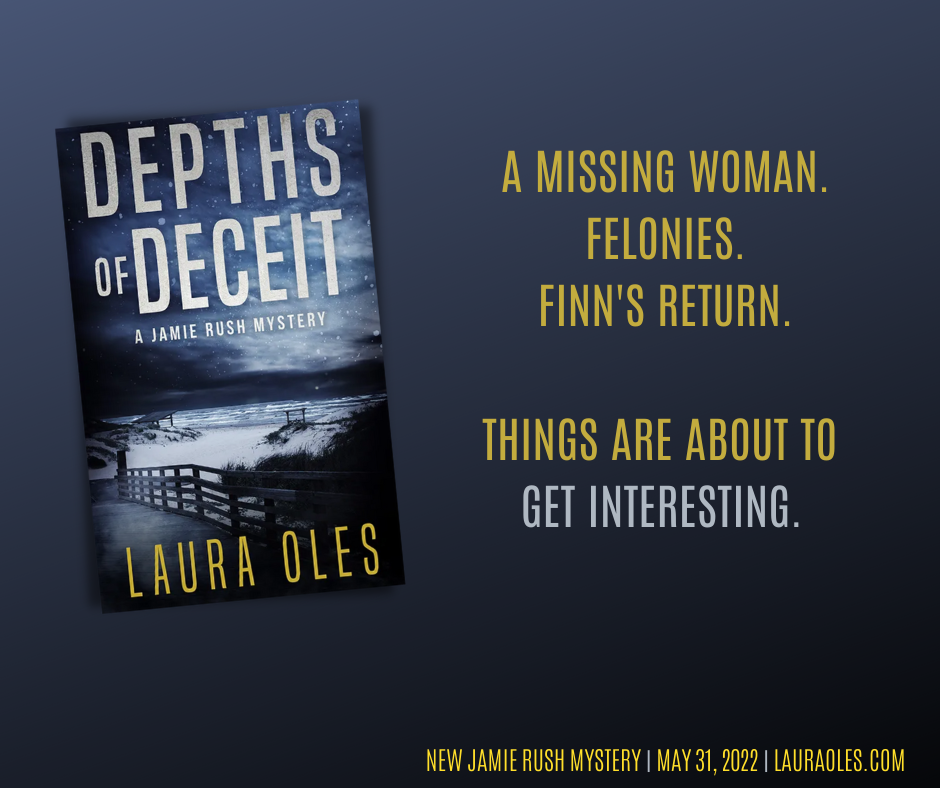
PI Jamie Rush has her hands full with small-time skip-tracing and surveillance jobs in Port Alene, Texas. The work is steady, though she still struggles to make ends meet. But when her partner, Cookie, brings in a low-paying and potentially time-consuming case, Jamie takes it on out of loyalty.

Cookie’s childhood friend, Renata, needs to find her younger sister, Leah. As Jamie digs into Leah’s past, it becomes clear that the missing woman’s life was shrouded in secrets, the kind that could jeopardize those involved in the case.

To complicate matters, PI Alastair Finn has returned, and he’s willing to reclaim his town by any means necessary. Jamie has never been one to retreat, and Alastair enjoys a good fight. Sparks will fly.

A missing woman. Felonies. Finn’s return. Every twist reminds Jamie that she’s still an outsider in this town. Jamie must prove herself all over again, and the stakes have never been higher.

Pub Day for DEPTHS OF DECEIT is May 31,2022. 

If you’d like to spend time with Jamie’s crew, you can pick up a copy for a special pre-order price here:https://amzn.to/3KvSUO

Music to Our Ears!

by Helen Currie Foster

On April 2 I drove with my writing compadre D.L.S. Evatt (aka Dixie) to Houston to sign books at Murder by the Book. That renowned bookstore has sold mysteries for 42 years. Huzzah!

We’d launched our books–my Ghost Daughter, Book 7 in the series, and her Bloodlines and Fencelines–at our Honky-Tonk Book Launch on December 5, 2021, at venerable Sam’s Town Point, a South Austin treasure for decades. The owner, Ramsay Midwood, declared it was the “first book launch” for Sam’s. Before the band––Floyd Domino’s All-Stars––began playing, Austin Shakespeare’s Ann Ciccolella interviewed us. Her first question: “why have a book launch at a honky-tonk?”

Dixie and Helen

Why? For all the right reasons—great beer signs, dance floor, pool table, and music. But the main reason: murder mysteries set in small Texas towns must have a place where townspeople meet, where news is exchanged and gossip is passed along, where people see friends and frenemies and fall in love, where the past isn’t forgotten but the present is very much in play.

For Alice Greer, the lawyer protagonist in my Ghost series, the century-old Beer Barn is that place. Artisanal beers, excellent Tex-Mex food, the requisite dance floor—and the mix of music that says “Texas Hill Country.” In Dixie’s Bloodlines and Fencelines, that place is Sara’s General Store.

Of course setting is crucial in mysteries. For a small town setting, a “town crossroads” becomes a useful dramatic tool, providing a place where the mystery’s protagonist runs into various characters and hears (and evaluates) their stories, slowly unraveling the truth of a murder. Have you ever lived or visited relatives in a small town? You may have identified potential locations that would work well in a mystery. In Itasca, Texas, home of my maternal grandparents (and the Itasca Wampus Cats), it might’ve been the church fellowship hall, or the one café that served breakfast and lunch, or (I keep returning to this thought) the frigid meat locker downtown where, like many families, my grandmother kept her side of beef, back before home freezers. I still remember the sharp cold vapor of the meat locker. Imagination stirs…

At any rate, Sam’s Town Point was perfect for a book launch. When we scouted Sam’s, Dixie took a look around and said, “There are stories in these floorboards.” So we wrote a song, “Stories in the Floorboards,” which premiered last month at our book event at the Austin Woman’s Club, sung by songwriter/actress Helyn Rain Messenger.

We asked John McDougall at Murder by the Book if he knew of other authors who’d written or commissioned a song for their book launch. He said, yes, Harlan Coben and Jeffrey Deaver had done so, and Lee Childs had commissioned an entire album. Well!

The notion of an album set me thinking of John Rebus, the crusty Edinburgh cop made famous by author Ian Rankin. Rebus, acerbic and brilliant, likes his music. In Black and Blue, he sticks a tape in his car cassette player – Robert Wyatt, Rock Bottom, then Deep Purple, “Into the Fire.” That title matches the heat of the fix he’s in at that point. (Later in the series, the cassette player becomes a CD player.) But at home, he still relies on the hi-fi.In Rather Be the Devil, set in his ways, now retired and older than dirt, Rebus knows he has an ominous shadow on his lung as he enters his apartment: “A glow from the hi-fi system that told him he hadn’t switched it off. Last album played: Solid Air. Felt like that was what he was walking through…” https://www.amazon.com/s?k=rather+be+the+devil+by+ian+rankin&crid=11GFHLFGLRGUT&sprefix=%2Caps%2C135&ref=nb_sb_ss_recent_1_0_recent

Rebus has stuck to his old technology. And now he’s ahead of the curve. Vinyl sales are up: “Left for dead with the advent of CDs in the 1980s, vinyl records are now the music industry’s most popular and highest-grossing physical format, with fans choosing it for collectibility, sound quality or simply the tactile experience of music in an age of digital ephemerality. After growing steadily for more than a decade, LP sales exploded during the pandemic.In the first six months of this year, 17 million vinyl records were sold in the United States, generating $467 million in retail revenue, nearly double the amount from the same period in 2020, according to the Recording Industry Association of America.”

https://www.nytimes.com/svc/oembed/html/?url=https%3A%2F%2Fwww.nytimes.com%2F2021%2F10%2F21%2Farts%2Fmusic%2Fvinyl-records-delays.html

Moreover, it’s not retirees pushing this trend: “And while you might think it’s nostalgic Boomers or Gen Xers behind the renaissance of records, in fact surveys show it’s millennial consumers driving the rising trend in vinyl sales.” https://www.themanual.com/culture/why-vinyl-is-coming-back/

Why? For some, vinyls are the new collectible. But maybe it’s about the additional experience involved in listening to a favorite chunk of music. Rebus, for instance, is not listening to streamed music, not asking Alexa to play music that “sounds like” some musician. No, he’s taking a number of steps, both mental and physical, before he begins to experience the music he’s after. He’s choosing an album, seeing the familiar cover again, sliding the fragile (yet powerful) disc from its jacket, and placing it on the turntable. The album represents an entire experience, not just one cover song. Then he’s lifting the arm, carefully lowering the needle, hearing the introductory hum and scratch and—there it is again, the music that lives in his memory and is playing out again right now, in his living room. He’s making music.

Moreover, he’s activating memories, and perhaps comparing the memories of the music with his present situation, as Rebus does here, thinking the song title—John Martyn’s “Solid Air”—“felt like … what he was walking through.” (A compelling description. https://www.youtube.com/watch?v=UikPQOaJpfU)

Writers use music in mysteries to add depth to the protagonist’s character. Inspector Morse, alone in his flat, listens to opera. Lord Peter Wimsey plays Bach on his baby grand; Sherlock Holmes plays the violin and attends opera. Rebus relies on the music of his time, has the albums, still has t-shirts from concerts he attended. Detectives need a listening ear, need to be able to discern the sound of a lie, hear the tremble in a frightened voice. What the sleuth chooses to listen to can almost make us feel we’re hearing background music. Music becomes the continuo, the bass line that we feel beating like a heart as a book comes to life.

Because—even if we don’t know the specific notes Holmes is fingering on his violin, or which Bach fugue Wimsey is toying with, or which Wagnerian album Morse has put on his hi-fi, or precisely what “Solid Air” sounds like, we do have a huge memory vault of similar music that bubbles up as we read a mystery. We may not quite create the same soundtrack the author had in mind, but our brains engage.

Book 5 of my series, Ghost Next Door, involves a murder at the Coffee Creek city park, the night before Coffee Creek’s first barbecue competition. My protagonist, lawyer Alice Greer, is part of the happy crowd under the stars, listening to keyboard geniuses playing varieties of boogie-woogie, a genre which may have begun in the lumber camps of East Texas and still flourishes in Austin. Early in the evening Alice hears “Right Place, Wrong Time,” presaging what happens next. https://www.youtube.com/watch?v=hf15HrUZ5Wk. The following night she and her romantic interest, Ben Kinsear, attend the Pianorama at the Beer Barn (Alice’s favorite client). Six piano players are trading licks, winding up with Freddie Slack’s “Down the Road A Piece,” with its rippling magic trick at the end, https://www.youtube.com/watch?v=OX8TPanPKzU, and ending with Slack’s haunting theme song, “Strange Cargo.” https://www.youtube.com/watch?v=tQM46xi031M

The crowd demands an encore, Alice listens as the theme grows “more complex, begins to create dreams, memories, ambitions.” The music reflects Alice’s emotions.

Music memory involves several different parts of our brain. “Different types of music-related memory appear to involve different brain regions, for instance when lyrics of a song are remembered, or autobiographical events are recalled associated with a particular piece of music.” https://academic.oup.com/brain/article/138/8/2438/330016

And it may be for that reason that music stays in our brains longer than many other memories. https://kids.frontiersin.org/articles/10.3389/frym.2017.00005#:~:text=Our%20brains%20possess%20a%20remarkable,might%20know%20it%20by%20heart.

You already know this. Your personal music catalog—music from your past, your present, your childhood, your teenage years, and the new piece of music you just listened to—is with you, quietly ticking away in your brain, available and waiting. And there’s always more to add.

So, you could check out the line-up at Sam’s Town Point. Go Hear Floyd Domino’s All-Stars. Keep filling the music catalog…

https://www.samstownpointatx.com/

Helen Currie Foster writes the Alice MacDonald Greer “Ghost” series, north of Dripping Springs, Texas, supervised by three burros. She’s fascinated by dirt and water law, as well as human history, and the way the past, uninvited, keeps crashing the party.

Ghost Daughter, Book 7, was named Semifinalist for the BookLife Prize for Mystery/Thriller (“an intriguing and complex narrative”). Book 8 is underway.

blog reference

Why I Go to Critique Group

by Kathy Waller

I said to my critique partner this morning, The whole project is stinky it stinks it’s fatally flawed just nothing no hope.

She said, But Chapter 13 is so good so funny Molly is so funny it’s not stinky.

I said, Yes, the first part of chapter 13 and the last part of chapter 13 are funny and very very good but there’s still no middle of chapter 13 and what there is stinks and anyway the other 47,000 words stink except for a few hundred here and there.

And she said, But the middle could be revised and edited it has promise.

I said, But it won’t work because I have written myself into a hole and can’t get out so I have to trash that part and anyway the whole concept stinks.

And she said, NO you can fix it just keep going because I like Molly she’s so funny.

And that is why I go to critique group every blessed week.

*****

Writing is a solitary activity, but most of writing isn’t writing. It’s rewriting, rewriting, and rewriting. And then it’s revising and revising. And editing editing editing. And rewriting again. And . . .

Sometimes it’s whingeing and complaining and eating peanut butter out of the jar with a spoon and buying larger clothes and telling Molly she’s a heartless ***** who doesn’t deserve one paragraph of her own, much less a whole book.

And it’s feeling like a fraud when you tell people you’re a writer and deciding you’d be happier if you gave up and dedicated yourself to French cookery or tatting or riding a unicycle.

But if you’re lucky, it’s also going to critique group and then going home and writing and writing and writing and . . .

Here’s the way Austin Mystery Writers work: We email first drafts, revised drafts, or final (almost) drafts, depending on where we are in the process.

We read all the week’s submissions, then sit around a table–or on one side of a table in front of a monitor displaying partners in little Zoom squares–and talk about what each member has written.

Criticism here doesn’t mean trashing. It means that each member points out what the writer has done well and what she might have done better. Sometimes we suggest examples of better–the “experts” say that’s not proper, but it works for us–and sometimes we simply say what we think doesn’t work so well without elaborating. Sometimes we disagree; one person doesn’t like a word or sentence or paragraph, while another thinks it’s fine. Sometimes we all chime in and discuss ideas.

Then we say, “Thank you.”

Because we’ve become friends during our association, we can say what we think and appreciate what the others say.

We encourage one another.

We also laugh a lot.

Because of AMW, I’ve published short stories and co-written one novella.

Because of AMW, I’ve become a better writer.


I posted “Why I Go to Critique Group” (one time I titled it “Why I Go to Critique Group and Can’t Afford Not To”) on my personal blog on July 9, 2010, when Gale Albright and I were members of the two-person Just for the Hell of It Writers, which was soon swallowed up by Austin Mystery Writers (a consummation devoutly to be wished).

I periodically pull the piece out and repost it.

Because it’s important.

***

Has anyone noticed that the em dash (—) in my posts looks like an en dash (–)? I can’t help it. Sometimes I find an em dash on a grammar website (like now) and copy and paste into my post, but right now I’m just not in the mood. But I’d like picky readers, like myself, to know that I’m aware of the error and wish the platform would correct it,

***

Kathy Waller posts on her personal blog, Telling the Truth, Mainly, http://kathywaller1.com. She’s published the works pictured above, the first three with Wildside Press, the last, co-written with Manning Wolfe, by Starpath. She has finally decided the ancient pre-published book is not stinky and has hopes of finishing it one day. If her critique partners agree.

Sisters in Crime, Thank You!!!

By K.P. Gresham

First off, the best job I ever had (short of writing mysteries) was teaching. And yes, I taught Middle Schoolers, which most people think is the worst possible teaching job you can have. Not me. I loved the students, and I loved my fellow teachers and staff. The kids were sponges. As long as you weren’t a jerk to them, they weren’t a jerk to you. And when they succeeded, both teacher and student won. The same could be said for all of us school employees who came to work every day to help those students become educated, excellent citizens.

What does that have to do with Sisters in Crime? Well, this time I’M the student, and my fellow chapter members and I are the sponges, learning as much as we possibly can to be better writers, readers and business people.

Sisters in Crime (SinC), both on the national level and the chapter levels, provides the teaching. The organization is based solely on helping readers and writers, women and men to learn their craft and sell their books.

SinC is the premier crime writing association focused on equity and inclusion in our community and in publishing. The association, founded in 1986, has 4500+ members who enjoy access to tools to help them learn, grow, improve, thrive, reinvent if necessary, and to share the lessons they’ve learned during their mystery writing experience.

4500+ members? That’s a whole lot of folks to learn from!

SinC National offers many resources to mystery readers and writers. They support a large international network of local chapter with grants, webinars, a central bank of crime-writing research, etc. They support local libraries and independent bookstores. National also provides a monthly newsletter called inSinC which is sent to every member.

Local chapters are where the meatiest teaching takes place. In the last year, our Heart of Texas Chapter centered in Austin, Texas, hosted a plethora of programs spanning the mystery writing need-to-know list. NY Times Bestselling author L.R. Ryan shared her secrets to plotting the blockbuster novel. Cathy DeYoung, a former LAPD CSI fingerprint analyst (and the inspiration for the character of Abby on the TV show, NCIS) walked us through the steps of exploring a crime scene. Mike Kowis, a mild-mannered tax attorney for a Fortune 500 company AND a fellow author, taught us the ins and out of the tax code for authors and other legal matters.  Oh, and we were graced with a frank Q & A with the U.S. District Judge of the U.S. District Court for the Western District of Texas.

Honestly. Why would a writer not want to learn from these experts??  And these incredible lessons all were brought together through the Sisters in Crime organizations.

Once you get past the realization that we kill people for a living (on the page, of course), crime writers and readers are a very supportive, very giving group of people. And Sisters in Crime is the best way to get to know them.


***

TV Programs I Like–from the Backlist

Well. Today I planned to get out of bed and be perfect. It didn’t work that way.

First I had a fight getting a certain video to embed properly in a certain site. It was a very nice video, and I was trying to help a friend, but the video began with an ad about a cure for toenail fungus, complete with pictures. That was not what I had in mind, and it was certainly not what my friend had in mind. The fight took longer than it should have. I’m afraid to look back to see if the cure–for the video, not the toenail fungus–is still working.

Then while I fought, my breakfast, thanks to a kind husband, sat on the table beside the recliner where I was working, and I looked up and saw Ernest the Cat had designs on it. Yesterday I found him stretching upward, his paw in my bacon. He’s never tasted bacon, but he’d like to. I rescued breakfast.

So now I’m sitting here in my Snoopy and Woodstock nightshirt, entirely inappropriate attire for a woman of my age and respectability, recovering from a major fume.

I knew I should have put on makeup as soon as I got out of bed. Yesterday I did so for the first time in ages–let’s face it, staying home for seventeen months straight changes one’s attitude toward personal grooming–and with makeup, the day went better.

I used a face cream, which I thought might be a night cream but didn’t have my glasses on and so couldn’t tell but risked it anyway.  And it did wonders for the wrinkles around my eyes, filled them right in.

I put on enough blush that a ship on troubled seas would need no lighthouse to warn it away from perilous rocks, so I wiped some of it off. I used eye shadow, maybe too much, but I didn’t wipe that off because behind my glasses it’s invisible anyway. I applied lipstick.

Then I used my curling iron. That’s problematic because something is wrong with my shoulders–no rotator cuff tears, but the arms don’t like to go up as far as they should, like to the top of my head, and I refuse to go back to PT and have a bunch of skinny infants tell me I’m doing the exercises wrong, when all I’m doing is executing them faster than prescribed because I want to get them over with and go home.

But anyway, I made the effort and used the curling iron, and then I even brushed my hair, and the day really did go better. I imagine my husband was relieved. He’s staying in self-imposed quarantine, too, and there’s not much visual variety inside. I’m probably the reason he spends so much time looking at the cats.

Anyway, I spent the next part of my better yesterday deciding that I spend too much time watching television. That wasn’t a difficult decision, since I’ve watched all the BritBox offerings at least three times. I like to watch TV shows and movies more than once; the more often I watch, the less attention I have to pay to know what’s going on. But it seemed time to unsubscribe. After all, I still have Prime and ROKU.

I also decided I wasn’t listening to enough music–I used to have music going all the time–so I upgraded Spotify in hopes it will play what I tell it to, like it used to, instead of what it wants to. I went all the way up to 99 cents a month. I’m not sure 99 cents is enough to do what I expected. I want Max Morath playing piano rags–he has the best touch I’ve ever heard. And Brian Stokes Mitchell, whose name I can rarely remember without prompting, singing a certain song from South Pacific, which I’m afraid is not in the repertoire.

But there’s an out. If I’m not happy, I can always go back to Acorn TV, which I subscribed to years ago. I watch mostly British programs. The accents are comforting.

Anyway, having progressed from cussing a certain website to discussing television, I’ll move into the main idea of this post, which my high school English teacher said I should do in the first paragraph, but I’m old enough to break the rules.

The main idea is TV shows I like–old TV shows. I’m always reading the backlist, so why shouldn’t I do the same for viewing?

Here they are, in no particular order:

  1. Kavanaugh QC, starring John Thaw as a London barrister, a senior member of River Court chambers, who usually appears for the defense but sometimes prosecutes. The antithesis of Thaw’s former character, the irascible Inspector Morse, Kavanaugh is even-tempered and respected by both colleagues and opposing counsel. A family man, he is also, like many protagonists in crime fiction, a workaholic, but his character plays against type when his wife accepts a job with the European Union based in Strasbourg, and he must adjust his own life to accommodate hers. Some mild comic relief is provided by a snobbish colleague in chambers, Jeffrey Aldermarten, but Kavanaugh’s cases are serious, no comedy there. His goal is justice, which he often finds difficult to deliver, even when he wins his cases.
  2. Wycliffe, based on W. J. Burley’s novels. Jack Shepherd stars as Detective Superintendent Charley Wycliffe, whose territory covers the coast of Cornwall. He is quiet, thoughtful, and good at his job, but not interested in advancement. He’s often at odds with his Deputy Chief Constable, who is concerned with budget restraints and with convincing Wycliff to run his division from the office rather than work cases himself. The Chief Constable and others often urge Wycliffe to apply for promotion–and to retire. He is assisted by two Detective Inspectors, Doug Kersey and Lucy Lane. Kersey is a solitary man, lonely, quietly and hopelessly attracted to Lucy. Lucy, as ambitious as Wycliffe is not, finds promotion is based more on sexual politics than on ability. Cases in this series are serious, but scenes of Wycliffe’s family life, while not comedic, sometimes lighten the intensity. Emphasis is on human relationships, not on just police procedure.
  3. Line of Duty, another police procedural, which ran for six seasons and has received numerous awards, including being ranked third in a Radio Times 2018 poll of the best British crime dramas of all time. The series begins with a young Steve Arnott being transferred to the Anti-Corruption unit because he has refused to cover up a mistake made during a raid in which he took part. Corruption in the department goes deeper, however, than anyone suspects, and the lives of members of the unit are sometimes in danger, even from their own colleagues. Twists and turns abound; it appears that no one is completely clean–or they can be made to appear bent–and the viewer continually wonders whom he can trust, and even whom he can like. What makes the series especially satisfying is that the plot isn’t strictly linear–it circles around; events that seemed to be resolved in early episodes emerge as catalysts toward the end. Gritty doesn’t begin to describe Line of Duty. You’ll thank yourself for watching. I’ve seen it twice and might watch it again. And yet, I’m not sure I want to.
  4. A Touch of Frost. I love this series, the early episodes of which are based on the novels of R. D. Wingfield. David Jason stars as William “Jack” Frost, an experienced detective with the Denton Police Force, who does everything his way. Superintendent “Horn Rimmed Harry” Mullet admires Frost’s abilities but would love to retire him, downsize him, generally get rid of him–Frost is famous for neglecting paperwork, which gets Mullet in trouble up the line, and for happily putting his foot in his mouth, with generally amusing results. But Frost is the Chief Constable’s fair-haired boy–he once subdued an armed man, was shot, and won the George Cross for bravery. Frost is a flawed individual, as the best characters are. Privately, the award embarrasses him, since his heroism was the result of his being drunk on duty–he’d just made up his mind to leave an unhappy marriage when his wife was diagnosed with terminal cancer, and he carelessly risked his life because he knew he had to stay with her. In the first episode, Frost is widowed; a series of relationships fail because his job always comes first. But he is loyal to his colleagues and becomes especially fond of a young man who serves as his assistant. And although he has no tolerance for crime, he often feels compassion and understanding for those who commit it. The series comes to an end that is both sad and satisfactory, like many of Frost’s cases. The popular series ended when David Jason retired, saying at sixty-eight he was older than any real police detective, and that he couldn’t imagine filming Frost in a wheelchair.

All of these mystery/thriller/police procedurals, and many others, are available on Prime as well as on BritBox and other subscription services. 

Now I shall divest myself of my Snoopy shirt, don some regular clothes–also known as rags, but these days, only one human and two cats see them, and they don’t care–and apply makeup. Maybe I’ll wear enough blush to be a lighthouse. With the amount of rain we’ve been having, I might end up being useful.

***

Photographs of actors are television screenshots taken by me.
Photograph of Snoopy and Woodstock was taken my my husband. 

***

Kathy Waller blogs at Telling the Truth, Mainly. Her stories are published in anthologies and online. Sometimes she works on a novel. Sometimes she doesn’t. She wants to re-read an old book by Rebecca West, but she can’t remember the title. 


Judging a Book by Its Cover

By K.P. Gresham

“Good cover design is not only about beauty… it’s a visual sales pitch. It’s your first contact with a potential reader. Your cover only has around 3 seconds to catch a browsing reader’s attention. You want to stand out and make them pause and consider, and read the synopsis.”
― Eeva Lancaster, Being Indie: A No Holds Barred, Self Publishing Guide for Indie Authors

Of course, the opposite is capsulized in a familiar quote, “Don’t buy the book by its cover.” BUT, if an author wants to sell their book, they’d better face some marketing facts.

A book cover sells the book. At least it’s the first thing to catch the readers’ gaze as they wander through the shelves of a bookstore, library or click through bookseller websites. Yes, of course the blurb on the back is incredibly important, but it’s the cover the buyer sees first. It’s the cover that makes that buyer turn the book over and read the blurb.

Think about it. If the cover grabs you, you’ll pick up (or click on) the book. If it’s blah, chances are you’re going to move on to the next book.

Now what exactly in the cover image grabs you?  Does the cover tell you the genre? What to expect? Look professional? I’m a mystery writer, so I’m looking for a cover that not only says it’s a mystery, but what kind of mystery it is. Here are some examples.

Cozy Mysteries—The readers are looking for lightheartedness, as well as any of the tropes associated with cozies: animals, home-town-feel, food, maybe even a graphic image (cartoon) suggesting any of the above. They do NOT want to see brutality.  For example, here’s the cover for Arsenic and Adobe by Mia Manansala. Note the cartoon-like quality, the dog, the happy homemaker and the bottle of poison. All of these elements tell the reader this book is a mystery, homey, and involves cooking. (And don’t forget the dachshund on the shoulder!) Cozy readers love these signals. Yes, they’re going to turn the book over to learn more about it.

Horror Mysteries–Here the prospective buyer is looking for dark, scary elements. The cover should promise there will be blood and violence in the book. Body parts are great. The titles alone should give the reader the chills. The Mosquito Man by Jeremy Bates is a perfect example. Yikes!!!

Suspense Mysteries–Again, we start with the fact the reader wants to KNOW this is mystery. Suspense is a tricky cover. How does one put the feeling of suspense on a cover?  In a dramatic work, suspense is the anticipation of the outcome of a plot or the solution to a puzzle, particularly as it affects a character for whom one has sympathy. How do you put that in an image? There are different ways to achieve this in a cover. Location. Lighting. Showing action or giving a subtle clue; having the feel that there’s something risky going on. For this example, I’m going with Louise Penny’s, All The Devils Are Here. Here, the silhouetted building against a dark sky evokes mystery, and the Van Gogh-like swirls in the night sky suggest to the reader that there’s more to this book than simply being set in Paris. It suggests depth of plot.

These are only 3 basic categories of mysteries. Consider how the covers are created that show the true crime category? The thriller category? The paranormal mysteries category? Then study your own reaction when you’re checking out the mystery sections in your favorite bookstore or online. The only thing I can think of on a cover that would hook you more than the lay-out or artwork is the author’s name. If you have a favorite author (and yes, that for me is still J.D. Robb), I’ll buy the book without even looking at the cover. But like I said, that’s the only thing I can think of that would sway a buyer more than the visual impact of the cover.

So authors, beware! Readers are judging books by their covers! To our beloved readers, take your batch of three seconds, go book-shopping and buy some books!!!

   K.P. Gresham, author of the Pastor Matt Hayden Mystery series and Three Days at Wrigley Field, is a preacher’s kid who likes to tell stories, kill people (on paper, of course!) and root for the Chicago Cubs. Born in Chicago and a graduate of Illinois State University, K.P. and her husband moved to Texas, fell in love with not shoveling snow and are 35+ year Lone Star State residents. She finds that her dual country citizenship, the Midwest and Texas, provide deep fodder for her award-winning novels. A graduate of Houston’s Rice University Novels Writing Colloquium, K.P. now resides in Austin, Texas, where she is the president of the Sisters in Crime Heart of Texas Chapter and is active in the Writers League of Texas and Austin Mystery Writers.

Where to Find Me

Website: http://www.kpgresham.com/

Email: kp@kpgresham.com

Blogs: https://inkstainedwretches.home.blog/

https://austinmysterywriters.com/

Facebook: https://www.facebook.com/kpgresham

Books by

K.P. Gresham

Three Days at Wrigley Field

The Pastor Matt Hayden Mystery Series

The Preacher’s First Murder

Murder in the Second Pew

Murder on the Third Try

Coming in 2021

Four Reasons to Die