Who Do You Love?

 / AUSTIN MYSTERY WRITERS

Yes, Bo Diddley, https://www.youtube.com/watch?v=e5tSgiB_Tgc but I like the Thorogood version too bit.ly/4gNi38m

I’ve got a secret. So many books I have NOT read. You’d be shocked. No, really. My husband (retired business professor) admires Tolstoy, especially Anna Karenina. He’s read most of Dickens and every word of Moby Dick–several times. When we were dating he bought Baudelaire’s Les Fleurs du Mal (English translation) because he’d seen it on my shelf. He knows I’m hung up on Virginia Woolf; he’s read Three Guineas. He’s read reams of history—shelves and shelves, plus tome after tome on Richard Feynman and everything that’s going on with astronomy and quantum physics. He forges onward, aiming for the stars at the edge of the universe.

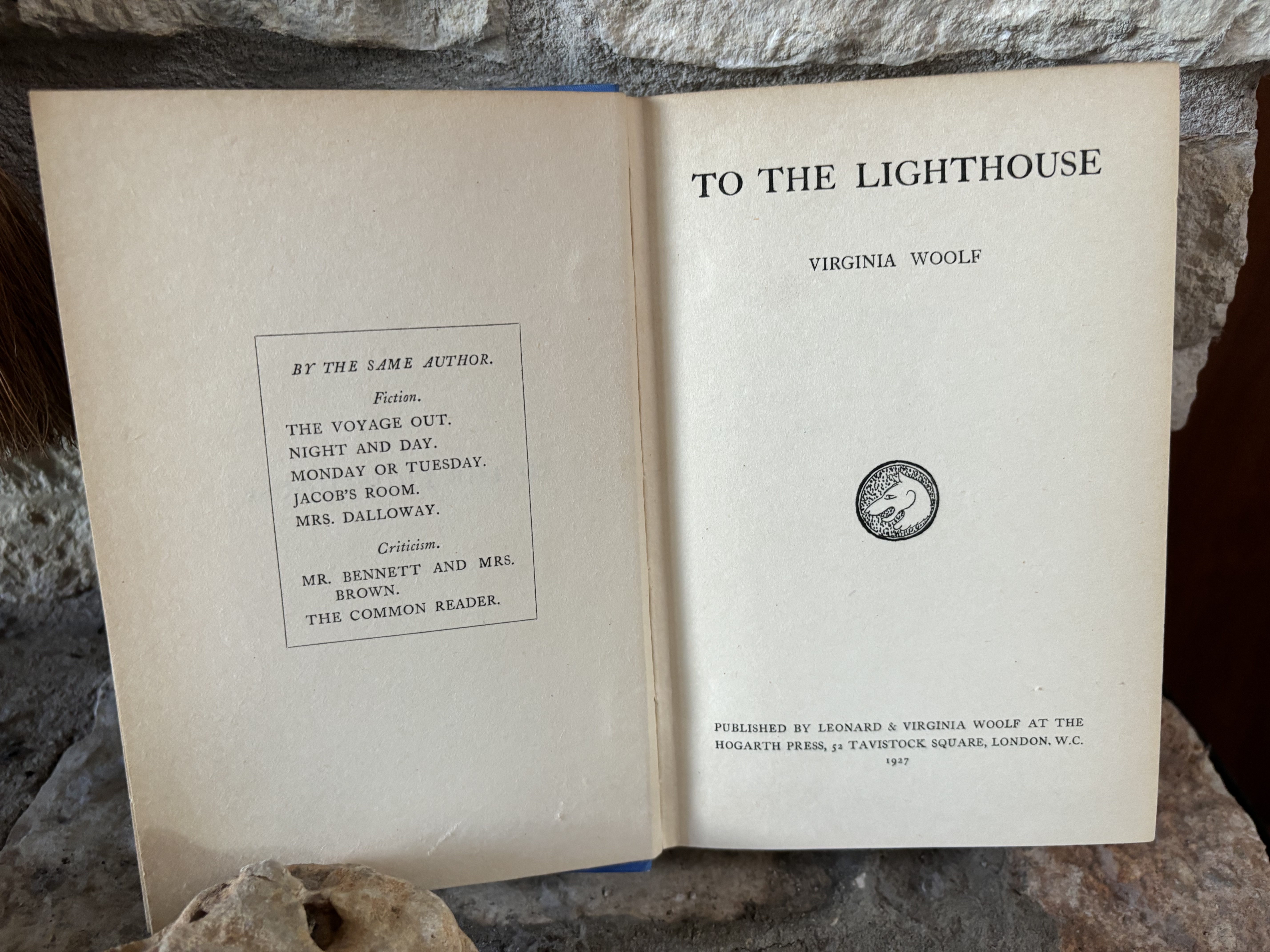
I, however, the English major, the mystery writer? I who should have read All The Books? I confess a powerful secret vice: rereading my favorites, particularly Virginia Woolf. Every year, To the Lighthouse sneaks back into my hand. Why? Why not concentrate only on the new novels, the best-sellers?

Because I have to reread that moment in Part III when, years later, after world war and illness have claimed her beloved friend Mrs. Ramsay and so many of the Ramsay family, the spinster Lily Briscoe returns to the Ramsays’ summer home on the Isle of Skye. https://bit.ly/3zHF77w

Out on the lawn, facing the old white house, she sets up again the unfinished oil painting she began all those years earlier—the painting that had posed such a challenge in Part I as her mind reverberated with the repeated mantra from Professor Ramsay’s obnoxious male philosophy student: “Women can’t paint, can’t write.” During the long day, full of changing light on the sea, and repeated interruptions by other characters, Woolf returns us over and over to Lily, staring at her painting, seeing again the remembered shapes of Mrs. Ramsay and her son James all those years ago. And her artistic effort? Here’s the end of the book:

“It would be hung in the attics, she thought; it would be destroyed. But what did that matter? She asked herself, taking up her brush again. She looked at the steps; they were empty; she looked at her canvas; it was blurred. With a sudden intensity, as if she saw it clear for a second, she drew a line there, in the centre. It was done; it was finished. Yes, she thought, laying down her brush in extreme fatigue, I have had my vision.”

Why do I return to that? So much of the book is touching, gripping, and even hilarious, including the thoughts of Professor Ramsay, a philosophy professor who’s both overbearing and insecure. He delights in his own “splendid mind”: “For if thought is like the keyboard of a piano divided into so many notes, or like the alphabet is ranged in twenty-six letters all in order, then his splendid mind had no difficulty in running over those letters one by one, firmly and accurately, until it had reached, say, the letter Q.  …Very few people in the whole of England ever reach Q.” Then he falters. “But after Q? What comes next? After Q there are a number of letters the last of which is scarcely visible to mortal eyes, but glimmers red in the distance.”  He braces himself, clenches himself. “Q he was sure of. Q he could demonstrate. If Q then is Q—R—” Then “he heard people saying—he was a failure—that R was beyond him. He would never reach R.”  

What an image—the alphabet, R glimmering red in the distance, then fading, fading!  And then of course there’s the famous dinner party featuring Mrs. Ramsay’s boeuf en daube. Surely, just reading this, you smell the simmered sauce, the wine, the bay leaf? The thought crossed my mind that if Professor Ramsay had been offered a sip of the Talisker malt whiskey for which Skye is famous, he’d have felt a bit better. https://www.malts.com/en/talisker (The distillery gives a great tour, too.)

But Lily’s painting? This spinster friend of Mrs. Ramsay, with her amateur brushstrokes? The tale of Lily’s painting, her decision and indecision as she holds her brush, grabbed me all those years ago, and refuses to let go. The same question must hit every musician—“Is this the last note? Did that chord resolve properly? Does it make you feel beauty and longing, or does it just hang there, unfinished?”  Every cook: “A pinch of salt? What about some coriander? To garlic or not to garlic?” Every filmmaker: “Do they walk into the sunset? Or fade out? Or kiss?” And every writer? “Is this character real? Is this setting compelling? Does the plot work? And will anyone care?”

Lily’s painting embodies desire to capture memory, resistance, light and color, and more than that. Isn’t it  her experience? A moment of creation, of recapture, of making a line on a canvas and then feeling completion?  She’s had her vision. If you know of another book where we readers feel such a moment of revelation from the frustrating process of creation—let me know.

Oh, don’t get me wrong. My Kindle received today the brand-new Martin Walker (A Grave in the Woods) and I can’t wait. bit.ly/3Xzqawt Like the other women in his (busy) life,  I love to accompany Inspector Bruno, in his fictional Perigord village of St. Denis, partly because of his cooking. Thank you, Martin Walker, for describing the ham hanging from the kitchen ceiling, the cheerful chickens, and the paté with its duck fat on top, waiting in Bruno’s fridge, and the way Bruno sings La Marseillaise to count how long until he must sizzle the foie de gras before he deglazes the pan. I look forward to new recipes and to finding out who’s buried in the woods.

And a sad farewell: I’ve decided to forgive Elly Griffiths for saying goodbye to Ruth Galloway in her last book in that series, The Last Remains, even though I have loved watching Ruth clamber down into a trench to dig up ancient bones in East Anglia. amzn.to/3ZxU5rv I’ve also savored every page of Alan Bradley’s latest (last?) Flavia de Luce – What Time the Sexton’s Spade Doth Rust – as he allows this delightful protagonist to feel herself beginning to grow up—not too much, not too fast, just enough. https://bit.ly/4dla13A 

And I did just finish We Solve Murders, Richard Osman’s first book in a new series. bit.ly/4ezjIwh  Have to confess I found myself missing Joyce, Ibrahim, Ron, Elizabeth and the other characters of his Thursday Murder Club books. My strong belief is I must careabout a mystery protagonist and so far I haven’t completely bought in to his new cadre–though I do like Steve. We’ll see.  I’d be interested in your reactions.

So that’s four new mysteries, just in September. I’m also rereading Virginia Woolf’s The Waves, and finding even more, yes, even more to love about how she brings those characters to vivid life, and how she describes the way we humans think and react to each other.

And out here with the three burros I’m writing the tenth in my Coffee Creek series featuring Alice MacDonald Greer and the gorgeous landscape of the Texas Hill Country, with its pristine (well, so far) bluegreen streams. Water’s for fighting over, right?

But when the going gets tough, you may find me sidling back to the revolving bookcase, on the shelf where Virginia Woolf and all the old faves hang out.

Helen Currie Foster lives and writes north of Dripping Springs, Texas, loosely supervised by three burros. She’s drawn to the compelling landscape and quirky characters of the Texas Hill Country. She’s also deeply curious about our human history and how, uninvited, the past keeps crashing the party. Latest in her award-winning series: Ghost Bones.

Follow her on http://www.facebook.com/helencurriefoster/ and http://www.helencurriefoster.com

Share this:

“Everybody Eats Mushrooms.” Some Live to Tell the Tale.

By M. K. Waller

Today’s post comprises two parts–a bit of fiction followed by a bit of fact–linked by a “fleshy, spore-bearing fruiting body of a fungus” and a mystery writer who used it as a murder weapon–and later confessed to something even worse.

I.

The following flash fiction was inspired by a photo prompt on Friday Fictioneers, a weekly writing challenge sponsored by Rochelle Wisoff-Fields.

‘SHROOMS

John ambled into the kitchen. “What’s cooking?”

“Mushroom gravy.” Mary kept stirring.

John frowned. “Toadstools. Fungi. Dorothy Sayers killed someone with Amanita.

“These are morels.” She added salt. “Everybody eats mushrooms.”

“I don’t.”

“Suit yourself.”

He sat down. “Where’d you buy them?”

“I picked them.”

You?

“Aunt Helen helped. She knows ‘shrooms.” Mary held out a spoonful. “Taste.”

“Well . . . ” John tasted. “Mmmm. Seconds?”

“Yoo-hoo.” Aunt Helen bustled in. “See my brand new glasses? Those old ones–yesterday I couldn’t see doodly squat.”

Mary looked at the gravy, then at John. “Maybe you should spit that out.”

II.

The following is a guest post I wrote for Manning Wolfe’s Bullet Books Speed Reads blog. In it, I explain what an author does when she doesn’t have a clue about the subject she’s writing about.

There are many rules for writers. Two of the major ones: Write what you know and Write what you love.

I was pleased that Stabbed, which I co-wrote with Manning Wolfe, was set in Vermont. I love vacationing there: mountains and trees, summer wildflowers and narrow, winding roads, rainstorms and starry nights, white frame churches and village greens.

In Chapter 1, Dr. Blair Cassidy, professor of English, arrives home one dark and stormy night, walks onto her front porch, and trips over the body of her boss, Dr. Justin Capaldi. She locks herself in her car and calls the sheriff. The sheriff arrives and . . .

What happens next? Vermont is a small state. Who takes charge of murder investigations? The sheriff? Or the state police? What do their uniforms look like? Where do major rail lines run? What’s the size of a typical university town? And a typical university? What else had I not noticed while driving through the mountains?

Not knowing the answers, I defaulted to a third rule: Write what you learn. Research. Research. Research. The best mystery authors have been avid researchers.

Agatha Christie, for example, is known for her extensive knowledge of poisons. As a pharmacy technician during World War I, she did most of her research on the job before she became a novelist. Later she dispatched victims with arsenic, strychnine, cyanide, digitalis, belladonna, morphine, phosphorus, veronal (sleeping pills), hemlock, and ricin (never before used in a murder mystery). In The Pale Horse, she used the less commonly known thallium. Christie’s accurate treatment of strychnine was mentioned in a review in the Pharmaceutical Journal.

Francis Iles’ use of a bacterium was integral to the plot in Malice Aforethought. His character, Dr. Bickleigh, serves guests sandwiches of meat paste laced with Clostridium botulinum and waits for them to develop botulism. If Dr. Bickleigh had known as much about poisons as his creator did, he wouldn’t have been so surprised when his best-laid plans went, as Robert Burns might have said, agley.

Among modern authors, P.D. James is known for accuracy. Colleague Ruth Rendell said that James “always took enormous pains to be accurate and research her work with the greatest attention.” Before setting Devices and Desires near a nuclear power station, she visited power plants in England; she even wore a protective suit to stand over a nuclear reactor. Like Christie, James used information acquired on the job—she wrote her early works during her nineteen years with the National Health Service—for mysteries set in hospitals.

Most authors don’t go as far as to stand over nuclear reactors to be sure they get it right, but even the simplest research can be time-consuming.

And no matter how hard they strive for accuracy, even the most meticulous researchers sometimes make errors.

Dorothy L. Sayers was as careful in her fiction as she was in her scholarly writing. But she confessed in a magazine article that The Documents in the Case contained a “first-class howler”: A character dies from eating the mushroom Amanita muscaria, which contains the toxin muscarine. Describing the chemical properties of muscarine, Sayers said it can twist a ray of polarized light. But only the synthetic form can do that—the poison contained in the mushroom can’t.

Considering Sayers’ body of work, this one “howler” seems a very small sin, and quite forgivable.

Most readers, however, don’t forgive big mistakes, and reputable writers don’t expect them to. Thorough research is a mark of respect for readers.

Sometimes, getting the facts straight in fiction has real-life consequences the author can’t predict. Christie’s The Pale Horse is credited with saving two lives: In one case, a reader recognized the symptoms of thallium poisoning Christie had described and saved a woman whose husband was slowly poisoning her; in a second, a nurse who’d read the book diagnosed thallium poisoning in an infant. The novel is also credited with the apprehension of one would-be poisoner.

Back to Stabbed—Well, we don’t expect it to save lives or help catch criminals. But doing my due diligence and reading up on Vermont’s railways, demographics, and criminal procedure set the novella on a sound factual footing.

Unlike Christie, Iles, and Sayers, however, I didn’t have to expend too much effort learning about how the murder weapon worked. One look at the book’s title and–well, d’oh–no research needed.

***

Learn more about Friday Fictioneers at Rochelle Wisoff-Fields’ blog and on their Facebook page.

***

M. K. Waller (Kathy) is a former teacher, former librarian, former paralegal, and former pianist at various small churches desperate for someone who could find middle C.

She writes crime fiction, literary fiction, humor, memoir, and whatever else comes to mind.

She grew up in Fentress,  population ~ 150 in 1960, on the San Marcos River in Central Texas, the Blackland Prairie, and memories of the time and the place inform much of her fiction.

Except for the part about murders. Fentress didn’t have any murders. At least any that people talked about.

She now lives in Austin.

A Little Burro Therapy

By Helen Currie Foster

The three burros who live with Alice MacDonald Greer, lawyer/amateur sleuth protagonist of my Texas Hill Country legal thrillers, bear a strong resemblance to the three burros who rule our patch of the Hill Country.

We manage our small piece of the planet for native grasses and birds under the county Wildlife Management Program. Today I received our spring box of blue grama and buffalo grass seed, for re-seeding bare patches with native grass. (More below on bare patches.)

The burro idea sprang full-blown into life at a wedding on the banks of the Blanco River years ago, when we were enchanted to see docile and well-behaved burros with panniers on their backs full of cold bottles of water and beer, being led to the guests by docile and well-behaved teenagers. Immediately I envisioned myself trekking up and down our fields leading a burro bearing panniers of grass seed which can be (believe it or not) heavy. As a bonus we knew the burros could help keep down tall dry grass–a concern during fire season.

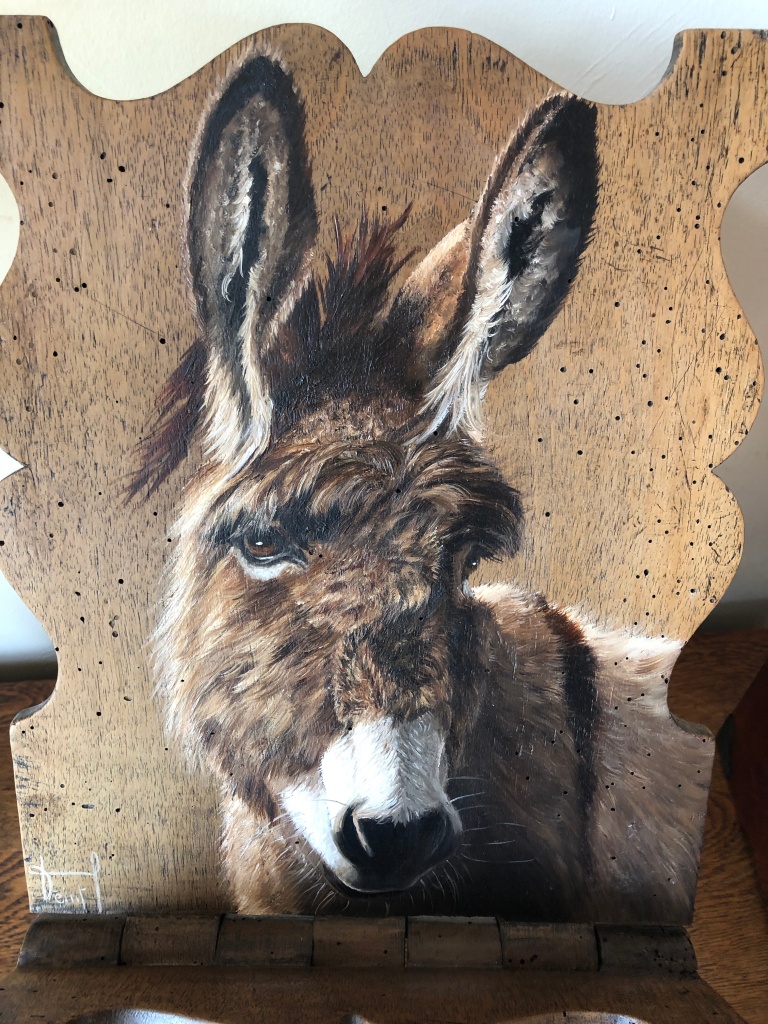
The Platonic Ideal? Belle, a lovely donkey painted by Helene Feint. 

So just before Christmas we bought two smallish burros from the wedding venue, with certificates attesting to their conformation, heritage, and names (Amanda and Caroline, mother and daughter). Both were elegant, with classically lovely faces, straight legs, and dainty hooves.

This is the youngest, Caroline.

Per Random House Unabridged, “burro” is “a small donkey, especially one used as a pack animal in the Southwestern U.S.” (We use donkey interchangeably.) Let me say for the record that the “pack animal” concept went nowhere with Amanda and Caroline–they were deeply insulted at the idea of any burden on their backs. They made it crystal clear that they had not signed on to work. Still–they were decorative, and they ate down the grass.

Sebastian (left) and Amanda

But on Christmas morning when we looked across the pasture, my spouse asked, his voice disturbed: “How many donkeys do you see?” …Three.

The newcomer was shorter, pudgier, and male–well, an “altered” boy. Knock-kneed, chipmunk-cheeked, he seemed to keep a chewable cud in each cheek. He’d climbed through a fence to visit. We found his owner and bought him. Given his appearance (and the snootiness of Amanda and Caroline) we gave him a new and more dignified name: Sebastian.

While Amanda and Caroline are ladies of leisure, Sebastian has taken on two jobs. First, he’s our designated greeter. He brays a loud greeting as you drive through the gate. He brays again to salute the dawn (or pre-dawn).

Second, Sebastian has declared himself the official guard-donkey. In particular, he’s hell on canines. Pre-donkeys there were cows on the property–and coyotes. But no coyote dares invade Sebastian’s turf. He’d be happy to kick a coyote into the next county. Donkeys are shockingly fast on their feet and could easily catch a coyote. Earlier this year I found Sebastian standing triumphant and motionless in the middle of the dirt road, ears back, head up, posture stubborn, hooves planted–a picture of victory. Visible in the dirt? Tracks of a mama coyote with one pup, who’d erroneously strayed into forbidden territory. The tracks indicated a frantic exit. As he stood in the road, surveying his domaine, Sebastian was announcing, “I’m walkin’ here.”

Random House Unabridged includes a definition of “donkey” as “a stupid, silly or obstinate person.” Donkeys are not stupid. They are curious, persistent, intelligent, and acute of hearing. Are they silly? Well…Amanda and Caroline are aloof and standoffish, but Sebastian wants to play. With a bucket between his teeth, he’ll run over and whop Amanda on the hindquarters with it, then stand there. He so wants her to join in his favorite game, which is apparently called “I’ve got the bucket, now you come bite the bucket and yank it away, then you can hit me with it, then I will chase you, and then…?!?!?” So far, the girls steadfastly refuse to cooperate. When whopped with the bucket, Amanda chooses to bite Sebastian instead of biting the bucket. Maybe that’s a different game?

Obstinate? Oh, yes. They are persistent in searching for ways to get past the gate into the yard and eat the roses. They’re also very hard to stop when they want to go somewhere, and very hard to move when they intend to stay put.

Re-seeding bare patches? These three donkeys pick a spot, then take turns rolling on their backs until the grass gives up and a circular bare spot remains. Then, after rain, they race to the soggy bare spot and roll on their backs until they’re thoroughly muddy. Hence my constant race to re-seed bare patches.

Donkeys model companionship. Indeed, they need it. Despite their occasional spats, Sebastian, Amanda and Caroline spend their days and nights together, never more than about 100 feet apart.

Writers have to take breaks, or go nuts. I’m in that boat right now, because I’m almost but not quite finished with Book 9 in the Alice MacDonald Greer Mystery series. As is well known, writers in such circumstances can be subject to breakdowns–small rages, or tears, or snappishness, or overdosing on Cheezits.

I can recommend burro therapy. As I stand next to Sebastian, stroking his neck, and he leans back against me, I feel my heartrate slow and my breathing relax. Maybe that’s how burros feel too? Maybe this is their secret advantage, a resource that helps explain their long presence on the planet? Here’s how Alice puts it in Ghost Cat:

“Donkey hugs meant leaning into their sides, stroking their necks. The donkeys instantly settled, leaning back against her. The weird thing, Alice thought, was how the donkeys settled her. They weren’t dogs, loyal and needy, or cats, neutral and non-needy. Donkeys were ancient residents of the planet, tough, independent, curious herd animals with their own inner life.”

And in Ghosted“Finding herself needing a little burro therapy, …Alice stood in her driveway surrounded by the three. At the moment she was brushing Big Boy. He leaned against her; the warmth felt good in the late morning chill. Those eyelashes, those soft ears, Alice thought. No wonder Titania fell in love with Bottom.” 

Indeed, Queen Titania, seeing Bottom with his head magically changed to an ass’s head, says,

“I pray thee, gentle mortal, sing again.

Mine ear is much enamour’d of thy note;

So is mine eye enthralled to thy shape;

And thy fair virtue’s force perforce doth move me

On the first view to say, to sweat, I love thee.”

A Midsummer Night’s Dream, Act III, Scene II.

So if you’re in need of burro therapy, fellow writers, come on out. Bring some carrots!

***

Copyright 2024, Helen Currie Foster, All rights reserved.

***

Author: Helen Currie Foster

I live north of Dripping Springs, Texas, loosely supervised by three burros. I’m deeply curious, more every day, about human history and prehistory and how, uninvited, the past keeps crashing the party. I’ve loved the Texas Hill Country since my first sight of it as a teenager. Artesian springs, Cretaceous fossils, rocky landscapes hiding bluegreen water in the valleys. After law school (where I grew fascinated with water and dirt) I practiced environmental law and regulatory litigation for thirty years––then the character Alice suddenly appeared in my life. I’m active with Austin Shakespeare and Heart of Texas Sisters in Crime. And I’m grateful to the readers who enjoy the Alice MacDonald Greer Mystery series! 

Helen Currie Foster, January 15, 2024

“But at my back I always hear time’s wingèd chariot drawing near…” (Andrew Marvell, 1621-1678)  

Today in pre-dawn darkness, the house quiet except for the murmuring furnace, my characters were already at me, barking orders: “More! More smells, tastes, experiences! More about me! Tell people what I’m thinking, what I’m experiencing, what I’m worrying about!”

They’re right. Readers want to know their favorite mystery protagonists. Why? Because readers are in league with them, walking in their shoes. Readers know that stepping into a protagonist’s sensory experience—smells, food, experiences, relationships—will springboard them into the setting, help them to be in the picture, ready to seize on every clue.

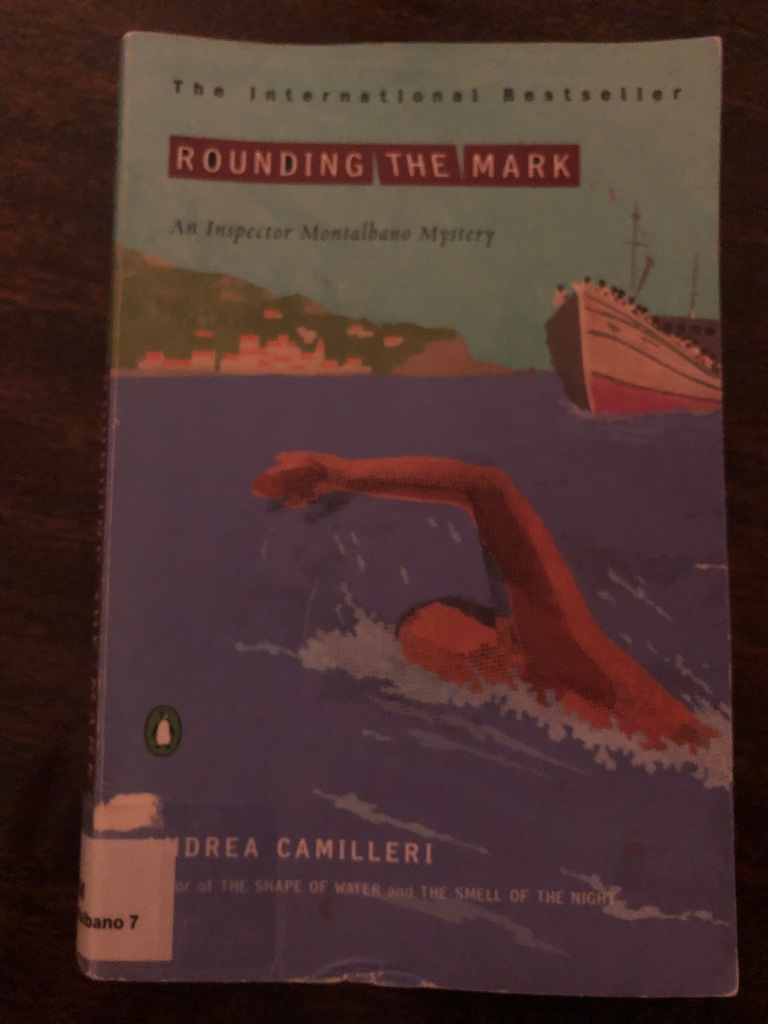
Resolution 1. Tastes! Flavors! Food! As Rounding the Mark, Book 7 of Andrea Camilleri’s long-running series, begins, Inspector Montalbano of little Vigáta, Sicily, can’t sleep:

“Stinking, treacherous night. Thrashing and turning, twisting and drifting off one minute, jolting awake and then lying back down—and it wasn’t from having scarfed down too much octopus a strascinasali or sardines a beccafino the evening before. No, he didn’t even have that satisfaction.”

Fortunately the recipes are described in the Notes at the book’s end. In Sicily, where seafood reigns supreme, Montalbano refers to small octopi, boiled and dressed in olive oil and lemon juice, and then sardines, stuffed and rolled up with sauteed breadcrumbs, pine nuts, sultana raisins, and anchovies. When Montalbano returns home from the police station he always races to his refrigerator to see what his housekeeper, Adelina, has left for him. In Book 16, Treasure Hunt, Montalbano “howled like a wolf with joy” when he finds “eggplant parmesan, done up just right, enough for four.”

Can’t you just smell this dish? Montalbano consumes the entire panful: “the sauce was a wonder to taste.” (50). We see how he delights in his food, how very particular he is. (And throughout the series Adelina keeps cooking – pasta in squid ink, involtini of small fish, pasta ‘Ncasciata…https://www.foodandwine.com/pasta-ncasciata-sicilian-baked-pasta-7093847

Here’s Montalbano in Rounding the Mark after discovering a new restaurant:

“The antipasto of salted octopus tasted as though it were made of condensed sea and melted the moment it entered his mouth…And the mixed grill of mullet, sea bass and gilthead had that heavenly taste the inspector feared he had lost forever….After a long and perilous journey of the sea, Odysseus had finally found his long lost Ithaca. “(73)

Camilleri (died 2019) was writing mystery, murder, crime—but he included as major players in the setting Sicilian food, awareness of this ancient Mediterranean island culture, and echoes of classic myth.

We can only imagine Montalbano shaking his head at the food situation of private detective Cormoran Strike, protagonist of The Running Grave, seventh in the series by “Robert Galbraith” (aka J.K. Rowling). To protect his knee, Strike, a military police veteran who lost his lower leg in Afghanistan, must lose weight; he’s now lost “three stone” or about 42 pounds. “Usually he’d have grabbed a takeaway on the way home” but now, “without much enthusiasm,” he’s fixing broccoli and salmon in the tiny flat above his seedy London office.

Does the author need to describe these flavors? Aren’t “broccoli” and “salmon” redolent enough by themselves, especially broccoli? Later, as the plot roars into action, Strike’s off his diet, overcome by “the lure of sweet and sour chicken and fried rice” (767) and demanding that his partner Robin Ellacott stop at a 24-hour McDonald’s on London’s Strand (848) where, as they walk to the office, he’s eating “large mouthfuls of burger” and starting on two bags of fries. He’s back to his usual food habits––pub food, fast food––yet his mind’s on the recent attack, “as though he’d only just felt the heat of the bullet searing his cheek.” At chapter’s end, as they discuss the case, “Strike ate a solitary cold chip lingering at the bottom of a greasy bag.” There’s an urgency to his desperate hunger, to the need for enough energy to stick with an exhausting case—and don’t we all know about that solitary cold french fry in the bottom of the bag? Can’t you see him fishing it out? For Strike, food fills a need, but he’s not immersed in the culinary experience. He’s focused on his case.

What keeps Strike working as a private investigator? Challenge, curiosity, tenacity, terror—but not great cuisine. Food-wise, Montalbano’s habits differ sharply from Strike’s. But for each man, eating habits vividly highlight both personal life and setting.

Resolution 2: Human Scent! Other scents matter to both Strike and Montalbano. In the first chapter of The Ink Black Heart, Cormoran Strike has tried to find a perfect perfume for Robin’s 30th birthday. When she sprays on the new perfume, “he…detected roses and an undertone of musk, which made him think of sun-warmed skin.”

Similarly, in Treasure Hunt, when Montalbano and his compadre, the daring Ingrid, are outside on his veranda, “The night now smelled of brine, mint, whisky, and apricot, which was exactly what Ingrid’s skin smelled like. It was a blend not even a prize parfumeur could have invented.” (175)

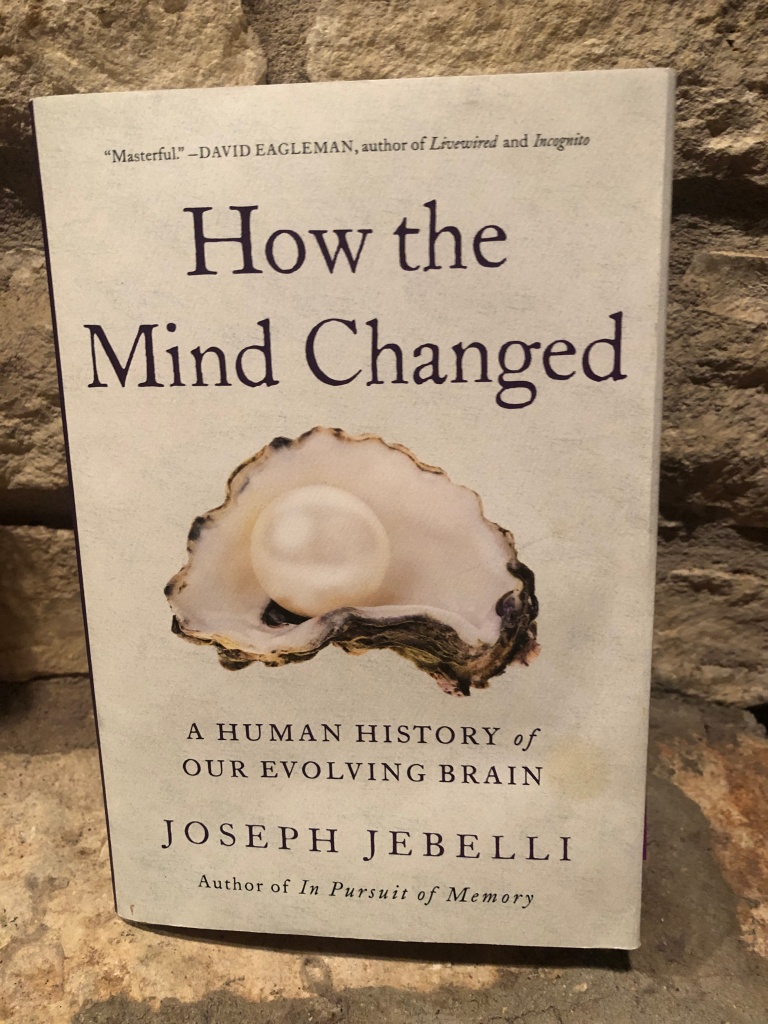
Reportedly one writing instructor has suggested that authors “include smell on every page.” These two mystery writers don’t obey that injunction (do you know any who do?). But why is scent so critical for us? Apparently the amygdala (a paired structure, with one in each temporal lobe) “developed from our most primitive sense—the sense of smell.” Joseph Jebelli, How the Mind Changed (Little, Brown, Spark, 2022, at 30). It’s near the olfactory nerve which is why scents connect strongly to emotions and memories. https://my.clevelandclinic.org/health/body/24894-amygdala

What scents spark your own memories? If a book mentions honeysuckle on a summer day, I might remember my grandparents’ front porch in Itasca, Texas, and how we learned as kids to suck nectar from a honeysuckle blossom. What pops up for you when a book mentions lavender? Or clean sheets? Baby powder? Or iodine, rubbing alcohol, band-aids? Marshmallows toasting on a stick? Pine straw underfoot? The first ocean breeze when you hit the beach? Does a book feel richer to you when your own memories are awakened?

What about the scent of January? Today’s the coldest day of 2024 so far, here in the Hill Country. Inside – hot tea: mint, chamomile, green, or  maybe ginger slices, with honey and lemon. Outside, cedar burning in a neighbor’s brush pile.

Resolution 3: Character’s thoughts (and feelings)! In Treasure Hunt Camilleri includes a hilarious italicized interchange between Montalbano (called “Montalbano One”) and “Montalbano Two” where Montalbano Two criticizes Montalbano One’s case-handling as showing signs of deterioration, of “losing his cool,” highlighting Montalbano’s own concerns about aging. (18-19)

Camilleri also uses other techniques to put us in Montalbano’s head. Here’s one from Rounding the Mark, where, again, Montalbano’s worrying about getting older:

“As he was shaving, the scenes of the previous evening on the wharf ran through his head again. Little by little, as he reviewed them with a cold eye, he began to feel uneasy…. There was something that didn’t jibe….He stubbornly played the scenes over in his head, trying to bring them more into focus. No dice. He lost heart. This was surely a sign of aging. He used to be able to find the flaw, the jarring note…without fail.” (61)

Camilleri lets his character feel. When a small boy is kidnapped from north Africa by sex traffickers and escapes on the pier in Sicily, Montalbano  returns him to his “mother,” not understanding she isn’t his “mother” at all. When the little boy is killed Montalbano visits the morgue:

“He lifted the sheet with one hand…and froze. A chill ran down his spine. It all came back to him at once: the look the little boy had given him as his mother ran up to take him back….he hadn’t understood that look. Now…he did. The little eyes were imploring him. They were telling him for pity’s sake, let me go, let me escape. And now…he felt bitterly guilty…He was slipping. It was hard to admit, but true… “(84)

In contrast, Cormoran Strike is more inscrutable, more unwilling to reveal his emotions, perhaps even to himself. Galbraith describes Strike as a “mentally resilient man” who tries but sometimes fails to control emotion. One of his tools “was a habit of compartmentalization that rarely failed him, but right now, it wasn’t working. Emotions he didn’t want…and memories he generally suppressed were closing in on him…” As a consequence he was “brooding so deeply that he barely registered the passing Tube stations and realized, almost too late, that he was already” at his stop. (105) In one scene after visiting his sister Strike starts home feeling very angry at his dead mother, who died of an overdose when he was nineteen. Galbraith then uses italics for Strike’s mental attack on her: “If you hadn’t been what you were, maybe I wouldn’t be what I am. Maybe I’m reaping what you sowed, so don’t you f*king laugh at the army, or me, you with your paedophile mates and the squatters and the junkies…” (106) These passages show the reader Strike’s painful upbringing and may partially explain his need (and ability) to compartmentalize—both, ironically, key to his later success.

Strike drinks, smokes, has sex, but almost in the same way as he gulps down fast food. Food seems temporarily satisfying, but not a life pleasure. Early on we become aware that the strongest sensation Strike is described as experiencing is the pain of his stump, and the relief he experiences when he removes his prosthetic. In his compartmentalization of his emotions, has he replicated this binary condition? (No spoilers here!)

Resolution Four: The Weather! Camilleri and Galbraith’s characters don’t always focus on weather, but here in the Texas Hill Country we must take notice. It’s too cold (like today), too hot (pretty soon), too wet (spring rain bombs and dangerous low-water crossings), or too dry (like last summer’s dreadful drought). Blessings on March, which will bring bluebonnets and the ethereal prairie celestial, then wine cups, with the pink of redbud and Mexican buckeye to rejoice the eye. But weather’s definitely a factor in upcoming Book 9 of the Alice MacDonald Greer Mystery series. Watch for it—coming soon!

My Dirty Little Secret

by K.P. Gresham

Up to now, I’ve avoided a particular phrase in describing my Pastor Matt Hayden Mystery Series. And the secret is…I write Christ-centered mysteries.

To me, this term is more accurate in describing my books than calling it Christian fiction. Of course, it is Christian fiction. However, a lot of folks who read Christian fiction expect there will be no swear words, no blood on the page, nothing that would be considered “controversial.”

In my Christ-centered mysteries, I like to acknowledge the real world, just as Christ lived in the real world during His time on earth. He ate with taxpayers, drank wine (heavens, His first miracle was to create some awesome wine for a wedding banquet at His mother’s request), hung out with tax collectors and bad guys. Although He was incredibly within His rights to judge others, He did not. Instead, He loved them.

My character, Pastor Matt Hayden, has existed in the real world. He came from a police family. His father was a police captain, his brother was an officer on the bomb squad, and Matt was an undercover cop on the Miami docks. Then a corrupt police chief killed both his father and brother as they had been getting too close to outing the chief’s crimes. Finally, the chief came after Matt. A confrontation ensued, and Matt had the opportunity to kill the chief. God stayed his hand. And Matt was called to become a pastor, which he did when he entered the Federal Witness Protection Program.

Matt becomes a pastor who is very familiar, maybe too familiar, with the real world. He knows, as Jesus knew, people who were crooks, prostitutes, alcoholics–you get the gist. And Matt does not condemn them. He holds them to account, of course. But his main goal is to love them.

So, in my books, you’re going to hear swear words, ‘cuz bad guys swear. And Matt’s girlfriend owns a bar. And bad stuff happens to good people, and good people sometimes slip up and do bad things.

That’s life. 

I have to acknowledge this reality, because I saw folks lie to my dad a lot. My dad was an incredible Lutheran minister. The messages from his pulpit were all about love. But what I saw, that dad didn’t always see, was the “act” some folks were pulling on him. Whenever we’d go to a parishioners home, the family Bible was always on display, the best china was on the table, everyone was dressed nicely, and we all said grace before and gave thanks after a delicious meal. But I knew that some people weren’t always so crystal clean. Not everyone, by a long shot. I love the people of those churches. Good, loving people. But there were a few that had issues. One of my dad’s “good” friends was a regular at a questionable bar in town with a woman on his lap who wasn’t his wife. Dad never knew this; I didn’t want to break his heart. This type of thing happened from time to time.  Sometimes dad’s world wasn’t real.

Jesus, on the other hand, couldn’t be hoodwinked. And I wanted Matt to come into his ministry with his eyes wide-open. And I want my books to show Matt’s faith and desire to love in a real-world setting.

So, if you go to the link above to get my books, you will see that this is the first time I’m saying my books are Christ-centered mysteries. And when you get there, you will see the name of this promotion is…

November Edgy Christian Fiction.

So, I guess I’m living on the Edge. But now you know my secret.

K.P. Gresham, Author

Professional Character Assassin

K.P. Gresham is the award-winning author of the Pastor Matt Hayden Mystery Series as well as several stand-alone novels.  Active in Sisters in Crime and the Writers League of Texas, she has won Best Novel awards from the Bay Area Writers League as well as the Mystery Writers of America.

Click here to receive K.P.’s newsletter and a get a free short story!

Website: http://www.kpgresham.com/

Email: kp@kpgresham.com

Blogs: https://inkstainedwretches.home.blog/

https://austinmysterywriters.com/

Facebook: https://www.facebook.com/kpgresham

Books by

K.P. Gresham

Three Days at Wrigley Field

The Pastor Matt Hayden Mystery Series

The Preacher’s First Murder

Murder in the Second Pew

Murder on the Third Try

Four Reasons to Die

Tell Me a Story!

By Helen Currie Foster

In My Reading Life, a grand book about reading and writing, author Pat Conroy says, “The most powerful words in English are ‘tell me a story…’” bit.ly/3PpSoHF

Yes! And don’t we know stories demand––require––insist on characters? Fairy tales––Jack in the Beanstalk, Hansel and Gretel. Epics––The Fellowship of the Ring, Star Wars. 

I love the beginning of Emily Wilson’s recent translation of The Odysseybit.ly/43Bdjvi

Tell me about a complicated man,

Muse, tell me how he wandered and was lost

When he had wrecked the holy town of Troy…

…Now, goddess, child of Zeus,

Tell the old story for our modern times.

Find the beginning.

So, how do writers create memorable characters? What works to create character? And why do we care? Isn’t it because character drives narrative?

Recall Shakespeare’s famous terse description in Julius Caesar: “Yon Cassius hath a lean and hungry look…” Those ambiguous words reach beyond the man’s shape or facial expression to hint at driving ambition…the very subject which drives the play’s narrative.

Or take Pride and Prejudice, published in 1813, and still one of the most loved novels in the English language. https://www.independent.co.uk/arts-entertainment/books/features/austen-power-200-years-of-pride-and-prejudice-8454448.html

How does Jane Austen create character? Looking back, I am surprised by the lack of physical description. She doesn’t tell us what Mr. or Mrs. Bennet, or the five daughters, look like. We’re given a few visual breadcrumbs, told that Bingley and Darcy are “handsome” and that Bingley “wore a blue coat and rode a black horse.” But her characters, with their personalities, their actions, largely come to life in our minds otherwise: by conversation.

Elizabeth overhears Mr. Darcy describing her as “tolerable but not handsome enough to tempt me”—a criticism she later recounts to friends, “for she had a lively, playful disposition.” Okay, there’s one aspect of Elizabeth—lively and playful. Yet after telling friends that Elizabeth “had hardly a good feature in her face,” Darcy “began to find it was rendered uncommonly intelligent by the beautiful expression of her dark eyes.” So she’s also intelligent! Elizabeth tells her sister Jane, “you are a great deal too apt…to like people in general. You never see a fault in any body.” Elizabeth is not just “playful” and “intelligent,” but a critical observer.

Using dialogue––what Elizabeth and Darcy say––Austen shows us how Elizabethand ultimately Darcy––think. In a world focused on superficiality—class, wealth, appearance, social skills and niceties––Austen makes us care about two characters who are too smart, too critical, too thoughtful, not to keep thinking and––ultimately––change their minds. Their characteristics (both pride and prejudice!) drive the narrative.

But hey, what about those dark eyes? Mr. Darcy disturbs the haughty Miss Bingley by saying he’s meditating on “the very great pleasure which a pair of fine eyes in the face of a pretty woman can bestow.” As all Austen readers know, that specific detail––“[A] pair of fine eyes”––will also powerfully move the plot.

Texas’s Larry McMurtry shows us how conflict between characters drives narrative. In his Lonesome Dove, the first character we meet is Augustus, sitting on the porch at the Hat Creek Cattle Company, in “the smidgin of shade he had to work with.” He has retrieved his jug from the springhouse and, as is his custom, he’s drinking Tennessee mash whiskey, which makes him feel “feel nicely misty inside.”

We’re in Augustus’s point of view when we meet his counterpoint, the other key character, his stubborn partner Captain Woodrow Call. Augustus, when he hears the whir of a nervous rattler in the corner of the springhouse, believes “in giving creatures a little time to think.” He doesn’t shoot the snake; he waits until the rattler has “calmed down” and crawled out a hole. He contrasts his own behavior to Call’s:

Call had no respect whatsoever for snakes, or for anyone who stood aside for snakes. He treated rattlers like gnats, disposing of them with one stroke of whatever tool he had in hand. “A man that slows down for snakes might as well walk,” he often said.

As  Call and their diffident hand, PeaEye, arrive at the porch, Augustus notes that while he himself stands four inches taller than Call, and Pea Eye three inches taller, there’s no way to convince Pea Eye that Call is the short man: “Call had him buffaloed.” Augustus knows that if a man means to hold his own with Call, that man must keep in mind that Call isn’t as big as he seemed. Thus Augustus begins many a day by remarking, “You know, Call, you ain’t really no giant.”

McMurtry doesn’t give us a detailed physical description of Augustus or Call. Instead, we hear them banter. We see Call’s impact on others, and how Augustus works to maintain his own status vis à vis Call. Right off the bat McMurtry makes us feel the sheer force of two characters, two magnetic and conflicting personalities, and their relationship, as we’re launched into this epic tale. Their characters, the combined magnetism and conflict, drive us to Montana…and back…

We first meet Sir Arthur Conan Doyle’s character Sherlock Holmes in A Study in Scarlet, when Holmes is introduced to the narrator, Dr. Watson, as a potential roommate. Watson walks into the lab: “There was only one student in the room, who was bending over a distant table absorbed in his work. At the sound of our steps he glanced round and sprang to his feet with a cry of pleasure. ‘I’ve found it! I’ve found it,’ he shouted to my companion, running towards us with a  test-tube in his hand.” Then he shakes hands with Watson: “You have been in Afghanistan, I perceive.” Watson is astonished. bit.ly/3N0U4Ep

We get no actual physical description of Holmes until Chapter Two. Instead, we confront Holmes’s vigor, curiosity, perspicacity, confidence in his own powers. Similarly, in “A Scandal in Bohemia,” Watson first describes Holmes’s “immense faculties and extraordinary powers of observation” in deciphering clues. Then, looking up from the street, Watson sees the detective’s silhouette on the window-shade: “I saw his tall, spare figure pass twice…He was pacing the room swiftly, eagerly, with his head sunk upon his chest and his hands clasped behind him.” Watson instantly knows, “He was at work again.”

The author engraves that image of Holmes, pacing eagerly, on our imaginations. We can’t wait to see Holmes in action: that’s what we’re reading for.

Herman Melville deprives the reader as well as Ishmael, the narrator of Moby Dick, of even one glance at Captain Ahab until Chapter 28, when Ishmael is well out to sea on the whaling ship Pequod. Ahab finally appears on deck and stands erect, holding on by a shroud, his bone peg-leg planted in the auger hole drilled on deck for that purpose:

There was an infinity of firmest fortitude, a determinate, unsurrenderable wilfulness, in the fixed and fearless, forward dedication of that glance. Not a word he spoke; nor did his officers say aught to him; though…they plainly showed the uneasy, if not painful, consciousness of being under a troubled master eye…moody stricken Ahab stood before them with a crucifixion in his face; in all the nameless regal overbearing dignity of some mighty woe.

The word “character” comes from the Greek root for “engraving tool.” https://www.merriam-webster.com/dictionary/character If ever character was engraved on a person’s body, Melville’s description of Ahab and his impact on his shipmates qualifies. The uneasy silence of the officers! The crucifixion in Ahab’s face! His unsurrenderable wilfulness, fixed and fearless!

If that’s not enough foreshadowing, in Chapter 36, Ahab demands the entire crew to assemble and then hammers a gold piece to the mast for the first man who sees the white whale which took off Ahab’s leg—Moby Dick. Starbuck objects: he signed on to hunt whales, not to take vengeance on a mere animal, which he calls blasphemous. But Ahab makes the rest of the crew swear: “Death to Moby Dick!” Melville creates a character whose physical description conveys tragic history and deep emotion, and whose forceful actions persuade the crew to follow him. We know there’s no stopping Ahab now. And we haven’t yet met the whale.

Pat Conroy also tells us, in My Reading Life, of the day his beloved high school English teacher, Greg Norris, took sixteen-year old Conroy to visit the poet Archibald Rutledge. Rutledge “suggested that I make the close observation of nature part of my life’s work and that I learn the actual names of things,” because “specifics always proved fruitful to the validity of any narrative”:

“A Cherokee rose, not just a rose. A swallowtail butterfly, not just a butterfly. That kind of thing,” he said. “Get the details right. Always the details.”

https://en.wikipedia.org/wiki/Rosa_laevigata

Always a great reminder for mystery writers. My character Alice, in the Alice MacDonald Greer Mystery series––stays on me to get the details right. https://bit.ly/3qC2fzI

So–tell me a story! Show me the character! Get the details! And we’re off!

About Helen Currie Foster

I live north of Dripping Springs, Texas, supervised by three burros. I’m deeply curious, more every day, about human history and prehistory and how, uninvited, the past keeps crashing the party. I’ve loved the Texas Hill Country since my first sight of it as a teenager. Artesian springs, Cretaceous fossils, rocky landscapes hiding bluegreen water in the valleys. After law school (where I grew fascinated with water and dirt) I practiced environmental law and regulatory litigation for thirty years––then the character Alice suddenly appeared in my life. I’m active with Austin Shakespeare and Heart of Texas Sisters in Crime. And I’m grateful to the readers who enjoy the Alice MacDonald Greer Mystery series!

Why They’re Favorites…? On Rereading

BY HELEN CURRIE FOSTER

What’s your favorite place to read? A certain chair? The one with a lamp that shines on your book, not in your eyes? Perhaps a ferryboat seat, where you glance up at the horizon, then down at your book? On a plane, or train?

When I was young our house had an elm tree in the back yard which was not only climbable, but offered two branches that stuck out at the perfect angle for a lounging pre-adolescent. Even better—the lounger was invisible from the house. I could scramble up, arrange myself, open my book—and be left unfound, undisturbed, for some time.

A later joy was climbing on the New Haven RR in Boston after final exams (Chaucer, Shakespeare), armed with the latest James Bond and the very biggest Hershey bar with almonds, and being rocked south for miles along the coastline. Uninterrupted.

And I confess to rereading books. I further confess to rereading children’s books. Maybe a more accurate word is: revisiting. At least every two years, I pick up Kipling’s Kim, finding my way to the part where Kim guides his Tibetan lama, who seeks a sacred river, on a pilgrimage into the high deodar forests of the Himalayas. I can almost smell the trees. There Kim steals the Russian spies’ notes––his own initiation into the Great Game. Even more satisfying? The long afternoon where, exhausted, he is “taken apart” by Eastern massage and finally stumbles out, recovered, to find his lama at the brink of—well, no spoilers.

Why this gravitational pull of favorite children’s books?

Maybe because the best children’s books feature enterprise, surprise, disguise. And—most important––the discovery of identity.

Consider The Sword in the Stone, where Merlin transforms Wart into various animals (badger, owl, fish) who teach him survival techniques (“put your back into it!”). And magic! Giants! Griffins! The Queen of Air and Darkness! (See volume below–griffin looming behind tree.) One favorite moment? When Merlin transforms Wart to a raptor—a small merlin––who must sit for desperate minutes during his formal initiation, near the maddened and perilous Peregrine. Why does Wart need Merlin’s special tutelage? Because of his identity, which he and we will finally discover.

Others I still pull off the shelf: The Wind in the Willows, especially Mole’s tearful return home, where he recognizes his true self.

Also Susan Cooper’s The Dark Is Rising. Maurice Sendak’s Nutshell Library – memorizing all the poems. I sneak back to Harry Potter—a feast of enterprise, surprise, disguise, and Harry’s search for his own identity. Occasionally I return to Lord of the Rings––especially the battle for Gondor. You’ll note I missed out on Jack London and many others. But there’s always The Lion, the Witch and the Wardrobe—remember that wondrous moment when Lucy slips through the back of the wardrobepast all the mothballed coats…into magic? Into the snowy landscape where she meets Mr. Tumnus the faun? Into the realm where––as Lucy later discovers––she is Queen Lucy?

You have your favorites. So do our collective children and grandchildren. Bookstore shelves still offer children tales of enterprise, surprise, disguise—and characters discovering their own identities.

And fortunately, children’s books needn’t follow the 1930 Detection Club’s 10 Rules for Writing a Mystery. Rule #2: “All supernatural or preternatural agencies are ruled out as a matter of course.” Following Rule #2 would let out magic, of course, and its enormous space for imagination. (If you, like me, crave an occasional touch of magic for grown-ups, try Remarkably Bright Creatures by Shelby Van Pelt. amzn.to/44iIoVj)

As a mystery writer/reader I usually write about mystery. But thinking lately about the bibliophile’s favorites—favorite reading spots, favorite chairs, favorite characters––has sent me down a different path. Why reread? Wait––why revisit?

What is it about the end of Kimor the plight of Frodo and Samwise in Shelob’s lair, or Harry Potter’s first moment on his broom, learning how good he is at Quidditch––that whispers, “read it again!”

I reread mysteries too. Have you reread a Dorothy Sayers, a Ngaio Marsh, a Sherlock Holmes? Or John le Carré? How many times have you read Tinker, Tailer, Soldier, Spy, or Smiley’s People? (Come on, spy thrillers are part of the mystery-thriller-spy novel genre.) And why do we reread le Carré? One character in particular: George Smiley.

Smiley first appears on page 1 of chapter 1, titled “A Brief History of George Smiley,” in Call for the Dead, le Carré’s first book, published in 1961. Smiley’s marriage to the aristocratic Lady Ann Sercomb has ended when she abandoned him, and he’s described as follows: “Short, fat and of a quiet disposition, he appeared to spend a lot of money on really bad clothes, which hung about his squat frame like skin on a shrunken toad.”

We learn of his deep love of 17th century German literature, his success at Oxford, his recruitment by MI-6, his dangerous service abroad as a spy in WWII. Not a commanding figure, no. But le Carré allows us to glimpse his sharp mind, his penetration, his ability to absorb all he hears. Smiley’s work as an intelligence officer provides him “with what he had once loved best in life: academic excursions into the mystery of human behaviour, disciplined by the practical application of his own deductions.”

Smiley appears next in A Murder of Quality (1962), where Smiley’s solution to the murder rests on a scathing critique of the snobbishness of British public schools (le Carré despised his own experience at such a school).

By the time we reach Tinker, Tailor, Soldier, Spy (1974), Smiley has been put out to grass at MI-6 under the new regime headed by Bill Haydon, who has seduced Smiley’s wife Ann and taken over London Station after causing the bitter dismissal of Control as its head.

In Tinker, Tailor, Smiley is plucked out of retirement to interview a somewhat dubious British agent who claims the Russians may have placed a mole inside MI-6. Here’s Smiley, listening to the agent’s tale:

“He sat leaning back with his short legs bent, head forward, and plump hands linked across his generous stomach. His hooded eyes had closed behind the thick lenses. His only fidget was to polish his glasses on the silk lining of his tie, and when he did this, his eyes had a soaked, naked look that was embarrassing to those who caught him at it.”

Smiley’s investigation marches ahead. The BBC wants to make a series of Tinker, Tailor. And John le Carré has an actor in mind: Alec Guinness. https://www.theguardian.com/tv-and-radio/2019/sep/05/tinker-tailor-soldier-spy-40-years-on-alec-guinness

Le Carré’s letter to Sir Alec Guinness (3 March 1978) appears in A Private Spy / The Letters of John le Carré, at 213. He tells Sir Alec:

“Apart from plumpness, you have all the other physical qualities: a mildness of manner, stretched taut, when you wish it, by an unearthly stillness and an electrifying watchfulness. In the best sense, you are uncomfortable company, as I suspect Smiley is. An audience wishes––when you wish it––to take you into its protection. It feels responsible for you, it worries about you. I don’t know what you call that kind of empathy, but it is very rare, & Smiley and Guinness have it: when either of you gets his feet wet, I can’t help shivering.”

I love that “as I suspect Smiley is.” Does the author’s own speculation about George Smiley explain, in part, why we readers become so attached to this character? What drives us to Smiley’s side? Is it his apparent ineffectualness, his vulnerability, his stillness, his watchfulness, entwined with our certainty that he will somehow keep going?

Not until 1979 in Smiley’s People does Smiley achieve final vindication, catching the Russian master-spy who conceived the long set of steps that led to Haydon’s seduction and Control’s fall. At the climax, we (along with Smiley and his fellow spy Peter Guillam) await the possible arrival of the Russian in cold war Berlin, at the crossing point from East Germany. Will the spy make it across the bridge? Guillam asks what cover the Russian will use:

Smiley sat opposite him across the little plastic table, a cup of cold coffee at his elbow. He looked somehow very small inside his overcoat.

“’Something humble,” Smiley said. “Something that fits in. Those who cross here are mostly old-age pensioners, I gather.’ He was smoking one of Guillam’s cigarettes and it seemed to take all his attention.”

At book’s end, we are waiting with Smiley. It’s cold there by the Berlin bridge. I expect Smiley’s feet are wet. Like the author, “I can’t help shivering.” When we know a character’s vulnerabilities, we begin to perceive true identity.

For Smiley, for all the characters created by their authors with such vividness and such vulnerability that we seem to feel what they feel, for such characters–I reread. Yes, the better word is revisit: I go back just to be sure the characters are still there, still available, still waiting quietly on the shelf. And, yes, just as good as I thought they were.

I’d love to hear your favorites (reading spots, children’s books) and the favorite characters you…revisit.

*****

Author: Helen Currie Foster

I live north of Dripping Springs, Texas, supervised by three burros. I’m deeply curious, more every day, about human history and prehistory and how, uninvited, the past keeps crashing the party. I’ve loved the Texas Hill Country since my first sight of it as a teenager. Artesian springs, Cretaceous fossils, rocky landscapes hiding bluegreen water in the valleys. After law school (where I grew fascinated with water and dirt) I practiced environmental law and regulatory litigation for thirty years––then the character Alice suddenly appeared in my life. I’m active with Austin Shakespeare and Heart of Texas Sisters in Crime. And I’m grateful to the readers who enjoy the Alice MacDonald Greer Mystery series! 

Death of a Mystery Writer

by M. K. Waller

This post doesn’t aim to inform, persuade, or entertain. It’s more of an observation, a meditation, a rumination, a mulling over, a puzzling. A rambling through recent events and old secrets. A mystery.

I. The Story

Crime fiction writer Anne Perry died in Los Angeles on April 10. She was eighty-four. A native of New Zealand and long-time resident of Scotland, she published her first mystery novel, The Cater Street Hangman, in 1979. Her latest, The Fourth Enemy, was published the week before her death. A final novel, A Traitor Among Us, will appear in September 2023.

In all, Perry published over a hundred books: the Thomas and Charlotte Pitt series (32 novels); the Daniel Pitt series (6 novels); the William Monk series (24 novels)the Elena Standish series (5 novels); the World War I series (5 novels); the Christmas Stories (20 novellas); the Christmas Collections (6 anthologies); a fantasy series (2 novels); the Timepiece series (4 novellas for young adults with dyslexia); standalone novels (7); and three volumes of nonfiction. She also contributed to and edited four short story anthologies. To date, over 26 million copies of her books have been sold.

television series based on her William Monk novels is being developed. In 2017, Perry moved from Scotland to Los Angeles to “more effectively promote films based on her novels.”

In 2014, freelance writer Lenny Picker wrote in Publisher’s Weekly, “Quantity for Perry has not come at the cost of quality. She’s won major mystery awards, including an Edgar and two Anthonys, which demonstrate the esteem of fellow writers and fans alike.” At the 2009 Malice Domestic, she received the Agatha Award for lifetime achievement.

Her two fantasy novels, Tathea (which she began writing in her twenties) and Come Armageddon, instead of concerning “good men laboring to clean up London’s mean streets by bringing wrongdoers to justice,” instead “present a heroine seeking answers to life’s big questions.”

“Her belief in free will,” writes Picker, “allows Perry to hope for spiritual progress, both for herself and for humanity at large.”

He continues, “Perry’s writings are an effort to facilitate such progress. Through mystery and fantasy, she aspires to make a difference in her readers’ lives, by teaching them, in her words, ‘something of the human condition—a wisdom and compassion, an understanding of life that enables feeling empathy for people whose paths may be very different from our own.’”

II. The News Media

BBC News, 27 November 2014
PD James, crime novelist, dies aged 94

Crime novelist PD James, who penned more than 20 books, has died aged 94.

Her agent said she died “peacefully at her home in Oxford” on Thursday morning.

The author’s books, many featuring sleuth Adam Dalgliesh, sold millions of books around the world, with various adaptations for television and film.

*

BBC News, 2 May 2015
Author Ruth Rendell dies aged 85

Crime writer Ruth Rendell has died aged 85, her publisher says.

She wrote more than 60 novels in a career spanning 50 years, her
best-known creation being Inspector Wexford, which was turned into a highly
successful TV series.

Rendell, one of Britain’s best-selling contemporary authors, also wrote
under the pen-name Barbara Vine.

*

BBC News, 13 April 2023
Anne Perry, Murderer turned crime writer, dies aged 84


Crime author Anne Perry, who, as a teenager helped murder her friend’s mother, has died aged 84.

The writer served five years in prison from the age of 15 for bludgeoning Honorah Mary Parker to death.

Perry died in a Los Angeles hospital, her agent confirmed. She had been declining for several months after suffering a heart attack in December. . . .

Her first novel, The Cater Street Hangman, was published in 1979. She went on to write a string of novels across multiple series, which collectively sold 25 million copies around the world.


Three major British writers of crime fiction die. They were contemporaries. They were prolific. Their novels received both popular and critical acclaim.

One major British news outlet reports the deaths. But the third report expends over 300 words before focusing on the author’s literary career–and then devotes only ninety-nine words to her books.

P. D. James lived an exemplary life, untouched by notoriety. The most serious offense I’ve found reported about Ruth Rendell is that on her first writing job, reporting for a newspaper in Essex, ” . . . she was forced to resign after filing a story about a local sports club dinner that she hadn’t attended. Her report failed to mention that the after-dinner speaker had died half-way through the speech.”

But Anne Perry was a murderer. In 1954, when she was fifteen, she helped to bludgeon her best friend’s mother to death. Convicted, she served five years in a New Zealand prison, was released under a new name and identity, joined her family in the United Kingdom, and worked for twenty years in what her New York Times obituary refers to as “less creative fields,” before becoming a writer. In 1994, forty years after the murder, and fifteen years after the publication of her first novel, her secret became public. She has since spoken about it in interviews. Although the Personal Biography on her official website omits reference to the crime, she has never claimed innocence. In the reporter’s judgment, Perry’s criminal past was of more import than her years as a literary superstar.

III. Social Media

Readers, too, judge. So do other writers.

Comments on Perry’s Facebook page express admiration for her and sadness at her passing. Elsewhere, however, reactions are mixed. A paraphrased and truncated sample of what I’ve seen on social media follows:

Perry was a gracious person and a brilliant writer. She should be remembered that way.

She was a murderer. She should have written in a different genre. A murderer shouldn’t write about murder.

Reading her books and knowing what she did–it makes me feel weird.

She didn’t celebrate murder in her books. She brought murderers to justice.

Can writers choose what they write? Choose what they’re good at? Perry tried writing historical fiction but didn’t succeed. Should she have refused to do what she did best?

She had to make a living.

It doesn’t matter what she was; it’s what she became that counts.

She served her time, paid her debt to society.

Five years isn’t enough to make up for murder.

She behaved badly at the trial. She laughed. She’s never expressed remorse.

Maybe bringing criminals to justice in her fiction was an attempt to atone.

It’s impossible to atone for murder.

What about redemption? Don’t you believe in redemption?

When you buy her books, you’re supporting her and condoning murder.

She made a major contribution to the mystery genre and to the culture.

She was a great person.

She read some of my work and offered advice. She was very helpful.

If she’d been a man who committed a brutal murder, would the public let her off so easily?

I love her books. I don’t care what she did before.

She was a murderer. I’ve never read her books and never will read them.

Her books raised awareness of social issues.

It’s a shame reporters dredge up all that business about the murder. That shouldn’t be her legacy.

Leave her to heaven
And to those thorns that in her bosom lodge
To prick and sting her.

The evil that men do lives after them;
The good is oft interrèd with their bones.

All right–Shakespeare wrote those last two, and he didn’t post them on social media. But they’ve been looping through my brain over the past week, so I thought I’d throw them in.

IV. The Questions

The social media exchange is about more than just Anne Perry. It concerns how we view the relationship between artists and their art.

How do we separate writers from what they’ve written? Can we? Should we try?

And what do readers have the right to expect of writers, beyond words on the page? Do good writers have to be Good People? Just how good do they have to be? When people who’ve done bad deeds write good books, are we wrong to read them?

If writers and their books are inextricably linked, and reading is wrong, how much imperfection should we tolerate before we take those books off our To Be Read list? (Should books by Bad People be pulled from library shelves?*)

Or maybe reading isn’t the issue–maybe it’s money.

When we purchase books by writers whose past acts are abhorrent to us, and thus support them financially, do we condone their crimes? Money talks, but what exactly does it say?

Does time matter? What if a writer is dead, and the crime is long past, and our purchase instead supports heirs, publishers, booksellers–are we still enablers?

Is there a flip side? Do writers–artists–have a responsibility to the public? When they behave unacceptably–in Perry’s case, an understatement–should they expect the public to embrace their creations on merit alone?

Had Perry become a painter or sculptor, would the discussion be different?

Does Art stand on merit alone, independent of its creator?

Should there be a discussion at all? Are these questions a waste of time, gray cells, and energy, and not worth the pixels they’re written in?

Is Hamlet correct:

There is nothing either good or bad but thinking makes it so.

V. One Answer

To Perry, at least, the issue was more than academic. The New York Times obituary quotes from the 2009 documentary film Anne Perry: Interiors:

“‘In a sense it’s not a matter — at the end — of judging,’ she said in the documentary. ‘I did this much good and that much bad. Which is the greater?’

“’It’s in the end, Who am I? Am I somebody that can be trusted? Am I someone that is compassionate, gentle, patient, strong?’ She mentioned other traits: bravery, honesty, caring. ‘If you’re that kind of person — if you’ve done something bad in the past, you’ve obviously changed.’

She concluded, ‘It’s who you are when time’s up that matters.‘”

*****

Sources–And possibly a summing-up of everything that comes before:

Leave her to heaven
And to those thorns that in her bosom lodge
To prick and sting her.

William Shakespeare, Hamlet, I, v

The evil that men do lives after them;
The good is oft interrèd with their bones

– William Shakespeare, Julius Caesar, III, ii

Why, then, ’tis none to you, for there is
nothing either good or bad but thinking makes it
so
. – William Shakespeare, Hamlet, II, ii

*

*Librarians select books and materials based on their reading of multiple reviews published in professional journals, without regard to the Goodness or Badness of the authors. It’s a matter of professional ethics.


Kathy Waller blogs at her website, Telling the Truth, Mainly, and with Austin Mystery Writers. She’s published short stories and has a novel in progress. Follow this link to her on Facebook.

March Madness?!

by Helen Currie Foster

“MARCH MADNESS”? In the Texas Hill Country, “March Madness” doesn’t only mean NCAA basketball. Its alternate form: Demented Spring Gardening. Too early, you say? Well, according to the snakes, spring’s already here.

Of course it’s not officially spring yet. Just three weeks ago, here north of Dripping Springs, Texas, the entire landscape—every tree, every leaf–was shrouded in solid ice. But this week, well before the equinox, beneath the oaks you’ll spot the amazing heartbreakingly beautiful fuchsia of the redbuds.

And roses! The tender yellow flowers of the Lady Banksia rose are cascading from the oak tree that serves as her trellis.

On other branches you can see the first luxurious pink buds of Souvenir de Malmaison, named for Empress Josephine’s rose garden, beginning to open.

In the garden the ineffably fragrant Zephirine Drouhin is performing her slow tease, loosening the green sepals, delicately unveiling her bright pink petals.

I’ve already planted two new and reputedly very fragrant roses––Madame Plantier, and Cramoisi Superieur. (What a name!) And I replanted Buff Beauty, which produces buff and yellow and apricot blooms. Still waiting for two more—Savannah and Sweet Mademoiselle, both promising strong fragrance. Seriously, a rose without fragrance? Isn’t it disappointing to lean forward into a rose, inhale…and…nothing? As Shakespeare points out in Sonnet 56:

The rose looks fair, but fairer we it deem

For that sweet odour which doth in it live.

But for sheer fragrant spring bravado, tinged with peril, what about the ridiculous grape Kool-Aid smell of Texas mountain laurel? Intoxicating and loopy. The plant—sophora secundifolia–– isn’t called “Texas mescal bean” for nothing. https://www.wildflower.org/plants/result.php?id_plant=sose3: “The brilliant red seeds contain the highly poisonous alkaloid cytisine (or sophorine) – this substance is related to nicotine and is widely cited as a narcotic and hallucinogen.”


Poets give us strong language for the power of spring. From Dylan Thomas: “The force that through the green fuse drives the flower…”  https://poets.org/poem/force-through-green-fuse-drives-flower

From “in-Just” by e.e. cummings:

in Just-

spring          when the world is mud-

luscious the little

lame balloonman

whistles          far          and wee

“Mud-luscious!” Cummings captures the joys of digging, planting, splashing—of being a child in spring. https://www.poetryfoundation.org/poems/47247/in-just

“A Light exists in Spring” by Emily Dickinson was new to me. I treasure her recognition, her human diagnosis, of that first moment when we notice the magical presence of spring. It begins:

A Light exists in Spring
Not present on the Year
At any other period —
When March is scarcely here

A Color stands abroad
On Solitary Fields
That Science cannot overtake
But Human Nature feels.

bit.ly/420VlSC

More symptoms of March Madness? The powerful, even uncontrollable, urge to fill your cart full of geraniums, dirt, mulch, annuals, perennials, unknown roses, tomato plants, new trees… Trudging a quarter mile from the local native plants emporium to your car, lugging a red wagon full of blue sage, lantana, and other plants hopefully accurate in describing themselves as “deer-resistant”… Other symptoms include impassioned online review of rose varieties, frantic ripping open of seed packets and daily watering of small unlabeled pots, then staring at tiny emerging seedlings and wondering—what are you? Is that the fennel or the Aji Crystal Pepper or the Mexican plum?

I’d never heard of Mexican plum until a friend gave me a jar of her amazing Mexican plum jam. She described the trees as small, with fragrant white blossoms. So I ordered seeds. The very small print on the seed packet required “stratification” in the refrigerator. Well, I tried. Every morning I peer at the still-empty pots of dirt… little plants, where are you? Can you live in the Hill Country?

Also—perhaps prematurely—we dragged hay bales into the garden and embarked on the great Haybale Tomato experiment:

Supposedly, according to our favorite local well-driller, this approach produces for one local rancher “the most beautiful tomatoes in the Hill Country.” Our donkeys kept sticking their muzzles through the fence, trying to eat the bales. Watch this space. https://www.youtube.com/watch?v=z2jjIHgmypM

Gardens can be perilous. Think of Eden. But how many murder mysteries are set in gardens, or involve garden poisons? If you haven’t already become a fan of Reginald Hill, you might try Deadheads. Dalziel and Pascoe solve virtually every murder presented to them in their Yorkshire police headquarters. In this one, roses abound, beginning on the first page. And rose culture. And… murder. bit.ly/3Fgce23

Texas author Susan Wittig Albert knows her way around poisonous plants, in Texas or elsewhere. I just finished her Hemlock, Book 28 in her China Bayles series. This mystery—impressively researched, and fast-moving–takes the reader to the Blue Ridge mountains and theft of a rare botanical book, with deft historical backstory.  https://susanalbert.com/hemlock-book-28/

For more on Texas mountain laurel, its power and peril – see Ghost Dog, Book 2 in my Alice MacDonald Greer Mystery series. bit.ly/3YIotv5

The weather report threatens another cold snap this week—even (gasp!) a possible freeze. But right now it’s 74 degrees. Geraniums to plant. Blue sage. Tomatoes to water. Yes, it’s hubris, exposing these tender plants so early to the vagaries of Hill Country weather, but—I can’t help it. I just saw a big bud on Star of the Republic! I swear it wasn’t there yesterday. March Madness reigns!

***

Find Helen Currie Foster on Facebook or at http://www.helencurriefoster.com. The eight books of the Alice MacDonald Greer Mystery series, including the most recent, Ghosted, amzn.to/3YrJBXf, are available at Austin’s BookPeople as well as on Amazon (Kindle and Paperback).

An Early History of the Mystery Novel

By K.P. Gresham

Believe it or not, the mystery novel is considered a “young” form of literature. Yep, that’s right. Mystery fiction didn’t exist before 19th century England. Many suggest two reasons why this was the case. First, the ability to read was now reaching “below” the upper class educated citizens. Farmers and factory workers and children were being taught to read. Secondly, back then, most towns relied instead on constables and night watchmen. No centralized police forces existed.

So what happened that caused the change in policing? The public’s morbid national obsession with murder.

Two cases in particular were instrumental in beginning this fixation on crime, according to Lucy Worsley, chief curator at the Historic Royal Palaces, the independent charity responsible for maintaining the Tower of London, Hampton Court Palace, Kensington Palace State Apartments, and more.

In her BBC four-part series, “A Very British Murder” (2013), Worsley suggests that the first murder, known as The Radcliffe Highway Murders, took place in 1811. Only a constable was available to the poor maid who realized something dreadful had happened when she returned to the home of her employers only to find the door locked, and a woman screaming inside. The newspapers hyped the crime, stirring the public into a frenzy.

Sussex Advertiser | 16 December 1811

Then, less than a week later, a second family was attacked and murdered. Sensationalism reached a fever pitch.

Star (London) | 20 December 1811

Eventually John Williams was arrested and charged with the crimes. He committed suicide in his jail cell before the trial, though his trial was carried on without him. It was speculated that this was done to calm the public’s fear.

The second case, “The Red Barn Murder”, took place in 1826. Here a woman was found dead in a barn, apparently the victim of an elopement gone wrong. Again, the public fixated on the murder to the extent that a very macabre execution took place. On 11 August 1828, the convicted murderer, John Corder, was taken to the gallows and hanged shortly before noon in front of a large crowd. One newspaper claimed that there were 7,000 spectators, another as many as 20,000. But that wasn’t all. The body was taken back to the courtroom at Shire Hall, where it was slit open along the abdomen to expose the muscles. The crowds were allowed to file past until six o’clock, when the doors were shut. According to the Norwich and Bury Post, over 5,000 people lined up to see the body.

So now the British public was ripe to read anything that would feed their fascination with murder. All it needed was a writer to satiate their thirst.

Enter Edgar Allen Poe and his short story, “The Murders in the Rue Morgue” which was published in Graham’s Magazine in 1849. It has been described as the first modern detective story and featured the world’s first fictional detective, C. Auguste Dupin. Though Baltimore-born Poe was known in America for his literary critiques (several of which named Henry Wadsworth Longfellow a plagiarist), he was much more popular in Great Britain where he became well-known as an author.

(It should be noted that two books are also considered early mysteries but had little following due to their foreign languages. The first may have been Voltaire’s Zadig written in 1747, and Das Fraulein von Scuderi by E.T.A. Hoffmann in 1819.)

And the floodgates opened. Wilkie Collins’ novel The Woman in White was published in 1860. Arthur Conan Doyle published his first Sherlock Holmes mystery, A Study in Scarlet, in 1887. Doyle’s series is credited with being singularly responsible for the huge popularity of the mystery genre.

Mystery novels have gone far beyond the private detective motif. The genre now covers romantic suspense, noir, cozies, thrillers, traditional, etc.: even comic books, graphic novels and web-based detective series now carry on the mystery tradition.

I read mysteries, watch mystery movies, (probably have most of the Basil Rathbone Sherlock Holmes movies memorized line by line), and write mysteries. However, I had no idea I was entertained by such a “young” form of literature.

So, whodunnit next?

***

Note: Sources for this blog included Lucy Worsley’s BBC’s four-part series, A Very British Mystery, and the Biblio Blog “What Exactly is a Mystery Book”.

***

K.P. Gresham, Author

Professional Character Assassin

K.P. Gresham is the award-winning author of the Pastor Matt Hayden Mystery Series as well as several stand-alone novels.  Active in Sisters in Crime and the Writers League of Texas, she has won Best Novel awards from the Bay Area Writers League as well as Mystery Writers of America.

Click here to receive K.P.’s newsletter and a get a free short story!

Website: http://www.kpgresham.com/