SAY WHAT?
By Francine Paino, a.k.a. F. Della Notte
And the A.I. debate goes on. It seems everyone has something to lose from its dominance, with claims ranging from human extinction (sometimes I wonder if that would be so bad) to theft and destruction of human creativity, especially in writing, which I do think would be bad.
Then there are advances in medicine, engineering, science, coding, and production. Because of technology and A.I., medical research is moving away from animal testing, especially on dogs. “The transition to a completely AI-driven, cruelty-free scientific system is well underway, but it will still take time to phase out entirely.” (Humane World for Animals) Who can argue with that? But this debate will no doubt continue for a long time.
I believe guardrails and kill switches must be further developed, and A.I. must continue to be used as a tool, not as an entity separate from human controls. How can that be done? I have no idea, since I’m not a technical engineer, theoretical scientist, or expert in any of the other areas needed to come up with the answers. So, you must be asking yourself by now: what does A.I. have to do with baking bread? After all, A.I. doesn’t turn on the oven, prepare ingredients, wash its hands before plunging them into flour, water, and yeast to combine and meld them into dough.
Some say that the skill Set for baking bread is unlike general cooking, where you can adjust flavor or “eyeball” ingredients on the fly. Baking bread necessitates precision in weights, measurements, physical touch, and a grasp of atmospheric conditions in one’s kitchen.
I’ve consulted many of my favorite TV cooks, cookbooks, and YouTube’s many visual presentations. Results: Sometimes okay. Sometimes awful! But yesterday, I baked some of the best bread ever. So, what changed?
I woke up to the sound of pouring rain outside. The morning was dark as night. My first realization: I don’t have any bread in the house. Choices: get dressed, go out in the downpour and get to the supermarket to buy some bread– assuming the supermarket is open at 4 am. I could drown in a flood first. Nuts to that. OR, I could bake it myself. Well, as you’ve already read, my track record isn’t great, but it would be edible. So, after downing a few cups of coffee, I dragged out my trusty old cookbook, assembled my ingredients, and decided to ask A.I. some questions since no live cooks would be available to me at that hour, or at any hour.
Question One – Can my focaccia recipe also be used for bread?
A.I. Answer – Absolutely yes. Just shape the dough into a loaf instead of stretching it out for focaccia. Wonderful.
So, I began. Once I had all the ingredients combined and shaped it into a ball to let it rise, I covered it and went to my desk to write. After an hour, I remembered the dough. Back in the kitchen, I divided it into 2 balls, kneaded and reshaped them into loaves, set them in their pans to rise again, and returned to writing. Another hour passed. When I returned to the kitchen, the loaves had risen to the tops of the pans. Now I was to dimple them with my fingers, which I did.
Then disaster: they both collapsed. Now what?

Question: A.I., what happened? Can I save my bread?
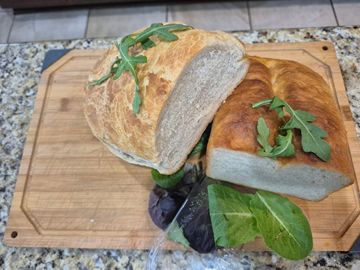
A.I. asked me to describe what I’d done and how long I allowed the rise. After I explained, my A.I. kitchen assistant revealed that an hour was too long to wait before dimpling. That’s why they collapsed. To save them, I was told to rework each loaf by re-kneading and reshaping, and allow no more than 30 minutes for the rise. Then cover them and bake at 450 degrees for 30 minutes. According to A.I., they’d rise again. Being an obedient student, I did as instructed, and voila. The bread rose, baked, and came out delicious and light. My husband said it was the best I’d ever made. Needless to say, I shall repeat this process. BTW – I said thank you, and A.I. graciously accepted and said it was a pleasure to assist.
If you’re wondering if I use A.I. to write, the answer is NO! A.I. is a wonderful tool, not a substitute for human ingenuity. I use it to assist with marketing blurbs and ads. As per Kindle publishing rules, I use it for pre-professional editing, but not to create or develop story lines or blog concepts—including this one.
So, until A.I. learns to wash its hands (if it has hands) and knead dough with clean digits, and feel the barometric pressure in the kitchen, I think we humans still have the upper hand.
Happy reading and baking too!
P.S.: Many internet articles written by humans talk about adjusting baking liquids depending on the weather.
PPS: Be careful. Using A.I. summaries is faster, but check the sites it pulls from and judge for yourself.


