Interview With Terry Shames: Discussing A Risky Undertaking for Loretta Singletary, and More

Terry Shames

Tonight (June 3) Terry Shames will be at Book People along with SC Perkins. Don’t miss it!

Terry Shames was kind enough to agree to an interview.

VPC: Thank you for letting me interview you. Tell us a little bit about Samuel Craddock and how he came to you as a character.

TS: I attended a workshop where one of the speakers gave an impassioned speech in which she said a writer needs to reach deep inside and find the story that only she can tell. I had heard that line before, but for some reason this time it resonated. I realized that I wanted to write a story set in the town where my grandparents lived when I was a child. I also wanted an older protagonist who was still vital. I was tired of reading crime fiction in which older characters were described in disparaging terms. I was very close to my grandfather, who was active into his “golden” years, and he seemed like the perfect model for my protagonist. So Samuel Craddock was born.
 
VPC: This is number 8 in the series, right? How is this book different from the previous books in the series?

TS: It’s probably a little lighter in tone than most of them. The last book, A Reckoning in the Back Country, was very grim, so I decided to step back a bit in this one—if you can call it light when one of your main recurring character is in harm’s way. In each book I focus on something of current social importance. I had read about the particular vulnerability of seniors going on dating sites—especially their economic vulnerability, and thought it was a perfect setup for Loretta to be in trouble.
 
VPC: Sounds funny and a little scary. I know you can’t share everything, but what can you tell us about your days working for the CIA?

TS: At this point, anything I did at the CIA is long past its “do not tell” date. I’ll share the thing that used to amuse me. I was tasked with reading incoming documents in my section and assigning security labels to them—secret, top secret, “eyes” only, etc. First of all, why they thought a 21-year-old should be in that job was odd. It was more or less boilerplate labeling, based on particular buzz codes, but still there was a certain amount of decision-making to be made. Second, the assessments were strictly set, so that I sometimes had to assign Top Secret Code Word labels to things I had read in the Washington Post the day before. That’s why when current political figures hyperventilate about people leaking top secret documents, I view that problem with a healthy grain of salt.
 
VPC: Thanks, good information to know. What is your typical writing day or week like?

TS:I would really prefer to write first thing in the morning, but I am dedicated to keeping physically fit, so every morning I work out either at the gym or at home. Then I go to my desk and fool around until I get anxious. (Fooling around includes reading the news, answering emails, updating my website, doing promo, checking in on social media etc.) Finally, when I’m antsy enough or when my stern voice kicks in, I get to work. Usually the actual writing time is not that long. But while I’m working, I am very focused and can pound out 2,000 words in a couple of hours. I think that’s because while I’m “fooling around” my lizard brain is working to figure out what I’m going to write when I finally get to it.
 
VPC: What do you do when you’ve hit a wall and can’t seem to solve a plot problem or when the words don’t want to come to you?

TS: This doesn’t happen often when I’m working on the Samuel
Craddock series. I don’t know why. I can only remember one time, when I was writing Dead Broke in Jarrett Creek, when I couldn’t figure out where I was going with a plot, so I just forged ahead without really getting a grip on it. I ended up having to excise and revise a lot of the last 20,000 words because I went on a tangent that didn’t work out. The book I’m working on now is much more difficult. I hit places where I simply don’t know what should happen next. When that happens, sometimes I will brainstorm, which consists of quickly writing down ten possible things that can happen. This usually gives me at least one idea. And sometimes I just write blather. What I mean is that I set up a conversation or do a lot of description that may not necessarily end up in the book but just gives me a sense of where everybody is in the book and what they’re up to. And one other thing I do is really think about what I want to accomplish, not just in the scene but in the book as a whole. That can help. And then….there’s the old, “write anything. ANYTHING. But just get some words down.” That can actually be very freeing.
 
VPC: What do you co to blow off steam?

TS: Exercise helps. But I also rant on Facebook, write letters to the NY Times or to members of Congress. I drink. I love to cook, so cooking a meal can feel very freeing. I love to watch basketball. I love to hang out with friends.
 
VPC: I’ve read some of your pieces in the NY Times and I was impressed! I understand that you lived in Italy for a while. What can you tell us about your time there? What was your favorite thing about your experience?

TS: We lived there in the early 1990s. My husband was doing some research with a scientist in Padua. We decided it would be fun to live in Florence while their collaboration was going on. It was a wonderful experience. I loved the art, the people, the beautiful countryside. We had great plans to see a lot of Italy, but mostly we took an opportunity to really get to know Florence. I hiked, went on excursions in the Chianti, explored in depth. Our son went to the fourth grade and part of fifth grade there, in an international school, so we met people from all over the world, and loved every minutes of it. When we go back on visits, I feel as if I’ve gone home.

VPC: Sounds wonderful!
Thank you so much for doing this interview. I hope that we’ve introduced some new people to you and your work.

For more information about Terry Shames and her books, you can follow her at https://www.terryshames.com

A Review of The Secret Lives of Cats

by V.P. Chandler

One thing I like about being in a book club is that I get a chance to read books that I hadn’t heard of. And since I hadn’t heard of Kristine Kathryn Rusch’s story, The Secret Lives of Cats, I’m glad that it came to my attention and I had a good excuse to read it.


Amazon describes it as: Winner of the Ellery Queen Mystery Magazine Readers Choice Award for 2008, this Anthony-nominated story was one of the most talked about stories of the year.


I can believe it. I was drawn in by its first sentence. “Homer Ziff didn’t believe in old adages, but after his long and eventful spring, he couldn’t help but think that whoever put the words “curiosity,” “cat,” and “kill” in the same sentence had to be onto something.”


I like curiosity, cats, and of course crime fiction. So I’m there! You got me. (And look at this awesome cover. I love it.)

Screen Shot 2019-04-22 at 3.04.41 PM

I like the premise. Ziff wonders where his cats go during the day so he attaches a small camera to each cat’s collar. The camera takes still photos, not video. (This was written when GoPro was still new and incredibly expensive.) Every day he downloads and saves many of the photos to see where they go. He notices that they go to a place where other cats congregate and sit there. Are they looking at something? What are they doing? He’s fascinated and after several days it becomes apparent that what they are looking at are bones, human bones.


He calls the police. “When the operator answered, he said, “I think there’s a dead body in my neighborhood.” And that brought the detectives to his door.”


He has to explain to them that the cats have found a dead body, but he doesn’t know exactly where it is. And he has to do this without sounding crazy or guilty. Fortunately for him, one of the detectives understands right away.


I’ll let you read the rest of the story to find out what happens. I thought it was a full-length book so I was a little disappointed that it was a short story, only 33 pages long. I wanted more! I liked everything about it, the characters, the descriptions, and the plot. I thought it moved right along.


I highly recommend this short read and I’ll definitely be reading more by Kristine Kathryn Rusch. I was curious to see what else she has written and was thrilled to find that she also writes a lot of sci-fi. I’ll confess that I’m a bit of a Trekkie so I was tickled to see that she’s written a few ST books too! (Insert The Original Series music here. Ah, ah, ah, ah, ah, ah, ahhhh.)


So go check out The Secret Lives of Cats and the other books listed on her site. https://kriswrites.com/


Happy hunting and live long and prosper!


Originally posted on vpchandler.com 

Crawling Under the Porch

Last week, Fran Paino described how family obligations can keep a writer from writing. My post describes an experience that happened several years ago. It’s similar to Fran’s–and at the same time, very different. 

***

In her book The Artist’s WayJulia Cameron  introduces the  Artist’s Date–a weekly solo “adventure to feed the soul and allow for continued creativity.” In other words, artists–including writers–need to play. At a writers’ retreat in Alpine, Texas, author Karleen Koen led students through a whole week of play. Returning home, I vowed to incorporate the Artist’s Date into my writing life.

It wouldn’t be difficult. Central Texas affords plenty of places to play: Longhorn Cavern State Park at Burnet, lavender fieldsin the Hill Country,  the Elizabet Ney Museum, the Umlauf Sculpture Gardenand the Japanese Garden at Zilker Park,in Austin are only a few.

But having just had a week-long Artist’s Date, I chose to start with a Writing Date instead.

“Lady Macbeth,” the Elizabet Ney Museum, by Ingrid Fisch, is licensed under CC BY-SA 3.0. Via Wikipedia.

Here’s how it went:

I woke at a reasonable hour and dressed to leave for my coffee shop/office.

Downstairs, doling out cat food, I realized I’d seen no cats. That was troubling. William usually slept late, but Ernest was an early riser. He often climbed onto my pillow and swatted my face, making me an early riser, too.

So I called, ran upstairs, searched, called some more. William, draped across his pagoda, opened his eyes and blinked but offered no help.

I ran downstairs, called, searched, dropped to my knees and peered under furniture. I ran back upstairs. Etc.

Finally dropping in the right place, I found Ernest under the bed, sitting in that compact way cats have, with all his feet nearly tucked in. His eyes were not warm and welcoming. When I tried to pull him out, he wriggled loose and ran into the hall and thence into the guest room and under that bed–a sure sign of a sick cat.

He reminded me of a get-well card I once sent to a great-aunt. On the front was a drawing of an orange tabby with a bored, Morris-like expression on his face, and the words, “Feeling poorly? Do as I do.” Inside it said, “Crawl under the porch.”

Ernest didn’t have a porch so he crawled under the next best thing.

I put batteries in the flashlight and girded my loins. Negotiating the guest room is not for the faint of heart. The bed is built low to the ground, and there’s stuffin there.

Again on my hands and knees, and practically standing on my head, I located Ernest lying in a corner near the wall. I stretched out on the carpet, reached as far as possible, and scratched his ears. He didn’t protest, but the look in his big green eyes said I’d better not make any sudden moves.

I didn’t.

Ernest is mostly muscle. Talons tip his twenty toes. He has a mouthful of teeth.

Barry Goldwater. PD. Via Wikipedia.

Like Barry Goldwater, he believes extremism in the defense of liberty is no vice.

I believe in keeping my all blood on the inside of my skin.

But I also believe extremism in the pursuit of getting sick children to the doctor is a necessary evil.

And I had a pretty good idea of what had occurred.

Ernest suffers from what might be termed a sluggish constitution, aggravated by his habit of swallowing objects that aren’t food, like bits of string, thread, ribbon. We don’t leave it lying around, but he finds it anyway. The vet says cats are drawn to elongated things. Something about mouse tails, I guess.

The first time he hid under the bed, two years before, I had to authorize X-rays, ultrasound, and a simple procedure he really, really didn’t like. We refer to it as the $400 enema. Swallowing string can cause serious problems for a cat. So I had to get him some help before a minor problem became major.

I found his jingly collar, the one he refused to wear, lay down again, and jingled at him. He gnawed on the collar and purred. Then he flopped over onto his back so I could rub his belly.

After a couple of minutes the dust bunnies keeping Ernest company attacked. I began sneeze. Ernest doesn’t care for sneezing–it scares him–so I went back downstairs and sneezed till my throat was raw. Then I coughed. And coughed. And coughed. I couldn’t find cough drops or unexpired cough medicine, so I poured out the dregs of some extremely aged Jim Beam (my mother had bought it to baptize her Christmas applesauce cakes thirty years before), and added the only sweetener we had, David’s hummingbird sugar.

While I was resting, sipping medicine from a spoon, Ernest waltzed down the stairs. He sashayed past me and headed to the kitchen. I heard crunching. Then he sashayed back.

Sneak that I am, I lured him into my lap, applied a full nelson, stuffed him into the waiting crate, lugged him to the car, and hauled him to the vet. He protested. When two big dogs in the waiting room charged up to his crate to pant hello, he shut up.

First stop was the scale: seventeen pounds. No surprise. My back muscles were already crying for the massage therapist.

Then the vet poked and prodded and determined Ernest had indeed ingested something he shouldn’t have, probably something the shape of a mouse tail.

I had three choices: take him home, give him meds, and watch him for twenty-four hours; leave him there for meds and the procedure he really, really didn’t like and pick him up at five p.m.; or be referred elsewhere for X-rays, because our vet’s office was in process of being moved down the street and his X-ray machine was in pieces.

He said choice #1 would have been fine for his cat, but I chose #2. If I left Ernest there, I knew he would come home unclogged. If I took him home, he would run under the bed and I’d never see him again. I hated to leave him, but it was, after all, his fault.

Anyway, at five p.m., David and I retrieved Ernest and a tube of Laxatone for maintenance. Ernest recovered and, after a time, forgave me. Everything returned to normal, till the next time he ate thread.

And that is the story of what I did the day I didn’t write.

I’m still trying to decide if it qualifies as an Artist’s Date.

***

Note–and this is how I understood the veterinarian’s explanation, not to be taken as medical advice: Some foreign objects will biodegrade in a cat’s GI tract. String, thread, ribbon, and things of that type, even if they’re biodegradable, sometimes catch in the back of a cat’s mouth when he swallows. As food travels through the GI tract, the thread straightens out and becomes taut and can cut the cat’s intestines, necessitating surgery (if the problem is diagnosed in time). Laxatives can worsen the condition. A visit to a veterinarian is desirable.

***

Images
Field of lavender by David Bartus via Morguefile
Mouse by sibya via Pixabay
Ernest by owner

***

M. K. Waller blogs at Telling the Truth, Mainly. Visit her on Facebook at https://www.facebook.com/kathy.waller68/

THE WRITING LIFE – For the Sandwich Generation

Image by Jan Vašek from Pixabay

By Francine Paino

I’m a morning writer, and it’s morning.  Filled with energy, and inspiration, I grab the notes I’d scribbled on the post-it when ideas woke me during the night. Sharpen those pencils and dust off the keyboard. Coffee’s brewing, toast pops up. Ready, set, go.

Not   So   Fast

The phone rings. “Mom. Emergency. The sitter is sick. Can you take the baby for a few hours?”  I, the devoted grandmother, agree to help. When the baby naps, I’ll write.

The phone rings again. The nonagenarian is desperate to get to the supermarket.

Welcome to life in the sandwich generation. 

Here I am a piece of Swiss cheese firmly pressed between two slices of hearty Italian bread. On one side is my nonagenarian mother, a feisty old lady, who doesn’t look or act her age.  She is in great physical shape other than the fact that she can’t hear very well, can’t smell very well, and claims not to be able to walk very well. As for the walking, just give her a shopping cart in the supermarket and try to keep up with her. I’ve lost several pounds chasing her up and down the aisles.

On the other side are my grandchildren, normal little people going through the different stages of emotional, physical and intellectual growth. They provide the expected tests for the adult nervous system: conflict, espionage, and subterfuge. Put any one of them together with the nonagenarian who wishes to be a revered elder and a naughty child at the same time, and it’s like herding cats.  

And so, I pick up the 24-month-old and then the 95-year-old, and off to the supermarket we go!

The young one sits in the basket in front of me, and the old one is behind me zipping around with her cart and getting into as much mischief as possible, picking up candies and treats  she knows the 24 month-old is not allowed to eat.

The child’s radar, of course, locks onto the junk food. She tries to elongate her little arm to reach over me and receive the treat from her great-grandmother.

The powers of observation in both the toddler and the nonagenarian are impeccable; their timing the envy of any dance team. If I turned to a shelf on my left, the nonagenarian reaches over my right shoulder to give the toddler some forbidden sweet. Once that sweet is in the 24-month-old’s chubby little fist, I must employ all my powers of persuasion to get it away. After I succeed, I turn to scold the nonagenarian but she’s disappeared. I find myself talking to thin air. 

This continues up and down each aisle as the elder rises to the challenges of flexible movement and rapid deployment, accumulating as many different snacks as possible and passing them to her beloved great-grandchild before I can stop her.

The woman who cannot walk so well is able to dodge, feint and sidestep with incredible speed. She appears and disappears at key times while I actually try to gather items on the list.

At last, I make it to the check-out line where the naughty old child hands a candy bar to the determined young child. “Here, sweetie, take this,” but my antennae are up and my intercept quick.

I snatch the bar away before the little one captures it in her vice-like grip. Both the old and the young cry out in dismay. Finally, I have no choice but to appropriately discipline both, which nearly creates a riot at the register. It is my good fortune that no do-gooders are there to insist that I be reprimanded for reprimanding those in my charge. 

Bags packed, groceries paid for, I swiftly maneuver the nonagenarian and the toddler to the car and get them safely strapped into their seats, after which I load the shopping.

I drop the nonagenarian at home with her purchases. And now there is one. This is manageable.

As soon as I reach the safety of my home, I promptly put the toddler down for a nap. Ahh. Blessed relief. It’s quiet at last, and time to write. I smile and close my eyes for a moment of peace to gather my thoughts.

 The next time I open them, a little voice is calling, “Nonna.”  

###

The original version of this, Supermarket Nightmare, appeared in the March 2015 edition of Funny Times.

Day of the Dark: Stories of Eclipse


DAY OF THE DARK (Wildside, July 2017)


Interview for Day of the Dark


Are you excited about the upcoming eclipse on August 21rst? Well you aren’t the only one. And Austin Mystery Writer members, Kathy Waller and Laura Oles, contributed stories to an anthology titled, Day of the Dark. Every story takes place during the eclipse. The idea for the anthology came from the imagination of former AMW member, Kaye George.

Amazon says: A recipe for disaster: take one total solar eclipse, add two dozen spine-chilling mysteries, and shake the reader until the world ends in Day of the Dark!

So if you don’t mind, I’d like to get Kaye George, Laura Oles, and Kathy Waller to tell us more about it.

VP Chandler- Kaye George, where did you get the idea for the anthology?

KG- I got the idea as soon as I heard about the eclipse and how rare they are in any one location. I wanted to write a story on it and thought others might, too.


VPC- Nice! This question is for everyone. How did you choose the location of your story?

KW- I had the idea of using Marva Lu, the protagonist from a previous story. She lives in North Texas, so I had to set the story there. I knew the eclipse would darken the day enough for my purposes. The story hinged on her being on her home ground. Away from there, she would be a different person.

VPC- I remember Marva Lu. Wasn’t she is that awesome and amazing anthology, Murder On Wheels? Pretty sure I’m right. 😉 What about your setting, Kaye?

KG- I chose my own neighborhood because I’m so excited that we’ll see the total eclipse right in my back yard. And my front yard, too.

VPC- How exciting! I’m jealous. What about your story, Laura?

LO- Our family has spent many long summer weekends in Port Aransas, and the island life–the slow pace, the mix of locals and tourists, the pull of the ocean–is something I keep returning to. It has its own special magic.


VPC- Port A is special. The people are just as interesting as the setting.

Now for question #3, in my experience I’ve worked on some projects that came to me right away and flowed easily, and some projects were painful to get onto the page. Which was it for your story in this anthology?

KG- I’d call this one medium. Not too hard, but didn’t flow like a river.

KW- Once I finally started writing, it flowed. With the time I had, it had to.

LO- I knew immediately where the story would take place and I knew the main character. I needed some time to consider how his life would be turned upside down and what role the eclipse would play.


VPC- I know that writers know their characters much better than readers do and they often leave background information out of their stories. Tell us something about your protagonists that the reader doesn’t know.

KW- If the reader has read Hell on Wheels in Murder on Wheels, they probably know as much about the protagonist as I do. Until I wrote I’ll Be a Sunbeam, I didn’t know she sang duets at church, or that she taught Sunday school. I learn things about my characters as I write. I’m sure she likes dogs and cats, but she can’t have a cat because she has a gerbil.

LO- There is more to the story of why he left his life in Denver and moved to the coast.

KG- My protagonist, she’s older than the age she tells people. Her husband doesn’t even know her exact age.


VPC- Here’s a question I like to ask other authors.  How much of you is in your antagonist?

KW-  Probably a lot more than I want to admit. Our minds are always buzzing, we’re always arguing with ourselves and with everyone else inside our heads, we’re always plotting. And those are the least objectionable qualities we share.

KG- I’m not sure who the antagonist is. Either the young mother or the young father, I think. They aren’t very good parents, so I hope there isn’t too much of me in them.

LO- Not much similarity between me and the antagonist.


VPC- Well, you both like Port Aransas.

Another question, what do you think of the anthology as a whole? Is there one    particular story that is your favorite? Is there a story that surprised you?

KG- As the compiler and editor, I can’t play favorites, but I think there are stories here for a lot of varied tastes. I hope everyone finds a favorite!

KW- Cari Dubiel’s Date Night is mind-boggling. Joseph S. Walker’s Awaiting the Hour is rather sad, touching. Debra H. Goldstein’s A Golden Eclipse surprised me–a clever interpretation of the theme. And Katherine Tomlinson’s The Path of Totality is timely; I laughed until the very end, when alt-facts took a scary turn. If I’d read the other twenty-three stories before submitting, I wouldn’t have had the nerve to send Kaye mine.

LO- What I love about this anthology is the variation. While they all have the eclipse as an important element, each story is different from the others–I’m grateful to be Included with so many other talented authors.


VPC- How many of you are planning on seeing the eclipse?

LO- We have the eclipse on the calendar but aren’t sure where we will be yet. The whole family plans on getting together to experience it.

KW- I’m going to Blue Springs, Missouri, near Kansas City, for the event. I have family there. It was my husband’s idea. Fortunately, he arranged for airline and hotel months ago.

VPC- And I know Kaye will see it from her home. Kaye, I think I heard that the profits will be donated to charity? What is the charity?

KG- Fourteen of the 24 authors have picked personal charities. Mine is Earth and Sky. Four other authors, including Laura, are donating to that one, too.

VPC- I love Earth and Sky!

KW- Mine will go to Texas Museum of Science and Technology (TXMOST) in Cedar Park.


VPC- That all sounds good to me. Thanks for your time. I can’t wait to get my copy.


Available in ebook or paperback: https://www.amazon.com/Day-Dark-Stories-Harriette-Sackler-ebook/dp/B073YDGSL5


More websites with information about Day of the Dark:


https://www.criminalelement.com/blogs/2017/07/qaa-with-kaye-george-editor-of-the-anthology-day-of-the-dark


https://kayegeorge.wixsite.com/kaye-george/day-of-the-dark-anthology


http://thestilettogang.blogspot.com/2017/07/day-of-dark-anthology-debuts-by-debra-h.html

Bouchercon 2016: New Orleans

For those who love to read mysteries as well as write them, Bouchercon is where you will find your people– and they will most likely be hanging out in the hotel bar.

cafedumonde

Cafe Du Monde-a must in New Orleans!

The 47th Bouchercon World Mystery Convention found its home this year in The Big Easy. The combination of a compelling locale along with some of the biggest names in crime fiction created the largest registration to date. Over 1,900 guests flocked to New Orleans in search of panels, book signings, author sightings and fabulous food, along with intentions of connecting with old friends and making new ones.

I found all of those things.

This was my first Bouchercon as previous attempts to attend havelauravalerie been thwarted by schedule conflicts, work issues and school events. This year, somehow, we made it work. Embarking on a road trip with fellow AMW member Valerie Chandler, the two of us packed the car and hit the road, following IH-10 all the way across state lines and into the heart of New Orleans. Nine hours in a car sounds like a chore, but we fared pretty well. We found each other to be entertaining company–and the snacks were pretty good, too. A successful road trip hinges on these two things–the right people and the right munchies.
harlanlaura

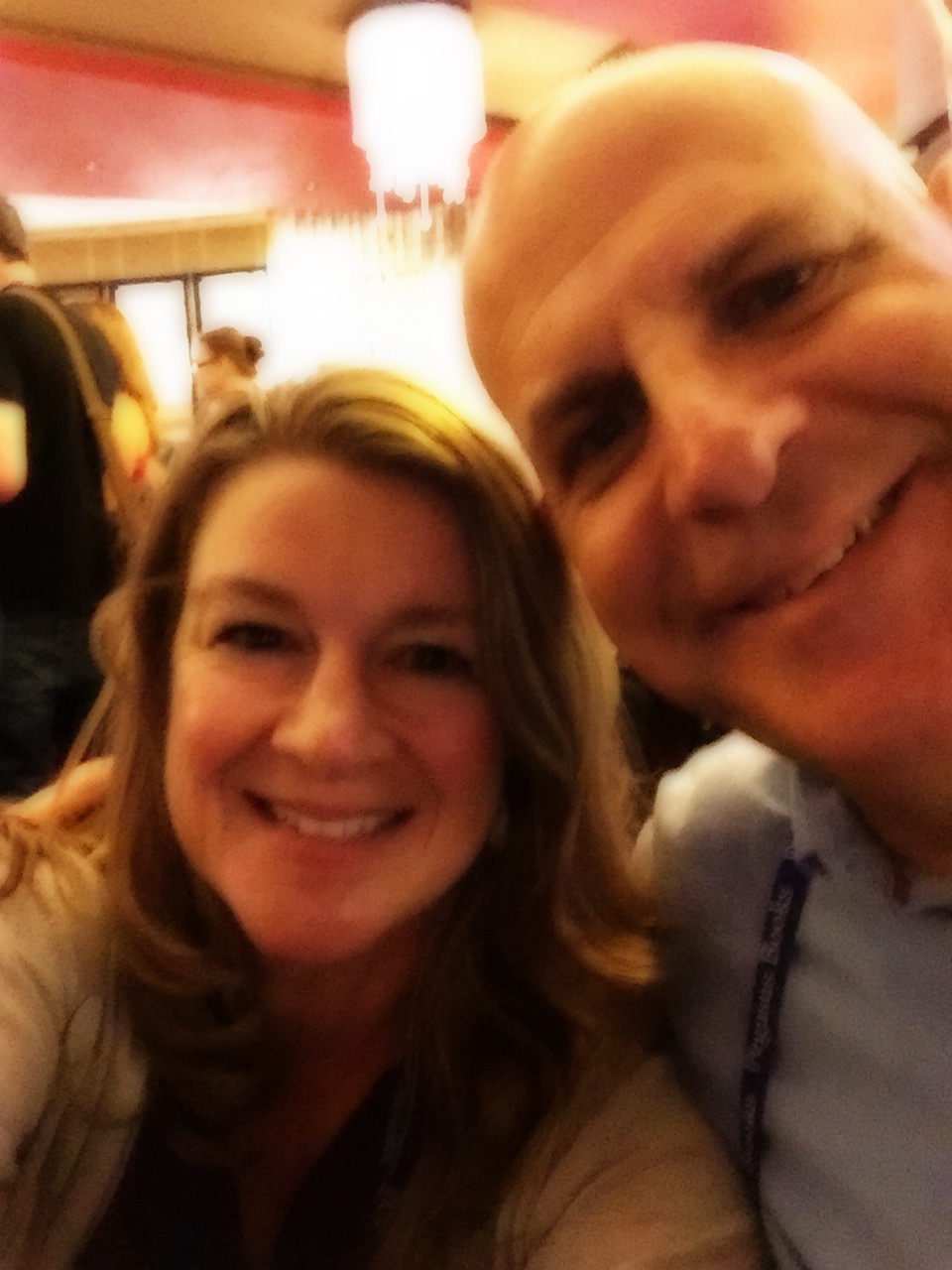
Laura Oles & Harlan Coben

Walking into the hotel on Wednesday evening thrust us in the middle of a party already in progress. The bar area bustled with animated conversations and activity. Clearly, people were already in the “laissez le bon temps roulez” frame of mind. Writing is such a solitary process that it was a wonderful thing, seeing these mystery lovers together sharing stories and spirits. The bar served as the community meeting center for the conference, with people coming and going (and some staying all night). It was an event in and of itself.

Registration to Bouchercon includes a trip to the conference bookstore. Shopping in the Bouchercon Bookstore was a real treat. Along with our registration goodies–T-shirt, tote bag, water bottle–each attendee received six coupons for free books. The store was stocked with all the latest titles (and a few ARCs) from authors attending the conference. It took some time to make my selections, as I debated which titles to take home. These books now sit on my nightstand waiting for my attention, which I fully intend to give them after I complete the latest round of edits on my own novel.

cobenconnelly

Michael Connelly interviews Harlan Coben

On Thursday morning, Michael Connelly interviewed Harlan Coben, and it was one of the best exchanges between two powerhouse authors I have ever witnessed. They tackled the realities of writing vs. the fantasy of it and shared the stories of their successes with humor and humility. Harlan explained that it was his tenth book that finally garnered him some success–his TENTH. So, for those of us who do not yet have that number as a backlist, his advice is to keep writing. And when you’re done, write the next one. Tough love, people.

The panels were fantastic and the conversations afterward were equally interesting. On

hank_panel

Hank Phillippi Ryan moderates a panel discussion–very well as always!

average, there were six panels offered in each key time slot, making it difficult to decide which ones to attend. My conference schedule was highlighted and notated as though I had been preparing for an exam.

Bouchercon encompasses a wide variety of sub genres, and it was interesting to hear discussions related to so many different kids of mysteries– how they are constructed, how they are marketed and how they find their way to readers. I think that this broad scope of inclusion is one of the elements that makes Bouchercon so unique. It doesn’t narrow itself to a small slice of mystery. It’s about the entire pie.

palacecafeSpeaking of dessert, I would be remiss if I didn’t spend a moment fawning over the New Orleans cuisine. The dining options were vast, varied and with rare exception, all excellent. We found the Palace Café, located on the foot of the French Quarter, and loved it so much that we returned again a second time. The atmosphere was very NOLA, with its sharply dressed waiters, white table linens and black iron spiral staircase. The shrimp tchefuncte was fabulous and flavorful, and I still miss the bananas foster. It was that good.

palacecafe2

Bananas Foster at the Palace Cafe

Sisters in Crime celebrated 30 years at the conference, and the breakfast meeting brought some of the most talented–and supportive–crime writers working today. The breakfast, held on the 41st floor of the NOLA Marriott, was elegant yet casual, the view of the city through the hotel windows serving as the perfect backdrop for the conversations taking place. This group of women and men, who come together for the purposes of promoting equality in the field of crime fiction, have accomplished a great deal in three decades. While there is more work to be done, it is clear that their commitment has created substantial progress.

Having time to spend catching up with friends, many of whom I only see once or twice a year, was a true treasure. Those connections and conversations are experiences I bring home and keep with me as I return to the daily work of writing solo. They remind me that, even though I write alone, I am far from it.

I now return to real life, and it’s nice to be home. Still, I wish I could find a way to bring the community of Bouchercon and the New Orleans food with me. The memories will have to do, and I am thankful to have had the opportunity to attend. So, friends, until next time. Maybe I’ll see you in Toronto at Bouchercon 2017?  –Laura Oles

Interview With AMW Member, V.P. Chandler


10407893_1010906502272011_8835198574869839611_nThis is the last installment of the AMW member interviews. Who did I leave out? Me! So some of my fellow members have asked me questions. I must admit, I was a little nervous. Ask me anything! I’ll give you an answer. And this goes for you too, reader. Ask me anything. I’ll try to answer what you throw at me. *Gulp!*


Kaye George (former member but still active in many AMW activities!)- How long have you been writing toward publication?

VPC- I plead the fifth. (Already!) Okay, I’ll answer. I’ve been working on my book, in its many incarnations, since about 2009. It’s had big changes and I’ve also worked on other projects in the meantime.


KG- Do you find it hard or easy to fit writing into your schedule?

Pomodoro timer

Pomodoro timer

VPC- Most days I can fit in some writing. It’s the days that have unexpected challenges, like an emergency trip to the vet, that make it hard. And on some days, like today, I’m doing things like writing a blog post. Lots of things take time away from working on book projects.

I’ll also fess up that I’m also a procrastinator, so I sometimes have to trick myself into working. “I have to work at least 20 minutes.” Then next thing I know it’s been 3 hours and I got a lot of work done.


KG- Do you work outside the home?

VPC- I volunteer for my church. I do the website and sometimes fill in for the secretary. I also help with websites, Facebook pages, and projects of organizations like Writer Unboxed and our local chapter of Sisters in Crime.


KG- How many rattlers have you actually killed?

VPC- LOL! I know you’re asking me this because you’ve read a draft of my book. The answer is, a lot. Back when we lived at our ranch, I wondered the same thing and started counting them up. At that time the number was about 150. When I got to number 200, I bought myself a gun charm for my charm bracelet. I figured I deserved it! So all in all I’d say I personally killed about 250 snakes.

Charms to celebrate moving to central Texas, shooting rattlesnakes, writing my newest story about a Texas Ranger, love of rabbits, joining AMW, and writing Rota Fortunae.

Charms to celebrate moving to central Texas, shooting rattlesnakes, writing my newest story about a Texas Ranger, love of rabbits, joining AMW, and writing Rota Fortunae.

I have a picture of the dead snakes that we killed on our busiest day, but I won’t post that here. If anyone is interested, I can post it in the comments. We killed 18 snakes that day. It was just after Thanksgiving and that’s the time of year that they are mating and looking to hibernate. I can tell you more about that day later, if anyone is interested.

An added note: I know some people will be upset that we killed rattlesnakes. There were thousands of snakes where we lived and we didn’t kill any of the nonpoisonous one. AND our son was only three years old so it was a matter of life or death. Again, I can discuss more about that in the comments if anyone wishes to.


Elizabeth Buhmann- Your settings always have a wonderful Texas feel to them. You are a native Texan, surely, but hasn’t your family been here for a while, too?

VPC- Yes. I have a direct ancestor who arrived about 1834. It’s funny that I’m descended from a Winters and I moved to a town where one of its earliest settlers was a Winters, my

Winters house. www.wimwic.org

Winters house. http://www.wimwic.org

4x great uncle. (I think that’s the right number of greats.) When I learned that, I figured it was meant to be for me to live here!


EB- Your father was a criminal justice professional, wasn’t he? Tell us a bit about him and how he has influenced your writing.

VPC- He was a criminal justice professor at Sam Houston State and he influenced me greatly. I believe his specialties were criminal history and organized crime. He loved to tell stories about cases, including those he was involved in during his time as Director of Public Safety in Corpus Christi. He and my step-mother were also avid readers of mysteries so we often talked about those too.

My father’s parents also had an influence. My grandfather was a pathologist, the first one in South Texas. And my grandmother was an accomplished photographer. She worked with him by taking the photos to document his findings. Both were friends with Erle Stanley Gardner and he sometimes asked their advice on forensics. 144432He mentions them in the Foreword in his book, The Case of the Careless Cupid.

I didn’t get a chance to know them back in those days, but I’ve heard many stories about what they did and accomplished.


EB- Are you a Texas history buff? Your first novel (which I had the privilege of reading in draft form) is set about a hundred (?) years in the past. What sort of sources did you use to paint such a realistic picture of what Texas was like then?

VP- Thank you! I used to hate history. I thought it was so boring. And, like many things, the older I got the more I found it interesting. I like learning about people and how they overcame obstacles. One of the best resources I’ve found is the Texas State Historical Association website. It’s incredible!

Other sources were just various things I could find by using Google and asking friends who are knowledgeable. My Facebook friends are great! I also collect hard to find, out of print books about Texas.


Gale Albright- Has being a member of Austin Mystery Writers improved your confidence in your writing?

VPC- Yes! Tremendously. I can’t imagine where I’d be if it wasn’t for this group and the feedback and support we give each other.


GA- Can you tell me the pros and cons of being a member of a critique group?

VPC- One of the best things about a good critique group is getting honest, and polite feedback. Another plus about AMW is that we are a group of people with a variety of backgrounds, so we can approach a story from different experiences. We also have different things that we notice in a story, like punctuation or pacing. So we can give a variety of suggestions on how to make a story better.


GA- Austin Mystery Writers’ short-story anthology, Murder on Wheels, recently received a Silver Falchion Award at Killer Nashville. What’s your reaction been to that?

VPC- When we were nominated, I was like, “Whaaaat?” LOL It didn’t sink in for about a day. I didn’t want to let myself get excited. Then when we won, I couldn’t believe it. I was very pleased. I’ve been telling everybody!


SilverFalchionAwardWinner_Web-300x300


GA- You have a big interest in historical novels. Do you think you’ve found a niche for yourself, or do you plan to branch out to other types of writing?

VPC- Good question. This is something I think about a lot. I love historical fiction, and plan to write a series set in Texas. Hopefully my first book, Gilt Ridden, will be the first in a series. I have about five other stories planned out for my characters. I like the idea that my antagonist, Kay Stuart, solves current problems (murders), by finding the answers in Texas history.

I also have an idea for a series using one of her best friends, Jessie Reese, who is a modern deputy sheriff. Those will be straight up mystery/suspense with no history.

BUT I also love to write horror. I’m working on a story that may be a novella or novel that is sci-fi/horror.

So I guess my answer is that right now I’m focusing on historical fiction/mystery with a side jaunt into horror. But I find I’m having so much fun writing horror, it may be more of a focus of mine in the future. I plan to just write what is fun to write. And when I do that, the writing is better anyway.


GA- What’s the most fun part of writing for you? What is not so much fun?

VPC- I love writing squeamish or emotional scenes. I like the idea of making the reader laugh or cry. Such power! Bwa ha ha ha ha ha !

On the other hand, I hate it when the plot or the scene just isn’t coming together. It’s excruciating! I literally have to get up and walk around. Sometimes I have to stand at the table to write. I also don’t like long descriptions. I hate reading them and I hate writing them. I like to get to the point.


GA- Do you have any fun research trips planned?

VPC- I wish! I will be going to Bouchercon in New Orleans next week with fellow member Laura Oles. I guess I’ll keep my eyes open for inspiration. I’ll also be going to the Writer Unboxed Un-Conference in November, which (witch?) will be in Salem, Massachusetts. Kathy Waller will also be there with me. Maybe we’ll find some ghosts!

10469735_963654960315288_5870602240262122958_n

Salem trip to Writer Unboxed Un-Con in 2014


Thank you for all of the questions! I love being a member of AMW. I can’t imagine going through this journey of being a writer without their support and guidance!


Does anybody have anymore questions? Bring ‘em on!

Questions

Pets and the Fourth


Today we have a guest blogger who is a former AMW member, Kaye George.


If you’re reading this, you either like to read or to write, right? Or you’re a loyal friend of one of the Austin Mystery Writers. I’ve seen an odd connection between lovers of the written word and the love of animals. Or maybe that’s just a universal thing, or a thing with people who hang around in cyber space. Anyway, I’d like to appeal to those of you who love animals.

running dog

If you have a dog or cat, take care of it tonight! Please don’t leave it outside. Between July 4th and July 6th, animal control services nationwide see a 30% rise in missing pets!* If you live in Texas, among many other places, fireworks will start well before the 4th, so you’ll need to take precautions in the days leading up to Fireworks Day, as well as the days afterward.


If you have an animal that is overly anxious, you might want to give him medicine to soothe him during the height of the booming. Hugging or wrapping tightly can help some dogs. If you can distract your pet with other noises, that might help. Also, it’s good to have at least an ID tag, at most a chip, just in case he gets out and runs away, confused and frightened by the unusual noises.


If you should see an animal running loose and scared, you can report it here:

https://www.petamberalert.com/report-a-pet-sighting/


One more if. If you’re fortunate enough to have a laid-back furry buddy who can ignore fireworks, count yourself lucky and enjoy the holiday. Happy Fourth!


*https://www.petamberalert.com/blog/keeping-your-pets-safe-on-the-4th-of-july/

Life Lessons Learned In “Battle”


I’ve been waging war.

12087928_10207847195967051_9168143893847477408_o

Photo by Michael O’Reilly

(No, that isn’t a picture of me. It’s a picture my friend Michael O’Reilly took of his friend. He sometimes goes around Austin with a sword and asks strangers to pose with it. Really, and he gets some great pictures!)

But back to my story. I’ve been at war with the Dreaded Ivy Monster. This thing has overtaken my yard and covers huge bushes. It’s choking the life out of everything. And while I’m out there on the front line, hacking and pulling, I do a lot of thinking.

20160627_104708

Small section of the monster that’s overtaken my yard. There are rock and other plants under there.

I can’t help but seeing symbolism in what I’m doing. I actually talked about this on the first post of my blog back in 2012. At that time I happened to be thinking about clutter. http://vpchandler.com/trim-away-the-dead/

But apparently fighting the DIM is good for my imagination. I recently told a friend who felt like she wasn’t making progress on her book,

“We have a vine that’s grown to be a monster. It’s taken over the flowerbeds and killed some of the bushes. Everyday I go outside and trim it and rip up parts of it out of the ground. Basically chipping away at the problem, but I’m getting results. I’ll take one tendril and pull on it. It’s amazing to see how intertwined it all is.

Every time I go out there I can’t help but compare working on it to writing and editing a book. I may spend anywhere from 5 minutes to an hour on it. But each time I see progress. Each time I’m unraveling a tendril, I’m unraveling a problem.”


As I say in the above quote, I’ve been editing my book, getting rid of unwanted and unnecessary stuff. So when I pull on a lonnng tendril that has creeped and wound its way through the bushes, it reminds of getting rid of unwanted story lines. Of course they weave their way through the book so I have to make sure everything makes sense when that’s gone! But it feels good when the extra stuff is hacked away.

Something else also popped into my mind yesterday, of course while fighting the DIM. The more I thought about it, the more I liked it. Now I’m not a poet, but here’s what I was thinking.


Reach For the Light

What kind of vine are you? Are you a jasmine, a honeysuckle, English ivy, the stifling kudzu? I hope you aren’t the dreaded poison ivy or poison oak!

Whatever vine you are, search for the light that helps you grow.
Don’t stay in the dark humus, the decay of years past. That way stifles and rots your roots. It weakens growth and stunts your leaves.

No, search for the light.
If you have to twist your way among Life’s branches to go around obstacles, keep at it. Study your path, grow strong and use what you’ve learned to anchor yourself while you reach for the new, the sun, and see what Life has to offer.


(It’s not Emily Dickinson, but I like it.)


I can now see rocks!

The edge of progress. I can now see rocks!

I’d also like to add that it’s rewarding to see how a few minutes here and there can produce results. So whatever you’re working on, whether it’s writing, gardening, painting, or what have you, a few minutes can make a difference. And while you’re pulling those weeds, let your mind wander. Who knows, you might find the answers to the questions you’ve been looking for or you might get a glimpse into the meaning of Life.


Whiskers, my trusty companion in battle. He comforts me and criticizes my work. Apparently I'm not worthy.

Whiskers, my trusty companion in battle. He comforts me and criticizes my work. Apparently I’m not worthy.

Does this happen to you? Do you get insights to your writing or life when you’re driving, washing dishes or doing other such work? Had any “aha!” moments? Share them with us!

Banishing Lazy Words by Terry Shames

This week we have a guest blogger, friend and fellow mystery writer, Terry Shames!

Terry grew up in Texas, and has an abiding affection for the people she grew up with and the landscape and culture of the town that is the model for Jarrett Creek. She graduated from the University of Texas and has an MA from San Francisco State University. Terry now lives in Northern California with her husband, two terriers and a regal cat.

Terry’s first Samuel Craddock novel, A Killing at Cotton Hill, (July 2013) and was named one of the top five debut mystery novels of 2013 by MysteryPeople. The second in the series, The Last Death of Jack Harbin was named one of the top five mysteries of 2014 by the Library Association’s Library Journal. Dead Broke in Jarrett Creek, the third in the Samuel Craddock series, came out in October of 2014, followed by A Deadly Affair at Bobtail Ridge in April 2015 and The Necessary Murder of Nonie Blake in January 2016.

A member of Mystery Writers of America and Sisters in Crime, she serves on the boards of Northern California chapters of both.

Welcome, Terry! shamesTerry_1

Banishing Lazy Words

When I’m editing a book, I know that when I begin to get restless I’ve probably come across a nest of lazy words–words that are shorthand, or placeholders, for what I really want to say. Here are some lazy word indicators:

These, this, those, thing, stuff, some, about, just…and the dreaded “to be” verb (was, were…)

I often find when I come across several of these words on one page it means I was reluctant to dig deeper into the emotional content in the scene. When I buckle down and confront what I’m avoiding writing, digging deep to find the emotional core of the scene, I often end up writing a lot more words than I had before.

Here’s an example of a piece I was editing for someone else. I ran across several places on one page where two characters were talking about, “This thing we have going,” and “This thing we are trying.” The “thing” the writer was talking about was a difficult relationship between people of different ethnic backgrounds. By repeating the words “this thing,” she avoided addressing in depth the painful aspects of the relationship. The words fell flat on the page. Only when she changed it to say what she really meant, “Our risky experiment,” and “The way we are thumbing our nose at tradition,” did it begin to have the depth it deserved. Instead of a romance novel, it because more like Romeo and Juliet.

In first drafts, we often use shorthand for what we know is going to be a difficult description. But as writers we have to work hard to ferret out those lazy little words and phrases and say what we really mean. Not, “Amanda’s bedroom was a mess. There was STUFF lying everywhere,” or “I walked into Bill’s office. There was STUFF lying everywhere,” but instead, “Amanda’s clothes were strewn on the floor leading to the bed,” or “Judging from Bill’s office, he was a guy who dropped whatever he was reading onto any handy surface as soon as he was done with it.” Instead of saying, “there were several things he wanted to tell her,” it’s more interesting to read, “he stored up little criticisms that he could spring on her later.”

Contrast these two paragraphs:

“They dated for a few months, during which he told several lies. Some time later, she tried to remember which lies bothered her the most. There was the time he told her he was an accountant and lost his job when the economy went bad. And another time he said he looked around for a job for a long while before he could find another one. But the worst was when he said he’d buy her some jewelry, and never did.”

The fix:

“They dated for six month. After he disappeared, she found that he had hardly opened his mouth without lying. She bought into it when he told her he was an accountant, and lost his job when the economy went bust. She even believed that he pounded the pavement looking for a job for six months before he found one. But the lie that hurt most was that he promised to buy her a diamond ring, and he never did.”

The first paragraph is full of lazy words like “a few,” “several,” “some, “tried,” most,” “there was,” etc. The second one uses livelier, mores descriptive words.

When you read authors you admire, note that they pin down real time, real place, real emotion. It makes their prose richer and keeps readers engaged. It takes hard editing work, but it’s worth it. It’s the key element that will make your prose come alive.

You can find more information about Terry Shames at www.terryshames.com 

Thank you, Terry! That’s good concrete information that all writers can use. What do you think, reader? Any questions or comments?