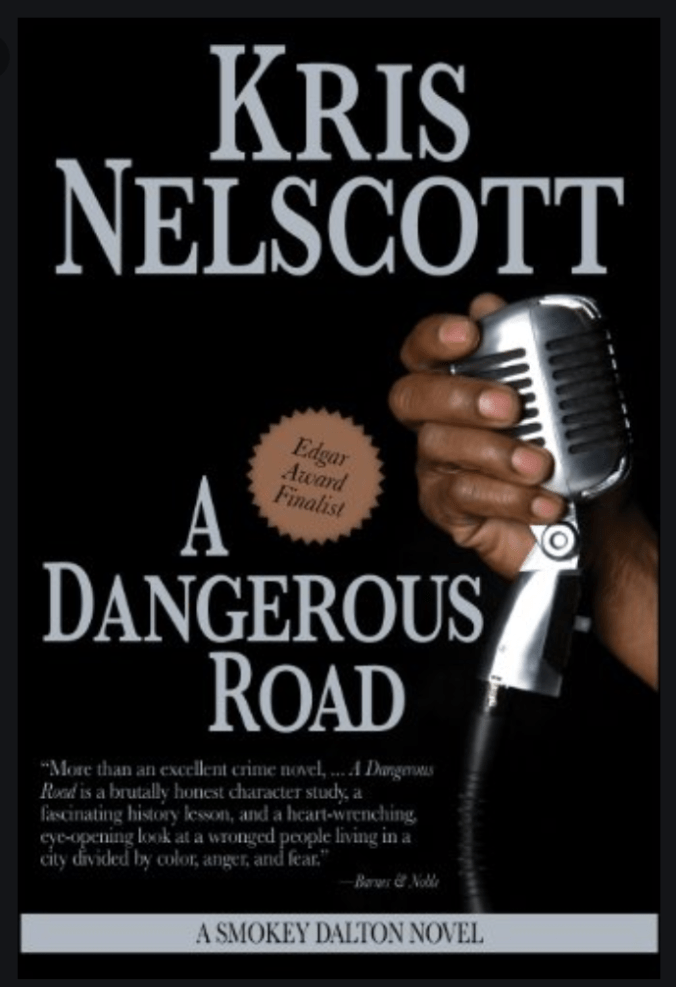
V.P. Chandler Review of A Dangerous Road: A Smokey Dalton Novel by Kris Nelscott

As with many other books, I’ve been late on the scene with this series and author. A Dangerous Road made its debut in 2001 but I just discovered it recently. I was fortunate that my book club chose it. So not only did I get to read a great book, I got to read an intriguing mystery that kept me turning pages! And I got to discuss it with good friends.

I primarily write historical mysteries, usually Westerns, but this one takes place in Memphis in 1968. A turbulent time and place. There was a lot that I didn’t know about this time and I can tell that Nelscott did her homework. For example, there was a strike among the garbage collectors and trash began to pile up. The smell and inconvenience added to the tension of the story. The impending marches and the arrival of Dr. Martin Luther King, Jr., are churning up hostilities between the races, and among the races. Add to that a black male P.I. who has a white, attractive, female client, Laura Hathaway, and the tension mounts!

The mystery part of the story is about $10,000. Laura Hathaway demands to know why her mother would leave $10,000 to Smokey. He has no idea. He doesn’t know the Hathaways. Could Mrs. Hathaway have been the anonymous benefactor who left him $10,000 ten year prior? It seems like too much of a coincidence. And why would she do that? Laura decides to hire Smokey to find out about her family background, what secrets they were hiding and how he is involved in it, if he is.

That’s what kept me turning pages. I had no idea where it was going to go!

The book starts with scenes from the premiere of Gone With the Wind in 1940 in Atlanta. (I didn’t know that it premiered there! Did you?) It takes a while until it becomes clear why this event was important to the story. But it’s pivotal.

Which gets me to what I admired most about the book. Not only was it a mystery, but it deftly maneuvered through and around the worlds of 1940 Atlanta and 1968 Memphis. Both eras are complicated. Dalton and the black community have to constantly be alert and careful what they say and do. And not all dangers are outside their own community.

Nelscott dances her way around and through the story, taking the reader with her. I was impressed with its complexity and how she was able to keep the tension throughout. I was not surprised to learn that it won the Herodotus Award for Best Historical Mystery and was short-listed for the Edgar Award for Best Novel.

This reader and writer will definitely be reading more of the Smokey Dalton stories!

Characters We’re Drawn To

by Helen Currie Foster

Originally posted on Ink-Stained Wretches

Last week Big D hosted the Bouchercon book conference. Two sessions made me wonder why we’re drawn to particular book characters, and how key they are to readers.

At the Bouchercon “Success in Publishing” panel, a speaker said, “People read for character. Conflict turns pages.” A second speaker said she’ll re-read a writer’s submittal if, the next day, she remembers the characters.

Best-selling author Elizabeth George (Inspector Lynley series) told a spellbound audience (me too) that for a new book, before she starts writing anything else, she creates her characters and settings.

George designs her characters to “reflect the human heart in conflict.” Sometimes she’ll have as many as six characters telling the story from their point of view. She creates a character prompt sheet, deciding, for each, what is this character’s real need? She considers the character’s psychopathology: what would the character do under stress? If the character appears only once, what is the character’s agenda in
that scene?

George then decides, where does this novel begin? Only then does she start to outline the first ten scenes. Each must be causally related to another scene. She then writes a rough draft of those first ten scenes, and repeats the process for the next ten scenes. Nothing is set in concrete.

In the tug-of-war for primacy between plot and character, what gives a character “pull”? If we “read for character,” which characters really attract us––perhaps even more than a forceful plot? What does Elizabeth George mean––the human heart in conflict?

Each of you has your own list of favorite characters, some from favorite childhood books. Take Charlotte’s Web. I’m fond of the pig Wilbur, and the child Fern. I empathize with Wilbur’s terror when he’s being chased for the slaughter. But Charlotte…isn’t she the magnet? Aren’t we as fixated on her as Wilbur is? Using Elizabeth George’s approach, how is Charlotte’s spiderly heart in conflict? We know she’s determined to teach Wilbur how to survive. We know that a spider has no duty to befriend an orphan pig. Conflict? We know by the end that Charlotte has spent her last days using her remaining energy to teach Wilbur what he needs to know, while fully aware that her own end is nigh. We’re drawn to Charlotte’s generosity, her clever planning, her foresight, her perseverance: we admire her. Like Wilbur we hope for her approval. Do we empathize with her? Yes, when she’s working so hard on those webs. We feel her exhaustion! We too are swinging from one side of the web to the other! Wilbur has learned from Charlotte’s work, too. Perhaps he has learned gratitude? Awe? Aw.

We’re also drawn to childhood characters who learn. Think of that little sourpuss Mary in The Secret Garden. Readers can empathize with her lonely railroad journey to a place where she knows no one, but honestly, she is essentially unlikable: rude, willful, suspicious, unkind. Her heart distrusts the world. As the gorse bushes blossom and the downs bloom, as the children find their way to each other and into the secret garden, Mary slowly changes, slowly learns friendship, slowly learns generosity. We see from her eyes, hear with her ears, and experience her transformation ourselves.

What about Kim? This little orphan, footloose in the Raj, asks himself the great question: “Who is Kim?” Is he English? Hindu? Pathan? Who deserves his loyalty? I love Kim’s rapid costume changes, his effortless switches of vernacular as he deals with beggars, farmers with sick children, high-born old ladies in their palanquins. I itch for him in the woolen school uniform he must wear when sent off to a miserable English school, separated from the beloved Tibetan lama he has adopted. Kipling’s rich plot takes Kim (and us) across India and up into the high cool hills of the Himalayas, as Kim is initiated into the perilous Great Game of spying between the British and the Russians. Such a rich plot––secret messages, invisible ink, spies dressed as beggars, hypnotic jewel games––could dominate the characters. I don’t think it does. On one long day of healing after Kim finishes his exhausting trip from the high hills down to the plains, carrying the sick lama, we experience Kim’s discovery. The lama finds his long-sought river, and Kim begins to know who he is.

Okay, one last favorite character from that grand tale, Lonesome Dove. The question “which is your favorite character…?” occasioned great debate at our house. I opt for Gus. We meet him at the beginning, we see what he sees, hear what he thinks, we know just how he feels as the sun slowly––finally––sinks low enough in the first chapter that he can stalk out to the adobe springhouse to get his jug and have a swig in the dab of shade on the porch. We see other characters through his eyes. But I also admire Gus: I admire his taking care to help Lorena survive, his concern for Newt. I hate that Deets dies, that the little Irish boys die, but I can ascribe that to fate (as wielded by Larry McMurtry). Gus is different. Oh, yes, the author made me care for other characters on that long drive to Montana. But I personally experienced most of the book from Gus’s saddle, as if I were perched right behind him. I don’t want McMurtry to let Gus ride over that hill.… Gus, don’t go over that hill!

Oh, and let’s add A Gentleman in Moscow. Mmm, that tenacious Count Rostov.

My favorites share some qualities: generosity, intelligence, some humor. But in addition, despite their human hearts in conflict, they choose to take action, action potentially at odds with their own interests, despite personal danger and fear of loss. So, throw determination in there too.

Review of Daughters of Bad Men


Written by V.P. Chandler

Back in September Daughters of Bad Men, by our own Laura Oles, was chosen as the book for the Murder In The Afternoon Book Club at Book People. Now if you’re an author, or even if you’re not, your TBR (To Be Read) pile of books is probably extensive. And if you’re an author, that pile includes books written by friends.

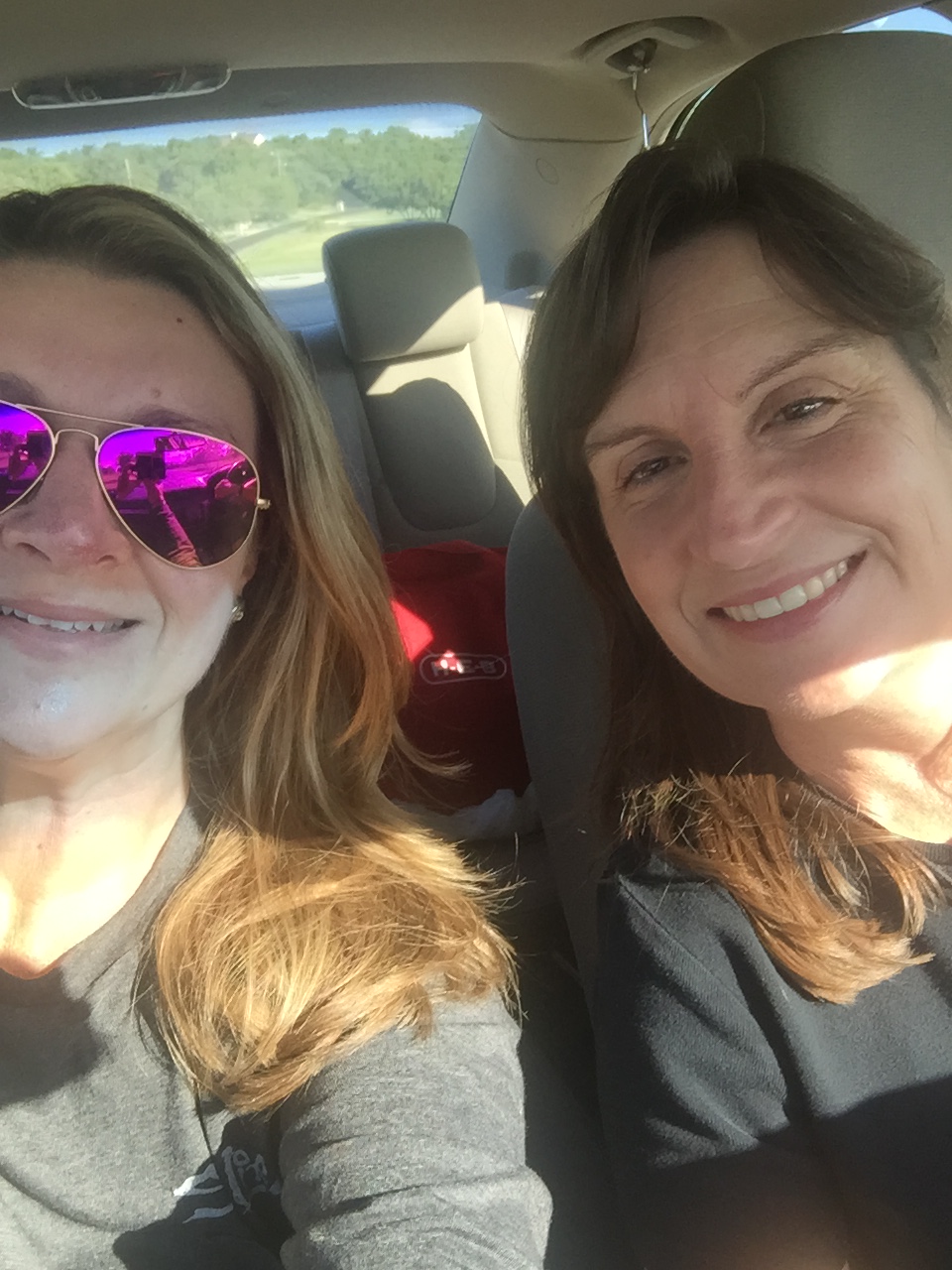
Laura and I hitting the road to go to Bouchercon in New Orleans!

So, since Laura’s book was chosen as a book club choice, that gave me an extra incentive to pull it from my shelf and delve in! Unfortunately, I wasn’t able to make it to the book club so I’m still brimming with the need to discuss it.


So right off the bat, I enjoyed it! It takes place in Port Arlene, Texas, a fictional tourist town near Corpus Christi. Since I grew up in CC, I was immediately interested. She captured the feel of a tourist beach town. I could smell the food, the salty air, and feel the gritty sand that invades everything. And while tourists are having fun eating, basking in the sun, and fishing, they aren’t aware of the seedier side of life that exists along with the plastic fish stuck in nets that are ever-present in the restaurants.

The antagonist is Jamie Rush who is a skip tracer. She also has an extra skill set because she grew up in a family of con artists. She can easily see a con a mile away and she knows all of the tricks that people use when they don’t want to be found. But instead of using her talents to con people, she’s chosen to help people, or at least earn her money honestly. And although she lives in the same area with most of her family, she’s distanced herself and has nothing to do with them.


So when her half-brother contacts her, she ignores his messages. The messages become more urgent when he explains that his daughter, Kristen, is missing. This still doesn’t raise a red flag with Jamie because her niece has pulled a disappearing act before. And Kristen usually has her own cons going on the side. But what if she’s truly in danger? Jamie wouldn’t be able to live with herself if something happened to Kristen and Jamie didn’t check it out.

Added to the mix of characters is Jamie’s trusty sidekick, Cookie, an over-sized, intimidating, tacky Hawaiian shirt-wearing, huggable, fiercely loyal friend. (Enough adjectives for you?) Another friend, a woman who runs a betting operation, who learned the ropes from her father. And another woman who comes from a violent organized crime family. (It’s very interesting to see how these daughters of bad men interact.)

Jamie begins digging in Kristen’s life and what she uncovers is a complicated web of love, revenge, and “just business”.

I thought that this story was going to be a typical “p.i. procedural”. I was lulled into a false sense of security by the laid-back pace of beach town life and then it accelerated non-stop to an incredibly satisfying ending. There were a few surprises in there that kept me turning the pages!

So, if you haven’t gotten this book, get it!


*Warning- Reading this book will also make you crave fried shrimp, cold beer, and the perfect fish taco. Don’t say I didn’t warn you! Seriously, now I need to take a trip to the coast for some fresh seafood and to hear the seagulls.

Further Thoughts on Smell in Literature, or The Dog as Watson


By Helen Currie Foster

An author can get great mileage by giving the point of view to a Watson sort of character. The Watson can be present for all events, hear all dialogue and see all clues—while not understanding them. The Reader feels clever for having grasped the significance of clues the Watson missed or misunderstood. The Watson can admire Sherlock’s astounding mental feats while deploring Sherlock’s shortcomings (sometimes his manners, sometimes cocaine). Meanwhile the reader can identify with the Watson and can experience, perhaps, the feel and sound and… yes, the SMELL of a scene, while Sherlock is detecting or explaining arcana.

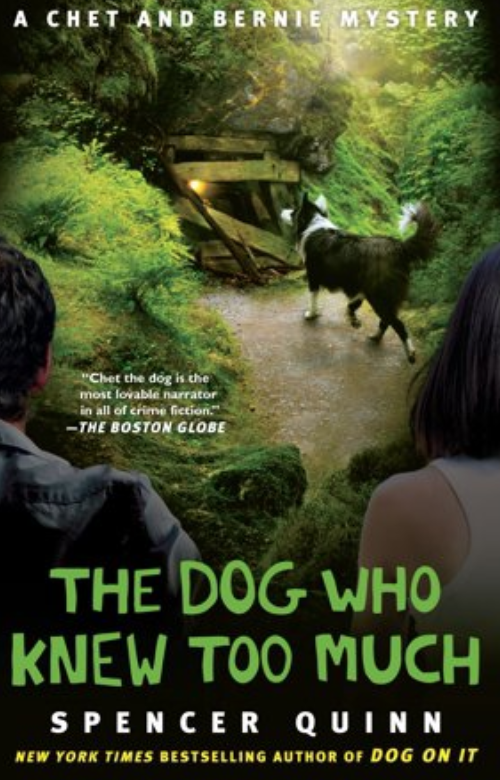
The best Watson I’ve met is…a dog. Yes, it’s Chet, the large (hundred-pounder!) companion and partner of detective Bernie Little in the Chet and Bernie Series. Spencer Quinn (nom de … plume? Or de tail?) of Peter Abrahams is the genius who most recently gave us The Heart of Barkness.

You say you won’t read a mystery told by a dog? I’m not a dog person, and that’s what I said too, turning my inadequate human nose up in the air. (I have donkeys, not dogs.)

Then I met Chet. Chet opened up the astounding sensory richness of the world that lies beyond human (that is, Bernie’s) detection, and, particularly, the world of smell.


Here’s a scene—a scent?—from The Dog Who Knew Too Much:

“Autumn didn’t mention your sense of humor.” Anya gave him a not-very-friendly look when she said that, but at the same time I picked up a scent coming off her—faint but unmistakable—that meant she was starting to like Bernie. Nothing about humans is simple: I’ve learned that lots of times in my career.”


Here’s Chet using his ears as well, when Bernie is banging on the door of the RV where he hopes to find Lotty Pilgrim, the country-western star accused of murder In The Heart of Barkness:

“Silence from inside. Then came footsteps, very soft, but there’s no such thing as footsteps too soft for my ears. Also I could hear breathing on the other side of the door. Plus there were smells of cigarette smoke, coffee, and perfume—and the specific smell of Lotty Pilgrim, which had an interesting milky quality. The door might as well not have been there.

At least in my case. Did Bernie realize Lotty was standing pretty much right in front of us? He raised his voice. “Lotty? Lotty?” Raised it to a level that meant the answer to my question was no.

No answer from Lotty. The milky smell changed, went the tiniest bit sour. I’ve tasted milk both sour and not, don’t like either kind. Water’s my drink. The best I ever tasted came right out of a rock, but no time to go into that now.”

Right there, we see Chet’s astounding ears in action, and his nose. We learn exactly what Lotty could smell like to our human noses, if only the dadgum door weren’t in the way. We learn that Chet can detect that some emotion—fear?—has turned Lotty’s milky smell “the tiniest bit sour.” Then we may wonder whether our human noses could possibly notice, at a subliminal level, what Chet detects as smell? Is our human sense of smell so low-level (Chet’s opinion) that our minds can’t really register certain smells as smells? Instead, perhaps our minds register an emotion, a suspicion, instead of a smell. That is, if we’re on Lotty’s side of the door, which Bernie is not, at least here.

Bernie and Chet make a great team. Chet hears a faraway car sneaking across the desert toward Bernie, way before Bernie hears it. Chet tries to let Bernie know…but Bernie’s slow on the uptake. We readers know peril impends. Listen, Bernie! Pay attention! He won’t, but not until the last second, when Chet must leap into action.

My love affair with Chet is not just his sheer joyousness. It’s his masterful specificity about smell. Here he is, on the job, searching a mountain campsite for traces of a lost boy camper:

     “When it comes to nighttime security, you can’t go wrong by sniffing around. Nothing new to pick up, the scents of the boys still all over the place—although growing fainter—plus Bernie’s scent, Turk’s, and my own, the most familiar smell in the world: old leather, salt and pepper, mink coats, and just a soupçon of tomato; and to be honest, a healthy dash of something male and funky. My smell: yes, sir. Chet the Jet was in the vicinity, wherever that was, exactly.”

Here’s a challenge for you dog people. Give us as detailed a description of your dog’s smell as Chet’s description of his own! Oh, okay, I’ll try to do the same for my donkeys. In November.

Last month I was bemoaning the stinginess of some of my favorite writers in using smells in their writing. Maybe Virginia Woolf—hey, she loved her dogs, wrote about her dogs, doubtless could have described their smells as well as Chet described his, if the times, or the Times Literary Supplement, had permitted—will rise to the challenge. Watch this space.

Murdercon, 2019–The Perfect Ménage à Trois!

By K.P. Gresham

I’m talking about the recent crime writer’s convention recently held in Raleigh, NC. What did you think I was referring to?

To create this perfect threesome, you combine Lee Lofland and his crew at The Writers Police Academy with Sirchie—the leading manufacturer of criminal investigation, forensic and law enforcement products, and add a few crazy crime writers who want to learn new and innovative ways to kill people. Then you title it, Murdercon, 2019, and put all those three elements together in Raleigh, NC for four fantastic days of murder and mayhem. More importantly, the goal of the conference is to teach the mystery writers what REALLY happens in the world of criminal investigation. What we see on TV or the big screen is often a far cry from what really happens at a crime scene and beyond.

For example, I love watching NCIS and NCIS New Orleans (shout out to Captain Archer, A.K.A. Scott Bacula), but let’s be real.  DNA identifications don’t happen in less than a day, nor do face ID’s, fingerprint analyses, or hook-ups to every street camera in the known universe.

The experts at Murdercon absolutely know what they are talking about. In fact, this year’s conference was held at the actual Sirchie headquarters in Raleigh. Okay, so who or what is Sirchie?

Sirchie, founded in 1927 by Francis Sirchie, supplies law enforcement agencies with fingerprinting supplies, advanced equipment, customized vehicles, and kitting services. He got his big break in World War II with his state of the art fingerprinting technology. The U.S. Government awarded Sirchie’s company the contract to fingerprint every World War II soldier, munitions worker, medical personnel—the list goes on. That contract rocketed Sirchie into the forensic investigation giant that it is today.

They “manufacture high-quality criminal investigation, tactical, surveillance, and other police-related solutions including customized special purpose vehicles as well as delivering industry-leading training for public safety, medical, and education communities featuring hands-on learning techniques.” That came straight from their website,  https://www.sirchie.com/. Check out what this incredible company does to keep our country and our world safe.

So, back to Murdercon. The conference was nonstop from dawn to way after sunset. I attended sessions on latent fingerprint development, fire arms and ballistics, an impromptu talk given by David Alford, one of the FBI’s lead Crime Scene Investigators of the Unibomber’s cabin, and a session on “Weapons of Mass Destruction”. (Scared the pants off of me, and yes, I’m going to use the info in a book!) We got to touch, use, experience some of the equipment Sirchie develops, and we even got a tour of their factory.

But the one-on-one interactions between the experts and writers was the best part for me.  Thanks to the patience of James Reynolds, a Sirchie guru who helped lead the conference, I was able to get my crime scene for an upcoming book “just right”. For two hours he helped me line up who had to be where, what evidence would be left, how the investigators would find it—the entire experience was off the charts. By the time we finished mocking up the crime scene in the hotel lounge, I think we’d scared some folks away—were we really planning a crime?

Hats off to those who put together this incredible conference. A perfect ménage à trois ? More like a match made in heaven!

PLAYING FOR PIZZA – by John Grisham

Written by Francine Paino

  The master of suspense took a break from his usual mystery, crime, and thriller books to write Playing for Pizza; a football story hatched as he researched settings for another novel.  

Playing for Pizza tracks a third-string quarterback for the Cleveland Browns in what turns out to be a life lesson – the question is, will he learn?

Poor Rick Dockery. With only minutes left to play, in the AFC Championship game, Dockery comes in as Quarterback with a 17- point lead and snatches defeat from the jaws of victory.  Rick ends up in a hospital, recovering from the concussion he suffered along with the loss. His agent, Arnie, and the duty nurse discourage him from remembering too much of what had happened, but eventually, poor Rick does remember and then learns that virulent Cleveland fans want to storm the hospital and dismember him – or at least run him out of town on a rail. In addition to the disaster, his agent informs him that the Browns have released him and no other team wants him – he is unemployable in the NFL, but Rick isn’t done with football – he can’t be; it’s all he knows.

Dubbed by an unforgiving and vicious press as “the greatest goat in the history of professional sports,” Rick has hit rock bottom.  His agent suggests that it might be time to find another profession; Dockery, however, refuses to give up. Arnie is running out of patience and ideas, not to mention the fact that he isn’t making any money representing the disgraced Quarterback, yet he makes “one more call,” to an old buddy.

Coach Russo is looking for a QB for the Panthers—of Parma, Italy. They play at a Division 3 level – maybe. Russo wants an American QB to lead his team of tough Italians, whose professions range from truck drivers to airline pilots and everything in-between. These men hold full-time jobs and play for love of the game, and pizza!  As one of the three Americans allowed on any team in Italy, Rick will be provided with a car, rent money and a very small salary – nowhere near the pay scale in the NFL.

With no other options available, feeling the pressure to get out of the States, filled with resentment and self-pity, Rick Dockery accepts the job. He flies off to a country he barely knows exists and a city he’d never heard of before.

The coach meets him at the airport and immediately realizes that Dockery is in for a few shocks. Coach Russo crash courses Rick in Italian football. The Panthers are on an eight-game schedule with play-offs and a shot at the Italian Super Bowl. At the same time, Rick must cope with stick-shift small cars, bumper-to-bumper parking, and the culture of food, wine, and opera– things about which Rick Dockery knows nothing. By his own admission, his education consisted of football, Phys. Ed., more football, and cheerleaders. 

Rick begins the process of adjusting to his new circumstances and his new team. Secretly, he believes he would be hiding out in Parma for a while and would return to the States after other NFL teams forgot his humiliation and offered him a spot.

One vicious reporter from Cleveland, however, finds out where Dockery is and has no intention of allowing him any salvation in football. The reporter stalks him and reports back to the Cleveland Post on Dockery’s progress, turning anything Dockery does well into a series of “lucky breaks.”

Throughout, we watch Dockery cope with the culture shock of a completely alien environment while melding with teammates who are unlike any he’d ever encountered in the States and somehow, play his best football.

Sometimes the story feels like a travel guide through northern Italy and a play-by-play in football, but it’s told through the eyes of a lost soul on a life journey. Dockery learns that in Italy, although “it (footfall) was just a club sport, winning meant something – commitment meant even more.”

By the end of Rick’s story, we see a man emerge from the immature self-absorbed, culturally deficient boy/man who’d arrived in a foreign country only a few weeks before. Moreover, if you are a football fan, the last game is a heart-stopper.

There’s no fairy-tale ending here. Dockery has choices to make, but he finds confidence, becomes comfortable in his own skin, and learns the real meaning of playing for pizza.

It’s not a new release, but it’s still a great summer read.

We Don’t Need No Stinkin’ Rules

Alpine 2014 137

Last week I attended the Writers’ League of Texas Summer Retreat in Kerrville, Texas. I was in the Write Away section–didn’t take a class but spent all day writing–and I got a lot done. The week was pleasant. But I’d been to WLT retreats before, and this one just wasn’t what the others had been. Something was off. 

It took me four days to figure out what was missing: Gale.

Austin Mystery Writer Gale Albright and I were retreat and workshop junkies, and we attended them together whenever we could. The highlight was the 2014 WLT retreat in Alpine. We took the class in That Damned Rough Draft, where novelist Karleen Koen told us she couldn’t teach us to write, but she could teach us to play. We spent the entire week engaged in activities designed to stimulate creativity–in other words, playing.

Gale didn’t really need to be taught to play. She was already an expert. Under her direction, we played all over the greater Alpine area–Marfa, Terlingua, Fort Davis, the MacDonald Observatory, Big Bend. We considered taking a side trip through Del Rio on the way home, but absence of a gasoline station in Marathon (I think we were looking in the wrong place) turned us around and sent us back the way we’d come. We enjoyed being crazy, but we weren’t stupid.

Gale died in 2016. Without her, retreats just aren’t the same.

This week, AMW repeats the post Gale wrote about that WLT Summer Retreat in Alpine in 2014 and some of the things we learned while Karleen taught us to play. ~ M.K. Waller

***

Rules for writing?

Outline? No outline? Seat of the pants?

Karleen Koen, instructor for That Damned Rough Draft at the Writers’ League of Texas summer writing retreat at Sul Ross University in Alpine, says there are no rules for writing. And she never said the phrase, “We don’t need no stinkin’ rules.” That’s my inner child cutting up.

She said she wouldn’t teach us to write, but would help us learn how to play. If you play, your inner child, your subconscious, will make itself known and your writing will be the richer for it.

And another thing. Writing a novel is hard–real hard.

We are adventurers, embarking on the quest of a lifetime, daring everything on a wild, reckless throw of the dice. Fame and fortune. Or maybe no one will pay attention at all.

According to Koen, a writer’s tools are her words. An artist has brushes and canvas, a sculptor his clay. We have only words to bring a whole new world to life, a world of our own creation. We must lure and seduce readers to enter our world with our use of words.

Not Rules but Suggestions:

Don’t talk your story away. Energy you need for the story goes out at the mouth.

Writers are looking for affirmation. We never get enough.

Grant yourself permission to write badly. The point is to be writing.

Poetry helps writers with their voice. Karleen Koen always reads poems before class begins.

Writing the rough draft is not a time to perfect your prose. Let your subconscious work with you. A rough draft is not linear. The novel is hard. You have to willing to commit to the marathon. Not the sprint.
Alpine 2014 135You have to pay attention to anything that excites you as a writer.

Nobody can see our hard work if we’ve done our work right. It looks slick. Bumps come with writing novels.

Our suffering is invisible to everyone but us.

Magic and alchemy are part of a story. They take the reader to another world.

You need time and space to create.

Don’t compare. Everybody feels bad when you compete

I need to know what I don’t know. I want to get the story finished. Have I bitten off more than I can chew?

What makes a novel? Hook, plot, tension, character, dialogue, scenes, ending, middle, beginning–magic.

Painters have color

Sculptors have clay.

All writers have are words.

Karleen suggests these daily exercises to tempt forth your magic, muse, subconscious, inner child, whatever makes you tick.

Keep a writer’s diary and write about your writing self every day.

Write three longhand morning pages first thing when you wake up every day, no editing. Don’t think. Just write whatever comes into your  head.

Alpine 2014 114Take photographs and write about them. Take pictures of whatever “pings” in  your gut. Write about why.

Don’t let your editor subdue your creator, even in revision.

Don’t share writing with just anyone. Writing is part of our inner child. Too much criticism shuts you down.

Your first reader is very important. All you want to ask the first reader are three questions about your manuscript:

  1. What did you like?
  2. What do you want to know more about?
  3. Where did I lose you?

This will help shape the novel and show where you are off pace.

Cool down between drafts.

Learn to play with words. Be creative and loose.

Find a niche that’s well calibrated to your interests and your talent.

You can only develop your voice by writing.

Enter your story and take us with you.

Know how your hero/heroine is going to be transformed by the end of the novel.

Sometimes revision can lead to beating a dead dog. You’ve been to the well too many times.

You adventurer,  you.

Alpine 2014 206My inner child likes murals. Is there a novel in them?

By Gale Albright

Review of Billy Kring’s book Degüello

by V.P. Chandler

I just finished reading Degüello: A Hunter Kincaid Mystery (The Hunter Kincaid Mysteries Book 6) by Billy Kring and have to tell you about it.

My introduction to Billy Kring’s writing began with his first Hunter Kincaid book, Quick, and I was both hooked and blown away.

Hunter is a tough, female border patrol agent who doesn’t back down from a fight. She faces incredibly tough situations with grit and feeling. I love her! She can drink beer and eat spicy tacos with the rest of the guys, on both sides of the U.S. southern border. And her tenacity and instincts are still strong in Degüello.

(Some of you may be wondering what “degüello” means. It can mean, slaughter, massacre, a killing off, or a beheading. Wiki also says that there’s a bugle by the same name. “The Degüello is a bugle call, notable in the US for its use as a march by Mexican Army buglers during the 1836 Siege and Battle of the Alamo to signal that the defenders of the garrison would receive no quarter by the attacking Mexican Army under General Antonio López de Santa Anna.”)

And when you get to the end of the story, you’ll see that this description is appropriate. I don’t know if Kring knew about the bugle when he came up with the title, but it sure fits!

So let’s get to the story. Children are being kidnapped in Mexico and brought to the U.S. to be sold to the sex trade. They are put on an airplane near San Angelo, Texas and transported to other parts of the world. Kincaid comes across the transfer of children along the border and is able to save a child but the kidnappers escape. Then a mother of a missing child begs Hunter to find her daughter. Hunter hesitates because there are rules that she has to follow, but she wants to do what she can to help. Through circumstances, it ends up being all up to her and Ike, a former body guard of a drug cartel kingpin.

The story is full of action and cunning characters. (Poor Ike is taken to the hospital twice.) As the description says on Amazon. “Sorely outgunned and outmanned, but to save the captives, Hunter puts a desperate plan into motion, and what follows is a storm of smoke, fire, and blood, and who will survive is anyone’s guess.”

You can’t beat that!

P.S. As a side note I’d like to add my favorite line that comes towards the end of the book. A character says that Hunter came to the rescue  “Like Wonder Woman charging into No Man’s Land.”

I love Wonder Woman and that’s one of my favorite moments in the movie. And the description is spot on.

So I guess you can tell that I liked it. Go check it out and the other Hunter Kincaid books. Here’s a link to his Amazon page.

Billy Kring on Amazon

How Did She Think of That? And How Did Adamsberg Figure It Out?: Thoughts on Fred Vargas and her Policiers

by Helen Currie Foster

Fred Vargas by Marcello Casal/ABr, licensed under CC BY-3.0 BR. Via Wikipedia

Her sheer imagination, her complex and nearly crazy—yet convincing—plots, have won Fred Vargas three International Dagger Awards from the Crime Writers Associationfor her policiers, or police procedurals. Vargas is the nom de plume of Fréderique Audoin-Rouzeau, a French medieval historian and archeologist (born in Paris 1952) who worked at the Institut Pasteur. Vargas provides a vividly unusual police environment with her Paris-based Serious Crime Squad, headed by Commissaire Jean-Baptiste Adamsberg. I immediately fell for her idiosyncratic protagonist—Adamsberg is Pyrenees born, left handed, a water-colorist who paints in order to puzzle out murder inquiries, and who alternately frustrates and mesmerizes his staff through his unconventional thinking. Vargas has steadily added a cadre of interesting characters to Adamsberg’s team, each quite odd in his or her own way (not forgetting the large white cat which sleeps atop the copier and must be carried to its food bowl—a cat which demonstrates great heroism in This Night’s Foul Work) (tr. 2008).

Click here to read the original post at Ink-Stained Wretches.

Building Character Profiles While Fighting the Battle of the Bulge

Francine Paino

The Battle of the Bulge, (December 16, 1944–January 16, 1945), was the last significant German effort to split the allies at the Ardenne Forest….

Oops. Sorry. I wrote this at 4:30 a.m. I hadn’t had enough coffee.  

Although the Battle of the Bulge or the Ardenne Counter-offensive was a major military campaign and an important part of WW II, that’s not the bulge that concerns me.

We writers sit in front of computers or writing pads, or typewriters (LOL) for hours each day trying to convert into words the stories playing like movie reels in our brains to entertain others. We continue to study the craft – necessary to improve as writers – also done sitting—thus, we don’t usually get the exercise we need for good physical conditioning and creative thinking.

 Stanford University study:  https://news.stanford.edu/2014/04/24/walking-vs-sitting-042414/

Another interesting article, among many, claims that scientists have now discovered that exercising regularly, in any manner you choose, such as bike riding or walking, do improve creative thought.  

https://www.telegraph.co.uk/news/science/science-news/10491702/Lacking-inspiration-Exercise-found-to-boost-creativity.html

However, a word of caution. Exercise cannot become another tool for the number one writers’ disease: Procrastination!

So, what to do?

For myself, now that my metabolism has deserted me, I feel the need to get on that treadmill—which I hate—and force myself to move along at a respectable pace, or spend 15 hard minutes twice a day with an exercise hoop – which I hate even more.

I’ve tried too many forms of physical exercise to list, but after a long, long story, ‘I’ve decided the treadmill suits me best because it allows me to study different characters in my collection of recorded movies, while meeting the demands of a workout.

Thus, while I’m trying (a child’s term) to take off some of the bulges in places that lumps and bumps don’t belong, I’m doing some passive character analysis and development too.

Among my favorites are the British ladies in Tea With Mussolini, set in 1930’s Florence, Italy. Maggie Smith is the elitist, widow of a British Ambassador, which she never lets anyone forget. Dame Judy Dench, an artist of limited talents devotes herself to helping restore artworks in Italian churches, and Dame Joan Plowright plays an upstanding British lady who works for an Italian reprobate dealing with British imports. ‘Plowright’s portrayal of Mary Wallace’s character inspired some of the characteristics of my Mrs. B. in I’m Going to Kill that Cat.

Add to this list of fascinating characters….Cher. She portrays a free-spirited, wealthy, boisterous and good-hearted American Jewish actress who finds herself deceived by an Italian-Nazi operative.

Another movie favorite is Larry Crowne, a very modern-day situation. Tom Hanks portrays the affable, title character in a story about how life can throw more curve-balls than Sandy Koufax.

Larry Crowne must change or perish. Hanks portrays his character with a constant optimism, even in the face of hard-knocks and fears; Crowne adapts. As he meets new challenges in his life, he also meets an embittered professor, played by Julia Roberts. 

Watching these and other movie characters change and grow in the face of conflict, and painful circumstances provide insights that help me show growth and development for those who live in my head and in my stories.

So, now that I’ve shared one of my methods of adapting exercise to the craft while fighting the writer’s battle of the bulge, I hope I’ve provided some inspiration. It certainly can’t hurt writers to stimulate the circulation of blood to the brain.

Moreover, there is an additional benefit that I’ve not seen discussed: the reduction of guilt. Guilt for not exercising and guilt for not writing in order to exercise.

So, get out there. Walk. Look at nature. Indoors, ride a stationary bike or jog on a treadmill while watching movies or reading books. Work your body and your creativity.

Happy writing!