Please Take (a) Note!


by Helen Currie Foster

Lately I’ve been thinking about remarkable people who never got to see the significance of their work, regardless of its brilliance. People whose minds moved so fast their words didn’t compute, for most listeners. People whose contributions went unrecognized for many years. And if they hadn’t written down their ideas? Maybe eventually someone would have made the same discoveries, but when?

Here are just three.

I’d never heard of Simon Stevin until I read Michael Pye’s The Edge of the World (2014), on how modernity reached the shores of the North Sea. Stevin, born illegitimate in Bruges in 1548, worked as a book-keeper in Antwerp, and then enlisted at the liberal new Leiden University. He produced a book on double-entry book-keeping and another on figuring the interest on borrowed money, when publishing such hard-won information was a subversive revolutionary act. This “engineer, book-keeper, king of numbers,” per Pye, wanted to make math work in the everyday world. 

Stevin tutored his student friend Prince Maurits in math, beginning a lifelong association. He made the prince a sailing chariot for the beach, with two sails, four great wheels, and flags flying. Stevin informed the prince the earth went around the sun. When Maurits became king, Stevin became an army engineer, devising, pumps, dredgers, windmills. He produced an influential treatise on fortifications and another on how to calculate longitude at sea. He wrote a book asking Dutch cities to adopt uniform money measures, suggested a decimal system, founded a mathematics curriculum at Leiden. And he wrote down these ideas! Stevin’s dream, that explaining practical mathematics would help his country thrive, eventually came true––though not necessarily in his lifetime.

You already know about the world’s first computer programmer? Another who did not live to see her work recognized is Countess Ada Lovelace, Lord Byron’s daughter. At seventeen she began helping mathematician Charles Babbage with his “difference machine” for math calculations. In 1843 she published an article in an English science journal describing processes we now call computer programs, including how to create codes using letters and symbols as well as numbers. She died of uterine cancer in 1852, at 37. Her work came to public attention in 1953 when B.V. Bowden republished her notes in Faster than Thought: A Symposum on Digital Computing Machines. In 1980 the U.S. Department of Defense named a new computer language “Ada.”

“We’re still catching up with one of the greatest minds of the last century.” That’s Anthony Gottlieb, “The New Yorker,” May 4, 2020, on Frank P. Ramsey. Ramsey––a Cambridge (UK) scholar whose genial brilliance intimidated his professors when he appeared on campus at 18––died at only 26, in 1930. Economists, philosophers and mathematicians are still exploring the “Ramsey effect” on their disciplines. He was immediately taken up by Maynard Keynes, and refuted Keynes’s fuzzy notions of probability. He was tapped to translate Ludwig Wittgenstein’s “Tractatus Logico-Philosophicus” from Germanas the only German speaker available who could not only understand what Wittgenstein was trying to say, but say it more clearly (he reportedly dictated his translation).In one paper he created two math theorems which, decades after his death, became part of the “Ramsey theory” analyzing order and disorder. (See video of a student working a Ramsey probability problem). Ramsey’s modesty about his astounding abilities made him appear almost offhand about his accomplishments.

As a student of Virginia Woolf, I blinked twice to find Ramsey appearing in her diary (February 1923).

Yes!–– at dinner with Maynard Keynes. “Ramsay [sic], the unknown guest, was something like a Darwin, broad, thick, powerful & a great mathematician, & clumsy to boot. Honest I should say, a true Apostle.” Keynes at least tangentially belonged, with Virginia and Leonard Woolf, to the Bloomsbury group, which included several members of the select Cambridge “Apostles” club (including Leonard Woolf). In 1927, Woolf published To the Lighthouse about a family she called the Ramsays, where Mr. Ramsay, a professor, fears that though he has reached Q, he lacks genius and will never be able to think his way past Q, that he’ll never reach R: “How many men in a thousand million, he asked himself, reach Z after all?” If Woolf had known then what we know now she’d have known Frank Ramsey could easily have reached R and zoomed on past Z. 

Okay, I admit I took the Special Math Course for English Majors to get my math graduation credit. Yes, I did. Nevertheless I’m doggedly staggering through the first full biography of Ramsey, Frank Ramsey: A Sheer Excess of Powers, by Cheryl Misak (Oxford Press 2020), fascinated by his mind and especially his lightly worn “sheer excess of powers.” I might, even, try to find his 1926 paper about truth and subjective probability, where he said we should take account of people’s judgment of probability.” 

Now there’s a pungent topic for mystery writers. At every turn, our characters use subjective probability to make decisions. “Can I kill without being caught?” “Can I catch this villain without being killed?” “Have I examined all the what-if’s here?” “What are the chances anyone will recognize me?” Suspense lies in decisions made on subjective probability.

Okay, so Ramsey died without knowing that ninety years later University of Georgia students in hoodies, poised at the whiteboard, would be filming explanations of “Ramsey Theory.” Ada Lovelace died without knowing the Defense Department would name a computer language for her.  If asked, would she have preferred Countess? Would she be fascinated by the world of hacking? Simon Stevin would drive our city streets, ready to opine on public transportation–would he recommend air-conditioned tubes, with moving sidewalks, to move people east and west across Austin? Or possibly a sailboat with wheels?

Now we come to you. Yes, you. How will we know what you thought?

Stevin, Lovelace and Ramsey at least published some of their work. You can go farther. You own your copyright as soon as your work is “fixed.” You can also provide notice of copyright by using the symbol or the word “Copyright” and your name and the year of first publication, and registering your copyright by paying the required fee and depositing required copy(ies) of your work, thereby creating a public record of your copyright claim. (See details and requirements here.) 

That’s at least a start. As for Aeschylus, only seven of his seventy to ninety tragedies remain intact. Sophocles? Only seven of over a hundred remain. Euripides? Eighteen of over ninety-five remain. Sappho? We have only two complete poems out of her nine books of verse, from the woman the ancients called “the tenth Muse.”

Will depositing your work at the Library of Congress––oh yes, you must––give us some assurance we can know your ideas, your writings, a century hence? The Alexandrian Library didn’t fare so well. Nor did the Dresden Sächsische Landesbibliothek which lost perhaps 200,000 volumes in the Allied bombing of the Dresden historic center. The 1986 fire at the Los Angeles Library burned 400,000 books.

No guarantees, but it’s a start. At least try to leave the world a copy. Even if you leave us too soon, even if fame has not yet arrived…you never know. A century from now, maybe…?

Beware, Sherlock Holmes!

By K.P. Gresham

The spring of 2020 has provided me with the opportunity to return to one of my favorite pastimes…and escapes.

READING!

And why not get back to my favorite sleuth, Sherlock Holmes?

I’ve spent the last few months catching up present-day iterations of the iconic and prolific Sherlock Holmes. Arthur Conan Doyle’s private detective first saw publication in 1887. Since then, authors (and screenwriters) around the world have given a go at their take on the famous detective.

My first selection was The Lady Sherlock Series by Sherry Thomas.  As its title suggests, Sherlock Holmes is actually a woman names Charlotte Holmes. This turned out to be a delightful read. Thomas creates a storyline that sounds far-fetched but pulls it off with insightful references to the original Doyle short stories. The mysteries she’s created don’t allow you to put the books down.

Next, I turned to Laurie King’s bestselling novel, The Beekeeper’s Apprentice. In this book and those following in the series, an aging Sherlock is befriended by (or is it she who befriends him?) a highly observant, seventeen year-old woman who rivals his abilities in observation and deduction. She soon becomes his apprentice in the detective game, and then…well…the game’s afoot!

Anna Castle writes a delightful series, The Professor and Mrs. Moriarity Mysteries. In her incredibly believable way, Castle creates a world where Professor Moriarty is the good guy, and Sherlock Holmes is not. Not exactly, anyway.

Other authors have had their own way with Holmes. The Sherlock Holmes – Anthony Horowitz Series comes to mind as well as the Anna Elliott and Charles Veley series, The Sherlock Holmes and Lucy James Mysteries. Even Kareem Adbul-Jabar co-wrote a series based on Mycroft Holmes.

Now the warning. Reading all these Sherlock Holmes iterations (and binge-watching movies/series featuring Basil RathboneJeremy BrettRobert Downey, Jr. and Benedict Cumberbatch) puts one in a mood to eat. Apparently I’m highly suggestible when reading a good book. When the characters have tea, I want tea. And I’m not just talking about the beverage. I’ve been chowing down on tea sandwiches, scones, pastries, desserts–and I’m not even a sweets lover. And when a character in the book has had a shock or a close call, whiskey is handed out in short order. Now I don’t drink whiskey, but I manage to find my own libation. I hate to see a character drink alone.

So thanks to that lean, tall Sherlock Holmes, I have put on the extra pounds that he willfully sheds when he’s on the hunt for a villain.

Alas.

If you’re looking for a comfort binge in these difficult times, I suggest you give Sherlock Holmes a try. But remember! You’ve been warned that you might come away with more (weight) than you bargained for!

True Crime Podcasts Worthy of Binge-Listening

by V.P. Chandler

VP Chandler


Several years ago AMW member Laura Oles suggested that I might like listening to true crime podcasts. She kept talking about one titled, Serial.

“Yeah, yeah, I don’t really do the podcast thing.”

Then our family was scheduled to take a trip to West Texas. It’s not exactly a short drive to get there, so I thought it would be a good opportunity to try it out. I downloaded the whole first season onto my iPad and we were off. And ever since then, I’ve been hooked.

Serial’s description of season 1 (2014) from their website,

“A high-school senior named Hae Min Lee disappeared one day after school in 1999, in Baltimore County, Maryland. A month later, her body was found in a city park. She’d been strangled. Her 17-year-old ex-boyfriend, Adnan Syed, was arrested for the crime, and within a year, he was sentenced to life in prison. The case against him was largely based on the story of one witness, Adnan’s friend Jay, who testified that he helped Adnan bury Hae’s body. But Adnan has always maintained he had nothing to do with Hae’s death. Some people believe he’s telling the truth. Many others don’t.”

And let me tell you, Serial has won many awards and they are well-deserved.

As we left the rolling hills for flat roads flanked by mesas, we were pulled into the story. After each episode, we’d dissect the new evidence and theories. We felt like detectives. Are the witnesses telling the truth? Who is lying and why? Is there other evidence? Why would they make such bad decisions? Hearing the voices of the real people involved made it even more real. Sometimes we’d be certain that someone was going to lie, but after their interview, we were sure that they were telling the truth. *conundrum* It’s not easy being a detective.

And while we were caught up in the drama and intrigue, there were also somber reminders that these were real people who have been caught up in horror and heartache. When you hear how much they hurt, that they just want answers, it pulls at you. How can detectives and reports handle talking to them? I don’t think that just anyone could put together one of these investigative reports. It takes months and even years to follow leads. And it also takes a special talent to walk that thin line of pushing to get answers, and yet remaining sensitive to the feelings of friends and family. The reporters often say to the listeners that they purposefully hold back in order not to re-traumatize people. I think that’s extremely important to mention. And all of the podcasts that I mention follow that rule of conduct. I’m constantly amazed at the editing skills of these shows. Their sense of story is strong. They know how to piece it together while still uncovering new evidence.

Here are other podcasts that I’ve enjoyed. They are fascinating.


S-Town

“John despises his Alabama town and decides to do something about it. He asks a reporter to investigate the son of a wealthy family who’s allegedly been bragging that he got away with murder. But then someone else ends up dead, sparking a nasty feud, a hunt for hidden treasure, and an unearthing of the mysteries of one man’s life.”

It doesn’t go like you think it will. But it’s a peek into a fascinating man’s life and the people that know him.

Missing and Murdered


I thought that this show was called “Finding Cleo” and I was confused that the first season was about a woman named Alberta Williams. So don’t let that confuse you.

Season 1  “Sparked by a chilling tip, Missing & Murdered: Who Killed Alberta Williams? is an eight-part podcast investigation that unearths new information and potential suspects in the cold case of a young Indigenous woman murdered in British Columbia in 1989.”

The second season is about finding out what happened to a girl named, Cleo. “Like many Indigenous children, Cleo’s brothers and sisters were taken from their community, displayed in advertisements, and sent to live with white adoptive families across North America, through a controversial program called “Adopt Indian and Metis.” They’ve reconnected as adults and are determined to find their missing sister and penetrate the secrets shrouding the truth about Cleo. CBC’s Connie Walker joins in their search, uncovering disturbing new details about how and why Cleo was taken, where she wound up, and how she died.”

Both of these stories are about indigenous families in Canada and the suffering that that communities still experience. I knew that there is an epidemic of women being killed and their plight is just now getting media attention. But I hadn’t known about the Highway of Tears. It’s a highway in British Columbia where many indigenous women have either been killed or dumped. The reporter, Connie Walker, is Cree, so she brings an extra knowledge and sensitivity to her work.

Your Own Backyard

“A documentary podcast series investigating the 1996 disappearance of Cal Poly student, Kristin Smart.” It’s Only 7 episodes long, so it goes fast. Trust me, you’ll end up binge-listening to it.


Someone Knows Something

This series has 5 seasons. I’ve listened to the first two seasons.

Season 1
“In 1972, five-year-old Adrien McNaughton vanished while on a family fishing trip in Eastern Ontario. Despite an intensive search and investigation, no sign of Adrien was found, no clue as to where he might be. The case has hung over the area like a dark mass ever since, especially in the small town of Arnprior, where the McNaughton family lived.”

It was sad and fascinating. I learned a lot about cadaver dogs. (It’s not as gruesome as it sounds.)

Season 2

“On December 31, 1997, at a New Year’s Eve party broadcast on live TV, Sheryl Sheppard accepted a marriage proposal from her boyfriend, Michael Lavoie. Two days later, she disappeared. In Season 2 of SKS, David Ridgen joins Sheppard’s mother Odette on her search for answers.”

I’m very impressed with his laidback technique for speaking with people. He’s a good reporter.

The next one I’ll be listening to is

Uncover

(I’m interested in season 6, Satanic Panic, but I’m sure I’ll start with season 1. I always have to start with the first one.)

So there you have a list of very good true crime podcasts that will keep you busy. I’ve found that they make a long drive or doing housework more enjoyable. *Forewarning, not all mysteries are solvable. Unlike fiction, they can’t be solved and wrapped up in a bow. I think that adds to the tension and desire for a conclusion. But it also gives the listener a sense of what families and police face in trying to find the truth.

Do you have a favorite? Please, let me know. I’d like to add it to my library.


THE USES OF DISGUISE

By Helen Currie Foster

So, did you dress up for Halloween? Did you buy a mask in New Orleans, or Venice, perhaps one with feathers? What would you wear to a costume ball?


“Man is least himself when he talks in his own person. Give him a mask and he will tell the truth.”  Oscar Wilde

“Man is a make-believe animal—he is never so truly himself as when he is acting a part.” William Hazlitt

Both statements have some truth. Maybe Oscar Wilde meant that when we can hide our faces, or adopt a disguise, we feel free to do what we want––without hesitation or regret.  Yell “trick or treat!” Dance at the masked ball as a glamorous mystery person!  Rob the stagecoach! Maybe writers understand Hazlitt: we’re at our best, writing, as we invent characters, invent parts for the characters, invent disguises. Yes, we’re at our best “acting a part…” and we act many parts as we write.

At my college there was a costume room where students could buy clothes from decades earlier.  One year a group of us rummaged around and found remarkable outfits which we’d don sometimes for fun. For $1.50 I acquired a stunning long black silk evening sheath from maybe 1919, with black sequin trim under the bodice, slits in the sides of the skirt, and two long black “wings” attached to the shoulders that I could use like a shawl, or like… wings. When I put that dress on––SHAZAM! I wasn’t a young thing from Texas, I was the embodiment of glamour. (Where is that dress?) So, what’s the outfit you wear, or dream about, when you’re ready to put on that black cat-eyed mask from (New Orleans) (Venice) and enter the party? The disguise you’d choose? The disguise that would let you do what you want, learn what you want, go where you want?


Two genres especially abound in disguise: children’s literature, and mysteries.

Disguise lets us learn what may otherwise be unavailable. Think of T. H. White’s The Sword in the Stone, where Merlyn (White’s spelling) enchants Wart (the future King Arthur) by turning him into a perch in the moat. Wart learns to swim from a fish called a tench, who reminds him, “Put your back into it.” He’s taken to learn about power from the King of the Moat, a murderously hungry four-foot long fish: “The power of strength decides everything in the end, and only Might is right.” He learns from his night as a merlin, in the terrifying catechism imposed by the peregrine, that the first law of the foot is “Never to let go.”

Harry Potter, Hermione and Ron need information to foil the Dark Lord, and to raid Gringotts Bank and the Ministry of Magic. They resort to the invisibility cloak, or use Polyjuice Potion to look like Bellatrix, or Crabbe and Goyle.


But knowledge won by disguise carries peril. Wart barely survives the unscrupulous King of the Moat, having to dive “the heartiest jack-knife he had ever given.” The moment when Harry Potter’s invisibility cloak slips, when the Polyjuice potion wears off, threatens exposure and punishment.

Kim, in Kipling’s beloved novel, disguises himself to learn secrets as a child spy for the Company’s intelligence service in India. But Kim doesn’t see disguise as work. He revels in the sheer joy of successful impersonation. He rejoices in the walnut dye that lets him escape on a railroad journey to meet his lama, where he tries out various personae, explaining to the passengers “that he was assistant to a juggler who had left him behind sick with fever.” As the occupants of the train car change, “he varied this tale, or adorned it with all the shoots of a budding fancy…” This joyous talent becomes dangerous as he adopts Mohammedan garb, spying for Mahbub Ali, and priestly garb as he chases Russian spies across the Himalayan foothills.

Maybe Kim’s an exemplar of Hazlitt’s statement, that “man is never so truly himself as when he is acting a part.” When fate requires a disguise—or just for fun on the Indian railway––Kim uses all of himself to create that disguise, summoning memory, imagination, accent, intonation, clothing, gesture, posture. As actors do! Perhaps all these disguises are part of him…though not all of him.


Like Kim, Sherlock Holmes (or Arthur Conan Doyle) loves disguise. Remember “A Scandal in Bohemia?” Disguises everywhere! First, a client sporting a “black vizard mask” seeks help from Sherlock Holmes. The client’s disguised as the Count von Kramm, a Bohemian nobleman, but confesses he’s actually King of Bohemia. He wants Holmes to “repossess” (snitch) a compromising photograph of the King and the famous beauty Irene Adler.

Holmes himself then adopts disguises. First, to spy on Adler, he appears as “a drunken-looking groom, ill-kempt and side-whiskered, with an inflamed face and disreputable clothes,” so convincing that Watson “had to look three times before I was certain that it was indeed he.” Next he plots a disguise to gain entry to Adler’s house, where the photograph is hidden:

“He disappeared into his bedroom and returned in a few minutes in the character of an amiable and simple-minded Nonconformist clergyman. His broad black hat, his baggy trousers, his white tie, his sympathetic smile, and general look of peering and benevolent curiosity were such as Mr. John Hare alone could have equaled.”

Watson notes that it was not merely that Holmes changed his costume: “His expression, his manner, his very soul seemed to vary with every fresh part that he assumed. The stage lost a fine actor, even as science lost an acute reasoner, when he became a specialist in crime.”

But Conan Doyle fools us yet again. Holmes orchestrates a street melée whereby a crowd (of accomplices) carry the clergyman into Adler’s house. When Watson throws a fire rocket through the window, Holmes, as predicted, sees Adler rush toward the photograph’s hiding place. On their way back to Baker Street Holmes happily tells Watson about his ploy, but as he searches for his door key, he hears “Good-night, Mr. Sherlock Holmes,” from “a slim youth in an ulster who had hurried by.”

Foiled again––Holmes, that is. Irene Adler, disguised as a boy, has followed him home and confirmed the “clergyman” was Holmes. The next morning Holmes and Watson discover her house is empty, the photograph’s gone, and his disguises were in vain. That’s “how the best plans of Mr. Sherlock Holmes were beaten by a woman’s wit,” says Watson.

Holmes does love a good disguise, and maybe that’s why he can recognize one. For another example of his Hazlitt-esque behavior, see “The Man with the Twisted Lip,” where Watson almost doesn’t recognize Holmes as an aged opium smoker, and Holmes susses out the (disguised) truth about the disappearance of a client’s highly respectable husband by (literally) washing clean the face of a notorious street beggar.

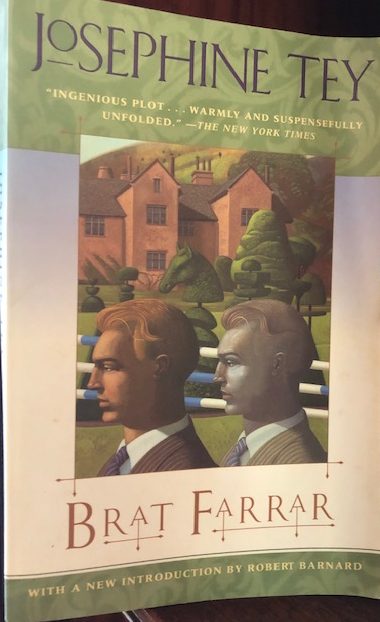
Josephine Tey teases us with disguise in Brat Farrar where the mystery turns on whether Brat Farrar, a young man who introduces himself as the long-lost heir to the Ashby family estate, is or is not Patrick Ashby, thought to have killed himself, leaving his minutes younger twin Simon as putative heir. Simon will be dispossessed if Brat Farrar is for real. The point of view is frequently in in Brat’s head, and we must decide if we like this disguised pretender as a protagonist, or not. He himself is ambivalent, arguing with himself about the whole scheme: On the one hand, he thinks, “But I’m not a crook! I can’t do something that is criminal.” But then: “All he could do was sit in the saddle and hope for the best. But at least it would be a breath-taking ride; a unique, heart-stopping ride. Danger to life and limb he was used to; but far more exciting was this new mental danger, this pitting of wits.” As he feels his way along, still in disguise, Brat slowly learns who did kill Patrick. That knowledge nearly kills Brat Farrar.

New Zealand’s Ngaio Marsh has the murderer disguise his or her true identity in both Photo Finish and A Clutch of Constables. In the first case, the murderer creates a new identity from whole cloth. He accidentally gives himself away to Detective Rory Alleyn in part when Alleyn overhears his soft-voiced use of a Mafia expression. In A Clutch of Constables, the murderer––a master of disguise––entirely steals another’s identity, including his butterfly-hunting expertise, for the duration of a cruise. He relishes his persona and manipulates the unwitting characters like chess pieces on the board of the plot––more in the Hazlitt manner, being most truly himself as he throws himself into the role.

Mystery writers disguise their murderers, their sleuths, sometimes their victims, sometimes their protagonists.  I use disguise in my new murder mystery Ghost Cat. I’ll be interested in what you think. Happy reading and writing, everyone!

Ghost Cat on Amazon


Review of Boar Island by Nevada Barr


VP Chandler

Written by V.P. Chandler


The first Anna Pigeon book that I read by Nevada Barr was Blind Descent, book 6 of the series, back in 1998. And I’ve read most of her books since then. I’m hooked!

Since the main character in the books is a park ranger, each story is set in a national park. I’ve learned so much about nature, each park, and its landscape and history.  I particularly liked the history in Flashback, book 11. It was set in Dry Tortugas National Park. I didn’t know that that is where those who had been accused of Lincoln’s assassination were imprisoned back in 1865!

Here is the complete list of her books and where they are set.

As you’d expect, Anna has to solve mysteries and face all sorts of dangers in each book like mountain lions, bears, natural disasters, forest fires, and of course the most dangerous of all, people.

Boar Island starts away from the park with a case of cyber-bullying. You know what? Here’s the description from Barr’s website:

Anna Pigeon, in her career as a National Park Service Ranger, has had to deal with all manner of crimes and misdemeanors, but cyber-bullying and stalking is a new one. The target is Elizabeth, the adopted teenage daughter of her friend Heath Jarrod. Elizabeth is driven to despair by the disgusting rumors spreading online and bullying texts. Until, one day, Heath finds her daughter Elizabeth in the midst of an unsuccessful suicide attempt. She calls in the cavalry—her aunt Gwen and her friend Anna Pigeon.

While they try to deal with the fragile state of affairs—and find the person behind the harassment—the three adults decide the best thing to do is to remove Elizabeth from the situation. Since Anna is about to start her new post as Acting Chief Ranger at Acadia National Park in Maine, the three will join her and stay at a house on the cliff of a small island near the park, Boar Island.

But the move east doesn’t solve the problem. The stalker has followed them east. And Heath (a paraplegic) and Elizabeth aren’t alone on the otherwise deserted island. At the same time, Anna has barely arrived at Acadia when a brutal murder is committed.

While this does describe the setup, it doesn’t come close to describing the action and complex story that weaves together. Poor Anna! By the end I think she could totally commiserate with John McClane of Die Hard. She’s a physically fit character, but the injuries that she’s had in past stories still plague her at times. As they should! And the choices that she’s made, good and bad, also haunt her. She’s a life-like character that you can relate to.

Boar Island is a good book that will keep you turning pages. I sped right through it. Cyber-bullying, obsession, murder, feuds, high tech, and a harsh environment in a remote location, it’s got it all!

You can learn more about Nevada Barr at: http://www.nevadabarr.com/homepage


Love in the Time of Coronavirus, or Pulling Poems Off the Shelf

by Helen Currie Foster

Maybe you recall an interview like this, a chance for a fellowship.

Three dour English academics at eight a.m., staring skeptically at me, siting tense in my penitentially hard wooden chair.

First question: “Do you like poetry?”

“No!” I blurt.

“Not even Keats?” – the horrified response.

I try, fruitlessly, bootlessly, to explain, a la Marianne Moore. Poetry requires the reader to take a deep dive, to concentrate, commit time, hoping the poet isn’t just producing a clever crossword puzzle with arcane clues, but offering a key to the universe. To the meaning of life. So I don’t “like it” like one likes, say, certain music.

End of interview.

A murder mystery, in contrast (I’m still arguing this decades later), invites the reader to notice the clues and…participate. Even have some fun.

Fun!

Here are three poets who offer not only fun, but some good advice for mystery writers.

Do you know “Passengers” by Billy Collins, about the airport waiting room? The first couplet grabs all of us:

At the gate, I sit in a row of blue seats

With the possible company of my death,…

We’re there. We’ve been in those blue seats, we remember the people near us, the girl eating pizza, the kids on the floor, the guy on his interminable work call.

Collins does this so craftily. “At the gate, I sit in a row of blue seats.” Yup. And as we board, doesn’t the thought cross our minds that this plane may be the death of us? He’s got us in the first couplet.

Here’s another, “The Lanyard.” First couplet:

The other day as I was ricocheting slowly

Off the pale blue walls of this room…

We’ve all felt like that, bored… then:

I found myself in the L section of the dictionary

Where my eyes fell upon the word lanyard

That word lanyard! We all know one use for a lanyard. We’re straight back to camp, trying to braid gimp into a present for, yes, probably our mom. Billy Collins got us with “lanyard” in the title, and with his “ricocheting slowly” off the walls, which is just how we feel sometimes. In two lines he has our full attention. We’re already there with him, remembering the gimp, the braids, the other campers, and letting our eyes go down the page to see where he’s taking us.

Or how about Elisabeth McKetta’s collection, “The Fairy Tales Mammals Tell”? Take, for example, “An Occasional Elegy for Milk,” with its first couplet:

         Weaning my daughter felt

         Like breaking up with her.

In short poems in the last sections (2009, 2014) of his vast collection, Oblivion Banjo, Charles Wright takes us outdoors to face big themes (time passing, mortality). Here’s the beginning of “The Evening Is Tranquil, and Dawn Is a Thousand Miles Away”:

         The mares go down for their evening feed

                  Into the meadow grass.

         Two pine trees sway the invisible wind—

                  Some sway, some don’t sway.

We’re there. Present tense, two mares, evening feed, pine trees. I won’t tell you how it ends: you’ll want to get there yourself. Similarly, his “Tutti Frutti”:

         “A-wop-bop-a-loo-lop a-lop-bam-boo,”

                  Little Richard in full gear—

         What could be better than that?

Obviously you want to know the answer. In eleven lines you’ll have it and be riffling through the pages for more.

Well! Here’s a poem worthy of time and attention. This insight, this simile, zooms straight to the heart and the brain. It’s real. Memory stirs, and we are there inside the poem. Not locked outside waiting to grasp the oh-so-secret clue, but right in the room.

We mystery writers seek vivid images, strong verbs, intriguing details. Like poets. We too want readers picking up each clue, following our character to the end. These poets, these poems, show how a first line can convince the reader to go on to the next line, and the line after that, not feeling that the writer’s just showing off erudition, or hiding a great meaning we’ll be lucky to find, but as if we’re invited into the enterprise, we’re in the waiting room, we’re watching the mares, we’re all in it together.

P.S. If only I’d read Billy Collins’s “Introduction to Poetry” before that interview! I could have said something about how we don’t want to “torture a confession out of” a poem….Oh well.

Interview with Bonnar Spring

by. V.P. Chandler

For today’s blog post I’m interviewing writer Bonnar Spring. Her debut book, Toward The Light, has just been released and it’s already receiving great reviews!

VPC– Hello, Bonnar! First things first. Congratulations of your debut novel! And secondly, I’ve heard that you were raised in Texas. Where are you from? (As a Texan I’m obligated to ask that question. LOL)

Bonnar: I grew up in Beaumont, Texas, where my dad’s family has lived forever. He was a chemical engineer and so was his father. Until I was a teenager, I though all dads were engineers who worked at the refineries!

VPC– That’s so cute. It’s funny how our world views are formed when we’re young. So tell me about the book. It sounds exciting!

Bonnar– Luz Concepcion returns to Guatemala to murder Martin Benavides, the man who destroyed her family. Benavides rose from guerrilla leader to president, and now runs a major drug network. Assisted by the CIA, who has its own reasons for eliminating him, Luz gets a job as nanny to Benavides’ grandson, Cesar. Her plans unravel when she gets caught up in the world of drug traffickers and revolutionaries and falls in love with an expat who keeps as many secrets as she does—and with Cesar, a lonely boy whose world will be ripped apart if Luz succeeds in her mission.

VPC- Everyone asks authors this question, how did you get the idea for the story?

Bonnar: Yeah  🙂 . . . well, in my case, it’s sorta convoluted. Here’s the short version to give the idea and then, I hope, conclude before your readers’ eyes glaze over: Imagine a cocktail party years ago when the Middle East was in turmoil. (Okay, when is it not!) But this happened when a certain dictator was pushing all our buttons, and the conversation turned to a question much on our minds at the time of when/if was it acceptable to kill someone evil, someone who was the leader of another country (Yeah, could’ve been ripped right from 2020 headlines!).

Questions swirled: If you could you do something like that, should you? It started to feel like a personal, moral compass moment: What would I do? And then—how would I make decisions if I was in a situation where all my choices going forward were bad choices?

I’ve worked for many years with refugees and immigrants. In that time, I’ve heard countless stories about hardship, war, fear, family, and escape. I began to think about framing the idea as a story.

I know nothing more than I read in the news about the Middle East, so I transposed the setting to Central America, where I’ve often traveled. It has a similarly tumultuous history of strongmen, violent political factions, corruption, and drugs. The settings in Toward the Light are fictionalized versions of real places in Guatemala.

VPC– I’ve read that you’ve received some nice reactions to the book. It was on the list of Apple Books “Winter’s Most Anticipated Reads” list! I was also impressed that Hank Phillippi Ryan and Hallie Ephron have given it their stamp of approval. Brava!

Bonnar– You know, people say all the time how generous the writing community is. Hank’s and Hallie’s willingness to read the ARC and write a blurb are good examples. I’d met them a few times at MWA events, but it’s not like we were buddies or anything. So I emailed and asked – and both said yes. In fact, I think I sent out about 12 emails in total asking for early readers to write blurbs. Of those, all but 2 or 3 wrote back. A couple of authors were busy with life/books and begged off. The others, including several authors whose books I’d read and enjoyed but never corresponding with, also agreed.

Apple’s “Winter’s Most Anticipated Reads” – now that was a complete delightful surprise!

VPC– So now that it’s been out for about a month and you’ve been at book events, what has it been like? Any surprises? Anything you’ve learned? Any advice for other writers when they go on tour?

Bonnar– Setting up book events is still a little scary, but once I get to a bookstore or library and start talking, signings have been more fun than I expected. I’m not a very outgoing human. I’ve taught at the college level for many years, though, and have a ‘teacher’ persona I can dredge up when necessary. I was initially worried that wouldn’t happen with book stuff, because these events are all about my story, my characters, and me in a much different way than standing in front of a class and talking about gerunds.

Questions that have surprised me so far: Have you ever been to Guatemala? (Seriously? The answer is yes—I don’t know how else I’d have the nerve to write about it.)

And: How much money do you make? (I dodge that one/ The answer is “probably not much,” but I say, “I won’t know anything for months!”)

VPC- So I’ve heard that you’ve been very busy with more writing. You’ve written two more novels?

Bonnar– Yes, I have two other completed mss. One is another international thriller and the other is a mystery. Because I revise endlessly, it will be a while before either is ready to send out into the world.

VPC– Any other advice for writers of thrillers and mysteries?

Bonnar– Being asked to give advice when I’m still so new at this makes me smile. I learned early on what works for one person doesn’t necessarily fit all sizes!

That said, careful editing was invaluable for me in landing an agent and then a book deal. As I said a minute ago, revision is crucial to polishing a ms. It’s not ‘done’ the first time you type The End. Keep at it (put it down for a few months if necessary to return with fresh eyes) until you’ve smoothed out all those not-quite-right spots that nag at you, until the sequence of scenes and transitions is clear, until you’ve eliminated your “filler” words. Btw, my biggest offenders are just, actually, also, and somehow.

VPC– I’m always forgetting about my filler words. Thanks for the reminder! And thank you for granting my request for an interview!

Bonnar– I’ve enjoyed our virtual meeting so much, Valerie!

            VPC– And I’d like to tell all of the people in the Austin area that if you’d like to meet Bonnar, she’ll be at Malvern Books on March 4, 7pm-9pm. Come on by and see her and buy her book!

Tell Me a Story!

by Helen Currie Foster

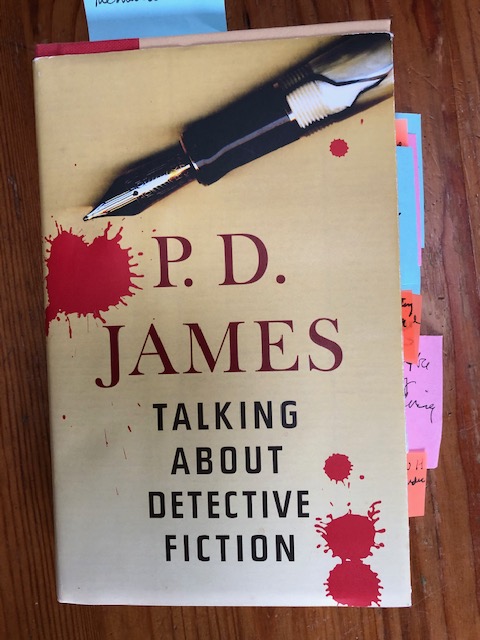
P.D. James, Talking about Detective Fiction, 2009

“Tell me a story,” begs the child.

“Tell me a story about before you met me,” the lover entreats the loved one.

“Tell me the story about how you met,” we ask the new couple.

“Tell me the scariest moment,” the reporter demands of the returning explorer.

“Tell me a story,” we whisper to the books on the library shelf.

After an astounding career as master of detective fiction, P. D. James finished Talking about Detective Fiction in 2009, when she was nearly ninety. This small but hugely thoughtful book touches many topics: the history of detective fiction, authorial arguments over point of view and whether or not the murderer can be a protagonist, variants in the genre. Then James tackles the importance of setting, the importance of character, and the importance of plot.

As to setting: “If we believe in the place we can believe in the characters.” She notes that one function of the setting is to add credibility to a story. For James, credibility is particularly needed for crime fiction, which often offers not just dramatic but bizarre or horrific events. (This this immediately brought to mind Robert Galbraith’s (J.K. Rowling’s) Cormoran Strike series, including The Silkworm.) According to James, “My own detective novels, with rare exceptions, have been inspired by the place rather than by a method of murder or a character.” She says her Devices and Desires was born when she stood on a deserted beach in East Anglia, then turned and saw the vast outline of a nuclear power station.

Character: her characters “grow like plants” while she’s writing but still bring surprises, so that “at the end, no matter how carefully and intricately the work is plotted, I never get exactly the novel I planned.”

As to why people love this genre? For the story. For the story! Here she quotes E.M. Forster:

“‘We are all like Scheherazade’s husband in that we want to know what happens next. That is universal and that is why the backbone of a novel has to be a story….Qua story, it can have only one merit: that of making the audience want to know what happens next. And conversely it can have only one fault: that of making the audience not want to know what happens next.’” [E.M. Forster, Aspects of the Novel]

Our mystery genre has at its heart, of course, a mystery, and we know that by the end it will be solved, more or less. Of course, we readers relish solving the mystery, but, as James says of herself, if that were the only attraction, we wouldn’t reread our old favorites. Which many of us do.

Why do we reread? Not just for the solution, but for the story. Once upon a time there was [a character] who lived in [a setting] and one day, a [terrible awful amazing startling promising exciting bizarre weird shocking hilarious unexpected] thing happened. And what do you think happened next?

We can’t wait. Bring it on. Because we want a story, in a setting we believe in, even if surprising, so we believe in the characters, and––even when we’re re-reading an old favorite–– we want to keep turning the pages so we can know what happens next.

Thank you, P. D. James, for this rich small book, and for all your books with their settings, characters, plot intricacies…and story.

What Makes A Good Story, Or Is Joseph Campbell Bossing Me Around?

Written by K.P. Gresham

Writers (or at least me) despise (rightly so) the idea of formulaic writing. I am creative! I have my own ideas! Ain’t nobody gonna tell me how to write!

But what if this “formula” came from inside ourselves? What if I create it in my thoughts, my actions, my psyche? What if this “formula” is actually an internal pattern shared by all humans?

Joseph Campbell was a pattern finder. As he studied different cultures, different mythologies, different religions, he developed his theory that the journey of the archetypal hero is at the very soul of what makes us human. He called it the “Monomyth” and, drawing on Carl Jung’s theories, he proposed that a psychic unity is shared by all humankind, and that our lives AND stories are all mythic narratives as variations of a single great story.

Boulderdash, my creative spirit cries! But…shoving hubris aside, what does the evidence show?

Okay. Enough of Campbell. I’m not smart enough or deep enough to even begin to understand the intricacies of his studies or theories. So I did what most of us do. I looked for someone who could “explain it to me.”

For me, those answers came from reading Chris Vogler’s The Writers Journey. Mr. Vogler breaks down this inner self-generated pattern of how humans think and act into twelve understandable, progressive steps.

Step One-The Hero’s Ordinary World (Everyday Life Before the Insanity Begins)

Examples: Dorothy’s life in Kansas before the tornado tosses her into the land of Oz. Luke Skywalker’s mundane life on Tatooine before the C3PO and R2D2 show up. Your life when you’re in your comfort zone.

Step Two-The Hero’s Call to Adventure (Introduction of Something that Must Happen)

Examples: Bilbo Baggins appalling invitation to go with the dwarves to reclaim their treasure in The Hobbit. Captain Pyke’s challenge to James T. Kirk to join Starfleet in the latest Star Trek movie iterations. Your college acceptance letter taking you to a life you’ve never lived before.

Step Three-Refusal of the Call (Ain’t No Way I’m Gonna…)

Examples: Humphrey Bogart doesn’t want to take Kathryn Hepburn on The African Queen. Indiana Jones not wanting to investigate his father’s hogwash theories of the Holy Grail in Indiana Jones and The Last Crusade. Your unsuccessful job hunt that presents you with the one offer you’d most dislike doing.

Step Four-Meeting with the Mentor (Somebody help!)

Examples: Robert Redford getting Paul Newman to help him get even with a murdering crime boss in The Sting. Charlie is guided by Willy Wonka through the Chocolate Factory. Your new boss’s admin takes pity on you and shows you the ropes of the career foisted upon you.

Step Five-Crossing the First Threshold (Taking that first step on the new journey.)

Examples: Alec Baldwin jumps from a helicopter to help find Sean Connery’s Russian sub, The Red October. Cop Axel Foley (Eddie Murphy) leaves his Detroit home to discover who murdered his friend in Beverly Hills. You pack your belongings in a car and leave home.

Step Six- Tests, Allies and Enemies (Life Happens)

Examples: In Casablanca, Rick’s Café is frought with desperate refugees, thieves, spies and intrigue. In the recent movie, 1917, the two soldiers meet with countless dangers and pitfalls in their efforts to save 1600 British troops. You have to figure out where to live, who are your friends and who are your enemies, and how will you pay for it all.

Step Seven-Approach to the Inmost Cave (Facing Your Worst Fear)

Example: In The Matrix, the Oracle tells Neo that either Neo or Morpheus must die, and Neo has the power to choose which goes. Nala asks Simba to return to the Pride and take back the throne in The Lion King. You realize that you must make peace with the parent who never loved you.

Step Eight-The Ordeal (Your fight within the belly of the beast.)

Example: In Spiderman, Norman figures out that Peter Parker is Spiderman and kidnaps . In The Odyssey, Odysseus must go to the underworld to find the way home and is almost killed. You have no choice but to declare bankruptcy in a financial matter.

Step Nine-Reward (Hero Achieves Goal)

Example: Luke reconciles with Darth Vader in Return of the Jedi. Robert Redford and Paul Newman pull off their “Sting” and get away with it. You and your creditors come up with a plan to pay off your debt. Step Ten-The Road Back (Trouble’s Not Quite Over)

Example: The moonlight cycle ride of Elliott and E.T. as they escape government bad guys. Harry Potter’s walk on Hogwart’s Bridge to destroy in the Elder Wand in Deathly Hallows II. Your ride home from a hospital visit with medicines in tow and physical therapy sessions in sight.

Step Eleven-Resurrection (Death and Darkness Get One More Shot Before Their Destruction)

Example: In Divergent, Tris’s mother dies, but Tris and Four defeat the Erudite coup. In Back to the Future, Marty McFly witnesses the Professor getting killed (again), only to learn the Professor was wearing a bullet proof vest. You discover your long lost sister only to realize she’s dying.

Step Twelve- Hero Returns to Real World with Elixir (Back at Home, but You’re Not the Same Person You Were When You Left.)

Example: Dorothy goes home to Kansas knowing that she if loved by her family. In the Hunt for Red October, Ryan is able to sleep on the airplane going home. Turbulence isn’t a problem—he’s seen a lot worse. You realize you’ve gone through hell with a certain issue, but you’ve come out alive and stronger.

Now folks have taken these steps and created beat sheets (I’m referring specifically to Blake Snyder’s Save the Cat! fifteen step beat sheet), diagrams, pie charts, whatever. But the basic monomyth theory is the same: a hero’s journey. Formulaic? Perhaps. Or maybe a pattern observed in the psychic unity of mankind. Is this something foisted upon us or something that originates from the very core that makes us human?

High brow questions for a low brow thinker. All I know is I love a good story.

John Le Carré, Agent Running in the Field (October 17, 2019)

by Helen Currie Foster

Originally posted on Ink-Stained Wretches. https://inkstainedwretches.home.blog/2019/12/23/john-le-carre-agent-running-in-the-field-october-17-2019/

Okay, you already know I’m hooked on le Carré. Never did I think any of his characters would buy my allegiance more than George Smiley, the nearsighted brilliant cuckold, a scholar of German romantic poetry, capable of thinking many chess moves ahead. Smiley can spin a web to catch a traitor. Smiley’s heroic.

But now, Nat’s got me. Nat, 47-year old field man from the British secret service or “Office,” has returned to his London home from Europe, at loose ends. He has proudly served his Queen, his country, his Service. He’s a jock, loves running, loves to play ferocious strategic badminton at the Athleticus, a club near his home. He’s Club champion. He loves his wife Prue, who as his spouse actually served the Office when they were stationed together in Russia. Prue now handles big pro bono legal cases and Nat likes to drop in to watch her courteous destruction of the opposition. Nat, with his German-Russian-English-Scots background, speaks Russian like a native. Now he’s expecting to be made “redundant,” put out to pasture, offered dead-end private sector jobs in, say, security.

Meanwhile, at the Athleticus he is challenged by a tall, bespectacled, socially awkward guy, Ed Shannon, who demands a match with the Club champion. Nat assesses this approach:

And the voice itself, of which by now I have a fair sample? In the time-honored British parlour game of placing our compatriots on the social ladder by virtue of their diction I am at best a poor contestant, having spent too much of my life in foreign parts. But to the ear of my daughter Stephanie, a sworn leveler, my guess is that Ed’s diction would pass as just about all right, meaning no direct evidence of a private education.

How deft is that description? So deft. Part of le Carré’s genius is to compose sentences which effortlessly expand the characters and scenes he’s building. Here Nat describes himself using (italicized) info from his own employment file:

I possess rugged charm and the accessible personality of a man of the world.

I am in appearance and manner a British archetype, capable of fluent and persuasive argument in the short term. I adapt to circumstance and have no insuperable moral scruples.

What a great ploy, letting the narrator use other peoples’ descriptions to present himself. Nat’s voice is irresistible.

Nat’s at a turning point. Now at home, waiting for some assignment from the Office and wondering about his future, he suspects his college student daughter thinks dad’s job performance is mediocre, far outshone by Prue’s legal career. It grates that his daughter doesn’t even know what he’s done:

I’d like to have told her why I’d failed to phone her on her fourteenth birthday because I knew it still rankled. I’d like to have explained that I had been sitting on the Estonian side of the Russian border in thick snow praying to God my agent would make it through the lines under a pile of sawn timber. I’d like to have given her some idea of how it had felt for her mother and me to live together under non-stop surveillance as members of the Office’s Station in Moscow where it could take ten days to clear or fill a dead letter box, knowing that, if you put a foot out of place, your agent is likely to die in hell.

When Nat goes in for the interview where he expects to be put out to pasture, we get an eyeful and earful of the infighting and sharp elbows within the Office. To our pleased surprise, Nat seems well able to handle those elbows. Furthermore, Nat wins the badminton match against the importunate Ed. When they drink a beer later, and after subsequent matches, Ed inveighs passionately against Trump, Putin, and the parlous situation of post-Brexit Britain. Meanwhile, instead of being terminated, Nat is asked to manage the Haven, a London sub-station of the Office, including supervising an intense agent named Florence who’s pressing the Office to approve Operation Rosebud. Operation Rosebud would insert eavesdropping equipment into the lush English home of a Ukrainian oligarch with well-documented links to Moscow Centre and Putin. Here’s Nat’s description of Florence:

And in Florence, as Giles [whom Nat’s replacing] was at pains to inform me over a nocturnal bottle of Talisker whisky in the back kitchen of the Haven, Rosebud had found an implacable if obsessive champion…

With Operation Rosebud about to begin, a sleeper Russian agent––currently acting as a double agent for the Office­­––requests an emergency meeting with Nat. It may be possible, the agent says, for Britain to capture a very big fish…well, no spoilers. Nat travels to Karlovy Vary to meet an informant who can identify the fish. The informant grills Nat, in dialogue so sharp on current world politics it hurts:

“So what are you?”
“A patriot, I suppose.”
“What of? Facebook? Dot-coms? Global warming? Corporation so big they can gobble up your broken little country in one bite? Who’s paying you?”

Like a set of Matryoshka dolls, le Carré’s plot holds secrets within secrets within secrets. Le Carré fans know his plots, in hindsight, seem prescient: he brought us big pharma in Africa and disaster in Chechnya before those issues hit the world stage. Now he zeroes in on the Europe of today’s news broadcasts, with Putin looming to the east, Trump to the west, and Britain bent on Brexit. I found myself wondering––fearing––how real the most treacherous plot in this Matryoshka might turn out to be.

Meanwhile, I know Nat’s got hidden depths. I’m rooting for Nat––and Prue––all the way.

*

John le Carre. Agent Running in the Field. Viking, October 2019.

Cover photo of Agent Running in the Field via Amazon.com

Image of Matryoshka dolls by Schwoaze, via Pixabay