I was writing a book review when Lark Rise to Candleford, a television series I had runnin in the backround as a helpful distraction, suddenly hijacked my topic and required me to begin again.
I hate it when that happens. I hate it especially now, because when I finish this post, it’s going to sound like a fourth-grade book report.
But, as many of us have learned over the past six months, sometimes we just do what we have to do. So here’s my report.
Lark Rise to Candleford, adapted from a trilogy of semi-autobiographical novels by Flora Thompson, is set in the English countryside in the 1800s, and focuses on the lives of residents of the country hamlet of Lark Rise and the nearby town of Candleford. David and I watched it on PBS ten years ago. It’s sweet and sentimental, and we enjoyed it. The critic who called it “ham-fisted” can go jump in the lake.
The episode that caught my attention tonight begins at harvest time, when all the residents of Lark Rise take to the fields to help young farmer Al Arliss bring in the wheat crop. That’s all the residents. Women and children follow the men and gather the “leavings.” What they bring in will determine how much flour they’ll have for the rest of the year. Harvesting usually takes two weeks, but Al is determined to finish in twelve days–perhaps in ten. He pushes the others. By the end of the day, adults are exhausted.
But before it’s time to leave the fields, children are falling ill–with measles.
One Candleford child, postmaster Dorcas’ adopted son, has worked in the fields that day “for fun.” The next morning, when Dorcas realizes he’s sick, she closes the post office and quarantines with him in their house upstairs. She tells her employees to provide as many services as possible from the post office porch.
Teenaged Laura, the eldest of a large Lark Rise family, now a postal clerk in Candleford, assures Dorcas that measles is common in families. Mailman Thomas, who as a teenager lost several siblings to measles and reared the survivors after his parents died, agrees that it’s common but says some families are “very reduced” by it.
A journalist stopping by Lark Rise on his way to Cambridge tells Laura’s father, a stonemason who’s been in the fields with his wife and children, that there are measles in Oxford; he’s been covering the story for his newspaper. It’s newsworthy because for the first time, the city has set up contagion hospitals.
The disease is hitting harder this time, he says, because it’s past due. This isn’t just an outbreak. It’s an epidemic.
By the next day, every child in Lark Rise has measles.
But the wheat must be harvested. Every single person must work in the fields. For the next two weeks.
But children are seriously ill. Mothers can’t leave them.
Children die of measles.
But if the women don’t work in the fields, there will be no flour for the winter.
Children will die of starvation. So will adults.
The men of Lark Rise agree. It’s a problem. But there’s not a thing to do about it.
Except there is.
The journalist tells them, “Measles will not recognize the walls that separate you as neighbors.”
Do what they’ve done in Oxford: bring the children to one place so they can be cared for together. The Turrill home–Queenie Turrill, the community’s wise woman and healer, has been foster mother to children for over fifty years. Mothers of children with lighter cases go to the fields. Others stay as nurses. Thomas, who has spent years trying to forget the deaths of his loved ones, puts that sorrow aside and helps with nursing–after all, he’s a committed Christian, and his wife has told him it’s the Christian thing to do.
And the shopkeepers of Candleford, many of whom look down on the poor, unsophisticated farmers of Lark Rise, show up en masse to work beside them and harvest the grain.
I watched that show ten years ago, and the only thing that stuck with me then was the death of the farmer’s teenaged brother. It was sad. As usual, I cried. That was that.
Tonight I saw something entirely different. Every line of dialogue had new meaning.
Contagious disease. Past due. Epidemic. Life-threatening. No treatment. Voluntary isolation. Immediate action. Quarantine hospitals. Collapsing economy. No food for the winter. No money for rent. Essential workers. Essential services.
And people listening to reason, following the lead of the medical community in a major city, caring about one another, taking care of one another. Working together for the good of everyone. Loving their neighbors as they love themselves.
Sweet, sentimental, ham-fisted, I don’t care. It felt good to see a story about people facing terrible odds and doing the best they could. And doing it right.
Past, present, future. Measures of time. The future is uncertain, or at least cannot be seen by the finite minds of wo/mankind, but the past remains a blueprint to build on, to change to make better, providing we don’t try to hide or deny the past. We cannot escape our history—nor should we. Like the gorgeous butterfly that emerges from the shell of a caterpillar, out of ugly facts of history, come two beautiful stories that lift the soul.
In Where the Crawdads Sing, by Delia Owens, and Snow Flower and the Secret Fan, by Lisa See, we are invited into different worlds to experience beliefs and customs that we find unacceptable by 21st Century standards.
These fictional characters are intensely real and their stories grab the readers’ heartstrings as we walk alongside them and watch the painful development and evolution of the human soul, at the societal and personal levels.
Both books can be described as beautiful, agonizing, poignant, terrible, heartbreaking, joyous, and a beautiful testament to relationships and the triumph of the human spirit.
Where The Crawdads Sing draws us into atale of betrayal, abandonment, and murder, through the life of Kya Clark and the backwater residents of Barkley Cove, who view her as “swamp trash” to be shunned, ridiculed and looked down upon.
The story begins with the 1969 murder of Chase Andrews, the townie playboy, and son of a respected Barkley Cove family. It then toggles back to 1952. Six-year-old Kya watches her mother, the last of her dysfunctional family, walk away from their shack, never to return, leaving Kya alone to live with a drunken, physically, and mentally abusive father.
Kya is forced to dig deep and find the strength to make some semblance of a life with him, always afraid that he’d come home drunk, constantly hoping her mother would return. Things seem to improve, but eventually, he leaves too, and Kya is left to survive or die, among the gulls, fish, and wildlife of the swamp.
Considered illiterate swamp trash, Kya is referred to as the Marsh Girl. After spending one humiliating day in school, she vows never to return and successfully evades the town’s truant officers’ half-hearted efforts. Only one man called Jumpin’, the gas station owner and his wife show her any kindnesses, until the day she encounters Tate, a boy who was once her brother’s friend – then her life changes.
Tate befriends her, and it’s through him that she learns to read and write. It’s with Tate that Kya builds her already extraordinary knowledge of the ecosystem of the swamp. Over time, Kya’s extraordinary knowledge of the ecosystem leads her to success as a published author, thanks to Tate’s encouragement. Her first book brings a royalty of $5,000, a great deal of money to Kya; despite her success, she never dreams of leaving the swamp’s safety, and the townspeople of Barkley Cove never see her as anything other than the “Marsh Girl.”
We live and learn through Kya’s determination and development as she overcomes enormous challenges for seventeen years until the past and present become one. Then Kya becomes the prime suspect in Chase Andrews’s murder and may face the death penalty.
Where the Crawdads Sing is a door to the beauty of the wetland ecosystems, and a window to many 1960s prejudices reflected by a backwater society’s discrimination and refusal to give a person like Kya a chance in life.
Delia Owens is a wildlife scientist who writes with the accumulated knowledge of 23 years of experience with animals and environments. In Ms. Owen’s words, Kya’s story shows that “we are forever shaped by the children we once were.”
In Snowflower and the Secret Fan, the lives of two very young girls in the Hunan Province of China, transport us back in time to a country on the other side of the world and immerses us in a different culture.
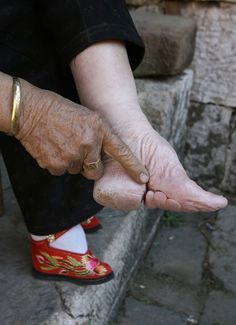
In 19th Century China, women were considered of little worth and had to be married out. They lived in almost total seclusion, and to make the best marriage contracts, young female children around six had their feet bound, to keep them as small as possible, the goal being five-inch long “golden lilies.”
The story is told through eighty-year-old Lily, who looks back on her life and asks the gods for forgiveness, realizes that the binding altered not only her feet but also her whole character. “By age forty,” she says, “the rigidity of that binding had moved from her golden lilies (tiny feet) to her heart, which held on to injustices and grievances so strongly” that she could no longer forgive those she loved and loved her.
We meet Snow Flower when she and Lily are six-years-old, and about to have their feet bound to make them more desirable. In the superstitious traditions of the time, the matchmaker and the diviner examine Lily and tell her family she is no ordinary child. Lily will have a favorable marriage contract, but she is also worthy of a laotong – a special relationship between girls.
For the Chinese of Hunan, the laotong or “old-sames” link was the strongest of all precious female bonds of friendship between women. It was more rare and formal, requiring a contract. A woman could only have one laotong, and it was unbreakable for life. The matchmaker negotiates a marriage contract for Lily and selects Snow Flower to be Lily’s “old-same.” The girls are taught a secret writing code called nu shu (women’s writing), and as laotong, they write their stories on fans or embroider them on handkerchiefs. It was a salve for their lonely hearts. The laotong understand one another’s souls.
These loveable young girls support one another through the torture of footbinding, they grow into women and marry. Lily’s fortunes change for the better. Snow Flower’s fortunes change for the worse, and still, their special relationship endures. They become good wives and adhere to the expected behaviors of wives and daughters-in-law. They celebrate one another’s sons, for nothing is as crucial for a woman’s standing in the family as bearing sons. As “old-sames,” they share their pain and fear through famine, plague and rebellion, but can their relationship withstand a serious misunderstanding?
This is author Lisa See’s ancestral history. She spares no detail in the horrific footbinding process that deformed millions of little girls’ feet until it was outlawed in 1912. Without rancor, judgment, or shame, she draws the reader in and we share the agony these children endured, sometimes unto death if infections set in when the bones finally break to keep the toes folded under the foot and retard its growth. The physical agony eventually ends, but these women never walk normally again. We watch them sway and find a different balance on stumps, never meant to carry the body’s weight. We meet the older women of their families. We are sad for many who end up with significant disabilities later in life, yet continue to inflict footbinding on the female children because traditions and societal expectations demanded it.
Neither story ignores, covers-up, condemns, or apologizes. Where there were prejudice and slurs, Owens wrote it. Where there was the breaking of bones to the point of destroying the body’s ability to function, Ms. See wrote it.
Although painful to read and admit, even as fiction, the characters make us think, admire the strength they discovered in the face of oppression, grieve for their suffering and loss, and celebrate the triumphs of their souls.
Why, exactly, do we take such interest in what our favorite detectives eat or what a character like Aunt Agatha grabs for first at teatime at Melrose Plant’s country house? (Answer: fairy cakes.)
Some say that cooking distinguishes humans from other species—or at least played a role in our evolution. (Apparently chimpanzees can learn to cook, though…)
If cooking’s a distinctive human trait, choosing which cooking to eat is an even finer distinction, one used to great effect in murder mysteries. The what, where and how a character chooses to eat can tell us a great deal. Mystery writers use food to develop characters, settings, and local flavor. Sometimes these seem to merge. (Here I’m discussing mysteries generally, not athe culinary mystery subgenre, or mysteries involving poisons including the thirty or so which Agatha Christie wrote.)
Consider, for example, that complex man Andy Dalziel, Detective Chief Inspector in Reginald Hill’s Dalziel and Pascoe series.
An ex-rugby player, nicknamed the “fat bastard,” he’s introduced in Exit Lines as he clambers out of bed with a morning hangover after a rough night:
And now, he told himself with the assurance of one who believed in a practical, positive and usually physical response to most of life’s problems, all he needed to complete this repair of normality was a platterful of egg, sausage, bacon, tomatoes and fried bread. Bitter experience had taught him in the years since his wife’s departure to eschew home catering. It wasn’t that a basic cuisine was beyond his grasp; it was the cleaning up afterwards that defeated him…only a beast would tolerate fat-congealed frying-pans. Fortunately the police canteen did an excellent breakfast. Gourmet cooking they might not provide, but what did that matter to a man who…affected to believe that cordon bleu was a French road-block? And a slight blackening round the edge of a fry-up was to a resurrected copper what the crust on old port was to a wine connoisseur––a sign of readiness.
Gosh. The classic English breakfast “fry-up”––Yorkshire version––served in a police canteen. We’ve just learned about Dalziel that he likes the classic and plenty of it, that his wife’s left him and he doesn’t like to eat alone at home, that he habitually tries to hide his sophistication, and that the police station’s his comfort zone. We know he’s no secret gourmet. Hill’s not interested in showing us his own food sophistication (we almost hope the “slight blackening around the edges” does not describe his own breakfast). Hill is not offering us food porn––far from it. He’s giving us a close-up of Dalziel, alone at home, getting ready to walk onstage at the police station.
A different sort of home cooking characterizes Donna Leon’s Inspector Guido Brunetti series, set in Venice. Here’s Brunetti in Death and Judgment, coming home to lunch, where he finds his wife Paola––professor of English, born into Venetian wealth, politically liberal––listening indignantly to the political news:
“Guido, these villains will destroy us all. Perhaps they already have. And you want to know what’s for lunch.” …
When he does ask, “What’s for lunch?” Paola responds:
“Pasta fagioli and then cotoletta.”
“Salad?”
“Guido,” she asked with pursed lips and upraised eyes, “when haven’t we had salad with cutlets?”
Instead of answering her question he asked, “Is there any more of that good Dolcetto?”
“I don’t know. We had a bottle of it last week, didn’t we?”
Imagine how they’d react if confronted with Dalziel’s fry-up? Of course they’ll have salad, because in Venice one always has salad with cutlets! How different this home is from Dalziel’s. Brunetti and his wife talk food, talk wine, insist on proper Venetian cooking. Brunetti’s apartment with Paola and his children is truly home base. In this scene Paola’s already asked him to look into a situation…and he’s about to tell her what he has found out. Fans of Donna Leon already know that part of Brunetti’s daily work challenge comes from the inherent corruption of the judicial system, which often sends him into despair. Yet he loves Venice. Leon uses scenes showing the happy comforts provided by Brunetti’s family and family meals, with correct Venetian cuisine, to explain how Brunetti keeps his emotional balance. Despite grim crimes, despite his city’s corruption, Brunetti won’t leave: he’s part of Venice.
Food preferences make characters both human (don’t we all have preferences?) and distinctive. Think of Rex Stout’s Nero Wolfe, shut in his hermetic mansion where his Swiss chef Fritz Brenner provides favorite dishes prepared just so.
Think of Agatha Christie’s Hercule Poirot, with his eternal tisanes.
Think of the strong food dislikes of Anne Hillerman’s policewoman Bernadette Manuelito. According to her husband Jim Chee, in Cave of Bones, Bernadette “had never ordered salad at a restaurant,” never made one at home, and if he made salad for them, she would eat only the iceberg lettuce and eat around the other vegetables. Pizza? Only pepperoni for her. Bernadette is smart, brave, sensible…but not when it comes to vegetables.
Louise Penny uses cooking to great effect in constructing the setting for her Inspector Gamache series, the quirky little Québec village of Three Pines. The village is isolated and rural, but has attracted exceedingly sophisticated residents—the poet Ruth, the sculptor Clara, Inspector Gamache and his wife Reine-Marie and others. This setting would seem quite improbable but for the role of the bistro, a place of style, comfort, warmth and great food. In the opening scene of A Better Man, “Clara’s and Myrna’s armchairs were pulled close to the hearth, where logs popped and sent embers fluttering up the field-stone chimney. The village bistro smelled of woodsmoke and maple syrup and strong fresh coffee.” Wouldn’t we all like a bistro like that, just across the village green? With really good coffee? Furthermore, the bistro, with its proprietors Gabri and Olivier, attracts other food artisans. When residents are desperately sandbagging the banks of the flooding river at Three Pines, these provide succor:
Gabri and Olivier were handing out hot drinks. Tea, coffee, hot chocolate, and soup. Monsieur Béliveau, the grocer, and Sarah the baker, were taking around trays of sandwiches. Brie and thick slices of maple-cured ham, and arugula on baguettes and croissants, and pain ménage.
The bistro is “home base” for this series. Inspector Gamache deals with crimes all across Quebec, but the inhabitants of Three Pines, glued together by the bistro, provide a vivid supporting cast and sometimes play leading roles in Penny’s series. I don’t think they’d stay in Three Pines if the food weren’t so good.
Like Louise Penny, Martha Grimes has created a character magnet in the village of Long Piddleton for her Richard Jury series: the Jack and Hammer pub. The Jack and Hammer serves as the central meeting point for the highly diverse supporting characters, including Jury’s noble sidekick, the wealthy Melrose Plant. Indeed, Grimes has named each book in the series for a pub, including The Old Success (2019). There’s usually a set piece in the books, always worth waiting for, where Melrose’s detested Aunt Agatha, angling for his fortune, invites herself to tea or dinner or invades his breakfast at Melrose’s manor house. During this scene in The Old Success we see Melrose, a little fussed because Ruthven the butler has not brought his usual egg cup, making “soldiers” as usual for breakfast––cutting his toast into oblongs and dipping them in his boiled egg.
“I always do,” Melrose said. His breakfast habit cements Melrose in our minds as wed to his personal traditions…even though he currently eschews use of his title. Oh, and the butler Ruthven has brought his wife’s excellent cooking, including kippers and sausages, to the sideboard. Melrose’s house in Long Piddleton and the diverse village characters who meet at the Jack and Hammer form a solid home base regardless of how far (Africa, Europe, the Scillies) he and Jury range in solving the crime at hand, and how complex the crime. Sooner or later the threads may pull together at the Jack and Hammer.
I’ve used “the local” to create local flavor in the Alice MacDonald Greer series. The Beer Barn not only smells like local beer, and artisanal beer, but when Jaime’s in the kitchen, the Tex-Mex cooking is superb. The Beer Barn is meant to be the roadhouse/dance hall we all love in Central Texas. It’s where Alice meets enemies, hears a new singer in Ghost Dog, meets the reporter in Ghost Letter, tries to unravel a mystery with her best friend in Ghost Cat.
Texas dance halls still dot the back roads of the rugged Texas Hill Country with their own beer-infused local flavor, local dancing, local music from a dead-pan country band. The Beer Barn’s my dream institution.
Also a highly distinctive setting: the small town Texas coffee shop or cafe, with breakfast from the grill, mile-high pie and endless cups of coffee. And don’t forget the San Antonio ice house tradition. See K.P. Gresham’s series with its Fire and Ice House bar, beginning with The Preacher’s First Murder. Local bars/diners/restaurants make great settings for murders, mysteries, and detectives. And to the joy of central Texans, many are still actually real…thank goodness.
Okay, what’s for lunch?
***
Image of traditional English breakfast by Peter Marks from Pixabay Image of cup and saucer by M. Maggs from Pixabay Image of maple trees by diapicard from Pixabay Images of book covers from Amazon.com
***
Helen Currie Foster is author of the Alice MacDonald Greer mystery series. Her latest, GHOST CAT, was released in April 2020.
Reading a novel by Alexandra Burt means you must be prepared to ignore everything else because her stories will keep you captive until you reach the last page. Skilled in short stories, true crime and crime fiction, Burt delivers two fantastic reads this year. I asked Alexandra to share her thoughts on world building , true life haunts, and how she approaches the craft of writing suspense.
It looks like 2020 is a big year for you. You have a new novel and a true crime story coming out this year. Let’s start with your contribution to The Best New True Crime Stories. What can you share about your story?
My contribution to The Best New True Crime Stories: Small Towns is a cold case that happened in my hometown in 1983. It was the height of the Cold War and at its core it is about the threats I faced, literally and figuratively. My hometown, Fulda, is a baroque town in central Germany located between the Rhön and Vogelsberg mountains. Seemingly plucked from Grimm’s fairytales, but Fulda has a dark history. Nothing about the rolling hills and farms dotting the landscape hints at Fulda as the place where Armageddon was supposed to happen. Fulda Gap, two lowland corridors, two obvious routes for a hypothetical Soviet tank attack on West Germany from Eastern Europe were the likely invasion route of Russia, the spot where U.S. and Soviet soldiers pointed hundreds of medium-range nuclear missiles at each other. The threats were ever-present. When I hiked in the marshes by the border, East German look-out towers with guards and spotlights stared back at me in the distance.
In 1983, I happened to be close to the scene of a crime, a quarter of a mile, the way the crow flies. A child died and the killer remains at large, the case was never solved, the killer never apprehended. There’s the story of a life cut short, and then there’s my story. Thirty-seven years have passed and the Cold War summer of 1983 still clings to me like a second skin. I have raised a daughter and I write crime fiction but I have never forgotten the girl that lost her life before her life even began. I have made a life for myself in the Hill Country of Central Texas, in the southeast part of the Edwards Plateau that is not unlike the Hesse highlands of my childhood. But I never learned to trust the world with my daughter’s life. I’ve learned that a watchful eye is not enough, that a simple moment of inattention, a minute of carelessness, can turn into something that cannot be undone. And little girls don’t always make it home alive. And every day I don’t know what to do with the evils of the world, and so I write about them.
Shadow Garden is your latest crime novel. Tell us a bit about what inspired this story?
My previous book The Good Daughter was released days after the election in 2016 and during that time I felt as if the majority of the country fell into a dark hole. Including myself. I had the urge to examine if the same was as stake for all of us, if people of wealth, power, and affluence deploy a different set of principles when confronted with crime. It started out as a moral thought experiment, wondering about all the complicated ways money messes with morals. We know wealth impacts our sense of morality, our relationships with others, and our mental health. Is it true that the more you have to lose, the harder you fight to keep it, whatever ‘it’ may be? Money, a reputation, a standing in the community? Is being rich inherently immoral and if so, but what are the consequences? I imagined Donna Pryor, a woman of humble beginnings, who has everything but the truth of what happened to her family. From there I allowed the story to unfold organically and I sat by and watched them get to the truth of who The Pryors really are. Shadow Garden’s initial title was “The Many Incarnations of Donna Pryor” and I mention it because the book had quite a few incarnations itself. It started out as detective novel, purely comprised of interviews, then it turned into a family saga spanning decades before and after a crime occurred, just to arrive at Shadow Garden, an estate at the end of a rural road and a life of privilege that begins to crumble and somewhere in the ruins is the truth.
Many who read your work comment on your ability to combine heightened suspense with fully drawn characters in a compelling setting. Is there a certain aspect of word building that comes more easily to you? Is there a part that’s more challenging?
First of all, that’s a huge compliment. Thank you. The beginning of a novel is a very long period of imagining the setting and the people and I don’t take notes nor do I examine plot but I create the characters’ world. There is nothing else for a while, the characters really live at my house and eat at my table and not until the first draft is complete are they allowed to huddle and regroup. I don’t struggle with world building since it is ground zero at the beginning of a new project and anything is possible. There’s huge freedom in the vast scope of a new project. I am always very sure of the setting but the plot changes endlessly and often and the characters usually end up needing work. It’s a matter of having a great editor, which I have, and revising draft after draft, after draft.
When I was younger I wanted to be a painter and I went to art school but then abandoned that path. There is still a lot of visual artist left in me. It’s the first thing I imagine in any project, novel or short story—what is the essence of it; a still-life in oil or a landscape in watercolor—and the setting becomes a place and then it becomes a world and a clock ticks in the background to give it pace and there is structure and meaning which turns into a theme. Long story short: once I commit, I’m all in for however long it takes to make that world come alive the best way I know how.
Readers are often curious about their favorite authors’ habits. What is your daily or weekly schedule like? Do you ever get stuck? If so, how do you find your way out?
Unfortunately I’m still struggling to keep a schedule and all writers are powerless to real life happening as they work. I take it day by day, keep my fingers crossed, and hope for the best. It’s a best-laid plans kind of thing; most days writing doesn’t turn out as well as one hopes. One should not expect for things to always turn out to plan. My daily schedule looks something like this: after a workout (more often than not a workout competes with falling into a two-hour social media hole), I sit at my desk and pick up where I left off the previous day. Sometimes there’s an abundance of oxygen for that task and I just kind of go with it, other days it’s just not flowing. Be that as it may, there are deadlines and word goals and I swear by something I have discovered a few months ago: focus music. It promises laser productivity and a boost in focus. Simply put, it is music void of both ultra-low and overly loud bass and high pitch sounds that tend to become annoying over time. There are no ruptures, no pauses, no breaks or major volume deviations. The type and number of instruments remains constant through hours of play and the music follows a particular pattern mimicking the brain waves present in a focused state and eventually the brain waves mimic the music. It’s my secret weapon. I will write and look up and realize three hours have passed. It may not be a way ‘out’ but it’s a way to remain ‘in’, if that makes sense?
I do get stuck at times and I wish I knew of a magic potion but I kind of obsess about it and just keep my fingers crossed and hope to spot the proverbial light at the end of the tunnel. Sometimes all you can do is chip away at a problem and hope for the best and so far it’s served me well. Still wouldn’t mind some sort of a potion though.
— Alexandra Burt was born in a baroque German town in the East Hesse Highlands. She moved to Texas and worked as a freelance translator. Determined to acknowledge the voice in the back of her head prompting her to break into literary translations, she decided to tell her own stories. She currently resides in Central Texas. Remember Mia (2015) is her first novel. The Good Daughter was published in February 2017. Her third novel, Shadow Garden, is forthcoming in July, 2020. She is working on her fourth novel. She has contributed to Lone Star Lawless: 14 Texas Tales of Crime, and The Best New True Crime Stories: Small Towns. Her short stories have appeared in publications and literary reviews.
The Texas Governor’s Mansion is the perfect setting for my next book in the Pastor Matt Hayden Mystery Series. I’ve said it before, I LOVE doing research for my stories, and studying up on the Governor’s Mansion is a blast. Such rich history. So many anecdotes. I just had to share some of them with you.
First off, I am not a native Texan (though I’ve lived here for thirty-six years) so most of what I’ve learned is all new territory for me. To that end, I must credit The FRIENDS of the GOVERNOR’S MANSION who wrote The Governor’s Mansion of Texas, A Historic Tour, published in 1985, as well as the website https://gov.texas.gov/first-lady/history for most of this information.
The Mansion’s history began with a $14,500 appropriation from the legislature roughly a decade after Texas became a state in 1845. Austin master builder Abner Cook was awarded the construction contract. This beautiful home has served as the official residence of Texas governors and their families since 1856. (Governor Elisha M. Pease and his family were the mansion’s first occupants.) It is the fourth oldest continuously occupied governor’s residence in the country and the oldest governor’s mansion west of the Mississippi River.
The mansion stayed pretty much in its original condition until after the Civil War when Governor Edmund J. Davis started a line of renovations in 1879 with an indoor lavatory installation. By 1915, there was running water, a telephone, electricity and wallpaper and more living space. I could go on, with more renovations, security installations, historic donations, BUT!
What makes this Mansion beloved are the stories of the people who lived there.
One of my favorites was the tale of Governor James Hogg (the first native Texan to become governor) and his rambunctious four children. To this day, the stair railings are still scarred where Governor Hogg hammered nails to deter his children from sliding down the banister.
Another fave. Governor Joseph D. Sayers—the one who had electricity and wallpaper installed–owned a dog. Well, his dog must have appreciated all the modern improvements because when it was time for the Sayers family to move out of the house, the dog refused to leave. He stayed with the carriage driver the rest of his days—at the Mansion.
Then there was Governor Miriam “Ma” Ferguson, the first female governor of Texas. She vowed to return to the Mansion after her husband was impeached, (yes, James Ferguson had served as governor and gotten the boot). She was elected and arrived in the same Packard the family used to leave in 1917. An interesting aside: Mrs. Ferguson fought to end the Ku Klux Klan, passing an anti-mask law making it illegal to wear masks in public. Now isn’t that topical in this day and age?
So many stories, so little time. I haven’t even mentioned Queen Elizabeth’s visit, or the unsolved 2008 arsonist attack on the Mansion in 2008 or its more recent occupants. I mean to think about it. How could I describe Ann Richards in one blog?
To that end, I highly recommend the above mentioned book or a quick visit to the link I’ve shared above. Thank you to all who kept records of the history of the Mansion so folks like me can wonder and laugh and learn to appreciate just this one small piece of our Texas heritage. Think how much, much more there is to learn!
Like I said, I like doing research when I’m writing a book. And, I’ll even give you a hint about this, the fourth installment in the Pastor Matt Hayden Mystery Series.
I don’t kill the Governor–but everyone else is game!
When I opened my personal blog, back in the Dark Ages, I titled it To Write Is to Write Is to Write. I intended to tell everything I know about writing.
Everything I knew filled roughly 2.5 posts.
Now I write about what I don’t know about writing and leave giving advice to those who know what they’re doing.
Reverting to my old librarian persona, I also write about blogs by writers who aren’t anywhere near running out of material. Here’s a short list.
Each Friday, Rochelle Wisoff-Fields invites readers to compose 100-word stories based on a photo prompt. Writers post stories on their own blogs and then link to an inLinkz list to share with other Fictioneers and with the public. It’s fun. Specific rules are found here.
Sammi Cox posts a weekend word prompt: The rules: “Write a piece of flash fiction, a poem, a chapter for your novel…anything you like. Or take the challenge below – there are no prizes – it’s not a competition but rather a fun writing exercise.” Participants are free to link their efforts in the comments.
TSRA also promotes—and thank goodness, considering how much writers need it—”FUN and an OASIS OF CALM and Font of useful Knowledge andTips for Indies (please do NOT feed my naughty chimps or they may follow you home) from the woes and stresses of the real world”—such as,
Kate was on a bit of a hiatus for a while but is back now with “Social Distancing for Dogs.” She’s posted a lot of dog stories—my favorites are about the dear (and sometimes smelly) Macaulay, the dog with the Neville Chamberlain mustache, including
I could go on—my first draft is twice as long as this one—but the deadline loomed hours ago. I hope you’ll check out some of these blogs. And I hope you enjoy them and return for more.
And—do you have any blogs you’d like to share? Including your own. Record them in a comment.
Kathy renamed her personal blog Telling the Truth, Mainly, and, in her posts, tells the truth, mainly. Her guests tell the truth, mainly, too.
The original title, To Write Is to Write Is to Write, is a fragment of a quotation from Gertrude Stein, who knew how to write and who told Ernest Hemingway how to write.
The current title comes from the first chapter of Mark Twain’s Huckleberry Finn. Mark Twain knew everything about writing. Ernest Hemingway said so.
Over the past weeks of being locked down, I’ve read many beautifully written high-minded prose on self-reflection, and assessments of personal, social, and political attitudes in these tumultuous times. My question, however, is simpler. Will we emerge as a new nation of truly liberal thinkers who can share ideas, even ones that are contrary to our mindsets? Truthfully, I don’t know the answer. But having survived disasters, losses, injuries, and illnesses, I refuse to be beaten down now. For me, it’s “one foot in front of the other,” and march on.
So, on the lighter side, how do I pull myself back to center and regain control? I walk on the treadmill (ugh!), clean, and organize what’s gotten out of control during life before COVID (double ugh!). I catch up on DVR programs and read a mountain of books. While all of these are helpful, the number one activity that I find satisfying, refreshing, and restores my sense of control is cooking.
My entire childhood and a good part of my adulthood were spent in Corona, NY (nothing to do with the virus), an immigrant community where Italian cooking, reigned supreme. I remember the lively discussions, sharing of methods, and debates between my grandmother, my mother, and other relatives and friends about the finer points of preparing foods, even something as seemingly simple as making a marinara sauce.
Even my grandfather had opinions about good cooking, and his pet peeve was potatoes. When not working 18-hour days in the business he built from scratch or tending his little farm, he took a hands-on approach, insisting that spuds be sliced precisely in the correct thickness and shape for each different recipe. Today’s cooks have the mandolin to help with that. The only mandolin he’d ever heard of was the kind that made music!
Then there’s Julia Child. “I don’t get the whole thing with Italian cooking,” she once said. “They put some herbs on things, they put them in the oven, and they take them out again.” To the revered American master of French cooking, Italian cooking was too easy.
Well, Ms. Child, I beg to differ, but first a little culinary history.
The development of French food reaches back to medieval times. During this era, according to the ECPI blog, “French cuisine was fundamentally the same as Moorish Cuisine,” and everything was served at the same time, serviceen confusion.
In time, presentation became very important, and great value was placed on rich and beautiful displays, utilizing consumable items such as egg yolks saffron, spinach, and sunflower for color. “One of the most elaborate dinners was a peacock or roast swan, which was sewn back into its skin and quills to look intact. The feet and nose were plated with gold to finish the exhibition.”
It was in the 16th century that French cooking received an infusion of new ideas. While the Renaissance flourished in Italy, the powerful Florentine Medici family married off their 15-year-old princess, Catherine, to Henri, Duc d’ Orleans. Off to France, the princess went, taking with her the chefs in her service and their advanced cooking skills. They were already creating dishes such as lasagna, and manicotti, which are still staples of Italian cooking today, as they experimented with truffles and mushrooms.
Even though these two culinary schools’ took distinctive and separate paths, the French owe much of their gastronomic advancements to the Italians, thanks to Catherine de Medici.
Over time, French cooking became revered for its Haute Cuisine, developed to entertain French royalty. Steeped in butter, fats, fancy crusts, and all sorts of disguises, still, one must guess or be told what they are eating, delicious though it is.
We Italians, on the other hand, don’t really like our foods disguised. We like to know what we are eating as soon as it’s on the plate – or at least as soon as we’ve taken the first bite.
Italian cooking has grown from centuries of learning how a few simple ingredients enhance each other. What evolved into today’s Italian cuisine began during the Roman Empire. Of course, then, as now, the wealthy could afford to buy and try the exotic and foreign. Thus, the most affluent Romans had cooks experimenting with foods from the lands they’d conquered: Spices from the Middle East, fish from the Mediterranean, and cereals from the North African plains. The majority of folk, however, relied on the “Mediterranean Triad: vine, grain, and olive,” and two thousand years later, pure Italian olive oil is still a universal leader, for its purity of taste and clarity.
Most Italian cooking is, on the surface, simple – needing few ingredients, but the knowledge of how to use them is what makes the dishes shine. For example, the American habit of overwhelming pasta with sauce is un-Italian. Properly prepared, Italian sauces are intensely flavorful and should only coat the pasta, not drown it.
Contrary to Ms. Child’s belief, however, there are some very complicated Italian dishes for which one needs patience, time, and the willingness to try, fail, throw it away, and try again.
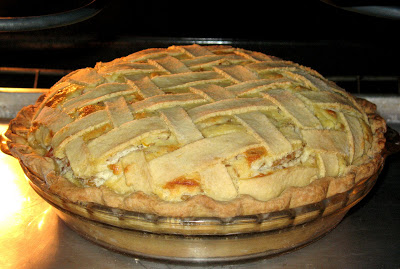
Homemade lasagna and manicotti, originating during the Renaissance, continue to be a labor of love. The Bolognese Sauce that is misrepresented in America as just a simple meat sauce takes hours to prepare. There are other delicacies such as the Pizza Grana, a traditional Neapolitan Easter pie. Years ago, my grandmother, my mother, and I made these every Easter. It was indeed a labor of love. There is a link below for the industrious who want a challenge. A word of warning, though. Do NOT use any prepared pie crusts. Part of the lusciousness of the recipe is the sweet crust (pasta frolla). If you read the recipe, you’ll understand why it’s limited to an annual preparation.
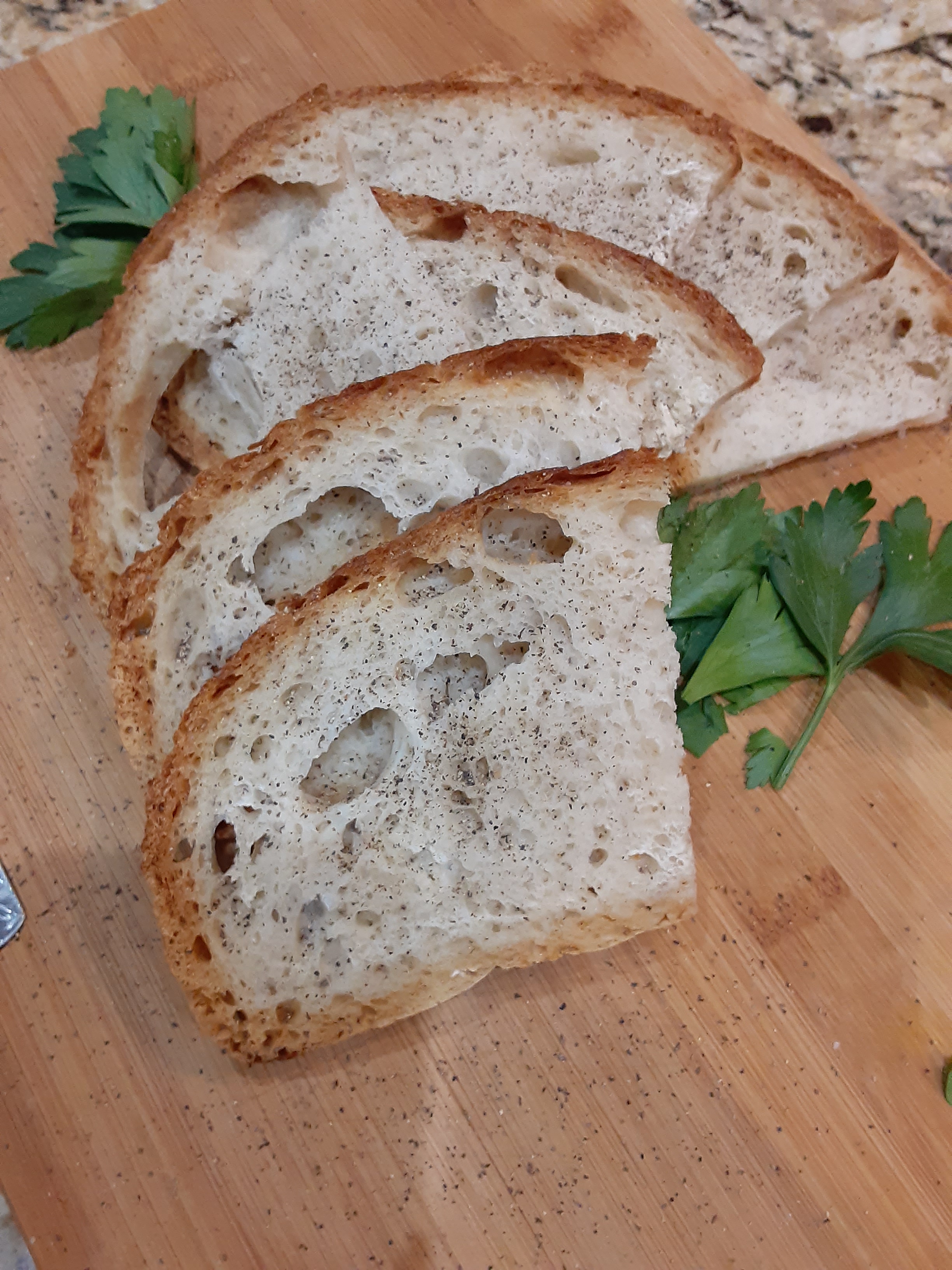
Then there is my favorite. Homemade pancetta and black pepper bread. I don’t bake it too often because my husband and I eat too much of it.
Vegetables are fundamental to the Italian diet, and here a word on olive oil is essential. Olive oils range from cooking quality to the more expensive finishing quality. They vary in flavor and weight from region to region, and those differences are especially significant for vegetables because heat alters the flavonoids that give the oil its flavor. Thus, I often use a less expensive oil to sauté broccoli, aglio e olio (garlic and olive oil), which can be served as a side dish (contorno), or as part of a first course, (prima piatta). Pour it over Orrechietti pasta, add a little grated cheese, and serve with a mixed salad. You have a meal.
String beans are one of my family’s favorite vegetables. Blanched for no more than one minute to retain vitamins, then cooled, and sprinkled with salt and high quality, cold-pressed, pure Italian Olive Oil, my grandchildren can and do eat green beans prepared this way by the pound.
As you can imagine, the volumes written about all cooking, including Italian cuisine, can fill bookstores. Cooking can be creative and imaginative. Take a basic recipe as I did with the pancetta and black pepper and add or change ingredients and invent something new. So, instead of allowing this upside-down, dangerous world to rob me of my peace and inspiration, I go to the kitchen where I feel free, refreshed, in control, and creative.
But it’s time to end my musings on the benefits of cooking. My grandchildren await me at the kitchen table, staring at the mountain of green beans, asking for, “more olive oil, please?”
As my favorite Italian chef, Lidia Bastianich, says, “tutti in cucina a cucinare.”
To make this into a pancetta and black pepper bread, before beginning the dough, sautee ½ – 1 lb chopped pancetta (I recommend Primo, Italian style diced) DO NOT COOK THROUGH. Allow it to cool.
Add the cooled pancetta in the first step of making the bread, along with 1-2 TBSPN coarse black pepper.
Be sure to have a cooking thermometer that goes up to 250 degrees. Generally, bread is cooked through at 200 – 210.
When I was four years old, I took a pair of scissors and a roll of red, gooey adhesive tape and wrote my name on the inside of the kitchen door. It didn’t occurred to me I shouldn’t, and my parents never said a word. I’m sure they discussed it, but I wasn’t privy to that conversation. The crooked red letters stayed on the door for years. When they were finally removed, a heavy red stain remained.
When I was eight, my father gave me a ream of legal-sized paper. I produced a newspaper, one copy per issue, focusing on the social activities of dogs, cats, and horses in the neighborhood. I reported on the wedding of Mr. Pat Boone, my rat terrier, and Miss Bootsie, my grandfather’s evil gray-and-white cat. Miss Bootsie was really Mr. Bootsie, but even then I knew the value of poetic license. Mr. Tommy, my cousin’s orange tabby, married someone, too, but I don’t remember whom or what gender. Or what genus and species for that matter.
For years, I loved writing—the paper, the pencils and pens, the ink, the facts, the improved facts, and the outright fiction.
The feeling lasted until high school, when I began taking courses labeled English. Writing became torture. What will I write about, how many words does it have to be, I don’t know anything about that, I don’t have anything to say. Through high school and two college degrees–in English–I produced the required papers but agonized over every word.
There were bright spots: writing the junior class prophecy, which made even the teachers laugh when I read it at the junior-senior banquet; composing a satire on life in the teachers’ lounge I hid in when I was a teacher, issued serially on an irregular basis whenever the Muse moved me.
Overall, however, my relationship with writing remained conflicted. I pretended it didn’t. After all, I taught English.
Things began to change when I told a therapist about my early love affair with words. He responded, “I think you’d better start writing.” He suggested I join the Austin Writers’ League.
The next day, I joined. James Michener didn’t object. I took informal classes at universities. An instructor invited me to a Saturday-morning writing practice group. The next weekend, I drove fifty miles, parked in front of the café where it met, watched people carry notebooks inside, backed my car out, and drove home. It took another week to build the courage to pick up my notebook to join them and become a regular.
The result? Once again, I fell in love with writing. I also fell in love with a member of the writing practice group and, after a decent interval, married him.
And I published some short stores in anthologies and online, and one novella.
But my romance with writing hasn’t ended happily ever after. I don’t have a long list of appealing topics. I don’t have a file of perfect first sentences. I still have to write to find out what I know and what I think. I always wonder what happens next (and understand why Hemingway, Faulker, and Fitgerald drank to excess). I’m still driven by deadlines—my brain doesn’t turn on till one is upon me—and I write furiously up until the deadline (or, as now, after it).
Starting any piece is difficult. But once I (finally) begin, the words flow.
I wouldn’t exchange that feeling for anything.
In fifteen years, I’ve come from I can’t join the Austin Writers’ League to I’m working on a novel, attending Austin Mystery Writers critique group, writing for publication, blogging, writing every day.
And, contrary to the moans I make when asked how the writing is going, I love every second of it. Mostly.
***
The therapist actually said, “If you don’t start writing, you’re going to explode.” Since I took his suggestion, more things have changed. The Austin Writers’ League has morphed into the Writers’ League of Texas. The writing practice group that met at the cafe dissolved, and I joined another, Writing from the Heart, which met at BookPeople Bookstore; later it moved to various branches of the Austin Public Library. Now as 15 Minutes of Fame (More or Less), it meets online.
Invitation: 15 Minutes of Fame is free and all are invited to attend—no fees, no dues, no membership registration, no RSVP, no critique, no need write and spell as if your English teacher will scribble on your paper. No need to be a published author or to write “well.” Just have pen and paper or computer ready and show up. We do timed writings—choose a time, write, read aloud what we’ve written (IF we want to read; reading isn’t required), then do it all again. We meet from 10:00 a.m. to noon, on Saturdays; the schedule has been irregular recently but we’re in the process of getting back on track. When it’s stable, we’ll update the website, http://minutesoffame.wordpress.com If you’re interesting in writing with us, email kathywaller1 (at) gmail (dot) com.
*
Bootsie had long gray hair and green eyes, was beautiful, and slashed both a little girl who tried to pet him every time she saw him, and her owner, my grandfather, who thought he was peachy keen. Pat Boone was mine, and one of the dearest dogs who ever lived.
*
This post first appeared, with modifications, on Telling the Truth, Mainly.
*
Image of terrier by kteri3565 from Pixabay
Image of cat by Lenka Novotná from Pixabay
Image of James Michener by Robert Wilson, public domain, from Wikipedia
Image of critics examining ratty drafts by me
May 8 was VE Day. 2020 marks the 75th anniversary of Germany’s surrender in Europe. Three-quarters of a century ago, Adolf Hitler and his National Socialist German Workers’ Party (Nationalsozialistische Deutsche Arbeiterpartei, NSDAP, also known as the Nazis hid in their bunkers, committed suicide or melted into the general population and escaped justice.
Thanks to Hitler’s diabolical determination to have Germany rule the world, over 100 countries were dragged into the conflagration, defined by two major groups. Germany, Japan, and Italy, the major powers of the Axis Alliance, and the major powers of the Allied forces, led by Great Britain, the United States, the Union of the Soviet Socialist Republic (USSR), and to a lesser extent, China. The remainder of the world lined up with one side or the other, with some exceptions, most notably Spain, Switzerland, Sweden, and Portugal, and they too had to arm and defend their borders. Some of these impartial countries ended up occupied regardless of the “neutrality,” but no matter which side any nation fought on from 1939-1945, now, 75 years later, the world remembers once again and all are glad for its end.
This year’s tributes are, however, quiet, lonely affairs, as the world battles another monster: COVID-19, which is preventing large public ceremonies from marking the end of a war that cost 40 – 50 million lives worldwide, both military and civilian. Lest we forget when we speak and write of the human cost so long ago as numbers and statistics, these were people. They were sons, daughters, husbands, wives, and children, which gives us one inescapable truth. War is hell!
Great Britain lost 450,700 souls. They scaled back their big, planned celebrations: no mass gatherings, no hugging, and kissing. Tragically, many of the remaining veterans who fought in that war are living and dying sad and lonely deaths in nursing homes in Great Britain and throughout the world.
The United States gave up 418,500+ lives. Of these, 2,000 were civilians. The rest died in uniform.
France – Despite their initial collapse and surrender to Hitler, both in their home nation and Indochina, gave 567,600 souls to the war.
After 75 years, Germany must live with the fact that it all began with them. Hidden behind an effort to reestablish the German peoples’ right to live and thrive, was an evil intent that would poison the nation and take upwards of 8,000,000 German lives.
The Union of the Soviet Socialist Republic, then in the hands of Josef Stalin, another up and coming devil in history, lost 24,000,000
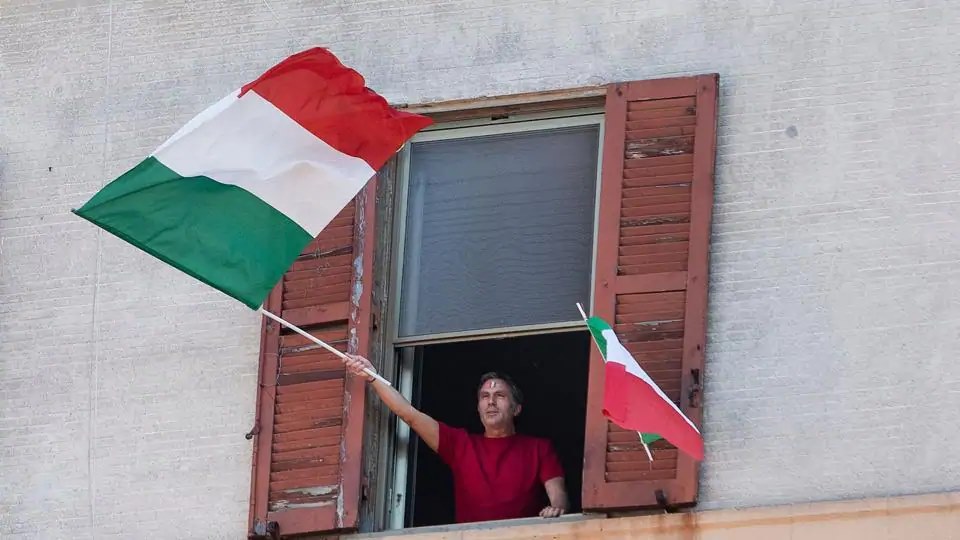
In Italy, official tributes began on April 25, Liberation Day, marking the date when Allied forces and Italian partisans drove the German occupation army out of the country. Italian losses stacked up at 457,000, including deaths from the civil war that took place simultaneously with the world conflict. For Italy, the war did not end on April 25 or May 8. Italians suffered through three distinctive battles between 1943-1945: Liberation against the Germans, the fight against fascism, the class war that underpinned both, and the struggle to reorganize a nation. On April 25, Italians came out on their balconies and sang Bella Ciao, the Italian protest song. It rang out across the nation.
Often in wars, fight songs are inspired, such as the Star-Spangled Banner, written in 1814, during the War of 1812, and The Marseilles, in 1792, when France declared war against Austria. Bella Caio, the Italian protest song against oppression, originated with the protests of the Mondina women who worked the northern rice paddy fields in the late 19th century. It reemerged during WW II, and has since been translated into 30 languages and has become an international anthem of resistance.
Tributes to the final battles of WW II are not over on May 8. Although the war with Japan ended on August 14, the official surrender date was September 2, 1945. At the war’s end, Japan lost upwards of 3,100,000. September 2, will officially mark the end of WW II, 75 years ago and this commemoration will also be muted by COVID-19, but not ignored.
If we are fortunate enough to have our health and our jobs, we are grateful but still struggling to create a new normal for ourselves and our families. So many of us now have kids finishing their semesters through online school while we’re working full time. Many of our touchstones and daily routines have been upended. We are doing our best each day, although the definition of ‘our best’ also changes on the daily.
Andy Boyle is here to help.
You see, his book, BIG PROBLEMS, was released by Penguin on March 31st. He is one of many authors who has found himself promoting a new book in the middle of this pandemic. Today, Andy shares what he learned while writing BIG PROBLEMS and offers advice on how to keep moving towards our goals—and why taking a break is not only fine, but necessary.
LO: First off, congratulations on your new book! Can you share a bit about the life experiences that culminated in your writing BIG PROBLEMS?
AB: Thank you so much! I’ve been a journalist for about 15 years, and it’s impossible for me to look through things without that lens. So after my first book, Adulthood for Beginners, came out, I was trying to find a meaty subject to sick my teeth into, something that would allow me to use myself as the storytelling and thematic vehicle to explain a big topic. But also, in the end, hopefully help people, which is one of the reasons I became a journalist in the first place.
And the topic I chose is, well, at its heart a mystery. How come a person like me—allegedly well-educated—managed to get so fat, just like millions of others? And then, to add another mystery, how come I was able to lose so much weight (and keep it off), unlike most people?
That led to the pitch for BIG PROBLEMS: A Former Fat Guy’s Look At Why We’re Getting Fatter And What You Can Do To Fix It. My agent liked it, my publisher liked it, and voila. I would research the macro and micro levels that led to myself—and others—getting fat, told through that journalistic lens, while also including quite a bit of levity and humor throughout.
I rewrote the book multiple times to get it right. At one point, I went back and redid about 50,000 words, replacing entire portions of the book, adding in more research, doing more journalism. It was a lot of work. It was a lot of running and weight-lifting and sweating.
But, in the end, I’m quite proud of the end result. I even narrated the audiobook! And I even had a director for that. The entire time I kept complaining about how “the guy who wrote this should’ve done a better job with these sentences.” The joke never got old.
LO: Do you find the habits you learned are harder/easier to stick to in this particular time of being in a pandemic?
Andy’s cat, Tiberius, catching up on some reading…
AB: I think everything is harder for everyone right now, and folks who are saying it isn’t are, uh, perhaps misstating the facts a little. So, everyone needs to first cut themselves an incredible amount of slack.
But for me, the same habits that led to me losing weight, staying productive, and pushing myself toward healthier decisions, are the same habits I’m using now, which were all focused on certain goals. (For me, objective goals work best. Write 1,000 words a day, eat 200 grams of protein a day, read 90 minutes a day, that sort of thing.)
The only difference is, with everything going on, I’ve changed my goals substantially. Before my book came out, my goal was to be able to bench press a certain amount (225 pounds) for 5 sets of 5 reps, and deadlift 405 pounds for 5 reps. That was what kept me going to the gym regularly, following my strength program, eating properly, everything. When the gym practically disappeared from my life (when I was 10 and 30 pounds from my two goals, respectively), I decided my goals needed to change. With nothing heavy to regularly lift up and down, how could I have that kind of objective goal?
Now it’s much more simple: Workout four days a week (that’s mostly consisted of running 3-5 miles, with the occasional body weight/cables-attached-to-my-door strength training), hit a certain caloric and protein goal and get a good amount of sleep.
I’ve got a full-time job at the Chicago Sun-Times, plus I’ve been promoting a book, plus trying to plot out a novel. So my artistic goals have changed quite substantially, too. I just try and set aside 30 minutes a day now for my non-work projects. That could be spending 30 minutes learning a card trick. Or 30 minutes outlining my novel. Or 30 minutes writing up a character sketch. For me, 30 minutes is quite achievable after my normal work day, and it often ends up being longer than that. If I were a full-time writer, I would definitely have bigger goals. (For instance, when I was drafting my book, my goal was 1,500 words a day, which usually involved the research/interviews/etc., which wasn’t exactly easy when I had a full-time job. But hey, I did it. Somehow.)
Another important point: I don’t beat myself up if I don’t hit my goals. The idea is to try to hit them. If I only exercise three days a week, I still exercised. If I only write 500 words a day, I still wrote. Having goals helps you push yourself toward whatever you’re trying to get done. (Making daily lists of TO DOs helps with this immensely, especially for my day job. It also gives me a sense of accomplishment after I check each one off, even if it’s as simple as “Answer Laura’s wonderful questions she emailed you.”)
LO: Many writers consider themselves introverts, so working in isolation may not be a huge adjustment, but what advice do you have for the more extroverted among us? How are you adapting?
AB: I can walk between both worlds, but if I had my choice, I would be a hermit who lived on a plot of land in my home state of Nebraska with beautiful prairie vistas. I value my private time, especially when I am being creative. But I am also quite adept at putting on “The Andy Show,” to quote a former girlfriend, when I am around other people, AKA being entertaining and fun and Mr. Life of The Party. So, my Nebraska home would need to be like a five-minute drive from a hangout spot at the very least.
Photography by Mandy Dempsey
As a writer, being around people is great because you sometimes hear random idioms and turns of phrases, which you can then squirrel away into your phone in the NOTE you have titled “COOL DIALOGUE.” It’s also great to be around others because it reminds you how people react to one another, how people dress, how they smile, how they laugh, how they move their hands when they’re nervous, so many things. Just like reading helps to make you a better writer, being around humans helps to make you understand humans better—and as writers, we mostly deal with humans. Win-win.
I have most definitely missed my occasional coffee get-togethers with my writer friends. I’ve been hopping on video chats with people, reaching out more via text. My writing group had a video get-together to critique a draft of a novel of mine, which was lovely. I also held a Zoom “book launch” event the day my book came out, and about 25 people came. It was lovely.
However folks are getting through right now, though, is the “right way” to get through it all, introverted or extroverted. But one thing I’ve learned in my life is, if you’re ever in doubt of whether or not you should email an old friend or text someone to just say hello, just do it. Those connections are important, especially as you get older.
LO: How do you get your mind into a creative space right now? Or is that an unrealistic expectation during this time?
AB: I do it by making the time for it. That sounds like such a cliched thing, but I’ve never been a person who writes because the muse has spoken to my soul. Or because I have been struck with fantastic inspiration and have the entire writing project fully realized in my head.
No, I write because I’ve made a goal of writing XXX words a day, or for XX minutes, or whatever. And then I will usually schedule the writing time in my calendar, and then I get the message that says “10 minutes until WRITE 1,500 WORDS appointment,” which is enough time to go oh shit oh shit I am hungry I need to clean my entire home oh my cat needs new toys oh I should text my girlfriend oh shit oh shit AND NOW I am writing.
It’s work. And just like you gotta show up to your job to do your job (or at least now, log into your computer while wearing sweatpants at home), you gotta show up to do your creative work. And you make time for the work and make an appointment with yourself that you’ll do the work.
I used to be (still am?) a musician. Went to music school for my first two years of college. Studied vocal music performance. (Maybe 18-year-olds shouldn’t be allowed to make such decisions.) What that taught me about creativity is you gotta make time to sit down, practice scales, try work that stretches your brain and skills (also known as: is hard), and just do the work. You make time for it. Over time, you get better. But it’s still work, and it sometimes still sucks and you can’t tell that you’ve gotten any better.
Mozart and Beethoven didn’t just go “Huzzah, I am going to write a piece of music that shall change the world!” (Which probably would’ve been in German.) No, they created a habit: They will try and write something during certain periods of time, probably while cursing in German. (Das ist Scheiße!). Sometimes the work sucked. Sometimes it was Beethoven’s Ninth. Regardless, they followed their process and the work followed.
I’m currently outlining a novel, a method I’ve never really had much success with before. (And you may be wondering, Andy, how much success have you had with previous novels? As I’ve only gotten non-fiction published, that should tell you a lot about my fiction success.) But I sit there for an extended period of time, legal pad in hand, and I just jot down ideas. I make little timelines and draw when events could occur, which lead to some of those ideas I jotted down.
I have to show up by putting my butt in a chair. The creativity happens somewhere while you’re doing the work. And, when you’re actively working on a project, you’ll be out on a run or sitting watching TV and you’ll get a great idea—WHAT IF THE LOVE INTEREST FROM HIS PAST KILLED HIM???—and then you jot it down into your phone’s NOTES tab under COOL IDEAS.
But that’s for me. I always am in need of a project. If you’re juggling 900 things and just trying to keep your head above water right now, you may not have the mental bandwidth for any sort of creative outlet. And that is completely fine. Anyone who says otherwise is probably a charlatan trying to sell you something or make themselves seem amazing in comparison. Which means they suck.
Sometimes the most creative thing you can do is let your mind get bored through the drudgery of everyday existence.
Q: What is it like, having a book come out in the midst of a pandemic?
It is a weird time to be promoting a book, especially when folks can’t walk into bookstores, check out the “New Releases” table, pick things up, be sold because of the back cover copy or the front cover artwork. It seems like now, more than ever, word of mouth is one of the best ways to promote books.
That means you should be regularly telling your friends books that you’ve loved, in the hope that they will buy them. And then you should also give links to your friends of the independent bookstores they can order the books from.
And this is me, your new internet friend, telling you to pick up my book. And then to tell everyone about it. And then also get Laura’s book. And tell everyone about it. And then tell everyone about another book you’ve loved that they should read.
Andy Boyle is the author of Adulthood for Beginners and an award-winning journalist and technologist. His work has previously been featured in the Chicago Sun-Times, Axios, Esquire, the Boston Globe, the Chicago Tribune and on NBC News. His work was cited in the 2012 Pulitzer Prize for Breaking News. He was also the runner-up in the 2019 Hugh Holton Award through the Mystery Writers of America’s Midwest chapter. A native of Nebraska, he lives in Chicago.
Laura Oles’ debut mystery, DAUGHTERS OF BAD MEN, was an Agatha nominee, a Claymore Award finalist and a Killer Nashville Readers’ Choice nominee. She is also a Writers’ League of Texas Award Finalist. Her short stories have appeared in several anthologies, including MURDER ON WHEELS, which won the Silver Falchion Award in 2016. Her most recent short story, “The Deed” was included DENIM, DIAMONDS AND DEATH: Bouchercon Anthology 2019.
Before turning to crime fiction, Laura spent two decades as a photo industry journalist covering technology trends for a variety of consumer and industry magazines. You can find her at https://lauraoles.com
 Lark Rise to Candleford, adapted from a trilogy of semi-autobiographical novels by Flora Thompson, is set in the English countryside in the 1800s, and focuses on the lives of residents of the country hamlet of Lark Rise and the nearby town of Candleford. David and I watched it on PBS ten years ago. It’s sweet and sentimental, and we enjoyed it. The critic who called it “ham-fisted” can go jump in the lake.






 The Mansion’s history began with a $14,500 appropriation from the legislature roughly a decade after Texas became a state in 1845. Austin master builder





 But my romance with writing hasn’t ended happily ever after. I don’t have a long list of appealing topics. I don’t have a file of perfect first sentences. I still have to write to find out what I know and what I think. I always wonder what happens next (and understand why Hemingway, Faulker, and Fitgerald drank to excess). I’m still driven by deadlines—my brain doesn’t turn on till one is upon me—and I write furiously up until the deadline (or, as now, after it).







 Austin Mystery Writers