My Writing Library: Nancy Peacock’s A Broom of One’s Own

Advice to writers?

There’s a lot out there, some good, some bad.

Back up your computer. Back up all your files. All the time. That’s good advice. It comes from every writer friend I have. Recently I learned what truly excellent advice that is.

A Broom of One's Own - Nancy Peacock - Harper Perennial, 2008 - PB & Kindle

A Broom of One’s Own – Nancy Peacock – Harper Perennial, 2008 – PB & Kindle

Someday I’ll regain enough emotional stability to talk about it without twitching like a frantic Deputy Barney Fife.

Friends sometimes give bad advice, however. The one who told me I had to outline every scene before I began my manuscript had me stalled for months. The method worked for her but tied me up in knots. Don’t worry–he won’t recognize himself.

If you’re interested in writing. you’ve no doubt browsed the section of the bookstore or library for books about how to write. Shelves are packed with them. I’ve bought them for years, compulsively. Some have helped me, but some–not so much.

The least helpful preach rules that must be closely adhered to:

>You must outline before writing.

>You must get up an hour early to write before you go to work.

>You must write for a set time every single day. Even days when you sleep through the alarm, and the boss makes you stay late, and you get home and have to cook dinner, and then your five children tell you they promised you would make homemade brownies for their class Halloween parties, and the sixth says she’s given away her mermaid costume because now she wants to be a duck, and the stores don’t have any duck costumes, and you couldn’t make that child look like a duck if your life depended on it. And your husband is working in the Azores and won’t be home till Thanksgiving.

>And my #1 favorite: You must describe each scene of your projected novel on a 3″ x  5″ note card, and stack the cards in sequence, before you begin the manuscript. At any point, you may stack them in a different order, but you must never jump ahead and write a scene out of sequence, before you’ve written the scenes before it.

That Very Specific Commandment appeared in a book by a prominent author and teacher, so I thought I had to obey. For months I kept the paper companies in business by buying note cards, describing scenes, becoming seasick every time I tried to write, throwing the cards away–and buying new cards. I recently read the author now uses popular software when he composes. He didn’t mention note cards.

***

As I said before, some advice is good, and some isn’t. Each writer gets to decide for himself which is which, to find his own process and establish his own rules. We’re all different.

For that reason, the books I like are primarily descriptive rather than prescriptive, not How to but How I… Books in which authors tell stories about their own experiences, success and failures, methods, and beliefs about the writing life. If they slip in some How to…, it’s usually worth considering.

Perhaps the best-known and -loved of his genre is Anne Lamott’s Bird by Bird, a humorous and heartfelt memoir of her development as a writer and as a human being. Stephen King’s On Writing is another, a story of persistence crowned by his wife’s pulling the manuscript of Carrie out of the wastebasket and insisting he continue trying to get it published.

But there are other fine books that, though not so well known, are worth anyone’s time and attention.

The first came to my notice for a Story Circle challenge: Write and post a four-sentence book review. I chose a review copy of Nancy Peacock’s A Broom of One’s Own: Words on Writing, Housecleaning, & Life. From cleaning the houses of a variety of clients, Peacock extracts truths about about writing. Below is my original review.

English: Broom Suomi: Luuta

English: Broom Suomi: Luuta (Photo credit: Wikipedia). By Pearson Scott Foresman [Public domain], via Wikimedia Commons

“I like Nancy Peacock’s A Broom of One’s Own: Words About Writing, Housecleaning & Life so much that it’s taken me over two months and two missed deadlines to untangle my thoughts and write this four-sentence review, an irony Peacock, author of two critically acclaimed novels, would no doubt address were I in one of her writing classes.

“She would probably tell me there is no perfect writing life; that her job as a part-time house cleaner, begun when full-time writing wouldn’t pay the bills, afforded time, solitude, and the “foundation of regular work” she needed;  that engaging in physical labor allowed her unconscious mind to “kick into gear,” so she became not the writer but the “receiver” of her stories.

“She’d probably say that writing is hard; that sitting at a desk doesn’t automatically bring brilliance; that writers have to work with what they have; that “if I don’t have the pages I hate I will never have the pages I love”; that there are a million “saner” things to do and a “million good reasons to quit” and that the only good reason to continue is, “This is what I want.”

“So, having composed at least two dozen subordinated, coordinated, appositived, participial-phrase-stuffed first sentences and discarded them before completion; having practically memorized the book searching for the perfect quotation to end with; and having once again stayed awake into the night, racing another deadline well past the due date, I am completing this review—because I value Nancy Peacock’s advice; and because I love A Broom of One’s Own; and because I consider it the equal of Anne Lamott’s Bird by Bird; and because I want other readers to know about it; and because this is what I want.”

Since I’m not limited to four sentences, I’ll add that I appreciate Peacock’s integrity. In an afterword, “Writing Advice from the Author,” she rebuts ten pieces of “free advice she’s received about being an author.”

About #10, “You have to network, network, network, and never forget that everyone you meet is a potential source for something besides friendship,” she counters, “People are not commodities. Enough said.”

And under “bonus advice on developing your own writing life,” she says,

“Be kind. Do not write for revenge. Do not vilify. If you are writing a memoir understand that you will have to write about your own role in whatever event you are exploring. Nothing is ever everyone else’s fault. A part of being kind is seeing the complexities of life and people, finding what is human in your story. This does not mean being dishonest.”

In its own way, A Broom of One’s Own is as amusing as Bird by Bird. Much humor comes from Peacock’s description of her relationship with clients and of their idiosyncrasies.

Asked whether she has any housecleaning tips, she says, “My most valuable advice is to never hire a writer to clean your house.”

I planned to review three books readers might like as much as I do, but I’ve run on long enough.

So I’ll wrap this up with a paragraph about the author herself, taken from her website:

“Nancy Peacock does not have enough fingers and toes (it’s the standard issue of ten of each) to count the number of times she’s quit this confounded writing business. Yet somehow she always comes back to it, and has finally come to accept it is not only her lot in life, but a damn good place to be too.”

The authors whose advice I respect most are ones like Peacock: kind, thoughtful, understanding, honest, and generous, willing to share what they know and to admit they don’t know it all.

They also believe the writing life is “…a damn good place to be too.”

***

Kathy

Kathy

Kathy Waller blogs at Kathy Waller–Telling the Truth, Mainly,
and at Writing Wranglers & Warriors.
Years ago she gave several stacks of her books about writing
to the library she directed.
She wishes she had them back.

***


Live Without Water - Nancy Peacock - Longstreet, 1996 - HB & PB

Life Without Water
Nancy Peacock
Longstreet, 1996
Hardback & Paperback


The Premise of a Mystery

A mystery needs a strong premise to succeed in today’s vast sea of manuscripts and newly published books. But what exactly is a premise? And how can you tell if the premise of your book is a good one?

photo (45)

In Save the Cat, Blake Snyder defines the premise as the idea that promises to be an exciting or interesting story. It’s a short answer to the question, “What’s it about?” Its job is to make you want to read the book. Premise in this sense is similar to the back cover copy (blurb or description) of the book.

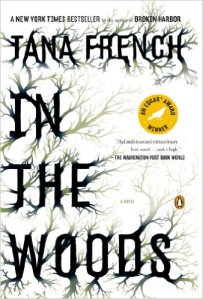
What’s a ginthewoodsood premise for a mystery? A child is murdered and the detective has to catch the killer. Not good enough. It’s a murder mystery, but why read this one?


Three children go into the woods. Two are murdered and the third is found covered with blood. He remembers nothing. Better. I might read it.

But that was 20 years ago. Now there’s been a similar murder in the same woods and the detective is the third child who survived the earlier crime and still has no memory of it. I will definitely sample that book.

A twenty-year-old body is found, that of a young woman. Twenty years earlier, a young man and his girlfriend planned to elope. When she failed to show up, he thought she’d jilted him. The young man is now a detective, and the body is that of his girlfriend.

faithfulplace

In the Woods and Faithful Place are excellent examples of one way to build a compelling premise for a mystery: an interesting crime plus a personal connection with the detective. The fundamental conflict of any mystery—murderer versus agent of truth and justice—is amplified by internal conflict.

Moreover, there is a built-in professional conflict for the detective, because he should recuse himself. In ITW, he keeps it a secret that he was the third child. In FP, he defies orders and investigates secretly on his own.

For Snyder, the premise is a what-if containing elements of both character and inciting incident. For John Truby (The Anatomy of Story), the premise is a short synopsis that includes the inciting incident, the main character, and the outcome.

His example, for the Godfather: “The youngest son of a Mafia family takes revenge on the men who shot his father and becomes the new Godfather.” The whole story, in a nutshell.

The two different senses of the term ‘premise’ are both widely used. In Story, Robert McKee discusses both concepts, which he calls, respectively, the inspiring idea and the controlling idea.

The story-in-a-nutshell of a mystery is the solution to the mystery. It is what I have elsewhere called the hidden drama. It’s the truth about the murder that is concealed in the enticing set-up.

A mystery needs a strong premise in both senses. The set-up states the mystery (someone has been murdered—why? By whom?) and the hidden drama, when revealed, must pack some sort of wallop to pay off the promise of a good story.

I cannot give you an example of the latter without spoiling a mystery. So that’s what I’m going to do. If you have not read Rebecca, STOP READING NOW! Read Rebecca and come back.

Joan Fontaine and Judith Anderson as the second Mrs. DeWinter and Mrs. Danvers, respectively, in the 1940 film diected by Alfred Hitchcock

Joan Fontaine and Judith Anderson as the second Mrs. DeWinter and Mrs. Danvers, respectively, in the 1940 film diected by Alfred Hitchcock

A shy, unconfident young woman marries a man whose first wife, Rebecca, has died in an accident. Rebecca was beautiful, talented, seemingly perfect in every way. How can our poor heroine ever compete with the ghost of this paragon?

Not the most powerful set-up (no mention of a crime), but the hidden drama—oh my. It turns out Rebecca was EVIL! Her husband hated her and murdered her! He got away with it—or did he? OMG!!! A witness comes forward! Breathtaking, page-turning suspense ensues. This book delivers on its premise like no other.

Cornwall

On just such a bay in Cornwall, Rebecca De Winter drowned…supposedly.

Call them hook and twist: a compelling crime to be solved and an underlying truth that is both unexpected and confounding. A really good mystery needs both.

Elizabeth Buhmann

————————————————————

A woman who witnessed a murder lied on the stand. Twenty years later, the man who was convicted on her testimony has just been exonerated and released:

Lay Death at Her Door, by Elizabeth Buhmann

Shattering a Vase

…it was like taking a vase and setting it down so hard it shatters…

~  Tracy Chevalier

When I taught secondary English, grading essays was my least favorite task. I was happy to read them, but assigning letter grades? I hated that.

I hated judging. I hated trying to determine the difference between a B and an A, or, worse, between a B-plus and an A-minus.

But the worst–the part that made me want to moan like the Ghost of Hamlet’s father, “Oh, horrible, oh, horrible, most horrible!”–was listening to students who thought their work merited higher grades: “But I worked so harrrrrrrd.

Some had watched classmates complete an entire assignment during a lull in history class and then score A’s. It wasn’t fair.

“Harrrrrrrrrrd” was my signal to say that no, it didn’t seem fair, but that good writing comes from more than just time sheets and sweat. It’s the words on the page that matter.

Now, to my dismay, I sometimes find myself slipping into student mode. For example, when I submit a chapter to my critique group, or an agent, or a publisher, or a reviewer, or even a family member, and they find fault, or don’t even mention my genius, I have to restrain myself from wailing, But I worked so harrrrrrrd…

Each time it happens, I pull out the old talk about time sheets and sweat. I add that whingeing is the hallmark of the amateur.

And I meditate upon Tracy Chevalier.

Chevalier wrote the critically acclaimed historical novel Girl with a Pearl Earring. Her next (third) novel began as a draft written in third person, with small sections in first-person voices of children. The finished manuscript was a disappointment.

When I reread the first draft, she says,  I cried at the end. It was boring, dead weight, terrible. Then I looked it over and thought, there’s nothing wrong with the story except the way it’s told.

She found the solution in another contemporary novel:

I had the idea when, just as I was finishing the first draft in third person, I read Barbara Kingsolver’s The Poisonwood Bible, which uses five different voices beautifully. It’s a wonderful book, using multiple voices very successfully, and I thought, “Oh, that’s an interesting technique, I wonder if I should take the kids’ voices I’ve already written and have the three of them tell it.” It just felt right.

The revision was published as Falling Angels, an exquisite novel about a young wife and mother struggling to survive in the rigid, but rapidly changing, social structure of Edwardian England. The book is written in first person, from twelve perspectives, in twelve distinctive voices.

I came across Chevalier’s account when I was just beginning to write fiction and became obsessed with the work. Writing an entire manuscript, setting it aside, starting all over—it had to be pure drudgery. I couldn’t imagine putting myself through that. 

Recently, though, I reread the article and a different passage caught my attention—Chevalier’s description of the rewrite:

I took the draft, and it was like taking a vase and setting it down so hard it shatters, then putting the pieces back together in a different way. I rewrote the whole thing in first person with all these different voices.

That passage doesn’t describe drudgery. Shattering a vase, putting the pieces back together to make something new—that’s a picture of creation, of the excitement and the pleasure and the beauty that accompany it.

I love Tracy Chevalier’s novels and admire her talent. But, on a more personal level, I’m grateful to her for sharing publicly how Falling Angels made its way into print, for reminding me that hard work and drudgery aren’t synonymous, for implying it’s okay to cry over a bad draft and that perceived failure can turn into success, and for showing that the act of writing itself affords as much pleasure as the spirit is willing to embrace.

And—for tacitly suggesting that no one really needs to hear me whinge about how harrrrrrrrd I work.

It’s the words on the page that matter.

*****

Note: I do love Chevalier’s novels. In fact, I love Falling Angels so much that during library duty one Saturday morning, I was so intent on finishing the book—just racing toward the climax—that I unlocked the front doors but left the lights in the reading room off, and spent the next ninety minutes parked behind the circulation desk, reading and hoping no one would walk in and want something. I’m not proud of what I did, but patrons didn’t seem to notice anything different, and I finished the book.

Note: The angel pictured above stands in the Oakwood Cemetery in Hendersonville, North Carolina. Carved from Italian marble, she is the angel often referred to in Thomas Wolfe’s Look Homeward, Angel. Wolfe’s childhood home is in Asheville, about twenty miles north of Hendersonville.

*****

Information about Tracy Chevalier comes from Fiction Writers Review.

*****

Posted by Kathy Waller

Kathy

Kathy

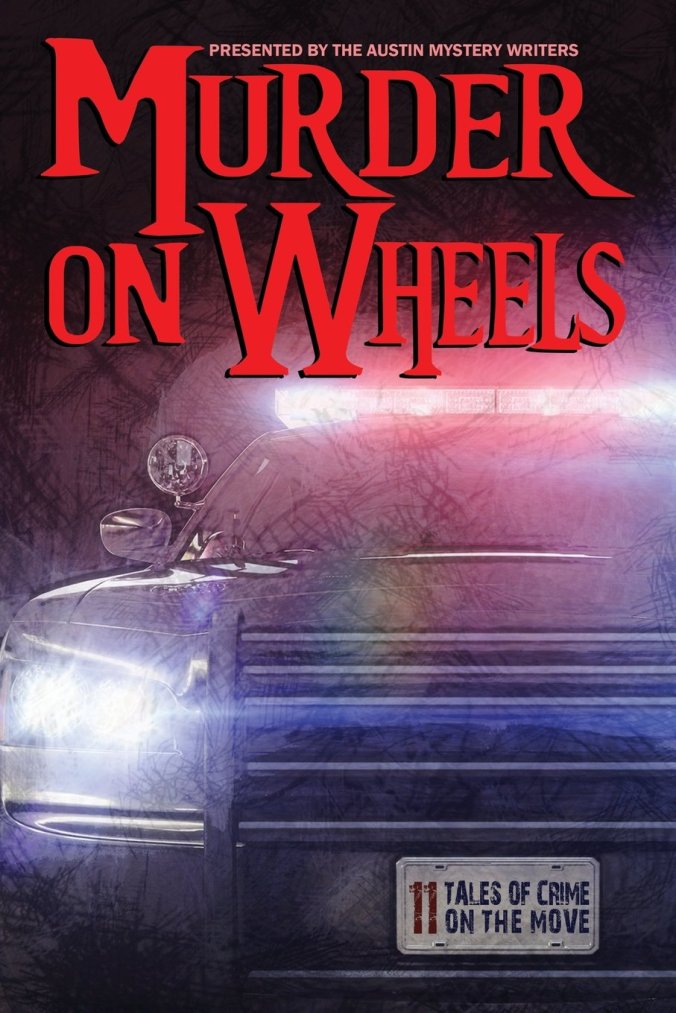
Two of Kathy’s stories appear in
Austin Mystery Writers’ crime fiction anthology,
Murder on Wheels.
She blogs at Kathy Waller ~ Telling the Truth, Mainly,
and on the group blog, Writing Wranglers and Warriors.

Join AMW for MURDER ON WHEELS Launch ~ August 11

Please join

Austin Mystery Writers

Gale Albright, Valerie Chandler, Kaye George,
Scott Montgomery, Laura Oles, and Kathy Waller
&
Earl Staggs and Reavis Wortham

as they celebrate the launch of their first crime fiction anthology

MURDER ON WHEELS:
11 Tales of Crime on the Move

“Eleven stories put the pedal to the floor and never let up! Whether by bus, car, tractor, or bike, you’ll be carried along at a breakneck pace by the talented Austin Mystery Writers. These eight authors transport you from an eighteenth-century sailing ship to the open roads of modern Texas, from Alice’s Wonderland to a schoolbus yard in the suburbs of Dallas. Grab your book, hold on to your hat, and come along for the ride!”

Tuesday, August 11, 2015
7:00 p.m.

BookPeople Bookstore
6th Street and Lamar

Austin, Texas

“There is something for everyone…” ~ Amazon Review

“…light-hearted (and occasionally black-hearted) collection of short stories… I thoroughly enjoyed it. … take your choice–historical, humorous, dark and light. Good reading for mystery fans.” ~ Amazon Review

 “… dialog that is realistic and makes the characters believable and three dimensional. There is something for everyone…” ~ Amazon review

“… a diverting read.” ~ Barry Ergang, Kevin’s Corner

71QiKRIkj+L

That Would Make a Pretty Good Story

When Howard was four, he and his baby sister were playing in the living room, while his mother and his grandmother sat at the kitchen table just around the corner. A few days before, while staying with his grandmother, Howard had said something cute–he did that a lot–and today, over coffee, his grandmother told her daughter about it.

Immediately after Grandma finished the anecdote, Howard piped up from the other room, “That makes a pretty good story, doesn’t it?”

That’s a four-year-old thinking like a writer. Thinking, in fact, like James Thurber, who filled entire books with cute things. Thurber said this about his works in progress:

“I often tell them at parties and places. And I write them there too….I never quite know when I’m not writing. Sometimes my wife comes up to me at a party and says, ‘Dammit, Thurber, stop writing.’ She usually catches me in the middle of a paragraph. Or my daughter will look up from the dinner table and ask, ‘Is he sick?’ ‘No,’ my wife says, ‘he’s writing something.'”


Writers never stop writing. We may be immersed in experience and emotion, and at the same time be standing outside ourselves, thinking, That would make a pretty good story.

For the purposes of this post, I’m now going to tell a brief story. When you finish reading it, there will be a test:

A couple of weeks ago, I was riding the Washington, D. C. Metro, going from Reagan International Airport to Bethesda, Maryland, for Malice Domestic, a convention at which fans and authors celebrate the traditional mystery.

My plane had arrived late. Darkness had fallen and seeped into the rail tunnels. Signage was… lacking. I couldn’t see names of the stops, nor could I understand the voice announcing them.

I’d already wasted time by taking the YELLOW LINE instead of the BLUE LINE, because, on impulse, I decided my way would get me to the RED LINE just as easily as the BLUE LINE would. And it would have, if the YELLOW LINE I boarded hadn’t been going the wrong way. If I missed my stop now, there was a distinct possibility I would have to sleep on the Metro, which is considered taboo.

Now, each Metro car has one map beside one of the doors. At a stop near mine, I decided to move to the front seat so I could see and count the stops preceding mine. I rose, pushed my humongous suitcase into the aisle, and somehow managed to position it between me and the front of the car. So I pulled up the handle and tried to turn the case so I could roll it behind me. At the same time, I tried to exchange places with it. I think.

That is when the suitcase attacked me. Rocking back and forth, it threw me off balance, and I fell backward, full length, into the aisle. On the way down, I thought, I’ve never fallen this direction before. Then my bottom hit, and after that, my head.

When I realized my head would hit the floor, I had a nanosecond of worry, but I hardly felt the impact. That surprised me, because my head is protected by far less padding than is my bottom. It was such an easy fall, very much like lying down in the aisle, without knowing you’re going to.

End of story, almost.

Here’s test question #1: How does this not-so-pretty-good tale about a train ride relate to thinking like a writer?

Because when no one ran to help me up, and I realized I was alone, surrounded by dark, unfamiliar territory far from home, where anybody and his mean dog could enter the car at any time… I lay in the aisle, smiling, gazing at the ceiling, and thinking, This will make a pretty good story, won’t it?

Unfortunately, this obsession–the word is an exaggeration, but sometimes it feels like obsession–with story isn’t necessarily welcome… because we can’t switch it off. It follows us into the sickroom and stands with us at the graveside and makes us feel ashamed, because one small corner of our minds is nearly always detached, removed from real life, observing, remembering, writing. 

We speak about the subject among ourselves. But when we speak about it to non-writers, we concentrate on the lighter side. The other part we prefer to leave in darkness.

Only the relative anonymity of the blogger allows me to write about it here.

Test question #2: Do you write all the time? Do you know when you’re not writing? Have you had an experience that would make a pretty good story?

 ***

Note: Imagine the child in the portrait above with blond hair… That would be Howard.

Note: Metro riders who knew where they were going were so very helpful in assuring me that, yes, the YELLOW LINE would stop at Gallery Place. I think I asked at least a dozen of them over the course of the evening. A transit worker carrying a broom yelled at me, but I’m sure he was doing the best he could, bless his heart. I am sorry to say I raised my voice a couple of decibels in return (righteous indignation), but, bless my heart, I was doing the best I could, too. It’ll probably make a pretty good story.

***

You can read Kathy Waller’s personal blog here, and once or twice a month she posts at Writing Wranglers and Warriors.

Kathy

Kathy

Two of her stories appear in AMW’s MURDER ON WHEELS, published by Wildside Press and available at Amazon and Barnes & Noble.

Our anthology!

Our anthology!


The Writing Process: The Wisdom of Darrell Royal and Lessons from a Jack Russell Terrier

Most people don’t believe it, but I was almost thirty years old, and had been teaching English for seven years, when I discovered I possessed a writing process. I learned about it in a special summer program for teachers of English at the University of Texas – Austin–the Hill Country Writing Project.

Author Anna Castle addressing SINC ~ Heart of Texas Chapter, March 2015

Author Anna Castle addressing SINC ~ Heart of Texas Chapter, March 2015

A certain writer of fiction for middle grade who spoke at the Texas Library Association’s Bluebonnet luncheon several years ago was even older than I when she found out about hers. I won’t mention her name, although I’ve just discovered she lives in Austin and am wondering whether she might accept an invitation to speak at one of my Sisters in Crime chapter’s meetings–But I digress.

This author said children she met at school visits started asking, “What is your writing process?”  When they explained to her what that was, she thought a while and then described it in roughly the following way:


Hit the alarm button, roll out of bed, throw on robe, drag out of bedroom, bang on son’s door in passing, go downstairs, make coffee, pile dirty towels in hall, bang on son’s door and yell “Get up,” dress, put towels in and start washer, go to office, turn on computer, inhale coffee fumes until eyes open, pull up file, stare at monitor, drink coffee, stare some more, check on son . . . 

This author’s process isn’t exactly what the UT scholars meant but it’s worked for her through nearly sixty books (the last time I counted).

About a month ago I reviewed my own writing process–I’d been trying and failing to complete (which means I couldn’t even begin) a 100-word story for Friday Fictioneers, and I believed analyzing my process might offer insight into the source of the problem. I did my best to remember how I had written the first three short-short stories, which had practically composed themselves.

The next three paragraphs provide a rough description of what went through my mind as I wrote those stories, which were based on picture prompts. I’ve included links so you can see the pictures and also, if you wish, read the final versions of the stories.

The second story: “Lovestruck.” Prompt–picture of old boat. Know nothing about boats. Grandfather’s old wooden boat on river. Friend’s husband surprised her with boat; she wasn’t pleased. Husband and wife. He wants boat. She sees flaws, thinks he’s crazy. He sees possibilities. Probably unrealistic. She’s patient. He doesn’t listen? What’s the end? Oh–he loves the boat–a love affair, name boat. No, lust. Ending? ???Too long. Quote Coleridge–develops wife’s character, she reads. Oh–have him intro boat-girlfriend to wife–first line–hook reader. Ending? Cut more. Oh–she wants something, boat is leverage–imply–end? suggest they look at–what?–sewing machine. She wants him happy–but–what’s good for gander. Both smiling. Cut.

The third story: “‘Shrooms.” Prompt–picture of mushrooms. What the heck I do with that? Poisonous. Lord Peter Wimsey–victim killed w/ deadly Amanita. Wife cooks mushroom gravy–End, poisons husband. How trite. Keep them talking about mushrooms. Tease–he won’t eat mushrooms, never does. Afraid of mistake–toadstools. She picked them. Husband–horrified! Create character, aunt–knows mushrooms–helped pick. Okay. Tastes, yum. Aunt pops in–new glasses–poor vision picking mushrooms–imply. End ambiguous. Accident? What did husband eat? Whimsy, understatement–Might want to spit out. Not trite.

First story: “Nothing But Gray.” Prompt: Man looking out window at courtyard? stone walls on all sides, no visible exit–b&w except for pot plants, red flowers. Boxed in, trapped, stone, gray. Start–boy, not man, place him staring out, gray stone, his POV. Easy–put him at window. Consider table, 4 plates, one boy. Guests for dinner? A brother. Mom comes in. Gray. Death. Mom in denial. 4 plates. (Note: Really, I’m not sure how I wrote this. Serendipity. Started writing and tripped over a miracle.)

That isn’t exactly what the scholars meant either–they talked about pre-writing, writing, revising, editing, polishing, nitpicking,** things that can be taught in a formal classroom setting.

English: A whole and split Cadbury Creme Egg.

English: A whole and split Cadbury Creme Egg. (Photo credit: Wikipedia). By Evan-Amos (Own work) [CC0], via Wikimedia Commons

I’m talking about the process unique to the individual, the brain state during which neurons explode at the mere thought of outlining before you do anything else or outlining at all, the state during which you either eat five pounds of Cadbury eggs or handcuff yourself to the birdbath so you can’t reach the box. Or, the state in which you’re relaxed, productive, focused, enjoying the act of creation despite the confusion and uncertainty creation entails.

To be continued…

Join me for Part 2 to discover
the Five Truths of the Writing Process,
how to make your writing practice more effective, and
What Darrell Royal and a Jack Russell Terrier Have to Do With Anything

 *

  • Nitpicking isn’t an official part of the writing process, but some people throw it in anyway.
  • To become a Friday Fictioneer, read instructions here: https://rochellewisofffields.wordpress.com/friday-fictioneers-2/. Then check Rochelle’s main page for the photo prompt, here: https://rochellewisofffields.wordpress.com/ You’ll probably have to scroll down to locate the correct picture. The projected date of publication will be the title. The official publication date is the Friday after the Wednesday prompt announcement. However, as I understand it, that’s a Friday-ish deadline. If Friday is impossible, just put it online before the next prompt comes out. Any Fictioneers out there, please correct me if I’m wrong.

*

Kathy

Kathy

Kathy Waller blogs at To Write Is to Write Is to Write, and once or twice a month at Writing Wranglers and Warriors. Two of her stories will appear in AMW’s MURDER ON WHEELS, available soon from Wildside Press. Years ago, Kathy’s tongue got lodged in her cheek and she’s never managed to get it unstuck, so you can’t believe everything she says. Except about the writing process.

My Valentine to Writing

Five members of Austin Mystery Writers post here regularly, and I sometimes wonder whether you readers know which of us is which. So I’m going to clear up any questions  concerning my identity.

I’m Kathy. I write about angst. Any time you arrive here to find weeping and wailing and gnashing of teeth over the writing life, it’s my teeth you hear gnashing.

Kathy

Kathy

I’m writing this at home, but home isn’t the only place I gnash. I do it at my office, AKA bookstore coffee shop, in full view of the public. I try to emote quietly, but muttering carries. People around me, many of them equipped with laptops and writing assignments of their own, receive full benefit of my outbursts: “Stupid, stupid, stupid!” “Noooo.” “What’s the word? What’s the word?” “^!*%&@% network.”

(I don’t really say ^!*%&@% , but that’s what I mean.)

I suspect other writers gnash, too.

Consider American poet William Cullen Bryant, author of “Thanatopsis.” I can’t imagine his interrupting himself with undignified emotional outbursts, but no one who holds his forehead like that is easy in his mind.

Today, though, there will be no gnashing. Today I depart from the usual tales of woe to say, I love writing.

I love the exhilaration I experience when words flow onto the page.

I love finding just the right word to express my meaning.

I love revising, moving sentences and paragraphs around, cutting excess–words, paragraphs, whole pages.

I love writing an entire blog post and then scrapping it and writing something different. (As I did for this post.)

I love filling holes to add clarity.

I love watching a story develop: beginning, middle, and end.

I love–oh, how I love–line editing, slashing words and phrases, discovering the one word whose omission makes the piece smoother, tighter.

I love the joy I feel on reading the finished product–and finding one more word to cut.

I love the satisfaction and the surprise of completing a task I didn’t think I could do.

I love making something out of nothing.

I love making art.

I love creating.

I love saying, “I write.”

I love loving writing.

*****

Lagniappe, Freebie, Pilon

William Cullen Bryant wrote “Thanatopsis” when he was seventeen years old. The title comes from the Greek thanatos (“death”) and opsis (“sight”), and has been translated “Meditation upon Death.” He initially hid the poem from his father because it expressed ideas not found in traditional Christine doctrine. In the concluding lines, which my mother memorized in high school and sixty years later could recite from memory, the poet instructs how to “join the innumerable caravan” of those who have gone before.

*

So live, that when thy summons comes to join
The innumerable caravan, which moves
To that mysterious realm, where each shall take
His chamber in the silent halls of death,
Thou go not, like the quarry-slave at night,
Scourged to his dungeon, but, sustained and soothed
By an unfaltering trust, approach thy grave
Like one who wraps the drapery of his couch
About him, and lies down to pleasant dreams.

Imagine Bryant reading those lines. He must have loved writing.

See the entire poem here.

*****

029

To Write Is to Write Is to Write

Kathy Waller blogs at To Write Is to Write Is to Write,which she plans to rename, and, every thirty days or so, with friends at Writing Wranglers and Warriors. She blogged at Whiskertips until cats took it over.


Tailoring, Treaties, and Tomatoes: 3 Techniques to Turn You into a Tenacious Writer

Italiano: Pomodoro grinzoso

Italiano: Pomodoro grinzoso (Photo credit: Wikipedia). By Abbasnullius (Own work) [Public domain], via Wikimedia Commons

In a post that appeared here last fall, Austin Mystery Writer Laura Oles asked the burning question,

Can a technique named after a tomato serve as the answer to your time management woes?

Or, more specifically, what does the writer do when it’s impossible to devote a large block of time–several consecutive hours, at least–to writing?

Laura answered the question with a resounding Yes! and went on to describe her success using the Pomodoro Technique, which involves working in 25-minute blocks of time.

After reading her post, I put a Pomodoro on my toolbar. I like it. It helps me log my time, a necessary evil for professional writers, and gives me a feeling of accomplishment.

But my schedule isn’t demanding. I often feel I’m running around like a chicken with its head cut off, trying to just get through the day, but really–I have time to write.  Pomodoro works while I’m writing.

But procrastination–in my case known as staring into space and thinking about what I’m going to do . . . later–wastes time. I need a jump start in order to start writing.

Even the promise an old-fashioned homegrown tomato is not enough of a carrot to lure me to the page. (Sorry about that.) To move me, there must also be a stick. Fortunately, sticks are available.

One I’ve found helpful is a writing challenge: A Round of Words in 80 Days (ROW80), subtitled The Writing Challenge That Knows You Have a Life.

In ROW80, you set your own goals. They must be specific and measurable, but they’re tailored to your needs. The first day of the challenge, you announce your goals in a blog post; then you put a link to your post on the ROW80 Linky.

I won’t try to explain the Linky, but you can read about it in the FAQs.

There are four rounds each year, starting the first Mondays in January, April, July, and October. Each runs eighty days and is followed by several days off. You check in every Sunday and Wednesday with a blog post in which you report your progress. If you need to change your goals, that’s fine. Just state the new ones and go on from there.

Round 1 for 2015 began January 5. Too late to enter? No. Jump in tomorrow or Sunday, or next week . . .

Your obligations, in addition to writing the Sunday and Wednesday posts and listing them on the Linky are 1) to put a link to the Linky page on your post; and 2) to visit the blogs of other ROW80 participants, comment, encourage them.

ROW80 allows flexibility. You choose when and how much you write, and if you don’t meet your goals, you haven’t failed–you’ve learned something. No pain, plenty of gain. The challenge is a stick, but there’s a lot of carrot in it, too.

A slightly stickier stick appears on Ramona DeFelice Long’s blog, which is an excellent resource for writers. Ramona is a professional editor as well as a writer. She’s successful because she works at her craft. In this post, she describes the persistence and determination required of the serious writer:

Writers write. Writers who get published complete work and submit that work to agents and editors. It’s how it works. The way to write for publication is to commit to it. That means nothing–and no one–stands in the way of your writing goals.

Ramona invites readers to take “The Sacred Writing Time Pledge.” As in ROW80, you tailor the pledge to your own needs–within certain parameters. But after that, there’s no wiggle room. A Sacred Pledge is meant to be kept. It’s simple: You do what you said you would do, or you don’t do it.

The pledge is a kind of treaty, too–a formal agreement between the writer and other parties. In most cases, it takes a village to make a writer. You sign the pledge, but there are spaces for your villagers to sign as well.

What I like best about Ramona’s pledge is its focus on the goal most writers aspire to–publication–and its honesty about what it takes to get there.

Now for a summary: In this post, I presented for your edification three techniques:

 ROW80, which lets you tailor goals to your needs;

The Sacred Writing Pledge, which a comprises both a pledge and a treaty; and

Pomodoro, which is a tomato.

Singly, or in combination, these three can help turn you into a tenacious writer.

But Wait!

I just read over the paragraph in which I referred to Ramona’s pledge as a stickier stick, and I realize the stick part is a gross exaggeration.

The Sacred Writing Time Pledge contains much more carrot than stick. In the first place, publication is as good a carrot as any writer can aspire to. It’s the literary equivalent of carrot cake.

Also, Ramona reminds us that we take the Sacred Writing Time Pledge not to enter 2015 burdened with an overwhelming task, but with hands open, ready to receive a gift:

 Think of it as renewing a vow–or falling in love for the first time, or again—with what you want to write.

Falling in love. What could be better?

Falling in love is carrot cake with a dollop of ice cream on the side.

 *****

And now, for tenacious readers, a pilon:

Tenacious

Cowhide makes the best of leather.
It should. It keeps a cow together.

 ~ Ogden Nash (of course)

 *****

0kathy-blog

  Posted by Kathy Waller,
who also blogs at
To Write Is to Write Is to Write

Writing, Thinking, Pantsing, and Miracles

Pantsing, when successful, lets you create a story closely resembling the spark that ignited it. ~Janalyn Voigt, Live, Write, Breathe

The first step in starting a blog is finding the perfect name. I wanted to call mine Contrariwise, as an homage to Lewis Carroll and to my ability to locate an argument in nearly any issue I come across.

Contrariwise was already in use, however, several times over, and I couldn’t find another literary allusion that satisfied, so I named it Whiskertips. It was my own invention, an homage to the two whiskered beasts with whom I share living quarters.

The next step is thinking of something to blog about. For most people, determining a theme would be Step #1. Reversing the steps led to a series of posts I like to think of as eclectic. In other words, I wrote about whatever came to mind. I also hosted guest bloggers. Mark Twain and Emily Dickinson appeared often. But after a while, nothing came to mind, and I began to fall back on the beasts. When they IMG_0832.1assumed complete control of content, I withdrew and created another blog. I took its name from Gertrude Stein: To Write Is to Write Is to Write.* In a note in the sidebar, I stated the purpose: I would write about the experience of becoming a writer. I would write about writing.

It seemed like a good idea at the time.

But the best-laid plans of mice and men, etc. In only weeks–days–I had another eclectic blog on my hands. Why? Because I didn’t know anything about writing.

Or, to qualify that, I didn’t know anything writers–or anyone else–would want to read.

I know the basics: grammar, usage, mechanics, various elements of fiction, methods and techniques learned from reading, attending workshops, taking classes, reading articles, books, and blogs. But I had nothing to add.  Other people had gotten there first. And who wants to read another article about where the commas go?

The worst part was that most of the authorities claimed to have the One True Way:

Write fast. Don’t revise as you go. Outline–you have to outline every scene. Use index cards. Use colored pens. Tape butcher paper to the wall. Never share your work before you’ve completed it. Find a critique group. Write 1,000 words a day, and in ninety days you’ll have a completed manuscript. Write every day. Write morning pages. Keep a writing journal. Keep a bible for your manuscript. Query early. Query later. Have a platform. Establish a brand.

All good advice, I was sure. And frustrating, because I couldn’t seem to follow the rules.

Finally, I gave up. The experts were great at explaining how they write, but they weren’t so good at telling me how to write.

I had to struggle for a while, find my own way, develop my own process, set my own rules, and deviate from rules I’d outgrown.

Now, after years of wrangling with the experts, and with myself, I finally have something to say about how I write:

I don’t start with an outline. I start with a character and a line and go from there. I can’t construct a decent plot until I understand the characters, and I can’t understand the characters until I know their backstories. The only way I can know backstories is to write them, not in a separate document, but as part of the manuscript itself. Afterward, I go back and start putting the material in order. I may have to scrap some of the best parts–the darlings–but they go in a Darlings file so I can use them later if I find a place they fit.

This method is called pantsing–as in flying by the seat of your pants. Some plotters look down on pantsers. That used to make me feel like a failure. Then I read Writing Mysteries, a collection of essays edited by Sue Grafton, in which Tony Hillerman tells about his own pantsing. He said it takes longer, but in the end, he gets there. Since reading that, I’ve stopped apologizing for pantsing. What’s good for Tony Hillerman is good enough for me.

Let me make one thing clear: I revise. The condition of my first manuscript dictates that I revise a lot. The end product looks very different from the original.

Because I’m a pantser, the NanoWriMo program of writing a 50,000-word novel in thirty days doesn’t bring out the best in me. I write more slowly, and I can’t pound out a book on someone else’s timetable. For years I registered for NaNo and then wrote perhaps ten words. That’s called losing Nano.  Now I register and write whatever I want on my own timetable. I lose nothing, NaNo loses nothing.

(There’s another reason I don’t do well with NaNoWriMo. I don’t like to talk about it. But if you want to read about it, check Wikipedia under Passive-Aggressive behavior.)

The exception to my pantsing process occurs when a story comes to me already outlined. One such blessed event happened one night just after I’d gotten into bed and turned out the light: a story appeared, beginning, middle and end. I thought it would take about 600 words, but the final version turned out to be nearly 5,000 words. It included a little pantsing.

When I began this post, I knew only two or three things about writing, but now I realize I know more. Having already run on at length, I will leave the rest for another time. After I’ve pointed out one more thing:

Some writers, myself included, know (There’s another one!)–that writing is  a form of thinking, a way to generate ideas, to learn what we already know.

But I also subscribe to Gertrude Stein’s description:

One of the pleasant things that those of us who write or paint do
is to have the daily miracle. It does come.

I depend on the daily miracle. When I write, and keep on writing, it does come.

 *

*The entire quotation is “To write is to write is to write is to write is to write is to write is to write.” I presume it was not already in use because no one wanted it.

*

Posted by Kathy Waller 0kathy-blog

Kathy blogs at To Write Is to Write Is to Write and at  the group blog Writing Wranglers and Warriors.

Find her on Facebook at https://www.facebook.com/kathy.waller68.


Morning Pages: Don’t Speak. Don’t Judge. Don’t Fall Asleep.

Karleen Koen

Karleen Koen

The first day of last summer’s Writer’s League of Texas retreat, author-instructor Karleen Koen told students that every morning before class, we must do Morning Pages: Wake up, don’t speak, take pen and paper–not computer–and, while still drowsy, write “three pages of anything.” Don’t judge. Keep the pen moving. In her course notebook, Karleen listed the following:

Stream of consciousness, complain, whine, just move your hand across the page writing whatever crosses your mind until you get to the end of page three.

Karleen stressed that she didn’t invent Morning Pages. The technique, minus the name, came from the book Becoming a Writer by teacher Dorothea Brande, published in 1934 and reissued in 1981. Author John Gardner, in his foreword to the reprinted edition, states it was “astonishing” that the book had ever gone out of print.

IMG_3540

Becoming a Writer by Dorothea Brande

Ms Brande advises aspiring writers to “rise half an hour, or a full hour, before you customarily rise.” She continues,

Write anything that comes into your head: last night’s dream, if you are able to remember it; the activities of the day before; a conversation, real or imaginary; an examination of conscience. Write any sort of early morning reverie, rapidly and uncritically. (Brande, p. 72)

Julia Cameron, in her bestselling The Artist’s Way, published in 1992, named the process Brande advocated Morning Pages and made them the cornerstone of her Artist’s Way program. Cameron considers them a form of meditation.

Why do Morning Pages? To quiet the internal critic; to tap into the subconscious; to discover what you know; to remember and to capture the present; to build fluency, the ability to “write smoothly and easily when the unconscious is in the ascendant.” (Brande, p. 72) And, as Koen notes, to whine and complain.

When I do Morning Pages, I like to focus on whining and complaining. Words of discontent virtually flow from my pen when I follow Brande’s instruction to rise early. To wit:

The morning after Karleen assigned Morning Pages, my roommate and I woke to my cell phone alarm at seven rather than the previous day’s eight. (I think that was the morning the phone flew from the nightstand and landed on the concrete floor.) I propped myself up on a couple of pillows, gathered the pen and the notebook I’d placed on the nightstand before retiring the night before, and started to write.

While I wrote, my roommate sat on the side of her bed. Instead of picking up her notebook, she spoke. I reminded her we weren’t supposed to talk. She told me she didn’t care what we weren’t supposed to do. After violating the rules once or twice more, she started on her Morning Pages.

Roommate drinking tea and smiling

Roommate drinking tea and smiling

In my usual all-or-nothing fashion (a tiny bit of OCD), I wrote through hand cramp and shifting pillows. Halfway through, I fell asleep. When I woke about a half-hour later, I resumed scribbling.

My roommate had already finished her Pages. She had dressed. She had sat on the porch and drunk a cup of hot tea. She was smiling.

Sometimes it is better to bend the rules.

At break time, I quoted to Karleen the first sentence of my Morning Pages: I don’t like Karleen any more. (I said it in bold font.) She laughed uproariously and asked if I knew how funny I was. I didn’t tell her I was dead serious. Before the end of the day I would like her again, and if I told the truth now, I would have to apologize later, and I just didn’t have the energy.

Since I’m confessing, I might as well admit that, while I was scribbling, I figured out a fool-proof way to make Morning Pages a positive experience: Use a notebook with little tiny pages. They fill up faster.

Looking back, I’m ashamed of the thought, but at the time it seemed a darned good idea.

Anyway. Having griped about that miserable experience, I’ll also admit that Morning Pages work. I’ve done them off and on since 1998, when I heard Julia Cameron speak at the Austin Whole Life Festival. A small group of young men stood outside Palmer Auditorium holding placards and begging attendees to abandon chakras and crystals and choose reason instead, while inside, Cameron shared the most reasonable ideas on stimulating creativity.

So I read The Artist’s Way and, although a 17-cent spiral notebook would have sufficed, I bought a copy of The Artist’s Way Journal. (The Journal had enormous, narrow-ruled pages that took forever to cover, but having the proper tools is important to OCDs.)

Then I wrote. And whined. And complained. As I did, the garbage in my head moved down my arm, through my hand, and onto the page. By the time I got to page three, my mood had lightened. When I turned to other writing, the garbage stayed trapped inside the Journal.

Once the brain has been cleared of debris, words can flow.

That’s my experience. Others have their own reasons for writing those three pages per day. But those who engage in the practice swear by it.

Adequate sleep

Adequate sleep

As I said, I’m not consistent. I’ve done Morning Pages for months at a time, then skipped one day and failed to resume the habit.* Nearly every time I’ve given up,  fatigue has been the cause. A long commute before and after an extra-long day makes rising early unpleasant if not impossible. The same thing goes for getting to bed too late. Morning Pages require adequate sleep. But so does good health. So does good writing of any kind.**

Before leaving the retreat, I bought a special notebook for my return to Morning Pages. The signature on the cover looked like Dickens but turned out to be Darwin. No matter. Darwin and I are friends, too, and I wanted the green one. I’ve not yet made peace with going to bed at a decent hour. I’m trying. But when I stay up into the wee hours working on a blog post, my morning edges toward afternoon.

Oh–I’ve just remembered: A situation unrelated to fatigue once interfered with Morning Pages. It involved the repaving of twenty miles of FM20, a wintry cold house, and a new box of cat litter.

But that’s a story for another post.

Charles Darwin's signature on elegant green notebook

Charles Darwin’s signature on elegant green notebook

###

*Morning Pages is about the only habit I’ve ever managed to break.

** I’m not sure about sleep being necessary for good writing of all kinds. I suspect Hemingway, Faulkner, and Fitzgerald might have stayed up past bedtime. But I bet Willa Cather kept regular hours. And, as people with any discernment at all recognize, Cather is at the very top of the American novelist pecking order.

###

0kathy-blog

Kathy Waller blogs at To Write Is to Write Is to Write (http://kathywaller1.com) and at the group blog Writing Wranglers and Warriors. She’s set aside her novel manuscript for a while to concentrate on writing short stories.