Just Look Around!

by HELEN CURRIE FOSTER

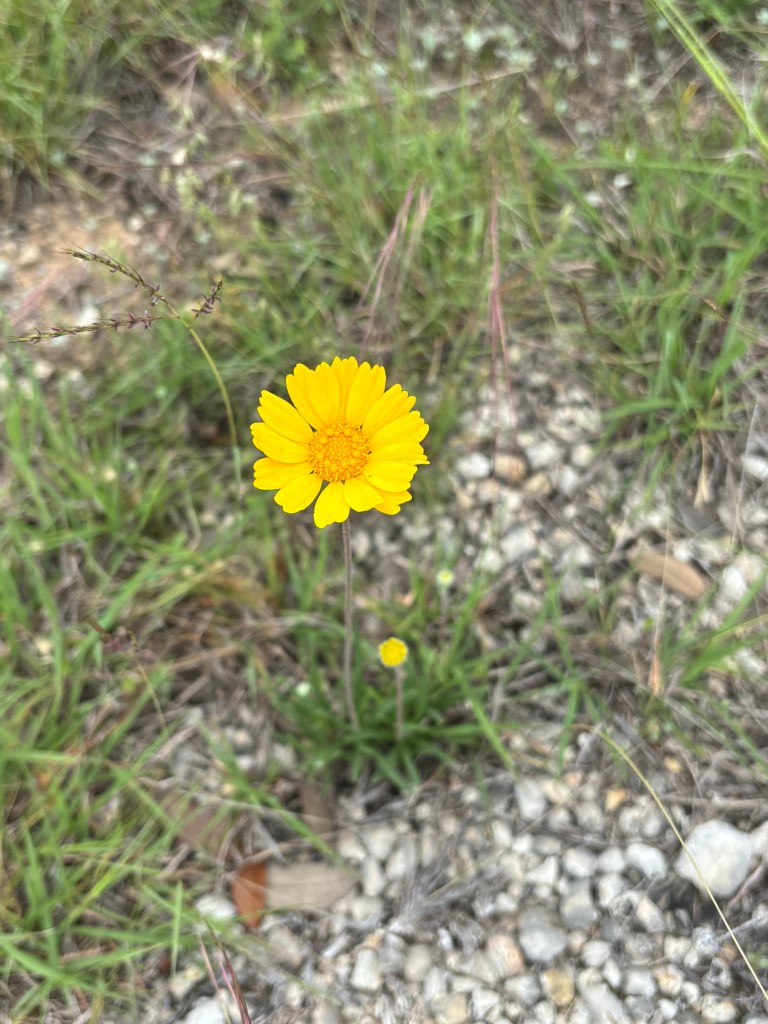
Not enough rain fell this year to allow the brilliant cerulean fields of Hill Country bluebonnets we usually expect, but the hardy lupines are busy making seedpods. “Maybe next year,” they say. Now instead we have the bright yellow coreopsis lanceolata, nodding their heads with any breeze,
the wine-cups with their indescribable color—a member of the mallow family, not quite fuchsia, not maroon, just—heart-stopping,

the milkweed flower globes beloved of monarch butter-flies, and others. Heaven includes a few prairie celestials, magically opening in early in the afternoon, then vanishing by dusk.

Also, “Sweet Mademoiselle,” planted a couple of years ago, and who has never bloomed, produced her first rose!

Meanwhile, the ever-interloping cactus hope to assuage my fury at them (remember those secretly spreading roots and the huge basal “plates” that help the Cactus Conspiracy spread?) by popping open their yellow flowers. I am not fooled. I’ll continue to battle them with shovel and hoe. And a picker-upper.

Now for some Hill Country facts.

BIG CATS?  Just in case you thought the animal that appears in my mystery Ghost Cat was, perhaps, unrealistic? Over-the-top? Mere fantasy? Couldn’t have played a part at beginning and end? Not so! https://www.statesman.com/story/news/state/2025/04/21/mountain-lion-san-marcos-trail-texas-sightings/83194256007/

See? Perfectly possible. It’s still wild out here in the Hill Country, even as suburbs press upon us. At dusk I often find myself glancing at the edge of the drop-off behind the house, wondering if I’ll see a pair of ears. You can say mountain lion, puma, cougar…they’re secretive, strong, and active in the spring.

But the big cat I once saw on Bell Springs Road west of here was likely a large bobcat. I was alone, driving home from the post office. Up ahead a golden vision, spotted, walked slowly to the edge of the asphalt. I stopped. The cat stood, gazed at me, and after a breathless (for me) interval, gracefully turned and vanished through a fence into thick cedar. A magical moment. Every time I drive that road, I hold my breath, longing for one more sighting of something looking like this:

https://images.app.goo.gl/K9VMv8bW92CpoSacA

ANCIENT BONES? I wrote about old bones in my Ghost Bones (2024)—and now have learned that our Hays County police deal with ancient bones more often than you’d think. One resident recently called to report she’d found a skull in her firepit. The skull, with its lower jaw present, was obviously fairly old, but in an unexplained death Hays County is not permitted to send a body to the Travis County Medical Examiner without including the name of the person whose skull it is. (Hays County doesn’t have its own medical examiner.) So this skull traveled instead to Texas State anthropologists who reported, after testing, that the skull apparently belonged to a long, long-ago teenager who’d gone through hard times, as was evident from the “enamel lines” (a bit like tree rings) in the teeth.

But how it wound up in that firepit? So far as I know, that’s still a mystery. We forget—until reminded by a skull in a firepit—how long humans have roamed these hills, drawn by hunger and thirst to spring water and the hunt for food.

We also forget the age and history of this landscape. Some trees have sheltered native Americans, deer, and buffalo. The Columbus Live Oak near the Colorado River in Columbus is estimated to be over 500 years old. Others may be as old as 1,000 years.

https://tfsweb.tamu.edu/websites/FamousTreesOfTexas/TreeLayout.aspx?pageid=26882https://goodcalculators.com/tree-age-calculator/

I revere the live oak in our front yard as if it were a beloved ancient relative and a symbol of stability and the power of trees. If anything were to happen to it—woe! I tried to estimate its age—using the calculator instruction to measure girth in inches at 4.5 feet, divide by pi, then multiply by a “growth factor” of 4, which gave me 127 years old. Perhaps this tree was a sapling in 1900, before either World War, before the Viet Nam war, before our current fraught politics. On a nearby hill there’s an ancient patch of even bigger live oaks. Perhaps those particular oaks depend on the odd little ribbon of wet white clay that lies about five feet underground and has been there—who knows how long. But the feeling of walking in beneath these old live oaks can confer a sense of being in the protection of one’s elders.

So, welcome to the Hill Country in spring—southeasterly winds from the Gulf, blowing the flowers back and forth; reasonably moderate temperatures; fields and trees as green as green, as far as you can see. At the bird feeder, more color! Purple house finch, yellow-throated vireo, lesser goldfinch with brilliant gold breasts, vermilion cardinals, black-crested titmouse, white-winged dove—and the shy and tiny, but utterly gorgeous, painted bunting. (Reportedly it loves millet.) They provide not just color but music, from the titmouse, the tiny but high-volume Carolina wren, plaintive doves, whistling cardinals, and, at night, chuck-will’s-widow.

Not for long, of course. In winter ice can wreak havoc on trees and people. Summer sun? Scorching. Autumn? Nothing like the colors of New England, but hey—the sumac turns red. So welcome, Spring, with your bluebonnets and live oaks, with bird music and color, and with your reminder of the power and beauty of nature!

***

Progress report: madly working on Book 10 of the Alice MacDonald Greer Mystery series, set in the Hill Country. Have ordered “Forest Bathing” by Dr. Qing Li. Would enjoy hearing what you all are reading too, and any reports of “forest bathing”!


Helen Currie Foster lives and writes the Alice MacDonald Greer Mystery series north of Dripping Springs, Texas, loosely supervised by three burros. She’s drawn to the compelling landscape and quirky characters of the Texas Hill Country. She remains deeply curious about our human history and how, uninvited, the past keeps crashing the party.

Follow Helen at http://www.helencurriefoster.com.
Waking or Sleeping?

by Helen Currie Foster

This week out here on the creek I was iced in, with no power.

I was sitting by the fireplace wrapped in a blanket, when I came upon an unfamiliar word: HYPNOGAGIA. “Hypnagogia is the transition between wakefulness and sleep. During this state, it’s common to experience visual, audio, or other types of hallucinations. It’s also common to experience muscle jerks and sleep paralysis.” https://bit.ly/3YhrbZ6

Some people purposefully try to induce to hypnagogia to stimulate creativity. Id. According to Allison Eck, Harvard Gazette (Autumn 2022), hypnagogia is “widely thought of as a sweet spot for creativity.” https://hms.harvard.edu/magazine/sleep/behind-veil-hypnagogic-sleep. Eck describes the experience of scientist August Kekulé in the mid 1800’s during his search for the structure of the compound benzene, as he dozed before his fireplace in Ghent. “[A]s he dozed, images hinting at its structure appeared in his mind’s eye. He later wrote that he saw dancing atoms beaded together along an invisible string, ‘twisting in snake-like motion.’ The atoms morphed into an ouroboros” (another new word for me: a snake eating its own tail). Kekulé realized benzene’s structure was a ring  of carbon atoms, each attached to a hydrogen atom.

Scientists and innovators like Einstein and Edison, and writers like Vladimir Nabokov, “have transited this cerebral pathway in search of solutions to problems.” Id.

Have you experienced hypnagogia? I think I have, a few times, in mystery-writing, most recently in my newest, Ghosted. https://www.amazon.com/Ghosted-Alice-MacDonald-Greer-Mysteries/dp/1732722927/ref=tmm_pap_swatch_0?_encoding=UTF8&qid=1675707798&sr=8-1

On each occasion I’ve gone to bed with my mind on a plot problem, or a scene that needs to take shape. Preliminary requirements appear to include being ensconced under the covers, on my left side, envisioning a possible scene as I slide into sleep—then watching the scene begin to unfold. I try to remind my brain to remember this solution. While most dreams fly away with sunrise, these solutions have come back in the morning. If I could make this happen whenever I want (so far, no dice), a book would get finished so much faster!

This occasional experience may be “lucid dreaming,” the state of being aware that you’re dreaming. “When you wake up from a lucid dream, you actually have a more positive mood in the morning,” writes researcher Michelle Carr, Department of Psychiatry at the University of Rochester, in Aeon. https://aeon.co/essays/in-sleep-the-body-is-a-channel-to-communicate-with-the-dreaming-mind. Carr describes herself as a dream scientist: “I want to uncover ways to repair nightmares and, in their place, engineer dreams for healing.”

Hypnogagia is a big topic these days. A team of engineers and scientists at the MIT Media Lab developed a glove-like tool to help decipher dreams. Researchers are testing whether the glove may allow people to manipulate their hypnagogic experiences, which could help sufferers from PTSD and nightmare disorders feel a stronger sense of control.  Again, as Eck puts it, “…[A]t the very least, drawing attention to our hypnagogic personas may bring us newfound ideas that we can act on when we wake.”  Id.

Charles Dickens, inveterate insomniac, walked the streets of London at night and used dream states in his books, including, famously, A Christmas Carol. https://www.frontiersin.org/articles/10.3389/fpsyg.2021.700882/full

Could we term it “lucid dreaming” when Scrooge is shown visions—then decides to change the dreadful outcomes by his future actions? He begs the Ghost of Christmas Yet to Come, “Assure me that I yet may change these shadows you have shown me, by an altered life?” He promises, “I will honour Christmas in my heart, and try to keep it all the year. I will live in the Past, the Present, and the Future…” Then Scrooge sees the phantom’s hood and dress collapse into his bedpost, scrambles out of bed, repeating that last sentence––and heads out to buy the prize Christmas turkey for the Cratchits.

Vladimir Nabokov kept a dream diary, and in his autobiography, Speak, Memory, wrote about the procession of  what he called “hypnagogic mirages,” images he would see ‘just before falling asleep,” often accompanied by “a neutral, detached, anonymous voice which I catch…”

He emphasizes he is still aware during “the visions that pass before my closed eyes. They come and go, without the drowsy observer’s participation, but are essentially different from dream pictures for he is still master of his senses” (emphasis added). Lucid dreaming? https://www.loa.org/books/8-novels-memoirs-1941-1951?gclid=Cj0KCQiA54KfBhCKARIsAJzSrdotSuqt8CbUDCbTtegLG4hvxHker5ZZVuIwntp0lTzrNsY0PD5UeA8aAmQyEALw_wcB

Tolstoy’s notes show he envisioned characters in such visions. For a deeper dive, see https://ciaotest.cc.columbia.edu/olj/socsci/socsci_99pev01.html

(Side note––in Speak, Memory Nabokov also describes his synesthesia, where each letter of the alphabet appeared in its own color—depending on the language. In English a long “a” was the tint of weathered wood, but in French was polished ebony. Other letters were green, blue, yellow and so on. He also could not bear the sound of music. An unusual brain!) https://www.google.com/search?gs_ssp=eJzj4tLP1TcwTjMxr8gxYPQSKMtJTMnMzSxSyEtMys_OLwMAiy0J6w&q=vladimir+nabokov&oq=vladimir+n&aqs=chrome.1.69i57j46i131i433i512j0i512l2j46i512j0i512l3j46i512.8717j0j15&sourceid=chrome&ie=UTF-8

We mystery writers can mine hypnagogic moments for ideas on character and scenes––but the genre suggests a limit.

A good mystery offers the reader the chance to solve a puzzle. As set forth in the original rules of London’s Detection Club, “The detective must not light on any clues which are not instantly produced for the inspection of the reader.” Nor can the detective solve by “an unaccountable intuition.” https://murder-mayhem.com/the-detection-club-rules

Meeting of the Detection Club in 1936.

 Indeed, is there anything more irritating to a mystery reader than the tardy mention of a clue? No! Mystery readers are entitled to all clues, as soon as that clue is found, and clues are facts. The mystery writer offers a collaboration to the reader, in which the detective and reader are on the same page—fact-wise. We readers want evidence. A character’s dreams may offer insight into a character—but not evidence.

Besides—while most of us are at least mildly interested in our own dreams, unless we’re also therapists we’re not usually too interested in the dreams of others. Do you remember your interest level the last time someone began describing a dream to you? I confess my eyes can begin to glaze. Of course it’s hard to convey dreams with the color and speed and power the dreamer experienced. But in the world of mysteries, we are greedy for facts. In Martin Walker’s “Bruno, Chief of Police” series, set in a small town in the French Dordogne, Bruno’s activities are fascinating––his cooking, his love life, his detection––and while we know he had a difficult military service in Bosnia, the author doesn’t dwell on Bruno’s dreams about those days. Instead he provides us with what we want: Bruno’s memories. Those contain facts, at least Bruno’s versions of facts, for which the reader is grateful. http://www.brunochiefofpolice.com/

So I’m cautious. In my Alice MacDonald Greer Mystery series, at least so far, Alice doesn’t share her dreams. For one thing, as observed in the New Yorker, “As for writing about them, even Henry James, who’s seldom accused of playing to the cheap seats, had a rule: ‘Tell a dream, lose a reader.’” Dan Piepenbring, “The Enthralling, Anxious World of Vladimir Nabokov’s Dreams” (February 8, 2018). https://www.newyorker.com/books/page-turner/what-vladimir-nabokov-saw-in-his-dreams

The ice has melted! And Ghosted is out! Book 8 in the series is available now in paperback and also on Kindle via pre-order delivery on February 10, on Amazon. Also coming soon to Austin’s BookPeople!

Follow me at www.helencurriefoster.com.

https://www.facebook.com/helencurriefoster

https://www.instagram.com/helencurriefoster/

***

Author: Helen Currie Foster

I live north of Dripping Springs, Texas, supervised by three burros. I’m deeply curious, more every day, about human history and prehistory and how, uninvited, the past keeps crashing the party. I’ve loved the Texas Hill Country since my first sight of it as a teenager. Artesian springs, Cretaceous fossils, rocky landscapes hiding bluegreen water in the valleys. After law school (where I grew fascinated with water and dirt) I practiced environmental law and regulatory litigation for thirty years––then the character Alice suddenly appeared in my life. I’m active with Austin Shakespeare and Heart of Texas Sisters in Crime. And I’m grateful to the readers who enjoy the Alice MacDonald Greer Mystery series!

View all posts by Helen Currie Foster

Murder on Wheels Nominated for 2016 Silver Falchion Award

Posted by Kathy Waller

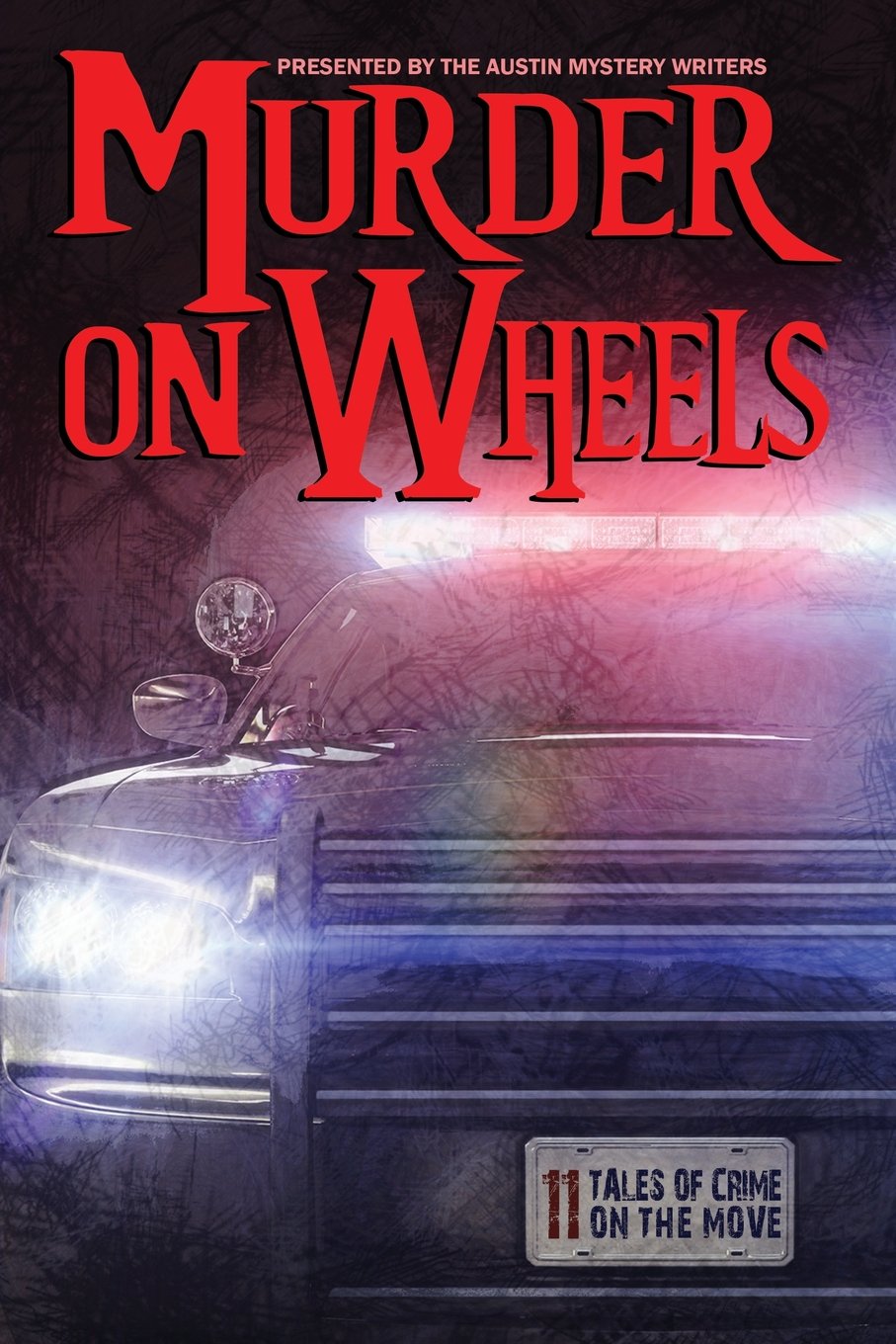
MURDER ON WHEELS, Austin Mystery Writers’ first crime fiction anthology, has been named a finalist for Killer Nashville’s 2016 Silver Falchion Award.

Best Fiction Short Story Anthology
Ramona DeFelice Long, Fish or Cut Bait
Kaye George, Murder on Wheels
Joe McKinney, Shrieks and Shivers from the Horror Zine
Josh Pachter, The Tree of Life

71QiKRIkj+LThe Killer Nashville Silver Falchion Award™ honors “the best books published for the first time that are readily available to a North American audience in any format from the past year.”

The idea for MURDER ON WHEELS came from a late-night group e-mail session.  As Kaye George explains in her Introduction, she and her husband had taken a ride on a large commercial double-decker bus, the Megabus, that runs between major cities.

“I started thinking that the bus would make a good setting for a murder,” Kaye writes. “There was only one problem–where to hide the body.”

One night, when all the AMWs were online, Kaye mentioned the idea. That led to members suggesting other vehicular settings: Bopped on a Bicycle, Creamed in a Car, Vaporized on a Velocipede… The thesaurus got involved, wordplay began, and an idea formed–we would all write stories around the theme of wheels. Once momentum started to gather, there was no getting off that bus.

So we wrote. Each of us contributed one or two stories. We were pleased to have two guest writers, Reavis Wortham and Earl Staggs, contribute as well. Ramona DeFelice Long edited the manuscript. MURDER ON WHEELS was published by Wildside Press in April 2015.

The final line-up goes like this:

A NICE SET OF WHEELS, by Kathy Waller
FAMILY BUSINESS, by Reavis Z. Wortham
ROTA FORTUNAE, by V. P. Chandler
MOME RATH, MY SWEET, by Gale Albright
THE WHEELS ON THE BUS GO ROUND AND ROUND, by Kaye George
BUON VIAGGIO, by Laura Oles
APORKALYPSE NOW, by Gale Albright
HAVE A NICE TRIP, by Kaye George
DEAD MAN ON A SCHOOL BUS, by Earl Staggs
HELL ON WHEELS, by Kathy Waller
RED’S WHITE F-150 BLUES, by Scott Montgomery

We’re also pleased to announce that member Laura Oles’ manuscript, THE DAUGHTERS OF BAD MEN, is a finalist for Killer Nashville’s Claymore Award.

Winners of the 2016 Silver Falchion Award and  the Claymore Award will be announced tonight at the Dinner and Awards Banquet at Killer Nashville Writers’ Conference in Franklin, Tennessee.

We’ve all heard, It’s an honor just to be nominated. In this case, it’s not a cliche. Austin Mystery Writers are honored to be nominated for these awards.

We’re also delighted, ecstatic, effervescent, excited, flabbergasted, frolicsome, joyous, jubilant, thrilled, thunderstruck… and in a veritable tizzy.

###

Kathy Waller blogs at MOW BOOK LAUNCH 003 (3)
Telling the Truth, Mainly and at
Writing Wranglers and Warriors.
Her short stories appear in
MURDER ON WHEELS and at
Mysterical-E

Banishing Lazy Words by Terry Shames

This week we have a guest blogger, friend and fellow mystery writer, Terry Shames!

Terry grew up in Texas, and has an abiding affection for the people she grew up with and the landscape and culture of the town that is the model for Jarrett Creek. She graduated from the University of Texas and has an MA from San Francisco State University. Terry now lives in Northern California with her husband, two terriers and a regal cat.

Terry’s first Samuel Craddock novel, A Killing at Cotton Hill, (July 2013) and was named one of the top five debut mystery novels of 2013 by MysteryPeople. The second in the series, The Last Death of Jack Harbin was named one of the top five mysteries of 2014 by the Library Association’s Library Journal. Dead Broke in Jarrett Creek, the third in the Samuel Craddock series, came out in October of 2014, followed by A Deadly Affair at Bobtail Ridge in April 2015 and The Necessary Murder of Nonie Blake in January 2016.

A member of Mystery Writers of America and Sisters in Crime, she serves on the boards of Northern California chapters of both.

Welcome, Terry! shamesTerry_1

Banishing Lazy Words

When I’m editing a book, I know that when I begin to get restless I’ve probably come across a nest of lazy words–words that are shorthand, or placeholders, for what I really want to say. Here are some lazy word indicators:

These, this, those, thing, stuff, some, about, just…and the dreaded “to be” verb (was, were…)

I often find when I come across several of these words on one page it means I was reluctant to dig deeper into the emotional content in the scene. When I buckle down and confront what I’m avoiding writing, digging deep to find the emotional core of the scene, I often end up writing a lot more words than I had before.

Here’s an example of a piece I was editing for someone else. I ran across several places on one page where two characters were talking about, “This thing we have going,” and “This thing we are trying.” The “thing” the writer was talking about was a difficult relationship between people of different ethnic backgrounds. By repeating the words “this thing,” she avoided addressing in depth the painful aspects of the relationship. The words fell flat on the page. Only when she changed it to say what she really meant, “Our risky experiment,” and “The way we are thumbing our nose at tradition,” did it begin to have the depth it deserved. Instead of a romance novel, it because more like Romeo and Juliet.

In first drafts, we often use shorthand for what we know is going to be a difficult description. But as writers we have to work hard to ferret out those lazy little words and phrases and say what we really mean. Not, “Amanda’s bedroom was a mess. There was STUFF lying everywhere,” or “I walked into Bill’s office. There was STUFF lying everywhere,” but instead, “Amanda’s clothes were strewn on the floor leading to the bed,” or “Judging from Bill’s office, he was a guy who dropped whatever he was reading onto any handy surface as soon as he was done with it.” Instead of saying, “there were several things he wanted to tell her,” it’s more interesting to read, “he stored up little criticisms that he could spring on her later.”

Contrast these two paragraphs:

“They dated for a few months, during which he told several lies. Some time later, she tried to remember which lies bothered her the most. There was the time he told her he was an accountant and lost his job when the economy went bad. And another time he said he looked around for a job for a long while before he could find another one. But the worst was when he said he’d buy her some jewelry, and never did.”

The fix:

“They dated for six month. After he disappeared, she found that he had hardly opened his mouth without lying. She bought into it when he told her he was an accountant, and lost his job when the economy went bust. She even believed that he pounded the pavement looking for a job for six months before he found one. But the lie that hurt most was that he promised to buy her a diamond ring, and he never did.”

The first paragraph is full of lazy words like “a few,” “several,” “some, “tried,” most,” “there was,” etc. The second one uses livelier, mores descriptive words.

When you read authors you admire, note that they pin down real time, real place, real emotion. It makes their prose richer and keeps readers engaged. It takes hard editing work, but it’s worth it. It’s the key element that will make your prose come alive.

You can find more information about Terry Shames at www.terryshames.com 

Thank you, Terry! That’s good concrete information that all writers can use. What do you think, reader? Any questions or comments?


Guest Blogger Janet Christian

38-Janet-Christian-5x7

Today’s guest blogger is Janet Christian, author of the Marianna Morgan PI murder mystery series (she’s working on book two at this time) and the soon to be published Virgilante paranormal mystery. She also has a dystopian science fiction novel, Born Rich, which she’s expanding into an epic, so it’s currently not for sale.

Janet served as 2003 President of the Heart of Texas Sisters in Crime in Austin, and became a published author in 2012. She also maintains an author’s blog.

Janet and her husband Eric Marsh live on a 100 acre ranch near Lockhart, TX – 30 miles south of Austin. They have four goofy dogs, an ever-changing population of cats (usually around 10), and a small herd of  spotted-wool Jacob sheep. When she isn’t writing, Janet creates pottery art pieces in her combination pottery studio and tiki bar.

Janet, welcome to AMW!

Three steps to research success

I was inspired to write this article after conversations with several writers who said they just wanted to write, and factual details weren’t that important to readers, anyway. The writers were willing to do limited online research, but had no inclination to talk to experts or visit locations. Research can certainly either be the bane or the joy of writing, regardless of genre or time period of the story. But research is always important, so why not find ways to make it work in your favor, and perhaps to even be enjoyable.

I understand that we writers tend to be a solitary bunch, but please make the effort to do thorough research beyond just surfing the web. You’ll be happy that you did. And so will your readers. Besides, at least to me, one of the joys of writing is learning all those amazing and cool facts and bits of trivia.

Here are three tips to help ensure your research is thorough, useful, and hopefully fun to acquire.

1. Surf the web

Google and other seSurfing the Webarch tools are amazingly complete storehouses of information, but searching can be tricky. If you want to know what year an event occurred, one search usually provides the answer. But if your goal is more esoteric, it can take dozens of searches, tweaking the keywords each time, before you find the information you seek.

Like most writers, I’ve attempted searches for some pretty obscure facts. And once recently my search resulted in the message “No results found.” I’m both simultaneously tickled and frightened that I “broke” Google. Maybe I need to rethink that plot twist.

While search tools are powerful, and can provide a world of search results, you should not count on it as your sole research tool. We all know the internet is chock full of not-quite-true “facts” and information. But the biggest reason is because of the amount of results one search provides. It can be overwhelming to sift out the clutter and get to the specific facts you seek. You can also find search results that directly contradict each other. (Try searching “are vaccines safe” or “is global warming real” for proof of just how contradictory results can be.)

Use a search tool as a springboard for where to go next. For my first novel, The Case of a Cold Trail and a Hot Musket, I wanted my protagonist, Private Investigator Marianna Morgan, to search for a stolen Brown Bess musket. In fact, my novel was inspired by a newspaper article about a long-lost Brown Bess being donated to the Alamo. Online searches gave me many facts about the musket, including images of its wooden stock and unusual triangular, cross-section bayonet. But there were many variations of the musket. And nothing online told me what condition it would be in after having been buried for thirty-five years. This is the point in research where it’s good to move on to step 2.

2. Contact an expert

Talk to expertsI was fortunate in the case of my Brown Bess research that my sister has a business acquaintance with Dr. Richard Bruce Winders, Historian and Curator of the Alamo. I was granted an appointment with Dr. Winders and had the privilege of holding the actual Brown Bess mentioned in the article that inspired my murder mystery. Dr. Winders also described in detail how I could safely hide one in my story.

But don’t let your lack of a direct or indirect relationship with an expert deter you. When I needed to research how the abduction of a child would have been handled in an unincorporated area near San Antonio in the days before 911 emergency service existed, I called Chief Don Davis, who was the Police Chief of Terrell Hills, Texas at the time I was writing. He was more than happy to see me. The accuracy and detail I included in my novel were a direct result of Chief Davis’s informative and helpful answers.

I’ve interviewed many other experts as well, covering topics as diverse as reptile exhibits, how many UPS drivers are assigned to a given geographic area, vintage Mustangs, and what would happen to a koi pond if a decomposing body were buried beneath the rubber liner. Some experts I met in person, others I talked to on the phone. I recommend face-to-face where possible, but phone calls are a perfectly acceptable alternative. I’ve yet to contact an expert who wasn’t happy to help, and all patiently answered my many questions. I always make sure to thank them in the back of the book and send them a signed copy once it’s published.

Whether you’re writing contemporary or historical mysteries, and regardless of whether they’re cozies or hard-boiled, there’s always an expert who can provide those gems of detail that really bring a story to life. And bringing reality and life to a story is where the third tip in research comes in.

3. On site visits

Triton, MN, September 28,2010--Rich Barto, an Small Business Administration (SBA) Construction Analyst inspects a home that was damaged when the Zumbro River overflowed its banks. FEMA, the SBA and the State of Minnesota are conducting damage assessment to determine if the state is eligible for federal assistance. Photo by Patsy Lynch/FEMA

In addition to my expert contacts on reptile exhibits, I visited the Animal World and Snake Farm Zoo near San Antonio. It was an hour and a half drive, but well worth it. Because of that visit, I was able to add multiple sensory experiences to the scene where Marianna visits a roadside reptile exhibit while tracking the bad guy. I believe my experiencing the assault of smells, sounds, and sights in person gave the scene in my novel a realism I could not have created any other way.

An actual on-site visit may not always be practical, but when it is, take advantage. If you’re writing a mystery that takes place in London, unless you have an extensive travel budget, you may not be able to visit. And if your story is set in 1800s London, a visit may not be all that useful, anyway. But sometimes there are other ways to accomplish a sense of “being there.” And even those alternatives can be invaluable.

Want a feel for Victorian England? Visit the largest Renaissance Faire you can find within a reasonable drive. Setting your charming cozy in a small town populated by quirky characters? Visit two or three cool small towns.

We’ve likely all read stories where it was clear the author published without doing any research. Even little mistakes can throw a reader out of a story. Did a football fan buy your mystery because it involves a murder during a Super Bowl? You can bet they’ll write a scathing review if you set the story in 1966 (the first Super Bowl was in 1967), or even if you describe the wrong concession foods. But if you’ve done your online research, talked to a football expert, and actually attended a football game (even a high school game, especially in Texas, will give you the sense of the crowd’s excitement and behavior), your story will “ring true” and that football fan will love it and look forward to buying your next book.

Isn’t at least one of our ultimate goals to have readers who love our books and can’t wait for each new release? Research can be one of the biggest keys to helping that happen.


Thanks Janet! You can find more of her writing at www.janetchristian.com

Interview with Manning Wolfe

One of the perks of being a writer is having interesting and talented friends. Today I’d like to introduce you to Manning Wolfe.Manning Wolfe Headshot 2

VPC – Manning, welcome to the AMW blog and congratulations on your debut novel! Can you tell us a little something about it?


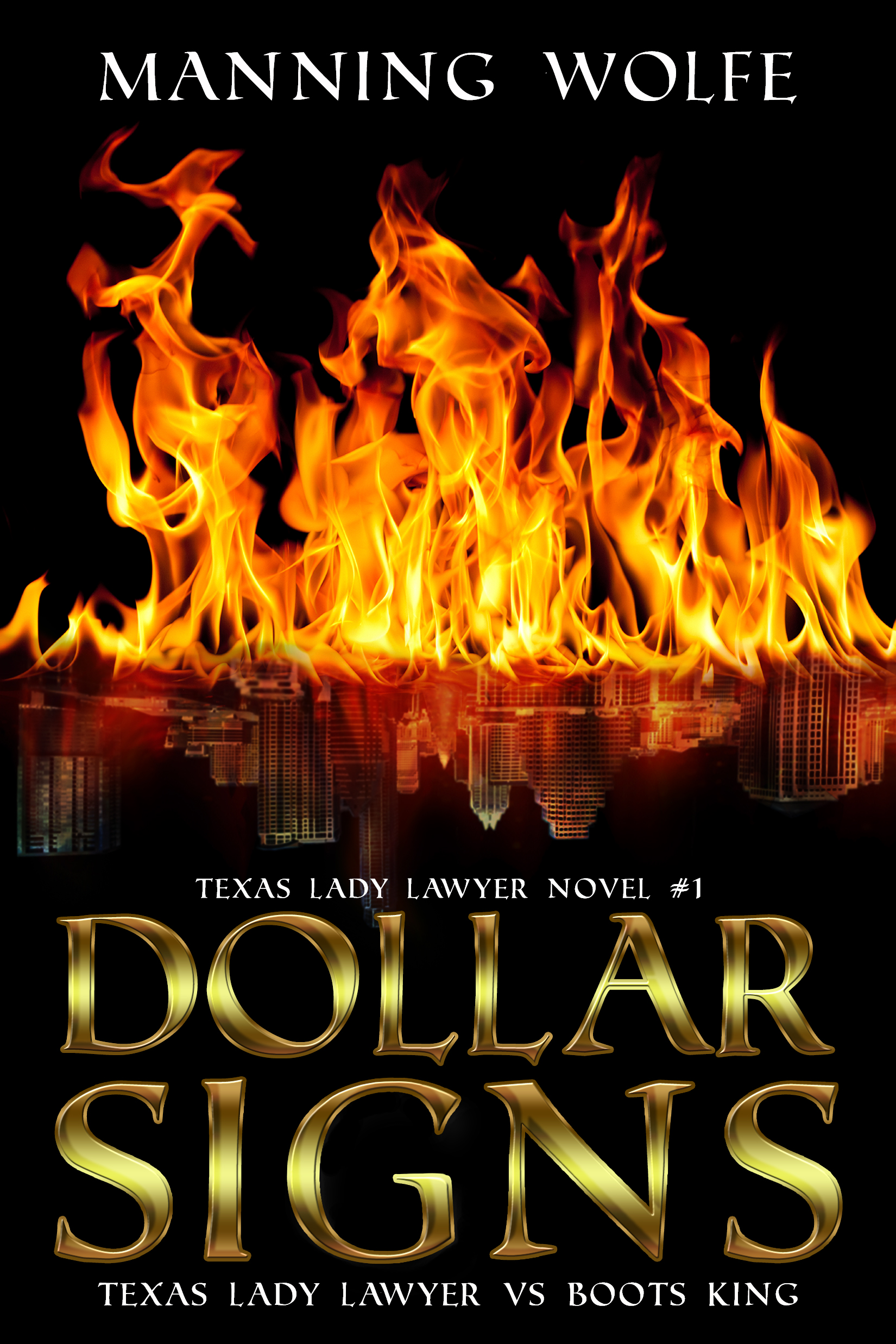
MW –Yes, it’s called Dollar Signs:Texas Lady Lawyer vs Boots King. It’s the first in a series and this one is set in Austin, Houston, and Port Aransas, Texas. MERIT BRIDGES, an Austin attorney and widowed mother with a lot of sass is the lead protagonist. She works hard, drinks too much wine, and sleeps with younger men. When she goes after a shady corporation threatening her client, she finds Boots King, a hired gun, threatening to kill her.

VPC – I know you’re a lawyer. In what ways did you use your legal background to write the book?

MW – The plot idea for Dollar Signs came from a client that I had several years ago who had gotten involved with an unscrupulous Outdoor Advertising Company (Billboards). Of course, I departed from that scenario fairly quickly in the book as the characters began to develop and the story took on a life of its own. I felt badly for that client and always wished he had gotten a fair shake. In Dollar Signs, I get to have the story turn out as I would have liked in real life. I’ve never practiced litigation although there are some courtroom scenes in the book. I wanted to show the other side of law – the business of it and the strategy that is involved.

VPC – Have you always wanted to be a writer?

MW – Yes, since I was a small child I’ve been spinning yarns and telling tales. I wrote my stories down as drawings, and then in narrative as soon as I was able to write. I loved Nancy Drew growing up and always wanted to write stories with a strong plot. I had great teachers who encouraged proper basic writing habits, so I received a good foundation early on. Much later, I wrote the screenplay of the life of Buckminster Fuller and found that I like combining cinematic style with novel structure. That blend has led me to the way I write today – fast paced legal thrillers with a strong visual component.

VPC – Where did you grow up and how has it affected your writing?

MW – I grew up in a small town just north of Houston called Humble. By the time I was in junior high, I had read every book in our public library. I still remember the wonderful librarian there and her interest in my constant reading habit. My father often asked me to do research in the courthouse archives in Harris County.  Those two things led not only to my legal career, but my writing career as well.  Property and business issues in the law are like a puzzle to me.  I always loved games and still enjoy online games and cards. Sorting out legal problems in real life or in a story is like a puzzle to my brain. I enjoy figuring things out and documenting that in writing.

VPC – Do you have any favorite authors?

MW – I read a lot and across many genres, but my favorites are thrillers. As far as legal thrillers, I like the early John Grisham novels, as well as Michael Connelly’s Mickey Haller series starting with The Lincoln Lawyer. Patricia Highsmith, who wrote The Talented Mr. Ripley, is a master of suspense. John Ellsworth’s Thaddeus Murfee series is very exciting, too. I think Scott Turow’s Presumed Innocent, that was made into a movie starring Harrison Ford, is one of the best legal thrillers ever written. And, of course, most people forget that Harper Lee’s To Kill A Mockingbird, another favorite of mine, was a legal thriller.

VPC – So what’s in store for your next book?

MW – The next book in the series is Green Fees: Texas Lady Lawyer vs Browno Zars, about a young golfer who wants to play the PGA tour and gets snagged up with a dastardly con man. It also was inspired by an actual client who was a golf pro. I’m editing it now for release later this year. I have about a dozen Texas Lady Lawyer novels in mind, some of them are outlined and some are just ideas.

VPC- Sounds good! Thanks for dropping by today and good luck on your new book. 🙂

DOLLAR SIGNS Final Ebook Cover 04

To keep up with Manning and her writing, you can go to her website at manningwolfe.com


Pieces of Time

“After you learn – and if you’re good and Gawd helps ya and you’re lucky to have a personality that comes across – then what you’re doing is, you’re giving people… little, tiny pieces of time… that they never forget.”- James Stewart, explaining to Peter Bogdanovich what actors do

Three paragraphs into a post about the importance of motivation in character and plot development–working title: “What Do You Want?”–I remembered hearing that As Good As It Gets would be on television. I’d like to see it again, so I checked the schedule for the network that airs oldies.

As Good As It Gets wasn’t running, nor was anything else I wanted to see, but while I was there, I went on to see what’s playing today, and tomorrow, and the next day, until nearly two weeks were planned out. Because it’s so easy to forget these things, I prepared a schedule:

Cropped screenshot of Claudette Colbert and Cl...

Cropped screenshot of Claudette Colbert and Clark Gable from the trailer for the film It Happened One Night. (Photo credit: Wikipedia). By Trailer screenshot, from DVD It Happened One Night, Columbia, 1999 (It Happened One Night trailer) [Public domain], via Wikimedia Commons

Tuesday, December 15
5:45a It Happened One Night
8:00p The Desperate Hours (I love Frederic March and Humphrey Bogart)
10:30p Compulsion (based on the Leopold and Loeb case; Orson Welles as the DA)

Wednesday, December 16
3:40p Come Back, Little Sheba (always wanted to see it, never have)
5:45p Let No Man Write My Epitaph (Burl Ives, always wonderful, and Jean Seberg, ditto)

Thursday, December 17
6:20a Blueprint for Murder (don’t get to see Joseph Cotton much any more)
5:25p Stalag 17 (William Holden and Gary Merrill; what’s not to like?)
8:00p Twelve O’Clock High (Gregory Peck and Gary Merrill; see above)

Friday, December 18
8:00a The Bells of St. Mary’s (Ingrid Bergman; her smile in that last scene makes me reach for a second crying towel; worth getting up early for)

Saturday, December 19
5:15p The Rainmaker (Katharine Hepburn; no comment needed)
8:00p Roman Holiday (Audrey Hepburn; two Hepburns in rapid succession–modified rapture!)
10:40p Father Goose (Cary Grant; well, d’oh)

Sunday, December 20
11:00a The Cheap Detective (Neil Simon’s script, Sid Caesar, Dom DeLuise, John Houseman, Madeline Kahn, Fernando Llamas, Phil Silvers, and on and on…)
8:00p Cheaper by the Dozen (seen it several times, but I love Clifton Webb and Myrna Loy)

And during the rest of the week, there will be opportunities to see Tootsie, Bye Bye Birdie, The Keys of the Kingdom, Oliver Twist (1933 version, with Dickie Moore), Let’s Make it Legal (Claudette Colbert and Marilyn Monroe), That Touch of Mink, and Barefoot in the Park.

And the Shirley Temple Christmas Day marathon, or at least Captain January, might be fun…

I’d be happy to watch nearly everything that network has to offer, one after the other.

(Except The Man Who Shot Liberty Valance. After seeing that one a half-dozen times, I know who shot him and don’t need a review.)

But now, a reality check. The movies are uncut, and they’re interrupted by numerous commercials, so each runs about three hours. Watching the ones named above, minus Captain January because it’s a maybe–would take sixty-three hours. If I watched for sixteen hours straight–nothing else, just sat there and watched–the film binge would take four days. Watching eight hours a day would use up eight days. I hate to admit it, but lying on the couch all day, eating Hershey’s Kisses, watching old films… I could do that. But I won’t.

Because how much time have I spent over my lifetime lost in the fantasy on a small screen? How many hours have I sat and watched instead of taking up pen and paper–or laptop–and writing?

Too many.

James Stewart didn’t make all those marvelous little pieces of time by lying on his couch, watching Charlie Chaplin on TV.

Stories are pieces of time, too, and I want to make more of them. But it’s not going to happen while I’m mesmerized by Hollywood. I have to turn off that television and write.

***


Kathy Waller blogs at Telling the Truth, Mainly12376007_1178023688877814_9154670791884953413_n (3)
and at Writing Wranglers and Warriors.
Two of her stories appear in the anthology
MURDER ON WHEELS (Wildside, 2015).
She’s now working on short stories
and on a mystery novel set in a town
very like the one she grew up in.


The Premise of a Mystery

A mystery needs a strong premise to succeed in today’s vast sea of manuscripts and newly published books. But what exactly is a premise? And how can you tell if the premise of your book is a good one?

photo (45)

In Save the Cat, Blake Snyder defines the premise as the idea that promises to be an exciting or interesting story. It’s a short answer to the question, “What’s it about?” Its job is to make you want to read the book. Premise in this sense is similar to the back cover copy (blurb or description) of the book.

What’s a ginthewoodsood premise for a mystery? A child is murdered and the detective has to catch the killer. Not good enough. It’s a murder mystery, but why read this one?


Three children go into the woods. Two are murdered and the third is found covered with blood. He remembers nothing. Better. I might read it.

But that was 20 years ago. Now there’s been a similar murder in the same woods and the detective is the third child who survived the earlier crime and still has no memory of it. I will definitely sample that book.

A twenty-year-old body is found, that of a young woman. Twenty years earlier, a young man and his girlfriend planned to elope. When she failed to show up, he thought she’d jilted him. The young man is now a detective, and the body is that of his girlfriend.

faithfulplace

In the Woods and Faithful Place are excellent examples of one way to build a compelling premise for a mystery: an interesting crime plus a personal connection with the detective. The fundamental conflict of any mystery—murderer versus agent of truth and justice—is amplified by internal conflict.

Moreover, there is a built-in professional conflict for the detective, because he should recuse himself. In ITW, he keeps it a secret that he was the third child. In FP, he defies orders and investigates secretly on his own.

For Snyder, the premise is a what-if containing elements of both character and inciting incident. For John Truby (The Anatomy of Story), the premise is a short synopsis that includes the inciting incident, the main character, and the outcome.

His example, for the Godfather: “The youngest son of a Mafia family takes revenge on the men who shot his father and becomes the new Godfather.” The whole story, in a nutshell.

The two different senses of the term ‘premise’ are both widely used. In Story, Robert McKee discusses both concepts, which he calls, respectively, the inspiring idea and the controlling idea.

The story-in-a-nutshell of a mystery is the solution to the mystery. It is what I have elsewhere called the hidden drama. It’s the truth about the murder that is concealed in the enticing set-up.

A mystery needs a strong premise in both senses. The set-up states the mystery (someone has been murdered—why? By whom?) and the hidden drama, when revealed, must pack some sort of wallop to pay off the promise of a good story.

I cannot give you an example of the latter without spoiling a mystery. So that’s what I’m going to do. If you have not read Rebecca, STOP READING NOW! Read Rebecca and come back.

Joan Fontaine and Judith Anderson as the second Mrs. DeWinter and Mrs. Danvers, respectively, in the 1940 film diected by Alfred Hitchcock

Joan Fontaine and Judith Anderson as the second Mrs. DeWinter and Mrs. Danvers, respectively, in the 1940 film diected by Alfred Hitchcock

A shy, unconfident young woman marries a man whose first wife, Rebecca, has died in an accident. Rebecca was beautiful, talented, seemingly perfect in every way. How can our poor heroine ever compete with the ghost of this paragon?

Not the most powerful set-up (no mention of a crime), but the hidden drama—oh my. It turns out Rebecca was EVIL! Her husband hated her and murdered her! He got away with it—or did he? OMG!!! A witness comes forward! Breathtaking, page-turning suspense ensues. This book delivers on its premise like no other.

Cornwall

On just such a bay in Cornwall, Rebecca De Winter drowned…supposedly.

Call them hook and twist: a compelling crime to be solved and an underlying truth that is both unexpected and confounding. A really good mystery needs both.

Elizabeth Buhmann

————————————————————

A woman who witnessed a murder lied on the stand. Twenty years later, the man who was convicted on her testimony has just been exonerated and released:

Lay Death at Her Door, by Elizabeth Buhmann

It’s Not About You

once upon a timeWhile attending Malice Domestic in Bethesda, MD last month, I overheard a small group of authors gathered in the hotel bar discussing the issue of whether family members or friends thought a character was actually a portrayal of them. It seemed each had a story to share. One author’s sister felt a character was based on her. The author, however, stated the two–the sister and the character in question–had very little in common. The sister had picked up on one particular behavior and, from that point, assumed the entire character was based on her. It caused a bit of a family kerfuffle.

A quick online query about the topic will reveal many writers discussing how someone–a loved one, a friend, a colleague– believes a character is based on her and is unhappy about it, even when the author assures her it just isn’t so.

That’s not to say that certain authors haven’t based characters on real people–it happens all the time and often the author will reveal that information outright. After all, Anne Lamott once wrote, “You own everything that happened to you. Tell your stories. If people wanted you to write warmly about them, they should have behaved better.” That said, this topic becomes further complicated when the book is a work of fiction and no intent to base a character on a real person was made.  So, what happens when someone in your circle believes a character–one with one or more negative traits– is based on her?

If the character is a benevolent superhero with skills that put all around her to shame, letting your aunt/sister/friend claim that character as a portrayal is no issue. Let her enjoy the idea. However, what if the character is difficult, angry or passive-aggressive? How does an author help those around her understand that it is indeed a work of fiction?

While I can’t speak about the experiences of other authors, as they are as vast and layered as the works in our genre, I can share my general thought process when writing fiction. If this post helps neutralize a heated conversation, I’m happy to help.

I tend to be drawn to the dynamics between people, to specific conversations, to behavior and to moments in time. I might take one particular spark–a discussion, an encounter–and run with it. The result may be a compilation of my own experiences with several people over a long period of time, and I find that my characters take those behaviors and use them for their own purposes. No one in any of my work represents any one person. However, one person may have traits from several people or have experiences from several people all wrapped up in that one person. That’s a pretty wide net. After all, each one of us can be angry, difficult, funny, sarcastic or rude at any given time. Each one of us may have experienced the shattering loss of a parent, the sharp tongue of a hostile work colleague, the exhaustion of a demanding career. It doesn’t mean a character with those traits or experiences is based on a real person.

Each writer brings to her work a culmination of experiences, heartbreaks, conversations and issues and those tiny threads are bound to weave themselves in the story somehow.

But not in the way others might believe.

My primary purpose is to encourage the reader to care about the characters and what happens to them. That is my goal. Creating characters based on real people isn’t part of my process.   I may appreciate how one friend handles difficult conversations while another friend’s compassion with animals makes me smile, but that doesn’t mean those same people show up in my work. The particular behavior or personality trait might but that is only because it belongs to the character. That’s where it ends.

Writers study the world around them, taking note of interactions and exchanges, tucking them away in the hopes they might be useful in a story one day.  What happens next is complete fiction, and isn’t that one of the best things about being a mystery writer?

–Laura Oles

Writing, Thinking, Pantsing, and Miracles

Pantsing, when successful, lets you create a story closely resembling the spark that ignited it. ~Janalyn Voigt, Live, Write, Breathe

The first step in starting a blog is finding the perfect name. I wanted to call mine Contrariwise, as an homage to Lewis Carroll and to my ability to locate an argument in nearly any issue I come across.

Contrariwise was already in use, however, several times over, and I couldn’t find another literary allusion that satisfied, so I named it Whiskertips. It was my own invention, an homage to the two whiskered beasts with whom I share living quarters.

The next step is thinking of something to blog about. For most people, determining a theme would be Step #1. Reversing the steps led to a series of posts I like to think of as eclectic. In other words, I wrote about whatever came to mind. I also hosted guest bloggers. Mark Twain and Emily Dickinson appeared often. But after a while, nothing came to mind, and I began to fall back on the beasts. When they IMG_0832.1assumed complete control of content, I withdrew and created another blog. I took its name from Gertrude Stein: To Write Is to Write Is to Write.* In a note in the sidebar, I stated the purpose: I would write about the experience of becoming a writer. I would write about writing.

It seemed like a good idea at the time.

But the best-laid plans of mice and men, etc. In only weeks–days–I had another eclectic blog on my hands. Why? Because I didn’t know anything about writing.

Or, to qualify that, I didn’t know anything writers–or anyone else–would want to read.

I know the basics: grammar, usage, mechanics, various elements of fiction, methods and techniques learned from reading, attending workshops, taking classes, reading articles, books, and blogs. But I had nothing to add.  Other people had gotten there first. And who wants to read another article about where the commas go?

The worst part was that most of the authorities claimed to have the One True Way:

Write fast. Don’t revise as you go. Outline–you have to outline every scene. Use index cards. Use colored pens. Tape butcher paper to the wall. Never share your work before you’ve completed it. Find a critique group. Write 1,000 words a day, and in ninety days you’ll have a completed manuscript. Write every day. Write morning pages. Keep a writing journal. Keep a bible for your manuscript. Query early. Query later. Have a platform. Establish a brand.

All good advice, I was sure. And frustrating, because I couldn’t seem to follow the rules.

Finally, I gave up. The experts were great at explaining how they write, but they weren’t so good at telling me how to write.

I had to struggle for a while, find my own way, develop my own process, set my own rules, and deviate from rules I’d outgrown.

Now, after years of wrangling with the experts, and with myself, I finally have something to say about how I write:

I don’t start with an outline. I start with a character and a line and go from there. I can’t construct a decent plot until I understand the characters, and I can’t understand the characters until I know their backstories. The only way I can know backstories is to write them, not in a separate document, but as part of the manuscript itself. Afterward, I go back and start putting the material in order. I may have to scrap some of the best parts–the darlings–but they go in a Darlings file so I can use them later if I find a place they fit.

This method is called pantsing–as in flying by the seat of your pants. Some plotters look down on pantsers. That used to make me feel like a failure. Then I read Writing Mysteries, a collection of essays edited by Sue Grafton, in which Tony Hillerman tells about his own pantsing. He said it takes longer, but in the end, he gets there. Since reading that, I’ve stopped apologizing for pantsing. What’s good for Tony Hillerman is good enough for me.

Let me make one thing clear: I revise. The condition of my first manuscript dictates that I revise a lot. The end product looks very different from the original.

Because I’m a pantser, the NanoWriMo program of writing a 50,000-word novel in thirty days doesn’t bring out the best in me. I write more slowly, and I can’t pound out a book on someone else’s timetable. For years I registered for NaNo and then wrote perhaps ten words. That’s called losing Nano.  Now I register and write whatever I want on my own timetable. I lose nothing, NaNo loses nothing.

(There’s another reason I don’t do well with NaNoWriMo. I don’t like to talk about it. But if you want to read about it, check Wikipedia under Passive-Aggressive behavior.)

The exception to my pantsing process occurs when a story comes to me already outlined. One such blessed event happened one night just after I’d gotten into bed and turned out the light: a story appeared, beginning, middle and end. I thought it would take about 600 words, but the final version turned out to be nearly 5,000 words. It included a little pantsing.

When I began this post, I knew only two or three things about writing, but now I realize I know more. Having already run on at length, I will leave the rest for another time. After I’ve pointed out one more thing:

Some writers, myself included, know (There’s another one!)–that writing is  a form of thinking, a way to generate ideas, to learn what we already know.

But I also subscribe to Gertrude Stein’s description:

One of the pleasant things that those of us who write or paint do
is to have the daily miracle. It does come.

I depend on the daily miracle. When I write, and keep on writing, it does come.

 *

*The entire quotation is “To write is to write is to write is to write is to write is to write is to write.” I presume it was not already in use because no one wanted it.

*

Posted by Kathy Waller 0kathy-blog

Kathy blogs at To Write Is to Write Is to Write and at  the group blog Writing Wranglers and Warriors.

Find her on Facebook at https://www.facebook.com/kathy.waller68.