Interview With George Wier

George Wier was nice enough to agree to an interview. Thank you, George! George Wier
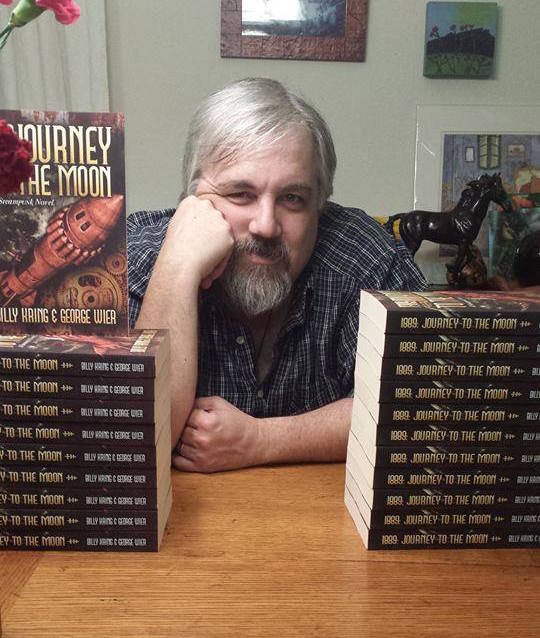
(He’s a personal friend of mine so he knew I’d give him grief if he didn’t. 😉  )

I know that you’re not originally from Austin. How did you get here?

I moved to Austin in 2002 from College Station. One day I took a look at the world around me and realized that most of my friends and all of my family had moved away. Also, after thirty years of living in Bryan-College Station, I knew everyone and everything that I wanted to know.  In a word, I was bored. I called an old friend who lived in Austin and told him about my dilemma, and without even the hint of hesitation, he offered a spare room in his apartment and told me to load up my meager possessions and come on. I left the next day. This was about September or October, not far from my 37th birthday. I was essentially–and with malice aforethought–wiping out an old existence and beginning a new one. I was time to do that. It was one of the best decisions I ever made. Apart from rooting for the old home team (the Aggies) I took to Austin like a duck to water. I’m home now.

Have you always been a writer? Was there a book that inspired you to write?

Yes, I have always been a writer, ever since I could read. My first inspiration was comic books and film. My first actual attempt at a complete narrative was essentially a skit that was somehow a cross between a story and a script, and was actually inspired by Monty Python. I couldn’t do humor well, though, and sight gags were not my thing. The earliest, clearest influences on my writing came from science fiction, particularly Frank Herbert’s Dune books. I loved those. There is one story idea from those early days that I will attempt sometime in the near future. It’s about an outpost at the fringe of human expansion into the universe, and will be sort of a cross between Castaway and the Star Trek universe. We’ll see, though, if I ever get that done. My hopper is pretty much loaded up at the moment.

Along about 1976 or ’77, I was given a collection of Doc Savage paperbacks by my best friend’s sister. Her name was Peggy Dale Taylor. The Doc Savage books she gave me were the 1960s and ’70s Bantam paperback reprints of the old Street and Smith Doc Savage series written under the pen name of Kenneth Robeson, but mostly actually penned by Lester Dent, who though originally from Missouri, was a member of the Explorer’s Club in New York. Dent wrote about a quasi-private investigator, quasi-superhero named Clark Savage, Jr., and his five aides, who traveled the world righting wrongs and punishing evildoers. They sparked the imagination of this young teenager and would later very largely influence my Bill Travis Mystery series. The difference, however, between Doc Savage and Bill Travis is that Bill is based in Texas and rarely crosses the state line, he doesn’t have a lot of gadgets to help him out, and his small collection of friends are more from the “friends in low places” crowd, and less from the “cream of the crop”. I’ve written ten Bill Travis books, and there are at least eleven more to go before I round out the series, including three prequels. And by the time I’m at the end of that long runway, I should–hope springs eternal–know how to write.

Tell us about the different genres you write. Does the genre influence how you approach or plot your book?

Mostly, I write MY genre. I’m not sure what that is. For instance, the Bill Travis books, though billed as mystery, occasionally cross over the line into the fantastic, or you might call it Science Fiction. The first book, The Last Call, is straight action-adventure. The second book, Capitol Offense, while it has elements of action-adventure, is at least half mystery with some elements of political intrigue. The third book, Longnecks and Twisted Hearts, quite definitely crosses the line into science fiction, yet remains mostly a murder mystery. Books four and five, The Devil to Pay and Death On the Pedernales, are both pretty much straight mysteries. Book Six, Slow Falling, has so much science fiction that it should probably be classified as such, yet it’s my favorite of all of them. And so on through the series. By the time we get to book ten, Ghost of the Karankawa, Bill Travis meets Bigfoot. So, there you go. 

Genre doesn’t so much influence me. The story does, however. It’s going to ultimately be whatever it is. I don’t write from outline, or at least in those few instances when I have and “knew” what was coming in later chapters, the outline might be a simple sentence of what was to happen in that chapter. About the only time I do that however, is either when I’m skipping around in the book and writing it in a non-linear fashion or when I’m collaborating and my co-author needs to fill in what I skipped over. In the latter instance, it’s at least courteous for me to provide some clues as to what, in general, I think should happen here and there in the story. I guess that’s about it on that.

As a side-note, I don’t like to read a lot of books in the genre in which I’m going to be doing any extensive writing (i.e., mysteries) because I don’t like to be unduly influenced by other writers. People tell me that my writing style is similar to John D. McDonald. I must confess, I’ve never read a John D. McDonald book. I hear that they’re wonderful, and at the top of the mystery genre, so I always take that as a high compliment and accept it as gracefully as I can. But, I’ll only read a mystery if it’s written by a friend and this friend needs an endorsement or a general leg up. That’s about it. 

What is the secret to your success?

Writing is like anything else. Most of the battle is won by showing up. You have to sit down and write. You have to write a lot. You have to produce, bang out copy, write like there’s no tomorrow (there really isn’t, after all, there is only today!), plan and scheme and push the envelope. However, I think what you’re asking me is for some formula. Okay, I’ll give it to you. Here are my “secrets” to success (it’s interesting to me that there are no real secrets. The nature of the universe is that we all think that there’s some great secret hidden back of the curtain of reality, and that if we could only somehow penetrate that curtain, why, we’d HAVE IT and we’d simply do that magical little formula and the world would lie at our feet. The secret of the universe is nothing. This is also the definition of a mystery. A mystery is: the answer was not given. That’s all a mystery is. The mystery of the universe is a big fat zero. We don’t do well, as a species, with zero. Nothing is difficult to confront. If you don’t believe me, try walking through an unfamiliar house full of furniture in the pitch blackness. You move slowly, at best, because you’re pretty sure you’re going to hit something hard and kill your shins, or fall down and break your neck. So, in our minds, that darkness, that big zero, is really “something”. (Let me tell you, it’s not!):   

I have, this lifetime, sifted through quite a bit of data on success. I’ve narrowed my findings to ten basic points:

     1. Work toward your goal every single day.

     2. Do not let the sun set without accomplishing something towards it.

     3. Hold on to any wins you achieve along the way and disregard the losses.

     4.Don’t allow anyone to evaluate or invalidate your goals, your dreams, and particularly your abilities.

     5. Thinking about a thing is not the same as doing a thing. Success is only ever accomplished through action. The dream, however, must give your actions purpose and life.

     6. Treat your goals as if they are living beings, and grant them life.

     7. All other rules apply with regard to your goals, particularly the Golden Rule.

     8. Study, learn and become the top person on the planet in your field. Knowing WHY is of immense value. Knowing HOW will guarantee prosperity. Knowing both HOW and WHY is everything.

     9. If you get mad at someone or something that stands in your way, you have granted them or it immense power. Become unflappable. In any situation you are the expert. You are the source. Unquestionably. Success is hidden in the minutiae. It’s the small things that, brought together, create the whole.

     10. Fortune and fame are illusions, and at best are fleeting. Don’t seek these. Instead, seek happiness. You will ultimately find that it resides within you.

I’ve found that most writers have other talents. What are your other talents?

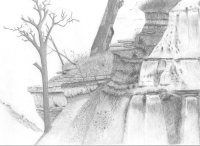
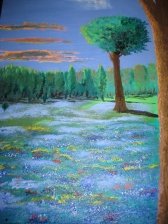
Well, that’s a loaded question. I like to think I’m adept at everything I do, and typically overinflate my abilities, at the very least to myself. However, I like to draw (with a mechanical pencil), I paint, I play violin and I play country fiddle, and I do other things I’m not supposed to do. 

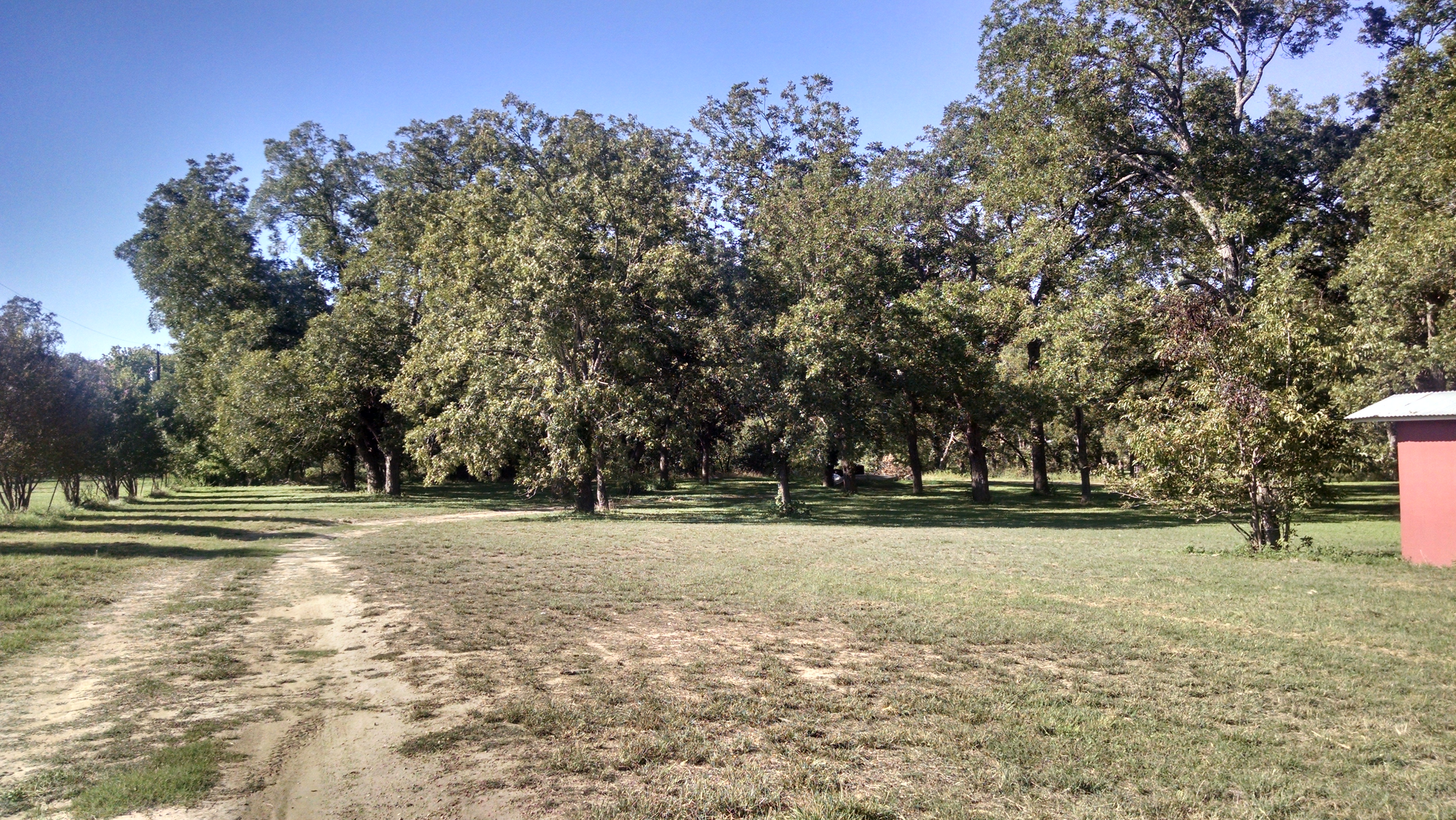
Some of George’s pictures
West Texas  Fall    Secret Meadow

Do you have any advice particularly for mystery writers?

The main piece of advice, I suppose, is what I said above about not reading too much in that genre. But really, you might like to read mysteries and want to write them as well. Really, it’s a personal preference on my part not to do so. I also write a little science fiction, for instance, and I am so well-read in that genre, and will continue to be so, that it’s impractical for me to even think about not reading science fiction. So, whatever your write, whether it’s mystery or romance or whatever, you should write what my friend Joe Lansdale calls “your own genre”. Your writing is YOUR genre. Write what you want to write, and how you want to write it. And, write what you, yourself, would most want to read. That’s the simple one. Do that, and you’ve got it made.

Tell us something cool about Austin that we probably don’t know.

The one thing I like about Austin is that it’s full of secrets. There are so many little-known, out-of-the-way and off-the-beaten-path little hidey-hole restaurants, coffee bars, music venues, acting and dancing troupes, and etc. I love finding those. It’s my goal to find all of them! Sallie and I venture forth at least once weekly looking for that offbeat place that we’ve never heard of before. And I have the knack for smelling them out.

How can we find more information about you and your books?

The best place is my website, www.georgewier.com (which takes you directly to the www.billtravismysteries.comsite). Both of these sites have now been combined into one. Also, I have a wordpress blog at http://georgewier.wordpress.com. Other than that, you can follow me on Twitter at @BillTravisWrite and on Facebook at George Wier-Author. Also, I encourage everyone to communicate directly with me. I usually answer my own emails, and I typically do this quickly. So, please communicate with me. I know that people get punished in this world for the two great crimes: being there and communicating. But, that’s the only way to ever get anywhere. So, yes, get in touch with me and ask if you can’t find the answer. Or just email me to say “Hey!” I’ll say “hey” back at you.

What are you working on now?

Hmm. The question should be “what are you NOT working on now?” I’m working on Bill Travis #11, Desperate Crimes. Also, I’m right at the end of yet another mystery standalone entitled Errant Knight. It’ll be forthcoming in a few weeks as an ebook and a trade paperback. I will have another book coming out from Cinco Puntos Press in January of 2016 entitled Murder In Elysium. Also, I’m collaborating at the moment with Billy Kring (another fantastic mystery author) on the steampunk series The Far Journey Chronicles. Billy and I have completed and published 1889: Journey to the Moon, and have finished and are in the process of editing 1899: Journey to Mars. We have also begun 1904: Journey Into Time. There will be a minimum of four books in that series, with the last one planned: 1909: Journey to Atlantis. Aside from that, I’ve got a few other projects going that I pay attention to, catch as catch can. But I have far more than that planned, including a collaborative series with science fiction great (and friend), T.R. Harris, of San Diego, California. I guess that’s it.

Thanks for the interview. You’ve given me a lot to think about and now I’m pumped up! I can’t wait to get back to my writing!


Murder in Exotic Places

Elizabeth BuhmannBy Elizabeth Buhmann

I love to read murder mysteries that are set somewhere in the world that I have never been. Let me hasten to say that I do not care for such mysteries when they’ve been written by someone who has also never been there, or who has not been there for more than a visit.

No, I want a book that oozes local color and a narrator who has clearly lived there, walked the streets every day and been part of the community. Sometimes it’s an ex-pat, sometimes a person sent there by a job (or a spouse’s job). Or it may be an English-speaking native, or the books may have been written in another language and translated into English.

The River Ganges, Varanasi, Uttar Pradesh, India

The River Ganges, Varanasi, Uttar Pradesh, India

The author also needs to be a skillful and inventive mystery and suspense writer, so the kind of books I’m talking about are few and far between. When I find them, I love them. When the book is part of a series, well then. Hog heaven!

Right now for me the exotic murder mysteries are set in India. I’ve found several! MM Kaye, of Far Pavillions fame, was born in India and spent much of her adult life there. Did you know she wrote six murder mysteries? Her “Death in” series is a veritable clinic in the romantic suspense genre, and the one that’s set in India, Death in Kashmir, evokes the waning years of the British Raj.

servant

cadaver

Tarquin Hall’s Vish Puri series is more fun than a basket of Macaques (thank you, Russ Hall, for recommending them). Start with The Case of the Missing Servant. I cannot get through one of these books without making Punjabi curry and browsing Google images of Dehli.

Shamini Flint’s delightful Inspector Singh travels to Mumbai in A Curious Indian Cadaver. Flint is an attorney who lives (like her Sikh detective) in Singapore and has travelled extensively throughout Southeast Asia. Her books are set in India, Singapore, Malaysia, Cambodia, and China.

deadhand

elephanta

And why go to the expense and bother of world travel when you can read Paul Theroux? He has written about India in a number of his travel books, but did you know he set a murder mystery in Calcutta? A Dead Hand is an interesting read, but  what I highly recommend is  the Elephanta Suite—it’s terrific! It’s not a murder mystery, though. It’s a collection of short stories set in Bangalore, Mumbai and a spa in northern India.

amazing

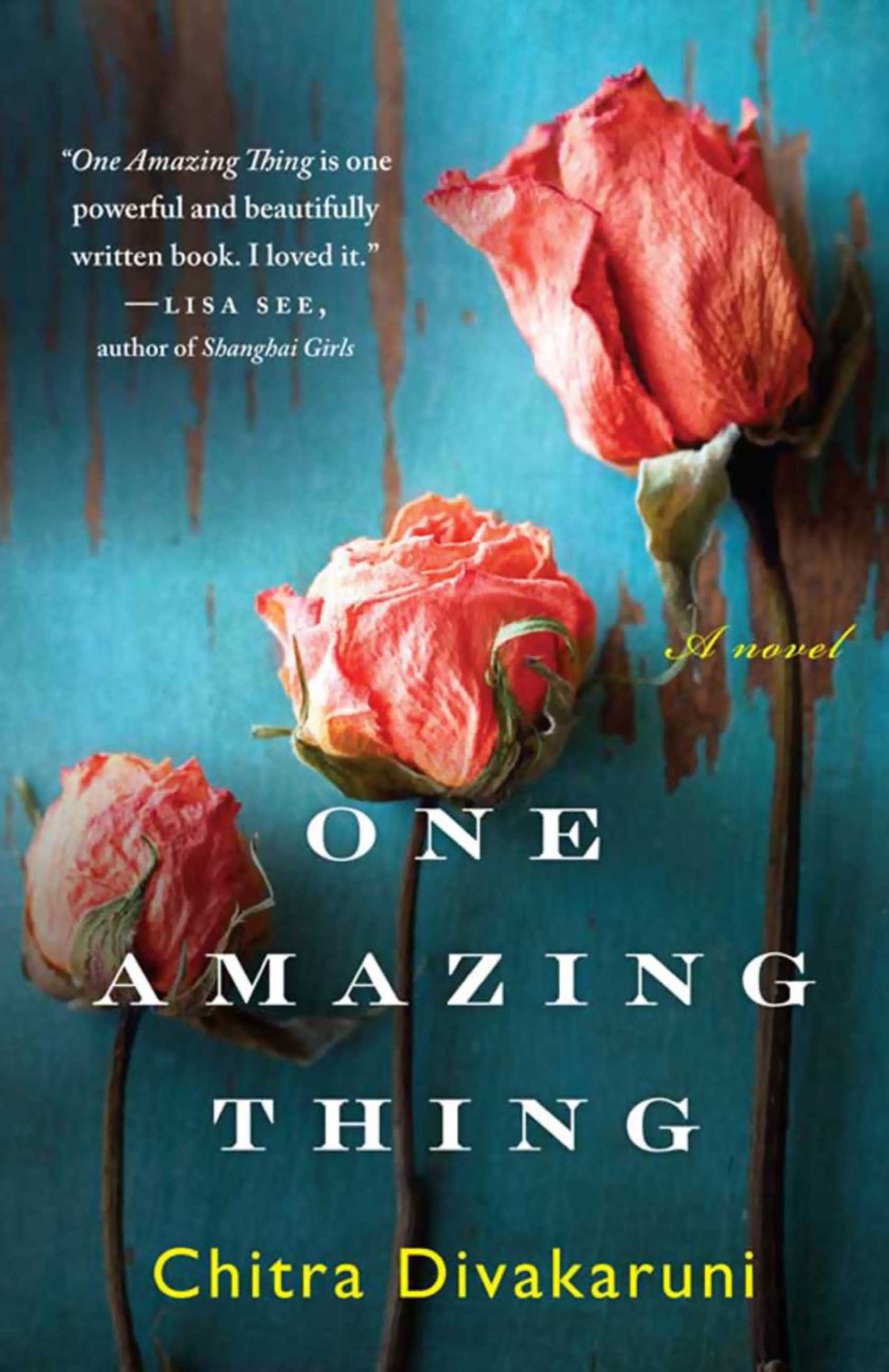
indiaSince I am digressing from murder, I have to mention Chitra Divakaruni’s books. In One Amazing Thing, an earthquake traps a diverse group of people in the basement of an Indian Consulate in America, and to while away the hours waiting to be rescued, they tell stories from their lives. When the first character began her story, I literally got a chill down my spine.

One last recommendation: If you try any of these books, you may be seized by the need for a spicy korma or rogan josh. My trusty House of India Cookbook has served me well for forty years, and it’s still available on Amazon!

Next time I’ll share a list of murder mysteries set in Africa.

laydeathElizabeth Buhmann is the author of Lay Death at Her Door (Red Adept Publishing, May 2013), a stand-alone mystery/suspense novel about an old murder that comes unsolved when the man who was convicted of it is exonerated. The story is told from the point of view of the woman on whose eyewitness testimony the prosecution was based. When the book opens, her life is about to come apart at the seams.

Mystery/Thriller Recommendations

It’s that time of year! A time for reflection on the past year and anticipation of the new. If you’re like me, you hear a lot of people mention a good book or movie and you think to yourself, “That sounds good! I gotta remember that.” And then you don’t.

So, since I have a lot of friends on Facebook who like mysteries and thrillers, I’ve asked them to recommend at least one good book or movie they discovered this year. And of course, each of us here at AMW has a recommendation too.

Here they are, in no particular order:

1. Mandy Eve Barnett (author): mandyevebarnett.com – Lucy – it is unusual, exciting and a great twist at the end! A woman, accidentally caught in a dark deal, turns the tables on her captors and transforms into a merciless warrior evolved beyond human logic.

2. Beverly Nelms (personal and book club friend) – A Most Wanted Man with Philip Seymour Hoffman from a John LeCarre book. It’s about a (most likely) innocent Muslim man being ground up in the system by the Taliban, then by us. PSH plays a German operative with a small group of “assets” who is trying to help him. Underdogs helping the underdog. The view of agents, especially ours, is devastating.

3. Laura Wilson (personal and book club friend) – I liked The Girl with the Dragon Tattoo, book much better than the movie, by Stieg Larsson. The main character is a girl with a troubled background who is brilliant with technology and a research savant. There is torture, murder, blackmail and deceit all over this book.

4. Billy Kring (mystery author) www.billykring.com – Suspect by Robert Crais. One of my top reads of the year, and highly recommended. LAPD cop Scott James and his female partner are ambushed, and Scott is wounded, his partner killed. He is broken, suffering, and angry, textbook PTSD. As a last chance, he is partnered with a german shepherd with her own problems. Maggie is a two-tour bomb-sniffing dog who lost her handler in an ambush. She is also suffering from PTSD, and it is her last chance, too. When they begin to investigate the case where Scott’s partner was murdered, they have to rely on each other, and what they encounter in the case could well break both of them.

5. David B. Schlosser (writer, editor) – www.dbschlosser.com – The Broken Shore by Peter Temple. This terrific Australian mystery explores the traditional aspects of a crime/cop story — good guys, bad guys, and their travails — as well as some really interesting cultural challenges in Australia.

6. Kelly Pustejovsky (personal friend) – I watched Dream House yesterday on Netflix, surprisingly good.

7. Tara Madden (personal friend) – Wilde’s The Gods of Gotham and it’s sequel. Fairly new mystery series about the very beginnings of the NYPD set in the 1840s. Very good. Really pulls you into the story. Great richly created characters.

8. Jeanne Kisacky (writer) – It’s been out a while, but Elizabeth Wein’s Code Name Verity defied my ability to see where the plot was going. It was truly remarkable to read a book and not have any of my guesses pan out.

9. H.M. Bouwmann (author and professor) – www.hmbouwman.com – I’ll second the Code Name Verity recommendation. And I enjoyed both Robert Galbraith (Rowling) mysteries–though I loved the first more than the second. Also, just as an FYI, the opening couple of pages are not great. Then: very good.

10. Roger Cuevas (personal friend) – I love Alice LaPlant’s “Turn of Mind.” It’s narrated by a woman, a former hand surgeon with Alzheimer’s. Then one day her neighbor and long-time friend is found dead and the body’s hands have been expertly removed. Did she do it? Our narrator just can’t remember…

11. Morris Nelms (personal, book club friend, professor of fine arts, and musician) (Yea, he’s a cool guy) – The Afghan, by Forsyth. Frequencies, a sci-fi whodunit movie. Crescent City Rhapsody, a sci-fi thriller about what happens when an EMP disables everything.

12. Joseph Huerta (personal friend) – The two “Blood” books by James Rollins and Rebecca Cantrell that feature warfare against the forces of Armageddon, including angels and devils and a secret band of priests who were once vampires. Yes, it doesn’t really sound like a Joe-book but it was truly fascinating. The third book will be out this Spring.

13. Angie Kinsey (writer) – www.angiekinsey.com – The Martian by Andy Weir – a not too far fetched sci-fi thriller about an engineer who gets stranded on Mars. He has to figure out how to stay alive with the resources he has until he can connect with home. Entertaining and thrilling!
14. Debbie Woodard (personal friend) –  I discovered the BBC’S Sherlock this year. Fantastic production, great actors, character-driven-well-written scripts.

15. Elizabeth Buhmann (AMW member) – I’ve read a lot of good mysteries this year. I think I’ll go for Present Darkness, the latest by Malla Nunn, but my recommendation is not to start here but to start with her first, A Beautiful Place to Die. The setting for these books is South Africa in the 1950s, at the height of the Apartheid era.

16. Laura Oles (AMW member) – My favorite this year isn’t a traditional mystery but I loved it because it had a strong mystery component and very strong storytelling. It was Leaving Time by Judy Picoult.

17. Gale Albright (AMW member) – I was fascinated and awed by Tana French’s In the Woods, from the very first paragraph because her writing is lyrical and compelling. It’s set in Ireland and is her first book about the “Dublin Murder Squad.”

18. Kaye George (AMW member) – I’m JUST like that. I vow to remember the good books I’ve read, but, alas, my memory doesn’t really go back 12 months. I know that every Harlan Coben I read is my favorite. Recently I read “Iron Lake” by William Kent Krueger and it was terrific. It’s the first Cork O’Connor book. I’ve read others, but had never read this one.

19. Kathy Waller (AMW member) – Terry Shames’ A Killing at Cotton Hill. She captures small town life in a southern town while mixing humor with suspense and mystery. I couldn’t put it down. It won the 2014 Macavity Award. 

20. My favorite book that I read this past year was Jackaby by William Ritter. I loved the mix of historical fantasy and mystery. Jackaby is an investigator of unexplained phenomena and the story is told from the POV of his new assistant, Abigail Rook. It’s a bit like Sherlock Holmes meets Harry Potter. It was delightful and intriguing.

So there you have it! A whole slew of books to add to your TBR (To Be Read) list.

Writer Unboxed Un-Conference

Salem house

Just got back from the Writer Unboxed Un-Con a couple of days ago and like many of my peers, I’m having a hard time adjusting to real life again. It was so great! What’s Writer Unboxed? I guess I’ll start at the beginning.

WU is a wonderful blog (www.writerunboxed.com) that’s all about the craft of writing fiction and providing moral support for fellow writers. I’ve been a member of the “family” for a few years now and I can say that it’s been invaluable.

This was the first conference and it was held in Salem, Massachusetts and what a wonderful time of year to be there! The leaves were gorgeous and it was right after Halloween so there was still a magical feeling in the air.

The days were packed with classes and workshops. I literally filled my notebook with notes. I wish I could tell you everything I learned and the insights I discovered, but that would take  pages and pages to do. So instead I’ll share some granules of wisdom and some links so you can delve further on your own.

My first class was Lisa Cron’s Wired for Story. I’m now a groupie. It was about how stories are the most powerful form of communication and our brains are literally wired for story because that’s how information has been passed down for generations. When someone says, “Let me tell you a story…” your brain releases Dopamine and you’re ready to experience the story. A good story is more important than beautiful writing because you’ll get a better reader response. She compared it to a tricked out car with no engine. It’s pretty, but it won’t get you anywhere. And most importantly—story is internal, not external. It’s what happens to your characters. Lisa has a TED talk all about this. I highly recommend it. It’s almost more like learning philosophy and about writing.

Learned about Setting as Character taught by Brunonia Barry and Liz Michalski. Both are from the area so not only was it a good class about describing your setting, they offered some new insights into the area. Most of it was a writing exercise and some of us shared what we wrote.

Velveteen Characters taught by Therese Walsh. Therese is a founder of WU and organized the conference so she is a powerhouse, to say the least. Basically she said that all of your characters are important, even the secondary ones. You should try to give each one a quirk or flaw, it makes them more real and will enhance the story. She suggested for a writing prompt to make 5 assumptions about a character and flip them. See what happens!

Plot vs  and Story taught by Lisa Cron, Brunonia Barry, and Donald Maass. This was a biggie. To sum up copious notes, story is internal and the changes that happen within your characters. Plot is actions, events and things that affect your characters. Also a side-note,  every single scene should have conflict, action, suspense, and a turning point.

Where Story Comes From led by Meg Rosoff. Basically, you are unique so your voice is unique. It was about tapping into the conscious and unconscious mind, to get to those memories, fears, and feelings that are real. If you can convey those feelings, your voice will be unique and you’ll connect with the reader.

Donald Maass’s class on How Good Manuscripts Go Wrong. So many notes! He talked about how to make your characters deeper and more interesting by giving them flaws and obstacles to overcome. Does your MC (main character) do something that no one else can do? Does your MC know something that no one else knows?  And don’t forget to add tension to every scene. Most books don’t have enough tension.

The last day was an all-day long workshop about 21st Century Fiction. It seems that genres are starting to cross over and readers are expecting it. Plot driven books have deeper characters and literary books have more suspense and action. His method was to ask questions which make you think about your characters and the events. Many people, myself included, had “aha!” moments which made us look at things differently. So insightful.

That’s it in a nutshell. I’m including a video of me singing the Un-Con song. It’s embarrassing and the quality isn’t great, but it was fun.


AMW Writing Retreat- AKA Babes in the Woods

I’ll be honest, I’ve never been on a writing retreat. So as the days got closer to October, my excitement grew. What all is involved? What is expected of me?

Like most gals (I think), I thought about accessories. What do I wear? Which made me think about my suitcase. I hate using the same old black blah suitcase so  I went shopping. I’ll also be going to a conference in November so I’ve been thinking about this. I went to JaCque Penney and found exactly what I was looking for.  I love this color of blue.

Suitcase

I also got so excited that I asked a talented friend to make something to “mark” the occasion. She made AMW book markers and magnets. Aren’t they cute? Book markers


(I think we should have more of these for prizes at future AMW events)

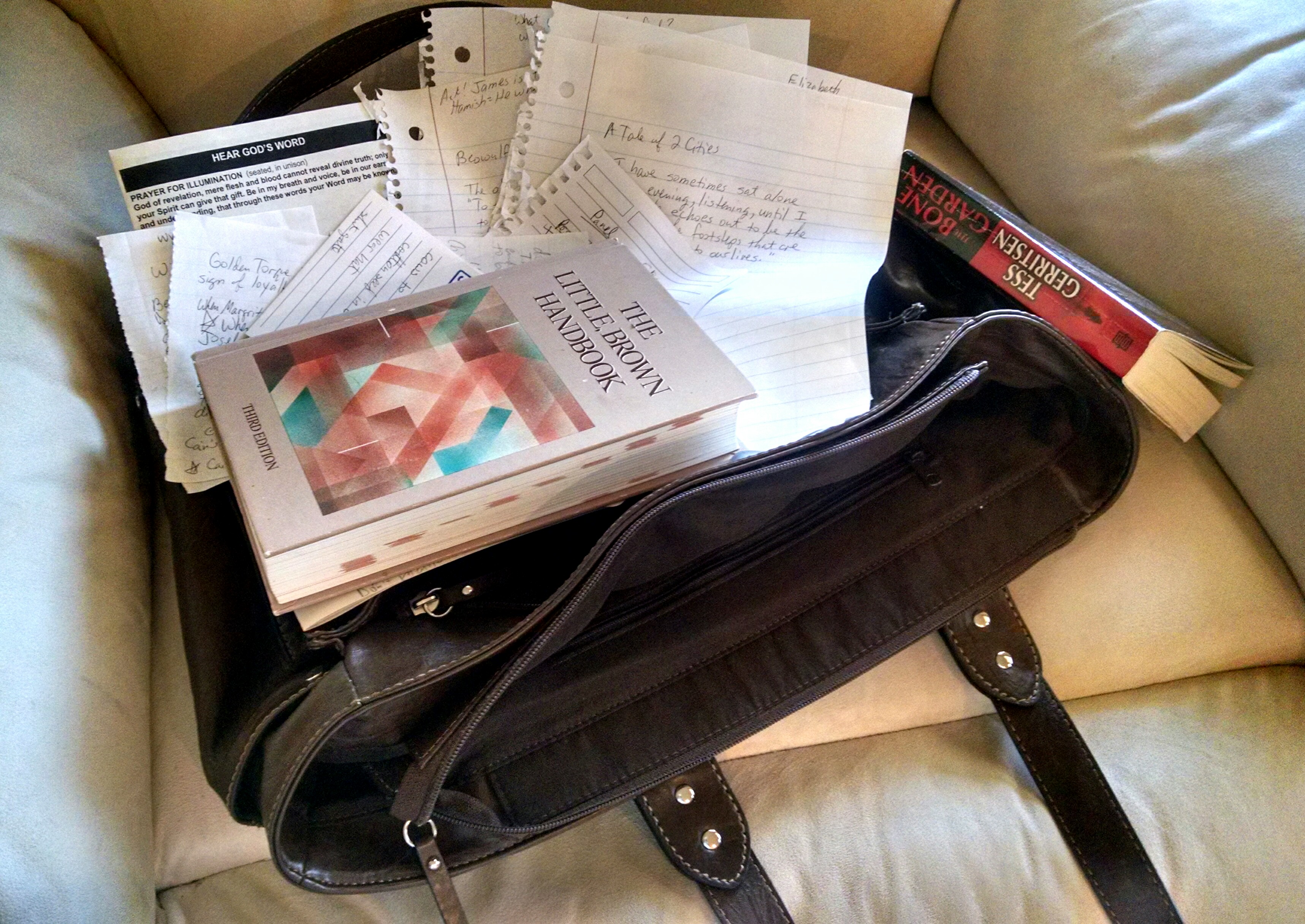
Friday finally came around, time to get to the cabin! I gathered my notes, computer, and supplies.

My notes


I got my directions and I was on my way! I arrived in no time at all and was the first to get there. I hunted around for the key, found it and let myself in. It was a gorgeous day so I opened all the windows. Let the magic begin! Cabin

While I waited for the others to arrive I unpacked. I heard a vehicle approaching. Yay! They’re here! Nope, a truck pulling a large BBQ cooker was arriving at the property next door. About ten minutes later I heard another engine. Yay! Nope, another truck pulling a large cooker, followed by a few more trucks.

By the time my cohorts had arrived, five more cookers had passed by. They were planning on some serious BBQ next door.Turns out there was a cook-off planned for the same weekend.

BBQ Sign

That’s okay because nothing was going to stop us!


We visited, relaxed, and had a nice time that first night.

Gale on couchKathy on couch


The next morning we awoke with a sense of business. Time to write! At first this was all I could think about, a keyboard staring back at me.Keyboard

I’m so glad I have an outline to keep me on track. Once I got started, I was in the groove and made some good progress. Throughout the day, we wrote in writing sprints. They were usually about 30 minutes long with breaks in between. During the breaks I’d go outside and enjoy the cool weather and listen to the music from the cook off next door.  Yard (We never did bet brave enough to see if they needed more judges.)


By the time we left on Sunday, all three of us had made quite a bit of progress on our projects. Mine was definitely more than if I had stayed at home. It was nice to share a creative space and have that extra discipline.

I declare the 2014 retreat a success!

Have you ever been on a writing retreat? Please share your ideas and experiences.


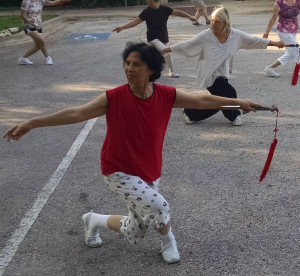
Tai Chi and the Writing Life

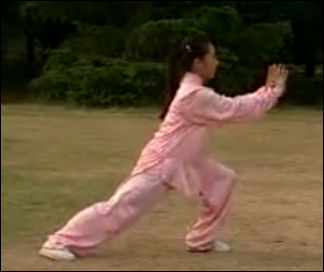
For me, Tai Chi is the perfect complement for the writing life. A meditative, do-it-anywhere physical discipline that builds strength, flexibility, coordination and balance, Tai Chi is just the right tonic for a profession that involves a lot of solitude and sitting.

Tai Chi

Warning: More than one person, including yours truly, has been sucked into Tai Chi for life by this video.

But the study of Tai Chi also promotes a character and frame of mind that supports the writing life. At Master Gohring’s Tai Chi and Kung Fu, where I’ve studied for five years, we remind ourselves at the end of each class that we follow the Five Hearts: Faith, Respect, Patience, Perseverance and Humility.

The five hearts work for writers, too.

Faith is not about religion; it’s about committing to your choice of discipline. In writing, it’s not indulging doubts about whether you should even try to write.

I take it a step further and strive to keep faith in the book I am working on. It’s hard, when you’re struggling, not to go haring off after another idea entirely. Set aside the questions; have faith that you are meant to write, and meant to write this book.

Respect: In Tai Chi, we respect the masters and teachers and students who have gone before us and from whom we learn. As writers, we respect the craft and the great writers who have gone before us, as well as other writers and other genres than our own.

We respect readers, too, and opinions different from your own. We should even respect our own negative reviewers—or am I going too far? Just kidding. Respect is an attentive attitude, the antidote for carelessness, dismissiveness, and stagnation.

Patience is remembering that you can’t do it all or learn it all in a day, or even a year—or many years. Your first draft is not a masterpiece. Of course not. Patience: give yourself a chance. Tai Chi and writing both take time and work.

Learning sword from a friend

Learning sword from a friend.

Perseverance goes without saying. Setbacks and disappointments are unimportant. Those who quit cannot succeed.

Humility: In Tai Chi, there is always more to learn, more that you don’t know. Same with us. Every book is a fresh challenge.

Affirmations

The five “life skills” are affirmations with accompanying Kung Fu movements. They help build the attitude we strive for in our study of Tai Chi, and they work for writing, too.

The path of self-mastery requires balanced emotions; balanced emotions do not yield to negativity. You don’t lose your motivation or confidence when you get a tough critique, a bad review or rejection, or when someone casually says something devastating about your efforts and goals.

The path of self-mastery requires a courageous heart; a courageous heart shows strength in the face of fear. What are our fears as writers? Failure, scorn, bad reviews, the risk of putting ourselves out there. We resolve to meet fear with strength.

The path of self-mastery requires a focused mind; a focused mind sees no obstacles. This isn’t about putting your head in the sand. An “obstacle” does not prevent you from getting to your goal. It’s just a challenge, a thing in the road, a problem to be solved so you can reach your goal.

The path of self-mastery requires persistent action; persistent action achieves a goal without quitting. See perseverance above! Writing, like Tai Chi, is a discipline.

The path of self-mastery requires a creative spirit; a creative spirit has no self-doubt. For us, this affirmation applies when we are doing the purest part of our work, when we are creating and letting it out. I love these words by Martha Graham:

It is not your business to determine how good it is nor how valuable nor how it compares with other expressions… You do not even have to believe in yourself or your work. You have to keep yourself open and aware to the urges that motivate you. [See the whole passage.]

blacksashsm

Elizabeth Buhmann is the author of murder mystery Lay Death at Her Door and has a black sash in Tai Chi. She also maintains an online Tai Chi Notebook. She studies Tai Chi at Master Gohring’s Tai Chi and Kung Fu in Austin and practices with a group of Chinese friends on the weekends.

Interview with Tim Bryant, author of Spirit Trap

I recently met author Tim Bryant at Book People’s Lonestar Mystery Discussion. He’s such an interesting person, I wanted to know more about him, his creative process, and his path to writing. Thanks for letting me interview you, Tim! Tim Bryant

AMW – When did you know that you wanted to be a writer?

TB – I’m not entirely sure I ever wanted to be a writer. I just was one. My grandmother probably knew I was a writer when I was ten years old. It took me at least thirty more years to realize she was onto something. I dedicated my first novel to her. I was happy that she was able to see it before she died.

AMW – What was the first creation of yours that got published?

TB – Well, I had had music published because I came to fiction writing after many years as a musician. The first piece of fiction I got published was my first Dutch Curridge short story. It’s called “Bob Wills Is Still The King,” and it was published in REAL Regarding Arts & Letters Literary Magazine. I had written several other Dutch short stories and a lot of non-Dutch stories too, of course, but that was the one that pretty much started everything.

AMW – How long did it take for you to write your first novel?

 TB – The first novel was DUTCH CURRIDGE. It took close to a year from start to finish, although the real meat of the writing probably took four months. My original idea with it was that I would take the collection of Dutch Curridge short stories— I think there were six or seven of them at that point— and weave them together into novel form. It was a fine idea in theory, it just didn’t work. I finally ended up setting all of those stories aside and writing the novel from scratch. Some of the earlier material worked its way into it, but only here and there. The story about the migrating squirrels and that parts about Dutch’s marriage and divorce, to name two examples. The bulk of the story was new material and was much better for it.

AMW – Did anyone help you? Did you belong to a critique group?

 TB – Unfortunately, I didn’t have any kind of group during the writing of the first novel. I wish I had. That did come along almost immediately after, and a couple of the people are still with me today. My friend Brett Gaffney has been a huge help with workshopping and even helped co-write the book THOSE WHO KNOW US BEST DON’T KNOW US AT ALL. It’s a book of free verse, but it also has a dark, mysterious edge to it and actually shares a character with the Dutch books. Brett’s my first go-to with things, and I do think writers need that. My good friend Jen Moody edited “Doll’s Eyes,” which was part of the Subterranean Press anthology IMPOSSIBLE MONSTERS. She did such an amazing job on that, I asked her to edit the newest Dutch novel, SPIRIT TRAP. She’s top shelf when it comes to editing, and she’s a great fiction writer too. They’re both invaluable secret weapons to have as a writer.

AMW– Do you currently belong to a writing group?

TB – Yes. In addition to Brett and Jen, I have a local writing group that meets regularly. They’re librarians and teachers in addition to being writers, and they’re great motivators, supportive friends, and I owe them a lot as well. I also hang out with Joe Lansdale from time to time, when he’s in town. I’ve certainly learned a lot from Joe. Writing is such a solitary endeavor, I find I really need those connections, just to keep me focused…and sane.

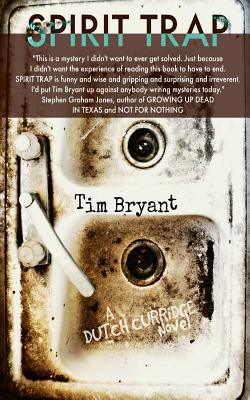
AMW – Your recent book, Spirit Trap, is the third book in the Dutch Curridge series. Tell us a little something about Dutch.

tim-bryant-spirit-trap

TB – Dutch is a private eye in 1950s Fort Worth who worked with the Tarrant County Sheriff’s Department until he realized he was too bad to be a good cop and too good to be a bad one. He identifies strongly with the down-and-out citizens of Fort Worth. He sees himself as one of them, where maybe the other guys on the force didn’t. Dutch has always been an underdog. He’s fought for everything he has (which isn’t much), and he’s ready to fight for every other underdog he meets up with.

On a personal level, he likes Jack Daniels and Dr Pepper, western swing and jazz music and a young lady who writes for the local newspaper. He has a bad ear, which is a leftover from a childhood illness, and a good friend named Slant Face, who hails from Manchester, England.

AMW – The series is set in Fort Worth in 1955. Why Fort Worth and why 1955?

 TB – Having a background in music, I wanted to extend some of that to the Dutch stories, and Fort Worth just has an extremely rich musical history. Especially, in that era of the 1940s and ‘50s. WBAP radio was broadcasting all over this part of the country. Bob Wills and Milton Brown were breaking down musical and racial barriers. Jazz clubs were hot, especially in the African-American neighborhoods. Fort Worth was a wild and colorful place, with Hell’s Half Acre downtown and Jacksboro Highway to the north. Dutch belonged in a place like that. He was right at home.

AMW – I’ve been reading the book and I can honestly say it’s what I call a “total immersion experience”. I can hear the music, the voices, and noises of the time. Did you have to do a lot of research to capture the era?

TB – Yes. I’ve done tons of research, and that research continues. I enjoy it so much, I hardly think of it as being research. I love reading about the history, personal accounts, pouring over maps, watching films and listening to recordings from that era and area. I’ve joked that I probably know more about Fort Worth than most people who live there, but it’s true. I’ve only visited a handful of times, believe it or not, but I’d love to spend more time there.

But yes, I did work to get the full effect of the time and place. The feel and the sounds. Fort Worth is much like a character in the books, so it was essential that I get it right.

AMW– Do you write other kinds of stories besides mysteries?

TB – Absolutely. In fact, I’m not sure I really write standard mysteries at all. The second book in the Dutch series, SOUTHERN SELECT, is probably the most straight-forward mystery I’ve written, and, although it’s quite important in the series, it seems to get overlooked a little. I tend to think of mystery in the larger sense. Not so much cases of missing heirlooms and dead bodies, even if those things do show up from time to time. To me, the best mysteries are the ones that are never solved. They get people thinking and talking. They’re the ones that draw them in, keep them up at night. So I like stories that ask questions more than I like stories that answer them. I think most of my stories ask the questions that intrigue me most.

AMW– You mentioned you’re a musician. What instrument and what kind of music do you play? Is your music available online?

TB – I’ve played music for most of my life too. I’m primarily a piano player, although I can fake a few other things enough to fool a few people. I play totally by ear, by instinct. I’ve been lucky enough to play music all over New Orleans, around Texas, on the same stage and in studios with some of my heroes.

My music is available on iTunes, most places you find music. It’s under either my name or 2Take Tim, which is a nickname I got down in New Orleans, or Ramshackle Day Parade, a cool international band that I put together. That band featured Steve Wickham, who plays with The Waterboys and Tatanka Ohitika— Strong Buffalo— a Dakota-Sioux poet. Almost all of my music  is available at TimBryantsUprightPiano.com.

AMW – What are the next projects you’re looking at? Another Curridge book? Something that’s been on the “back burner” you’ve been dying to get to?

TB – SPIRIT TRAP was the last major thing I wrote. Right before that, I wrote a non-Dutch novel called CONSTELLATIONS. A publisher in New York City is looking at that one. I have two other non-Dutch novels that I’m working on. I tend to alternate between the Dutch books and non-Dutch books, so I’ll most likely finish at least one of them before I return to Dutch.

One is indeed that big one that’s been simmering on the back burner. I think it might be time to bring it forward now. It’s set in the Philippines during World War II, and I’ve been researching that one for a good while now. I was going to say it’s one of those mysteries that’s not really a mystery. I think it would be closer to say it’s a non-mystery that really is one. Everything about life is a mystery, right?

I’ll return to Dutch though. He’s a friend too at this point. He always comes back around, and I’m always happy to see him. There should be at least two more Dutch novels. I think I’ll be back to him in 2015.

AMW – Thank you, Tim and good luck with the new book!


Flashback, Backstory, and Parallel Storylines

Elizabeth BuhmannA certain kind of story appeals to me above all others. It’s my archetype for mystery: A crime is successfully hidden for many years. The story begins when something sets off a chain of events to expose the old wrong. In the end, justice, so long denied, is restored.

In my writing, I’ve gravitated to this kind of story three times now: in my first published book, in a second manuscript that I hope to publish next year, and my current work in progress, called Blue Lake.

  • In Lay Death at Her Door, an innocent man takes the fall for a murder. Twenty years later, he’s exonerated, and the crime comes unsolved.
  • In Monster, an ambitious embryologist abandons a deformed child when his rogue experiment fails. Eighteen years later, the child goes looking for her birth parents.
  • In Blue Lake, a death in the distant past was once briefly suspected of being a murder, then written off as an accident. A family is destroyed and a crime goes unpunished for decades.

In each case, I have two stories to tell. What really happened a long time ago? And how does the truth come out all these years later? One entire story takes place in the distant past.

Any writer who attends workshops or belongs to a critique group (and that’s just about all of us) is frequently admonished to avoid or minimize back story and flashback. How, then, can you tell the old story in a book like mine? This worried me no end the first time around.

Flashback: In the midst of the present story, we shift briefly to a past event, then resume where we left off. A little bit is fine: At the start of Blue Lake, Regina has been refusing to go home to her estranged family, but she has learned that her father is dying, and she finally changes her mind. [FLASHBACK:]

Mary had called again the night before.

“Just wanted to keep you informed,” she’d said.

“I’m not coming.”

“You don’t have to. It’s okay.” And knowing Mary, she meant it. But it wasn’t okay. She’d have to go, and soon.

Just a few lines—a tolerable interruption, but you can’t do too much of this without fatally chopping up your present storyline.

Back story: We are filled in with information that explains how the characters and plot got to be where they are. In Monster, Detective Gil Tillier is at a crime scene for the first time in a couple of years.

He felt an itch of excitement, like an old racehorse snorting in the pasture at the sound of a starting gate. [BACK STORY:] Not that he was old. On the contrary, he’d been something of a wunderkind: lieutenant at the age of thirty, head of CID at thirty-two. Quit at thirty-three.

That’s one sentence of back story—about as much as we want before we get back to the body on the floor.

The way I think of it, flashback is dramatized, while back story is not. Flashback shows, while back story is told. Both are short interruptions in the story line. Neither technique is adequate for telling the past story in the kind of book I want to write.

Parallel Storylines: I want two full stories, interwoven. Both stories have to be fully dramatized. The excursions into the past must be of sufficient length to pull us all the way in. Often, entire chapters will be committed to one storyline or the other, alternately.

The past and present stories must be equally interesting. In Lay Death, the young Kate’s adventures in Africa and Massachusetts, and her love affair with Elliott in college, have to be worth reading in their own right.

At the same time, the reopening of the investigation into Elliott’s death twenty years later has to be compelling, too. Neither story can be left to languish too long. They have to feed off each other and collide at the climax.

It’s not for me to say if I succeed in these complex plot structures, but I find this kind of book most rewarding  when it works. I want to fully understand how the world got knocked out of balance in the distant past. And then I want to watch how truth and justice win out in the end.

Cover-Lay-Death-BuhmannAmazon Top 100 and B&N Top Ten Bestseller Lay Death at Her Door is on sale for the first time in 2014, this week only. “What an ending! All the threads that seem to be unrelated weave tightly together at the end. I can’t wait to read more by Elizabeth Buhmann!” – NYT Bestselling Author Kate Moretti

We Don’t Need No Stinkin’ Rules

Alpine 2014 137Rules for writing?

Outline? No outline? Seat of the pants?

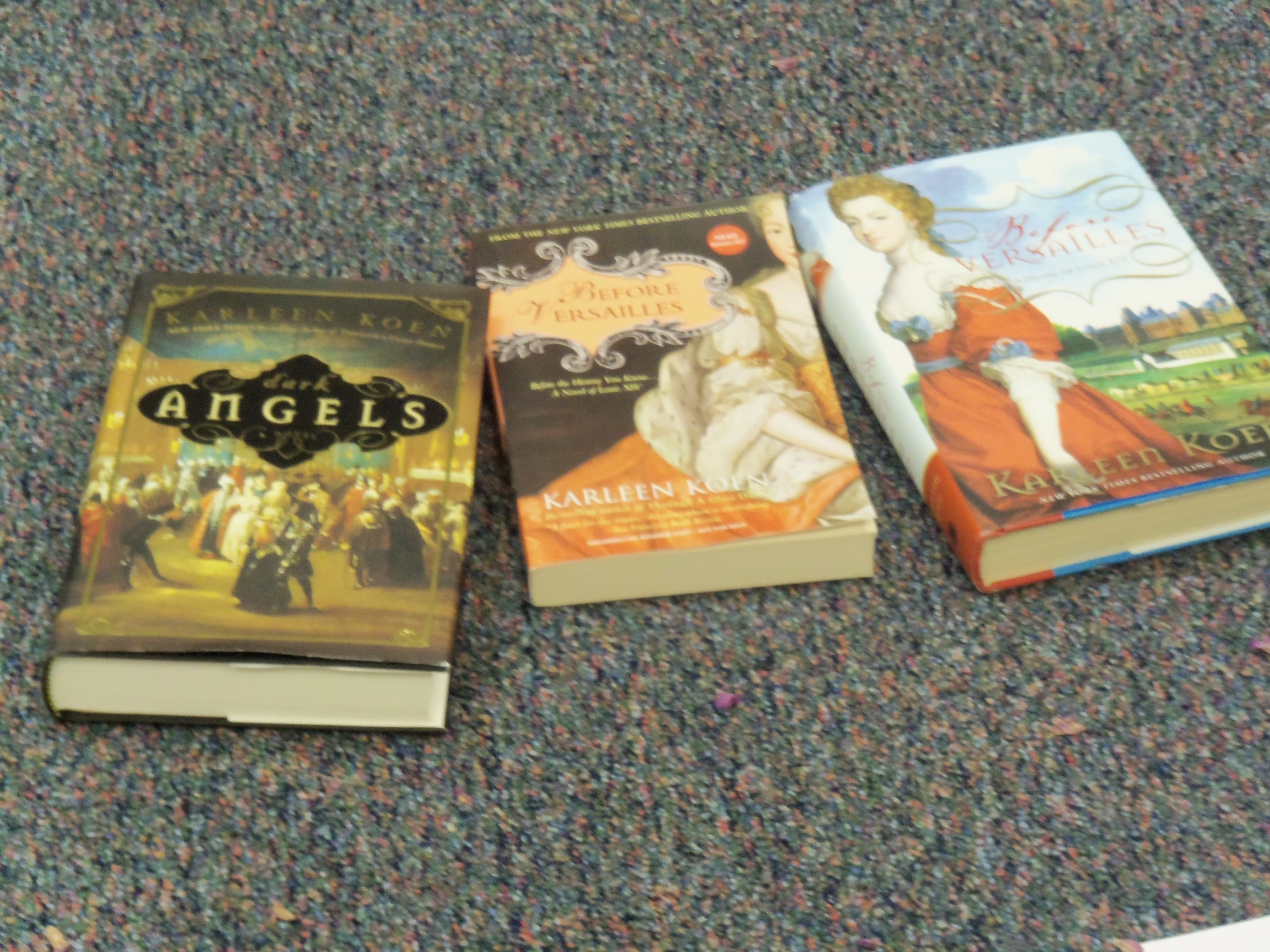
Karleen Koen, instructor for That Damned Rough Draft at the Writers’ League of Texas summer writing retreat at Sul Ross University in Alpine, says there are no rules for writing. And she never said the phrase, “We don’t need no stinkin’ rules.” That’s my inner child cutting up.

She said she wouldn’t teach us to write, but would help us learn how to play. If you play, your inner child, your subconscious, will make itself known and your writing will be the richer for it.

And another thing. Writing a novel is hard–real hard.

We are adventurers, embarking on the quest of a lifetime, daring everything on a wild, reckless throw of the dice. Fame and fortune. Or maybe no one will pay attention at all.

According to Koen, a writer’s tools are her words. An artist has brushes and canvas, a sculptor his clay. We have only words to bring a whole new world to life, a world of our own creation. We must lure and seduce readers to enter our world with our use of words.

Not Rules but Suggestions:

Don’t talk your story away. Energy you need for the story goes out at the mouth.

Writers are looking for affirmation. We never get enough.

Grant yourself permission to write badly. The point is to be writing.

Poetry helps writers with their voice. Karleen Koen always reads poems before class begins.

Writing the rough draft is not a time to perfect your prose. Let your subconscious work with you. A rough draft is not linear. The novel is hard. You have to willing to commit to the marathon. Not the sprint.

Alpine 2014 135You have to pay attention to anything that excites you as a writer.

Nobody can see our hard work if we’ve done our work right. It looks slick. Bumps come with writing novels.

Our suffering is invisible to everyone but us.

Magic and alchemy are part of a story. They take the reader to another world.

You need time and space to create.

Don’t compare. Everybody feels bad when you compete

I need to know what I don’t know. I want to get the story finished. Have I bitten off more than I can chew?

What makes a novel? Hook, plot, tension, character, dialogue, scenes, ending, middle, beginning–magic.

Painters have color

Sculptors have clay.

All writers have are words.

Karleen suggests these daily exercises to tempt forth your magic, muse, subconscious, inner child, whatever makes you tick.

Keep a writer’s diary and write about your writing self every day.

Write three longhand morning pages first thing when you wake up every day, no editing. Don’t think. Just write whatever comes into your  head.

Alpine 2014 114Take photographs and write about them. Take pictures of whatever “pings” in  your gut. Write about why.

Don’t let your editor subdue your creator, even in revision.

Don’t share writing with just anyone. Writing is part of our inner child. Too much criticism shuts you down.

Your first reader is very important. All you want to ask the first reader are three questions about your manuscript:

  1. What did you like?
  2. What do you want to know more about?
  3. Where did I lose you?

This will help shape the novel and show where you are off pace.

Cool down between drafts.

Learn to play with words. Be creative and loose.

Find a niche that’s well calibrated to your interests and your talent.

You can only develop your voice by writing.

Enter your story and take us with you.

Know how your hero/heroine is going to be transformed by the end of the novel.

Sometimes revision can lead to beating a dead dog. You’ve been to the well too many times.

You adventurer,  you.

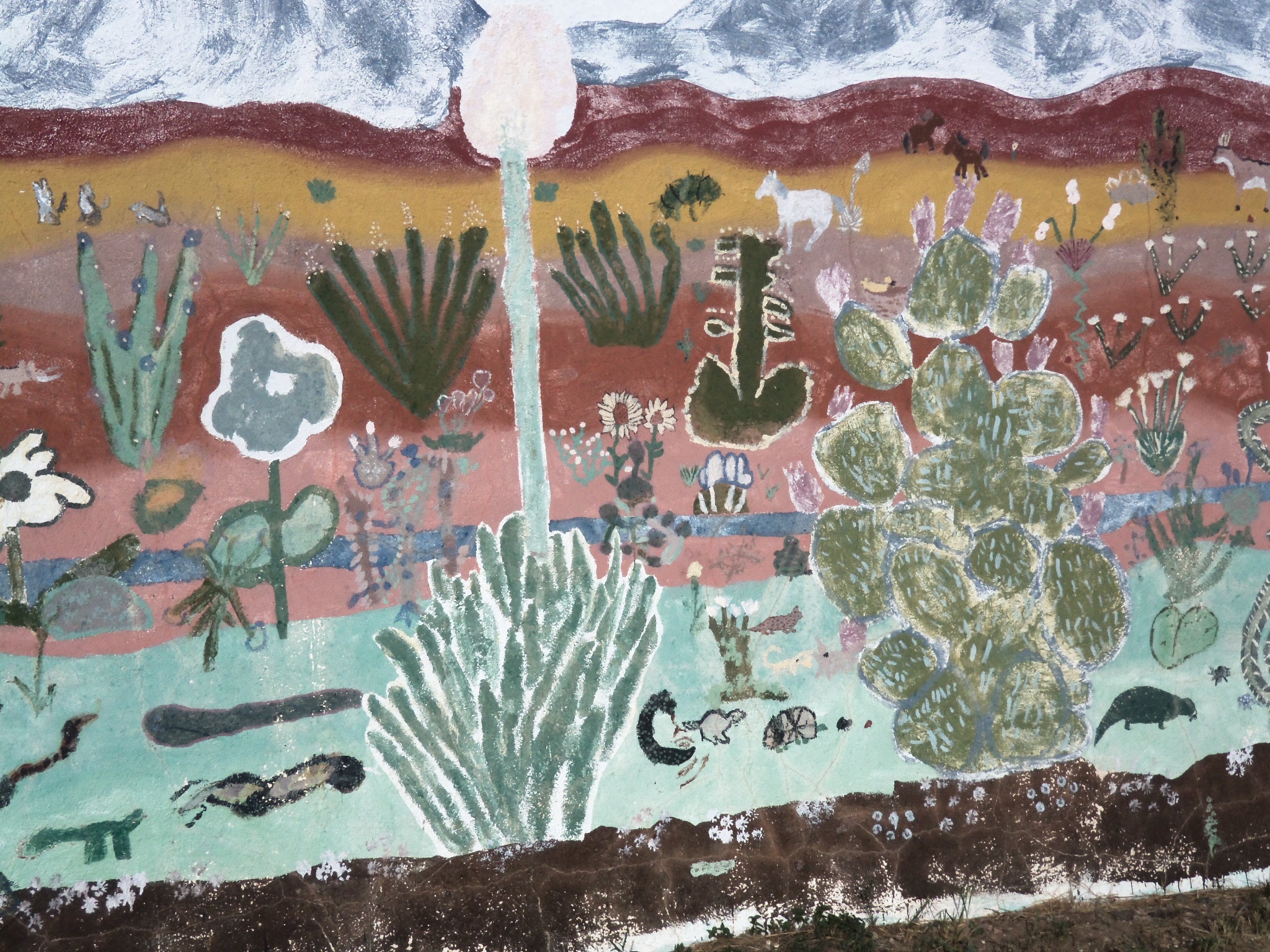
Alpine 2014 206My inner child likes murals. Is there a novel in them?

By Gale Albright

Don’t Cry for Me, Austin, Texas

0kathy-blog

Posted by Kathy Waller

*****

On Saturday, Gale and I will leave on a seven-hour drive to Alpine, in West Texas. We’ll attend the Writers’ League of Texas’ 2014 Summer Writing Retreat.

  • Big Bend National Park. By Kathy Waller.

    Big Bend National Park. By Kathy Waller.

    I’m almost ready to leave. All I have to do is

  • print out and re-read all email correspondence from the WLT concerning the retreat;
  • put together and print at least fifty pages of my rough raft, which isn’t too rough considering all the revising and polishing I’ve done, against all the best advice; (putting together the draft entails sorting through the many files I’ve saved under a variety of names, none of which makes sense now);
  • buy new sneakers (the retreat doesn’t require formal dress) and a passel of socks to replace those the dryer has eaten; buy new khaki slacks if I can find a pair whose legs don’t drag the ground (petites are usually sold out);
  • pile everything I need to take, and a few things I don’t, on the guest room bed beside the suitcase, which is closed to prevent William and Ernest (big, hulking guy cats) from sleeping in it;
  • find my favorite novel, Harper Lee‘s To Kill a Mockingbird, for class, even though the book violates the cardinal rule of novel-writing by beginning with several pages of backstory and getting away with it;
  • buy a notebook, even though I have several, because a week-long retreat merits a new one, and pens in a variety of styles and colors;
  • make sure the laptop, the cord, the mouse, and my camera are stowed safely inside my
    More prizes!

    More prizes!

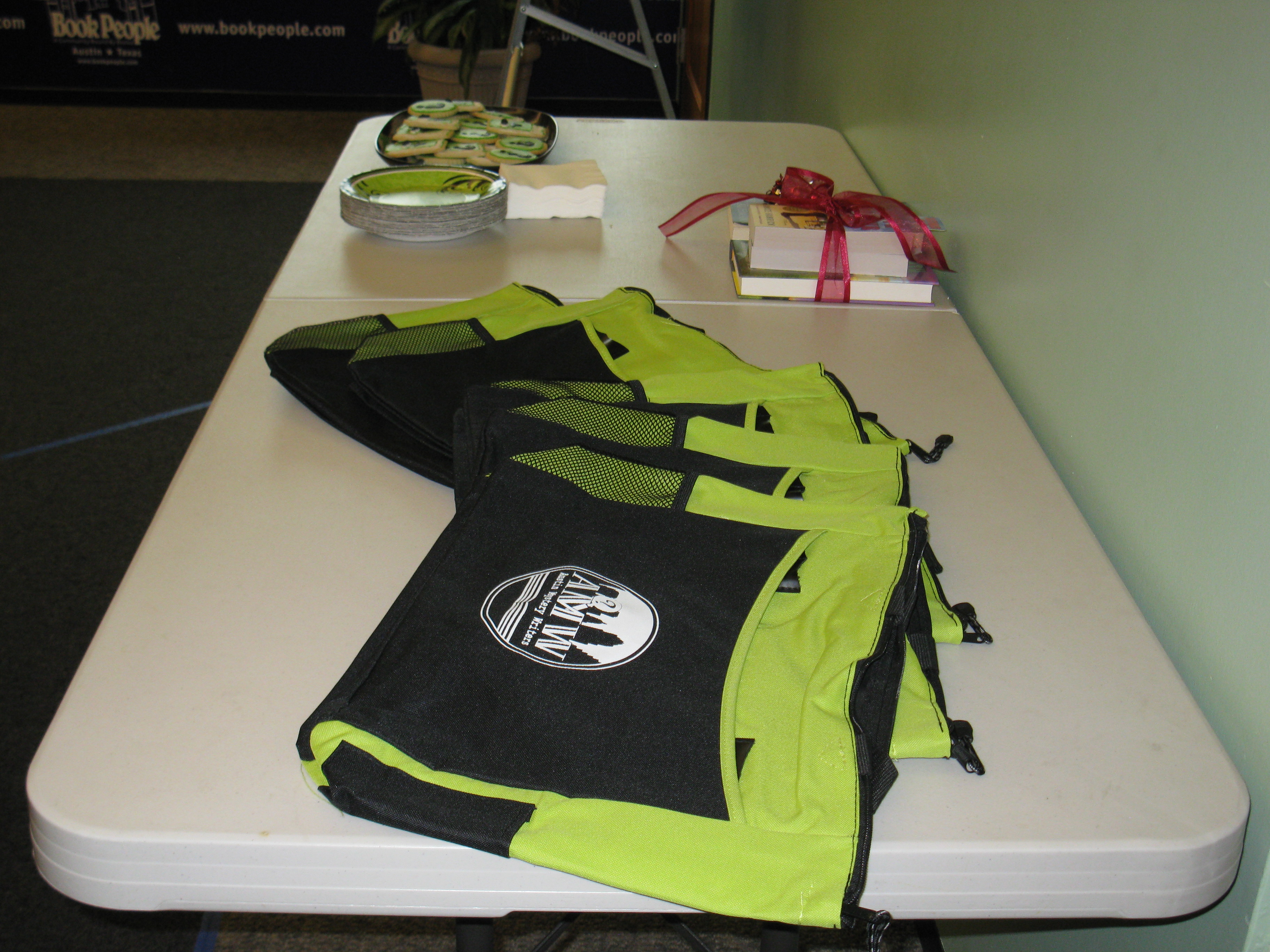
    green Austin Mystery Writers tote; make sure my charged cell phone and the charger are stowed safely inside my purse;

  • confirm with my husband that the car will make it to Alpine and back;
  • do one last load of laundry; pack;
  • get up early, load the car, pick up Gale, and head out.

Gale is probably ready to leave now. She is organized.

Some people would say we’re crazy, driving half-way across the state to do homework every night. Before my first retreat, three years ago, I might have said the same.

But at the end of the first day’s class, I was so energized that I couldn’t stop writing. I wrote long emails that made better reading than anything else I produced during the week. (I had a friend patient enough to read them and kind enough to say, “Send more.”) I might even have done some blogging. After all that, I completed my homework.

The person responsible for my sudden productivity was Karleen Koen, novelist and teacher, whose class was titled something like Writing Your Novel, but who actually taught creativity, with activities designed to quiet the internal critic and allow ideas to surface. One of the ten-minute writings I did in class later turned into a thirty-page story for the Austin Mystery Writers’ anthology of short stories.* Anyone who can pull me out of the doldrums and start me on a creative binge, as Karleen did, is an exemplary teacher.

Next week, I’ll spend five days in another of Karleen’s classes: The Damned Rough Draft: Reframing and Reimagining Your Novel in Its Beginning Stages. Gale is registered to take the class, too. I have a vision of two roommates writing busily away every night.

Of course, we’ll also sit on the porch of the little 1950s tourist court where we’re staying (and where I once ran into a lizard in the shower), enjoying the cool, clear, mosquito-less evenings in a town that, every night, turns off all lights and lets the stars shine through.

And there’s the restaurant in nearby Marfa that serves pistachio encrusted fried chicken breast. I hear they’ve added pistachio encrusted steak to the menu.

Some of our Sisters in Crime will be there. We’ll definitely run into them and will perhaps cook up some mischief.

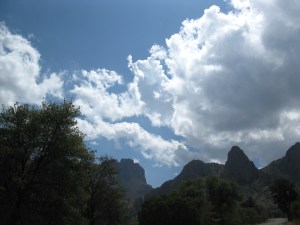
And there’s the extra day Gale and I will spend after the conference roaming around the countryside. Fort Davis. The MacDonald Observatory. Balmorhea State Park, a cool oasis in the high desert. Big Bend National Park. Endless possibilities.

But I’m going out there to write. I’ll do nothing to distract us from Karleen Koen’s class. Based on my experience, it will be too valuable to play hookey, even mentally.  But we will play, because Karleen believes that’s where creativity comes from.

And that’s how my August will begin.

English: This is Alpine, Texas with the six-th...

English: This is Alpine, Texas with the six-thousand foot plus Ranger, Twin Sisters, & Paisano Peaks in the foreground. (Photo credit: Wikipedia) Public domain. By Rebelcry (Own work) [Public domain], via Wikimedia Commons

So, ‘though I’ll be far away from beautiful Austin, Texas for an entire week, there’s no reason to pity me.

I’ll be in the mountains, doing what I love.


 *****

*Have you heard about the AMW anthology? If not, you will.

 *****

Kathy Waller blogs at To Write Is to Write Is to Write.

Karleen Koen blogs at Karleen Koen–writing life.