Back In The Saddle Again

VP Chandler

by V.P. Chandler

The world has been a crazy place since the emergence of Covid-19. Although it’s still out there, I’ve begun to venture forth into the world and attend author events. It feels wonderful to get back into the world of books and speaking with other writers! I think the last event I went to was the Bullet Books event in February of 2020 at the Bosslight Bookstore in Nacogdoches. (Fellow AMW writers Kathy Waller, Helen Currie Foster, and Laura Oles are also Bullet Books authors.)

My first foray back into the public realm was a Noir At The Bar event in Dallas back in June. Of course, it was outside and still blazing hot even though it started at 7. But I had such a great time listening to the other authors that it was worth it! Not a dud in the bunch. We laughed at some stories and were creeped out by others. I read a short piece that I wrote a few years ago, Tutusuana. (“Tutusuana” is a Comanche word that’s explained in the story.) It was nice to see old friends and finally meet online friends in person. Loved the experience. I highly recommend The Wild Detectives bookstore/bar. This is a jewel in the Bishop Arts district in Dallas.

Now we travel to Book People. Yesterday, August 21, I went to my first Book People event since pre-Covid. Mark Pryor has a new book Die Around Sundown. This is the first book in a new series so of course I had to be there to cheer him on! I’m excited to read this book. It’s an historical mystery set in Nazi-occupied France. I enjoyed the book talk and, again, seeing friends in person that I haven’t seen in a while.

This Wednesday I plan to go to an author event at my local library. I haven’t met Michael Miller but since I live in a small town, I want to attend events and provide support. He’s a long-time university professor, presently at Texas State. And he is also a Presbyterian minister, serving La Iglesia Presbiteriana Mexicana for the last ten years in San Marcos. His book is The Two Deaths of Father Romero: A Novel of the Borderlands. Sounds interesting!

Then the next day I’ll be back at Book People, if the roads aren’t flooded. (We’ve been in a severe drought this summer, as much of the world has been too. I’m looking forward to the rain, but I hope it’s a slow, soaking rain and not a deluge.)

It’s going to be epic. Two of the authors are NYT best selling authors. All of the panelists are Texas mystery authors with stories set in Texas. You know I’m gonna love that.  https://www.bookpeople.com/event/mystery-author-panel

Note: AMW member Helen Currie Foster will be on the panel too.

What a busy week! Looks like I have a lot of reading in my future. A few more books to add to my TBR (To Be Read) pile. My shelves are sagging. I better get busy, or build more shelves!

The Flavor of the Place

by Helen Currie Foster

August 8, 2022

Our family’s favorite mystery quote (bolded below) appears in Strong Poison, by Dorothy Sayers, where detective Lord Peter Wimsey first meets novelist Harriet Vane. Vane’s on trial for murder, accused of systematically poisoning her former lover with arsenic.

Wimsey suspects the lover’s uncle, Norman Urquhart, but the uncle assures the police that he served a blameless dinner to his nephew. Wimsey sends the all-competent Bunter (his manservant and WWI batman), to winkle out secrets from Urquhart’s cook, Mrs. Pettican, and the housemaid.

Bunter ingratiates himself by means of crumpets:

“At half-past four…he was seated in the kitchen of Mr. Urquhart’s house, toasting crumpets. He had been trained to a great pitch of dexterity in the preparation of crumpets, and if he was somewhat lavish in the matter of butter, that hurt nobody except Mr. Urquhart. It was natural that the conversation should turn to the subject of murder. Nothing goes so well with a hot fire and buttered crumpets as a wet day without and a good dose of comfortable horrors within. The heavier the lashing of the rain and the ghastlier the details, the better the flavour seems to be.” 

What a setting! I’ve never tasted a crumpet, but can feel the heat of the fire and inhale the smells of toasting and melting butter. And in contrast to (or fueled by) this warmth, this delicious comfort, the cook reminds us of the victim’s death: “A dreadful wicked woman she must ‘a’ been,” said Mrs. Pettican, “—‘ev another crumpet, do, Mr. Bunter—a-torturin’ of the poor soul that long-winded way. Bashin’ on the ‘ed or the ‘asty use of a carvin’ knife when roused I can understand, but the ‘orrors of slow poisonin’ is the work of a fiend in ‘uman form, in my opinion.”

So in our kitchen at buttery moments some family member will mutter, “If he was somewhat lavish in the matter of butter…” But this week I wondered, “What are crumpets?” I mean, with Bunter toasting them over a (presumably coal) fire, then lavishing butter on them, they sound wonderful, especially for teatime in a firelit kitchen, on a cold wet afternoon, discussing the horrors of slow poisoning.

Compelled by curiosity I found a recipe. https://www.daringgourmet.com/traditional-english-crumpets/ Huh. I’d imagined English muffins. No. Instead, the goal is a tender disc, yeasty but also leavened with baking soda, creating bubbled holes to absorb melted butter, jam, and other decorations. Problem: locating crumpet rings. Yes, I’ve ordered some.

Sayers wasn’t writing a culinary cozy, despite the crumpets and an intense discussion on the following page between Mrs. Pettican and Bunter about casseroled chicken. A scene beginning with toasting crumpets produces a triumph of setting and character, a comic but dread-inspiring description of the victim’s death, and clever clue placement. Sayers does not describe either the smell of the toasting, or the taste of the crumpets, but surely you, dear reader, imagined those? Didn’t you feel yourself right there in the kitchen, with the rainy day outside, the gossipy discussion of the lover’s death agonies, and a vivid depiction of Bunter’s character? Courteous, yet firm, he deftly extracts critical information not reflected in the police report—and yes, a clue you doubtless spotted. Maybe Vane will escape the hangman’s noose after all. 

As Proust famously pointed out, smells can stimulate memories. https://www.penguin.co.uk/articles/2020/07/more-than-cake-unravelling-the-mysteries-of-proust-s-madeleine Smells can also trigger emotional reactions: “Your olfactory bulb runs from your nose to the base of your brain and has direct connections to your amygdala (the area of the brain responsible for processing emotion) and to your hippocampus (an area linked to memory and cognition). Neuroscientists have suggested that this close physical connection between the regions of the brain linked to memory, emotion, and our sense of smell may explain why our brain learns to associate smells with certain emotional memories.” https://www.scientificamerican.com/article/why-do-smells-trigger-memories1/

Despite the strong impact of smells on humans, writers’ references to smell often seem sparse. Part of the problem is the sheer difficulty of describing certain smells. Imagine trying to describe the smell of a beloved house. It’s a mysterious mix, isn’t it? If I try to describe my mother’s house, I can’t do it with just one word. Part of the remembered smell is a faint perfume—maybe a bath powder she used, like Caswell Massey’s Gardenia. But there are other ingredients as well—contributions from oak furniture, cotton sheets, old Christmas cards on a closet shelf… See, I can’t accurately describe the smell itself; I have to name things.

My grandmother’s house in Hill County delivered a similar mixture, varying by seasons. In summer, it smelled of cantaloupe from her garden; at Christmas, of a decorated cedar tree. But always the substrate included a hard-to-describe mixture of our grandfather’s Yardley English Lavender talc, kept on the kitchen shelf where he shaved; of the garbage chute in the kitchen; of oil and electric discharges from his ham radio rig; of the ancient living room piano (wires, wood, felt). How describe the totality of that smell, that amalgam of odors, so instantly recognizable to me, but unknown to you? And how describe it without a bunch of nouns? 

Poets apparently run into that problem. I set out to locate poems incorporating odor and fragrance, grabbing poetry volumes from the shelves. Yeats? Gorgeous references to sight and sound, as in “The Lake Isle of Innisfree”: “Nine bean-rows will I have there, a hive for the honeybee, /And live alone in the bee-loud glade…” The poem is rich in sight, in sound, but not smell. We don’t smell the clay and wattles or honey.

Same for Wendell Berry’s A Small Porch—a volume of ideas, images, light and air. But I didn’t find smell. Nor did I find smell references in Chaucer or a number of Renaissance English poets, except that Michael Drayton gives us a wonderful line in “To the Virginian Voyage” referring to the much-anticipated Virginia landfall of seaborne English explorers: “When as the luscious smell/of that delicious land…” Of course Shakespeare mentions the “sweet odour” of roses (as in Sonnet 54): “Of their sweet deaths are sweetest odours made.” 

Indeed, I had trouble finding references to smell in most of the poetry books I opened. There were some. In “Aimless Love,” “gazing down affectionately at the soap,” Billy Collins writes, “I could feel myself falling again/as I felt its turning in my wet hands/and caught the scent of lavender and stone.”

Marianne Moore, in “Enough,” from O To Be a Dragon, gives us this: “The crested moss-rose casts a spell; its bud of solid green, as well, /and the Old Pink Moss—with fragrant wings/ imparting balsam scent that clings…” Many readers will recognize balsam. Another from Moore’s “In the Public Garden”: “O yes, and snowdrops in the snow that smell like violets.”

Also readers may know the smell of violets. Charles Wright, in “Dog Creek Mainline,” gives more challenging references: “Dog Creek: cat track and bird splay,/Spindrift and windfall; woodrot; Odor of muscadine…” If you’ve played around wild grapevine you know the odor of muscadine––maybe woodrot too. 

Try the experiment yourself. Pull some poetry off the shelf. Don’t most poems rely on sight and sound, and rarely odor? Because a particular smell can be very hard to describe.

https://bit.ly/3dhCTQO. Per Rodrigo Suarez at the Queensland Brain Institute: 

“The way the brain deals with smells is very different to how it deals with other senses, such as seeing and hearing. For example, we can identify the different instruments playing in a band, or the different shapes and colours in a painting. But it is very hard for us to tell the individual parts of a smell mixture.” He goes on: “We can sense the smell of “orange” or “coffee” as a single thing, but have trouble identifying the many different parts that make up those smells individually. However, it is possible to get better at this with practice. Professional wine-tasters or perfume-makers can detect more parts of a smell mixture than most people.”

Our difficulty in describing smell is not that we humans can’t detect odors—we can, says Greg Miller, Science (November 11, 2014): “We humans have about 400 different types of receptors for detecting odorant molecules. That’s on the low end for mammals, but it’s enough, at least in theory, to allow us to distinguish a trillion different odors, one team of neuroscientists calculated earlier this year (although there’s been some controversy about that estimate).”

But, per Miller, we describe odors differently from sights and sounds: “When people—English speaking people, anyway—describe odors, what they are actually doing much of the time is describing the source of the odor. Orange-y. Smokey-. Skunk-y. This seems natural enough, but it’s fundamentally different from how we describe other sensory experiences. Words like “white” and “round” describe visual features of an object, not the object itself. It could be a baseball, or it could be the Moon. In the same way, a tone can be “high-pitched” whether it comes from a bird or a teakettle.” https://bit.ly/3JFFobV

Some studies suggest that our language is inadequate to the task of describing smell. Another suggestion is that other languages than English may be better at conveying odor.

But determined mystery writers find a way, because odor can make important contributions to a setting. In 1937, in Rex Stout’s fourth Nero Wolfe mystery, The Red Box, the detective lectures his cook, Fritz Brenner: “Do you know shish kebab? I have had it in Turkey. Marinate thin slices of tender lamb for several hours in red wine and spices. Here, I’ll put it down: thyme, mace, peppercorns, garlic…” https://amzn.to/3PahvKz

Can’t you smell those spices? And doesn’t that passage help round out (pun) our vision of Nero Wolfe, gourmet, gourmand, brilliant detective? We’re planted in the kitchen of Wolfe’s New York brownstone, the primary setting for all the mysteries. These few lines convey Wolfe’s insistence on sophisticated cuisine, and reflect the rigor he demands of every employee under his roof, including Fritz the cook; Theodore Horstmann, the keeper of his orchid greenhouse; and our narrator, his foot soldier, Archie Goodwin. A shish kebab recipe helps define the setting and Wolfe’s character as well.

Ngaio Marsh begins Night at the Vulcan (1951) with Martyn Tarne, a young New Zealand actress desperately seeking an acting role in London. One night, out of food and money, with no place to stay, she enters the Vulcan Theatre which has advertised for a dresser: “She was at the back of the stalls, standing on thick carpet at the top of the ramp facing the centre aisle…The deadened air smelt of naphthalene and plush.” The empty theatre lacks an eager audience, waiting for the curtain to go up. Instead Marsh gives us the “deadened air” of a closed theatre, where the plush seats are empty, and the air smells of naphthalene—chemical dry cleaning. Martyn starts to work: “As soon as she crossed the threshold of the star dressing-room she smelt greasepaint. The dressing-shelf was bare, the room untenanted, but the smell of cosmetics mingled with the faint reek of gas.” I don’t know the smell of greasepaint, but Martyn does; she’s in a setting she understands.

Mick Herron’s unputdownable Slough House series uses odor to create the key setting––the decrepit building which serves as center stage. Book 2, Dead Lions, describes entry to the building as follows: “No one enters Slough House by the front door; instead, via a shabby alleyway, its inmates let themselves into a grubby yard with mildewed walls….” Yecch, mildew. The building houses the “slow horses” who flunked out of MI-5’s headquarters in posh Regent’s Park, and are now under the tutelage of former Cold Warrior Jackson Lamb, a terrifying mentor. “Jackson Lamb’s lair,” the office on the building’s top floor, is described thus: “The air is heavy with a dog’s olfactory daydream: takeaway food, illicit cigarettes, day-old farts and stale beer, but there will be no time to catalogue this because Jackson Lamb can move surprisingly swiftly for a man of his bulk….” No question that odor is part of the setting. Lamb is an olfactory terrorist. https://amzn.to/3ppQsAJ

The century-old Beer Barn, a beloved road house in Coffee Creek, is where townspeople gather in my Ghost series. That includes lawyer and protagonist Alice Greer. Naturally the smell of beer is key. In Book 3, Ghost Letter, Alice invites a political reporter to the Beer Barn for lunch: “As they pushed through the Beer Barn’s tall swinging doors the fragrant haze enveloped them—incense compounded of hickory smoke from the wood-fired grill, chiles toasted on an iron comal, and thousands of bubbles popping in bottles and glasses, releasing the yeasty magic of beer to the air.”

Smells may be hard to define, but including the smell of a setting can enrich a mystery’s impact. Or, as Mrs. Pettican says, “Have another crumpet, do!” 

Helen Currie Foster lives and writes north of Dripping Springs, Texas, loosely supervised by three burros jostling for roles in the Alice MacDonald Greer Mystery series, set in the unique landscape of the Texas Hill Country. So far all three burros have made an appearance, though insisting on aliases. Book 8 is on its way…

Review: Nancy Peacock’s A Broom of One’s Own (A Public Service Repost)

by Kathy Waller

I wrote the following for my personal blog to answer a “challenge.” I intended to post it at the end of September 2009–yes, 2009. But I got all tangled up in words and couldn’t write a thing. Then I intended to post it at the end of October. I still couldn’t write it. I managed to write it after the October deadline.

In the middle of the “process,” I considered posting the following review: “I like Nancy Peacock’s A Broom of One’s Own very very very very very much.”

But the challenge specified a four-sentence review, and I had hardly one, and I didn’t want to repeat it three times.

So there’s the background.

I must also add this disclaimer: I bought my copy of A Broom of One’s Own myself, with my own money. No one told, asked, or paid me to write this review. No one told, asked, or paid me to say I like the book. No one told, asked, or paid me to like it. No one offered me tickets to Rio or a week’s lodging in Venice, more’s the pity. I decided to read the book, to like it, and to write this review all by myself, at the invitation of Story Circle Book Review Challenge. Nobody paid them either. Amen.

*********************************************

Review of Nancy Peacock’s A Broom of One’s Own

I like Nancy Peacock’s A Broom of One’s Own: Words About Writing, Housecleaning & Life so much that it’s taken me over two months and two missed deadlines to untangle my thoughts and write this four-sentence review, an irony Peacock, author of two critically acclaimed novels, would no doubt address were I in one of her writing classes.

She would probably tell me that there is no perfect writing life; that her job as a part-time house cleaner, begun when full-time writing wouldn’t pay the bills, afforded time, solitude, and the “foundation of regular work” she needed;  that engaging in physical labor allowed her unconscious mind to “kick into gear,” so she became not the writer but the “receiver” of her stories.

She’d probably say that writing is hard; that sitting at a desk doesn’t automatically bring brilliance; that writers have to work with what they have; that “if I don’t have the pages I hate I will never have the pages I love”; that there are a million “saner” things to do and a “million good reasons to quit” and that the only good reason to continue is, “This is what I want.”

So, having composed at least two dozen subordinated, coordinated, appositived, participial-phrase-stuffed first sentences and discarding them before completion; having practically memorized the text searching for the perfect quotation to end with; and having once again stayed awake into the night, racing another deadline well past the due date, I am completing this review—because I value Nancy Peacock’s advice; and because I love A Broom of One’s Own; and because I consider it the equal of Anne Lamott’s Bird by Bird; and because I want other readers to know about it; and because this is what I want.

*

I’ve posted this review before both here and elsewhere. I consider the reposting a service to writers. The book is absolutely invaluable, and all writers need to know about it.

***

I blog at Telling the Truth, Mainly. I write crime fiction–have published short stories and am working on a novel. My blog, however, doesn’t have much to do with crime. There I write about anything that comes along. I like to think it’s eclectic, but it’s really just a jumble.

Music to Our Ears!

by Helen Currie Foster

On April 2 I drove with my writing compadre D.L.S. Evatt (aka Dixie) to Houston to sign books at Murder by the Book. That renowned bookstore has sold mysteries for 42 years. Huzzah!

We’d launched our books–my Ghost Daughter, Book 7 in the series, and her Bloodlines and Fencelines–at our Honky-Tonk Book Launch on December 5, 2021, at venerable Sam’s Town Point, a South Austin treasure for decades. The owner, Ramsay Midwood, declared it was the “first book launch” for Sam’s. Before the band––Floyd Domino’s All-Stars––began playing, Austin Shakespeare’s Ann Ciccolella interviewed us. Her first question: “why have a book launch at a honky-tonk?”

Dixie and Helen

Why? For all the right reasons—great beer signs, dance floor, pool table, and music. But the main reason: murder mysteries set in small Texas towns must have a place where townspeople meet, where news is exchanged and gossip is passed along, where people see friends and frenemies and fall in love, where the past isn’t forgotten but the present is very much in play.

For Alice Greer, the lawyer protagonist in my Ghost series, the century-old Beer Barn is that place. Artisanal beers, excellent Tex-Mex food, the requisite dance floor—and the mix of music that says “Texas Hill Country.” In Dixie’s Bloodlines and Fencelines, that place is Sara’s General Store.

Of course setting is crucial in mysteries. For a small town setting, a “town crossroads” becomes a useful dramatic tool, providing a place where the mystery’s protagonist runs into various characters and hears (and evaluates) their stories, slowly unraveling the truth of a murder. Have you ever lived or visited relatives in a small town? You may have identified potential locations that would work well in a mystery. In Itasca, Texas, home of my maternal grandparents (and the Itasca Wampus Cats), it might’ve been the church fellowship hall, or the one café that served breakfast and lunch, or (I keep returning to this thought) the frigid meat locker downtown where, like many families, my grandmother kept her side of beef, back before home freezers. I still remember the sharp cold vapor of the meat locker. Imagination stirs…

At any rate, Sam’s Town Point was perfect for a book launch. When we scouted Sam’s, Dixie took a look around and said, “There are stories in these floorboards.” So we wrote a song, “Stories in the Floorboards,” which premiered last month at our book event at the Austin Woman’s Club, sung by songwriter/actress Helyn Rain Messenger.

We asked John McDougall at Murder by the Book if he knew of other authors who’d written or commissioned a song for their book launch. He said, yes, Harlan Coben and Jeffrey Deaver had done so, and Lee Childs had commissioned an entire album. Well!

The notion of an album set me thinking of John Rebus, the crusty Edinburgh cop made famous by author Ian Rankin. Rebus, acerbic and brilliant, likes his music. In Black and Blue, he sticks a tape in his car cassette player – Robert Wyatt, Rock Bottom, then Deep Purple, Into the Fire.” That title matches the heat of the fix he’s in at that point. (Later in the series, the cassette player becomes a CD player.) But at home, he still relies on the hi-fi.In Rather Be the Devil, set in his ways, now retired and older than dirt, Rebus knows he has an ominous shadow on his lung as he enters his apartment: “A glow from the hi-fi system that told him he hadn’t switched it off. Last album played: Solid Air. Felt like that was what he was walking through…” https://www.amazon.com/s?k=rather+be+the+devil+by+ian+rankin&crid=11GFHLFGLRGUT&sprefix=%2Caps%2C135&ref=nb_sb_ss_recent_1_0_recent

Rebus has stuck to his old technology. And now he’s ahead of the curve. Vinyl sales are up: “Left for dead with the advent of CDs in the 1980s, vinyl records are now the music industry’s most popular and highest-grossing physical format, with fans choosing it for collectibility, sound quality or simply the tactile experience of music in an age of digital ephemerality. After growing steadily for more than a decade, LP sales exploded during the pandemic.In the first six months of this year, 17 million vinyl records were sold in the United States, generating $467 million in retail revenue, nearly double the amount from the same period in 2020, according to the Recording Industry Association of America.”

https://www.nytimes.com/svc/oembed/html/?url=https%3A%2F%2Fwww.nytimes.com%2F2021%2F10%2F21%2Farts%2Fmusic%2Fvinyl-records-delays.html

Moreover, it’s not retirees pushing this trend: “And while you might think it’s nostalgic Boomers or Gen Xers behind the renaissance of records, in fact surveys show it’s millennial consumers driving the rising trend in vinyl sales.” https://www.themanual.com/culture/why-vinyl-is-coming-back/

Why? For some, vinyls are the new collectible. But maybe it’s about the additional experience involved in listening to a favorite chunk of music. Rebus, for instance, is not listening to streamed music, not asking Alexa to play music that “sounds like” some musician. No, he’s taking a number of steps, both mental and physical, before he begins to experience the music he’s after. He’s choosing an album, seeing the familiar cover again, sliding the fragile (yet powerful) disc from its jacket, and placing it on the turntable. The album represents an entire experience, not just one cover song. Then he’s lifting the arm, carefully lowering the needle, hearing the introductory hum and scratch and—there it is again, the music that lives in his memory and is playing out again right now, in his living room. He’s making music.

Moreover, he’s activating memories, and perhaps comparing the memories of the music with his present situation, as Rebus does here, thinking the song title—John Martyn’s “Solid Air”—“felt like … what he was walking through.” (A compelling description. https://www.youtube.com/watch?v=UikPQOaJpfU)

Writers use music in mysteries to add depth to the protagonist’s character. Inspector Morse, alone in his flat, listens to opera. Lord Peter Wimsey plays Bach on his baby grand; Sherlock Holmes plays the violin and attends opera. Rebus relies on the music of his time, has the albums, still has t-shirts from concerts he attended. Detectives need a listening ear, need to be able to discern the sound of a lie, hear the tremble in a frightened voice. What the sleuth chooses to listen to can almost make us feel we’re hearing background music. Music becomes the continuo, the bass line that we feel beating like a heart as a book comes to life.

Because—even if we don’t know the specific notes Holmes is fingering on his violin, or which Bach fugue Wimsey is toying with, or which Wagnerian album Morse has put on his hi-fi, or precisely what “Solid Air” sounds like, we do have a huge memory vault of similar music that bubbles up as we read a mystery. We may not quite create the same soundtrack the author had in mind, but our brains engage.

Book 5 of my series, Ghost Next Door, involves a murder at the Coffee Creek city park, the night before Coffee Creek’s first barbecue competition. My protagonist, lawyer Alice Greer, is part of the happy crowd under the stars, listening to keyboard geniuses playing varieties of boogie-woogie, a genre which may have begun in the lumber camps of East Texas and still flourishes in Austin. Early in the evening Alice hears “Right Place, Wrong Time,” presaging what happens next. https://www.youtube.com/watch?v=hf15HrUZ5Wk. The following night she and her romantic interest, Ben Kinsear, attend the Pianorama at the Beer Barn (Alice’s favorite client). Six piano players are trading licks, winding up with Freddie Slack’s “Down the Road A Piece,” with its rippling magic trick at the end, https://www.youtube.com/watch?v=OX8TPanPKzU, and ending with Slack’s haunting theme song, “Strange Cargo.” https://www.youtube.com/watch?v=tQM46xi031M

The crowd demands an encore, Alice listens as the theme grows “more complex, begins to create dreams, memories, ambitions.” The music reflects Alice’s emotions.

Music memory involves several different parts of our brain. “Different types of music-related memory appear to involve different brain regions, for instance when lyrics of a song are remembered, or autobiographical events are recalled associated with a particular piece of music.” https://academic.oup.com/brain/article/138/8/2438/330016

And it may be for that reason that music stays in our brains longer than many other memories. https://kids.frontiersin.org/articles/10.3389/frym.2017.00005#:~:text=Our%20brains%20possess%20a%20remarkable,might%20know%20it%20by%20heart.

You already know this. Your personal music catalog—music from your past, your present, your childhood, your teenage years, and the new piece of music you just listened to—is with you, quietly ticking away in your brain, available and waiting. And there’s always more to add.

So, you could check out the line-up at Sam’s Town Point. Go Hear Floyd Domino’s All-Stars. Keep filling the music catalog…

https://www.samstownpointatx.com/

Helen Currie Foster writes the Alice MacDonald Greer “Ghost” series, north of Dripping Springs, Texas, supervised by three burros. She’s fascinated by dirt and water law, as well as human history, and the way the past, uninvited, keeps crashing the party.

Ghost Daughter, Book 7, was named Semifinalist for the BookLife Prize for Mystery/Thriller (“an intriguing and complex narrative”). Book 8 is underway.

blog reference

Why I Go to Critique Group

by Kathy Waller

I said to my critique partner this morning, The whole project is stinky it stinks it’s fatally flawed just nothing no hope.

She said, But Chapter 13 is so good so funny Molly is so funny it’s not stinky.

I said, Yes, the first part of chapter 13 and the last part of chapter 13 are funny and very very good but there’s still no middle of chapter 13 and what there is stinks and anyway the other 47,000 words stink except for a few hundred here and there.

And she said, But the middle could be revised and edited it has promise.

I said, But it won’t work because I have written myself into a hole and can’t get out so I have to trash that part and anyway the whole concept stinks.

And she said, NO you can fix it just keep going because I like Molly she’s so funny.

And that is why I go to critique group every blessed week.

*****

Writing is a solitary activity, but most of writing isn’t writing. It’s rewriting, rewriting, and rewriting. And then it’s revising and revising. And editing editing editing. And rewriting again. And . . .

Sometimes it’s whingeing and complaining and eating peanut butter out of the jar with a spoon and buying larger clothes and telling Molly she’s a heartless ***** who doesn’t deserve one paragraph of her own, much less a whole book.

And it’s feeling like a fraud when you tell people you’re a writer and deciding you’d be happier if you gave up and dedicated yourself to French cookery or tatting or riding a unicycle.

But if you’re lucky, it’s also going to critique group and then going home and writing and writing and writing and . . .

Here’s the way Austin Mystery Writers work: We email first drafts, revised drafts, or final (almost) drafts, depending on where we are in the process.

We read all the week’s submissions, then sit around a table–or on one side of a table in front of a monitor displaying partners in little Zoom squares–and talk about what each member has written.

Criticism here doesn’t mean trashing. It means that each member points out what the writer has done well and what she might have done better. Sometimes we suggest examples of better–the “experts” say that’s not proper, but it works for us–and sometimes we simply say what we think doesn’t work so well without elaborating. Sometimes we disagree; one person doesn’t like a word or sentence or paragraph, while another thinks it’s fine. Sometimes we all chime in and discuss ideas.

Then we say, “Thank you.”

Because we’ve become friends during our association, we can say what we think and appreciate what the others say.

We encourage one another.

We also laugh a lot.

Because of AMW, I’ve published short stories and co-written one novella.

Because of AMW, I’ve become a better writer.


I posted “Why I Go to Critique Group” (one time I titled it “Why I Go to Critique Group and Can’t Afford Not To”) on my personal blog on July 9, 2010, when Gale Albright and I were members of the two-person Just for the Hell of It Writers, which was soon swallowed up by Austin Mystery Writers (a consummation devoutly to be wished).

I periodically pull the piece out and repost it.

Because it’s important.

***

Has anyone noticed that the em dash (—) in my posts looks like an en dash (–)? I can’t help it. Sometimes I find an em dash on a grammar website (like now) and copy and paste into my post, but right now I’m just not in the mood. But I’d like picky readers, like myself, to know that I’m aware of the error and wish the platform would correct it,

***

Kathy Waller posts on her personal blog, Telling the Truth, Mainly, http://kathywaller1.com. She’s published the works pictured above, the first three with Wildside Press, the last, co-written with Manning Wolfe, by Starpath. She has finally decided the ancient pre-published book is not stinky and has hopes of finishing it one day. If her critique partners agree.

Letters: A Velocity of Being

by Kathy Waller

The definition of reading readiness is the point
at which a child goes from not reading, to reading.
Sight and Sound Reading

But, Gwammy, I can’t wead.*
~ Jenny, five years old, after one week in kindergarten


When I was five, my Great-aunt Ethel gave me an ancient primer. She had found it in an old school building, abandoned when consolidation sent children in my hometown to a school two miles away, and then used only as a polling place. The primer had also been abandoned, and Aunt Ethel, election judge, liberated it and gave it to the youngest member of the family (youngest by about forty years; it was an old town).

My parents read to me almost from day one. The story goes that, as a toddler, I met my father at the door every evening when he got home from work, saying, “‘Ead a book, Daddy.” (Unlike Jenny, I had no pwoblem pwonouncing my ahs; I just dropped them.)

We didn’t have a library nearby, but I plenty of books: a Bumper Book, Little Golden Books, Grimms’ Fairy Tales, Andersen’s Fairy Tales, which I didn’t like, in part because they were dark (“The Little Match Girl”), but mostly because the end papers sported a hairy black thing with an ugly humanish face and enough long, winding legs to qualify it as a spider. Grimms’ tales were more pleasant.

When I received the primer, I already knew the alphabet. In fact, a year before, I’d written my name in red adhesive tape–the gooiest, stickiest adhesive I’ve ever come across–on the inside of the kitchen door. It stayed there for years.

Anyway, armed with the primer–a school book, for reading–I set about teaching myself. While my mother did housework, I trailed behind, spelling out words.

“T-h-e”

“The”

“m-a-n”

“man”

“s-a-i-d”

“said”

I don’t think I taught myself to read. But the next year, when I entered first grade–no kindergarten back then–I was ready. I took right off on the underwhelming adventures of Dick, Jane, and Sally (siblings who never had a decent disagreement) plus Spot and Puff, who came and ran a lot.

In second grade, I got a Little Big BookGunsmoke–that had one hundred pages. I read it on Saturday and reported the accomplishment in our Class News at school on Monday. Later I got a literary Little Big BookHuckleberry Finn. One sentence confused me: a dead man’s leg was stuck out at a strange angel. I was about thirty when I realized angel was really angle. I was also surprised when, in high school, I learned that the Little Big Book had been severely abridged.

Then I discovered comic books. They were more educational than most people think. From Scrooge McDuck, I learned that emeralds come from South America. Unfamiliar with physics, I pronounced Atom Cat as A-Tomcat. Seemed reasonable.

The next year, thanks to a Christmas present from my grandmother, I discovered Nancy Drew. Nancy had a blue convertible and drove around wherever she wanted, and her father never grounded her. I envied Nancy her freedom. I didn’t like her, though; she had a tomboy friend, George, who said, “Hypers, you slay me,” which was fine, but her other friend, Bess, was plump, and Nancy often referred to how much Bess ate. I presume in later editions, Nancy behaved better. But her treatment of Bess didn’t stop me from reading about her. I wrote letters to Joske’s Department Store in San Antonio: “Please send me one copy of The Hidden Staircase and one copy of The Clue in the Jewel Box. Please charge my account.” They each cost two dollars. My mother kindly signed the letters. It was her account.

I soon outgrew Nancy, but, like many other mystery readers and writers, I credit her for getting me hooked. I read a couple of Trixie Beldens–Trixie was sickeningly enthusiastic when her mother made her dust the living room before going out to solve mysteries, but she did manage to sneak out at night. I read some Kathy Martins. Kathy, a nurse, often suspected her (nice guy) brother for whatever (minor) crime had been committed, which I thought strange, but she was more mature and more realistic than other characters. No convertible, no sneaking.

Young Adult novels didn’t exist as a genre until the late sixties, when increased federal money became available to schools, and authors found a new audience. Born too soon, I moved from children’s books into adult fare: Zane GreyThomas B. CostainCharles DickensAldous HuxleyJane AustenHarper LeeDaphne DuMaurierRafael Sabatini (Scaramouche: “He was born with a gift of laughter and a sense that the world was mad.”) Noticing that I read the classics, the bookmobile librarian, unasked, brought me a copy of the scandalous Madame Bovary. I was fifteen. He’s still my hero.

On the bookmobile, I rediscovered mysteries in the real thingSherlock Holmes. I cried and cried when he and Moriarty went over Reichenbach Falls. Nobody told me he would be back.

And another real thingAgatha Christie. Which led to Marjorie AllinghamNgaio MarshRobert BarnardJosephine Tey, Donna LeonKarin FossumElizabeth George, and so many others.

But enough about me. The point is that reading was, and is, important to me.

And that this week I’ve been reading A Velocity of Being: Letters to Young Readers, edited by Maria Popova & Claudia Bedrick. The editors compiled 121 letters from “scientists, musicians, artists, philosophers, composers, poets, actors, a 98-year-old Holocaust survivor, Italy’s first woman in space, and many more remarkable humans whose splendor of spirit cannot be contained in the shorthand descriptors we often use to condense a person’s character and cultural contributions.” Each letter is paired with an illustration to “bring it to life visually.”

Many letters describe books as portals to the universe, to other worlds, to adventure, to curiosity and questions, to dreams, to logic and imagination; they’re boats and planes and magic carpets. Contributors write about hating book reports, and being hellions when they were little and refused to listen to Goodnight Moon at bedtime because they wanted dinosaurs, and being called antisocial when they preferred to read instead of play with friends.

But other contributors take the subject to a deeper level:

Author Alain de Botton writes, We wouldn’t need books quite so much if everyone around us understood us well. But they don’t. Even those who love us get us wrong. They claim to know what we need, but forget to ask us properly first. They can’t understand what we feel . . . That’s the moment to turn to books They are friends waiting for us, and they will always speak honestly to us. They are the perfect cure for loneliness. They can be our very closest friends.

Screenwriter Shonda Rhimes says, Reading saved me. When I was twelve, I spent most of my day trying to be invisible. The year before I’d been the new girl in school, and I’d spent a lot of time trying to be accepted. . . . The very desire to bend and twist to fit in–assures your rejection They did not like me. They hated me.
I spent a lot of time alone. I rode the bus alone. I spent weekends alone, I ate lunch alone. Except I was never alone. I always had a book in my hand. If you have a book, you don’t need to bend and twist to fit–you’re there. You are in. . . .
If you have a book in your hand, you can stop being invisible. Because you’re a little more invincible
.

Venture capitalist Chris Sacca says that books are dangerous: If you keep reading, you might learn so much that you can take over for the adults and then you kids will be in charge! You all could be the journalists, entrepreneurs, artists, professors, authors, doctors, explorers, scientists, and even the leaders of our countries! Then what would the grown-ups do? Live in a world run by brilliant, interesting, innovative, and compassionate young people. Ugh. No, thank you.
So please stop reading before you become really smart, successful, and happy.

But seriously, books are dangerous. Holocaust survivor Helen Fagiwrites about life in the World War II Polish ghetto, where being caught reading by the Nazis meant anything from hard labor to death. But books were smuggled in, read by each person for only one night, and then, for the sake of safety, passed on. She stayed up all one night reading Gone with the Wind. Then she decided the children she secretly taught needed not dry information, but stories. And for one hour each night, she told them the story of Scarlett and Melanie, Rhett and Ashley; and for that hour they “escaped a world of murder.” Then “a knock at the door shattered our dream world.” Years later, she met one of only four of the students who survived. The woman called her “the source of my hopes and my dreams in times of total deprivation and dehumanization.”

Composer Mohammad Fairouz shares a story that I cherish from my upbringing; . . . 1400 years ago in the deserts of Arabia, a meditative prophet named Mohammad had a vision of the Angel Gabriel who came to him with a message: “Read” . . . This was the first word of the Quran.
In the years following the prophet’s death, his followers built an empire where they contributed to every branch of knowledge, from algebra to optics and medicine to music. Countless things we have today would not exist without their contributions: that includes space stations, glasses, aspirin, your iPad.
They were able to do this because they were inspired to seek out the power that comes with being to read. You deserve the same power . . .

Years ago, I knew a young man who had never learned to read. I don’t know why; he just hadn’t. As an adult, he took a literacy class. He said that when he traveled for his work, he was always scared, because he couldn’t read road signs, and he was afraid he would get lost. At the most basic level, reading is power.

And consider: At one time in the American South, it was illegal to teach slaves to read. If they were literate, they might be able to read signs that would help them escape. They might also read some inconvenient truths: “. . .  that all men are created equal, that they are endowed by their Creator with certain unalienable Rights, that among these are Life, Liberty and the pursuit of Happiness . . .” Inconvenient for their owners, that is.

Does reading fiction make better people? Research doesn’t give a definitive answer. But “at the Princeton Social Neuroscience Lab, psychologist Diana Tamir has demonstrated that people who often read fiction have better social cognition. In other words, they’re more skilled at working out what other people are thinking and feeling. . . .

“So the research shows that perhaps reading fiction does make people behave better. Certainly some institutions consider the effects of reading to be so significant that they now include modules on literature. At the University of California Irvine, for example, Johanna Shapiro from the Department of Family Medicine firmly believes that reading fiction results in better doctors and has led the establishment of a humanities programme to train medical students.

“It sounds as though it’s time to lose the stereotype of the shy bookworm whose nose is always in a book because they find it difficult to deal with real people. In fact, these bookworms might be better than everyone else at understanding human beings.”

Philosopher and professor Martha Nussbaum gives an example: The great African-American novelist Ralph Ellison said that a novel like his Invisible Man could be “a raft of hope, perception, and entertainment” on which America could “negotiate the snags and whirlpools” that stand between us and the democratic ideal. He’s referring here to Huck Finn and Jim, who got to know one another as full human beings, rather than just as a white man and a black man, when they traveled down the river on a raft together. On the raft, they had to look at one another, listen to one another’s stories. In our divided society, such encounters happen all too seldom in real life, and are fraught with mistrust when they do. Reading can create such encounters in the head, so that the ones that happen in the world are a little less crude, a little less deformed by fear and anger.

Huckleberry Finn has for years made the American Library Association’s list of most often challenged, banned, or restricted books–a novel that can teach us to be better people.

Design writer and educator Steven Heller extends the idea that reading is power and issues a challenge: Books are weapons in humankind’s battle against ignorance. I don’t mean like lasers and drones. I mean that knowledge is strength and the kind of knowledge you get from books is not the same as the quick fix that Googling gets you. What’s more, books can’t be hacked. But they can he censored, which means blocked or forbidden from being published. And this is why they are so valuable to us all. Often in fighting ignorance, the ignorant take books prisoner. If you don’t read books, then those that have been censored over the ages will be lost and forgotten. So kids, don’t let them down. Read them, savor them protect them. Don’t let others make books irrelevant.

*

*Jenny soon learned to wead. And to pwonounce her ahs.

*

I’ve gone on too long. If you’re still with me, thanks for sticking. And one more thing: Despite the title, A Velocity of Being isn’t just for young readers. It’s also for adults who need to be reminded to make reading part of their children’s lives.

***

Kathy Waller blogs at Telling the Truth, Mainly. Find her on Facebook at https://www.facebook.com/kathy.waller68. She’s published short stories and memoir and is working on a novel.

While writing this post, Kathy was watching/listening to an old TV series of Dorothy L. Sayers‘ Lord Peter Wimsey mysteries. Bless Youtube and all who post on her. (Opinion: Ian Carmichael was the best Peter Wimsey by far.)

Book Review: Benjamin Capps’ The Heirs of Franklin Woodstock

by Kathy Waller

George Woodstock received the peculiar phone call on his sixty-sixth birthday. . . He let the phone ring twice, then answered, “Woodstock Machine Shop.”

It was Helen’s voice. “Clara called, George.”

“Where is she?” 

“Your sister. She’s out at Woodstock where she always is. Your papa has escaped from the nursing home.” . . . 

“What in the hell does escaped mean? Did you ask any questions? . . .  Have they put up a fence for patients to climb over? Or did he tunnel out? Did he wound any guards? I thought Papa was in a nursing facility.”

“Please don’t be snotty, George. I’m only telling you what Clara said. I said you’d call back.”

According to Best Mystery Novels, mysteries must meet certain criteria: there must be a puzzle; a detective or protagonist who sets out to solve the puzzle; suspects; clues; red herrings; hidden evidence; gaps in information; and suspense.

The Heirs of Franklin Woodstock  isn’t classed as a mystery.  It’s “general fiction.” Literary fiction. It isn’t shelved  in  bookstores and libraries amongst the Christies and the Hammetts and the Chandlers.

Author Benjamin Capps is famous for his award-winning historical fiction, realistic novels set in an Old West lacking the romance of pulp fiction. He didn’t write mysteries.

But based on the criteria laid out above, The Heirs of Franklin Woodstock is a mystery. On page one, the puzzle is laid out: ninety-one-year-old rancher Franklin Woodstock has “escaped” from the nursing home and is missing. And protagonist George Woodstock sets out on the three-hour drive from Fort Worth, northwest to the town of Woodstock, near his father’s seven-thousand-acre ranch, to find out what’s going on. (Clara, the sister who called, is known in the family as “a dingbat.”)

George’s investigation begins in chaos. The sheriff says they don’t usually find missing persons, just bodies they then identify by going through the files. He has two deputies out looking and will call in more searchers–George offers to help with expenses if necessary–but that’s about all his office can do.

At the Goodhaven Nursing Home, George asks the nurse at the front desk if she has a clue as to what his father might have been thinking in the days before he disappeared. She has a ready, and vehement, non-answer:

“I’m trying to bring the charts up for the next shift,” she said. ” . . . Now, sir, I would like to tell you what is charted again and again about Mr. Franklin Woodstock: Stubborn! Will not eat boiled and mashed carrots. Stubborn! Will not accept bath. Stubborn! Will not let aides assist in toilet. Stubborn! Tries to pinch aide or nurse. Stubborn! Will not lay as asked in bed. Stubborn! Pulls out feeding tube. Stubborn! Broke injection needle. Stubborn! Will not swallow boiled and mashed vegetables. Stubborn! Spits out pills.”

Asked the same question, the ward nurse sticks out a hand: “See that thumb? That knuckle! That’s  where a patient bit me. Just bit me on purpose.  . . .  She’s only got about seven teeth and she sunk every of them into my thumb.”

The Director of Nursing speaks more formally, but her only specific reference to George’s father is that a nurse was fired because she was discovered  bringing him food from home–ground broiled steak mixed with mushroom soup and thermoses of cold beer.

At the Woodstock ranch, George finds a haven in the person of Izzy, housekeeper, cook, compulsive gardener, canner, egg gatherer and churner of butter, and mother to everyone, although she’s probably no older than George. Izzy’s son Juan, who’s always gone by the name of Johnny Woodstock, is, as always, doing the practical–heading out on horseback with tenant-cowhands Buck and Slim to search for their employer. Johnny knows the ranch nearly as well as Franklin does.

Then the phone calls begin, and the six-hour round-trips to the airport in Fort Worth to pick up siblings and to try to keep his small machine shop afloat.

So the suspects gather. With plans. And motives.

Walter, a New York businessman with a degree from Harvard Business School, sees an opportunity to subdivide five thousand acres for an exclusive community, “no low-class people.” With his experience, of course, he’ll head up the project. That Chicano Johnny is good enough for punching cows but using a computer and managing a huge enterprise? Maybe he graduated from high school. Walter has also hired a private detective to find Papa, no matter how far he has to go or how much it costs.

Irma and her evangelist son Wilbur propose a different idea: The ranch will become Noah’s Ark, a combination religious retreat that will attract famous preachers, and a place of safety where every resident will be armed, a thousand rounds of ammo for each rifle, seeds, chainsaws, experts who can fix windmills and water pumps, animals two by two . . . because Russia, or somebody, is preparing to drop the Bomb. They’ve thought it out to the nth degree. Papa was a Born Again Christian and would have approved. Wilbur will probably be the first president, receiving a modest salary of $60,000. Irma had suggested $100,000.

Clara seems to want only to spoil her grandchildren, and Clarence, with a Ph.D. in literature and teaching in California, seems only to want to sit up all night with George, sharing several six-packs and talking old times. But Frank, his geologist son, believes the ranch sits on deep oil wells that could be profitable.

During George’s long drives between Fort Worth and the ranch, we learn a lot about Franklin Woodstock. He hasn’t always been “stubborn” or “Born Again.” He’s been a hard worker and a shrewd manager, starting with nothing and acquiring land and cattle, building “the Old Place” and later a large house, adding stock tanks and windmills, working alongside his hands in every endeavor. He has raised a family and sent his children to any school they wanted. When Clara’s grandson, Homer, who is “different,” is expelled from third grade for arguing unintelligibly with the teacher because he doesn’t want to sit down, and then (it is assumed) keeps breaking into the school library and stealing books (which are always returned), Franklin somehow smooths things over and starts building a library in his own home; the break-ins cease. Homer can’t read but seems to think if he could , he would understand what everyone else does.

Franklin Woodstock is the best man George has ever known.

We learn a lot about George, too: a surveyor with the CCC, a navigator who flew forty missions over the Pacific in World War II, an assistant engineer with the U. S. Army Corps of Engineers, a machinist and tool-and-die maker. He’s a man  with a high school education who wants to work with his hands, and he’s good at it. His father respects that and has promised him $100,000 to expand his business–a loan, not a gift. But with nothing on paper, and no witnesses to the promise, George doesn’t know whether he’ll get the money. And he feels guilty for even thinking about it.

He’s also worried that his siblings are behaving as if Papa is already dead. Walter says they can have him declared so. Walter is determined. Who knows what the others will agree to?

Although the active characters are the heirs of Franklin Woodstock, the old man holds the novel together. He’s missing. Is he dead or alive? Will they ever know?

What happened to Franklin Woodstock? There’s the mystery.

There are, of course, clues, red herrings, hidden evidence, gaps in information, suspense–all of the other basic criteria. But it would be a shame to share too much here.

As they say in fourth-grade book reports, if you want to know what happens, you’ll have to read the book.

***

A word about the author:

Benjamin Capps was born in 1922 in Dundee, Archer County, Texas.

At fifteen, he entered Texas Technological College in Lubbock but left after a year to work in the Civilian Conservation Corps and then as a surveyor in the U. S. Department of Engineering. As a navigator, he flew forty missions over the Pacific in World War II. He received two degrees in English and journalism from the University of Texas and taught at Northeastern State College in Oklahoma. But teaching didn’t allow him time to write and drained his creativity. He became a machinist and tool-and-die maker before becoming a full-time writer. He lived in Grand Prairie, Texas.

In “Benjamin Capps Papers: A Guide,” (University of Texas Arlington Special Collections), it notes that,

According to Capps, his writing’s aim is to be authentic and “to probe the human nature and human motives” involved in his stories. His works are painstakingly researched for historical accuracy and generally explore lesser known facets of the American frontier. 

Three of his books won Spur Awards from the Western Writers of America. One novel and one work of nonfiction received a Wrangler Award from the Cowboy Hall of Fame and Western Heritage Center. He was the recipient of numerous other awards.

Dundee, Capps’ birthplace, is nineteen miles from Archer City, where Larry McMurtry was born eleven years later. Capps never achieved McMurtry’s fame (or notoriety).

But he’s been counted among writers such as Walter Van Tilburg Clark and Conrad Richter for writing about the Old West with “compelling authenticity.”

James W. Lee, Director, Center for Texas Studies, University of North Texas, calls his Woman of the People “the finest novel ever to come out of Texas.” (Note: Lee is right.)

He also says “Ben Capps is the Texas author whose work will still be read a hundred years from now.”

***

Kathy Waller has published short stories and one novella, Stabbed, written with Manning Wolfe. She blogs at Telling the Truth, Mainly.

*

Sources:

Benjamin Capps. The Heirs of Franklin Woodstock. Lubbock: TCU Press, 1989.

Spur Award for the Best Western Novel

Texas Archival Resources Online

Encyclopedia.com

Texas Escapes

Within Hours

Book flap and blurbs

Master’s class, “Literature and Lore of the Southwest,” Southwest Texas State University, taught by Dr. Dickie Heaberlin, 1984. Memory and informed opinions of Kathy Waller, student.

Cover image: Amazon.com

Sisters in Crime, Thank You!!!

By K.P. Gresham

First off, the best job I ever had (short of writing mysteries) was teaching. And yes, I taught Middle Schoolers, which most people think is the worst possible teaching job you can have. Not me. I loved the students, and I loved my fellow teachers and staff. The kids were sponges. As long as you weren’t a jerk to them, they weren’t a jerk to you. And when they succeeded, both teacher and student won. The same could be said for all of us school employees who came to work every day to help those students become educated, excellent citizens.

What does that have to do with Sisters in Crime? Well, this time I’M the student, and my fellow chapter members and I are the sponges, learning as much as we possibly can to be better writers, readers and business people.

Sisters in Crime (SinC), both on the national level and the chapter levels, provides the teaching. The organization is based solely on helping readers and writers, women and men to learn their craft and sell their books.

SinC is the premier crime writing association focused on equity and inclusion in our community and in publishing. The association, founded in 1986, has 4500+ members who enjoy access to tools to help them learn, grow, improve, thrive, reinvent if necessary, and to share the lessons they’ve learned during their mystery writing experience.

4500+ members? That’s a whole lot of folks to learn from!

SinC National offers many resources to mystery readers and writers. They support a large international network of local chapter with grants, webinars, a central bank of crime-writing research, etc. They support local libraries and independent bookstores. National also provides a monthly newsletter called inSinC which is sent to every member.

Local chapters are where the meatiest teaching takes place. In the last year, our Heart of Texas Chapter centered in Austin, Texas, hosted a plethora of programs spanning the mystery writing need-to-know list. NY Times Bestselling author L.R. Ryan shared her secrets to plotting the blockbuster novel. Cathy DeYoung, a former LAPD CSI fingerprint analyst (and the inspiration for the character of Abby on the TV show, NCIS) walked us through the steps of exploring a crime scene. Mike Kowis, a mild-mannered tax attorney for a Fortune 500 company AND a fellow author, taught us the ins and out of the tax code for authors and other legal matters.  Oh, and we were graced with a frank Q & A with the U.S. District Judge of the U.S. District Court for the Western District of Texas.

Honestly. Why would a writer not want to learn from these experts??  And these incredible lessons all were brought together through the Sisters in Crime organizations.

Once you get past the realization that we kill people for a living (on the page, of course), crime writers and readers are a very supportive, very giving group of people. And Sisters in Crime is the best way to get to know them.


***

A Little Hitchcock, Two Stories, Plus Spoilers

by Kathy Waller

The summer  I was six, my cousin of the same age was visiting our spinster great-aunt and bachelor uncle who lived up the street. Uncle called one evening. Cousin was being a major pain. It was a weeknight, and the only amusement our miniscule town afforded, a roller skating rink, was open only on weekends. Great-aunt and uncle weren’t accustomed to dealing with children of the painful variety, so he did what he often did when desperate. He appealed to my mother: You’ve got to do something.

A veteran of dealing with a juvenile pain, she proposed the perfect solution. They loaded both of us into the car and took us fifteen miles to the drive-in movie.

An excellent plan: Bugs BunnyPorky Pig, trailers of coming attractions, and the feature film: Alfred Hitchcock’s Vertigo.

synopsis of the novel from which the movie was adapted appears on Wikipedia:

A prosperous shipbuilder hires a former detective who suffers from vertigo to tail his wife Madeleine who is acting strangely. The detective falls in love with the shipbuilder’s wife but is unable to stop her committing suicide by jumping from a tower. Haunted by her death, he sees a woman who bears a strong resemblance to the dead woman, however, his attempts to get closer to this doppelgänger ultimately result in tragedy.

In these enlightened times, many, if not most, parents would be horrified at anyone’s allowing a first-grader to see such a nightmare-inducing movie. I, however, spent every afternoon glued to the Afternoon Movie. I guess my mother assumed that if I could handle Don Ameche trying to get rid of his wife, Claudette Colbert, by drugging her hot chocolate and then piping in repeated suggestions that she jump off her bedroom balcony, Hitchcock wouldn’t upset me.

And I’ve always been grateful to her, because that night at the drive-in, I fell in love. I watched Hitchcock’s television programs and all the movies I could manage. They were wonderful, and if they starred Cary Grant–Francine Paino wrote about one of those, North by Northwest, last week–that was icing on the cake.

Now Netflix, Prime, Roku, and other streaming services have allowed me to watch many of them again.

But this post isn’t a celebration of Hitchcock. It’s about two stories adapted for his television show. Watching them as an adult, I saw something I hadn’t seen years (and years) ago. I enjoyed both, but one had something extra.

The first is “The Second Wife,” in which a mail-order bride comes to believe that her husband plans to kill her. At the outset, he seems insensitive, unconcerned about her needs; when she says the laundry room in the basement is uncomfortably cold, he complains about the cost of installing a heater. She also hears

stories: he took his first wife to visit her people at Christmas and she died and was buried there–or that’s what he claims.

Gossip fuels the second wife’s fears, and when the husband announces plans to take her home for Christmas, she acquires a gun. Before they leave, however, he insists she go down to the basement. She takes the gun and descends the stairs. He’ll follow in a moment.

The viewer feels her fear: The husband will kill the second wife, as he killed the first.

But there’s a literary catch. In a letter, Anton Chekhov stated one of his principles for writing fiction: “One must never place a loaded rifle on the stage if it isn’t going to go off. It’s wrong to make promises you don’t mean to keep.”

The wife has a gun. And this is Hitchcock; he keeps his promises.

The wife shoots and kills her husband, then realizes he’d only wanted to show her her Christmas present–the heating system he’d had installed in the laundry room.

A tragic ending, but satisfying in its irony.

The second story, “Night of the Owl,” however, has something extra, something unexpected.

A couple have reared an adopted daughter, now a teenager, a bright student, a well-adjusted, happy girl. But the parents have carefully guarded a secret: the girl’s father murdered her mother, then killed himself in prison. When a prison chaplain and his accomplice appear and blackmail the couple, then come back for more, the father considers his options: murder the blackmailer, or tell his daughter about her past. Both are unthinkable. Then one of the blackmailers is murdered. Evidence points to the father.

How can the plot be resolved? Did the father commit murder? He escapes being charged but can’t escape telling his daughter about her birth parents.

In “The Second Wife,” the resolution is either/or, and the viewer can almost certainly predict which it will be.

But the ending of “The Night of the Owl” isn’t predictable. Will the girl become hysterical? Fall into depression? Reject her adoptive parents? Run away? Harm herself?

Told the truth about the murder/suicide in her background, she expresses empathy. How unhappy her parents must have been, she says–what sad lives they must have lived.

I didn’t see that coming. A Hitchcock program with a happy ending. And an exceptional character.

Critics (professional and amateur) point to problems with both  programs. Fair enough. I didn’t watch for flaws. In fact, I didn’t watch for anything but the pleasure of seeing programs I’d first watched as a child. I just happened to see something more.

And to quote Osgood Fielding III, “Nobody’s perfect.”

***

“Night of the Owl” is available on Youtube.

*

Robert Bloch wrote the teleplay of “The Second Wife” based on a story by Richard Deming. It aired on The Alfred Hitchcock Hour on October 4, 1962.

Richard Fielder wrote the teleplay of “The Night of the Owl” based on a novel by Paul Winterton. It aired on The Alfred Hitchcock Hour on April 26, 1965.

*

Joe E. Brown appears as Osgood Fielding III in Some Like It Hot. He has the best line in one of the best, and funniest, movies ever made.

Research turned up this biographical item: “An ardent opponent of the Nazi regime, in 1939 Brown testified before the House Immigration Committee in support of a bill that would allow 20,000 German-Jewish refugee children into the United States. He would later adopt two German-Jewish refugee girls himself, naming them Mary Katherine Ann (born 1930) and Kathryn Francis (born 1934).”

*

Images are taken from Wikipedia. Both are in the public domain.

***

Kathy Waller blogs at Telling the Truth, Mainly.


Curiouser and Curiouser!

by Helen Currie Foster

At book groups I ask the beloved readers: “Why do we read mysteries?”

After a pause, for modesty, one honest person says: “We like to figure it out!”

Yes, we do. Why? Writer Patricia Cornwell, who created the forensic pathologist Kay Scarpetta, gives this answer as to why readers are fascinated by murder forensics: “To me, this goes back to our tribal survival instincts. If you can re-create a situation in your mind about what happened to someone, how that person died, there’s a better chance it won’t happen to you…[I]t’s part of the life force compelling us to look death in the face…We want to learn what happened…so we’ll feel less vulnerable about the same thing happening to us. It’s the kind of curiosity that propels us to study monsters.” https://amzn.to/3vQ3fPe

We want to know. Who killed Cock Robin? Who killed the two princes in the Tower—was it really Richard III? https://www.medievalists.net/2021/02/new-study-strengthens-claims-richard-iii-murdered-the-princes-in-the-tower/

 Was Henry II complicit in his knights’ gruesome slaughter of Archbishop Thomas Becket in Canterbury Cathedral? https://blog.britishmuseum.org/thomas-becket-the-murder-that-shook-the-middle-ages/ Curious humans still ask, who’s the guilty party?

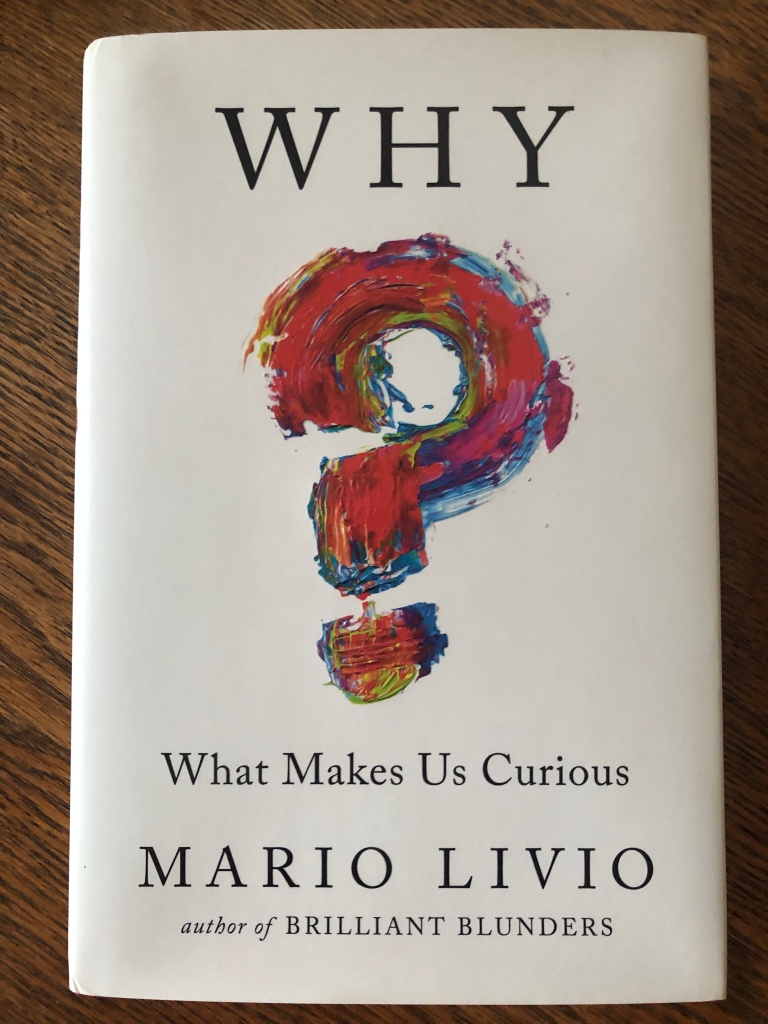
Astrophysicist Mario Livio has been curious enough about curiosity to write a book on it: “Why? What Makes Us Curious.” https://amzn.to/3Gm7jLW

“Other animals are curious,” he says, “but only humans are worried and curious about reasons and causes for things. Only humans really ask the question, ‘Why?’” https://www.pri.org/stories/2017-08-27/why-are-humans-so-curious

While survival provides an evolutionary purpose for curiosity, Livio points out, “One of the things that researchers still don’t have an answer to, is that we, as humans, seem to be much more curious than what is just necessary for survival.”

According to Livio, we have two basic types of curiosity that show up in two different parts of our brains during MRI scans. One type is “perceptual curiosity”—what we feel when something surprises or puzzles us. “It is felt as a sort of uneasiness, an unpleasant situation … like an itch you need to scratch…,” he says. Yes, that creepy feeling, the hair on the nape of your neck prickling, because something doesn’t feel quite right. https://knowledge.wharton.upenn.edu/article/makes-us-curious/

The interesting thing about murder is that we seem convinced that ultimately, the murderer will be found out. At least as early as the 14th century, in The Canterbury Tales, Geoffrey Chaucer (c. 1343-1400) knew readers were sure they could identify a murderer. “The Priest’s Tale” tells us, “Though it may skulk a year, or two, or three, Murder will out…”

In Hamlet (c.1602)King Claudius fears detection of his murder of Hamlet’s father. He confesses at prayer, “O, my offence is rank, it smells to heaven; it hath the primal eldest curse upon it, a brother’s murder.” Act III, Scene 4. Hamlet has already announced in a soliloquy, “For murder, though it have no tongue, will speak with most miraculous organ.” Hamlet, Act II Sc. 2. Hamlet intends to play detective, sure that he himself can detect the king’s guilt by watching the king’s reaction to the play he has the actors perform: “I’ll observe his looks…if he but blench, I know my course.” 

Literary agent Anne Tibbets says mystery readers insist on understanding what happened. We are outraged if the author dares hide or suppress clues: we want a fair shot at solving the murder. We evaluate each potential suspect; we note physical clues; we scrutinize alibis; we use our own human experience to test the strength of each suspect’s motives. But as readers, of course we depend on the protagonist asking the right questions for us, identifying the victim, interviewing witnesses, examining the crime scene, noticing every salient detail. Each murder mystery effectively presents us with a miniature history of a crime, and we must absorb, and dissect, that history in order to satisfy ourselves we know “what happened.” 

Because we’re curious. Or, as Alice observes in her visit to Wonderland, “Curiouser and curiouser.” Lewis Carroll dubbed Alice “this curious child” and indeed, following Alice down the rabbit hole, we too want to know what the golden key will open and what’s behind the little door.

Alice is an indefatigable questioner. For instance, quizzing the Mock Turtle about his school days, she asks, “What else had you to learn?”

“Well, there was Mystery,” the Mock Turtle replied…”Mystery, ancient and modern, with Seaography…”

Mystery, for history, ancient and modern. The Mock Turtle is spot on. So much of history remains a mystery: no matter how many questions we ask, no matter how skilled and diligent the historian, no matter how thick the tome or how voluminous the footnotes,  we never have all the documents, all the testimony, needed to understand everything that happened during, say, the great convulsions of history. Just think of the unknown moments buried during Reconstruction, or the Spanish Civil War, or the Russian Revolution, or…  

Like Alice, mystery readers are “curiouser and curiouser.” The joy of being a mystery reader, after experiencing the miniature history within a good murder mystery, we reach the conclusion we’ve awaited. For once, at least, our curiosity is satisfied. We know “what happened.”

Author Helen Currie Foster lives and writes north of Dripping Springs, Texas, supervised by three burros. She writes the Alice MacDonald Greer mysteries, set in the small town of Coffee Creek, Texas, somewhere west of Dripping Springs and east of Fredericksburg. In Book 7, Alice finds herself in a lethal battle over hidden art and the victim’s will. Available on Amazon and IngramSpark, and at BookPeople in Austin.

Find her online: http://helencurriefoster.com/ and

https://www.facebook.com/helencurriefoster/