“MARCH MADNESS”? In the Texas Hill Country, “March Madness” doesn’t only mean NCAA basketball. Its alternate form: Demented Spring Gardening. Too early, you say? Well, according to the snakes, spring’s already here.
Of course it’s not officially spring yet. Just three weeks ago, here north of Dripping Springs, Texas, the entire landscape—every tree, every leaf–was shrouded in solid ice. But this week, well before the equinox, beneath the oaks you’ll spot the amazing heartbreakingly beautiful fuchsia of the redbuds.
And roses! The tender yellow flowers of the Lady Banksia rose are cascading from the oak tree that serves as her trellis.
On other branches you can see the first luxurious pink buds of Souvenir de Malmaison, named for Empress Josephine’s rose garden, beginning to open.
In the garden the ineffably fragrant Zephirine Drouhin is performing her slow tease, loosening the green sepals, delicately unveiling her bright pink petals.
I’ve already planted two new and reputedly very fragrant roses––Madame Plantier, and Cramoisi Superieur. (What a name!) And I replanted Buff Beauty, which produces buff and yellow and apricot blooms. Still waiting for two more—Savannah and Sweet Mademoiselle, both promising strong fragrance. Seriously, a rose without fragrance? Isn’t it disappointing to lean forward into a rose, inhale…and…nothing? As Shakespeare points out in Sonnet 56:
The rose looks fair, but fairer we it deem
For that sweet odour which doth in it live.
But for sheer fragrant spring bravado, tinged with peril, what about the ridiculous grape Kool-Aid smell of Texas mountain laurel? Intoxicating and loopy. The plant—sophora secundifolia–– isn’t called “Texas mescal bean” for nothing. https://www.wildflower.org/plants/result.php?id_plant=sose3: “The brilliant red seeds contain the highly poisonous alkaloid cytisine (or sophorine) – this substance is related to nicotine and is widely cited as a narcotic and hallucinogen.”
“A Light exists in Spring” by Emily Dickinson was new to me. I treasure her recognition, her human diagnosis, of that first moment when we notice the magical presence of spring. It begins:
A Light exists in Spring
Not present on the Year
At any other period —
When March is scarcely here
A Color stands abroad
On Solitary Fields
That Science cannot overtake
But Human Nature feels.
More symptoms of March Madness? The powerful, even uncontrollable, urge to fill your cart full of geraniums, dirt, mulch, annuals, perennials, unknown roses, tomato plants, new trees… Trudging a quarter mile from the local native plants emporium to your car, lugging a red wagon full of blue sage, lantana, and other plants hopefully accurate in describing themselves as “deer-resistant”… Other symptoms include impassioned online review of rose varieties, frantic ripping open of seed packets and daily watering of small unlabeled pots, then staring at tiny emerging seedlings and wondering—what are you? Is that the fennel or the Aji Crystal Pepper or the Mexican plum?
I’d never heard of Mexican plum until a friend gave me a jar of her amazing Mexican plum jam. She described the trees as small, with fragrant white blossoms. So I ordered seeds. The very small print on the seed packet required “stratification” in the refrigerator. Well, I tried. Every morning I peer at the still-empty pots of dirt… little plants, where are you? Can you live in the Hill Country?
Also—perhaps prematurely—we dragged hay bales into the garden and embarked on the great Haybale Tomato experiment:
Supposedly, according to our favorite local well-driller, this approach produces for one local rancher “the most beautiful tomatoes in the Hill Country.” Our donkeys kept sticking their muzzles through the fence, trying to eat the bales. Watch this space. https://www.youtube.com/watch?v=z2jjIHgmypM
Gardens can be perilous. Think of Eden. But how many murder mysteries are set in gardens, or involve garden poisons? If you haven’t already become a fan of Reginald Hill, you might try Deadheads. Dalziel and Pascoe solve virtually every murder presented to them in their Yorkshire police headquarters. In this one, roses abound, beginning on the first page. And rose culture. And… murder. bit.ly/3Fgce23
Texas author Susan Wittig Albert knows her way around poisonous plants, in Texas or elsewhere. I just finished her Hemlock, Book 28 in her China Bayles series. This mystery—impressively researched, and fast-moving–takes the reader to the Blue Ridge mountains and theft of a rare botanical book, with deft historical backstory. https://susanalbert.com/hemlock-book-28/
For more on Texas mountain laurel, its power and peril – see Ghost Dog, Book 2 in my Alice MacDonald Greer Mystery series. bit.ly/3YIotv5
The weather report threatens another cold snap this week—even (gasp!) a possible freeze. But right now it’s 74 degrees. Geraniums to plant. Blue sage. Tomatoes to water. Yes, it’s hubris, exposing these tender plants so early to the vagaries of Hill Country weather, but—I can’t help it. I just saw a big bud on Star of the Republic! I swear it wasn’t there yesterday. March Madness reigns!
***
Find Helen Currie Foster on Facebook or at http://www.helencurriefoster.com. The eight books of the Alice MacDonald Greer Mystery series, including the most recent, Ghosted, amzn.to/3YrJBXf, are available at Austin’s BookPeople as well as on Amazon (Kindle and Paperback).
Believe it or not, the mystery novel is considered a “young” form of literature. Yep, that’s right. Mystery fiction didn’t exist before 19th century England. Many suggest two reasons why this was the case. First, the ability to read was now reaching “below” the upper class educated citizens. Farmers and factory workers and children were being taught to read. Secondly, back then, most towns relied instead on constables and night watchmen. No centralized police forces existed.
So what happened that caused the change in policing? The public’s morbid national obsession with murder.
Two cases in particular were instrumental in beginning this fixation on crime, according to Lucy Worsley, chief curator at the Historic Royal Palaces, the independent charity responsible for maintaining the Tower of London, Hampton Court Palace, Kensington Palace State Apartments, and more.
In her BBC four-part series, “A Very British Murder” (2013), Worsley suggests that the first murder, known as The Radcliffe Highway Murders, took place in 1811. Only a constable was available to the poor maid who realized something dreadful had happened when she returned to the home of her employers only to find the door locked, and a woman screaming inside. The newspapers hyped the crime, stirring the public into a frenzy.
Eventually John Williams was arrested and charged with the crimes. He committed suicide in his jail cell before the trial, though his trial was carried on without him. It was speculated that this was done to calm the public’s fear.
The second case, “The Red Barn Murder”, took place in 1826. Here a woman was found dead in a barn, apparently the victim of an elopement gone wrong. Again, the public fixated on the murder to the extent that a very macabre execution took place. On 11 August 1828, the convicted murderer, John Corder, was taken to the gallows and hanged shortly before noon in front of a large crowd. One newspaper claimed that there were 7,000 spectators, another as many as 20,000. But that wasn’t all. The body was taken back to the courtroom at Shire Hall, where it was slit open along the abdomen to expose the muscles. The crowds were allowed to file past until six o’clock, when the doors were shut. According to the Norwich and Bury Post, over 5,000 people lined up to see the body.
So now the British public was ripe to read anything that would feed their fascination with murder. All it needed was a writer to satiate their thirst.
Enter Edgar Allen Poe and his short story, “The Murders in the Rue Morgue” which was published in Graham’s Magazine in 1849. It has been described as the first modern detective story and featured the world’s first fictional detective, C. Auguste Dupin. Though Baltimore-born Poe was known in America for his literary critiques (several of which named Henry Wadsworth Longfellow a plagiarist), he was much more popular in Great Britain where he became well-known as an author.
(It should be noted that two books are also considered early mysteries but had little following due to their foreign languages. The first may have been Voltaire’s Zadig written in 1747, and Das Fraulein von Scuderi by E.T.A. Hoffmann in 1819.)
And the floodgates opened. Wilkie Collins’ novel The Woman in White was published in 1860. Arthur Conan Doyle published his first Sherlock Holmes mystery, A Study in Scarlet, in 1887. Doyle’s series is credited with being singularly responsible for the huge popularity of the mystery genre.
Mystery novels have gone far beyond the private detective motif. The genre now covers romantic suspense, noir, cozies, thrillers, traditional, etc.: even comic books, graphic novels and web-based detective series now carry on the mystery tradition.
I read mysteries, watch mystery movies, (probably have most of the Basil Rathbone Sherlock Holmes movies memorized line by line), and write mysteries. However, I had no idea I was entertained by such a “young” form of literature.
So, whodunnit next?
***
Note: Sources for this blog included Lucy Worsley’s BBC’s four-part series, A Very British Mystery, and the Biblio Blog “What Exactly is a Mystery Book”.
***
K.P. Gresham, Author
Professional Character Assassin
K.P. Gresham is the award-winning author of the Pastor Matt Hayden Mystery Series as well as several stand-alone novels. Active in Sisters in Crime and the Writers League of Texas, she has won Best Novel awards from the Bay Area Writers League as well as Mystery Writers of America.
This week out here on the creek I was iced in, with no power.
I was sitting by the fireplace wrapped in a blanket, when I came upon an unfamiliar word: HYPNOGAGIA. “Hypnagogia is the transition between wakefulness and sleep. During this state, it’s common to experience visual, audio, or other types of hallucinations. It’s also common to experience muscle jerks and sleep paralysis.” https://bit.ly/3YhrbZ6
Some people purposefully try to induce to hypnagogia to stimulate creativity. Id. According to Allison Eck, Harvard Gazette (Autumn 2022), hypnagogia is “widely thought of as a sweet spot for creativity.” https://hms.harvard.edu/magazine/sleep/behind-veil-hypnagogic-sleep. Eck describes the experience of scientist August Kekulé in the mid 1800’s during his search for the structure of the compound benzene, as he dozed before his fireplace in Ghent. “[A]s he dozed, images hinting at its structure appeared in his mind’s eye. He later wrote that he saw dancing atoms beaded together along an invisible string, ‘twisting in snake-like motion.’ The atoms morphed into an ouroboros” (another new word for me: a snake eating its own tail). Kekulé realized benzene’s structure was a ring of carbon atoms, each attached to a hydrogen atom.
Scientists and innovators like Einstein and Edison, and writers like Vladimir Nabokov, “have transited this cerebral pathway in search of solutions to problems.” Id.
On each occasion I’ve gone to bed with my mind on a plot problem, or a scene that needs to take shape. Preliminary requirements appear to include being ensconced under the covers, on my left side, envisioning a possible scene as I slide into sleep—then watching the scene begin to unfold. I try to remind my brain to remember this solution. While most dreams fly away with sunrise, these solutions have come back in the morning. If I could make this happen whenever I want (so far, no dice), a book would get finished so much faster!
This occasional experience may be “lucid dreaming,” the state of being aware that you’re dreaming. “When you wake up from a lucid dream, you actually have a more positive mood in the morning,” writes researcher Michelle Carr, Department of Psychiatry at the University of Rochester, in Aeon. https://aeon.co/essays/in-sleep-the-body-is-a-channel-to-communicate-with-the-dreaming-mind. Carr describes herself as a dream scientist: “I want to uncover ways to repair nightmares and, in their place, engineer dreams for healing.”
Hypnogagia is a big topic these days. A team of engineers and scientists at the MIT Media Lab developed a glove-like tool to help decipher dreams. Researchers are testing whether the glove may allow people to manipulate their hypnagogic experiences, which could help sufferers from PTSD and nightmare disorders feel a stronger sense of control. Again, as Eck puts it, “…[A]t the very least, drawing attention to our hypnagogic personas may bring us newfound ideas that we can act on when we wake.” Id.
Could we term it “lucid dreaming” when Scrooge is shown visions—then decides to change the dreadful outcomes by his future actions? He begs the Ghost of Christmas Yet to Come, “Assure me that I yet may change these shadows you have shown me, by an altered life?” He promises, “I will honour Christmas in my heart, and try to keep it all the year. I will live in the Past, the Present, and the Future…” Then Scrooge sees the phantom’s hood and dress collapse into his bedpost, scrambles out of bed, repeating that last sentence––and heads out to buy the prize Christmas turkey for the Cratchits.
Vladimir Nabokov kept a dream diary, and in his autobiography, Speak, Memory, wrote about the procession of what he called “hypnagogic mirages,” images he would see ‘just before falling asleep,” often accompanied by “a neutral, detached, anonymous voice which I catch…”
We mystery writers can mine hypnagogic moments for ideas on character and scenes––but the genre suggests a limit.
A good mystery offers the reader the chance to solve a puzzle. As set forth in the original rules of London’s Detection Club, “The detective must not light on any clues which are not instantly produced for the inspection of the reader.” Nor can the detective solve by “an unaccountable intuition.” https://murder-mayhem.com/the-detection-club-rules
Meeting of the Detection Club in 1936.
Indeed, is there anything more irritating to a mystery reader than the tardy mention of a clue? No! Mystery readers are entitled to all clues, as soon as that clue is found, and clues are facts. The mystery writer offers a collaboration to the reader, in which the detective and reader are on the same page—fact-wise. We readers want evidence. A character’s dreams may offer insight into a character—but not evidence.
Besides—while most of us are at least mildly interested in our own dreams, unless we’re also therapists we’re not usually too interested in the dreams of others. Do you remember your interest level the last time someone began describing a dream to you? I confess my eyes can begin to glaze. Of course it’s hard to convey dreams with the color and speed and power the dreamer experienced. But in the world of mysteries, we are greedy for facts. In Martin Walker’s “Bruno, Chief of Police” series, set in a small town in the French Dordogne, Bruno’s activities are fascinating––his cooking, his love life, his detection––and while we know he had a difficult military service in Bosnia, the author doesn’t dwell on Bruno’s dreams about those days. Instead he provides us with what we want: Bruno’s memories. Those contain facts, at least Bruno’s versions of facts, for which the reader is grateful. http://www.brunochiefofpolice.com/
So I’m cautious. In my Alice MacDonald Greer Mystery series, at least so far, Alice doesn’t share her dreams. For one thing, as observed in the New Yorker, “As for writing about them, even Henry James, who’s seldom accused of playing to the cheap seats, had a rule: ‘Tell a dream, lose a reader.’” Dan Piepenbring, “The Enthralling, Anxious World of Vladimir Nabokov’s Dreams” (February 8, 2018). https://www.newyorker.com/books/page-turner/what-vladimir-nabokov-saw-in-his-dreams
The ice has melted! And Ghosted is out! Book 8 in the series is available now in paperback and also on Kindle via pre-order delivery on February 10, on Amazon. Also coming soon to Austin’s BookPeople!
I live north of Dripping Springs, Texas, supervised by three burros. I’m deeply curious, more every day, about human history and prehistory and how, uninvited, the past keeps crashing the party. I’ve loved the Texas Hill Country since my first sight of it as a teenager. Artesian springs, Cretaceous fossils, rocky landscapes hiding bluegreen water in the valleys. After law school (where I grew fascinated with water and dirt) I practiced environmental law and regulatory litigation for thirty years––then the character Alice suddenly appeared in my life. I’m active with Austin Shakespeare and Heart of Texas Sisters in Crime. And I’m grateful to the readers who enjoy the Alice MacDonald Greer Mystery series!
[The blogger having been rendered incapable of typing with more than five fingers, she repeats a post that appeared on Austin Mystery Writers in 2015.]
*****
. . . it was like taking a vase and setting it down so hard it shatters . . . ~ Tracy Chevalier
When I taught secondary English, grading essays was my least favorite task. I was happy to read them, but assigning letter grades? I hated that.
I hated judging. I hated trying to determine the difference between a B and an A, or, worse, between a B-plus and an A-minus.
But the worst–the part that made me want to moan like Hamlet’s father’s ghost, “Oh, horrible, oh, horrible, most horrible!”—was listening to students who believed their work merited higher grades: “But I worked so harrrrrrrd.”
Some had watched classmates complete an entire assignment during a lull in history class and then score A’s. It wasn’t fair.
“Harrrrrrrrrrd” was my signal to say that No, it didn’t seem fair, but that good writing involves more than time sheets and sweat. It’s the words on the page that matter.
Now, to my dismay, I often find myself slipping into student mode. For example, when I submit a chapter to my critique group, or a beta reader, or even a family member, and they find fault, or don’t even mention my genius, I have to restrain myself from wailing, But I worked so harrrrrrrd…
Each time it happens, I repeat to myself the old lecture about time sheets and sweat. I add that whingeing is the hallmark of the amateur.
And I meditate upon Tracy Chevalier.
Chevalier wrote the critically acclaimed historical novel Girl with a Pearl Earring. Her next novel began as a draft written in third person, with small sections in first-person voices of children. The completed manuscript disappointed her.
When I reread the first draft, she says,I cried at the end. It was boring, dead weight, terrible. Then I looked it over and thought, there’s nothing wrong with the story except the way it’s told.
She found the solution in another contemporary novel:
I had the idea when, just as I was finishing the first draft in third person, I read Barbara Kingsolver’s The Poisonwood Bible, which uses five different voices beautifully. It’s a wonderful book, using multiple voices very successfully, and I thought, “Oh, that’s an interesting technique, I wonder if I should take the kids’ voices I’ve already written and have the three of them tell it.” It just felt right.
The revision was published as Falling Angels, an exquisite novel about a young wife and mother struggling to survive in the rigid, but rapidly changing, social structure of Edwardian England. The book is written in first person, from twelve perspectives, in twelve distinctive voices.
I came across Chevalier’s account when I was just beginning to write fiction and had become obsessed with the work. Writing an entire manuscript, setting it aside, starting all over—it had to be pure drudgery. I couldn’t imagine putting myself through that.
Later, though, I reread the article and a different passage caught my attention—Chevalier’s description of the rewrite:
I took the draft, and it was like taking a vase and setting it down so hard it shatters, then putting the pieces back together in a different way. I rewrote the whole thing in first person with all these different voices.
That passage doesn’t describe drudgery. Shattering a vase, putting the pieces back together to make something new—that’s a picture of creation, of the excitement and the pleasure and the beauty that accompany it.
I love Tracy Chevalier’s novels and admire her talent. But, on a more personal level, I’m grateful to her for sharing publicly how Falling Angels made its way into print—for reminding me that hard work isn’t synonymous with drudgery, for implying that it’s okay to cry over a bad draft and that perceived failure can turn into success, and for showing that the act of writing itself affords as much pleasure as the spirit is willing to embrace.
And—for tacitly suggesting that no one really needs to hear me whinge about how harrrrrrrrd I work.
It’s the words on the page that matter.
*****
Note: I really do love Chevalier’s novels. In fact, I love Falling Angels so much that during library duty one Saturday morning, I was so intent on finishing the book—just racing toward the climax—that I unlocked the front doors but left the lights in the reading room off, and spent the next ninety minutes parked behind the circulation desk, reading, and hoping no one would walk in and want something. I’m not proud of what I did. It was unprofessional. But patrons were understanding. And I finished the book.
Why do we mystery readers read the next line? Turn to the next page?
Some writers have the knack of persuading us–for example, Tony Hillerman. His mysteries feature Navajo police Joe Leaphorn, Jim Chee and Bernadette Manuelito. Never forget that Hillerman was a journalist before he wrote mysteries. I’m betting he excelled at attention-catching ledes that made you read his news articles. An early example of his getting us to turn to the next page occurs in The Dark Wind (1982), page 1:
“The Flute Clan boy was the first to see it. He stopped and stared. ‘Someone lost a boot,’ he said. Even from where he stood, at least fifteen yards farther down the trail, Albert Lomatewa could see that nobody had lost the boot. The boot had been placed, not dropped. It rested upright, squarely in the middle of the path, its pointed toe aimed toward them…”
Come on, you’ll turn the page, right?
For me, the same holds true for poetry. Untangling a new poem demands commitment. I confess the combination of the title and first lines can draw me right in. Masters of such trickery include Robert Frost and Billy Collins. Take for instance Frost’s “Mending Wall,” from North of Boston (1914): “Something there is that doesn’t love a wall…” Well, I want to know what. Or “After Apple Picking”: “My long two-pointed ladder’s sticking through a tree/ Toward heaven still…” I won’t leave that ladder quite yet.
Billy Collins simply uses a one-two punch: first his title, then the first lines, and you’re hooked. From Aimless Love (2013), titled “Hell”: “I have a feeling that it is much worse/ Than shopping for a mattress at a mall…”
When that combination–title plus opening lines–arouses my curiosity, it’s because I feel I’m experiencing along with the poet. Where’s the poet going? I’ll follow to find out (and Collins’s self-deprecating humor keeps me reading).
Okay, we’re curious animals. We’ve been asking “WHY?” at least since we were two. Theories abound. Is it because we’re responding to our outside world? Or is it innate–instinctual? Genetic? Do we get a dopamine rush from capturing new information? “Drive theory” calls curiosity a naturally-occurring urge we have to satisfy–a reason we read mysteries and work crossword puzzles. Alternatively, “incongruity theory” suggests we tend to see the world as orderly and predictable, but we become curious when an external event doesn’t fit our perceived order. Do mystery readers experience curiosity falling within each category? We want to find missing information (Clues!)–drive theory. And maybe we want a satisfying conclusion (justice served, the murderer punished, motives revealed) –incongruity theory.
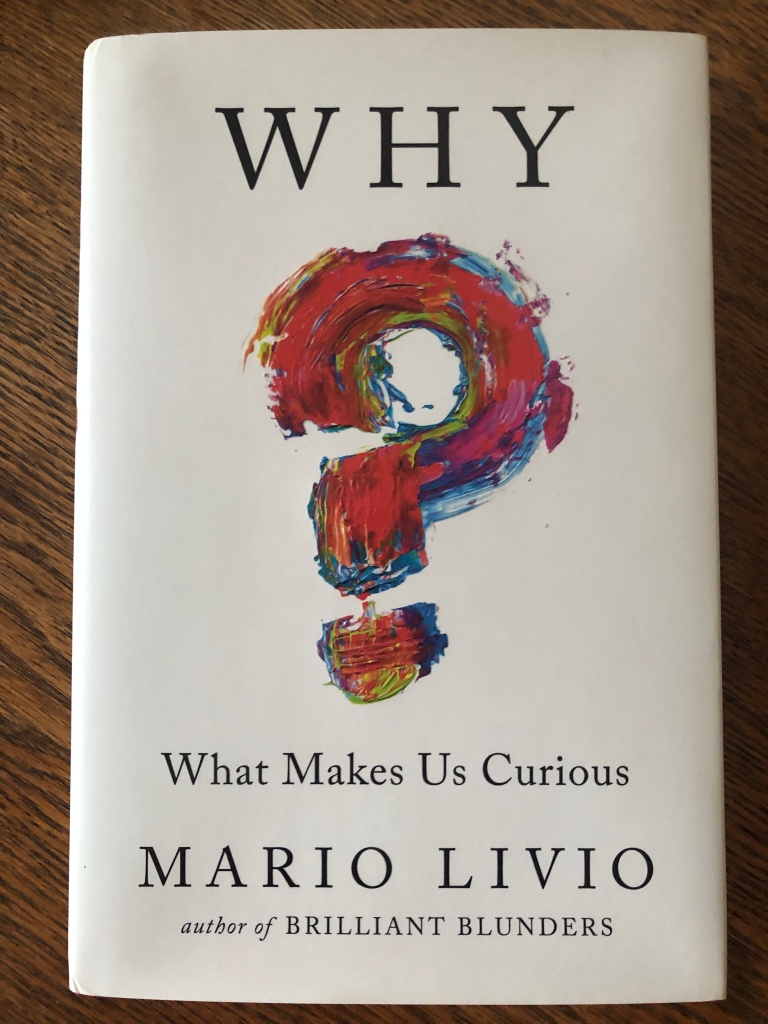
I suspect readers are like Leonardo da Vinci. Mario Livio asks, in Why: What Makes Us Curious (2017), what distinguished Leonardo from his predecessor anatomists, hydraulicists, botanists? “Leonardo had an unquenchable curiosity which he attempted to satisfy directly through his own observations rather than by relying on statements by figures of authority.”
Just like mystery readers. We insist on discovering each clue for ourselves. Woe betide the writer who cheats us–hides a clue, or packs the last chapter with explanations we had no chance to discover directly through our own observations. Not only cheatsy, but contrary to a key provision in the original Detection Club rules. https://murder-mayhem.com/the-detection-club-rules. A violation of our beloved genre!
We need for the sleuth to ask the right questions. An Austin detective recently gave an absolutely riveting presentation to our Heart of Texas Sisters in Crime chapter, describing how to conduct an interview of a potential suspect (not under arrest) who’s been asked to talk to the police. He said the interviewer needs to be likable–should give the suspect no reason to dislike him. The initial greeting should create a sense of reciprocity but also mention the sleuth’s authority. The detective begins the interview in a calm, low voice, giving the suspect autonomy and building rapport: “Is it okay if I call you Alec?” “Tell me a little bit about yourself.” He elicits the suspect’s story, then goes over it, watching for nonverbal indications of uncomfortable areas (the suspect changes posture, etc.). He watches for signs of deception–easy to detect if the suspect lies, harder to detect if the suspect fails to answer the question completely or directly, or restates the question to avoid having to answer the actual query, During the interview, the sleuth must keep a neutral face even if the suspect confesses something disgusting or shocking: “The second the suspect senses judgment on your part, they won’t talk to you.”
The mystery sleuth–professional or amateur–must recognize key questions. Take Anthony Horowitz’s Moonflower Murders–a follow-on to his Magpie Murders, featuring a contemporary murder mystery again wrapped around an earlier mystery involving the fictional detective Atticus Pund. Protagonist Susan Ryeland asks: why did the waiter at the posh club drop the plates? And why did her boss’s assistant quit her job at the publishing company? I’ll leave you to find out. Ryeland’s dogged pursuit of the answers to these key questions nearly gets her killed. But she solves the murder.
For an entirely different creative use of the question mark, with a twist: study (or just enjoy) Richard Osman. His often comic Thursday Murder Club mysteries revolve around a group of retirees in a comfortable retirement village. The club’s purpose? Solving cold cases. The disparate characters contribute varied personalities and talents–a Zen-focused psychiatrist (Ibrahim), a vivacious widowed nurse (Joyce), a burly ex-union organizer (Ron), and the mysterious former spy (Elizabeth.
Osman brings these characters to life not by a predictable prosy description, but by the questions they ask and answer. In the club meeting on page 1 of The Man Who Died Twice, Joyce asks, “Do you think a dog might be good company?…I thought I might either get a dog or join Instagram.” Ibrahim: “I would advise against it.” The day’s topic is murder; but with such a Q and A, we begin to grasp the nature of this somewhat wacky group. We’re allowed to read Joyce’s diary, in which she comes across as convivial, a bit ditsy, and quite shrewd.
Osman extends this technique to other characters. When drug dealer Connie introduces herself to Chris and Donna, police officers who hope to engage in a sting and arrest her, we get this:
“What’s your eye shadow?” Connie asks Donna.
“Pat McGrath, Gold Standard,” says Donna.
“It’s lush,” says Connie.
Connie’s a murderous drug dealer. But hey! She’s also into fashion. And Donna? Same.
Osman also uses those hanging questions as hooks. At the end of chapter 17, we’re eavesdropping on Joyce’s diary. The daily entry ends, “I wonder if anyone else is awake?” Now turn the page to chapter 18: “Ryan Baird is awake. He is currently playing Call of Duty online. He is spraying machine gun fire at full volume while his neighbors bang on the walls.”
You’ll be glad to know Ryan will get his, but the clever Q and A hooks us into the next chapter and expands Ryan’s character.
Osman’s Q and A also deepens the relationship between two unlikely friends, Joyce and Elizabeth:
“What do you and I talk about, Joyce?” asks Elizabeth.
Joyce thinks. “It’s been mainly murder, hasn’t it? Since we met?”
Thank you, Richard Osman. This is fun.
Just in case you’re wondering whether you (or your friends and relatives) ask enough questions, or ask the right or wrong questions, or have no clue how to keep a conversation going, or (heaven help us) don’t know how to ask questions of a group, here are 450 suggestions. Unfortunately, this collection didn’t include a list of “ideal questions for solving a murder.” https://www.scienceofpeople.com/questionos-to-ask-people
But, like Leonardo, we readers will discover those questions “directly through [our] own observations.”
My next book in the Alice MacDonald Greer Mystery series, Ghosted, will be out soon. Toward the end the protagonist, Alice, asks a key question. Watch for it! Happy Holidays!
Helen Currie Foster writes the Alice MacDonald Greer Mystery series, set in the Texas Hill Country. She lives north of Dripping Springs, loosely supervised by three burros. She’s active with Austin Shakespeare, Heart of Texas Sisters in Crime, and the Hays County Master Naturalists (still trying to learn those native grasses). Her most recent book, Ghost Daughter, was named Eric Hoffer Book Award Grand Prize Short List Finalist, as well as Finalist in the 2022 Next Generation Indie Book Awards, and Finalist in the 16th Annual National Indie Excellence Awards.
The ninth in Shames’ Samuel Craddock Mystery series,Murder at the Jubilee Rally focuses on conflicts residents of Jarrett Creek, Texas, experience when a motorcycle rally prepares to open outside of town—and the challenges Police Chief Samuel Craddock faces when murder follows.
Since you can read award-winning author Bruce DeSilva’s excellent review here, I won’t try to duplicate. Except to point out that—
DeSilva calls the Samuel Craddock series “genre-bending,” because the “author’s folksy prose and Jarrett Creek’s small-town ways . . . give the novel the feel of a cozy,” and yet the problems facing the town and Police Chief Craddock “give the novel the feel of a modern police procedural.”
With the term “genre-bending,” DeSilva hits upon one reason—perhaps the reason—for the series’ success. Shames joins elements of two very different genres—cozy mysteries and police procedurals—with skill and grace, into a seamless whole. That ain’t hay either.
As a reader, I enjoy Shames’ novels, but as a writer, I seethe with envy. If only I could do what she does . . .
Nevermind.
Now, for a broader view, I’ll turn from Shames’ ninth book to her first, A Killing at Cotton Hill, published in 2013.
At the bookstore, I fell in love with the cover. On page one, I fell in love with the book. Soon thereafter, I fell in love with a sentence. Here it is, underlined, in the paragraph quoted below—the words of narrator Samuel Craddock:
I head into the house for my hat and my cane and the keys to my truck. There’s not a thing wrong with me but a bum knee. Several months ago one of my heifers knocked me down accidentally and it spooked her so bad that she stepped on my leg. This happened in the pasture behind my house, where I keep twenty head of white-faced Herefords. It took me two hours to drag myself back to the house, and those damned cows hovered over me every inch of the way.
That’s what author Ernest Hemingway would callone true sentence. Cows are curious. They’re nosy. They like to observe. I’ve seen cows hover. That’s exactly the kind of thing my father might have said about his damn cows.
Shames gets it right. Every word in that sentence, and throughout the book, is pitch-perfect.
The night I read about the hovering cows, I wrote Shames a fan email telling her I loved the sentence.
But when I completed the novel and tried to write a review for my personal blog, I got tangled up in words. It came out sounding like this:
I love this book. It’s just so…There’s this wonderful sentence on the second page about hovering cows…That’s exactly what cows do…I can just see those cows…The person who wrote that sentence knows cows…It’s just so…I just love it.
That’s what happens when a reviewer lacks detachment. Wordsworth said poetry begins with emotion “recollected in tranquility.”So do book reviews. There’s nothing tranquil about that tangle of words.
So, with no review, I compromised. I posted the paragraph containing the beloved sentence and added a picture of white-faced Herefords.
Not long after, Shames spoke at the Heart of Texas (Austin) chapter of Sisters in Crime, and I told her how much I admired her work. A year later, in 2014, I heard her read from her second novel, The Last Death of Jack Harbin. And I’ve read all the books she’s published since.
From 2013 to 2022, that’s nine Samuel Craddock mysteries, each a great read, each just as good as—or better than—the one before.
But regarding Shames’ sentences—
It is a truth universally acknowledged that her hovering cows will always be Number One.
_____
Notes
*Shames breaks the silly rule against “mixing” present and past tenses in narration. Samuel Craddock speaks the language spoken by men like him in real Jarrett Creeks all over Texas.
**The cow sentence isn’t really about cows. It’s about Samuel Craddock. But I am fond of white-faced Herefords, and the image Shames paints of them is so vivid that it obscures the man dragging himself toward his house. For me, at least.
***I took the photo of the cover of A Killing at Cotton Hill. The fur on the right side of the book doesn’t belong there, but it was easier to just take the picture than to move the cat.
Kathy Waller has published short crime fiction as well as a novella co-written with Manning Wolfe. For more info, and/or to read her posts on topics ranging from A to izzard, visit her personal blog, Telling the Truth, Mainly (http://kathywaller1.com). She also cross-posts her Ink-Stained Wretches posts at Austin Mystery Writers.
My mother used to tell me I should become a lawyer. “You’re analytical,” she said.
I think she meant I was argumentative, but that’s a different story.
I would like to be analytical in the way lawyers are, but I’m not. And I don’t think on my feet. If I were practicing criminal defense, my clients would be halfway to prison before I realized I should have said, “Objection!”
Nonetheless, though not a lawyer type, I decided back in Aught Three that I might make a fair-to-middlin’ paralegal after I retired from library work. So I registered for an eleven-month course in paralegal studies. And found myself back in the world of Saturday classes and papers and exams and quizzes and perpetual studying.
And perpetual remembering. Cases, statutes, ordinances. Codes, Codes, Codes. I’d been out of school for twelve years. I wasn’t accustomed to stuffing my head with–stuff–and spilling it back onto exams.
I’ve read that if you know 80% of the course material, you’ll be able to pass the tests. That may work for other students.
But I believe–I’m sure–that if I know 80% of the material, the exams will cover the other 20%. Consequently, the only thing to do is learn 100%.
And it’s such dry material. Drier than the Dewey Decimal System. No surprise, of course, but I longed for literature, novels just crying out to be torn apart, rummaged through, distilled to their very essence . . .
My memory needed story.
So, preparing for the probate exam, I wrote one–in the form of a mnemonic. It explained intestate succession–who gets what when a Texan dies without leaving a valid will–as laid out by the Texas Probate Code in force as of November 2003. One of our instructors had warned the class that students usually considered probate the most difficult section of the course.
Composing the memory aid took the better part of an afternoon. It required that I not only observe restrictions imposed by rime and meter, but that I strictly adhere to the provisions of the Code. There was no wiggle room. It had to be correct.
At the end of the day, I was pleased. Aside from a couple of rhythmic aberrations, all the lines scanned, the rime scheme was satisfactory, and the targeted provisions of the Code were covered.
It was a pretty good song.
As a mnemonic, however, it lacked a lot. It was long and complicated. I could have completed an entire exam in the time it took me to sing (silently) down to the second chorus.
It was easier to just learn the Code.
Still, I was proud of my effort, so I posted the little flash of creativity on the class’s online bulletin board. My old biology classmates would have read it and applauded. My paralegal classmates looked at me funny.
Well, an instructor had also told us that paralegals aren’t supposed to display a sense of humor.
But funny looks don’t bother me. I spent years in education. I’m used to them.
At the risk of getting several more, I present a bit of law in verse.
DISCLAIMER
The content of the following composition was accurate as of November 1, 2003. The song does not reflect changes in the law since that date. Neither does it represent a legal opinion, nor is it intended to offer counsel or advice. Its appearance on this blog does not constitute practicing law without a license.
In other words, the Texas Probate Code was swallowed up by the Estates Code, and “John Brown’s Intestacy” is no longer accurate. The author doesn’t intend to make it accurate. And she is still not attempting to practice law without a license.
********************
JOHN BROWN’S INTESTACY
By Kathy Waller
(To be sung to the tune of John Brown’s Body,
aka The Battle Hymn of the Republic).
I.
John Brown died and went to heaven but forgot to make a will.
His intestate succession now the Probate Code will tell.
Was he married, was he single, do his kids sit ‘round the ingle?
Had he common prop. or sep.?
Glory, glory, Texas Probate!
Separate property Section 38!
Common property Section 45!
Make a will while you’re alive!
II.
If John’s married and he leaves a wife, no kids, or kids they share,
Then 45(a)1 leaves wife all common prop. that’s there.
But if he has an extra kid, wife ends up with just half
And the kids share all the rest.
Glory, glory 45(b)!
Don’t omit Section 43!
By the cap or by the stirpes,
Wife shares it with the kids!
III.
For separate prop., if he’s no wife, it goes to kids or grands.
If none of those, John’s parents halve the personal and lands.
If only mom or pop lives, the surviving one takes half.
John’s siblings share the rest.
Glory! Both John’s folks are deceased–
All his sibs will share the increase,
And if no siblings, 38(a)4 means
They’ll need a family tree.
IV.
If John has separate prop. and leaves a wife and kids or grands,
38(b)1 gives wife one-third of personal prop. at hand,
And a one-third interest just for life in houses and in lands.
Descendants take the rest.
Glory, glory 38(b)1!
It’s one-third/two-thirds division!
But if John leaves a wife but no kids,
Section 38(b)2 applies!
V. – VII.
John’s wife gets all his personal prop. and half the real estate.
The other half of real estate goes back to 38—
38(a), to be exact, and up the family tree,
Unless his gene pool’s defunct.
For if John Brown was an only child with parents absentee,
No brothers, sisters, uncles, aunts, or cousins on the tree,
No grandparents or great-grandparents to grab a moiety,
His wife will get it all.
BUT if John Brown leaves this life with naught a soul to say, “Amen,”
The Probate Code’s escheat will neatly tie up all the ends:
The Lone Star State will step right up to be John’s kith and kin,
And Texas takes it all!
Glory, glory Texas Probate!
Slicing up poor John Brown’s estate!
Avoid the Legislature’s dictate:
Make a will while you’re alive!
Kathy Waller blogs at Telling the Truth, Mainly. Her short stories appear in several anthologies and online. She lives in Austin with one cream tabby and one husband. She’s still working on that mystery novel.
She did work as a paralegal for 2.5 years. She found the work interesting and loved the job (mostly). When she resigned, her attorney said, “I think you’re quitting because you need to do something more creative. So much of the law is just drudgery.” She agreed with him.
Still on the research kick, I’m in the process of learning all about moonshine. No, not how to drink it. How to make it. While plotting out my next book, Death Takes the Fifth, I realized moonshine (and by extension, moonshiners) would play an integral role in the story. Let’s be clear—making moonshine is a against the law in 48 states unless you’ve got a distributor’s license, so DO NOT make this stuff. And, for the record, the moonshiners in my book get in a lot of trouble for what they’re doing.
I got the idea from watching the TV show, “Moonshiners”, on Discovery TV. Yep, I’ve followed the cast through quite a few of their antics, whether it be finding a still site, constructing a still, what kind of water makes the best hooch, recipes for anything from whiskey to gin to absinthe, and how to escape the law (well, moonshiners try, anyway). I even bought a jar of (legal) moonshine marketed at a nearby liquor store to see how it tastes. I’m pretty sure the storebought version is lower in alcohol content and therefore has less of a bite than the real stuff, but I still saw a few fumes behind my eyeballs.
After recovering from that bit of research, I started jotting down some of the facts I needed to make sure the moonshiners were correctly depicted in my book.
The most important ingredient in moonshine is the water. From what I understand, spring water loaded with limestone makes the best liquor. We have a lot of limestone in Texas. Heck, the exterior of my house is limestone. And there are plenty of springs around Austin for this to be a viable process. Once you have your water, it’s time to make the mash.
Oh. The mash. That’s the combination of grains (corn or barley or wheat, etc.), sugar (which brings up the alcohol level–can be anything from refined sugar to sugar beets), water, and aromatics (can be fruit or spices or herbs depending on what type of moonshine you want to make) and yeast. For example, if you want to make a gin moonshine, you must have juniper berries–which can taste pretty strong. The moonshiner might counter that with ingredients like cardamon pods, peppercorns, anise, lemon/orange peels, cinnamon—you get the drift. The mash is then sealed in a big tub (whiskey-aged barrels give it a real nice quality, I understand) and allowed to sit for seven to ten days for all of it to ferment.
By now, it’s time to find the location where you’re actually going to make the moonshine. Near a limestone spring is optimal. It’s also important that the site be away from hikers, hunters, and passers-by. You do not want anyone stumbling on to your still site and either stealing your stuff or calling the police. Again, it is ILLEGAL to make moonshine without the proper permits. Also, moonshiners like to find a spot where they can make a quick get-away if the revenuers come a-calling.
While the mash is doing its chemical thing, its time to construct the still. The folks on The “Moonshiners” tend to favor copper stills, but I’ve seen them make it out of empty beer kegs, old barrels, etc. I’ve inserted a diagram below describing the design of a rather simplistic still. Everything is welded together.
The mechanism on the far left is where the now fermented mash is poured and heated (to somewhere starting at 170 degrees Fahrenheit.) The steam put off by the mash is the alcohol. The steam goes through the cap arm into the thumper keg where it mixes with cold water, thus increasing the alcohol level. After going through the thumper, the now liquid alcohol goes into the warm box and spirals down to the spout. When the liquor’s ready, it comes out the tap or spout. To make sure the liquor doesn’t go everywhere, the moonshiner puts a (pardon the language) coon dick in the spout so the liquor pours straight into whatever container you’re putting the moonshine in. I’ve seen The Moonshiners use gallon glass jugs, plastic milk jugs, mason jars, etc.
About the coon dick. Yes, it really is a raccoon’s…umm…tally whacker. And yes, the aforementioned tally whacker on a raccoon has a bone in it that is perfect for keeping a steady stream of moonshine heading right into the waiting container. (I’m not making this stuff up.)
Now it’s time to see if the moonshine is any good. First off, the moonshine product should be clear. Next, the moonshiner usually uses a mason jar to test the alcohol level of the product. They fill the jar halfway, put the lid on tight, turn it on its side and shake the jar. The bubbles will tell the story. If the bubbles are large and pop pretty quickly, the alcohol level in the jar is high. If the bubbles are small and stay around a while, the alcohol level is low. And, of course, there’s the taste test.
I’ve had a blast learning about all of this, but then again, I love to do research. Between the TV show and the internet, I hope I’ve created some plot twists and characters that you will enjoy as much as I do.
Moonshine is Mighty Fine and ILLEGAL!" data-content="https://austinmysterywriters.com/2022/09/05/moonshine-is-mighty-fine-and-illegal/" title="Share on Tumblr"data-posttype="link">Share on Tumblr
The world has been a crazy place since the emergence of Covid-19. Although it’s still out there, I’ve begun to venture forth into the world and attend author events. It feels wonderful to get back into the world of books and speaking with other writers! I think the last event I went to was the Bullet Books event in February of 2020 at the Bosslight Bookstore in Nacogdoches. (Fellow AMW writers Kathy Waller, Helen Currie Foster, and Laura Oles are also Bullet Books authors.)
The whole crewScott Montgomery and Joe LansdaleSwapping liesThe first batch
My first foray back into the public realm was a Noir At The Bar event in Dallas back in June. Of course, it was outside and still blazing hot even though it started at 7. But I had such a great time listening to the other authors that it was worth it! Not a dud in the bunch. We laughed at some stories and were creeped out by others. I read a short piece that I wrote a few years ago, Tutusuana. (“Tutusuana” is a Comanche word that’s explained in the story.) It was nice to see old friends and finally meet online friends in person. Loved the experience. I highly recommend The Wild Detectives bookstore/bar. This is a jewel in the Bishop Arts district in Dallas.
Mike McCraryEryk PruittWilliam Dylan PowellHarry HunsickerJim NesbittKathleen KentKasey LansdaleKevin R. TippleKeith LansdaleWho is this scary, short lady? Me!Scott MontgomeryJoe LansdaleTran Quỳnh Thị Vũ and Patrick Noel Batalla PombuenaOrganizer of event, Johnny WesnerPoster I designed
Now we travel to Book People. Yesterday, August 21, I went to my first Book People event since pre-Covid. Mark Pryor has a new book Die Around Sundown. This is the first book in a new series so of course I had to be there to cheer him on! I’m excited to read this book. It’s an historical mystery set in Nazi-occupied France. I enjoyed the book talk and, again, seeing friends in person that I haven’t seen in a while.
New books!Scott Montgomery introducing Mark Pryor
This Wednesday I plan to go to an author event at my local library. I haven’t met Michael Miller but since I live in a small town, I want to attend events and provide support. He’s a long-time university professor, presently at Texas State. And he is also a Presbyterian minister, serving La Iglesia Presbiteriana Mexicana for the last ten years in San Marcos. His book is The Two Deaths of Father Romero: A Novel of the Borderlands. Sounds interesting!
Then the next day I’ll be back at Book People, if the roads aren’t flooded. (We’ve been in a severe drought this summer, as much of the world has been too. I’m looking forward to the rain, but I hope it’s a slow, soaking rain and not a deluge.)
It’s going to be epic. Two of the authors are NYT best selling authors. All of the panelists are Texas mystery authors with stories set in Texas. You know I’m gonna love that. https://www.bookpeople.com/event/mystery-author-panel
Note: AMW member Helen Currie Foster will be on the panel too.
What a busy week! Looks like I have a lot of reading in my future. A few more books to add to my TBR (To Be Read) pile. My shelves are sagging. I better get busy, or build more shelves!
Our family’s favorite mystery quote (bolded below) appears in Strong Poison, by Dorothy Sayers, where detective Lord Peter Wimsey first meets novelist Harriet Vane. Vane’s on trial for murder, accused of systematically poisoning her former lover with arsenic.
Wimsey suspects the lover’s uncle, Norman Urquhart, but the uncle assures the police that he served a blameless dinner to his nephew. Wimsey sends the all-competent Bunter (his manservant and WWI batman), to winkle out secrets from Urquhart’s cook, Mrs. Pettican, and the housemaid.
Bunter ingratiates himself by means of crumpets:
“At half-past four…he was seated in the kitchen of Mr. Urquhart’s house, toasting crumpets. He had been trained to a great pitch of dexterity in the preparation of crumpets, and if he was somewhat lavish in the matter of butter, that hurt nobody except Mr. Urquhart. It was natural that the conversation should turn to the subject of murder. Nothing goes so well with a hot fire and buttered crumpets as a wet day without and a good dose of comfortable horrors within. The heavier the lashing of the rain and the ghastlier the details, the better the flavour seems to be.”
What a setting! I’ve never tasted a crumpet, but can feel the heat of the fire and inhale the smells of toasting and melting butter. And in contrast to (or fueled by) this warmth, this delicious comfort, the cook reminds us of the victim’s death: “A dreadful wicked woman she must ‘a’ been,” said Mrs. Pettican, “—‘ev another crumpet, do, Mr. Bunter—a-torturin’ of the poor soul that long-winded way. Bashin’ on the ‘ed or the ‘asty use of a carvin’ knife when roused I can understand, but the ‘orrors of slow poisonin’ is the work of a fiend in ‘uman form, in my opinion.”
So in our kitchen at buttery moments some family member will mutter, “If he was somewhat lavish in the matter of butter…” But this week I wondered, “What are crumpets?” I mean, with Bunter toasting them over a (presumably coal) fire, then lavishing butter on them, they sound wonderful, especially for teatime in a firelit kitchen, on a cold wet afternoon, discussing the horrors of slow poisoning.
Compelled by curiosity I found a recipe. https://www.daringgourmet.com/traditional-english-crumpets/ Huh. I’d imagined English muffins. No. Instead, the goal is a tender disc, yeasty but also leavened with baking soda, creating bubbled holes to absorb melted butter, jam, and other decorations. Problem: locating crumpet rings. Yes, I’ve ordered some.
Sayers wasn’t writing a culinary cozy, despite the crumpets and an intense discussion on the following page between Mrs. Pettican and Bunter about casseroled chicken. A scene beginning with toasting crumpets produces a triumph of setting and character, a comic but dread-inspiring description of the victim’s death, and clever clue placement. Sayers does not describe either the smell of the toasting, or the taste of the crumpets, but surely you, dear reader, imagined those? Didn’t you feel yourself right there in the kitchen, with the rainy day outside, the gossipy discussion of the lover’s death agonies, and a vivid depiction of Bunter’s character? Courteous, yet firm, he deftly extracts critical information not reflected in the police report—and yes, a clue you doubtless spotted. Maybe Vane will escape the hangman’s noose after all.
As Proust famously pointed out, smells can stimulate memories. https://www.penguin.co.uk/articles/2020/07/more-than-cake-unravelling-the-mysteries-of-proust-s-madeleine Smells can also trigger emotional reactions: “Your olfactory bulb runs from your nose to the base of your brain and has direct connections to your amygdala (the area of the brain responsible for processing emotion) and to your hippocampus (an area linked to memory and cognition). Neuroscientists have suggested that this close physical connection between the regions of the brain linked to memory, emotion, and our sense of smell may explain why our brain learns to associate smells with certain emotional memories.” https://www.scientificamerican.com/article/why-do-smells-trigger-memories1/
Despite the strong impact of smells on humans, writers’ references to smell often seem sparse. Part of the problem is the sheer difficulty of describing certain smells. Imagine trying to describe the smell of a beloved house. It’s a mysterious mix, isn’t it? If I try to describe my mother’s house, I can’t do it with just one word. Part of the remembered smell is a faint perfume—maybe a bath powder she used, like Caswell Massey’s Gardenia. But there are other ingredients as well—contributions from oak furniture, cotton sheets, old Christmas cards on a closet shelf… See, I can’t accurately describe the smell itself; I have to name things.
My grandmother’s house in Hill County delivered a similar mixture, varying by seasons. In summer, it smelled of cantaloupe from her garden; at Christmas, of a decorated cedar tree. But always the substrate included a hard-to-describe mixture of our grandfather’s Yardley English Lavender talc, kept on the kitchen shelf where he shaved; of the garbage chute in the kitchen; of oil and electric discharges from his ham radio rig; of the ancient living room piano (wires, wood, felt). How describe the totality of that smell, that amalgam of odors, so instantly recognizable to me, but unknown to you? And how describe it without a bunch of nouns?
Poets apparently run into that problem. I set out to locate poems incorporating odor and fragrance, grabbing poetry volumes from the shelves. Yeats? Gorgeous references to sight and sound, as in “The Lake Isle of Innisfree”: “Nine bean-rows will I have there, a hive for the honeybee, /And live alone in the bee-loud glade…” The poem is rich in sight, in sound, but not smell. We don’t smell the clay and wattles or honey.
Same for Wendell Berry’s A Small Porch—a volume of ideas, images, light and air. But I didn’t find smell. Nor did I find smell references in Chaucer or a number of Renaissance English poets, except that Michael Drayton gives us a wonderful line in “To the Virginian Voyage” referring to the much-anticipated Virginia landfall of seaborne English explorers: “When as the luscious smell/of that delicious land…” Of course Shakespeare mentions the “sweet odour” of roses (as in Sonnet 54): “Of their sweet deaths are sweetest odours made.”
Indeed, I had trouble finding references to smell in most of the poetry books I opened. There were some. In “Aimless Love,” “gazing down affectionately at the soap,” Billy Collins writes, “I could feel myself falling again/as I felt its turning in my wet hands/and caught the scent of lavender and stone.”
Marianne Moore, in “Enough,” from O To Be a Dragon, gives us this: “The crested moss-rose casts a spell; its bud of solid green, as well, /and the Old Pink Moss—with fragrant wings/ imparting balsam scent that clings…” Many readers will recognize balsam. Another from Moore’s “In the Public Garden”: “O yes, and snowdrops in the snow that smell like violets.”
Also readers may know the smell of violets. Charles Wright, in “Dog Creek Mainline,” gives more challenging references: “Dog Creek: cat track and bird splay,/Spindrift and windfall; woodrot; Odor of muscadine…” If you’ve played around wild grapevine you know the odor of muscadine––maybe woodrot too.
Try the experiment yourself. Pull some poetry off the shelf. Don’t most poems rely on sight and sound, and rarely odor? Because a particular smell can be very hard to describe.
“The way the brain deals with smells is very different to how it deals with other senses, such as seeing and hearing. For example, we can identify the different instruments playing in a band, or the different shapes and colours in a painting. But it is very hard for us to tell the individual parts of a smell mixture.” He goes on: “We can sense the smell of “orange” or “coffee” as a single thing, but have trouble identifying the many different parts that make up those smells individually. However, it is possible to get better at this with practice. Professional wine-tasters or perfume-makers can detect more parts of a smell mixture than most people.”
Our difficulty in describing smell is not that we humans can’t detect odors—we can, says Greg Miller, Science (November 11, 2014): “We humans have about 400 different types of receptors for detecting odorant molecules. That’s on the low end for mammals, but it’s enough, at least in theory, to allow us to distinguish a trillion different odors, one team of neuroscientists calculated earlier this year (although there’s been some controversy about that estimate).”
But, per Miller, we describe odors differently from sights and sounds: “When people—English speaking people, anyway—describe odors, what they are actually doing much of the time is describing the source of the odor. Orange-y. Smokey-. Skunk-y. This seems natural enough, but it’s fundamentally different from how we describe other sensory experiences. Words like “white” and “round” describe visual features of an object, not the object itself. It could be a baseball, or it could be the Moon. In the same way, a tone can be “high-pitched” whether it comes from a bird or a teakettle.” https://bit.ly/3JFFobV
Some studies suggest that our language is inadequate to the task of describing smell. Another suggestion is that other languages than English may be better at conveying odor.
But determined mystery writers find a way, because odor can make important contributions to a setting. In 1937, in Rex Stout’s fourth Nero Wolfe mystery, The Red Box, the detective lectures his cook, Fritz Brenner: “Do you know shish kebab? I have had it in Turkey. Marinate thin slices of tender lamb for several hours in red wine and spices. Here, I’ll put it down: thyme, mace, peppercorns, garlic…” https://amzn.to/3PahvKz
Can’t you smell those spices? And doesn’t that passage help round out (pun) our vision of Nero Wolfe, gourmet, gourmand, brilliant detective? We’re planted in the kitchen of Wolfe’s New York brownstone, the primary setting for all the mysteries. These few lines convey Wolfe’s insistence on sophisticated cuisine, and reflect the rigor he demands of every employee under his roof, including Fritz the cook; Theodore Horstmann, the keeper of his orchid greenhouse; and our narrator, his foot soldier, Archie Goodwin. A shish kebab recipe helps define the setting and Wolfe’s character as well.
Ngaio Marsh begins Night at the Vulcan (1951) with Martyn Tarne, a young New Zealand actress desperately seeking an acting role in London. One night, out of food and money, with no place to stay, she enters the Vulcan Theatre which has advertised for a dresser: “She was at the back of the stalls, standing on thick carpet at the top of the ramp facing the centre aisle…The deadened air smelt of naphthalene and plush.” The empty theatre lacks an eager audience, waiting for the curtain to go up. Instead Marsh gives us the “deadened air” of a closed theatre, where the plush seats are empty, and the air smells of naphthalene—chemical dry cleaning. Martyn starts to work: “As soon as she crossed the threshold of the star dressing-room she smelt greasepaint. The dressing-shelf was bare, the room untenanted, but the smell of cosmetics mingled with the faint reek of gas.” I don’t know the smell of greasepaint, but Martyn does; she’s in a setting she understands.
Mick Herron’s unputdownable Slough House series uses odor to create the key setting––the decrepit building which serves as center stage. Book 2, Dead Lions, describes entry to the building as follows: “No one enters Slough House by the front door; instead, via a shabby alleyway, its inmates let themselves into a grubby yard with mildewed walls….” Yecch, mildew. The building houses the “slow horses” who flunked out of MI-5’s headquarters in posh Regent’s Park, and are now under the tutelage of former Cold Warrior Jackson Lamb, a terrifying mentor. “Jackson Lamb’s lair,” the office on the building’s top floor, is described thus: “The air is heavy with a dog’s olfactory daydream: takeaway food, illicit cigarettes, day-old farts and stale beer, but there will be no time to catalogue this because Jackson Lamb can move surprisingly swiftly for a man of his bulk….” No question that odor is part of the setting. Lamb is an olfactory terrorist. https://amzn.to/3ppQsAJ
The century-old Beer Barn, a beloved road house in Coffee Creek, is where townspeople gather in my Ghost series. That includes lawyer and protagonist Alice Greer. Naturally the smell of beer is key. In Book 3, Ghost Letter, Alice invites a political reporter to the Beer Barn for lunch: “As they pushed through the Beer Barn’s tall swinging doors the fragrant haze enveloped them—incense compounded of hickory smoke from the wood-fired grill, chiles toasted on an iron comal, and thousands of bubbles popping in bottles and glasses, releasing the yeasty magic of beer to the air.”
Smells may be hard to define, but including the smell of a setting can enrich a mystery’s impact. Or, as Mrs. Pettican says, “Have another crumpet, do!”
Helen Currie Foster lives and writes north of Dripping Springs, Texas, loosely supervised by three burros jostling for roles in the Alice MacDonald Greer Mystery series, set in the unique landscape of the Texas Hill Country. So far all three burros have made an appearance, though insisting on aliases. Book 8 is on its way…




 Austin Mystery Writers