WHAT WOULD YOU TAKE WITH YOU?

By Helen Currie Foster

Those of you out here in the Hill Country know that when drought turns the landscape to a flammable crisp, we’re often warned to prepare to leave home fast—meaning, decide what precious items we can’t live without, and pack those items in a box or laundry tub, ready to grab at a moment’s notice.

The Bastrop fire erupted east of Austin on September, 4, 2011, wasn’t distinguished for 55 days, and destroyed 1600 homes while burning over 32,000 acres.

From Dripping Springs we could see smoke plumes from Bastrop. I began filling a laundry basket. Which pictures? Old ones—ancestors. Old handsewn quilts. And also—a very few books.

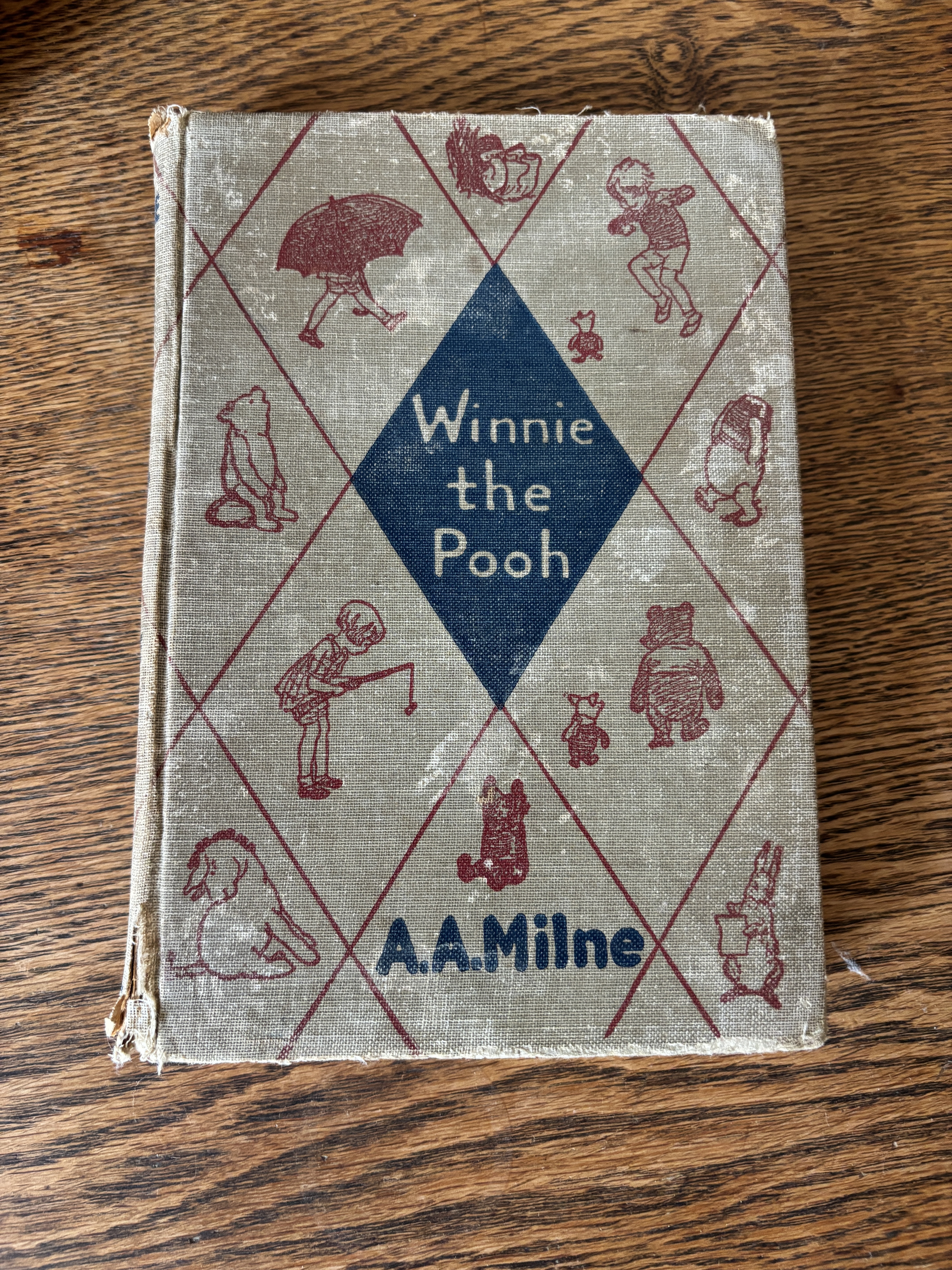
The original family copy of Winnie the Pooh (1949); a tattered paperback (1972!) of Tolkien’s The Fellowship of the Ring; some slim volumes of poetry. Then I realized we needed documents: passports! Birth certificates! Wills! Deeds!
With smoke rising in the east, I worried about overfilling the laundry basket, or omitting something key. I stared around the kitchen. Most kitchen utensils could be replaced, but not the following—so they went in the basket:

*An ancient cast iron frying pan, well-seasoned, the perfect size. Maybe the same variety that settlers carried west. Indestructible, and a good weapon in time of need.

*My grandmother’s ancient aluminum cake pan, nearly a century old. The top fits perfectly on the bottom and the bottom turns up around the edges of the top, so a cake can ride comfortably on a car floorboard.

When disaster threatens, we make choices. Our decisions––what we treasure enough to carry along––are so personal, so unique. Would you grab your fanciest clothes? Or your favorite jeans, perfectly broken in? Maybe an “old blue shirt that suits me just fine,” as Guy Clark sang in his “Stuff That Works”? https://genius.com/Guy-clark-stuff-that-works-lyrics 

His distinctive voice, relaxed, restful, singing this great song, calls to mind the memory of that “old blue shirt” (long-sleeved, pale blue, washed a million times) he wore at concerts.

 But in an emergency, what about your writing?

Writers can avoid the tragedy that befell Ernest Hemingway in 1922 when his first wife, Hadley Richardson, carefully packed his early writings in a small trunk to deliver to him in Switzerland. That trunk was stolen from the train at the Gare de Lyon and never seen again. Hadley had also included the carbons, perhaps anticipating her husband would be able to present an original to a publisher and still keep a copy. She reportedly wept for years. https://lostmanuscripts.com/2010/07/31/hemingways-lost-suitcase/

Today, in contrast, confronted by fire or other threat of loss, writers have options to protect that great human accomplishment—writing.

According to linguist Dr. Ingrid Piller, writing was invented independently at least three times:   Sumerian cuneiform in Mesopotamia (ca. 3400 BCE), Chinese characters in China (ca. 1200 BCE) and Mayan glyphs in Mesoamerica (ca. 300 BCE). Of these, only the Chinese script is an unbroken living tradition.

But during this long history of writing, we’ve lost a heartbreaking trove of manuscripts, many by writers we wish we could have met. https://en.wikipedia.org/wiki/List_of_lost_literary_works

Sappho? (630-570 BC) Her lyric poetry, made to be sung with music, was so accomplished she was called in her time “The Tenth Muse.” But beyond fragments, we have only her Ode to Aphrodite.

Ctesibus? I’d never heard of (much less tried to pronounce the name of) this Greek inventor, a barber’s son born in Alexandria in 300 BC. He wrote on pneumatics, and invented the water organ and an improved water clock (which became our most accurate clock until Huygens invented the pendulum clock in 1656). But Ctesibus’s Memorabilia? Gone.

Aeschylus (525-455 BC) wrote 90 or so plays—only six survive. Promethus the Fire-Bringer? Lost. Sophocles (497-406 BC) wrote close to 120 plays of which only seven (Oedipus, Antigone) survive in complete form—even though Sophocles competed over 50 years in the Athens dramatic competitions (and won 24 of 30!).

Euripides (480-406 BC) wrote over 90 plays; only 18 survive complete.

Sometimes the powerful have ordered destruction. Only four Mayan codices survive: most were burned by Spanish priests in the 16th century. Many Inca Quipus were burned by Spanish priests in 1583, on orders from the Third Council of Lima. In China, a work by Confucius, The Classic of Music, was lost during the Han Dynasty with all copies reportedly destroyed on orders of the emperor during “the burning of books and burying of scholars” in 213 and 212 BC.

Europe was also unhealthy for literature. Three works by Chaucer are missing. Only two plays remain of the Coventry Mystery Play cycle—an event Shakespeare likely attended before the plays were repressed in 1579. No copies remain of Shakespeare’s Love’s Labour’s Won, written in 1598 and published in 1603.  Of Monteverdi’s 18 operas, only three survive. Seven of Moliere’s plays are lost.

An author’s family might destroy the work. That happened to the brilliant Lady Mary Worley Montagu—her family destroyed her journals because they thought she’d included too much satire. Lord Byron’s executors destroyed two volumes of his Memoirs. Family destroyed four of Lewis Carroll’s journals.

Gerard Manley Hopkins burned all his early poetry when he entered the priesthood. Margaret Fuller’s manuscript on the history of 1849 Rome was lost in a shipwreck in 1850—as was she. Mary Shelley’s Lodore disappeared when she sent it by mail to the publisher: it had to be completely rewritten.  Thomas Carlyle sent his first draft of The French Revolution to John Stuart Mill, whose maid mistakenly burned it. Carlyle had to start over.

In the twentieth century we lost a number of Scott Joplin’s compositions. Anne Frank’s diary from December 1942 to December 1943 was never found. An unpublished novel by Sylvia Plath disappeared before 1970.

But all is not lost. Hope remains. We continue to find new fragments of ancient works.

The book club I belong to liked very much Janet Soskice’s The Sisters of Sinai. (bit.ly/4i2tquC) Soskice recounts the adventures of Victorian-era British twins, Agnes Smith Lewis and Margaret Gibson, who braved the deserts of Sinai in the 1890’s to find, in St. Catherine’s Monastery, a palimpsest. (A palimpsest is a manuscript, parchment, or writing surface from which a later writer has scraped or washed the original text in order to use the surface for a new document—often leaving faint visible traces of the original.) Below the surface covered by a later-added manuscript on female saints, Agnes spotted a hidden 2d-3d century Aramaic copy of the four gospels. You can find her 1894 publication, A Translation of the Four Gospels, online at Amazon. bit.ly/4igo5AT

These days, writers—hoping no internet disaster occurs­­––can save drafts on computers, or on iCloud Drive (that mysterious place!).

A creature from the last century, I keep an ongoing paper copy while writing. There’s some physical satisfaction in scribbling notes to self on the paper pages of a manuscript. But there’s also a sense of power in the rapid editing the computer permits. Delete! Insert!

Currently I’m still on our human adventure of writing––in the throes of finishing Ghost Music, Book 11 in my mystery series set in the Texas Hill Country.

Keep writing!
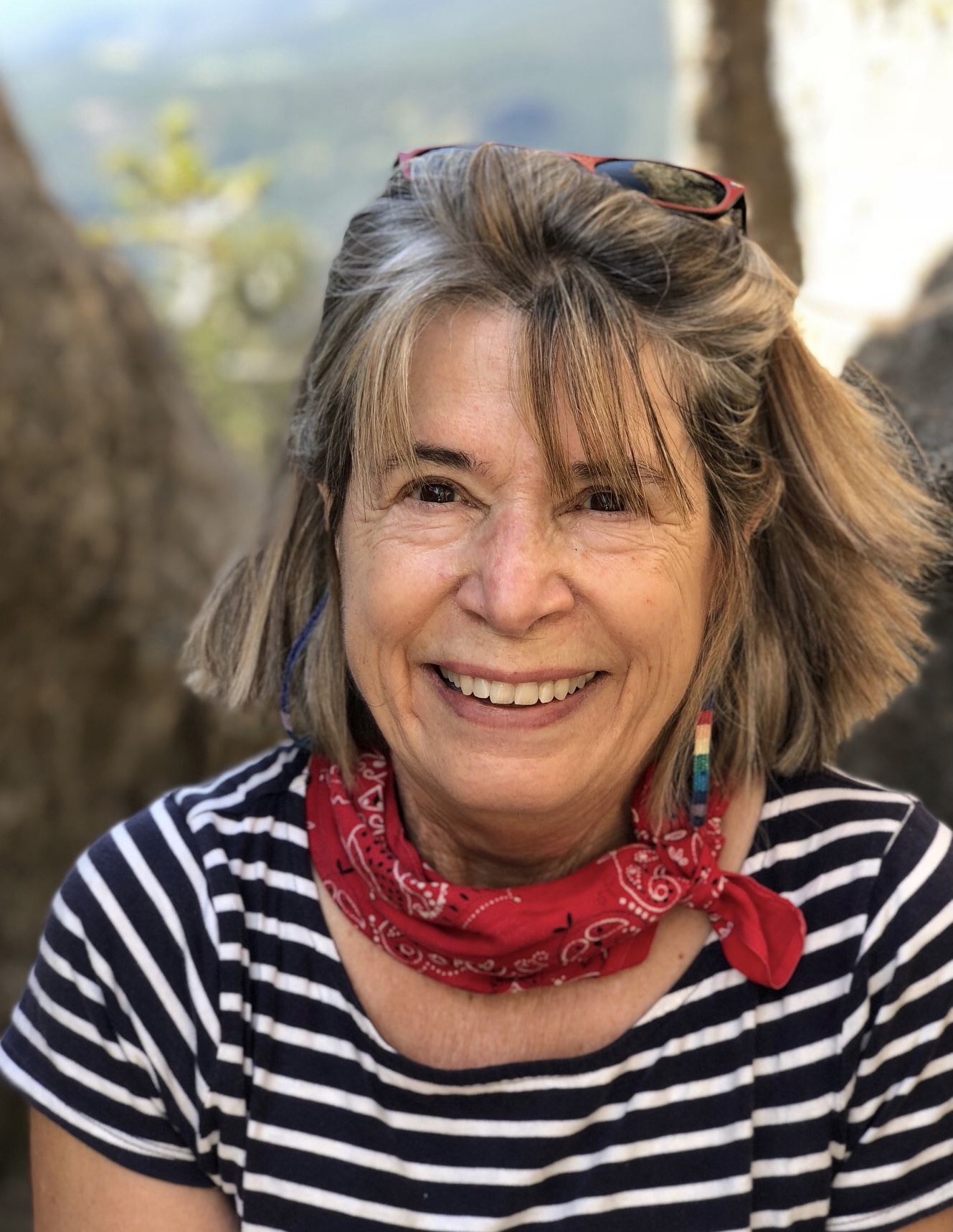
Helen Currie Foster lives and writes north of Dripping Springs, Texas, loosely supervised by three burros. She remains deeply curious about human history and how, uninvited, the ghost of the past keeps crashing the party. Find her on Facebook or at www.helen.currie.foster.com. The Alice MacDonald Mystery Series is available online or in Austin at BookPeople.


BAKING BREAD WITH A.I.

SAY WHAT?

By Francine Paino, a.k.a. F. Della Notte

And the A.I. debate goes on. It seems everyone has something to lose from its dominance, with claims ranging from human extinction (sometimes I wonder if that would be so bad) to theft and destruction of human creativity, especially in writing, which I do think would be bad.

Then there are advances in medicine, engineering, science, coding, and production. Because of technology and A.I., medical research is moving away from animal testing, especially on dogs. “The transition to a completely AI-driven, cruelty-free scientific system is well underway, but it will still take time to phase out entirely.” (Humane World for Animals) Who can argue with that? But this debate will no doubt continue for a long time.

I believe guardrails and kill switches must be further developed, and A.I. must continue to be used as a tool, not as an entity separate from human controls. How can that be done?  I have no idea, since I’m not a technical engineer, theoretical scientist, or expert in any of the other areas needed to come up with the answers. So, you must be asking yourself by now: what does A.I. have to do with baking bread? After all, A.I. doesn’t turn on the oven, prepare ingredients, wash its hands before plunging them into flour, water, and yeast to combine and meld them into dough.

Some say that the skill Set for baking bread is unlike general cooking, where you can adjust flavor or “eyeball” ingredients on the fly. Baking bread necessitates precision in weights, measurements, physical touch, and a grasp of atmospheric conditions in one’s kitchen.

I’ve consulted many of my favorite TV cooks, cookbooks, and YouTube’s many visual presentations. Results: Sometimes okay. Sometimes awful!  But yesterday, I baked some of the best bread ever. So, what changed?

I woke up to the sound of pouring rain outside. The morning was dark as night. My first realization: I don’t have any bread in the house. Choices: get dressed, go out in the downpour and get to the supermarket to buy some bread– assuming the supermarket is open at 4 am. I could drown in a flood first. Nuts to that. OR, I could bake it myself. Well, as you’ve already read, my track record isn’t great, but it would be edible. So, after downing a few cups of coffee, I dragged out my trusty old cookbook, assembled my ingredients, and decided to ask A.I. some questions since no live cooks would be available to me at that hour, or at any hour.

Question One – Can my focaccia recipe also be used for bread?

A.I. Answer –   Absolutely yes. Just shape the dough into a loaf instead of stretching it out for focaccia. Wonderful.

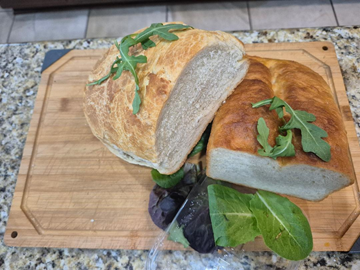
So, I began. Once I had all the ingredients combined and shaped it into a ball to let it rise, I covered it and went to my desk to write. After an hour, I remembered the dough. Back in the kitchen, I divided it into 2 balls, kneaded and reshaped them into loaves, set them in their pans to rise again, and returned to writing. Another hour passed. When I returned to the kitchen, the loaves had risen to the tops of the pans. Now I was to dimple them with my fingers, which I did.

Then disaster: they both collapsed. Now what?

Question: A.I., what happened? Can I save my bread?

A.I. asked me to describe what I’d done and how long I allowed the rise.  After I explained, my A.I. kitchen assistant revealed that an hour was too long to wait before dimpling. That’s why they collapsed. To save them, I was told to rework each loaf by re-kneading and reshaping, and allow no more than 30 minutes for the rise. Then cover them and bake at 450 degrees for 30 minutes. According to A.I., they’d rise again. Being an obedient student, I did as instructed, and voila. The bread rose, baked, and came out delicious and light. My husband said it was the best I’d ever made. Needless to say, I shall repeat this process. BTW – I said thank you, and A.I. graciously accepted and said it was a pleasure to assist.

If you’re wondering if I use A.I. to write, the answer is NO! A.I. is a wonderful tool, not a substitute for human ingenuity. I use it to assist with marketing blurbs and ads. As per Kindle publishing rules, I use it for pre-professional editing, but not to create or develop story lines or blog concepts—including this one.

So, until A.I. learns to wash its hands (if it has hands) and knead dough with clean digits, and feel the barometric pressure in the kitchen, I think we humans still have the upper hand.

Happy reading and baking too!

P.S.: Many internet articles written by humans talk about adjusting baking liquids depending on the weather.

PPS: Be careful. Using A.I. summaries is faster, but check the sites it pulls from and judge for yourself.

Your Doomscrolling Escape Hatch

I have a complicated relationship with social media.

 I treat it like a prickly colleague I need to check in with now and again and then excuse myself after I’ve spent an hour scrolling when I should have been doing something more important. I’ll abstain for a month or few. Then I’ll return, checking on family and friends. My feed is soon overwhelmed with all kinds of nonsense, including algorithm detours so off track that they resemble the last time I searched for an obscure restaurant without consulting my GPS first.  

While I’m working on better curating my social media experience, I have returned to one of my favorite methods of quality escapism.

My friends, if you aren’t putting down the phone and picking up a short story anthology or a novella, may I kindly recommend that you give it a try? As someone who has written short stories included in several anthologies, I am also a reader who has discovered other writers and other genres this way. Giving a short story twenty minutes of my time pays far more dividends than the social media algorithm ever could. 

Why not a novel, you ask? I love sinking into a good book, but sometimes that action results in completely ignoring other obligations, which leaves Tomorrow Laura in a real pickle. It’s almost always worth it, but the times I’m talking about here involve those moments when your brain itches to pick up your phone for “just a few minutes.” What I’m suggesting is that you pick up a short story magazine or anthology instead. A companion to your phone, but one offering a better conversation. 

Short stories are a wonderful way to dip in and out of a new universe and meet new characters without the three-hundred-page commitment. You may also discover you enjoy a different genre that you’ve avoided reading because, again, time commitment. The sheer abundance of fantastic short form fiction available right now is spectacular. You can throw a rock (please don’t) and hit a dozen collections worth your time. 

I’d be remiss if I didn’t mention Substack because it’s the one social media platform I spend time on regularly. Substack’s design encourages longer form discussions (think blog plus newsletter) and many writers have found a happy home posting essays, articles and stories there. But any algorithm driven product is a mixed bag for me, so after a little reading there, it’s back to short form fiction.

I’m not saying that social media isn’t a way to find your next great read—it definitely happens—but we’re now at the enshittification stage of social media (you can read more on that here  https://www.newyorker.com/culture/infinite-scroll/the-age-of-enshittification ) so I’m working to be more deliberate with my attention because it’s the one thing I can fully control. My goal now to use it as a tool that supports my love of reading and creating rather than mindlessly consuming whatever pops up in my feed (some success, some failure).

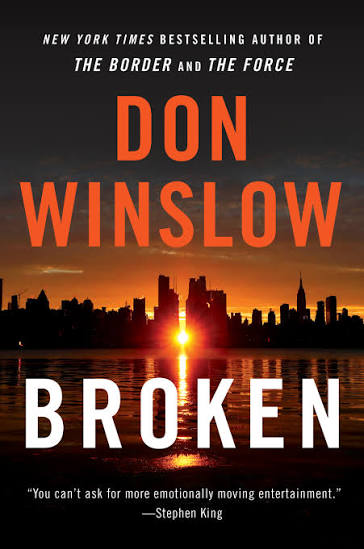
I’m currently re-reading Don Winslow’s Broken, a collection of six novellas, because “Crime 101” remains one of my all-time favorite stories. You know when you read something and then think, “Damn, that was something special”? I’m chasing more of that these days.

I also have a new little project launching soon, one that’s dedicated to finding and sharing fantastic short form fiction. I can’t wait to share it with you once it’s ready. 

What short story, anthology, novella or collection is a favorite of yours? Please share in the comments!

(A Small Snippet of) Recommendations: 

Ellery Queen Magazine:

https://elleryqueenmysterymagazine.com

Alfred Hitchcock’s Mystery Magazine:

https://alfredhitchcockmysterymagazine.com

Black Cat Weekly Magazine:

https://blackcatweekly.com

Broken by Don Winslow

https://bookshop.org/p/books/broken-don-winslow/2b90248c9e52682d?ean=9780062988904&source=IndieBound&ref=https%3A%2F%2Fwww.donwinslow.com%2F

Best of “The Strand Magazine”: 25 Years of Twists, Turns, and Tales from the Modern Masters of Mystery and Fiction By Andrew Gulli and Lami Gulli

https://tinyurl.com/t2txkx4c

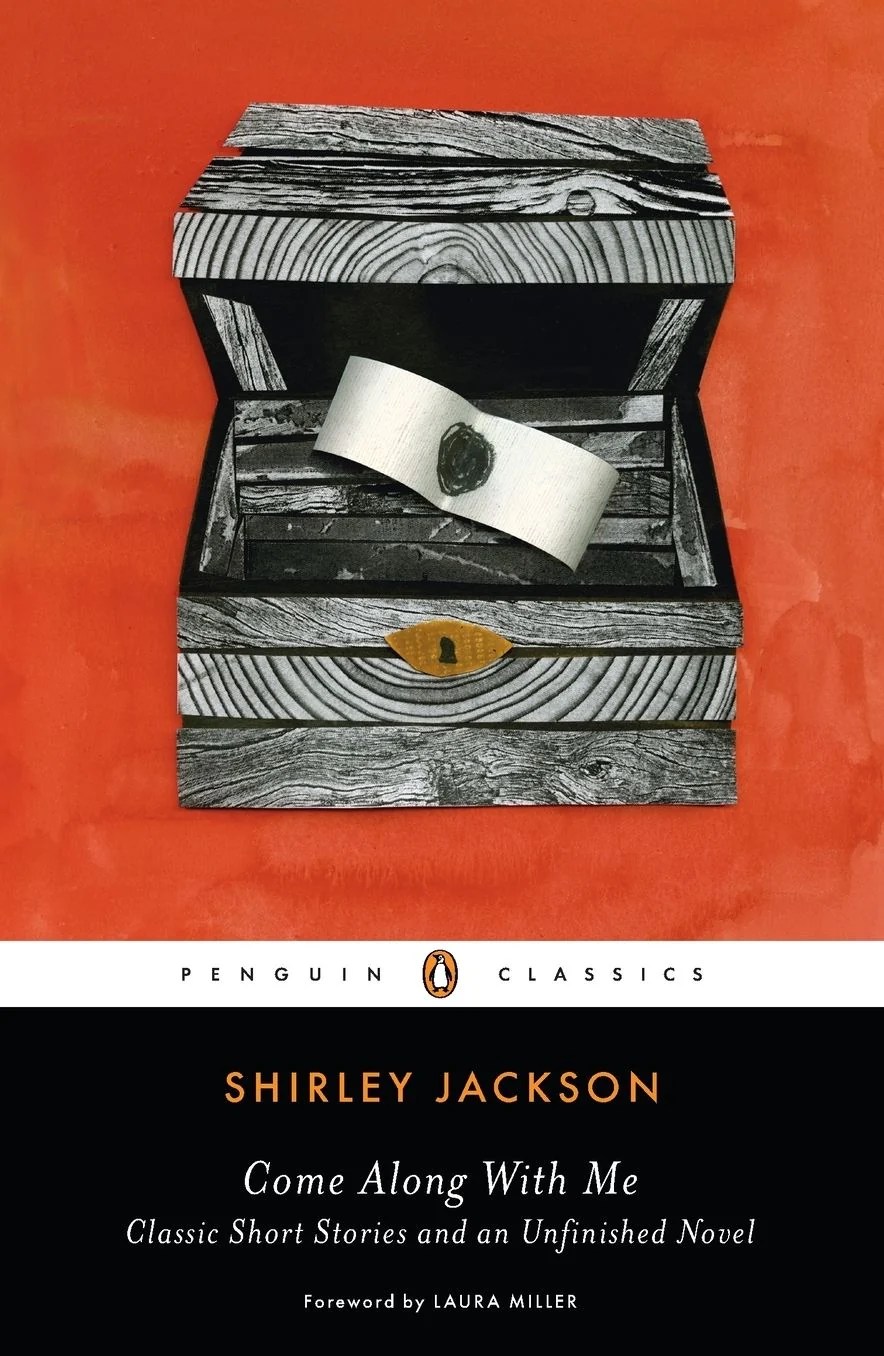
Come Along with Me: Classic Short Stories and an Unfinished Novel (Penguin Classics by Shirley Jackson, Lara Miller (Foreword):

https://tinyurl.com/Shirley-Jackson

The Best American Mystery and Suspense 2025: An Anthology of Premier Short Fiction  Edited by Steph Cha and Don Winslow:

https://tinyurl.com/aje2amwa

Wish Upon a Crime: Crime Fiction Inspired by Fairy Tales by Michael Bracken & Stacy Woodson

https://tinyurl.com/pruubpw3

Story Club with George Saunders:

https://georgesaunders.substack.com

Cold Caller Magazine:

https://coldcallermag.substack.com

Laura Oles is the award-winning author of the Jamie Rush mystery series. Her shorter work has appeared in crime fiction anthologies, consumer magazines and business publications. She is a member of Sisters in Crime and the Writers’ League of Texas. Before turning to fiction, Laura spent two decades as a photo industry journalist.She loves road trips, bookstores and any outdoor activity that doesn’t involve running. She lives in the Texas Hill Country with her family. (https://www.lauraoles.com).

A 9/11 TRIBUTE – 25 Years Later

By

Francine Paino

In 25 days, this coming September 11th will mark a quarter-century since the United States was attacked by evil in a way we’d never imagined.  For those of us who lived it, it’s as fresh in our memories as if it happened yesterday.

There was only one color in New York on September 11, 2001: Ash Grey. There was only one fragrance in the air: toxic fumes, sharp and acrid, as far as 25 miles away.

No one was black, white, or brown. We reached out for each other’s hands, without regard for race or ethnicity. Together, we watched in horror close up and from local distances, praying that our loved ones would somehow be spared a horrible end—but not all were.

On that day, the sun shone in a bright, clear blue sky, not common over the skyline of New York. It was as if God wanted everyone to see, without confusion, malevolence in action, and the heroism that battled it.

But who, exactly, were the heroes that day? Were the heroes those who like to stand above us and preach, like Hollywood stars? No. Did overpaid, spoiled-brat athletes run in to try to save those trapped and praying for rescue? No. Did the fascist/socialist fist-pumping, Hate-and-Steal-From-Those-Who-Have-More mobs try to get near those buildings to help? Certainly not. And make no mistake, they existed in New York 25 years ago. In our nation’s capital, D. C., did the feckless Congress ask to be transported to the Pentagon to help rescue those trapped inside, as Secretary of Defense Donald Rumsfeld did? Again, no!  Were Pennsylvania’s politicians first to the crash site of Flight 95 and the brave men and women on board who chose to die fighting? No.

The rescuers that day, who rushed into danger, were the fire, rescue, EMT, and police departments. And some civilian volunteers tried to help, even without training. They didn’t ask if it was safe. They knew it wasn’t.

On that day, 25 years ago, 343 New York City firefighters, including one chaplain and two paramedics, died. Thirty-seven police officers of the Port Authority of NY and NJ perished, as did twenty-three police officers of the NYPD and one New York Fire Patrol officer. Emergency medical technicians and paramedics of private emergency services also gave their lives to help others—and their sacrifices didn’t end that day.

Since 2001, 400 additional FDNY members have died from 9/11-related diseases, caused by toxins spewed into the air that day, and the number continues to grow.

More than 8,000 people have died from 9/11-related illnesses, surpassing the total number of lives lost on September 11, 2001. According to data and public awareness campaigns highlighted by The Mesothelioma Center, the long-term health consequences—including cancers like mesothelioma and lung cancer from Ground Zero toxins and asbestos exposure—continue to claim lives 25 years later. (The Mesothelioma Center) Just as devastating, over 40 percent of the victims still have not been identified—that’s about 1,000 people. An additional agony for their families.

And here we are, 25 years later, with obnoxious, hateful people trying to say we deserved that attack. Tell that to the families of those who died trying to save others, and to the victims armed with coffee cups and pencils, who were virtually pulverized, and those who did manage to get out alive, but damaged for life.

And now we watch our less-than-illustrious city councils, mayors, and governors prostitute themselves, bending over to the criminal insurrectionist mobs. They shout Defund the police, a service without which no civil society can exist. By doing so, they dishonor the memories of all who died on 9/11, the rescuers, and the victims waiting and praying that police or firefighters could reach and save them. No one that day prayed for or expected a politician or community activist to rescue them.

Indeed, these politicians have despoiled and rendered meaningless the actions of the officers who worked so hard to rescue so many and maintain law and order in the aftermath—again with no regard for the risk to their own health, working in the heart of the poisoned air of New York City and its suburbs.

But our political leaders are put in power by us—We, the people. Thus, we are a nation in disgrace. Unlike the surprise attack on Pearl Harbor, which remains in the minds of Americans even to this day, we’ve ignored the sacrifices made by so many who serve law and order, allowing us to live and work in a safe society, and 9/11 is one of the great failings of our public school systems. It is not taught. “Only 14 states explicitly require public schools to teach students about the events of September 11, 2001, leaving the topic up to local districts or omission in the remaining 36 states.” (Rep.  A, Garabino)

The police, fire, and EMT services are the real stars in our lives, not the tinkling fake glitter of those who hide behind their private security guards and walled communities, then dare to lecture us. Or, the athletes who choose to kneel, bow, and scrape to those who would rather see our country perish—rather than stand up and say, “NO. Destruction is not the way.” And to the ethics-free Democrats and spineless Republicans masquerading as politicians, who allow our cities to be burned down and our law-abiding citizens to be attacked so that they can maintain their privileged positions and wealth and power—let’s defund you.

To all the men and women of every police, fire, and EMT department in the United States, thank you for your willingness to do jobs that put your lives in danger to protect ours.Thank you for your efforts to keep our streets safe despite the ingratitude of the public and the disgusting backstabbing politicians. Thank you for your resilience and your service.  

And once again, to all who died at the hands of evil on 9/11, including the police, fire, and EMT personnel, may God keep you in the light of His face, and give peace and comfort to the loved ones you left behind.

Why Do We Allow the Machines to Decide if Our Writing is Human?

By Laura Oles

This piece was originally intended to examine the impact AI has on the current publishing landscape and how authors are navigating a profession in turmoil. I had several pages of notes, some annotations, a couple ponderings and some righteous indignation against tech bro billionaires that I planned to share. 

It got hot in here for a minute.

But, I’m tired and a bit defeated. 

This topic continues to be heavily covered in industry articles, on Substack and on social media. The most recent debate that has set the publishing world ablaze centers on a debut author who landed and lost a $2 million dollar book deal. Multiple outlets report that his manuscript was fed through Pangram, an AI software tool designed to spot AI generated work. Some articles report that the author has offered examples proving he wrote the manuscript. I don’t know what happened here, but I do know that letting AI software be the ultimate expert (if that’s the case here) is some bullshit. 

I can’t believe that we’re now in a position where writers must prove to an AI program that our writing is our writing. These LLM’s stole all our books and are now the arbiter of whether our writing is human enough? Programs that have falsely labeled human writing as AI generated get to be the final judge? Several writers stated that they have tested these programs by feeding their older novels into such programs, and the software claimed many were AI generated.  

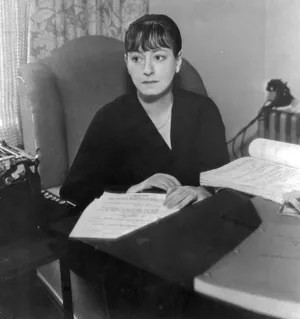
To paraphrase Dorothy Parker, “What fresh hell is this?”

As a writer, I have countless files of notes, revisions, outlines, cut files and research. I am also a fan of the em dash, a punctuation that has been (unfairly) marked as a hallmark of AI. The em dash is the Swiss army knife of punctuation. I use it often and sometimes incorrectly. I now catch myself considering other alternatives for fear someone (that vast void of opinions or bots on the Internet) will accuse me of using AI in my writing. Also—why are em dashes out here catching strays when they were just minding their own business?

I don’t use AI for my writing. I’ve chosen the glorious path of mucking around with a paragraph for an hour because it doesn’t flow quite right, and I still can’t figure out why. My critique partner can attest to this madness as she suffers from a similar affliction. I understand that not everyone wants to do this. I also believe that this practice is part of the craft. I’m currently dancing around a chapter like a Grace Kelly wannabe if her shoes were too tight and possibly on backwards. It’s a little chaotic. That’s art.

And I don’t hate technology.  In my previous life, I was a founding team member of a digital imaging company in a time when Kodak was king. I’ve got two decades of experience navigating a seismic shift of an industry in flux. Our clients were photo labs, camera stores and a handful of professional photographers. We were extremely aware of photographers’ copyright protections and included education, training and specific language in all our products. We respected the artists. And we trained our team to respect the artists. It was a core part or our organization’s foundation. Granted, we were a small player on a large field, but we knew who we were and what we valued.

I wish Open AI, Anthropic and the other tech cohorts who are pushing AI enhancements on everything except breakfast cereals (Cheerios! Now with AI!) had respect for the artists’ works they crushed into concrete for their empires’ foundations. I know it won’t happen–I’d have better odds hitting the lottery or being struck by lightning.

“Focus on what you can control.” 

Stellar advice that is easier to say than do, but I believe our power lies in where we spend our time, energy, money and attention. So, I’ll continue supporting writers whose work I love and the bookstores who promote them. And I’ll let the other more eloquent voices in our field debate the best practices for how to protect authors and their work as the AI industrial complex runs roughshod over such pesky obstacles as copyright and ethical guardrails. 

I’ll end with Camille Pagán’s succinct statement on Substack:

“The Pangram problem:  AI companies stole hundreds (possibly more than a thousand) of the health articles and medical guides I wrote, as well at least seven of my novels. Now—shocking—my content is routinely flagged for AI (which I never use)…because the tools recognize style and content that was stolen.  The fix isn’t an “AI detector.” It’s to stop allowing tech cos to pirate and profit from real, human creators.”

Resources:

Cal Newport:

https://www.thedeeplife.com/listen/

The Em Dash Responds to the AI Allegations: (Read this–you’ll love it).

https://www.mcsweeneys.net/articles/the-em-dash-responds-to-the-ai-allegations

The Craft of Storytelling with Ann Patchett (I just love this interview):

https://podcasts.apple.com/us/podcast/taken-for-granted/id1554567118?i=1000775742525

Fredrik Backman’s Hilarious Speech on Creativity and Procrastination: 

https://www.youtube.com/watch?v=NSuSyZ92Cjg

Dorothy Parker image copyright: Culver Pictures, 1939

Laura Oles is the award-winning author of the Jamie Rush mystery series. Her shorter work has appeared in crime fiction anthologies, consumer magazines and business publications. She is a member of Sisters in Crime and the Writers’ League of Texas. Before turning to fiction, Laura spent two decades as a photo industry journalist.She loves road trips, bookstores and any outdoor activity that doesn’t involve running. She lives in the Texas Hill Country with her family. (https://www.lauraoles.com).

TELL ME A STORY . . . HERE COMES THE ODYSSEY!

By Helen Currie Foster

July 5, 2026

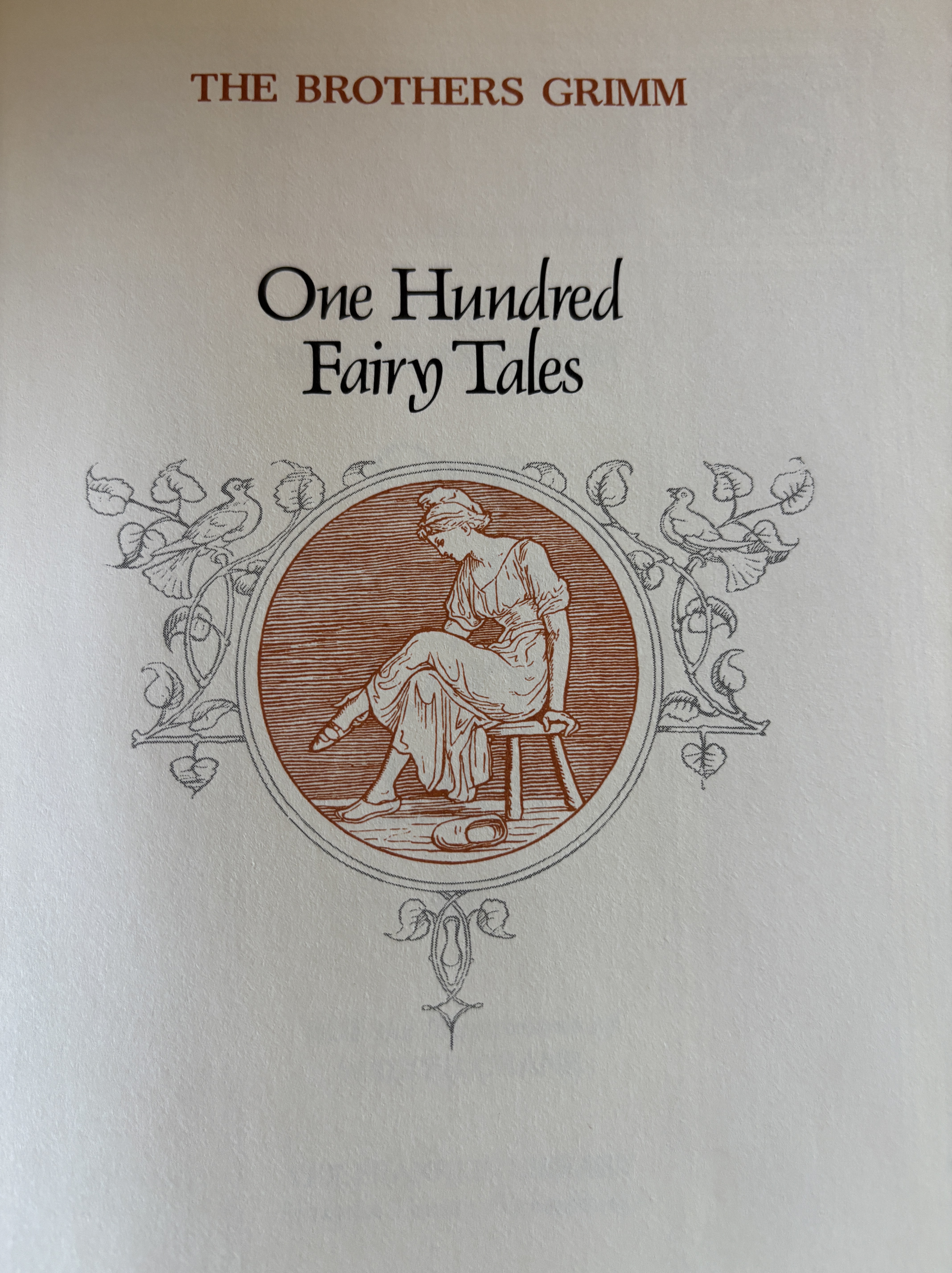
The Grimm Brothers’ tales, first published in 1812, are part of our childhoods—Hansel and Gretel! Little Red Riding Hood ( aka Little Red-Cap)! Cinderella! Rumpelstiltskin! Rapunzel! Sleeping Beauty! Snow White! The Bremen Town Musicians! As you well know, some tales involve grisly situations where children—to survive––must be resourceful. Hansel, caged by the wicked witch in the woods to become her future supper, sticks a bone through the bars to convince the witch he’s not yet fattened up. When the witch orders his sister Gretel to climb into the oven to see if it is “hot enough,” Gretel—no fool—persuades the witch to demonstrate—then shoves her in! The children escape!  

As folklore students in Hesse, Germany, the Grimm Brothers collected and edited (perhaps with extra moralizing) oral versions of tales from family friends. The Grimms ultimately gave us two hundred fairy tales. https://www.britannica.com/biography/Brothers-Grimm. 

The Grimms’ (grim) lesson that youngsters will use every means to stay safe—including trickery and persuasion—also appears in The Three Billy Goats Gruff (one of the Norwegian tales collected 1841-1844 by Peter Christen Asbjørnsen and Jørgen Moe). https://bit.ly/4vffbac

The three hungry young goats, desperate to cross a bridge to reach their grassy meadow, are in peril of becoming lunch for the ravenous troll threatening them from beneath the bridge. The two younger goats cleverly urge the troll to wait for their toothsome big brother as they race across—and then big brother defeats the troll.

Hunger! Danger! Potential betrayal! The need for ruses! For cleverness! Even disguises! Fierce lessons for children!

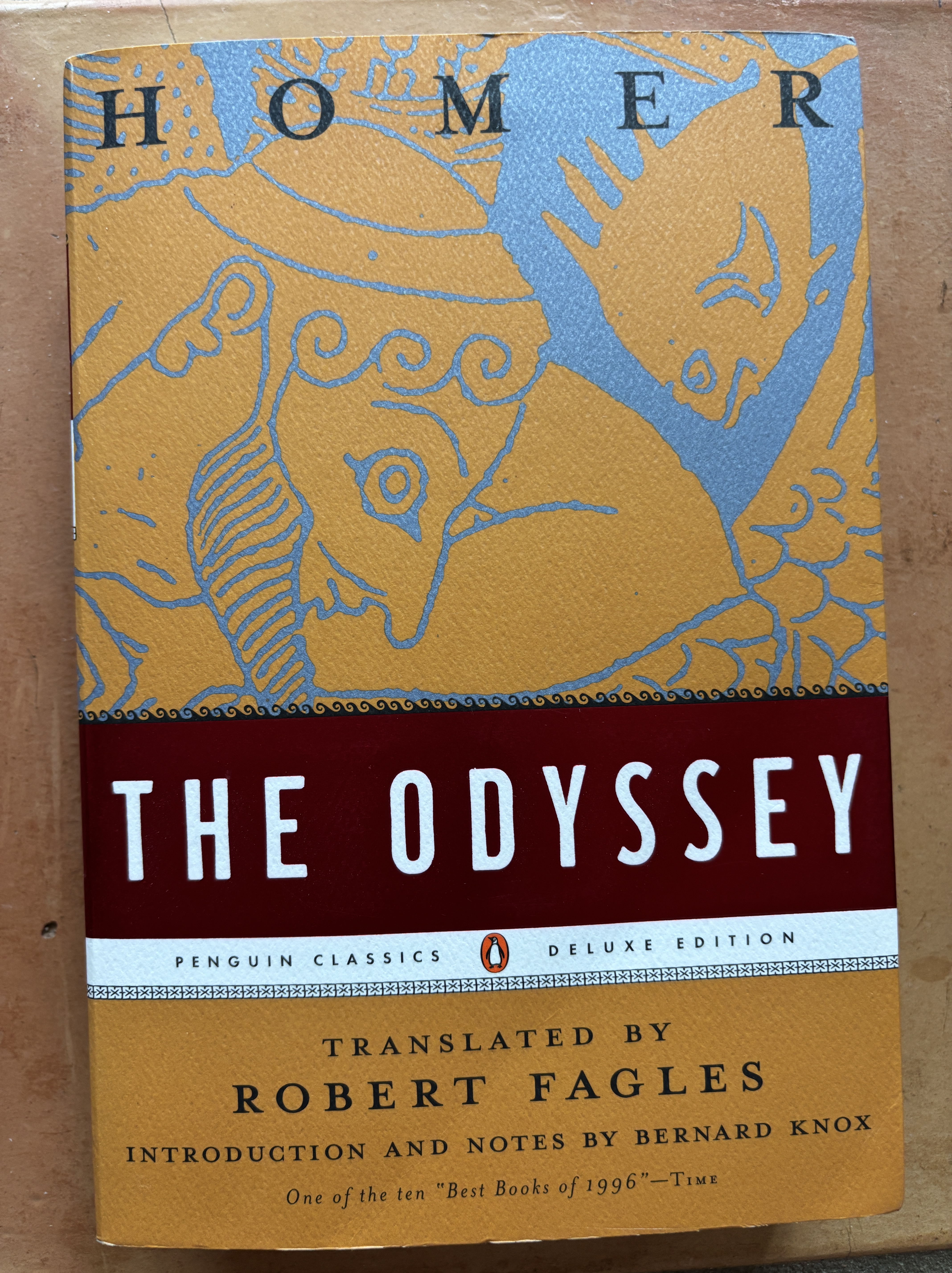
And for grownups? Oh, yes. Consider the perils faced by Odysseus in The Odyssey, when the crafty architect of the Trojan Horse departs for home after the Trojan War. He (like the children in the old tales) will need all the ruses he can develop, all the disguises he can wear, all the courage he can muster, to deal with the Cyclops Polyphemus… The nymph Calypso, who traps him in her cave… Poseidon, furious… Circe! Scylla and Charybdis! A tale of tales….and of a teller of tales.

Such troves of scholarship in past years!  1996 brought us Robert Fagles’ translation of The Odyssey.  Fagles tells us this epic poem (12,109 lines of hexameter verse) was “composed, probably, late in the eighth century B.C. or early in the seventh…The poem, in other words, is some 2,700 years old.”

Fagles says copies of the poem “were to be found all over the Greek world of the fourth and fifth centuries B.C.” Fagles, at 3. https://bit.ly/4vbzDbR

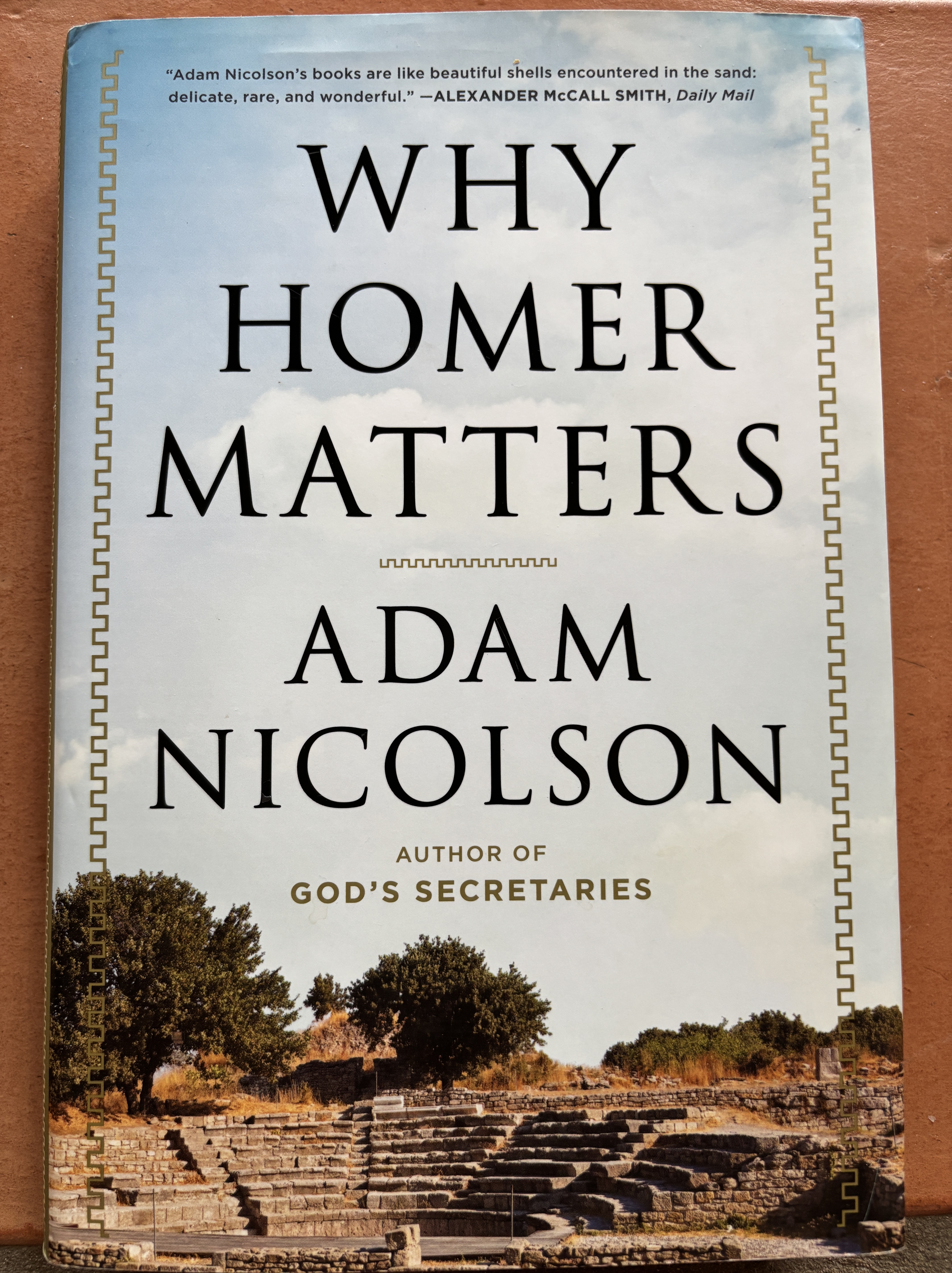
The year 2014 brought us Adam Nicolson’s Why Homer Matters. Nicolson envisions Homer as recording the conflicts experienced when “the semi-nomadic, hero-based culture of the Eurasian steppes to the north and west of the Black Sea” moved south and encountered “the sophisticated, authoritarian and literate cities…of the eastern Mediterranean. Greekness…emerged from the meeting and melding of those two worlds.” At 2. For Nicolson, “Homer is a foundation myth, not of man nor of the natural world, but of the way of thinking by which the Greeks defined themselves” and “which, in many ways we have inherited.” For instance, which matters most? Individual or community? The debate continues.

Nicolson sees the poems as recording “the violence and sense of strangeness of about 1800 BC recollected in the tranquillity of about 1300 BC…written down (if not in a final form) in about 700 BC.” At 4. Nicolson says the oldest surviving example of written Greek poetry is three lines of Greek scratched onto a funeral offering, a wine cup. “The second and third lines…are perfect Homeric hexameters” but not, Nicholson says, of Homer’s poetry.

Both Fagles and Nicolson cite the pioneering work of Milman Parry and Albert Lord. In the 1920’s Parry discovered that The Odyssey and The Iliad were full of prefabricated bits (such as descriptions of the “wine-dark sea”). Using those bits could allow a singing poet—the bard­­—to keep the metrical pattern of the music moving, while letting listeners hear and feel the traditional elements they’ve heard before, and anticipate hearing again. Nicolson, at 77-79. In what sounds like epic grad school work, Parry’s student Albert Lord accompanied him for two years through remote villages of Yugoslavia to hear and record over seven hundred singers, each using their single-stringed violin (the gusle) (interesting to hear online!) as accompaniment to their “long epic songs of battle and disaster.”  Nicolson, at 83, 85. Albert Lord turned those two years into his remarkable book on oral composition of epic poetry by bards, in The Singer of Tales, Cambridge, Mass., 1960. https://bit.ly/4vQM6Da

Is there a bard in the 2026 version of The Odyssey about to hit our screens? Yes!

What will we hear?

Will it be poetic?

Nicolson reminds us that “Homeric epics are essentially the music of hexameters.” At 76. Each line has six “feet.” Feet can have a long stress and two shorts (dactyl) or two longs (spondee). The fifth foot is usually a dactyl while the sixth must be a spondee. Id. Because each line has a natural break in the middle, the bard can tailor the music to the varying stresses.

The Fagles translation is in hexameter, but Fagles notes, “Turning briefly to Homer’s metrics, I would also like to hold a middle ground, here between his spacious hexameter line—his ‘ear, ear for the sea-surge’ as Pound once heard—and a tighter line more native to English verse.” So his translation “opts for a freer give-and-take between the two.” He works “from a five-or six-beat line while leaning more to six” but sometimes, seven beats, or, for stress, three. Fagles, at 492.

But wait! In 2018, Emily Wilson published a new version of The Odyssey. And hers—is entirely in iambic pentameter! Five feet, ten syllables…as she shows us in line one: “Tell me about a complicated man.” Why?

As she says in her Translator’s Note, “The Odyssey is a poem, and it needs to have a predictable and distinctive rhythm that can be easily heard when the text is read out loud. The original is in six-footed lines (dactylic hexameters), the conventional meter for archaic Greek narrative verse. I used iambic pentameter, because it is the conventional meter for regular English narrative verse—the rhythm of Chaucer, Shakespeare, Milton, Byron, Keats, and plenty of more recent anglophone poets.” Wilson, at 82.

However the dialogue sounds in the 2026 movie version, I can’t wait to see—and hear—this version of Homer’s The Odyssey. If it was 2700 years old in 1996, it’s 2730 years old now…and still bringing in the crowds. Because, all these years later, we still beg, “Tell me a story!”

Helen Currie Foster lives and writes the Alice MacDonald Greer Mystery Series north of Dripping Springs, Texas, loosely supervised by three burros. She’s drawn to the compelling landscape and quirky characters of the Texas Hill Country. She’s also deeply curious about our human history and how, uninvited, the past keeps crashing the party. Follow her at http://www.helencurriefoster.com and on Facebook. The ten books in the series are available online at Amazon and at BookPeople in Austin.

WORDLORE

OR

Fun With Words

By

Francine Paino, a.k.a. F. Della Notte

Writers love words…(talk about stating the obvious!) And there are so many words, proverbs, expressions, clichés, and idioms to choose from, it’s difficult not to fall into the trap of spending too much time in the world of etymology instead of focusing on telling stories. But for today, let’s do just that. Many online courses suggest that anyone learning a foreign language collect and learn at least some idioms to understand and speak like a native. So, here are some fun and not-so-fun expressions. Imagine taking them literally.

One of my favorites for wishing good luck in performance is the Italian “In Bocca al Lupo.” (In the wolf’s mouth.) This one requires a response – crepi il lupo (May the wolf die).  No. Italians do not try to stick their heads or other body parts into a wolf’s mouth. It’s the equivalent of telling someone in the theater to “Break a Leg,” which is the most common form of stage-show good wishes. It came from theater superstition that wishing someone good luck was bad luck, so they used reverse psychology by wishing a broken leg. But think about how a performer would react if they took it literally! Speaking of limbs, here’s one that is fun.

SHAKE A LEG – For this, we can thank the 19th-century Royal Navy. The Boatswain’s mate shouted “shake a leg, to awaken their crews. Members then stuck a leg out of their hammocks in order to prove they were awake and ready for duty.  So when someone says, “shake a leg,” do not stand still and shake one. Instead, hurry up!

Then, thanks to our own military, we have Bite the Bullet – a quick way to say put aside your distaste or unwillingness to do a task and get it done. This painful idiom originated on battlefields, when anesthetics were unavailable. Wounded soldiers were given sticks, or leather straps, or bullets to bite down on to endure painful procedures.

Expressions that create a more pleasant vision include “Fit as a Fiddle.”In today’s world, it means a person is in perfect health. Its origins date back to the 17th century and stem from the need to maintain violins/fiddles in good condition to achieve the best possible sound. So, close your eyes and imagine playing a fiddle or a violin while you take a run or lift some weights to stay fit like that fiddle.

Then there is the universal proverb, “Cleanliness is next to Godliness.” Although it sounds biblical, it is not. Its concept reaches back to Babylonian and Hebrew religious texts and sentiments. It was not coined as a phrase until preacher John Wesley used it in 1778, in his sermon titled “On Dress.” In the early 20th century, Mahatma Gandhi, on a lifelong mission to help his native India, promoted good hygiene, arguing that the mind and body must be clean to gain spiritual blessings. He noted, “Only when there is both inner and outer cleanliness, it becomes next to godliness.”

From the Southern U.S., we have a treasure trove beginning with Nervous as a long-tailed cat in a room full of rockin’ chairs, describing someone who is nervous and jumpy. The expression is rooted in Southern oral tradition and appeared in newspapers from the 1930s and ‘40s, particularly in Tennessee and Alabama. It is the original, longer form of ‘nervous as a cat.’

A new one to me was Snatch you baldheaded, aSouthern expression meaning to severely scold, discipline, or straighten someone out. The phrase is most often used as a warning from an elder to a child or younger person who is misbehaving. Its etymology likely grew from the older idea of handling someone so roughly that their hair would be pulled out. Over time, Southern speakers began using snatch you baldheaded and the related phrase jerk you baldheaded as colorful warnings rather than literal descriptions.

In the northeast, particularly in New York City, a true melting pot of immigrants, we find some of the most colorful expressions derived from foreign words. In the late 19th and 20th centuries, the largest foreign communities in New York City were Italians and Jews, thereby giving their languages and customs time to meld into the American way.

Here are a few Yiddish Words that have been incorporated into standard NYC speak and are frequently used and understood… in New York, that is.

  • Glitch: A minor malfunction or technical problem. This word moved from Yiddish into NYC tech and broadcasting circles, and then worldwide. It traces back to German glitschen (to slip, slide, or skid).
  • Klutz: A clumsy or awkward person. Another Yiddish word harkening back to its original German form. It entered American English in the 1920s.
  • Kosher: (NOT food). Something that is considered legitimate, proper, or acceptable. New Yorkers use it outside of a food context, and if something isn’t kosher, it isn’t legitimate. It derives from the Hebrew word kasher, which literally means “fit,” “proper,” or “suitable.”

And of course, there is a flood of Italian words that have been incorporated into New York City English, mostly in mispronounced forms, but totally understood.

  • Agita:  It is an Americanized pronunciation of acido or acidità (Italian for “acid” or “heartburn”), not a variation of the English word agitate, although itsounds like it might be. Its roots are in Southern Italian dialects, and it became common in NYC English in the 1970s.
  • Capisce: Pronounced ka-PEESH, in New York-ese. A direct substitute for “Do you understand?” or “Got it?” Capische (ka peesh e), with equal emphasis on all syllables, became common even among New York City’s non-Italians in the late 20th century.

Writers are always advised to avoid idiomatic expressions or use them sparingly, but there are times when including them in dialogue adds depth and color to a character.

Mrs. B, our heroine of the Housekeeper Mystery Series, favors the cleanliness proverb. She is a tiny bit OCD when it comes to cleaning and organization, but that doesn’t alter her ability to think through problems or solve crimes.

As for etymologies, there are hundreds of sites to entertain and educate anyone interested in the history and development of words. I’ve included some of them here.

So, happy reading, till next time.

https://www.ef.edu/english-resources/english-idioms

https://www.mkgandhi.org/articles/gandhian-thoughts-about-cleanliness.php

High Tech, Hustle Culture, and Hope

Fresh Golden Threads for The Emperor’s New Clothes

By Laura Oles

“Some day you will be old enough to start reading fairy tales again.” –C.S. Lewis

If you’re in search of a dark crime story, look no further than a classic fairy tale. Take a handful of jealousy, revenge, gaslighting, theft or even murder, and coat it with the sparkling exterior of a fantastical castle or a forest filled with magical beasts, and voila!  You have a crystal ball full of comeuppance. 

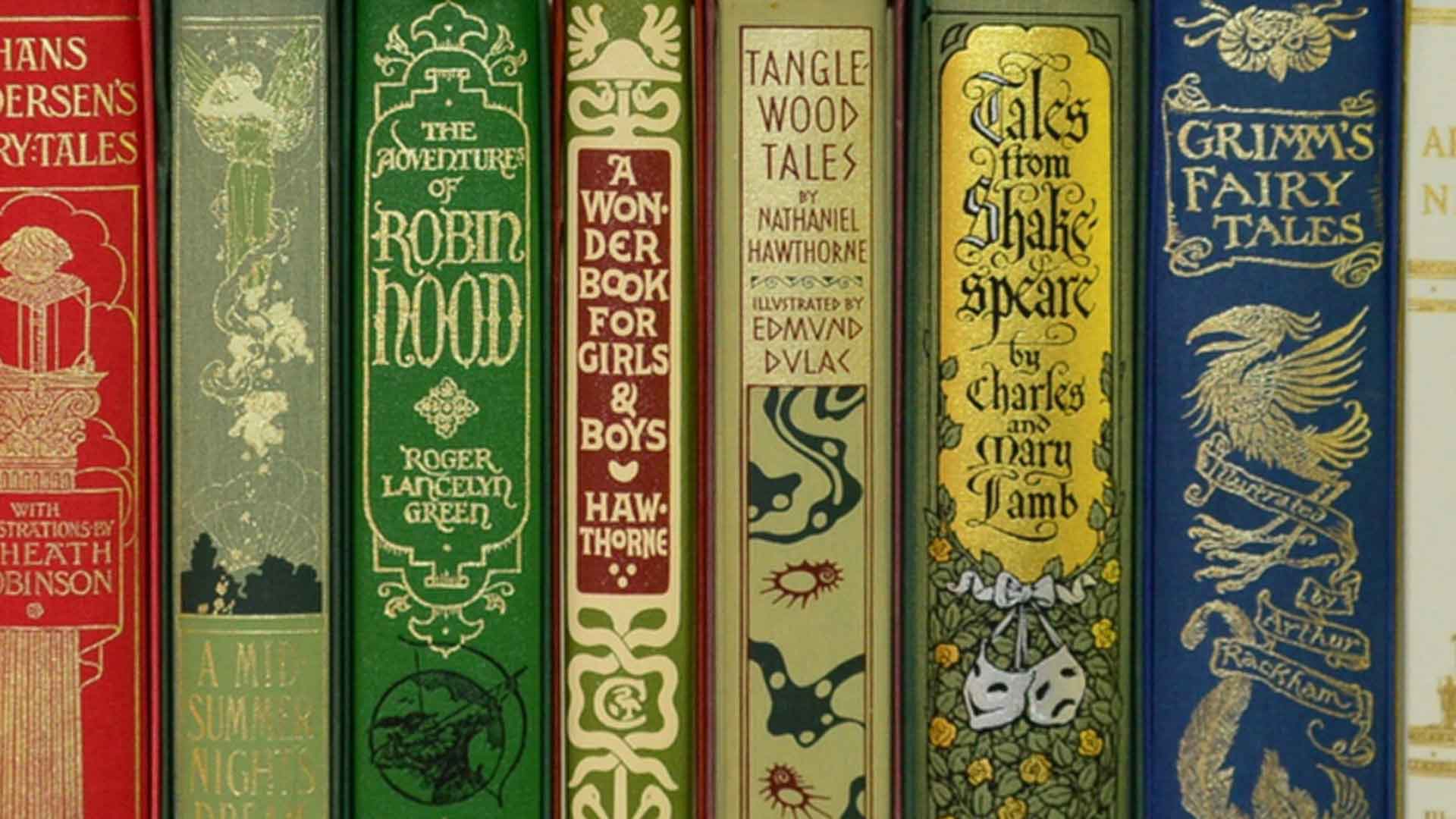
From: Folio Society Classic Fairy Tale Collection

There’s a kidnap plot in “Hansel and Gretel,” attempted poisoning in “Snow White,” toxic families and unpaid labor in “Cinderella,” and several breaking and entering charges in “Goldilocks and the Three Bears.” 

According to the BBC, fairy tales can be traced back thousands of years. Durham University anthropologist Dr. Jamie Tehrani shared that some tales like “Beauty and the Beast” and “Rumpelstiltskin” are approximately 4,000 years old. Additionally, he told the BBC, “Some of these stories go back much further than the earliest literary record and indeed further back than Classical mythology – some versions of these stories appear in Latin and Greek texts – but our findings suggest they are much older than that.”

Ah, the long tail of crime tales…

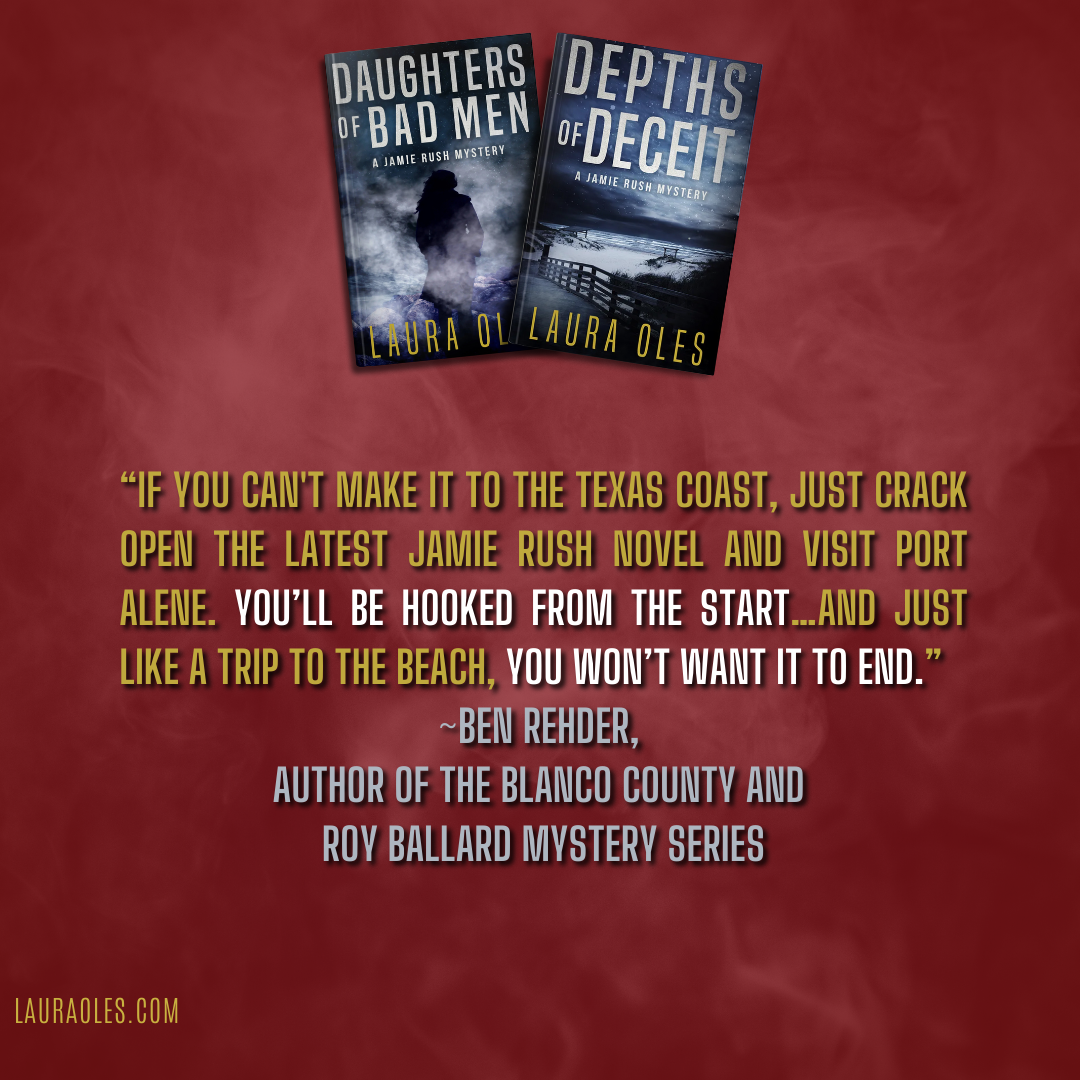
As an avid lover of short stories, I was thrilled to be included in the recently released Wish Upon a Crime: Crime Fiction Inspired by Fairy Tales by Michael Bracken and Stacy Woodson. The opportunity to reimagine these stories in a current context was a fabulous challenge.  

My contribution, “The Emperor’s New Clothes,” finds itself in the center of emerging tech hustle culture. Countless cautionary tales can be found in this world of big promises and bigger pitfalls, the brass ring always barely beyond reach for all but a few with secret access to the inside track. 

Oh, to be chosen.

 Daniel Hayes finds himself at a crossroads after his last investment goes bust. He knows he has what it takes to strike it big—he just needs one more shot to prove himself. One more chance to quiet the chorus of naysayers and to demonstrate, once and for all, that he has what it takes make it in Big Tech.  

The universe drops a golden coin in Daniel’s palm, and he knows that he’s finally found the perfect opportunity to show his family, friends, and Instagram followers that he’s made it to the top. He may need to make a few compromises, but that’s a small price to pay, isn’t it?

Wish Upon a Crime is available now.   

THE TABLE OF CONTENTS

  • “Hansel and Gretel” by Joseph S. Walker
  • “Goldilocks and the Three Bears” by John M. Floyd
  • “Rapunzel” by Adam Meyer
  • “The Emperor’s New Clothes” by Laura Oles
  • “Three Billy Goats Gruff” by Michael Bracken
  • “Beauty and the Beast” by James A. Hearn
  • “The Bremen Musicians” by Debra H. Goldstein
  • “Jack and the Beanstalk” by Andrew Welsh-Huggins
  • “Cinderella” by Donna Andrews
  • “The Frog Prince” by Josh Pachter
  • “Little Red Riding Hood” by Barb Goffman
  • “The Briar Patch” by Tom Milani
  • “King o’ the Cats” by David Dean
  • “The Gingerbread Man” by Stacy Woodson

Laura Oles is the award-winning author of the Jamie Rush mystery series. Her work has appeared in crime fiction anthologies, consumer magazines and business publications.She loves road trips, bookstores and any outdoor activity that doesn’t involve running.She lives in the Texas Hill Country with her family. (https://www.lauraoles.com).

UNDER CLOSE OBSERVATION…

BY HELEN CURRIE FOSTER

May 18, 2026

One morning each year the bird genius, Jesse Huth, of Huth Avian Services, arrives from Wimberley to conduct our annual bird survey.

Every year I tiptoe along behind, hearing his soft announcements. “Green heron above the creek.” I look up, straining to spot the lovely heron in flight. While I’m wondering what it would be like to fly like that, I hear: “Red-tailed hawk.” Now Jesse’s facing a different direction, lifting his binoculars. Later, “American Redstart.” (I ask myself: what’s that?) We climb back up from the creek. Then, “Field sparrow. Lark sparrow.” (I peer, unsure of the difference.) Then off to the pasture. “Vireo, red-eyed.” “Vireo, white-eyed.” And “Vireo, yellow-throated.” 

Those vireos?—I never spot them, whatever they are doing––flying, darting, twittering, disappearing.

Then—such elation! Sitting boldly at the top of a tree we see the brilliant crimson of a summer

tanager, surveying its territory. https://macaulaylibrary.org/asset/657490711.

And in the same tree—golden-cheeked warblers! https://macaulaylibrary.org/asset/657490671

I’ve never seen one before. And finally, hiding in the branches, the ineffably gorgeous painted bunting! https://macaulaylibrary.org/asset/657490695

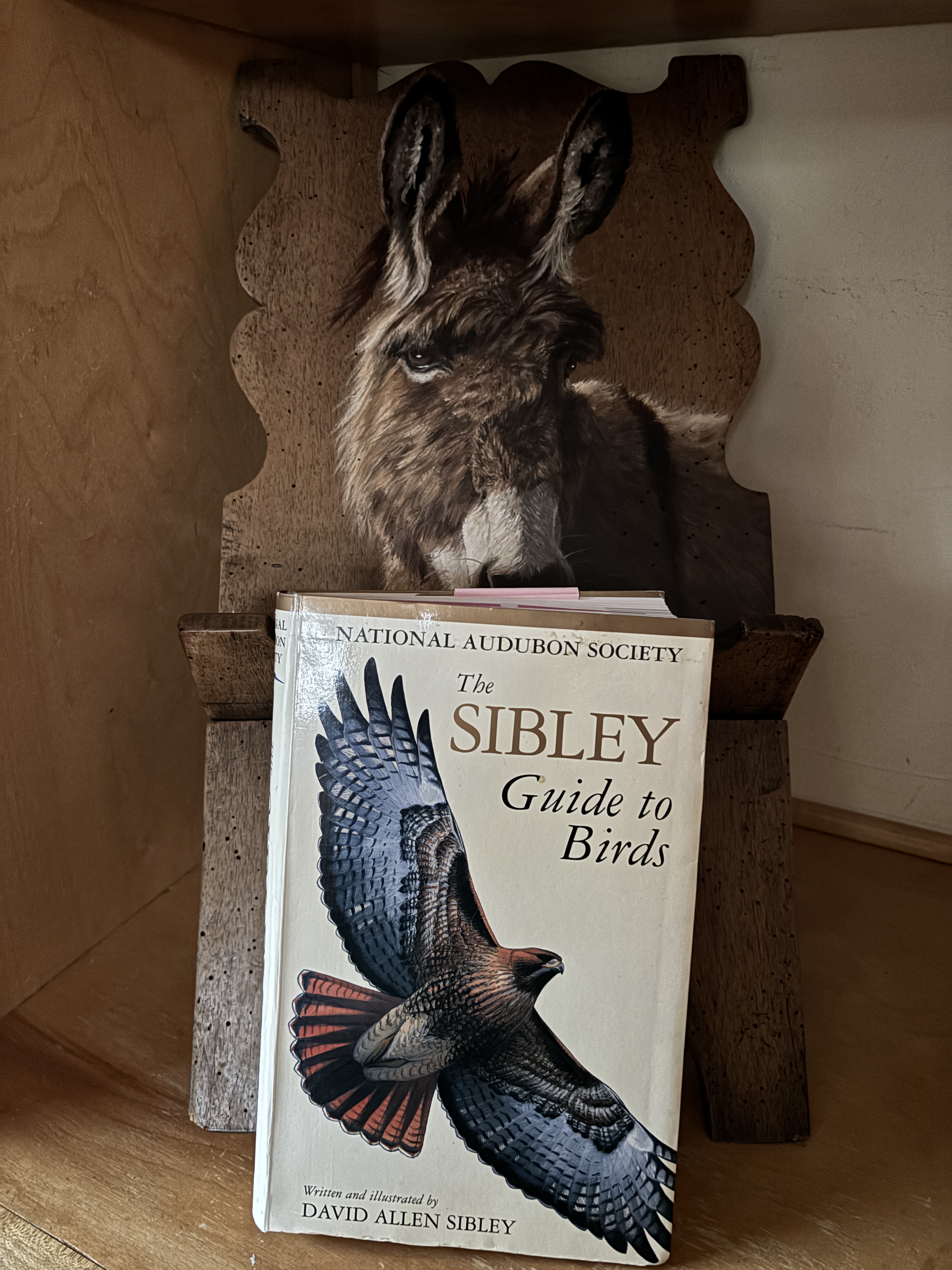
Jesse’s an expert on birds. He has studied their voices, their habits, their preferences, their appearance. He knows how to use owl calls to draw a crowd of various birds. After Jesse departs, I grab The Sibley Guide to Birds to study those three vireos (red-eyed, white-eyed, yellow-throated).

So tiny, the differences! You have to see the eye, where the yellow is, and where it isn’t; you must notice whether it has the gray cap, or not…

Jesse has spent years with those birds under close observation, yes, and under closer observation, applying his knowledge of detail. He sees differences that escape me. He can distinguish their songs.

After two hours he’s observed, and recorded or photographed, 40 species.

Details! Writers also must choose details that work, that light up, that bring to life characters and setting. That phrase—“under close observation”—describes the writer’s job: finding just the right details of setting, just the right details of characters, to make the plot come to life and satisfy the reader, the audience.

We all know great examples. In Act I, Shakespeare’s Julius Caesar closely observes Cassius:

            “Seldom he smiles, and smiles in such a sort

            As if he mock’d himself and scorn’d his spirit

            That could be moved to smile at anything.

            Such men as he be never at heart’s ease

            Whiles they behold a greater than themselves,

            And therefore are they very dangerous.”  Act I, Scene II.

Reading that, did you get a glimpse of Cassius’s face, as Caesar describes it? And hear that firm conviction, “therefore are they very dangerous”? Right away we begin to hold our breath.

I confess I do want to like the protagonist, whether in a play, a novel, a mystery, biography, autobiography. I do not need to approve entirely of that character, but, whatever the genre, I prefer to spend time reading about someone I can empathize with. So, turning to autobiography, consider these excerpts from the beginning of Out of Africa, by Isak Dinesen:

I had a farm in Africa, at the foot of the Ngong Hills. The Equator runs across these highlands, a hundred miles to the North, and the farm lay at an altitude of over six thousand feet. In the day-time you felt that you had got high up, near to the sun, but the early mornings and evenings were limpid and restful, and the nights were cold. …

We grew coffee on my farm. The land was in itself a little too high for coffee, and it was hard work to keep it going; we were never rich on the farm. But a coffee-plantation is a thing that gets hold of you and does not let you go, and there is always something to do on it: you are generally a little behind with your work.

…Later on, when I flew in Africa, and became familiar with the appearance of my farm from the air, I was filled with admiration for my coffee-plantation, that lay quite bright green in the grey-green land, and I realized how keenly the human mind yearns for geometrical figures.

With these details Isak Dinesen makes us see the farm and the Ngong Hills, then makes us feel the air at six thousand feet… with “lipid and restful” evenings. We feel her emotional attachment—“a coffee-plantation is a thing that gets hold of you and does not let you go.” Then she catches our imagination, describing seeing her farm from the air while flying, and shares her discovery that “the human mind yearns for geometrical figures.” Her own observations of detail reveal to us the protagonist, the main character in this autobiography, as a thinker, a noticer, a person with staying power, who once (but no longer) “had a farm in Africa”—and now offers to share that adventure. Her intelligence, her sensibility, her brilliant use of detail, kept me turning the page.

Another protagonist we meet and can’t abandon: Count Alexander Ilyich Rostov, of Amor Towles’s A Gentleman in Moscow. We’re introduced as the Count strides back from the Kremlin Gates to his home at the Hotel Metropol. On the way he greets the fruit seller, thanks the soldiers whose prisoner (we now perceive) he is, returns to his elegant suite—and learns that he has been dispossessed. He will spend the rest of his life in a tiny room in the hotel’s attic: “a cast-iron bed, a three-legged bureau, and a decade of dust.” He’s allowed to retrieve a few possessions. He wants “all the books” and also chooses two high-back chairs his grandmother’s oriental coffee table, porcelain plates, two table lamps, and the portrait of his sister…plus one trunk which he fills with clothes and personal effects, including his sister’s tiny scissors. We watch him take a last walk through his suite, then return to his tiny new room. A pigeon lands outside:

“Why, hello,” said the Count. “How kind of you to stop by.”

The pigeon looked back with a decidedly proprietary air. Then he scuffed the flashing with its claws and thrust its beak at the window several times in quick succession.

“Ah, yes,” conceded the Count. “There is something in what you say.”

I already liked this man, his exquisite courtesy to the pigeon, his apparent ability to laugh at himself, his apparent determination to stay himself, to refuse to give the state the satisfaction of causing him despair …despite the state’s efforts to destroy almost everything he has. Then I watch while he hosts a party for his friends in the hotel staff:

“The Count was something of a natural-born host and in the hour that ensued, as he topped a glass here and sparked a conversation there, he had an instinctive awareness of all the temperaments in the room.”

Personal tragedy, but humor, civility, sensitivity, courage—and determination. Okay, I’ll definitely keep reading.

Screenwriter Robert McKee, in his book Story about principles of screenwriting, points out that a story’s protagonist must have a conscious desire, but must also have the capacities, and at least a chance, to attain that desire. Also, according to McKee, “The protagonist must be empathetic; he may or may not be sympathetic.” Per McKee, “Empathetic means ‘like me.’ Deep within the protagonist the audience recognizes a certain shared humanity.”

McKee explains: “The unconscious logic of the audience runs like this: ‘This character is like me. Therefore, I want him to have whatever he wants, because if I were he in those circumstances, I’d want the same thing for myself.’” Amor Towles certainly accomplished that with Count Rostov.

So what details have kept you reading a book? What particular description made you think—this writer’s keeping me entertained, keeping me turning the pages? In particular, are there protagonists who—when you think about it—have some appealing characteristics you enjoy? I’d love to hear your thoughts.

Now, a short report. First, no peaches. Tragically, after warm weather when the blossoms opened and tiny peaches formed, two late freezes killed the baby peaches. Sigh. Second, after unusual rain, the pastures out here in Hays County are bright green. No bluebonnets this year (well, maybe six), but we still have magenta Wine Cup, lavender Passion Flower, and so many yellow flowers—Brown-eyed Susan, Mexican Hat, Golden-Eye, Coneflowers, Sunflowers, Cowpen Daisy, Golden-Wave Coreopsis, Navajo Tea, Indian Blanket. Hard to know which is which.

I’m at work on Book 11 in the Alice MacDonald Greer Mystery series, set in the Texas hill country. That means working on the big triumvirate—setting, characters, plot. The protagonist, Alice, definitely has a conscious desire, and the capacities to attain it—but barriers lie ahead. Yes, she’s under close observation. Stay tuned.

Helen Currie Foster lives and writes the Alice MacDonald Greer Mystery series north of Dripping Springs, Texas, loosely supervised by three burros. She’s drawn to the compelling landscape and quirky characters of the Texas Hill Country. She’s also deeply curious about our human history and how, uninvited, the past keeps crashing the party. She’s active with Austin Shakespeare and the Heart of Texas Sisters in Crime Chapter of the national Sisters in Crime (come join us! 2-3:30, Laura Bush Library on Bee Cave Road, second Sundays of the month).

June 25, 2026–Watch for the DSCL Author Showcase–Helen will be presenting, along with Jo Pellinore and Michael Baldwin! Social at 5:45, Panel Discussion 6-7:30. Contact Dripping Springs Community Library to register.

Follow Helen at http://www.helencurriefoster.com and find her books on Amazon and also at BookPeople in Austin, Texas.

Dust Bunnies, Cat Hair, and Murder

By

Francine Paino, AKA F. Della Notte

Occasionally, I like to revisit old blog posts about life’s constants. Chasing dust bunnies and cat hair are among those constants, and they can be murder when not addressed routinely.

In today’s parlance, Household Management, Homemaking, Domestic Administration, or whatever term one uses to feel better about it, housework is a necessary evil. If you can hire outside help to keep those dust bunnies and cat hairs under control, I salute you, but in my life, the chores involved in maintaining a generally clean home fall to me. I do, however, have some unorthodox help, although they lift not one finger.

As I slog through the early-morning tasks involved in domestic engineering, two of my favorite fictional TV sleuths keep me company. They are as different from one another as they are from me.  

In the early episodes of Murder, She Wrote, JB Fletcher (Jessica), the down-to-earth, self-possessed, independent mystery writer, was occasionally seen doing domestic chores before she became a wealthy author who hired others to do that work. Jessica even types her own manuscripts on an old-fashioned typewriter – before moving up to a word processor, then a computer.  

Jessica, a retired high-school English teacher and a childless widow, writes a novel to distract herself from the death of her beloved husband. Her nephew, Grady, reads it, thinks it’s terrific, and sends it to a New York City publisher, who is taken with the story and decides to publish and sell it. Thus, JB Fletcher becomes the new mystery author in her second season of life.

Throughout the series, she grows as a writer and develops a reputation for being exceptionally astute. Her observations and deductions are worthy of any professional police officer or Private Eye – and both often consult her, as the storylines create different criminal scenarios. Through all the changes and growth, this classy lady and amateur sleuth never loses the personal qualities that set her apart.

For additional company, entertainment, and murder, while I haul the vacuum cleaner around the house, (don’t you just hate these chores?) I turn to my favorite TV homicide detective, Lieutenant Columbo, of the LAPD. As soon as I tune in, I smile.

Deliberately clumsy and unkempt, Colombo wears scuffed shoes and a wrinkled, ill-fitting trench coat over rumpled clothes. His facade as a mid-level cop with run-of-the-mill capabilities is fun to watch.

While JB Fletcher’s situations are more of a mystery, Lt. Colombo’s are more suspense/thrillers. The audience almost always sees the crime committed at the beginning of the show. The main question is: how will the bungling Colombo solve the case, or will he encounter a criminal more ingenious than he is? (I’ve never seen that.)

Unlike Sherlock Holmes, who leads with his abilities, Colombo hides behind a nasty cigar, always in hand, and his habit of saying goodbye – but then, “just one more thing,” to the annoyance of other characters, who wish to be rid of him, and some viewers too. Of course, this masquerade of disheveled clothes and a muddled mind makes most criminals underestimate his remarkable crime-solving abilities.  

In Ransom for a Dead Man, originally aired in the first season, Colombo encounters wily opponent Leslie Williams, a homicidal attorney who contrives a complex plot to get rid of her husband. Williams calls Colombo out on his grubby subterfuge, and her brilliance challenges his ability to capture this elusive adversary.

A plot, a word, an expression, or a look sometimes triggers ideas for my own stories. I stop my chores, grab a pencil, and something to write on, most often a scrap of paper, and jot down these nuggets of inspiration before they disappear in the fog of disinfectants.

A recent addition to my TV companions in housework is the Dalgliesh series, inspired by the PD James novels about a British detective-poet. Set in the 1970s, Dalgliesh is considered an intelligent, highbrow, thinking-person’s crime story. (Not exactly targeting the sparkle squad.)

I’m always amazed at how British crime dramas present even the most heinous crimes in a restrained, unemotional style. My only problem with Dalgliesh is that it slows down my house chores because it cannot compete with the whine and suction sounds of the vacuum, which I must turn off to give the detective my full attention. So, how do my characters stack up to my TV pals?

The lead male in the Housekeeper Mystery Series is a priest, Father Melvyn Kronkey, who is devoted to his parishioners, but wants to keep them at arm’s length, and can’t because of his housekeeper/ assistant.  

Mrs. B.  is not unlike JB Fletcher, with an Italian twist and runs on espresso. She has a nose for trouble, and reaches for it with both hands, dragging the good Father into the brawl. And there are a bunch of scene-stealing cats.

Unlike Dalgliesh’s calm detective work, they are often involved in cat-and-mouse chaos with unpredictable bad guys.  Guns and shootouts? Sometimes. Calm and measured? Hardly ever.

And while chasing dust bunnies is rarely as dangerous as chasing villains, it’s amazing what plotting can happen with a mop in hand. Dull and mundane though they are, domestic chores allow time and space for ideas, plots, and characters to incubate. Even murder methods and motives simmer with no other consequences than something not getting cleaned well enough.

And of course, in all these flights of fancy, the resident cats are never at risk.

HAPPY READING!