by Laura Oles
As a writer, I sometimes find myself struggling through periods of being stuck and working my way out of it. Like that character I locked in the trunk of a car (I’m sorry I did that to you, but I knew you’d escape somehow), I’m having to rethink my tactics.
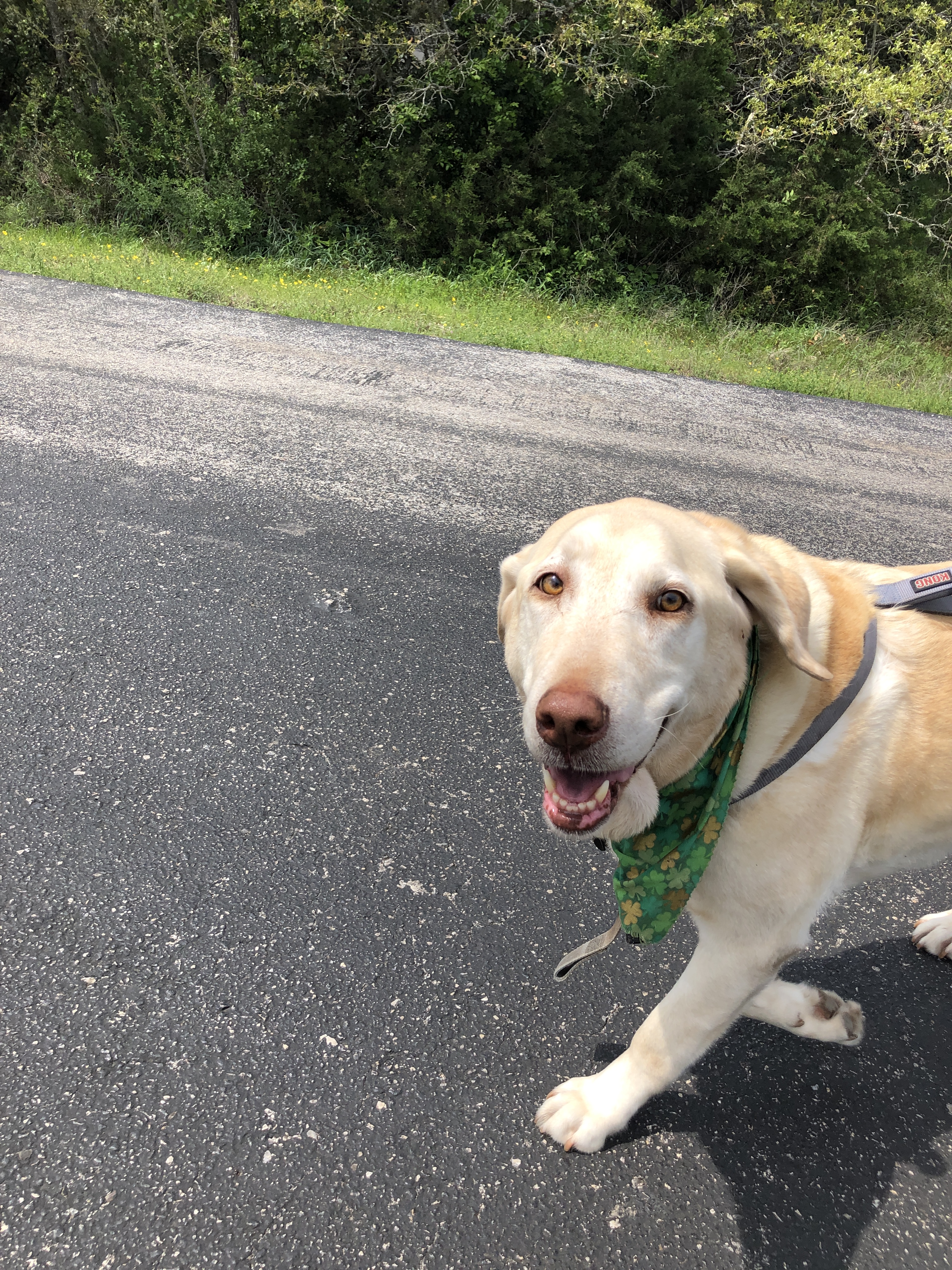
One of my most effective methods of getting unstuck no longer works. My first line of defense, until recently, was to take my Labrador Retriever for a good long walk. I’d bounce ideas off her and she’d pretend to listen as she considered whether she could catch a nearby deer, road runner or squirrel (no, no and no). My sweet pup has recently left this world, and her absence in conjunction with the triple digit Texas heat has meant my walks just aren’t as appealing as they once were.
The truth is that we all get stuck. Sometimes we get in our own way. Thankfully, there are strategies to get out.
In a recent episode of Hidden Brain, a podcast hosted by Shankar Vedantam, Shankar interviews psychologist Adam Alter about how musicians, writers and other professionals dig themselves out of their performance holes. The epic writers block that plagues George R. R. Martin is discussed, and Martin himself has said of the increasing gaps between each book, “I’ve had dark nights of the soul where I’ve pounded my head against the keyboard and said, ‘God, will I ever finish this?’”
I’m scared, George. If you can’t do it, what hope do I have?
Thankfully, Shanker and Dr. Alter have some solid strategies to offer. For example, Dr. Alter explains how an experiment from behaviorist Clark Hull might help someone struggling with stagnation. The experiment involved mice. I know, I know. How can mice running through mazes help with writer’s block?
Hear them out.
In the beginning of the experiment, the mice moved slowly at first in the maze and then sped up again. Once the goal came into view—exiting the maze–the mice moved more quickly. Dr. Hall labeled this the Goal Gradient. When the end is in sight, the pace picks up. This theory has since been further researched to expose a U-shaped motivation arc. We may start off on a project quickly and then slow down in the middle. Then our pace picks up at the and of a project. Quick. Slow. Quick. Take the example of being in the messy middle of a novel. Too far away from the excitement of beginning a new project and too far away to see the end. It’s like being in the center of the ocean when we’re far away from shore but we can’t see the destination yet.
And there we tread water.
STUCK.
So, how do we combat this?
CREATE SUBGOALS
Dr. Alter uses this technique in his own writing. He recommends taking a large goal, such as writing a novel, and breaking it into smaller sub goals such as completing a scene, writing one chapter, or choosing a small word count to start. “The nice thing about writing a book is that it’s broken naturally into chapters, so already you’ve shrunk those middles down.” He further explains that you can take one subset and further divide it. “I’ve used the tactic of every hundred words when I’m struggling more…I find that I’m shrinking and expanding constantly as I’m writing a book.”
USE A TIMER

Dr. Alter sets a timer for a single minute for those times when he’s struggling with a particularly difficult aspect of writing. The idea is to just get back into the rhythm of writing, and each minute will lead to five minutes and then ten. “Each minute is its own goal, its own victory.”
A deadline, a timeline or some other small constraint can push us through our own block. Constraints can bring freedom. And then a breakthrough.
BATTLING PERFECTIONISM
We’re often our own worst enemy.
Musician Jeff Tweedy, front man of Wilco, has described in significant detail his own experiences with writer’s block. One thing he battles the most is perfectionism.
“Perfectionism is paralyzing because what perfectionism signals to you is that unless you produce perfection, you’re failing. The feedback you’re getting is negative feedback and it’s demotivating.”
I feel so seen right now.
But you didn’t fail.
Tweedy says that he battles perfectionism by pouring out the bad material. “Imagine that your ideas are liquids sitting one on top of the other in your head, you’ve got to pour out the bad stuff.” This works because the expectation is that, of course, some of the work each day is mediocre. It’s part of the process but you’re “getting rid of the bad stuff so the good stuff can emerge.”
IT’S NOT JUST YOU
If you’re scrolling through social media and getting the impression that your other author friends are all killing it while you struggle to get five hundred words down, it can feel very lonely. But, chances are all the seats are full on the struggle bus.
“Researchers have found that many of us have a tendency to focus on our own struggles while imagining that others have it easy,” Shankar says. The research shows that most people are stuck sometimes and believe they are the only ones experiencing it. “It’s hidden from view, and it feels lonely,” Dr. Alter says. Psychologists call this “pluralistic ignorance.” The concept centers around the idea that we all walk around thinking a similar thing but believe we’re the only one thinking these thoughts.
Social media can keep us connected but it’s often a highlight reel—it’s usually the very best news each person in your feed has to share. We don’t see the long bouts of struggle, the everyday challenges, the mundane aspects of the creative process. So, while we root for those who have good news to share, we can also remember that there’s much more to their stories.
This Hidden Brain podcast episode covers additional topics, including the deeper issues of how our mind keeps us trapped in certain behaviors. I highly recommend giving it a listen the next time you’re feeling at odds with your creativity. I’m sure I’ll listen to it multiple times, maybe even on a long walk when that time returns.
Getting stuck isn’t some sort of failure or an indication that talent lacks. It happens to many of us. I wish I had a magic potion to share that would banish writer’s block forever. I’d send bottles to all my writer friends with free refills for life.
What I can offer, though, is encouragement, support, and a link to a fantastic podcast episode.
Laura Oles is the Agatha-nominated and award-winning author of the Jamie Rush mystery series. Her work has appeared in crime fiction anthologies, consumer magazines and business publications. She loves road trips, bookstores and any outdoor activity that doesn’t involve running.
YOU 2.0: How to Break Out of a Rut

 Austin Mystery Writers
Great ideas, Laura! This is very helpful. Thanks!
Kaye George Mysteries with a Twist (sent from my phone)
LikeLike
Hi Laura,
Thank you for the insights. The issues you listed are things I’m working through – each day, it seems! – but I suspected there were others out there struggling as well. It’s supportive to know that’s the case.
I’ll be listening to the Hidden Brain podcast.
Lynn
LikeLike
Hi Laura,
I write mystery novels and I plan to self-publish but I’m still trying to figure that out. I’ve finished the first book and I’m 3/4 of the way through the 2nd novel. I planned the books as a series, but each novel is a stand-alone story.
My question to you is this: How can I join the Austin Mystery Writers group?
Thanks,
Lynn Gingras-Taylor😊
LikeLike