My most recent blog post announced the publication of my short story, “Under The Blackjack Tree” in Killer Nashville magazine and now I’m now doubly thrilled to announce that the short story was also chosen by Otto Penzler and John Grisham to appear in the 2025 edition of Best Mystery Stories of the Year! (Mysterious Press)This is a huge honor. Honestly, at first I didn’t think it was true. I read the email about three times and did some online research before I believed it!
But another reason why this is so special to me is because my story is steeped with bits of my family’s history.
It began when my mother told me several years ago that one of her most cherished memories was when she got to help her grandfather feed the inmates at the Huntsville jail when she was about four. (Wait, what?) That’s when I learned that my great grandfather had been sheriff of Walker County. I later learned that it was common practice for the sheriff and his family to live on the first floor of the jailhouse while the inmates would be on the second floor.
The image of an innocent girl closely interacting with a potentially dangerous person was so intriguing to me, I was compelled to put it in a story. (I played with the timeline and instead of my mother being the little girl, I made it my grandmother. It simplified the story.) I had no idea where the story was going to go, but I knew that I needed that opening scene. It took me places that I didn’t expect!
Some of the things that were true are-
My great grandfather was sheriff at the time of Bonnie and Clyde. I thought that would make an interesting backdrop. A lot of tension in Texas at that time.
My grandmother’s first mother did die in childbirth and her loving stepmother was called “Cullie”.
There really was a bank robbery in Conroe at that time. (I don’t think it was ever solved.)
Trusted inmates often cooked the meals for the other inmates and sometimes for the family.
It was my mother that fell into the yard with the hunting dogs and was almost mauled.
My grandmother was shot in the face with a shotgun, by accident. It was a miracle that her eyes were spared, and she had not one single scar. That is such an amazing part of our family history that I had to include it.
And two things that I didn’t know until after I wrote the story.
My grandmother was sometimes called “Mary V” at school because there was another Mary in her class.
When she attended Sam Houston to get her teaching certificate, she would often cut across the cemetery when her classmates wouldn’t. She was never a squeamish person.
My grandmother, the flapper!
Although the Mary V in the story is pure fiction, I hope that my grandmother would be proud the story and that some of our family history is saved and shared with others.
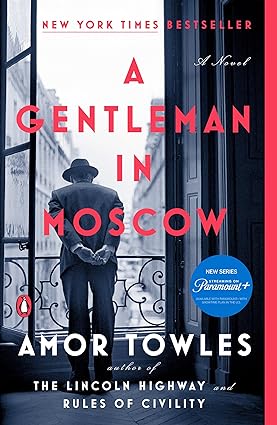
Ever since I read A Gentleman in Moscow (2016) I’ve considered Amor Towles’ writing style to be nearly perfect. So when my niece told me Towles was making an appearance at the Empire Theatre in San Antonio, I booked it. He was there to support the San Antonio Book Festival and to talk about his latest book, Table for Two. It’s a collection of six short stories plus a novella. Unlike some of his other stories, these all take place in the current Millennium.
Over the evening I learned a interesting things about Towles.
I learned that he is what we used to label in the news business, an “easy interview.” Austin’s own Stephen Harrigan (Big Wonderful Thing, 2019) was on the stage with Towles as moderator but he didn’t get to ask many of the questions on his notepad. Towles was in a talkative mood so needed little prompting.
I learned that Towles took up writing full time only after success in his first career at a small Wall Street investment firm.
I learned that once he gets a project in mind, he begins to fill notebook after notebook with hand-written outlines, ideas, scenes, characters. It may take years. He says this process frees his imagination and subconscious to go where beautiful language and the characters’ inner lives take him.
There was more but of the many memorable things I learned about this accomplished author, what I remember best, and took to heart, was his description of his research process. He said that when writing he intentionally postpones what he calls “applied research” until near the end. During this time he is also reading novels written by others that are set in the same historical period as the book he’s working on. His novel is almost written before he begins deep research.
That’s why he waited until A Gentleman in Moscow was almost finished before traveling to Moscow and checking into the Hotel Metropol, the exclusive hotel where his story about Count Alexander Ilyich Rostov is set.
Towles advised that details gleaned from this kind of active research should be written into the story much the way one might design the stage for Anton Chekhov’s The Cherry Orchard (1903). Of course Towles would choose this particular play as a point of reference because, like his own novel set in Russia, Chekhov’s tragicomedy also deals with a period of decline for the Russian aristocracy.
He said that when the curtain rises for the play the audience might see only the suggestion of a cherry orchard through large windows as if were rendered by an impressionist such as Claude Monet or Mary Cassatt. The windows might be framed by plywood bookcases painted to resemble mahogany. In the center of the room there would be a table set with a porcelain tea service.
When an author is ready to fold research into the story, Towles said it should be presented with similar layers of reality. Some details are just suggested in the background. Some, like the bookcases, give the scene the appearance of reality but need not be too detailed. Then there are aspects of research that can’t be given short shrift. For these, the author must adhere to absolute authenticity. The audience needs to hear the chair move across the floor and the teacup rattle in the saucer. The challenge for me is where all of the information that I’ve accumulated in my own research belongs – in the window or on the table?
Charles McNulty, theater critic for the Los Angeles Times, said in a June 6, 2022, review of a local revival of The Cherry Orchard, “Big things occur in Chekhov. Houses are lost, guns occasionally go off, and people die. But the focus is on muddling through.”
Much the same might be said about A Gentleman in Moscow and the subtle use of active research by Towles so that his story isn’t swallowed up in the details.
Image of Anton Chekov via Wikipedia. Public domain.
Image of stage of The Cherry Orchard via Wikipedia. Public domain.
***
A former political reporter in Austin, Dixie also taught writing at Syracuse University. When she teamed up with Sue Cleveland to write fiction, they sold a screenplay to a Hollywood producer. Although the movie was never made, the seed money financed ThirtyNineStars, their publishing company. Through it they published two award-winning thrillers (Shrouded and Digging up the Dead) under the pen name, Meredith Lee. Dixie’s first solo mystery was Bloodlines & Fencelines, set in a tiny Texas town near Austin. Kirkus reviews described the book as, “A twisty whodunit that’s crafted with care and saturated with down-home Southern charm.” She is working on second mystery in the series. www.dlsevatt.com
New reads! If, like me, you desperately miss John le Carré, consider A Spy Alone, the 2023 debut spy thriller by Charles Beaumont, a field operative veteran of Britain’s MI-6. https://bit.ly/3ZzHjHs His premise is fascinating: we know of the “Cambridge Five” who spied for Russia from the 1930’s to 1950’s—Kim Philby, Guy Burgess, Donald Maclean, Anthony Blunt and John Cairncross. https://en.wikipedia.org/wiki/Cambridge_Five But has there ever been, or could there be, a spy ring linked to Oxford? Beaumont’s protagonist Simon Sharman feels real, right from the first page:
“It is their shoes that give them away. As a lifelong fieldman, Simon Sharman hasn’t forgotten the lesson: walkers might change their jackets, pull on a pair of glasses, even a wig. But nobody changes their shoes on a job. Look at their shoes.“
I was hooked. Warning: Beaumont’s book is contemporary, well-written, tense, and may interfere with sleep.
Two other recent reads: old adventure and a new “adult fantasy.” I’d never heard of The Long Ships by Frans G. Bengtsson (1954).
Set from 980 to 1010 A.D., the book recounts the wide-ranging adventures of Norseman Red Orm Tostesson, and the collision between Christian priests (the “shaven men”) and the Norse culture of Skania at the south tip of Sweden. Now I know what it meant to go “a-viking”—to go sea-raiding! 500 pages, with Red, a very engaging Norseman. Great maps, too.
The Lost Bookshop, by Evie Woods (2024),offers time travel between the 1920’s and 30’s in Britain, and the present; a search for a lost Brontë manuscript; a disappearing attic; and disappearing and reappearing characters. I confess I flipped through big chunks, relieved when true love finally won out after two women, generations apart, survive appalling treatment. The disappearing attic reminded me of Susan Cooper’s Over Sea, Under Stone, and of course the wardrobe into Narnia in The Lion, the Witch and the Wardrobe. I’m always up for secret doors.
I’m rereading a fascinating and fairly demanding study by Graham Robb, who has probably bicycled and walked further in Britain and France than most humans:
In The Search for Middle Earth: Mapping the Lost World of the Celts (2013), he describes how the Keltoi, or Celts, developed a system of surveying based on a midline transected by the lines of the summer and winter solstice to estimate travel distances and times—a feat not replicated for centuries. He maps the Heraklean Way, the path from southwestern Iberia that runs northeast across the Pyrenees to the Alps along the diagonal of the solstice sun, which Hannibal took when he invaded Italia. He describes Druid schooling (20 years to learn) and maps out protohistoric forts which turn out to lie along survey lines. He provides amazing maps. Two ongoing lessons from Robb’s devoted research: the winners write history; and humans tend to underestimate the accomplishments of earlier civilizations.
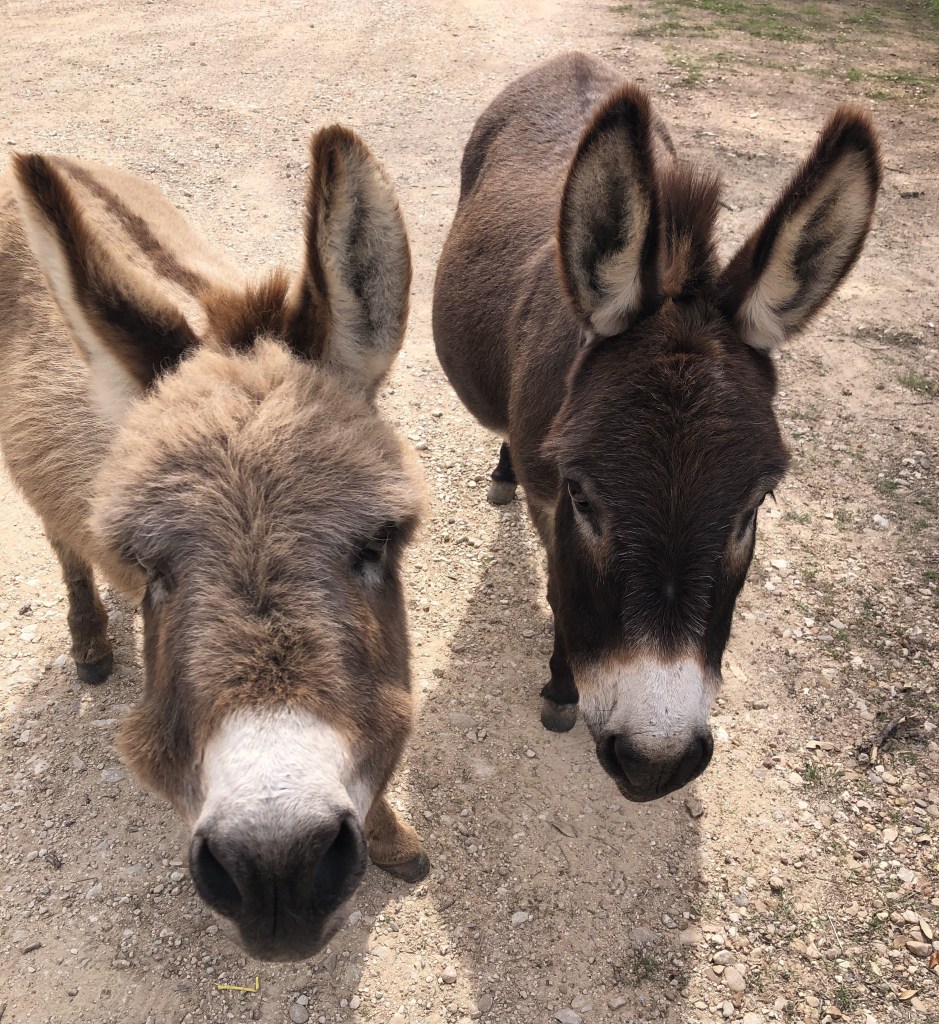
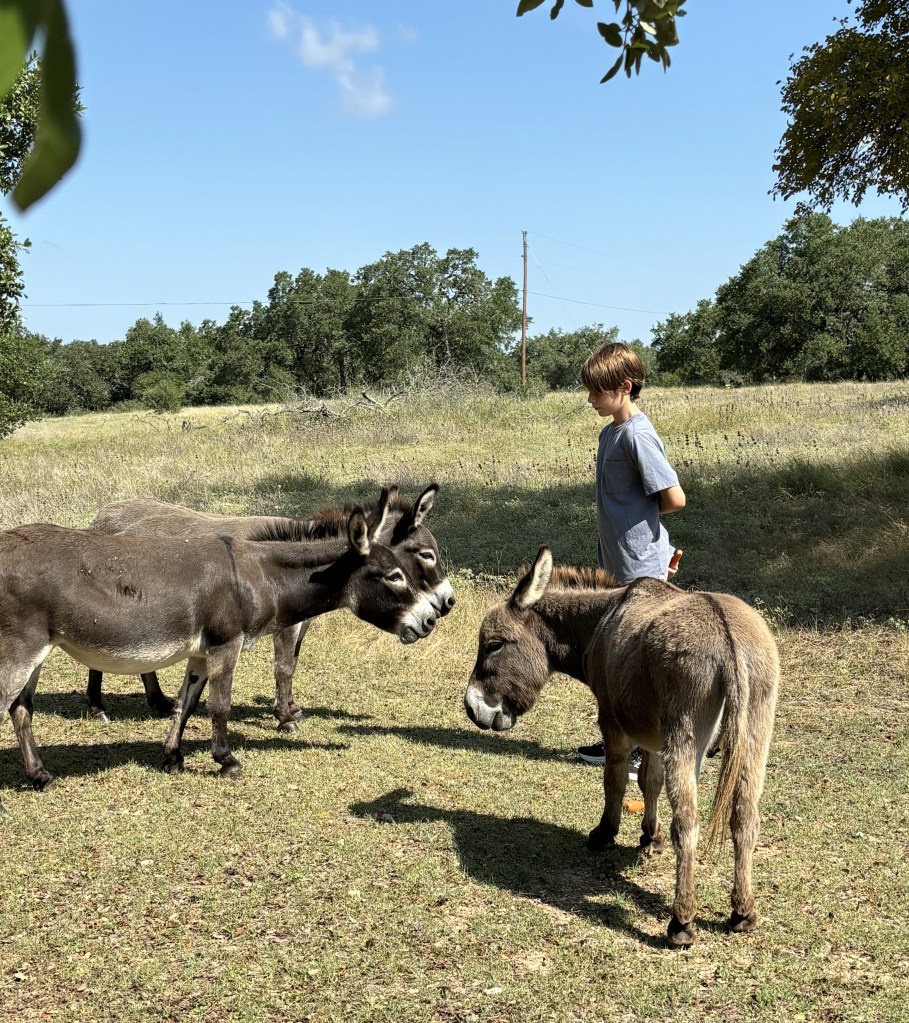
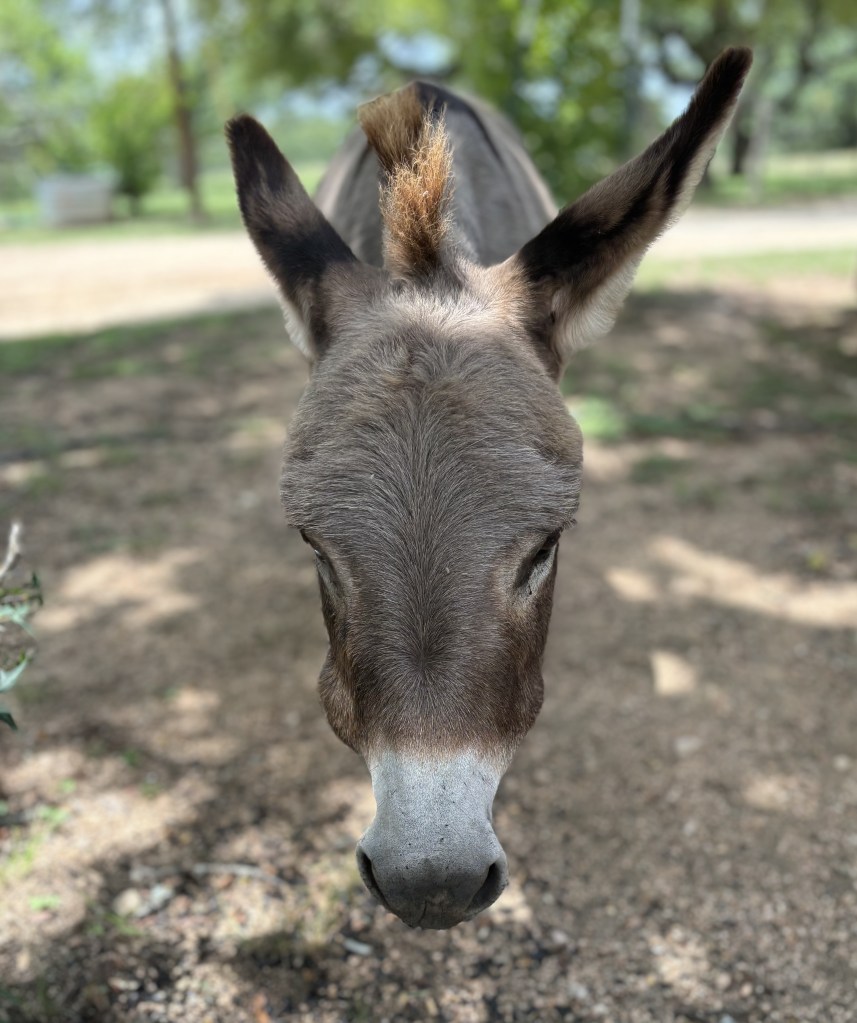
Several of you asked about the three burros, given the recent cold snap. Thank you, they’re well. Their hair’s not waterproof so in cold rain they gather on the south side of the stable, under the roof, safe from rain and the north wind. They were relieved to see green grass again after the drought broke, but they’re also eating—and rolling in––green hay. And mud!
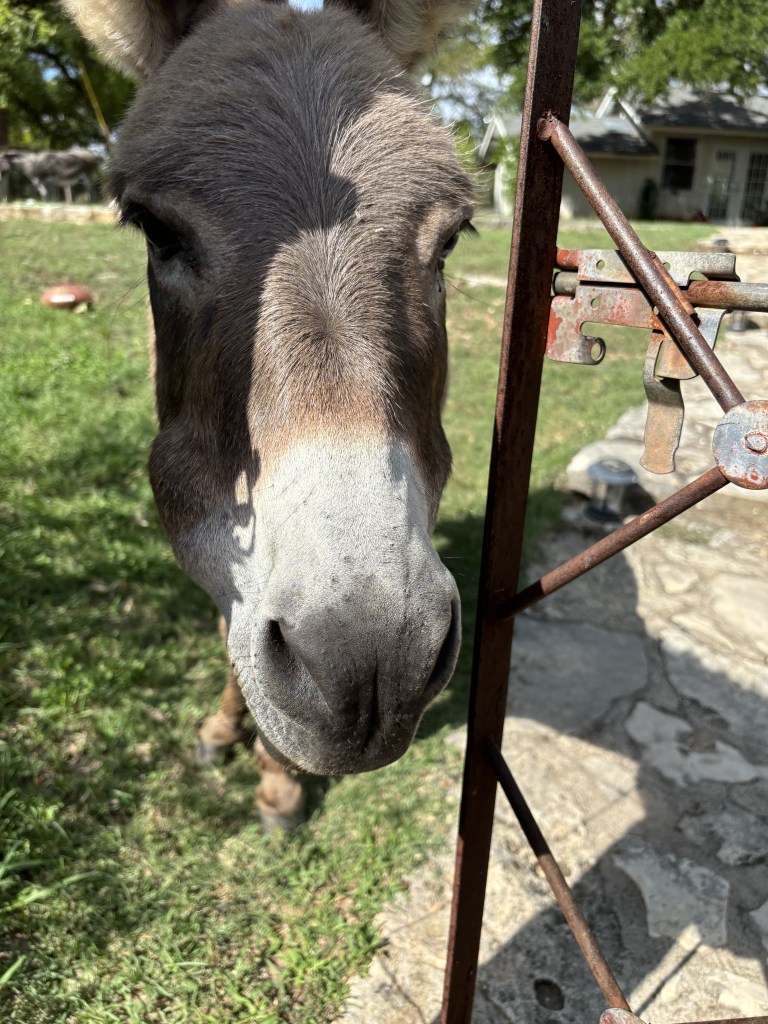
Yet despite hay, they gather outside the gate every morning and afternoon for carrots. They consider this part of their deal.
Burros are curious. They amble over to watch us garden and hang up laundry. They need company. They graze near each other. They may live into their 40’s. Sebastian, the short stubby knock-kneed male who invited himself to live here, may be 35 or more. Amanda (who insists I tell you she’s registered, with papers)may be 20. Her daughter Caroline is 12. Sebastian deems it his duty to bray loudly when any person or car appears at the end of the driveway, and to welcome the sun every morning with a stunningly loud bray. Now both Amanda and Caroline have begun to bray occasionally.
Only donkeys can bray. Unlike horses or zebras, donkeys begin a bray on the inhale and continue braying on the exhale. They have great hearing—supposedly they can hear another donkey bray 60 miles away.
They especially detest canids and will attack, dance on and kick dogs, coyotes, bobcats, foxes. A spooked horse will run away: donkeys stand together until they decide what they’re going to do. This morning, leaving for the post office, I saw the three donkeys standing together, knees locked, ears cocked, eyes fixed on two trespassing dogs who’d strayed across the cattleguard and into the donkeys’ domain.
The dogs immediately acknowledged their gross error of judgment, raced frantically away and never returned.
If donkeys could read (wait—maybe they can, but have trouble turning the pages), I predict they’d prefer mysteries. They enjoy puzzles (like how to lift the chain and invade the fenced garden).
Humans and donkeys. We are both curious animals.
Helen Currie Foster lives and writes the Alice MacDonald Greer Mystery Series north of Dripping Springs, Texas, loosely supervised by three burros. She’s drawn to the compelling landscape and quirky characters of the Texas Hill Country. She’s also deeply curious about our human history and how, uninvited, the past keeps crashing the party! Currently she’s working on Book 10. Her protagonist, Alice, gets into legal drama, and matters of the heart. Alice does have a treehouse…
The following post appeared on my personal blog, Telling the Truth, Mainly, in April 2022. But the story of my writing process is always worth a retelling. Please read on.
*************
Sometime back in the 1930s, my grandmother picked up the telephone receiver just in time to hear the Methodist minister’s wife, on the party line, drawl, “I am just wo-ahn out. I’ve been waterin’ the yahd.”
To those not in the know, the statement might not seem funny, but my family has its own criteria for funny. And so those two sentences entered our vernacular.
They were used under a variety of circumstances: after stretching barbed wire, frying chicken, mowing the lawn, doing nothing in particular.
My father would fold the newspaper, set it on the table, and announce, “I am just wo-ahn out. I’ve been waterin’ the yahd.”
I am wo-ahn out now but not from waterin’ the yahd.
Putative novel 2022
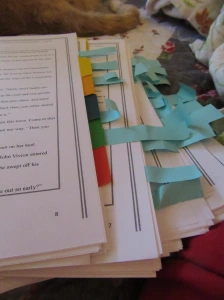
Last night David, the family’s official printer, printed the manuscript of what I’ve been calling my putative novel. It runs to over two hundred pages, 51,000 words. It isn’t finished—far from it. There’s more to write, scenes to put in order, clues and red herrings to insert, darlings to kill. All that stuff. And more.
However, for the first time it feels like I can stop calling it putative. No longer supposed, alleged, or hypothetical. It’s looking more like a potential novel. Possible, Even probable.
Now, about being wo-ahn out.
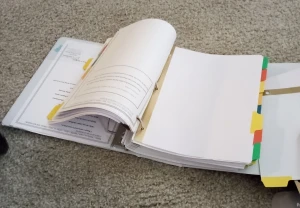
Last night I started putting the manuscript, scene by scene, into a three-ring binder. That required using a three-hole punch.
I hate using three-hole punches. I hate fitting the holes in the paper onto the binder rings. They never fit properly. Getting them on the rings requires effort. It’s tiring.
When I went to bed, I was all the way up to page 37.
Then I woke at 5:30 this morning. Instead of turning over and going back to sleep, I got up. I just couldn’t wait to get back to organizing my manuscript.
But I didn’t organize. I managed to drop the whole thing onto the floor and then couldn’t pick it up. (I’d had knee surgery and wasn’t quite up to bending over that far.) I had to wait for David.
Putative novel 2022-2024
By the time the notebook and manuscript were back in my possession, I was sick and tired of the whole thing. I played Candy Crush.
If I’d had any sense at all, I’d have gone back to bed. I was sleepy. I felt awful. I needed to sleep.
But did I go back to bed? Noooooooooooooooooooooo. That would have been the act of a rational person.
I stayed up added to my sleep deprivation.
I could go to bed right now. I could conk out and tomorrow feel ever so much better.
But will I? No. Because I’m too tired to stand up, too tired to put on my pajamas, too tired to pull down the sheets.
I am just wo-ahn out. I’ve been waterin’ the yahd.
***
Things have changed since 2022. Some days, the novel has reverted to putative, but on most days, it’s still possible. Thanks to extensive revision, the current draft bears little resemblance to the one in the notebook. I have given up three-ring binders and three-hold punches.
***
M. K. Waller’s latest story, “Mine Eyes Dazzle,” appears in the eclipse-themed anthology Dark of the Day, edited by Kaye George (Down and Out Books, 2024). Other stories appear inDay of the Dark (Wildside, 2017), Lone Star Lawless (Wildside, 2017), Murder on Wheels (Wildside, 2015), and online on Mysterical-E. She is co-author of the novella Stabbed (Starpath, 2019), written with Manning Wolfe. She also writes as Kathy Waller. She lives in Austin and blogs at Telling the Truth, Mainly.
I can’t tell you how many times I’ve come across a quote, an idea or something else I wanted to remember and thought, “I need to write that down.”
So I did.
Over and over and over.
In countless notebooks and journals and on post it notes.
The problem I found is that, while committing something to paper is an important first step, it is only a first step. There are many moments where I’ve written something down only to lose it amongst some ephemera, discovered only again when I’m looking for something else.
It’s like finding twenty bucks in those shorts from last summer. It’s a nice surprise, but maybe I should try tracking this information (and my dollars) a bit better.
First, I tried using a Bullet Journal…
The Bullet Journal was created by Ryder Carroll as a way to organize schedules, to-do lists and other details for work and personal life. It started as his own method of corralling his many thoughts and commitments into a central place. It’s a fantastic method for many dedicated BuJo lovers, and the premise is simple. All you need is an empty notebook and a pen.
Turns out, you also need a certain mindset. It’s a commitment.
Image Credit: @pureplanning_bymj
I have so much admiration for dedicated Bujo people. And I love seeing their gorgeous daily/weekly/monthly spreads, but I could never stick with it. I do have one completed book—used over a two-year period—that I enjoy leafing through now and then. Scattered amongst those pages are several quotes, concepts and ideas that I wanted to gather in a more central location, to rescue from my failed experiment.
I still love the idea. I just stink at the execution.
This is when I discovered the Commonplace Book.
A commonplace book is simply a notebook where you record learning and information from other sources for the purpose of collecting and reflecting upon for some future time. Many notable people in history have kept commonplace books, including Virginia Woolf, Mark Twain, Marcus Aurelius, Ralph Waldo Emerson, and Henry David Thoreau. (Image Credit: UT Austin, Harry Ransom Center, Lewis Carroll’s CPB)
Unlike a Bullet Journal, which has its own system, a commonplace book only requires that you collect your ideas, quotes and more in one location. What you choose to include is completely up to you. The most common use is for recording secondary sources, but that can take all forms. Music lyrics? Key dialogue from a movie you love? Put them all in one place. I keep my commonplace book on my desk so I can access it when I’m reading or working on a project. Others prefer to always carry one, ever prepared to catch that next inspirational idea while out for a daily walk or in a coffee shop.
Unlike a journal, with content focused heavily on personal thoughts, musings and experiences, a commonplace book is something designed to help you learn from others. These ideas may spur some new thoughts or considerations, and this is a perfect place to record those as well. It can be anything you like, of course, but it’s not the best place to record daily tasks or reminders. Keep your digital or paper planner for those purposes (and feel free to ask me about planners because I will happily engage in that topic, too).
There is scientific evidence that supports the theory of choosing to write by hand rather than typing into a digital document. A recent study from the University of Tokyo showed that graduates revealed that “writing on physical paper can lead to more brain activity when remembering the information an hour later. Researchers say that the unique, complex, spatial and tactile information associated with writing by hand on physical paper is likely what leads to improved memory.” (Science Daily).
My commonplace book has a wide variety of quotes and concepts tucked inside. Adam Grant, Anne Lamott and James Clear make regular appearances on my pages. I can tell by my handwriting how I’m feeling because my messier cursive signals I’m in a rush while my neater entries show that I’m taking time to really consider what I’m transcribing. The important part is the practice. Keeping a commonplace book encourages my love of learning, of reading and of writing. There is a quiet joy in taking time to learn something new, to consider it and then commit it to paper.
Maybe you’re already doing some form of this practice. I was, and it was only when I sought to improve my process that I learned about the commonplace book and how to better use it in my daily life. Having one location helps me gather this knowledge and, more important, keep it somewhere that allows me to reflect and learn. If you haven’t tried keeping a CPB, I hope you’ll consider it, and I would love to hear how it works for you.
Laura Oles is the Agatha-nominated and award-winning author of the Jamie Rush mystery series. Her work has appeared in crime fiction anthologies, consumer magazines and business publications.
“Education is not the filling of a pail, but the lighting of a fire.”
While there is some debate as to whether this quote belongs to William Butler Yeats, the sentiment is one that has stayed with me, particularly throughout my writing career. One of the best things about being a writer is that it requires ongoing education. I love that my job demands regular research. I’ve gone down more rabbit holes that I care to admit, but it’s this spark of learning something new that fuels my enthusiasm for my fiction.
I experienced a wonderful “lighting of a fire” during my week in Salem, Massachusetts at the Writer Unboxed Unconference. Unlike other writer conferences that I attend (and love), this one involved being solely a student for the entire week. The conference welcomes all genres, and spending time outside of crime fiction gave me some valuable insight into how others approach storytelling, structure and character development.
Therese Walsh opened with her session titled “Good Chaos: Provocation and Invitation,” and by the end, I knew this week would be one of time well invested. Susan DeFreitas is a gift to writers. Her session, “Emotional Alchemy,” was so thoughtful and packed with practical advice that I took ten pages of notes. I’ve re-read them twice since returning home. And as someone who gets excited about outlines, timelines and plotting considerations, her “Anatomy of a Novel: Create a Blueprint” session provided me with specific skills to apply to a current project.
Watching Tiffany Yates Martin stand in front of a room to discuss fiction is an experience I hope every writer gets at least once. Her passion, knowledge and enthusiasm for characters, craft, storytelling and readers rolled through the room. She’s also damn funny. I left with another ten pages of notes.
Because there were two session tracks, I was forced to make difficult choices regarding the schedule, and I know that I missed several other excellent sessions. Lunch breaks provided the opportunity to explore a bit of Salem, walking through downtown and adjacent neighborhoods. Evenings were spent sampling different restaurants, and I left with a favorite pub (O’Neill’s), sushi spot (Finz Seafood & Grill—the Lobster Maki Roll was fabulous), coffee shop (Lulu’s) and bookstore (Wicked Good Books). That I was able to experience this week with some of my favorite writer friends made it even more special.
Returning home with a novella sized document full of notes, I took my time reading through them, extracting additional gems, and analyzing how they might influence my own projects. I’m back at my desk, and the spark remains. The learning continues, and it seems I will never graduate.
If so, I would consider that success.
Laura Oles is the award-winning author of the Jamie Rush mystery series. Her debut mystery, Daughters of Bad Men, was an Agatha nominee, a Claymore Award finalist, and a Writers’ League of Texas Award finalist. Her work has appeared in crime fiction anthologies, consumer magazines and business publications. She loves road trips, bookstores and any outdoor activity that doesn’t involve running. https://lauraoles.com
Up to now, I’ve avoided a particular phrase in describing my Pastor Matt Hayden Mystery Series. And the secret is…I write Christ-centered mysteries.
To me, this term is more accurate in describing my books than calling it Christian fiction. Of course, it is Christian fiction. However, a lot of folks who read Christian fiction expect there will be no swear words, no blood on the page, nothing that would be considered “controversial.”
In my Christ-centered mysteries, I like to acknowledge the real world, just as Christ lived in the real world during His time on earth. He ate with taxpayers, drank wine (heavens, His first miracle was to create some awesome wine for a wedding banquet at His mother’s request), hung out with tax collectors and bad guys. Although He was incredibly within His rights to judge others, He did not. Instead, He loved them.
My character, Pastor Matt Hayden, has existed in the real world. He came from a police family. His father was a police captain, his brother was an officer on the bomb squad, and Matt was an undercover cop on the Miami docks. Then a corrupt police chief killed both his father and brother as they had been getting too close to outing the chief’s crimes. Finally, the chief came after Matt. A confrontation ensued, and Matt had the opportunity to kill the chief. God stayed his hand. And Matt was called to become a pastor, which he did when he entered the Federal Witness Protection Program.
Matt becomes a pastor who is very familiar, maybe too familiar, with the real world. He knows, as Jesus knew, people who were crooks, prostitutes, alcoholics–you get the gist. And Matt does not condemn them. He holds them to account, of course. But his main goal is to love them.
So, in my books, you’re going to hear swear words, ‘cuz bad guys swear. And Matt’s girlfriend owns a bar. And bad stuff happens to good people, and good people sometimes slip up and do bad things.
That’s life.
I have to acknowledge this reality, because I saw folks lie to my dad a lot. My dad was an incredible Lutheran minister. The messages from his pulpit were all about love. But what I saw, that dad didn’t always see, was the “act” some folks were pulling on him. Whenever we’d go to a parishioners home, the family Bible was always on display, the best china was on the table, everyone was dressed nicely, and we all said grace before and gave thanks after a delicious meal. But I knew that some people weren’t always so crystal clean. Not everyone, by a long shot. I love the people of those churches. Good, loving people. But there were a few that had issues. One of my dad’s “good” friends was a regular at a questionable bar in town with a woman on his lap who wasn’t his wife. Dad never knew this; I didn’t want to break his heart. This type of thing happened from time to time. Sometimes dad’s world wasn’t real.
Jesus, on the other hand, couldn’t be hoodwinked. And I wanted Matt to come into his ministry with his eyes wide-open. And I want my books to show Matt’s faith and desire to love in a real-world setting.
So, if you go to the link above to get my books, you will see that this is the first time I’m saying my books are Christ-centered mysteries. And when you get there, you will see the name of this promotion is…
November Edgy Christian Fiction.
So, I guess I’m living on the Edge. But now you know my secret.
K.P. Gresham, Author
Professional Character Assassin
K.P. Gresham is the award-winning author of the Pastor Matt Hayden Mystery Series as well as several stand-alone novels. Active in Sisters in Crime and the Writers League of Texas, she has won Best Novel awards from the Bay Area Writers League as well as the Mystery Writers of America.
In My Reading Life, a grand book about reading and writing, author Pat Conroy says, “The most powerful words in English are ‘tell me a story…’” bit.ly/3PpSoHF
Yes! And don’t we know stories demand––require––insist on characters? Fairy tales––Jack in the Beanstalk, Hansel and Gretel. Epics––The Fellowship of the Ring, Star Wars.
I love the beginning of Emily Wilson’s recent translation of The Odyssey: bit.ly/43Bdjvi
Tell me about a complicated man,
Muse, tell me how he wandered and was lost
When he had wrecked the holy town of Troy…
…Now, goddess, child of Zeus,
Tell the old story for our modern times.
Find the beginning.
So, how do writers create memorable characters? What works to create character? And why do we care? Isn’t it because character drives narrative?
Recall Shakespeare’s famous terse description in Julius Caesar: “Yon Cassius hath a lean and hungry look…” Those ambiguous words reach beyond the man’s shape or facial expression to hint at driving ambition…the very subject which drives the play’s narrative.
How does Jane Austen create character? Looking back, I am surprised by the lack of physical description. She doesn’t tell us what Mr. or Mrs. Bennet, or the five daughters, look like. We’re given a few visual breadcrumbs, told that Bingley and Darcy are “handsome” and that Bingley “wore a blue coat and rode a black horse.” But her characters, with their personalities, their actions, largely come to life in our minds otherwise: by conversation.
Elizabeth overhears Mr. Darcy describing her as “tolerable but not handsome enough to tempt me”—a criticism she later recounts to friends, “for she had a lively, playful disposition.” Okay, there’s one aspect of Elizabeth—lively and playful. Yet after telling friends that Elizabeth “had hardly a good feature in her face,” Darcy “began to find it was rendered uncommonly intelligent by the beautiful expression of her dark eyes.” So she’s also intelligent! Elizabeth tells her sister Jane, “you are a great deal too apt…to like people in general. You never see a fault in any body.” Elizabeth is not just “playful” and “intelligent,” but a critical observer.
Using dialogue––what Elizabeth and Darcy say––Austen shows us how Elizabeth—and ultimately Darcy––think. In a world focused on superficiality—class, wealth, appearance, social skills and niceties––Austen makes us care about two characters who are too smart, too critical, too thoughtful, not to keep thinking and––ultimately––change their minds. Their characteristics (both pride and prejudice!) drive the narrative.
But hey, what about those dark eyes? Mr. Darcy disturbs the haughty Miss Bingley by saying he’s meditating on “the very great pleasure which a pair of fine eyes in the face of a pretty woman can bestow.” As all Austen readers know, that specific detail––“[A] pair of fine eyes”––will also powerfully move the plot.
Texas’s Larry McMurtry shows us how conflict between characters drives narrative. In his Lonesome Dove, the first character we meet is Augustus, sitting on the porch at the Hat Creek Cattle Company, in “the smidgin of shade he had to work with.” He has retrieved his jug from the springhouse and, as is his custom, he’s drinking Tennessee mash whiskey, which makes him feel “feel nicely misty inside.”
We’re in Augustus’s point of view when we meet his counterpoint, the other key character, his stubborn partner Captain Woodrow Call. Augustus, when he hears the whir of a nervous rattler in the corner of the springhouse, believes “in giving creatures a little time to think.” He doesn’t shoot the snake; he waits until the rattler has “calmed down” and crawled out a hole. He contrasts his own behavior to Call’s:
Call had no respect whatsoever for snakes, or for anyone who stood aside for snakes. He treated rattlers like gnats, disposing of them with one stroke of whatever tool he had in hand. “A man that slows down for snakes might as well walk,” he often said.
As Call and their diffident hand, PeaEye, arrive at the porch, Augustus notes that while he himself stands four inches taller than Call, and Pea Eye three inches taller, there’s no way to convince Pea Eye that Call is the short man: “Call had him buffaloed.” Augustus knows that if a man means to hold his own with Call, that man must keep in mind that Call isn’t as big as he seemed. Thus Augustus begins many a day by remarking, “You know, Call, you ain’t really no giant.”
McMurtry doesn’t give us a detailed physical description of Augustus or Call. Instead, we hear them banter. We see Call’s impact on others, and how Augustus works to maintain his own status vis à vis Call. Right off the bat McMurtry makes us feel the sheer force of two characters, two magnetic and conflicting personalities, and their relationship, as we’re launched into this epic tale. Their characters, the combined magnetism and conflict, drive us to Montana…and back…
We first meet Sir Arthur Conan Doyle’s character Sherlock Holmes in A Study in Scarlet, when Holmes is introduced to the narrator, Dr. Watson, as a potential roommate. Watson walks into the lab: “There was only one student in the room, who was bending over a distant table absorbed in his work. At the sound of our steps he glanced round and sprang to his feet with a cry of pleasure. ‘I’ve found it! I’ve found it,’ he shouted to my companion, running towards us with a test-tube in his hand.” Then he shakes hands with Watson: “You have been in Afghanistan, I perceive.” Watson is astonished. bit.ly/3N0U4Ep
We get no actual physical description of Holmes until Chapter Two. Instead, we confront Holmes’s vigor, curiosity, perspicacity, confidence in his own powers. Similarly, in “A Scandal in Bohemia,” Watson first describes Holmes’s “immense faculties and extraordinary powers of observation” in deciphering clues. Then, looking up from the street, Watson sees the detective’s silhouette on the window-shade: “I saw his tall, spare figure pass twice…He was pacing the room swiftly, eagerly, with his head sunk upon his chest and his hands clasped behind him.” Watson instantly knows, “He was at work again.”
The author engraves that image of Holmes, pacing eagerly, on our imaginations. We can’t wait to see Holmes in action: that’s what we’re reading for.
Herman Melville deprives the reader as well as Ishmael, the narrator of Moby Dick, of even one glance at Captain Ahab until Chapter 28, when Ishmael is well out to sea on the whaling ship Pequod. Ahab finally appears on deck and stands erect, holding on by a shroud, his bone peg-leg planted in the auger hole drilled on deck for that purpose:
There was an infinity of firmest fortitude, a determinate, unsurrenderable wilfulness, in the fixed and fearless, forward dedication of that glance. Not a word he spoke; nor did his officers say aught to him; though…they plainly showed the uneasy, if not painful, consciousness of being under a troubled master eye…moody stricken Ahab stood before them with a crucifixion in his face; in all the nameless regal overbearing dignity of some mighty woe.
The word “character” comes from the Greek root for “engraving tool.” https://www.merriam-webster.com/dictionary/character If ever character was engraved on a person’s body, Melville’s description of Ahab and his impact on his shipmates qualifies. The uneasy silence of the officers! The crucifixion in Ahab’s face! His unsurrenderable wilfulness, fixed and fearless!
If that’s not enough foreshadowing, in Chapter 36, Ahab demands the entire crew to assemble and then hammers a gold piece to the mast for the first man who sees the white whale which took off Ahab’s leg—Moby Dick. Starbuck objects: he signed on to hunt whales, not to take vengeance on a mere animal, which he calls blasphemous. But Ahab makes the rest of the crew swear: “Death to Moby Dick!” Melville creates a character whose physical description conveys tragic history and deep emotion, and whose forceful actions persuade the crew to follow him. We know there’s no stopping Ahab now. And we haven’t yet met the whale.
Pat Conroy also tells us, in My Reading Life, of the day his beloved high school English teacher, Greg Norris, took sixteen-year old Conroy to visit the poet Archibald Rutledge. Rutledge “suggested that I make the close observation of nature part of my life’s work and that I learn the actual names of things,” because “specifics always proved fruitful to the validity of any narrative”:
“A Cherokee rose, not just a rose. A swallowtail butterfly, not just a butterfly. That kind of thing,” he said. “Get the details right. Always the details.”
Always a great reminder for mystery writers. My character Alice, in the Alice MacDonald Greer Mystery series––stays on me to get the details right. https://bit.ly/3qC2fzI
So–tell me a story! Show me the character! Get the details! And we’re off!
About Helen Currie Foster
I live north of Dripping Springs, Texas, supervised by three burros. I’m deeply curious, more every day, about human history and prehistory and how, uninvited, the past keeps crashing the party. I’ve loved the Texas Hill Country since my first sight of it as a teenager. Artesian springs, Cretaceous fossils, rocky landscapes hiding bluegreen water in the valleys. After law school (where I grew fascinated with water and dirt) I practiced environmental law and regulatory litigation for thirty years––then the character Alice suddenly appeared in my life. I’m active with Austin Shakespeare and Heart of Texas Sisters in Crime. And I’m grateful to the readers who enjoy the Alice MacDonald Greer Mystery series!
I’m a little out of practice being part of a crowd. This last year has taken me down some unforeseen roads, avenues that are only now leading back to some normal semblance of my daily life.
More on that in a minute.
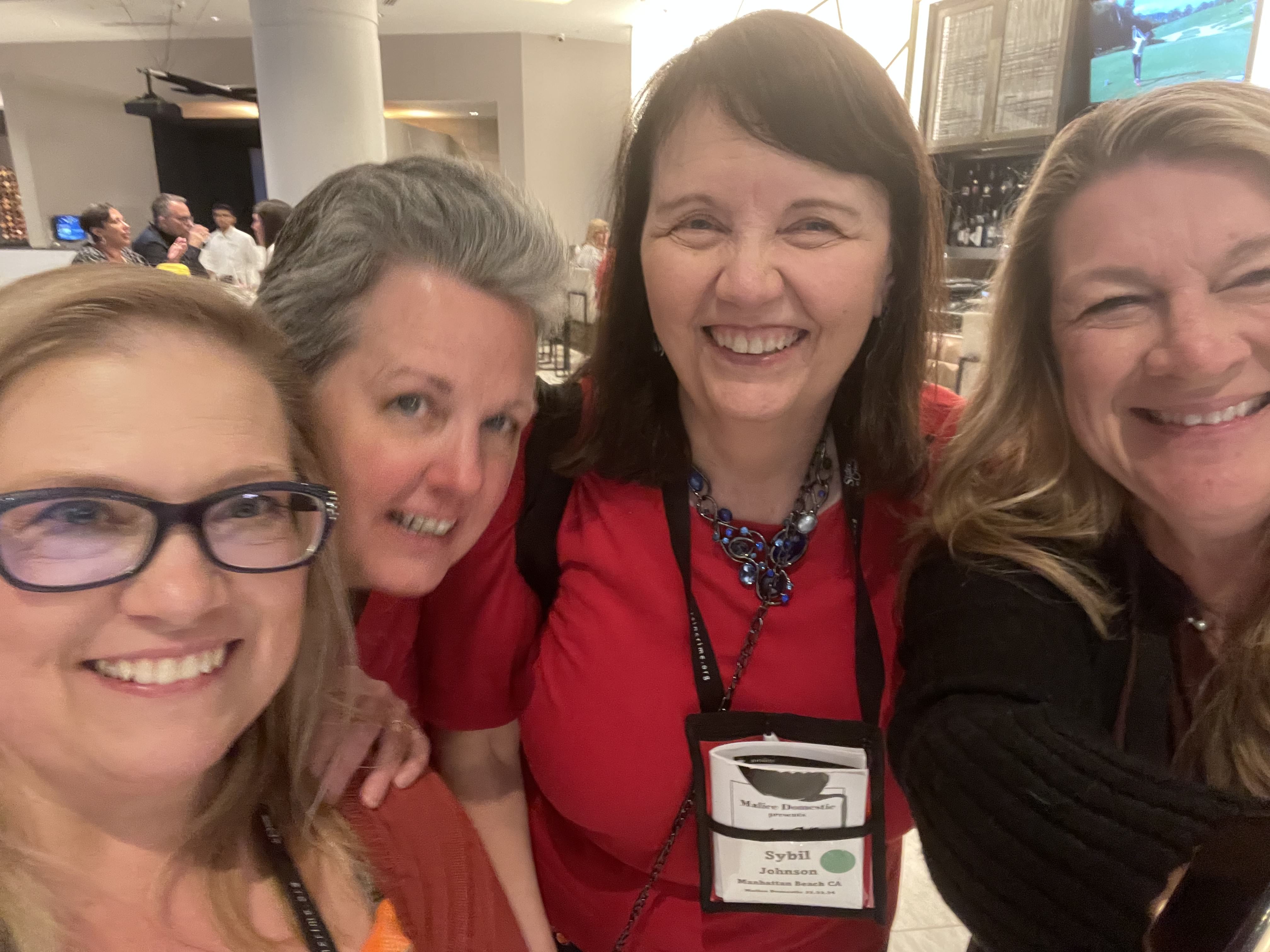
Speaking of crowds, I recently attended Malice Domestic (a mystery readers and writers conference) and also served as a speaker at an event at a gorgeous library in the Texas Hill Country town of Kerrville. May has meant time talking with readers about the stories they loved, connecting with other writer friends whose work I admire, and basking in the joy that is having endless conversations about the nuances of storytelling, structure, and world building.
Yes, I’m still willing to have the plotter/pantser debate. Also, I’m pro Oxford comma.
As I get my groove back attending writing conferences and other book events, I realized something.
I missed these people.
Not only as a writer but also as a reader. Reading has always been an important lifeline for me, especially in my youth when I was moving almost every year to a new school as part of an Air Force family. But books were a particularly important part of my survival toolbox once 2022 kicked down my door. It was the works of many talented authors that supported me, in part, through this last year.
Let me explain with a small detour about a big topic:
My younger sister had a horrific beginning to 2022, starting with a perfect storm of medical events culminating in her experiencing (according to one of her many doctors) “too many strokes to count.” She then fought her way through an entire year of re-learning to do everyday things, learning to do some things differently, and keeping her razor-sharp sense of humor intact. I was grateful that I was able to spend weeks at a time with her during her hospital stays and then assisting in adjustments to being at home as she reclaimed her life. I’m sure I smothered her with too much attention and hovering, and I’m grateful that she trusted me enough to be a part of her recovery.
Did I mention that she was also pregnant at the time? As a surrogate? (The baby is, remarkably, completely healthy, and lovely.) And then she needed to have open-heart surgery? My sister is a fierce force of nature. Her recovery has been astounding, hard won, and also complicated in many ways. She has shared her story far more eloquently than I ever could—it’s her story after all. She’s also a gifted writer.
While many people have followed her incredible journey—and she has been so graciously open with the difficult details of her recovery—this is the first time I’ve been able to write about it in any format. For someone who makes a living with words, this last year left me speechless.
And then towards the end of 2022, I had my own health scare, which required tests, a biopsy and then surgery. My recovery was a good one, and I was able to enjoy the holidays with my family. At this point, I wanted nothing more than to see 2022 in my rear-view mirror. When I talked to my sister about how my scar would heal and how visible it would be, she told me, “Be proud of that scar. You earned it.”
During this last year of medical emergencies and the restless waiting of recoveries, my own writing simply wouldn’t come. I was immersed in traveling, caregiving and trying to keep myself together. I simply had no space for writing stories—I was too busy living this one—but I did find comfort in reading. I read short stories, novellas, and novels, grateful for these authors who gave me the gift of their created worlds. I needed a break from my spinning universe, and immersing myself in a book in the late evening hours gave me respite that, to this day, I know helped me through it all.
I started this year giving my calendar some serious side-eye, afraid to make any plans for fear of the next crisis to come. But then, while walking down a favorite stretch of beach in Port Aransas with my husband over New Year’s weekend, I spotted a beautiful shell. A lighting whelk, nestled in the sand. In my twenty-five years of walking that beach, I’ve never come across a shell so lovely. I took it as a sign that maybe it would be okay to consider better things would come, that being afraid of hope might be energy wasted. That shell sits on my desk as a reminder that the future holds promise as well as challenges.
I resumed making plans for the year, attending conferences, book events and celebrations. Part of me fears declaring such plans to the universe, but then again, if anything happens, I hope my writing community will wait for me until I can return. Until then, I’ll do the best I can with a book on the nightstand.
Sometimes, it’s the little things.
Laura Oles is the award-winning author of the Jamie Rush mystery series. Her debut mystery, Daughters of Bad Men, was an Agatha nominee, a Claymore Award finalist and a Killer Nashville Readers’ Choice nominee. Depths of Deceit, her second novel, was named Best Mystery of 2022 by Indies Today. She is also a Writers’ League of Texas Award finalist. Her work has appeared in crime fiction anthologies, consumer magazines and business publications. She loves road trips, bookstores and any outdoor activity that doesn’t involve running. https://lauraoles.com
Still on the research kick, I’m in the process of learning all about moonshine. No, not how to drink it. How to make it. While plotting out my next book, Death Takes the Fifth, I realized moonshine (and by extension, moonshiners) would play an integral role in the story. Let’s be clear—making moonshine is a against the law in 48 states unless you’ve got a distributor’s license, so DO NOT make this stuff. And, for the record, the moonshiners in my book get in a lot of trouble for what they’re doing.
I got the idea from watching the TV show, “Moonshiners”, on Discovery TV. Yep, I’ve followed the cast through quite a few of their antics, whether it be finding a still site, constructing a still, what kind of water makes the best hooch, recipes for anything from whiskey to gin to absinthe, and how to escape the law (well, moonshiners try, anyway). I even bought a jar of (legal) moonshine marketed at a nearby liquor store to see how it tastes. I’m pretty sure the storebought version is lower in alcohol content and therefore has less of a bite than the real stuff, but I still saw a few fumes behind my eyeballs.
After recovering from that bit of research, I started jotting down some of the facts I needed to make sure the moonshiners were correctly depicted in my book.
The most important ingredient in moonshine is the water. From what I understand, spring water loaded with limestone makes the best liquor. We have a lot of limestone in Texas. Heck, the exterior of my house is limestone. And there are plenty of springs around Austin for this to be a viable process. Once you have your water, it’s time to make the mash.
Oh. The mash. That’s the combination of grains (corn or barley or wheat, etc.), sugar (which brings up the alcohol level–can be anything from refined sugar to sugar beets), water, and aromatics (can be fruit or spices or herbs depending on what type of moonshine you want to make) and yeast. For example, if you want to make a gin moonshine, you must have juniper berries–which can taste pretty strong. The moonshiner might counter that with ingredients like cardamon pods, peppercorns, anise, lemon/orange peels, cinnamon—you get the drift. The mash is then sealed in a big tub (whiskey-aged barrels give it a real nice quality, I understand) and allowed to sit for seven to ten days for all of it to ferment.
By now, it’s time to find the location where you’re actually going to make the moonshine. Near a limestone spring is optimal. It’s also important that the site be away from hikers, hunters, and passers-by. You do not want anyone stumbling on to your still site and either stealing your stuff or calling the police. Again, it is ILLEGAL to make moonshine without the proper permits. Also, moonshiners like to find a spot where they can make a quick get-away if the revenuers come a-calling.
While the mash is doing its chemical thing, its time to construct the still. The folks on The “Moonshiners” tend to favor copper stills, but I’ve seen them make it out of empty beer kegs, old barrels, etc. I’ve inserted a diagram below describing the design of a rather simplistic still. Everything is welded together.
The mechanism on the far left is where the now fermented mash is poured and heated (to somewhere starting at 170 degrees Fahrenheit.) The steam put off by the mash is the alcohol. The steam goes through the cap arm into the thumper keg where it mixes with cold water, thus increasing the alcohol level. After going through the thumper, the now liquid alcohol goes into the warm box and spirals down to the spout. When the liquor’s ready, it comes out the tap or spout. To make sure the liquor doesn’t go everywhere, the moonshiner puts a (pardon the language) coon dick in the spout so the liquor pours straight into whatever container you’re putting the moonshine in. I’ve seen The Moonshiners use gallon glass jugs, plastic milk jugs, mason jars, etc.
About the coon dick. Yes, it really is a raccoon’s…umm…tally whacker. And yes, the aforementioned tally whacker on a raccoon has a bone in it that is perfect for keeping a steady stream of moonshine heading right into the waiting container. (I’m not making this stuff up.)
Now it’s time to see if the moonshine is any good. First off, the moonshine product should be clear. Next, the moonshiner usually uses a mason jar to test the alcohol level of the product. They fill the jar halfway, put the lid on tight, turn it on its side and shake the jar. The bubbles will tell the story. If the bubbles are large and pop pretty quickly, the alcohol level in the jar is high. If the bubbles are small and stay around a while, the alcohol level is low. And, of course, there’s the taste test.
I’ve had a blast learning about all of this, but then again, I love to do research. Between the TV show and the internet, I hope I’ve created some plot twists and characters that you will enjoy as much as I do.
Moonshine is Mighty Fine and ILLEGAL!" data-content="https://austinmysterywriters.com/2022/09/05/moonshine-is-mighty-fine-and-illegal/" title="Share on Tumblr"data-posttype="link">Share on Tumblr












 Austin Mystery Writers

