By Helen Currie Foster
Molly Ivins—always a truth-teller—described the state this way: “Texas! Land of wretched excess!”
Yes, I also quoted her in a March 2025 blog. But I was describing sustained icy weather.
This time? Austin weather persons say it has not rained here this August!
And as you’ve noticed, temperatures continue to spike above 100 degrees. Outdoor house plants? In a fit of mercy, maybe you brought some back inside.
That’s what we did today for five jasmine plants, acquired in grad school, that we’ve cosseted for decades. Decades! Usually they live indoors in winter, or on the deck in summer.
But this week, walking past them, I felt a disturbance. Even with daily water, even with blossoms, I felt warning signals.
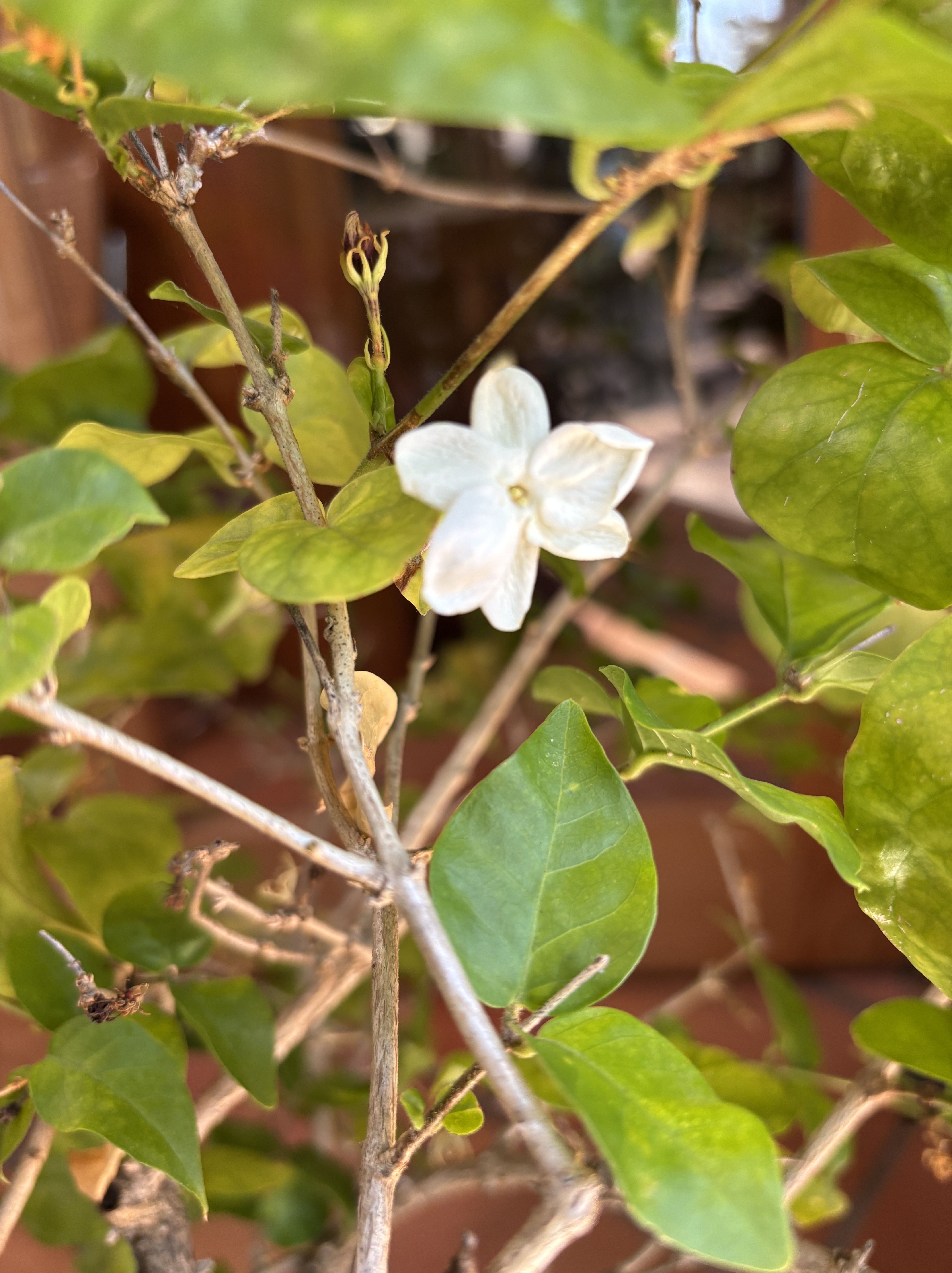
Was that just my…overheated…imagination? Plus the fact that, as eloquently sung in Kiss Me Kate, “It’s too darn hot!”?
Or was it more? I’m reading Michael Pollan’s A World Appears (2026), about today’s ongoing scientific debate over the nature of consciousness—a topic humans have wondered about for millennia. https://www.scientificamerican.com/article/what-is-consciousness-science-faces-its-hardest-problem-yet/\; https://www.sciencedaily.com/releases/2026/07/260729043829.htm
Per Pollan: “A great many mammals, several bird species, and octopuses are now generally thought to be conscious, and there are scientists and philosophers who believe that some rudimentary form of consciousness, or sentience, reaches much further, all the way to insects and, possibly, beyond the animal kingdom.” (Id., at 1.)
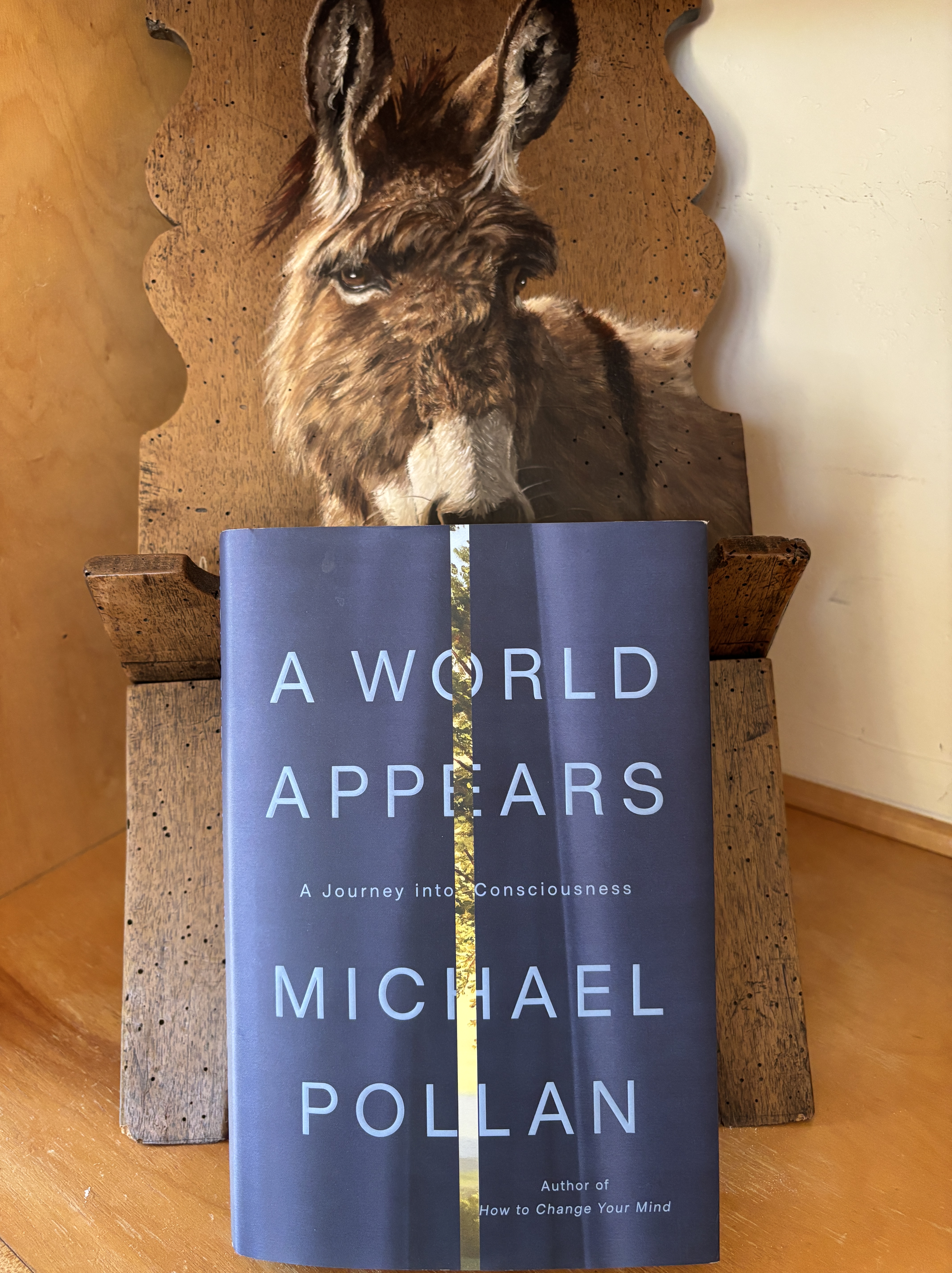
Beyond animals? Yes, all the way to plants!
So, are plants sentient? One plant scientist points to “all the volatile compounds emitted by a succession of plants, from poplars and tobacco plants to peppers and olive trees. Plants emit volatile chemicals for a range of purposes: to signal distress, to alert neighboring plants to threats, to thwart or poison herbivores, and possibly even to soothe themselves (many plants emit ethylene, an anesthetic gas, for reasons not well understood.” Id., at 20.) (Please to note Pollan has inserted plants in the middle of the cover.)
So maybe our jasmines emitted a volatile alarm chemical. Was the alarm intended for humans? Who can tell? But the plants made it inside…
It’s a “hard problem,” the whole “consciousness” debate that Pollan’s book describes, and we’re in for a fascinating scientific journey.
Query for you mystery readers: would you agree that it’s premature for the unraveling of a murder mystery to depend on warnings from plants? For one thing, the science is evolving. But also, to provide a real fact-based clue in a mystery, should the plant’s warnings alert not just perhaps other plants, but a human? The detective, a witness, the victim—or the reader? The jury will be out on that for awhile.
But I ask because, in the oppressive heat, I took refuge in Agatha Christie’s The Mystery of the Blue Train (also titled Heart of Fire) (1928).
Woe! The author appears to have committed the sin of presenting to the reader (who, like all mystery readers, is determined to solve the mystery based on available clues) information about what appears to be a mere notion on the part of a character. Poirot reveals, at book’s end, that Miss Grey (a sensible character) “firmly believes that she felt your daughter’s presence beside her one day in the Casino Gardens at Monte Carlo, just after she had been having a talk with Knighton. She was convinced, she says, that the dead woman was urgently trying to tell her something, and it suddenly came to her that what the dead woman was trying to say was that Knighton was her murderer!” (Ch. 35.)
What? Is this a ghost story? What actual fact, what actual clue, was revealed by an already dead person to Miss Grey? Could this apparent ghostly concern, this ghostly attempt at communication, convey a real clue? Yet in the last chapter that’s how Poirot treats Miss Grey’s interpretation of the ghost’s concern––as an actual clue.
I’m not sure this accords with the sacred collaboration between the mystery writer and the mystery reader, where (as the 1930 Detection Club rules insist), every clue must be instantly produced to the reader.
And the notion of a character thinking she hears a dead victim trying to whisper the name of her murderer? What’s your reaction?
Still, given the (possible?) messages from the jasmine, I’m hoping we won’t relive the worst Texas drought, the drought of the 1950’s, so vividly described in Elmer Kelton’s classic The Time It Never Rained (1973).
Kelton’s dedication: “In a broad sense this book is dedicated to the old-time Western ranchman, whose life style gave him an inkling of Heaven and more than his proper share of Hell.”
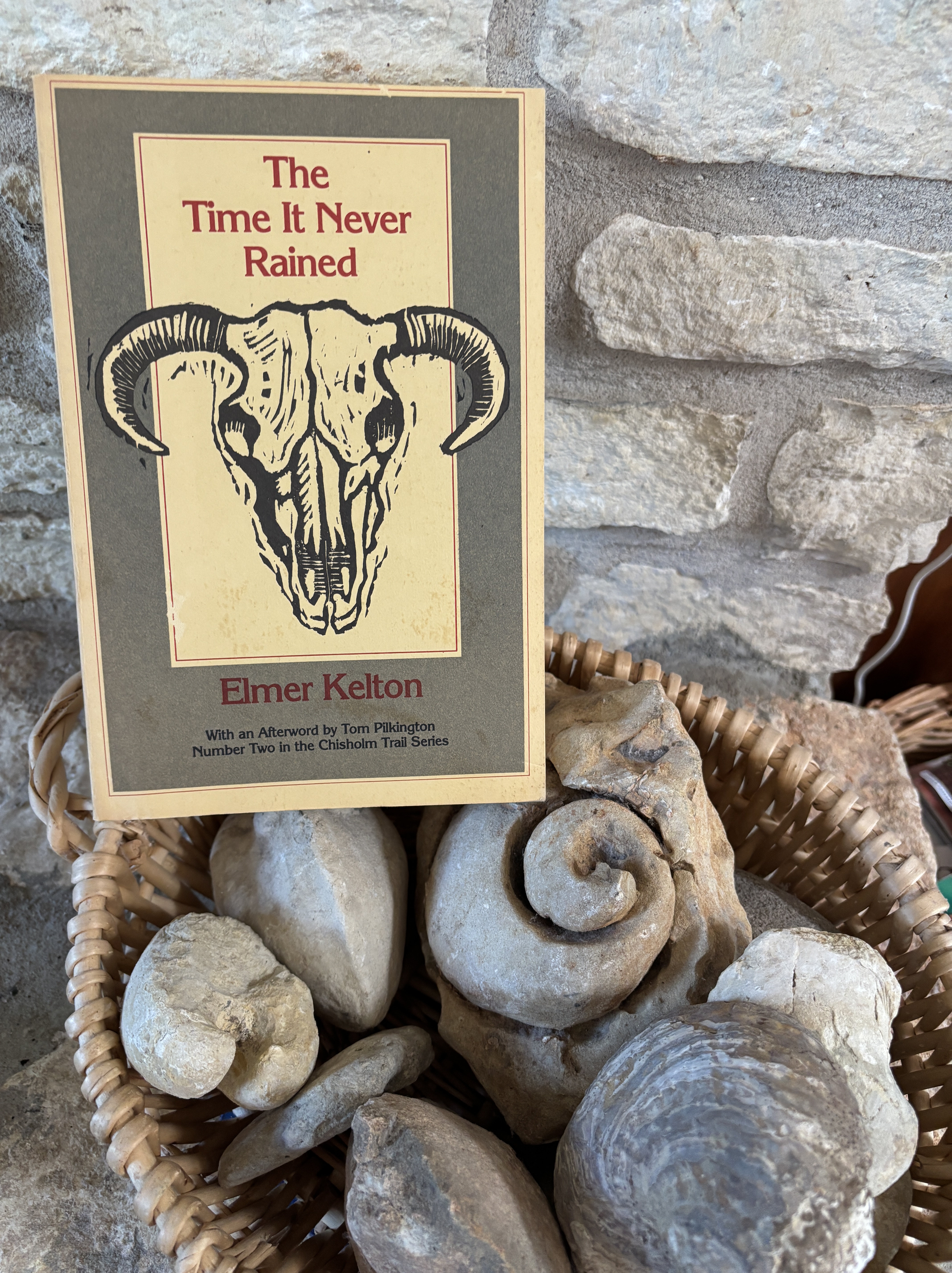
The heat was indeed hellish. Corsicana, northeast of Austin, experienced 82 days of temperatures over 100 °F or 37.8 °C, peaking at 113 °F or 45 °C. https://en.wikipedia.org/wiki/1950s_Texas_drought
The seven-year drought finally broke in 1957. Per NPR, “Rural Texas never fully recovered. Between 1950 and 1960, the state lost nearly 100,000 farms and ranches, and rural residents who had made up more than a third of the population dwindled to just a quarter of the population.” https://www.npr.org/2012/07/07/155995881/how-one-drought-changed-texas-agriculture-forever
Out in the pasture the grass is tan, not green. The three donkeys are disconsolate. They come to the gate to pester us for carrots.
For continued green, I’m counting on the live oaks. Cedar elms. Redbud. Peach trees. Other plant treasures—basil, sage, geraniums, lantana, plumbago, bay tree, mint––are faring okay so far. But what about the poor suffering stuck-in-the-dirt rose bushes? Water? More mulch? Crossed fingers?
I’m working now on Book 11 in my Alice MacDonald Greer Mystery Series set in the hill country…Ghost Music. No drought involved, so far! But as always in this series, water is an important character!
Helen Currie Foster lives and writes north of Dripping Springs, Texas, loosely supervised by three burros. She’s drawn to the compelling landscape and quirky characters of the Texas Hill Country. She’s also deeply curious about our human history and how, uninvited, the past keeps crashing the party! She’s active in Heart of Texas Sisters in Crime and also Austin Shakespeare. Follow her at http://www.helencurriefoster.com

Find her books on Amazon and also at BookPeople in Austin, Texas.






 Austin Mystery Writers