Serendipitous Surprises

I wasn’t going to discuss the dreadful heat. But early this morning came two despite-the-heat surprises: first, moonset of the August Supermoon.

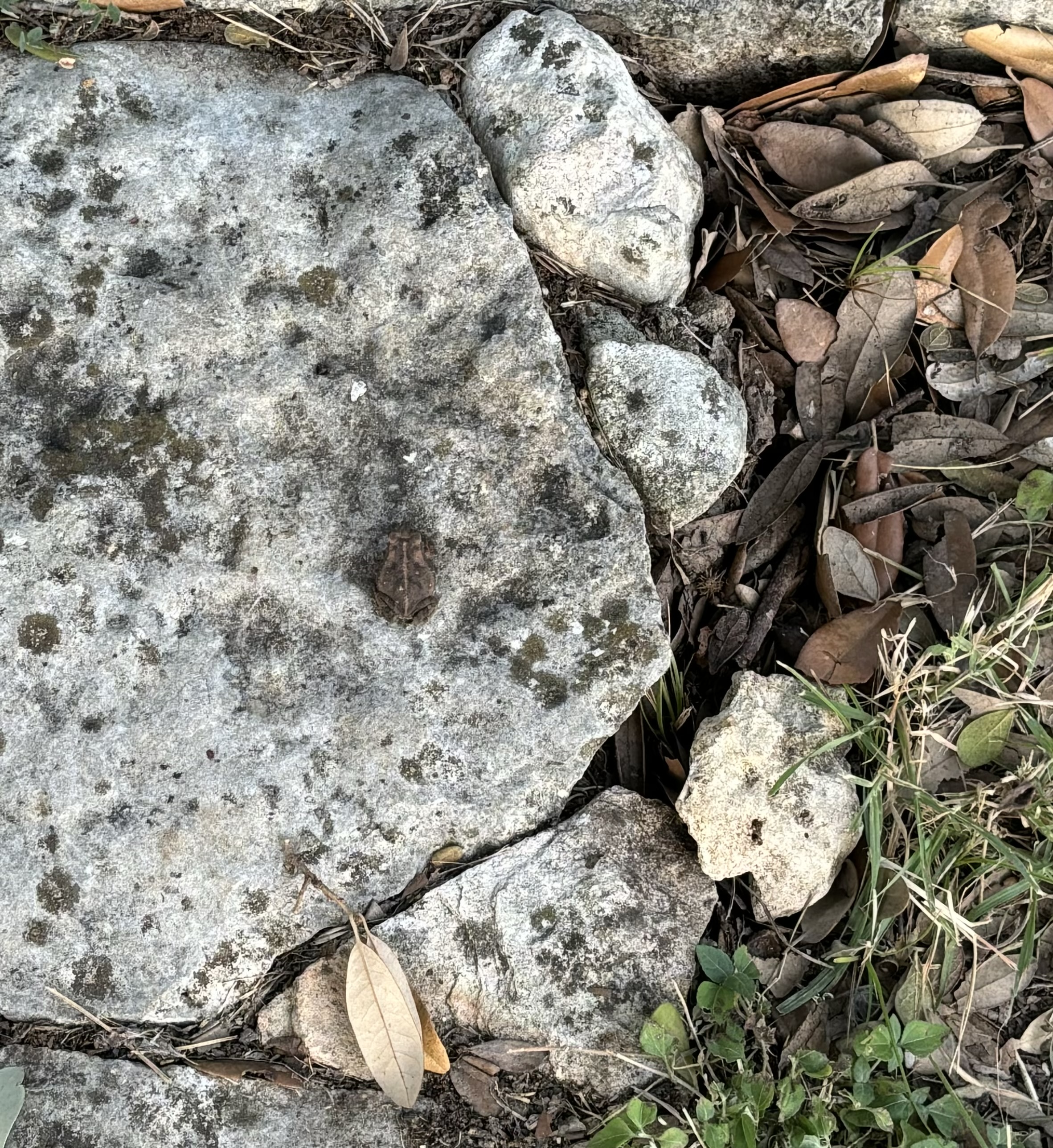
Next, a tiny frog, less than an inch long, sitting quietly in the shade. Could it be a Texas cricket frog? Maybe some frog-maven will know. Can you spot it here?
Another treasure: an email from a reader who’d read Ghost Cave, first book in my Alice MacDonald Greer Mystery series, and wanted the recipe for the coffee cake served by Alice’s redoubtable elderly friend Ilka:

They settled at the tea table. Ilka poured. Bone china, thin and old, the glaze crazed. Like Ilka’s face and hands, thought Alice. The cake stand held something Alice had never seen—a pale smooth yeasty-smelling cake with thin cinnamon topping…

“Oh, goodness, Ilka,” said Alice. “What is that?” The yeast dough, ivory and fragrant, left a mysterious fragrance in the air.

“Cardamom,” said Ilka.

Yikes! I had to tell her I had no recipe! Only—a memory! As kids we were in awe of our neighbor Mrs. Slinn, up the street. She wore her hair pulled back in a bun and longish dresses and, I think, always an apron. When we scruffy little children approached her door she always offered cookies. (We still roll out her classic “teacake” sugar cookie dough to make Santas, snowmen, reindeer.)But occasionally Mrs. Slinn swept down the street to our kitchen bringing magic: a round yeast coffee cake, no taller than 3 inches in the middle, ivory-gold with a delicate sprinkle of cinnamon and sugar on top. It tasted amazing and when cut into small wedges was absolutely delicious…

To this memory, in Ghost Cave, I’d added cardamom—not a spice we knew when I was little. But where to find a recipe for the inquiring reader?

FROM THE READER HERSELF! She wrote back that she’d located cookbooks from Mason County, Texas (dated 1976), and Fredericksburg (12th edition–Fredericksburg cooks published their first cookbook in 1916!). Each included a recipe for “yeast coffee cake.” (The Fredericksburg recipes include the original names—like Apfelkuchen, Schnecken, Kolatschen.) Which is further proof that mystery readers themselves are bright, curious sleuths. And why hearing from readers is wonderful.

Below you’ll find a slightly modified recipe from the excerpts she sent, but with a little cardamom added.

At a recent book talk I called the relationship between mystery reader and mystery writer a collaboration. Indeed, a primary rule of the 1930 Detection Club in London was that any clue must be instantly produced for the reader. No holding back explanations or back story until the end of the book! Of course that rule was sometimes violated (yes, Madam Christie, we’re talking about you). In contrast, Christie’s contemporary, the New Zealander Ngaio Marsh, occasionally adds some colorful backstory at the end, but she also generally has already given the reader fair notice of the clues that will identify the murderer.

In her series featuring the elegant Scotland Yard sleuth Roderick Alleyn, Marsh typically begins with the setting—often provided by a variety of characters––of the site where murder will inevitably take place, either in England or New Zealand. The setting could be an artist’s colony (“Colour Scheme”), a tour boat on an English river, a village church hall, a pub, an elegant country house (“Dancing Footman”), the London apartment of a practically bankrupt upper-class family (no one seems to have a job) (“Surfeit of Lampreys”). Thus when we open a Marsh mystery, first we meet the potential suspects, including one we may hope is innocent, may hope is truthful. Then comes a seriously tricky murder. (Did someone disturb the fly rod on the wall? Why?) At that point Inspector Alleyn arrives, with his sidekick Fox and the crime scene specialists. For the competitive mystery reader—collaborating with the author to detect the murderer––each detail matters and is promptly disclosed. But who lied? Who was mistaken?

Rest assured Marsh knew her subject matter and her settings: she was an artist, an actor and a theatre director as well as a writer. She lived and worked in England as well as New Zealand. She was appointed Dame Commander of the British Empire in 1966. The Mystery Writers of America bestowed the Grand Master Award for her lifetime achievement as a mystery novelist. https://en.wikipedia.org/wiki/Ngaio_Marsh  I suspect her character Agatha Troy (an artist who finally marries Alleyn) may be in part a portrait of Marsh.

And Marsh received a birthday Google Doodle on April 23, 2015! https://doodles.google/doodle/ngaio-marshs-122nd-birthday/

Marsh’s first book came out in 1934, featuring Alleyn as the upper-class “grandee” who resigned from the foreign service to join Scotland Yard. A different sort of sleuth was emerging in the U.S. In 1930 Dashiell Hammett published The Maltese Falcon and we met Sam Spade. In 1933 Raymond Chandler, like Hammett, was already publishing in The Black Mask magazine, and in 1939 he published The Big Sleep, presenting Philip Marlowe. Decades later the mystery genre continues to grow and grow:  Noir! Culinary mysteries! Cozies! Mysteries narrated by dogs! (Spencer Quinn’s Chet and Bernie series.) Cowboy mysteries! Fantasy/sci-fi/mystery! Sleuths in Laos, China, Australia, Scandinavia, Russia, Alaska, Louisiana, national parks, Native American reservations. Edinburgh! The Shetlands! Botswana! Canada! Italy! France! Israel! Scandinavia! Legal thrillers! Spy thrillers! What a wealth of mysteries for us to enjoy.

And what about the Texas Hill Country? In her latest adventure, Ghost Bones, lawyer Alice MacDonald Greer grapples with the murder of a deeply respected judge. His death was apparently triggered by his efforts to solve the murders of six people on his property almost two centuries ago. Alice needs all the help she can get from her irrepressible assistant, Silla, and from Ben Kinsear, as she tangles with mystery, legal drama, and matters of the heart.  Finally–please let me know if you recognize that little froglet!

Helen Currie Foster lives and writes the Alice MacDonald Greer Mystery series north of Dripping Springs, Texas, loosely supervised by three burros. She’s drawn to the compelling landscape and quirky characters of the Texas Hill Country. She’s also deeply curious about our human history and prehistory, and how, uninvited, the past keeps crashing the party. Follow her at www.helen.currie.foster.com.

Nearly Mrs. Slinn’s Coffee Cake:

3/8 c. milk, 2 Tbls. sugar, ½ tsp. salt, ¼ cup butter, 1 egg, beaten, 2 tsp. dry yeast, 1 ½ Tbls. warm water, 1 tsp. ground cardamom, 1 ¾ c flour–Plus additional melted butter (about 2 Tbls.) and sugar/cinnamon mixture (1 tsp cinnamon to 1/ c sugar) for the topping.

Scald milk and pour over the butter, salt and sugar. Stir and let stand until lukewarm. Dissolve yeast in warm water for 5 minutes. Stir egg and yeast mixture into milk mixture.  Stir in 1 tsp cardamom and 1 cup of flour. Beat well. Continue adding remaining flour.  Put dough on lightly floured board and knead until smooth (add a bit more flour if too sticky). Place in greased bowl, cover, and let double in size. Then punch down.

Butter bottom and sides of round 8” pan. Put parchment paper in the bottom.  Pat in dough. Brush with melted butter and sprinkle on the sugar/cinnamon mixture. Let rise again until double in size. Bake at 350 for about 20 minutes or until just turning golden.   Let cool. Serve it forth!

THE USES OF DISGUISE

By Helen Currie Foster

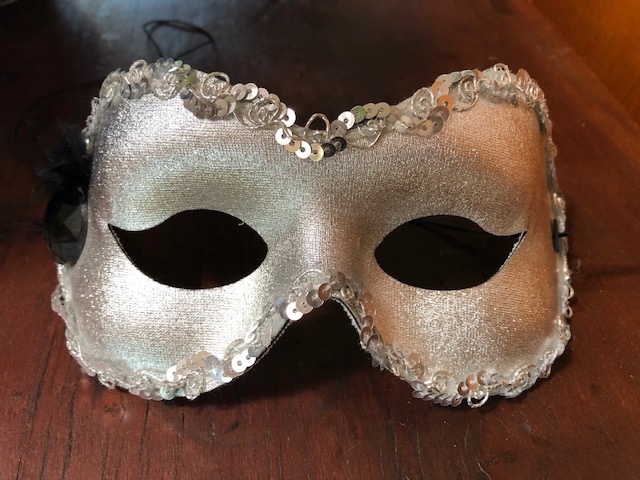
So, did you dress up for Halloween? Did you buy a mask in New Orleans, or Venice, perhaps one with feathers? What would you wear to a costume ball?


“Man is least himself when he talks in his own person. Give him a mask and he will tell the truth.”  Oscar Wilde

“Man is a make-believe animal—he is never so truly himself as when he is acting a part.” William Hazlitt

Both statements have some truth. Maybe Oscar Wilde meant that when we can hide our faces, or adopt a disguise, we feel free to do what we want––without hesitation or regret.  Yell “trick or treat!” Dance at the masked ball as a glamorous mystery person!  Rob the stagecoach! Maybe writers understand Hazlitt: we’re at our best, writing, as we invent characters, invent parts for the characters, invent disguises. Yes, we’re at our best “acting a part…” and we act many parts as we write.

At my college there was a costume room where students could buy clothes from decades earlier.  One year a group of us rummaged around and found remarkable outfits which we’d don sometimes for fun. For $1.50 I acquired a stunning long black silk evening sheath from maybe 1919, with black sequin trim under the bodice, slits in the sides of the skirt, and two long black “wings” attached to the shoulders that I could use like a shawl, or like… wings. When I put that dress on––SHAZAM! I wasn’t a young thing from Texas, I was the embodiment of glamour. (Where is that dress?) So, what’s the outfit you wear, or dream about, when you’re ready to put on that black cat-eyed mask from (New Orleans) (Venice) and enter the party? The disguise you’d choose? The disguise that would let you do what you want, learn what you want, go where you want?


Two genres especially abound in disguise: children’s literature, and mysteries.

Disguise lets us learn what may otherwise be unavailable. Think of T. H. White’s The Sword in the Stone, where Merlyn (White’s spelling) enchants Wart (the future King Arthur) by turning him into a perch in the moat. Wart learns to swim from a fish called a tench, who reminds him, “Put your back into it.” He’s taken to learn about power from the King of the Moat, a murderously hungry four-foot long fish: “The power of strength decides everything in the end, and only Might is right.” He learns from his night as a merlin, in the terrifying catechism imposed by the peregrine, that the first law of the foot is “Never to let go.”

Harry Potter, Hermione and Ron need information to foil the Dark Lord, and to raid Gringotts Bank and the Ministry of Magic. They resort to the invisibility cloak, or use Polyjuice Potion to look like Bellatrix, or Crabbe and Goyle.


But knowledge won by disguise carries peril. Wart barely survives the unscrupulous King of the Moat, having to dive “the heartiest jack-knife he had ever given.” The moment when Harry Potter’s invisibility cloak slips, when the Polyjuice potion wears off, threatens exposure and punishment.

Kim, in Kipling’s beloved novel, disguises himself to learn secrets as a child spy for the Company’s intelligence service in India. But Kim doesn’t see disguise as work. He revels in the sheer joy of successful impersonation. He rejoices in the walnut dye that lets him escape on a railroad journey to meet his lama, where he tries out various personae, explaining to the passengers “that he was assistant to a juggler who had left him behind sick with fever.” As the occupants of the train car change, “he varied this tale, or adorned it with all the shoots of a budding fancy…” This joyous talent becomes dangerous as he adopts Mohammedan garb, spying for Mahbub Ali, and priestly garb as he chases Russian spies across the Himalayan foothills.

Maybe Kim’s an exemplar of Hazlitt’s statement, that “man is never so truly himself as when he is acting a part.” When fate requires a disguise—or just for fun on the Indian railway––Kim uses all of himself to create that disguise, summoning memory, imagination, accent, intonation, clothing, gesture, posture. As actors do! Perhaps all these disguises are part of him…though not all of him.


Like Kim, Sherlock Holmes (or Arthur Conan Doyle) loves disguise. Remember “A Scandal in Bohemia?” Disguises everywhere! First, a client sporting a “black vizard mask” seeks help from Sherlock Holmes. The client’s disguised as the Count von Kramm, a Bohemian nobleman, but confesses he’s actually King of Bohemia. He wants Holmes to “repossess” (snitch) a compromising photograph of the King and the famous beauty Irene Adler.

Holmes himself then adopts disguises. First, to spy on Adler, he appears as “a drunken-looking groom, ill-kempt and side-whiskered, with an inflamed face and disreputable clothes,” so convincing that Watson “had to look three times before I was certain that it was indeed he.” Next he plots a disguise to gain entry to Adler’s house, where the photograph is hidden:

“He disappeared into his bedroom and returned in a few minutes in the character of an amiable and simple-minded Nonconformist clergyman. His broad black hat, his baggy trousers, his white tie, his sympathetic smile, and general look of peering and benevolent curiosity were such as Mr. John Hare alone could have equaled.”

Watson notes that it was not merely that Holmes changed his costume: “His expression, his manner, his very soul seemed to vary with every fresh part that he assumed. The stage lost a fine actor, even as science lost an acute reasoner, when he became a specialist in crime.”

But Conan Doyle fools us yet again. Holmes orchestrates a street melée whereby a crowd (of accomplices) carry the clergyman into Adler’s house. When Watson throws a fire rocket through the window, Holmes, as predicted, sees Adler rush toward the photograph’s hiding place. On their way back to Baker Street Holmes happily tells Watson about his ploy, but as he searches for his door key, he hears “Good-night, Mr. Sherlock Holmes,” from “a slim youth in an ulster who had hurried by.”

Foiled again––Holmes, that is. Irene Adler, disguised as a boy, has followed him home and confirmed the “clergyman” was Holmes. The next morning Holmes and Watson discover her house is empty, the photograph’s gone, and his disguises were in vain. That’s “how the best plans of Mr. Sherlock Holmes were beaten by a woman’s wit,” says Watson.

Holmes does love a good disguise, and maybe that’s why he can recognize one. For another example of his Hazlitt-esque behavior, see “The Man with the Twisted Lip,” where Watson almost doesn’t recognize Holmes as an aged opium smoker, and Holmes susses out the (disguised) truth about the disappearance of a client’s highly respectable husband by (literally) washing clean the face of a notorious street beggar.

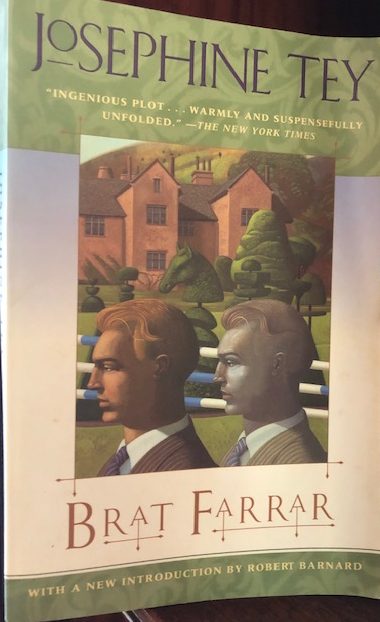
Josephine Tey teases us with disguise in Brat Farrar where the mystery turns on whether Brat Farrar, a young man who introduces himself as the long-lost heir to the Ashby family estate, is or is not Patrick Ashby, thought to have killed himself, leaving his minutes younger twin Simon as putative heir. Simon will be dispossessed if Brat Farrar is for real. The point of view is frequently in in Brat’s head, and we must decide if we like this disguised pretender as a protagonist, or not. He himself is ambivalent, arguing with himself about the whole scheme: On the one hand, he thinks, “But I’m not a crook! I can’t do something that is criminal.” But then: “All he could do was sit in the saddle and hope for the best. But at least it would be a breath-taking ride; a unique, heart-stopping ride. Danger to life and limb he was used to; but far more exciting was this new mental danger, this pitting of wits.” As he feels his way along, still in disguise, Brat slowly learns who did kill Patrick. That knowledge nearly kills Brat Farrar.

New Zealand’s Ngaio Marsh has the murderer disguise his or her true identity in both Photo Finish and A Clutch of Constables. In the first case, the murderer creates a new identity from whole cloth. He accidentally gives himself away to Detective Rory Alleyn in part when Alleyn overhears his soft-voiced use of a Mafia expression. In A Clutch of Constables, the murderer––a master of disguise––entirely steals another’s identity, including his butterfly-hunting expertise, for the duration of a cruise. He relishes his persona and manipulates the unwitting characters like chess pieces on the board of the plot––more in the Hazlitt manner, being most truly himself as he throws himself into the role.

Mystery writers disguise their murderers, their sleuths, sometimes their victims, sometimes their protagonists.  I use disguise in my new murder mystery Ghost Cat. I’ll be interested in what you think. Happy reading and writing, everyone!

Ghost Cat on Amazon