See You…in September!

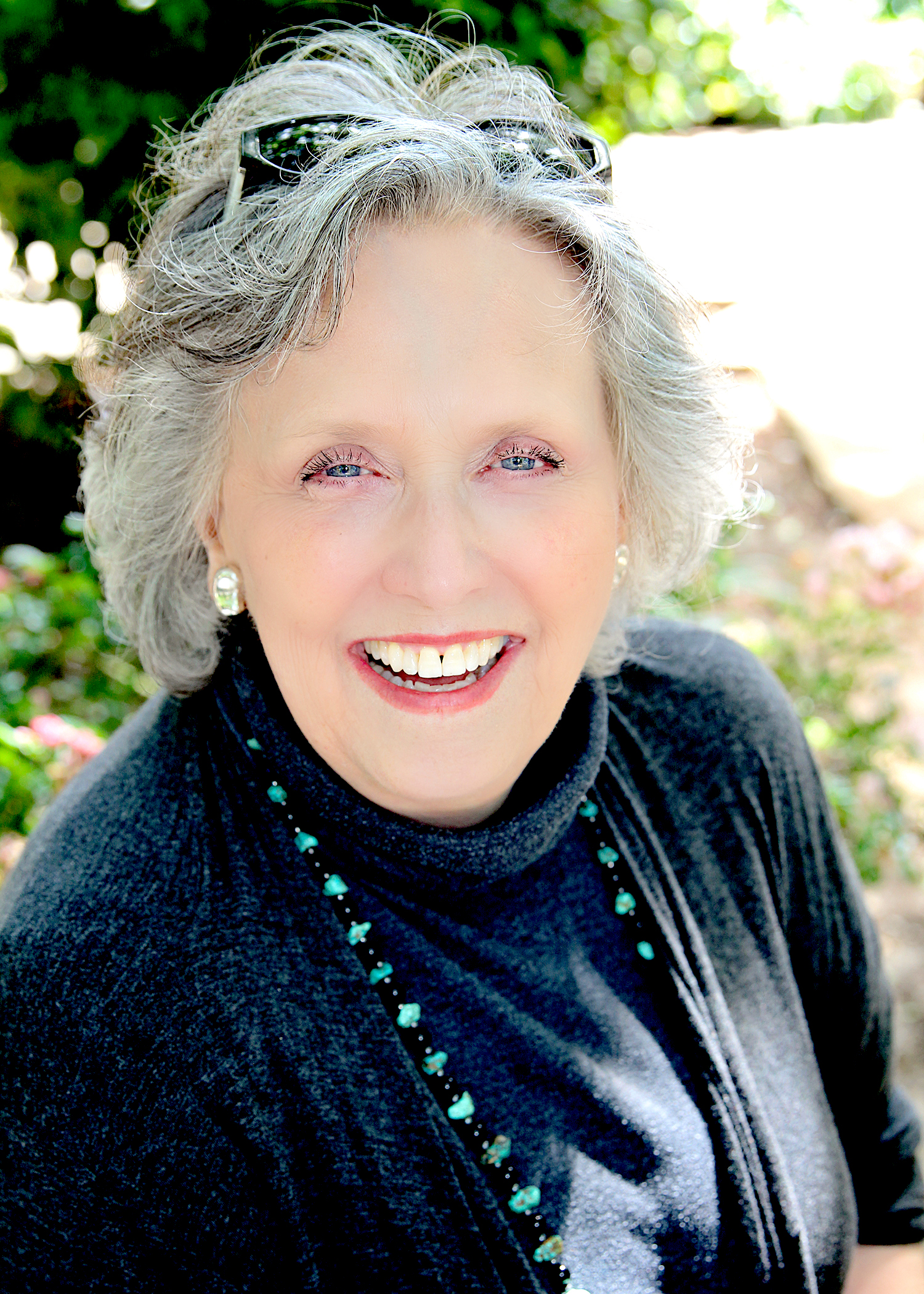
By Helen Currie Foster

It’s September! New school year! New shoes, after a hot barefoot summer! New outfit, for the first day of school! And then––new classes! New subjects, new teachers, new tools! New friends! New lockers, new classrooms, new hallways…. New season—new teammates, new coach, new plays.

Remember all that?  Your first day back at school? Back to college, back to university? Do you remember the excitement, the nervousness, the anticipation?

September 1 was  Labor Day. And now there will be apples, apple pie and apple crisp. There will be chrysanthemums, spilling out of baskets. Even in central Texas, leaves will change color—as Maxwell Anderson’s lyrics have it, “When the autumn weather turns the leaves to flame.” Here in the Hill Country, sumac and Spanish oak turn red, sweet gum turns yellow. No, not the glory of the maples, but a change in the landscape. Because finally, after the dog days of summer, that’s what September brings: something new.

It’s time to pull up the tired summer flowers and thank them for their service. Time to dig some holes and plant new trees, and order some bulbs. I’ll be planting the Mexican plum seedlings a friend gave me, and ordering narcissus bulbs for indoor blooming.

Then the Hill Country brings its own fall excitement. Dove season began  September 1 and a down-the-road neighbor, disturbed by shotgun pellets clattering onto her roof, had to call the sheriff, and have officers explain to a clueless (thoughtless? lawless?) neighbor that it’s contrary to law to allow your ammunition to cross your own fence line. Also unneighborly. But hmm, that could find its way into a future book plot….

Our Hill Country holds surprises. One is the way water hides in the Hill Country—down in secret seeps and creeks, around curves and hollows. And what odd creatures live out here! For example, this fall we’ve seen again the rare and secretive rock squirrel. (We’ve seen a solitary rock squirrel only once every few years.)  We’ve heard the great horned owls that call at night, up and down the creek, and the herons who call, flying down the valley. The buzzards drone, annoyingly, from the tops of telephone poles. We treasure glimpses of the shy, gorgeous painted buntings who appear briefly at the bird feeder, then flit away. Porcupines visit. Roadrunners dart across the road.

And the dog days are over. (This year they were July 3-11, and these hot sultry days have borne their name from ancient times ostensibly because it’s when Sirius, the Dog Star that accompanies Orion, rises with the sun.) https://www.almanac.com/content/what-are-dog-days-summer

But during the dog days I took refuge at night, binge-reading two mystery series that were new to me, by British author Peter Grainger: the DC Smith Investigation series and the Kings Lake Investigation. http://bit.ly/4gmPsad

These wry British procedurals are set on the coast of Norfolk, providing a cool and rainy ocean-side backdrop for the appealing characters. At least I could read about rain and cool breezes. But the books offered not only a respite from ridiculous heat, but a welcome respite from writing. I’ve been in the last weeks of finishing Ghost Justice—Book 10 in my Alice MacDonald Mystery Series, set here in the Texas Hill Country. For me that process includes waking in the wee hours with my mind on plot additions and subtractions, dialogue, characters. For such moments—when the characters wake me up at night voicing their further demands (yes, they seem to come to life and require conversation and attention)––I find mysteries provide absorbing distraction.

And now – Watch for Ghost Justice this week!  https://amzn.to/4pk8WQO

Helen Currie Foster lives and writes the Alice MacDonald Greer Mystery series north of Dripping Springs, Texas, loosely supervised by three burros. She’s drawn to the compelling landscape and quirky characters of the Texas Hill Country. She’s also deeply curious about our human history and how, uninvited, the past keeps crashing th eparty. Follow her at http://www.helencurriefoster.com.

Sea Shelves by the Seashore 

An Interview with Myra Barreiro

By Laura Oles

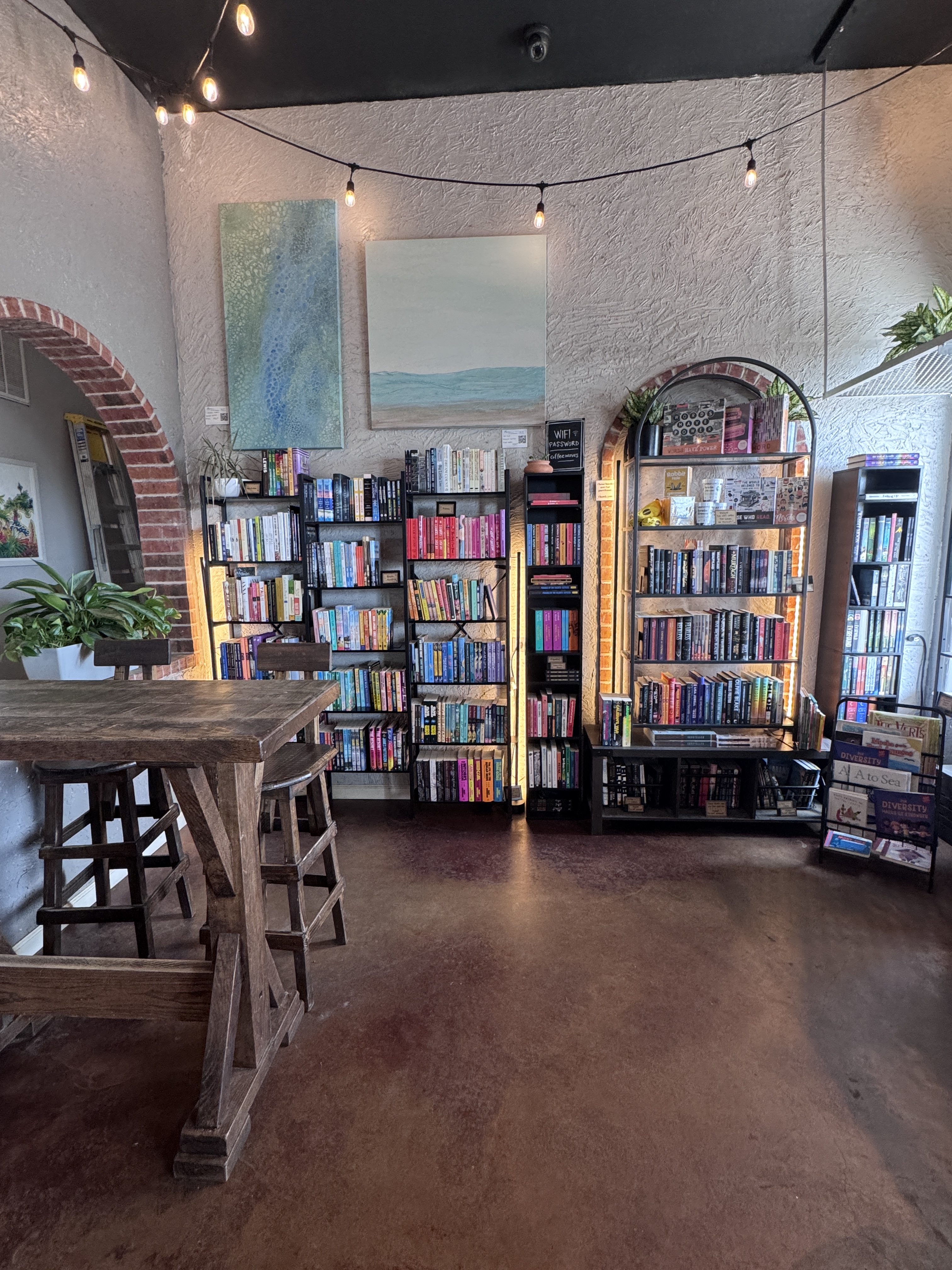
If your idea of the perfect vacation getaway includes time on the beach, a bookstore visit and a coffee shop stop, then I have the perfect place for you. Coffee Waves is one of my regular stops when visiting the island, and on a recent weekend trip, I pulled into the parking lot and found my dream come true—a new bookstore! 

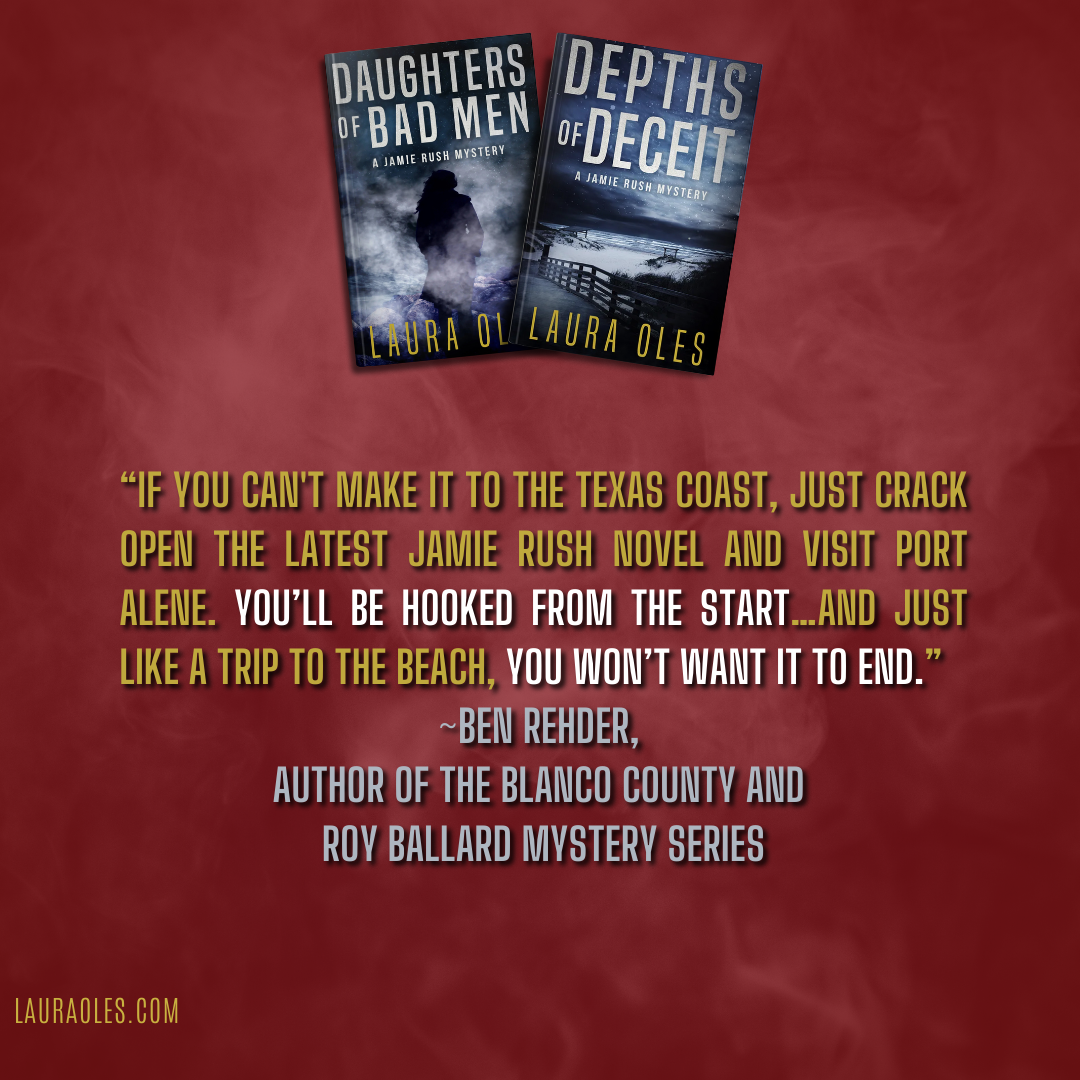
I’ve long believed that Coffee Waves was the perfect place to host a bookstore. The shop has a substantial nook with welcoming open arches and enough room to browse, sip and read. This area is now home to Sea Shelves by the Seashore. As I took time to scan the shelves, I was impressed with the varied selection and thoughtful choices offered. I felt the selection reflected a love of books and a mission to offer a wide range of options to readers of all ages. It was also a lovely surprise to find my Jamie Rush novels on the shelf!

I had the good fortune to meet the owner, Myra Barreiro, on a recent visit and enjoyed getting to know her. I wanted to learn more about her background and her journey in bringing Sea Shelves to life. When I invited her to share her story with Austin Mystery Writers, she was gracious with her time. Below is our conversation:

LO:  Hi Myra!  Thank you so much for speaking with us. Please share a bit about yourself.

MB: Hi! My name is Myra. I have lived in Port Aransas for four years but have been visiting for 13. I grew up in Mineral Wells, Texas. In the time between graduating high school and opening my own bookstore, I have served 4 years in the United States Army as an Intelligence Analyst, worked for Lockheed Martin for 7 years (also as an Intelligence Analyst), graduated from Sam Houston State University with a Bachelor’s degree of Science in Public Health, and–most recently–helped manage and run two local shops for several years in Port Aransas. I have two extremely smart and handsome boys, a dog named Kahlua, and a black cat named Michael B. Kitty… that’s what I call him, but he has several names.

LO: Many people dream of one day opening a bookstore. What made you decide to bring this idea to reality?

MB: It’s funny how opening a bookstore seems to be a dream for many. I am very happy to have had the chance to turn my dream into a reality. So, as mentioned before, I was helping to manage two local shops, and had been doing so for a while, but it was time for me to move on and create something for myself, something I thought this community desperately needed. I had been dreaming about opening a bookstore on the island for several years, and stepping away from my previous position allowed me to move forward with that dream.

LO: I’ve always thought the back lounge area of Coffee Waves was the perfect location for a bookstore or reading area. How did this relationship come about and how long did it take?

MB: When I decided I was going to make this bookstore dream happen, finding the perfect location was pretty high up on my list of priorities. I drove all around the island looking for properties or buildings, units with potential. I asked realtor friends if they had any info on empty commercial spaces, but nothing piqued my interest. There were spaces, but they were either already under contract or not in the right location, weren’t the right size, and out of my price range. I started to think my dream would remain just that, a dream. I almost gave up until I started thinking on a smaller scale. I had a crazy idea to maybe ask other businesses if they wouldn’t mind letting me take up a bit of their space. Set up shop in an existing shop. I wondered if that was a thing, so I did a search on the internet and sure enough, it was something that was happening all over. I took some notes. Wrote out pros and cons and key things to bring up while talking to businesses to get them onboard with the idea. After researching a bit more, I started a list of potential businesses that might be willing to let me move forward with the idea of putting a bookstore inside of their existing shop. 

Naturally, Coffee Waves was at the top of my list. Who doesn’t love a good book with a cup of coffee? And they have that overflow seating area?? It seemed like the perfect place to make it happen. I came in and asked if I could schedule a meeting with someone to discuss the idea. We scheduled a meeting, met up, and I pitched my idea. I said, “I don’t want to take away from your seating, I just want to occupy your wall space.” They mulled it over for about a week and decided to give me the green light! I was so unbelievably elated until I realized I had about 2 weeks to get this dream up and running before the chaos of Spring Break! I immediately placed an order for shelving and my first book order and haven’t stopped since.

LO:  You’ve done a wonderful job of curating both titles and genres. Can you share a bit more about how you choose what to carry?

MB: I receive recommendations every now and then of specific titles or authors, but the curation of titles has been mostly research. When I initially thought of opening a bookstore, I wanted to focus solely on beach, island, small fishing town, and vacation themed reads, but not everyone is into that and I wanted to give people options, so I started researching. What were people reading in 2024? What are they looking forward to reading in 2025? Best-selling genres? What are the top favorites and must-read titles of all time? Favorite classics? What’s trending on BookTok? I took my findings and curated what you’ve seen in the bookstore and continue to add to it every week.

LO:  What do you love to read? And has opening Sea Shelves impacted your reading in any way?

MB: My favorite genres are psychological thrillers, mystery, and horror. I’m drawn to scary stories with twist endings and stories that make you think. 

If opening the store has had any impact on my reading, I would have to say that I am now more willing to read and am interested in reading genres outside of my favorites. Thrillers will probably always be my favorite, but I’ve come to appreciate and enjoy reading other genres as well. I have over 1200 titles on the sea shelves and would love to get through them all. Maybe one day I will(:

LO: I met Beatrice when purchasing a book during my last visit.  Please tell us about her.

Meet Beatrice!

MB: I’m jealous she had the chance to meet you before I did.

Beatrice is amazing. Hardest working employee I have. She’s great. Since not taking away from the coffee shop’s seating was a big selling point in setting up the bookstore here, the books are out and exposed during the coffee shop’s business hours, 7 a.m. to 9 p.m. As much as I’d love to be at the bookstore all day, I have other responsibilities outside of the shop that need my attention, and sometimes I just need to step away for a quick lunch or to run a quick errand. That’s where Beatrice comes in. She holds it down while I’m away. It was an easy decision to set up a self-checkout option, giving customers the ability to make a purchase even if I was not physically present. Customers seem to love having the option to checkout with Beatrice, and I think giving her a name makes the experience a little more personable for them. Definitely a great addition to the bookstore.

LO: Anything else you’d like to share? 

MB: I would just like to say that this entire experience of opening a bookstore has been a roller coaster ride and a dream come true. I encourage anyone who has the same dream to go for it if they are ever presented with the opportunity. Taking the first step will be scary but definitely worth it.

I would also like to thank Coffee Waves Port Aransas for giving me a chance to live out my dream in their space, and Laura Oles for this interview and giving me the opportunity to share my story.

LO: Thanks so much, Myra, for sharing how Sea Shelves started as a dream and became a reality. I know Sea Shelves is quickly becoming a favorite of locals and visitors.

***

Some readers may know that my mystery series is set in a fictional version of Port Aransas. Maybe Jamie and Cookie will make a stop into Sea Shelves one day? Jamie’s always on the lookout for an Elmore Leonard novel, and I know she’d love this place.

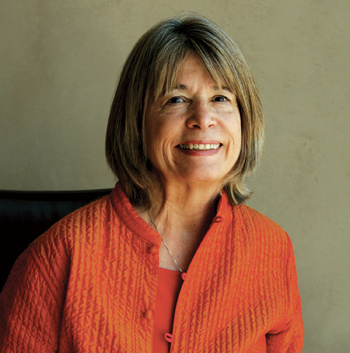
Laura Oles is the award-winning author of the Jamie Rush mystery series. Her work has appeared in crime fiction anthologies, consumer magazines and business publications. Her debut mystery, Daughters of Bad Men, was an Agatha nominee, a Claymore Award finalist, and a Writers’ League of Texas Award finalist. Depths of Deceit, her second novel, was named Best Mystery by Indies Today. She loves road trips, bookstores and any outdoor activity that doesn’t involve running.She lives in the Texas Hill Country with her family. (https://lauraoles.com

Connecting Through the Ether

VP Chandler

By V.P. Chandler

Have you ever researched something—like a purse, a computer, or even a car—only to suddenly notice it everywhere, even though you hadn’t before? Inspiration for stories works the same way.

One of the most common questions authors hear is: “Where do you get your ideas?” The answer: pretty much everywhere—news articles, books, movies, history, snippets of conversation, personal experiences… inspiration can spark from the smallest detail.

I’m currently writing a historical novella, and inspiration is coming from all directions. I feel like a goalie in a soccer match—I’m fully immersed.

Story Settings and Characters

My protagonist is a young woman named Martha. She’s married to Tom, who has moved her far from home—and life isn’t unfolding as she expected. (Isn’t that always the case? But is it simply the way things are, or is something nefarious at work?) They’re building a cabin in the East Texas woods around 1830. I imagined they’d arrived at the tail end of the Old 300, grabbing land wherever they could. (Although the story could take place anywhere from 1820 to 1880, west of Virginia in pine country, I discovered that pines aren’t as widespread as I once thought—which is why research matters.)

https://www.tshaonline.org/handbook/entries/old-three-hundred

As I write, Martha is revealing herself to me—like she exists on another plane and there’s a conduit between us through something I call “the ether,” a metaphysical space. (Is that a real thing? I don’t know—dammit, Jim, I’m a writer, not a metaphysicist!) Her voice is growing stronger. Her past and current life are becoming clearer. When she speaks, it feels like she’s speaking directly at me. I think most writers go through this—and when it happens, it’s exhilarating. To me, it means the character will have depth and feel real.

And, as in the past, there have been “signs” that I’m on the right track with characters and story. Sometimes these signs are even eerie. In the first chapter, when it was new and amorphous, I was writing a dream sequence to explain her inner thoughts, worries, and where she’s from. I imagined she came from a large family, and she had had a brown and white dog named “Peaches”.

A few days later I was on Facebook and came across this picture. It caught my attention because a cabin is a major feature of the story, and I took a screenshot for inspiration to look at details. Later I read the description. Look at what I circled. That’s right! I wasn’t too surprised by the date. But the dog in the picture was name “Peaches”! And it looks brown and white to me. It gave me inspiration that I’m on the right track with the story and characters.

(Picture from https://www.facebook.com/TracesofTexas. They post historical and modern pics taken in Texas.)

Another time, while writing my (currently unpublished) novel Gilt Ridden, I created a character in West Texas, educated and obsessed with gold, known locally as “The Professor,” living in a dugout. Years later, I came across a local-history book about Stonewall County describing a man known as “The Professor” who lived in a dugout and searched for gold. I hadn’t known he existed—but the parallels were uncanny. At first, I worried that people would think that I borrowed someone’s real story. But then it comforted me. I took it as a sign that I had created a realistic character from imaginary circumstances.

So when you’re writing—or working on any project—block out the world and tune in to the voice or idea coming from the ether. Who knows what will be revealed?


Bonus Content

I’ve been obsessed with one song lately. It’s been playing in my head nonstop for a week. I didn’t know much about it until I watched the YouTube video. The character is pregnant and contemplating life choices, just like Martha! Now it’s really stuck in my head. Hope you enjoy it:

Sara Bareilles – “She Used to Be Mine” (from Waitress)

READING WHILE TRAVELING

by Helen Currie Foster

Just before a trip I get anxious: is there enough stored in my Kindle to keep me happy? You constant readers know that feeling. Did you upload enough for the waiting room at the airport? For the plane? For a sleepless first night, jet-lagging? Enough to keep you happy even if weak (or no) wi-fi at the (tent, cabin, hotel, boat, campsite, rental) precludes another download? Yes, there’ll be news–but I am escaping!

We’re on a family trip to France, with children and grandchildren. I loaded up the Kindle diligently beforehand. Of course there are way too many wonderful things to do besides read…

Still, my heart sang when we entered the rental in the French mountains and spied—A BOOKCASE!

Moreover, the shelves held mysteries! Ian McEwan, Patricia Cornwell, Elizabeth George, Janet Evanovich, V.I. Warshawski, Alexander McCall Smith…

Also serious nonfiction and titles from Kazuo Ishiguro, Dostoevsky, Graham Greene, Julian Barnes and more. Then I spotted Kinky Friedman’s Frequent Flyer and thought—eclectic tastes! Perhaps some were left behind by guests. Still, the shelves made me want to meet the owners. The welcoming bookshelves and, to boot, a choice of comfortable corners where a tired tourist can flop, prop up the well-used feet, and read…what more can one ask?

(Sidebar—when you see a Talking Head on your screen, with a bookshelf behind—do you wonder if the books really belong to the Head? Or are they just a prop intended to impress? Maybe we’ll see some interviewer pose a question: “How did you like Crimes Against Humanity?” Blank stare.)

I know I’ve mentioned her in a prior blog, but have you discovered Dorothy Dunnett yet? https://en.wikipedia.org/wiki/Dorothy_Dunnett

If you’re familiar with Dunnett’s stunning two historical fiction series, The Lymond Chronicles and The House of Niccolo, you already know she delivered powerful (and powerfully surprising) plots, magnetic characters, and vivid reconstructions of the 15th and 16th centuries. Using (for all that detail) an omniscient narrator.

But in her spare time she also wrote the Dolly mystery series, involving an astoundingly talented portrait painter named Johnson Johnson (yes, two), who happens to turn up in scenic locations in his yacht, the Dolly, on secret missions for the British ministry of defense. I’ve reread three of those on this trip—one set in Ibiza, one in Morocco, one in Canada. Unlike the Niccolo or Lymond historical series, Dunnett’s heroines in these first-person mysteries are in their late teens or twenties and trying to make their way in the world (as an au pair, a cook, an executive assistant, etc.). Naturally they find themselves in dangerous situations while trying to identify a murderer, and Dunnett gives each her own first-person voice—each interestingly different.

Clearly Dunnett didn’t merely set foot in these locales: she absorbed them. The action’s fast-moving, but she paints a landscape with details that place you right in the square where the villains are about to—well, here’s an example from Moroccan Traffic, in the Atlas Mountains, where Wendy, a young executive assistant, watches as Johnson and the engaging inventor Mo pursue two ruthless adversaries up perilous cliffs:

…where they had set their faces to climb was the flank of the mountain; the boulder slope rising to cliffs and ridges and rock bands interlaid with tongues of snow, and scree-fields, and stony pockets of pasture. And further up, behind escarpment and terrace, the burning forepeaks of the range.

         I had seen it all from the road. Somewhere there, already entrenched, already waiting, were Gerry and Sullivan, ex-SAS marksmen.

You can also tell that Dunnett (as well as her character Johnson) was a painter:

All around us the hills, limp as blankets, glowed in soft reds, their milky hollows the colour of amethyst. The snow on Sirwa was tinged golden pink, and cast china blue shadows which were technically impermanent. A man walked by the road, a black goat like a scarf around his neck.

         And from Roman Nights – the young heroine, an astronomer, battles spy dealings in Italy including the Aragonese Castle on Ischia in the Bay of Naples:

         On a plateau the cathedral reared its three roofless sides like a kind of dismembered Versailles, white and flaking; the walls furnished with crumbling cherubs and statues, with rococo arches and pillars and architraves.

Dunnett gives her astronomer heroine plenty of tongue-in chic wit:

Johnson and Lenny sailed out of Amalfi, in a pure, warm air blowing about eight on the bloody Beaufort scale, and the rain lashing down. After becoming exceedingly well acquainted with the water filling the Gulf of Salerno, we fled into a fishing harbour called San Marco and spent the night offshore in a cat’s cradle of other boats’ cables.

Thank you, Dorothy Dunnett, for stupendous scholarship and for witty mysteries in places so believably described. What a gift to the traveler! Sorry, gotta go—I’m deep into Tropical Issue, set in Madeira, where I’ve never been—but it sure looks great in this prose…

What gifts they are to humans—to write, to read!

Award-winning writer Helen Currie Foster lives and writes in the iconic Texas hill country, supervised by three inquisitive and persistent burros. After practicing law for more than thirty years, she found the Alice MacDonald Greer Mysteries had suddenly appeared in her life. Book 10 in the series, Ghost Justice, is expected to debut in August 2025. Helen is continually fascinated by human history and how, uninvited, the past keeps invading our parties. Follow her on Facebook and Amazon, and in Austin at BookPeople.

https://www.facebook.com/helencurriefoster

Walking the Dark Side of Summer: A Personal Look at For Every Evil Under the Sun

VP Chandler


By V.P. Chandler

When I first sat down to write the stories that would eventually become part of For Every Evil Under the Sun, I didn’t know exactly where they would lead me—I only knew I wanted to stretch my writing skills, try new things, and be a part of a hot, cool collaboration. (Yes, I like puns.)

Now, I’m proud to announce that this collection is out in the world, published by the brand-new Fredonia Ink Publishing. I’m honored to be sharing the pages with two powerhouse writers, Alexandra Burt and Laura Oles—both of whom are not only incredibly talented but also deeply committed to telling stories that explore the dark, complex corners of the human experience.

This collection is a bit of a literary experiment. We each approached the idea of “evil” through our own unique lens—psychological thriller, family drama, crime, horror, western—and let the stories guide us. What came out of it is a collection that isn’t just eclectic, it’s electric. It shines! (Yes, another pun.)

As for me, I leaned into the grit—into crime, revenge, justice. I wanted my stories to carry that weight—to explore the consequences of violence and vengeance. And also add a little bit of fun to the mix. And the stories by Alexandra Burt and Laura Oles are equally as dark and entertaining.

And hey, if you’re in Austin this summer, I’d love to invite you to join us for a special event at Vintage Bookstore and Wine Bar (1101 E. 11th St.) on July 18 at 7pm. Alexandra, Laura, and I will be discussing short story craft, the experiences of women writing crime fiction, and what went into shaping this haunting little book. It’ll be an evening of books, wine, and maybe a few goosebumps.

So if you’re in the mood for stories that simmer under the heat of summer and explore just how far people will go—to protect, to avenge, to survive—then For Every Evil Under the Sun might just be what you’re looking for.

Hope to see you in July.

—VP Chandler
vpchandler.com


🗓️ Event Info: July 18, 7pm @ Vintage Bookstore and Wine Bar, Austin, TX
🔗 Learn more, here is the Amazon listing. Ebook now available and paperback will be soon on Amazon and bookstores everywhere: https://tinyurl.com/2tph4xcz

THE TINCTURE OF TIME

By Helen Currie Foster ~  June 9, 2025

I’ve always loved Guy Clark’s version of “Stuff that Works.” Dublin Blues, 1995.

https://www.youtube.com/watch?v=2mprD2MN5vo

Listening, I can just see, just feel, that “old blue shirt” that “suits him just fine.” I can imagine the old boots that let him “work all day” and then go “dance all night.” And of course that friend who “always shows up when the chips are down”––I’m thinking, my bestie. Just hearing about the shirt, the boots, the friend always leaves me with the same settled, restful confidence he’s describing. “Stuff that works!”

“Brown paper packages tied up with string” may have undeniable charm, “stuff that works” means stuff I turn to, go back to, and rely on. Like old travel pants with pockets that zip, soft shirts without a scratchy label, shoes that just carry me along, soles not too thick or thin.

What about you? Things that keep working, that stand the test of time? The pens that always work, the ink you like, the just-right-feel in your hand as you write? The car that always starts, the recipe you can count on?

Part of the charm of “stuff that works” is reliability – working each and every time.

Time, that deep human preoccupation! Is time reliable? Time messes with us. Time stands still. Time passes. Time flies. Time heals. Time runs out. Time grows short. The time changes…and times change. “Time, like an ever-flowing stream…” Sometimes an hour feels interminable; sometimes an hour passes in a flash. Albert Einstein’s theory of general relativity says that even in the universe, time is not constant, but is influenced by gravity. Yikes! (says the English major).

Writers struggle to analyze time’s impact on us. Just a couple of examples––Anthony Powell, A Dance to the Music of Time; Vladimir Nabokov, Speak, Memory;Virginia Woolf, particularly the “Time Passes” section of To the Lighthouse. Historians try to make sense of the impact of events over time, like Drew Gilpin Faust in This Republic of Suffering, on death and the Civil War.

Poets remind us of their mortality—and hence our own. Here’s Robert Frost, in Ten Mills, Part II, THE SPAN OF LIFE, from A Further Range (Henry Holt and Company, 1936):

The old dog barks backward without getting up.

I can remember when he was a pup.


Or Billy Collins at the beginning of “Life Expectancy” in Whale Day (2020):

On the morning of a birthday that ended in a zero,

I was looking out at the garden

When it occurred to me that the robin

On her worm-hunt in the dewy grass

Had a good chance of outliving me….

T.S. Eliot begins East Coker : “In my beginning is my end,” then:

…there is a time for building

And a time for living and for generation

And a time for the wind to break the loosened pane

Ad to shake the wainscot where the field-mouse trots

And to shake the tattered arras woven with a silent motto.

Sebastian Junger reflects on near-death experiences, including his own: In My Time of Dying (2024).

Of course animals can be aware of time. Right? The three donkeys– Sebastian, Amanda, and Caroline ––appear promptly at the gate in front of the house at 11:30 a.m., and again at 4:30 p.m., which, they are confident, are the hours when carrots ought to be offered. We know animals can mourn the loss of a member of their pod, their herd, their litter. But do they worry about their own mortality? Do our friends the non-human primates? Well, maybe! Um, time will tell! https://bit.ly/4mZqi4k

To be human is to be aware of our own mortality. And for humans, time is both reliable—tick, tock—and unreliable: we cannot know what the future holds. Fiction writers, however, get to make those decisions for their characters. In the mystery genre, we get to decide: who shall live? Who shall die? How, and why?

I’ve wrestled with these questions in my Alice MacDonald Greer Mystery Series: what happens next?Should I not  have killed a particular character? Should a new character survive and reappear in the next book? It’s a heavy responsibility! We readers can become quite attached to characters. In the last few weeks, finishing Book 10, I took refuge in Laurie King’s Mary Russell/Sherlock Holmes series. She created a character I found particularly appealing in The God of the Hive. https://bit.ly/449Lugn

But then? The book made me revisit the pain of losing a beloved character to—well, literary death. Remember Gus in Larry McMurtry’s Lonesome Dove? I still miss Gus… Gus, don’t ride over that hill!

In addition to night-time plunges into Laurie King land, I found banging on the piano a helpful respite from the writing process. But after two broken wrists in the past two years (careless, careless) I’d had to quit the beloved boogie woogie lessons and feared I’d never be able to play those strenuous pieces again.

My brother the physician, when asked by his siblings for advice, often prescribes “a little tincture of time.” It’s amazing how often that prescription works. This past week, after (really quite a lot of) tincture of time, I persuaded our century-old piano once again to play boogie-woogie pieces from the 1942 All Star Boogie Woogie Piano Solos! Pete Johnson, Meade “Lux” Lewis, Pine Top Smith, Hersal Thomas, Albert Ammons. Suddenly—how long is “a little tincture of time”?––finger memory began to return. Not all the way back yet, but still! Maybe I’ll get to resume piano lessons with that Austin treasure of jazz, boogie, country and everything else, Floyd Domino.

Charles Darwin was not known to rush into print. In 1837 in Edinburgh he presented his first paper concerning the action of worms “on the formation of mould,” a topic he studied for over forty years. Not until 1881, after two scientists pooh-poohed his theories, during the Great British Agricultural Depression (1873-1896) he published The Formation of Vegetable Mould Through the Action of Worms on the work of earthworms. Curious about their senses, their awarenesss, their work, he studied how worms could tug leaves into their burrows, eat and digest them, and then produce worm casts—millions of tons of richer soil. His query as to whether earthworms were sensitive to light “led me to watch on many successive nights worms kept in pots, which were protected from currents of air by means of glass plates.” His summary after all those years? Darwin doubts “whether there are many other animals which have played so important a part in the history of the world” as earthworms. Producing stuff that works…!

For so many of us, books are the “stuff that works.” Hurrah for reading!


Award-winning author Helen Currie Foster lives and writes the Alice MacDonald Greer Mystery series north of Dripping Springs, Texas, loosely supervised by the three burros. She’s drawn to the compelling landscape and quirky characters of the Texas Hill Country. She remains deeply curious about our human history and how, uninvited, the past keeps crashing our party. Follow her at http://www.helencurriefoster.com and on Amazon, and find the books at Austin’s BookPeople!

https://www.facebook.com/helencurriefoster

The Enduring Value of Third Spaces

By Laura Oles

Why do so many of us choose to work or study at our favorite coffee shop? Even if we have a fully equipped office, we pack up our laptop and relocate, settling in with likeminded people doing the same thing.

If this sounds like you, you’ve adopted a favorite “third space.”

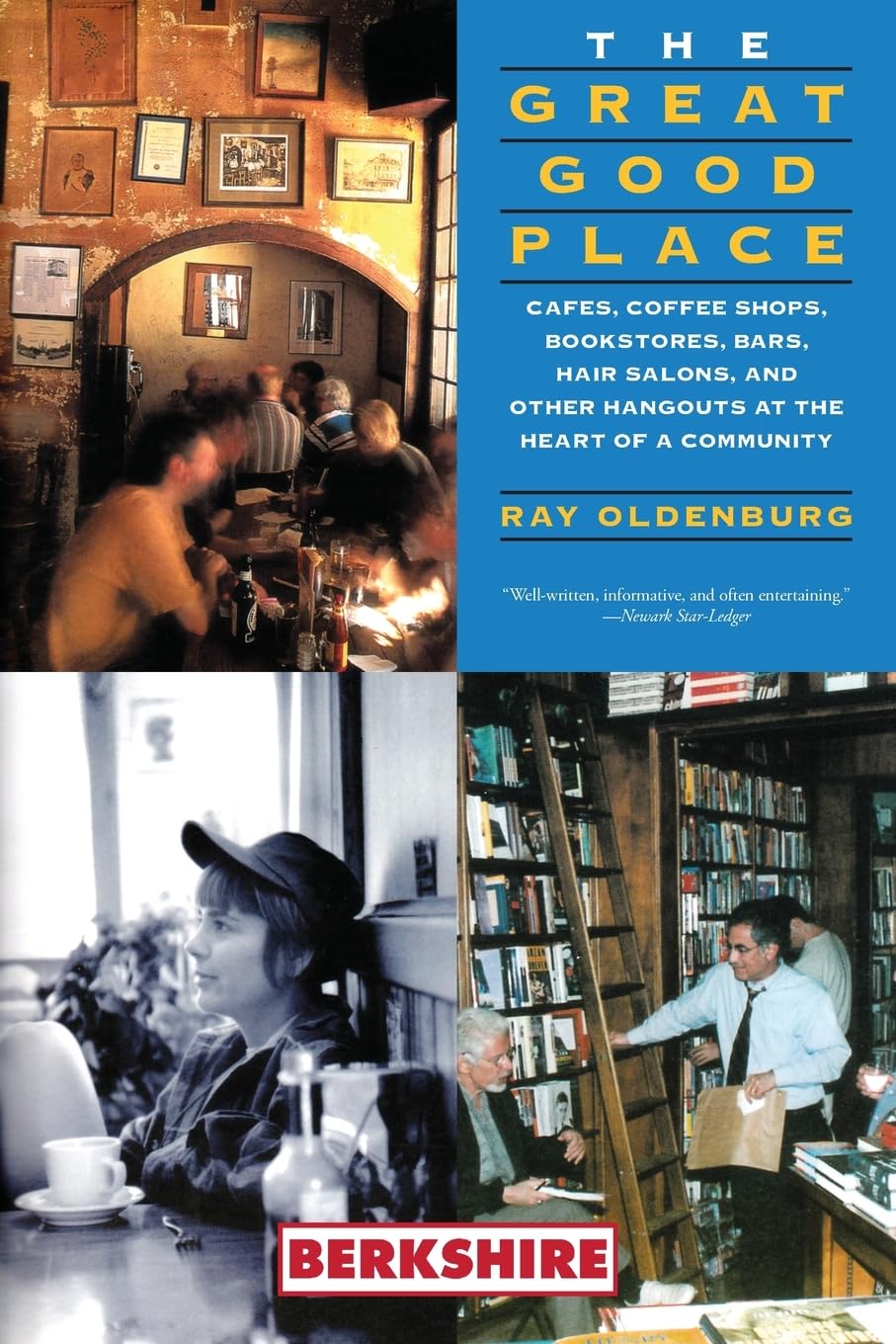
Urban sociologist Ray Oldenburg coined the term “third space” in his book, “The Great Good Place,” (originally published in 1989 and revised in 2023).  Popular third spaces include coffee shops, pubs, diners, libraries, parks and gyms. The third space, Dr. Oldenburg stated, were ones that allowed people to leave private and professional concerns behind to connect with others in conversation. Third spaces “host the regular, voluntary, informal and happily anticipated gatherings of individuals beyond the realms of home and work.”  

There’s some science that indicates it’s not simply the lure of a fantastic latte. A 2012 study published in the Journal of Consumer Research indicated that lower levels of ambient noise can spur creative idea generation. In a later 2019 study, researchers pointed to “stochastic resonance,” a measure of a particular background noise level that benefits our senses and can help in those moments where we are temporarily distracted or in a contemplative state. 

In short, the “coffee shop effect” has been cited in several studies. This, coupled with being surrounded by others seeking a similar environment, can further motivate us into action.  The idea of parallel work—working alongside others but not directly with them—can help us in our solitary efforts. All while feeling less alone.

Still, not all coffee shops will become beloved third spaces. A place where you will regularly spend both money and time is chosen. It is special. It draws you in and invites you to linger for a bit, often in the company of friends or colleagues.

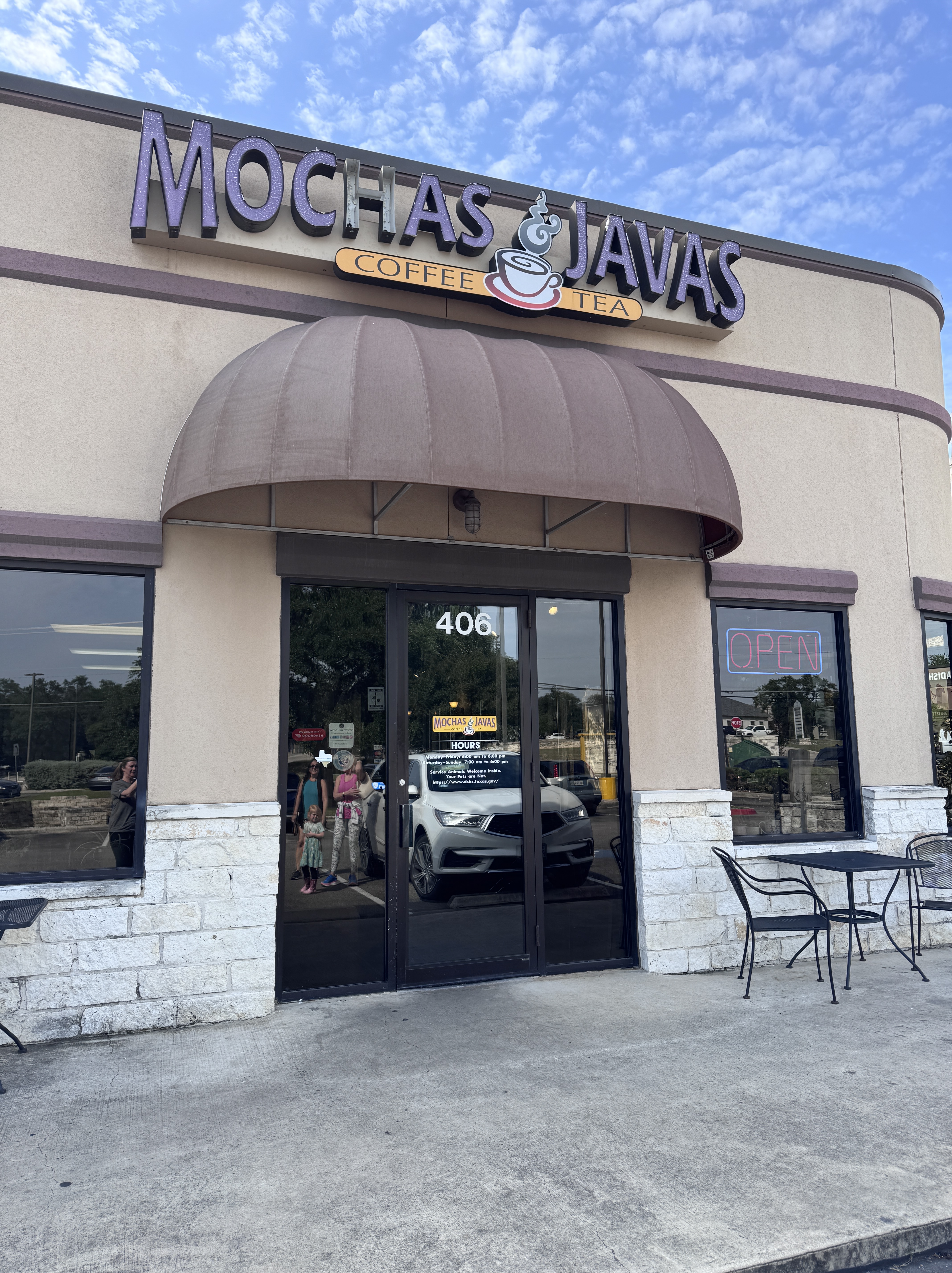
The third space has evolved from being a place where people gather to connect with community, to one that incorporates these components and adds a welcoming setting for students and WFH employees and solopreneurs. As someone who raised three kids while working from home, I sometimes struggled to tune out tasks and chores. So, I sought my own third space and found it at Mochas & Javas. In addition to business articles and columns, I wrote much of my debut novel at the Wonder World location.  

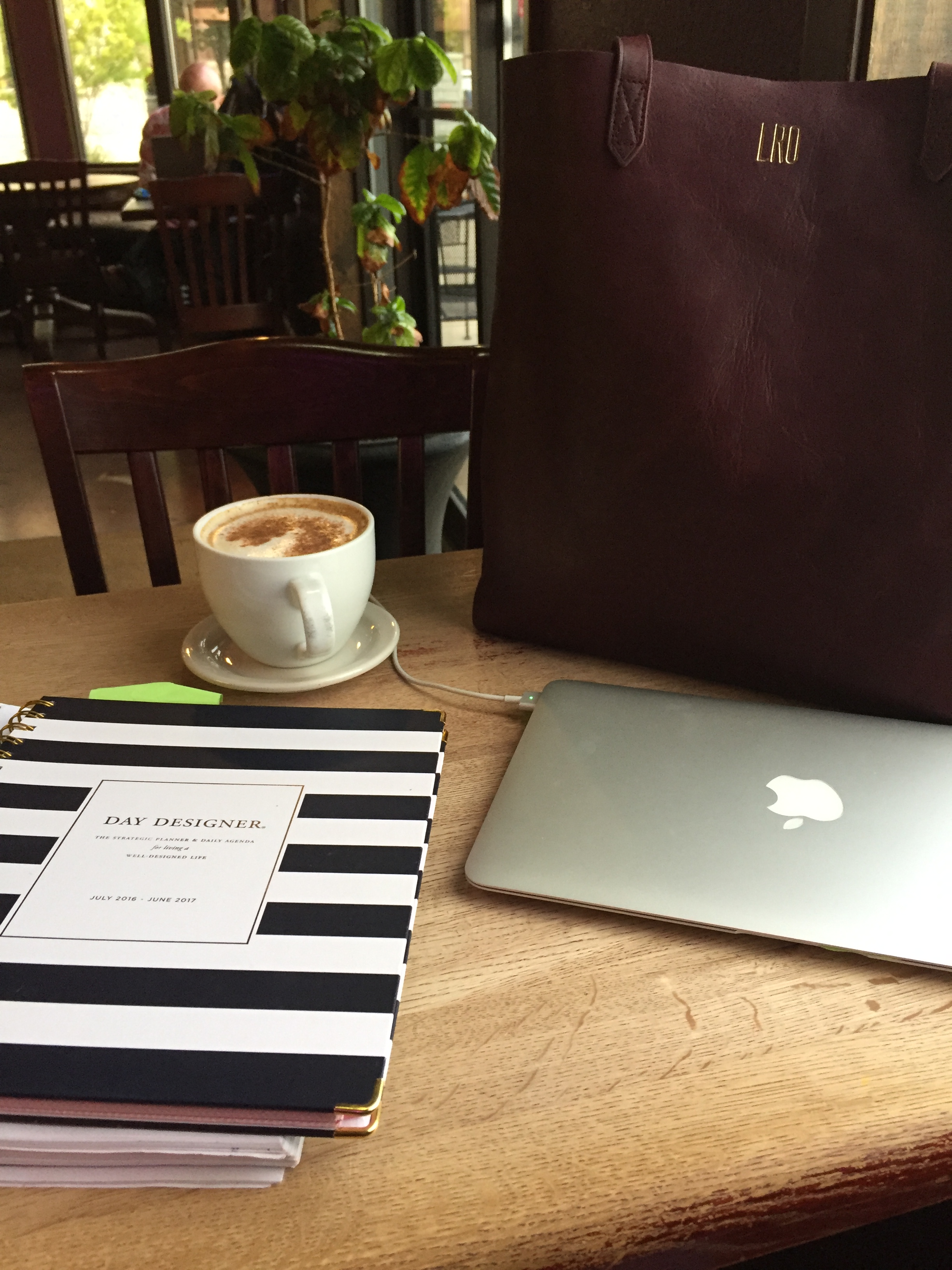
My “MJ office” in 2016

Mochas & Javas continues to be part of my regular routine—sometimes to chat with friends and other times to stare down a deadline—and I was curious to learn more about not only this beloved local institution but the guiding principles behind the business.

Mochas and Javas was founded in 2003 by four family members—Kevin Carswell, his brother Kirby Carswell and their wives, Michelle and Kelly Carswell. The idea originated when Kevin and Michelle began brainstorming about a local venue where San Marcos residents could gather to enjoy quality food and beverages as well as “legendary customer service.” Like many fantastic ideas penned on the back of a napkin or a business card, Michelle sketched the now well-known logo on a napkin and named the business Mochas & Javas (Community Impact, 2019). Over the last twenty years, Mochas & Javas has thoughtfully expanded into five locations.

I asked Kevin if he would share his insight about Mochas & Javas as a trusted third space in the San Marcos community and his philosophy regarding building this popular Hill Country destination. He was kind enough to share his thoughts with me in the following interview:

LO: “Getting together for coffee” is a common refrain we share with friends and colleagues.  What encouraged you to take the first steps to create Mochas & Javas as a gathering space for the San Marcos community?

KC: When we began the discussion about opening our own business we discussed several types of business. But coffee made the most sense at the time, because it was in the food and beverage industry, which is my background and in 2002, the coffee industry was rapidly expanding. I had heard the term “third” space before, but not sure that I fully grasped the concept until we opened, expanded and then had time to grow MJ’s (I’ll abbreviate the full name) over several years and then see how many of our guests became daily/weekly regulars or made MJ’s their third space. Coffee does bring people together, I’ve seen many relationships built from the connection our guests made with one another while at MJ’s, it’s a great thing to see. And for myself I’ve made many friends over the years through MJ’s, lifelong friends. It’s a good feeling. 

LO: Do you find that each location has its own personality/vibe or is the community based on proximity? Or a combination?

KC:  One of the areas that I enjoy about MJ’s is that they all have their own “vibe” or connection to the community or the surrounding area that they are located. Such as WW, many locals with a mix of students and visitors. Whereas LBJ is a more concentrated number of students and professors with a nice mix of visitors, usually families coming for informal or formal visit to TX State University. Our Frisco store is very similar to our WW store, as where it’s mostly locals and business professionals with a mix of students. 

LO:  Why do you think local writers, artists, students and businesspeople are drawn to Mochas & Javas as a third space? 

KC:  Over the years many writers have used the WW store as their office. Paul Pullin for example is in his third book and has become a good friend over the years, he’s been a regular for 22 years. We’ve chosen not to place TVs at any of our stores. I believe they are a distraction, and most people today already have plenty of screen time. If our guests were staring at a screen, they may never meet someone new. We need more face-to-face conversations and MJs provide this. 

LO:  How has Mochas & Javas expanded and evolved since you opened the first location over twenty years ago? 

KC:  MJs opened the LBJ and WW stores the same year, 2003, about 6 months apart. We have always had plans to expand, sometimes slower than we first thought, but moving a bit slower is not a bad thing. Keeping our debt in check and growth at a steady pace. Five stores in 22 years is no record, but we have five stable stores with a strong following from our loyal guests. We are planning to continue with our expansion but will plan accordingly based off good solid numbers which allow us to grow without taking on more than we can manage. 

LO:  Mochas & Javas has strong ties to the Hill Country community, and I wonder if this stems from your philosophy of “always giving back.” Can you expand on this?

KC:  I grew up in San Marcos, our family moved from the Houston area in 1967/68 to San Marcos. So, I’ve seen the city change over the past 57 years. Giving back not only to the San Marcos community but all the communities that we serve great coffee to. Giving back is an important part of owning and operating our business in the communities we serve, and we are grateful that we have the success to do this. We’ve made many small donations and added some larger ones over the years. They are all worthwhile. It’s a great way to say thank you to our community and guests for the many years of support.

The best part of working at MJs, from my standpoint, is our guests and staff. The interaction with both groups of people is the most enjoyable part of our business. I never get tired of working at the register or being a barista. It’s a lot of fun. 

Learn more about Mochas & Javas here:  https://www.mochasandjavas.com

Laura Oles is the award-winning author of the Jamie Rush mystery series. Her debut mystery, Daughters of Bad Men, was an Agatha nominee, a Claymore Award finalist, and a Writers’ League of Texas Award finalist. Depths of Deceit, her second novel, was named Best Mystery by Indies Today. Her novella, Last Call, won the Silver Falchion award. Her work has appeared in crime fiction anthologies, consumer magazines and business publications. She lives in the Texas Hill Country with her family. (https://lauraoles.com

The Upside of Resistance

 Productive Procrastination for Creatives

Most writers battle resistance from time to time, and it comes in many forms. Maybe you’re working on a project with a looming deadline, which is the perfect time to clean your kitchen.

Just ask Agatha Christie.

“The best time for planning a book is when you’re doing the dishes.”—Agatha Christie

I realize I’m bending her quote to serve my purposes, but who am I to argue with greatness?

© agathachristie.com

My most recent battle with resistance happened yesterday. After being away from a project too long due to other writing deadlines, I struggled to find my groove, which culminated in my spending nine hours trying to get my arms around a manuscript. My characters refused to behave, and a section of the second act sagged like a neglected hundred-year roof. The final pin dropped in the form of my losing several thousand words due to some sort of file syncing error. I’d spent all day trying to nail Jello to the wall and wondering why it refused to stick. 

I called my sister-in-law, who sagely suggested I needed to step away from my computer. Get some fresh air, go for a walk. I felt a bit better after but still defeated. I spent the rest of the evening with the gritty dust of failure stuck to my skin. I then reminded myself that this, too, is part of the process. The only way out is through. Tomorrow is another day.

I decided to start this morning with some writer support. After a two mile walk while listening to Brandon Sanderson discuss writing with Tim Ferris, I then read J.T. Ellison’s Substack on resistance. There was something about listening to other authors discuss their craft and the struggles that come with it that helped me refocus with a fresh perspective (and an attitude adjustment, which was sorely needed. I was very salty).

If you’re struggling with any sort of creative project, consider taking respite by listening to other creatives discuss how they do their thing.  Here are a few of my favorites:

The Tim Ferriss Show: Episode #794: Brandon Sanderson on Building a Fiction Empire… 

Buckle up, loves, because this episode is 3.5 hours long. It took me several walks and cleaning sessions to get through it, but I promise it’s jam packed with some fantastic advice and discussion related to both the art and business of writing. Few writers have accomplished what Brandon has while also so freely sharing his expertise with others.  

https://www.youtube.com/watch?v=5zzzjLKuFZA

Work Life with Adam Grant: Your Insecurities Aren’t What You Think They Are

Adam Grant is an organizational psychologist with a curiosity superpower that translates into countless benefits for his audience.  His WorkLife podcast is a regular listen in my feed. This episode is also how I found Taylor Tomlinson, which some might think is a strange way to discover a comedian.  Their discussion about how to handle insecurities when your job is centered largely on external feedback and validation (hello, writers!) is one that you may listen to more than once. 

https://podcasts.apple.com/us/podcast/worklife-with-adam-grant/id1346314086?i=1000523780269

J.T. Ellison Substack: The Creative Edge

If you’re a Substack fan, I highly recommend giving J.T Ellison’s newsletter a read. She gives us an inside look at her life as a bestselling author juggling multiple projects for both traditional publishers as well as her own imprint. Her advice is practical and specific, and she mixes in a generous amount of empathy. Here’s the post that pulled me out of my latest bout of writing resistance.

https://jtellison.substack.com/p/interim-step-two-facing-down-resistance

#AmWriting: Substack and Podcast

The author collective of the #AmWriting enterprise deliver some of the best stories, guidance, and interviews related to the business and craft of writing. Regardless of genre or publishing preference, they have you covered.  Their Substack is well organized and offers tons of shovels to help you dig yourself out of any writing hole you currently find yourself stuck in. 

https://amwriting.substack.com

James Clear: Atomic Habits and Newsletter

As someone who receives far too emails, James Clear’s newsletter is the rare one that I make sure to read as soon as it hits my inbox.  His 3-2-1 format (three ideas, two quotes and one question to consider) are thoughtfully considered. Every issue provides a valuable takeaway, and his recent Master Class covers the concepts he outlines in his mega-bestseller Atomic Habits.  Here’s what he shares with us about resistance:

“If you feel resistance before you begin, it’s usually procrastination and you need to get started.  If you feel resistance after you begin, it’s usually feedback and you need to make adjustments.”

Jiro Dreams of Sushi

Jiro Ono is an 85-year-old sushi chef and proprietor of Sukiyabashi Jiro, a 10-seat restaurant located in a Tokyo subway station. Some of the top critics believe he is the world’s greatest sushi chef. This documentary follows his passion for continued mastery even at what he sees as the final years of his career.  “A thoughtful and elegant mediation on work, family and the art of perfection, chronicling Jiro’s life as both an unparalleled success in the culinary world, and a loving yet complicated father.”

I discovered this documentary after my last visit to Japan and was moved by both the constant pursuit of mastery as well as the price it exacts on those closest to him.

I’d like to leave you with a quote that I revisit so often that I should have it tattooed on my forehead. 

“If I waited for perfection, I’d never write a word.”—Margaret Atwood

The world needs your stories more than ever, so I hope that if you’re battling resistance, you’ll find some support from the creative community. Storytelling, at its heart, should be something we enjoy, and if it isn’t bringing that to you right now, I hope it soon returns. And when it does, readers will be waiting for you.

–Laura Oles (https://lauraoles.com) is the award-winning author of the Jamie Rush mystery series. Her debut mystery, Daughters of Bad Men, was an Agatha nominee, a Claymore Award finalist, and a Writers’ League of Texas Award finalist. Depths of Deceit, her second novel, was named Best Mystery by Indies Today. Her novella, Last Call, won the Silver Falchion award. Her work has appeared in crime fiction anthologies, consumer magazines and business publications. She lives in the Texas Hill Country with her family.

Equinox!

by Helen Currie Foster

An excess of animal spirits”–springtime! Really? Molly Ivins was right as usual when she wrote, “Texas–land of wretched excess!” We’ve had ridiculous lows, unseen for decades. Early daffodils and hyacinths came, shivered, and shriveled in the unholy cold winds roaring across the plains. But we’ve also had the earliest 90 degrees in decades! Wretched excess indeed!

Just two days until the vernal equinox on March 19, and spring. What makes us wander outside, searching for the first bluebonnet, the first violet? What makes us huddle outside the garden store, searching through the little plants shivering in the breeze, fingering seed packets, carrying home small pots of basil and blue salvia even though the weather’s far too untrustworthy for planting? What is this proto-agricultural spirit that makes us lug home the potting soil, hoe the garden bed? More sunlight? Cabin fever? Some early human gene? We, the Animal Kingdom, working with the Plant Kingdom?

I’m rereading Barry Cunliffe’s Europe Between the Oceans: 9000 BC-AD 1000a book I value not just for the stunning photographs of prehistoric sites and art, but for describing a history of human inventiveness. Cunliffe, Oxford Professor Emeritus of Archeology since 2007 (many books), says “massive transformation” occurred in Europe between 1300-800 BCPopulation growth required developing more crops than wheat and barley, including lentils, peas and—“the celtic bean (Vicia faba).”

Immediately I ordered a giant pack of fava bean seeds.

This image has an empty alt attribute; its file name is img_0981.jpg

Then I read the label: they’re mostly a winter crop–but this year I’m desperate. With last year’s blistering hot drought, I wound up with only one pot of cherry tomatoes on the porch and a dozen wilting jalapeno plants in the garden. Cunliffe’s reference to Vicia faba fired my imagination—envisioning myself harvesting large fuzzy green pods, containing delectable beans, and adding a little vinaigrette…olive oil (since 4000 BC) and vinegar (3000 BC). Using an ancient bean and ancient vinaigrette recipe! Possibly those beans were harvested, and the vinaigrette shaken, by some long-ago ancestor 3000 years ago, making me wonder if we have genetic preferences, genetic recipe roots? After all, we of the Animal Kingdom depend on the Plant Kingdom (oxygen, vinaigrette, and wine!).

Mysteries offer escape—a protagonist we like, an intriguing plot, a vivid setting. Like plants, favorite old mysteries offer much when we revisit. Mystery writers? They’re good to “talk to.” This morning I discovered on the shelf my dad’s 1934 Modern Library edition of Dashiell Hammett’s The Maltese Falcon, with a brief bio and the “new introduction” by Hammett.

This image has an empty alt attribute; its file name is img_0980.jpg

I didn’t know Hammett had worked as an operative for Pinkerton’s Detective Agency before he started writing! “Drifting through a miscellany of ill-paid jobs, he found a temporary solution to his economic problem by shadowing real malefactors with what might be called conspicuous success.” Then came the World War: “He won a sergeantcy and lost his health.”

Hammett can remember where he got his characters. Here’s a snippet of what he says about The Maltese Falcon:

“Dundy’s prototype I worked with in a North Carolina railroad yard; Cairo’s I picked up on a forgery charge in Pasco, Washington, in 1920; Polhous’s was a former captain of detectives…Effie’s once asked me to go into the narcotic smuggling business with her in San Diego…”

Hammett then muses about his own protagonist. “Spade had no original. He is a dream man in the sense that he is what most of the private detectives I worked with would like to have been and what quite a few of them in their cockier moments thought they approached. For your private detective does not—or did not ten years ago when he was my colleague—want to be an erudite solver of riddles in the Sherlock Holmes manner; he wants to be a hard and shifty fellow, able to take care of himself in any situation, able to get the best of anybody he comes in contact with, whether criminal, innocent by-stander or client.”

What a great description, and didn’t Humphrey Bogart nail it?

It strikes me that this new character of his upended the vision of the members of the London 1930 Detectives Club—Hammett gave the wide-eyed mystery audience a protagonist who is not a secret member of the aristocracy (Albert Campion) or a perfect gentleman (Roderick Alleyn) or a hyper-particular French veteran drinking tea and waxing his moustache (Hercule Poirot)…but a “hard and shifty fellow…able to get the best of anybody.” Welcome to the New World’s new-style mystery protagonists, the children of Hammett, Raymond Chandler, Sara Paretzky and others…including that hybrid protagonist, Mary Russell, in Laurie King’s Mary Russell and Sherlock Holmes series.

For Mary Russell and Sherlock Holmes, the scent of honey is a repeat theme (her Holmes is a beekeeper). I like her Holmes, I like her Russell, and just finished her Garment of Shadows (2012). King has chosen a fascinating and ambitious setting: the 1920’s, with Spain and France fighting for control of Morocco, each coveting its crucial strategic location at Gibraltar, while various Moroccan groups—Berber and otherwise—fight for independence. King uses first person point of view for Mary Russell, who’s suffering from acute amnesia—forgetting her childhood and even her marriage––but uses third person POV for Holmes’s chapters. Those shifts sometimes confused me. But her depth of history and geography, and her vivid descriptions of the magical city of Fez with its souk, bring the setting alive. Mary Russell herself has become quite a protagonist, with linguistic skills—including Arabic––and the imagination and drive to devise a daring escape from a horrible prison. I’d like to learn knife-throwing like Mary Russell (she keeps one in her boot) but the likelihood seems dim.

Writer/theologian Bruce Reyes-Chow mentioned how, when stuck, he’d “talk through ideas with myself, my plants…” I intend to follow his lead. On our deck sit five jasmine plants we’ve toted around since the seventies. I think they sometimes do communicate with me—“I’m dry-y-y-y!” But from now on, when I’m stuck on a plot, I’ll go consult them. Every spring, those jasmine produce tiny white flowers with an unmatchable scent. In search of even more scent, this year I’ve planted another mix of old and new. Rose de Recht is a fragrant pink heirloom damask, Fragrant Blush promises pink perfume, and Star of the Republic is tough, like her name, but delicate pink with exquisite fragrance.

This image has an empty alt attribute; its file name is img_0978.jpg

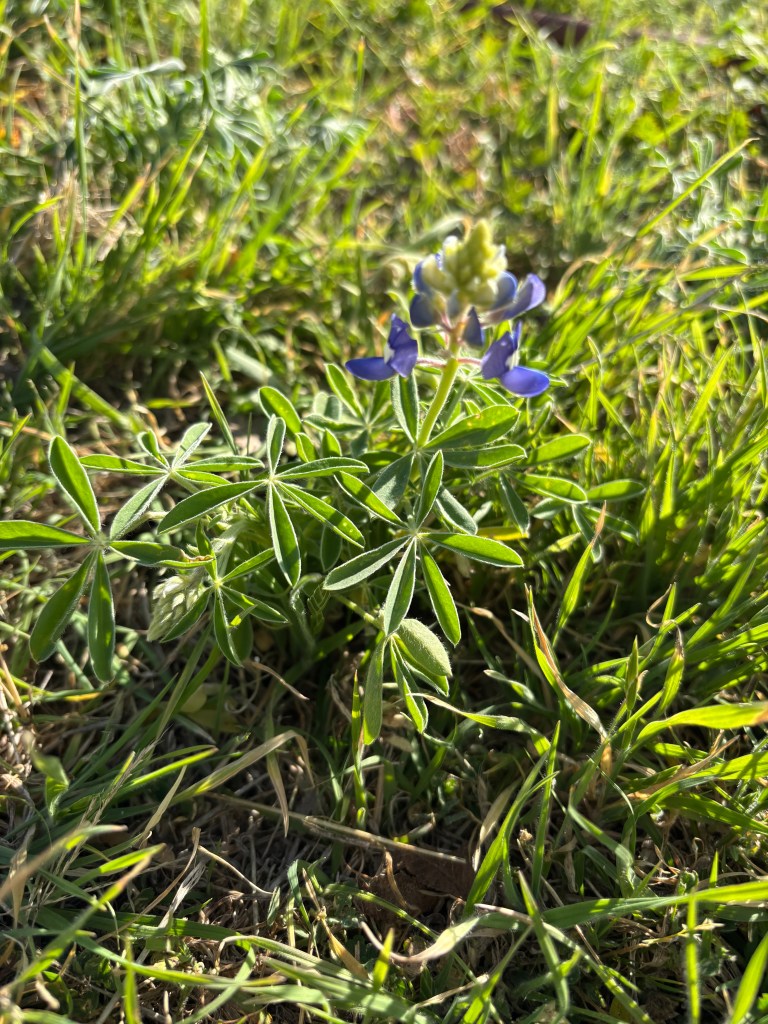
And now suddenly the redbuds, with their irresistible yet evanescent fuchsia buds, are blooming. I’ve seen our first bluebonnet,

This image has an empty alt attribute; its file name is img_0974.jpg

and the first purple prairie verbena. The live oaks know it’s almost the equinox—they’ve flung down their old leaves (aided by the fierce winds) and are preparing their catkins and baby leaves. The cedar elms have put out tiny chartreuse leaves just in the last two days.

This image has an empty alt attribute; its file name is img_0973.jpg

So it’s spring! Grab that trowel! And after all your work, you deserve to loll on the couch at night with a good mystery. I’m halfway through the tenth book in my Hill Country murder mystery series. This one raises a question I find intriguing and difficult. Can justice be served when, unauthorized to pronounce justice, we take justice into our own hands? Is that still justice? I’m discussing it with the plants. More to come….

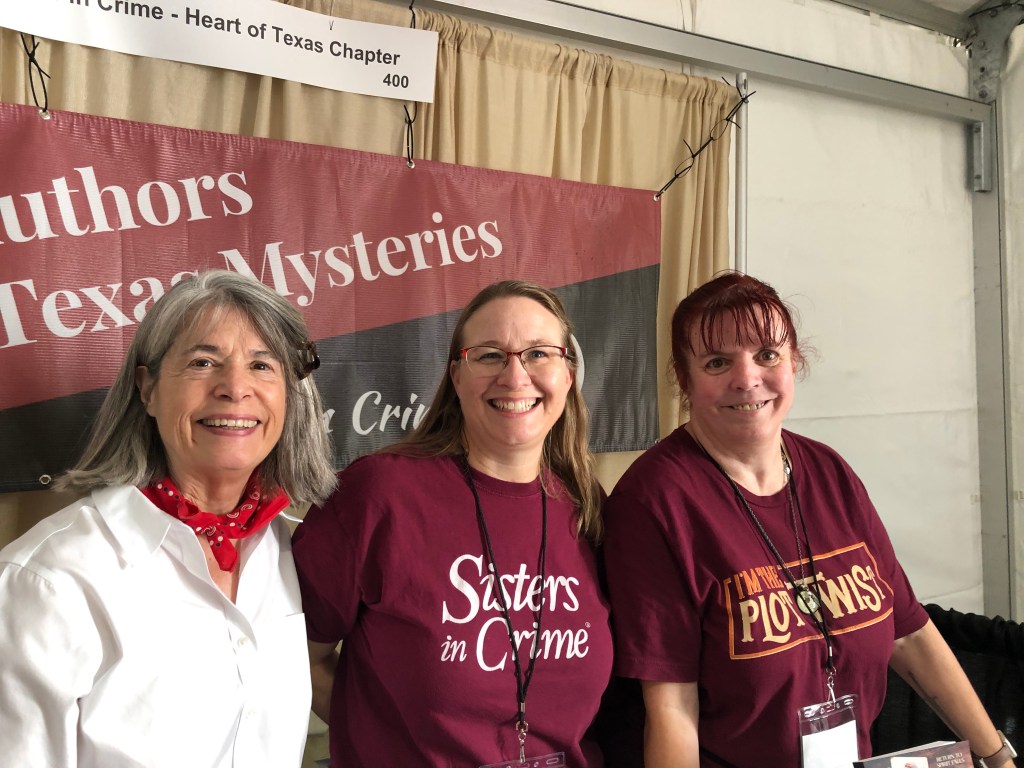
Here are Helen, Noreen Cedeno, and Juanita Houston at the Texas Book Festival!–Heart of Texas Sisters in Crime

***

Award-winning Helen Currie Foster lives and writes the Alice MacDonald Greer Mystery series (9 volumes so far) north of Dripping Springs, Texas, loosely supervised by three burros. She’s working on Book 10. She’s drawn to the compelling landscape and quirky characters of the Texas Hill Country. She’s also deeply curious about our human history and how, uninvited, the past keeps crashing the party.

Follow her at Helen Currie Foster and at her author page on Amazon.

In the Window or On the Table? What I Learned from Amor and Anton

By: Dixie Evatt

Ever since I read A Gentleman in Moscow (2016) I’ve considered Amor Towles’ writing style to be nearly perfect. So when my niece told me Towles was making an appearance at the Empire Theatre in San Antonio, I booked it. He was there to support the San Antonio Book Festival and to talk about his latest book, Table for Two. It’s a collection of six short stories plus a novella. Unlike some of his other stories, these all take place in the current Millennium.

Over the evening I learned a interesting things about Towles.

I learned that he is what we used to label in the news business, an “easy interview.” Austin’s own Stephen Harrigan (Big Wonderful Thing, 2019) was on the stage with Towles as moderator but he didn’t get to ask many of the questions on his notepad. Towles was in a talkative mood so needed little prompting.

I learned that Towles took up writing full time only after success in his first career at a small Wall Street investment firm.

I learned that once he gets a project in mind, he begins to fill notebook after notebook with hand-written outlines, ideas, scenes, characters. It may take years. He says this process frees his imagination and subconscious to go where beautiful language and the characters’ inner lives take him.

There was more but of the many memorable things I learned about this accomplished author, what I remember best, and took to heart, was his description of his research process. He said that when writing he intentionally postpones what he calls “applied research” until near the end. During this time he is also reading novels written by others that are set in the same historical period as the book he’s working on. His novel is almost written before he begins deep research.

That’s why he waited until A Gentleman in Moscow was almost finished before traveling to Moscow and checking into the Hotel Metropol, the exclusive hotel where his story about Count Alexander Ilyich Rostov is set.

Towles advised that details gleaned from this kind of active research should be written into the story much the way one might design the stage for Anton Chekhov’s The Cherry Orchard (1903). Of course Towles would choose this particular play as a point of reference because, like his own novel set in Russia, Chekhov’s tragicomedy also deals with a period of decline for the Russian aristocracy.

He said that when the curtain rises for the play the audience might see only the suggestion of a cherry orchard through large windows as if were rendered by an impressionist such as Claude Monet or Mary Cassatt. The windows might be framed by plywood bookcases painted to resemble mahogany. In the center of the room there would be a table set with a porcelain tea service.

When an author is ready to fold research into the story, Towles said it should be presented with similar layers of reality. Some details are just suggested in the background. Some, like the bookcases, give the scene the appearance of reality but need not be too detailed. Then there are aspects of research that can’t be given short shrift. For these, the author must adhere to absolute authenticity. The audience needs to hear the chair move across the floor and the teacup rattle in the saucer. The challenge for me is where all of the information that I’ve accumulated in my own research belongs – in the window or on the table?

Charles McNulty, theater critic for the Los Angeles Times, said in a June 6, 2022, review of a local revival of The Cherry Orchard, “Big things occur in Chekhov. Houses are lost, guns occasionally go off, and people die. But the focus is on muddling through.”

Much the same might be said about A Gentleman in Moscow and the subtle use of active research by Towles so that his story isn’t swallowed up in the details.

***

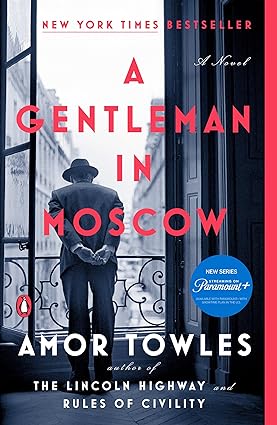
Cover of A Gentleman in Moscow via Amazon

Image of Anton Chekov via Wikipedia. Public domain.

Image of stage of The Cherry Orchard via Wikipedia. Public domain.

***

A former political reporter in Austin, Dixie also taught writing at Syracuse University. When she teamed up with Sue Cleveland to write fiction, they sold a screenplay to a Hollywood producer. Although the movie was never made, the seed money financed ThirtyNineStars, their publishing company. Through it they published two award-winning thrillers (Shrouded and Digging up the Dead) under the pen name, Meredith Lee. Dixie’s first solo mystery was Bloodlines & Fencelines, set in a tiny Texas town near Austin. Kirkus reviews described the book as, “A twisty whodunit that’s crafted with care and saturated with down-home Southern charm.” She is working on second mystery in the series. www.dlsevatt.com