It’s September! New school year! New shoes, after a hot barefoot summer! New outfit, for the first day of school! And then––new classes! New subjects, new teachers, new tools! New friends! New lockers, new classrooms, new hallways…. New season—new teammates, new coach, new plays.
Remember all that? Your first day back at school? Back to college, back to university? Do you remember the excitement, the nervousness, the anticipation?
September 1 was Labor Day. And now there will be apples, apple pie and apple crisp. There will be chrysanthemums, spilling out of baskets. Even in central Texas, leaves will change color—as Maxwell Anderson’s lyrics have it, “When the autumn weather turns the leaves to flame.” Here in the Hill Country, sumac and Spanish oak turn red, sweet gum turns yellow. No, not the glory of the maples, but a change in the landscape. Because finally, after the dog days of summer, that’s what September brings: something new.
It’s time to pull up the tired summer flowers and thank them for their service. Time to dig some holes and plant new trees, and order some bulbs. I’ll be planting the Mexican plum seedlings a friend gave me, and ordering narcissus bulbs for indoor blooming.
Then the Hill Country brings its own fall excitement. Dove season began September 1 and a down-the-road neighbor, disturbed by shotgun pellets clattering onto her roof, had to call the sheriff, and have officers explain to a clueless (thoughtless? lawless?) neighbor that it’s contrary to law to allow your ammunition to cross your own fence line. Also unneighborly. But hmm, that could find its way into a future book plot….
Our Hill Country holds surprises. One is the way water hides in the Hill Country—down in secret seeps and creeks, around curves and hollows. And what odd creatures live out here! For example, this fall we’ve seen again the rare and secretive rock squirrel. (We’ve seen a solitary rock squirrel only once every few years.) We’ve heard the great horned owls that call at night, up and down the creek, and the herons who call, flying down the valley. The buzzards drone, annoyingly, from the tops of telephone poles. We treasure glimpses of the shy, gorgeous painted buntings who appear briefly at the bird feeder, then flit away. Porcupines visit. Roadrunners dart across the road.
And the dog days are over. (This year they were July 3-11, and these hot sultry days have borne their name from ancient times ostensibly because it’s when Sirius, the Dog Star that accompanies Orion, rises with the sun.) https://www.almanac.com/content/what-are-dog-days-summer
But during the dog days I took refuge at night, binge-reading two mystery series that were new to me, by British author Peter Grainger: the DC Smith Investigation series and the Kings Lake Investigation. http://bit.ly/4gmPsad
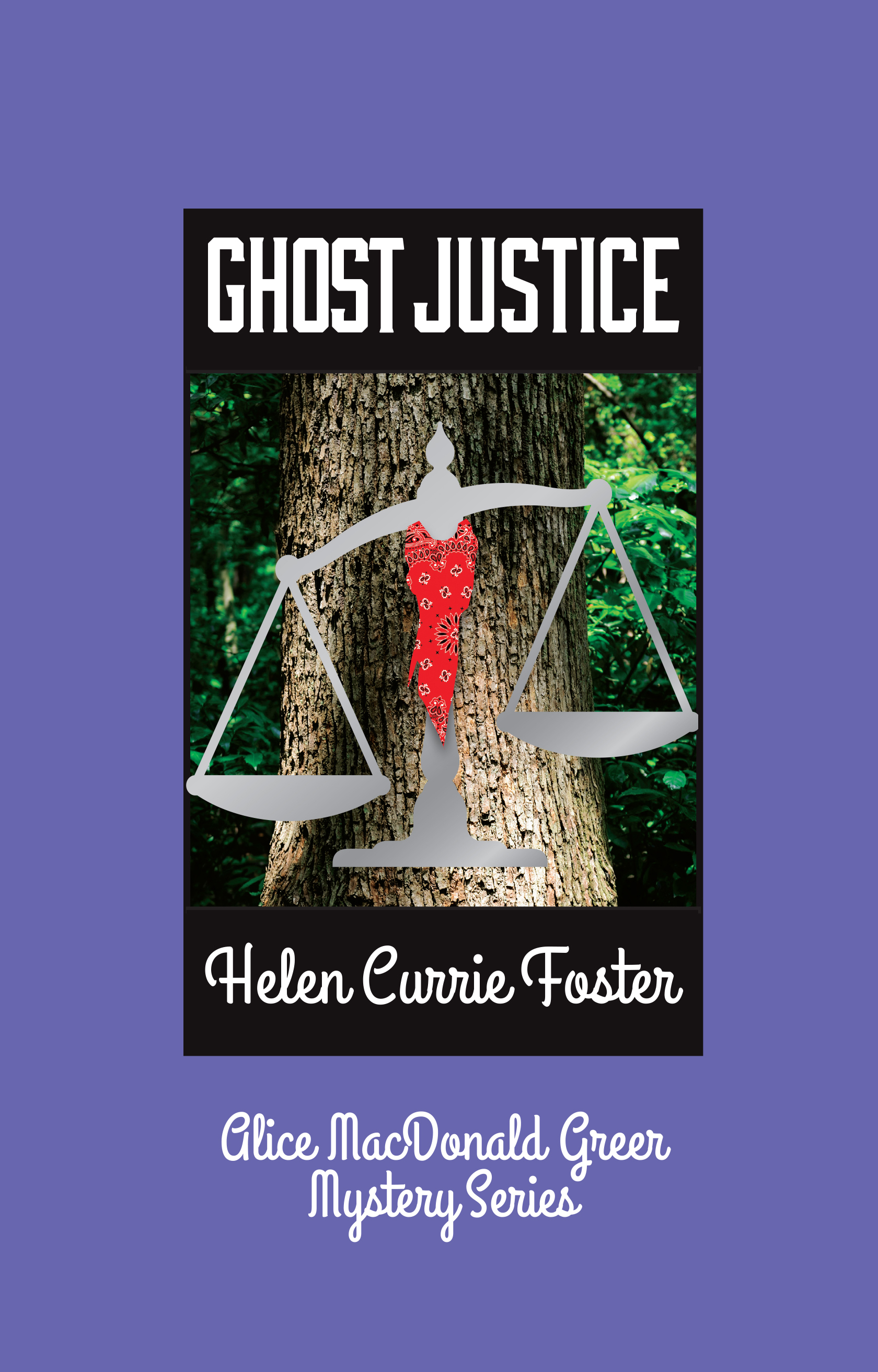
These wry British procedurals are set on the coast of Norfolk, providing a cool and rainy ocean-side backdrop for the appealing characters. At least I could read about rain and cool breezes. But the books offered not only a respite from ridiculous heat, but a welcome respite from writing. I’ve been in the last weeks of finishing Ghost Justice—Book 10 in my Alice MacDonald Mystery Series, set here in the Texas Hill Country. For me that process includes waking in the wee hours with my mind on plot additions and subtractions, dialogue, characters. For such moments—when the characters wake me up at night voicing their further demands (yes, they seem to come to life and require conversation and attention)––I find mysteries provide absorbing distraction.
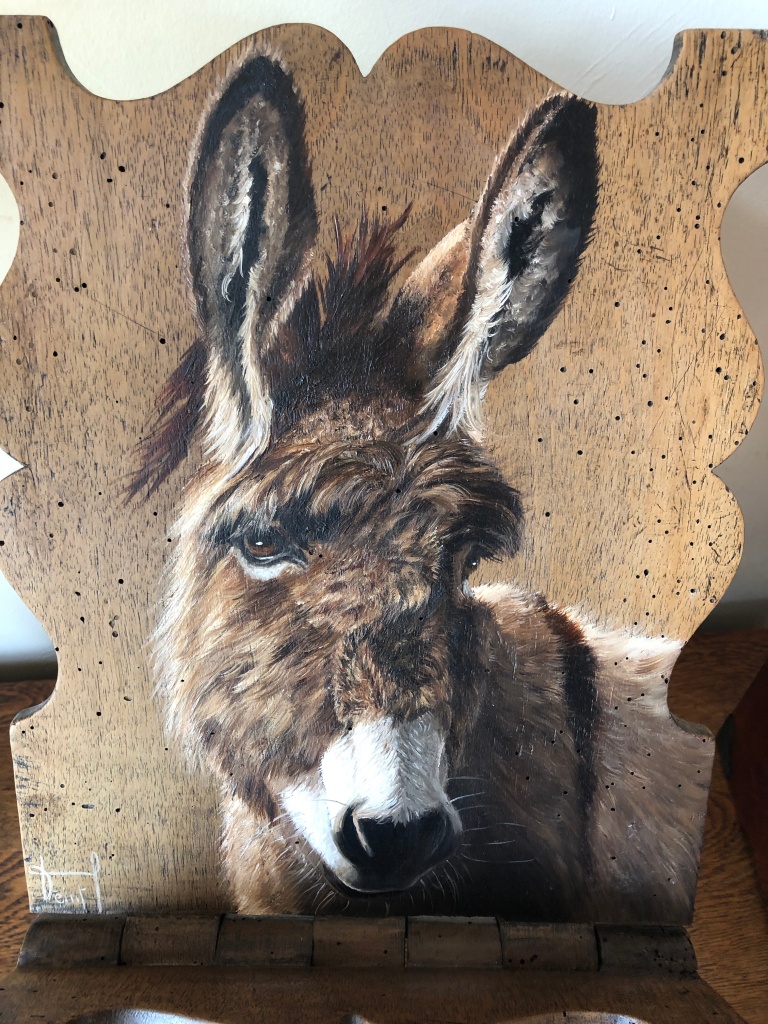
Helen Currie Foster lives and writes the Alice MacDonald Greer Mystery series north of Dripping Springs, Texas, loosely supervised by three burros. She’s drawn to the compelling landscape and quirky characters of the Texas Hill Country. She’s also deeply curious about our human history and how, uninvited, the past keeps crashing th eparty. Follow her at http://www.helencurriefoster.com.
Not enough rain fell this year to allow the brilliant cerulean fields of Hill Country bluebonnets we usually expect, but the hardy lupines are busy making seedpods. “Maybe next year,” they say. Now instead we have the bright yellow coreopsis lanceolata, nodding their heads with any breeze,
the wine-cups with their indescribable color—a member of the mallow family, not quite fuchsia, not maroon, just—heart-stopping,
the milkweed flower globes beloved of monarch butter-flies, and others. Heaven includes a few prairie celestials, magically opening in early in the afternoon, then vanishing by dusk.
Also, “Sweet Mademoiselle,” planted a couple of years ago, and who has never bloomed, produced her first rose!
Meanwhile, the ever-interloping cactus hope to assuage my fury at them (remember those secretly spreading roots and the huge basal “plates” that help the Cactus Conspiracy spread?) by popping open their yellow flowers. I am not fooled. I’ll continue to battle them with shovel and hoe. And a picker-upper.
See? Perfectly possible. It’s still wild out here in the Hill Country, even as suburbs press upon us. At dusk I often find myself glancing at the edge of the drop-off behind the house, wondering if I’ll see a pair of ears. You can say mountain lion, puma, cougar…they’re secretive, strong, and active in the spring.
But the big cat I once saw on Bell Springs Road west of here was likely a large bobcat. I was alone, driving home from the post office. Up ahead a golden vision, spotted, walked slowly to the edge of the asphalt. I stopped. The cat stood, gazed at me, and after a breathless (for me) interval, gracefully turned and vanished through a fence into thick cedar. A magical moment. Every time I drive that road, I hold my breath, longing for one more sighting of something looking like this:
ANCIENT BONES? I wrote about old bones in my Ghost Bones (2024)—and now have learned that our Hays County police deal with ancient bones more often than you’d think. One resident recently called to report she’d found a skull in her firepit. The skull, with its lower jaw present, was obviously fairly old, but in an unexplained death Hays County is not permitted to send a body to the Travis County Medical Examiner without including the name of the person whose skull it is. (Hays County doesn’t have its own medical examiner.) So this skull traveled instead to Texas State anthropologists who reported, after testing, that the skull apparently belonged to a long, long-ago teenager who’d gone through hard times, as was evident from the “enamel lines” (a bit like tree rings) in the teeth.
But how it wound up in that firepit? So far as I know, that’s still a mystery. We forget—until reminded by a skull in a firepit—how long humans have roamed these hills, drawn by hunger and thirst to spring water and the hunt for food.
We also forget the age and history of this landscape. Some trees have sheltered native Americans, deer, and buffalo. The Columbus Live Oak near the Colorado River in Columbus is estimated to be over 500 years old. Others may be as old as 1,000 years.
I revere the live oak in our front yard as if it were a beloved ancient relative and a symbol of stability and the power of trees. If anything were to happen to it—woe! I tried to estimate its age—using the calculator instruction to measure girth in inches at 4.5 feet, divide by pi, then multiply by a “growth factor” of 4, which gave me 127 years old. Perhaps this tree was a sapling in 1900, before either World War, before the Viet Nam war, before our current fraught politics. On a nearby hill there’s an ancient patch of even bigger live oaks. Perhaps those particular oaks depend on the odd little ribbon of wet white clay that lies about five feet underground and has been there—who knows how long. But the feeling of walking in beneath these old live oaks can confer a sense of being in the protection of one’s elders.
So, welcome to the Hill Country in spring—southeasterly winds from the Gulf, blowing the flowers back and forth; reasonably moderate temperatures; fields and trees as green as green, as far as you can see. At the bird feeder, more color! Purple house finch, yellow-throated vireo, lesser goldfinch with brilliant gold breasts, vermilion cardinals, black-crested titmouse, white-winged dove—and the shy and tiny, but utterly gorgeous, painted bunting. (Reportedly it loves millet.) They provide not just color but music, from the titmouse, the tiny but high-volume Carolina wren, plaintive doves, whistling cardinals, and, at night, chuck-will’s-widow.
Not for long, of course. In winter ice can wreak havoc on trees and people. Summer sun? Scorching. Autumn? Nothing like the colors of New England, but hey—the sumac turns red. So welcome, Spring, with your bluebonnets and live oaks, with bird music and color, and with your reminder of the power and beauty of nature!
***
Progress report: madly working on Book 10 of the Alice MacDonald Greer Mystery series, set in the Hill Country. Have ordered “Forest Bathing” by Dr. Qing Li. Would enjoy hearing what you all are reading too, and any reports of “forest bathing”!
Helen Currie Foster lives and writes the Alice MacDonald Greer Mystery series north of Dripping Springs, Texas, loosely supervised by three burros. She’s drawn to the compelling landscape and quirky characters of the Texas Hill Country. She remains deeply curious about our human history and how, uninvited, the past keeps crashing the party.
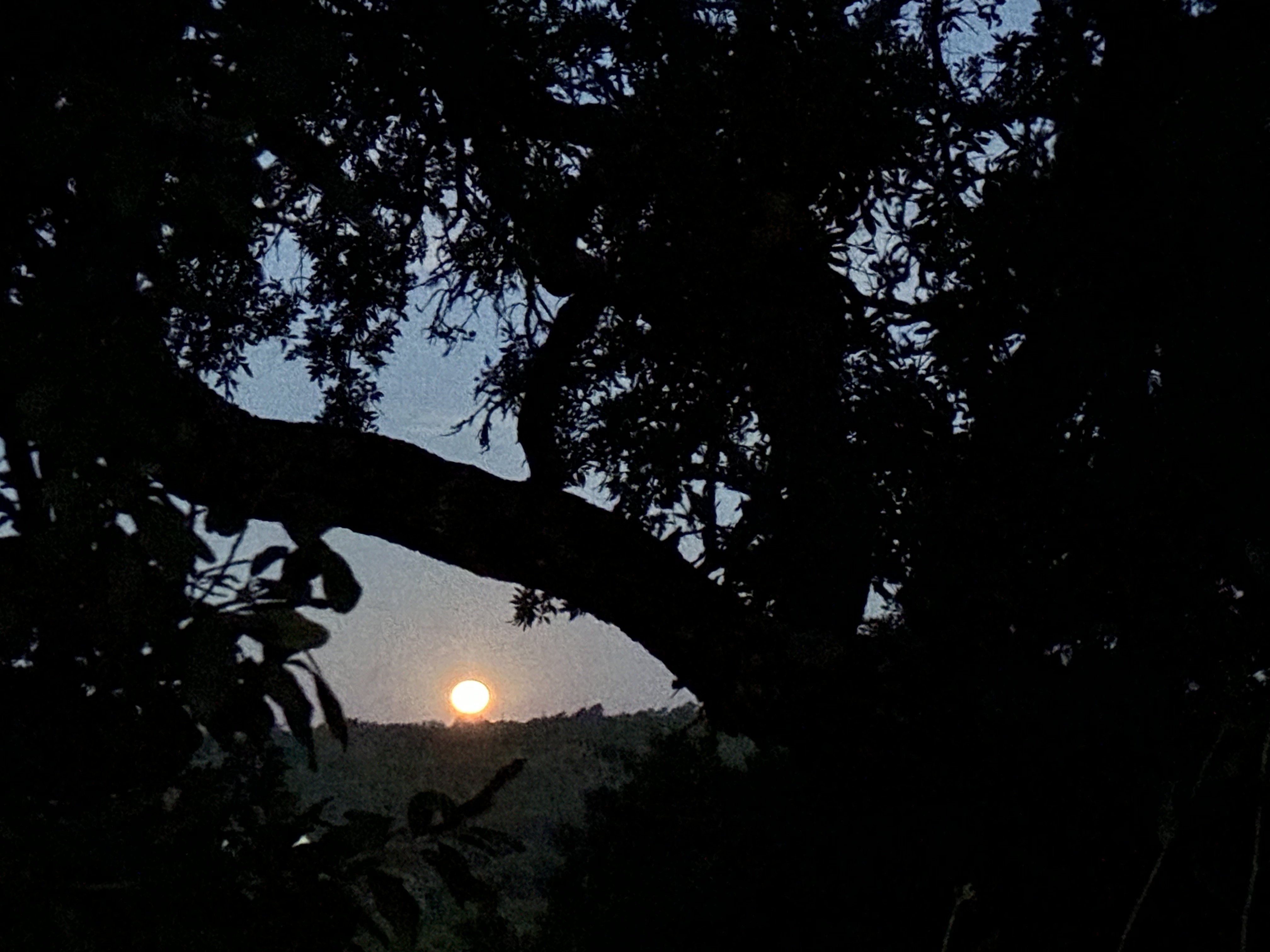
I wasn’t going to discuss the dreadful heat. But early this morning came two despite-the-heat surprises: first, moonset of the August Supermoon.
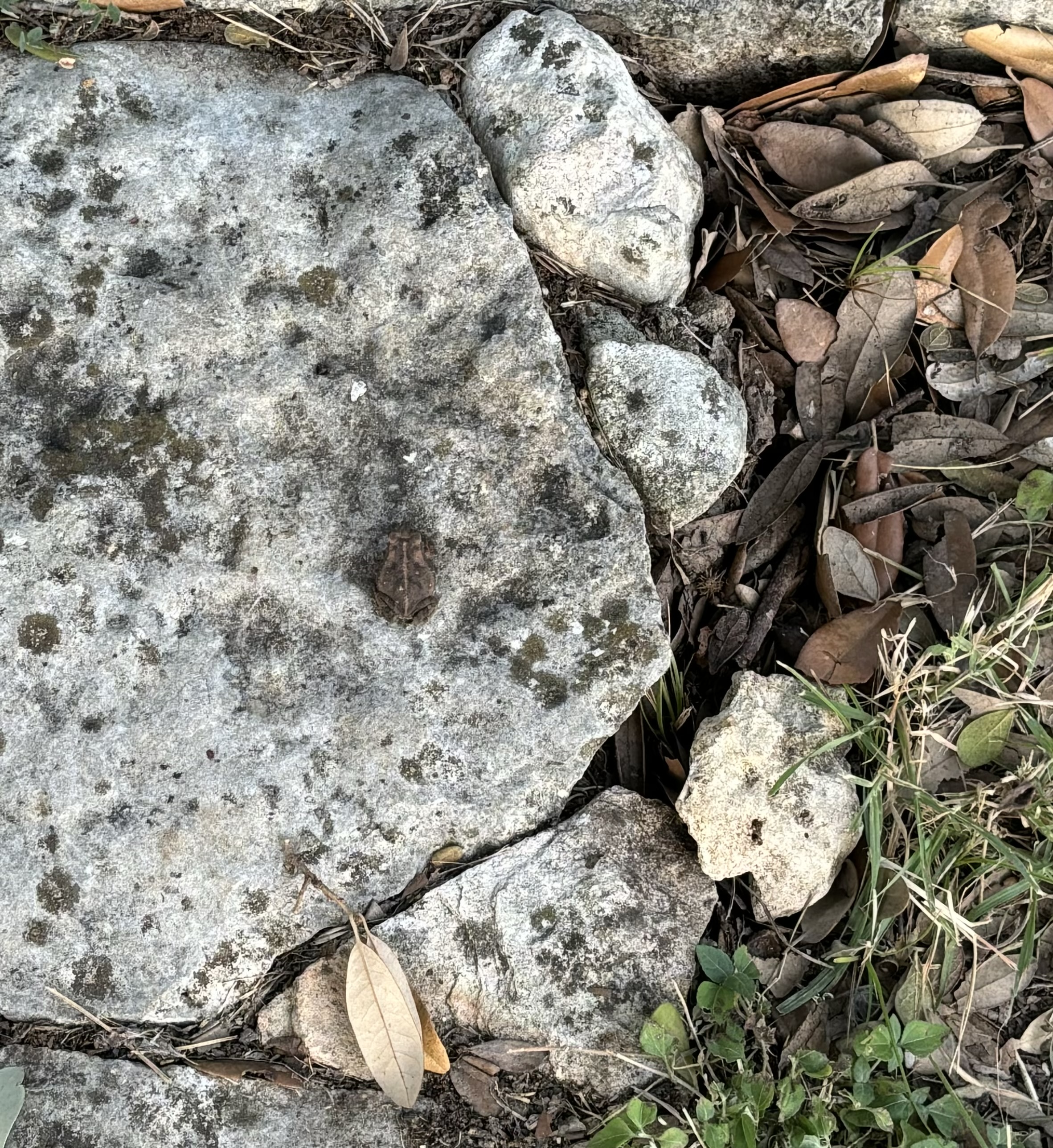
Next, a tiny frog, less than an inch long, sitting quietly in the shade. Could it be a Texas cricket frog? Maybe some frog-maven will know. Can you spot it here?
Another treasure: an email from a reader who’d read Ghost Cave, first book in my Alice MacDonald Greer Mystery series, and wanted the recipe for the coffee cake served by Alice’s redoubtable elderly friend Ilka:
They settled at the tea table. Ilka poured. Bone china, thin and old, the glaze crazed. Like Ilka’s face and hands, thought Alice. The cake stand held something Alice had never seen—a pale smooth yeasty-smelling cake with thin cinnamon topping…
“Oh, goodness, Ilka,” said Alice. “What is that?” The yeast dough, ivory and fragrant, left a mysterious fragrance in the air.
“Cardamom,” said Ilka.
Yikes! I had to tell her I had no recipe! Only—a memory! As kids we were in awe of our neighbor Mrs. Slinn, up the street. She wore her hair pulled back in a bun and longish dresses and, I think, always an apron. When we scruffy little children approached her door she always offered cookies. (We still roll out her classic “teacake” sugar cookie dough to make Santas, snowmen, reindeer.)But occasionally Mrs. Slinn swept down the street to our kitchen bringing magic: a round yeast coffee cake, no taller than 3 inches in the middle, ivory-gold with a delicate sprinkle of cinnamon and sugar on top. It tasted amazing and when cut into small wedges was absolutely delicious…
To this memory, in Ghost Cave, I’d added cardamom—not a spice we knew when I was little. But where to find a recipe for the inquiring reader?
FROM THE READER HERSELF! She wrote back that she’d located cookbooks from Mason County, Texas (dated 1976), and Fredericksburg (12th edition–Fredericksburg cooks published their first cookbook in 1916!). Each included a recipe for “yeast coffee cake.” (The Fredericksburg recipes include the original names—like Apfelkuchen, Schnecken, Kolatschen.) Which is further proof that mystery readers themselves are bright, curious sleuths. And why hearing from readers is wonderful.
Below you’ll find a slightly modified recipe from the excerpts she sent, but with a little cardamom added.
At a recent book talk I called the relationship between mystery reader and mystery writer a collaboration. Indeed, a primary rule of the 1930 Detection Club in London was that any clue must be instantly produced for the reader. No holding back explanations or back story until the end of the book! Of course that rule was sometimes violated (yes, Madam Christie, we’re talking about you). In contrast, Christie’s contemporary, the New Zealander Ngaio Marsh, occasionally adds some colorful backstory at the end, but she also generally has already given the reader fair notice of the clues that will identify the murderer.
In her series featuring the elegant Scotland Yard sleuth Roderick Alleyn, Marsh typically begins with the setting—often provided by a variety of characters––of the site where murder will inevitably take place, either in England or New Zealand. The setting could be an artist’s colony (“Colour Scheme”), a tour boat on an English river, a village church hall, a pub, an elegant country house (“Dancing Footman”), the London apartment of a practically bankrupt upper-class family (no one seems to have a job) (“Surfeit of Lampreys”). Thus when we open a Marsh mystery, first we meet the potential suspects, including one we may hope is innocent, may hope is truthful. Then comes a seriously tricky murder. (Did someone disturb the fly rod on the wall? Why?) At that point Inspector Alleyn arrives, with his sidekick Fox and the crime scene specialists. For the competitive mystery reader—collaborating with the author to detect the murderer––each detail matters and is promptly disclosed. But who lied? Who was mistaken?
Rest assured Marsh knew her subject matter and her settings: she was an artist, an actor and a theatre director as well as a writer. She lived and worked in England as well as New Zealand. She was appointed Dame Commander of the British Empire in 1966. The Mystery Writers of America bestowed the Grand Master Award for her lifetime achievement as a mystery novelist. https://en.wikipedia.org/wiki/Ngaio_Marsh I suspect her character Agatha Troy (an artist who finally marries Alleyn) may be in part a portrait of Marsh.
Marsh’s first book came out in 1934, featuring Alleyn as the upper-class “grandee” who resigned from the foreign service to join Scotland Yard. A different sort of sleuth was emerging in the U.S. In 1930 Dashiell Hammett published The Maltese Falcon and we met Sam Spade. In 1933 Raymond Chandler, like Hammett, was already publishing in The Black Mask magazine, and in 1939 he published The Big Sleep, presenting Philip Marlowe. Decades later the mystery genre continues to grow and grow: Noir! Culinary mysteries! Cozies! Mysteries narrated by dogs! (Spencer Quinn’s Chet and Bernie series.) Cowboy mysteries! Fantasy/sci-fi/mystery! Sleuths in Laos, China, Australia, Scandinavia, Russia, Alaska, Louisiana, national parks, Native American reservations. Edinburgh! The Shetlands! Botswana! Canada! Italy! France! Israel! Scandinavia! Legal thrillers! Spy thrillers! What a wealth of mysteries for us to enjoy.
And what about the Texas Hill Country? In her latest adventure, Ghost Bones, lawyer Alice MacDonald Greer grapples with the murder of a deeply respected judge. His death was apparently triggered by his efforts to solve the murders of six people on his property almost two centuries ago. Alice needs all the help she can get from her irrepressible assistant, Silla, and from Ben Kinsear, as she tangles with mystery, legal drama, and matters of the heart. Finally–please let me know if you recognize that little froglet!
Helen Currie Foster lives and writes the Alice MacDonald Greer Mystery series north of Dripping Springs, Texas, loosely supervised by three burros. She’s drawn to the compelling landscape and quirky characters of the Texas Hill Country. She’s also deeply curious about our human history and prehistory, and how, uninvited, the past keeps crashing the party. Follow her at www.helen.currie.foster.com.
Nearly Mrs. Slinn’s Coffee Cake:
3/8 c. milk, 2 Tbls. sugar, ½ tsp. salt, ¼ cup butter, 1 egg, beaten, 2 tsp. dry yeast, 1 ½ Tbls. warm water, 1 tsp. ground cardamom, 1 ¾ c flour–Plus additional melted butter (about 2 Tbls.) and sugar/cinnamon mixture (1 tsp cinnamon to 1/ c sugar) for the topping.
Scald milk and pour over the butter, salt and sugar. Stir and let stand until lukewarm. Dissolve yeast in warm water for 5 minutes. Stir egg and yeast mixture into milk mixture. Stir in 1 tsp cardamom and 1 cup of flour. Beat well. Continue adding remaining flour. Put dough on lightly floured board and knead until smooth (add a bit more flour if too sticky). Place in greased bowl, cover, and let double in size. Then punch down.
Butter bottom and sides of round 8” pan. Put parchment paper in the bottom. Pat in dough. Brush with melted butter and sprinkle on the sugar/cinnamon mixture. Let rise again until double in size. Bake at 350 for about 20 minutes or until just turning golden. Let cool. Serve it forth!
The three burros who live with Alice MacDonald Greer, lawyer/amateur sleuth protagonist of my Texas Hill Country legal thrillers, bear a strong resemblance to the three burros who rule our patch of the Hill Country.
We manage our small piece of the planet for native grasses and birds under the county Wildlife Management Program. Today I received our spring box of blue grama and buffalo grass seed, for re-seeding bare patches with native grass. (More below on bare patches.)
The burro idea sprang full-blown into life at a wedding on the banks of the Blanco River years ago, when we were enchanted to see docile and well-behaved burros with panniers on their backs full of cold bottles of water and beer, being led to the guests by docile and well-behaved teenagers. Immediately I envisioned myself trekking up and down our fields leading a burro bearing panniers of grass seed which can be (believe it or not) heavy. As a bonus we knew the burros could help keep down tall dry grass–a concern during fire season.
So just before Christmas we bought two smallish burros from the wedding venue, with certificates attesting to their conformation, heritage, and names (Amanda and Caroline, mother and daughter). Both were elegant, with classically lovely faces, straight legs, and dainty hooves.
This is the youngest, Caroline.
Per Random House Unabridged, “burro” is “a small donkey, especially one used as a pack animal in the Southwestern U.S.” (We use donkey interchangeably.) Let me say for the record that the “pack animal” concept went nowhere with Amanda and Caroline–they were deeply insulted at the idea of any burden on their backs. They made it crystal clear that they had not signed on to work. Still–they were decorative, and they ate down the grass.
Sebastian (left) and Amanda
But on Christmas morning when we looked across the pasture, my spouse asked, his voice disturbed: “How many donkeys do you see?” …Three.
The newcomer was shorter, pudgier, and male–well, an “altered” boy. Knock-kneed, chipmunk-cheeked, he seemed to keep a chewable cud in each cheek. He’d climbed through a fence to visit. We found his owner and bought him. Given his appearance (and the snootiness of Amanda and Caroline) we gave him a new and more dignified name: Sebastian.
While Amanda and Caroline are ladies of leisure, Sebastian has taken on two jobs. First, he’s our designated greeter. He brays a loud greeting as you drive through the gate. He brays again to salute the dawn (or pre-dawn).
Second, Sebastian has declared himself the official guard-donkey. In particular, he’s hell on canines. Pre-donkeys there were cows on the property–and coyotes. But no coyote dares invade Sebastian’s turf. He’d be happy to kick a coyote into the next county. Donkeys are shockingly fast on their feet and could easily catch a coyote. Earlier this year I found Sebastian standing triumphant and motionless in the middle of the dirt road, ears back, head up, posture stubborn, hooves planted–a picture of victory. Visible in the dirt? Tracks of a mama coyote with one pup, who’d erroneously strayed into forbidden territory. The tracks indicated a frantic exit. As he stood in the road, surveying his domaine, Sebastian was announcing, “I’m walkin’ here.”
Random House Unabridged includes a definition of “donkey” as “a stupid, silly or obstinate person.” Donkeys are not stupid. They are curious, persistent, intelligent, and acute of hearing. Are they silly? Well…Amanda and Caroline are aloof and standoffish, but Sebastian wants to play. With a bucket between his teeth, he’ll run over and whop Amanda on the hindquarters with it, then stand there. He so wants her to join in his favorite game, which is apparently called “I’ve got the bucket, now you come bite the bucket and yank it away, then you can hit me with it, then I will chase you, and then…?!?!?” So far, the girls steadfastly refuse to cooperate. When whopped with the bucket, Amanda chooses to bite Sebastian instead of biting the bucket. Maybe that’s a different game?
Obstinate? Oh, yes. They are persistent in searching for ways to get past the gate into the yard and eat the roses. They’re also very hard to stop when they want to go somewhere, and very hard to move when they intend to stay put.
Re-seeding bare patches? These three donkeys pick a spot, then take turns rolling on their backs until the grass gives up and a circular bare spot remains. Then, after rain, they race to the soggy bare spot and roll on their backs until they’re thoroughly muddy. Hence my constant race to re-seed bare patches.
Donkeys model companionship. Indeed, they need it. Despite their occasional spats, Sebastian, Amanda and Caroline spend their days and nights together, never more than about 100 feet apart.
Writers have to take breaks, or go nuts. I’m in that boat right now, because I’m almost but not quite finished with Book 9 in the Alice MacDonald Greer Mystery series. As is well known, writers in such circumstances can be subject to breakdowns–small rages, or tears, or snappishness, or overdosing on Cheezits.
I can recommend burro therapy. As I stand next to Sebastian, stroking his neck, and he leans back against me, I feel my heartrate slow and my breathing relax. Maybe that’s how burros feel too? Maybe this is their secret advantage, a resource that helps explain their long presence on the planet? Here’s how Alice puts it in Ghost Cat:
“Donkey hugs meant leaning into their sides, stroking their necks. The donkeys instantly settled, leaning back against her. The weird thing, Alice thought, was how the donkeys settled her. They weren’t dogs, loyal and needy, or cats, neutral and non-needy. Donkeys were ancient residents of the planet, tough, independent, curious herd animals with their own inner life.”
And in Ghosted: “Finding herself needing a little burro therapy, …Alice stood in her driveway surrounded by the three. At the moment she was brushing Big Boy. He leaned against her; the warmth felt good in the late morning chill. Those eyelashes, those soft ears, Alice thought. No wonder Titania fell in love with Bottom.”
Indeed, Queen Titania, seeing Bottom with his head magically changed to an ass’s head, says,
“I pray thee, gentle mortal, sing again.
Mine ear is much enamour’d of thy note;
So is mine eye enthralled to thy shape;
And thy fair virtue’s force perforce doth move me
On the first view to say, to sweat, I love thee.”
A Midsummer Night’s Dream, Act III, Scene II.
So if you’re in need of burro therapy, fellow writers, come on out. Bring some carrots!
***
Copyright 2024, Helen Currie Foster, All rights reserved.
***
Author: Helen Currie Foster
I live north of Dripping Springs, Texas, loosely supervised by three burros. I’m deeply curious, more every day, about human history and prehistory and how, uninvited, the past keeps crashing the party. I’ve loved the Texas Hill Country since my first sight of it as a teenager. Artesian springs, Cretaceous fossils, rocky landscapes hiding bluegreen water in the valleys. After law school (where I grew fascinated with water and dirt) I practiced environmental law and regulatory litigation for thirty years––then the character Alice suddenly appeared in my life. I’m active with Austin Shakespeare and Heart of Texas Sisters in Crime. And I’m grateful to the readers who enjoy the Alice MacDonald Greer Mystery series!
What’s your favorite place to read? A certain chair? The one with a lamp that shines on your book, not in your eyes? Perhaps a ferryboat seat, where you glance up at the horizon, then down at your book? On a plane, or train?
When I was young our house had an elm tree in the back yard which was not only climbable, but offered two branches that stuck out at the perfect angle for a lounging pre-adolescent. Even better—the lounger was invisible from the house. I could scramble up, arrange myself, open my book—and be left unfound, undisturbed, for some time.
A later joy was climbing on the New Haven RR in Boston after final exams (Chaucer, Shakespeare), armed with the latest James Bond and the very biggest Hershey bar with almonds, and being rocked south for miles along the coastline. Uninterrupted.
And I confess to rereading books. I further confess to rereading children’s books. Maybe a more accurate word is: revisiting. At least every two years, I pick up Kipling’s Kim, finding my way to the part where Kim guides his Tibetan lama, who seeks a sacred river, on a pilgrimage into the high deodar forests of the Himalayas. I can almost smell the trees. There Kim steals the Russian spies’ notes––his own initiation into the Great Game. Even more satisfying? The long afternoon where, exhausted, he is “taken apart” by Eastern massage and finally stumbles out, recovered, to find his lama at the brink of—well, no spoilers.
Why this gravitational pull of favorite children’s books?
Maybe because the best children’s books feature enterprise, surprise, disguise. And—most important––the discovery of identity.
Consider The Sword in the Stone, where Merlin transforms Wart into various animals (badger, owl, fish) who teach him survival techniques (“put your back into it!”). And magic! Giants! Griffins! The Queen of Air and Darkness! (See volume below–griffin looming behind tree.) One favorite moment? When Merlin transforms Wart to a raptor—a small merlin––who must sit for desperate minutes during his formal initiation, near the maddened and perilous Peregrine. Why does Wart need Merlin’s special tutelage? Because of his identity, which he and we will finally discover.
Others I still pull off the shelf: The Wind in the Willows, especially Mole’s tearful return home, where he recognizes his true self.
Also Susan Cooper’s The Dark Is Rising. Maurice Sendak’s Nutshell Library – memorizing all the poems. I sneak back to Harry Potter—a feast of enterprise, surprise, disguise, and Harry’s search for his own identity. Occasionally I return to Lord of the Rings––especially the battle for Gondor. You’ll note I missed out on Jack London and many others. But there’s always The Lion, the Witch and the Wardrobe—remember that wondrous moment when Lucy slips through the back of the wardrobe, past all the mothballed coats…into magic? Into the snowy landscape where she meets Mr. Tumnus the faun? Into the realm where––as Lucy later discovers––she is Queen Lucy?
You have your favorites. So do our collective children and grandchildren. Bookstore shelves still offer children tales of enterprise, surprise, disguise—and characters discovering their own identities.
And fortunately, children’s books needn’t follow the 1930 Detection Club’s 10 Rules for Writing a Mystery. Rule #2: “All supernatural or preternatural agencies are ruled out as a matter of course.” Following Rule #2 would let out magic, of course, and its enormous space for imagination. (If you, like me, crave an occasional touch of magic for grown-ups, try Remarkably Bright Creatures by Shelby Van Pelt. amzn.to/44iIoVj)
As a mystery writer/reader I usually write about mystery. But thinking lately about the bibliophile’s favorites—favorite reading spots, favorite chairs, favorite characters––has sent me down a different path. Why reread? Wait––why revisit?
What is it about the end of Kim, or the plight of Frodo and Samwise in Shelob’s lair, or Harry Potter’s first moment on his broom, learning how good he is at Quidditch––that whispers, “read it again!”
I reread mysteries too. Have you reread a Dorothy Sayers, a Ngaio Marsh, a Sherlock Holmes? Or John le Carré? How many times have you read Tinker, Tailer, Soldier, Spy, or Smiley’s People? (Come on, spy thrillers are part of the mystery-thriller-spy novel genre.) And why do we reread le Carré? One character in particular: George Smiley.
Smiley first appears on page 1 of chapter 1, titled “A Brief History of George Smiley,” in Call for the Dead, le Carré’s first book, published in 1961. Smiley’s marriage to the aristocratic Lady Ann Sercomb has ended when she abandoned him, and he’s described as follows: “Short, fat and of a quiet disposition, he appeared to spend a lot of money on really bad clothes, which hung about his squat frame like skin on a shrunken toad.”
We learn of his deep love of 17th century German literature, his success at Oxford, his recruitment by MI-6, his dangerous service abroad as a spy in WWII. Not a commanding figure, no. But le Carré allows us to glimpse his sharp mind, his penetration, his ability to absorb all he hears. Smiley’s work as an intelligence officer provides him “with what he had once loved best in life: academic excursions into the mystery of human behaviour, disciplined by the practical application of his own deductions.”
Smiley appears next in A Murder of Quality (1962), where Smiley’s solution to the murder rests on a scathing critique of the snobbishness of British public schools (le Carré despised his own experience at such a school).
By the time we reach Tinker, Tailor, Soldier, Spy (1974), Smiley has been put out to grass at MI-6 under the new regime headed by Bill Haydon, who has seduced Smiley’s wife Ann and taken over London Station after causing the bitter dismissal of Control as its head.
In Tinker, Tailor, Smiley is plucked out of retirement to interview a somewhat dubious British agent who claims the Russians may have placed a mole inside MI-6. Here’s Smiley, listening to the agent’s tale:
“He sat leaning back with his short legs bent, head forward, and plump hands linked across his generous stomach. His hooded eyes had closed behind the thick lenses. His only fidget was to polish his glasses on the silk lining of his tie, and when he did this, his eyes had a soaked, naked look that was embarrassing to those who caught him at it.”
Le Carré’s letter to Sir Alec Guinness (3 March 1978) appears in A Private Spy / The Letters of John le Carré, at 213. He tells Sir Alec:
“Apart from plumpness, you have all the other physical qualities: a mildness of manner, stretched taut, when you wish it, by an unearthly stillness and an electrifying watchfulness. In the best sense, you are uncomfortable company, as I suspect Smiley is. An audience wishes––when you wish it––to take you into its protection. It feels responsible for you, it worries about you. I don’t know what you call that kind of empathy, but it is very rare, & Smiley and Guinness have it: when either of you gets his feet wet, I can’t help shivering.”
I love that “as I suspect Smiley is.” Does the author’s own speculation about George Smiley explain, in part, why we readers become so attached to this character? What drives us to Smiley’s side? Is it his apparent ineffectualness, his vulnerability, his stillness, his watchfulness, entwined with our certainty that he will somehow keep going?
Not until 1979 in Smiley’s People does Smiley achieve final vindication, catching the Russian master-spy who conceived the long set of steps that led to Haydon’s seduction and Control’s fall. At the climax, we (along with Smiley and his fellow spy Peter Guillam) await the possible arrival of the Russian in cold war Berlin, at the crossing point from East Germany. Will the spy make it across the bridge? Guillam asks what cover the Russian will use:
Smiley sat opposite him across the little plastic table, a cup of cold coffee at his elbow. He looked somehow very small inside his overcoat.
“’Something humble,” Smiley said. “Something that fits in. Those who cross here are mostly old-age pensioners, I gather.’ He was smoking one of Guillam’s cigarettes and it seemed to take all his attention.”
At book’s end, we are waiting with Smiley. It’s cold there by the Berlin bridge. I expect Smiley’s feet are wet. Like the author, “I can’t help shivering.” When we know a character’s vulnerabilities, we begin to perceive true identity.
For Smiley, for all the characters created by their authors with such vividness and such vulnerability that we seem to feel what they feel, for such characters–I reread. Yes, the better word is revisit: I go back just to be sure the characters are still there, still available, still waiting quietly on the shelf. And, yes, just as good as I thought they were.
I’d love to hear your favorites (reading spots, children’s books) and the favorite characters you…revisit.
*****
Author: Helen Currie Foster
I live north of Dripping Springs, Texas, supervised by three burros. I’m deeply curious, more every day, about human history and prehistory and how, uninvited, the past keeps crashing the party. I’ve loved the Texas Hill Country since my first sight of it as a teenager. Artesian springs, Cretaceous fossils, rocky landscapes hiding bluegreen water in the valleys. After law school (where I grew fascinated with water and dirt) I practiced environmental law and regulatory litigation for thirty years––then the character Alice suddenly appeared in my life. I’m active with Austin Shakespeare and Heart of Texas Sisters in Crime. And I’m grateful to the readers who enjoy the Alice MacDonald Greer Mystery series!
I know, you’re asking yourself what barbecue has to do with mystery writing, my other beloved topic. Barbecuing, like writing (see K.P. Gresham’s wonderful recent blog), is a solitary pursuit.
And a mystery. And we barbecuers want it that way. We have our little ways. We know exactly how those baby-back ribs should go limp when done, go kind of boneless, as did Trixie, the little girl in Knuffle Bunny, when her dad left her beloved bunny in the laundromat dryer.
We know precisely the color of mahogany-ebony-mesquite the brisket will achieve the moment we decide it’s time to begin applying the mop. Also, of course, we know the color of the mop, its ingredients, its smell, its virtue. We know precisely the heft and flexibility that a brisket should demonstrate when we pick it up in our silicone-gloved hands to test its doneness.
We know, and we’re not telling.
Like writing, barbecuing is a solitary calling. Sure, people will wander out, ask if they can help. But these terrace tourists don’t want smoke in their eyes, their hair, their clothes. Besides, the Barbecuer doesn’t want them. Doesn’t want suggestions, doesn’t want comparisons, doesn’t want recipes. So if you wander out to the Barbecuer’s sacred precincts, your only job is to ask if the Barbecuer would like something to drink.
The Barbecuer, alone on the captain’s deck, seeks perfection. [Yes, I’m rereading my favorite Patrick O’Brians.] Perfection requires concentration. Because the Barbecuer is engaged in a sacred ritual: preparing the offering for the people.
You may be thinking wrongly of the word “barbecue” as did famed food-writer Michael Pollan who admits, “[A]s a Northerner, I’d already spent more than half of my life as a serial abuser of that peculiar word, which is to say, as a backyard blackener of steaks and chops over too-hot fires—over flames!—with a pitiable dependence on sauce.” Cooked, p. 45. That was before he saw the light on the road to whole-hog barbecue.
Barbecue is not the mere flipping of burgers or sizzle of a steak or blackening of hot dogs over a too-hot fire. Barbecue, while a gift, traditionally, to the gods, is a ritual offering to the gathered cohort. See the Iliad.
It is a ritual to be communally observed (not kibitzed at).
Think of the best barbecues in which you’ve participated. The Barbecuer completes preparation of the ritual gift and serves it forth. On a large and venerable cutting board, in sight of the waiting crowd, the Barbecuer slices the brisket, offers the pulled pork, displays the properly limp yet crispy-crusted ribs. This offering is accompanied by the ritual sighs and groans of the rapt crowd, holding plates and awaiting their turn.
Sure, it’s competitive. I mean, Achilles way outshines Agamemnon when it comes to barbecue, and that’s strategic. Achilles and his team nail it when Odysseus comes calling to beg (unsuccessfully) Achilles to make up his quarrel with that tyrant Agamemnon:
…Patroclus obeyed his great friend,
Who put down a heavy chopping block in the firelight
And across it laid a sheep’s chine, a fat goat’s
And the long back cut of a full-grown pig,
marbled with lard. Automedon held the meats
While lordly Achilles carved them into quarters,
Cut them well into pieces, pierced them with spits
And Patroclus raked the hearth, a man like a god
making the fire blaze. Once it had burned down|
and the flames died away, he scattered the coals
And stretching the spitted meats across the embers,
Raised them onto supports and sprinkled clean pure salt.|
As soon as the roasts were done and spread on platters,
Patroclus brought the bread, set it out on the board
In ample wicker baskets. Achilles served the meat.
See? “Lordly Achilles.” No way will Achilles lose that argument with Odysseus, despite the latter’s eloquence. I’ve always said that peace in the middle east could be achieved if both sides ––all sides––sat down to share really excellent barbecue, but that approach didn’t work for Agamemnon and Achilles.
Given the stellar role of the Barbecuer, alone there in the spotlight, one would think the Barbecuer would figure strongly in our literature. Here, Readers, I seek help. I’ve searched vainly for roles for the Barbecuer equal in stature to the best barbecue. (Though apparently—I can’t find where—Chaucer at least wrote “Woe to the cook whose sauce has no sting.” Readers?)
Some mysteries do involve barbecue, or use barbecue in the setting. My Ghost Next Door features murder of a food writer during (key word) the first annual Coffee Creek Brisket Competition. One contestant is even a suspect. But not a serious one, because…what self-respecting Barbecuer would leave the side of his or her barbecue, even if presented with a great opportunity for a secret silent murder? Can you imagine a Barbecuer taking the risk that the ribs would burn? The brisket dry out? The pork shoulder shrivel? Certainly not.
Thus in my view the role of murderer is contraindicated for a Barbecuer. Perhaps the writer could assign the deed to a mere Assistant, who might go AWOL and stab the buddy who forgot the beer, the aunt who forgot the devilled eggs, the guest who always volunteers to make coleslaw but chops the cabbage too big and uses way-old ranch dressing instead of Real Mayonnaise. The Assistant could even create an alibi—leave to buy more beer, to get more salt and ice for a guest making homemade peach ice cream, to help carry in the giant blackberry cobbler, to husk the corn.
But writer, you would sacrifice realism if you excused the Barbecuer from tending the ritual offering merely to move the plot forward. Even if the Barbecuer has the best thermometer, the most accurate timer…could slip out for a moment of mayhem…the responsibility’s too great.
Of course barbecue itself is a mystery. Here I reveal my own prejudices. Standing in my back yard north of Dripping Springs is a venerable Weber kettle. Like Knuffle Bunny it has lost some of its elegance, some of its youthful gloss (and a few knobs and vents). Relatives have Tragers they like. Green Eggs have appeared. But I love the old Weber the same way I love, say, the old Kitchenaid stand mixer in the kitchen. Both are old-fashioned, made of steel, curvy and solid. The old kettle adds greatly to barbecue mystery—no, there’s no automatic temperature sensor, indeed, no electronics whatsoever. It’s acoustic. Acoustic Barbecue. Just the meat, the coals, the mop—and time. Time to gaze solemnly at the developing crust, time to add just a few more coals to the “parsimonious little fire” on one side of the kettle, time to poke the meat to gauge whether it’s almost ready for the mop…
Still ahead lies the moment on the cutting board, the presentation of the ritual offering. Much like a book launch. But in the meantime, there’s the solitary work, the focused attention, the lone responsibility on the shoulders, of the Barbecuer.
A lot like writing.
***
Helen Currie Foster is the author of the Alice MacDonald Greer Mystery series. The latest in the series is GHOST CAT, available at Austin’s BookPeople and other independent bookstores as well as Amazon and Kindle.
So, did you dress up for Halloween? Did you buy a mask in New Orleans, or Venice, perhaps one with feathers? What would you wear to a costume ball?
“Man is least himself when he talks in his own person. Give him a mask and he will tell the truth.” Oscar Wilde
“Man is a make-believe animal—he is never so truly himself as when he is acting a part.” William Hazlitt
Both statements have some truth. Maybe Oscar Wilde meant that when we can hide our faces, or adopt a disguise, we feel free to do what we want––without hesitation or regret. Yell “trick or treat!” Dance at the masked ball as a glamorous mystery person! Rob the stagecoach! Maybe writers understand Hazlitt: we’re at our best, writing, as we invent characters, invent parts for the characters, invent disguises. Yes, we’re at our best “acting a part…” and we act many parts as we write.
At my college there was a costume room where students could buy clothes from decades earlier. One year a group of us rummaged around and found remarkable outfits which we’d don sometimes for fun. For $1.50 I acquired a stunning long black silk evening sheath from maybe 1919, with black sequin trim under the bodice, slits in the sides of the skirt, and two long black “wings” attached to the shoulders that I could use like a shawl, or like… wings. When I put that dress on––SHAZAM! I wasn’t a young thing from Texas, I was the embodiment of glamour. (Where is that dress?) So, what’s the outfit you wear, or dream about, when you’re ready to put on that black cat-eyed mask from (New Orleans) (Venice) and enter the party? The disguise you’d choose? The disguise that would let you do what you want, learn what you want, go where you want?
Two genres especially abound in disguise: children’s literature, and mysteries.
Disguise lets us learn what may otherwise be unavailable. Think of T. H. White’s The Sword in the Stone, where Merlyn (White’s spelling) enchants Wart (the future King Arthur) by turning him into a perch in the moat. Wart learns to swim from a fish called a tench, who reminds him, “Put your back into it.” He’s taken to learn about power from the King of the Moat, a murderously hungry four-foot long fish: “The power of strength decides everything in the end, and only Might is right.” He learns from his night as a merlin, in the terrifying catechism imposed by the peregrine, that the first law of the foot is “Never to let go.”
Harry Potter, Hermione and Ron need information to foil the Dark Lord, and to raid Gringotts Bank and the Ministry of Magic. They resort to the invisibility cloak, or use Polyjuice Potion to look like Bellatrix, or Crabbe and Goyle.
But knowledge won by disguise carries peril. Wart barely survives the unscrupulous King of the Moat, having to dive “the heartiest jack-knife he had ever given.” The moment when Harry Potter’s invisibility cloak slips, when the Polyjuice potion wears off, threatens exposure and punishment.
Kim, in Kipling’s beloved novel, disguises himself to learn secrets as a child spy for the Company’s intelligence service in India. But Kim doesn’t see disguise as work. He revels in the sheer joy of successful impersonation. He rejoices in the walnut dye that lets him escape on a railroad journey to meet his lama, where he tries out various personae, explaining to the passengers “that he was assistant to a juggler who had left him behind sick with fever.” As the occupants of the train car change, “he varied this tale, or adorned it with all the shoots of a budding fancy…” This joyous talent becomes dangerous as he adopts Mohammedan garb, spying for Mahbub Ali, and priestly garb as he chases Russian spies across the Himalayan foothills.
Maybe Kim’s an exemplar of Hazlitt’s statement, that “man is never so truly himself as when he is acting a part.” When fate requires a disguise—or just for fun on the Indian railway––Kim uses all of himself to create that disguise, summoning memory, imagination, accent, intonation, clothing, gesture, posture. As actors do! Perhaps all these disguises are part of him…though not all of him.
Like Kim, Sherlock Holmes (or Arthur Conan Doyle) loves disguise. Remember “A Scandal in Bohemia?” Disguises everywhere! First, a client sporting a “black vizard mask” seeks help from Sherlock Holmes. The client’s disguised as the Count von Kramm, a Bohemian nobleman, but confesses he’s actually King of Bohemia. He wants Holmes to “repossess” (snitch) a compromising photograph of the King and the famous beauty Irene Adler.
Holmes himself then adopts disguises. First, to spy on Adler, he appears as “a drunken-looking groom, ill-kempt and side-whiskered, with an inflamed face and disreputable clothes,” so convincing that Watson “had to look three times before I was certain that it was indeed he.” Next he plots a disguise to gain entry to Adler’s house, where the photograph is hidden:
“He disappeared into his bedroom and returned in a few minutes in the character of an amiable and simple-minded Nonconformist clergyman. His broad black hat, his baggy trousers, his white tie, his sympathetic smile, and general look of peering and benevolent curiosity were such as Mr. John Hare alone could have equaled.”
Watson notes that it was not merely that Holmes changed his costume: “His expression, his manner, his very soul seemed to vary with every fresh part that he assumed. The stage lost a fine actor, even as science lost an acute reasoner, when he became a specialist in crime.”
But Conan Doyle fools us yet again. Holmes orchestrates a street melée whereby a crowd (of accomplices) carry the clergyman into Adler’s house. When Watson throws a fire rocket through the window, Holmes, as predicted, sees Adler rush toward the photograph’s hiding place. On their way back to Baker Street Holmes happily tells Watson about his ploy, but as he searches for his door key, he hears “Good-night, Mr. Sherlock Holmes,” from “a slim youth in an ulster who had hurried by.”
Foiled again––Holmes, that is. Irene Adler, disguised as a boy, has followed him home and confirmed the “clergyman” was Holmes. The next morning Holmes and Watson discover her house is empty, the photograph’s gone, and his disguises were in vain. That’s “how the best plans of Mr. Sherlock Holmes were beaten by a woman’s wit,” says Watson.
Holmes does love a good disguise, and maybe that’s why he can recognize one. For another example of his Hazlitt-esque behavior, see “The Man with the Twisted Lip,” where Watson almost doesn’t recognize Holmes as an aged opium smoker, and Holmes susses out the (disguised) truth about the disappearance of a client’s highly respectable husband by (literally) washing clean the face of a notorious street beggar.
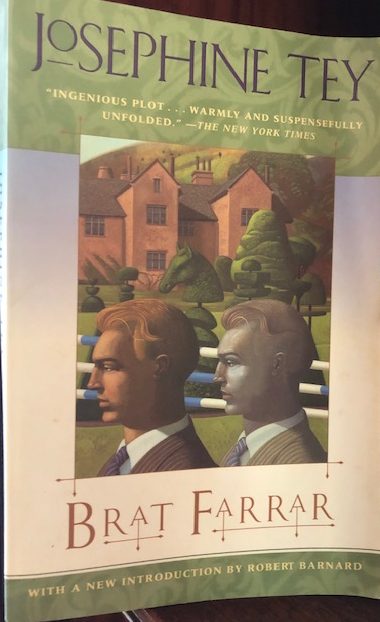
Josephine Tey teases us with disguise in Brat Farrar where the mystery turns on whether Brat Farrar, a young man who introduces himself as the long-lost heir to the Ashby family estate, is or is not Patrick Ashby, thought to have killed himself, leaving his minutes younger twin Simon as putative heir. Simon will be dispossessed if Brat Farrar is for real. The point of view is frequently in in Brat’s head, and we must decide if we like this disguised pretender as a protagonist, or not. He himself is ambivalent, arguing with himself about the whole scheme: On the one hand, he thinks, “But I’m not a crook! I can’t do something that is criminal.” But then: “All he could do was sit in the saddle and hope for the best. But at least it would be a breath-taking ride; a unique, heart-stopping ride. Danger to life and limb he was used to; but far more exciting was this new mental danger, this pitting of wits.” As he feels his way along, still in disguise, Brat slowly learns who did kill Patrick. That knowledge nearly kills Brat Farrar.
New Zealand’s Ngaio Marsh has the murderer disguise his or her true identity in both Photo Finish and A Clutch of Constables. In the first case, the murderer creates a new identity from whole cloth. He accidentally gives himself away to Detective Rory Alleyn in part when Alleyn overhears his soft-voiced use of a Mafia expression. In A Clutch of Constables, the murderer––a master of disguise––entirely steals another’s identity, including his butterfly-hunting expertise, for the duration of a cruise. He relishes his persona and manipulates the unwitting characters like chess pieces on the board of the plot––more in the Hazlitt manner, being most truly himself as he throws himself into the role.
Mystery writers disguise their murderers, their sleuths, sometimes their victims, sometimes their protagonists. I use disguise in my new murder mystery Ghost Cat. I’ll be interested in what you think. Happy reading and writing, everyone!
AMW memberHelen Currie Fosterwas interviewed for the MysteryPeople blog by Crime Fiction Coordinator Scott Montgomery. Helen is the author of the Alice MacDonald Greermystery series: GHOST CAVE, GHOST DOG, GHOST LETTER, GHOST DAGGER, and THE GHOST NEXT DOOR.
Midwest Book Reviewcalls the Alice MacDonald Greer mysteries a “simply outstanding mystery series.”