Western Mysteries

Photo by Ladyheart

Photo by Ladyheart

I have a confession to make. I love westerns, all kinds of westerns. I like characters with a sense of independence, who live life by their own rules. I like studying that era of our history. It has everything you could want that makes a great story: evil-doers, heroes, the clash of cultures (Native American/European, city/country, poor/rich), people trying to make their lives better, people trying to hold on to their heritage. You name it.

I also like modern westerns. They still hold the same sense of character and grit as the older ones.

So it’s no great surprise that like western mysteries. I thought I’d delve into that subgenre and look for books to add to my TBR (To Be Read) shelf and take you along with me.


That's Craig and me eating BBQ with friends.

Craig and me eating BBQ with friends.

Craig Johnson

Those of you who know me know that I’m a fan of Craig Johnson and the Longmire series. The way he captures the essence of the west and the clash of cultures while respecting both sides is masterful. The books are full of drama, humor, and history. The characters grow deeper by each book. (As they should.)

At the moment I’ve only read the first three books in the series. I have a lot of reading to do! But I’ve watched all of the TV episodes. If you haven’t seen them, check them out on Netflix. It’s one of my favorite shows. All of the actors are excellent at their jobs and they’re nice in real life. And Craig Johnson is as nice as could be too.

Check out his website for all the info. http://www.craigallenjohnson.com


Billy Kring

13010864_220093178364661_670439328912394144_n

Manning Wolfe, me, and Billy Kring. We like Mexican food!


Most of his Hunter Kincaid series takes place in Texas and along the Mexican border since Hunter is a border patrol agent. I’ve read the first one, Quick, and let me tell you, it’s good! It’s a page-turner. I will say it’s not for the squeamish, but Billy tells me (since he’s a friend of mine) that the others aren’t quite so graphic. But it didn’t bother me since I kind of expected that, considering the topic.

I think it’s interesting that Billy’s a big cowboy (former border patrol and anti-terrorism expert) and the Kincaid books are told from a woman’s perspective. And he writes it well!

Go check out his website and book list. It’s impressive! He also writes other genres. There’s something for everyone. http://www.billykring.com


J.A. JanceJanceJA
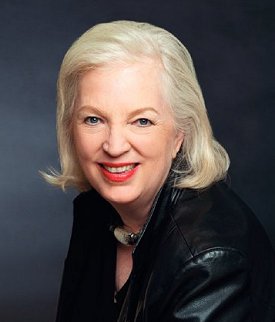
And just so you don’t think I only read books written by big burly cowboys, (Yes, I’m partial to them) I want to tell you about J.A. Jance. She has a special place in my mystery reader/writer heart. She is one of the writers who inspired me to pick up a pen and write. Her Joanna Brady series is very good. It takes place in Arizona and Joanna is a sheriff in a small border town. She’s a full and complex character that deals with all sorts of horrors and problems, big and small.

Jance also writes a Detective Beaumont series, some of which I’ve read and it’s very good too. http://www.jajance.com


Those are my favorties, but I wanted to know more. So whenever I have a question about mysteries, I turn to my friends. And the person I know who’s the most knowledgeable is Scott Montgomery, mystery coordinator at Book People in Austin. He pointed me to Tony Hillerman and Peter Bowen.

**Scott gave me an extra tidbit of info. “The first hardboiled detective novel, Hammett’s Red Harvest, is about a detective coming into a corrupt Montana mining town and playing both evil interests off one another like A Fistful Of Dollars (inspired by Yojimbo, which was inspired by Red Harvest)”

So there you go.


Tony Hillerman 27hillerman.large1
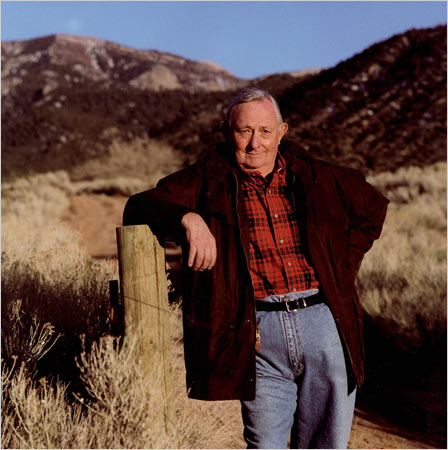
You can’t talk about this genre without talking about Tony Hillerman. He’s famous for his Navajo Tribal Police Series. The series starts with The Blessing Way (1970) and goes to the 18th one, The Shape Shifter (2006). The series features Joe Leaphorn and Jim Chee, Navajo police officers who solve mysteries with their knowledge of the people and knowledge of the area. The two first work together in the seventh novel in the series, Skinwalkers. (I can’t wait to read some of these!)

Hillerman was such an accomplished writer that his books have won numerous awards and he’s considered to be one New Mexico’s foremost novelists. TH is no longer alive, but his daughter, Anne, has continued his legacy. http://www.annehillerman.com


Peter Bowen Peter Bowen

Bowen lives in Montana and is known for his Yellowstone Kelly historical novels (fictionalized stories based on a real person) and the Gabriel Du Pré mysteries are set in modern Montana. All of his books sound rich with characters and place. You can find out more at his website: http://peterbowenmt.com.


Dusty Richards 
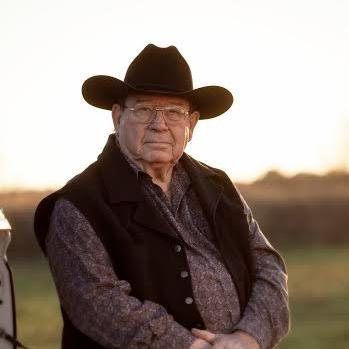
Since I’m talking about Westerns, I have to tell you about Dusty Richards. He doesn’t write mysteries but he writes darn good westerns. How did I come to discover him? My husband was a co-op engineer and Dusty serves on the board of his electric co-op. They were both attending a conference and got to talking. My husband told him about me and Dusty said, “Hold on a moment.” He went up to his room and came back with a signed copy of his book to me to wish me well in my writing endeavors.
Since then my husband has read many of his books and said they are great. (And this is coming from a guy who compares EVERY book to Louis L’Amour.)

Since then I’ve followed Dusty on social media and I see that one of his books is being made into a movie. Yay! I like it when good things happen for good people.

He also has a literary quarterly that’s always looking for western stories, modern or historical. If you’re interested in submitting, the website is: http://saddlebagdispatches.com

And his regular website is: http://dustyrichardslegacy.com


Well, thanks for moseying along with me on this trail. Since I’m partial to this genre, it’s no surprise that I’ve written some Western short stories (Suspense and Horror) and the novel I’m working on (Suspense) is set in West Texas. I hope to make it the first in a series, or two.


So happy trails and vio con Dios! Hasta luego!

At our Double Mountain ranch where we used to live.

At our Double Mountain ranch where we used to live.
Critic or Critiquer?

Lately, the topic of critique groups has reared its head. Valerie Chandler represented both Austin Mystery Writers and Sisters in Crime: Heart of Texas chapter at the Third Thursday meeting of the Writers League of Texas at BookPeople on July 21.  Valerie was invited to join local critique group leaders/members to make announcements about their organizations before the main panel discussion of the evening.

again val with mow

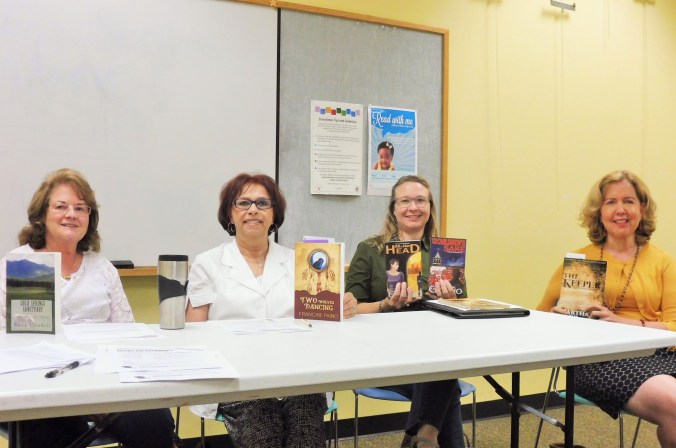
I was privileged to moderate a panel of local authors and members of Sisters in Crime: Heart of Texas chapter on our July 10 meeting at the  Yarborough branch of the Austin Public Library. Included in the wide-ranging discussion was a ringing endorsement of critique groups and how they helped writers. The panel was composed of writers Doris Christian (writing as Sara Caudell), Francine Paino, Noreen Cedeno, and Martha Carr.P1030005 (2)

Below, see a post I wrote some years ago about the difference between being critical and being helpful in a critique situation. It appeared in one of the Sisters in Crime: Heart of Texas chapter’s HOTSHOTS! newsletter. I thought it would be helpful to resurrect it.

By Gale Albright

I grew up admiring critics.hutto oct. 1 2014 023 (2)

Critics like Dorothy Parker and Rex Reed. Their comments were witty, dry, often acerbic. For many years, Rex Reed has been known for his acidic movie reviews. Just a small example among many is this one, from the New York Observer, July 13, 2010:

“At the movies, incomprehensible gibberish has become a way of life, but it usually takes time before it’s clear that a movie really stinks. Inception, Christopher Nolan’s latest assault on rational coherence, wastes no time. It cuts straight to the chase that leads to the junkpile without passing go, although before it drags its sorry butt to a merciful finale, you’ll be desperately in need of a ‘Get Out of Jail Free’ card.”

Pretty funny, eh? And then there’s the iconic Dorothy Parker, whose critique of a youthful Katharine Hepburn’s performance on Broadway has become legendary: “Miss Hepburn runs the emotional gamut from A to B,” Miss Parker was supposed to have said to a colleague during the play’s intermission.

So, naturally, I thought you were supposed to basically heap scorn on books and movies and performances you didn’t like. As long as you were witty, dry, and often acerbic. A good critic made expert use of sarcasm and unkind jokes and metaphors.

I thought the critic was the center of attention. The bringer of wit and laughter.

I learned that the origin of the word sarcasm was from Latin for rending the flesh. Apt indeed.

The trouble is, when your flesh is rended, it doesn’t feel very good. As a person who thought cheap shots and ill-considered comebacks were the height of wit, I discovered how devastating it was to be on the receiving end of those oh-so-clever comments and witticisms.

Especially when it involved something I had written.

When I went back to college after intervening years of Real Life, I decided to major in English Writing and Rhetoric. To my chagrin, I had to take some classes in which, among other things, we had to learn the proper manner of critique. Critique etiquette, as it were.

I found I was not the second coming of Rex Reed or Dorothy Parker. Nasty, witty comments were strictly taboo. I had to learn how to give constructive criticism to classmates.

At first, I had a very hard time. What if I just hated what the other person wrote? What if it was stupid, boring, idiotic, or insane? Too bad.  And I had to do it over and over again. In short, I hated it. I felt totally out of my depth.

It was pure torture. Witticisms leaped to my tongue, only to die a stillborn death within my mouth. It was discipline. It was a change of habit. It was hard.

Then I understood. A critic is a star. She is the center of the universe. She earns her money by saying clever, often unkind things. But a person who offers a critique is not a star. To offer a critique is to offer a somewhat educated opinion, encouragement, and suggestions. One endeavors to be honest without being cruel or funny. I had to learn that I was not the director of the show. My lofty pronouncements did not come straight from Mount Olympus. I was merely a handmaid in the service of some other writer’s creative birthing.

At school I was told to start out a critique by telling the writer “what worked” in the piece. Sometimes I had to look pretty hard to find something “that worked.” It was like your mother telling you that if you can’t say something nice, don’t say anything at all. Except, the catch was, you couldn’t abstain. You had to give feedback.

After stressing the positive parts of a piece of writing, the critiquer would then write down “What didn’t work so well was ….” And say it without making a cruel comment at the writer’s expense.

All the critiquer has to offer is a personal opinion. It is to be hoped that critiquers in writers’ groups are people who love reading and writing, so that their opinions might have some literary weight. But it’s still just a solitary opinion.

As a critiquer, I’m not writing a syndicated column. I’m not an agent or an editor. I’m a fellow writer who needs another pair of eyes to look at my work. I want feedback, gentle feedback. It’s a balancing act.

I can’t lie and say something is great when it’s not. That’s evading one’s responsibility as a critiquer. But I’m not mean. The aim, I should think, of a writing group, is to keep the writers writing and coming back to the critique group. You don’t want to be so witty and sarcastic and cruel that a writer quits the group, shreds all her writings, shoots her laptop and treks off to Tibet in search of the spiritual peace of which you robbed her.

If a writer seeks out a critique group, obviously said writer, number one, wants to be read and, number two, wants feedback. Number three, said writer probably wants to continue writing.

A writer puts his heart and soul and ego on the page. A writer needs tender treatment. Tell the truth, but do it in a constructive manner. To critique is to help a fellow writer improve, not implode.

What goes around comes around. Yesterday’s witty, cruel comments may come back to haunt you when your own heart and soul are exposed on the page.

Writers.  Handle them with care.


Write What You Know: A BookPeople Event with Martin Limón, Manning Wolfe and Billy Kring

A lawyer, an Army clerk and a border patrol agent walk into a bookstore…

BookPeople, our much beloved independent bookstore here in Austin, hosted a panel of crime writers this past week, and the discussions kept us laughing, interested and entertained the entire evening. Scott Montgomery, BookPeople’s Crime Fiction Coordinator, moderated the panel, although it quickly evolved from a formal Q&A session to a fascinating conversation amongst colleagues and friends.

Martin Limón, Manning Wolfe and Billy Kring gathered together to share how each of them has taken their professional experiences and used them as foundations upon which to build successful crime writing careers. The program was titled “Write What You Know,” and it’s clear that each author has executed this writing tenet with substantial skill.

martin_manning_billyIt seems that a solid sense of humor is a requirement in each of these fields, as Billy, Manning and Martin shared stories that were equal parts heartbreaking and humorous. Like any profession that is also a passion, the work is made easier by the love for it, but the injustices are more painful for the same reason. Manning’s debut mystery novel, Dollar Signs, is loosely based upon one of her cases while working as an Austin attorney, and the nuances of that case are brought to life, mixed with a healthy dose of savvy storytelling.   When asked what had prompted her love of reading during her childhood, Manning gave credit to a librarian in her life. “Once I started, I just took off and read every book in the library. Books were a way for me to escape my small town and expand and travel in many ways, all while just sitting in my room.”

Martin’s fascination and respect for Korea and its culture was evident during this panel discussion as he shared how some family and friends were puzzled by his desire to stay in Korea during his time of service. As he explained to Scott Montgomery, “Culturally, I realized early on how different Korea is from the West. Not only are the buildings and the food and the clothes and the music and the art much different, but also the way people think. I was fascinated by this (and I still am).” His attraction to the culture and the time period in which he served is evident in his latest release, Ping Pong Heart, which takes us into the heart of a North-South Korea espionage mystery.

When asked what drew him to reading, Martin admitted that he hadn’t been much interested in reading when he was a child. He’d found it difficult to find stories that captured this imagination. Then along came Jack London, whom he had discovered when he was fourteen years old, and To Build a Fire converted him into a life long reader.

panel_bookpeople1.jpgMartin shared with us that, while he would have loved to have spent his entire military career in Korea, the Army decided to send him back to the States to serve as a recruiter. It was during this time that he decided he would use his spare time to write. “I had wanted to write for twenty years, and at that point, I decided to give myself permission.” That decision was the catalyst that sparked a successful writing career, one that has allowed Martin to share his fascination of both Korea and time period in which he served in that country.
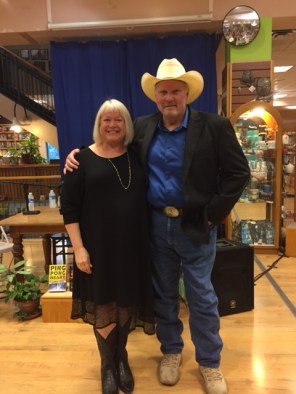
Billy Kring’s latest novel, Tonton, features female border patrol agent, Hunter Kincaid, throwing her into a South Florida case involving a Haitian community and vodou. When asked if some of his villains were based upon actual people he had encountered during his time working border intelligence and security, he replied, “Yes, and I haven’t even used some of the worst offenders yet.”

Are you scared yet, readers? You should be. Billy paints an effectively frightening villain within his book’s pages, and it has been recommended that this latest book is best read during the daytime. The opening scene of Tonton is based upon an actual experience of Billy’s while working border security. “Well, everything but the shark, but the shark is from another case,” he explained.

billy_manning.JPG
Billy explained that he truly enjoyed the work he did, which meant that he came late to the writing game. He had once had a bank job and he hated it, living each day in a cubicle and not being out in the world. He loved the fact a career in border security meant that each day brought new challenges and experiences. “I never knew what was going to happen next, and I liked that part of the job.” Like Martin and Manning, Billy then realized he could take his enthusiasm and experience for his work and bring it to a life writing fiction. Billy also shared the nuances that ripple across our borders. “There are two distinct cultures that have changed and merged over many generations, and it’s important to recognize that and bring those elements to the story.”

One thing is clear after spending an evening with these three authors–each one of them brings their experiences to life in ways that are engrossing, entertaining and compelling. While an evening with their books is fantastic, an evening with the authors behind those books?

Even better.

–Laura Oles


ROW80: The Writing Challenge That Knows You Have a Life

Posted by Kathy Waller

It is a truth universally acknowledged that to accomplish anything of worth, one must first set goals.

English: 85. Functions and Use Scenarios Mappi...

English: 85. Functions and Use Scenarios Mapping to Requirements and Goals (Photo credit: Wikipedia). By Richard J. Mayer and others [Public domain], via Wikimedia Commons

But goals drive me crazy, and that’s no secret either. Periodically, fellow Austin Mystery Writer Gale Albright pulls out her notebook and says, “All right. Let’s write down our goals.” Her goals, my goals, goals for us as a team. She’s serious about goals.

As soon as she says the magic word, I start a major case of the fantods. I can come up with goals, but when I see them on paper, claustrophobia sets in. I dig in my heels and think, “I will not do [whatever I’ve written that I will do]. And you can’t make me.” Sometimes I don’t just think it–I say it.

I’ve said it to Gale so often that now when she pulls out her notebook, she begins with, “I know you don’t like goals, but…”

I don’t think she knows I have a long history of goal-setting–I love trying to organize myself. And there are so many goals out there just itching to be adopted.

Writing challenges lurk all over the Internet: Write every day, write a thousand words every day, keep a journal, do morning pages, do evening pages, write for an hour-two hours-three hours every day, produce a 50,000-word novel in November by writing 1,667 words a day…

That last, which you no doubt recognize as the goal of NaNoWriMo, really drives me up the wall. Every year, I register. Then, every October 31, the fantods set in, and there goes my chance of winning. I’ve given up all hope of getting a NaNo tee-shirt.

row80logocopySeveral years ago, however, I discovered a writing challenge I can live with: A Round of Words in 80 Days: The writing challenge that knows you have a life.

It goes like this: Each year, there are four 80-day rounds. On the first day of each round, participants decide on goals and post them on their blogs. Then they put links to their posts on a ROW80 Linky for a ROW80 blog hop.

For the rest of the round, participants report their progress on Sundays and Wednesdays, and publish their links on the day’s Linky.

If they’ve met their goals, that’s great. If they haven’t, that’s life. Participants are free to change goals and post new ones.

Anyone who wants to join is welcome, and it’s okay to jump in at any time during the round–just post goals on the next Sunday/Wednesday check-in day and go on from there.

I’ve done ROW80 several times without even a hint of the fantods. The secret, I think, is in the subtitle: The writing challenge that knows you have a life.

I have a life. And sometimes it gets in the way. Cedar fever, company coming, hauling cats to the vet–so many things can bump writing down to second or third or tenth priority. When I  set out to write every single day, or one hour every single day–or adopt any goal set by someone else–and then don’t meet that goal, I’ve failed. And I’m likely to stop altogether.

But ROW80 not only allows me to set my own goals, it also acknowledges I might need to set them aside. It allows me to tweak them, change them, and if I need to, scuttle them and start over. There’s no pressure to conform or to make excuses for lapses. I’m in charge.

Now, here’s the evidence that I’m a little crazy: No matter what goals I set or what challenges I face, I’m always in charge. No one stands over me holding a machete to make sure I write one hour a day. No one pins a Scarlet F-for-failure on my tee-shirt when I don’t write in my journal.

Nobody. Not even Gale.

But there’s a flexibility to ROW80 that somehow makes goals easier to live with. I’m free, free, free… In addition, I’m not in this alone. At present, fourteen bloggers have registered on today’s Linky. Tomorrow there will be more. Reading their posts is instructive as well. Participants don’t make excuses; they evaluate, consider what didn’t work and what might work, and go from there.

Yesterday I drafted some goals, posted them on my blog, and registered on the Linky. On Wednesday, I’ll report on my progress, or possibly on my not-progress. But when I’m part of ROW80, I usually make some progress, even when life gets in the way.

Rules for A Round of Words in 80 Days, appear here. Information about how ROW80 started appears here. Find the ROW80 blog here.

###

fantod: Usually, fantods. a state of extreme nervousness or restlessness; the willies; the fidgets (usually preceded by the)

I came across the word fantods in a story by O. Henry and liked it so much I decided to have the fantods as often as possible.

###

Kathy Waller blogs at Telling the Truth, Mainly
and at the group blog Writing Wranglers and Warriors
as well as here at Austin Mystery Writers.
Her short stories appear at Mysterical-E
and in Murder on Wheels


A Brief Malice Domestic Recap

(Kaye George, prolific mystery writer and blogger, has granted us permission to borrow and publish a recap of her “A Brief Malice Recap” from her blog “Travels with Kaye” at http://travelswithkaye.blogspot.com/)


Kaye George at Malice DomesticIt was exhilarating and exhausting, as usual. This year I was there to let people know about two new books of mine that both came out in early April.

Here’s me at Malice Go Round, giving one minute of information on each book. This is an event described as Speed Dating, But with Authors. A pair of authors visits 20 tables of 8-10 people each, staying for 4 minutes and taking 1 minute to change tables. We tell the listeners about our books and give them bookmarks and sometimes other things so they’ll remember us. I paired up with Jim Jackson, James M. Jackson is his author name. His newest book is ANT FARM, in his Seamus McCree series. My new ones are FAT CAT TAKES THE CAKE (by Janet Cantrell) and REQUIEM IN RED (by Kaye George). This event was Friday morning after I checked in Thursday night.

This picture was taken by Patti Phillips when I was at her table.

After Malice Go Round, I walked over to Booeymonger’s with Judy Penz Sheluk, who was at Malice for the first time. This sandwich and salad place is where the Guppies have gathered for lunch ever since the convention moved to Bethesda from Crystal City in Virginia. I got to chat with several Guppies there.

Later that afternoon, I met with my agent, Kim Lionetti. This is the only time I see her face to face, once a year. That night Berkley, my Fat Cat publisher took us out to dinner at The American Tap Room.

Early Saturday, 7:30, was the Sisters in Crime breakfast, where all the Guppies wear boas or reasonable facsimiles. Jan Rubens, who came with Jim Jackson, took this picture of ALL the Gups that attended. After I wore a feather boa one year and threw it away the same day, I wear my chartreuse scarf.

I admit I deflated a bit and stayed in the hotel for lunch, then went to my panel, “Death for Dessert: Sweet Murder” in the afternoon. Our admirable moderator was Nancy J. Parra and the panelists were Kathy Aarons, Maggie Barbieri, me, and Jessie Crocket/Jessica Estevao. We all write cozy mysteries with dessert recipes in the back. We discovered that Jessie is actually the only one of us who is a good cook. This photo was shot by Julie Hennrikus.

I raced to the wine and cupcake reception given by my agency, BookEnds, guided by Terrie Moran, who had also guided me to the dinner the night before. If these people keep guiding me, I’ll never learn how to get anywhere. Actually, I may not anyway, so I’m grateful for that!

Our panel signed books soon after that, then we did a cocktail or so, then the Banquet with the Agatha Awards.

I highly regret that I wasn’t able to make it to the New Authors Breakfast the next morning at 7. I chalked it up to getting older, but I came down with a cold and bronchitis as soon as I got home, so I’ll blame that instead. I’m making plans to hold a mystery conference/convention where nothing starts earlier than 10.

My own camera, as usual, stayed safely tucked inside my suitcase for the whole trip. Someday I’ll take pictures!

Another fun time talking to and seeing so many of my online pals!

Kaye's panel at Malice DomesticBreakfast at Malice Domestic where Guppies wear boas.

(Pictures) Top picture is Kaye George. Second picture is Kaye George’s panel at Malice Domestic, “Death for Dessert: Sweet Murder” (Photo by Julie Hennrikus). Third picture is Breakfast at Malice Domestic, where Guppies wear boas.

Why I’m Not a Journalist

The Good Old Days.

Let’s face it: Were things really that good?

Yes, they were. Those ’70s television sit-coms were the best things ever.

I’m binge-watching The Mary Tyler Moore Show, which ran from 1970 to 1977. It was funny then and it’s just funny now.

One episode isn’t quite as funny as the others, though, because it reflects an aspect of my life I find particularly painful.

First season cast: (left top) Harper, Asner, L...

First season cast: (left top) Harper, Asner, Leachman; (left bottom) MacLeod, Moore, Knight. Last season cast: (right top) Knight, MacLeod, Asner; (right bottom) White, Engel, Moore. (Photo credit: Wikipedia). By CBS Television Uploaded by We hope at en.wikipedia [Public domain], via Wikimedia Commons

It’s the scene in which news writer Murray Slaughter rushes home to operate on an ailing water heater, leaving associate producer Mary Richards to cover for him. If a bulletin comes in over the wire–

No problem, she says. The news is almost over, she says. If a story comes across the wire, I’ll just take it off the teletype machine, type it up, and get it to the anchor desk. It’s easy, she says.

She rolls a piece of paper into her typewriter, just in case.

Then a story comes in: A fire is threatening a munitions plant on the outskirts of town.

Mary tears off the bulletin, sits down at her desk, thinks… and thinks… types a few words…  erases… brushes away the crumbs… thinks… and thinks….

Producer Lou Grant, who’s been leaning over her shoulder, bouncing up and down on his toes, finally grabs the paper, runs into his office, types–like the wind–then flies out just in time to meet anchorman Ted Baxter leaving the studio. The show’s over. He’s already signed off–“Good night, and good news”–and the competition’s 7:00 o’clock news will get the scoop.


Embed from Getty Images

That’s why I’m not a journalist. I’m not Lou. I’m not Murray. I’m Mary.

That, and because as a journalist, I would have to make cold calls: get people on the phone, request interviews, ask questions. I’m not comfortable talking to people I don’t know.

But mainly, it’s because editors would expect me to write fast. I don’t do fast. I’m slower than Mary Richards is. Sometimes getting words on paper requires moaning and weeping and riving of hair.

Looking back I wonder how I got to this point. Not the distaste for talking to strangers–I’ve never liked doing that–but the difficulty with writing.

In the beginning, I loved to write. By the time I was seven, I was writing long letters to grandmothers and aunts and cousins. Once when I was home from school, enjoying ill health, I used my father’s fountain pen to write letter after letter. Another time, I used a pencil with a point so soft and dull I doubt the recipients could read through the smears.

The summer I was eight, I spent June in Central Texas with an aunt and uncle while my mother was in Dallas with my grandmother, who was ill. My father, who remained at home in Del Rio, brought me a present one weekend: a ream of legal-sized paper.


Embed from Getty Images

On a scale of one to ten, most children would have rated a ream of paper at minus 3. I gave it a twelve and used it to produce my own newspaper. Mostly I reported weddings in the cat and dog community. I described bridesmaids’ dresses worn by Blackie and Bootsie and Kitty and my fox terrier, Pat Boone. It was a devastating little parody of a small-town newspaper. That summer, I was a journalist.

Fairchild Mill Grindstone

Fairchild Mill Grindstone (Photo credit: Wikipedia)

But things changed. Writing stopped being easy. It stopped being fun. It became a millstone ’round my neck. It became nose-to-the-grindstone work. I turned into Mary Richards, thinking, typing, thinking, thinking, typing, erasing, thinking…

How did that happen? I suspect it had something to do with school and English classes, and writing pieces I didn’t want to write, on topics I knew nothing about. And having to outline before I wrote.

There’s nothing that strangles the free flow of words onto the page than having to organize your thought before you’ve had any.

Portrait of E. M. Forster by Dora Carrington I...

Portrait of E. M. Forster by Dora Carrington Italiano: Ritratto di E. M. Forster di Dora Carrington (Photo credit: Wikipedia)

A lifetime later, I discovered novelist E. M. Forster’s remark on the relationship between writing and organizing: “How do I know what I think until I see what I say?”

In other words, if you can write an outline, you’ve already written the piece in your head. 

But I didn’t know that then. I didn’t know it doesn’t have to be right the first time. I didn’t know I could just start writing and, that way, find out what I knew and what I thought before I tried to put those thoughts in order.

I didn’t know Nancy Peacock would one day write, “If I don’t have the pages I hate I will never have the pages I love.”

I didn’t know all I had to do was lighten up.

Now I’ve lightened a bit, and so has the millstone. When I write for my personal blog, I’m fluent–unless I’m trying to be serious, weighty, and profound.

English: Original caption:"NASA Remembers...

English: Original caption:”NASA Remembers Walter Cronkite. Legendary CBS newsman Walter Cronkite speaks in February 2004 at a ceremony at the National Air and Space Museum in Washington honoring the fallen astronauts of the STS-107 Columbia mission. (Photo credit: Wikipedia)

I do not do profound. I think profound, but I write shallow. I wish it were otherwise, but, to quote Walter Cronkite, that’s the way it is.

Some things haven’t changed, however. I will never fit in the little journalism box. I don’t write fast. I don’t want to strike up conversations with strangers. And the only facts I want to deal with are ones I make up myself.

So that’s why I’m not a journalist.

That’s why I write fiction.

Writers of fiction have deadlines. But they don’t have Lou Grant leaning over them, fidgeting while they think and delete and rewrite and delete and rewrite…

Writers of fiction–especially we pantsers, who write by the seat of our pants–can see what they say before they know what they think.

Sorry, Mary Richards, but that’s the way it is.

*

The Mary Tyler Moore Show, “Room 223”: Mary takes a journalism class
(Resolution isn’t great, but the show is.)

Other high points:

The Mary Tyler Moore Show, “Chuckles Bites the Dust: Chuckles the Clown goes to a parade dressed as a peanut, and an elephant… But it’s okay to laugh.

The Mary Tyler Moore Show, “The Lars Affair”: Sue Ann Nivens closes an oven door in a way formerly unknown to man.

I don’t understand the legalities of putting these programs on Youtube, but as long as they’re there, I’ll assume it’s okay to link to them. Enjoy.

*

P. S. I don’t like being interviewed either. I always tell reporters to be sure they make me sound intelligent. One young lady told me she didn’t have to fix anything because I talk in complete sentences. I told her that was strictly accidental.

*

–Posted by Kathy Waller


Interview With AMW Member Laura Oles

In continuing my series of interviews of fellow members of AMW, I’d like to introduce you to Laura Oles.

Austin Mystery Writer Laura Oles

VPC- Welcome, Laura! Tell us a little about your background.

LO- I grew up in an Air Force family and moved a number of times growing up.   I graduated from Texas State and met my husband while I was in college. His parents were both professional photographers and entrepreneurs who introduced me to the world of photography. At the time, I didn’t know an f/stop from a bus stop, but I loved the industry almost immediately. We were working in the time of early digital photography and had built a business that did some pretty cool things in that space. I also started writing for digital photography magazines—both consumer and trade— and did that for about fifteen years. Some of the most interesting people I’ve ever met work behind the camera. It remains my first love, although I detest having my photo taken. Ask anyone—the camera comes out and I duck behind a tree.   If awkward smiling were an Olympic sport, I would bring home the gold.

LRO-sanfran

Laura hiding from the camera.

VPC- I can vouch for that, readers. It’s true! So you’ve had some success with publishing nonfiction, why are you interested in writing fiction?

LO- Yes, I wrote Digital Photography for Busy Women back in 2005 and was so happy to see the reception it received in the photography field. Technology books become obsolete pretty quickly, so while it served its purpose then, it’s outdated now. Part of the cycle. Still, it came out an important time in the industry when people were leaving film for digital and had no idea what to do with their photos once the image had been taken. I had been covering related technology for industry magazines and the book was an extension of that education.

Nonfiction has its own challenges but I love it as much as I love fiction. I grew up reading fiction at an early age, getting lost in Nancy Drew, Sweet Valley High and Judy Blume, Reading fiction was the perfect escape for a kid that kept relocating to a new school, a new city. While I enjoy many genres, mystery, suspense and thrillers remain my favorites. Not only do I love getting lost in the worlds other people create, I also love creating my own worlds and occupying them with interesting personalities. My husband once told me that I talk about these characters like they’re real people. I guess for me, they are real people. Is that weird?

I also like reading both fiction and nonfiction. I often bounce between reading a business book and a mystery at the same time. So, right now I’ve got Charles Duhigg’s Smarter Faster Better and Mark Pryor’s Hollow Man in progress. I find it hard to commit to reading one book at a time. Both books are excellent. And my TBR list is a little out of hand at the moment.


VPC- I know that you also have three kids. Two of them are twins! How do you juggle writing, working and raising a family?

LO- I think one of the challenges of loving your work and loving your family is that you never feel like you’re excelling in either arena at the same time. Other people may have tamed this dragon but I have yet to do so. I try to compartmentalize as much as possible, but it’s difficult. My time is often split into small segments so I work at piecing them together to create something meaningful. For example, I’ve started and stopped answering these questions several times already because of a soccer tournament, Prom, and NHS volunteer projects. Granted, it’s easier than it was when my kids were little, especially when my twins were in the pre-school stages. I don’t think I drank of cup of hot coffee for a couple of years. With three teenagers, it’s a different kind of busy. My job is largely driving, coordinating schedules, counseling and proofreading my kids’ English papers.   I am very fortunate to have an awesome husband who, despite a demanding work and travel schedule, still makes most of the sporting events, concerts and other things that are important. If he has to drive from the airport to a volleyball game, he’s there.

With respect to writing, I think one of the most difficult things is shifting my brain from multi-tasking to creative mode. I have found that it is so important to protect that sacred space of allowing your imagination to roam, to get lost in the ‘what if’s of storytelling so the story has time to grow and take some turns. I really have to work at protecting that space. It’s very easy for real life to intrude and lay claim to it. (Link to Laura’s article about making the most of your time via the Pomodoro Method.) OLYMPUS DIGITAL CAMERA


VPC: What aspect of writing do you enjoy the most?

LO: I have a fond affection for dialogue. I love writing interactions between characters, trying to find the proper beats where the back-and-forth feels authentic. Elmore Leonard remains one of my all time favorite masters of dialogue. He said, “If it sounds like writing, I rewrite it.” I think that’s very good advice. I also enjoy editing, maybe even more than writing the first draft, because it’s my opportunity to shape the story and figure out what works and what is getting in the way of the story moving forward.


VPC- How did you come to be a member of AMW?

LO-I met Kathy Waller and Gale Albright through our local Sisters in Crime chapter and was part of the Barbara Burnett Smith Mentor program in 2012. They invited me in and I have enjoyed their company and critiques ever since. Writing is a solitary process, so having like minded writers who want to discuss plot points, character development and setting is a wonderful thing. I would probably bore my non-writer friends out of their minds but the AMW people get me. And I’m grateful for it.


VPC- What are you working on now?

LO-I am currently revising my second mystery, Point & Shoot, which was named a finalist in the Writer’s League of Texas manuscript competition. I’m also working on a few short stories, including one for an anthology being put together by AMW for publication next year. I continue to write for the photo industry, although I’m taking a hiatus for a bit to focus on my fiction (no pun intended). I’m leaving for Malice Domestic this week (in Bethesda, MD) and am looking forward to spending time with some of my favorite writers and friends.   I’m also finally making it to Bouchercon this year in New Orleans. Other than that, I’m just trying to find time to write each day so I can keep my imaginary friends alive. They suffer if I’m gone too long. And I do, too.  I’m cranky if I’ve gone a bit without writing.  Even worse than when I skip coffee, and that’s saying something.


Hank & Laura

With Hank Phillippi Ryan at MD 2014

Malice laura and kaye

Laura and Kaye George at Malice in 2014


Article about Malice Domestic 2014


Thank you for the interview, Laura Oles! I’ve enjoyed these interviews. I like showing the world how diverse we are in AMW.

WATCH OUT FOR THE NET

Pflugerville Book Pfestival April 16 and 17

By Gale Albright

Ever since I assumed the presidency of Sisters in Crime: Heart of Texas chapter in January of 2016, I’ve been trying not to get tangled up in the net. The “net” as in “networking.”

I love all the things I’m involved in, but it behooves me to get my head out of the clouds and be careful where my feet are stepping. I don’t want to get so tangled up that I trip and fall.

I get excited, I get ambitious, I get enthusiastic, and I tend to say “yes” to any and all new projects that come my way. I find out about these projects via networking.

A net can be a safety net and it can also be a net that traps you.

Without networking, without contacts with others who have similar interests, without commitment to projects, nothing would happen. But you have to do the work. You have to get people to help you do the work. You have to pace yourself so you won’t burn out. I’m talking to myself here, so if you can see yourself in what I’m saying, don’t take it personally.

So far, I haven’t agreed to take care of more than one thing at a time. I need to make sure that doesn’t happen.

“Enthusiasm” and “Exhaustion” both start with the same letter.SINC August Meg Gardiner 005


IMG_2617It is through Sisters in Crime: Heart of Texas chapter that our organization had a wonderful weekend visit from international best-selling author Rhys Bowen in March. It is through Scott Montgomery, crime fiction coordinator for BookPeople, that I got to know Hopeton Hay of KAZI FM’s book review. I got to interview Sue Grafton on his radio program. I’m now involved in the Pflugerville Book Pfestival (April 16-17) because of networking with Scott and Hopeton. Networking can lead to wonderful things: moderating a mystery panel at a book festival; producing May Mystery Month day-long free workshops at BookPeople; meeting writers and making new friendships.
But remember to breathe, take your vitamins, and don’t get your feet tangled in the net.

JULY SINC HELEN CURRIE FOSTERSINC JULY GHOST DOGdeathontourcoverSINC August Meg Gardiner 003ALEXANDRA PICTURE 2

Speaking of networking, please come to the Pflugerville Book Pfestival April 16-17, at the Pflugerville Public Library at 1008 Pfluger Street.ALEXANDRA BURT BOOK COVER

The weekend festival, free and open to the public, is packed with writers, book signings, panel discussions and interviews. I will moderate the panel “Sisters in Crime: Women Crime Fiction Writers” with award-winning authors Meg Gardiner, Alexandra Burt, Janice Hamrick, and Helen Currie Foster from 1:30 – 2:30 p.m. on Saturday, April 16.

On Sunday, April 17, there will be panels on mystery in fantasy and science fiction novels, international crime fiction, and the greatest crime-fiction novels of all time.

Get information and schedules about the Pflugerville Book Pfestival by calling 512-990-6375 or go to http://www.pflugervilletx.gov/index.aspx?NID=2237


Janice Hamrick on Work, Writing, & Studies in Scotland

Janice_Hamrick_2012_for_web.pngJanice Hamrick may not be a professor, but watching her presentation during her recent program for the Heart of Texas Chapter of Sister’s in Crime, it’s quite clear she has a talent for teaching. In less than ninety minutes, Janice had demonstrated how each writer in the group could take a simple exercise and turn it into something compelling and interesting.
It’s harder than it looks.

Writing is also like that. Countless people say that they will, someday, sit down to write the Great American Novel once they have more time, more money, more freedom. Janice cautions against such thinking because writers make the time–no, writers steal the time–to put their projects on the top of the priority list. Even now, with an award winning series under her belt, Janice wakes up at 5 am to focus on her fiction before working a full day as a technical writer. She understands that there is no ideal time. There is only time, and it is up to each one of us to claim it.

We recently met for dinner at Gruene River Grille, a jewel of a restaurant nestled in the heart of Texas Hill Country, and tested the waitress’ patience with our three hour dinner (the waitress was amazing, by the way). Our conversation traveled the gamut of topics ranging from work and family to writing and publishing, and at the end of the dinner, we still left ground uncovered.

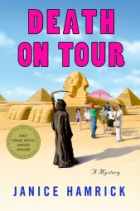
Janice is a writer’s writer–she is supportive, honest, kind and willing to share her expertise with others, all the while remarkably humble when the topic turns her to her own professional accomplishments. Her debut novel, Death of Tour, won the Mystery Writers of America/Minotaur Books First Crime Novel Competition in 2010 and launched her popular Jocelyn Shore series. After three successful books under her belt, Janice continued to work and write, and also traveled to Scotland to earn an M.Sc. in History from the University of Edinburgh. She has since returned to Austin, where she juggles work, life and writing.

Below are a few highlights from our discussion:

LO: How did you come to writing? At what point did you realize you wanted to write a mystery?

JH: I’ve wanted to write my whole life. In fact, I can’t remember a time when I didn’t want to be a writer. And I’ve loved mysteries almost that long, beginning with Trixie Beldon, Nancy Drew, and the Three Investigators. It seemed a natural thing to try to write one of the books I loved.

LO:  How did the character of Jocelyn Shore come to you?

Will_Janice.JPG

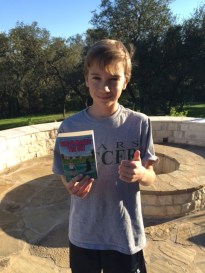
William Oles gives Janice’s series a ‘thumbs up!’

JH: I got the idea for a mystery set on a tour of Egypt when I went on a tour myself and noticed the potential for undetected deception is particularly great in a group of strangers who are traveling together. Once I got the basic plot idea, I needed a character with an intuitive understanding of human nature – and who better than a teacher for that?  I love Jocelyn for having no illusions about what people are capable of and yet still genuinely liking them.

LO: Take us through your entry in the Minotaur competition and what happened when you realized that you had won.

JH: I stumbled on the contest when I was searching for agents to query, and I entered it in pretty much the same way I occasionally buy a lottery ticket – it seemed like such a long shot. In fact, it was not on my radar at all, and I had almost forgotten about it by the time I got the phone call.  I was at lunch with friends, didn’t hear the phone ring, and checked my messages in my car – before starting to drive, thank goodness.  When I heard an editor from Minotaur wanted me to call her back, my head almost exploded. I mean, I’m insecure, but even I didn’t think that editors routinely made personal phone calls just to tell writers their books suck.

LO: Many writers believe that their lives will be forever changed if they are fortunate enough to win a competition or, better yet, receive a traditional publishing contract.  As someone who has achieved the very thing most writers covet, what advice or insight can you give to those still striving for those goals?

JH: I’m not going to lie – being published was my biggest dream come true. However, like most dreams, the reality isn’t exactly what I expected. It’s not what my friends expected, either. I can’t tell you how often I’ve been asked if I’m going to quit my day job. My response is always the same: “No, I like to eat.”  The financial rewards aren’t what people expect, especially in the beginning of your career.

The biggest surprise to me was that publishers expect authors to become publicists, marketing managers, social media gurus, and polished public speakers, which, when you think about it, is almost the exact opposite of everything a solitary writer-type is likely enjoy or excel at doing. Those activities have a steep learning curve and really cut into my writing time. Even worse, all those things focused my attention on what other people want or what I “should” be writing. And actually – that leads to my advice, because I see it happening to all writers, whether they’ve been published or not. The tendency is to focus on what is selling, how to sell, what successful writers do, and what trends are popping up in publishing instead of focusing on the writing. It absolutely crushes creativity…and the fun.

My advice:  Read what you love. Write what you love. Finish what you start. Then you can worry about trying to get published.

An important side note– I’d started querying agents at the same time I entered the Minotaur competition.  Even after I won, the rejection slips kept rolling in. So, take that as further proof that being rejected does not indicate anything about the quality of your work.

And yes, the rejections still stung. 

LO: Your sabbatical from your job to temporarily move to Scotland sounds like a fantastic adventure. Can you share more of that experience with us?

JH: I moved to Edinburgh, Scotland, for an entire year and traveled extensively while earning an M.Sc. in History from the University of Edinburgh. The title of my thesis was “Supernatural Belief, the Scientific World, and the Victorian Experience of Grief in England: 1848–1890.”  It was the best year of my life…so far, at least.  Completely life- and attitude-changing.  As a side note, although the title of my dissertation is awesome, academic writing completely and utterly sucks the life out of even the coolest topic.

LO: Are you writing now? If so, how do you balance this with your current career demands?

JH: I AM writing now.  I’m working on a short story, which I’ve never done before, and I’m in the plotting stages of a new mystery. Details to be kept mysterious.  I get up at about 5:00 a.m. every day to write fiction before my workday starts. I tried doing it in the evenings, but I found that at the end of a full day, I’m tired of being on the computer in addition to just being tired.

LO: What advice might you offer to writers who hope to one day publish a mystery?

JH: Although I have lots of small tips and tricks, everything important I’ve learned can be boiled down to three things

  1. Write at least five days a week.  Even if you can only manage half a page, establishing a deathontourcoverwriting habit is vital. Don’t wait to be “inspired.” You are a writer, and writing is hard. Embrace that.
  1. Finish what you start. Do not start one thing after another without ever reaching “The End” of anything. Do not spend years and years on one book, endlessly polishing and rewriting. Get to the end and LET IT GO. Put it in a drawer if you aren’t happy enough to start querying and start something new. Start something new even if you ARE happy enough to start querying. You have an endless supply of stories inside you. Get them out there.
  1. Have FUN!  Stop reading publishing news. Stop obsessing over the failures and successes of other writers who aren’t you. Stop willingly inviting negative, critical, and fear-mongering voices into your head. (As a writer, you have enough voices in there already.)  Stop obsessing over how to get published and start obsessing over actually writing. Don’t get me wrong – writing is terribly hard work and some days it just sucks. But there are also days when it’s like flying. Obsess about getting more of those days.

You can learn more about Janice Hamrick, her Jocelyn Shore series, and her current projects at www.janicehamrick.com.

—Laura Oles


D-minus

MOW BOOK LAUNCH 003 (3)
First posted by Kathy Waller
on Writing Wranglers and Warriors
and on Telling the Truth, Mainly

Very long, but sort of necessary

On January 29, I was diagnosed with Stage IV metastatic breast cancer. Two kinds of cancer are present, not a common occurrence. One kind is aggressive but easier to treat than the other, which is slow-growing. There is a lesion in each lung. One was biopsied, so we know which kind it is. My oncologist said there’s no reason to think the lesion in the other lung is the same kind, but since that lesion wasn’t been biopsied, we don’t know. The radiologist preferred not to biopsy it because it’s near the heart. Sticking needles near the heart isn’t a preferred protocol.

Before I go further, I must say this: Please don’t say you’re sorry. I don’t feel ill. I have no symptoms except one lump I can feel. I’m sorry–really, really sorry, big-time sorry–I’m in this fix, but I already know you’re sorry, too, so it’s okay not to say it. Hearing it can be a bit of a downer. 

I announced the diagnosis to a friend over lunch. We discussed the situation from all sides. Before we parted, she said, “You know this is an opportunity to write.” I said, Yes, I’d already thought of that.

Newbie writers repeatedly ask themselves–and each other–When can I call myself a ***writer*** without feeling like a fraud?

Answer: When no matter where you are, or what you’re doing, or what you’re feeling, you think, I can write about this.

From now on, when people ask what I do, or what I am, I shall say, in a firm and forthright manner, as if they’d better believe it or else, I am a writer.

I responded to the diagnosis with a combination of O God and Okaaaayyyyy…. The oncologist spoke of palliative care and statistics. I despise the word palliative, and the statistics were mind-boggling, and not in a good way. But I told David I’m going to fight, and he said he was, too. I said I was going to be happy while I fought. He said, “That’s what fighting is.” I’ve never heard a better definition.

When a navigator (survivor) from the Breast Cancer Resource Center (BCRC) called to introduce herself, I told her I hadn’t read the stack of literature the surgeon had given me–a looseleaf notebook, a spiral notebook, and a passel of booklets–because after glancing over a couple of pages, I decided I didn’t need that much information. I said I guessed I was in denial. She said a little denial can be a good thing.

I dumped the stack of paper in David’s lap and invited him to read it. He did. He’s a good person. A brick, if I may use an old-fashioned word that sounds funny now but in this case isn’t. He takes copious notes, asks questions, knows what meds and chemo drugs I take, records appointments on his calendar, remembers what other questions we need to ask, and and and… He can recite most of the info from memory.

I’ve vowed several times to step up and take more responsibility for the fight. To date, I’ve learned which anti-nausea pill to take first and which to take if the first one hasn’t worked. I know chemo #4 is scheduled for April 15, too, plus a few other random facts.

On the not-denial side–and to date–for a few days after a chemo infusion, I feel kind of meh but generally okay. However, I become fatigued easily. But I forget about the fatigue and do too much and then pay for it. The oncologist said, “Yeah, everybody does that.” The first time, I paid with a day in bed. Then, a couple of weeks ago, I stayed up half the night, three nights in a row, trying to write three hundred words for a guest blog, and paid for over-reach by thinking, What if the chemo doesn’t work?

The good old, What if?

The thought had already crossed my mind, of course, but this time it was accompanied by the line from It’s Always Something, Gilda Radner’s account of  her experience with ovarian cancer:

I had wanted to wrap this book up in a neat little package. I wanted a perfect ending. Now I’ve learned the hard way that some poems don’t rhyme, and some stories don’t have a clear beginning, middle, and end.

I’ve not read the book, but a long time ago, I read that sentence, and it stuck.

The BCRC navigator called again to see how I was getting along. We I met for iced tea and conversation, and I unloaded a couple of million words on her and said I would attend a meeting of a group the oncologist had strongly recommended (twice already). I perked up some more.

But then came the third visit with oncologist. He ordered a CT scan to check progress, as in, Is the chemo working?–and the possibility of No surfaced again. After a while, No morphed from possibility to probability. Then it began to feel like a prediction. More sighing, combined with an undeclared expectation of the worst.

But I knew that surgical oncologist Dr. Bernie Siegal says cancer patients must tell the truth, that if you go around claiming, I’m fine, just fine, your subconscious, which takes words literally, will believe you, and won’t tell your body it must fight. He recommends using a grading system: When you feel like C-minus, admit it. So I told people who asked, and some who didn’t, that I was a D-minus: scared to death.

Anyway. I had the CT scan yesterday (Thursday) afternoon. The oncologist had stressed that he wanted me to have the results by the second day at the latest–I like him a lot–so if we hadn’t heard by then, to call his office.

Later I realized that when you have a scan on Thursday, the second day is Monday, which leaves a weekend of not knowing in the middle.

But. Here’s where things get better.

The oncologist called yesterday afternoon, not two hours after we left the imaging center. One lung lesion has almost “resolved,” the other has reduced in size by nearly half, one lymph node has reduced significantly. However, a lymph node near where the bronchial tubes branch off from the trachea has enlarged significantly. He said it could be just “reactive,” doing what lymph nodes normally do when you have, say, a cold–but not to count on that. We’ll follow it closely, see what it does, and if it doesn’t shrink, figure out what to do next.

In short, this is a mixed result, but the oncologist is pleased. What pleases him pleases me. So I’m pleased.

Backing up a bit, at our second visit, the oncologist asked whether I had more questions. I said, “No.”

He said, “Okay. Well, your next question should be, ‘How will we know the chemo is working?’” I told him I’d assumed he’d get around to that when he was ready.

Now, Dear Reader, your next question should be, Why did it take you so long to write this post?

For a variety of reasons, I suppose. Because I’ve only now decided how to approach the topic. Because I wanted to hear some good news before writing. Because I wanted some grounding–I like certainty; even relative certainty–before writing.

Because I didn’t want to.

Because writing about any subject makes it real.

Years ago, I put off writing a letter because I’d have had to say in it that my father had died. I still haven’t written that letter. Writing it would have made the death real, and I preferred it stay as it was, hovering on the edge of reality.

Writing about Stage IV cancer would have made every detail, every statistic, real. I wasn’t ready for that.  Now it’s okay. It’s real, not like it was yesterday with No in the ascendant, but real with mixed but pleasing results.

Ending tacked on Tuesday night: That’s the post I wrote last Friday, or most of it. I started working on it during chemo infusion #3 and continued that evening and into the night. Chemo drugs seem to invigorate me. Sunday, however, the crash came. The “flu-like” symptoms the oncologist had been asking about finally hit. That lasted only thirty-six hours or so, and it could have been worse. However, it left me in a nasty mood from which I haven’t emerged.

Last Friday, this was a chirpy post about adventures in breast cancer. Tonight–or, as it will probably post tomorrow, the 30th, a day late–it’s a non-chirpy post written by someone who’s in a nasty, nasty mood. Because I took all the chirpy parts out.

I shouldn’t admit that. Even if it’s evident, I shouldn’t admit it. I should pretend to be chirpy. I really, really should. That’s what nice Southern girls are supposed to do. Chirp.

But I remember the name of the English honor society I joined in college: Sigma Tau Delta. Sincerity. Truth. Design.

And I think of Dr. Siegal: If you’re feeling D-minus, say you’re D-minus.

So what this post lacks in Design, it makes up for in Sincerity and Truth. Tonight, I’m D-minus.

Having said that, however, I think tomorrow I’ll be much improved.

###

Oh, all right. As long as I’m already late, I’ll mention one achievement: After watching selected videos on YouTube, I have learned to wrap a scarf into a turban. For one devoid of manual dexterity, that’s big. The first two times we appeared together in public, the turban stayed put, and I received compliments. During Friday’s chemo, filaments of fringe kept popping out. They looked like little bitty antennae.

Obviously, Friday’s edition was poorly engineered from the get-go, because as soon as I got home, one end slipped out and draped down the side of my face. Fringe crawled over in front of my glasses.

©MKW. Any person who even thinks about copying, reproducing, grabbing, stealing, purloining, or otherwise taking and placing, positioning, or using this photograph anywhere else in the Universe should recognize, understand, and know that if he, she, or it does, Something Bad will happen.

©MKW. Any person who even thinks about copying, reproducing, grabbing, stealing, purloining, or otherwise taking and placing, positioning, or using this photograph anywhere else in the Universe should recognize, understand, and know that if he, she, or it does, Something Bad will happen.

I reminded myself of Lord Byron in Albanian dress. Except Byron’s headgear probably isn’t called a turban.

And he’s absolutely gorgeous.

I look like I wrapped a scarf around my head, and shouldn’t have.


###

Kathy Waller blogs at Telling the Truth, Mainly and at Writing Wranglers and Warriors.