THE GHOSTS OF HISTORY WHAT THEY CAN TELL US

Francine PainoBy Francine Paino

The late president, Harry S. Truman said, “The only thing new in the world is the history you do not know.”

People make history. What were the lives of those who came before really like? Men and women who lived without the conveniences, comforts, and communications we enjoy today.

Most adults throughout history couldn’t read or write. They depended on oral historians and they certainly didn’t have 24-hour news cycles to keep them informed.

How and why did they prosper or fail? Who were the great leaders of these populations? How was the common person’s life impacted by discoveries, wars, and political decisions? Were their lives improved or worsened?

What provocative question would you ask that cannot be learned from the histories you do know? The ghosts of artists, performers, and sports figures, political and military leaders might offer corrections or additions to our knowledge.

Starting with the first humans to stand upright, there are questions. Archeologists still ponder the evidence of humans using and controlling fire a million years ago. While spontaneous fires happened and probably frightened those first men and women. What accident caused the spark that showed these primitives that they could create fire? Perhaps it was a woman trying to crush the head of a fish and accidentally struck another rock that caused that first human made spark. Wouldn’t I love to know?

Think of the great warrior women in history. Would you call up the spirit of one of the biblical women like Deborah, Judith or Jael? What secrets could they tell of their lives? When thinking of great warrior women and leaders in ancient times one cannot ignore Cleopatra or Boudica.

I always wonder which Roman leader and general Cleopatra truly loved, if she loved either. Was it Caesar or Marc Antony? Did she seduce and use Marc Antony only to protect her’s and Caesar’s son, Caesarian’s birthright?

In A.D. 60-61, Queen Boudica, of the Iceni tribe was a remarkable pagan leader who refused to bow to Rome. Her courageous leadership inspired her tribe to fight against the might of the Roman war machine. Defeated in the end, Boudica and her daughters took poison rather than face capture.

Everything known about Boudica, the Iceni and the battles with Rome was written and recorded by Roman scholars. What corrections might her ghost give us, if summoned?

Albert Einstein, Marie Curie and other great scientists have advanced the sciences in all areas. Is there anything they might add to the histories we know? Are there unrevealed truths, known only to them?

In sports, maybe you’d like to know about Babe Ruth, beyond the opinions and movies. Already considered one of the best ballplayers, after leading the Boston Red Sox to three world series, how did the Sultan of Swat, otherwise known as the Bambino, really feel when club owner Harry Frazee sold him to the New York Yankees?

For me, there are too many ghosts to name, but if I could summon only one, it would be the 17th President of the United States.

Democrat Andrew Johnson was elected vice-president when Republican Abraham Lincoln won the presidency. In the early 19th century, presidents and vice-presidents did not run as a team from the same party. These two men served during one of the most devastating times in U.S. history.

After the destructive Civil War, that ended slavery, but killed 600,000 men, an exhausted nation then faced the shocking assassination of Abraham Lincoln, on April 14, 1865. Democrat vice-president Andrew Johnson, under the U.S. Constitution, took the oath of office and became the 17th president, even as the hunt for the conspirators continued.

Those involved in Lincoln’s assassination were speedily caught. The planner and triggerman, John Wilkes Booth resisted capture and was shot to death outside the barn on Garrets Farm, in Virginia. Another conspirator, John Surratt, Mary’s son escaped to Canada.

In early May 1865, the remaining eight faced a military tribunal. All were found guilty. Four, Arnold, Mudd, and O’Laughlen, were sentenced to life in prison, and Spangler received a six-year sentence. Their part in the conspiracy to kidnap the president was well established, but not their involvement in the assassination.

The four collaborators found guilty and sentenced to death were Herold, Powell, Atzerodt, and Mary Surratt.

After the trial, five of the nine military commissioners who found Mary Surratt guilty petitioned President Johnson. They recommended that her sentence be changed to life in prison. Instead, Johnson, who never directly replied to the request, ordered the executions to take place as soon as possible.


My burning question to the ghost of Andrew Johnson, would be,  After the recommendation for leniency from  five battle-hardened generals who’d found her guilty, why sir, could you not have shown mercy? There is much speculation and obfuscation, but I’ll never know that answer in this lifetime.

History is the study and accounting of past events, especially the development of human knowledge, understanding and growth, and the social interactions between peoples. It is through these affairs that we filter our attitudes and beliefs in today’s world. Not knowing history is imprudent and dangerous.

Real history is bloodier than the bloodiest fiction, more heart wrenching than the best novels of love and loss, and more beautiful and inspiring than anything an author can invent; and all created in real time by real men and women.

It makes one wonder what history books will say about us and what our ghosts may be able to reveal to the future generations.

Bouchercon Lifts Up Community Through Silent Auction

One of the most wonderful things about being in the mystery writing community is how often authors and organizations dedicate themselves to raising money for causes that support literacy, libraries and youth reading programs. This year, Bouchercon2019 is sponsoring a fantastic silent auction in order to benefit Literacy Instruction for Texas (LIFT ).

According to Texas LEARNS, there are 3.8 million adults in Texas without a high school diploma. The importance of literacy to individuals as well as our community can’t be overstated. The ability to effectively read and write has a significant impact on job opportunities, upward mobility, community connectedness and social inclusion. 

Literacy is an important first rung on the ladder that can lead a person out of poverty and open doors for increased earning opportunities. Literacy can also improve a family’s options through future generations. When parents are able to model a love for reading and learning in the home, this impacts not only the children but also others who spend time in the home. For young women, the stakes are significant. Literacy empowers young girls and women and encourages them to become economically self-sufficient and independent. 

For these reasons and many others, we are proud to support LIFT this year in their efforts to increase literacy in Texas. We are excited to host a silent auction supporting this organization and are also asking for your support as well.

We welcome your donations for the silent auction at this year’s Bouchercon conference. To learn more about LIFT, click here: https://lift-texas.org. To learn more about how to donate to this year’s Bouchercon silent auction, click here:  https://www.bouchercon2019.com/silent-auction

You can also send an email to:  bouchercon2019silentauction@gmail.com

For ideas on creating your donation basket or offering, follow the Bouchercon2019 Silent Auction Highlights Facebook page here: https://www.facebook.com/Bouchercon2019SilentAuction/

–Laura Oles

Book Clubs for Authors: A Doggone Good Time!

by K.P. Gresham

I’m a fiction writer, and my world pretty much revolves around my profession. My friends, my colleagues, my editors, my publicists are comprised mostly of people in the writing business. To make that world even smaller, I write mysteries, and I love to read mysteries. Noir, suspense, thriller, cozies, you name it, I’m in. Sisters in Crime, I love you! Writers League of Texas? You’re the best! Austin Mystery Writers? Your support and critiques are off the charts.

I existed in a happy, but small little world of people who get together to figure out how best to kill other people. (Fictionally, of course.)

Until…

Marni, a good friend of mine from water aerobics, invited me to join her book club. I asked what do you read? She gave me the list for that year’s selection.

I knew one or two of the novels by name recognition. The rest? Not so much. Surprised that I was so poorly read across the genres, I joined Marni’s book club. I also quickly learned that not only was I not well-read, I’d lost touch with folks in the real world as well.

It’s been seven years since I joined that club, and I have no intention of leaving any time soon.

Interested in a narrative about the rise of communism in Russia? Check out The Gentleman from Moscow by Amor Towles. World War II stories from Italy? Beneath a Scarlet Sky by Mark Sullivan. Okay, you’re more into the French point of view? Check out Wolves at the Door: America’s Greatest Female Spy by Judith Pearson. Okay, the last two were historical narrative fiction, but I learned so much from reading them.

I’m figuring with seven years at one book a month, that puts 84 books in my head that I probably would have never read. 84 books which used styles I’d never heard of before. 84 books of history, biographies, tragedies, comedies, science, science fiction–one of our group’s main goals is to read across the genres and experience new writers and subjects. I’ve read first person, second person, and third person POVs. Books that have been written in present and past tense, as well as time travels. This experience has been a microcosm of study on subjects I knew about, but had never really studied.

All right. Not every book was great. But as a writer I learned a great deal from those selections as well. Too many characters? After a while I didn’t care about any of them. Switching point of view from sentence to sentence? What a pain in the neck for the reader. No description of setting? Little to no sense of character development? A cop out ending? Yeah. They drove me nuts. BUT that also provided me with a cautionary tale to avoid those pitfalls.

What’s the book club’s biggest pay-off? The friendships I’ve had the privilege to develop with these well-educated, well-traveled, successful women. (Men aren’t banned. They just don’t ever come.) And we have a great time. Wine and snacks are involved. We always discuss the authors and their backgrounds, oftentimes showing You Tube author interviews. Some of us are very opinionated (me!), but the atmosphere is never hostile or uncomfortable. We genuinely want to hear each other’s opinions and personal experiences that relate to the book, all the while trying to figure out what we’ll recommend when the time comes for the next selections.

So authors, consider joining a book club that takes you out of your genre. Besides expanding your writing skills, you’ll have a doggone good time!

***

K.P. Gresham, author of the Pastor Matt Hayden Mystery series and Three Days at Wrigley Field, moved to Texas as quick as she could. Born Chicagoan, K.P. and her husband moved to Texas, fell in love with not shoveling show and are 30+ year Lone Star State residents. She finds that her dual country citizenship, the Midwest and Texas, provide deep fodder for her award-winning novels. Her varied careers as a media librarian and technical director, middle school literature teacher and theatre playwright and director add humor and truth to her stories. A graduate of Houston’s Rice University Novels Writing Colloquium, I.P. now resides in Austin, Texas, where life with her tolerant but supportive husband and narcissistic Chihuahua is acceptably weird.

Sharks: Who, Where, and How to Get Rid of Them

by Kathy Waller

This is a shark:

This shark does not live in the ocean. It lurks in bookstores, coffee shops, libraries:

Disguised as an aspiring writer, it invades critique groups and, fueled by ego, envy, jealousy, and just plain mean-spiritedness, can do untold harm.

Writer, instructor, and “genre-hopper” Maralys Wills describes its pernicious effect:

“Nothing will stifle creativity faster than the critiquer who’s ‘out to get’ other writers. Subtly, or not so subtly, a shark is so impossible to please that other authors become frustrated, then discouraged, and finally defeated.”

Wills speaks from experience. She was once in a critique group with a writer who wrote “golden prose” that Wills could only praise. But she was the only one who saw flawless writing.

“Sure enough, each week,  the others ripped and tore and nit-picked to death the work I found so perfect. . .  and all the time I was thinking, You guys must be desperate to flaunt your hatchets. None of you are as good as she is.”

Wills has a rule covering toxic critique groups: “Any group dominated by a shark should be disbanded. Preferably, you should kill the shark on your way out.”

In critique groups, intentions matter. Relationships matter.

In the most productive groups, members behave like professionals. They look for the positive and address the negative in language designed to help their colleagues improve. In the best groups, they behave like friends. Sometimes, members even morph from friends into buddies. And in a buddy-style relationship, anything can happen.

For example, in a chapter I submitted to a short-lived two-person group—we called ourselves the Just for the Hell of It Critique Group, for a reason I won’t go into here—a  contentious old lady says to another character, “And you and that Claudia person can just go right back where you came from.”

Gale, my partner, objected to the word person; she said the old woman knew Claudia and so would say, “You and Claudia can just go right back where you came from.” I didn’t argue (a rule: no arguing),  but I knew the character, and I could hear her say, “that Claudia person.” Because writers are free to reject advice if they wish, I left the word where it was.

Some time later, commenting on  a revision of that page, Gale again said I should remove person. But I still liked person—it was one of my darlings—so I quietly declined to do so.

By the third go-around, Gale had  had enough: “That Claudia person thing is driving me crazy.”

She wouldn’t have said that to just anyone. We’d worked together and learned to trust each other. We spoke the same language. We were buddies.

She knew I would laugh. I laughed. She laughed. I removed the offending person.

So here is my love song, not fancy or fine, but most sincere, to the Austin Mystery Writers, the Just for the Hell of It Writers, and all those groups that give aspiring writers the knowledge, support, and  courage to keep aspiring, to publication and beyond.

By the way, the toxic critique group Maralys Wills wrote about—she and the writer of “golden prose” left the group. I don’t know what happened to the sharks. Wills and the other writer might have killed them on the way out. Or they might still be out there, destroying other writers’ creativity.

Maralys Wills, however, became an award-winning author of both fiction and non-fiction.

And the writer of “golden prose” that the sharks trashed at every meeting? She became the author of the best-selling Inspector Lynley mysteries—Elizabeth George.

***

These are not sharks:

For your reading pleasure, I recommend Maralys Wills’ Damn the Rejections, Full Speed Ahead: The Bumpy Road to Getting Published. 

***

Kathy Waller’s stories appear in the Austin Mystery Writers crime fiction anthologies, Murder on Wheels (Wildside, 2015) and Lone Star Lawless (Wildside, 2017), and at Mysterical-E. She blogs at Telling the Truth, Mainly and has a novella coming out this fall.  She lives in Austin with two cats and one husband.

VISITING THE AUSTIN DPS – AN EXERCISE IS PATIENCE AND ENDURANCE

Francine Paino


By Francine Paino

A few weeks ago, I was forced to visit the Austin Department of Public Safety, where I spent four long, long hours. Let me be clear, however, I’m not slamming the Austin DPS. It’s a factor of population vs. the number of employees. In fact, I found the agents polite and friendly, as opposed to the Department of Motor Vehicles in New York (DMV) where friendly and courteous are not in their vocabulary. To be fair, (maybe) they too suffer from the imbalance balance of employees vs. the population.

Thank God, I don’t visit every DMV, DPS or departments throughout the country that issue, renew, replace and take care of every function concerning drivers licenses. I can only guess that it will almost always be the same. Population vs. the number of employees.

So, I arrived at the DPS with my 96-year-old mother, who had her wallet stolen. TWICE IN ONE WEEK! (Another story for another blog.)We arrived at 9:30 a.m. Can’t get this nonagenarian out of bed much earlier than 9. People lined up outside the door; a police deputy watched the exit then let us in, one-at-a-time. First stop, the information desk.

Ten ahead of us.

When it was our turn, I explained the reason for our visit: mother needed a new license.

Her only identification (remember her wallet had been stolen – TWICE) was her old, expired temporary license. The young woman nodded, put it in an envelope, made a few notes, handed us the envelope and another number, and told us to take a seat.

In the waiting area, the seats were all filled. People were sitting on the floor. Mother cannot sit on the floor. She leaned on her cane and sighed. To our delight, a lovely lady, sitting in the front row, saw her number come up before it was called. She gave my mother her seat. Then a very nice gentleman insisted that I take his. (my age must be showing, too!?!)

I looked at the board, and my heart sank. It was 9:50 a.m. The active letters were L, S, and N. Our number was S 3097. The highest S number on the board was 3009. I thought an “S” word. It was going to be a very, very long day.

So, trying not to lose my cool, I fidgeted in the hard plastic seat castigating myself for not bringing something to read. Instead, I decided to think about what could be accomplished while enduring a wait that could make an overly stressed person wig out.

Beside launching one into antiquity, if used effectively, the time spent at the DPS can be constructive.

One could improve one’s Spanish since all announcements, written notices and billboards are bilingual. If one sits there long enough, one becomes proficient in short phrases, such as: Now, the number being served is_____, A ora, serviendo numero____, at station _____. a la stacion ____Or, Children must be accompanied by an adult at all times. Los niños deben estar acompañados por un adulto en todo momento. 

A  few more hours and I might have achieved some decent conversational skills.

One could, of course, read a book for pleasure, but A-type personalities who feel they must accomplish something could make lists. Shopping lists, chores, e-mails to be sent, phone calls to be made, lists of things to do to make up for lost time when one finally leaves the DPS.

If one is really proactive, one could begin writing envelopes for Christmas cards, or draft the terms of a last will and testament, since the wait might thrust one to the brink of the next world.

So, how did I spend my time?

I drafted this blog, made a list of chores and tasks to be completed by the end of the day, and outlined two chapters for my next book. All of this, however, had to be written on a very little notepad because I didn’t have the foresight to bring along a decent size writing pad or my tablet – dumb!

I’m sure you’re wondering why, with at least 100 people ahead of us, we didn’t leave and come back. The first, most important reason was the uneven progress at the stations. It reminded me of what it was like learning to drive a stick-shift car. Stop, start, and jerk the vehicle. The digital board stopped, started, crawled then hit overdrive, posting numbers in rapid succession. Thus, the risk of missing our number and starting over was unthinkable!

The second reason, to stay put and allow one’s butt to fuse into the comfortless chair is, as soon as you get out of it, someone else takes it—and rightfully.

So, I sat there muttering curses and scribbling cramped little notes in my cramped little notebook. Finally, four hours later, number S 3,097 was flashed on the board, followed by the announcement in English and Spanish.

“At last! Come, mother,” I said and literally had to pull her out of the chair. I think her butt had melded to the plastic.

We proceeded to the assigned station. Then disaster!

“Where is your application?” asked the agent.

“Application!? What application?” My voice was on the edge of hysteria. I broke out in a sweat. “I wasn’t told to fill out an application.”

Mother stood there in her best fragile little-old-lady posture, which she is not, and thankfully kept quiet.

“Please,” I begged. “We’ve been here for four hours. I wasn’t told to fill anything out.”

This kind agent smiled, handed me the application, told us to step aside, and fill it out while she serviced the next person on the line. For this, I believe she’ll have a place in heaven—or perhaps she was afraid I’d go postal.

I filled it out as fast as I could, controlling my serial killer handwriting so that it would be legible. The kind agent waved us back to her station, and fifteen minutes later, mother had a new temporary license.

So, what have I learned? The next time I must visit the DPS, I’ll have a supply of pencils, a legal pad, and a book. Perhaps a pillow too.

No matter how you look at it, spending four hours in a bad chair, waiting to be called for a process that takes only minutes is an exercise in patience, endurance, determination, and a sense of humor – which I did not have.

Stories Behind the Stories #1

People have been telling me that I should write some of the true stories that are behind the story of my novel, Gilt Ridden, and other stories that inspire my writing. So, I’m writing a series of blog posts that I’ll call The Stories Behind the Stories.

This is the story of the first rattlesnake that I found in our house when we first moved to our Double Mountain ranch. I included it in some of the first drafts of the book, but later I omitted it and just referred to it in dialogue. People said I had too many rattlesnake scenes already.

For the whole story, follow the link below

Source: Stories Behind the Stories #1

My Unconventional Writing Partner

–By Laura Oles

Writing, as we all know, is a solitary process. You’re the only one who can get words on the page, edits turned in on time, and new projects out in the world.  Because of this, it helps to have a support network to help you get out of your own head. I don’t subscribe to the idea that being alone all the time makes my writing any stronger.  In fact, I think it’s quite the opposite.  I’m grateful to have several talented writers as friends, and I know I’ve become a stronger writer because of their guidance and support. 

I also have someone in my life who contributes in a different way.  She doesn’t get to our critique meetings and harbors no opinion on the plotter/pantser debate.  

This is Amber.  She’s part of my writing support group.

Her words per minute score on the laptop is pretty abysmal, she naps for hours and she always wants me to write stories about dogs in swimming pools. 

But she has other skills.

She gets me outside for a walk each day, which it turns out, is really important when I’m spending my days at my desk or inside the house.  I tend to overthink things–big things, small things, you name it–so the fact that she needs to get out to stretch those Labrador legs comes in very handy. When I find myself wrapped up in something that I can’t figure out, it’s time for us to go outside.

The temperatures in Texas are topping triple digits on the regular, so this means we have to get our two-mile walk down pretty early in the morning.  After a few hours of wrestling with a project, I’m ready for a break and a short walk around the neighborhood.  Amber is always ready for a stroll.  Her dependence on me makes me a better writer. It forces me to go outside and get a different perspective. Dogs plus nature equal happiness in my book.

Sometimes I talk to myself, trying to work out a plot point or a scene, and Amber is the perfect partner in this situation.  She lets me talk it out without looking at me like I’m crazy.  She walks alongside, searching for deer to chase and brush to walk under for back scratches.  Those brief outings help me shake things loose in my mind, not to mention my back.  

One of the best pieces of writing advice I’ve ever received is to “keep your butt in the chair.”  I remind myself of this during those times when I’m feeling challenged and want nothing more than to get up and distract myself. So, in those situations, I sit and wrestle with the task at hand.  Well, not all the time. There are times that I go get a cup of coffee and a snack. Or two snacks. Maybe do some productive procrastination (housework, email). However, sometimes Amber needs me to get my butt OUT of the chair, and this responsibility is what helps me get back IN the chair later. 

So, dogs are good for writers.  

Cats may disagree. 

 Not sure.

I’ve never had a cat willing to go on a walk with me.  

An Interview with Elizabeth Buhmann, Author of BLUE LAKE

by M.K. Waller

[Notice:
Typgress is not authorized
to post content from this blog
on its site.]

When I began Elizabeth Buhmann’s BLUE LAKE, I was—I’m ashamed to say—afraid I would be disappointed. Her first novel,LAY DEATH AT HER DOOR, was so well constructed, clues so obviously placed, that I should have been able to predict the ending—but so deftly woven into the plot that the last chapter was a complete surprise. More than a surprise—a shock. That novel was so good, I knew BLUE LAKE couldn’t match it.

I was wrong. BLUE LAKE is different from its predecessor, of course, but just as well written and just as suspenseful.  And when I reached the end, I said, “I should have known.”

BLUE LAKE does not disappoint.

Buhmann hides things in plain sight—the mark of a good mystery writer, and the delight of every mystery reader.

*

“Rural Virginia, 1945. The Second World War had just ended when Alice Hannon found the lifeless body of her five-year-old daughter, Eugenie, floating in Blue Lake. The tragedy of the little girl’s death destroyed the Hannon family.

“More than twenty years later, Alice’s youngest daughter, Regina, returns home after a long estrangement because her father is dying. She is shocked to discover, quite by accident, that her sister’s drowning was briefly investigated as a murder at the time. . . . 

Click here to read the original post on Ink-Stained Wretches.


When Tech Takes Over

-Laura Oles

A few years ago, Microsoft released a study that claimed the average American had the attention span of a goldfish.  

Eight seconds. 

I can relate.

While this study has been hotly debated–some sources claim we are simply becoming more adept at filtering out unimportant content designed to grab out attention–I remain undecided. Some days I’m Dory from Finding Nemo. “Just keep swimming, just keep swimming…ooh, what’s that? A new project?”

And I’m off on a tangent.

This has become particularly more challenging now that summer is here and our kids have no fixed daily schedule.  I love this part of parenthood–my kids are older now and time is fleeting–but I also realize that I have to carve out a set schedule even though others are coming in and out all day.  Working from home is a wonderful gift but also brings its own challenges.

And don’t get me started on the time suck that is social media. I know some truly productive people who are on Facebook/Instagram/Twitter all the time, and I marvel at how they manage it all.

I’m not one of those people.  

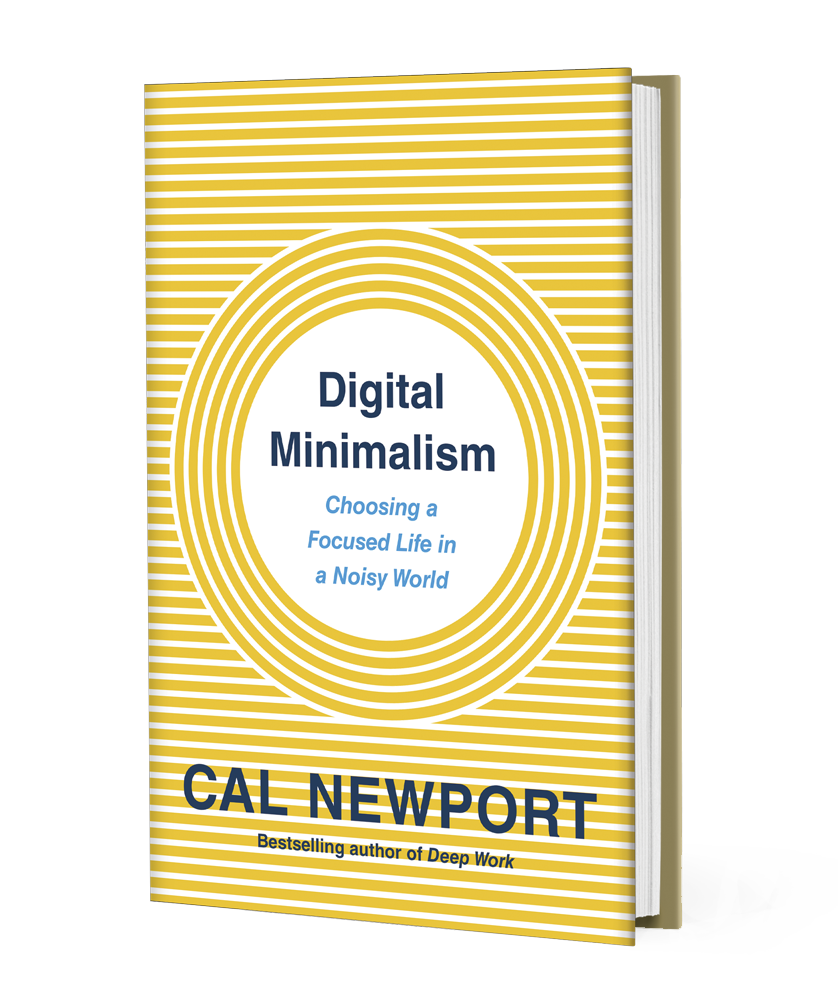
So, as someone who was in search of solutions, I was thrilled to come across Cal Newport’s latest book titled Digital Minimalism.  I had read his previous book, Deep Work, and found some very compelling arguments for ignoring most things that demand our attention in order to accomplish our top priorities.  Cal Newport is an associate professor of computer science at Georgetown University, but he isn’t on social media.  He’s a prolific author and an example of what one can accomplish when treating our attention and time as our most valuable resources.  One of Newport’s most powerful contentions is that so few people possess the ability to focus on a single task for long periods of time that this skill will soon become a huge competitive advantage. 

I decided to experiment with some of the lessons I learned to see which ones, if any, might help improve my focus and reclaim some lost time.  Here are a few that are working for me:

No Morning Social Media:  With the exception of my publisher’s FB group and a writers’ sprint thread, I try not to be on social media unless there is a specific reason (book promotions, etc).  Working from home can be fraught with distractions, but I feel this is one thing I can control.  This rule helps me turn my attention to my daily priorities sooner instead of squandering minutes and energy on social media procrastination.  

Scheduled Email:  Having my email accessible on my phone has been a mixed blessing.  I can quickly respond to requests and inquiries, but then again, like social media, before long I’m down a rabbit hole of other people’s priorities. I now check in three times a day–early morning, lunch, and end of day–and this seems to work well.  If there’s an urgent concern, that’s usually when I get a phone call. People know how to reach me if needed. 

OSX Daily

Do Not Disturb is Your Friend:  Did you know that studies show that we check our phones several times per hour even when we aren’t receiving notifications?  And when our phones are blowing up with non-critical messages and demands for our attention, it takes us 20 minutes to refocus completely on the task at hand? There are so many ways for technology to intrude that it has required me to rethink my constant accessibility.  I now put my phone on Do Not Disturb for certain hours in the day when I know I will need uninterrupted time.  That doesn’t mean my time remains completely uninterrupted, but at least I’ve narrowed down the ways in which my time gets fractured into smaller segments.

I realized that I sometimes allow technology to determine which priorities receive my attention rather than using technology first and foremost for my own benefit in pursuit of my goals.  Pushing my correspondence and social media to the late afternoons/evenings has helped open my creativity and allowed the space my mind needs to work out plot issues and character motivations.  By not filling in small bits of time with other distractions, I’m returning to those earlier days when our minds were allowed to wander and ponder.  

I still fall off track now and then–usually, when I’m struggling with a particular aspect of a writing project–but I now catch myself more quickly and return to the task at hand.  Being more mindful of my attention has also helped me better identify why I’m procrastinating in a certain situation.  Once I can name it, I can figure out how to fix it.  I still fall short sometimes, and that’s okay.  Small improvements can mean big results over the long term. Not perfect, but better.  

I’ll take better. 

Well-Rounded Thrillers? Naw…Really?

By K.P. Gresham

Sara Paretsky’s letter to the editor of the New York Times (June 14, 2019) has created quite a stir in the mystery writing community. This actually surprised me a little.

Sara Paretsky by Mark Coggins, licensed under CC BY-2.0, via Wikipedia.

For years the majority of U.S. publishers, editors and booksellers have preferred male-authored novels in the mystery thriller genre. Let’s define our terms here. Hard thrillers are generally male-oriented in intended audience, protagonist sex, and author generation while cozy mysteries are intellectually gender-neutral and character- and puzzle-inclined) The New York Times put out an op-ed that said female authors are finally breaking into this male-dominated genre.

Ms. Paretsky’s point is that women have been writing thrillers for decades.  . . .

Click here to read the rest of the post at Ink-Stained Wretches.