A Dream Come True

kp gresham


By K.P. Gresham

Writers love to dream. We dream when we’re awake and when we’re asleep. Sometimes its hard to tell the difference. Here’s an example.

I woke to the sound of the TV news coming from the other room. This was no surprise as my husband always turned on the telly when he had his morning coffee. What I heard coming from the TV, however, stunned me.

“My fellow Americans,” the President was saying. “I know these next few weeks and months will be very dark indeed. Thousands will die from Covid-19. Many more thousands will become sick. But remember this. We are Americans. Just as our forefathers fought side by side with people they’d never met, races they’d never before even knew existed, followers of different religions, they came together to create The United States of America. Their goal? To form a more perfect union.”

I swung my legs out of bed and joined my husband in the front room, where he sat mesmerized, staring at the TV.

I saw the President was standing alone behind a podium in the White House Rose Garden. “Today it is in that unity that we must come together to help each other through this trying time. It’s amazing what a smile and a wave to a stranger while social distancing can do not only for that stranger, but for you as well. Giving joy brings joy. Sending an encouraging email tells us we can be a source of comfort. Passing on a Facebook joke brings a smile to our face as well as those we’ve friended.”

Entranced, I sat down beside my husband on the couch.

“When Pearl Harbor was attacked, thus bringing the United States into World War II,” the President continued, “the Japanese admiral who lead the attack said, ‘I fear all we have done is to awaken a sleeping giant.’ His fear came to pass.” The President’s smile was victorious. “The entire U.S. population roared to the support of our common cause. We signed up for the Armed Forces, turned our manufacturers into war machine producers, started food banks, sold and bought war bonds.  Normal citizens turned into parachute seamsters, hospital workers, night raid wardens and troops on the front line.”

My husband put his hand around my shoulder. I felt him sending me confidence through that hug.

“In the midst of this war on Covid-19–and it is a war–we as a united people under one flag, must now understand that we, too, can be part of the solution. Put on your armor, your face masks, your gloves, etc., arm yourself with sanitizer. Take orders from your generals, or in our case, the medical experts who tell you to wash your hands, stay at home, and when you do have to go out, wear a mask and stay at least six feet away from every person you see.

“Now is the time for the United States to no longer be that sleeping giant, uninvolved and inactive. Let us roar into action, together, united, knowing our attitude will be the difference between the life and death for millions of our fellow citizens. Be positive! Know you ARE the solution! Only together can we defeat this enemy.”

Yes! I thought. I can be part of the solution!

“As your President,” he continued, “I call all Americans to arms. I call the businesses of this country to retool and make the equipment our soldiers on the front lines, the first responders, need to succeed. I call on the wealthy to have a care for our service workers on whom they depend for their comfort. Remember that bartender who knows exactly how dry you like your martini. Remember that masseuse who is the only one who can get that kink out of your neck. I suspect strongly that the wealthier you are the more workers and businesses you will have on your list. I call on every person to be the support each other needs. A smile. An attitude of ‘We’re in this together and, by God (literally), we will get through this.’

“To my fellow politicians I say this.” He gazed straight into the camera. “Right now is NOT the time for assessing blame, dire predictions, threats to our medical experts, or refusing to follow the restrictions deemed best for our country. Time for all of those arguments, judgements, recriminations belongs to a history yet to be written. Right now we’re fighting a war, and as leader of this country, I say we all, including the government, will fight this war as one.”

My chest swelled with pride. We are the United States of America!

“In conclusion,” he said. “I thank all of the first responders, all of the medical experts, all of the businesses and individuals who are rising up to defeat this disease. We are a mighty country. God bless the United States of America.”

I was invigorated. Hopeful. Determined.

And apparently I was asleep.

Suddenly my alarm screamed into my hopefulness, jerking me awake. What the hell?

Then I realized it had all been a dream. Damn. My sense of empowerment and determination seeped away as I became more and more ensconced in wakefulness.

Time to get back to reality. But wouldn’t it be nice if that dream would someday come true?

CORONAVIRUS AND DRAGONWYCK By Francine Paino

Feeling confined? Suffering from a bit of cabin fever? Getting Stir Crazy?  While we shelter in place, we have an excellent opportunity to find new OR reconnect with outstanding, thought-provoking, uplifting, and entertaining old books and movies.

Yesterday, I was channel surfing, searching for something that would keep my on the treadmill, and I ran across that marvelous old movie, Dragonwyck. Many years ago, I’d read the book written by Anya Seton in 1941, and made into a film in 1946. The movie starred Vincent Price and Gene Tierney (gosh, she was so-o-o beautiful).

This is a deliciously gothic tale of life in 1844, on the upstate New York estate of Nicholas VanRyn, a fictitious member of the very real “Upper Ten” New Yorkers, as described by a leading journalist of the time, Thomas N. Baker, professor of history at SUNY Potsdam.[i]

The story begins at the home of independent farmers, Ephraim and Abigail Wells, and their children in Greenwich, Connecticut. A letter arrives from Abigail’s rich and powerful cousin, Nicholas VanRyn, who admits that he has looked into her background and decided that she and her husband are worthy and of good character, even if only farmers.  He invites Abigail to send one of her daughters to him to be a companion and governess to his eight-year-old daughter, assuring her that the girl will receive every advantage that his wealth and position can provide.

The Wells must decide whether or not to send either Tabitha, who has no desire to leave the farm, or Miranda, who spends her time daydreaming of a different life. Miranda, of course, very much wants to go. Ephraim relents despite his misgivings, and Miranda is allowed to go the VanRyn home, where she becomes enchanted by Nicholas and his wealth.
Miranda realizes that something is amiss in Nicholas’s relationship with his wife Joanna, and both are both distant from their daughter, Katrine. From the servants, Miranda hears  that the VanRyn bloodline is cursed. It’s rumored that the VanRyns hear the harpsichord played by the ghost of Nicholas’s great-grandmother Azilde whenever misfortune befalls the family. These stories, however, do not dampen Miranda’s obsession with Nicholas and his wealth.

Soon after her arrival, Joanna dies and Nicholas quickly marries Miranda. It is only after marriage that she begins to see the strange, dark side of his character. Now begins the big reveal of murder, madness, and the road to the final tragedy.

In the movie, the pretty pictures in Miranda’s head begin to fracture when Nicholas objects to the woman she’d hired as a personal maid because she limped, but when Miranda tells Nicholas that she is pregnant, he gives in.  After the birth of their baby boy, Miranda demands that her son be baptized immediately because of his defective heart. Nicholas objects but in the end allow it, and just in time.  The baby is christened and dies in his mother’s arms, and Nicholas’s personality becomes more sullen. Life at Dragonwyck becomes stranger, and more threatening.

Anya Seton’s inspiration for the story was the historical framework of the “manor system,” the anti-rent wars, the Astor Place massacre, and the steamboat races on the river, that often resulted in crashes and deaths. It was all part of life on the Hudson, with its brand of Yankee gothic and ghosts, and where there existed houses and mansions “not unlike” Seton’s Drangonwyck.

The atmosphere in the book is set immediately with Edgar Alan Poe’s poem Alone.  From childhood hair, I have not been as others were—I have not seen as others see—I could not bring my passions from a common spring. The opening lines describe both Nicholas and Miranda. He for his hedonist/atheist dark madness, and she for her discontent with the life to which she was born.
Seton uses some of the major conflicts of the mid-nineteenth century in her story. In both the movie and the book, Nicholas’s tenant farmers are ready to rebel against his feudal control; their discontent is woven throughout the book. Nicholas, however, insists that he would never relinquish the lands that had been in his family since they arrived in America.

In the Hudson Valley Magazine, David Levine explains. “Feudalism was declared illegal in New York State in 1782, but the practice continued. After the War for Independence, many farmers found themselves still beholden to these old aristocracies. The farmer paid all taxes, while the landowners paid nothing. The farmer had no right to buy the land, even though, in many cases, the landlords did not have legal title to the land they were renting out. They could be evicted for failure to pay the rent even if they had enough personal property to cover the debt.” Farmers began to question why, after their ancestors had fought for freedom 50 years earlier, were they still held under the yoke of another European master.” [ii]

Seton also uses The Astor Place Massacre of 1849 as a major turning point in Miranda’s and Nicholas’s story. By May, 1849, Miranda is in a constant state of anxiety trying to please Nicholas. While in New York City, they go to the theater with friends on May 10. The great actor William Charles Macready is starring in Shakespeare’s Macbeth. When they arrive a mob has already formed in front of the theater. At the end of the play, the theater manager tells the audience to exit through the back doors and they would be led to safety. Nicholas refuses and seems frighteningly elated by the prospect of bloodshed. He insists on exiting through the front doors, “the same way they came in.”

Nicholas involves himself in the fight and is wounded.  After the incident, he and Miranda return to Dragonwyck, where he becomes more morose and distant, spending most of his time in his tower room. Nicholas’s and Miranda’s marriage and their lives together disintegrate, and the story climaxes, as it must, in an attempted murder and death.

Although the movie takes certain liberties with the story because it cannot delve deeply into all of the author’s characterizations and historical events, it hits the major points well, and Vincent Price as Nicholas is the outstanding performer. Both the movie and the book are well worth becoming (re)acquainted with while confined to home.

In addition to Dragonwyck, if anyone is interested in the Astor Place Massacre, I highly recommend Nigel Cliff’s The Shakespeare Riots, which I intend to re-read while sheltered in place.
Stay well, and stay safe!

__________________________________________

[i] https://www.history.com/news/before-the-one-percent-americans-resented-the-upper-ten 
(accessed 3/30/20)
[ii] https://hvmag.com/life-style/history/history-of-americas-other-revolution-the-anti-rent-wars/ 
(accessed 3/30/20)


An Interview with Crime Writer Alexandra Burt

by Laura Oles

Reading a novel by Alexandra Burt means you must be prepared to ignore everything else because her stories will keep you captive until you reach the last page. Skilled in short stories, true crime and crime fiction, Burt delivers two fantastic reads this year. I asked Alexandra to share her thoughts on world building , true life haunts, and how she approaches the craft of writing suspense.

It looks like 2020 is a big year for you.  You have a new novel and a true crime story coming out this year.  Let’s start with your contribution to The Best New True Crime Stories.  What can you share about your story?

My contribution to The Best New True Crime Stories: Small Towns is a cold case that happened in my hometown in 1983. It was the height of the Cold War and at its core it is about the threats I faced, literally and figuratively. My hometown, Fulda, is a baroque town in central Germany located between the Rhön and Vogelsberg mountains. Seemingly plucked from Grimm’s fairytales, but Fulda has a dark history. Nothing about the rolling hills and farms dotting the landscape hints at Fulda as the place where Armageddon was supposed to happen. Fulda Gap, two lowland corridors, two obvious routes for a hypothetical Soviet tank attack on West Germany from Eastern Europe were the likely invasion route of Russia, the spot where U.S. and Soviet soldiers pointed hundreds of medium-range nuclear missiles at each other. The threats were ever-present. When I hiked in the marshes by the border, East German look-out towers with guards and spotlights stared back at me in the distance. 

In 1983, I happened to be close to the scene of a crime, a quarter of a mile, the way the crow flies. A child died and the killer remains at large, the case was never solved, the killer never apprehended. There’s the story of a life cut short, and then there’s my story. Thirty-seven years have passed and the Cold War summer of 1983 still clings to me like a second skin. I have raised a daughter and I write crime fiction but I have never forgotten the girl that lost her life before her life even began. I have made a life for myself in the Hill Country of Central Texas, in the southeast part of the Edwards Plateau that is not unlike the Hesse highlands of my childhood. But I never learned to trust the world with my daughter’s life. I’ve learned that a watchful eye is not enough, that a simple moment of inattention, a minute of carelessness, can turn into something that cannot be undone. And little girls don’t always make it home alive. And every day I don’t know what to do with the evils of the world, and so I write about them. 

Shadow Garden is your latest crime novel.  Tell us a bit about what inspired this story? 

My previous book The Good Daughter was released days after the election in 2016 and during that time I felt as if the majority of the country fell into a dark hole. Including myself. I had the urge to examine if the same was as stake for all of us, if people of wealth, power, and affluence deploy a different set of principles when confronted with crime. It started out as a moral thought experiment, wondering about all the complicated ways money messes with morals. We know wealth impacts our sense of morality, our relationships with others, and our mental health. Is it true that the more you have to lose, the harder you fight to keep it, whatever ‘it’ may be? Money, a reputation, a standing in the community? Is being rich inherently immoral and if so, but what are the consequences? I imagined Donna Pryor, a woman of humble beginnings, who has everything but the truth of what happened to her family. From there I allowed the story to unfold organically and I sat by and watched them get to the truth of who The Pryors really are. Shadow Garden’s initial title was “The Many Incarnations of Donna Pryor” and I mention it because the book had quite a few incarnations itself. It started out as detective novel, purely comprised of interviews, then it turned into a family saga spanning decades before and after a crime occurred, just to arrive at Shadow Garden, an estate at the end of a rural road and a life of privilege that begins to crumble and somewhere in the ruins is the truth.

Many who read your work comment on your ability to combine heightened suspense with fully drawn characters in a compelling setting.  Is there a certain aspect of word building that comes more easily to you?  Is there a part that’s more challenging?

First of all, that’s a huge compliment. Thank you. The beginning of a novel is a very long period of imagining the setting and the people and I don’t take notes nor do I examine plot but I create the characters’ world. There is nothing else for a while, the characters really live at my house and eat at my table and not until the first draft is complete are they allowed to huddle and regroup. I don’t struggle with world building since it is ground zero at the beginning of a new project and anything is possible. There’s huge freedom in the vast scope of a new project.  I am always very sure of the setting but the plot changes endlessly and often and the characters usually end up needing work. It’s a matter of having a great editor, which I have, and revising draft after draft, after draft. 

When I was younger I wanted to be a painter and I went to art school but then abandoned that path. There is still a lot of visual artist left in me. It’s the first thing I imagine in any project, novel or short story—what is the essence of it; a still-life in oil or a landscape in watercolor—and the setting becomes a place and then it becomes a world and a clock ticks in the background to give it pace and there is structure and meaning which turns into a theme. Long story short: once I commit, I’m all in for however long it takes to make that world come alive the best way I know how. 

Readers are often curious about their favorite authors’ habits.  What is your daily or weekly schedule like?  Do you ever get stuck?  If so, how do you find your way out?

Unfortunately I’m still struggling to keep a schedule and all writers are powerless to real life happening as they work. I take it day by day, keep my fingers crossed, and hope for the best. It’s a best-laid plans kind of thing; most days writing doesn’t turn out as well as one hopes. One should not expect for things to always turn out to plan. My daily schedule looks something like this: after a workout (more often than not a workout competes with falling into a two-hour social media hole), I sit at my desk and pick up where I left off the previous day. Sometimes there’s an abundance of oxygen for that task and I just kind of go with it, other days it’s just not flowing. Be that as it may, there are deadlines and word goals and I swear by something I have discovered a few months ago: focus music. It promises laser productivity and a boost in focus. Simply put, it is music void of both ultra-low and overly loud bass and high pitch sounds that tend to become annoying over time. There are no ruptures, no pauses, no breaks or major volume deviations. The type and number of instruments remains constant through hours of play and the music follows a particular pattern mimicking the brain waves present in a focused state and eventually the brain waves mimic the music. It’s my secret weapon. I will write and look up and realize three hours have passed. It may not be a way ‘out’ but it’s a way to remain ‘in’, if that makes sense? 

I do get stuck at times and I wish I knew of a magic potion but I kind of obsess about it and just keep my fingers crossed and hope to spot the proverbial light at the end of the tunnel.  Sometimes all you can do is chip away at a problem and hope for the best and so far it’s served me well. Still wouldn’t mind some sort of a potion though. 

Alexandra Burt was born in a baroque German town in the East Hesse Highlands. She moved to Texas and worked as a freelance translator. Determined to acknowledge the voice in the back of her head prompting her to break into literary translations, she decided to tell her own stories. She currently resides in Central Texas. Remember Mia (2015) is her first novel. The Good Daughter was published in February 2017. Her third novel, Shadow Garden, is forthcoming in July, 2020. She is working on her fourth novel. She has contributed to Lone Star Lawless: 14 Texas Tales of Crime, and The Best New True Crime Stories: Small Towns. Her short stories have appeared in publications and literary reviews. 

Read a Book, Save the World

By K.P. Gresham

My hubby and I make it our mission to see all of the films nominated for the Academy Awards’ most coveted prize—the Oscar for Best Picture. This year was no exception. We saw Ford V Ferrari, The Irishman, JoJo Rabbit, well, let’s just we say all of them. So on February 9 of 2020, we sat down with friends, champagne glasses in hand, and watched the Academy Awards show. I agreed with most of the winners. Renee Zellweger knocked it out of the park as Judy Garland. Brad Pitt was awesome in Once Upon a Time in Hollywood. For damn sure, 1917 deserved the award for Best Cinematography. But when Parasite was announced as 2019’s best film, I didn’t get it. Then again, I didn’t get the movie either. The poor living off the rich.  The rich living off the poor. Who was the bad guy? Which was the parasite?

So, I got out my cell phone, went to Dictionary.Com, and looked up the word.   The first definition that came up was the one that stuck with me. It read, “an organism that lives on or in an organism of another species, known as the host, from the body of which it obtains nutriment.” I thought of the mosquito who bites humans and sucks their blood. They feel no remorse, no guilt. It’s what they do to survive. How exactly did this definition apply to the movie Parasite?

Then my book club (Remember them? I bragged on them several blogs ago.) had as its monthly selection  Hyeonseo Lee’s book titled The Girl With Seven Names. It was the author’s true story of escaping from North Korea, via China, and finally arriving in South Korea. As she made this dangerous journey, she used seven different names to remain off the authorities’ radar.

Lee’s descriptions of growing up in North Korea were very unsettling. There are over fifty layers of societal classes in the country, each with their own set of privileges and restrictions. The only constant among all of these “castes” is that the supreme ruler (first Kim Jong-il and now Kim Jong-un) is to be worshipped and glorified. (It is believed that Kim Jong-un was born in a lowly stable and that a bright, huge star announced his birth. Seriously?) As for the other laws, not so much. The main rule is Kim Jong-un first, and, as long as you’re not stupid, you are allowed to do pretty much whatever you have to do to survive. Bribery of officials to look the other way is the norm. (Hey, they have to make a living too.) This is how people learn to deal with famine, pestilence, and unemployment.  There is no guilt in doing what one must do to survive.

Further, the society has no guilt in doing what it must do to survive.  Bingo. I finally figured out what the movie Parasite was all about. A different culture. A different value system. A guilt-less survival instinct.

Books teach us things. Oh, yes, books entertain, but they also take us into worlds beyond our own experiences, histories we never learned, and points of view we never considered. Had I not read Hyeonseo Lee’s book, I would not have understood the movie, or the culture. More to the point, I understand that America’s culture has different norms, different thought processes, and a different hierarchy of what’s acceptable. We may think that the characters in Parasite and Lee’s book should feel remorse for how they live. But for them, it’s what they must do. And if their culture is all in on this “no guilt” survival, doesn’t that reveal something of their leadership?

For me, The Girl with Seven Names was a real eye opener.  Books teach us about folks who are not of our national or personal culture. We can learn why they live how they live. Maybe, even, we can learn how to live with them.

It might make the world a safer place.

So Many Blogs, So Little Time #ROW80

Originally posted on Ink-Stained Wretches. https://inkstainedwretches.home.blog/2020/02/23/so-many-blogs-so-little-time-row80/

by Kathy Waller

blog 

noun

  1. a website containing a writer’s or group of writers’ own experiences, observations, opinions, etc., and often having images and links to other websites.
  2. a single entry or post on such a website:She regularly contributes a blog to the magazine’s website.

Dictionary.comAccording to GrowthBadger, there are over 600 million blogs online today. Over 31 million bloggers in the United States post at least once a month. Over 2 billion posts are published each year worldwide.Alas, no matter how hard I try, I can’t read them all. I have some favorites, however, and in this post I’ll profile two of them.*

FRIDAY FICTIONEERS

Which is easier to write—novels or short stories? How about short-short stories? How about short-short-short . . .

Each week, a photograph is posted at Rochelle Wisoff-Fields—Addicted to Purple. Using the photo as a prompt, you write a 100-word story—complete with beginning, middle, and end—post both photo and story on your own blog, and link to an inLinkz list of other Friday Fictioneers’ stories.

Prompts are also posted on the Facebook Friday Fictioneers page.

Rules and February 21 photo prompt appear here.

Photo prompts are not in the public domain. They’re to be posted only for Friday Fictioneers, and photographers are always to be credited.

The week’s inLinkz list is here. Currently, 56 writers have added their names here.  Below are five stories I’ve chosen at random.

“After All This Time” 
“Diluted”
“Rosey, a buggy and a heap of hay”
“Secrets”
“Why Should I Go to Pakistan?”
“How Much?”

Here are some of my own past efforts:

“You’ll Be Fine”
“‘Shrooms”
“Lovestruck”
and more here.

***

A ROUND OF WORDS IN 80 DAYS: THE WRITING CHALLENGE THAT KNOWS YOU HAVE A LIFE

Many writing challenges set goals for you: Write 1,000 words every day. Write five chapters every week. Write write write . . .  And then life gets in the way, and goals are not met, and the challenge ends not with a bang, but a whimper.

ROW80, on the other hand, allows writers to set their own goals. There are four 80-day rounds in a year. At the beginning of a round, you set your goals, write about them on your blog, and then post about your progress on Sundays and Wednesdays.

As with Friday Fictioneers, posts are linked so other participants can keep up with your progress.

Progress is the operative word. Goals can be modified at any time.

Everything you need to know about how the challenge works is on the ROW80 site:

What Is Row 80?
How Do I Join?
I’m Lost . . . FAQ
Accountability Partners
Blog

If you miss out on the beginning of a round, you haven’t missed out. Just set goals, write them up, and post on the next Sunday or Wednesday that comes along.

***

I missed the beginning of 2020’s first ROW80 round, but today is Sunday, so I’m going to jump in.

Round 1 ends on March 26–31 days away.

Goal: By March 26, I’ll add 4,000 words to my WIP.

*

I hope you’ll check out Friday Fictioneers and ROW80. Now I have to post.

NEW ORLEANS – A CITY OF MYSTERY, MAGIC, HISTORY AND THE WORLD WAR II MUSEUM


Francine Paino

Written by Francine Paino


New Orleans is known for many things.  It is a city of magic, mystery and a creole culture. New Orleans offers fabulous Cajun food, jazz and traditions born of hundreds of years of French, Spanish and American influences melding to create one of the most exciting cities in the U.S.


February marks the beginning of the Mardi Gras culture of masks, beads, and jazz music on every corner and in the streets, and the closer it gets to Fat Tuesday, the more frenzied the partying becomes.


Somewhat out of character in this atmosphere, however, New Orleans has a very sobering institution. Surrounded by the city’s distinctive and ornate French architecture, surrounded by the mysterious atmosphere, and surrounded by celebrations and festivities, stands a stately monument.

Flying the Stars and Stripes, high above its roof, is the National World War II Museum. Visitors who take time off from the city’s fun events to come here experience the sacrifices made by so many in defense of other nations, as well as our own.

A 2017 TripAdvisor rated the World War II Museum the number one attraction in New Orleans, and number two in the world.  Again, in 2018, it was rated one of the top ten museums in the world.

Well planned, the museum’s design provides immersive exhibits, multimedia experiences, and a vast collection of artifacts. Spanning the nation’s pre-war domestic manufacturing, preparation to enter the war, and its industrial efforts on the home front once the U.S. entered the conflict, the exhibits pay attention to the women on the home front who took over the industrial work when the men were sent overseas.

Upon entering the museum, one looks up to see a  C- 47 transport plane suspended on cables. The C-47 carried many of the young men sent to fight and die in Europe and Southeast Asia. Beneath this plane is a Nazi anti-aircraft gun, the type used to shoot down the C-47s, and alongside the gun is an Andrew Higgins landing craft.

Throughout the museum, there are displays of weapons, the soldiers’ back packs, communication equipment, and first-person oral histories, as well as unique immersive exhibits—all included in the admission price.  One interactive exhibit is The Dog Tag Experience, which encourages visitors to choose a soldier from the kiosk of registered combatants and follow him through the war.

For those who prefer to go from exhibit to exhibit on their own, the displays are labeled and arranged to move the viewer from event to event, but also included in the admission price are guided tours.

These guides are well versed in the areas they cover, and they provide the details and connective tissue that turn specific events into full histories.

Then there is the 4D movie. Shown on a panoramic screen, and narrated by Tom Hanks, Beyond All Boundaries covers the epic story of WW II. The film is a very intense experience and not recommended for young children.

Although there are many stories of inspiration and courage, all war is hell, as is clearly shown here. No one sane wants it, but in the words of the first president of the United States, in his first annual address to Congress, “To be prepared for war is one of the most effectual means of preserving peace.” (George Washington, January 8, 1790) To that point, there is an exhibit board displaying how unprepared the U.S. was in 1941. Japan had 1,700,000 men in uniform, Germany had 3,180,000, and the U.S. had 335,000.

In a separate pavilion, connected by an indoor bridge are two roads. Each one occupies a full floor. One takes the visitor on the combat road to Berlin, starting with the battles in North Africa, and the other, on the road to Tokyo, weaves in and out of the island fights in the jungles of Southeast Asia.

New Orleans was selected for the museum because it is the city in which Andrew Higgins built the landing craft used in the amphibious invasions.  As the Supreme Allied Commander, Eisenhower believed the landing craft was one of the five essential inventions that helped win the war. New Orleans is better known, however, for its free spirit, fun, food, music, multicultural events, and Mardi Gras festival.  Having the museum here is a solemn reminder that the freedoms and celebrations we enjoy carry a hefty price tag.

The men and women who paid the price in the mid-twentieth century are almost gone. One day soon, all that will be left to tell future generations what happened to the world between 1932 and 1945 are these stories of the citizen soldiers, the men and women who fought the battles in Europe and the Pacific, and the odds they faced. Their records, personal oral histories, and photographs taken by military photographers in real-time ensure that they will be remembered forever.

The World War II museum is comprehensive, and it is not possible to see and experience everything it has to offer in one day. Nonetheless, any amount of time spent there is worth the price of admission.

Favorite Fictional Detectives

During a recent panel event at BookPeople on private detective fiction, we were asked to list some of our favorite characters in print and television/movies.  While it was difficult to narrow down, here are a few of my few favorites.  If you haven’t read Lisa Lutz, Sara Paretsky or Laura Lippman, I hope you’ll make a beeline for your favorite bookstore and give one (or all) of them a read.  I think you just may find your next favorite series.

Isabel (Izzy) Spellman: Isabel Spellman has been described as “the love child of Dirty Harry and Harriet the Spy,” which is one of the many reasons I love this character. As a licensed investigator in her family’s firm, she’s extremely capable and sharp, even as she navigates the pitfalls that come from working with her dysfunctional family. Her cleverness has an edge that keeps me turning the pages, and her sarcasm always sticks the landing. 

Tess Monaghan:  I discovered Tess during a time when my career required a great deal of travel. I picked up Baltimore Blues and never looked back. Tess’s investigative journalism background and her balance of strength and compassion compelled me to continue with the series. Laura Lippman gives us such a layered and authentic view of Baltimore through Tess’s eyes. And Tess ventured to go where few female detectives have dared—motherhood.

V I Warshawski:  I’m drawn to a strong and complex female protagonist, and VI absolutely fills this role. Sara Paretsky was one of the first authors to introduce a complicated and fully formed female private investigator, and readers will be forever grateful. Vic doesn’t apologize for who she is and how she makes her way in the world. She’s skilled in a street fight, appreciates Torgiano red wine and doesn’t suffer fools. What’s not to love?

TV:  Jim Rockford:. When I think about private detectives on television, my mind always goes to Jim Rockford. Maybe because he kept me company in my childhood. An ex-con who served time in San Quentin and then was later pardoned, he ran his investigative business out of a mobile home in LA and preferred fishing to most other pursuits. His father never felt being a PI was a real job, and the fact he was often getting shorted by clients didn’t help his end of the argument. Jim Rockford was fallible times, skilled at working cold cases but not always coming out on top in a brawl. He rarely used his gun. He was human, and I find that particularly appealing. And that theme song is pretty catchy, too.

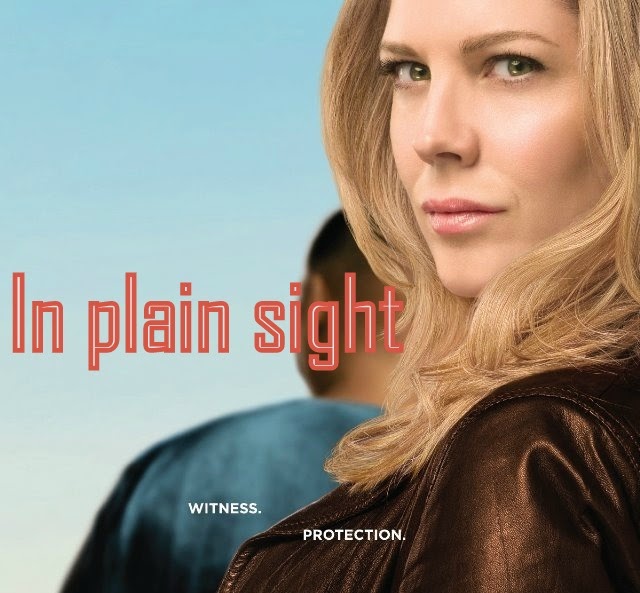
Mary Shannon/In Plain Sight: I’m going to color a little outside the lines on this one. Mary Shannon is a U.S. Marshall working for the Federal Witness Protection program, not a PI, but she’s a skilled investigator with a highly tuned (and hard-earned) understanding of human nature. Her complicated family backstory (her father is on the FBI’s most wanted list) informs her views on her cases and charges, but she’s first and foremost an outstanding hunter and protector. And her banter with her partner, Marshall, is pure gold.

What about you? Who are your favorite series characters? What keeps you turning the pages or tuning in? –Laura Oles

CHRISTMAS IN TEXAS – ITALIAN STYLE

            We Italian-Americans take our Christmas tradition seriously – as do Texans. I’m fascinated by some of the “Texas-American” customs, including Fried Turkey, on Christmas Day, which I haven’t yet had the pleasure of tasting. My son-in-law, a fabulous cook, promises that one day he’ll do it for us.

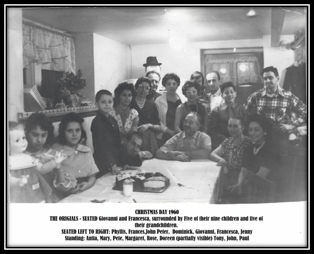
I cannot, however, separate myself from my cultural heritage being only a second-generation American, and more of an immigrant than I’d ever realized, having grown up in an immigrant community of Italians, in Corona, New York. I’ve lived my life until six years ago, in New York surrounded primarily by other Italians and Jews, many of whom graced our home and table to share our Christmas Eve rituals. Many are no longer with us in this world, but my love for them spans time, distance, and death – Here’s what they shared with us, and what I brought to Texas with me.

           The tradition of the special Christmas Eve dinner for La Vigilia (the vigil), came over with the unwanted Italian immigrants in the late 19th and early 20th centuries. In the U.S., it evolved into The Feast of the Seven Fishes

Hundreds of years ago, until the reforms of the 1960s, the Catholic liturgical calendar specified several days of abstinence from food and meats altogether; Christmas Eve was once such day. Although no longer required by the Church, preparing meatless meals and specifically fish dinners on Christmas Eve is still a widespread tradition across Italy and other predominantly Roman Catholic countries.  Its origins, however, were rooted in the impoverished areas of southern Italy, where locals relied on fish because it was considerably less expensive than meat. 

Some of my warmest childhood memories of Christmas Eve are of my grandmother preparing a range of fishes. Baccala (dried cod) salad, followed by spaghetti with a red sauce with eel (which I never ate) and/or Linguini with clams and anchovies (I always picked out the anchovies – which got me into a world of trouble.) Following the pasta dishes were lots of vegetables, fried smelts, maybe some baked flounder or redfish (what she bought depended on price). Fruit, coffee and hard biscotti ended the meal – and we all looked forward to the sumptuous dinner we’d have on Christmas Day.

For many years, in my home in New York, the Vigil dinner on Christmas Eve brought family and close friends to our table to share food, fun, stories of my husband’s and my backgrounds, as well as the tradition of our friends of other cultures who’d join us.

Typical menus always started with appetizers, followed by salads, then at least two different fish dishes. When my mother-in-law was alive, she’d prepare my husband’s favorite, a Sicilian dish of codfish in a red sauce with potatoes and capers. Linguini with white clam sauce was a constant, as well as bakes flounder and shrimp scampi. We always had an array of vegetables and the meal ended with coffees – espresso, American and decaf, as well as fruits, and cakes. (For our non-Catholic friends I always had roasted chicken and beef), but I held my family’s feet to the fire: No Meat on Christmas Eve! 

           When my children were very young, we made a big production of Santa’s arrival at midnight (Yes, that’s the one night a year I’d wake them from a sound sleep to greet Santa). Well, children grow, life moves on, many of the elders pass away, and we moved to Texas, where new traditions add to the old.

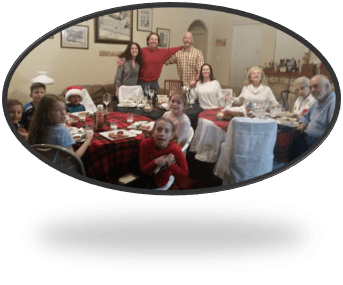
This year, on Christmas Eve, we were a scant fourteen because only one of my daughters lives in Austin.  She, her husband, and three children were here, along with my son-in-law’s mother and my friend, our Scottish/British friends and their triplets, and, of course, my mother, the still cooking and baking nonagenarian.

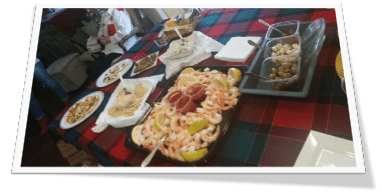
I decided for this Vigil dinner, I would prepare a seven fish menu. We began with appetizers of sardines with jalapeno cream cheese on crackers with hot sauce; smoked salmon on toasts with cream cheese and capers; a halibut salad, anchovies, and spicy green olives, shrimp cocktail and an assortment of other olives and cheeses.  Most of these were consumed with pre-dinner drinks – gotta keep those appetites going!

The first course at the table was a green-bean and sliced pepper salad – then came the star of the evening: Cioppino – Something I’ve adopted as my Christmas Eve tradition 

            Cioppino traveled from west to east. Created in the late 1800s by the Italian fisherman in California, this tomato-based seafood stew contained leftovers from the day’s catch, and cooked on the boats while at sea. 

There are some myths concerning the origin on the word Cioppino; it is not the fractured English of fisherman asking each other to Chip-a EENO. The immigrant fishermen were predominantly from the Genoa region of Northern Italy. In the Ligurian dialect, the word “ciuppin” (chu-pin) means “to chop” or “chopped,” which is an apt description of the process of making Cioppino.

Here, almost 200 years later, in my home in Austin, my Cioppino contained cod, shrimps, clams, scallops, and crabmeat. ( All store-bought, by the way. I’m not a fisherperson.)  I served Texas toasts and crusty Italian bread to soak up the delicious liquid in the bowl. Stuffed, we then refreshed our palates with fruits and took a rest to track Santa’s progress from the North Pole.

The meal ended with an assortment of cakes, from cheesecake to my mother’s homemade apple turnovers, biscotti, and pound cake – Yes, at 96, she still bakes. 

Before everyone departed to rush home before Santa arrived, the children gathered around the crèche. I passed the figure of baby Jesus from child to child and last to received Him, placed Him in the manger. The next day we’d celebrate His birth. This is a new custom I’ve started to remind them why we celebrate Christmas.

I don’t know what the next iteration of our Italian-American/Texas Christmas Eve traditions will be, but I’m confident the constant will be family and friends. 

Buon Natale  e felice anno nuovo a tutti!

(Merry Christmas and Happy New Year to all. )

Spinning Stories

About three years ago, I did something I never thought I’d do.

I joined a gym.

I’d walked through the doors in search of a way to deal with stress, and I knew that exercise was an effective method of managing it. And I liked the fact that it was a community gym, one that welcomed people of all ages and at all stages of athletic ability. Almost immediately, I found a supportive group of friends who helped me adjust as I tried new classes, learned to use the equipment, worked up to heavier weights.

In the midst of this, I discovered that many of my gym friends were also avid readers.  In particular, my spin class is filled with men and women who love to read books, discuss books and trade books. In the few minutes before class, we’d catch up on what we were reading, what we loved and what we planned to read next.  When I had discussed an effort to gather books for donation for the Ellis Memorial Library, which had been devastated by Hurricane Harvey, Trisha Taylor quickly set up her own network and had collected so many boxes of books that it took over half of her garage.  

I had found my people.

The Texas Health & Racquet Club Free Library

Encouraged by the knowledge that so many members of my gym were readers, I asked the manager for permission to set up a small free library in the lobby.  He was very supportive, and soon I brought a small cabinet and filled it with some of my favorite books.  

Our little library skews pretty heavy towards crime fiction, but that hasn’t been a problem. The books disappear, and other members are bringing in their own favorites to share. I love introducing my gym friends to my author friends (through their work), and I’m thrilled when someone tells me she ordered another book in a series because she loved the one she picked up from our library.  

We have also entertained the idea of combining a spin class with a book club but none of us are coordinated enough to pull that off. So for now, we’re content to go to class and discuss our latest reads during warm up.  We’re too exhausted to say anything else once it’s over, but every now and then, I see someone leave with a book—or a leave a book—and I can’t help but smile.

–Laura Oles

The New Girl Will Scare You Stiff

By KP Gresham

Originally posted on Ink-Stained Wretches

I can’t put down THE NEW GIRL–Daniel Silva’s latest book, that is. I have long been a fan of Silva’s series featuring Gabriel Allon, art restorer and master spy. The New Girl(Harper Publishing, July 16, 2019) is the 19thbook featuring Allon, and, in my opinion, the best. It’s a fast-paced, fact-filled, emotional, beautifully written suspense thriller, that mirrors the times we are living in.

It begins with the kidnapping of the Saudi Crown Prince’s daughter. Allon, head of Israeli intelligence, is directed by his Prime Minister to help the prince find the girl. The two become unlikely allies in a race against time to stop a Russian move to take control of the Middle East.

The book weaves fiction into the baffling aspects of Middle East intrigue in a way that actually helps explain what the heck is going on “over there”. Usually when I read such a book I spend my time wondering, how much of this is fiction and how much of this is fact. Luckily, I accidentally did something that provided a clear vision of where that line is drawn.

I mostly listen to audiobooks during my dog’s three miles walk every morning. (I tag along as company.) By mistake I played the end of the book complete with Mr. Silva’s acknowledgments and comments. I’m glad I did. I recommend this “oopsie” to those who pick up Mr. Silva’s book. He clearly sets out what is fact and what is not. This makes the reading of this suspenseful page turner even more meaningful because I could trust the author. He wasn’t trying to pull the wool over my eyes. He was trying to tell a good story, yes, and he was making it even more realistic by using facts to back up his plot line.

Full disclosure, because I enjoy a good night’s sleep, I wish the book had included fewer facts.

I love Bob Woodward’s quote about Mr. Silva’s book. “At times a brilliant novel tells us as much about the times we live in–and the struggles of the world, the global deceptions and tragedies–as or better than journalism. Daniel Silva’s The New Girl is such a novel.”

Pick up this New York Times (and USA Today and Wall Street Journal) #1 Bestseller. You’ll be enlightened.

And scared stiff.

The New Girl by Daniel Silva Amazon Link

https://inkstainedwretches.home.blog/2019/12/09/the-new-girl-will-scare-you-stiff/