In the Window or On the Table? What I Learned from Amor and Anton

By: Dixie Evatt

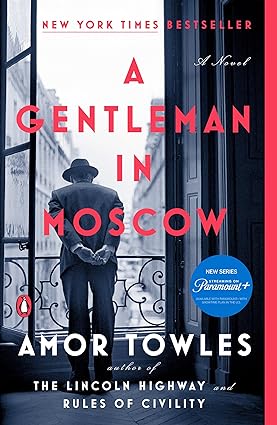
Ever since I read A Gentleman in Moscow (2016) I’ve considered Amor Towles’ writing style to be nearly perfect. So when my niece told me Towles was making an appearance at the Empire Theatre in San Antonio, I booked it. He was there to support the San Antonio Book Festival and to talk about his latest book, Table for Two. It’s a collection of six short stories plus a novella. Unlike some of his other stories, these all take place in the current Millennium.

Over the evening I learned a interesting things about Towles.

I learned that he is what we used to label in the news business, an “easy interview.” Austin’s own Stephen Harrigan (Big Wonderful Thing, 2019) was on the stage with Towles as moderator but he didn’t get to ask many of the questions on his notepad. Towles was in a talkative mood so needed little prompting.

I learned that Towles took up writing full time only after success in his first career at a small Wall Street investment firm.

I learned that once he gets a project in mind, he begins to fill notebook after notebook with hand-written outlines, ideas, scenes, characters. It may take years. He says this process frees his imagination and subconscious to go where beautiful language and the characters’ inner lives take him.

There was more but of the many memorable things I learned about this accomplished author, what I remember best, and took to heart, was his description of his research process. He said that when writing he intentionally postpones what he calls “applied research” until near the end. During this time he is also reading novels written by others that are set in the same historical period as the book he’s working on. His novel is almost written before he begins deep research.

That’s why he waited until A Gentleman in Moscow was almost finished before traveling to Moscow and checking into the Hotel Metropol, the exclusive hotel where his story about Count Alexander Ilyich Rostov is set.

Towles advised that details gleaned from this kind of active research should be written into the story much the way one might design the stage for Anton Chekhov’s The Cherry Orchard (1903). Of course Towles would choose this particular play as a point of reference because, like his own novel set in Russia, Chekhov’s tragicomedy also deals with a period of decline for the Russian aristocracy.

He said that when the curtain rises for the play the audience might see only the suggestion of a cherry orchard through large windows as if were rendered by an impressionist such as Claude Monet or Mary Cassatt. The windows might be framed by plywood bookcases painted to resemble mahogany. In the center of the room there would be a table set with a porcelain tea service.

When an author is ready to fold research into the story, Towles said it should be presented with similar layers of reality. Some details are just suggested in the background. Some, like the bookcases, give the scene the appearance of reality but need not be too detailed. Then there are aspects of research that can’t be given short shrift. For these, the author must adhere to absolute authenticity. The audience needs to hear the chair move across the floor and the teacup rattle in the saucer. The challenge for me is where all of the information that I’ve accumulated in my own research belongs – in the window or on the table?

Charles McNulty, theater critic for the Los Angeles Times, said in a June 6, 2022, review of a local revival of The Cherry Orchard, “Big things occur in Chekhov. Houses are lost, guns occasionally go off, and people die. But the focus is on muddling through.”

Much the same might be said about A Gentleman in Moscow and the subtle use of active research by Towles so that his story isn’t swallowed up in the details.

***

Cover of A Gentleman in Moscow via Amazon

Image of Anton Chekov via Wikipedia. Public domain.

Image of stage of The Cherry Orchard via Wikipedia. Public domain.

***

A former political reporter in Austin, Dixie also taught writing at Syracuse University. When she teamed up with Sue Cleveland to write fiction, they sold a screenplay to a Hollywood producer. Although the movie was never made, the seed money financed ThirtyNineStars, their publishing company. Through it they published two award-winning thrillers (Shrouded and Digging up the Dead) under the pen name, Meredith Lee. Dixie’s first solo mystery was Bloodlines & Fencelines, set in a tiny Texas town near Austin. Kirkus reviews described the book as, “A twisty whodunit that’s crafted with care and saturated with down-home Southern charm.” She is working on second mystery in the series. www.dlsevatt.com


Curious Animals And Recent Reads


by Helen Currie Foster

New reads! If, like me, you desperately miss John le Carré, consider A Spy Alone, the 2023 debut spy thriller by Charles Beaumont, a field operative veteran of Britain’s MI-6. https://bit.ly/3ZzHjHs His premise is fascinating: we know of the “Cambridge Five” who spied for Russia from the 1930’s to 1950’s—Kim Philby, Guy Burgess, Donald Maclean, Anthony Blunt and John Cairncross. https://en.wikipedia.org/wiki/Cambridge_Five But has there ever been, or could there be, a spy ring linked to Oxford? Beaumont’s protagonist Simon Sharman feels real, right from the first page:

“It is their shoes that give them away. As a lifelong fieldman, Simon Sharman hasn’t forgotten the lesson: walkers might change their jackets, pull on a pair of glasses, even a wig. But nobody changes their shoes on a job. Look at their shoes. 

I was hooked. Warning: Beaumont’s book is contemporary, well-written, tense, and may interfere with sleep. 

Two other recent reads: old adventure and a new “adult fantasy.” I’d never heard of The Long Ships by Frans G. Bengtsson (1954).

Set from 980 to 1010 A.D., the book recounts the wide-ranging adventures of Norseman Red Orm Tostesson, and the collision between Christian priests (the “shaven men”) and the Norse culture of Skania at the south tip of Sweden. Now I know what it meant to go “a-viking”—to go sea-raiding! 500 pages, with Red, a very engaging Norseman. Great maps, too.

The Lost Bookshop, by Evie Woods (2024), offers time travel between the 1920’s and 30’s in Britain, and the present; a search for a lost Brontë manuscript; a disappearing attic; and disappearing and reappearing characters. I confess I flipped through big chunks, relieved when true love finally won out after two women, generations apart, survive appalling treatment. The disappearing attic reminded me of Susan Cooper’s Over Sea, Under Stone, and of course the wardrobe into Narnia in The Lion, the Witch and the Wardrobe. I’m always up for secret doors.

I’m rereading a fascinating and fairly demanding study by Graham Robb, who has probably bicycled and walked further in Britain and France than most humans:

In The Search for Middle Earth: Mapping the Lost World of the Celts (2013)he describes how the Keltoi, or Celts, developed a system of surveying based on a midline transected by the lines of the summer and winter solstice to estimate travel distances and times—a feat not replicated for centuries. He maps the Heraklean Way, the path from southwestern Iberia that runs northeast across the Pyrenees to the Alps along the diagonal of the solstice sun, which Hannibal took when he invaded Italia. He describes Druid schooling (20 years to learn) and maps out protohistoric forts which turn out to lie along survey lines. He provides amazing maps. Two ongoing lessons from Robb’s devoted research: the winners write history; and humans tend to underestimate the accomplishments of earlier civilizations. 

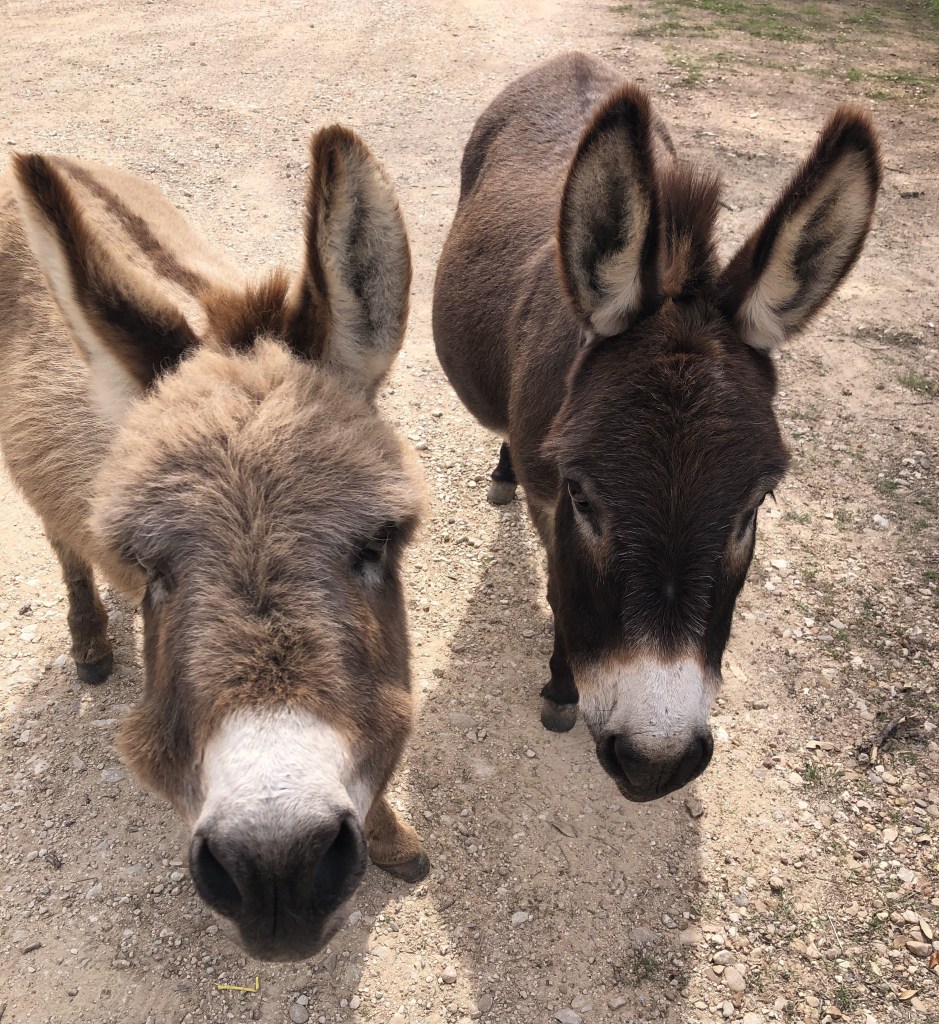
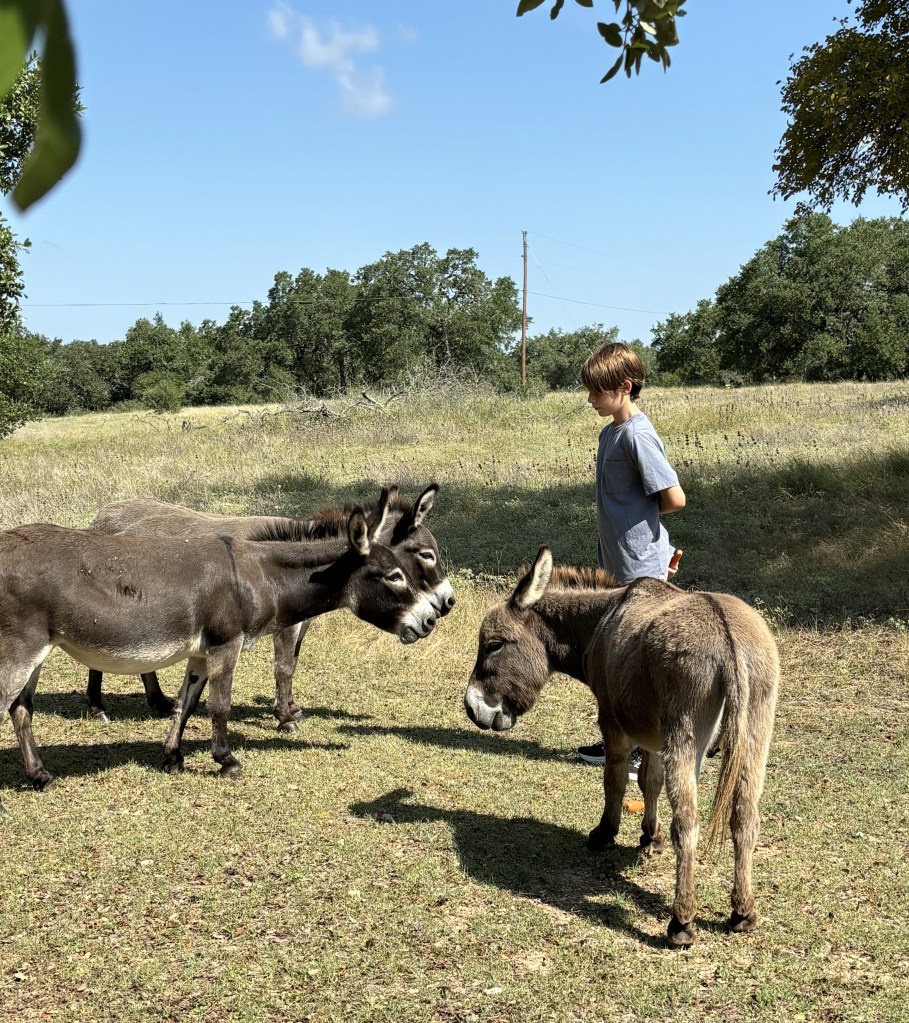
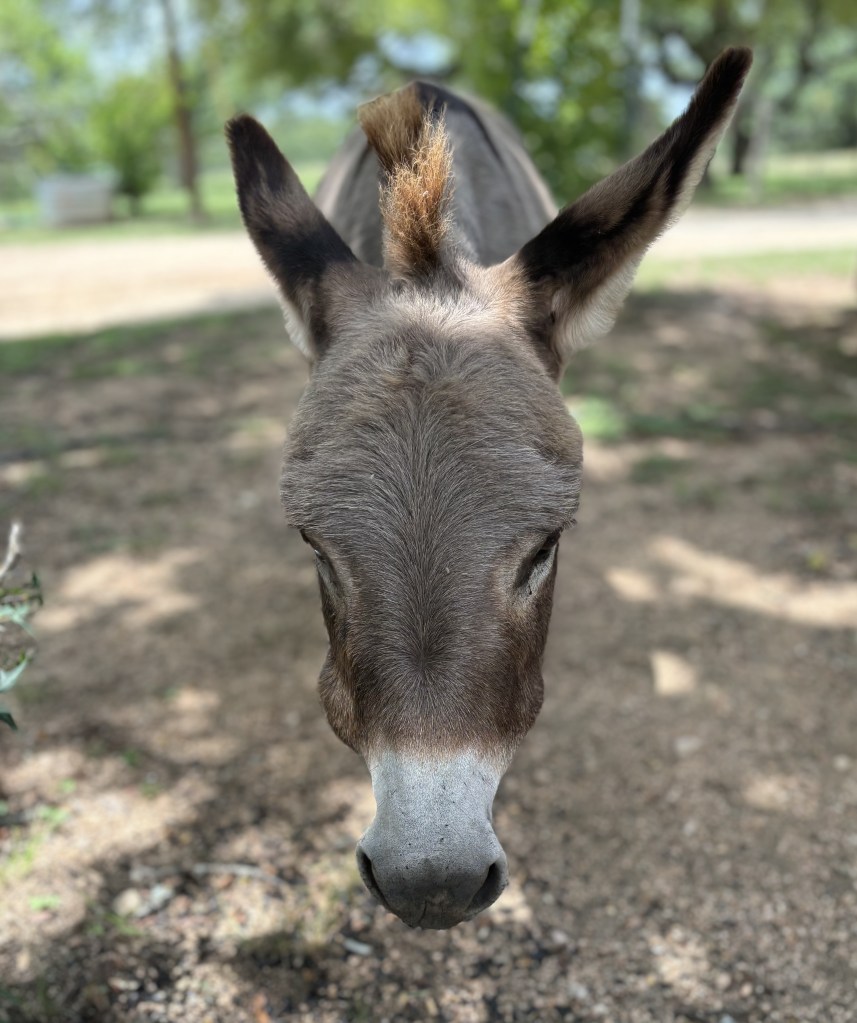
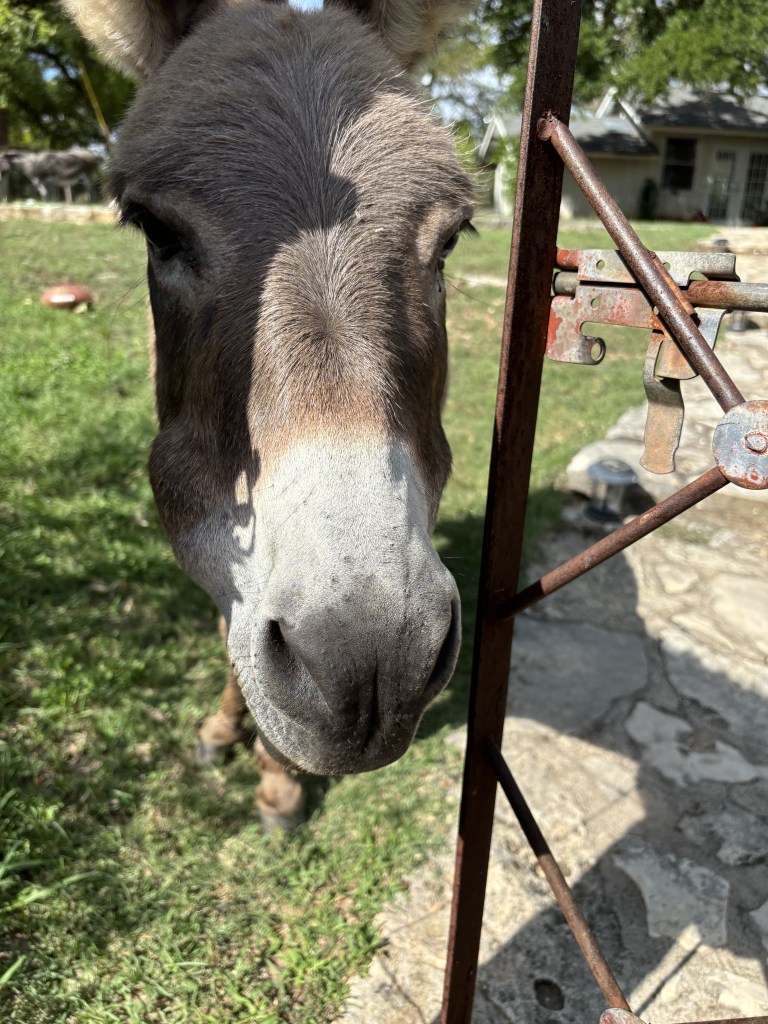
Several of you asked about the three burros, given the recent cold snap. Thank you, they’re well. Their hair’s not waterproof so in cold rain they gather on the south side of the stable, under the roof, safe from rain and the north wind. They were relieved to see green grass again after the drought broke, but they’re also eating—and rolling in––green hay. And mud!

Yet despite hay, they gather outside the gate every morning and afternoon for carrots. They consider this part of their deal.

Burros are curious. They amble over to watch us garden and hang up laundry. They need company. They graze near each other. They may live into their 40’s. Sebastian, the short stubby knock-kneed male who invited himself to live here, may be 35 or more. Amanda (who insists I tell you she’s registered, with papers) may be 20. Her daughter Caroline is 12. Sebastian deems it his duty to bray loudly when any person or car appears at the end of the driveway, and to welcome the sun every morning with a stunningly loud bray. Now both Amanda and Caroline have begun to bray occasionally. 

Only donkeys can bray. Unlike horses or zebras, donkeys begin a bray on the inhale and continue braying on the exhale. They have great hearing—supposedly they can hear another donkey bray 60 miles away. 

They especially detest canids and will attack, dance on and kick dogs, coyotes, bobcats, foxes. A spooked horse will run away: donkeys stand together until they decide what they’re going to do. This morning, leaving for the post office, I saw the three donkeys standing together, knees locked, ears cocked, eyes fixed on two trespassing dogs who’d strayed across the cattleguard and into the donkeys’ domain. 

The dogs immediately acknowledged their gross error of judgment, raced frantically away and never returned.

If donkeys could read (wait—maybe they can, but have trouble turning the pages), I predict they’d prefer mysteries. They enjoy puzzles (like how to lift the chain and invade the fenced garden). 

Humans and donkeys. We are both curious animals.

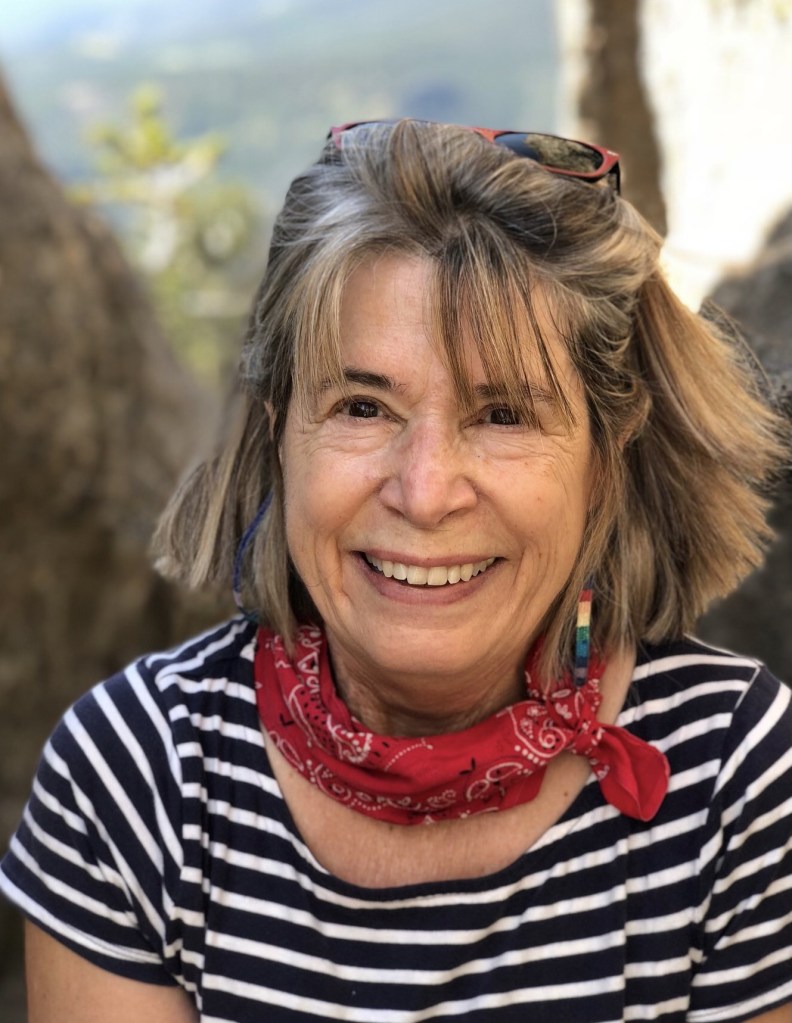
Helen Currie Foster lives and writes the Alice MacDonald Greer Mystery Series north of Dripping Springs, Texas, loosely supervised by three burros. She’s drawn to the compelling landscape and quirky characters of the Texas Hill Country. She’s also deeply curious about our human history and how, uninvited, the past keeps crashing the party! Currently she’s working on Book 10. Her protagonist, Alice, gets into legal drama, and matters of the heart. Alice does have a treehouse…

Follow Helen at http://www.helencurriefoster.com and on Amazon and Facebook, https://www.facebook.com/helencurriefoster

Stop Signs, Part I

by Kathy Waller

For Thanksgiving Week, I’m sharing a story made from things I’m thankful for: a hometown the size of a broom closet; long, hot summers that started on  June 1 and stretched clear to Labor Day; a visiting teenager who spent every spare minute reading Gone With the Wind; bobby socks and garter belts and petticoats; an ornery Presbyterian great-aunt and her ornery Baptist mare; front porches where quiet kids learned a lot; Army surplus bunk beds; a grandfather who said stop signs cause wrecks. I don’t know whether he believed it, but he said it. 

Flannery O’Connor said, “Anyone who survives a southern childhood has enough material to last a lifetime.” 

I survived. So do the memories. 

(“Stop Signs” won first place for short story in the 2000 North Texas Professional Writers Association Contest. It isn’t a murder mystery, but only because one of the characters restrains herself.)

***

Stop Signs, Part I

My grandfather thinks stop signs cause wrecks. That’s what he told Mama when they put up stop signs at Farm Road 20. If you go on across, you’ll be okay, but if you stop, you won’t be able to build up enough speed, and a car will come along and hit you for sure.

Mama didn’t argue. She says when she married into the Coburn family, she learned to pick her battles. The rest of the time, she’s just polite.

Nobody was just being polite that day on Aunt Eula’s front porch. Dr. Larrimore was there, and they were talking about the new phone system we’re getting. We’ve always just turned the crank and told Ernest who we want to talk to, but now we’ll have to dial a number. Dr. Larrimore said it’ll never work—people will get the O and the zero mixed up. They also agreed that man will never go to the moon because it isn’t in the Bible. Mama said the new phone system isn’t in the Bible either. I don’t know whether to be more concerned about getting the O and the zero mixed up or about having a doctor who gets them confused.

I know Aunt Eula wasn’t just being polite because she doesn’t bother with that kind of thing. She is Daddy’s oldest aunt, and, like Grandaddy, is tall and straight and white-haired. Unlike Granddaddy, she is proud and haughty. She belongs to both the Daughters of the Republic of Texas and the United Daughters of the Confederacy. She likes the United Daughters best. Mama says that’s because she’s an unreconstructed rebel.

Aunt Eula has a beautiful sorrel mare named Lady, who is my Mr. Boots’ mother. She bought her when the San Marcos Baptist Academy sold off its stables. I used to ride her before Mr. Boots was saddle broke. Mostly I chased her around the pasture trying to catch her. Once when I finally got hold of her and got the bit in her mouth and led her into the yard to saddle her, she sidled up to a big pecan tree and walked round and round it, while I followed, trying to get the saddle across. She’s never tried to unseat me, probably because by the time we get started, she’s worn out.

Daddy says Lady’s uncooperative because those Baptist Academy kids didn’t know how to ride and let her build up some bad habits. Mama says it’s because she belongs to Aunt Eula, and animals always resemble their owners. I say it’s because she’s a Baptist set down here in a nest of Presbyterians, and she’s testing the doctrine of Free Will against that of Predestination.

My cousin Ruth must be a Baptist, too, because she’s been using her Free Will ever since she arrived last month to spend the summer.

Ruth is thirteen, two years older than I am, and she used to be my dearest friend in the whole world. I could hardly wait till she got here. I had the summer all planned out. I would ride Mr. Boots and she would ride Lady, when she could catch her, and we would explore all the places over on York Creek that Mama won’t let me go to by myself. We’d share a bedroom and talk all night just like sisters.

But when we picked Ruth up at the train in San Marcos, I hardly recognized her. She was wearing a dress with about five petticoats, and high heels, and nylon hose. She was carrying a copy of Gone With the Wind.

We got into the back seat of the car. I held her book while she spent about five minutes arranging her petticoats.

“Do you like this book?” I said. “I read it last spring.”

She raised her eyebrows. “I’m surprised Aunt Virginia let you. It was written for adults.”

“I guess you haven’t heard,” I said. “I’m advanced. I’m a third of the way through the high school reading list.”

She smiled. “You’ll probably want to read this one again when you’re older. I imagine you missed a lot.”

I let that pass and tried again. “Why aren’t you wearing loafers and bobby sox?”

She said, “They’re not appropriate for the train.”

I said, “Why?” and she said, “They just aren’t,” and I said, “Who told you that?” and she said, “You’ll understand when you’re older.”

“You told me wearing a garter belt was like sitting on rubber bands.”

“I’ve grown up a lot since I said that.” Then she crossed her legs at the ankle and folded her hands over her white straw clutch purse, and by the time we got to Martindale, I was nauseated, and it wasn’t motion sickness that was causing it.

At home, Daddy carried Ruth’s suitcases into my room, and Ruth said she would sleep on the top bunk.

“That’s where I’m going to sleep,” I said.

Ruth knows better than to boss me outright—I got that settled when I was five—so she tried bribery instead.

“Look, if you let me sleep on the top, you can lie on the bottom and kick me while I’m sleeping.”

“It’s tempting,” I said, “but my legs aren’t that long. It looks like yours are, though. Exactly how tall are you now?”

She smiled. “Mother says I’m going to be statuesque.” And then Princess Grace floated out to see if Mama needed help in the kitchen.

The next day, I was up at six o’clock as usual, ready to saddle Mr. Boots, but Ruth didn’t drag out of bed until nine. Then, instead of saddling up and heading to York Creek, she insisted on walking downtown to say hello to all of my relatives. When she saw Aunt Eula and Aunt Babs sitting on the front porch, nothing would do but we must stop and visit. The first thing out of her mouth, Ruth asked Aunt Babs to teach her to crochet. Aunt Babs lit up like a chandelier and ran inside to get a hook and some yarn so they could start right away.

While she was gone, Ruth told Aunt Eula that she was reading Gone With the Wind and asked about the United Daughters. That got Aunt Eula started. Before they were finished, she and Ruth had rebuilt Tara on the banks of the San Marcos River and were ready to move in. Aunt Eula told Ruth the next time she came, she could look at Great-great-grandpa’s Civil War sword and medals. When we finally left, I heard Aunt Eula tell Aunt Babs that Virginia’s niece was turning into a lovely young lady even if she wasn’t a Coburn.

Ruth spent all the next day chain stitching with her nose in a book. That night, she kept the light on a half-hour past my bedtime. I finally leaned over the side of the top bunk and asked her, very politely, to turn out the light.

“I can’t,” she said. “I’m putting my hair in pin curls.”

“Anybody who spends that much time on a ducktail must have a bird brain,” I said, and she took one of her statuesque legs and kicked the underside of my mattress, and I yelled, and Mama came and moved Ruth into the front bedroom, where she had her own double bed and a good breeze and our grandmother’s piano, and she played her transistor radio all night long.

And that wasn’t all she did up there at night. I know because one night when I thought she might be asleep, I tiptoed in to turn off the radio—I’d had about as much “Purple People Eater” as anyone should have to endure—and Ruth was sitting on the side of the bed in the dark, talking to Junie Franklin through the window screen. He was sitting out in the yard on Uncle Robert’s Palomino. I was shocked. If Mama knew what was going on, she would be very disappointed.

TO BE CONTINUED

***

Frank Waller [“Dad”] and Kathy Waller, ca. 1962

More about the man who said stop signs cause wrecks at “Dad” on the blog Whiskertips.

Under The Blackjack Tree

VP Chandler

by V.P. Chandler

Thrilled to announce that one of my short stories has been published by Killer Nashville Magazine! Killer Nashville Magazine is a magazine that publishes stories in any genre that incorporate elements of mystery, thriller, or suspense.

This story means a lot to me because the seed of the idea is based on my family and family experiences. Look at my author notes at the end for the explanation.

I hope you enjoy it! Link here.

A Halloween Story: Hansel and Gretel and Cuthbert and Me

By M. K. Waller


Shakespeare said, “A sad tale’s best for winter,” but this is only October, and in Texas, that sure ain’t winter. And I don’t feel like telling a sad tale.

Halloween is near, so I shall tell a scary tale, one about a wicked witch and innocent little children.

But with a reminder: Sometimes it’s the innocent little children you have to watch out for.

For you to fully appreciate the trauma inflicted here, a preface—

My university degrees are in English and biology. I trained to teach secondary students. High school. Teenagers. People as tall as I am. Usually taller.

Mid-career, I was invited to take the position of school district librarian. I had neither education nor experience in the field, but both my employers and the State of Texas said that was okay—I was an English teacher, I could do anything. I would start working in August, two weeks away, and then jump back into graduate school for a second master’s degree when January rolled around. I’d do fine.

I thought both the State and my employer were a little crazy, and I hadn’t planned a return to grad school, but I was a little crazy, too, so I accepted the offer.

And both the library and I were fine. I was more than fine. I absolutely adored library work. It was like putting together a big puzzle—so many different pieces. And a couple of years later, here came computers and networking and T1 lines and the Internet and the world wide web and  . . . A wild learning curve, perpetual continuing education. On-the-job boredom? Not a chance.

Library school was—not adorable. It was challenging. Some courses were nerve-wracking. When they said library science, they meant science. In the words of the Library of Congress cataloger teaching the Organization of Materials course, as she looked out over a sea of bewildered students— “Come on, people. Cataloging isn’t rocket science. Rocket scientists couldn’t handle it.”*

But nothing was so challenging—or so nerve-wracking—as the two days a week I spent in my own elementary school library with the little people. Very little people. The ones some teachers called, privately, the ankle-biters.

I loved little children, nieces and nephews and such. I would play with them for hours on end. But they came in twos and threes. At the library, little children came in hordes.

Nothing in my formal education had prepared me to be in the same room with themIn all my fifteen years as a librarian, I was never prepared. They always managed to surprise me.

And now, my story for Halloween.

Oh—you must also know the story of Hansel and Gretel. In case you’ve forgotten, here’s Wikipedia’s summary:

Hansel and Gretel are siblings who are abandoned in a forest and fall into the hands of a witch who lives in a bread, cake, and sugar house. The witch, who has cannibalistic intentions, intends to fatten Hansel before eventually eating him. However, Gretel saves her brother by pushing the witch into her own oven, killing her, and escaping with the witch’s treasure.

Okay, to the story.

*

This is the story of Cuthbert, a five-year-old boy
who visited
my school library
for twenty minutes every week.
My job was to teach him about the library.
I’m not sure what his job was.
But he was very good at it.

*

Once upon a time, I read “Hansel and Gretel” to a class of kindergarteners. The audience, sitting rapt at my feet, comprised sixteen exceptionally good listeners, a fact I later regretted.

While I read, Cuthbert sat on the floor beside my chair and stroked my panty-hose-clad shin. Small children find panty-hose fascinating.

When I reached, “And they lived happily ever after,” Cuthbert stopped stroking and tugged on my skirt. I ceded him the floor.

“But it’s a good thing, what the witch did.”

Because he spoke kindergartener-ese and I sometimes didn’t, I thought I had misunderstood. Come again?

“It’s really a good thing, what the witch did.”

I should have slammed the book shut right then, or pulled out the emergency duct tape, or something, anything to change the subject. But I’m not very smart, so I asked Cuthbert to elaborate.

His elaboration went like this:

When the witch prepared the hot oven to cook and then eat Hansel, she was doing a good thing. Because then Hansel would die and go to Heaven to be with God and Jesus.

I smiled a no doubt horrified smile and said something like But But But. While Cuthbert explained even more fully, I analyzed my options.

a) If I said, No, the witch did a bad thing, because it is not nice to cook and eat little boys and girls, then sixteen children would go home and report, Miss Kathy said it’s bad to go to Heaven and be with God and Jesus.

b) If I said, Yes, the witch did a good thing, because cooking and eating little boys and girls ensures their immediate transport Heavenward, then sixteen children would go home and report, Miss Kathy approves of cold-blooded murder and cannibalism. Plus witchcraft. Plus reading a book about a witch, which in our Great State is sometimes considered more damaging than the murder/cannibalism package.

c) Anything I said might be in complete opposition to what Cuthbert’s mother had told him on this topic, and he would report that to her, and then I would get to attend a conference that wouldn’t be nearly so much fun as it sounds.

Note: The last sentence under b) is not to be taken literally. It is sarcasm, and richly deserved. The earlier reference to emergency duct tape is hyperbole. I’ve never duct taped a child.

Well, anyway, I wish I could say the sky opened and a big light bulb appeared above my head and gave me words to clean up this mess. But I don’t remember finding any words at all, at least sensible ones. I think I babbled and stammered until the teacher came to repossess her charges.

I do remember Cuthbert was talking when he left the room. There’s no telling what his classmates took away from that lesson.

If I’d been in my right mind, I might have said something to the effect that God and Jesus don’t like it when witches send people to Heaven before their due date.

But the prospect of talking theology with this independent thinker froze my neural pathways.

And anyway, I was using all my energy to keep from laughing.

*

*I know most people think librarians are educated to do two thing: stamp books and say, “Shhhhhh.” Those people are dead wrong. Someday I shall publish a post—maybe an entire book—upending all the common misconceptions about librarians. It will be a page-turner.

*

This post appeared on Telling the Truth, Mainly, in 2011 and again in 2012. I like to repost around Halloween, because the season cries out for scary stories, and that day with Cuthbert was pretty darned scary. (I’ve never thought of myself as a witch, but some people probably did. And still do.)

The discussion about  fairy tales and religion took place over twenty years ago. I think about it often and feel lucky I’ve never had a nightmare about it. But I remember Cuthbert fondly for giving me both the worst and the best day of my career. He was adorable.

***

M. K. Waller’s short stories appear is several anthologies, the latest of which is Kaye George’s Dark of the Day: Eclipse Stories (Down and Out Press, 2024). Her novella, Stabbed,  was co-written with Manning Wolfe. She also writes as Kathy Waller. Read more about her at kathywaller1.com and follow her on Facebook at https://www.facebook.com/kathy.waller68/

She lives in Austin, Texas.

****

Image by Gordon Johnson from Pixabay

Image by Free Fun Art from Pixabay

Image of “Hansel and Gretel” by Arthur Rackham from Wikipedia

“Everybody Eats Mushrooms.” Some Live to Tell the Tale.

By M. K. Waller

Today’s post comprises two parts–a bit of fiction followed by a bit of fact–linked by a “fleshy, spore-bearing fruiting body of a fungus” and a mystery writer who used it as a murder weapon–and later confessed to something even worse.

I.

The following flash fiction was inspired by a photo prompt on Friday Fictioneers, a weekly writing challenge sponsored by Rochelle Wisoff-Fields.

‘SHROOMS

John ambled into the kitchen. “What’s cooking?”

“Mushroom gravy.” Mary kept stirring.

John frowned. “Toadstools. Fungi. Dorothy Sayers killed someone with Amanita.

“These are morels.” She added salt. “Everybody eats mushrooms.”

“I don’t.”

“Suit yourself.”

He sat down. “Where’d you buy them?”

“I picked them.”

You?

“Aunt Helen helped. She knows ‘shrooms.” Mary held out a spoonful. “Taste.”

“Well . . . ” John tasted. “Mmmm. Seconds?”

“Yoo-hoo.” Aunt Helen bustled in. “See my brand new glasses? Those old ones–yesterday I couldn’t see doodly squat.”

Mary looked at the gravy, then at John. “Maybe you should spit that out.”

II.

The following is a guest post I wrote for Manning Wolfe’s Bullet Books Speed Reads blog. In it, I explain what an author does when she doesn’t have a clue about the subject she’s writing about.

There are many rules for writers. Two of the major ones: Write what you know and Write what you love.

I was pleased that Stabbed, which I co-wrote with Manning Wolfe, was set in Vermont. I love vacationing there: mountains and trees, summer wildflowers and narrow, winding roads, rainstorms and starry nights, white frame churches and village greens.

In Chapter 1, Dr. Blair Cassidy, professor of English, arrives home one dark and stormy night, walks onto her front porch, and trips over the body of her boss, Dr. Justin Capaldi. She locks herself in her car and calls the sheriff. The sheriff arrives and . . .

What happens next? Vermont is a small state. Who takes charge of murder investigations? The sheriff? Or the state police? What do their uniforms look like? Where do major rail lines run? What’s the size of a typical university town? And a typical university? What else had I not noticed while driving through the mountains?

Not knowing the answers, I defaulted to a third rule: Write what you learn. Research. Research. Research. The best mystery authors have been avid researchers.

Agatha Christie, for example, is known for her extensive knowledge of poisons. As a pharmacy technician during World War I, she did most of her research on the job before she became a novelist. Later she dispatched victims with arsenic, strychnine, cyanide, digitalis, belladonna, morphine, phosphorus, veronal (sleeping pills), hemlock, and ricin (never before used in a murder mystery). In The Pale Horse, she used the less commonly known thallium. Christie’s accurate treatment of strychnine was mentioned in a review in the Pharmaceutical Journal.

Francis Iles’ use of a bacterium was integral to the plot in Malice Aforethought. His character, Dr. Bickleigh, serves guests sandwiches of meat paste laced with Clostridium botulinum and waits for them to develop botulism. If Dr. Bickleigh had known as much about poisons as his creator did, he wouldn’t have been so surprised when his best-laid plans went, as Robert Burns might have said, agley.

Among modern authors, P.D. James is known for accuracy. Colleague Ruth Rendell said that James “always took enormous pains to be accurate and research her work with the greatest attention.” Before setting Devices and Desires near a nuclear power station, she visited power plants in England; she even wore a protective suit to stand over a nuclear reactor. Like Christie, James used information acquired on the job—she wrote her early works during her nineteen years with the National Health Service—for mysteries set in hospitals.

Most authors don’t go as far as to stand over nuclear reactors to be sure they get it right, but even the simplest research can be time-consuming.

And no matter how hard they strive for accuracy, even the most meticulous researchers sometimes make errors.

Dorothy L. Sayers was as careful in her fiction as she was in her scholarly writing. But she confessed in a magazine article that The Documents in the Case contained a “first-class howler”: A character dies from eating the mushroom Amanita muscaria, which contains the toxin muscarine. Describing the chemical properties of muscarine, Sayers said it can twist a ray of polarized light. But only the synthetic form can do that—the poison contained in the mushroom can’t.

Considering Sayers’ body of work, this one “howler” seems a very small sin, and quite forgivable.

Most readers, however, don’t forgive big mistakes, and reputable writers don’t expect them to. Thorough research is a mark of respect for readers.

Sometimes, getting the facts straight in fiction has real-life consequences the author can’t predict. Christie’s The Pale Horse is credited with saving two lives: In one case, a reader recognized the symptoms of thallium poisoning Christie had described and saved a woman whose husband was slowly poisoning her; in a second, a nurse who’d read the book diagnosed thallium poisoning in an infant. The novel is also credited with the apprehension of one would-be poisoner.

Back to Stabbed—Well, we don’t expect it to save lives or help catch criminals. But doing my due diligence and reading up on Vermont’s railways, demographics, and criminal procedure set the novella on a sound factual footing.

Unlike Christie, Iles, and Sayers, however, I didn’t have to expend too much effort learning about how the murder weapon worked. One look at the book’s title and–well, d’oh–no research needed.

***

Learn more about Friday Fictioneers at Rochelle Wisoff-Fields’ blog and on their Facebook page.

***

M. K. Waller (Kathy) is a former teacher, former librarian, former paralegal, and former pianist at various small churches desperate for someone who could find middle C.

She writes crime fiction, literary fiction, humor, memoir, and whatever else comes to mind.

She grew up in Fentress,  population ~ 150 in 1960, on the San Marcos River in Central Texas, the Blackland Prairie, and memories of the time and the place inform much of her fiction.

Except for the part about murders. Fentress didn’t have any murders. At least any that people talked about.

She now lives in Austin.

A Mind Unhinged


Posted by Kathy Waller

So you start writing your post about the incomparable Josephine Tey’s mystery novels two weeks before it’s due but don’t finish, and then you forget, and a colleague reminds you, but the piece refuses to come together, and the day it’s due, it’s still an embarrassment, and the next day it’s not much better, and you decide, Oh heck, at this point what’s one more day? and you go to bed,

and in the middle of the night you wake to find twenty pounds of cat using you as a mattress, and you know you might as well surrender, because getting him off is like moving Jello with your bare hands,

Elisabet Ney: Lady Macbeth, Detail

Elisabet Ney: Lady Macbeth, Detail (Photo credit: Wikipedia) Attribution: Ingrid Fisch at the German language Wikipedia.  GNU_Free_Documentation_License

so you lie there staring at what would be the ceiling if you could see it, and you think, Macbeth doth murder sleep…. Macbeth shall sleep no more,

and then you think about Louisa May Alcott writing, She is too fond of books, and it has turned her brain,

and you realize your own brain has not only turned, but has possibly come completely unhinged.

And you can’t get back to sleep, so you lie there thinking, Books, books, books. Strings and strings of words, words, words. Why do we write them, why do we read them? What are they all for?

And you remember when you were two years old, and you parroted, from memory, because you’d heard it so many times,

The owl and the pussycat went to sea in a beautiful pea green boat,

because happiness was rhythm and rime.

And when you were five and your playmate didn’t want to hear you read “Angus and the Cat,” and you made her sit still and listen anyway.

And when you were sixteen and so happy all you could think was, O world, I cannot hold thee close enough!, and you didn’t know who wrote it but you remembered the line from a Kathy Martin book you got for Christmas when you were ten.

And when you were tramping along down by the river and a narrow fellow in the grass slithered by too close, and you felt a tighter breathing, and zero at the bone.

And when you woke early to a rosy-fingered dawn and thought

By Dana Ross Martin, (CC BY-NC-ND 2.0), via flickr

By Dana Ross Martin, (CC BY-NC-ND 2.0)

I’ll tell you how the sun rose,
A ribbon at a time,
The steeples swam in Amethyst
The news, like Squirrels, ran –
The Hills untied their Bonnets –

And when you saw cruelty and injustice, and you remembered, Perfect love casts out fear, and knew fear rather than hate is the source of inhumanity, and love, the cure.

And when your father died unexpectedly, and you foresaw new responsibilities, and you remembered,

We never know how high we are
Till we are called to rise.

And when your mother died, and you thought,

Oh, if instead she’d left to me
The thing she took into the grave!-
That courage like a rock, which she
Has no more need of, and I have.

Fentress United Methodist Church. © Kathy Waller

Fentress United Methodist Church. © Kathy Waller

And at church the day after your father’s funeral, when your cousins, who were officially middle-aged and should have known how to behave, sat on the front row and dropped a hymnbook, and something stuck you in the side and you realized that when you mended a seam in your dress that morning you left the needle just hanging there and you were in danger of being punctured at every move, and somehow everything the minister said struck you as funny, and the whole family chose to displace stress by laughing throughout the service, and you were grateful for Mark Twain’s observations that

Laughter which cannot be suppressed is catching. Sooner or later it washes away our defences, and undermines our dignity, and we join in it … we have to join in, there is no help for it,

and that, 

Against the assault of Laughter nothing can stand.

And when you fell in love and married and said with the poet, My beloved is mine and I am his.

And when, before you walked down the aisle, you handed a bridesmaid a slip of paper on which you’d written, Fourscooooorrrrrrre…, so that while you said, “I do,” she would be thinking of Mayor Shinn’s repeated attempts to recite the Gettysburg Address at River City’s July 4th celebration, and would be trying so hard not to laugh that she would forget to cry.

And when your friend died before you were ready and left an unimaginable void, and life was unfair, and you remembered that nine-year-old Leslie fell and died trying to reach the imaginary kingdom of Terabithia, and left Jess to grieve but also to pass on the love she’d shown him.

And when the doctor said you have an illness and the outlook isn’t good, and you thought of Dr. Bernie Siegal’s writing, Do not accept that you must die in three weeks or six months because someone’s statistics say you will… Individuals are not statistics, but you also remembered what Hamlet says to Horatio just before his duel with Laertes,

There’s a special providence in the fall of a sparrow. If it be now, ’tis not to come. If it be not to come, it will be now. If it be not now, yet it will come—the readiness is all.

And by the time you’ve thought all that, you’ve come back to what you knew all along, that books exist for pleasure, for joy, for consolation and comfort, for courage, for showing us that others have been here before, have seen what we see, felt what we feel, shared needs and wants and dreams we think belong only to us, that

Photograph of Helen Keller at age 8 with her t...

Photograph of Helen Keller at age 8 with her tutor Anne Sullivan on vacation in Brewster, Cape Cod, Massachusetts (Photo credit: Wikipedia)

everything the earth is full of… everything on it that’s ours for a wink and it’s gone, and what we are on it, the—light we bring to it and leave behind in—words, why, you can see five thousand years back in a light of words, everything we feel, think, know—and share, in words, so not a soul is in darkness, or done with, even in the grave.

And about the time you have settled the question to your satisfaction, the twenty pounds of Jello slides off, and you turn over, and he stretches out and leans so firmly against your back that you end up wedged between him and your husband, who is now clinging to the edge of  the bed, as sound asleep as the Jello is, and as you’re considering your options, you think,

The Owl and the Pussy-cat went to sea
   In a beautiful pea-green boat,
They took some honey, and plenty of money,
   Wrapped up in a five-pound note.
The Owl looked up to the stars above,
   And sang to a small guitar…

and by the time the Pussycat and the Elegant Fowl have been married by the Turkey who lives on the hill, and have eaten their wedding breakfast with a runcible spoon, and are dancing by the light of the moon, the moon, you’ve decided that a turned brain has its advantages, and that re-hinging will never be an option.

***

20 pounds of cat. © Kathy Waller

20 pounds of cat. © Kathy Waller

***

Sources:

http://nfs.sparknotes.com/macbeth/page_58.html
https://www.goodreads.com/author/quotes/1315.Louisa_May_Alcott
http://www.poetryfoundation.org/poem/171941
http://www.vintagechildrensbooksmykidloves.com/2009/06/angus-and-cat.html
http://www.poetryfoundation.org/poem/182477
https://en.wikipedia.org/wiki/Epithets_in_Homer
http://biblehub.com/1_john/4-18.htm
http://writersalmanac.publicradio.org/index.php?date=2002/10/15
http://www.twainquotes.com/Laughter.html
http://biblehub.com/songs/2-16.htm
https://en.wikipedia.org/wiki/The_Music_Man_(1962_film)
https://en.wikipedia.org/wiki/Bridge_to_Terabithia_(novel)
http://www.shareguide.com/Siegel.html
http://nfs.sparknotes.com/hamlet/page_320.html
http://www.shorewood.k12.wi.us/page.cfm?p=3642

***

“A Mind Unhinged” appeared on Austin Mystery Writers on February 25, 2016.

***

Kathy Waller [M. K. Waller] writes crime fiction, literary fiction, humor, memoir, and whatever else comes to mind. Her latest story, “Mine Eyes Dazzle,” which appears in Dark of the Day, was mentioned by Robert Lopresti as “The best mystery story I read this week” (Little Big Crimes, May 12, 2024).

Other short stories appear in anthologies: the Silver Falchion Award winner Murder on Wheels, Lone Star Lawless, and Day of the Dark, as well as online. She is co-author, with Manning Wolfe, of the novella STABBED,

Memories of growing up in a small town on the San Marcos River in Central Texas, and life in a large extended family, inspire much of her work. She now lives in Austin.

She blogs at Telling the Truth–Mainly. Find her on Facebook and on Amazon.

Closely Observed

by Helen Currie Foster

When you read a passage and experience words that strikes home forcefully–so forcefully that you almost gasp–what did the writer do that moved you so?

I’m collecting examples. For my husband it’s John Steinbeck’s tide pool in Cannery Row:

“…When the tide goes out the little water world becomes quiet and lovely. The sea is very clear and the bottom becomes fantastic with hurrying, fighting, feeding, breeding animals…Starfish squat over mussels and limpets, attach their million little suckers and then slowly lift with incredible power until the prey is broken from the rock…”

I’ve never seen a Monterey tide pool. Yet Steinbeck made me feel I have. I want to sit at the edge of the tide pool, hear “the snapping shrimps with their trigger claws pop loudly” and see the “black eels poke their heads out of crevices and wait for prey.”

Why? Steinbeck’s description is so closely observed…it’s as if my own eyes and ears saw and heard.

What about food? Proust’s memory of a madeleine crumb dipped in his aunt’s tea didn’t initially resonate with me (a madeleine seemed too bland; I would’ve preferred a buttery, crunchy, tender croissant!)–until I read his analysis.

When Proust discovered that his second and third bites of the madeleine lacked the same impact–“the potion is losing its magic”–he stretched his mind further. He writes that the source of memory was not his sense of sight (though his description of the scalloped pastry is charming). Instead, his memory came from taste and smell: “But when from a long-distant past nothing subsists, after the people are dead, after the things are broken and scattered, still, alone, more fragile, but with more vitality, more unsubstantial, more persistent, more faithful, the smell and taste of things remain poised a long time, like souls, ready to remind us, waiting and hoping for their moment,…and bear unfaltering…the vast structure of recollection.”

No French bakery in my grandmother’s small Texas town, Itasca. But the memory of her kitchen still comes back when I smell lavender, or yeast–my grandfather’s lavender talc, my grandmother’s ineffably delicious yeast rolls.

Here’s another powerful example from The Orphan Keeper by Camron Wright, about a young man, kidnapped from his home in India, then sent to a dishonest orphanage which places him for adoption in America where he rejects any Indian heritage and suppresses all his memories that aren’t “American.”

As a student in England he’s taken to an Indian restaurant where–reluctantly–he smells, then tastes, what’s offered:

“The scent that swirled around his neck had started rubbing his shoulder, reminding him softly that once, a very long time ago, they had met….[He] took his first bite. The spices in his mouth grabbed hands and began dancing in rhythm across his tongue–cumin, garlic, peppers, ginger, tamarind, cinnamon, and more. They weren’t just dancing–they were cheering, clapping, celebrating, singing, reminiscing. They were pulling out wallets and showing each other pictures of their kids….The mingling spices, the familiar taste, it felt like a whisper arriving with the wind, more message than memory.”

Curry, of course. Just reading this made me long for mango chutney! And I thought it a powerful description, because closely observed, and particularly because until this moment we know the protagonist has been stubbornly resistant to anything Indian.

In A Gentleman in Moscow, by Amor Towles, do you recall the bouillabaisse scene? The three conspirators have carefully gathered the ingredients–hard to come by in Moscow; have picked up their spoons; and have taken their first taste. Count Rostov closes his eyes “to attend more closely to his impressions”:

“One first tastes the broth–that simmered distillation of fish bones, fennel, and tomatoes, with their hearty suggestions of Provence…One marvels at the boldness of the oranges arriving from Spain and the absinthe poured in the taverns. And all of these various impressions are somehow collected, composed, and brightened by the saffron–that essence of summer sun…[W]ith the very first teaspoonful one finds oneself transported to the port of Marseille–where the streets teem with sailors, thieves, and madonnas, with sunlight and summer, with languages and life.”

Bouillabaisse! Your memories may differ. Were you reading Julia Child and launching a kitchen experiment? Were you visiting Marseille, and were there still sailors, thieves and madonnas?

The Count has shared his memories, aroused by fish bones, fennel, tomatoes, shellfish and saffron. But your memories are your own. Also, the scene is powerful not just because it is closely observed, but also because it reminds the reader forcefully that at this point the Count has only his memories–he can’t leave the Moscow hotel, much less travel to Marseille.

I’m puzzled not to find food more “closely observed” in novels. A favorite moment: Virginia Woolf famously describes the boeuf en daube at the dinner party which is a central feature of the first half of To the Lighthouse. Mrs. Ramsay is thinking the cook “had spent three days over that dish,” as she prepares to serve it to her guests:

“…An exquisite scent of olives and oil and juice rose from the great brown dish as Marthe, with a little flourish, took the cover off. …[Mrs. Ramsay] peered into the dish, with its shiny walls and the confusion of savoury brown and yellow meats, and its bay leaves and wine, and thought, This will celebrate the occasion…”

Cookbooks, of course, intend to awaken our senses as we peruse the recipes. But the description of boeuf en daube in To the Lighthouse, with the mouthwatering anticipation it creates, has a different impact. It places us in the scene. It almost makes us, as readers, feel like guests sitting at Mrs. Ramsay’s table, alongside the odd characters Woolf has already introduced. Or possibly we also feel a bit like Mrs. Ramsay, the hostess, hoping to delight and reassure her houseguests, who are a difficult lot.

I’d love to hear other examples from readers. A “closely observed” passage can make us do just what the author wants: turn the page and keep reading! Right now I’m engrossed in Someone Always Nearby, Susan Wittig Albert’s fascinating novel about two real people, Georgia O’Keefe and Maria Chabot. I’m finding this a daring literary adventure about two daring and adventurous women, the artist you know and the woman who wanted to be indispensable to her.

It’s May–bluebonnets are gone, summer approaches. What tastes and smells bring back your summer memories? Grape popsicles, melting on the tongue? The clean bluegreen smell of Austin’s Barton Springs, mixing creek water and artesian spring water? The faint smell of chlorine from a pool crowded with splashing children? A mountain trail in the Rockies, with the cool green odor of aspen groves rising up from a creek? Dust blowing at the ball park, freshly mowed lawns, the faint rubbery smell of a sprinkler on a hot day? The smell of a roasting marshmallow just before it bursts into flame?

Good news from where I write: Ghost Bones, Book 9 in my Alice MacDonald Greer Mystery series set in the small town of Coffee Creek, Texas, will soon be out! With mystery, legal drama, and matters of the heart.

Helen Currie Foster lives and writes north of Dripping Springs, Texas, loosely supervised by three burros. She’s drawn to the compelling landscape and quirky characters of the Texas Hill Country. She’s also deeply curious about our human history and prehistory, and how, uninvited, the past keeps crashing the party. Ghost Daughter, Book 7 in The Alice MacDonald Greer Mystery series, was named Finalist in the 2022 Eric Hoffer Book Award Grand Prize Short List. Follow her:

https://www.helencurriefoster.com

and

https://facebook.com/helencurriefoster/

copyright 2024 Helen Currie Foster all rights reserved

I’ve Been Waterin’ the Yahd

By M. K. Waller

The following post appeared on my personal blog, Telling the Truth, Mainly, in April 2022. But the story of my writing process is always worth a retelling. Please read on.
*************

Sometime back in the 1930s, my grandmother picked up the telephone receiver just in time to hear the Methodist minister’s wife, on the party line, drawl, “I am just wo-ahn out. I’ve been waterin’ the yahd.”

To those not in the know, the statement might not seem funny, but my family has its own criteria for funny.  And so those two sentences entered our vernacular.

They were used under a variety of circumstances: after stretching barbed wire, frying chicken, mowing the lawn, doing nothing in particular.

My father would fold the newspaper, set it on the table, and announce, “I am just wo-ahn out. I’ve been waterin’ the yahd.”

I am wo-ahn out now but not from waterin’ the yahd.

Putative novel 2022

Last night David, the family’s official printer, printed the manuscript of what I’ve been calling my putative novel. It runs to over two hundred pages, 51,000 words. It isn’t finished—far from it. There’s more to write, scenes to put in order, clues and red herrings to insert, darlings to kill. All that stuff. And more.

However, for the first time it feels like I can stop calling it putative. No longer supposed, alleged, or hypothetical. It’s looking more like a potential novel. Possible, Even probable.

Now, about being wo-ahn out.

Last night I started putting the manuscript, scene by scene, into a three-ring binder. That required using a three-hole punch.

I hate using three-hole punches. I hate fitting the holes in the paper onto the binder rings. They never fit properly. Getting them on the rings requires effort. It’s tiring.

When I went to bed, I was all the way up to page 37.

Then I woke at 5:30 this morning. Instead of turning over and going back to sleep, I got up. I just couldn’t wait to get back to organizing my manuscript.

But I didn’t organize. I managed to drop the whole thing onto the floor and then couldn’t pick it up. (I’d had knee surgery and wasn’t quite up to bending over that far.) I had to wait for David.

Putative novel 2022-2024

By the time the notebook and manuscript were back in my possession, I was sick and tired of the whole thing. I played Candy Crush.

If I’d had any sense at all, I’d have gone back to bed. I was sleepy. I felt awful. I needed to sleep.

But did I go back to bed? Noooooooooooooooooooooo. That would have been the act of a rational person.

I stayed up added to my sleep deprivation.

I could go to bed right now. I could conk out and tomorrow feel ever so much better.

But will I? No. Because I’m too tired to stand up, too tired to put on my pajamas, too tired to pull down the sheets.

I am just wo-ahn out. I’ve been waterin’ the yahd.

***

Things have changed since 2022. Some days, the novel has reverted to putative, but on most days, it’s still possible. Thanks to extensive revision, the current draft bears little resemblance to the one in the notebook. I have given up three-ring binders and three-hold punches.

***

M. K. Waller’s latest story, “Mine Eyes Dazzle,” appears in the eclipse-themed anthology Dark of the Day, edited by Kaye George (Down and Out Books, 2024). Other stories appear in Day of the Dark (Wildside, 2017), Lone Star Lawless (Wildside, 2017),  Murder on Wheels (Wildside, 2015), and online on Mysterical-E. She is co-author of the novella Stabbed (Starpath, 2019), written with Manning Wolfe. She also writes as Kathy Waller. She lives in Austin and blogs at Telling the Truth, Mainly.

THE NAME OF THE ROSE IS—wait, how do you pronounce that?

BY HELEN CURRIE FOSTER

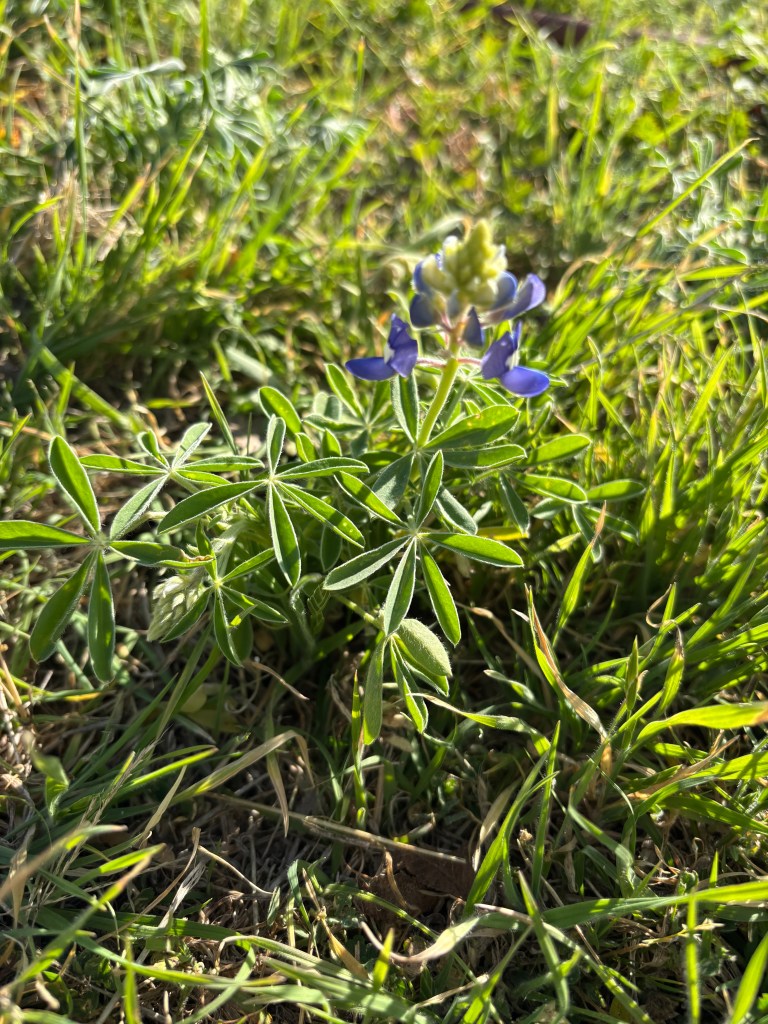
April 1! It’s spring, with a riot of bluebonnets this year.

Plus paintbrush! Winecup! Verbena! Prairie celestials (so lovely)!

And within the fence, safe from our marauding burros, the roses are opening their petals and sharing their beauty.  Humans have been growing and hybridizing roses for millenia. I favor those with deep rose fragrance. This year the sniff prize goes to Madame Isaac Pereire,

but Zephirine Drouhine is a strong contender as well—sweet perfume, but no thorns!

Blooming with pride are Cramoisi Superieur, fun to pronounce, and dainty little Perle d’or, below.

Yes, the French have been busy.  But I’m waiting on the spectacular Star of the Republic, which is covered with buds that will become exquisite cream and pink roses,  and is almost as tall as Texas.

Thanks for human ingenuity and the deep love of beauty and fragrance that resulted in these roses. We humans are so able to produce beauty—and yet we mystery readers and writers know how gripped we are by the companion question: why do humans commit the primal sin of murder?

I’ve been reading a riveting book called How the Mind Changed, A Human History of Our Evolving Brain (2022), by neuroscientist Joseph Jebelli, who studies the genetic history of the human brain. I’ve had to put stickers and checks on so many pages!

Jebelli says that, starting about 7 million years (or 230,000 generations) ago, when humans split from chimps, our brains were only 350 cm3 big. Then 3.5 million years ago, when our ancestor Lucy came along, we got a new uniquely human gene that gave us a folding neocortex and nearly doubled our brain size to 650 cm3.

Later, he says, our brains bloomed to 900 cm3, when we began cooking (maybe 2.7 million years ago), then to 1000 cm3, about 2.5 million years ago, then to 1500 cm3 500,000 years ago, and then grew another 25% by the time, 300,000-400,000 years ago, when Homo sapiens appeared.

Later research shows—the bigger the brain, the bigger the social group. Id., 69.

And lucky Homo sapiens came along when our planet was in extreme ecological instability: “African megadroughts depleted the land’s fresh water; vanishing grasslands diminished the number of animals available…” Homo sapiens spread across the planet, interbreeding along the way with the Neanderthals (who went extinct around 40,000 years ago), and the Denisovans, Neanderthal cousins from Asia. Most humans outside Africa carry around 2 percent Neanderthal-derived DNA while today humans in Papua New Guinea and Australia possess up to 6% Denisovan DNA.

Now we have tools of advanced microscopy and molecular genetics to use “the mosaic of neurons, the constellation of synapses and the tributaries of molecules to learn the age of the brain and the transformations it has seen.” Îd., 21.

But it’s Jebelli’s discussion of brain research on “fair play” that I find most fascinating – whether the experiment uses rats, vampire bats, or humans. “Our minds intuitively draw a distinction between unfair equality (all students receiving the same…grades regardless of merit) and fair inequality (the doctor earning more than the cleaner). When push comes to shove, humans nearly always prefer fair inequality to unfair equality.” Jebelli goes on to explain that when we humans engage in fair play, we experience a surge of neural activity in our brain’s reward centers, releasing dopamine, oxytocin, serotonin and endorphins. Id., 68.

Watch out: scientists are identifying gene mutations that explain amazing things. “Non-monogamous brains tend to have a special kind of dopamine receptor gene called DRD4, which is linked to promiscuity and infidelity.” Id., 78. Use that in a plot, mystery-writers!

But I was thrilled by the focus on the link between strong imagination and intelligence in our “default network, a brain system that participates in daydreaming, mind wandering, reflective thinking and imagining the future….People who engage in these cognitive practices…have greater access to the states of mind necessary to solve complex problems.” Id., 115. Jebelli says our default networks are only active when we’re not focused on a task, “when the brain is cycling through thoughts not associated with the immediate environment.”  In other words, the default network contrasts with our executive control network.  Jebelli makes another leap: compassion also stimulates the default network. “Compassion requires imagination. ‘Climb into his skin and walk around in it,’ Atticus tells Scout.” But imagination also requires compassion.  Id., 119.

Why has this book grabbed me? As a mystery writer I wrestle with why some humans will run into the street to save a child from a bus, and some will just watch; and why and how some humans invent gripping new imaginative worlds (Lord of the Rings, Harry Potter, Slough House, Yoknapatawpha County, the Forest of Arden, Hat Creek and the saga of Lonesome Dove) that tell of human struggles and victories, tragedies and comedies. Yes, writers who stimulate our “default networks”!

So you might like to take a peek at How the Mind Changed—check out the chapter on that age-old conundrum––what is consciousness? And the chapter on different minds, or neurodiversity, including genetic components. And the chapter on the new field of neurocriminology: what makes humans commit crimes? Which brain regions are responsible for violence? One possibility—it’s an area of the hypothalamus called the ventromedial hypothalamus, “an ancient brain region that has been conserved throughout mammalian evolution.” Yikes!

As Jebelli notes, plots will abound from this inquiry, this research. As always, inquiring minds want to know.

Meanwhile, it’s April! So let us now praise Geoffrey Chaucer – whose compassion and imagination gave us “Whan that April with his showres soote The droughte of March hath perced to the roote, And bathed every veine in swich licour, Of which vertu engendred is the flowr…”

And further to celebrate—Book 9 of my Alice MacDonald Greer legal thriller series has gone off for copy-edit. Yes, again the primal crime has been committed…!