A Mind Unhinged


Posted by Kathy Waller

So you start writing your post about the incomparable Josephine Tey’s mystery novels two weeks before it’s due but don’t finish, and then you forget, and a colleague reminds you, but the piece refuses to come together, and the day it’s due, it’s still an embarrassment, and the next day it’s not much better, and you decide, Oh heck, at this point what’s one more day? and you go to bed,

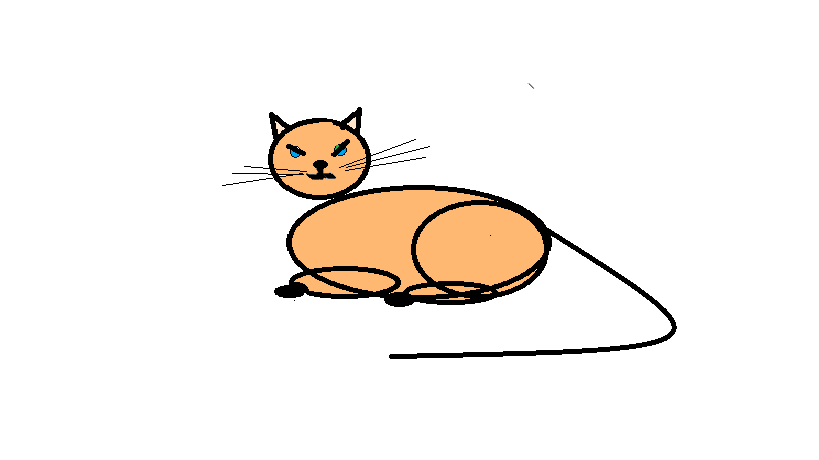
and in the middle of the night you wake to find twenty pounds of cat using you as a mattress, and you know you might as well surrender, because getting him off is like moving Jello with your bare hands,

Elisabet Ney: Lady Macbeth, Detail

Elisabet Ney: Lady Macbeth, Detail (Photo credit: Wikipedia) Attribution: Ingrid Fisch at the German language Wikipedia.  GNU_Free_Documentation_License

so you lie there staring at what would be the ceiling if you could see it, and you think, Macbeth doth murder sleep…. Macbeth shall sleep no more,

and then you think about Louisa May Alcott writing, She is too fond of books, and it has turned her brain,

and you realize your own brain has not only turned, but has possibly come completely unhinged.

And you can’t get back to sleep, so you lie there thinking, Books, books, books. Strings and strings of words, words, words. Why do we write them, why do we read them? What are they all for?

And you remember when you were two years old, and you parroted, from memory, because you’d heard it so many times,

The owl and the pussycat went to sea in a beautiful pea green boat,

because happiness was rhythm and rime.

And when you were five and your playmate didn’t want to hear you read “Angus and the Cat,” and you made her sit still and listen anyway.

And when you were sixteen and so happy all you could think was, O world, I cannot hold thee close enough!, and you didn’t know who wrote it but you remembered the line from a Kathy Martin book you got for Christmas when you were ten.

And when you were tramping along down by the river and a narrow fellow in the grass slithered by too close, and you felt a tighter breathing, and zero at the bone.

And when you woke early to a rosy-fingered dawn and thought

By Dana Ross Martin, (CC BY-NC-ND 2.0), via flickr

By Dana Ross Martin, (CC BY-NC-ND 2.0)

I’ll tell you how the sun rose,
A ribbon at a time,
The steeples swam in Amethyst
The news, like Squirrels, ran –
The Hills untied their Bonnets –

And when you saw cruelty and injustice, and you remembered, Perfect love casts out fear, and knew fear rather than hate is the source of inhumanity, and love, the cure.

And when your father died unexpectedly, and you foresaw new responsibilities, and you remembered,

We never know how high we are
Till we are called to rise.

And when your mother died, and you thought,

Oh, if instead she’d left to me
The thing she took into the grave!-
That courage like a rock, which she
Has no more need of, and I have.

Fentress United Methodist Church. © Kathy Waller

Fentress United Methodist Church. © Kathy Waller

And at church the day after your father’s funeral, when your cousins, who were officially middle-aged and should have known how to behave, sat on the front row and dropped a hymnbook, and something stuck you in the side and you realized that when you mended a seam in your dress that morning you left the needle just hanging there and you were in danger of being punctured at every move, and somehow everything the minister said struck you as funny, and the whole family chose to displace stress by laughing throughout the service, and you were grateful for Mark Twain’s observations that

Laughter which cannot be suppressed is catching. Sooner or later it washes away our defences, and undermines our dignity, and we join in it … we have to join in, there is no help for it,

and that, 

Against the assault of Laughter nothing can stand.

And when you fell in love and married and said with the poet, My beloved is mine and I am his.

And when, before you walked down the aisle, you handed a bridesmaid a slip of paper on which you’d written, Fourscooooorrrrrrre…, so that while you said, “I do,” she would be thinking of Mayor Shinn’s repeated attempts to recite the Gettysburg Address at River City’s July 4th celebration, and would be trying so hard not to laugh that she would forget to cry.

And when your friend died before you were ready and left an unimaginable void, and life was unfair, and you remembered that nine-year-old Leslie fell and died trying to reach the imaginary kingdom of Terabithia, and left Jess to grieve but also to pass on the love she’d shown him.

And when the doctor said you have an illness and the outlook isn’t good, and you thought of Dr. Bernie Siegal’s writing, Do not accept that you must die in three weeks or six months because someone’s statistics say you will… Individuals are not statistics, but you also remembered what Hamlet says to Horatio just before his duel with Laertes,

There’s a special providence in the fall of a sparrow. If it be now, ’tis not to come. If it be not to come, it will be now. If it be not now, yet it will come—the readiness is all.

And by the time you’ve thought all that, you’ve come back to what you knew all along, that books exist for pleasure, for joy, for consolation and comfort, for courage, for showing us that others have been here before, have seen what we see, felt what we feel, shared needs and wants and dreams we think belong only to us, that

Photograph of Helen Keller at age 8 with her t...

Photograph of Helen Keller at age 8 with her tutor Anne Sullivan on vacation in Brewster, Cape Cod, Massachusetts (Photo credit: Wikipedia)

everything the earth is full of… everything on it that’s ours for a wink and it’s gone, and what we are on it, the—light we bring to it and leave behind in—words, why, you can see five thousand years back in a light of words, everything we feel, think, know—and share, in words, so not a soul is in darkness, or done with, even in the grave.

And about the time you have settled the question to your satisfaction, the twenty pounds of Jello slides off, and you turn over, and he stretches out and leans so firmly against your back that you end up wedged between him and your husband, who is now clinging to the edge of  the bed, as sound asleep as the Jello is, and as you’re considering your options, you think,

The Owl and the Pussy-cat went to sea
   In a beautiful pea-green boat,
They took some honey, and plenty of money,
   Wrapped up in a five-pound note.
The Owl looked up to the stars above,
   And sang to a small guitar…

and by the time the Pussycat and the Elegant Fowl have been married by the Turkey who lives on the hill, and have eaten their wedding breakfast with a runcible spoon, and are dancing by the light of the moon, the moon, you’ve decided that a turned brain has its advantages, and that re-hinging will never be an option.

***

20 pounds of cat. © Kathy Waller

20 pounds of cat. © Kathy Waller

***

Sources:

http://nfs.sparknotes.com/macbeth/page_58.html
https://www.goodreads.com/author/quotes/1315.Louisa_May_Alcott
http://www.poetryfoundation.org/poem/171941
http://www.vintagechildrensbooksmykidloves.com/2009/06/angus-and-cat.html
http://www.poetryfoundation.org/poem/182477
https://en.wikipedia.org/wiki/Epithets_in_Homer
http://biblehub.com/1_john/4-18.htm
http://writersalmanac.publicradio.org/index.php?date=2002/10/15
http://www.twainquotes.com/Laughter.html
http://biblehub.com/songs/2-16.htm
https://en.wikipedia.org/wiki/The_Music_Man_(1962_film)
https://en.wikipedia.org/wiki/Bridge_to_Terabithia_(novel)
http://www.shareguide.com/Siegel.html
http://nfs.sparknotes.com/hamlet/page_320.html
http://www.shorewood.k12.wi.us/page.cfm?p=3642

***

“A Mind Unhinged” appeared on Austin Mystery Writers on February 25, 2016.

***
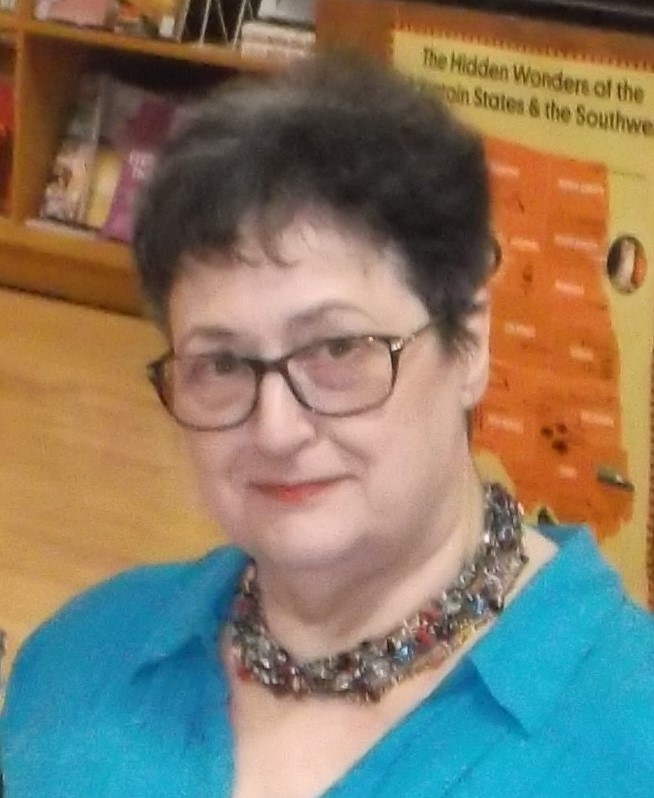
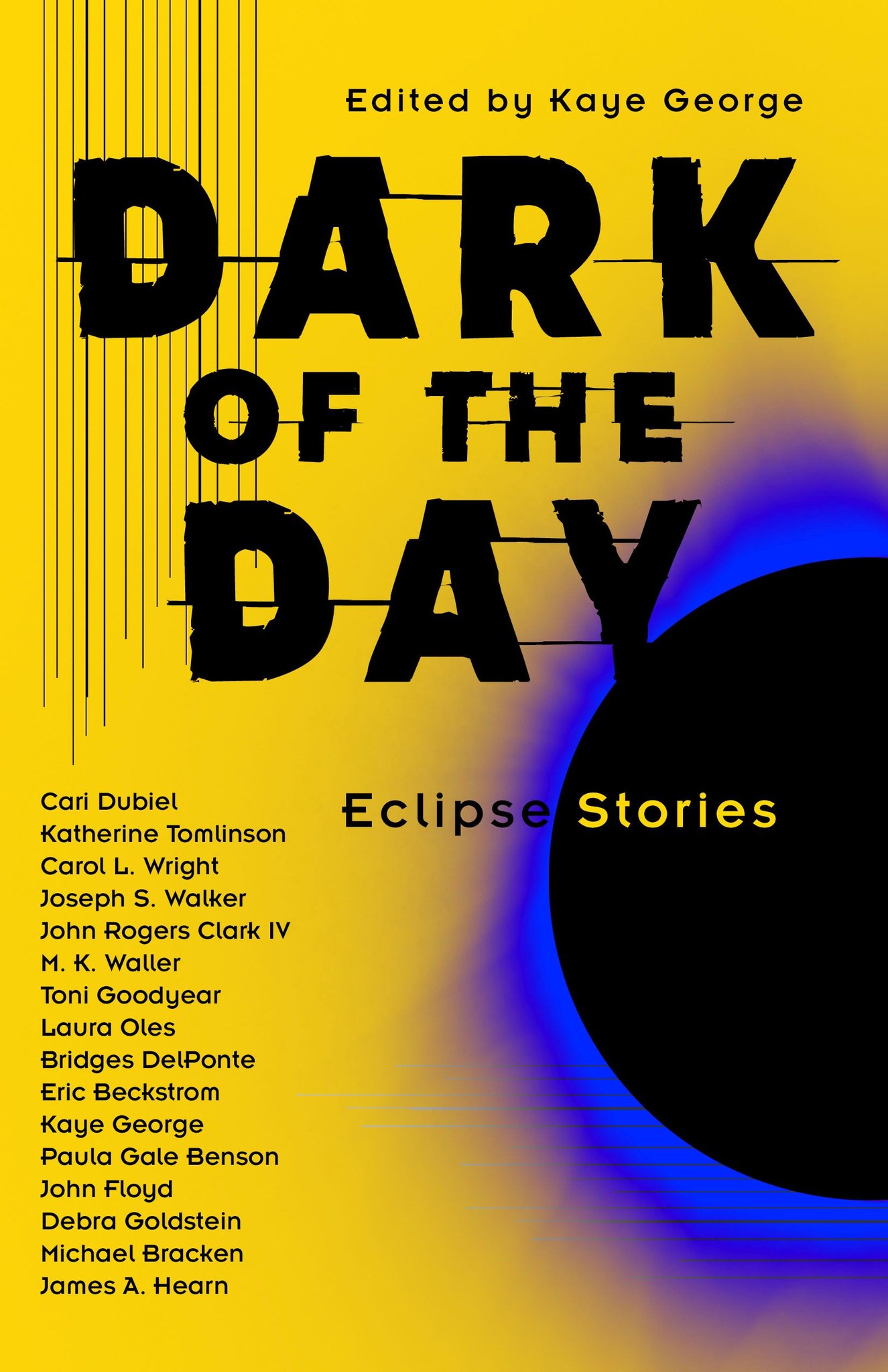
Kathy Waller [M. K. Waller] writes crime fiction, literary fiction, humor, memoir, and whatever else comes to mind. Her latest story, “Mine Eyes Dazzle,” which appears in Dark of the Day, was mentioned by Robert Lopresti as “The best mystery story I read this week” (Little Big Crimes, May 12, 2024).
Other short stories appear in anthologies: the Silver Falchion Award winner Murder on Wheels, Lone Star Lawless, and Day of the Dark, as well as online. She is co-author, with Manning Wolfe, of the novella STABBED,

Memories of growing up in a small town on the San Marcos River in Central Texas, and life in a large extended family, inspire much of her work. She now lives in Austin.

She blogs at Telling the Truth–Mainly. Find her on Facebook and on Amazon.

I’ve Been Waterin’ the Yahd

By M. K. Waller

The following post appeared on my personal blog, Telling the Truth, Mainly, in April 2022. But the story of my writing process is always worth a retelling. Please read on.
*************

Sometime back in the 1930s, my grandmother picked up the telephone receiver just in time to hear the Methodist minister’s wife, on the party line, drawl, “I am just wo-ahn out. I’ve been waterin’ the yahd.”

To those not in the know, the statement might not seem funny, but my family has its own criteria for funny.  And so those two sentences entered our vernacular.

They were used under a variety of circumstances: after stretching barbed wire, frying chicken, mowing the lawn, doing nothing in particular.

My father would fold the newspaper, set it on the table, and announce, “I am just wo-ahn out. I’ve been waterin’ the yahd.”

I am wo-ahn out now but not from waterin’ the yahd.

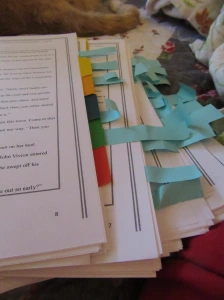
Putative novel 2022

Last night David, the family’s official printer, printed the manuscript of what I’ve been calling my putative novel. It runs to over two hundred pages, 51,000 words. It isn’t finished—far from it. There’s more to write, scenes to put in order, clues and red herrings to insert, darlings to kill. All that stuff. And more.

However, for the first time it feels like I can stop calling it putative. No longer supposed, alleged, or hypothetical. It’s looking more like a potential novel. Possible, Even probable.

Now, about being wo-ahn out.

Last night I started putting the manuscript, scene by scene, into a three-ring binder. That required using a three-hole punch.

I hate using three-hole punches. I hate fitting the holes in the paper onto the binder rings. They never fit properly. Getting them on the rings requires effort. It’s tiring.

When I went to bed, I was all the way up to page 37.

Then I woke at 5:30 this morning. Instead of turning over and going back to sleep, I got up. I just couldn’t wait to get back to organizing my manuscript.

But I didn’t organize. I managed to drop the whole thing onto the floor and then couldn’t pick it up. (I’d had knee surgery and wasn’t quite up to bending over that far.) I had to wait for David.

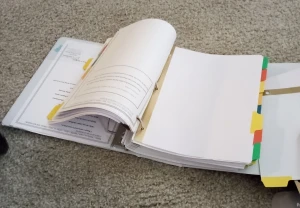
Putative novel 2022-2024

By the time the notebook and manuscript were back in my possession, I was sick and tired of the whole thing. I played Candy Crush.

If I’d had any sense at all, I’d have gone back to bed. I was sleepy. I felt awful. I needed to sleep.

But did I go back to bed? Noooooooooooooooooooooo. That would have been the act of a rational person.

I stayed up added to my sleep deprivation.

I could go to bed right now. I could conk out and tomorrow feel ever so much better.

But will I? No. Because I’m too tired to stand up, too tired to put on my pajamas, too tired to pull down the sheets.

I am just wo-ahn out. I’ve been waterin’ the yahd.

***

Things have changed since 2022. Some days, the novel has reverted to putative, but on most days, it’s still possible. Thanks to extensive revision, the current draft bears little resemblance to the one in the notebook. I have given up three-ring binders and three-hold punches.

***

M. K. Waller’s latest story, “Mine Eyes Dazzle,” appears in the eclipse-themed anthology Dark of the Day, edited by Kaye George (Down and Out Books, 2024). Other stories appear in Day of the Dark (Wildside, 2017), Lone Star Lawless (Wildside, 2017),  Murder on Wheels (Wildside, 2015), and online on Mysterical-E. She is co-author of the novella Stabbed (Starpath, 2019), written with Manning Wolfe. She also writes as Kathy Waller. She lives in Austin and blogs at Telling the Truth, Mainly.

True Crime: Update on the Poff Case


by Kathy Waller

In November 2019, a Texas woman was sentenced to 10 years in federal prison for mailing explosive devices to President Barak Obama and Governor Greg Abbot.  The crime had occurred in October 2016. The break: Investigators found a cat hair under the address label on one of the packages and matched it to one of the suspect’s cats. The following post, reprinted from the blog Telling the Truth, Mainly, includes facts not released to the news media at the time–the rest of the story.

*

AUSTIN — Three cats suspected of helping owner Julia Poff mail explosive devices to former President Barak Obama and Texas Governor Greg Abbott were released from custody late Thursday following questioning by federal law enforcement officers.

FBI crime lab investigators had found a cat hair under the address label on the package containing the explosives and traced it to the Poff cats. It is alleged that Ms. Poff sent the potentially deadly devices to former President Obama and Governor Greg Abbott because she was mad at them.

Muffy, Puffy, and Sybil-Margaret “Pud-Pud” Poff were taken from the Poff home in Brookshire, Texas, 34 miles west of Houston, Thursday around 9:00 a.m.

Muffy

FBI Agent Arnold Specie, chief of the Houston Bureau, announced in a press conference late Thursday that after intense grilling, officials were satisfied the cats had no connection to any nefarious activities.

“The only thing they’re guilty of is shedding on paper their owner later used to wrap the explosive devices. You can’t fault cats for shedding.”

He said there’s no doubt these are the right cats. “The fur of all three exhibits white hair. That’s true even of Puffy Poff, who is mostly orange but has a couple of white spots on her underside.” He assured the press that DNA testing will confirm the hair belongs to one of the Poff cats.

A reliable source, speaking on condition of anonymity, however, said he’s not so sure. “They know more than they’re telling,” he said. “It’s impossible to get anything out of suspects that keep falling asleep in the middle of questioning. And every time Muffy rolled over, Specie gave her a belly rub. Specie’s always been soft on cats.”

The early morning raid, which involved a number of federal agents as well as a Houston PD Swat team on stand-by, rocked this usually quiet community to its very core.

“I could tell something was going down,” said neighbor Esther Bolliver. “I was outside watering my rose bushes when I saw these men wearing dark suits and ties crouching behind Julia’s privet hedge. One of them was holding out what looked to be a can of sardines, and saying, ‘Kitty kitty kitty,’ in a high-pitched voice, you know, like you use whenever you call cats. I thought it was Animal Control.”

Mrs. Bolliver ran inside and told her husband. “I said, ‘Bert, come outside and look,’” she said.

“I knew they was G-Men first thing,” said Bert Bolliver. “It was the fedoras give ’em away. Animal Control don’t wear fedoras.”

Puffy

Ten-year-old Jason Bolliver, who had been kept home from school with a sore throat, added that the raid was exciting. “It’s the best thing that’s happened here since my teacher had her appendix out.”

Agent Garrison Fowle (pronounced Fole), who led the raid, said capturing the cats proved remarkably easy. “The sardines did the trick. Those cats ran right over and we grabbed them and wrapped them in big terry cloth bath sheets and stuffed them into carriers. It was a snap.”

Neighbors, however, contradict Agent Fowle’s account, pointing out that the Brookshire Fire Department had to be summoned to get Sybil-Margaret “Pud-Pud” out of a  live oak near the corner of the Poff property. It is believed she bolted because she realized the sardines were bait instead of snacks.

Sybil-Margaret “Pud-Pud”

While at the Poff residence, BFD EMTs bandaged second-degree scratches on Agent Fowle’s face. They also administered Benadryl to Agent Morley Banks, who had broken out in hives.

Agent Delbert Smits was airlifted to Ben Taub Hospital in Houston. Information about his condition has not been released, but Mrs. Bolliver observed Ben Taub has a first-class psychiatric emergency room, and she thinks that’s why Smits was taken all the way into Houston.

“By the time they got Pud-Pud down from that tree, the poor man was staggering around like he had a serious case of the fantods.”

After their release, Muffy, Puffy, and Sybil-Margaret “Pud-Pud” were relocated to an unspecified location.

Special Agent Fowle said the initial plan was to fly them to Washington, D. C., in the care of Agent Banks,  for further debriefing, but Agent Banks put the kibosh on that, saying there was no way in hell he was going to spend one more minute in the company of “those [expletive deleted] cats.” Fowle said Agent Banks has been granted sick leave until he stops scratching.

When  the commotion has died down a bit, Muffy, Puffy, and Sybil-Margaret “Pud-Pud” will be honored for their part in the capture of their owner at a joint session of the Texas Legislature at the State Capitol in Austin and a reception hosted by Governor Greg Abbott at the Governor’s Mansion.

President Barack Obama and Prime Minister David Cameron play with a cat named “Larry” at 10 Downing Street in London, England, May 25, 2011. Larry was adopted by 10 Downing to handle rodents. Liz Suggs holds the cat. (Official White House Photo by Pete Souza) Pete Souza, Public domain, via Wikimedia Commons.

Former President Barak Obama announced that on their next swing through Texas, he and Michelle want to take the cats out for a catfish dinner.

“Let me be clear,” President Obama said. “Although totally and completely innocent of any crime, these cats surely had a positive influence on the perp. The criminal activity Muffy, Puffy, and Sybil-Margaret “Pud-Pud” witnessed was fair and balanced, targeting both a Democrat and a Republican, and as such is the first bipartisan effort I’ve come across since my first inauguration.”

After law enforcement officers left, neighbors expressed concern about the cats’ future welfare. The Bolliver family, noting the three felines spend most of the day sleeping on the hood of their Buick anyway, wanted to take them, but their offer was rejected.

Instead, Muffy, Puffy, and Sybil-Margaret “Pud-Pud” will make their home in Houston with Special Agent Specie.

*

For readers who don’t remember the Poff incident, I include a link to this press release from the United States Attorney’s Office, Southern District of Texas, Brookshire woman imprisoned for sending homemade bombs to state and federal officials,” dated November 18, 2019.

If anything in the U.S. Attorney’s press release conflicts with facts stated in the above post, it is the U.S. Attorney’s press release that is wrong.

*

Kathy Waller has been a teacher, a librarian, and a paralegal. Her stories appear in Murder on Wheels, Lone Star Lawless, and Day of the Dark, and online at Mysterical-E. She co-authored the novella Stabbed with Manning Wolfe.

Her story “Mine Eyes Dazzle” will appear in the eclipse-themed anthology Dark of the Day, to be released on April 1, 2024. She lives in Austin.

Death of a Mystery Writer

by M. K. Waller

This post doesn’t aim to inform, persuade, or entertain. It’s more of an observation, a meditation, a rumination, a mulling over, a puzzling. A rambling through recent events and old secrets. A mystery.

I. The Story

Crime fiction writer Anne Perry died in Los Angeles on April 10. She was eighty-four. A native of New Zealand and long-time resident of Scotland, she published her first mystery novel, The Cater Street Hangman, in 1979. Her latest, The Fourth Enemy, was published the week before her death. A final novel, A Traitor Among Us, will appear in September 2023.

In all, Perry published over a hundred books: the Thomas and Charlotte Pitt series (32 novels); the Daniel Pitt series (6 novels); the William Monk series (24 novels)the Elena Standish series (5 novels); the World War I series (5 novels); the Christmas Stories (20 novellas); the Christmas Collections (6 anthologies); a fantasy series (2 novels); the Timepiece series (4 novellas for young adults with dyslexia); standalone novels (7); and three volumes of nonfiction. She also contributed to and edited four short story anthologies. To date, over 26 million copies of her books have been sold.

television series based on her William Monk novels is being developed. In 2017, Perry moved from Scotland to Los Angeles to “more effectively promote films based on her novels.”

In 2014, freelance writer Lenny Picker wrote in Publisher’s Weekly, “Quantity for Perry has not come at the cost of quality. She’s won major mystery awards, including an Edgar and two Anthonys, which demonstrate the esteem of fellow writers and fans alike.” At the 2009 Malice Domestic, she received the Agatha Award for lifetime achievement.

Her two fantasy novels, Tathea (which she began writing in her twenties) and Come Armageddon, instead of concerning “good men laboring to clean up London’s mean streets by bringing wrongdoers to justice,” instead “present a heroine seeking answers to life’s big questions.”

“Her belief in free will,” writes Picker, “allows Perry to hope for spiritual progress, both for herself and for humanity at large.”

He continues, “Perry’s writings are an effort to facilitate such progress. Through mystery and fantasy, she aspires to make a difference in her readers’ lives, by teaching them, in her words, ‘something of the human condition—a wisdom and compassion, an understanding of life that enables feeling empathy for people whose paths may be very different from our own.’”

II. The News Media

BBC News, 27 November 2014
PD James, crime novelist, dies aged 94

Crime novelist PD James, who penned more than 20 books, has died aged 94.

Her agent said she died “peacefully at her home in Oxford” on Thursday morning.

The author’s books, many featuring sleuth Adam Dalgliesh, sold millions of books around the world, with various adaptations for television and film.

*

BBC News, 2 May 2015
Author Ruth Rendell dies aged 85

Crime writer Ruth Rendell has died aged 85, her publisher says.

She wrote more than 60 novels in a career spanning 50 years, her
best-known creation being Inspector Wexford, which was turned into a highly
successful TV series.

Rendell, one of Britain’s best-selling contemporary authors, also wrote
under the pen-name Barbara Vine.

*

BBC News, 13 April 2023
Anne Perry, Murderer turned crime writer, dies aged 84


Crime author Anne Perry, who, as a teenager helped murder her friend’s mother, has died aged 84.

The writer served five years in prison from the age of 15 for bludgeoning Honorah Mary Parker to death.

Perry died in a Los Angeles hospital, her agent confirmed. She had been declining for several months after suffering a heart attack in December. . . .

Her first novel, The Cater Street Hangman, was published in 1979. She went on to write a string of novels across multiple series, which collectively sold 25 million copies around the world.


Three major British writers of crime fiction die. They were contemporaries. They were prolific. Their novels received both popular and critical acclaim.

One major British news outlet reports the deaths. But the third report expends over 300 words before focusing on the author’s literary career–and then devotes only ninety-nine words to her books.

P. D. James lived an exemplary life, untouched by notoriety. The most serious offense I’ve found reported about Ruth Rendell is that on her first writing job, reporting for a newspaper in Essex, ” . . . she was forced to resign after filing a story about a local sports club dinner that she hadn’t attended. Her report failed to mention that the after-dinner speaker had died half-way through the speech.”

But Anne Perry was a murderer. In 1954, when she was fifteen, she helped to bludgeon her best friend’s mother to death. Convicted, she served five years in a New Zealand prison, was released under a new name and identity, joined her family in the United Kingdom, and worked for twenty years in what her New York Times obituary refers to as “less creative fields,” before becoming a writer. In 1994, forty years after the murder, and fifteen years after the publication of her first novel, her secret became public. She has since spoken about it in interviews. Although the Personal Biography on her official website omits reference to the crime, she has never claimed innocence. In the reporter’s judgment, Perry’s criminal past was of more import than her years as a literary superstar.

III. Social Media

Readers, too, judge. So do other writers.

Comments on Perry’s Facebook page express admiration for her and sadness at her passing. Elsewhere, however, reactions are mixed. A paraphrased and truncated sample of what I’ve seen on social media follows:

Perry was a gracious person and a brilliant writer. She should be remembered that way.

She was a murderer. She should have written in a different genre. A murderer shouldn’t write about murder.

Reading her books and knowing what she did–it makes me feel weird.

She didn’t celebrate murder in her books. She brought murderers to justice.

Can writers choose what they write? Choose what they’re good at? Perry tried writing historical fiction but didn’t succeed. Should she have refused to do what she did best?

She had to make a living.

It doesn’t matter what she was; it’s what she became that counts.

She served her time, paid her debt to society.

Five years isn’t enough to make up for murder.

She behaved badly at the trial. She laughed. She’s never expressed remorse.

Maybe bringing criminals to justice in her fiction was an attempt to atone.

It’s impossible to atone for murder.

What about redemption? Don’t you believe in redemption?

When you buy her books, you’re supporting her and condoning murder.

She made a major contribution to the mystery genre and to the culture.

She was a great person.

She read some of my work and offered advice. She was very helpful.

If she’d been a man who committed a brutal murder, would the public let her off so easily?

I love her books. I don’t care what she did before.

She was a murderer. I’ve never read her books and never will read them.

Her books raised awareness of social issues.

It’s a shame reporters dredge up all that business about the murder. That shouldn’t be her legacy.

Leave her to heaven
And to those thorns that in her bosom lodge
To prick and sting her.

The evil that men do lives after them;
The good is oft interrèd with their bones.

All right–Shakespeare wrote those last two, and he didn’t post them on social media. But they’ve been looping through my brain over the past week, so I thought I’d throw them in.

IV. The Questions

The social media exchange is about more than just Anne Perry. It concerns how we view the relationship between artists and their art.

How do we separate writers from what they’ve written? Can we? Should we try?

And what do readers have the right to expect of writers, beyond words on the page? Do good writers have to be Good People? Just how good do they have to be? When people who’ve done bad deeds write good books, are we wrong to read them?

If writers and their books are inextricably linked, and reading is wrong, how much imperfection should we tolerate before we take those books off our To Be Read list? (Should books by Bad People be pulled from library shelves?*)

Or maybe reading isn’t the issue–maybe it’s money.

When we purchase books by writers whose past acts are abhorrent to us, and thus support them financially, do we condone their crimes? Money talks, but what exactly does it say?

Does time matter? What if a writer is dead, and the crime is long past, and our purchase instead supports heirs, publishers, booksellers–are we still enablers?

Is there a flip side? Do writers–artists–have a responsibility to the public? When they behave unacceptably–in Perry’s case, an understatement–should they expect the public to embrace their creations on merit alone?

Had Perry become a painter or sculptor, would the discussion be different?

Does Art stand on merit alone, independent of its creator?

Should there be a discussion at all? Are these questions a waste of time, gray cells, and energy, and not worth the pixels they’re written in?

Is Hamlet correct:

There is nothing either good or bad but thinking makes it so.

V. One Answer

To Perry, at least, the issue was more than academic. The New York Times obituary quotes from the 2009 documentary film Anne Perry: Interiors:

“‘In a sense it’s not a matter — at the end — of judging,’ she said in the documentary. ‘I did this much good and that much bad. Which is the greater?’

“’It’s in the end, Who am I? Am I somebody that can be trusted? Am I someone that is compassionate, gentle, patient, strong?’ She mentioned other traits: bravery, honesty, caring. ‘If you’re that kind of person — if you’ve done something bad in the past, you’ve obviously changed.’

She concluded, ‘It’s who you are when time’s up that matters.‘”

*****

Sources–And possibly a summing-up of everything that comes before:

Leave her to heaven
And to those thorns that in her bosom lodge
To prick and sting her.

William Shakespeare, Hamlet, I, v

The evil that men do lives after them;
The good is oft interrèd with their bones

– William Shakespeare, Julius Caesar, III, ii

Why, then, ’tis none to you, for there is
nothing either good or bad but thinking makes it
so
. – William Shakespeare, Hamlet, II, ii

*

*Librarians select books and materials based on their reading of multiple reviews published in professional journals, without regard to the Goodness or Badness of the authors. It’s a matter of professional ethics.


Kathy Waller blogs at her website, Telling the Truth, Mainly, and with Austin Mystery Writers. She’s published short stories and has a novel in progress. Follow this link to her on Facebook.

by Kathy Waller

[The blogger having been rendered incapable of typing with more than five fingers, she repeats a post that appeared on Austin Mystery Writers in 2015.]

*****

. . . it was like taking a vase and setting it down
so hard it shatters . . .

~  Tracy Chevalier

When I taught secondary English, grading essays was my least favorite task. I was happy to read them, but assigning letter grades? I hated that.

I hated judging. I hated trying to determine the difference between a B and an A, or, worse, between a B-plus and an A-minus.

But the worst–the part that made me want to moan like Hamlet’s father’s ghost, “Oh, horrible, oh, horrible, most horrible!”—was listening to students who believed their work merited higher grades: “But I worked so harrrrrrrd.” 

Some had watched classmates complete an entire assignment during a lull in history class and then score A’s. It wasn’t fair.

“Harrrrrrrrrrd” was my signal to say that No, it didn’t seem fair, but that good writing involves more than time sheets and sweat. It’s the words on the page that matter.

Now, to my dismay, I often find myself slipping into student mode. For example, when I submit a chapter to my critique group, or a beta reader, or even a family member, and they find fault, or don’t even mention my genius, I have to restrain myself from wailing, But I worked so harrrrrrrd…

Each time it happens, I repeat to myself the old lecture about time sheets and sweat. I add that whingeing is the hallmark of the amateur.

And I meditate upon Tracy Chevalier.

Chevalier wrote the critically acclaimed historical novel Girl with a Pearl Earring. Her next novel began as a draft written in third person, with small sections in first-person voices of children. The completed manuscript disappointed her.

When I reread the first draft, she says,  I cried at the end. It was boring, dead weight, terrible. Then I looked it over and thought, there’s nothing wrong with the story except the way it’s told.

She found the solution in another contemporary novel:

I had the idea when, just as I was finishing the first draft in third person, I read Barbara Kingsolver’s The Poisonwood Bible, which uses five different voices beautifully. It’s a wonderful book, using multiple voices very successfully, and I thought, “Oh, that’s an interesting technique, I wonder if I should take the kids’ voices I’ve already written and have the three of them tell it.” It just felt right.

The revision was published as Falling Angels, an exquisite novel about a young wife and mother struggling to survive in the rigid, but rapidly changing, social structure of Edwardian England. The book is written in first person, from twelve perspectives, in twelve distinctive voices.

I came across Chevalier’s account when I was just beginning to write fiction and had become obsessed with the work. Writing an entire manuscript, setting it aside, starting all over—it had to be pure drudgery. I couldn’t imagine putting myself through that. 

Later, though, I reread the article and a different passage caught my attention—Chevalier’s description of the rewrite:

I took the draft, and it was like taking a vase and setting it down so hard it shatters, then putting the pieces back together in a different way. I rewrote the whole thing in first person with all these different voices.

That passage doesn’t describe drudgery. Shattering a vase, putting the pieces back together to make something new—that’s a picture of creation, of the excitement and the pleasure and the beauty that accompany it.

I love Tracy Chevalier’s novels and admire her talent. But, on a more personal level, I’m grateful to her for sharing publicly how Falling Angels made its way into print—for reminding me that hard work isn’t synonymous with drudgery, for implying that it’s okay to cry over a bad draft and that perceived failure can turn into success, and for showing that the act of writing itself affords as much pleasure as the spirit is willing to embrace.

And—for tacitly suggesting that no one really needs to hear me whinge about how harrrrrrrrd I work.

It’s the words on the page that matter.

*****

Note: I really do love Chevalier’s novels. In fact, I love Falling Angels so much that during library duty one Saturday morning, I was so intent on finishing the book—just racing toward the climax—that I unlocked the front doors but left the lights in the reading room off, and spent the next ninety minutes parked behind the circulation desk, reading, and hoping no one would walk in and want something. I’m not proud of what I did. It was unprofessional. But patrons were understanding. And I finished the book.

*****

Information about Tracy Chevalier comes from Fiction Writers Review.

*****

Kathy Waller blogs at Telling the Truth, Mainly, and with Austin Mystery Writers. Her stories have been anthologized in Murder on Wheels, Lone Star Lawless, and Day of the Dark, and online in Mysterical-E.

Terry Shames’ Samuel Craddock Mysteries: A “Genre-Bending” Series

by Kathy Waller

Texas mystery author Terry Shames’ latest book, Murder at the Jubilee Rallyhas been reviewed on ABC News.

To use a folksy phrase—Folks, that ain’t hay.

The ninth in Shames’ Samuel Craddock Mystery series, Murder at the Jubilee Rally focuses on conflicts residents of Jarrett Creek, Texas, experience when a motorcycle rally prepares to open outside of town—and the challenges Police Chief Samuel Craddock faces when murder follows.

Since you can read award-winning author Bruce DeSilva’s excellent review here, I won’t try to duplicate. Except to point out that—

DeSilva calls the Samuel Craddock series “genre-bending,” because the “author’s folksy prose and Jarrett Creek’s small-town ways . . . give the novel the feel of a cozy,” and yet the problems facing the town and Police Chief Craddock “give the novel the feel of a modern police procedural.”

With the term “genre-bending,” DeSilva hits upon one reason—perhaps the reason—for the series’ success. Shames joins elements of two very different genres—cozy mysteries and police procedurals—with skill and grace, into a seamless whole. That ain’t hay either.

As a reader, I enjoy Shames’ novels, but as a writer, I seethe with envy. If only I could do what she does . . .

Nevermind.

Now, for a broader view, I’ll turn from Shames’ ninth book to her first, A Killing at Cotton Hill, published in 2013.

At the bookstore, I fell in love with the cover. On page one, I fell in love with the book. Soon thereafter, I fell in love with a sentence. Here it is, underlined, in the paragraph quoted below—the words of narrator Samuel Craddock:

I head into the house for my hat and my cane and the keys to my truck. There’s not a thing wrong with me but a bum knee. Several months ago one of my heifers knocked me down accidentally and it spooked her so bad that she stepped on my leg. This happened in the pasture behind my house, where I keep twenty head of white-faced Herefords. It took me two hours to drag myself back to the house, and those damned cows hovered over me every inch of the way.

That’s what author Ernest Hemingway would call one true sentence. Cows are curious. They’re nosy. They like to observe. I’ve seen cows hover. That’s exactly the kind of thing my father might have said about his damn cows.

Shames gets it right. Every word in that sentence, and throughout the book, is pitch-perfect.

The night I read about the hovering cows, I wrote Shames a fan email telling her I loved the sentence.

But when I completed the novel and tried to write a review for my personal blog, I got tangled up in words. It came out sounding like this:

I love this book. It’s just so…There’s this wonderful sentence on the second page about hovering cows…That’s exactly what cows do…I can just see those cows…The person who wrote that sentence knows cows…It’s just so…I just love it.

That’s what happens when a reviewer lacks detachment. Wordsworth said poetry begins with emotion “recollected in tranquility.” So do book reviews. There’s nothing tranquil about that tangle of words.

So, with no review, I compromised. I posted the paragraph containing the beloved sentence and added a picture of white-faced Herefords.

IMG_2814

Not long after, Shames spoke at the Heart of Texas (Austin) chapter of Sisters in Crime, and I told her how much I admired her work. A year later, in 2014, I heard her read from her second novel, The Last Death of Jack Harbin. And I’ve read all the books she’s published since.

From 2013 to 2022, that’s nine Samuel Craddock mysteries, each a great read, each just as good as—or better than—the one before.

But regarding Shames’ sentences—

It is a truth universally acknowledged that her hovering cows will always be Number One.

_____

Notes

*Shames breaks the silly rule against “mixing” present and past tenses in narration. Samuel Craddock speaks the language spoken by men like him in real Jarrett Creeks all over Texas.

**The cow sentence isn’t really about cows. It’s about Samuel Craddock. But I am fond of white-faced Herefords, and the image Shames paints of them is so vivid that it obscures the man dragging himself toward his house. For me, at least.

***I took the photo of the cover of A Killing at Cotton Hill. The fur on the right side of the book doesn’t belong there, but it was easier to just take the picture than to move the cat.

***

Image of Murder at the Jubilee Rally cover from Amazon.com

Image of Hereford cow by Lou Pie from Pixabay

***

Kathy Waller has published short crime fiction as well as a novella co-written with Manning Wolfe. For more info, and/or to read her posts on topics ranging from to izzard, visit her personal blog, Telling the Truth, Mainly (http://kathywaller1.com). She also cross-posts her Ink-Stained Wretches posts at Austin Mystery Writers.

Who Gets What? And Why? And Who Said?

by Kathy Waller


My mother used to tell me I should become a lawyer. “You’re analytical,” she said.

I think she meant I was argumentative, but that’s a different story.

I would like to be analytical in the way lawyers are, but I’m not. And I don’t think on my feet. If I were practicing criminal defense, my clients would be halfway to prison before I realized I should have said, “Objection!”

Nonetheless, though not a lawyer type, I decided back in Aught Three that I might make a fair-to-middlin’ paralegal after I retired from library work. So I registered for an eleven-month course in paralegal studies. And found myself back in the world of Saturday classes and papers and exams and quizzes and perpetual studying.

And perpetual remembering. Cases, statutes, ordinances. Codes, Codes, Codes. I’d been out of school for twelve years. I wasn’t accustomed to stuffing my head with–stuff–and spilling it back onto exams.

I’ve read that if you know 80% of the course material, you’ll be able to pass the tests. That may work for other students.

But I believe–I’m sure–that if I know 80% of the material, the exams will cover the other 20%. Consequently, the only thing to do is learn 100%.

And it’s such dry material. Drier than the Dewey Decimal System. No surprise, of course, but I longed for literature, novels just crying out to be torn apart, rummaged through, distilled to their very essence . . .

My memory needed story.

So, preparing for the probate exam, I wrote one–in the form of a mnemonic. It explained intestate succession–who gets what when a Texan dies without leaving a valid will–as laid out by the Texas Probate Code in force as of November 2003. One of our instructors had warned the class that students usually considered probate the most difficult section of the course.

Composing the memory aid took the better part of an afternoon. It required that I not only observe restrictions imposed by rime and meter, but that I strictly adhere to the provisions of the Code. There was no wiggle room. It had to be correct.

At the end of the day, I was pleased. Aside from a couple of rhythmic aberrations, all the lines scanned, the rime scheme was satisfactory, and the targeted provisions of the Code  were covered.

It was a pretty good song.

As a mnemonic, however, it lacked a lot. It was long and complicated. I could have completed an entire exam in the time it took me to sing (silently) down to the second chorus.

It was easier to just learn the Code.

Still, I was proud of my effort, so I posted the little flash of creativity on the class’s online bulletin board. My old biology classmates would have read it and applauded. My paralegal classmates looked at me funny.

Well, an instructor had also told us that paralegals aren’t supposed to display a sense of humor.

But funny looks don’t bother me. I spent years in education. I’m used to them.

At the risk of getting several more, I present a bit of law in verse.

DISCLAIMER

The content of the following composition was accurate as of November 1, 2003. The song does not reflect changes in the law since that date. Neither does it represent a legal opinion, nor is it intended to offer counsel or advice. Its appearance on this blog does not constitute practicing law without a license.

More specifically,

*The substance of the Texas Probate Code was codified in the Estates Code by the 81st and 82nd Legislatures, and for that reason, the Texas Legislative Council is not publishing it. If you would like more information, please contact the Texas Legislative Council.

In other words, the Texas Probate Code was swallowed up by the Estates Code, and “John Brown’s Intestacy” is no longer accurate. The author doesn’t intend to make it accurate. And she is still not attempting to practice law without a license.

********************

JOHN BROWN’S INTESTACY

By Kathy Waller

(To be sung to the tune of John Brown’s Body, 
aka The Battle Hymn of the Republic).

I.

John Brown died and went to heaven but forgot to make a will.
His intestate succession now the Probate Code will tell.
Was he married, was he single, do his kids sit ‘round the ingle?
Had he common prop. or sep.?

Glory, glory, Texas Probate!
Separate property Section 38!
Common property Section 45!
Make a will while you’re alive!

II.

If John’s married and he leaves a wife, no kids, or kids they share,
Then 45(a)1 leaves wife all common prop. that’s there.
But if he has an extra kid, wife ends up with just half
And the kids share all the rest.

Glory, glory 45(b)!
Don’t omit Section 43!
By the cap or by the stirpes,
Wife shares it with the kids!

III.

For separate prop., if he’s no wife, it goes to kids or grands.
If none of those, John’s parents halve the personal and lands.
If only mom or pop lives, the surviving one takes half.
John’s siblings share the rest.

Glory! Both John’s folks are deceased–
All his sibs will share the increase,
And if no siblings, 38(a)4 means
They’ll need a family tree.

IV.

If John has separate prop. and leaves a wife and kids or grands,
38(b)1 gives wife one-third of personal prop. at hand,
And a one-third interest just for life in houses and in lands.
Descendants take the rest.

Glory, glory 38(b)1!
It’s one-third/two-thirds division!
But if John leaves a wife but no kids,
Section 38(b)2 applies!

V. – VII.

John’s wife gets all his personal prop. and half the real estate.
The other half of real estate goes back to 38—
38(a), to be exact, and up the family tree,
Unless his gene pool’s defunct.

For if John Brown was an only child with parents absentee,
No brothers, sisters, uncles, aunts, or cousins on the tree,
No grandparents or great-grandparents to grab a moiety,
His wife will get it all.

BUT if John Brown leaves this life with naught a soul to say, “Amen,”
The Probate Code’s escheat will neatly tie up all the ends:
The Lone Star State will step right up to be John’s kith and kin,
And Texas takes it all!

Glory, glory Texas Probate!
Slicing up poor John Brown’s estate!
Avoid the Legislature’s dictate:
Make a will while you’re alive!

*****

Image of statue by Gerhard from Pixabay

Image of woman studying by Jan Vašek from Pixabay

*****

Kathy Waller blogs at Telling the Truth, Mainly. Her short stories appear in several anthologies and online. She lives in Austin with one cream tabby and one husband. She’s still working on that mystery novel.

She did work as a paralegal for 2.5 years. She found the work interesting and loved the job (mostly). When she resigned, her attorney said, “I think you’re quitting because you need to do something more creative. So much of the law is just drudgery.” She agreed with him.

Back In The Saddle Again

VP Chandler

by V.P. Chandler

The world has been a crazy place since the emergence of Covid-19. Although it’s still out there, I’ve begun to venture forth into the world and attend author events. It feels wonderful to get back into the world of books and speaking with other writers! I think the last event I went to was the Bullet Books event in February of 2020 at the Bosslight Bookstore in Nacogdoches. (Fellow AMW writers Kathy Waller, Helen Currie Foster, and Laura Oles are also Bullet Books authors.)

My first foray back into the public realm was a Noir At The Bar event in Dallas back in June. Of course, it was outside and still blazing hot even though it started at 7. But I had such a great time listening to the other authors that it was worth it! Not a dud in the bunch. We laughed at some stories and were creeped out by others. I read a short piece that I wrote a few years ago, Tutusuana. (“Tutusuana” is a Comanche word that’s explained in the story.) It was nice to see old friends and finally meet online friends in person. Loved the experience. I highly recommend The Wild Detectives bookstore/bar. This is a jewel in the Bishop Arts district in Dallas.

Now we travel to Book People. Yesterday, August 21, I went to my first Book People event since pre-Covid. Mark Pryor has a new book Die Around Sundown. This is the first book in a new series so of course I had to be there to cheer him on! I’m excited to read this book. It’s an historical mystery set in Nazi-occupied France. I enjoyed the book talk and, again, seeing friends in person that I haven’t seen in a while.

This Wednesday I plan to go to an author event at my local library. I haven’t met Michael Miller but since I live in a small town, I want to attend events and provide support. He’s a long-time university professor, presently at Texas State. And he is also a Presbyterian minister, serving La Iglesia Presbiteriana Mexicana for the last ten years in San Marcos. His book is The Two Deaths of Father Romero: A Novel of the Borderlands. Sounds interesting!

Then the next day I’ll be back at Book People, if the roads aren’t flooded. (We’ve been in a severe drought this summer, as much of the world has been too. I’m looking forward to the rain, but I hope it’s a slow, soaking rain and not a deluge.)

It’s going to be epic. Two of the authors are NYT best selling authors. All of the panelists are Texas mystery authors with stories set in Texas. You know I’m gonna love that.  https://www.bookpeople.com/event/mystery-author-panel

Note: AMW member Helen Currie Foster will be on the panel too.

What a busy week! Looks like I have a lot of reading in my future. A few more books to add to my TBR (To Be Read) pile. My shelves are sagging. I better get busy, or build more shelves!

Review: Nancy Peacock’s A Broom of One’s Own (A Public Service Repost)

by Kathy Waller

I wrote the following for my personal blog to answer a “challenge.” I intended to post it at the end of September 2009–yes, 2009. But I got all tangled up in words and couldn’t write a thing. Then I intended to post it at the end of October. I still couldn’t write it. I managed to write it after the October deadline.

In the middle of the “process,” I considered posting the following review: “I like Nancy Peacock’s A Broom of One’s Own very very very very very much.”

But the challenge specified a four-sentence review, and I had hardly one, and I didn’t want to repeat it three times.

So there’s the background.

I must also add this disclaimer: I bought my copy of A Broom of One’s Own myself, with my own money. No one told, asked, or paid me to write this review. No one told, asked, or paid me to say I like the book. No one told, asked, or paid me to like it. No one offered me tickets to Rio or a week’s lodging in Venice, more’s the pity. I decided to read the book, to like it, and to write this review all by myself, at the invitation of Story Circle Book Review Challenge. Nobody paid them either. Amen.

*********************************************

Review of Nancy Peacock’s A Broom of One’s Own

I like Nancy Peacock’s A Broom of One’s Own: Words About Writing, Housecleaning & Life so much that it’s taken me over two months and two missed deadlines to untangle my thoughts and write this four-sentence review, an irony Peacock, author of two critically acclaimed novels, would no doubt address were I in one of her writing classes.

She would probably tell me that there is no perfect writing life; that her job as a part-time house cleaner, begun when full-time writing wouldn’t pay the bills, afforded time, solitude, and the “foundation of regular work” she needed;  that engaging in physical labor allowed her unconscious mind to “kick into gear,” so she became not the writer but the “receiver” of her stories.

She’d probably say that writing is hard; that sitting at a desk doesn’t automatically bring brilliance; that writers have to work with what they have; that “if I don’t have the pages I hate I will never have the pages I love”; that there are a million “saner” things to do and a “million good reasons to quit” and that the only good reason to continue is, “This is what I want.”

So, having composed at least two dozen subordinated, coordinated, appositived, participial-phrase-stuffed first sentences and discarding them before completion; having practically memorized the text searching for the perfect quotation to end with; and having once again stayed awake into the night, racing another deadline well past the due date, I am completing this review—because I value Nancy Peacock’s advice; and because I love A Broom of One’s Own; and because I consider it the equal of Anne Lamott’s Bird by Bird; and because I want other readers to know about it; and because this is what I want.

*

I’ve posted this review before both here and elsewhere. I consider the reposting a service to writers. The book is absolutely invaluable, and all writers need to know about it.

***

I blog at Telling the Truth, Mainly. I write crime fiction–have published short stories and am working on a novel. My blog, however, doesn’t have much to do with crime. There I write about anything that comes along. I like to think it’s eclectic, but it’s really just a jumble.

Why I Go to Critique Group

by Kathy Waller

I said to my critique partner this morning, The whole project is stinky it stinks it’s fatally flawed just nothing no hope.

She said, But Chapter 13 is so good so funny Molly is so funny it’s not stinky.

I said, Yes, the first part of chapter 13 and the last part of chapter 13 are funny and very very good but there’s still no middle of chapter 13 and what there is stinks and anyway the other 47,000 words stink except for a few hundred here and there.

And she said, But the middle could be revised and edited it has promise.

I said, But it won’t work because I have written myself into a hole and can’t get out so I have to trash that part and anyway the whole concept stinks.

And she said, NO you can fix it just keep going because I like Molly she’s so funny.

And that is why I go to critique group every blessed week.

*****

Writing is a solitary activity, but most of writing isn’t writing. It’s rewriting, rewriting, and rewriting. And then it’s revising and revising. And editing editing editing. And rewriting again. And . . .

Sometimes it’s whingeing and complaining and eating peanut butter out of the jar with a spoon and buying larger clothes and telling Molly she’s a heartless ***** who doesn’t deserve one paragraph of her own, much less a whole book.

And it’s feeling like a fraud when you tell people you’re a writer and deciding you’d be happier if you gave up and dedicated yourself to French cookery or tatting or riding a unicycle.

But if you’re lucky, it’s also going to critique group and then going home and writing and writing and writing and . . .

Here’s the way Austin Mystery Writers work: We email first drafts, revised drafts, or final (almost) drafts, depending on where we are in the process.

We read all the week’s submissions, then sit around a table–or on one side of a table in front of a monitor displaying partners in little Zoom squares–and talk about what each member has written.

Criticism here doesn’t mean trashing. It means that each member points out what the writer has done well and what she might have done better. Sometimes we suggest examples of better–the “experts” say that’s not proper, but it works for us–and sometimes we simply say what we think doesn’t work so well without elaborating. Sometimes we disagree; one person doesn’t like a word or sentence or paragraph, while another thinks it’s fine. Sometimes we all chime in and discuss ideas.

Then we say, “Thank you.”

Because we’ve become friends during our association, we can say what we think and appreciate what the others say.

We encourage one another.

We also laugh a lot.

Because of AMW, I’ve published short stories and co-written one novella.

Because of AMW, I’ve become a better writer.


I posted “Why I Go to Critique Group” (one time I titled it “Why I Go to Critique Group and Can’t Afford Not To”) on my personal blog on July 9, 2010, when Gale Albright and I were members of the two-person Just for the Hell of It Writers, which was soon swallowed up by Austin Mystery Writers (a consummation devoutly to be wished).

I periodically pull the piece out and repost it.

Because it’s important.

***

Has anyone noticed that the em dash (—) in my posts looks like an en dash (–)? I can’t help it. Sometimes I find an em dash on a grammar website (like now) and copy and paste into my post, but right now I’m just not in the mood. But I’d like picky readers, like myself, to know that I’m aware of the error and wish the platform would correct it,

***

Kathy Waller posts on her personal blog, Telling the Truth, Mainly, http://kathywaller1.com. She’s published the works pictured above, the first three with Wildside Press, the last, co-written with Manning Wolfe, by Starpath. She has finally decided the ancient pre-published book is not stinky and has hopes of finishing it one day. If her critique partners agree.