by Helen Currie Foster~October 17,2023

Last week, trudging up a rocky trail to an abandoned abbey high above an Italian valley in the Sabine Hills, I heard another walker ask this: after the Romans defeated the Sabines, were any Sabine ruins left?
“Yes,” said the guide. “A temple to the goddess of empty spaces.”
The goddess of empty spaces? Her name?
“Vacuna.”
Even in fourth year Latin at McCallum High, our beloved teacher, Miss Bertha Casey, never mentioned Vacuna.
The walker’s question—any Sabine ruins?—had never occurred to me.
Questions by others can open empty pages in our own minds.
Vacuna’s authority remains a mystery—appropriate, if she was, among other powers, in charge of empty spaces. Or moments of rest, of vacancy, of relaxation. One writer says, “Vacuna was the Sabine goddess of water, nature, forests and fertility, but she was also the goddess of rest.” https://worldhistory.us/ancient-history/vacuna-the-hidden-goddess-veiled-in-the-mist-of-history.php; https://www.romeandart.eu/en/art-nimphs-floating-island.html; https://en.wikipedia.org/wiki/Vacuna
From this hill to the next hill stretched a vast empty space.

Well, not exactly empty––the air seemed visible, with sunlight glinting on bits of dust and mist. But the enormous not-exactly-empty openness fired imagination. The land below contains houses, farms, fences, vineyards—all presumably considered to belong to someone. But watching the air shimmer above the valley I wondered—does that openness belong to Vacuna? To anyone looking out across the valley?
Wait—it didn’t belong to anyone. Not to a hang-glider, nor a kite-flier, nor a drone. Long after they’d folded their toys and gone home, empty space would still be there, stirring imagination, raising questions, dreams, ideas.
How do you respond to the words “blank page”? To a new notebook? To a waiting empty screen—a “new document” in Word? Your pencil is sharp. Your fingers are poised. What will you write, draw, scribble on that blank page? The very sight of the words “blank page” makes you pause, doesn’t it, making you wonder what you might write? Blank pages prick the imagination.

Or you’re an artist, brush in one hand, a vivid palette of colors in the other, confronting a blank canvas. The choices! Red? Violet? Ochre? Viridian? Think of Rembrandt’s self-portrait, as the artist lifts his brush, staring directly at us while coyly hiding the canvas. For us, his canvas is blank. What’s the artist thinking? What do we imagine he’s painting? Of course the tricky master has already painted the canvas we’re looking at, and he included his staring eyes, his ruthless assessment of himself, every wrinkle, every wart.
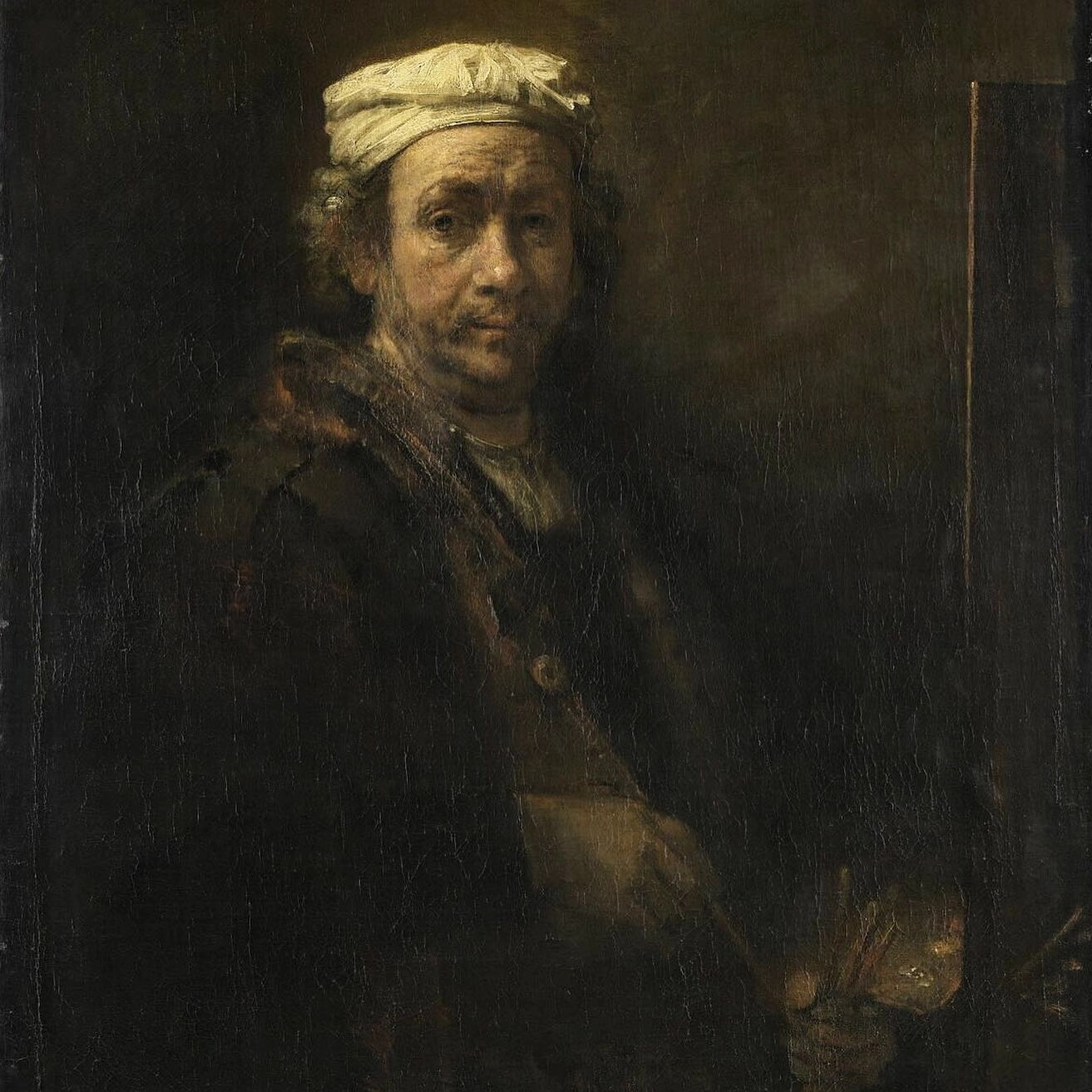
https://www.louvre.fr/en/what-s-on/life-at-the-museum/a-masterpiece-of-the-louvre And you? What would you paint?
I think of Lily Briscoe in Virginia Woolf’s To the Lighthouse, fiercely concentrating on finishing the portrait she began years ago. We can’t see her painting, but we feel the intensity of her decision-making as to precisely why, where, and how she’ll move her brush for the last stroke.
“Blank canvas”? Emptiness…better, openness; availability; possibility. Imagination calls.
I spend hours revisiting mysteries, reveling in the craftsmanship of the greats, and the enormous creativity that blossoms from the first page, where the canvas is empty before the reader. This week I’ve revisited “Fred Vargas” (writing name) – the French archeologist whose mysteries about her Pyrennean police commissaire, Jean Baptiste Adamsberg, lead the unsuspecting reader into wild leaps of imaginative plotting. https://fr.wikipedia.org/wiki/Fred_Vargas In An Uncertain Place, for instance, when Adamsberg goes to London for an international police conference, his English counterpart, Inspector Radstock, drags him to Highgate Cemetery where someone has left at the entrance 18 pairs of shoes with human feet in them. https://highgatecemetery.org/ The feet have been chopped off dead bodies awaiting burial in funeral parlors. Oh, wait—that’s 17 pairs plus one solo shoe with a solo foot. Adamsberg returns to France, still mulling this weirdness, and confronts a grisly murder where the corpse has been chopped into confetti, with special attention to the big toes and hands and feet. Why? And is the wild-eyed twenty-something who invaded Adamsberg’s Paris house really his undreamed-of son? The plot turns on Serbian vampire stories and the rumor that when Victorian artist/poet Dante Gabriel Rossetti exhumed his dead wife Elizabeth Siddal seven years after her death—ostensibly to retrieve his manuscript volume Poems—she was still rosy and pink. https://nonfictioness.com/victorian/the-exhumation-of-elizabeth-siddal/
From a blank page, to dead poets, to vampires and tombs in Serbia, to…well, check it out! Let me know if you actually identify the murderer before the end. Adamsberg’s one of my favorite characters. Still don’t know why he wears two watches and can’t tell time.
How do fiction writers fill the blank page? By that mysterious process—imagination. In the October 16, 2023 New York Times, Italian physicist Carlo Rovelli asks how we can learn about black holes—places we can neither travel to nor see. His answer? “To travel to places that we cannot reach physically, we need more than technology, logic or mathematics. We need imagination.”
Per Merriam Webster, “The meaning of IMAGINATION is the act or power of forming a mental image of something not present to the senses or never before wholly perceived in reality.” J.K. Rowling: “Though I personally will defend the value of bedtime stories to my last gasp, I have learned to value imagination in a much broader sense. Imagination is not only the uniquely human capacity to envision that which is not, and therefore the fount of all invention and innovation. In its arguably most transformative and revelatory capacity, it is the power that enables us to empathise with humans whose experiences we have never shared.” https://news.harvard.edu/gazette/story/2008/06/text-of-j-k-rowling-speech/
Our genre requires imagination. Mystery writers need a vivid, tangible setting, especially for the murder. My mind has taken me to a rock-art painted cave atop a bluff high above an old ranch, to a music recording studio, to a dining room where a horse rears. We need characters. Protagonist! Murder victim! Suspects! Subsidiary characters who adds color, flavor, depth—like Eddie LaFarge, the retired pro football center who limped into the Central Garage in my imaginary town of Coffee Creek.
And I find something unexpected has happened to me, writing the Alice MacDonald Greer murder mystery series. In the middle of the night, my characters now feel as real as relatives. I watch them driving, kissing, feeding the burros, worrying. Sometimes they pause for a moment, imagining what they’ll do next.
Thank you, Vacuna, goddess of empty spaces.

Those croissants? We’re recovering in Paris from hiking, where these, from the Maison Julien patisserie on Rue Cler, may be the best ever. Letting melting butter create those empty spaces between the layers? Genius.
Helen Currie Foster writes the Alice MacDonald Greer Mystery series (now working on the 9th) north of Dripping Springs, Texas, in the Hill Countrloosely supervised by three burros. She’s active in Austin Shakespeare and the Hays County Master Naturalists and very much enjoys talking to book groups. The 7th mystery, Ghost Daughter, published June 15, 2021, was named The Eric Hoffer Award 2022 Mystery/Crime Category First Runner-up, and also 2022 National Indie Excellence Award Finalist, Mystery.

 Austin Mystery Writers
Empty spaces and imagination, facinating concepts and nurishment for thought.
I hope that your trip has been amazing!
Love,
Keith
LikeLike