Beware, Sherlock Holmes!

By K.P. Gresham

The spring of 2020 has provided me with the opportunity to return to one of my favorite pastimes…and escapes.

READING!

And why not get back to my favorite sleuth, Sherlock Holmes?

I’ve spent the last few months catching up present-day iterations of the iconic and prolific Sherlock Holmes. Arthur Conan Doyle’s private detective first saw publication in 1887. Since then, authors (and screenwriters) around the world have given a go at their take on the famous detective.

My first selection was The Lady Sherlock Series by Sherry Thomas.  As its title suggests, Sherlock Holmes is actually a woman names Charlotte Holmes. This turned out to be a delightful read. Thomas creates a storyline that sounds far-fetched but pulls it off with insightful references to the original Doyle short stories. The mysteries she’s created don’t allow you to put the books down.

Next, I turned to Laurie King’s bestselling novel, The Beekeeper’s Apprentice. In this book and those following in the series, an aging Sherlock is befriended by (or is it she who befriends him?) a highly observant, seventeen year-old woman who rivals his abilities in observation and deduction. She soon becomes his apprentice in the detective game, and then…well…the game’s afoot!

Anna Castle writes a delightful series, The Professor and Mrs. Moriarity Mysteries. In her incredibly believable way, Castle creates a world where Professor Moriarty is the good guy, and Sherlock Holmes is not. Not exactly, anyway.

Other authors have had their own way with Holmes. The Sherlock Holmes – Anthony Horowitz Series comes to mind as well as the Anna Elliott and Charles Veley series, The Sherlock Holmes and Lucy James Mysteries. Even Kareem Adbul-Jabar co-wrote a series based on Mycroft Holmes.

Now the warning. Reading all these Sherlock Holmes iterations (and binge-watching movies/series featuring Basil RathboneJeremy BrettRobert Downey, Jr. and Benedict Cumberbatch) puts one in a mood to eat. Apparently I’m highly suggestible when reading a good book. When the characters have tea, I want tea. And I’m not just talking about the beverage. I’ve been chowing down on tea sandwiches, scones, pastries, desserts–and I’m not even a sweets lover. And when a character in the book has had a shock or a close call, whiskey is handed out in short order. Now I don’t drink whiskey, but I manage to find my own libation. I hate to see a character drink alone.

So thanks to that lean, tall Sherlock Holmes, I have put on the extra pounds that he willfully sheds when he’s on the hunt for a villain.

Alas.

If you’re looking for a comfort binge in these difficult times, I suggest you give Sherlock Holmes a try. But remember! You’ve been warned that you might come away with more (weight) than you bargained for!

James Michener Didn’t Care

by Kathy Waller

When I was four years old, I took a pair of scissors and a roll of red, gooey adhesive tape and wrote my name on the inside of the kitchen door. It didn’t occurred to me I shouldn’t, and my parents never said a word. I’m sure they discussed it, but I wasn’t privy to that conversation.  The crooked red letters stayed on the door for years. When they were finally removed, a heavy red stain remained.

Pat Boone - PixWhen I was eight, my father gave me a ream of legal-sized paper. I produced a newspaper, one copy per issue, focusing on the social activities of dogs, cats, and horses in the neighborhood. I reported on the wedding of Mr. Pat Boone, my rat terrier, and Miss Bootsie, my grandfather’s evil gray-and-white cat. Miss Bootsie was really Mr. Bootsie, but even then I knew the value of poetic license. Mr. Tommy, my cousin’s orange tabby, married someone, too, but I don’t remember whom or what gender. Or what genus and species for that matter.

For years, I loved writing—the paper, the pencils and pens, the ink, the facts, the improved facts, and the outright fiction.

The feeling lasted until high school, when I began taking courses labeled English. Writing became torture. What will I write about, how many words does it have to be, I don’t know anything about that, I don’t have anything to say. Through high school and two  college degrees–in English–I produced the required papers but agonized over every word.

There were bright spots: writing the junior class prophecy, which made even the teachers laugh when I read it at the junior-senior banquet; composing a satire on life in the teachers’ lounge I hid in when I was a teacher, issued serially on an irregular basis whenever the Muse moved me.

Overall, however, my relationship with writing remained conflicted. I pretended it didn’t. After all, I taught English.

Things began to change when I told a therapist about my early love affair with words. He responded, “I think you’d better start writing.” He suggested I join the Austin Writers’ League.

“I can’t,” I said. “James Michener belongs to the Austin Writers’ League. I can’t belong to anything James Michener belongs to.”

James Michener

The next day, I joined. James Michener didn’t object. I took informal classes at universities. An instructor invited me to a Saturday-morning writing practice group. The next weekend, I drove fifty miles, parked in front of the café where it met, watched people carry notebooks inside, backed my car out, and drove home. It took another week to build the courage to pick up my notebook to join them and become a regular.

The result? Once again, I fell in love with writing. I also fell in love with a member of the writing practice group and, after a decent interval, married him.

And I published some short stores in anthologies and online, and one novella.

But my romance with writing hasn’t ended  happily ever after. I don’t have a long list of appealing topics. I don’t have a file of perfect first sentences. I still have to write to find out what I know and what I think. I always wonder what happens next (and understand why Hemingway, Faulker, and Fitgerald drank to excess). I’m still driven by deadlines—my brain doesn’t turn on till one is upon me—and I write furiously up until the deadline (or, as now, after it).


Starting any piece is difficult. But once I (finally) begin, the words flow.

I wouldn’t exchange that feeling for anything.

In fifteen years, I’ve come from I can’t join the Austin Writers’ League to I’m working on a novel, attending Austin Mystery Writers critique group, writing for publication, blogging, writing every day.

And, contrary to the moans I make when asked how the writing is going, I love every second of it. Mostly.

***
The therapist actually said, “If you don’t start writing, you’re going to explode.” Since I took his suggestion, more things have changed. The Austin Writers’ League has morphed into the Writers’ League of Texas. The writing practice group that met at the cafe dissolved, and I joined another, Writing from the Heart, which met at BookPeople Bookstore; later it moved to various branches of the Austin Public Library. Now as 15 Minutes of Fame (More or Less), it meets online.

Invitation: 15 Minutes of Fame is free and all are invited to attend—no fees, no dues, no membership registration, no RSVP, no critique, no need write and spell as if your English teacher will scribble on your paper. No need to be a published author or to write “well.” Just have pen and paper or computer ready and show up. We do timed writings—choose a time, write, read aloud what we’ve written (IF we want to read; reading isn’t required), then do it all again. We meet from 10:00 a.m. to noon, on Saturdays; the schedule has been irregular recently but we’re in the process of getting back on track. When it’s stable, we’ll update the website, http://minutesoffame.wordpress.com If you’re interesting in writing with us, email kathywaller1 (at) gmail (dot) com.
*
Bootsie had long gray hair and green eyes, was beautiful, and slashed both a little girl who tried to pet him every time she saw him, and her owner, my grandfather, who thought he was peachy keen. Pat Boone was mine, and one of the dearest dogs who ever lived.
*
This post first appeared, with modifications, on Telling the Truth, Mainly.

*
Image of terrier by kteri3565 from Pixabay
Image of cat by Lenka Novotná from Pixabay
Image of James Michener by Robert Wilson, public domain, from Wikipedia
Image of critics examining ratty drafts by me

WW II: PAYING TRIBUTE IN THE TIME OF COVID-19 NEVER FORGET

May 8 was VE Day. 2020 marks the 75th anniversary of Germany’s surrender in Europe. Three-quarters of a century ago, Adolf Hitler and his National Socialist German Workers’ Party (Nationalsozialistische Deutsche Arbeiterpartei, NSDAP, also known as the Nazis hid in their bunkers, committed suicide or melted into the general population and escaped justice.

Thanks to Hitler’s diabolical determination to have Germany rule the world, over 100 countries were dragged into the conflagration, defined by two major groups. Germany, Japan, and Italy, the major powers of the Axis Alliance, and the major powers of the Allied forces, led by Great Britain, the United States, the Union of the Soviet Socialist Republic (USSR), and to a lesser extent, China. The remainder of the world lined up with one side or the other, with some exceptions, most notably Spain, Switzerland, Sweden, and Portugal, and they too had to arm and defend their borders. Some of these impartial countries ended up occupied regardless of the “neutrality,” but no matter which side any nation fought on from 1939-1945, now, 75 years later, the world remembers once again and all are glad for its end.

This year’s tributes are, however, quiet, lonely affairs, as the world battles another monster: COVID-19, which is preventing large public ceremonies from marking the end of a war that cost 40 – 50 million lives worldwide, both military and civilian. Lest we forget when we speak and write of the human cost so long ago as numbers and statistics,  these were people. They were sons, daughters, husbands, wives, and children, which gives us one inescapable truth. War is hell!

Great Britain lost 450,700 souls. They scaled back their big, planned celebrations: no mass gatherings, no hugging, and kissing. Tragically, many of the remaining veterans who fought in that war are living and dying sad and lonely deaths in nursing homes in Great Britain and throughout the world.

ww 2 75 anniversary GB

The United States gave up 418,500+ lives. Of these, 2,000 were civilians. The rest died in uniform. ww 2 75 anniversary U S

France – Despite their initial collapse and surrender to Hitler, both in their home nation and Indochina, gave 567,600 souls to the war.WW 2 75 anniversary Fr


After 75 years, Germany must live with the fact that it all began with them.  Hidden behind an effort to reestablish the German peoples’ right to live and thrive, was an evil intent that would poison the nation and take upwards of 8,000,000 German lives.

ww 2 75 anniversary ger

The Union of the Soviet Socialist Republic, then in the hands of Josef Stalin, another up and coming devil in history, lost 24,000,000

ww2 75th anniversary russia

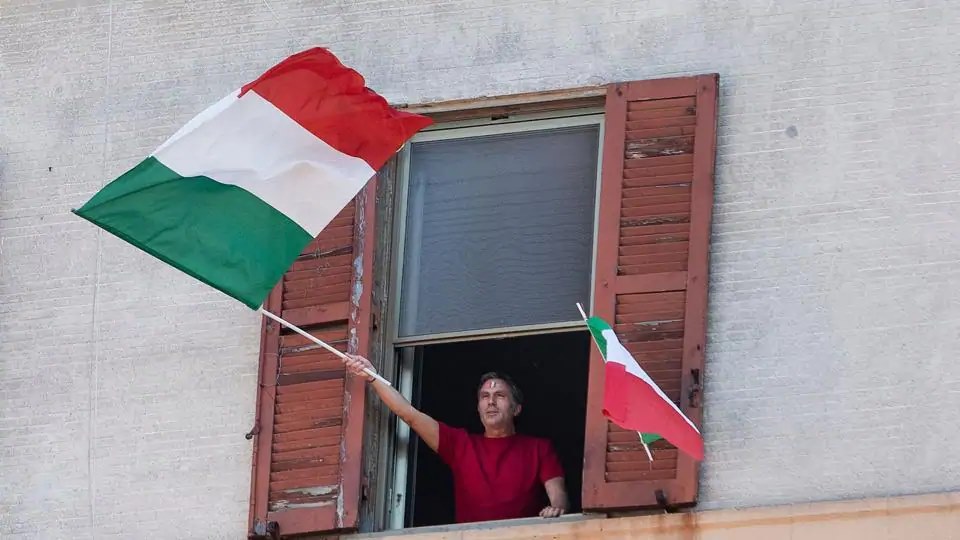
In Italy, official tributes began on April 25, Liberation Day, marking the date when Allied forces and Italian partisans drove the German occupation army out of the country. Italian losses stacked up at 457,000, including deaths from the civil war that took place simultaneously with the world conflict. For Italy, the war did not end on April 25 or May 8. Italians suffered through three distinctive battles between 1943-1945: Liberation against the Germans, the fight against fascism, the class war that underpinned both, and the struggle to reorganize a nation. On April 25, Italians came out on their balconies and sang Bella Ciao, the Italian protest song. It rang out across the nation.WW 2 75 anniversary Italy

Often in wars, fight songs are inspired, such as the Star-Spangled Banner, written in 1814, during the War of 1812, and The Marseilles, in 1792, when France declared war against Austria. Bella Caio, the Italian protest song against oppression, originated with the protests of the Mondina women who worked the northern rice paddy fields in the late 19th century. It reemerged during WW II, and has since been translated into 30 languages and has become an international anthem of resistance.

Tributes to the final battles of WW II are not over on May 8. Although the war with Japan ended on August 14, the official surrender date was September 2, 1945.  At the war’s end, Japan lost upwards of 3,100,000.  September 2, will officially mark the end of WW II, 75 years ago and this commemoration will also be muted by COVID-19, but not ignored.

Francine Paino

True Crime Podcasts Worthy of Binge-Listening

by V.P. Chandler

VP Chandler


Several years ago AMW member Laura Oles suggested that I might like listening to true crime podcasts. She kept talking about one titled, Serial.

“Yeah, yeah, I don’t really do the podcast thing.”

Then our family was scheduled to take a trip to West Texas. It’s not exactly a short drive to get there, so I thought it would be a good opportunity to try it out. I downloaded the whole first season onto my iPad and we were off. And ever since then, I’ve been hooked.

Serial’s description of season 1 (2014) from their website,

“A high-school senior named Hae Min Lee disappeared one day after school in 1999, in Baltimore County, Maryland. A month later, her body was found in a city park. She’d been strangled. Her 17-year-old ex-boyfriend, Adnan Syed, was arrested for the crime, and within a year, he was sentenced to life in prison. The case against him was largely based on the story of one witness, Adnan’s friend Jay, who testified that he helped Adnan bury Hae’s body. But Adnan has always maintained he had nothing to do with Hae’s death. Some people believe he’s telling the truth. Many others don’t.”

And let me tell you, Serial has won many awards and they are well-deserved.

As we left the rolling hills for flat roads flanked by mesas, we were pulled into the story. After each episode, we’d dissect the new evidence and theories. We felt like detectives. Are the witnesses telling the truth? Who is lying and why? Is there other evidence? Why would they make such bad decisions? Hearing the voices of the real people involved made it even more real. Sometimes we’d be certain that someone was going to lie, but after their interview, we were sure that they were telling the truth. *conundrum* It’s not easy being a detective.

And while we were caught up in the drama and intrigue, there were also somber reminders that these were real people who have been caught up in horror and heartache. When you hear how much they hurt, that they just want answers, it pulls at you. How can detectives and reports handle talking to them? I don’t think that just anyone could put together one of these investigative reports. It takes months and even years to follow leads. And it also takes a special talent to walk that thin line of pushing to get answers, and yet remaining sensitive to the feelings of friends and family. The reporters often say to the listeners that they purposefully hold back in order not to re-traumatize people. I think that’s extremely important to mention. And all of the podcasts that I mention follow that rule of conduct. I’m constantly amazed at the editing skills of these shows. Their sense of story is strong. They know how to piece it together while still uncovering new evidence.

Here are other podcasts that I’ve enjoyed. They are fascinating.


S-Town

“John despises his Alabama town and decides to do something about it. He asks a reporter to investigate the son of a wealthy family who’s allegedly been bragging that he got away with murder. But then someone else ends up dead, sparking a nasty feud, a hunt for hidden treasure, and an unearthing of the mysteries of one man’s life.”

It doesn’t go like you think it will. But it’s a peek into a fascinating man’s life and the people that know him.

Missing and Murdered


I thought that this show was called “Finding Cleo” and I was confused that the first season was about a woman named Alberta Williams. So don’t let that confuse you.

Season 1  “Sparked by a chilling tip, Missing & Murdered: Who Killed Alberta Williams? is an eight-part podcast investigation that unearths new information and potential suspects in the cold case of a young Indigenous woman murdered in British Columbia in 1989.”

The second season is about finding out what happened to a girl named, Cleo. “Like many Indigenous children, Cleo’s brothers and sisters were taken from their community, displayed in advertisements, and sent to live with white adoptive families across North America, through a controversial program called “Adopt Indian and Metis.” They’ve reconnected as adults and are determined to find their missing sister and penetrate the secrets shrouding the truth about Cleo. CBC’s Connie Walker joins in their search, uncovering disturbing new details about how and why Cleo was taken, where she wound up, and how she died.”

Both of these stories are about indigenous families in Canada and the suffering that that communities still experience. I knew that there is an epidemic of women being killed and their plight is just now getting media attention. But I hadn’t known about the Highway of Tears. It’s a highway in British Columbia where many indigenous women have either been killed or dumped. The reporter, Connie Walker, is Cree, so she brings an extra knowledge and sensitivity to her work.

Your Own Backyard

“A documentary podcast series investigating the 1996 disappearance of Cal Poly student, Kristin Smart.” It’s Only 7 episodes long, so it goes fast. Trust me, you’ll end up binge-listening to it.


Someone Knows Something

This series has 5 seasons. I’ve listened to the first two seasons.

Season 1
“In 1972, five-year-old Adrien McNaughton vanished while on a family fishing trip in Eastern Ontario. Despite an intensive search and investigation, no sign of Adrien was found, no clue as to where he might be. The case has hung over the area like a dark mass ever since, especially in the small town of Arnprior, where the McNaughton family lived.”

It was sad and fascinating. I learned a lot about cadaver dogs. (It’s not as gruesome as it sounds.)

Season 2

“On December 31, 1997, at a New Year’s Eve party broadcast on live TV, Sheryl Sheppard accepted a marriage proposal from her boyfriend, Michael Lavoie. Two days later, she disappeared. In Season 2 of SKS, David Ridgen joins Sheppard’s mother Odette on her search for answers.”

I’m very impressed with his laidback technique for speaking with people. He’s a good reporter.

The next one I’ll be listening to is

Uncover

(I’m interested in season 6, Satanic Panic, but I’m sure I’ll start with season 1. I always have to start with the first one.)

So there you have a list of very good true crime podcasts that will keep you busy. I’ve found that they make a long drive or doing housework more enjoyable. *Forewarning, not all mysteries are solvable. Unlike fiction, they can’t be solved and wrapped up in a bow. I think that adds to the tension and desire for a conclusion. But it also gives the listener a sense of what families and police face in trying to find the truth.

Do you have a favorite? Please, let me know. I’d like to add it to my library.