THE USES OF DISGUISE

By Helen Currie Foster

So, did you dress up for Halloween? Did you buy a mask in New Orleans, or Venice, perhaps one with feathers? What would you wear to a costume ball?
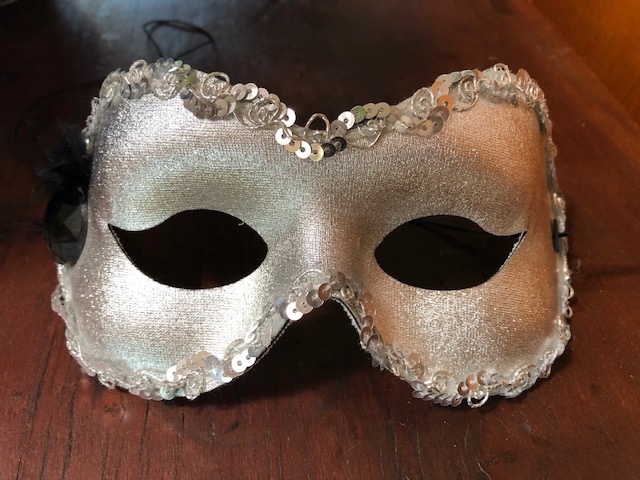


“Man is least himself when he talks in his own person. Give him a mask and he will tell the truth.”  Oscar Wilde

“Man is a make-believe animal—he is never so truly himself as when he is acting a part.” William Hazlitt

Both statements have some truth. Maybe Oscar Wilde meant that when we can hide our faces, or adopt a disguise, we feel free to do what we want––without hesitation or regret.  Yell “trick or treat!” Dance at the masked ball as a glamorous mystery person!  Rob the stagecoach! Maybe writers understand Hazlitt: we’re at our best, writing, as we invent characters, invent parts for the characters, invent disguises. Yes, we’re at our best “acting a part…” and we act many parts as we write.

At my college there was a costume room where students could buy clothes from decades earlier.  One year a group of us rummaged around and found remarkable outfits which we’d don sometimes for fun. For $1.50 I acquired a stunning long black silk evening sheath from maybe 1919, with black sequin trim under the bodice, slits in the sides of the skirt, and two long black “wings” attached to the shoulders that I could use like a shawl, or like… wings. When I put that dress on––SHAZAM! I wasn’t a young thing from Texas, I was the embodiment of glamour. (Where is that dress?) So, what’s the outfit you wear, or dream about, when you’re ready to put on that black cat-eyed mask from (New Orleans) (Venice) and enter the party? The disguise you’d choose? The disguise that would let you do what you want, learn what you want, go where you want?


Two genres especially abound in disguise: children’s literature, and mysteries.

Disguise lets us learn what may otherwise be unavailable. Think of T. H. White’s The Sword in the Stone, where Merlyn (White’s spelling) enchants Wart (the future King Arthur) by turning him into a perch in the moat. Wart learns to swim from a fish called a tench, who reminds him, “Put your back into it.” He’s taken to learn about power from the King of the Moat, a murderously hungry four-foot long fish: “The power of strength decides everything in the end, and only Might is right.” He learns from his night as a merlin, in the terrifying catechism imposed by the peregrine, that the first law of the foot is “Never to let go.”

Harry Potter, Hermione and Ron need information to foil the Dark Lord, and to raid Gringotts Bank and the Ministry of Magic. They resort to the invisibility cloak, or use Polyjuice Potion to look like Bellatrix, or Crabbe and Goyle.


But knowledge won by disguise carries peril. Wart barely survives the unscrupulous King of the Moat, having to dive “the heartiest jack-knife he had ever given.” The moment when Harry Potter’s invisibility cloak slips, when the Polyjuice potion wears off, threatens exposure and punishment.

Kim, in Kipling’s beloved novel, disguises himself to learn secrets as a child spy for the Company’s intelligence service in India. But Kim doesn’t see disguise as work. He revels in the sheer joy of successful impersonation. He rejoices in the walnut dye that lets him escape on a railroad journey to meet his lama, where he tries out various personae, explaining to the passengers “that he was assistant to a juggler who had left him behind sick with fever.” As the occupants of the train car change, “he varied this tale, or adorned it with all the shoots of a budding fancy…” This joyous talent becomes dangerous as he adopts Mohammedan garb, spying for Mahbub Ali, and priestly garb as he chases Russian spies across the Himalayan foothills.

Maybe Kim’s an exemplar of Hazlitt’s statement, that “man is never so truly himself as when he is acting a part.” When fate requires a disguise—or just for fun on the Indian railway––Kim uses all of himself to create that disguise, summoning memory, imagination, accent, intonation, clothing, gesture, posture. As actors do! Perhaps all these disguises are part of him…though not all of him.


Like Kim, Sherlock Holmes (or Arthur Conan Doyle) loves disguise. Remember “A Scandal in Bohemia?” Disguises everywhere! First, a client sporting a “black vizard mask” seeks help from Sherlock Holmes. The client’s disguised as the Count von Kramm, a Bohemian nobleman, but confesses he’s actually King of Bohemia. He wants Holmes to “repossess” (snitch) a compromising photograph of the King and the famous beauty Irene Adler.

Holmes himself then adopts disguises. First, to spy on Adler, he appears as “a drunken-looking groom, ill-kempt and side-whiskered, with an inflamed face and disreputable clothes,” so convincing that Watson “had to look three times before I was certain that it was indeed he.” Next he plots a disguise to gain entry to Adler’s house, where the photograph is hidden:

“He disappeared into his bedroom and returned in a few minutes in the character of an amiable and simple-minded Nonconformist clergyman. His broad black hat, his baggy trousers, his white tie, his sympathetic smile, and general look of peering and benevolent curiosity were such as Mr. John Hare alone could have equaled.”

Watson notes that it was not merely that Holmes changed his costume: “His expression, his manner, his very soul seemed to vary with every fresh part that he assumed. The stage lost a fine actor, even as science lost an acute reasoner, when he became a specialist in crime.”

But Conan Doyle fools us yet again. Holmes orchestrates a street melée whereby a crowd (of accomplices) carry the clergyman into Adler’s house. When Watson throws a fire rocket through the window, Holmes, as predicted, sees Adler rush toward the photograph’s hiding place. On their way back to Baker Street Holmes happily tells Watson about his ploy, but as he searches for his door key, he hears “Good-night, Mr. Sherlock Holmes,” from “a slim youth in an ulster who had hurried by.”

Foiled again––Holmes, that is. Irene Adler, disguised as a boy, has followed him home and confirmed the “clergyman” was Holmes. The next morning Holmes and Watson discover her house is empty, the photograph’s gone, and his disguises were in vain. That’s “how the best plans of Mr. Sherlock Holmes were beaten by a woman’s wit,” says Watson.

Holmes does love a good disguise, and maybe that’s why he can recognize one. For another example of his Hazlitt-esque behavior, see “The Man with the Twisted Lip,” where Watson almost doesn’t recognize Holmes as an aged opium smoker, and Holmes susses out the (disguised) truth about the disappearance of a client’s highly respectable husband by (literally) washing clean the face of a notorious street beggar.
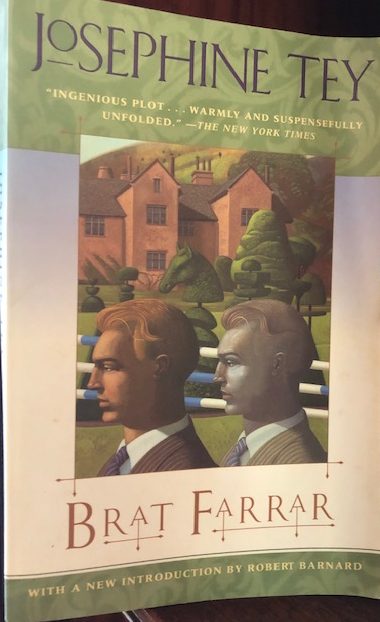
Josephine Tey teases us with disguise in Brat Farrar where the mystery turns on whether Brat Farrar, a young man who introduces himself as the long-lost heir to the Ashby family estate, is or is not Patrick Ashby, thought to have killed himself, leaving his minutes younger twin Simon as putative heir. Simon will be dispossessed if Brat Farrar is for real. The point of view is frequently in in Brat’s head, and we must decide if we like this disguised pretender as a protagonist, or not. He himself is ambivalent, arguing with himself about the whole scheme: On the one hand, he thinks, “But I’m not a crook! I can’t do something that is criminal.” But then: “All he could do was sit in the saddle and hope for the best. But at least it would be a breath-taking ride; a unique, heart-stopping ride. Danger to life and limb he was used to; but far more exciting was this new mental danger, this pitting of wits.” As he feels his way along, still in disguise, Brat slowly learns who did kill Patrick. That knowledge nearly kills Brat Farrar.

New Zealand’s Ngaio Marsh has the murderer disguise his or her true identity in both Photo Finish and A Clutch of Constables. In the first case, the murderer creates a new identity from whole cloth. He accidentally gives himself away to Detective Rory Alleyn in part when Alleyn overhears his soft-voiced use of a Mafia expression. In A Clutch of Constables, the murderer––a master of disguise––entirely steals another’s identity, including his butterfly-hunting expertise, for the duration of a cruise. He relishes his persona and manipulates the unwitting characters like chess pieces on the board of the plot––more in the Hazlitt manner, being most truly himself as he throws himself into the role.

Mystery writers disguise their murderers, their sleuths, sometimes their victims, sometimes their protagonists.  I use disguise in my new murder mystery Ghost Cat. I’ll be interested in what you think. Happy reading and writing, everyone!

Ghost Cat on Amazon


An Interview with Andy Boyle: Launching a Book and Staying Sane in These Uncertain Times

Hey, writers, how are you holding up these days?

If we are fortunate enough to have our health and our jobs, we are grateful but still struggling to create a new normal for ourselves and our families.  So many of us now have kids finishing their semesters through online school while we’re working full time. Many of our touchstones and daily routines have been upended. We are doing our best each day, although the definition of ‘our best’ also changes on the daily.

Andy Boyle is here to help.

You see, his book, BIG PROBLEMS, was released by Penguin on March 31st.  He is one of many authors who has found himself promoting a new book in the middle of this pandemic. Today, Andy shares what he learned while writing BIG PROBLEMS and offers advice on how to keep moving towards our goals—and why taking a break is not only fine, but necessary.

LO:  First off, congratulations on your new book!  Can you share a bit about the life experiences that culminated in your writing BIG PROBLEMS?

AB: Thank you so much! I’ve been a journalist for about 15 years, and it’s impossible for me to look through things without that lens. So after my first book, Adulthood for Beginnerscame out, I was trying to find a meaty subject to sick my teeth into, something that would allow me to use myself as  the storytelling and thematic vehicle to explain a big topic. But also, in the end, hopefully help people, which is one of the reasons I became a journalist in the first place.

And the topic I chose is, well, at its heart a mystery. How come a person like me—allegedly well-educated—managed to get so fat, just like millions of others? And then, to add another mystery, how come I was able to lose so much weight (and keep it off), unlike most people?

That led to the pitch for BIG PROBLEMS: A Former Fat Guy’s Look At Why We’re Getting Fatter And What You Can Do To Fix It. My agent liked it, my publisher liked it, and voila. I would research the macro and micro levels that led to myself—and others—getting fat, told through that journalistic lens, while also including quite a bit of levity and humor throughout.

I rewrote the book multiple times to get it right. At one point, I went back and redid about 50,000 words, replacing entire portions of the book, adding in more research, doing more journalism. It was a lot of work. It was a lot of running and weight-lifting and sweating.

But, in the end, I’m quite proud of the end result. I even narrated the audiobook! And I even had a director for that. The entire time I kept complaining about how “the guy who wrote this should’ve done a better job with these sentences.” The joke never got old.

LO:  Do you find the habits you learned are harder/easier to stick to in this particular time of being in a pandemic?

Andy’s cat, Tiberius, catching up on some reading…

AB: I think everything is harder for everyone right now, and folks who are saying it isn’t are, uh, perhaps misstating the facts a little. So, everyone needs to first cut themselves an incredible amount of slack.

But for me, the same habits that led to me losing weight, staying productive, and pushing myself toward healthier decisions, are the same habits I’m using now, which were all focused on certain goals. (For me, objective goals work best. Write 1,000 words a day, eat 200 grams of protein a day, read 90 minutes a day, that sort of thing.)

The only difference is, with everything going on, I’ve changed my goals substantially. Before my book came out, my goal was to be able to bench press a certain amount (225 pounds) for 5 sets of 5 reps, and deadlift 405 pounds for 5 reps. That was what kept me going to the gym regularly, following my strength program, eating properly, everything. When the gym practically disappeared from my life (when I was 10 and 30 pounds from my two goals, respectively), I decided my goals needed to change. With nothing heavy to regularly lift up and down, how could I have that kind of objective goal?

Now it’s much more simple: Workout four days a week (that’s mostly consisted of running 3-5 miles, with the occasional body weight/cables-attached-to-my-door strength training), hit a certain caloric and protein goal and get a good amount of sleep.

I’ve got a full-time job at the Chicago Sun-Times, plus I’ve been promoting a book, plus trying to plot out a novel. So my artistic goals have changed quite substantially, too. I just try and set aside 30 minutes a day now for my non-work projects. That could be spending 30 minutes learning a card trick. Or 30 minutes outlining my novel. Or 30 minutes writing up a character sketch. For me, 30 minutes is quite achievable after my normal work day, and it often ends up being longer than that. If I were a full-time writer, I would definitely have bigger goals. (For instance, when I was drafting my book, my goal was 1,500 words a day, which usually involved the research/interviews/etc., which wasn’t exactly easy when I had a full-time job. But hey, I did it. Somehow.)

Another important point: I don’t beat myself up if I don’t hit my goals. The idea is to try to hit them. If I only exercise three days a week, I still exercised. If I only write 500 words a day, I still wrote. Having goals helps you push yourself toward whatever you’re trying to get done. (Making daily lists of TO DOs helps with this immensely, especially for my day job. It also gives me a sense of accomplishment after I check each one off, even if it’s as simple as “Answer Laura’s wonderful questions she emailed you.”)

LO:  Many writers consider themselves introverts, so working in isolation may not be a huge adjustment, but what advice do you have for the more extroverted among us?  How are you adapting?

 AB: I can walk between both worlds, but if I had my choice, I would be a hermit who lived on a plot of land in my home state of Nebraska with beautiful prairie vistas. I value my private time, especially when I am being creative. But I am also quite adept at putting on “The Andy Show,” to quote a former girlfriend, when I am around other people, AKA being entertaining and fun and Mr. Life of The Party. So, my Nebraska home would need to be like a five-minute drive from a hangout spot at the very least.

Photography by Mandy Dempsey

As a writer, being around people is great because you sometimes hear random idioms and turns of phrases, which you can then squirrel away into your phone in the NOTE you have titled “COOL DIALOGUE.” It’s also great to be around others because it reminds you how people react to one another, how people dress, how they smile, how they laugh, how they move their hands when they’re nervous, so many things. Just like reading helps to make you a better writer, being around humans helps to make you understand humans better—and as writers, we mostly deal with humans. Win-win.

I have most definitely missed my occasional coffee get-togethers with my writer friends. I’ve been hopping on video chats with people, reaching out more via text. My writing group had a video get-together to critique a draft of a novel of mine, which was lovely. I also held a Zoom “book launch” event the day my book came out, and about 25 people came. It was lovely.

However folks are getting through right now, though, is the “right way” to get through it all, introverted or extroverted. But one thing I’ve learned in my life is, if you’re ever in doubt of whether or not you should email an old friend or text someone to just say hello, just do it. Those connections are important, especially as you get older.

LO:  How do you get your mind into a creative space right now? Or is that an unrealistic expectation during this time?

AB: I do it by making the time for it. That sounds like such a cliched thing, but I’ve never been a person who writes because the muse has spoken to my soul. Or because I have been struck with fantastic inspiration and have the entire writing project fully realized in my head.

No, I write because I’ve made a goal of writing XXX words a day, or for XX minutes, or whatever. And then I will usually schedule the writing time in my calendar, and then I get the message that says “10 minutes until WRITE 1,500 WORDS appointment,” which is enough time to go oh shit oh shit I am hungry I need to clean my entire home oh my cat needs new toys oh I should text my girlfriend oh shit oh shit AND NOW I am writing.

It’s work. And just like you gotta show up to your job to do your job (or at least now, log into your computer while wearing sweatpants at home), you gotta show up to do your creative work. And you make time for the work and make an appointment with yourself that you’ll do the work.

I used to be (still am?) a musician. Went to music school for my first two years of college. Studied vocal music performance. (Maybe 18-year-olds shouldn’t be allowed to make such decisions.) What that taught me about creativity is you gotta make time to sit down, practice scales, try work that stretches your brain and skills (also known as: is hard), and just do the work. You make time for it. Over time, you get better. But it’s still work, and it sometimes still sucks and you can’t tell that you’ve gotten any better.

Mozart and Beethoven didn’t just go “Huzzah, I am going to write a piece of music that shall change the world!” (Which probably would’ve been in German.) No, they created a habit: They will try and write something during certain periods of time, probably while cursing in German. (Das ist Scheiße!). Sometimes the work sucked. Sometimes it was Beethoven’s Ninth. Regardless, they followed their process and the work followed.

I’m currently outlining a novel, a method I’ve never really had much success with before. (And you may be wondering, Andy, how much success have you had with previous novels? As I’ve only gotten non-fiction published, that should tell you a lot about my fiction success.) But I sit there for an extended period of time, legal pad in hand, and I just jot down ideas. I make little timelines and draw when events could occur, which lead to some of those ideas I jotted down.

I have to show up by putting my butt in a chair. The creativity happens somewhere while you’re doing the work. And, when you’re actively working on a project, you’ll be out on a run or sitting watching TV and you’ll get a great idea—WHAT IF THE LOVE INTEREST FROM HIS PAST KILLED HIM???—and then you jot it down into your phone’s NOTES tab under COOL IDEAS.

But that’s for me. I always am in need of a project. If you’re juggling 900 things and just trying to keep your head above water right now, you may not have the mental bandwidth for any sort of creative outlet. And that is completely fine. Anyone who says otherwise is probably a charlatan trying to sell you something or make themselves seem amazing in comparison. Which means they suck.

Sometimes the most creative thing you can do is let your mind get bored through the drudgery of everyday existence.

Q:  What is it like, having a book come out in the midst of a pandemic?

It is a weird time to be promoting a book, especially when folks can’t walk into bookstores, check out the “New Releases” table, pick things up, be sold because of the back cover copy or the front cover artwork. It seems like now, more than ever, word of mouth is one of the best ways to promote books.

That means you should be regularly telling your friends books that you’ve loved, in the hope that they will buy them. And then you should also give links to your friends of the independent bookstores they can order the books from.

And this is me, your new internet friend, telling you to pick up my book. And then to tell everyone about it. And then also get Laura’s book. And tell everyone about it. And then tell everyone about another book you’ve loved that they should read.

Andy Boyle is the author of Adulthood for Beginners and an award-winning journalist and technologist. His work has previously been featured in the Chicago Sun-Times, Axios, Esquire, the Boston Globe, the Chicago Tribune and on NBC News. His work was cited in the 2012 Pulitzer Prize for Breaking News. He was also the runner-up in the 2019 Hugh Holton Award through the Mystery Writers of America’s Midwest chapter. A native of Nebraska, he lives in Chicago.

www.andyboyle.com

Laura Oles’ debut mystery, DAUGHTERS OF BAD MEN, was an Agatha nominee, a Claymore Award finalist and a Killer Nashville Readers’ Choice nominee. She is also a Writers’ League of Texas Award Finalist. Her short stories have appeared in several anthologies, including MURDER ON WHEELS, which won the Silver Falchion Award in 2016. Her most recent short story, “The Deed” was included DENIM, DIAMONDS AND DEATH: Bouchercon Anthology 2019.

Before turning to crime fiction, Laura spent two decades as a photo industry journalist covering technology trends for a variety of consumer and industry magazines. You can find her at https://lauraoles.com

A Dream Come True

kp gresham


By K.P. Gresham

Writers love to dream. We dream when we’re awake and when we’re asleep. Sometimes its hard to tell the difference. Here’s an example.

I woke to the sound of the TV news coming from the other room. This was no surprise as my husband always turned on the telly when he had his morning coffee. What I heard coming from the TV, however, stunned me.

“My fellow Americans,” the President was saying. “I know these next few weeks and months will be very dark indeed. Thousands will die from Covid-19. Many more thousands will become sick. But remember this. We are Americans. Just as our forefathers fought side by side with people they’d never met, races they’d never before even knew existed, followers of different religions, they came together to create The United States of America. Their goal? To form a more perfect union.”

I swung my legs out of bed and joined my husband in the front room, where he sat mesmerized, staring at the TV.

I saw the President was standing alone behind a podium in the White House Rose Garden. “Today it is in that unity that we must come together to help each other through this trying time. It’s amazing what a smile and a wave to a stranger while social distancing can do not only for that stranger, but for you as well. Giving joy brings joy. Sending an encouraging email tells us we can be a source of comfort. Passing on a Facebook joke brings a smile to our face as well as those we’ve friended.”

Entranced, I sat down beside my husband on the couch.

“When Pearl Harbor was attacked, thus bringing the United States into World War II,” the President continued, “the Japanese admiral who lead the attack said, ‘I fear all we have done is to awaken a sleeping giant.’ His fear came to pass.” The President’s smile was victorious. “The entire U.S. population roared to the support of our common cause. We signed up for the Armed Forces, turned our manufacturers into war machine producers, started food banks, sold and bought war bonds.  Normal citizens turned into parachute seamsters, hospital workers, night raid wardens and troops on the front line.”

My husband put his hand around my shoulder. I felt him sending me confidence through that hug.

“In the midst of this war on Covid-19–and it is a war–we as a united people under one flag, must now understand that we, too, can be part of the solution. Put on your armor, your face masks, your gloves, etc., arm yourself with sanitizer. Take orders from your generals, or in our case, the medical experts who tell you to wash your hands, stay at home, and when you do have to go out, wear a mask and stay at least six feet away from every person you see.

“Now is the time for the United States to no longer be that sleeping giant, uninvolved and inactive. Let us roar into action, together, united, knowing our attitude will be the difference between the life and death for millions of our fellow citizens. Be positive! Know you ARE the solution! Only together can we defeat this enemy.”

Yes! I thought. I can be part of the solution!

“As your President,” he continued, “I call all Americans to arms. I call the businesses of this country to retool and make the equipment our soldiers on the front lines, the first responders, need to succeed. I call on the wealthy to have a care for our service workers on whom they depend for their comfort. Remember that bartender who knows exactly how dry you like your martini. Remember that masseuse who is the only one who can get that kink out of your neck. I suspect strongly that the wealthier you are the more workers and businesses you will have on your list. I call on every person to be the support each other needs. A smile. An attitude of ‘We’re in this together and, by God (literally), we will get through this.’

“To my fellow politicians I say this.” He gazed straight into the camera. “Right now is NOT the time for assessing blame, dire predictions, threats to our medical experts, or refusing to follow the restrictions deemed best for our country. Time for all of those arguments, judgements, recriminations belongs to a history yet to be written. Right now we’re fighting a war, and as leader of this country, I say we all, including the government, will fight this war as one.”

My chest swelled with pride. We are the United States of America!

“In conclusion,” he said. “I thank all of the first responders, all of the medical experts, all of the businesses and individuals who are rising up to defeat this disease. We are a mighty country. God bless the United States of America.”

I was invigorated. Hopeful. Determined.

And apparently I was asleep.

Suddenly my alarm screamed into my hopefulness, jerking me awake. What the hell?

Then I realized it had all been a dream. Damn. My sense of empowerment and determination seeped away as I became more and more ensconced in wakefulness.

Time to get back to reality. But wouldn’t it be nice if that dream would someday come true?