Banishing Lazy Words by Terry Shames

This week we have a guest blogger, friend and fellow mystery writer, Terry Shames!

Terry grew up in Texas, and has an abiding affection for the people she grew up with and the landscape and culture of the town that is the model for Jarrett Creek. She graduated from the University of Texas and has an MA from San Francisco State University. Terry now lives in Northern California with her husband, two terriers and a regal cat.

Terry’s first Samuel Craddock novel, A Killing at Cotton Hill, (July 2013) and was named one of the top five debut mystery novels of 2013 by MysteryPeople. The second in the series, The Last Death of Jack Harbin was named one of the top five mysteries of 2014 by the Library Association’s Library Journal. Dead Broke in Jarrett Creek, the third in the Samuel Craddock series, came out in October of 2014, followed by A Deadly Affair at Bobtail Ridge in April 2015 and The Necessary Murder of Nonie Blake in January 2016.

A member of Mystery Writers of America and Sisters in Crime, she serves on the boards of Northern California chapters of both.

Welcome, Terry! shamesTerry_1

Banishing Lazy Words

When I’m editing a book, I know that when I begin to get restless I’ve probably come across a nest of lazy words–words that are shorthand, or placeholders, for what I really want to say. Here are some lazy word indicators:

These, this, those, thing, stuff, some, about, just…and the dreaded “to be” verb (was, were…)

I often find when I come across several of these words on one page it means I was reluctant to dig deeper into the emotional content in the scene. When I buckle down and confront what I’m avoiding writing, digging deep to find the emotional core of the scene, I often end up writing a lot more words than I had before.

Here’s an example of a piece I was editing for someone else. I ran across several places on one page where two characters were talking about, “This thing we have going,” and “This thing we are trying.” The “thing” the writer was talking about was a difficult relationship between people of different ethnic backgrounds. By repeating the words “this thing,” she avoided addressing in depth the painful aspects of the relationship. The words fell flat on the page. Only when she changed it to say what she really meant, “Our risky experiment,” and “The way we are thumbing our nose at tradition,” did it begin to have the depth it deserved. Instead of a romance novel, it because more like Romeo and Juliet.

In first drafts, we often use shorthand for what we know is going to be a difficult description. But as writers we have to work hard to ferret out those lazy little words and phrases and say what we really mean. Not, “Amanda’s bedroom was a mess. There was STUFF lying everywhere,” or “I walked into Bill’s office. There was STUFF lying everywhere,” but instead, “Amanda’s clothes were strewn on the floor leading to the bed,” or “Judging from Bill’s office, he was a guy who dropped whatever he was reading onto any handy surface as soon as he was done with it.” Instead of saying, “there were several things he wanted to tell her,” it’s more interesting to read, “he stored up little criticisms that he could spring on her later.”

Contrast these two paragraphs:

“They dated for a few months, during which he told several lies. Some time later, she tried to remember which lies bothered her the most. There was the time he told her he was an accountant and lost his job when the economy went bad. And another time he said he looked around for a job for a long while before he could find another one. But the worst was when he said he’d buy her some jewelry, and never did.”

The fix:

“They dated for six month. After he disappeared, she found that he had hardly opened his mouth without lying. She bought into it when he told her he was an accountant, and lost his job when the economy went bust. She even believed that he pounded the pavement looking for a job for six months before he found one. But the lie that hurt most was that he promised to buy her a diamond ring, and he never did.”

The first paragraph is full of lazy words like “a few,” “several,” “some, “tried,” most,” “there was,” etc. The second one uses livelier, mores descriptive words.

When you read authors you admire, note that they pin down real time, real place, real emotion. It makes their prose richer and keeps readers engaged. It takes hard editing work, but it’s worth it. It’s the key element that will make your prose come alive.

You can find more information about Terry Shames at www.terryshames.com 

Thank you, Terry! That’s good concrete information that all writers can use. What do you think, reader? Any questions or comments?

 

Mystery Workshop At Book People

Last Saturday I attended a writer’s workshop at Book People, sponsored by Mystery People and the Austin chapter of Sisters In Crime. I honestly didn’t think I’d learn much new. But I was wrong. *Note- Between classes we had drawings for giveaways like books and tote bags!

mysterypeople_cityscape_72


sinclogomediumred (1)

41VaFJ3tHPL._UX250_It started with George Wier speaking about writing action scenes. He’s literally a pro at this. Just read any of his books. (www.billtravismysteries.com) It wasn’t about how to describe a blow-by-blow fistfight. It was more about how to add tension to a scene, how to make it move along. I don’t know about you, but I like bullet points. So I’ll share my notes in that manner.


  • Before you can add action, you must put the reader in the moment. They won’t follow anything if they aren’t there. To accomplish this, describe the lay of the land and the surroundings.
  • What are the results of the action? There should be consequences or the reader won’t care.
  • The scene must have a beginning, middle, and end.
  • Don’t describe things in terms of time. (aka- three hours later). Believe it or not, that doesn’t do anything for the reader. Time isn’t as tangible as distance. “They walked down a flight of stairs.” Is much easier for the reader to see and instantly understand.
  • Perception is everything. Use all the senses. Have your characters be aware of their breathing, their surroundings, sounds, pain, everything.

The idea of writing about distance instead of time interests me. All of the things listed above make sense, but the idea that the reader can intuitively understand distance better than the concept of time is fascinating.

Scott Montgomery of Book People recommended the book, The Killer Inside Me by Jim Thompson. He said it was a good example of what Wier was talking about.

12440786_872683726208928_6233840132231229609_o

Cutting up between classes. Friend and author Billy Kring dropped by. He’s trying to distract me while George Wier looks on.

P1010228

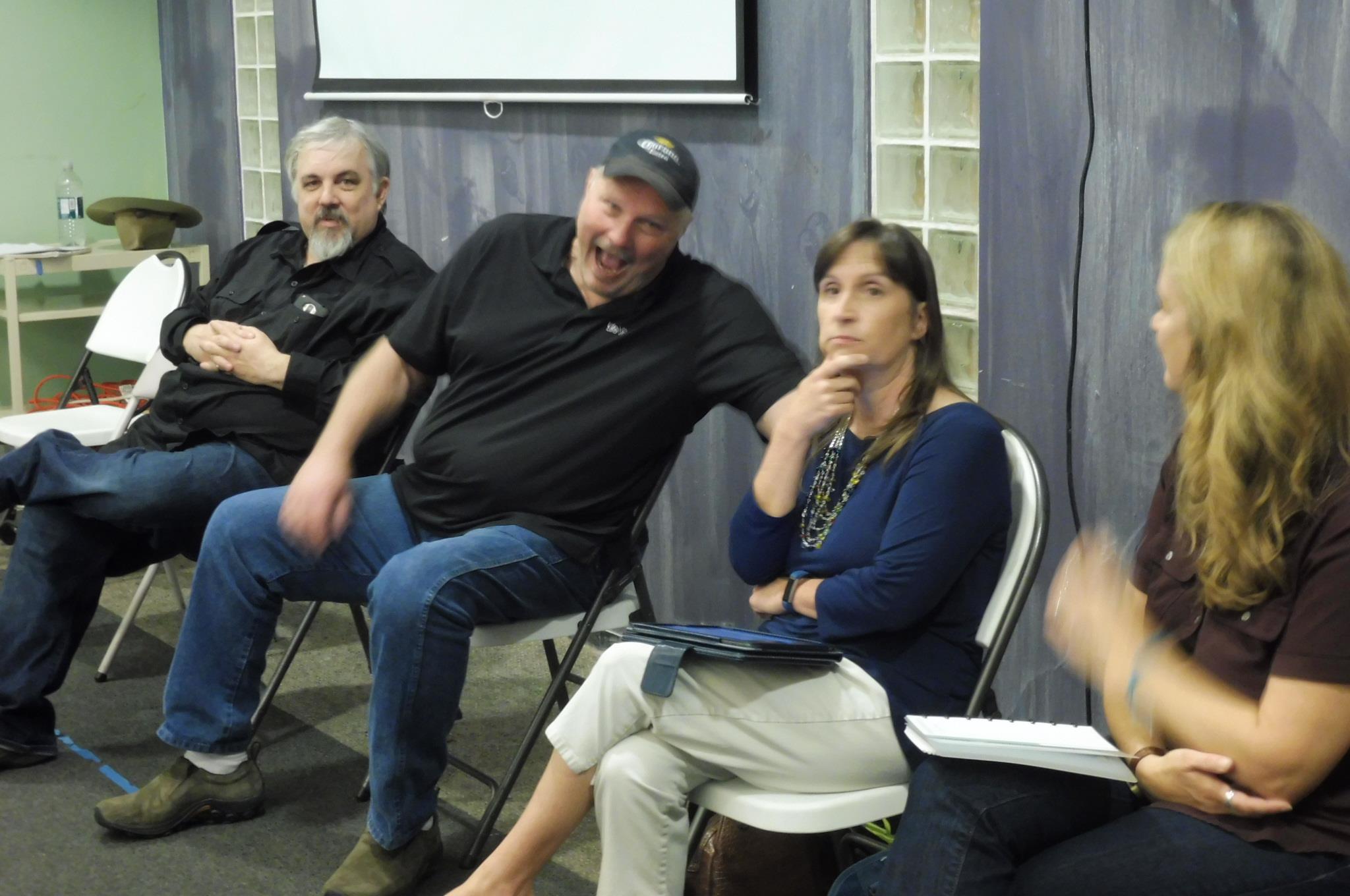
The guys behaving for Terry’s talk.


shamesTerry_1


Next at the workshop was Terry Shames. She gave us many tips on how to writing compelling settings. And she should know. She does an excellent job of describing the Texas town where her Samuel Craddock series takes place. (www.terryshames.com) I came away with the concept of interior settings and exterior settings. No, not what a living room looks like, interior as in what’s going on inside a character. (More bullet points!)

  • Treat your scenes as characters.
  • The way to make your story interesting is to show how the interior setting (of characters) intersect with the exterior setting. How would someone from a Texas ranch interact with the people and setting of New York city? How would that same person act in their own hometown?
  • The devil is in the details. Immerse the reader in the setting. You don’t have to do an information dump. (Please don’t.) But you can provide things like smells and sounds.
  • If you aren’t familiar with a place, research it. Talk to people who know the place.
  • Above all, know how your characters would interact with the setting. Someone who almost drowned would have a different reaction to falling in the water than someone who is an Olympic swimmer. So Know Your Characters!
  • Every scene should try to have-
  1. Action
  2. Dialogue
  3. Physical description of setting
  4. Physical description of characters
  5. Internal thinking
  6. Internal physical descriptions.
  • A good rhythm of a scene would be: 2/1/2, 4/3/5, 6/2/1. Try it and see what happens.


13221302_872683152875652_8550652881065447974_o

Brent and James. Looking forward to reading their books.

After lunch we gathered for the last class about collaboration. Brent Douglass and James Dennis, two of the three authors who make up the persona of Miles Arecenaux (www.milesarceneaux.com), led a funny discussion on their journey of collaborative writing. They started their first book back in the days before email. Thank goodness the days of mailing a manuscript back and forth are gone. Thank you email! So what are their tips?

  • Don’t be afraid to be honest with each other. Actually, they said to be brutally honest. Treat each other like siblings.
  • Play up to your partners’ strengths. You are different people with different experiences. You that to your advantage.
  • Work to maintain “one voice” for your book. It will get easier with practice but it will also take many edits to achieve this.
  • Defer to people with experience. (Again, take advantage of your partner’s strengths.)
  • It helps to build accountability. If you know that you’re expected to get your part done by a certain time and the others are counting on you, you better do it.
  • Broadcast gratitude. Not only show gratitude to your partners, show gratitude to other writers.


(Collaborating sounds interesting. I think I’d like to take a stab at that just for fun.)


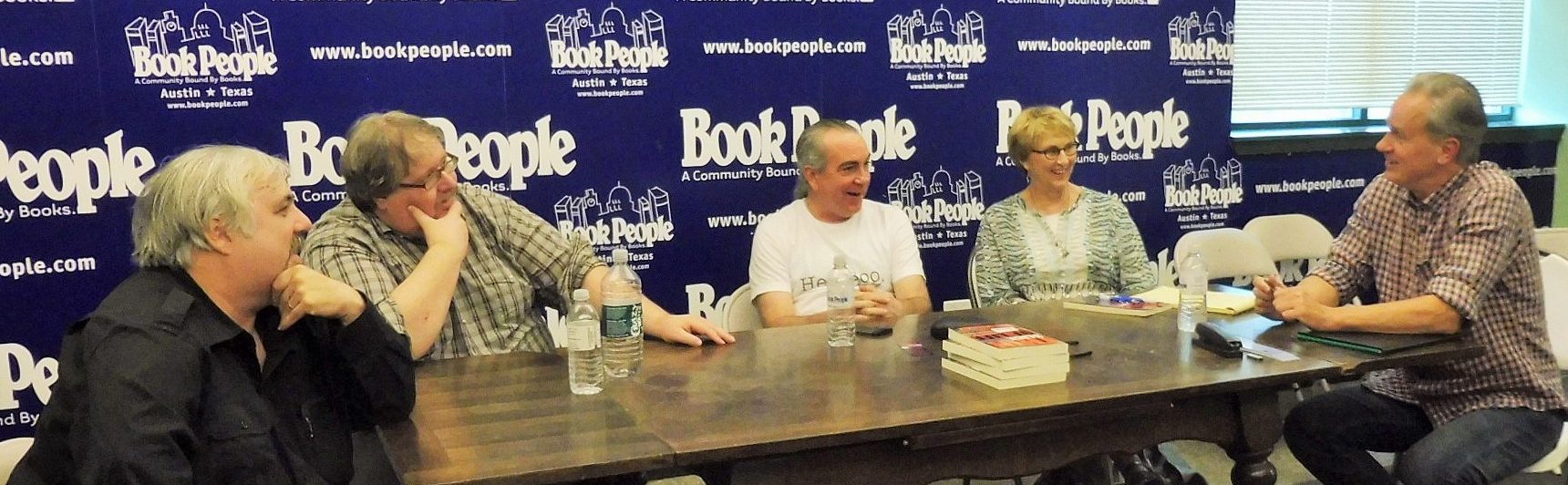
P1010257 (3)The last event was a panel discussion that was very informal. It was about publishing, marketing, and networking. Honestly, I was so caught up in listening, I forgot to take notes! All the speakers were charming, personable, and informative. It was worth every moment that I was there.

13221495_1309991895681591_3188641544421811289_n

Gale Albright helped put it all together and did the raffle.

13265889_1309991862348261_80808660105037085_n

George answering questions between classes.


P1010223

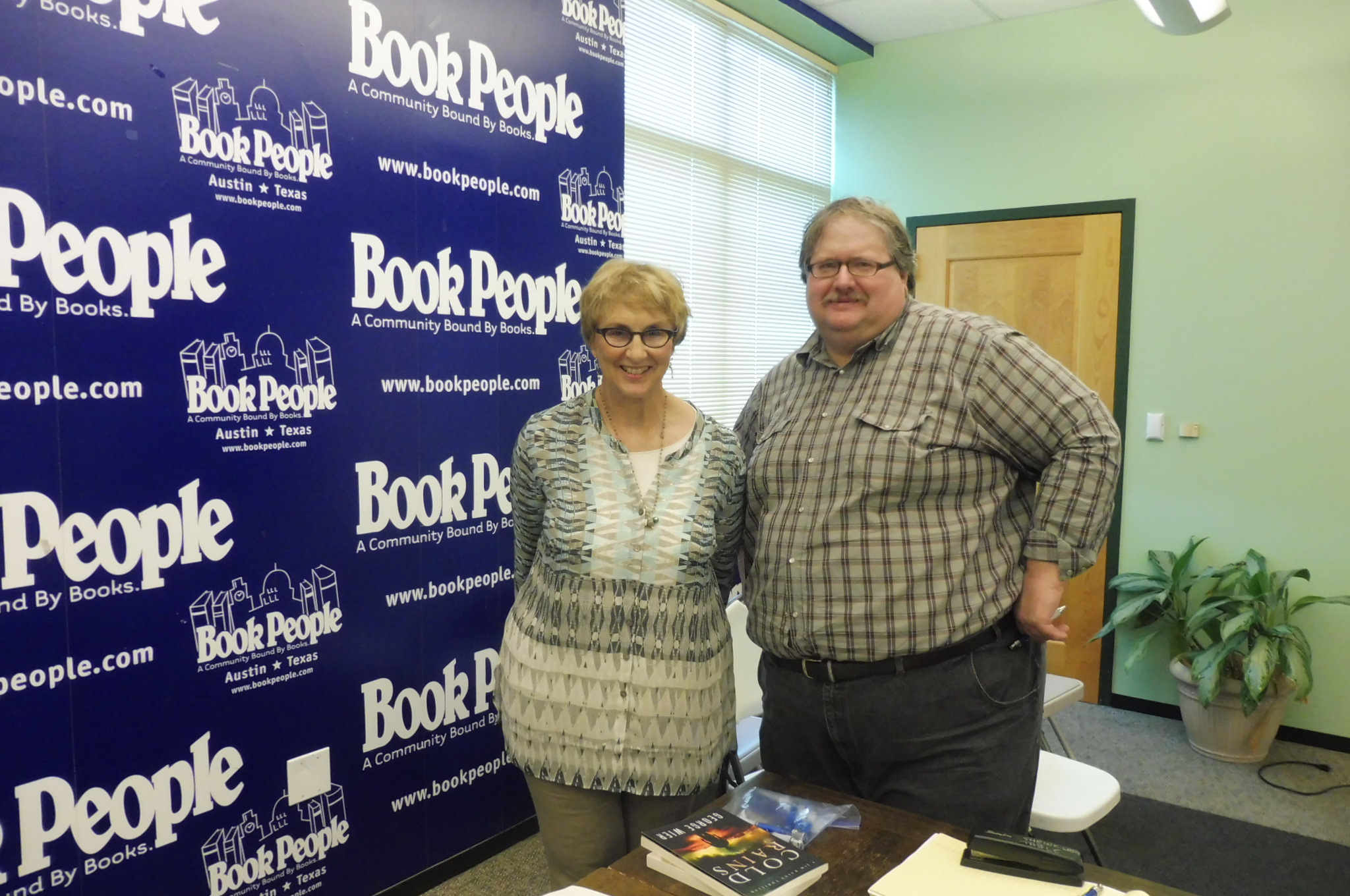
Terry and Scott


I’d like to say thank you to Book People and Scott Montgomery of Mystery People for hosting us!


A Brief Malice Domestic Recap

(Kaye George, prolific mystery writer and blogger, has granted us permission to borrow and publish a recap of her “A Brief Malice Recap” from her blog “Travels with Kaye” at http://travelswithkaye.blogspot.com/)


Kaye George at Malice DomesticIt was exhilarating and exhausting, as usual. This year I was there to let people know about two new books of mine that both came out in early April.

Here’s me at Malice Go Round, giving one minute of information on each book. This is an event described as Speed Dating, But with Authors. A pair of authors visits 20 tables of 8-10 people each, staying for 4 minutes and taking 1 minute to change tables. We tell the listeners about our books and give them bookmarks and sometimes other things so they’ll remember us. I paired up with Jim Jackson, James M. Jackson is his author name. His newest book is ANT FARM, in his Seamus McCree series. My new ones are FAT CAT TAKES THE CAKE (by Janet Cantrell) and REQUIEM IN RED (by Kaye George). This event was Friday morning after I checked in Thursday night.

This picture was taken by Patti Phillips when I was at her table.

After Malice Go Round, I walked over to Booeymonger’s with Judy Penz Sheluk, who was at Malice for the first time. This sandwich and salad place is where the Guppies have gathered for lunch ever since the convention moved to Bethesda from Crystal City in Virginia. I got to chat with several Guppies there.

Later that afternoon, I met with my agent, Kim Lionetti. This is the only time I see her face to face, once a year. That night Berkley, my Fat Cat publisher took us out to dinner at The American Tap Room.

Early Saturday, 7:30, was the Sisters in Crime breakfast, where all the Guppies wear boas or reasonable facsimiles. Jan Rubens, who came with Jim Jackson, took this picture of ALL the Gups that attended. After I wore a feather boa one year and threw it away the same day, I wear my chartreuse scarf.

I admit I deflated a bit and stayed in the hotel for lunch, then went to my panel, “Death for Dessert: Sweet Murder” in the afternoon. Our admirable moderator was Nancy J. Parra and the panelists were Kathy Aarons, Maggie Barbieri, me, and Jessie Crocket/Jessica Estevao. We all write cozy mysteries with dessert recipes in the back. We discovered that Jessie is actually the only one of us who is a good cook. This photo was shot by Julie Hennrikus.

I raced to the wine and cupcake reception given by my agency, BookEnds, guided by Terrie Moran, who had also guided me to the dinner the night before. If these people keep guiding me, I’ll never learn how to get anywhere. Actually, I may not anyway, so I’m grateful for that!

Our panel signed books soon after that, then we did a cocktail or so, then the Banquet with the Agatha Awards.

I highly regret that I wasn’t able to make it to the New Authors Breakfast the next morning at 7. I chalked it up to getting older, but I came down with a cold and bronchitis as soon as I got home, so I’ll blame that instead. I’m making plans to hold a mystery conference/convention where nothing starts earlier than 10.

My own camera, as usual, stayed safely tucked inside my suitcase for the whole trip. Someday I’ll take pictures!

Another fun time talking to and seeing so many of my online pals!

Kaye's panel at Malice DomesticBreakfast at Malice Domestic where Guppies wear boas.

(Pictures) Top picture is Kaye George. Second picture is Kaye George’s panel at Malice Domestic, “Death for Dessert: Sweet Murder” (Photo by Julie Hennrikus). Third picture is Breakfast at Malice Domestic, where Guppies wear boas.

Why I’m Not a Journalist

The Good Old Days.

Let’s face it: Were things really that good?

Yes, they were. Those ’70s television sit-coms were the best things ever.

I’m binge-watching The Mary Tyler Moore Show, which ran from 1970 to 1977. It was funny then and it’s just funny now.

One episode isn’t quite as funny as the others, though, because it reflects an aspect of my life I find particularly painful.

First season cast: (left top) Harper, Asner, L...

First season cast: (left top) Harper, Asner, Leachman; (left bottom) MacLeod, Moore, Knight. Last season cast: (right top) Knight, MacLeod, Asner; (right bottom) White, Engel, Moore. (Photo credit: Wikipedia). By CBS Television Uploaded by We hope at en.wikipedia [Public domain], via Wikimedia Commons

It’s the scene in which news writer Murray Slaughter rushes home to operate on an ailing water heater, leaving associate producer Mary Richards to cover for him. If a bulletin comes in over the wire–

No problem, she says. The news is almost over, she says. If a story comes across the wire, I’ll just take it off the teletype machine, type it up, and get it to the anchor desk. It’s easy, she says.

She rolls a piece of paper into her typewriter, just in case.

Then a story comes in: A fire is threatening a munitions plant on the outskirts of town.

Mary tears off the bulletin, sits down at her desk, thinks… and thinks… types a few words…  erases… brushes away the crumbs… thinks… and thinks….

Producer Lou Grant, who’s been leaning over her shoulder, bouncing up and down on his toes, finally grabs the paper, runs into his office, types–like the wind–then flies out just in time to meet anchorman Ted Baxter leaving the studio. The show’s over. He’s already signed off–“Good night, and good news”–and the competition’s 7:00 o’clock news will get the scoop.


Embed from Getty Images

That’s why I’m not a journalist. I’m not Lou. I’m not Murray. I’m Mary.

That, and because as a journalist, I would have to make cold calls: get people on the phone, request interviews, ask questions. I’m not comfortable talking to people I don’t know.

But mainly, it’s because editors would expect me to write fast. I don’t do fast. I’m slower than Mary Richards is. Sometimes getting words on paper requires moaning and weeping and riving of hair.

Looking back I wonder how I got to this point. Not the distaste for talking to strangers–I’ve never liked doing that–but the difficulty with writing.

In the beginning, I loved to write. By the time I was seven, I was writing long letters to grandmothers and aunts and cousins. Once when I was home from school, enjoying ill health, I used my father’s fountain pen to write letter after letter. Another time, I used a pencil with a point so soft and dull I doubt the recipients could read through the smears.

The summer I was eight, I spent June in Central Texas with an aunt and uncle while my mother was in Dallas with my grandmother, who was ill. My father, who remained at home in Del Rio, brought me a present one weekend: a ream of legal-sized paper.


Embed from Getty Images

On a scale of one to ten, most children would have rated a ream of paper at minus 3. I gave it a twelve and used it to produce my own newspaper. Mostly I reported weddings in the cat and dog community. I described bridesmaids’ dresses worn by Blackie and Bootsie and Kitty and my fox terrier, Pat Boone. It was a devastating little parody of a small-town newspaper. That summer, I was a journalist.

Fairchild Mill Grindstone

Fairchild Mill Grindstone (Photo credit: Wikipedia)

But things changed. Writing stopped being easy. It stopped being fun. It became a millstone ’round my neck. It became nose-to-the-grindstone work. I turned into Mary Richards, thinking, typing, thinking, thinking, typing, erasing, thinking…

How did that happen? I suspect it had something to do with school and English classes, and writing pieces I didn’t want to write, on topics I knew nothing about. And having to outline before I wrote.

There’s nothing that strangles the free flow of words onto the page than having to organize your thought before you’ve had any.

Portrait of E. M. Forster by Dora Carrington I...

Portrait of E. M. Forster by Dora Carrington Italiano: Ritratto di E. M. Forster di Dora Carrington (Photo credit: Wikipedia)

A lifetime later, I discovered novelist E. M. Forster’s remark on the relationship between writing and organizing: “How do I know what I think until I see what I say?”

In other words, if you can write an outline, you’ve already written the piece in your head. 

But I didn’t know that then. I didn’t know it doesn’t have to be right the first time. I didn’t know I could just start writing and, that way, find out what I knew and what I thought before I tried to put those thoughts in order.

I didn’t know Nancy Peacock would one day write, “If I don’t have the pages I hate I will never have the pages I love.”

I didn’t know all I had to do was lighten up.

Now I’ve lightened a bit, and so has the millstone. When I write for my personal blog, I’m fluent–unless I’m trying to be serious, weighty, and profound.

English: Original caption:"NASA Remembers...

English: Original caption:”NASA Remembers Walter Cronkite. Legendary CBS newsman Walter Cronkite speaks in February 2004 at a ceremony at the National Air and Space Museum in Washington honoring the fallen astronauts of the STS-107 Columbia mission. (Photo credit: Wikipedia)

I do not do profound. I think profound, but I write shallow. I wish it were otherwise, but, to quote Walter Cronkite, that’s the way it is.

Some things haven’t changed, however. I will never fit in the little journalism box. I don’t write fast. I don’t want to strike up conversations with strangers. And the only facts I want to deal with are ones I make up myself.

So that’s why I’m not a journalist.

That’s why I write fiction.

Writers of fiction have deadlines. But they don’t have Lou Grant leaning over them, fidgeting while they think and delete and rewrite and delete and rewrite…

Writers of fiction–especially we pantsers, who write by the seat of our pants–can see what they say before they know what they think.

Sorry, Mary Richards, but that’s the way it is.

*

The Mary Tyler Moore Show, “Room 223”: Mary takes a journalism class
(Resolution isn’t great, but the show is.)

Other high points:

The Mary Tyler Moore Show, “Chuckles Bites the Dust: Chuckles the Clown goes to a parade dressed as a peanut, and an elephant… But it’s okay to laugh.

The Mary Tyler Moore Show, “The Lars Affair”: Sue Ann Nivens closes an oven door in a way formerly unknown to man.

I don’t understand the legalities of putting these programs on Youtube, but as long as they’re there, I’ll assume it’s okay to link to them. Enjoy.

*

P. S. I don’t like being interviewed either. I always tell reporters to be sure they make me sound intelligent. One young lady told me she didn’t have to fix anything because I talk in complete sentences. I told her that was strictly accidental.

*

–Posted by Kathy Waller