Writers, Readers and Unexpected Detours

–By Laura Oles

I’m a little out of practice being part of a crowd. This last year has taken me down some unforeseen roads, avenues that are only now leading back to some normal semblance of my daily life.

More on that in a minute.

Speaking of crowds, I recently attended Malice Domestic (a mystery readers and writers conference) and also served as a speaker at an event at a gorgeous library in the Texas Hill Country town of Kerrville. May has meant time talking with readers about the stories they loved, connecting with other writer friends whose work I admire, and basking in the joy that is having endless conversations about the nuances of storytelling, structure, and world building.

Yes, I’m still willing to have the plotter/pantser debate. Also, I’m pro Oxford comma.

As I get my groove back attending writing conferences and other book events, I realized something.

I missed these people.
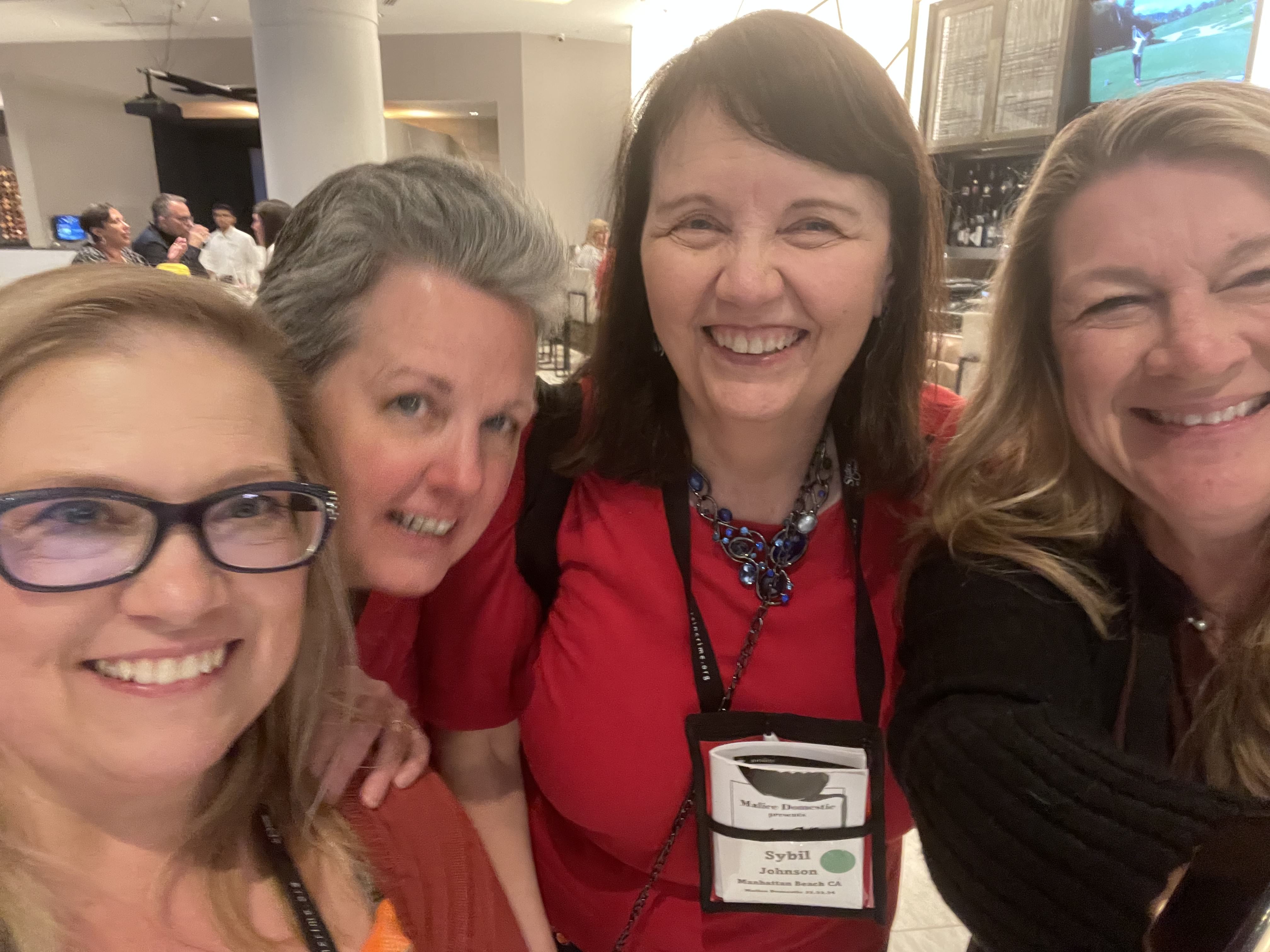
Not only as a writer but also as a reader. Reading has always been an important lifeline for me, especially in my youth when I was moving almost every year to a new school as part of an Air Force family. But books were a particularly important part of my survival toolbox once 2022 kicked down my door. It was the works of many talented authors that supported me, in part, through this last year.

Let me explain with a small detour about a big topic:

My younger sister had a horrific beginning to 2022, starting with a perfect storm of medical events culminating in her experiencing (according to one of her many doctors) “too many strokes to count.”  She then fought her way through an entire year of re-learning to do everyday things, learning to do some things differently, and keeping her razor-sharp sense of humor intact. I was grateful that I was able to spend weeks at a time with her during her hospital stays and then assisting in adjustments to being at home as she reclaimed her life. I’m sure I smothered her with too much attention and hovering, and I’m grateful that she trusted me enough to be a part of her recovery. 

Did I mention that she was also pregnant at the time? As a surrogate? (The baby is, remarkably, completely healthy, and lovely.)  And then she needed to have open-heart surgery? My sister is a fierce force of nature. Her recovery has been astounding, hard won, and also complicated in many ways. She has shared her story far more eloquently than I ever could—it’s her story after all. She’s also a gifted writer.

While many people have followed her incredible journey—and she has been so graciously open with the difficult details of her recovery—this is the first time I’ve been able to write about it in any format. For someone who makes a living with words, this last year left me speechless. 

And then towards the end of 2022, I had my own health scare, which required tests, a biopsy and then surgery.  My recovery was a good one, and I was able to enjoy the holidays with my family.  At this point, I wanted nothing more than to see 2022 in my rear-view mirror. When I talked to my sister about how my scar would heal and how visible it would be, she told me, “Be proud of that scar. You earned it.” 

During this last year of medical emergencies and the restless waiting of recoveries, my own writing simply wouldn’t come. I was immersed in traveling, caregiving and trying to keep myself together.  I simply had no space for writing stories—I was too busy living this one—but I did find comfort in reading.  I read short stories, novellas, and novels, grateful for these authors who gave me the gift of their created worlds.  I needed a break from my spinning universe, and immersing myself in a book in the late evening hours gave me respite that, to this day, I know helped me through it all.  

I started this year giving my calendar some serious side-eye, afraid to make any plans for fear of the next crisis to come. But then, while walking down a favorite stretch of beach in Port Aransas with my husband over New Year’s weekend, I spotted a beautiful shell. A lighting whelk, nestled in the sand.  In my twenty-five years of walking that beach, I’ve never come across a shell so lovely.  I took it as a sign that maybe it would be okay to consider better things would come, that being afraid of hope might be energy wasted. That shell sits on my desk as a reminder that the future holds promise as well as challenges.

I resumed making plans for the year, attending conferences, book events and celebrations. Part of me fears declaring such plans to the universe, but then again, if anything happens, I hope my writing community will wait for me until I can return. Until then, I’ll do the best I can with a book on the nightstand.

Sometimes, it’s the little things.

Laura Oles is the award-winning author of the Jamie Rush mystery series. Her debut mystery, Daughters of Bad Men, was an Agatha nominee, a Claymore Award finalist and a Killer Nashville Readers’ Choice nominee. Depths of Deceit, her second novel, was named Best Mystery of 2022 by Indies Today. She is also a Writers’ League of Texas Award finalist. Her work has appeared in crime fiction anthologies, consumer magazines and business publications. She loves road trips, bookstores and any outdoor activity that doesn’t involve running.  https://lauraoles.com

Can I Trust AI Writing Apps?

By K.P. Gresham


I’ve been reading quite a few headlines about the new Artificial Intelligence writing apps that burst onto the scene in November of 2022. Reviews have been mercurial. Some say is the end of our ability to think. Others say it is the savior of our intellectual future.

I’m a curious person, so I decided to give it a go. I joined ChatGPT via chatopenAI.com, and put in the following prompt:

“Compare books by K.P. Gresham and J.D. Robb.”

(Of course, I chose J.D. Robb—she’s my favorite author. Just once I wanted to see my name and her name in the same sentence!)

Here are excerpts from ChatGPT’s response:

J.D. Robb and K.P. Gresham are both authors who write mystery novels, but their books differ in several ways.

J.D. Robb’s books are primarily crime and suspense novels, featuring a recurring cast of characters led by the protagonist, Eve Dallas, a New York City police detective…

K.P. Gresham’s books, on the other hand, are typically set in small towns in Texas and deal with more personal, often domestic, crimes…

Another difference between the two authors is their approach to character development. J.D. Robb’s books are centered around a recurring cast of characters, including Eve Dallas and her husband, Roarke, who are well-developed and have complex backstories that are gradually revealed throughout the series. K.P. Gresham’s books, on the other hand, feature a different set of characters in each novel, with some recurring characters that show up occasionally.

In summary… While both authors are skilled at creating engaging and suspenseful stories, their books differ in terms of genre, writing style, setting, and character development.

Okay! I’ll take that. But there was a hiccup in my info: I do not have a different set of characters in each novel. My mysteries feature Pastor Matt Hayden and his cronies in every book.

I responded to the post: “I thought K.P. Gresham’s books feature Pastor Matt Hayden and his friends and family.”

Excerpts from ChatGPT’s Response:

You are correct, and I apologize for my previous response. K.P. Gresham’s books do indeed feature Pastor Matt Hayden and his friends and family. I was mistaken in my previous response, and I appreciate you bringing this to my attention.

“K.P. Gresham’s mystery novels, including “Murder in the Second Pew,” “Dying for a Change,” and “Murder in the Choir Loft,” are set in the small Texas town of Shady Grove and feature Pastor Matt Hayden as the main character…

Similar to J.D. Robb’s books, K.P. Gresham’s writing style is character-driven and creates a strong sense of place… K.P. Gresham’s books are centered around Pastor Matt Hayden and his family and friends.

In summary, K.P. Gresham’s mystery novels do indeed feature Pastor Matt Hayden and his friends and family, and the books are characterized by a strong sense of place, character development, and personal crimes that occur in the small Texas town of Shady Grove.”

Actually, this is great stuff—for the most part. Except I didn’t write Dying for a Change or Murder in the Choir Loft.

My response? “K.P. Gresham did not write Dying for a Change nor did she write Murder in the Choir Loft. She did write The Preacher’s First Murder, Murder in the Second Pew, Murder on the Third Try and Four Reasons to Die. Her stories do not take place in Shady Grove, but in Wilks, Texas, and Austin, Texas.”

Excerpts from Chat GPT’s Response:

Thank you for bringing this to my attention, and I apologize for my previous mistakes. You are correct that K.P. Gresham did not write “Dying for a Change” or “Murder in the Choir Loft” and that her novels do not take place in Shady Grove, but in Wilks and Austin, Texas.

“K.P. Gresham’s mystery novels, including “The Preacher’s First Murder,” “Murder in the Second Pew,” “Murder on the Third Try,” and “Four Reasons to Die,” are set in small Texas towns and feature Pastor Matt Hayden as the main character. Her writing style is character-driven, with a focus on creating a strong sense of place and developing the personalities and relationships of her characters…

Once again, thank you for correcting my mistakes, and I hope this response provides a more accurate comparison between the books of K.P. Gresham and J.D. Robb.”

That’s my glimpse of Chat GPT. It got the big, important stuff right (i.e. all the J.D. Robb information). When it came to little ol’ me, it needed some important corrections. (Important to me, anyway.)

My takeaway? If you’re using a writing AI, don’t count on it for lesser known info. As a writer, I take my research VERY seriously. I don’t think this technology shows enough promise to depend on everything it says. Is the AI teachable? Yes. Reliable? Not so much.

Stay safe by doing your own research. (Hey—next time I’m going to write a blog on making the “perfect” Old Fashioned adult beverage. Talk about enjoying your research!).

And, as always, keep on writing!


K.P. Gresham, Author

Professional Character Assassin

K.P. Gresham is the award-winning author of the Pastor Matt Hayden Mystery Series as well as several stand-alone novels.  Active in Sisters in Crime and the Writers League of Texas, she has won Best Novel awards from the Bay Area Writers League as well as the Mystery Writers of America.

Click here to receive K.P.’s newsletter and a get a free short story!

Website: http://www.kpgresham.com/

Email: kp@kpgresham.com

Blogs: https://inkstainedwretches.home.blog/

https://austinmysterywriters.com/

In Conversation with John M. Floyd: Short Stories, Long Walks and Words on the Page

By Laura Oles

If you love reading short stories—or writing them—chances are you’ve come across John M. Floyd’s work. John is the author of over a thousand short stories in publications like AHMM, EQMM, Strand Magazine, Mississippi Noir, The Saturday Evening Post, and four editions of Otto Penzler’s best-mysteries-of-the-year anthologies. He is an Edgar finalist, a Shamus Award winner, a five-time Derringer Award winner, and the author of nine books. He is also the 2018 recipient of the Short Mystery Fiction Society’s lifetime achievement award. 

I had the good fortune of sitting next to John at the Bouchercon 2019 anthology Denim, Diamonds, and Death: 50th Year signing.  His story, “The Midnight Child,” precedes mine, “The Deed,” in the anthology, which meant we were also placed together for this event. Getting to know John was, for me, a highlight of the Bouchercon conference. This is a writer who loves the work. Below is our conversation about his career beginnings, his love of short form fiction and his advice to those with an interest in writing short stories.

LO:  I’d love to start with your career at IBM as an engineer. Were you already writing short stories by then or did that come later?

JF: The writing bug bit me in the mid-1990s, while I was working for IBM. I was a systems engineer specializing in finance application (banking) software and traveling a lot, both here and overseas, and it was during some of those times spent alone in hotels, airplanes and airports that I started dreaming up stories. And once I started, I couldn’t stop.

LO:  What drew you to the short story form? And to the mystery genre?

JF: I think my love for short fiction probably came from a childhood of watching those little anthology shows on TV like Alfred Hitchcock Presents and Twilight Zone and One Step Beyond. They had different stories every week, were usually half an hour in length, and often had surprise endings. In a way, each episode was the visual equivalent of a genre short story, and I loved ‘em. As for the mystery genre, I’ve always liked reading and watching crime/suspense stories. 

LO: I enjoyed discovering that you’re also a poet with an impressive collection in print. What drew you to poetry?

JF: Well, I’m one of those poets who isn’t really a poet (and I noet). The poetry I’ve written and sold has mostly been light verse, because I love humor and wordplay. My collection of poems, called Lighten Up a Little, is a book of 300 humorous poems published in places like Ellery Queen’s Mystery Magazine, Writer’s Digest, Grit, Writers’ Journal, Farm & Ranch Living, etc., and are designed primarily to make you smile (and maybe Laugh Out Loud). In the introduction to the book, I pointed out that if you’re searching for enlightenment, inspiration, or the Meaning of Life, you might want to look elsewhere. 

LO:  Many fellow writers marvel at your prolific ability to consistently create compelling tales that draw the reader in. Can you give us a peek inside your process? What does an average day and/or week look like for you?

JF: My process, such as it is, involves first thinking of a plot and then populating it with (hopefully) interesting people to make the story happen. Only when I have the plot in my head (beginning, middle, and end) do I start writing. Be aware, the storyline isn’t set in stone—it might change a bit once the writing starts—but I do like to have that structure firmly in mind before I begin. Then, once the story is on paper, I rewrite and polish it and send it to a market. On an average day I might write several pages, but even when I’m not writing I’m usually plotting stories in my head. The idea/plotting part usually takes a few days or a week, the writing itself takes a couple of days, and the rewriting several more. As soon as I’m done, I usually light a new story up off the butt of the last one, like a chain-smoker, and keep going—and have been doing that for almost thirty years now.

LO: Which short stories by other writers have you read and just thought, “That’s something special.” It would be madness to try to pick only one, but are there certain ones that stayed with you long after you finished reading?

JF: Yes. A few stories I especially like are “Man From the South” by Roald Dahl, “The Last Rung on the Ladder” by Stephen King, “Voodoo” by Fredric Brown, “The Green Heart” by Jack Ritchie, and “The Kugelmass Episode” by Woody Allen. Some of these are long and some very short, but all are great fun to read.

LO: What are you reading right now?

JF: I’m RE-reading a novel by Nelson DeMille called “Wild Fire.” Just before that I read “Blowback,” a political thriller co-written by James Patterson and our mutual friend Brendan DuBois. Both novels are excellent, but don’t tell Brendan—I think he’s already having trouble getting his old hats to fit.

LO: What do you enjoy doing in your spare time? 

JF: What’s spare time? Seriously, though, I like walking, movies, puzzles, and playing with grandkids (we have seven).

LO: What advice would you share with writers who would like to pursue writing short stories for publication?

JF: Read a lot of them, write a lot of them, and DON’T QUIT. I once heard that a professional writer is just an amateur writer who didn’t give up.

LO: Is there anything else you’d like our readers to know?

JF: Yes: Try reading some short stories, especially those in places like Hitchcock and Ellery Queen and Strand Magazine. I love novels too, but there’s just something special about reading (and writing) the short stuff. You might find you like it.

About John:

John M. Floyd is the author of more than a thousand short stories in publications like AHMM, EQMM, Strand Magazine, Mississippi Noir, The Saturday Evening Post, and four editions of Otto Penzler’s best-mysteries-of-the-year anthologies. A former Air Force captain and IBM systems engineer, John is an Edgar finalist, a Shamus Award winner, a five-time Derringer Award winner, and the author of nine books. He is also the 2018 recipient of the Short Mystery Fiction Society’s lifetime achievement award. You can learn more at http://www.johnmfloyd.com 

by Kathy Waller

[The blogger having been rendered incapable of typing with more than five fingers, she repeats a post that appeared on Austin Mystery Writers in 2015.]

*****

. . . it was like taking a vase and setting it down
so hard it shatters . . .

~  Tracy Chevalier

When I taught secondary English, grading essays was my least favorite task. I was happy to read them, but assigning letter grades? I hated that.

I hated judging. I hated trying to determine the difference between a B and an A, or, worse, between a B-plus and an A-minus.

But the worst–the part that made me want to moan like Hamlet’s father’s ghost, “Oh, horrible, oh, horrible, most horrible!”—was listening to students who believed their work merited higher grades: “But I worked so harrrrrrrd.” 

Some had watched classmates complete an entire assignment during a lull in history class and then score A’s. It wasn’t fair.

“Harrrrrrrrrrd” was my signal to say that No, it didn’t seem fair, but that good writing involves more than time sheets and sweat. It’s the words on the page that matter.

Now, to my dismay, I often find myself slipping into student mode. For example, when I submit a chapter to my critique group, or a beta reader, or even a family member, and they find fault, or don’t even mention my genius, I have to restrain myself from wailing, But I worked so harrrrrrrd…

Each time it happens, I repeat to myself the old lecture about time sheets and sweat. I add that whingeing is the hallmark of the amateur.

And I meditate upon Tracy Chevalier.

Chevalier wrote the critically acclaimed historical novel Girl with a Pearl Earring. Her next novel began as a draft written in third person, with small sections in first-person voices of children. The completed manuscript disappointed her.

When I reread the first draft, she says,  I cried at the end. It was boring, dead weight, terrible. Then I looked it over and thought, there’s nothing wrong with the story except the way it’s told.

She found the solution in another contemporary novel:

I had the idea when, just as I was finishing the first draft in third person, I read Barbara Kingsolver’s The Poisonwood Bible, which uses five different voices beautifully. It’s a wonderful book, using multiple voices very successfully, and I thought, “Oh, that’s an interesting technique, I wonder if I should take the kids’ voices I’ve already written and have the three of them tell it.” It just felt right.

The revision was published as Falling Angels, an exquisite novel about a young wife and mother struggling to survive in the rigid, but rapidly changing, social structure of Edwardian England. The book is written in first person, from twelve perspectives, in twelve distinctive voices.

I came across Chevalier’s account when I was just beginning to write fiction and had become obsessed with the work. Writing an entire manuscript, setting it aside, starting all over—it had to be pure drudgery. I couldn’t imagine putting myself through that. 

Later, though, I reread the article and a different passage caught my attention—Chevalier’s description of the rewrite:

I took the draft, and it was like taking a vase and setting it down so hard it shatters, then putting the pieces back together in a different way. I rewrote the whole thing in first person with all these different voices.

That passage doesn’t describe drudgery. Shattering a vase, putting the pieces back together to make something new—that’s a picture of creation, of the excitement and the pleasure and the beauty that accompany it.

I love Tracy Chevalier’s novels and admire her talent. But, on a more personal level, I’m grateful to her for sharing publicly how Falling Angels made its way into print—for reminding me that hard work isn’t synonymous with drudgery, for implying that it’s okay to cry over a bad draft and that perceived failure can turn into success, and for showing that the act of writing itself affords as much pleasure as the spirit is willing to embrace.

And—for tacitly suggesting that no one really needs to hear me whinge about how harrrrrrrrd I work.

It’s the words on the page that matter.

*****

Note: I really do love Chevalier’s novels. In fact, I love Falling Angels so much that during library duty one Saturday morning, I was so intent on finishing the book—just racing toward the climax—that I unlocked the front doors but left the lights in the reading room off, and spent the next ninety minutes parked behind the circulation desk, reading, and hoping no one would walk in and want something. I’m not proud of what I did. It was unprofessional. But patrons were understanding. And I finished the book.

*****

Information about Tracy Chevalier comes from Fiction Writers Review.

*****

Kathy Waller blogs at Telling the Truth, Mainly, and with Austin Mystery Writers. Her stories have been anthologized in Murder on Wheels, Lone Star Lawless, and Day of the Dark, and online in Mysterical-E.

When Words Balk-Take A Walk. Solvitur Ambulando!

by Helen Currie Foster

This week I’ve been in the Land of Stuck. Walking in circles around the kitchen island struggling to come up with the missing scene. My next mystery’s nearly done, but… I’m stuck. Ever been there?

The poetry shelf offers a momentary escape. Billy Collins can always pull me into a poem. Often he’s going for a walk and I can’t help but feel invited. His “Aimless Love” begins:

He’s got me. 

Or “The Trouble with Poetry,” which begins, 

“This morning as I walked along the lakeshore, 

I fell in love with a wren 

and later in the day with a mouse 

the cat had dropped under the dining room table.”

Well, of course there he’s got me. Then again:

“The trouble with poetry, I realized 

as I walked along a beach one night––

cold Florida sand under my bare feet, 

a show of stars in the sky––”

I feel that same cold Florida sand under my right arch, despite the Texas heat outside. 

Another walking poet: Mary Oliver. In Blue Iris, She begins “White Pine” this way:

“The sun rises late in this southern county. And, since the first thing I do when I wake up is go out into the world, I walk here along a dark road.”

Huh. Walking as discipline? Every morning?

Walking’s not just for poets. St. Augustine is often credited with the Latin phrase Solvitur ambulando––“it is solved by walking” (which may have originally been a response to the 5th C. B.C. philosopher Zeno’s concept that we can never actually arrive at a destination). 

According to Ariana Huffington, a number of writers agree about the benefit of walking, including Hemingway, Nietzsche, and Thomas Jefferson. She quotes the latter: “The object of walking is to relax the mind…You should therefore not permit yourself even to think while you walk. But divert your attention by the objects surrounding you”.https://www.baltimoresun.com/opinion/bs-xpm-2013-09-03-bal-solution-to-many-a-problem-take-a-walk-20130830-story.html  Which reminds me of Collins’s wren.

“Solvitur ambulando” was the official motto of the Royal Air Forces Escaping Society, formed in 1946 to help those in former occupied countries during WWII who risked their lives to help RAF crew members escape. https://en.wikipedia.org/wiki/Solvitur ambulando (check out the terrific solvitur ambulando quotes in this article, from Lewis Carroll, Dorothy Sayers and others). I can’t imagine how high the blood pressure of those resistance heroes climbed during such episodes. Mine skyrocketed just reading A Woman of No Importance, Sonia Purnell’s description of the amazing work of America’s Virginia Hall in France during the resistance. Talk about tense moments. So, did the RAF Escaping Society adopt this motto because of the therapeutic value of walking, or because walking can trigger ideas, or solutions? Or both?

Bruce Chatwin (The Songlines, 1986) claimed he learned the phrase from Patrick Leigh Fermor. Fermor himself was quite a walker. He set out, in 1933, at age 18, to walk across Europe from the Hook of Holland to Istanbul and Greece. He tells the tale in Between the Woods and the Water, 1986. 

 I loved this book and Fermor is fascinating (check out his WWII heroics on Crete, including engineering and carrying out the kidnap of the Nazi commander). 

https://www.theguardian.com/theguardian/2011/jun/10/patrick-leigh-fermor-obituary

The English provide walkers with such wonderful public walking paths. My husband and I recently walked the Thames Footpath for several miles along the Thames, over to Bray––yes! Home of the Vicar of Bray! https://en.wikipedia.org/wiki/The_Vicar_of_Bray

In this charming village you can taste amazing smoked salmon at The Hinds Head (where you can read how many times the Vicar changed his denomination to keep his job, back in the religious flip-flops of England’s sixteenth century) and also at The Crown, a pluperfect pub. The Thames Footpath takes you through leafy woods, with views of the rivers, the fields, and occasional historic and mysterious signs (“Battlemead”). It provides boats to watch, ranging from kayaks and paddleboards to elegant near-yachts, festooned with banners for Jubilee, and one incredible ancient polished Chris Craft, casually docked by the restaurant at the Boathouse at Boulter’s Lock by two grizzled old salts. We tried but failed to overhear their intense lunch conversation. Just trying to eavesdrop was imagination-stirring. Where did they come from? Where were they going?

The footpath also led us to the village of Cookham, home of another surprise: the Stanley Spencer Gallery. Spencer, a WWI veteran and Slade School graduate, produced remarkable paintings, sometimes mixing nominally biblical subjects with contemporary life—for example, a resurrection study of Cookham housewives in aprons, climbing out of their graves with surprised faces. https://www.tate.org.uk/art/artists/sir-stanley-spencer-1977.

I thought I remembered Spencer’s name from Virginia Woolf’s diaries and looked it up when we got home. She wrote on May 22, 1934, about Clive Bell, Vanessa Bell (Clive’s wife), Duncan Grant (Vanessa’s lover), and Quentin Bell (Vanessa’s son) “all talking at once about Spencer’s pictures.” In 1934 Spencer was showing six works in the Royal Academy Summer Exhibition…about the time Patrick Leigh Fermor was off in the middle of his big walk.

Other poetic walkers? You’ve already thought of Robert Frost (“Two Roads Diverged…”) and Dante. Dante’s walks take the cake; I mean, the Inferno’s a hell of a walk.

So if walking calms the mind, allows creativity, reveals solutions, why am I revolving around the kitchen island?

Now that I think about it, some ideas have emerged. For instance, how much my extended family loves hiking in the Rockies, with (1) a destination; (2) a well-rounded lunch, including chocolate, in the pack; (3) plenty of water. How it feels to set off, hoping to see (1) moose, or (2) marmots, or (3) ptarmigan. How it feels to walk to the destination, grab a flat-topped boulder, warmed by sun, and have lunch, staring out at the view. Then to walk…downhill. No longer out of breath. Watching your fellow hikers dodging limbs, swinging around switchbacks. Triumphant walkers. And in the meantime, there have been discussions on the trail, conversations about this and that, switching from one companion to another. At the end of the trail, a sense of sleepy satisfaction.

So it’s time to get up early enough for a walk. Get up early enough to beat the Texas sun, and see if my neighbor’s front pasture includes a jackrabbit, or “jackbunny” as some call it. Cause a snort from the deer in the brush.

… Okay. Back from the walk. I think I’ve figured out that pesky bit about the last scene, except for a couple of details. So tomorrow, when the alarm rings—I’m going for a walk. Would you like to come too? I’d love it. We could talk.

More…

Helen Currie Foster lives and writes north of Dripping Springs, Texas, closely supervised by three burros. She’s curious about human nature, human history and prehistory, and why the past keeps crashing the party. She’s currently finishing book 8 in the Alice MacDonald Greer Mystery novel series. Book 7, Ghost Daughter, was named Grand Prize Short List in the 2022 Eric Hoffer Book Awards, and Finalist for Mystery, 2022 National Indie Excellence Awards. Her books are available on Amazon, Kindle, and Audible, and at independent bookstores.She loves to talk with book groups.

Review: Nancy Peacock’s A Broom of One’s Own (A Public Service Repost)

by Kathy Waller

I wrote the following for my personal blog to answer a “challenge.” I intended to post it at the end of September 2009–yes, 2009. But I got all tangled up in words and couldn’t write a thing. Then I intended to post it at the end of October. I still couldn’t write it. I managed to write it after the October deadline.

In the middle of the “process,” I considered posting the following review: “I like Nancy Peacock’s A Broom of One’s Own very very very very very much.”

But the challenge specified a four-sentence review, and I had hardly one, and I didn’t want to repeat it three times.

So there’s the background.

I must also add this disclaimer: I bought my copy of A Broom of One’s Own myself, with my own money. No one told, asked, or paid me to write this review. No one told, asked, or paid me to say I like the book. No one told, asked, or paid me to like it. No one offered me tickets to Rio or a week’s lodging in Venice, more’s the pity. I decided to read the book, to like it, and to write this review all by myself, at the invitation of Story Circle Book Review Challenge. Nobody paid them either. Amen.

*********************************************

Review of Nancy Peacock’s A Broom of One’s Own

I like Nancy Peacock’s A Broom of One’s Own: Words About Writing, Housecleaning & Life so much that it’s taken me over two months and two missed deadlines to untangle my thoughts and write this four-sentence review, an irony Peacock, author of two critically acclaimed novels, would no doubt address were I in one of her writing classes.

She would probably tell me that there is no perfect writing life; that her job as a part-time house cleaner, begun when full-time writing wouldn’t pay the bills, afforded time, solitude, and the “foundation of regular work” she needed;  that engaging in physical labor allowed her unconscious mind to “kick into gear,” so she became not the writer but the “receiver” of her stories.

She’d probably say that writing is hard; that sitting at a desk doesn’t automatically bring brilliance; that writers have to work with what they have; that “if I don’t have the pages I hate I will never have the pages I love”; that there are a million “saner” things to do and a “million good reasons to quit” and that the only good reason to continue is, “This is what I want.”

So, having composed at least two dozen subordinated, coordinated, appositived, participial-phrase-stuffed first sentences and discarding them before completion; having practically memorized the text searching for the perfect quotation to end with; and having once again stayed awake into the night, racing another deadline well past the due date, I am completing this review—because I value Nancy Peacock’s advice; and because I love A Broom of One’s Own; and because I consider it the equal of Anne Lamott’s Bird by Bird; and because I want other readers to know about it; and because this is what I want.

*

I’ve posted this review before both here and elsewhere. I consider the reposting a service to writers. The book is absolutely invaluable, and all writers need to know about it.

***

I blog at Telling the Truth, Mainly. I write crime fiction–have published short stories and am working on a novel. My blog, however, doesn’t have much to do with crime. There I write about anything that comes along. I like to think it’s eclectic, but it’s really just a jumble.

Why I Go to Critique Group

by Kathy Waller

I said to my critique partner this morning, The whole project is stinky it stinks it’s fatally flawed just nothing no hope.

She said, But Chapter 13 is so good so funny Molly is so funny it’s not stinky.

I said, Yes, the first part of chapter 13 and the last part of chapter 13 are funny and very very good but there’s still no middle of chapter 13 and what there is stinks and anyway the other 47,000 words stink except for a few hundred here and there.

And she said, But the middle could be revised and edited it has promise.

I said, But it won’t work because I have written myself into a hole and can’t get out so I have to trash that part and anyway the whole concept stinks.

And she said, NO you can fix it just keep going because I like Molly she’s so funny.

And that is why I go to critique group every blessed week.

*****

Writing is a solitary activity, but most of writing isn’t writing. It’s rewriting, rewriting, and rewriting. And then it’s revising and revising. And editing editing editing. And rewriting again. And . . .

Sometimes it’s whingeing and complaining and eating peanut butter out of the jar with a spoon and buying larger clothes and telling Molly she’s a heartless ***** who doesn’t deserve one paragraph of her own, much less a whole book.

And it’s feeling like a fraud when you tell people you’re a writer and deciding you’d be happier if you gave up and dedicated yourself to French cookery or tatting or riding a unicycle.

But if you’re lucky, it’s also going to critique group and then going home and writing and writing and writing and . . .

Here’s the way Austin Mystery Writers work: We email first drafts, revised drafts, or final (almost) drafts, depending on where we are in the process.

We read all the week’s submissions, then sit around a table–or on one side of a table in front of a monitor displaying partners in little Zoom squares–and talk about what each member has written.

Criticism here doesn’t mean trashing. It means that each member points out what the writer has done well and what she might have done better. Sometimes we suggest examples of better–the “experts” say that’s not proper, but it works for us–and sometimes we simply say what we think doesn’t work so well without elaborating. Sometimes we disagree; one person doesn’t like a word or sentence or paragraph, while another thinks it’s fine. Sometimes we all chime in and discuss ideas.

Then we say, “Thank you.”

Because we’ve become friends during our association, we can say what we think and appreciate what the others say.

We encourage one another.

We also laugh a lot.

Because of AMW, I’ve published short stories and co-written one novella.

Because of AMW, I’ve become a better writer.


I posted “Why I Go to Critique Group” (one time I titled it “Why I Go to Critique Group and Can’t Afford Not To”) on my personal blog on July 9, 2010, when Gale Albright and I were members of the two-person Just for the Hell of It Writers, which was soon swallowed up by Austin Mystery Writers (a consummation devoutly to be wished).

I periodically pull the piece out and repost it.

Because it’s important.

***

Has anyone noticed that the em dash (—) in my posts looks like an en dash (–)? I can’t help it. Sometimes I find an em dash on a grammar website (like now) and copy and paste into my post, but right now I’m just not in the mood. But I’d like picky readers, like myself, to know that I’m aware of the error and wish the platform would correct it,

***

Kathy Waller posts on her personal blog, Telling the Truth, Mainly, http://kathywaller1.com. She’s published the works pictured above, the first three with Wildside Press, the last, co-written with Manning Wolfe, by Starpath. She has finally decided the ancient pre-published book is not stinky and has hopes of finishing it one day. If her critique partners agree.

Judging a Book by Its Cover

By K.P. Gresham

“Good cover design is not only about beauty… it’s a visual sales pitch. It’s your first contact with a potential reader. Your cover only has around 3 seconds to catch a browsing reader’s attention. You want to stand out and make them pause and consider, and read the synopsis.”
― Eeva Lancaster, Being Indie: A No Holds Barred, Self Publishing Guide for Indie Authors

Of course, the opposite is capsulized in a familiar quote, “Don’t buy the book by its cover.” BUT, if an author wants to sell their book, they’d better face some marketing facts.

A book cover sells the book. At least it’s the first thing to catch the readers’ gaze as they wander through the shelves of a bookstore, library or click through bookseller websites. Yes, of course the blurb on the back is incredibly important, but it’s the cover the buyer sees first. It’s the cover that makes that buyer turn the book over and read the blurb.

Think about it. If the cover grabs you, you’ll pick up (or click on) the book. If it’s blah, chances are you’re going to move on to the next book.

Now what exactly in the cover image grabs you?  Does the cover tell you the genre? What to expect? Look professional? I’m a mystery writer, so I’m looking for a cover that not only says it’s a mystery, but what kind of mystery it is. Here are some examples.

Cozy Mysteries—The readers are looking for lightheartedness, as well as any of the tropes associated with cozies: animals, home-town-feel, food, maybe even a graphic image (cartoon) suggesting any of the above. They do NOT want to see brutality.  For example, here’s the cover for Arsenic and Adobe by Mia Manansala. Note the cartoon-like quality, the dog, the happy homemaker and the bottle of poison. All of these elements tell the reader this book is a mystery, homey, and involves cooking. (And don’t forget the dachshund on the shoulder!) Cozy readers love these signals. Yes, they’re going to turn the book over to learn more about it.

Horror Mysteries–Here the prospective buyer is looking for dark, scary elements. The cover should promise there will be blood and violence in the book. Body parts are great. The titles alone should give the reader the chills. The Mosquito Man by Jeremy Bates is a perfect example. Yikes!!!

Suspense Mysteries–Again, we start with the fact the reader wants to KNOW this is mystery. Suspense is a tricky cover. How does one put the feeling of suspense on a cover?  In a dramatic work, suspense is the anticipation of the outcome of a plot or the solution to a puzzle, particularly as it affects a character for whom one has sympathy. How do you put that in an image? There are different ways to achieve this in a cover. Location. Lighting. Showing action or giving a subtle clue; having the feel that there’s something risky going on. For this example, I’m going with Louise Penny’sAll The Devils Are Here. Here, the silhouetted building against a dark sky evokes mystery, and the Van Gogh-like swirls in the night sky suggest to the reader that there’s more to this book than simply being set in Paris. It suggests depth of plot.

These are only 3 basic categories of mysteries. Consider how the covers are created that show the true crime category? The thriller category? The paranormal mysteries category? Then study your own reaction when you’re checking out the mystery sections in your favorite bookstore or online. The only thing I can think of on a cover that would hook you more than the lay-out or artwork is the author’s name. If you have a favorite author (and yes, that for me is still J.D. Robb), I’ll buy the book without even looking at the cover. But like I said, that’s the only thing I can think of that would sway a buyer more than the visual impact of the cover.

So authors, beware! Readers are judging books by their covers! To our beloved readers, take your batch of three seconds, go book-shopping and buy some books!!!

   K.P. Gresham, author of the Pastor Matt Hayden Mystery series and Three Days at Wrigley Field, is a preacher’s kid who likes to tell stories, kill people (on paper, of course!) and root for the Chicago Cubs. Born in Chicago and a graduate of Illinois State University, K.P. and her husband moved to Texas, fell in love with not shoveling snow and are 35+ year Lone Star State residents. She finds that her dual country citizenship, the Midwest and Texas, provide deep fodder for her award-winning novels. A graduate of Houston’s Rice University Novels Writing Colloquium, K.P. now resides in Austin, Texas, where she is the president of the Sisters in Crime Heart of Texas Chapter and is active in the Writers League of Texas and Austin Mystery Writers.

Where to Find Me

Website: http://www.kpgresham.com/

Email: kp@kpgresham.com

Blogs: https://inkstainedwretches.home.blog/

https://austinmysterywriters.com/

Facebook: https://www.facebook.com/kpgresham

Books by

K.P. Gresham

Three Days at Wrigley Field

The Pastor Matt Hayden Mystery Series

The Preacher’s First Murder

Murder in the Second Pew

Murder on the Third Try

Coming in 2021

Four Reasons to Die

And Over. And Over. And . . .

by Kathy Waller

I’m thinking it over.

— Jack Benny

A curse on this week’s post. I banged out nearly 2,000 words that should have been online yesterday, and the post just gets longer and longer, and there ain’t no way I’ll get it finished and revised and edited and polished today, or this week, or possibly by New Year’s Eve 2022. I know the problem. Too much thinking. But I can’t help that. So I’ve pulled up something I wrote for my personal blog in 2010. I’m reposting, with some changes. I’d like to say it’s outdated, but nothing much has changed. No matter what the last line says.

*

In one of my favorite scenes from the Mary Tyler Moore Show, assistant TV news producer Mary Richards suggests that writing a news story isn’t all that difficult. News writer Murray Slaughter disagrees.

Then a wire comes in, something big. The story must be written and rushed to anchorman Ted Baxter, who is on the verge of uttering his sign-off:  “Good night, and good news.”

Murray, smiling, bows to Mary.

Mary rolls a sheet of paper into her typewriter. She types several words. Then she stops. She erases. She starts over. She stops. She erases. She starts over. She stops . . . Everyone in the newsroom stands around her desk, watching . . . waiting . . .

Finally, at the last minute, Murray loads his typewriter and, fingers flying, writes the story, rips the paper from the machine, and hands it to producer Lou Grant, who runs for the anchor desk.

That’s why didn’t go in for journalism. I’m not Murray.

I’m Mary.

That, and because I knew that if I were a journalist, I would have to talk to people: call them on the phone, request interviews, ask questions. I had no intention of talking to people I didn’t know.

But mainly, editors would expect me to write without thinking.

I look back and wonder how I got to that point. Not the distaste for talking to people I didn’t know—I’ve always had that—but the difficulty with writing.

When did I start letting my editor get in the way of my scribe?

Once upon a time, I loved to write. By the time I was seven, I was writing long letters to my grandfather and great-aunts and aunts and uncles and cousins. Once, I used a pencil with a point so soft, I doubt the recipients could read through the smears on the pages.

Another time, when I was on sick leave from school, enjoying the mumps, my mother let me use my father’s Schaeffer White Dot fountain pen, a source of even better smears.

The summer I was eight, I spent June in Central Texas with Aunt Laura and Uncle Joe while my mother stayed in Dallas with my grandmother, who was ill. My father, who remained in Del Rio working, visited one weekend and brought me a present: a ream of legal-sized paper.

I don’t know what prompted the gift, and on a scale of one to ten, most children would have rated a ream of paper at minus 3. I gave it a twelve.

I wrote my own newspaper. Most articles covered weddings between various cats and dogs of my acquaintance. I discovered a talent for describing tuxedos and bridesmaids’ dresses worn by Blackie and Bootsie and Miss Kitty and Pat Boone (my fox terrier). It was a devastating little parody of a small-town newspaper.

But suddenly, it seemed, I did what my thesis adviser, years later, warned me not to do: I got tangled up in words. Writing was no longer fun. Confidentially, I think it had something to do with English class, essays, outlines, and needing to sound erudite. I hated it.

Why I thought should teach English, I do not know.

Well, I do. Professor Ken Macrorie said English majors think they’ll be paid to read books.

It was years before the English Teacher Establishment (Macrorie was part of the shift) said, “You can’t write an outline until you know what you’re going to say, and you can’t know what you’re going to say until you’ve written something.”

Novelist E. M. Forster had said it long before: “How can I know what I think till I see what I say?” But education always lags behind.

Anyway, the word to both students and conflicted teachers (aka me) was—Write it and then fix it. And lighten up.

When I write blog posts, I don’t think so much. I lighten up. Words flow.

Unless I’m trying to be serious and sincere and profound and erudite. I’m not a profound writer. I think profound, but I write shallow. It’s in my nature.

And I still can’t imagine squeezing myself into the little journalism box. That’s pressure. And talking to people I don’t know. I’d rather make up the facts myself. Can’t do that in journalism. Journalism matters.

I don’t like talking to journalists, either. I always tell them to be sure to make me sound intelligent. A reporter told me she didn’t have to fix anything in my interview because I talk in complete sentences. I told her that was an accident.

Now. It’s way past my deadline for putting up this post.

But that is not of paramount concern. Because I’m not trying to say anything worthwhile.

I have lightened up.

*

“I’m thinking it over.” Forty seconds of perfection. (If the video doesn’t play, google “jack benny i’m thinking it over”. That should work.)

*

Image of Mary Tyler Moore cast via Wikipedia. Public domain.

*

Kathy Waller has published stories in anthologies Murder on Wheels: 11 Tales of Crime on the Move; Lone Star Lawless: 14 Texas Tales of Crime; and Day of the Dark: Stories of Eclipse; and online at Mysterical-E. She blogs at Telling the Truth, Mainly.

She is still amazed at how long it takes to write a blog post, even when she isn’t thinking.

Tipper: My Manager Extraordinaire

by K .P. Gresham

I suspect most of us have our secrets about how we survived the Pandemic of ’20-’21. Video games, binge-watching movies, reading like a fiend–you get the idea.

My secret was my dog, Tipper. Or should I say my manager. Tip’s a fifteen-pound rescue dog of the Chihuahua meets Terrier variety. Nobody wanted to adopt him because he has bad knees. Really? I’ve had two knee replacements and nobody ever threw me out on the street. Tipper came home to live with me and my better half, Kevin, that very day. 

Now, eight years later, it is my dog who has rescued me. Or should I say bosses me around. Thanks to him, I have the next installment of the Pastor Matt Hayden Mystery Series, Four Reasons to Die, later this summer. 

This is the schedule Tip put me on from the pandemic’s git-go. First, he begins his slow process of waking–this entails laying beneath the bed covers for at least a half hour after Kevin and I are already up, then he slowly rises like a ghost from the grave because the sheets trail after him as he fights his way out of bed, and finally, he spends another half hour under the bed to avoid the rising sun. His last half hour of officially waking iup is spent in my lap while I finish my morning pot of coffee.

And then he jumps down from my lap, game face on. Enough lolly-gagging on my part. Time to get to work.

We start our day with a three-mile walk. Tip has decided this is the amount of time it takes for me to chew through the scene I have to write that day. When we come home, he demands breakfast, then shoos me upstairs to my office to get to work. No shower. No breakfast. It’s work time. To make sure I stay at it, he takes up residence on the small couch in my office and does not leave it until he hears my husband (who during Covid works in his office downstairs) making lunch. Then Tipper jumps down from the couch and scratches at my leg to tell me to take a break. But does he come downstairs with me? Oh, no.  He goes back to his couch where he waits for fifteen minutes while I make my lunch and put some tidbits in his bowl. THEN, he comes down.

I finally get my shower after lunch–remember, he doesn’t let me take it before since he’s sure I will forget what I’ve decided to write during our walk. Only then does he allow me to return to my office to get back to work.

At 4:00, Tipper believes our work for the day is done. This is the time when, pre-pandemic, my neighbors and I used to get together to watch Jeopardy. We couldn’t, of course, during the Pandemic, but Tipper never got the memo. At 4:00, we’re supposed to close up shop. I oftentimes decide to keep on working until Kevin was done with his day, and Tipper thinks this is sacrilege. He leaves his couch to sit by my feet and growls as I type away. He believes its against his contract to work such long hours and has threatened several times to call Animal Rescue to arrest me.

I didn’t understand how serious he was about his managerial duties until he started wearing a tie to work. And proofing everything I write. And working on his own stories.

Lord help me, they’ll probably be better than mine…

Thank goodness for my little Tipper. I wouldn’t have made it through the Pandemic without him.

Coming Soon (Thanks to Tipper)!

Four Reasons to Die

The 4th Book in the Pastor Matt Hayden Mystery Series

 When Pastor Matt Hayden steps up to give the Texas Inaugural Ceremony’s benediction after the scheduled minister, Reverend Duff, disappears, he finds himself embroiled in a religious war, a political power-grab, and murder.

 The missing Duff, a progressive leftist, is locked in a bitter, public battle with the ultra-conservative Reverend Meade. Duff has also taken on U.S. Senator Womack, a far-right Presidential hopeful whose only love is himself.

 Matt joins the search for the missing pastor, but is he prepared to discover the true evil that threatens his family, including the new governor…and his beloved Angie?

***

Where to Find Me

Website: http://www.kpgresham.com/

Email: kp@kpgresham.com

Blogs: https://inkstainedwretches.home.blog/

https://austinmysterywriters.com/

Facebook: https://www.facebook.com/kpgresham

Books by K.P. Gresham

Three Days at Wrigley Field

The Pastor Matt Hayden Mystery Series

The Preacher’s First Murder

Murder in the Second Pew

Murder on the Third Try