When people talk about Bouchercon, especially in New Orleans, they usually share stories of late nights, legendary meals, bustling crowds, powdery beignets, and lots of alcohol.
That wasn’t my week.
But the funny thing is—I still accomplished exactly what I went to do.
My panel, Wide Open Spaces, with Craig Johnson, Bruce Borgos, Jeff Ayers, George Wilhite, and moderated by the lovely Sylissa Franklin was a highlight. The conversation flowed, and the audience was engaged. I made them laugh a few times and even got a gasp. So, mission accomplished. I walked away feeling like I’d contributed something worthwhile.
I also got to meet Clay Stafford in person and thank him for publishing my short story, Under The Blackjack Tree, in Killer Nashville Magazine. (The story that was chosen by John Grisham and Otto Penzler for The Best Mystery Stories of the Year 2025, which is still surreal to me. (Coming out next week!) Stafford’s keynote, The Story That Saved Me, was “cry for crime writers and readers to remember why stories of darkness and redemption still matter—and why telling the truth on the page can save us, too.” Honestly, it was one of the most inspiring talks I’ve heard in a long while. Glad I went.
Another highlight was finally meeting Otto Penzler in person. I thanked him for the opportunity, and he graciously signed my copy of the anthology. A small moment, but one I’ll carry with me.
At the end of most days, I met up with Laura Oles in the hotel/lounge bar. (It was so noisy all of the time!) We compared notes at the end of the day—who we’d seen, what panels had sparked ideas. She was on a terrific panel herself, Dialogue Matters: Slang, Concise, or Verbose? The group dug into how dialogue can reveal character and control pacing, which is something that I’m always working on.
I also loved being in the audience for Sweet Tea with a Splash of Crime: The Southern Influence, with Ace Atkins, S.A. Cosby, and other writers who captured both the grit and taste of Southern literature, and where it’s headed. Another standout was Killing Your Darlings, with Penzler and Donald Maass, which was a sharp reminder that ego doesn’t belong in the editing room if the goal is to make the story better.
And one of my favorite unexpected moments? Donald Maass allowed me to join him for lunch one afternoon. We had a thoughtful conversation about Writer Unboxed, an organization we’re both part of, about writing in general, and drawing inspiration from real life,. It was simple but memorable, the kind of connection that lingers long after the conference ends.
So no, this wasn’t a Bouchercon of big parties or long nights on Bourbon Street. But it was a Bouchercon where I hit my goals, connected with people who matter to me, and left with a few new insights and ideas. Sometimes the quieter wins are the ones that last.
Have you ever researched something—like a purse, a computer, or even a car—only to suddenly notice it everywhere, even though you hadn’t before? Inspiration for stories works the same way.
One of the most common questions authors hear is: “Where do you get your ideas?” The answer: pretty much everywhere—news articles, books, movies, history, snippets of conversation, personal experiences… inspiration can spark from the smallest detail.
I’m currently writing a historical novella, and inspiration is coming from all directions. I feel like a goalie in a soccer match—I’m fully immersed.
Story Settings and Characters
My protagonist is a young woman named Martha. She’s married to Tom, who has moved her far from home—and life isn’t unfolding as she expected. (Isn’t that always the case? But is it simply the way things are, or is something nefarious at work?) They’re building a cabin in the East Texas woods around 1830. I imagined they’d arrived at the tail end of the Old 300, grabbing land wherever they could. (Although the story could take place anywhere from 1820 to 1880, west of Virginia in pine country, I discovered that pines aren’t as widespread as I once thought—which is why research matters.)
As I write, Martha is revealing herself to me—like she exists on another plane and there’s a conduit between us through something I call “the ether,” a metaphysical space. (Is that a real thing? I don’t know—dammit, Jim, I’m a writer, not a metaphysicist!) Her voice is growing stronger. Her past and current life are becoming clearer. When she speaks, it feels like she’s speaking directly at me. I think most writers go through this—and when it happens, it’s exhilarating. To me, it means the character will have depth and feel real.
And, as in the past, there have been “signs” that I’m on the right track with characters and story. Sometimes these signs are even eerie. In the first chapter, when it was new and amorphous, I was writing a dream sequence to explain her inner thoughts, worries, and where she’s from. I imagined she came from a large family, and she had had a brown and white dog named “Peaches”.
A few days later I was on Facebook and came across this picture. It caught my attention because a cabin is a major feature of the story, and I took a screenshot for inspiration to look at details. Later I read the description. Look at what I circled. That’s right! I wasn’t too surprised by the date. But the dog in the picture was name “Peaches”! And it looks brown and white to me. It gave me inspiration that I’m on the right track with the story and characters.
Another time, while writing my (currently unpublished) novel Gilt Ridden, I created a character in West Texas, educated and obsessed with gold, known locally as “The Professor,” living in a dugout. Years later, I came across a local-history book about Stonewall County describing a man known as “The Professor” who lived in a dugout and searched for gold. I hadn’t known he existed—but the parallels were uncanny. At first, I worried that people would think that I borrowed someone’s real story. But then it comforted me. I took it as a sign that I had created a realistic character from imaginary circumstances.
So when you’re writing—or working on any project—block out the world and tune in to the voice or idea coming from the ether. Who knows what will be revealed?
Bonus Content
I’ve been obsessed with one song lately. It’s been playing in my head nonstop for a week. I didn’t know much about it until I watched the YouTube video. The character is pregnant and contemplating life choices, just like Martha! Now it’s really stuck in my head. Hope you enjoy it:
Sara Bareilles – “She Used to Be Mine” (from Waitress)
Today’s post is by our friend and former Austin Mystery Writer Kaye George, author of several successful mystery series. When I asked Kaye to do a guest post, I told her to pick her own topic. She’s chosen to write about her newest project, a departure from the mystery.
***
Kathy Waller gave me free rein, so I can write whatever I want here, right? Okay, okay, I’ll stick to writing about writing.
My latest project is foremost in my mind. SOMEONE IS OUT THERE came out in April, but it’s still getting noticed, which makes me so happy. I’ve done several mystery series, cozies and traditional, but got it into my head one day that I could write a suspense novel. It does kinda make sense, since I love to read them.
I’m trying to remember where the first seed for this came from, but I don’t really know, now that it’s done. I do know what went into it. I wanted to use a disaster that occurred in Ohio when we lived there. We lived in Dayton for about six years and, one day when the sky looked ominous and my husband was on the golf course, a disaster struck Xenia, a small town nearby—a town we used to drive to for chopping down our Christmas trees on a farm nearby. A vicious tornado struck the town in 1974, killing and injuring many, and wiping out, obliterating at least half of that town. That year they had what they called the 1974 Super Outbreak, one of the worst tornado seasons in US history. I figured it would make a good backdrop to a tense story.
To be honest, I also fed in some of the stories the people in Wichita Falls told me about the similar disaster they had there in 1979. We lived outside that town in Holliday years after that, but the people who had gone through it had vivid memories of every second. We had our own experiences there, too. Our second night in Holliday, there was a straight line windstorm with 90 mph winds that took off many roofs and caved in the school gymnasium, which had just been evacuated, fortunately. The night we moved out, a tornado touched down a mile away.
Anyway, enough about storms. I also needed to work up some stormy characters. I used my knowledge of nursing (from my mother, who was a nurse, and from my nurses’ aide experience) to create my main character. Unbeknownst to me, I used subconscious knowledge to create her name, Darla Taylor. I had a good portion of the book written when I realized I have a Facebook friend named Darla Taylor! I had used her name! I was mortified, and messaged her about it. She was actually okay with that, so I kept going. And gave her a copy when the book was finished. She liked it and reviewed it! Whew!
Stalking seemed like a scary thing to build the plot on, so I did that, keeping the identity of the stalker hidden until the end. I threw in my son’s family dog, Henry, a big chocolate lab (and renamed him Moose), and gave Darla a hobby of archery, since I used to love doing that.
You can see that so much of the book came from my life, because, where else would it come from? Although I have never been stalked. And hope it never happens.
Kaye George is an award-winning novelist and short-story writer. She writes cozy and traditional mysteries, a prehistory series, and one suspense novel, which is her seventeenth book. Over fifty short stories have been published, mostly in anthologies and magazines. A horror story will come out in 2026. With family scattered all over the globe, she makes her home in Knoxville TN. You can find out more here: http://kayegeorge.com/
Before we had powerful computers in our pockets or on our laps, we had reference books. . . shelves and shelves of them.
One of my favorite possessions is a vintage Webster’s dictionary, published 1956 – when I was 10 years old. All 11-plus pounds of the five-inch-thick book teeter on a top shelf in my office. I can no longer safely lift it and the pages are laid out in three columns of typeface so tiny that my aging eyes strain to make out the words.
My book is a holdover from the days when library dictionaries were housed and opened on a specialized wooden lectern. I wonder, do libraries still have these throwbacks to that bygone day or have the enormous books all made their way to the shredder?
I never look at mine that I’m not reminded of the 1950s movie, Born Yesterday, starring Judy Holliday. She won an Oscar for her portrayal of the brassy girlfriend of an uncouth tycoon. Her character tries to overcome her limited education and rudimentary vocabulary by reading, among other texts, Alexis de Tocqueville’s Democracy in America. In one of the more humorous scenes, she struggles to make meaning of the archaic text and is advised to simply check the dictionary if she encounters any words she doesn’t understand. The increasingly frustrated Holliday would no more than read a sentence before she is up again, consulting a dictionary. Word by word. Trip by trip. Written today, the scene would surely lose its charm since she would likely be reading Tocqueville on a Kindle where all you must do is press and hold a finger on a word for the meaning to flash before you.
Like Holliday with a Kindle, writers don’t have the need for shelves full of reference books since language prompts are everywhere from the demons in autocorrect to the drop-down menus in word processing programs that produce synonyms.
The 19th Century French author Jules Renard is credited with saying, “What a vast amount of paper would be saved if there were a law forcing writers to use only the right word.
Yet, finding the right word isn’t always so easy even with all our modern assets. Luckily there are still some reference sources to help. Here are a few:
Evan Esar’s “20,000 Quips & Quotes: A Treasury of Witty Remarks, Comic Proverbs, Wisecracks and Epigrams.” If she’d thumbed through this one, Holliday would have learned that Tocqueville said, “The last thing a political party gives up is its vocabulary.”
“The Allyn & Bacon Handbook” by Leonard J. Rosen and Laurence Behrens. You must love any book that is willing to devote 22 pages to the uses and misuses of the comma alone.
Theodore M. Bernstein’s “Dos, Don’ts & Maybes of English Usage.” For instance, he explains why Mark Antony didn’t say “Friends, Romans, countrymen, loan me your ears.”
“Describer’s Dictionary: A Treasury of Terms & Literary Quotations,” by David Grambs and Ellen S. Levine. It indexes illustrative passages of more than 600 authors from travel writer Paul Theroux to contemporary British novelist Zadie Smith.
Eli Burnstein’s “Dictionary of Fine Distinction Book,” offering a humorous look at often misused words and phrases. For instance, couch vs. sofa.
Valerie Howard’s “1,000 Helpful Adjectives for Fiction Writers,” promises to spice up characteristics, qualities or attributes of a noun when a writer is having trouble capturing just the right word.”
Bill Bryson’s “Dictionary of Troublesome Words: A Writer’s Guide to Getting it Right” sets out to decipher the idiosyncrasies of the English language. Things such as 126 meanings of “set” when used as a verb and another 58 when used as a noun.
Brian Shawver’s “The Language of Fiction: A Writer’s Stylebook.” Need to be reminded when to use a comma or semicolon? Shawver’s there to help.
Kathy Steinemann’s “The Writer’s Lexicon: Descriptions, Overused Words, and Taboos.” Among other things, she offers writers cures for overused modifiers (I’m talking about you “very”).
John B. Bremner’s “The Columbia Dictionary for Writers: Words on Words.” Here you can learn the history of H. L. Mencken’s inspiration for coining the term “ecdysiast” to replace “striptease.”
Christine Lindberg’s “The Oxford American Writer’s Thesaurus.” Writing about bread? How about a baker’s dozen choices: dal, pita, rye, naan, tortilla, focaccia, ciabatta, challah, corn, sourdough, pumpernickel, baguette, etc.
“Associated Press Stylebook and Briefing on Media Law” has been found on the desk of every journalist for decades since it dictates uniform rules for grammar, punctuation, style for capitalization and numbers, preferred spelling, abbreviations, acronyms, and such.
“Words, words, words,” is the sarcastic response Hamlet gave when Polonius asked him what he was reading. Fortunately, authors still have no shortage of excellent reference books to help them find the right ones.
***
A former political reporter in Austin, Dixie also taught writing at Syracuse University. When she teamed up with Sue Cleveland to write fiction, they sold a screenplay to a Hollywood producer. Although the movie was never made, the seed money financed ThirtyNineStars, their publishing company. Through it they published two award-winning thrillers (Shrouded and Digging up the Dead) under the pen name, Meredith Lee. Dixie’s first solo mystery was Bloodlines & Fencelines, set in a tiny Texas town near Austin. Kirkus reviews described the book as, “A twisty whodunit that’s crafted with care and saturated with down-home Southern charm.” She is working on second mystery in the series. www.dlsevatt.com
O villain, villain, smiling damned villain. . . That one may smile, and smile and be a villain. — William Shakespeare
Lately I’ve felt as if I have a sesame seed stuck between my molars. Except instead of an annoying seed, it’s an idea I can’t let go of. It started when a group of fellow writers were talking about overuse of certain pat descriptors to express emotions. “Smiled” is a common culprit. Now I’m haunted when I read my copy. Why are my characters always smiling? What kind of smile is it? Nervous smile, a smile to mask confusion, fake smile, cold-as-ice smile, snide smile, crooked smile, challenging smile, weak smile, infectious smile or just a plain old vanilla grin?
I can’t unsee the way I fall back on dull and overused expressions such as “she smiled,” instead of taking the time to ask myself, what underlying emotion is the character feeling? How can I describe that emotion so the reader understands it in a precise and fresh way? How can I eliminate all that superfluous smiling that goes on in my copy and instead home in on the intended emotion? In other words, when my characters smile, what emotion am I trying to communicate? Unless writing a picture book an author has only words to create an image in the reader’s mind.
My new-found fixation on smiling is now creeping into not only my writing but also into books I’m reading. Sometimes a smile is understood without the word being used as in The Frozen River by Ariel Lawhon. “Good humor stretches out from the corners of Ephraim’s eyes in the form of crow’s feet, and I realize he has lightened my mood on purpose.” Sometimes the smile is expressed unambiguously as in My Brilliant Friend by Elena Ferrante. “She made a half smile of contempt that meant: Marcello Solara makes me sick.” Or this from Vera Wong’s Unsolicited Advice for Murderers by Jesse Q. Sutanto. “They are sort of smiling, but the smiles are heavy and apologetic. . .these aren’t the kind of smiles you give when you have good news to share. They’re the kinds of smiles that know they’re about to ruin someone’s life.”
The scholar Paul Ekman has identified 18 common types of smiles with disparate meanings: the fixed polite smile (I really don’t know what to say); the embarrassed smile (I don’t know anyone); the tight-lipped relieved smile (oops, that was a close call); the exhausted smile (happiness after a long race); the sadistic smile (it particularly exudes evil); the exasperated smile (annoyance); the compliant smile (it will be over soon); the diplomatic smile (a “professional” smile); the ecstatic smile (life is wonderful); the exaggerated smile (imitation of joy, a little forced); the worried smile (the situation is really awkward); the contemptuous smile (one is secretly a bit spiteful); the ironic smile (welcome to sarcasm); the fake smile (to hide an emotion of weakness); the delighted smile (in front of a baby); the warm smile (that of a mother encouraging her child); the meditative smile (Buddha-like, filled with compassion); and the amorous smile (I adore you).
Ekman’s work was the basis of the American crime drama Lie to Me, in which an expert in facial expressions, tone of voice and body language uses his skills to help law enforcement uncover the truth.
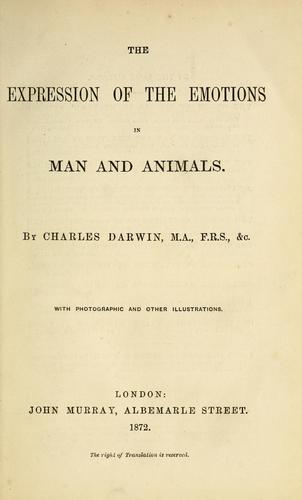
We have Charles Darwin in his 1872 book (Expressions of the Emotions: Man and Animals) to thank for one of the earliest scientific studies of human emotions. What is important for writers is that he also offered analysis of the body language — facial movements, gestures, sounds, and the physiological changes — that go with different emotions.
Conrad Veidt in character as Gwynplaine from the American film The Man Who Laughs (1928).
William Shakespeare wrote more than two hundred years earlier than Darwin, about the trap of the hidden meanings behind a smile. For instance, Hamlet confronts the lie hidden in a devious smile when he realizes his stepfather, King Claudius, murdered his father, saying “O villain, villain, smiling damned villain. . .That one may smile, and smile and be a villain.” The notion of a misleading smile is something Shakespeare first visited in Act 4 of Julius Caesar, when Octavius says, “And some that smile have in their hearts, I fear. . . millions of mischiefs.”
Fortunately there are any number of guidebooks to help writers navigate this tricky smile business. Among them are S.A. Soule’s The Writer’s Guide to Character Expressions and Emotions; Valerie Howard’s Character Reactions from Head to Toe; Kathy Steinemann’s The Writer’s Lexicon: Body Parts, Action and Expressions; and The Emotion Thesaurus by Becca Puglisi and Angela Ackerman. Jordan McCollum’s three-part posting on the subject of avoiding overused “gesture crutches” is also helpful.
These sources may also help writers avoid a second trap: overdoing tired descriptors to convey emotions. The conversation with other writers that set in motion my fixation on smiles was triggered by an article in which Mark Twain praised his friend, William Dean Howells. Twain minced no words about what he saw as overuse of empty stage directions to convey meaning while praising Howells as a master in the use of body language to describe thoughts and emotions without the need to be repetitive. “Some authors overdo the stage directions, they elaborate them quite beyond necessity; they spend so much time and take up so much room in telling us how a person said a thing and how he looked and acted when he said it that we get tired and vexed and wish he hadn’t said it at all,” Twain observed. He said directions such as “laughed” are worked to the bone when the author has given the character nothing to laugh about.
The lesson? Be clear about what kind of smile you intend but also give the character something to smile about.
***
A former political reporter in Austin, Dixie also taught writing at Syracuse University. When she teamed up with Sue Cleveland to write fiction, they sold a screenplay to a Hollywood producer. Although the movie was never made, the seed money financed ThirtyNineStars, their publishing company. Through it they published two award-winning thrillers (Shrouded and Digging up the Dead) under the pen name, Meredith Lee. Dixie’s first solo mystery was Bloodlines & Fencelines, set in a tiny Texas town near Austin. Kirkus reviews described the book as, “A twisty whodunit that’s crafted with care and saturated with down-home Southern charm.” She is working on second mystery in the series. www.dlsevatt.com
Image of Tim Roth at the 2015 San Diego Comic Con International in San Diego, California. The Hateful Eight panel by Gage Skidmore, CC BY-SA 3.0 , via Wikimedia Commons
Image of actor Conrad Veidt in character as Gwynplaine from the American film The Man Who Laughs (1928). Universal Pictures, Public domain, via Wikimedia Commons
Image of book cover, Charles Darwin, Public domain, via Wikimedia Commons
I’ve got a secret. So many books I have NOT read. You’d be shocked. No, really. My husband (retired business professor) admires Tolstoy, especially Anna Karenina. He’s read most of Dickens and every word of Moby Dick–several times. When we were dating he bought Baudelaire’s Les Fleurs du Mal (English translation) because he’d seen it on my shelf. He knows I’m hung up on Virginia Woolf; he’s read Three Guineas. He’s read reams of history—shelves and shelves, plus tome after tome on Richard Feynman and everything that’s going on with astronomy and quantum physics. He forges onward, aiming for the stars at the edge of the universe.
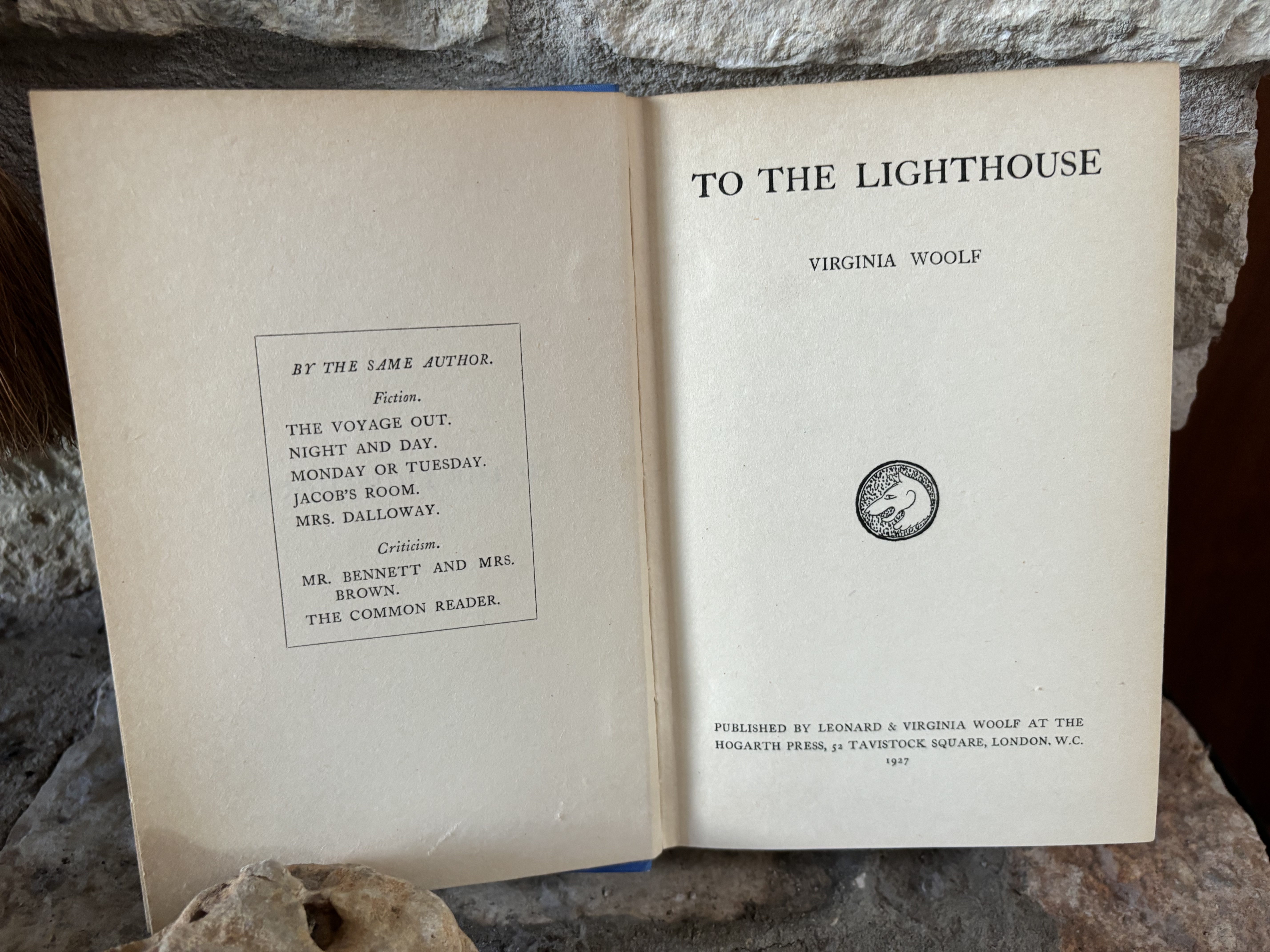
I, however, the English major, the mystery writer? I who should have read All The Books? I confess a powerful secret vice: rereading my favorites, particularly Virginia Woolf. Every year, To the Lighthouse sneaks back into my hand. Why? Why not concentrate only on the new novels, the best-sellers?
Because I have to reread that moment in Part III when, years later, after world war and illness have claimed her beloved friend Mrs. Ramsay and so many of the Ramsay family, the spinster Lily Briscoe returns to the Ramsays’ summer home on the Isle of Skye. https://bit.ly/3zHF77w
Out on the lawn, facing the old white house, she sets up again the unfinished oil painting she began all those years earlier—the painting that had posed such a challenge in Part I as her mind reverberated with the repeated mantra from Professor Ramsay’s obnoxious male philosophy student: “Women can’t paint, can’t write.” During the long day, full of changing light on the sea, and repeated interruptions by other characters, Woolf returns us over and over to Lily, staring at her painting, seeing again the remembered shapes of Mrs. Ramsay and her son James all those years ago. And her artistic effort? Here’s the end of the book:
“It would be hung in the attics, she thought; it would be destroyed. But what did that matter? She asked herself, taking up her brush again. She looked at the steps; they were empty; she looked at her canvas; it was blurred. With a sudden intensity, as if she saw it clear for a second, she drew a line there, in the centre. It was done; it was finished. Yes, she thought, laying down her brush in extreme fatigue, I have had my vision.”
Why do I return to that? So much of the book is touching, gripping, and even hilarious, including the thoughts of Professor Ramsay, a philosophy professor who’s both overbearing and insecure. He delights in his own “splendid mind”: “For if thought is like the keyboard of a piano divided into so many notes, or like the alphabet is ranged in twenty-six letters all in order, then his splendid mind had no difficulty in running over those letters one by one, firmly and accurately, until it had reached, say, the letter Q. …Very few people in the whole of England ever reach Q.” Then he falters. “But after Q? What comes next? After Q there are a number of letters the last of which is scarcely visible to mortal eyes, but glimmers red in the distance.” He braces himself, clenches himself. “Q he was sure of. Q he could demonstrate. If Q then is Q—R—” Then “he heard people saying—he was a failure—that R was beyond him. He would never reach R.”
What an image—the alphabet, R glimmering red in the distance, then fading, fading! And then of course there’s the famous dinner party featuring Mrs. Ramsay’s boeuf en daube. Surely, just reading this, you smell the simmered sauce, the wine, the bay leaf? The thought crossed my mind that if Professor Ramsay had been offered a sip of the Talisker malt whiskey for which Skye is famous, he’d have felt a bit better. https://www.malts.com/en/talisker (The distillery gives a great tour, too.)
But Lily’s painting? This spinster friend of Mrs. Ramsay, with her amateur brushstrokes? The tale of Lily’s painting, her decision and indecision as she holds her brush, grabbed me all those years ago, and refuses to let go. The same question must hit every musician—“Is this the last note? Did that chord resolve properly? Does it make you feel beauty and longing, or does it just hang there, unfinished?” Every cook: “A pinch of salt? What about some coriander? To garlic or not to garlic?” Every filmmaker: “Do they walk into the sunset? Or fade out? Or kiss?” And every writer? “Is this character real? Is this setting compelling? Does the plot work? And will anyone care?”
Lily’s painting embodies desire to capture memory, resistance, light and color, and more than that. Isn’t it her experience? A moment of creation, of recapture, of making a line on a canvas and then feeling completion? She’s had her vision. If you know of another book where we readers feel such a moment of revelation from the frustrating process of creation—let me know.
Oh, don’t get me wrong. My Kindle received today the brand-new Martin Walker (A Grave in the Woods) and I can’t wait. bit.ly/3Xzqawt Like the other women in his (busy) life, I love to accompany Inspector Bruno, in his fictional Perigord village of St. Denis, partly because of his cooking. Thank you, Martin Walker, for describing the ham hanging from the kitchen ceiling, the cheerful chickens, and the paté with its duck fat on top, waiting in Bruno’s fridge, and the way Bruno sings La Marseillaise to count how long until he must sizzle the foie de gras before he deglazes the pan. I look forward to new recipes and to finding out who’s buried in the woods.
And a sad farewell: I’ve decided to forgive Elly Griffiths for saying goodbye to Ruth Galloway in her last book in that series, The Last Remains, even though I have loved watching Ruth clamber down into a trench to dig up ancient bones in East Anglia. amzn.to/3ZxU5rv I’ve also savored every page of Alan Bradley’s latest (last?) Flavia de Luce – What Time the Sexton’s Spade Doth Rust – as he allows this delightful protagonist to feel herself beginning to grow up—not too much, not too fast, just enough. https://bit.ly/4dla13A
And I did just finish We Solve Murders, Richard Osman’s first book in a new series. bit.ly/4ezjIwh Have to confess I found myself missing Joyce, Ibrahim, Ron, Elizabeth and the other characters of his Thursday Murder Club books. My strong belief is I must careabout a mystery protagonist and so far I haven’t completely bought in to his new cadre–though I do like Steve. We’ll see. I’d be interested in your reactions.
So that’s four new mysteries, just in September. I’m also rereading Virginia Woolf’s The Waves, and finding even more, yes, even more to love about how she brings those characters to vivid life, and how she describes the way we humans think and react to each other.
And out here with the three burros I’m writing the tenth in my Coffee Creek series featuring Alice MacDonald Greer and the gorgeous landscape of the Texas Hill Country, with its pristine (well, so far) bluegreen streams. Water’s for fighting over, right?
But when the going gets tough, you may find me sidling back to the revolving bookcase, on the shelf where Virginia Woolf and all the old faves hang out.
Helen Currie Foster lives and writes north of Dripping Springs, Texas, loosely supervised by three burros. She’s drawn to the compelling landscape and quirky characters of the Texas Hill Country. She’s also deeply curious about our human history and how, uninvited, the past keeps crashing the party. Latest in her award-winning series: Ghost Bones.
Today’s post comprises two parts–a bit of fiction followed by a bit of fact–linked by a “fleshy, spore-bearing fruiting body of a fungus” and a mystery writer who used it as a murder weapon–and later confessed to something even worse.
I.
The following flash fiction was inspired by a photo prompt on Friday Fictioneers, a weekly writing challenge sponsored by Rochelle Wisoff-Fields.
John frowned. “Toadstools. Fungi. Dorothy Sayers killed someone with Amanita.“
“These are morels.” She added salt. “Everybody eats mushrooms.”
“I don’t.”
“Suit yourself.”
He sat down. “Where’d you buy them?”
“I picked them.”
“You?“
“Aunt Helen helped. She knows ‘shrooms.” Mary held out a spoonful. “Taste.”
“Well . . . ” John tasted. “Mmmm. Seconds?”
“Yoo-hoo.” Aunt Helen bustled in. “See my brand new glasses? Those old ones–yesterday I couldn’t see doodly squat.”
Mary looked at the gravy, then at John. “Maybe you should spit that out.”
II.
The following is a guest post I wrote for Manning Wolfe’s Bullet Books Speed Reads blog. In it, I explain what an author does when she doesn’t have a clue about the subject she’s writing about.
There are many rules for writers. Two of the major ones: Write what you know and Write what you love.
I was pleased that Stabbed, which I co-wrote withManning Wolfe, was set in Vermont. I love vacationing there: mountains and trees, summer wildflowers and narrow, winding roads, rainstorms and starry nights, white frame churches and village greens.
In Chapter 1, Dr. Blair Cassidy, professor of English, arrives home one dark and stormy night, walks onto her front porch, and trips over the body of her boss, Dr. Justin Capaldi. She locks herself in her car and calls the sheriff. The sheriff arrives and . . .
What happens next? Vermont is a small state. Who takes charge of murder investigations? The sheriff? Or the state police? What do their uniforms look like? Where do major rail lines run? What’s the size of a typical university town? And a typical university? What else had I not noticed while driving through the mountains?
Not knowing the answers, I defaulted to a third rule: Write what you learn. Research. Research. Research. The best mystery authors have been avid researchers.
Agatha Christie, for example, is known for her extensive knowledge of poisons. As a pharmacy technician during World War I, she did most of her research on the job before she became a novelist. Later she dispatched victims with arsenic, strychnine, cyanide, digitalis, belladonna, morphine, phosphorus, veronal (sleeping pills), hemlock, and ricin (never before used in a murder mystery). In The Pale Horse, she used the less commonly known thallium. Christie’s accurate treatment of strychnine was mentioned in a review in the Pharmaceutical Journal.
Francis Iles’ use of a bacterium was integral to the plot in Malice Aforethought.His character, Dr. Bickleigh, serves guests sandwiches of meat paste laced with Clostridium botulinumand waits for them to develop botulism. If Dr. Bickleigh had known as much about poisons as his creator did, he wouldn’t have been so surprised when his best-laid plans went, as Robert Burns might have said, agley.
Among modern authors, P.D. James is known for accuracy. Colleague Ruth Rendell said that James “always took enormous pains to be accurate and research her work with the greatest attention.” Before setting Devices and Desiresnear a nuclear power station, she visited power plants in England; she even wore a protective suit to stand over a nuclear reactor. Like Christie, James used information acquired on the job—she wrote her early works during her nineteen years with the National Health Service—for mysteries set in hospitals.
Most authors don’t go as far as to stand over nuclear reactors to be sure they get it right, but even the simplest research can be time-consuming.
And no matter how hard they strive for accuracy, even the most meticulous researchers sometimes make errors.
Dorothy L. Sayers was as careful in her fiction as she was in her scholarly writing. But she confessed in a magazine article that The Documents in the Case contained a “first-class howler”: A character dies from eating the mushroom Amanita muscaria, which contains the toxin muscarine. Describing the chemical properties of muscarine, Sayers said it can twist a ray of polarized light. But only the synthetic form can do that—the poison contained in the mushroom can’t.
Considering Sayers’ body of work, this one “howler” seems a very small sin, and quite forgivable.
Most readers, however, don’t forgive big mistakes, and reputable writers don’t expect them to. Thorough research is a mark of respect for readers.
Sometimes, getting the facts straight in fiction has real-life consequences the author can’t predict. Christie’s The Pale Horse is credited with saving two lives: In one case, a reader recognized the symptoms of thallium poisoning Christie had described and saved a woman whose husband was slowly poisoning her; in a second, a nurse who’d read the book diagnosed thallium poisoning in an infant. The novel is also credited with the apprehension of one would-be poisoner.
Back to Stabbed—Well, we don’t expect it to save lives or help catch criminals. But doing my due diligence and reading up on Vermont’s railways, demographics, and criminal procedure set the novella on a sound factual footing.
Unlike Christie, Iles, and Sayers, however, I didn’t have to expend too much effort learning about how the murder weapon worked. One look at the book’s title and–well, d’oh–no research needed.
M. K. Waller (Kathy) is a former teacher, former librarian, former paralegal, and former pianist at various small churches desperate for someone who could find middle C.
She writes crime fiction, literary fiction, humor, memoir, and whatever else comes to mind.
She grew up in Fentress, population ~ 150 in 1960, on the San Marcos River in Central Texas, the Blackland Prairie, and memories of the time and the place inform much of her fiction.
Except for the part about murders. Fentress didn’t have any murders. At least any that people talked about.
The following post appeared on my personal blog, Telling the Truth, Mainly, in April 2022. But the story of my writing process is always worth a retelling. Please read on.
*************
Sometime back in the 1930s, my grandmother picked up the telephone receiver just in time to hear the Methodist minister’s wife, on the party line, drawl, “I am just wo-ahn out. I’ve been waterin’ the yahd.”
To those not in the know, the statement might not seem funny, but my family has its own criteria for funny. And so those two sentences entered our vernacular.
They were used under a variety of circumstances: after stretching barbed wire, frying chicken, mowing the lawn, doing nothing in particular.
My father would fold the newspaper, set it on the table, and announce, “I am just wo-ahn out. I’ve been waterin’ the yahd.”
I am wo-ahn out now but not from waterin’ the yahd.
Putative novel 2022
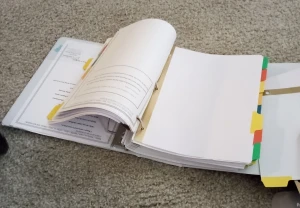
Last night David, the family’s official printer, printed the manuscript of what I’ve been calling my putative novel. It runs to over two hundred pages, 51,000 words. It isn’t finished—far from it. There’s more to write, scenes to put in order, clues and red herrings to insert, darlings to kill. All that stuff. And more.
However, for the first time it feels like I can stop calling it putative. No longer supposed, alleged, or hypothetical. It’s looking more like a potential novel. Possible, Even probable.
Now, about being wo-ahn out.
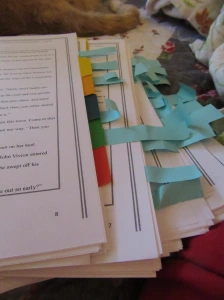
Last night I started putting the manuscript, scene by scene, into a three-ring binder. That required using a three-hole punch.
I hate using three-hole punches. I hate fitting the holes in the paper onto the binder rings. They never fit properly. Getting them on the rings requires effort. It’s tiring.
When I went to bed, I was all the way up to page 37.
Then I woke at 5:30 this morning. Instead of turning over and going back to sleep, I got up. I just couldn’t wait to get back to organizing my manuscript.
But I didn’t organize. I managed to drop the whole thing onto the floor and then couldn’t pick it up. (I’d had knee surgery and wasn’t quite up to bending over that far.) I had to wait for David.
Putative novel 2022-2024
By the time the notebook and manuscript were back in my possession, I was sick and tired of the whole thing. I played Candy Crush.
If I’d had any sense at all, I’d have gone back to bed. I was sleepy. I felt awful. I needed to sleep.
But did I go back to bed? Noooooooooooooooooooooo. That would have been the act of a rational person.
I stayed up added to my sleep deprivation.
I could go to bed right now. I could conk out and tomorrow feel ever so much better.
But will I? No. Because I’m too tired to stand up, too tired to put on my pajamas, too tired to pull down the sheets.
I am just wo-ahn out. I’ve been waterin’ the yahd.
***
Things have changed since 2022. Some days, the novel has reverted to putative, but on most days, it’s still possible. Thanks to extensive revision, the current draft bears little resemblance to the one in the notebook. I have given up three-ring binders and three-hold punches.
***
M. K. Waller’s latest story, “Mine Eyes Dazzle,” appears in the eclipse-themed anthology Dark of the Day, edited by Kaye George (Down and Out Books, 2024). Other stories appear inDay of the Dark (Wildside, 2017), Lone Star Lawless (Wildside, 2017), Murder on Wheels (Wildside, 2015), and online on Mysterical-E. She is co-author of the novella Stabbed (Starpath, 2019), written with Manning Wolfe. She also writes as Kathy Waller. She lives in Austin and blogs at Telling the Truth, Mainly.
As a writer, I sometimes find myself struggling through periods of being stuck and working my way out of it. Like that character I locked in the trunk of a car (I’m sorry I did that to you, but I knew you’d escape somehow), I’m having to rethink my tactics.
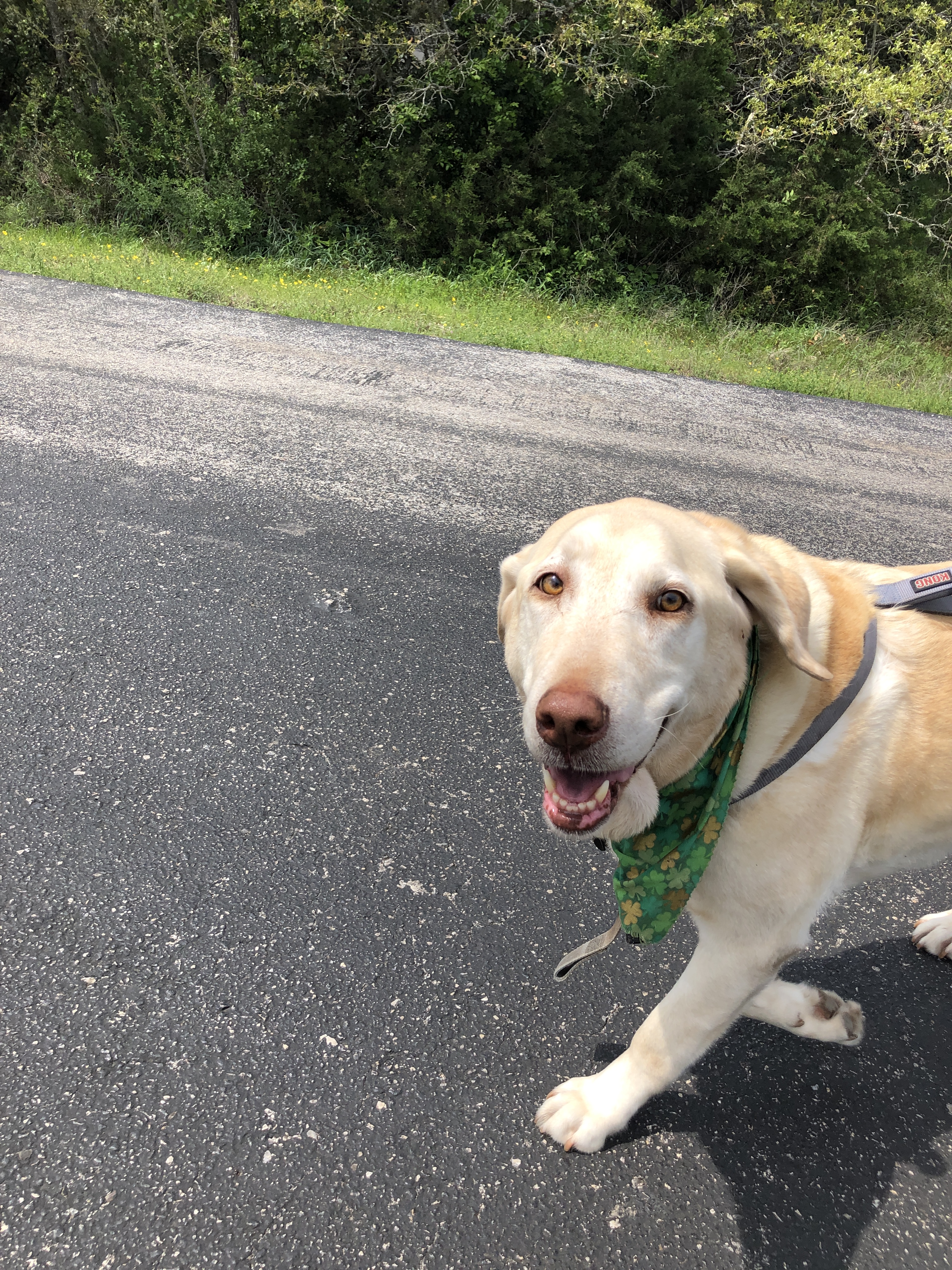
One of my most effective methods of getting unstuck no longer works. My first line of defense, until recently, was to take my Labrador Retriever for a good long walk. I’d bounce ideas off her and she’d pretend to listen as she considered whether she could catch a nearby deer, road runner or squirrel (no, no and no). My sweet pup has recently left this world, and her absence in conjunction with the triple digit Texas heat has meant my walks just aren’t as appealing as they once were.
The truth is that we all get stuck. Sometimes we get in our own way. Thankfully, there are strategies to get out.
In a recent episode of Hidden Brain, a podcast hosted by Shankar Vedantam, Shankar interviews psychologist Adam Alter about how musicians, writers and other professionals dig themselves out of their performance holes. The epic writers block that plagues George R. R. Martin is discussed, and Martin himself has said of the increasing gaps between each book, “I’ve had dark nights of the soul where I’ve pounded my head against the keyboard and said, ‘God, will I ever finish this?’”
I’m scared, George. If you can’t do it, what hope do I have?
Thankfully, Shanker and Dr. Alter have some solid strategies to offer. For example, Dr. Alter explains how an experiment from behaviorist Clark Hull might help someone struggling with stagnation. The experiment involved mice. I know, I know. How can mice running through mazes help with writer’s block?
Hear them out.
In the beginning of the experiment, the mice moved slowly at first in the maze and then sped up again. Once the goal came into view—exiting the maze–the mice moved more quickly. Dr. Hall labeled this the Goal Gradient. When the end is in sight, the pace picks up. This theory has since been further researched to expose a U-shaped motivation arc. We may start off on a project quickly and then slow down in the middle. Then our pace picks up at the and of a project. Quick. Slow. Quick. Take the example of being in the messy middle of a novel. Too far away from the excitement of beginning a new project and too far away to see the end. It’s like being in the center of the ocean when we’re far away from shore but we can’t see the destination yet.
And there we tread water.
STUCK.
So, how do we combat this?
CREATE SUBGOALS
Dr. Alter uses this technique in his own writing. He recommends taking a large goal, such as writing a novel, and breaking it into smaller sub goals such as completing a scene, writing one chapter, or choosing a small word count to start. “The nice thing about writing a book is that it’s broken naturally into chapters, so already you’ve shrunk those middles down.” He further explains that you can take one subset and further divide it. “I’ve used the tactic of every hundred words when I’m struggling more…I find that I’m shrinking and expanding constantly as I’m writing a book.”
Dr. Alter sets a timer for a single minute for those times when he’s struggling with a particularly difficult aspect of writing. The idea is to just get back into the rhythm of writing, and each minute will lead to five minutes and then ten. “Each minute is its own goal, its own victory.”
A deadline, a timeline or some other small constraint can push us through our own block. Constraints can bring freedom. And then a breakthrough.
BATTLING PERFECTIONISM
We’re often our own worst enemy.
Musician Jeff Tweedy, front man of Wilco, has described in significant detail his own experiences with writer’s block. One thing he battles the most is perfectionism.
“Perfectionism is paralyzing because what perfectionism signals to you is that unless you produce perfection, you’re failing. The feedback you’re getting is negative feedback and it’s demotivating.”
I feel so seen right now.
But you didn’t fail.
Tweedy says that he battles perfectionism by pouring out the bad material. “Imagine that your ideas are liquids sitting one on top of the other in your head, you’ve got to pour out the bad stuff.” This works because the expectation is that, of course, some of the work each day is mediocre. It’s part of the process but you’re “getting rid of the bad stuff so the good stuff can emerge.”
IT’S NOT JUST YOU
If you’re scrolling through social media and getting the impression that your other author friends are all killing it while you struggle to get five hundred words down, it can feel very lonely. But, chances are all the seats are full on the struggle bus.
“Researchers have found that many of us have a tendency to focus on our own struggles while imagining that others have it easy,” Shankar says. The research shows that most people are stuck sometimes and believe they are the only ones experiencing it. “It’s hidden from view, and it feels lonely,” Dr. Alter says. Psychologists call this “pluralistic ignorance.” The concept centers around the idea that we all walk around thinking a similar thing but believe we’re the only one thinking these thoughts.
Social media can keep us connected but it’s often a highlight reel—it’s usually the very best news each person in your feed has to share. We don’t see the long bouts of struggle, the everyday challenges, the mundane aspects of the creative process. So, while we root for those who have good news to share, we can also remember that there’s much more to their stories.
This Hidden Brain podcast episode covers additional topics, including the deeper issues of how our mind keeps us trapped in certain behaviors. I highly recommend giving it a listen the next time you’re feeling at odds with your creativity. I’m sure I’ll listen to it multiple times, maybe even on a long walk when that time returns.
Getting stuck isn’t some sort of failure or an indication that talent lacks. It happens to many of us. I wish I had a magic potion to share that would banish writer’s block forever. I’d send bottles to all my writer friends with free refills for life.
What I can offer, though, is encouragement, support, and a link to a fantastic podcast episode.
Laura Oles is the Agatha-nominated and award-winning author of the Jamie Rush mystery series. Her work has appeared in crime fiction anthologies, consumer magazines and business publications. She loves road trips, bookstores and any outdoor activity that doesn’t involve running.
In My Reading Life, a grand book about reading and writing, author Pat Conroy says, “The most powerful words in English are ‘tell me a story…’” bit.ly/3PpSoHF
Yes! And don’t we know stories demand––require––insist on characters? Fairy tales––Jack in the Beanstalk, Hansel and Gretel. Epics––The Fellowship of the Ring, Star Wars.
I love the beginning of Emily Wilson’s recent translation of The Odyssey: bit.ly/43Bdjvi
Tell me about a complicated man,
Muse, tell me how he wandered and was lost
When he had wrecked the holy town of Troy…
…Now, goddess, child of Zeus,
Tell the old story for our modern times.
Find the beginning.
So, how do writers create memorable characters? What works to create character? And why do we care? Isn’t it because character drives narrative?
Recall Shakespeare’s famous terse description in Julius Caesar: “Yon Cassius hath a lean and hungry look…” Those ambiguous words reach beyond the man’s shape or facial expression to hint at driving ambition…the very subject which drives the play’s narrative.
How does Jane Austen create character? Looking back, I am surprised by the lack of physical description. She doesn’t tell us what Mr. or Mrs. Bennet, or the five daughters, look like. We’re given a few visual breadcrumbs, told that Bingley and Darcy are “handsome” and that Bingley “wore a blue coat and rode a black horse.” But her characters, with their personalities, their actions, largely come to life in our minds otherwise: by conversation.
Elizabeth overhears Mr. Darcy describing her as “tolerable but not handsome enough to tempt me”—a criticism she later recounts to friends, “for she had a lively, playful disposition.” Okay, there’s one aspect of Elizabeth—lively and playful. Yet after telling friends that Elizabeth “had hardly a good feature in her face,” Darcy “began to find it was rendered uncommonly intelligent by the beautiful expression of her dark eyes.” So she’s also intelligent! Elizabeth tells her sister Jane, “you are a great deal too apt…to like people in general. You never see a fault in any body.” Elizabeth is not just “playful” and “intelligent,” but a critical observer.
Using dialogue––what Elizabeth and Darcy say––Austen shows us how Elizabeth—and ultimately Darcy––think. In a world focused on superficiality—class, wealth, appearance, social skills and niceties––Austen makes us care about two characters who are too smart, too critical, too thoughtful, not to keep thinking and––ultimately––change their minds. Their characteristics (both pride and prejudice!) drive the narrative.
But hey, what about those dark eyes? Mr. Darcy disturbs the haughty Miss Bingley by saying he’s meditating on “the very great pleasure which a pair of fine eyes in the face of a pretty woman can bestow.” As all Austen readers know, that specific detail––“[A] pair of fine eyes”––will also powerfully move the plot.
Texas’s Larry McMurtry shows us how conflict between characters drives narrative. In his Lonesome Dove, the first character we meet is Augustus, sitting on the porch at the Hat Creek Cattle Company, in “the smidgin of shade he had to work with.” He has retrieved his jug from the springhouse and, as is his custom, he’s drinking Tennessee mash whiskey, which makes him feel “feel nicely misty inside.”
We’re in Augustus’s point of view when we meet his counterpoint, the other key character, his stubborn partner Captain Woodrow Call. Augustus, when he hears the whir of a nervous rattler in the corner of the springhouse, believes “in giving creatures a little time to think.” He doesn’t shoot the snake; he waits until the rattler has “calmed down” and crawled out a hole. He contrasts his own behavior to Call’s:
Call had no respect whatsoever for snakes, or for anyone who stood aside for snakes. He treated rattlers like gnats, disposing of them with one stroke of whatever tool he had in hand. “A man that slows down for snakes might as well walk,” he often said.
As Call and their diffident hand, PeaEye, arrive at the porch, Augustus notes that while he himself stands four inches taller than Call, and Pea Eye three inches taller, there’s no way to convince Pea Eye that Call is the short man: “Call had him buffaloed.” Augustus knows that if a man means to hold his own with Call, that man must keep in mind that Call isn’t as big as he seemed. Thus Augustus begins many a day by remarking, “You know, Call, you ain’t really no giant.”
McMurtry doesn’t give us a detailed physical description of Augustus or Call. Instead, we hear them banter. We see Call’s impact on others, and how Augustus works to maintain his own status vis à vis Call. Right off the bat McMurtry makes us feel the sheer force of two characters, two magnetic and conflicting personalities, and their relationship, as we’re launched into this epic tale. Their characters, the combined magnetism and conflict, drive us to Montana…and back…
We first meet Sir Arthur Conan Doyle’s character Sherlock Holmes in A Study in Scarlet, when Holmes is introduced to the narrator, Dr. Watson, as a potential roommate. Watson walks into the lab: “There was only one student in the room, who was bending over a distant table absorbed in his work. At the sound of our steps he glanced round and sprang to his feet with a cry of pleasure. ‘I’ve found it! I’ve found it,’ he shouted to my companion, running towards us with a test-tube in his hand.” Then he shakes hands with Watson: “You have been in Afghanistan, I perceive.” Watson is astonished. bit.ly/3N0U4Ep
We get no actual physical description of Holmes until Chapter Two. Instead, we confront Holmes’s vigor, curiosity, perspicacity, confidence in his own powers. Similarly, in “A Scandal in Bohemia,” Watson first describes Holmes’s “immense faculties and extraordinary powers of observation” in deciphering clues. Then, looking up from the street, Watson sees the detective’s silhouette on the window-shade: “I saw his tall, spare figure pass twice…He was pacing the room swiftly, eagerly, with his head sunk upon his chest and his hands clasped behind him.” Watson instantly knows, “He was at work again.”
The author engraves that image of Holmes, pacing eagerly, on our imaginations. We can’t wait to see Holmes in action: that’s what we’re reading for.
Herman Melville deprives the reader as well as Ishmael, the narrator of Moby Dick, of even one glance at Captain Ahab until Chapter 28, when Ishmael is well out to sea on the whaling ship Pequod. Ahab finally appears on deck and stands erect, holding on by a shroud, his bone peg-leg planted in the auger hole drilled on deck for that purpose:
There was an infinity of firmest fortitude, a determinate, unsurrenderable wilfulness, in the fixed and fearless, forward dedication of that glance. Not a word he spoke; nor did his officers say aught to him; though…they plainly showed the uneasy, if not painful, consciousness of being under a troubled master eye…moody stricken Ahab stood before them with a crucifixion in his face; in all the nameless regal overbearing dignity of some mighty woe.
The word “character” comes from the Greek root for “engraving tool.” https://www.merriam-webster.com/dictionary/character If ever character was engraved on a person’s body, Melville’s description of Ahab and his impact on his shipmates qualifies. The uneasy silence of the officers! The crucifixion in Ahab’s face! His unsurrenderable wilfulness, fixed and fearless!
If that’s not enough foreshadowing, in Chapter 36, Ahab demands the entire crew to assemble and then hammers a gold piece to the mast for the first man who sees the white whale which took off Ahab’s leg—Moby Dick. Starbuck objects: he signed on to hunt whales, not to take vengeance on a mere animal, which he calls blasphemous. But Ahab makes the rest of the crew swear: “Death to Moby Dick!” Melville creates a character whose physical description conveys tragic history and deep emotion, and whose forceful actions persuade the crew to follow him. We know there’s no stopping Ahab now. And we haven’t yet met the whale.
Pat Conroy also tells us, in My Reading Life, of the day his beloved high school English teacher, Greg Norris, took sixteen-year old Conroy to visit the poet Archibald Rutledge. Rutledge “suggested that I make the close observation of nature part of my life’s work and that I learn the actual names of things,” because “specifics always proved fruitful to the validity of any narrative”:
“A Cherokee rose, not just a rose. A swallowtail butterfly, not just a butterfly. That kind of thing,” he said. “Get the details right. Always the details.”
Always a great reminder for mystery writers. My character Alice, in the Alice MacDonald Greer Mystery series––stays on me to get the details right. https://bit.ly/3qC2fzI
So–tell me a story! Show me the character! Get the details! And we’re off!
About Helen Currie Foster
I live north of Dripping Springs, Texas, supervised by three burros. I’m deeply curious, more every day, about human history and prehistory and how, uninvited, the past keeps crashing the party. I’ve loved the Texas Hill Country since my first sight of it as a teenager. Artesian springs, Cretaceous fossils, rocky landscapes hiding bluegreen water in the valleys. After law school (where I grew fascinated with water and dirt) I practiced environmental law and regulatory litigation for thirty years––then the character Alice suddenly appeared in my life. I’m active with Austin Shakespeare and Heart of Texas Sisters in Crime. And I’m grateful to the readers who enjoy the Alice MacDonald Greer Mystery series!



 One of my favorite possessions is a vintage Webster’s dictionary, published 1956 – when I was 10 years old. All 11-plus pounds of the five-inch-thick book teeter on a top shelf in my office. I can no longer safely lift it and the pages are laid out in three columns of typeface so tiny that my aging eyes strain to make out the words.
 brassy girlfriend of an uncouth tycoon. Her character tries to overcome her limited education and rudimentary vocabulary by reading, among other texts, Alexis de Tocqueville’s Democracy in America. In one of the more humorous scenes, she struggles to make meaning of the archaic text and is advised to simply check the dictionary if she encounters any words she doesn’t understand. The increasingly frustrated Holliday would no more than read a sentence before she is up again, consulting a dictionary. Word by word. Trip by trip. Written today, the scene would surely lose its charm since she would likely be reading Tocqueville on a Kindle where all you must do is press and hold a finger on a word for the meaning to flash before you.
 Like Holliday with a Kindle, writers don’t have the need for shelves full of reference books since language prompts are everywhere from the demons in autocorrect to the drop-down menus in word processing programs that produce synonyms.






 In Chapter 1, Dr. Blair Cassidy, professor of English, arrives home one dark and stormy night, walks onto her front porch, and trips over the body of her boss, Dr. Justin Capaldi. She locks herself in her car and calls the sheriff. The sheriff arrives and . . .
 poisons. As a pharmacy technician during World War I, she did most of her research on the job before she became a novelist. Later she dispatched victims with arsenic, strychnine, cyanide, digitalis, belladonna, morphine, phosphorus, veronal (sleeping pills), hemlock, and ricin (never before used in a murder mystery). In The Pale Horse, she used the less commonly known
  Aforethought.
 for accuracy. Colleague
  writing. But she confessed in a magazine article that




 Austin Mystery Writers
