Who Do You Love?

 / AUSTIN MYSTERY WRITERS

Yes, Bo Diddley, https://www.youtube.com/watch?v=e5tSgiB_Tgc but I like the Thorogood version too bit.ly/4gNi38m

I’ve got a secret. So many books I have NOT read. You’d be shocked. No, really. My husband (retired business professor) admires Tolstoy, especially Anna Karenina. He’s read most of Dickens and every word of Moby Dick–several times. When we were dating he bought Baudelaire’s Les Fleurs du Mal (English translation) because he’d seen it on my shelf. He knows I’m hung up on Virginia Woolf; he’s read Three Guineas. He’s read reams of history—shelves and shelves, plus tome after tome on Richard Feynman and everything that’s going on with astronomy and quantum physics. He forges onward, aiming for the stars at the edge of the universe.

I, however, the English major, the mystery writer? I who should have read All The Books? I confess a powerful secret vice: rereading my favorites, particularly Virginia Woolf. Every year, To the Lighthouse sneaks back into my hand. Why? Why not concentrate only on the new novels, the best-sellers?

Because I have to reread that moment in Part III when, years later, after world war and illness have claimed her beloved friend Mrs. Ramsay and so many of the Ramsay family, the spinster Lily Briscoe returns to the Ramsays’ summer home on the Isle of Skye. https://bit.ly/3zHF77w

Out on the lawn, facing the old white house, she sets up again the unfinished oil painting she began all those years earlier—the painting that had posed such a challenge in Part I as her mind reverberated with the repeated mantra from Professor Ramsay’s obnoxious male philosophy student: “Women can’t paint, can’t write.” During the long day, full of changing light on the sea, and repeated interruptions by other characters, Woolf returns us over and over to Lily, staring at her painting, seeing again the remembered shapes of Mrs. Ramsay and her son James all those years ago. And her artistic effort? Here’s the end of the book:

“It would be hung in the attics, she thought; it would be destroyed. But what did that matter? She asked herself, taking up her brush again. She looked at the steps; they were empty; she looked at her canvas; it was blurred. With a sudden intensity, as if she saw it clear for a second, she drew a line there, in the centre. It was done; it was finished. Yes, she thought, laying down her brush in extreme fatigue, I have had my vision.”

Why do I return to that? So much of the book is touching, gripping, and even hilarious, including the thoughts of Professor Ramsay, a philosophy professor who’s both overbearing and insecure. He delights in his own “splendid mind”: “For if thought is like the keyboard of a piano divided into so many notes, or like the alphabet is ranged in twenty-six letters all in order, then his splendid mind had no difficulty in running over those letters one by one, firmly and accurately, until it had reached, say, the letter Q.  …Very few people in the whole of England ever reach Q.” Then he falters. “But after Q? What comes next? After Q there are a number of letters the last of which is scarcely visible to mortal eyes, but glimmers red in the distance.”  He braces himself, clenches himself. “Q he was sure of. Q he could demonstrate. If Q then is Q—R—” Then “he heard people saying—he was a failure—that R was beyond him. He would never reach R.”  

What an image—the alphabet, R glimmering red in the distance, then fading, fading!  And then of course there’s the famous dinner party featuring Mrs. Ramsay’s boeuf en daube. Surely, just reading this, you smell the simmered sauce, the wine, the bay leaf? The thought crossed my mind that if Professor Ramsay had been offered a sip of the Talisker malt whiskey for which Skye is famous, he’d have felt a bit better. https://www.malts.com/en/talisker (The distillery gives a great tour, too.)

But Lily’s painting? This spinster friend of Mrs. Ramsay, with her amateur brushstrokes? The tale of Lily’s painting, her decision and indecision as she holds her brush, grabbed me all those years ago, and refuses to let go. The same question must hit every musician—“Is this the last note? Did that chord resolve properly? Does it make you feel beauty and longing, or does it just hang there, unfinished?”  Every cook: “A pinch of salt? What about some coriander? To garlic or not to garlic?” Every filmmaker: “Do they walk into the sunset? Or fade out? Or kiss?” And every writer? “Is this character real? Is this setting compelling? Does the plot work? And will anyone care?”

Lily’s painting embodies desire to capture memory, resistance, light and color, and more than that. Isn’t it  her experience? A moment of creation, of recapture, of making a line on a canvas and then feeling completion?  She’s had her vision. If you know of another book where we readers feel such a moment of revelation from the frustrating process of creation—let me know.

Oh, don’t get me wrong. My Kindle received today the brand-new Martin Walker (A Grave in the Woods) and I can’t wait. bit.ly/3Xzqawt Like the other women in his (busy) life,  I love to accompany Inspector Bruno, in his fictional Perigord village of St. Denis, partly because of his cooking. Thank you, Martin Walker, for describing the ham hanging from the kitchen ceiling, the cheerful chickens, and the paté with its duck fat on top, waiting in Bruno’s fridge, and the way Bruno sings La Marseillaise to count how long until he must sizzle the foie de gras before he deglazes the pan. I look forward to new recipes and to finding out who’s buried in the woods.

And a sad farewell: I’ve decided to forgive Elly Griffiths for saying goodbye to Ruth Galloway in her last book in that series, The Last Remains, even though I have loved watching Ruth clamber down into a trench to dig up ancient bones in East Anglia. amzn.to/3ZxU5rv I’ve also savored every page of Alan Bradley’s latest (last?) Flavia de Luce – What Time the Sexton’s Spade Doth Rust – as he allows this delightful protagonist to feel herself beginning to grow up—not too much, not too fast, just enough. https://bit.ly/4dla13A 

And I did just finish We Solve Murders, Richard Osman’s first book in a new series. bit.ly/4ezjIwh  Have to confess I found myself missing Joyce, Ibrahim, Ron, Elizabeth and the other characters of his Thursday Murder Club books. My strong belief is I must careabout a mystery protagonist and so far I haven’t completely bought in to his new cadre–though I do like Steve. We’ll see.  I’d be interested in your reactions.

So that’s four new mysteries, just in September. I’m also rereading Virginia Woolf’s The Waves, and finding even more, yes, even more to love about how she brings those characters to vivid life, and how she describes the way we humans think and react to each other.

And out here with the three burros I’m writing the tenth in my Coffee Creek series featuring Alice MacDonald Greer and the gorgeous landscape of the Texas Hill Country, with its pristine (well, so far) bluegreen streams. Water’s for fighting over, right?

But when the going gets tough, you may find me sidling back to the revolving bookcase, on the shelf where Virginia Woolf and all the old faves hang out.

Helen Currie Foster lives and writes north of Dripping Springs, Texas, loosely supervised by three burros. She’s drawn to the compelling landscape and quirky characters of the Texas Hill Country. She’s also deeply curious about our human history and how, uninvited, the past keeps crashing the party. Latest in her award-winning series: Ghost Bones.

Follow her on http://www.facebook.com/helencurriefoster/ and http://www.helencurriefoster.com

Share this:

Who Do You Love?

Yes, Bo Diddley, https://www.youtube.com/watch?v=e5tSgiB_Tgc but I like the Thorogood version too bit.ly/4gNi38m

I’ve got a secret. So many books I have NOT read. You’d be shocked. No, really. My husband (retired business professor) admires Tolstoy, especially Anna Karenina. He’s read most of Dickens and every word of Moby Dick–several times. When we were dating he bought Baudelaire’s Les Fleurs du Mal (English translation) because he’d seen it on my shelf. He knows I’m hung up on Virginia Woolf; he’s read Three Guineas. He’s read reams of history—shelves and shelves, plus tome after tome on Richard Feynman and everything that’s going on with astronomy and quantum physics. He forges onward, aiming for the stars at the edge of the universe.

I, however, the English major, the mystery writer? I who should have read All The Books? I confess a powerful secret vice: rereading my favorites, particularly Virginia Woolf. Every year, To the Lighthouse sneaks back into my hand. Why? Why not concentrate only on the new novels, the best-sellers?
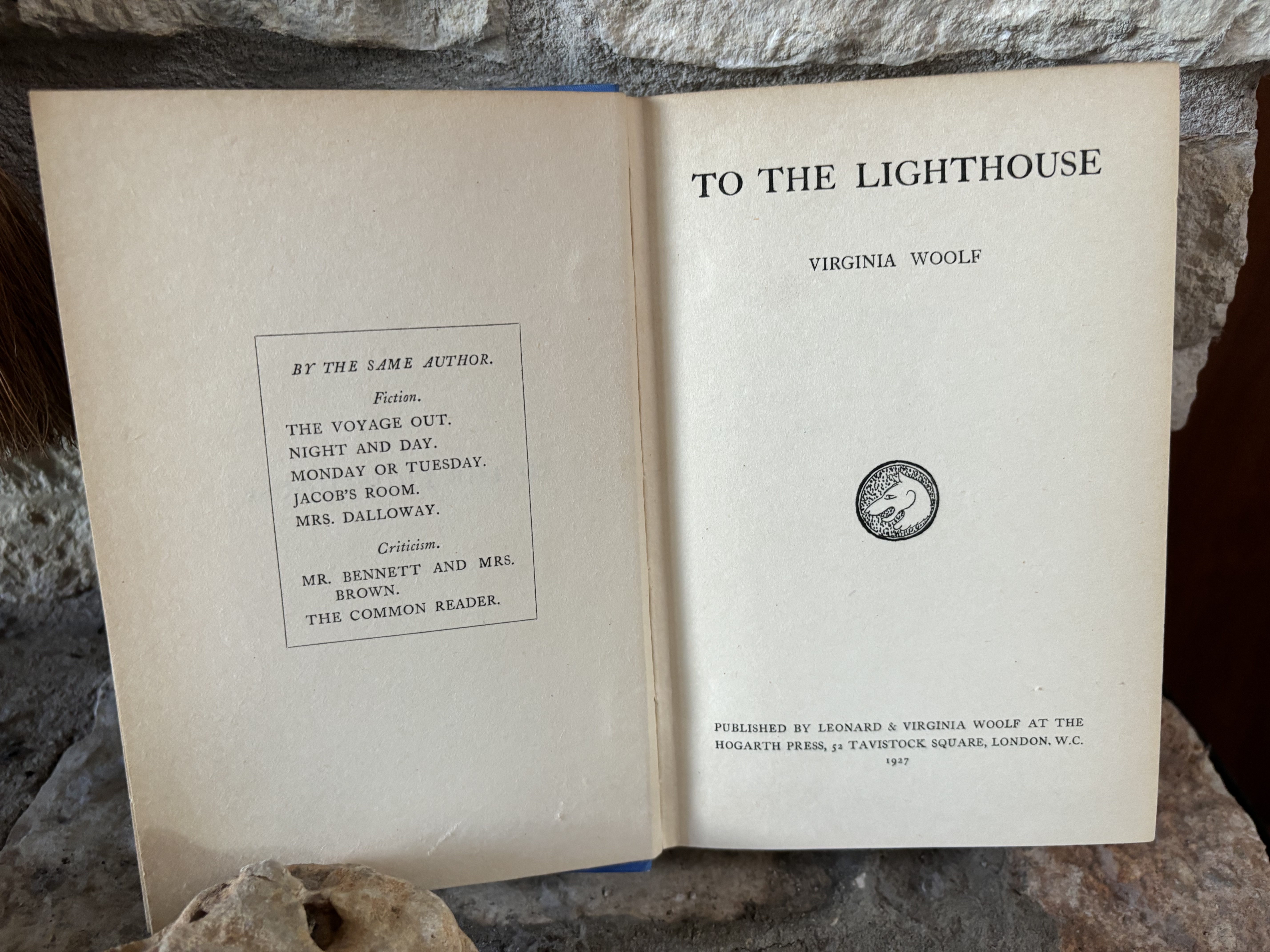
Because I have to reread that moment in Part III when, years later, after world war and illness have claimed her beloved friend Mrs. Ramsay and so many of the Ramsay family, the spinster Lily Briscoe returns to the Ramsays’ summer home on the Isle of Skye. https://bit.ly/3zHF77w
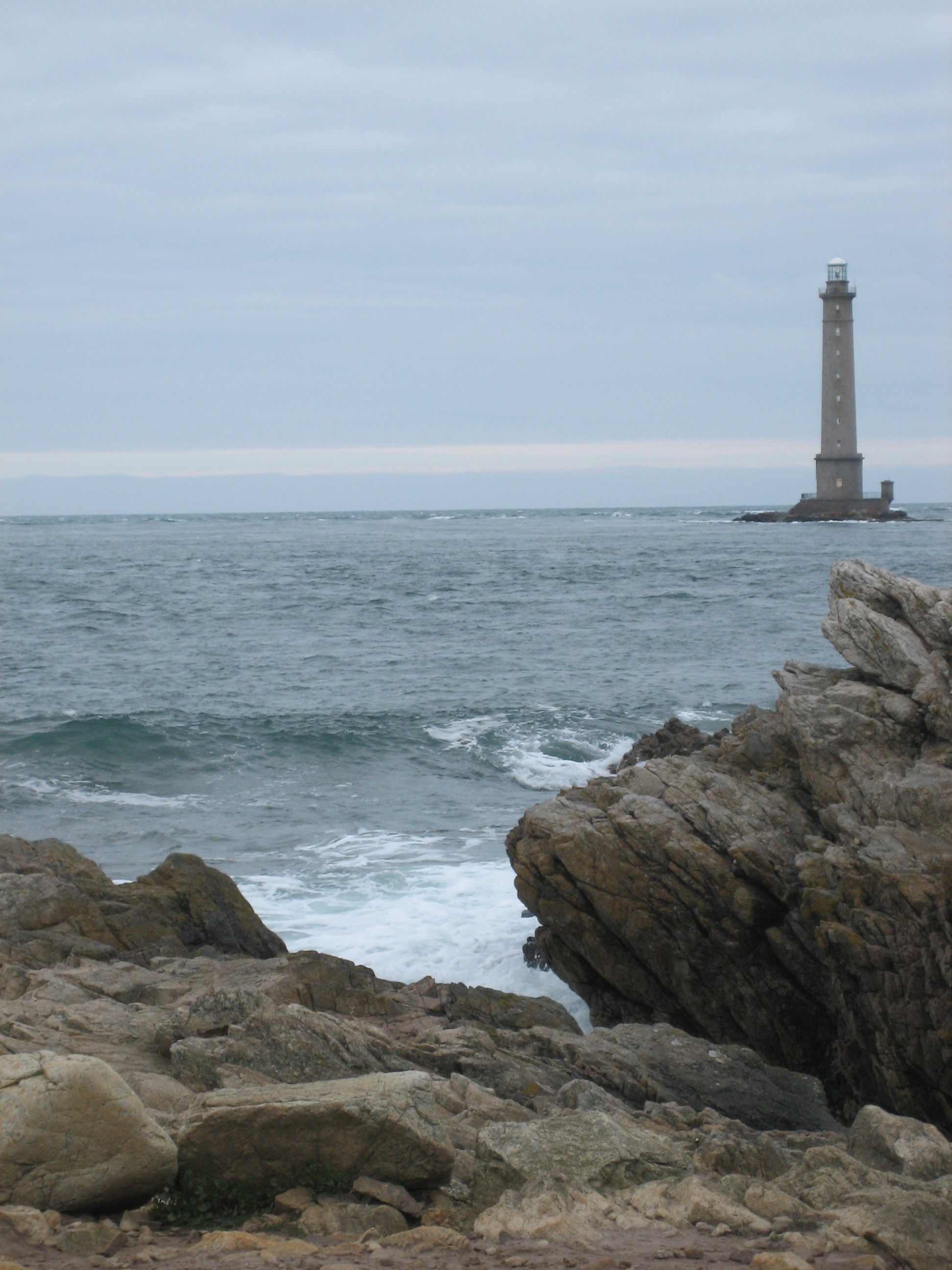
Out on the lawn, facing the old white house, she sets up again the unfinished oil painting she began all those years earlier—the painting that had posed such a challenge in Part I as her mind reverberated with the repeated mantra from Professor Ramsay’s obnoxious male philosophy student: “Women can’t paint, can’t write.” During the long day, full of changing light on the sea, and repeated interruptions by other characters, Woolf returns us over and over to Lily, staring at her painting, seeing again the remembered shapes of Mrs. Ramsay and her son James all those years ago. And her artistic effort? Here’s the end of the book:

“It would be hung in the attics, she thought; it would be destroyed. But what did that matter? She asked herself, taking up her brush again. She looked at the steps; they were empty; she looked at her canvas; it was blurred. With a sudden intensity, as if she saw it clear for a second, she drew a line there, in the centre. It was done; it was finished. Yes, she thought, laying down her brush in extreme fatigue, I have had my vision.”

Why do I return to that? So much of the book is touching, gripping, and even hilarious, including the thoughts of Professor Ramsay, a philosophy professor who’s both overbearing and insecure. He delights in his own “splendid mind”: “For if thought is like the keyboard of a piano divided into so many notes, or like the alphabet is ranged in twenty-six letters all in order, then his splendid mind had no difficulty in running over those letters one by one, firmly and accurately, until it had reached, say, the letter Q.  …Very few people in the whole of England ever reach Q.” Then he falters. “But after Q? What comes next? After Q there are a number of letters the last of which is scarcely visible to mortal eyes, but glimmers red in the distance.”  He braces himself, clenches himself. “Q he was sure of. Q he could demonstrate. If Q then is Q—R Then “he heard people saying—he was a failure—that R was beyond him. He would never reach R.”  

What an image—the alphabet, R glimmering red in the distance, then fading, fading!  And then of course there’s the famous dinner party featuring Mrs. Ramsay’s boeuf en daube. Surely, just reading this, you smell the simmered sauce, the wine, the bay leaf? The thought crossed my mind that if Professor Ramsay had been offered a sip of the Talisker malt whiskey for which Skye is famous, he’d have felt a bit better. https://www.malts.com/en/talisker (The distillery gives a great tour, too.)

But Lily’s painting? This spinster friend of Mrs. Ramsay, with her amateur brushstrokes? The tale of Lily’s painting, her decision and indecision as she holds her brush, grabbed me all those years ago, and refuses to let go. The same question must hit every musician—“Is this the last note? Did that chord resolve properly? Does it make you feel beauty and longing, or does it just hang there, unfinished?”  Every cook: “A pinch of salt? What about some coriander? To garlic or not to garlic?” Every filmmaker: “Do they walk into the sunset? Or fade out? Or kiss?” And every writer? “Is this character real? Is this setting compelling? Does the plot work? And will anyone care?”

Lily’s painting embodies desire to capture memory, resistance, light and color, and more than that. Isn’t it  her experience? A moment of creation, of recapture, of making a line on a canvas and then feeling completion?  She’s had her vision. If you know of another book where we readers feel such a moment of revelation from the frustrating process of creation—let me know.

Oh, don’t get me wrong. My Kindle received today the brand-new Martin Walker (A Grave in the Woods) and I can’t wait. bit.ly/3Xzqawt Like the other women in his (busy) life,  I love to accompany Inspector Bruno, in his fictional Perigord village of St. Denis, partly because of his cooking. Thank you, Martin Walker, for describing the ham hanging from the kitchen ceiling, the cheerful chickens, and the paté with its duck fat on top, waiting in Bruno’s fridge, and the way Bruno sings La Marseillaise to count how long until he must sizzle the foie de gras before he deglazes the pan. I look forward to new recipes and to finding out who’s buried in the woods.

And a sad farewell: I’ve decided to forgive Elly Griffiths for saying goodbye to Ruth Galloway in her last book in that series, The Last Remains, even though I have loved watching Ruth clamber down into a trench to dig up ancient bones in East Anglia. amzn.to/3ZxU5rv I’ve also savored every page of Alan Bradley’s latest (last?) Flavia de Luce – What Time the Sexton’s Spade Doth Rust – as he allows this delightful protagonist to feel herself beginning to grow up—not too much, not too fast, just enough. https://bit.ly/4dla13A 

And I did just finish We Solve Murders, Richard Osman’s first book in a new series. bit.ly/4ezjIwh  Have to confess I found myself missing Joyce, Ibrahim, Ron, Elizabeth and the other characters of his Thursday Murder Club books. My strong belief is I must care about a mystery protagonist and so far I haven’t completely bought in to his new cadre–though I do like Steve. We’ll see.  I’d be interested in your reactions.

So that’s four new mysteries, just in September. I’m also rereading Virginia Woolf’s The Waves, and finding even more, yes, even more to love about how she brings those characters to vivid life, and how she describes the way we humans think and react to each other.

And out here with the three burros I’m writing the tenth in my Coffee Creek series featuring Alice MacDonald Greer and the gorgeous landscape of the Texas Hill Country, with its pristine (well, so far) bluegreen streams. Water’s for fighting over, right?

But when the going gets tough, you may find me sidling back to the revolving bookcase, on the shelf where Virginia Woolf and all the old faves hang out.

Helen Currie Foster lives and writes north of Dripping Springs, Texas, loosely supervised by three burros. She’s drawn to the compelling landscape and quirky characters of the Texas Hill Country. She’s also deeply curious about our human history and how, uninvited, the past keeps crashing the party. Latest in her award-winning series: Ghost Bones.

Follow her on http://www.facebook.com/helencurriefoster/ and http://www.helencurriefoster.com

When Words Balk-Take A Walk. Solvitur Ambulando!

by Helen Currie Foster

This week I’ve been in the Land of Stuck. Walking in circles around the kitchen island struggling to come up with the missing scene. My next mystery’s nearly done, but… I’m stuck. Ever been there?

The poetry shelf offers a momentary escape. Billy Collins can always pull me into a poem. Often he’s going for a walk and I can’t help but feel invited. His “Aimless Love” begins:

He’s got me. 

Or “The Trouble with Poetry,” which begins, 

“This morning as I walked along the lakeshore, 

I fell in love with a wren 

and later in the day with a mouse 

the cat had dropped under the dining room table.”

Well, of course there he’s got me. Then again:

“The trouble with poetry, I realized 

as I walked along a beach one night––

cold Florida sand under my bare feet, 

a show of stars in the sky––”

I feel that same cold Florida sand under my right arch, despite the Texas heat outside. 

Another walking poet: Mary Oliver. In Blue Iris, She begins “White Pine” this way:

“The sun rises late in this southern county. And, since the first thing I do when I wake up is go out into the world, I walk here along a dark road.”

Huh. Walking as discipline? Every morning?

Walking’s not just for poets. St. Augustine is often credited with the Latin phrase Solvitur ambulando––“it is solved by walking” (which may have originally been a response to the 5th C. B.C. philosopher Zeno’s concept that we can never actually arrive at a destination). 

According to Ariana Huffington, a number of writers agree about the benefit of walking, including Hemingway, Nietzsche, and Thomas Jefferson. She quotes the latter: “The object of walking is to relax the mind…You should therefore not permit yourself even to think while you walk. But divert your attention by the objects surrounding you”.https://www.baltimoresun.com/opinion/bs-xpm-2013-09-03-bal-solution-to-many-a-problem-take-a-walk-20130830-story.html  Which reminds me of Collins’s wren.

“Solvitur ambulando” was the official motto of the Royal Air Forces Escaping Society, formed in 1946 to help those in former occupied countries during WWII who risked their lives to help RAF crew members escape. https://en.wikipedia.org/wiki/Solvitur ambulando (check out the terrific solvitur ambulando quotes in this article, from Lewis Carroll, Dorothy Sayers and others). I can’t imagine how high the blood pressure of those resistance heroes climbed during such episodes. Mine skyrocketed just reading A Woman of No Importance, Sonia Purnell’s description of the amazing work of America’s Virginia Hall in France during the resistance. Talk about tense moments. So, did the RAF Escaping Society adopt this motto because of the therapeutic value of walking, or because walking can trigger ideas, or solutions? Or both?

Bruce Chatwin (The Songlines, 1986) claimed he learned the phrase from Patrick Leigh Fermor. Fermor himself was quite a walker. He set out, in 1933, at age 18, to walk across Europe from the Hook of Holland to Istanbul and Greece. He tells the tale in Between the Woods and the Water, 1986. 

 I loved this book and Fermor is fascinating (check out his WWII heroics on Crete, including engineering and carrying out the kidnap of the Nazi commander). 

https://www.theguardian.com/theguardian/2011/jun/10/patrick-leigh-fermor-obituary

The English provide walkers with such wonderful public walking paths. My husband and I recently walked the Thames Footpath for several miles along the Thames, over to Bray––yes! Home of the Vicar of Bray! https://en.wikipedia.org/wiki/The_Vicar_of_Bray

In this charming village you can taste amazing smoked salmon at The Hinds Head (where you can read how many times the Vicar changed his denomination to keep his job, back in the religious flip-flops of England’s sixteenth century) and also at The Crown, a pluperfect pub. The Thames Footpath takes you through leafy woods, with views of the rivers, the fields, and occasional historic and mysterious signs (“Battlemead”). It provides boats to watch, ranging from kayaks and paddleboards to elegant near-yachts, festooned with banners for Jubilee, and one incredible ancient polished Chris Craft, casually docked by the restaurant at the Boathouse at Boulter’s Lock by two grizzled old salts. We tried but failed to overhear their intense lunch conversation. Just trying to eavesdrop was imagination-stirring. Where did they come from? Where were they going?

The footpath also led us to the village of Cookham, home of another surprise: the Stanley Spencer Gallery. Spencer, a WWI veteran and Slade School graduate, produced remarkable paintings, sometimes mixing nominally biblical subjects with contemporary life—for example, a resurrection study of Cookham housewives in aprons, climbing out of their graves with surprised faces. https://www.tate.org.uk/art/artists/sir-stanley-spencer-1977.

I thought I remembered Spencer’s name from Virginia Woolf’s diaries and looked it up when we got home. She wrote on May 22, 1934, about Clive Bell, Vanessa Bell (Clive’s wife), Duncan Grant (Vanessa’s lover), and Quentin Bell (Vanessa’s son) “all talking at once about Spencer’s pictures.” In 1934 Spencer was showing six works in the Royal Academy Summer Exhibition…about the time Patrick Leigh Fermor was off in the middle of his big walk.

Other poetic walkers? You’ve already thought of Robert Frost (“Two Roads Diverged…”) and Dante. Dante’s walks take the cake; I mean, the Inferno’s a hell of a walk.

So if walking calms the mind, allows creativity, reveals solutions, why am I revolving around the kitchen island?

Now that I think about it, some ideas have emerged. For instance, how much my extended family loves hiking in the Rockies, with (1) a destination; (2) a well-rounded lunch, including chocolate, in the pack; (3) plenty of water. How it feels to set off, hoping to see (1) moose, or (2) marmots, or (3) ptarmigan. How it feels to walk to the destination, grab a flat-topped boulder, warmed by sun, and have lunch, staring out at the view. Then to walk…downhill. No longer out of breath. Watching your fellow hikers dodging limbs, swinging around switchbacks. Triumphant walkers. And in the meantime, there have been discussions on the trail, conversations about this and that, switching from one companion to another. At the end of the trail, a sense of sleepy satisfaction.

So it’s time to get up early enough for a walk. Get up early enough to beat the Texas sun, and see if my neighbor’s front pasture includes a jackrabbit, or “jackbunny” as some call it. Cause a snort from the deer in the brush.

… Okay. Back from the walk. I think I’ve figured out that pesky bit about the last scene, except for a couple of details. So tomorrow, when the alarm rings—I’m going for a walk. Would you like to come too? I’d love it. We could talk.

More…

Helen Currie Foster lives and writes north of Dripping Springs, Texas, closely supervised by three burros. She’s curious about human nature, human history and prehistory, and why the past keeps crashing the party. She’s currently finishing book 8 in the Alice MacDonald Greer Mystery novel series. Book 7, Ghost Daughter, was named Grand Prize Short List in the 2022 Eric Hoffer Book Awards, and Finalist for Mystery, 2022 National Indie Excellence Awards. Her books are available on Amazon, Kindle, and Audible, and at independent bookstores.She loves to talk with book groups.

Please Take (a) Note!


by Helen Currie Foster

Lately I’ve been thinking about remarkable people who never got to see the significance of their work, regardless of its brilliance. People whose minds moved so fast their words didn’t compute, for most listeners. People whose contributions went unrecognized for many years. And if they hadn’t written down their ideas? Maybe eventually someone would have made the same discoveries, but when?

Here are just three.

I’d never heard of Simon Stevin until I read Michael Pye’s The Edge of the World (2014), on how modernity reached the shores of the North Sea. Stevin, born illegitimate in Bruges in 1548, worked as a book-keeper in Antwerp, and then enlisted at the liberal new Leiden University. He produced a book on double-entry book-keeping and another on figuring the interest on borrowed money, when publishing such hard-won information was a subversive revolutionary act. This “engineer, book-keeper, king of numbers,” per Pye, wanted to make math work in the everyday world. 

Stevin tutored his student friend Prince Maurits in math, beginning a lifelong association. He made the prince a sailing chariot for the beach, with two sails, four great wheels, and flags flying. Stevin informed the prince the earth went around the sun. When Maurits became king, Stevin became an army engineer, devising, pumps, dredgers, windmills. He produced an influential treatise on fortifications and another on how to calculate longitude at sea. He wrote a book asking Dutch cities to adopt uniform money measures, suggested a decimal system, founded a mathematics curriculum at Leiden. And he wrote down these ideas! Stevin’s dream, that explaining practical mathematics would help his country thrive, eventually came true––though not necessarily in his lifetime.

You already know about the world’s first computer programmer? Another who did not live to see her work recognized is Countess Ada Lovelace, Lord Byron’s daughter. At seventeen she began helping mathematician Charles Babbage with his “difference machine” for math calculations. In 1843 she published an article in an English science journal describing processes we now call computer programs, including how to create codes using letters and symbols as well as numbers. She died of uterine cancer in 1852, at 37. Her work came to public attention in 1953 when B.V. Bowden republished her notes in Faster than Thought: A Symposum on Digital Computing Machines. In 1980 the U.S. Department of Defense named a new computer language “Ada.”

“We’re still catching up with one of the greatest minds of the last century.” That’s Anthony Gottlieb, “The New Yorker,” May 4, 2020, on Frank P. Ramsey. Ramsey––a Cambridge (UK) scholar whose genial brilliance intimidated his professors when he appeared on campus at 18––died at only 26, in 1930. Economists, philosophers and mathematicians are still exploring the “Ramsey effect” on their disciplines. He was immediately taken up by Maynard Keynes, and refuted Keynes’s fuzzy notions of probability. He was tapped to translate Ludwig Wittgenstein’s “Tractatus Logico-Philosophicus” from Germanas the only German speaker available who could not only understand what Wittgenstein was trying to say, but say it more clearly (he reportedly dictated his translation).In one paper he created two math theorems which, decades after his death, became part of the “Ramsey theory” analyzing order and disorder. (See video of a student working a Ramsey probability problem). Ramsey’s modesty about his astounding abilities made him appear almost offhand about his accomplishments.

As a student of Virginia Woolf, I blinked twice to find Ramsey appearing in her diary (February 1923).

Yes!–– at dinner with Maynard Keynes. “Ramsay [sic], the unknown guest, was something like a Darwin, broad, thick, powerful & a great mathematician, & clumsy to boot. Honest I should say, a true Apostle.” Keynes at least tangentially belonged, with Virginia and Leonard Woolf, to the Bloomsbury group, which included several members of the select Cambridge “Apostles” club (including Leonard Woolf). In 1927, Woolf published To the Lighthouse about a family she called the Ramsays, where Mr. Ramsay, a professor, fears that though he has reached Q, he lacks genius and will never be able to think his way past Q, that he’ll never reach R: “How many men in a thousand million, he asked himself, reach Z after all?” If Woolf had known then what we know now she’d have known Frank Ramsey could easily have reached R and zoomed on past Z. 

Okay, I admit I took the Special Math Course for English Majors to get my math graduation credit. Yes, I did. Nevertheless I’m doggedly staggering through the first full biography of Ramsey, Frank Ramsey: A Sheer Excess of Powers, by Cheryl Misak (Oxford Press 2020), fascinated by his mind and especially his lightly worn “sheer excess of powers.” I might, even, try to find his 1926 paper about truth and subjective probability, where he said we should take account of people’s judgment of probability.” 

Now there’s a pungent topic for mystery writers. At every turn, our characters use subjective probability to make decisions. “Can I kill without being caught?” “Can I catch this villain without being killed?” “Have I examined all the what-if’s here?” “What are the chances anyone will recognize me?” Suspense lies in decisions made on subjective probability.

Okay, so Ramsey died without knowing that ninety years later University of Georgia students in hoodies, poised at the whiteboard, would be filming explanations of “Ramsey Theory.” Ada Lovelace died without knowing the Defense Department would name a computer language for her.  If asked, would she have preferred Countess? Would she be fascinated by the world of hacking? Simon Stevin would drive our city streets, ready to opine on public transportation–would he recommend air-conditioned tubes, with moving sidewalks, to move people east and west across Austin? Or possibly a sailboat with wheels?

Now we come to you. Yes, you. How will we know what you thought?

Stevin, Lovelace and Ramsey at least published some of their work. You can go farther. You own your copyright as soon as your work is “fixed.” You can also provide notice of copyright by using the symbol or the word “Copyright” and your name and the year of first publication, and registering your copyright by paying the required fee and depositing required copy(ies) of your work, thereby creating a public record of your copyright claim. (See details and requirements here.) 

That’s at least a start. As for Aeschylus, only seven of his seventy to ninety tragedies remain intact. Sophocles? Only seven of over a hundred remain. Euripides? Eighteen of over ninety-five remain. Sappho? We have only two complete poems out of her nine books of verse, from the woman the ancients called “the tenth Muse.”

Will depositing your work at the Library of Congress––oh yes, you must––give us some assurance we can know your ideas, your writings, a century hence? The Alexandrian Library didn’t fare so well. Nor did the Dresden Sächsische Landesbibliothek which lost perhaps 200,000 volumes in the Allied bombing of the Dresden historic center. The 1986 fire at the Los Angeles Library burned 400,000 books.

No guarantees, but it’s a start. At least try to leave the world a copy. Even if you leave us too soon, even if fame has not yet arrived…you never know. A century from now, maybe…?