BY HELEN CURRIE FOSTER
April 1! It’s spring, with a riot of bluebonnets this year.

Plus paintbrush! Winecup! Verbena! Prairie celestials (so lovely)!

And within the fence, safe from our marauding burros, the roses are opening their petals and sharing their beauty. Humans have been growing and hybridizing roses for millenia. I favor those with deep rose fragrance. This year the sniff prize goes to Madame Isaac Pereire,

but Zephirine Drouhine is a strong contender as well—sweet perfume, but no thorns!

Blooming with pride are Cramoisi Superieur, fun to pronounce, and dainty little Perle d’or, below.

Yes, the French have been busy. But I’m waiting on the spectacular Star of the Republic, which is covered with buds that will become exquisite cream and pink roses, and is almost as tall as Texas.
Thanks for human ingenuity and the deep love of beauty and fragrance that resulted in these roses. We humans are so able to produce beauty—and yet we mystery readers and writers know how gripped we are by the companion question: why do humans commit the primal sin of murder?
I’ve been reading a riveting book called How the Mind Changed, A Human History of Our Evolving Brain (2022), by neuroscientist Joseph Jebelli, who studies the genetic history of the human brain. I’ve had to put stickers and checks on so many pages!
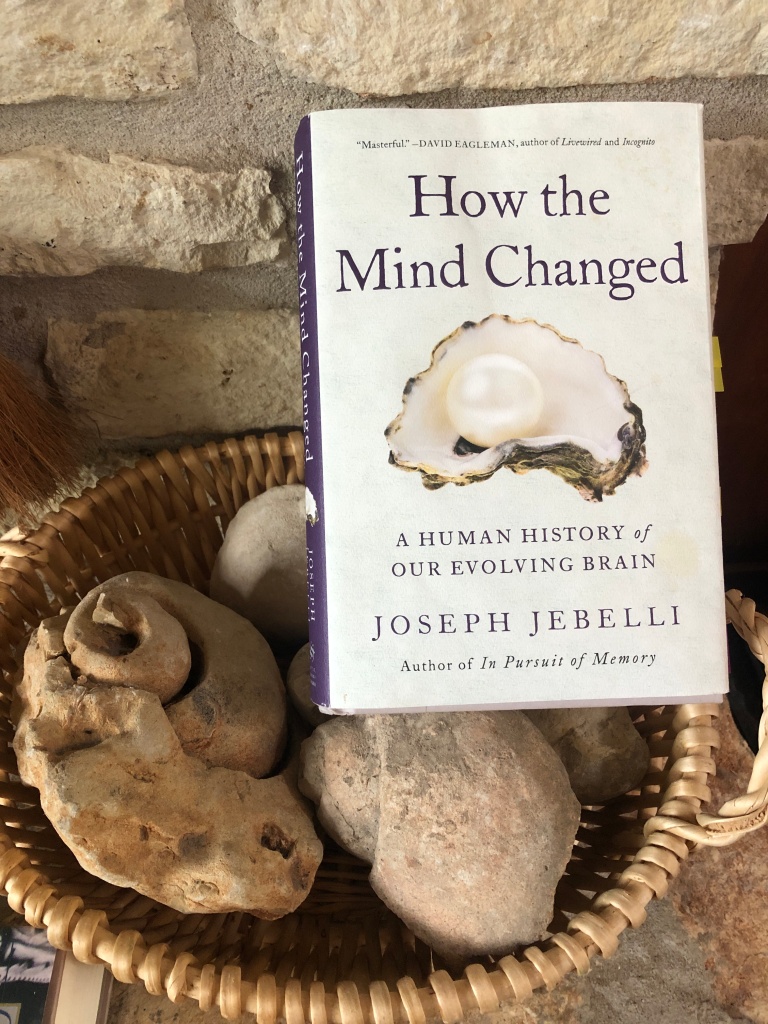
Jebelli says that, starting about 7 million years (or 230,000 generations) ago, when humans split from chimps, our brains were only 350 cm3 big. Then 3.5 million years ago, when our ancestor Lucy came along, we got a new uniquely human gene that gave us a folding neocortex and nearly doubled our brain size to 650 cm3.
Later, he says, our brains bloomed to 900 cm3, when we began cooking (maybe 2.7 million years ago), then to 1000 cm3, about 2.5 million years ago, then to 1500 cm3 500,000 years ago, and then grew another 25% by the time, 300,000-400,000 years ago, when Homo sapiens appeared.
Later research shows—the bigger the brain, the bigger the social group. Id., 69.
And lucky Homo sapiens came along when our planet was in extreme ecological instability: “African megadroughts depleted the land’s fresh water; vanishing grasslands diminished the number of animals available…” Homo sapiens spread across the planet, interbreeding along the way with the Neanderthals (who went extinct around 40,000 years ago), and the Denisovans, Neanderthal cousins from Asia. Most humans outside Africa carry around 2 percent Neanderthal-derived DNA while today humans in Papua New Guinea and Australia possess up to 6% Denisovan DNA.
Now we have tools of advanced microscopy and molecular genetics to use “the mosaic of neurons, the constellation of synapses and the tributaries of molecules to learn the age of the brain and the transformations it has seen.” Îd., 21.
But it’s Jebelli’s discussion of brain research on “fair play” that I find most fascinating – whether the experiment uses rats, vampire bats, or humans. “Our minds intuitively draw a distinction between unfair equality (all students receiving the same…grades regardless of merit) and fair inequality (the doctor earning more than the cleaner). When push comes to shove, humans nearly always prefer fair inequality to unfair equality.” Jebelli goes on to explain that when we humans engage in fair play, we experience a surge of neural activity in our brain’s reward centers, releasing dopamine, oxytocin, serotonin and endorphins. Id., 68.
Watch out: scientists are identifying gene mutations that explain amazing things. “Non-monogamous brains tend to have a special kind of dopamine receptor gene called DRD4, which is linked to promiscuity and infidelity.” Id., 78. Use that in a plot, mystery-writers!
But I was thrilled by the focus on the link between strong imagination and intelligence in our “default network, a brain system that participates in daydreaming, mind wandering, reflective thinking and imagining the future….People who engage in these cognitive practices…have greater access to the states of mind necessary to solve complex problems.” Id., 115. Jebelli says our default networks are only active when we’re not focused on a task, “when the brain is cycling through thoughts not associated with the immediate environment.” In other words, the default network contrasts with our executive control network. Jebelli makes another leap: compassion also stimulates the default network. “Compassion requires imagination. ‘Climb into his skin and walk around in it,’ Atticus tells Scout.” But imagination also requires compassion. Id., 119.
Why has this book grabbed me? As a mystery writer I wrestle with why some humans will run into the street to save a child from a bus, and some will just watch; and why and how some humans invent gripping new imaginative worlds (Lord of the Rings, Harry Potter, Slough House, Yoknapatawpha County, the Forest of Arden, Hat Creek and the saga of Lonesome Dove) that tell of human struggles and victories, tragedies and comedies. Yes, writers who stimulate our “default networks”!
So you might like to take a peek at How the Mind Changed—check out the chapter on that age-old conundrum––what is consciousness? And the chapter on different minds, or neurodiversity, including genetic components. And the chapter on the new field of neurocriminology: what makes humans commit crimes? Which brain regions are responsible for violence? One possibility—it’s an area of the hypothalamus called the ventromedial hypothalamus, “an ancient brain region that has been conserved throughout mammalian evolution.” Yikes!
As Jebelli notes, plots will abound from this inquiry, this research. As always, inquiring minds want to know.
Meanwhile, it’s April! So let us now praise Geoffrey Chaucer – whose compassion and imagination gave us “Whan that April with his showres soote The droughte of March hath perced to the roote, And bathed every veine in swich licour, Of which vertu engendred is the flowr…”
And further to celebrate—Book 9 of my Alice MacDonald Greer legal thriller series has gone off for copy-edit. Yes, again the primal crime has been committed…!


 Austin Mystery Writers