Equinox!

by Helen Currie Foster

An excess of animal spirits”–springtime! Really? Molly Ivins was right as usual when she wrote, “Texas–land of wretched excess!” We’ve had ridiculous lows, unseen for decades. Early daffodils and hyacinths came, shivered, and shriveled in the unholy cold winds roaring across the plains. But we’ve also had the earliest 90 degrees in decades! Wretched excess indeed!

Just two days until the vernal equinox on March 19, and spring. What makes us wander outside, searching for the first bluebonnet, the first violet? What makes us huddle outside the garden store, searching through the little plants shivering in the breeze, fingering seed packets, carrying home small pots of basil and blue salvia even though the weather’s far too untrustworthy for planting? What is this proto-agricultural spirit that makes us lug home the potting soil, hoe the garden bed? More sunlight? Cabin fever? Some early human gene? We, the Animal Kingdom, working with the Plant Kingdom?

I’m rereading Barry Cunliffe’s Europe Between the Oceans: 9000 BC-AD 1000a book I value not just for the stunning photographs of prehistoric sites and art, but for describing a history of human inventiveness. Cunliffe, Oxford Professor Emeritus of Archeology since 2007 (many books), says “massive transformation” occurred in Europe between 1300-800 BCPopulation growth required developing more crops than wheat and barley, including lentils, peas and—“the celtic bean (Vicia faba).”

Immediately I ordered a giant pack of fava bean seeds.

This image has an empty alt attribute; its file name is img_0981.jpg

Then I read the label: they’re mostly a winter crop–but this year I’m desperate. With last year’s blistering hot drought, I wound up with only one pot of cherry tomatoes on the porch and a dozen wilting jalapeno plants in the garden. Cunliffe’s reference to Vicia faba fired my imagination—envisioning myself harvesting large fuzzy green pods, containing delectable beans, and adding a little vinaigrette…olive oil (since 4000 BC) and vinegar (3000 BC). Using an ancient bean and ancient vinaigrette recipe! Possibly those beans were harvested, and the vinaigrette shaken, by some long-ago ancestor 3000 years ago, making me wonder if we have genetic preferences, genetic recipe roots? After all, we of the Animal Kingdom depend on the Plant Kingdom (oxygen, vinaigrette, and wine!).

Mysteries offer escape—a protagonist we like, an intriguing plot, a vivid setting. Like plants, favorite old mysteries offer much when we revisit. Mystery writers? They’re good to “talk to.” This morning I discovered on the shelf my dad’s 1934 Modern Library edition of Dashiell Hammett’s The Maltese Falcon, with a brief bio and the “new introduction” by Hammett.

This image has an empty alt attribute; its file name is img_0980.jpg

I didn’t know Hammett had worked as an operative for Pinkerton’s Detective Agency before he started writing! “Drifting through a miscellany of ill-paid jobs, he found a temporary solution to his economic problem by shadowing real malefactors with what might be called conspicuous success.” Then came the World War: “He won a sergeantcy and lost his health.”

Hammett can remember where he got his characters. Here’s a snippet of what he says about The Maltese Falcon:

“Dundy’s prototype I worked with in a North Carolina railroad yard; Cairo’s I picked up on a forgery charge in Pasco, Washington, in 1920; Polhous’s was a former captain of detectives…Effie’s once asked me to go into the narcotic smuggling business with her in San Diego…”

Hammett then muses about his own protagonist. “Spade had no original. He is a dream man in the sense that he is what most of the private detectives I worked with would like to have been and what quite a few of them in their cockier moments thought they approached. For your private detective does not—or did not ten years ago when he was my colleague—want to be an erudite solver of riddles in the Sherlock Holmes manner; he wants to be a hard and shifty fellow, able to take care of himself in any situation, able to get the best of anybody he comes in contact with, whether criminal, innocent by-stander or client.”

What a great description, and didn’t Humphrey Bogart nail it?

It strikes me that this new character of his upended the vision of the members of the London 1930 Detectives Club—Hammett gave the wide-eyed mystery audience a protagonist who is not a secret member of the aristocracy (Albert Campion) or a perfect gentleman (Roderick Alleyn) or a hyper-particular French veteran drinking tea and waxing his moustache (Hercule Poirot)…but a “hard and shifty fellow…able to get the best of anybody.” Welcome to the New World’s new-style mystery protagonists, the children of Hammett, Raymond Chandler, Sara Paretzky and others…including that hybrid protagonist, Mary Russell, in Laurie King’s Mary Russell and Sherlock Holmes series.

For Mary Russell and Sherlock Holmes, the scent of honey is a repeat theme (her Holmes is a beekeeper). I like her Holmes, I like her Russell, and just finished her Garment of Shadows (2012). King has chosen a fascinating and ambitious setting: the 1920’s, with Spain and France fighting for control of Morocco, each coveting its crucial strategic location at Gibraltar, while various Moroccan groups—Berber and otherwise—fight for independence. King uses first person point of view for Mary Russell, who’s suffering from acute amnesia—forgetting her childhood and even her marriage––but uses third person POV for Holmes’s chapters. Those shifts sometimes confused me. But her depth of history and geography, and her vivid descriptions of the magical city of Fez with its souk, bring the setting alive. Mary Russell herself has become quite a protagonist, with linguistic skills—including Arabic––and the imagination and drive to devise a daring escape from a horrible prison. I’d like to learn knife-throwing like Mary Russell (she keeps one in her boot) but the likelihood seems dim.

Writer/theologian Bruce Reyes-Chow mentioned how, when stuck, he’d “talk through ideas with myself, my plants…” I intend to follow his lead. On our deck sit five jasmine plants we’ve toted around since the seventies. I think they sometimes do communicate with me—“I’m dry-y-y-y!” But from now on, when I’m stuck on a plot, I’ll go consult them. Every spring, those jasmine produce tiny white flowers with an unmatchable scent. In search of even more scent, this year I’ve planted another mix of old and new. Rose de Recht is a fragrant pink heirloom damask, Fragrant Blush promises pink perfume, and Star of the Republic is tough, like her name, but delicate pink with exquisite fragrance.

This image has an empty alt attribute; its file name is img_0978.jpg

And now suddenly the redbuds, with their irresistible yet evanescent fuchsia buds, are blooming. I’ve seen our first bluebonnet,
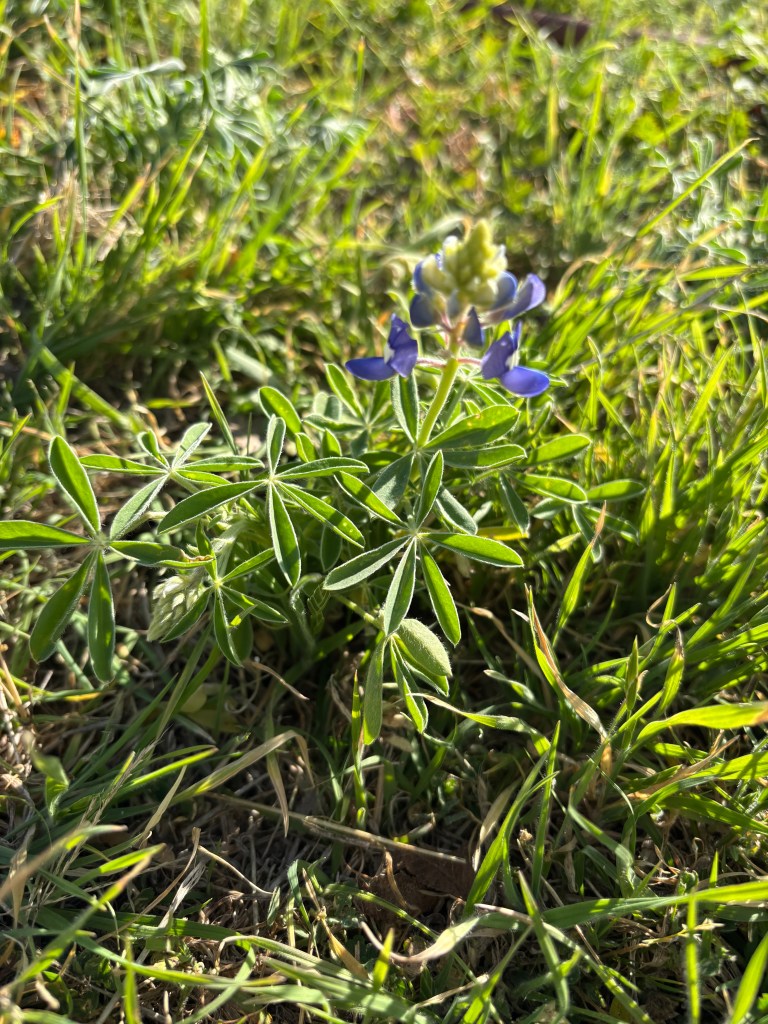
This image has an empty alt attribute; its file name is img_0974.jpg

and the first purple prairie verbena. The live oaks know it’s almost the equinox—they’ve flung down their old leaves (aided by the fierce winds) and are preparing their catkins and baby leaves. The cedar elms have put out tiny chartreuse leaves just in the last two days.

This image has an empty alt attribute; its file name is img_0973.jpg

So it’s spring! Grab that trowel! And after all your work, you deserve to loll on the couch at night with a good mystery. I’m halfway through the tenth book in my Hill Country murder mystery series. This one raises a question I find intriguing and difficult. Can justice be served when, unauthorized to pronounce justice, we take justice into our own hands? Is that still justice? I’m discussing it with the plants. More to come….
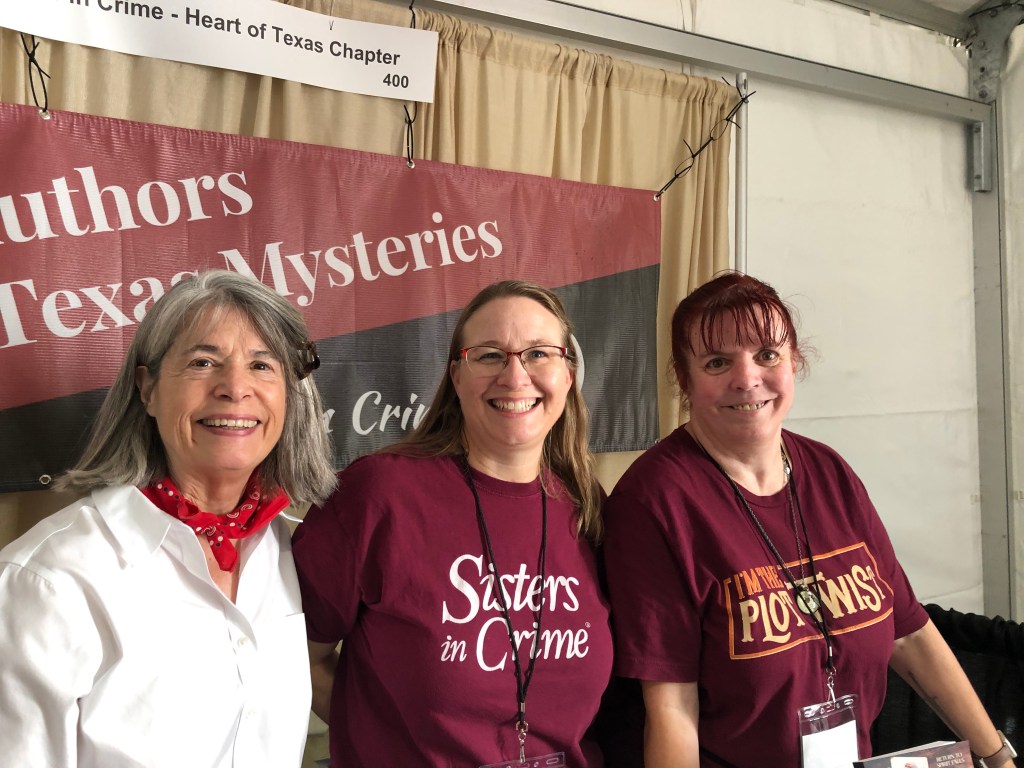
Here are Helen, Noreen Cedeno, and Juanita Houston at the Texas Book Festival!–Heart of Texas Sisters in Crime

***
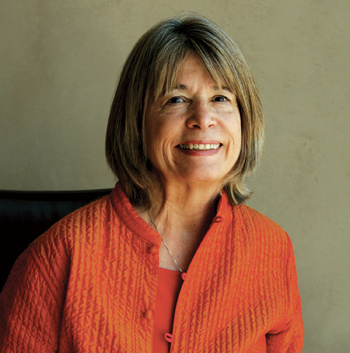
Award-winning Helen Currie Foster lives and writes the Alice MacDonald Greer Mystery series (9 volumes so far) north of Dripping Springs, Texas, loosely supervised by three burros. She’s working on Book 10. She’s drawn to the compelling landscape and quirky characters of the Texas Hill Country. She’s also deeply curious about our human history and how, uninvited, the past keeps crashing the party.

Follow her at Helen Currie Foster and at her author page on Amazon.

The Woods Are Lovely: A Passion for Trees

by Helen Currie Foster

October 29, 2024

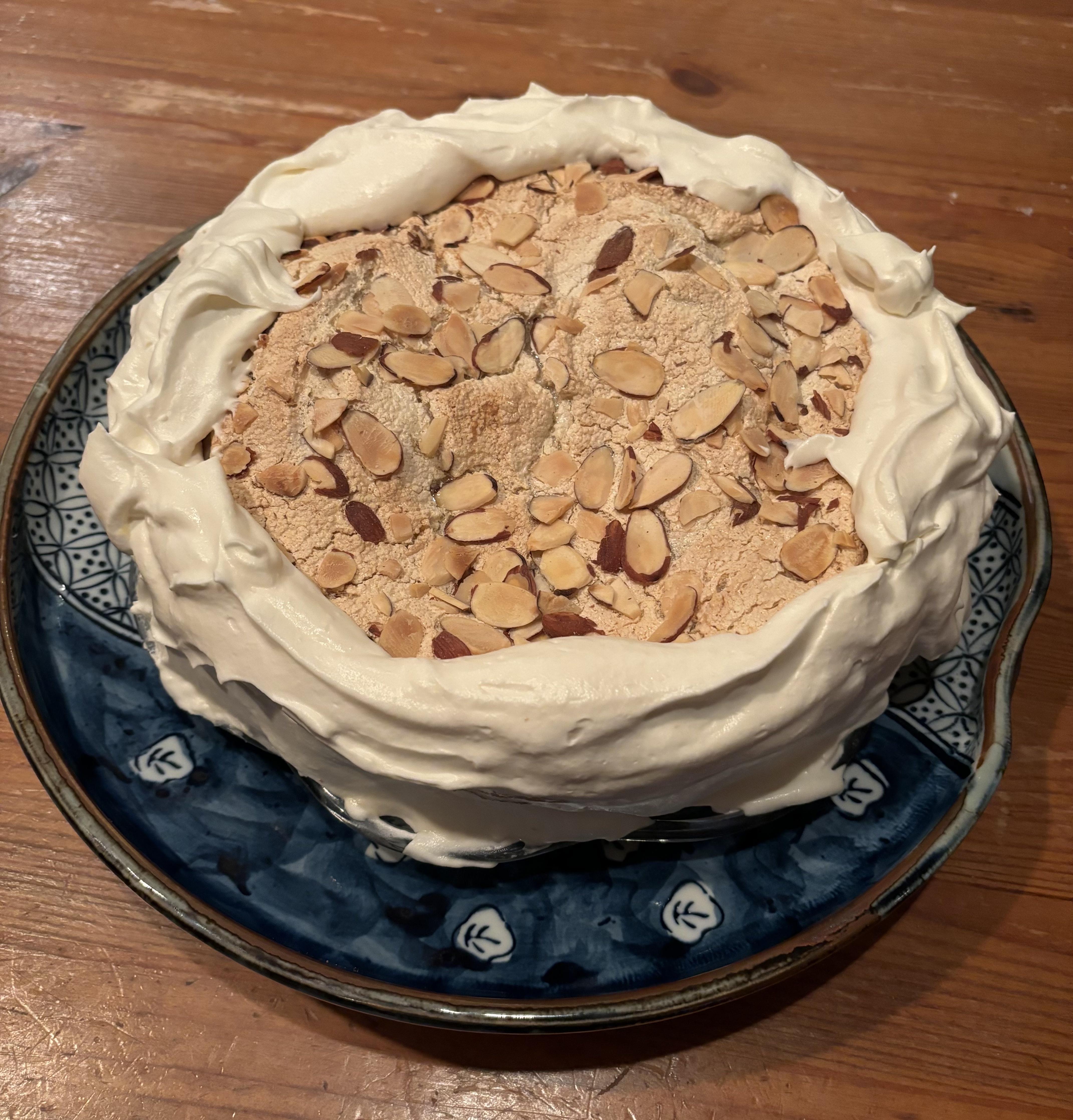
The mystery is solved! In my search for  what I recalled as “the “Blitzkuchen” once served at Schwamkrug’s outside New Braunfels, in the Texas Hill Country, I had the name wrong. It’s a blitz torte, not a blitz kuchen! Several readers sent recipes from German cookbooks indicating that “Blitzkuchen” is a quick cake, usually one layer only. My memory, though? A tall two-layer confection, baked with meringue and almond flakes on top and between the layers! And in my memory, more meringue on the outside, plus some moistness in the filling.

Online I found Oma Gerhild’s “Oma’s Blitz Torte Recipe ––Lightning Cake.” https://www.quick-german-recipes.com/german-blitz-torte-recipe.html  Each almond-flavored layer is baked with meringue and sliced almonds on top of the batter. The recipe offers either custard filling or whipped cream filling. I opted to finish off with whipped cream with powdered sugar and vanilla, not just inside, but around the cake (and in blobs all around the kitchen).

FINALLY! First, that lovely almond taste. Plus, everyone at the table now wore an attractive little white mustache of whipped cream. You don’t get that with a madeleine and a cup of tea, do you, M. Proust?

As October runs into November, Texas Hill Country towns are celebrating Oktoberfest, or, in New Braunfels, Wurstfest. Normally by now our trees would show some fall color––nothing like New England, of course. The cypresses by Lake Austin are turning bronze. Out here north of Dripping Springs, the possum haws are showing their red berries. The cedar elms turned bright yellow, then slowly lost their leaves. The live oaks, thankfully, stay green.

But this year? Drought brings bad news for trees. Cypress-lined creeks are dry…the cypresses’ arched roots groping into the earth for water. Downhill at our place Barton Creek is dry, and I mean dry, with only occasional small pools. Up on the limestone plateau the leaves on some smaller saplings just turned brown and fluttered to the ground, with the tree already looking dead. We’re watering, but in Stage 2 drought restrictions. Will our wells run dry? Have we drained the Trinity aquifers that lie hundreds of feet below?

So, to general geopolitical angst, I’ve added…tree worry.

Trees in books play such a role in our imaginations. After reading Johann David Wyss’s Swiss Family Robinson (1812)—where the shipwrecked family builds a tree-house on their desert island––I always wanted to live in a tree-house! https://en.wikipedia.org/wiki/The_Swiss_Family_Robinson We’re drawn to forests, home of the trees—scary, but sometimes the safest place. In The Sword in the Stone by T. H. White (1939), first of the four volumes that make up The Once and Future King, the Wart (the young Arthur, under Merlin’s tutelage) and Kay meet Little John who tells them about Robin Wood (explaining why it’s not “Robin Hood” and why he lives in the woods (or “‘oods”):

“They’m free pleaces, the ‘oods, and fine pleaces. Let thee sleep in ‘em, come summer, come winter, withouten brick nor thatch, and huntin’ ‘em for thy commons lest thee starve; and smell to ‘em with the good earth in the springtime; and number of ‘em as they brings forward their comely bright leaves, according to order…”

There the boys, the future King and Sir Kay, approach “the monarch of the forest. It was a lime tree as great as that which used to grow at Moor Park in Herefordshire, no less than one hundred feet in height and seventeen feet in girth, a yard above the ground….” Headquarters for Robin Wood and Maid Marian! And there begins a great and perilous adventure for Kay and Wart, who break into the castle of Morgan le Fay, Queen of Air and Darkness—to rescue prisoners paralyzed by magic. (Speaking of paralyzed victims of witches—note how C.S. Lewis later describes turned-to-stone courtyard figures in his first foray into fantasy, The Lion, the Witch and the Wardrobe (1950).)

One writer, Elisabeth Brewer, notes that “The Sword in the Stone shows a passion for trees that White shared with Tolkien. https://bit.ly/3Ceqk. How about the Ents we meet in Fangorn Forest, in J. R. R. Tolkien’s Middle-Earth? Trees that walk…and tend other trees. Not all trees are benign––including the wicked old willow which captures Frodo and friends (rescued by Tom Bombadil).

I’m reading a fascinating graphic (yes, graphic!) book about Tolkien and his close friend C.S. Lewis: The Mythmakers: The Remarkable Fellowship of C.S. Lewis and J.R.R. Tolkien, by John Hendrix. https://bit.ly/4hqiyFr

Tolkien and Lewis met in 1929 in Oxford, where they were, famously, members of a writers’ group, the Inklings, and shared many hours at The Eagle and Child. That’s not all they shared. In 1916, both men experienced horrific warfare on the Western Front in France. Young and just married, Tolkien fought in the trenches, then contracted life-threatening trench fever. At nineteen, Lewis was wounded by shrapnel (from friendly fire) on the Somme, and carried shrapnel in his body the rest of his life. Hendrix’s wonderful book uncovers the sort of salvation two disillusioned veterans found in the healing power of imagination, including Norse mythology and the European fairy tale. Tolkien knew of Yggdrasil, the sacred ash tree central to Norse mythology. https://en.wikipedia.org/wiki/Yggdrasilhttps://dc.swosu.edu/cgi/viewcontent.cgi?article=2130&context=mythlore

And how the worlds created by Lewis and Tolkien fired our imaginations! The fantasy world of C.S. Lewis’s Narnia emerged when The Lion, the Witch and the Wardrobe was published (1950). Tolkien’s The Hobbit, or There and Back Again, was first published in 1937 but became a pop-culture phenomenon only in 1960’s, when the paperback edition became available. https://time.com/4941811/hobbit-anniversary-1937-reviews/

Both Lewis and Tolkien had copies of The Sword in the Stone early on. Indeed, in 1939 it was a Book-of-the-Month Club selection. T. H. White 1964 obituary, https://nyti.ms/4hlasht. Curiously, Hendrix’s book on Tolkien and Lewis doesn’t mention T. H. White, perhaps because Hendrix focuses on the impact of war; T.H. White 1906-1964) was born too late to serve in World War I. Nor was he an Oxonian. While C.S. Lewis reportedly disparaged The Sword in the Stone in 1940, he later invited T. H. White to the Inklings if he ever visited Oxford. https://bit.ly/4f4wcww (“Dickieson post”). Perhaps Hendrix doesn’t mention T. H. White because unlike Tolkien and Lewis, though he creates a fantasy world, White grounds The Once and Future King firmly in England.

But Elisabeth Brewer commented in T.H. White’s The Once and Future King that The Sword in the Stone shows a passion for trees that White shared with Tolkien. (Dickieson post.)

What about powerful trees in more recent books? Consider the Whomping Willow, in J. K. Rowling’s Harry Potter and the Wizard of Azkabanhttps://bit.ly/4f1koex Magic—but terrorizing—it reveals the secret passage which ultimately allows Harry and friends to discover––well, remember? Indeed, Harry reminds us of T. H. White’s Wart, both with an earnest determination to do right, and a magical tutor.

Maybe children are especially open to tree power because they still climb trees. My dad swooped us off to grad school in Atlanta, and then to Charlotte, before we moved back to Texas. In the southeast I discovered the power of pine trees. We children built an admirable and secret treehouse in the woods, where we surveyed the world from on high. No parents came near to scold or warn: deep in the trees we ruled our own domain. Later in Carolina at eleven, I could climb the neighbors’ big back yard pine all the way to the top. The tree swayed slowly back and forth, but I could see the entire neighborhood and beyond. Tree power.

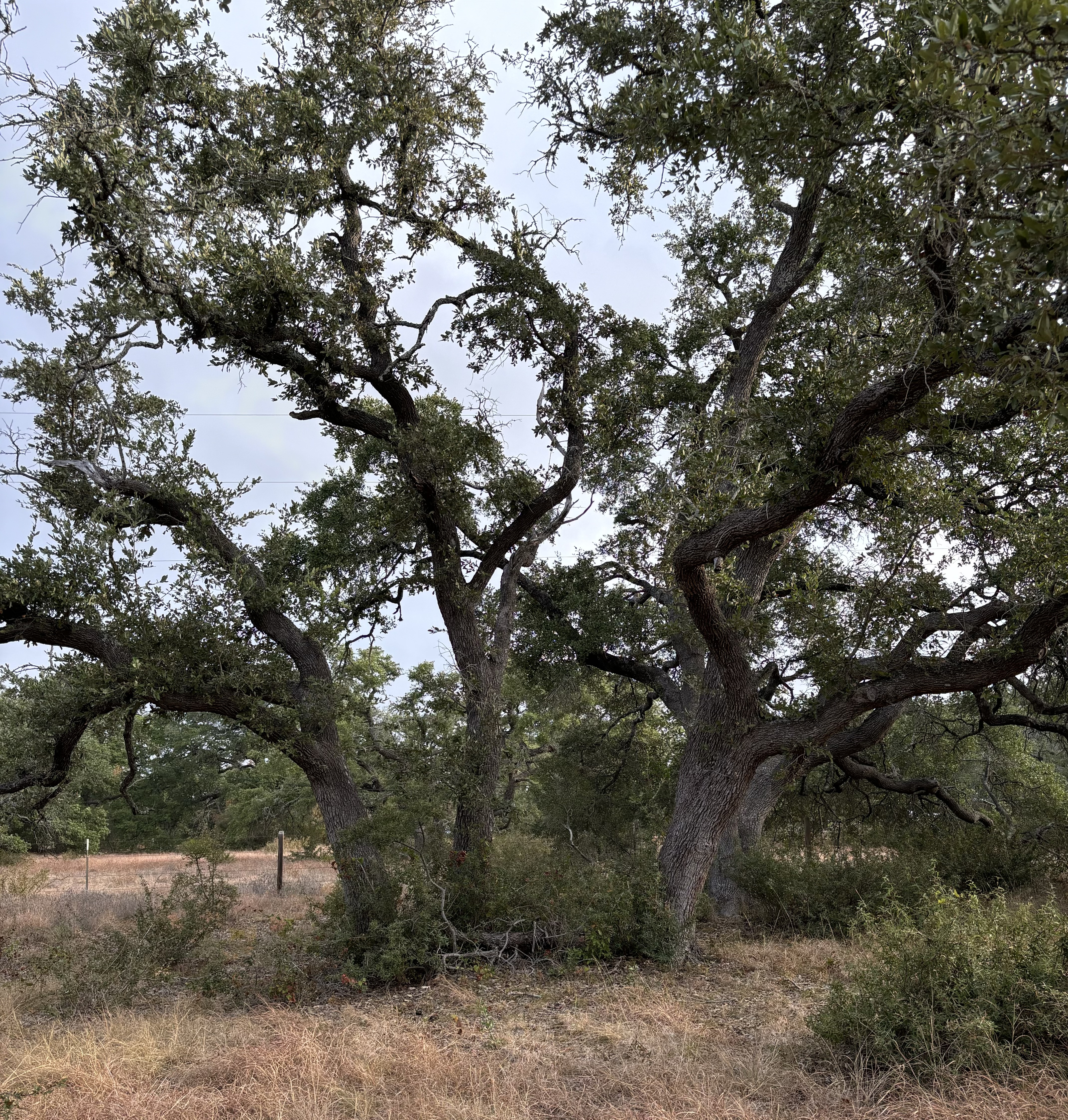
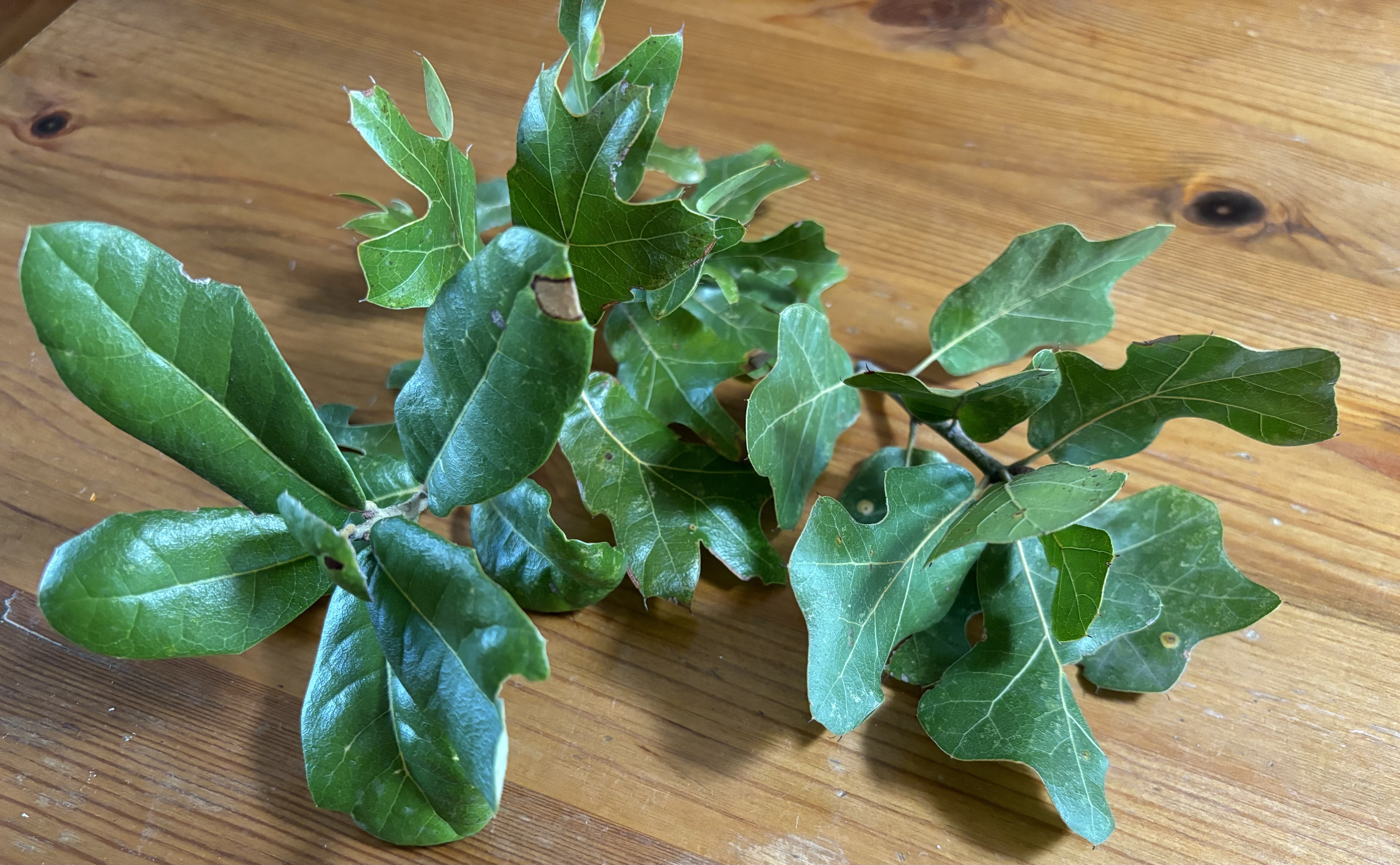
Out here on the Edwards Plateau, in the rugged karst landscape above a hill country creek, live oaks rule. The big evergreens, up to sixty feet tall, with a wide crown and massive limbs close to the ground, are Quercus Virginiana. They often grow in a circle—and you know they are communicating through their root systems. https://www.npr.org/sections/health-shots/2021/05/04/993430007/trees-talk-to-each-other-mother-tree-ecologist-hears-lessons-for-people-too

The way live oaks vary their leaves makes identification tough. On the Edwards Plateau, the species passes into the “shrubby Texas Live Oak”—shorter with smaller trunks: “…[I]ntermediate forms occur between the variety and the species and the distinctions are often difficult,” per Robert Vines, Trees, Shrubs and Woody Vines of the Southwest (1960). Well, thanks.

Now, in drought, with grass turned grayish tan, with dirt powder-dry beneath our feet, we treasure the blessed green of live oaks, often home to swings and hammocks, and providing wide shade to houses, pastures, and somnolent cattle.

Trees inspire us. We know Shakespeare’s song: “Under the greenwood tree, who loves to lie with me…” (As You Like It). The first poem in Wendell Berry’s A Timbered Choir begins, “I go among trees and sit still.”

Mary Oliver’s “Honey Locust” begins,

“Who can tell how lovely in June is the

honey locust tree, or why

A tree should be so sweet and live

            in this world?”

Robert Frost knows his trees: The Road Not Taken, Stopping by Woods on a Snowy Evening, Tree at My Window, Spring Pools, so many. Of course, his Birches:

“When I see birches bend to left and right

Across the lines of straighter darker trees,

I like to think some boy’s been swinging them…”

Frost makes it easy to imagine “some boy” swinging the birches—or Frost imagining that, as he marched through a yellow wood.

And then e.e. cummings, My Father Moved Through Dooms of Love—I like this verse:

“My father moved through theys of we,

Singing each new leaf out of each tree

(and every child was sure that spring

Danced when she heard my father sing)”

And Gerard Manley Hopkins, Spring and Fall:

“Margaret, are you grieving

Over Goldengrove unleaving?”

Yes, trees: later in the poem we find when “worlds of wanwood leafmeal lie.”

The forecast calls for rain. Please cross your fingers.

Helen Currie Foster lives and writes the Alice MacDonald Greer Mystery Series north of Dripping Springs, Texas, loosely supervised by three burros. She’s drawn to the compelling landscape and quirky characters of the Texas Hill Country. She’s also deeply curious about our human history and how, uninvited, the past keeps crashing the party. Currently she’s working on Book 10. Her protagonist, Alice, gets into legal drama, and matters of the heart. And yes, Alice does have a treehouse.

March Madness?!

by Helen Currie Foster

“MARCH MADNESS”? In the Texas Hill Country, “March Madness” doesn’t only mean NCAA basketball. Its alternate form: Demented Spring Gardening. Too early, you say? Well, according to the snakes, spring’s already here.

Of course it’s not officially spring yet. Just three weeks ago, here north of Dripping Springs, Texas, the entire landscape—every tree, every leaf–was shrouded in solid ice. But this week, well before the equinox, beneath the oaks you’ll spot the amazing heartbreakingly beautiful fuchsia of the redbuds.

And roses! The tender yellow flowers of the Lady Banksia rose are cascading from the oak tree that serves as her trellis.

On other branches you can see the first luxurious pink buds of Souvenir de Malmaison, named for Empress Josephine’s rose garden, beginning to open.

In the garden the ineffably fragrant Zephirine Drouhin is performing her slow tease, loosening the green sepals, delicately unveiling her bright pink petals.

I’ve already planted two new and reputedly very fragrant roses––Madame Plantier, and Cramoisi Superieur. (What a name!) And I replanted Buff Beauty, which produces buff and yellow and apricot blooms. Still waiting for two more—Savannah and Sweet Mademoiselle, both promising strong fragrance. Seriously, a rose without fragrance? Isn’t it disappointing to lean forward into a rose, inhale…and…nothing? As Shakespeare points out in Sonnet 56:

The rose looks fair, but fairer we it deem

For that sweet odour which doth in it live.

But for sheer fragrant spring bravado, tinged with peril, what about the ridiculous grape Kool-Aid smell of Texas mountain laurel? Intoxicating and loopy. The plant—sophora secundifolia–– isn’t called “Texas mescal bean” for nothing. https://www.wildflower.org/plants/result.php?id_plant=sose3: “The brilliant red seeds contain the highly poisonous alkaloid cytisine (or sophorine) – this substance is related to nicotine and is widely cited as a narcotic and hallucinogen.”


Poets give us strong language for the power of spring. From Dylan Thomas: “The force that through the green fuse drives the flower…”  https://poets.org/poem/force-through-green-fuse-drives-flower

From “in-Just” by e.e. cummings:

in Just-

spring          when the world is mud-

luscious the little

lame balloonman

whistles          far          and wee

“Mud-luscious!” Cummings captures the joys of digging, planting, splashing—of being a child in spring. https://www.poetryfoundation.org/poems/47247/in-just

“A Light exists in Spring” by Emily Dickinson was new to me. I treasure her recognition, her human diagnosis, of that first moment when we notice the magical presence of spring. It begins:

A Light exists in Spring
Not present on the Year
At any other period —
When March is scarcely here

A Color stands abroad
On Solitary Fields
That Science cannot overtake
But Human Nature feels.

bit.ly/420VlSC

More symptoms of March Madness? The powerful, even uncontrollable, urge to fill your cart full of geraniums, dirt, mulch, annuals, perennials, unknown roses, tomato plants, new trees… Trudging a quarter mile from the local native plants emporium to your car, lugging a red wagon full of blue sage, lantana, and other plants hopefully accurate in describing themselves as “deer-resistant”… Other symptoms include impassioned online review of rose varieties, frantic ripping open of seed packets and daily watering of small unlabeled pots, then staring at tiny emerging seedlings and wondering—what are you? Is that the fennel or the Aji Crystal Pepper or the Mexican plum?

I’d never heard of Mexican plum until a friend gave me a jar of her amazing Mexican plum jam. She described the trees as small, with fragrant white blossoms. So I ordered seeds. The very small print on the seed packet required “stratification” in the refrigerator. Well, I tried. Every morning I peer at the still-empty pots of dirt… little plants, where are you? Can you live in the Hill Country?

Also—perhaps prematurely—we dragged hay bales into the garden and embarked on the great Haybale Tomato experiment:

Supposedly, according to our favorite local well-driller, this approach produces for one local rancher “the most beautiful tomatoes in the Hill Country.” Our donkeys kept sticking their muzzles through the fence, trying to eat the bales. Watch this space. https://www.youtube.com/watch?v=z2jjIHgmypM

Gardens can be perilous. Think of Eden. But how many murder mysteries are set in gardens, or involve garden poisons? If you haven’t already become a fan of Reginald Hill, you might try Deadheads. Dalziel and Pascoe solve virtually every murder presented to them in their Yorkshire police headquarters. In this one, roses abound, beginning on the first page. And rose culture. And… murder. bit.ly/3Fgce23

Texas author Susan Wittig Albert knows her way around poisonous plants, in Texas or elsewhere. I just finished her Hemlock, Book 28 in her China Bayles series. This mystery—impressively researched, and fast-moving–takes the reader to the Blue Ridge mountains and theft of a rare botanical book, with deft historical backstory.  https://susanalbert.com/hemlock-book-28/

For more on Texas mountain laurel, its power and peril – see Ghost Dog, Book 2 in my Alice MacDonald Greer Mystery series. bit.ly/3YIotv5

The weather report threatens another cold snap this week—even (gasp!) a possible freeze. But right now it’s 74 degrees. Geraniums to plant. Blue sage. Tomatoes to water. Yes, it’s hubris, exposing these tender plants so early to the vagaries of Hill Country weather, but—I can’t help it. I just saw a big bud on Star of the Republic! I swear it wasn’t there yesterday. March Madness reigns!

***

Find Helen Currie Foster on Facebook or at http://www.helencurriefoster.com. The eight books of the Alice MacDonald Greer Mystery series, including the most recent, Ghosted, amzn.to/3YrJBXf, are available at Austin’s BookPeople as well as on Amazon (Kindle and Paperback).

Take Control of Your Life! Write!

kp gresham


by K.P. Gresham


This pandemic thing is getting really old. (A quote from Captain Obvious, obviously) But we writers have one thing in our arsenal that others don’t. We can create a world where we want to be.

Lori Rader-Day

Lori  Rader-Day, National Sisters in Crime President and award-winning mystery author, spoke to our Sisters in Crime Heart of Texas Chapter last Sunday. Besides promoting her new book, The Lucky One (which is an incredible must-read psychological suspense mystery), she also talked about how the pandemic is influencing her writing.

Authors, in our stories we get to create whole worlds that we can completely control. Our characters must acquiesce to our every whim. The settings can be places we want to hang, RESTAURANTS we want to eat at, crowded parks where we can watch fireworks with friends and family, churches where we can go to worship. As Ray Bradbury said, “Write only what you love, and love what you write. The key word is love. You have to get up in the morning and write something you love, something to get up for in the morning.”

This is a time where we can escape into our stories. Want to say something pithy in the real world? Act it out in your characters. Want to kill somebody? Do it on the page. (I can speak to this. It’s very cathartic.) The empowerment that comes by sitting down to the computer and writing just 250 words can produce those happy endorphins that’ll spark you right up. At least William Faulkner thought so. He said, “The right word in the right place at the right time can soothe, calm and heal.”
Full disclosure now. For the first two months of the pandemic I wrote absolutely nothing. Maybe I was too rattled, or just waiting for this pandemonium to pass, or in denial–bottom line I didn’t write one word.  Then I got mad. I wanted to scream at the TV. I wanted to rant on Facebook, “I’m mad as hell and I’m not gonna take this anymore!” After a few more weeks, I finally realized that this angst had to be released or I’d go crazy. And then I remembered how I had released that angst at different low points in my past.

Oh, yeah. That’s right. I wrote.

So I offer that you give it a try. Sit down, create the world that you CAN control and say what you have to say. As Walt Disney wrote, “That’s what we storytellers do. We restore order with imagination. We instill hope again and again and again.”

Take control of your world! Write!

***

K.P. Gresham authors the Pastor Matt Hayden mystery series. Her latest is MURDER ON THE THIRD TRY.


Five Reasons To Write Historical Mysteries

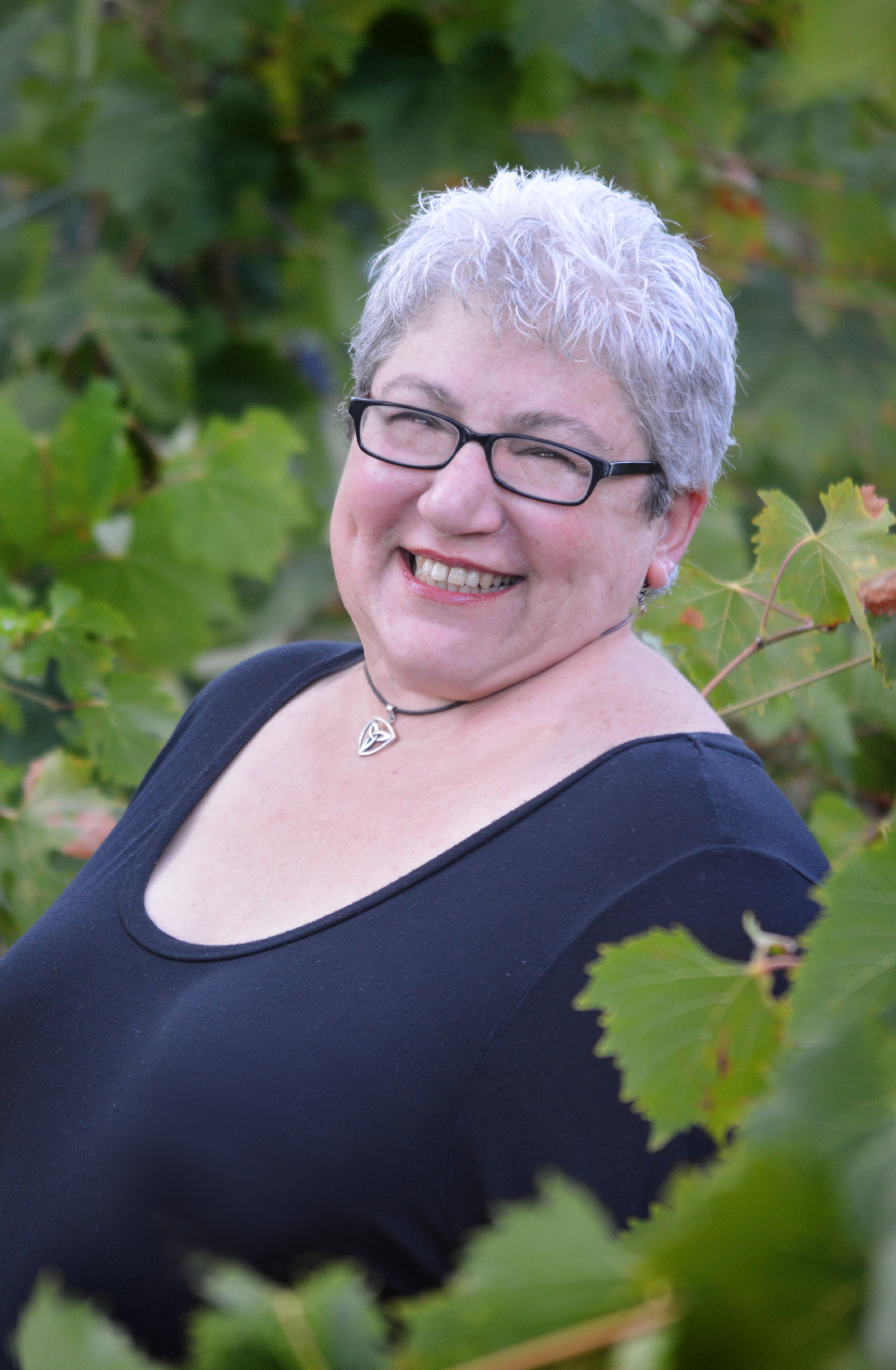
Today we welcome a guest blogger, mystery writer Jeri Westerson! She writes the critically acclaimed Crispin Guest Medieval Noir novels. Her protagonist is a disgraced knight turned detective, plying his PI trade on the mean streets of fourteenth century London. 

Jeri_2015 (1)

Her books have been shortlisted for a slew of mystery awards, including the Macavity, Romantic Times Reviewers’ Choice Award, the Agatha, and the Shamus, the first medieval mystery to be nominated for this prestigious PI award. The Boston Globe calls her detective “A medieval Sam Spade, a tough guy who operates according to his own moral compass.”

Jeri also has short stories in several anthologies and talks around the country about the Middle Ages, demonstrating her cache of medieval weaponry.

Jeri is a member of the southern California chapter of Mystery Writers of America, Sisters in Crime, Private Eye Writers of America and the Historical Novel Society. Jeri is married to a commercial photographer, has a screenwriting son, and herds two cats, a tortoise, and the occasional tarantula at her home in southern California.

Jeri, welcome to AMW!


5 Reasons to Write Historical Mysteries

By Jeri Westerson


I’ve been immersed in history all my life. My parents were rabid Anglophiles, stuffing our bookshelves with historical novels, works of nonfiction, and having discussions at the dinner table about the British monarchy. I can definitely name more kings and queens of England than American presidents. I had my own literary relationship with Geoffrey Chaucer and was probably the only kindergartner in Los Angeles who could recite part of the prologue to The Canterbury Tales…in Middle English.


And so many years later when I decided to become a novelist, it was pretty much a no-brainer that I would write historical novels about the medieval period. I switched to medieval mysteries when the kind of historical novel I liked to write proved to be the kind editors didn’t want to publish, though they translated very nicely to the mystery genre and I found success!


  1. I Like To Research.

Let’s face it. If you never liked doing homework or researching for a term paper, this isn’t the genre for you. I rather enjoyed looking things up, tracking down that little fact like a detective, and coming up with oodles of other nifty things by reading those footnotes (ALWAYS read footnotes). And I love libraries and you’ll be spending a lot of time in them. For the kind of thing I need, I spend time in university libraries. I’d love to travel across the pond to do my research in archives, but alas, it’s not in the budget. Fortunately, you can now reach many of these archives online. Some of the items you need might even be scanned and uploaded. Sometimes you still have to pay the archivist to make a copy for you and they will either scan it and email it, or copy it and snail mail it to you. Either way, you’ve made a new friend and possibly a new reader.


  1. The Timeline is Your Outline

When you write historically, readers expect to get a healthy dose of history with their mystery. And if you write a series that will happen over many years, all the better. In my Crispin Guest series, my fourteenth century disgraced knight turned detective, encounters all the juicier bits of the late 1300’s during Richard II’s reign, including a friendship with one Geoffrey Chaucer, running into his former charge Henry of Bolingbroke as he and his Lords Appellant force the king to follow Parliament’s dictates, encounters his former mentor John of Gaunt and his longtime mistress Katherine Swynford, and is on hand when King Richard is ultimately deposed. There’s a lot of intriguing court politics and threats of war going on in the seventeen years the series is taking place, and each year in history helps suggest plot points on which my detective runs afoul of his monarch.


  1. A Ready-Made Audience

Now granted, it isn’t a big audience, so prepare yourself that you will be writing in a niche, which means sales won’t be huge. But there are also many sub genres and cross genres when it comes to historical mysteries. There is also historical mystery/romance, historical mystery timetravel, and every other permutation you can think of. So there is every opportunity to widen that base.


  1. Just the Facts

You must be a stickler for facts. Movies seem to get to play fast and loose with facts. There are millions of people out there who watched Braveheart and think that William Wallace sired a child on the wife of the future King Edward II, when anyone who knows a smidgen of history knows that Queen Isabella was a child of twelve herself at the time and wasn’t even yet living in England. But there were many things about that film that make even amateur historians cringe. You won’t be able to do that with a book. Readers will call you on it. They will abandon the book early if you fudge the facts. They won’t be able to trust any of your book and it will spoil their enjoyment. Just consider it your unwritten contract with your reader that you will do your best to get it as historically accurate as you can.


  1. You Write Because You Like To Read It

As I mentioned in number four, it won’t be a huge market. So there’s no sense in choosing to write something only because you think it’s going to make a lot of money. Get it into your head now that you won’t make a lot of money. There now. Don’t you feel better? If by some off chance your book captures the imagination of readers and hits the bestseller list, mazel tov! If by another off chance Hollywood comes calling and offers to make a series of it, then celebrate. But please don’t ever expect it. You should be writing in a genre because that’s what you like to read. That’s where your writing shines. That’s where you get the most enjoyment writing.


Is writing historical mysteries for everyone? Only if you are a person who enjoys research. And if you are, the entire history of humanity is open for grabs.


silence_rgb

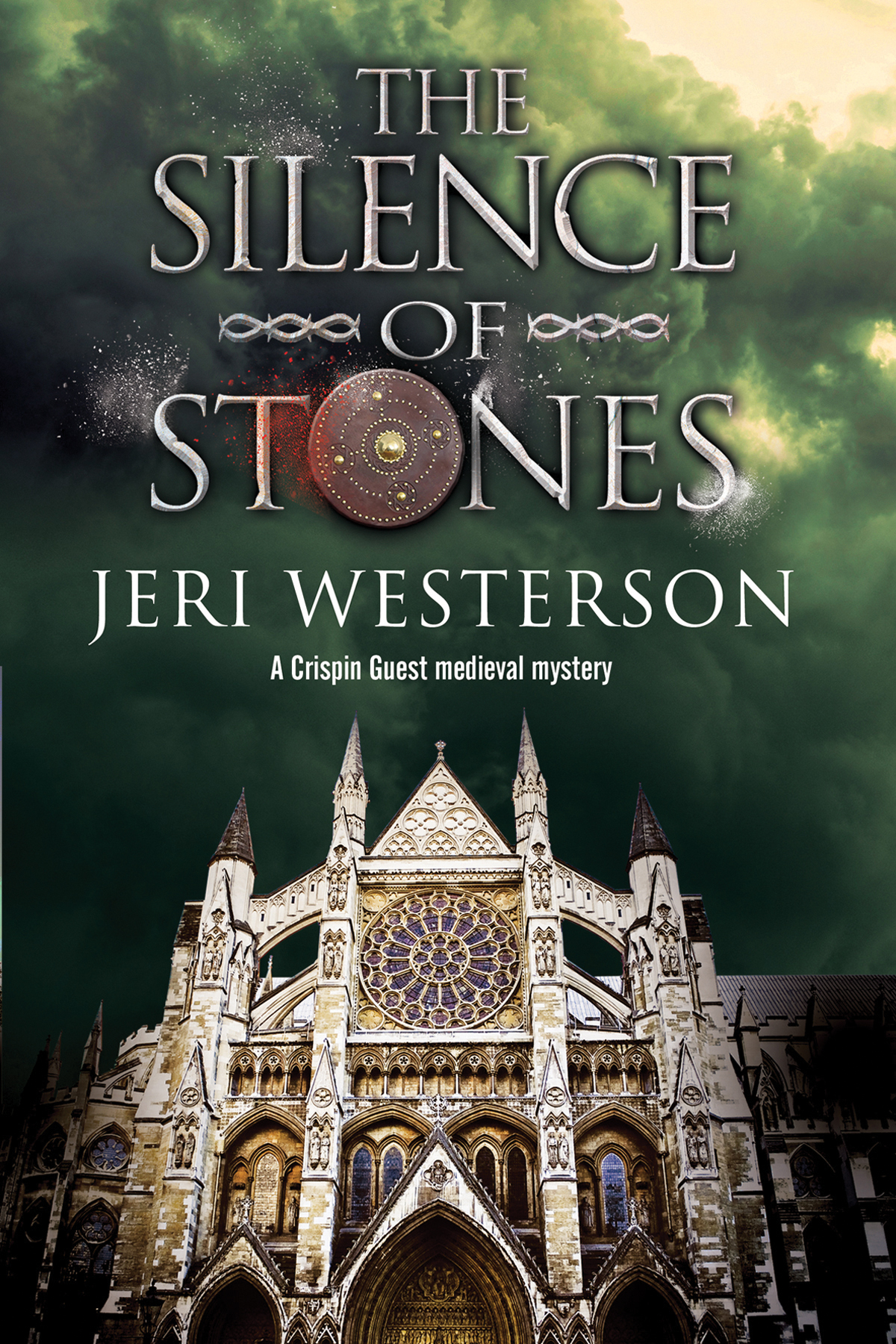
Jeri likes exploring the past, especially with her latest mystery, THE SILENCE OF STONES; A Crispin Guest Medieval Noir, dealing with the Stone of Destiny, Scottish rebels, a dark and brooding knight detective, and murder. Read an excerpt, see discussion guides, and watch the series book trailer on her website at www.JeriWesterson.com.