
Curious Animals And Recent Reads


by Helen Currie Foster

New reads! If, like me, you desperately miss John le Carré, consider A Spy Alone, the 2023 debut spy thriller by Charles Beaumont, a field operative veteran of Britain’s MI-6. https://bit.ly/3ZzHjHs His premise is fascinating: we know of the “Cambridge Five” who spied for Russia from the 1930’s to 1950’s—Kim Philby, Guy Burgess, Donald Maclean, Anthony Blunt and John Cairncross. https://en.wikipedia.org/wiki/Cambridge_Five But has there ever been, or could there be, a spy ring linked to Oxford? Beaumont’s protagonist Simon Sharman feels real, right from the first page:

“It is their shoes that give them away. As a lifelong fieldman, Simon Sharman hasn’t forgotten the lesson: walkers might change their jackets, pull on a pair of glasses, even a wig. But nobody changes their shoes on a job. Look at their shoes. 

I was hooked. Warning: Beaumont’s book is contemporary, well-written, tense, and may interfere with sleep. 

Two other recent reads: old adventure and a new “adult fantasy.” I’d never heard of The Long Ships by Frans G. Bengtsson (1954).

Set from 980 to 1010 A.D., the book recounts the wide-ranging adventures of Norseman Red Orm Tostesson, and the collision between Christian priests (the “shaven men”) and the Norse culture of Skania at the south tip of Sweden. Now I know what it meant to go “a-viking”—to go sea-raiding! 500 pages, with Red, a very engaging Norseman. Great maps, too.

The Lost Bookshop, by Evie Woods (2024), offers time travel between the 1920’s and 30’s in Britain, and the present; a search for a lost Brontë manuscript; a disappearing attic; and disappearing and reappearing characters. I confess I flipped through big chunks, relieved when true love finally won out after two women, generations apart, survive appalling treatment. The disappearing attic reminded me of Susan Cooper’s Over Sea, Under Stone, and of course the wardrobe into Narnia in The Lion, the Witch and the Wardrobe. I’m always up for secret doors.

I’m rereading a fascinating and fairly demanding study by Graham Robb, who has probably bicycled and walked further in Britain and France than most humans:

In The Search for Middle Earth: Mapping the Lost World of the Celts (2013)he describes how the Keltoi, or Celts, developed a system of surveying based on a midline transected by the lines of the summer and winter solstice to estimate travel distances and times—a feat not replicated for centuries. He maps the Heraklean Way, the path from southwestern Iberia that runs northeast across the Pyrenees to the Alps along the diagonal of the solstice sun, which Hannibal took when he invaded Italia. He describes Druid schooling (20 years to learn) and maps out protohistoric forts which turn out to lie along survey lines. He provides amazing maps. Two ongoing lessons from Robb’s devoted research: the winners write history; and humans tend to underestimate the accomplishments of earlier civilizations. 

Several of you asked about the three burros, given the recent cold snap. Thank you, they’re well. Their hair’s not waterproof so in cold rain they gather on the south side of the stable, under the roof, safe from rain and the north wind. They were relieved to see green grass again after the drought broke, but they’re also eating—and rolling in––green hay. And mud!

Yet despite hay, they gather outside the gate every morning and afternoon for carrots. They consider this part of their deal.
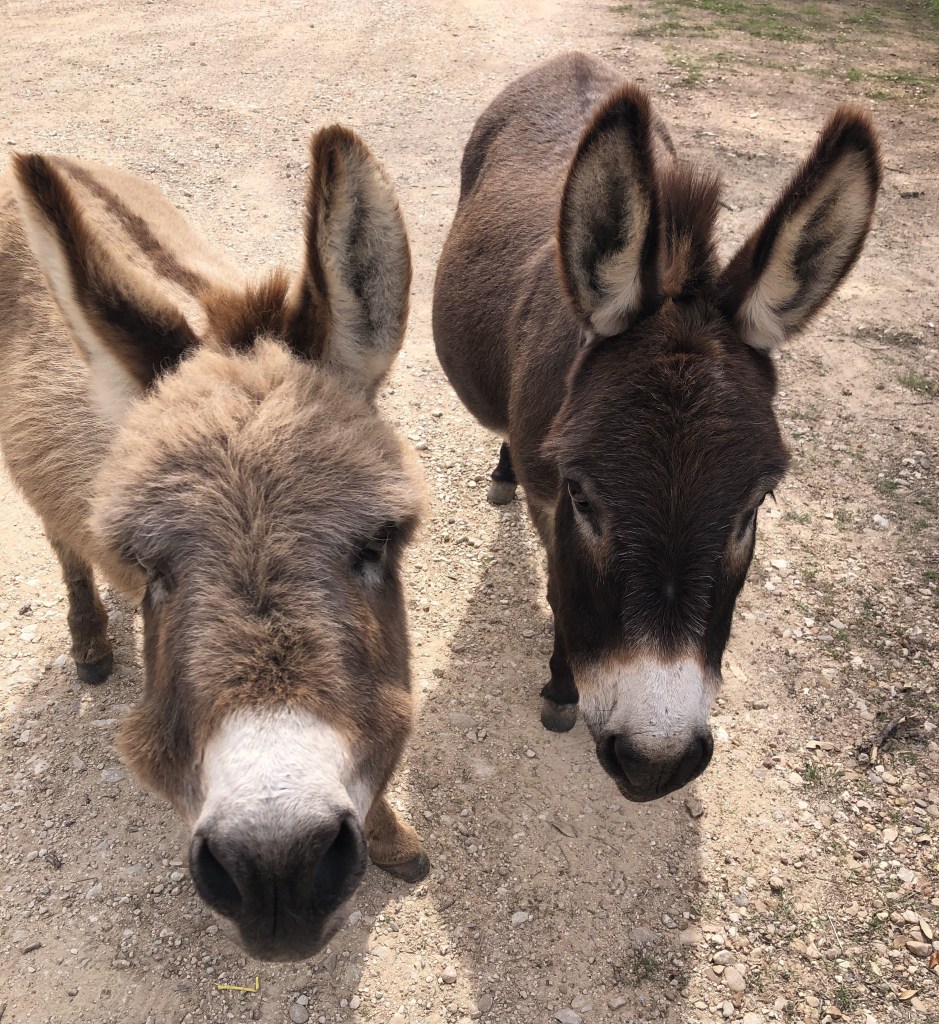
Burros are curious. They amble over to watch us garden and hang up laundry. They need company. They graze near each other. They may live into their 40’s. Sebastian, the short stubby knock-kneed male who invited himself to live here, may be 35 or more. Amanda (who insists I tell you she’s registered, with papers) may be 20. Her daughter Caroline is 12. Sebastian deems it his duty to bray loudly when any person or car appears at the end of the driveway, and to welcome the sun every morning with a stunningly loud bray. Now both Amanda and Caroline have begun to bray occasionally. 
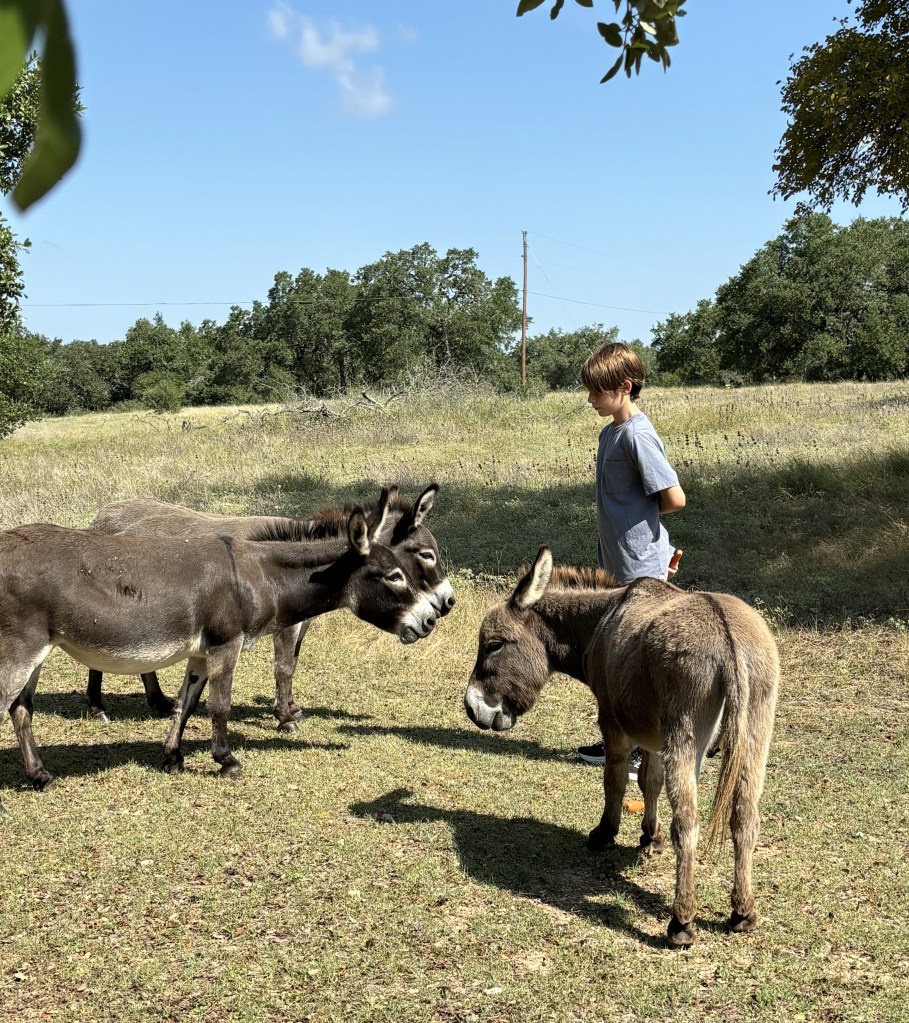
Only donkeys can bray. Unlike horses or zebras, donkeys begin a bray on the inhale and continue braying on the exhale. They have great hearing—supposedly they can hear another donkey bray 60 miles away. 

They especially detest canids and will attack, dance on and kick dogs, coyotes, bobcats, foxes. A spooked horse will run away: donkeys stand together until they decide what they’re going to do. This morning, leaving for the post office, I saw the three donkeys standing together, knees locked, ears cocked, eyes fixed on two trespassing dogs who’d strayed across the cattleguard and into the donkeys’ domain. 

The dogs immediately acknowledged their gross error of judgment, raced frantically away and never returned.
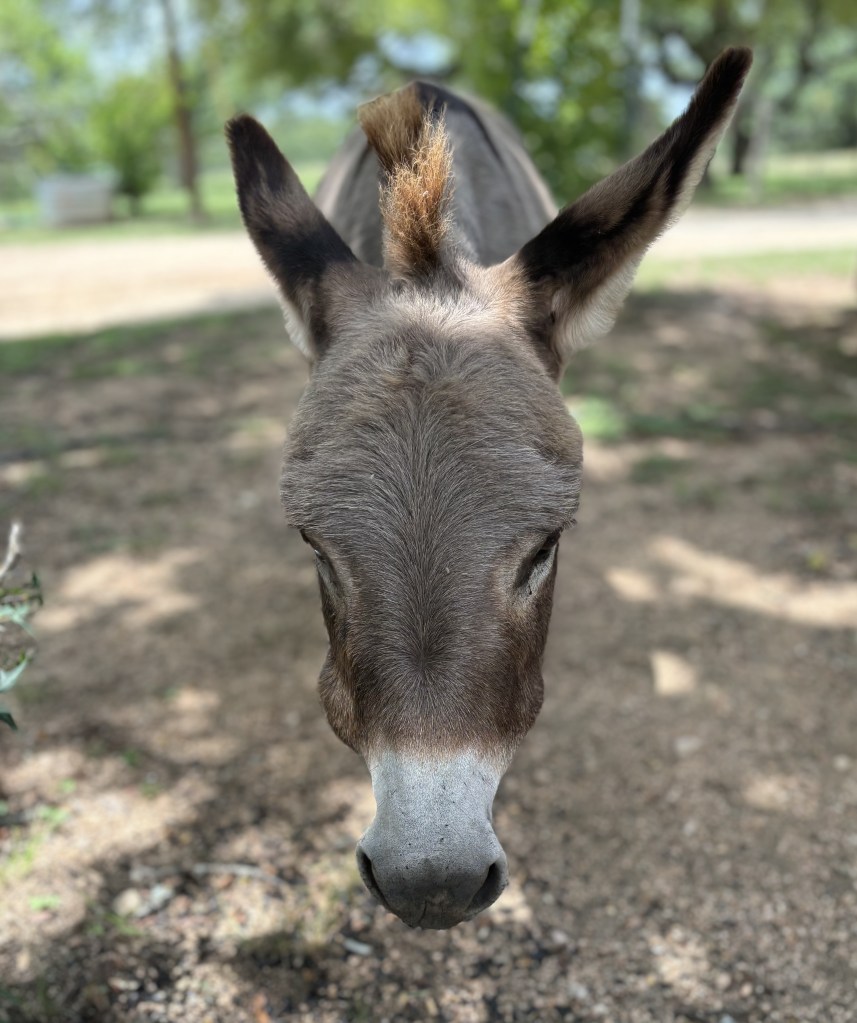
If donkeys could read (wait—maybe they can, but have trouble turning the pages), I predict they’d prefer mysteries. They enjoy puzzles (like how to lift the chain and invade the fenced garden). 
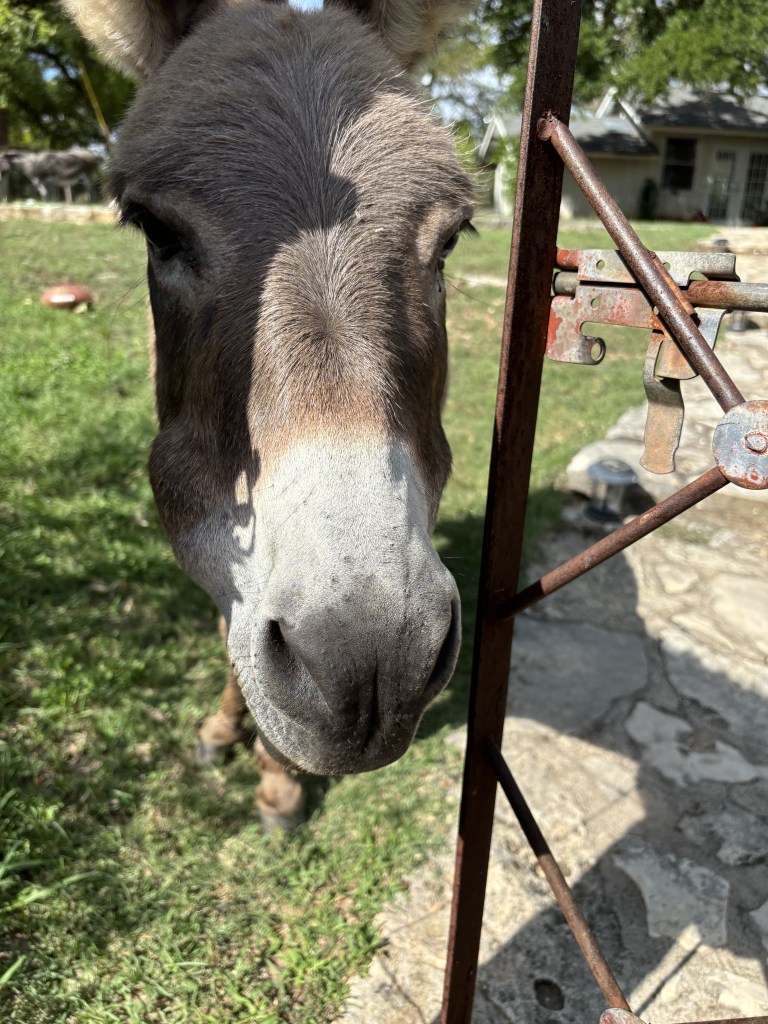
Humans and donkeys. We are both curious animals.

Helen Currie Foster lives and writes the Alice MacDonald Greer Mystery Series north of Dripping Springs, Texas, loosely supervised by three burros. She’s drawn to the compelling landscape and quirky characters of the Texas Hill Country. She’s also deeply curious about our human history and how, uninvited, the past keeps crashing the party! Currently she’s working on Book 10. Her protagonist, Alice, gets into legal drama, and matters of the heart. Alice does have a treehouse…

Follow Helen at http://www.helencurriefoster.com and on Amazon and Facebook, https://www.facebook.com/helencurriefoster

Why They’re Favorites…? On Rereading

BY HELEN CURRIE FOSTER

What’s your favorite place to read? A certain chair? The one with a lamp that shines on your book, not in your eyes? Perhaps a ferryboat seat, where you glance up at the horizon, then down at your book? On a plane, or train?

When I was young our house had an elm tree in the back yard which was not only climbable, but offered two branches that stuck out at the perfect angle for a lounging pre-adolescent. Even better—the lounger was invisible from the house. I could scramble up, arrange myself, open my book—and be left unfound, undisturbed, for some time.

A later joy was climbing on the New Haven RR in Boston after final exams (Chaucer, Shakespeare), armed with the latest James Bond and the very biggest Hershey bar with almonds, and being rocked south for miles along the coastline. Uninterrupted.

And I confess to rereading books. I further confess to rereading children’s books. Maybe a more accurate word is: revisiting. At least every two years, I pick up Kipling’s Kim, finding my way to the part where Kim guides his Tibetan lama, who seeks a sacred river, on a pilgrimage into the high deodar forests of the Himalayas. I can almost smell the trees. There Kim steals the Russian spies’ notes––his own initiation into the Great Game. Even more satisfying? The long afternoon where, exhausted, he is “taken apart” by Eastern massage and finally stumbles out, recovered, to find his lama at the brink of—well, no spoilers.

Why this gravitational pull of favorite children’s books?

Maybe because the best children’s books feature enterprise, surprise, disguise. And—most important––the discovery of identity.

Consider The Sword in the Stone, where Merlin transforms Wart into various animals (badger, owl, fish) who teach him survival techniques (“put your back into it!”). And magic! Giants! Griffins! The Queen of Air and Darkness! (See volume below–griffin looming behind tree.) One favorite moment? When Merlin transforms Wart to a raptor—a small merlin––who must sit for desperate minutes during his formal initiation, near the maddened and perilous Peregrine. Why does Wart need Merlin’s special tutelage? Because of his identity, which he and we will finally discover.

Others I still pull off the shelf: The Wind in the Willows, especially Mole’s tearful return home, where he recognizes his true self.

Also Susan Cooper’s The Dark Is Rising. Maurice Sendak’s Nutshell Library – memorizing all the poems. I sneak back to Harry Potter—a feast of enterprise, surprise, disguise, and Harry’s search for his own identity. Occasionally I return to Lord of the Rings––especially the battle for Gondor. You’ll note I missed out on Jack London and many others. But there’s always The Lion, the Witch and the Wardrobe—remember that wondrous moment when Lucy slips through the back of the wardrobepast all the mothballed coats…into magic? Into the snowy landscape where she meets Mr. Tumnus the faun? Into the realm where––as Lucy later discovers––she is Queen Lucy?

You have your favorites. So do our collective children and grandchildren. Bookstore shelves still offer children tales of enterprise, surprise, disguise—and characters discovering their own identities.

And fortunately, children’s books needn’t follow the 1930 Detection Club’s 10 Rules for Writing a Mystery. Rule #2: “All supernatural or preternatural agencies are ruled out as a matter of course.” Following Rule #2 would let out magic, of course, and its enormous space for imagination. (If you, like me, crave an occasional touch of magic for grown-ups, try Remarkably Bright Creatures by Shelby Van Pelt. amzn.to/44iIoVj)

As a mystery writer/reader I usually write about mystery. But thinking lately about the bibliophile’s favorites—favorite reading spots, favorite chairs, favorite characters––has sent me down a different path. Why reread? Wait––why revisit?

What is it about the end of Kimor the plight of Frodo and Samwise in Shelob’s lair, or Harry Potter’s first moment on his broom, learning how good he is at Quidditch––that whispers, “read it again!”

I reread mysteries too. Have you reread a Dorothy Sayers, a Ngaio Marsh, a Sherlock Holmes? Or John le Carré? How many times have you read Tinker, Tailer, Soldier, Spy, or Smiley’s People? (Come on, spy thrillers are part of the mystery-thriller-spy novel genre.) And why do we reread le Carré? One character in particular: George Smiley.

Smiley first appears on page 1 of chapter 1, titled “A Brief History of George Smiley,” in Call for the Dead, le Carré’s first book, published in 1961. Smiley’s marriage to the aristocratic Lady Ann Sercomb has ended when she abandoned him, and he’s described as follows: “Short, fat and of a quiet disposition, he appeared to spend a lot of money on really bad clothes, which hung about his squat frame like skin on a shrunken toad.”

We learn of his deep love of 17th century German literature, his success at Oxford, his recruitment by MI-6, his dangerous service abroad as a spy in WWII. Not a commanding figure, no. But le Carré allows us to glimpse his sharp mind, his penetration, his ability to absorb all he hears. Smiley’s work as an intelligence officer provides him “with what he had once loved best in life: academic excursions into the mystery of human behaviour, disciplined by the practical application of his own deductions.”

Smiley appears next in A Murder of Quality (1962), where Smiley’s solution to the murder rests on a scathing critique of the snobbishness of British public schools (le Carré despised his own experience at such a school).

By the time we reach Tinker, Tailor, Soldier, Spy (1974), Smiley has been put out to grass at MI-6 under the new regime headed by Bill Haydon, who has seduced Smiley’s wife Ann and taken over London Station after causing the bitter dismissal of Control as its head.

In Tinker, Tailor, Smiley is plucked out of retirement to interview a somewhat dubious British agent who claims the Russians may have placed a mole inside MI-6. Here’s Smiley, listening to the agent’s tale:

“He sat leaning back with his short legs bent, head forward, and plump hands linked across his generous stomach. His hooded eyes had closed behind the thick lenses. His only fidget was to polish his glasses on the silk lining of his tie, and when he did this, his eyes had a soaked, naked look that was embarrassing to those who caught him at it.”

Smiley’s investigation marches ahead. The BBC wants to make a series of Tinker, Tailor. And John le Carré has an actor in mind: Alec Guinness. https://www.theguardian.com/tv-and-radio/2019/sep/05/tinker-tailor-soldier-spy-40-years-on-alec-guinness

Le Carré’s letter to Sir Alec Guinness (3 March 1978) appears in A Private Spy / The Letters of John le Carré, at 213. He tells Sir Alec:

“Apart from plumpness, you have all the other physical qualities: a mildness of manner, stretched taut, when you wish it, by an unearthly stillness and an electrifying watchfulness. In the best sense, you are uncomfortable company, as I suspect Smiley is. An audience wishes––when you wish it––to take you into its protection. It feels responsible for you, it worries about you. I don’t know what you call that kind of empathy, but it is very rare, & Smiley and Guinness have it: when either of you gets his feet wet, I can’t help shivering.”

I love that “as I suspect Smiley is.” Does the author’s own speculation about George Smiley explain, in part, why we readers become so attached to this character? What drives us to Smiley’s side? Is it his apparent ineffectualness, his vulnerability, his stillness, his watchfulness, entwined with our certainty that he will somehow keep going?

Not until 1979 in Smiley’s People does Smiley achieve final vindication, catching the Russian master-spy who conceived the long set of steps that led to Haydon’s seduction and Control’s fall. At the climax, we (along with Smiley and his fellow spy Peter Guillam) await the possible arrival of the Russian in cold war Berlin, at the crossing point from East Germany. Will the spy make it across the bridge? Guillam asks what cover the Russian will use:

Smiley sat opposite him across the little plastic table, a cup of cold coffee at his elbow. He looked somehow very small inside his overcoat.

“’Something humble,” Smiley said. “Something that fits in. Those who cross here are mostly old-age pensioners, I gather.’ He was smoking one of Guillam’s cigarettes and it seemed to take all his attention.”

At book’s end, we are waiting with Smiley. It’s cold there by the Berlin bridge. I expect Smiley’s feet are wet. Like the author, “I can’t help shivering.” When we know a character’s vulnerabilities, we begin to perceive true identity.

For Smiley, for all the characters created by their authors with such vividness and such vulnerability that we seem to feel what they feel, for such characters–I reread. Yes, the better word is revisit: I go back just to be sure the characters are still there, still available, still waiting quietly on the shelf. And, yes, just as good as I thought they were.

I’d love to hear your favorites (reading spots, children’s books) and the favorite characters you…revisit.

*****

Author: Helen Currie Foster

I live north of Dripping Springs, Texas, supervised by three burros. I’m deeply curious, more every day, about human history and prehistory and how, uninvited, the past keeps crashing the party. I’ve loved the Texas Hill Country since my first sight of it as a teenager. Artesian springs, Cretaceous fossils, rocky landscapes hiding bluegreen water in the valleys. After law school (where I grew fascinated with water and dirt) I practiced environmental law and regulatory litigation for thirty years––then the character Alice suddenly appeared in my life. I’m active with Austin Shakespeare and Heart of Texas Sisters in Crime. And I’m grateful to the readers who enjoy the Alice MacDonald Greer Mystery series!