That First Line…and More?

by Helen Currie Foster

November 24, 2025

Writers live in trepidation that they’re failing a much-publicized writing test: a great first line.

Maybe that’s not a fair burden. If I already like a writer’s work—a favorite mystery-writer, for instance–I don’t demand a blockbuster first line. But I do need reassurance that I’m going to like that writer’s new book as well as the last. So on the opening page, I hope to see a reminder of the detective’s personality, of an interesting setting, of the vagaries of the detective’s colleagues.

If, however, it’s my first encounter with an author—I need to be drawn in swiftly. Looking at first lines (and what immediately follows) is a good exercise. Each reader knows when the opening has worked, and they’re hooked on a story—or not. Maybe the lesson is this: when the reader’s eyes fall on the first page, the writer must promise the story!

“Tell me a story!” That’s what we’re looking for when we open a book. The first sentence, the first page, needn’t summarize the book, but we want very quickly to know we’re going to get a story.

Here’s a first line that kept me reading: “When Augustus came out on the porch the blue pigs were eating a rattlesnake—not a very big one.”

Blue pigs? I’d never heard of blue pigs, much less pigs dining on rattlesnake. Of course I kept reading, just to hear more about Augustus: “Pigs on the porch just made things hotter, and things were already hot enough. He stepped down into the dusty yard and walked around to the springhouse to get his jug.” By then the reader might also be feeling thirsty and might wonder if Augustus would share that jug… but the author hadn’t finished:

“[T]he sun had the town trapped deep in dust, far out in the chaparral flats, a heaven for snakes and horned toads, roadrunners and stinging lizards, but a hell for pigs and Tennesseans.”

What a setting, and what a contrast to Augustus’s home—he’s stuck in godforsaken dusty chaparral flats, heaven for snakes and horned toads, and far from the moist green hills of Tennessee.

McMurtry’s first sentence is great. But then he gives us just a couple more sentences—and we find ourselves already longing to hear more about Augustus as the saga begins—Lonesome Dove, of course, and thank you, Larry McMurtry.

The on-line lists of “famous first lines” include perennial favorites. Of course Moby Dick is famous—“Call me Ishmael.” We’re notified that our protagonist will be wandering far….

Also there’s Pride and Prejudice: “It is a truth universally acknowledged that a single man in possession of a good fortune must be in want of a wife.”  Jane Austen doesn’t keep us waiting. By the end of the first page we know that “a single man of large fortune” has arrived in the neighborhood—and we tingle in anticipation of the plot suggested in the opening sentence.

What about Shogun? The first line of James Clavell’s novel hauls us in: “The gale tore at him and he felt its bite deep within and he knew that if they did not make landfall in three days they would all be dead.” Then, “Too many deaths on this voyage, he thought, I’m Pilot-Major of a dead fleet. One ship left out of five—eight and twenty men from a crew of one hundred and seven and now only ten can walk and the rest near death and our Captain-General one of them. No food, almost no water and what there is, brackish and foul.”

What will happen? Will the pilot survive? We’re hooked by the first sentence, and the next few sentences convince us that we’ve got a tale to read in Shogun. Even if we’ve never yet read any Clavell, we’re confident—as we are in Lonesome Dove, and in Pride and Prejudice––that the author’s got a story for us.

Hilary Mantel is a genius at first lines. The Mirror & the Light begins In London, in May 1536, with this sentence:  “Once the queen’s head is severed, he walks away.” It takes another page before we begin to grasp that “he” is Cromwell, attending the execution of Anne Boleyn. And already we know that this story will be frightening.

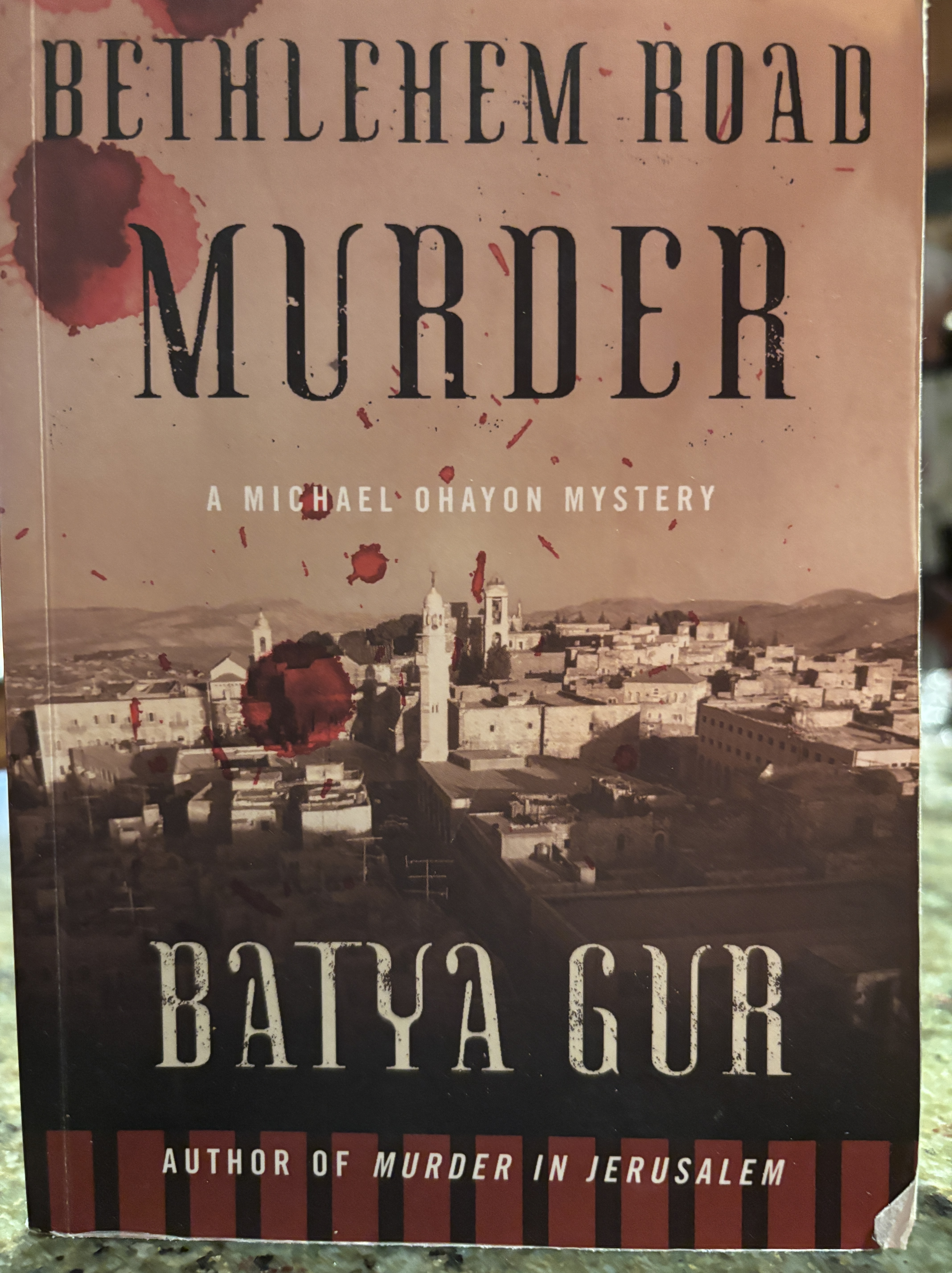
As a lover of mystery novels, I’m critical about beginnings. I liked Batya Gur’s mysteries, set in Jerusalem, with Chief Superintendent Michael Ohayon. Here’s the first line of Bethlehem Road Murder:
“There comes a moment in a person’s life when he fully realizes that if he does not throw himself into action, if he does not stop being afraid to gamble, and if he does not follow the urgings of his heart that have been silent for many a year—he will never do it.”

Okay, but who’s thinking that? The next sentence reveals the thought belongs to Chief Superintendent Ohayon himself, and he’s thinking that thought while he’s engaged in leaning over a woman’s corpse and trying to get a better look at the silk fibers from the rip in the scarf around her neck. In other words, our detective’s already on the job—but what are the “urgings of his heart” that we just heard about? I’m hooked—we have a corpse, a murder (surely a mystery to solve)—and also a mystery about what’s bugging our protagonist.
Here are the first and second line of one of Tony Hillerman’s later mysteries, The Shape Shifter (2006):

“Lieutenant Joe Leaphorn, retired, stopped his pickup about a hundred yards short of where he had intended to park, turned off the ignition, stared at Sergeant Jim Chee’s trailer home, and reconsidered his tactics. The problem was making sure he knew what he could tell them, and what he shouldn’t, and how to handle it without offending either Bernie or Jim.”

If you didn’t already know Lieutenant Leaphorn, you’d at least grasp from the first sentence that he’s tactful, careful, thoughtful. But what’s the issue he’s wrestling with? We’ll know by the end of the paragraph, and we’ll be deep into a new story. Just as we hoped.

And here’s the first line of Hillerman’s earlier The Ghostway (1986): “Hosteen Joseph Joe remembered it like this.”  The next paragraph explains how this witness “noticed the green car just as he came out of the Shiprock Economy Wash-O-Mat…The car looked brand new and it was rolling slowly across the gravel, the driver leaning out the window just a little.” And what Hosteen Joseph Joe remembered next was that the driver—though he looked like a Navajo—had yelled at Joseph Joe, who was eighty-one, and “that was not a Navajo thing to do.” We already feel a story—why would someone yell at Hosteen Joseph Joe?—but by the time Hosteen Joseph Joe winds up his narrative (just paragraphs later) he has also described the ensuing pistol shot leaving a dead man on the ground. Who was murdered? By whom? Why? We’ve definitely got a story.

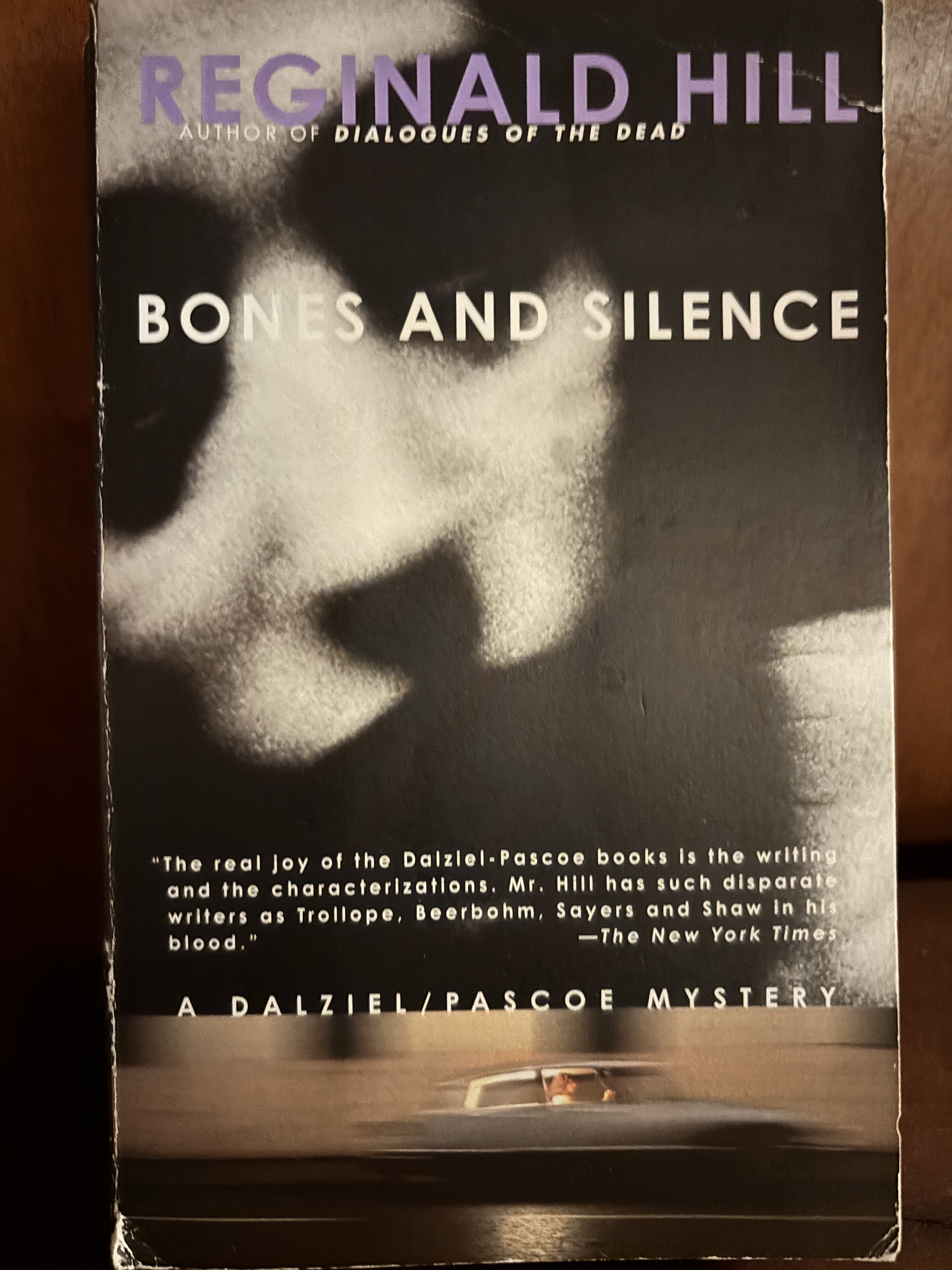
If you read Reginald Hill (his protagonists are Detective Superintendent Andy Dalziel and Peter Pascoe of the Yorkshire CID), you know that he begins every mystery differently. His Bones and Silence (1990) is no candidate for a mere “first sentence.” Instead, it opens with a letter to Superintendent Dalziel from an anonymous correspondent who intends to commit suicide, but wants to be in correspondence with Dalziel before this occurs. The letters continue to arrive for Dalziel for months—anonymous, and we don’t know whether the writer is man or woman—as he and Pascoe toil through a series of apparently unrelated murder investigations. We readers are kept in suspense until the very last page.
Finally—and do you remember being assigned this book?—consider this first sentence: “The cold passed reluctantly from the earth, and the retiring fogs revealed an army stretched out on the hills, resting.” Thus opens The Red Badge of Courage, by Stephen Crane. We see the landscape—and we see the army, “resting.” “Resting”? The army must need  rest and we wonder why. “Resting” somehow builds suspense for what may follow –for what may happen when the army finishes resting. We know there’s a story––but we don’t know what, and we won’t meet that young private for a couple of pages more.

Our craving for stories is what makes us human. Think of the power of those four little words: “Once upon a time…!” Four words that assure us of a story. We gather around to hear it, whether we’re three, thirty, ninety.

Robert Louis Stevenson, author of such tales as Treasure Island and Kidnapped, was given a name by the Samoans: TUSITALA—the Teller of Tales. What an honor!

And that’s who we aspire to be. Raconteurs! Storytellers! Writers! Authors! Tellers of Tales!

And now–here in the Hill Country west of Austin, we finally (FINALLY) got some rain. Wishing you a HAPPY THANKSGIVING!

My latest tale, Ghost Justice, came out August 29, 2025. It’s Book 10 in the series involving Alice, a lawyer working in the small town of Coffee Creek in the iconic Texas Hill Country. Legal drama, and matters of the heart! The next tale is simmering! Find Ghost Justice at BookPeople in Austin or on Amazon. https://www.amazon.com/Ghost-Justice-Helen-Currie-Foster/dp/1732722943

Follow me at http://www.helencurriefoster.com.

See You…in September!

By Helen Currie Foster

It’s September! New school year! New shoes, after a hot barefoot summer! New outfit, for the first day of school! And then––new classes! New subjects, new teachers, new tools! New friends! New lockers, new classrooms, new hallways…. New season—new teammates, new coach, new plays.

Remember all that?  Your first day back at school? Back to college, back to university? Do you remember the excitement, the nervousness, the anticipation?

September 1 was  Labor Day. And now there will be apples, apple pie and apple crisp. There will be chrysanthemums, spilling out of baskets. Even in central Texas, leaves will change color—as Maxwell Anderson’s lyrics have it, “When the autumn weather turns the leaves to flame.” Here in the Hill Country, sumac and Spanish oak turn red, sweet gum turns yellow. No, not the glory of the maples, but a change in the landscape. Because finally, after the dog days of summer, that’s what September brings: something new.

It’s time to pull up the tired summer flowers and thank them for their service. Time to dig some holes and plant new trees, and order some bulbs. I’ll be planting the Mexican plum seedlings a friend gave me, and ordering narcissus bulbs for indoor blooming.

Then the Hill Country brings its own fall excitement. Dove season began  September 1 and a down-the-road neighbor, disturbed by shotgun pellets clattering onto her roof, had to call the sheriff, and have officers explain to a clueless (thoughtless? lawless?) neighbor that it’s contrary to law to allow your ammunition to cross your own fence line. Also unneighborly. But hmm, that could find its way into a future book plot….

Our Hill Country holds surprises. One is the way water hides in the Hill Country—down in secret seeps and creeks, around curves and hollows. And what odd creatures live out here! For example, this fall we’ve seen again the rare and secretive rock squirrel. (We’ve seen a solitary rock squirrel only once every few years.)  We’ve heard the great horned owls that call at night, up and down the creek, and the herons who call, flying down the valley. The buzzards drone, annoyingly, from the tops of telephone poles. We treasure glimpses of the shy, gorgeous painted buntings who appear briefly at the bird feeder, then flit away. Porcupines visit. Roadrunners dart across the road.

And the dog days are over. (This year they were July 3-11, and these hot sultry days have borne their name from ancient times ostensibly because it’s when Sirius, the Dog Star that accompanies Orion, rises with the sun.) https://www.almanac.com/content/what-are-dog-days-summer

But during the dog days I took refuge at night, binge-reading two mystery series that were new to me, by British author Peter Grainger: the DC Smith Investigation series and the Kings Lake Investigation. http://bit.ly/4gmPsad

These wry British procedurals are set on the coast of Norfolk, providing a cool and rainy ocean-side backdrop for the appealing characters. At least I could read about rain and cool breezes. But the books offered not only a respite from ridiculous heat, but a welcome respite from writing. I’ve been in the last weeks of finishing Ghost Justice—Book 10 in my Alice MacDonald Mystery Series, set here in the Texas Hill Country. For me that process includes waking in the wee hours with my mind on plot additions and subtractions, dialogue, characters. For such moments—when the characters wake me up at night voicing their further demands (yes, they seem to come to life and require conversation and attention)––I find mysteries provide absorbing distraction.

And now – Watch for Ghost Justice this week!  https://amzn.to/4pk8WQO

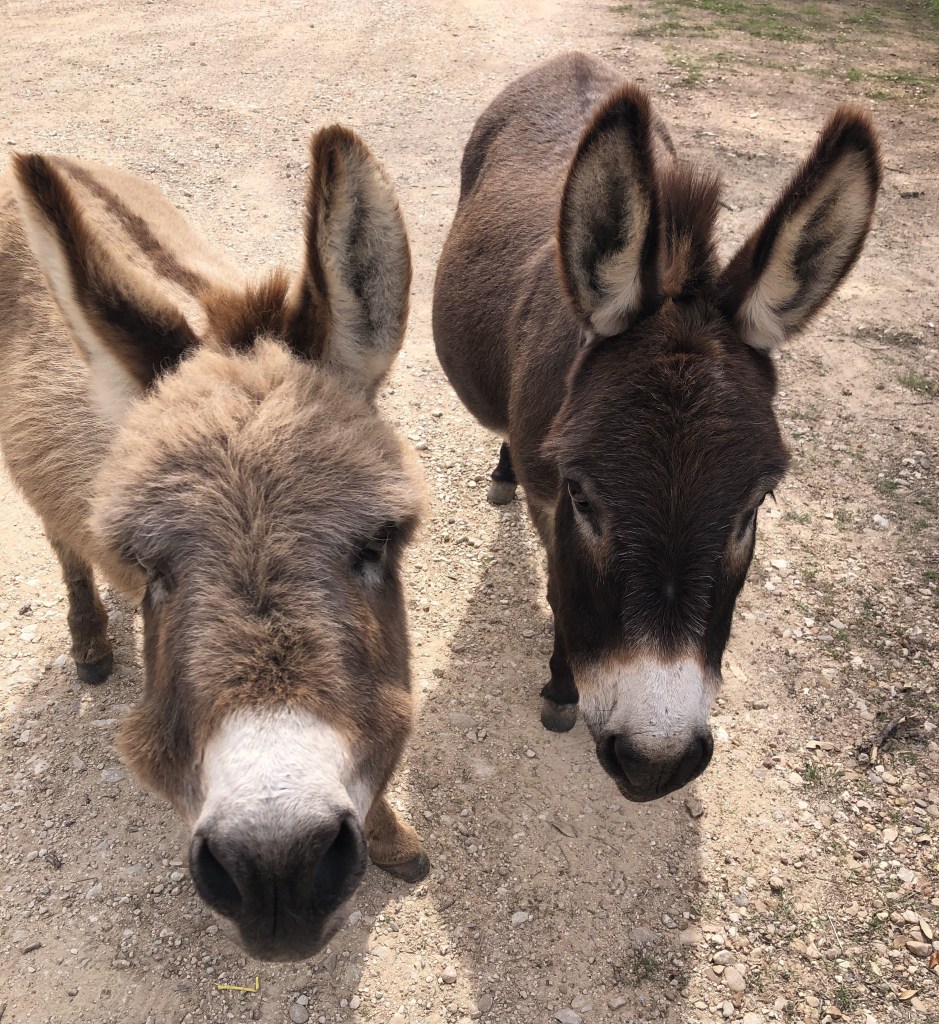
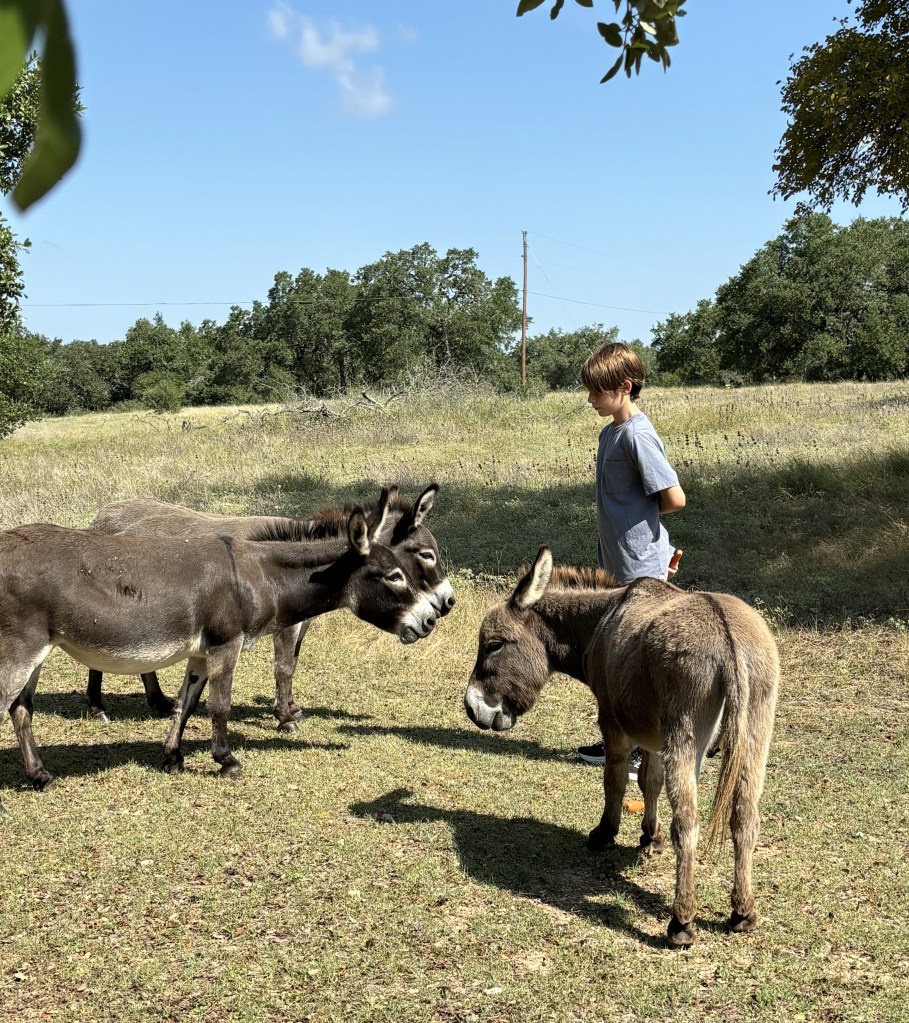
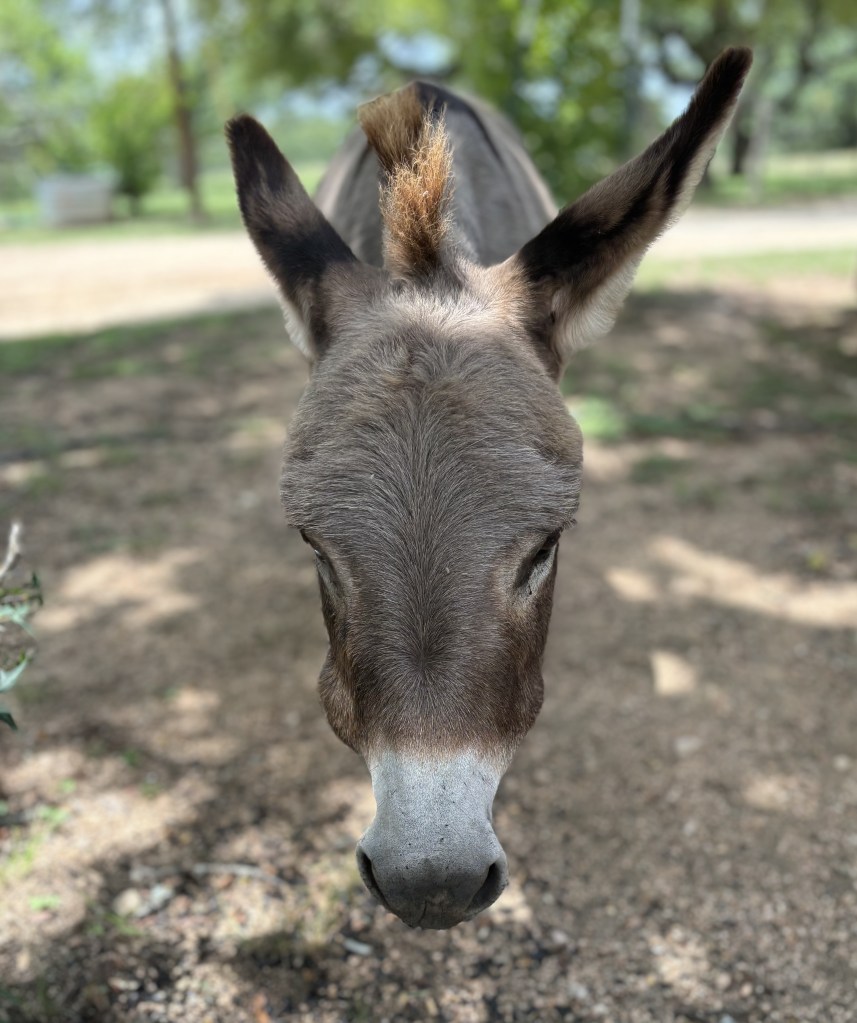
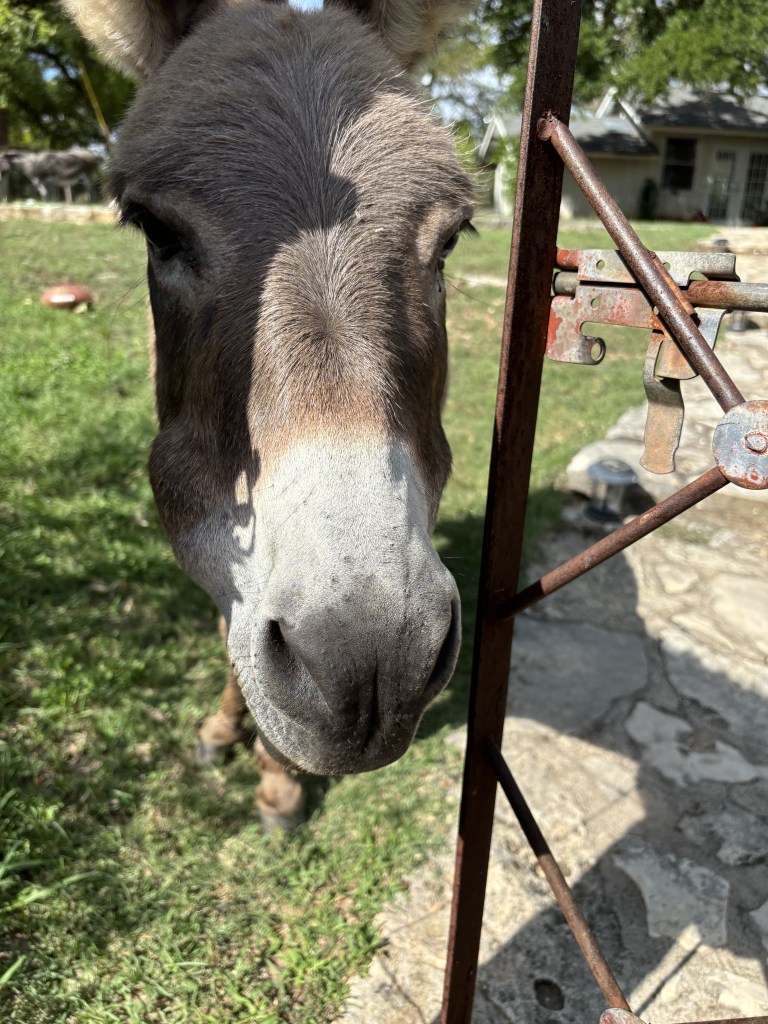
Helen Currie Foster lives and writes the Alice MacDonald Greer Mystery series north of Dripping Springs, Texas, loosely supervised by three burros. She’s drawn to the compelling landscape and quirky characters of the Texas Hill Country. She’s also deeply curious about our human history and how, uninvited, the past keeps crashing th eparty. Follow her at http://www.helencurriefoster.com.

READING WHILE TRAVELING

by Helen Currie Foster

Just before a trip I get anxious: is there enough stored in my Kindle to keep me happy? You constant readers know that feeling. Did you upload enough for the waiting room at the airport? For the plane? For a sleepless first night, jet-lagging? Enough to keep you happy even if weak (or no) wi-fi at the (tent, cabin, hotel, boat, campsite, rental) precludes another download? Yes, there’ll be news–but I am escaping!

We’re on a family trip to France, with children and grandchildren. I loaded up the Kindle diligently beforehand. Of course there are way too many wonderful things to do besides read…

Still, my heart sang when we entered the rental in the French mountains and spied—A BOOKCASE!

Moreover, the shelves held mysteries! Ian McEwan, Patricia Cornwell, Elizabeth George, Janet Evanovich, V.I. Warshawski, Alexander McCall Smith…

Also serious nonfiction and titles from Kazuo Ishiguro, Dostoevsky, Graham Greene, Julian Barnes and more. Then I spotted Kinky Friedman’s Frequent Flyer and thought—eclectic tastes! Perhaps some were left behind by guests. Still, the shelves made me want to meet the owners. The welcoming bookshelves and, to boot, a choice of comfortable corners where a tired tourist can flop, prop up the well-used feet, and read…what more can one ask?

(Sidebar—when you see a Talking Head on your screen, with a bookshelf behind—do you wonder if the books really belong to the Head? Or are they just a prop intended to impress? Maybe we’ll see some interviewer pose a question: “How did you like Crimes Against Humanity?” Blank stare.)

I know I’ve mentioned her in a prior blog, but have you discovered Dorothy Dunnett yet? https://en.wikipedia.org/wiki/Dorothy_Dunnett

If you’re familiar with Dunnett’s stunning two historical fiction series, The Lymond Chronicles and The House of Niccolo, you already know she delivered powerful (and powerfully surprising) plots, magnetic characters, and vivid reconstructions of the 15th and 16th centuries. Using (for all that detail) an omniscient narrator.

But in her spare time she also wrote the Dolly mystery series, involving an astoundingly talented portrait painter named Johnson Johnson (yes, two), who happens to turn up in scenic locations in his yacht, the Dolly, on secret missions for the British ministry of defense. I’ve reread three of those on this trip—one set in Ibiza, one in Morocco, one in Canada. Unlike the Niccolo or Lymond historical series, Dunnett’s heroines in these first-person mysteries are in their late teens or twenties and trying to make their way in the world (as an au pair, a cook, an executive assistant, etc.). Naturally they find themselves in dangerous situations while trying to identify a murderer, and Dunnett gives each her own first-person voice—each interestingly different.

Clearly Dunnett didn’t merely set foot in these locales: she absorbed them. The action’s fast-moving, but she paints a landscape with details that place you right in the square where the villains are about to—well, here’s an example from Moroccan Traffic, in the Atlas Mountains, where Wendy, a young executive assistant, watches as Johnson and the engaging inventor Mo pursue two ruthless adversaries up perilous cliffs:

…where they had set their faces to climb was the flank of the mountain; the boulder slope rising to cliffs and ridges and rock bands interlaid with tongues of snow, and scree-fields, and stony pockets of pasture. And further up, behind escarpment and terrace, the burning forepeaks of the range.

         I had seen it all from the road. Somewhere there, already entrenched, already waiting, were Gerry and Sullivan, ex-SAS marksmen.

You can also tell that Dunnett (as well as her character Johnson) was a painter:

All around us the hills, limp as blankets, glowed in soft reds, their milky hollows the colour of amethyst. The snow on Sirwa was tinged golden pink, and cast china blue shadows which were technically impermanent. A man walked by the road, a black goat like a scarf around his neck.

         And from Roman Nights – the young heroine, an astronomer, battles spy dealings in Italy including the Aragonese Castle on Ischia in the Bay of Naples:

         On a plateau the cathedral reared its three roofless sides like a kind of dismembered Versailles, white and flaking; the walls furnished with crumbling cherubs and statues, with rococo arches and pillars and architraves.

Dunnett gives her astronomer heroine plenty of tongue-in chic wit:

Johnson and Lenny sailed out of Amalfi, in a pure, warm air blowing about eight on the bloody Beaufort scale, and the rain lashing down. After becoming exceedingly well acquainted with the water filling the Gulf of Salerno, we fled into a fishing harbour called San Marco and spent the night offshore in a cat’s cradle of other boats’ cables.

Thank you, Dorothy Dunnett, for stupendous scholarship and for witty mysteries in places so believably described. What a gift to the traveler! Sorry, gotta go—I’m deep into Tropical Issue, set in Madeira, where I’ve never been—but it sure looks great in this prose…

What gifts they are to humans—to write, to read!

Award-winning writer Helen Currie Foster lives and writes in the iconic Texas hill country, supervised by three inquisitive and persistent burros. After practicing law for more than thirty years, she found the Alice MacDonald Greer Mysteries had suddenly appeared in her life. Book 10 in the series, Ghost Justice, is expected to debut in August 2025. Helen is continually fascinated by human history and how, uninvited, the past keeps invading our parties. Follow her on Facebook and Amazon, and in Austin at BookPeople.

https://www.facebook.com/helencurriefoster

Curious Animals And Recent Reads


by Helen Currie Foster

New reads! If, like me, you desperately miss John le Carré, consider A Spy Alone, the 2023 debut spy thriller by Charles Beaumont, a field operative veteran of Britain’s MI-6. https://bit.ly/3ZzHjHs His premise is fascinating: we know of the “Cambridge Five” who spied for Russia from the 1930’s to 1950’s—Kim Philby, Guy Burgess, Donald Maclean, Anthony Blunt and John Cairncross. https://en.wikipedia.org/wiki/Cambridge_Five But has there ever been, or could there be, a spy ring linked to Oxford? Beaumont’s protagonist Simon Sharman feels real, right from the first page:

“It is their shoes that give them away. As a lifelong fieldman, Simon Sharman hasn’t forgotten the lesson: walkers might change their jackets, pull on a pair of glasses, even a wig. But nobody changes their shoes on a job. Look at their shoes. 

I was hooked. Warning: Beaumont’s book is contemporary, well-written, tense, and may interfere with sleep. 

Two other recent reads: old adventure and a new “adult fantasy.” I’d never heard of The Long Ships by Frans G. Bengtsson (1954).

Set from 980 to 1010 A.D., the book recounts the wide-ranging adventures of Norseman Red Orm Tostesson, and the collision between Christian priests (the “shaven men”) and the Norse culture of Skania at the south tip of Sweden. Now I know what it meant to go “a-viking”—to go sea-raiding! 500 pages, with Red, a very engaging Norseman. Great maps, too.

The Lost Bookshop, by Evie Woods (2024), offers time travel between the 1920’s and 30’s in Britain, and the present; a search for a lost Brontë manuscript; a disappearing attic; and disappearing and reappearing characters. I confess I flipped through big chunks, relieved when true love finally won out after two women, generations apart, survive appalling treatment. The disappearing attic reminded me of Susan Cooper’s Over Sea, Under Stone, and of course the wardrobe into Narnia in The Lion, the Witch and the Wardrobe. I’m always up for secret doors.

I’m rereading a fascinating and fairly demanding study by Graham Robb, who has probably bicycled and walked further in Britain and France than most humans:

In The Search for Middle Earth: Mapping the Lost World of the Celts (2013)he describes how the Keltoi, or Celts, developed a system of surveying based on a midline transected by the lines of the summer and winter solstice to estimate travel distances and times—a feat not replicated for centuries. He maps the Heraklean Way, the path from southwestern Iberia that runs northeast across the Pyrenees to the Alps along the diagonal of the solstice sun, which Hannibal took when he invaded Italia. He describes Druid schooling (20 years to learn) and maps out protohistoric forts which turn out to lie along survey lines. He provides amazing maps. Two ongoing lessons from Robb’s devoted research: the winners write history; and humans tend to underestimate the accomplishments of earlier civilizations. 

Several of you asked about the three burros, given the recent cold snap. Thank you, they’re well. Their hair’s not waterproof so in cold rain they gather on the south side of the stable, under the roof, safe from rain and the north wind. They were relieved to see green grass again after the drought broke, but they’re also eating—and rolling in––green hay. And mud!

Yet despite hay, they gather outside the gate every morning and afternoon for carrots. They consider this part of their deal.

Burros are curious. They amble over to watch us garden and hang up laundry. They need company. They graze near each other. They may live into their 40’s. Sebastian, the short stubby knock-kneed male who invited himself to live here, may be 35 or more. Amanda (who insists I tell you she’s registered, with papers) may be 20. Her daughter Caroline is 12. Sebastian deems it his duty to bray loudly when any person or car appears at the end of the driveway, and to welcome the sun every morning with a stunningly loud bray. Now both Amanda and Caroline have begun to bray occasionally. 

Only donkeys can bray. Unlike horses or zebras, donkeys begin a bray on the inhale and continue braying on the exhale. They have great hearing—supposedly they can hear another donkey bray 60 miles away. 

They especially detest canids and will attack, dance on and kick dogs, coyotes, bobcats, foxes. A spooked horse will run away: donkeys stand together until they decide what they’re going to do. This morning, leaving for the post office, I saw the three donkeys standing together, knees locked, ears cocked, eyes fixed on two trespassing dogs who’d strayed across the cattleguard and into the donkeys’ domain. 

The dogs immediately acknowledged their gross error of judgment, raced frantically away and never returned.

If donkeys could read (wait—maybe they can, but have trouble turning the pages), I predict they’d prefer mysteries. They enjoy puzzles (like how to lift the chain and invade the fenced garden). 

Humans and donkeys. We are both curious animals.

Helen Currie Foster lives and writes the Alice MacDonald Greer Mystery Series north of Dripping Springs, Texas, loosely supervised by three burros. She’s drawn to the compelling landscape and quirky characters of the Texas Hill Country. She’s also deeply curious about our human history and how, uninvited, the past keeps crashing the party! Currently she’s working on Book 10. Her protagonist, Alice, gets into legal drama, and matters of the heart. Alice does have a treehouse…

Follow Helen at http://www.helencurriefoster.com and on Amazon and Facebook, https://www.facebook.com/helencurriefoster

The Woods Are Lovely: A Passion for Trees

by Helen Currie Foster

October 29, 2024

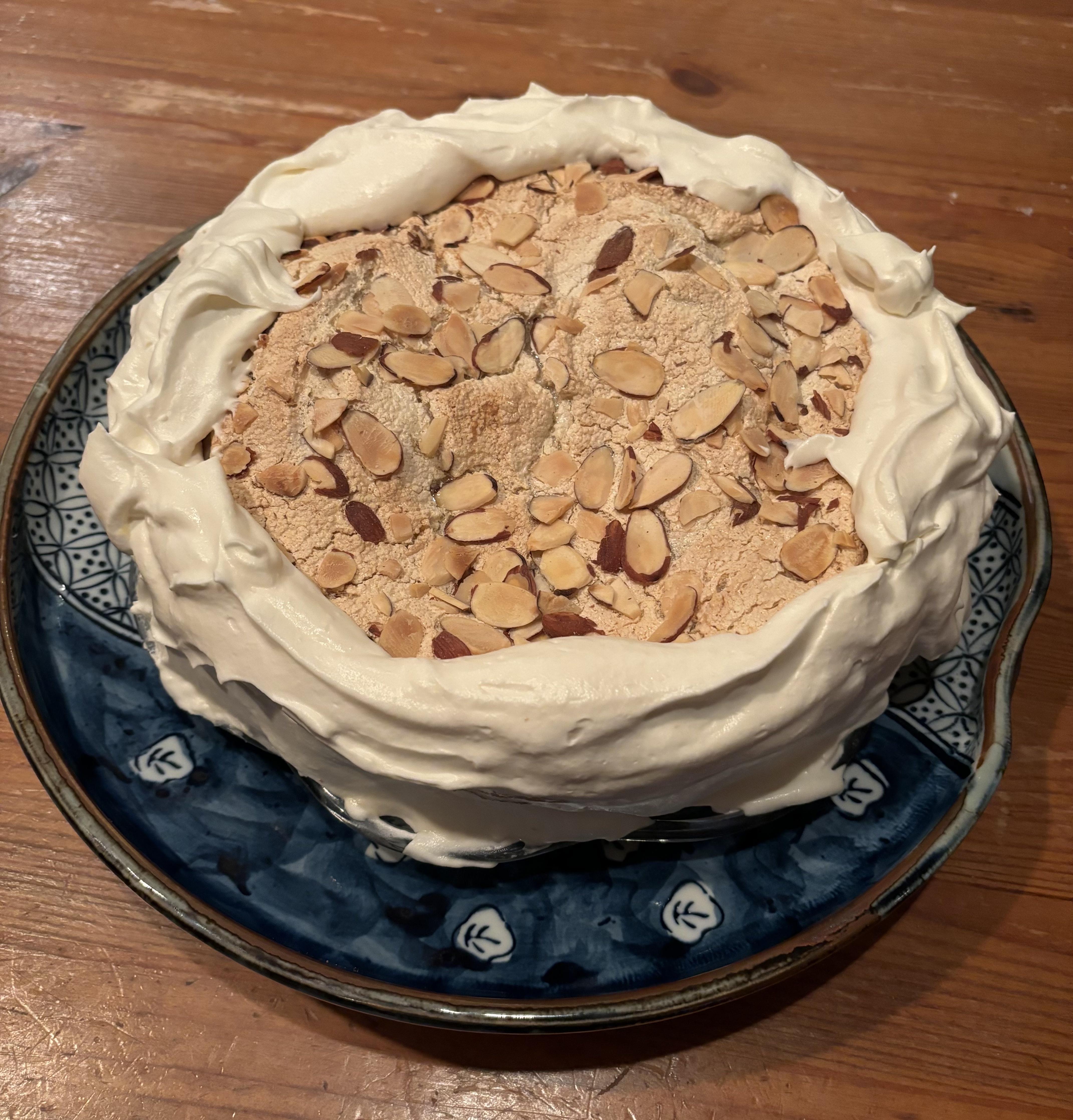
The mystery is solved! In my search for  what I recalled as “the “Blitzkuchen” once served at Schwamkrug’s outside New Braunfels, in the Texas Hill Country, I had the name wrong. It’s a blitz torte, not a blitz kuchen! Several readers sent recipes from German cookbooks indicating that “Blitzkuchen” is a quick cake, usually one layer only. My memory, though? A tall two-layer confection, baked with meringue and almond flakes on top and between the layers! And in my memory, more meringue on the outside, plus some moistness in the filling.

Online I found Oma Gerhild’s “Oma’s Blitz Torte Recipe ––Lightning Cake.” https://www.quick-german-recipes.com/german-blitz-torte-recipe.html  Each almond-flavored layer is baked with meringue and sliced almonds on top of the batter. The recipe offers either custard filling or whipped cream filling. I opted to finish off with whipped cream with powdered sugar and vanilla, not just inside, but around the cake (and in blobs all around the kitchen).

FINALLY! First, that lovely almond taste. Plus, everyone at the table now wore an attractive little white mustache of whipped cream. You don’t get that with a madeleine and a cup of tea, do you, M. Proust?

As October runs into November, Texas Hill Country towns are celebrating Oktoberfest, or, in New Braunfels, Wurstfest. Normally by now our trees would show some fall color––nothing like New England, of course. The cypresses by Lake Austin are turning bronze. Out here north of Dripping Springs, the possum haws are showing their red berries. The cedar elms turned bright yellow, then slowly lost their leaves. The live oaks, thankfully, stay green.

But this year? Drought brings bad news for trees. Cypress-lined creeks are dry…the cypresses’ arched roots groping into the earth for water. Downhill at our place Barton Creek is dry, and I mean dry, with only occasional small pools. Up on the limestone plateau the leaves on some smaller saplings just turned brown and fluttered to the ground, with the tree already looking dead. We’re watering, but in Stage 2 drought restrictions. Will our wells run dry? Have we drained the Trinity aquifers that lie hundreds of feet below?

So, to general geopolitical angst, I’ve added…tree worry.

Trees in books play such a role in our imaginations. After reading Johann David Wyss’s Swiss Family Robinson (1812)—where the shipwrecked family builds a tree-house on their desert island––I always wanted to live in a tree-house! https://en.wikipedia.org/wiki/The_Swiss_Family_Robinson We’re drawn to forests, home of the trees—scary, but sometimes the safest place. In The Sword in the Stone by T. H. White (1939), first of the four volumes that make up The Once and Future King, the Wart (the young Arthur, under Merlin’s tutelage) and Kay meet Little John who tells them about Robin Wood (explaining why it’s not “Robin Hood” and why he lives in the woods (or “‘oods”):

“They’m free pleaces, the ‘oods, and fine pleaces. Let thee sleep in ‘em, come summer, come winter, withouten brick nor thatch, and huntin’ ‘em for thy commons lest thee starve; and smell to ‘em with the good earth in the springtime; and number of ‘em as they brings forward their comely bright leaves, according to order…”

There the boys, the future King and Sir Kay, approach “the monarch of the forest. It was a lime tree as great as that which used to grow at Moor Park in Herefordshire, no less than one hundred feet in height and seventeen feet in girth, a yard above the ground….” Headquarters for Robin Wood and Maid Marian! And there begins a great and perilous adventure for Kay and Wart, who break into the castle of Morgan le Fay, Queen of Air and Darkness—to rescue prisoners paralyzed by magic. (Speaking of paralyzed victims of witches—note how C.S. Lewis later describes turned-to-stone courtyard figures in his first foray into fantasy, The Lion, the Witch and the Wardrobe (1950).)

One writer, Elisabeth Brewer, notes that “The Sword in the Stone shows a passion for trees that White shared with Tolkien. https://bit.ly/3Ceqk. How about the Ents we meet in Fangorn Forest, in J. R. R. Tolkien’s Middle-Earth? Trees that walk…and tend other trees. Not all trees are benign––including the wicked old willow which captures Frodo and friends (rescued by Tom Bombadil).

I’m reading a fascinating graphic (yes, graphic!) book about Tolkien and his close friend C.S. Lewis: The Mythmakers: The Remarkable Fellowship of C.S. Lewis and J.R.R. Tolkien, by John Hendrix. https://bit.ly/4hqiyFr

Tolkien and Lewis met in 1929 in Oxford, where they were, famously, members of a writers’ group, the Inklings, and shared many hours at The Eagle and Child. That’s not all they shared. In 1916, both men experienced horrific warfare on the Western Front in France. Young and just married, Tolkien fought in the trenches, then contracted life-threatening trench fever. At nineteen, Lewis was wounded by shrapnel (from friendly fire) on the Somme, and carried shrapnel in his body the rest of his life. Hendrix’s wonderful book uncovers the sort of salvation two disillusioned veterans found in the healing power of imagination, including Norse mythology and the European fairy tale. Tolkien knew of Yggdrasil, the sacred ash tree central to Norse mythology. https://en.wikipedia.org/wiki/Yggdrasilhttps://dc.swosu.edu/cgi/viewcontent.cgi?article=2130&context=mythlore

And how the worlds created by Lewis and Tolkien fired our imaginations! The fantasy world of C.S. Lewis’s Narnia emerged when The Lion, the Witch and the Wardrobe was published (1950). Tolkien’s The Hobbit, or There and Back Again, was first published in 1937 but became a pop-culture phenomenon only in 1960’s, when the paperback edition became available. https://time.com/4941811/hobbit-anniversary-1937-reviews/

Both Lewis and Tolkien had copies of The Sword in the Stone early on. Indeed, in 1939 it was a Book-of-the-Month Club selection. T. H. White 1964 obituary, https://nyti.ms/4hlasht. Curiously, Hendrix’s book on Tolkien and Lewis doesn’t mention T. H. White, perhaps because Hendrix focuses on the impact of war; T.H. White 1906-1964) was born too late to serve in World War I. Nor was he an Oxonian. While C.S. Lewis reportedly disparaged The Sword in the Stone in 1940, he later invited T. H. White to the Inklings if he ever visited Oxford. https://bit.ly/4f4wcww (“Dickieson post”). Perhaps Hendrix doesn’t mention T. H. White because unlike Tolkien and Lewis, though he creates a fantasy world, White grounds The Once and Future King firmly in England.

But Elisabeth Brewer commented in T.H. White’s The Once and Future King that The Sword in the Stone shows a passion for trees that White shared with Tolkien. (Dickieson post.)

What about powerful trees in more recent books? Consider the Whomping Willow, in J. K. Rowling’s Harry Potter and the Wizard of Azkabanhttps://bit.ly/4f1koex Magic—but terrorizing—it reveals the secret passage which ultimately allows Harry and friends to discover––well, remember? Indeed, Harry reminds us of T. H. White’s Wart, both with an earnest determination to do right, and a magical tutor.

Maybe children are especially open to tree power because they still climb trees. My dad swooped us off to grad school in Atlanta, and then to Charlotte, before we moved back to Texas. In the southeast I discovered the power of pine trees. We children built an admirable and secret treehouse in the woods, where we surveyed the world from on high. No parents came near to scold or warn: deep in the trees we ruled our own domain. Later in Carolina at eleven, I could climb the neighbors’ big back yard pine all the way to the top. The tree swayed slowly back and forth, but I could see the entire neighborhood and beyond. Tree power.

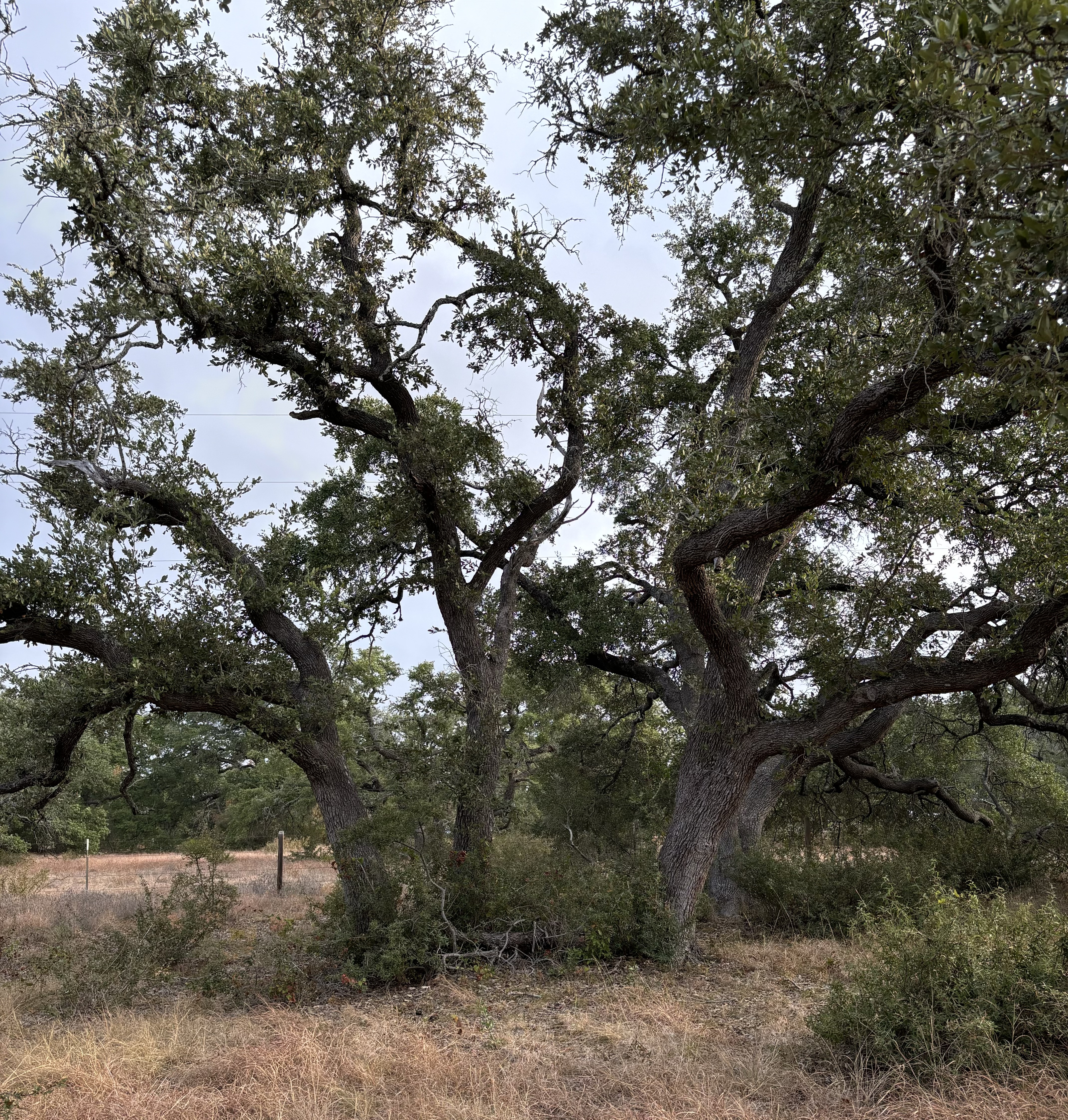
Out here on the Edwards Plateau, in the rugged karst landscape above a hill country creek, live oaks rule. The big evergreens, up to sixty feet tall, with a wide crown and massive limbs close to the ground, are Quercus Virginiana. They often grow in a circle—and you know they are communicating through their root systems. https://www.npr.org/sections/health-shots/2021/05/04/993430007/trees-talk-to-each-other-mother-tree-ecologist-hears-lessons-for-people-too

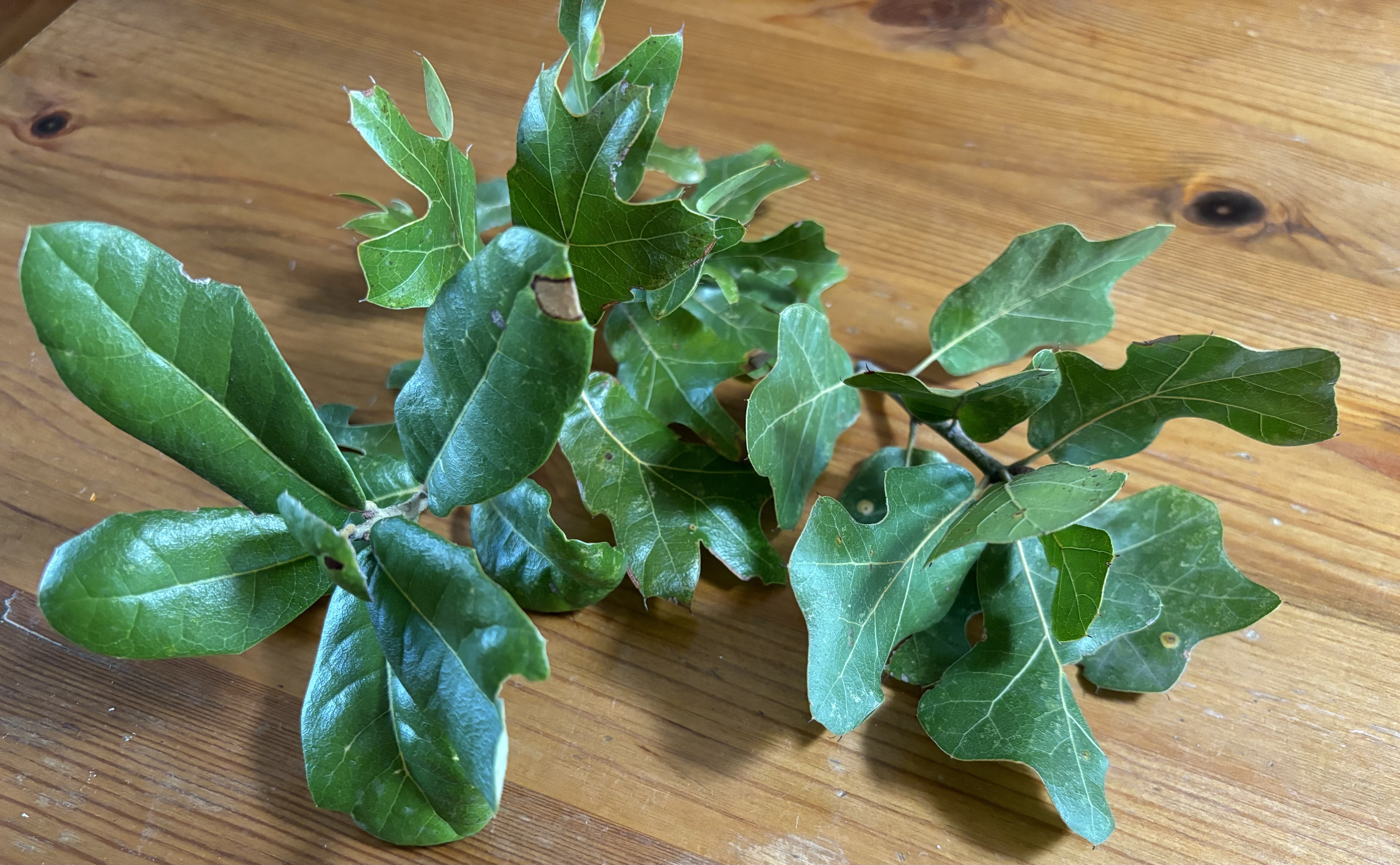
The way live oaks vary their leaves makes identification tough. On the Edwards Plateau, the species passes into the “shrubby Texas Live Oak”—shorter with smaller trunks: “…[I]ntermediate forms occur between the variety and the species and the distinctions are often difficult,” per Robert Vines, Trees, Shrubs and Woody Vines of the Southwest (1960). Well, thanks.

Now, in drought, with grass turned grayish tan, with dirt powder-dry beneath our feet, we treasure the blessed green of live oaks, often home to swings and hammocks, and providing wide shade to houses, pastures, and somnolent cattle.

Trees inspire us. We know Shakespeare’s song: “Under the greenwood tree, who loves to lie with me…” (As You Like It). The first poem in Wendell Berry’s A Timbered Choir begins, “I go among trees and sit still.”

Mary Oliver’s “Honey Locust” begins,

“Who can tell how lovely in June is the

honey locust tree, or why

A tree should be so sweet and live

            in this world?”

Robert Frost knows his trees: The Road Not Taken, Stopping by Woods on a Snowy Evening, Tree at My Window, Spring Pools, so many. Of course, his Birches:

“When I see birches bend to left and right

Across the lines of straighter darker trees,

I like to think some boy’s been swinging them…”

Frost makes it easy to imagine “some boy” swinging the birches—or Frost imagining that, as he marched through a yellow wood.

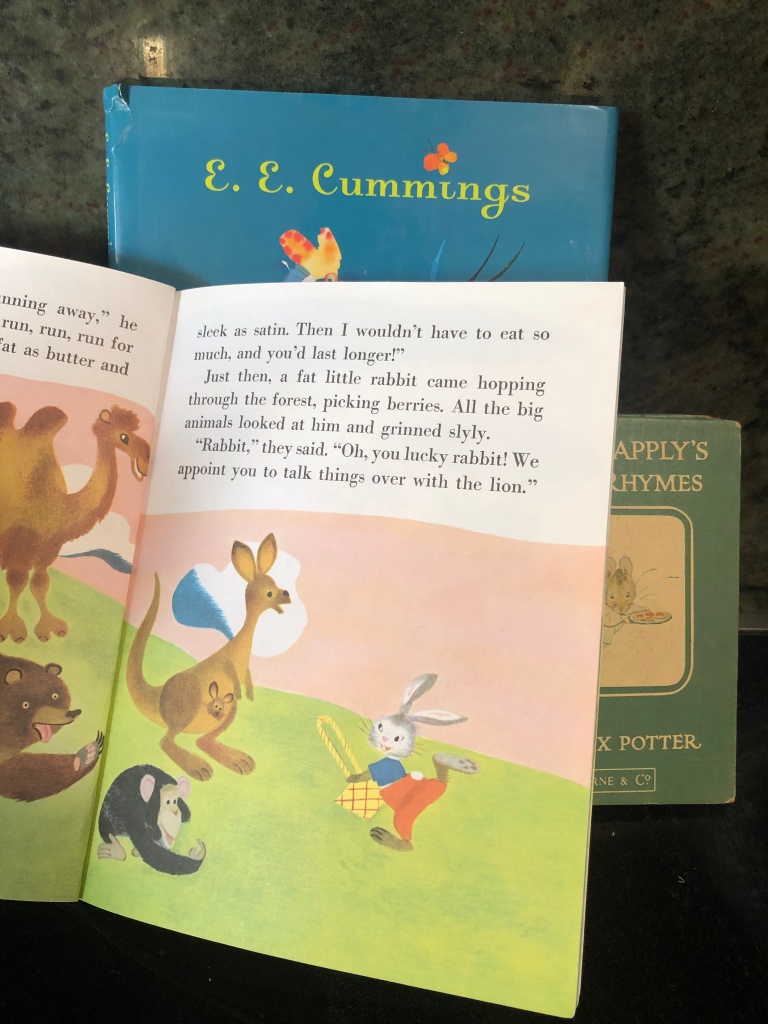
And then e.e. cummings, My Father Moved Through Dooms of Love—I like this verse:

“My father moved through theys of we,

Singing each new leaf out of each tree

(and every child was sure that spring

Danced when she heard my father sing)”

And Gerard Manley Hopkins, Spring and Fall:

“Margaret, are you grieving

Over Goldengrove unleaving?”

Yes, trees: later in the poem we find when “worlds of wanwood leafmeal lie.”

The forecast calls for rain. Please cross your fingers.

Helen Currie Foster lives and writes the Alice MacDonald Greer Mystery Series north of Dripping Springs, Texas, loosely supervised by three burros. She’s drawn to the compelling landscape and quirky characters of the Texas Hill Country. She’s also deeply curious about our human history and how, uninvited, the past keeps crashing the party. Currently she’s working on Book 10. Her protagonist, Alice, gets into legal drama, and matters of the heart. And yes, Alice does have a treehouse.

Who Do You Love?

 / AUSTIN MYSTERY WRITERS

Yes, Bo Diddley, https://www.youtube.com/watch?v=e5tSgiB_Tgc but I like the Thorogood version too bit.ly/4gNi38m

I’ve got a secret. So many books I have NOT read. You’d be shocked. No, really. My husband (retired business professor) admires Tolstoy, especially Anna Karenina. He’s read most of Dickens and every word of Moby Dick–several times. When we were dating he bought Baudelaire’s Les Fleurs du Mal (English translation) because he’d seen it on my shelf. He knows I’m hung up on Virginia Woolf; he’s read Three Guineas. He’s read reams of history—shelves and shelves, plus tome after tome on Richard Feynman and everything that’s going on with astronomy and quantum physics. He forges onward, aiming for the stars at the edge of the universe.

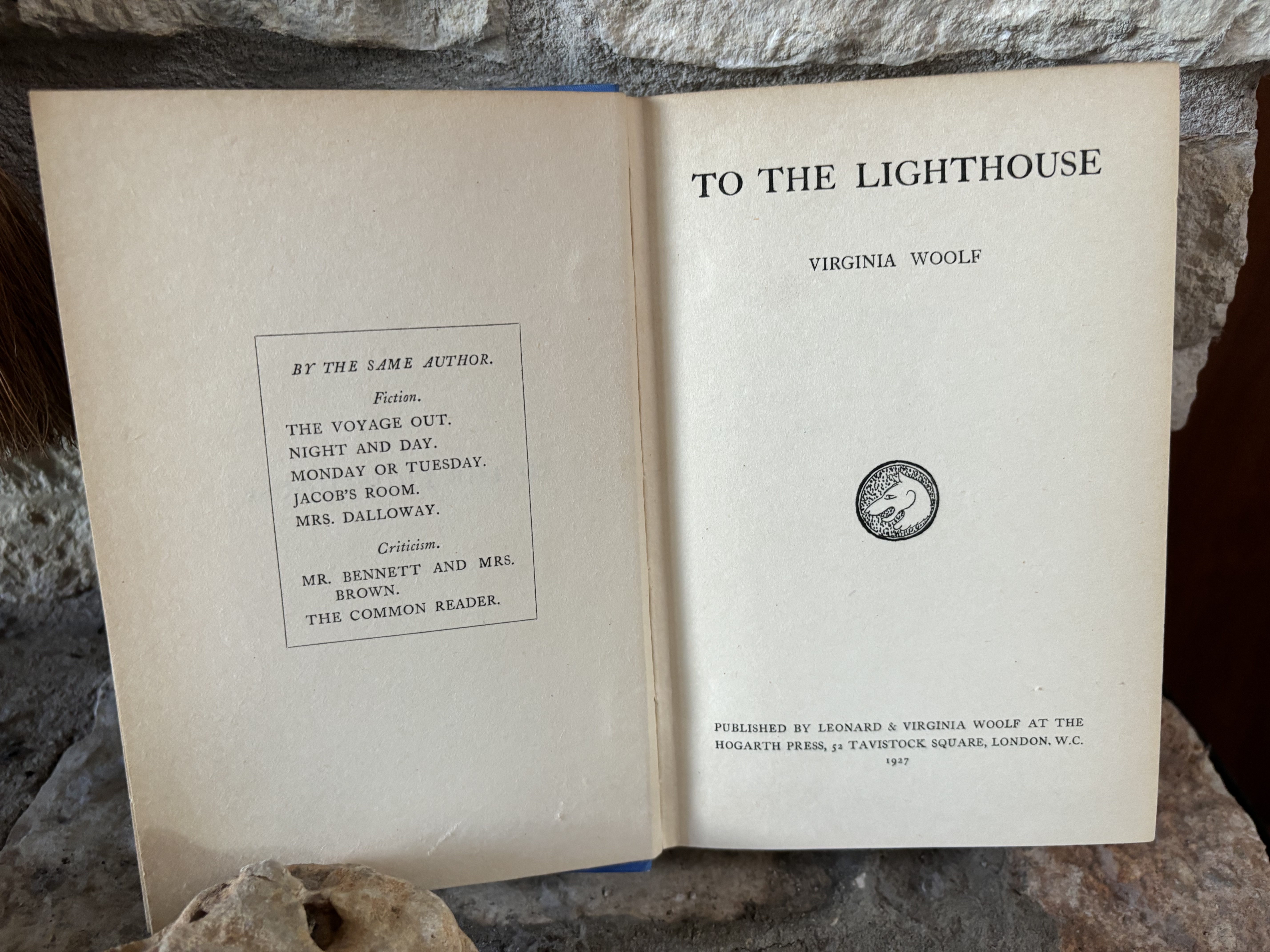
I, however, the English major, the mystery writer? I who should have read All The Books? I confess a powerful secret vice: rereading my favorites, particularly Virginia Woolf. Every year, To the Lighthouse sneaks back into my hand. Why? Why not concentrate only on the new novels, the best-sellers?

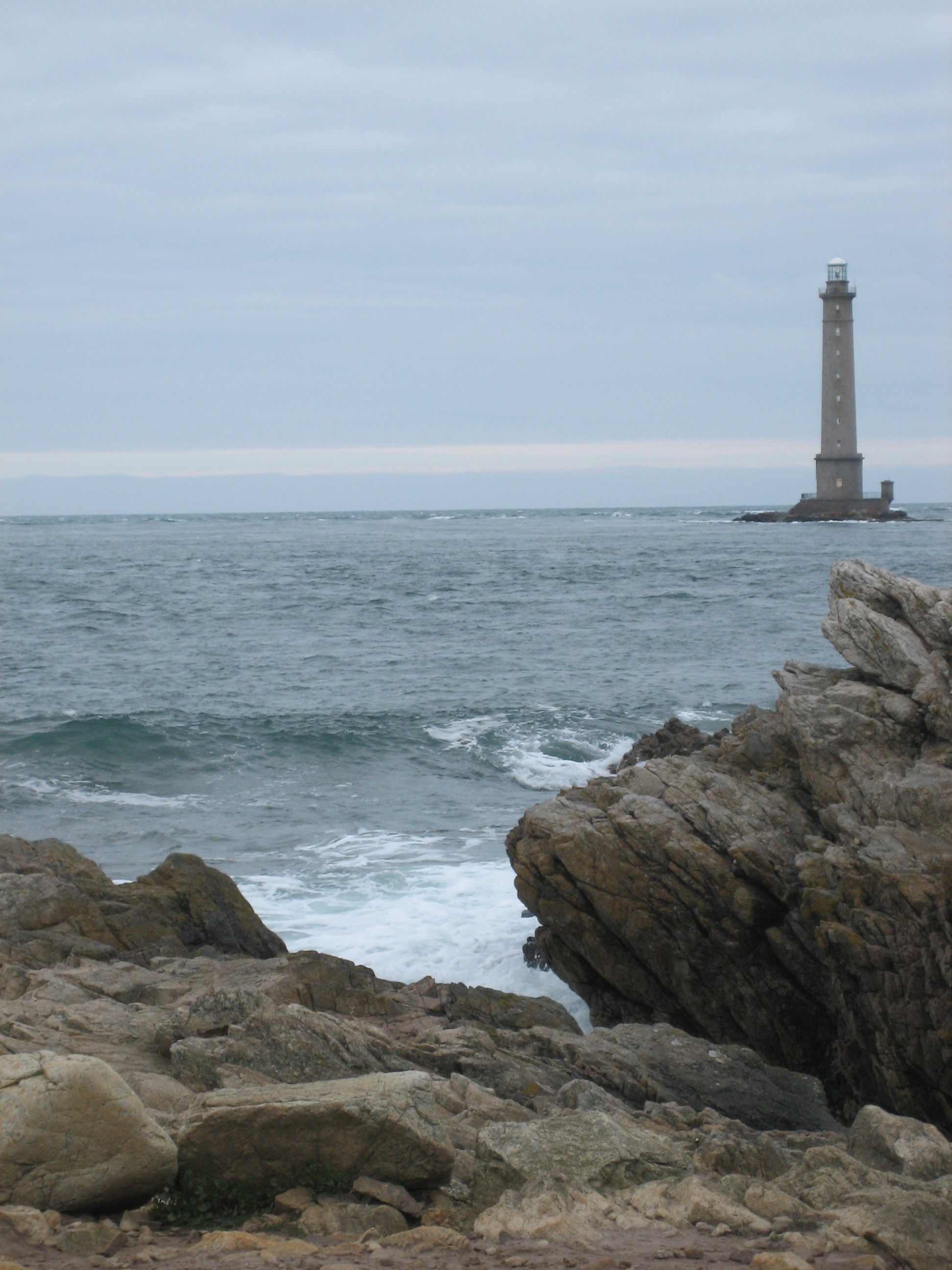
Because I have to reread that moment in Part III when, years later, after world war and illness have claimed her beloved friend Mrs. Ramsay and so many of the Ramsay family, the spinster Lily Briscoe returns to the Ramsays’ summer home on the Isle of Skye. https://bit.ly/3zHF77w

Out on the lawn, facing the old white house, she sets up again the unfinished oil painting she began all those years earlier—the painting that had posed such a challenge in Part I as her mind reverberated with the repeated mantra from Professor Ramsay’s obnoxious male philosophy student: “Women can’t paint, can’t write.” During the long day, full of changing light on the sea, and repeated interruptions by other characters, Woolf returns us over and over to Lily, staring at her painting, seeing again the remembered shapes of Mrs. Ramsay and her son James all those years ago. And her artistic effort? Here’s the end of the book:

“It would be hung in the attics, she thought; it would be destroyed. But what did that matter? She asked herself, taking up her brush again. She looked at the steps; they were empty; she looked at her canvas; it was blurred. With a sudden intensity, as if she saw it clear for a second, she drew a line there, in the centre. It was done; it was finished. Yes, she thought, laying down her brush in extreme fatigue, I have had my vision.”

Why do I return to that? So much of the book is touching, gripping, and even hilarious, including the thoughts of Professor Ramsay, a philosophy professor who’s both overbearing and insecure. He delights in his own “splendid mind”: “For if thought is like the keyboard of a piano divided into so many notes, or like the alphabet is ranged in twenty-six letters all in order, then his splendid mind had no difficulty in running over those letters one by one, firmly and accurately, until it had reached, say, the letter Q.  …Very few people in the whole of England ever reach Q.” Then he falters. “But after Q? What comes next? After Q there are a number of letters the last of which is scarcely visible to mortal eyes, but glimmers red in the distance.”  He braces himself, clenches himself. “Q he was sure of. Q he could demonstrate. If Q then is Q—R—” Then “he heard people saying—he was a failure—that R was beyond him. He would never reach R.”  

What an image—the alphabet, R glimmering red in the distance, then fading, fading!  And then of course there’s the famous dinner party featuring Mrs. Ramsay’s boeuf en daube. Surely, just reading this, you smell the simmered sauce, the wine, the bay leaf? The thought crossed my mind that if Professor Ramsay had been offered a sip of the Talisker malt whiskey for which Skye is famous, he’d have felt a bit better. https://www.malts.com/en/talisker (The distillery gives a great tour, too.)

But Lily’s painting? This spinster friend of Mrs. Ramsay, with her amateur brushstrokes? The tale of Lily’s painting, her decision and indecision as she holds her brush, grabbed me all those years ago, and refuses to let go. The same question must hit every musician—“Is this the last note? Did that chord resolve properly? Does it make you feel beauty and longing, or does it just hang there, unfinished?”  Every cook: “A pinch of salt? What about some coriander? To garlic or not to garlic?” Every filmmaker: “Do they walk into the sunset? Or fade out? Or kiss?” And every writer? “Is this character real? Is this setting compelling? Does the plot work? And will anyone care?”

Lily’s painting embodies desire to capture memory, resistance, light and color, and more than that. Isn’t it  her experience? A moment of creation, of recapture, of making a line on a canvas and then feeling completion?  She’s had her vision. If you know of another book where we readers feel such a moment of revelation from the frustrating process of creation—let me know.

Oh, don’t get me wrong. My Kindle received today the brand-new Martin Walker (A Grave in the Woods) and I can’t wait. bit.ly/3Xzqawt Like the other women in his (busy) life,  I love to accompany Inspector Bruno, in his fictional Perigord village of St. Denis, partly because of his cooking. Thank you, Martin Walker, for describing the ham hanging from the kitchen ceiling, the cheerful chickens, and the paté with its duck fat on top, waiting in Bruno’s fridge, and the way Bruno sings La Marseillaise to count how long until he must sizzle the foie de gras before he deglazes the pan. I look forward to new recipes and to finding out who’s buried in the woods.

And a sad farewell: I’ve decided to forgive Elly Griffiths for saying goodbye to Ruth Galloway in her last book in that series, The Last Remains, even though I have loved watching Ruth clamber down into a trench to dig up ancient bones in East Anglia. amzn.to/3ZxU5rv I’ve also savored every page of Alan Bradley’s latest (last?) Flavia de Luce – What Time the Sexton’s Spade Doth Rust – as he allows this delightful protagonist to feel herself beginning to grow up—not too much, not too fast, just enough. https://bit.ly/4dla13A 

And I did just finish We Solve Murders, Richard Osman’s first book in a new series. bit.ly/4ezjIwh  Have to confess I found myself missing Joyce, Ibrahim, Ron, Elizabeth and the other characters of his Thursday Murder Club books. My strong belief is I must careabout a mystery protagonist and so far I haven’t completely bought in to his new cadre–though I do like Steve. We’ll see.  I’d be interested in your reactions.

So that’s four new mysteries, just in September. I’m also rereading Virginia Woolf’s The Waves, and finding even more, yes, even more to love about how she brings those characters to vivid life, and how she describes the way we humans think and react to each other.

And out here with the three burros I’m writing the tenth in my Coffee Creek series featuring Alice MacDonald Greer and the gorgeous landscape of the Texas Hill Country, with its pristine (well, so far) bluegreen streams. Water’s for fighting over, right?

But when the going gets tough, you may find me sidling back to the revolving bookcase, on the shelf where Virginia Woolf and all the old faves hang out.

Helen Currie Foster lives and writes north of Dripping Springs, Texas, loosely supervised by three burros. She’s drawn to the compelling landscape and quirky characters of the Texas Hill Country. She’s also deeply curious about our human history and how, uninvited, the past keeps crashing the party. Latest in her award-winning series: Ghost Bones.

Follow her on http://www.facebook.com/helencurriefoster/ and http://www.helencurriefoster.com

Share this:

When the Character Steps off the Page…

by Helen Currie Foster

You go to a play, you’re reading the program, you’re waiting for the curtain to go up. It does. And onstage a character comes alive. You not only believe in that character—suddenly you feel that character is real.

After the play, in the lobby, out comes a chattering group of actors, one of whom is—the character you believed in! But it’s merely…another human being!

This happens to me over and over at Austin Shakespeare productions. I remember sitting riveted, watching Othello preparing to smother Desdemona, his face just a few feet from the front row of the Rollins Theatre. “No, no!” I wanted to scream. Minutes later, still quaking from the death scene, I watched the actors come back out for their traditional after-talk with the audience. I watched brokenhearted Othello plop down in a folding chair and grin at us––morphed from Othello into actor Mark Pouhé. At Free Shakespeare outdoors in Austin’s Zilker Park I held my breath, watching young Romeo climb the balcony to talk with Juliet, enchanted––like Juliet––by every word he uttered. Then at intermission, still in costume, actors came out and climbed the hillside, shaking buckets for donations, including…Romeo! Jarring to think he’d time-traveled from sixteenth century Verona to an Austin hillside. https://www.austinshakespeare.org/

You may be thinking, “I know all about that––it’s just the ‘willing suspension of disbelief.’ Coleridge, right? Maybe you’ve just got an aggravated case!”

https://en.wikipedia.org/wiki/Samuel_Taylor_Coleridge

But the question is—how exactly can actors do that? Maybe because Shakespeare has made Othello and Romeo so active, so appealing, so fascinating, so human, so alive in their loves and hates, that we believe in them, and we must hear their story. Others call such fixations our willing contract with actors, in exchange for being entertained––so long as the illusion is not spoiled. See The Actor’s Edge Online, https://www.youtube.com/watch?v=zdGM7QzFJhM

As always, Shakespeare says it best. In the Prologue to Henry V, his Chorus begs the audience to use their own imaginations to make the small wooden stage come alive with the war between the “two mighty monarchies,” England and France:

“Think, when we talk of horses, that you see them/

Printing their proud hoofs I’ th’ receiving earth./

For ‘tis your thoughts that now must deck our kings,/

Carry them here and there, jumping o’er times,

Turning the accomplishment of many years/

Into an hour-glass…” Henry V, Prologue.

That’s genius.

Coleridge himself recalled his agreement with Wordsworth as follows: that while Wordsworth would write poems about the charm of everyday things,

“It was agreed, that my endeavours should be directed to persons and characters supernatural, or at least romantic, yet so as to transfer from our inward nature a human interest and a semblance of truth sufficient to procure for these shadows of imagination that willing suspension of disbelief for the moment, which constitutes poetic faith.” (Emphasis added.)

https://en.wikipedia.org/wiki/Suspension_of_disbelief [Also spoken of as “the concept that to become emotionally involved in a narrative, audiences must react as if the characters are real…”] https://www.oxfordreference.com/display/10.1093/acref/9780199568758.001.0001/acref-9780199568758-e-267

By buying a theatre ticket, or a movie ticket, we’re inviting an agreement like the one between the child who begs, “Tell me a story!” and the adult who responds, “Once upon a time…” In those two phrases, the contract is made. The child agrees—likely longs––to suspend disbelief, and the storyteller promises a world where the unexpected (even the unbelievable) can happen. Talking animals…bears with beds and chairs…

You and I happily suspend our disbelief when the characters become real to us, even though the events may be beyond “belief.” Harry Potter! Indiana Jones and the Dial of DestinyLord of the RingsStar Wars!

What does this have to do with mysteries? At least the protagonist in any mystery must come alive for us. If you’re a Louise Penny fan, you appreciate how Gamache smiles at his wife, how he strokes his dog. As for Donna Leon’s Inspector Brunetti, I know him well; I’ve followed him upstairs to his Venetian apartment so many times, practically huffing with him on that last staircase. I’ve watched him choose a panini to have with coffee in his favorite coffee bar—indeed, I can practically smell the espresso. I’ve stood with him in the police boat as it bounces across the lagoon to a murder scene. He’s become so familiar, so…well, real to me. V.I. Warshawski in the Sara Paretzky novels? I know the emotion she feels when she touches her mother’s cherished wine glasses, I feel my blood pressure rise with hers over injustice. And Robert Galbraith’s team, Robin and Cormoran? I ache with the pain of Cormoran Strike’s prosthetic as he runs, trying to catch a suspect; I feel Robin’s fear as she opens a door to a dark hallway. I peer over Joyce’s shoulder as she writes in her journal in Richard Osman’s The Thursday Murder Club series.

A story (play, movie, mystery novel) demands a setting in which the protagonist comes alive for us. We’ve suspended disbelief when our favorite mystery characters no longer exist merely as ink on a page, as lines in a Kindle. Coleridge’s goal was to create “a human interest and a semblance of truth sufficient to procure for these shadows of imagination that willing suspension of disbelief for the moment.” We’re interested in what happens—a “semblance of truth”––to a character who arouses our “human interest.” The author, actor, director, has made us feel in league with our favorite characters. We’ve become collaborators with them, sharing their adventures, their frustrations, their fears. Suspending disbelief may be why we’re so anxious when our protagonists face danger, why we’re indignant when they’re treated badly, why we’re so relieved when they’re vindicated.

Of course a mystery plot may challenge imagination. The perfectly timed rescues in Daniel Silva’s spy thrillers…and the magnificent art restoration skills of his hero, Gabriel? The exquisitely choreographed capture and totally successful interrogation of Grigoriev in John Le Carré’s Smiley’s People?

Or the clever solutions deftly reached by ex(?)-spy Elizabeth and her friend Joyce at a foreign agent’s swimming pool suspended high above London, in The Bullet that Missed? https://amzn.to/45NxJlE

Knowing how reality usually works, we worry how plans go awry, how colleagues disappoint, how villains can foil. We shake our heads, fearfully anticipating that the plan will fail, and our character’s bluff will be called. But we’re still hoping, and holding our breath every second. And we keep turning the page.

Tell Me a Story!

By Helen Currie Foster

In My Reading Life, a grand book about reading and writing, author Pat Conroy says, “The most powerful words in English are ‘tell me a story…’” bit.ly/3PpSoHF

Yes! And don’t we know stories demand––require––insist on characters? Fairy tales––Jack in the Beanstalk, Hansel and Gretel. Epics––The Fellowship of the Ring, Star Wars. 

I love the beginning of Emily Wilson’s recent translation of The Odysseybit.ly/43Bdjvi

Tell me about a complicated man,

Muse, tell me how he wandered and was lost

When he had wrecked the holy town of Troy…

…Now, goddess, child of Zeus,

Tell the old story for our modern times.

Find the beginning.

So, how do writers create memorable characters? What works to create character? And why do we care? Isn’t it because character drives narrative?

Recall Shakespeare’s famous terse description in Julius Caesar: “Yon Cassius hath a lean and hungry look…” Those ambiguous words reach beyond the man’s shape or facial expression to hint at driving ambition…the very subject which drives the play’s narrative.

Or take Pride and Prejudice, published in 1813, and still one of the most loved novels in the English language. https://www.independent.co.uk/arts-entertainment/books/features/austen-power-200-years-of-pride-and-prejudice-8454448.html

How does Jane Austen create character? Looking back, I am surprised by the lack of physical description. She doesn’t tell us what Mr. or Mrs. Bennet, or the five daughters, look like. We’re given a few visual breadcrumbs, told that Bingley and Darcy are “handsome” and that Bingley “wore a blue coat and rode a black horse.” But her characters, with their personalities, their actions, largely come to life in our minds otherwise: by conversation.

Elizabeth overhears Mr. Darcy describing her as “tolerable but not handsome enough to tempt me”—a criticism she later recounts to friends, “for she had a lively, playful disposition.” Okay, there’s one aspect of Elizabeth—lively and playful. Yet after telling friends that Elizabeth “had hardly a good feature in her face,” Darcy “began to find it was rendered uncommonly intelligent by the beautiful expression of her dark eyes.” So she’s also intelligent! Elizabeth tells her sister Jane, “you are a great deal too apt…to like people in general. You never see a fault in any body.” Elizabeth is not just “playful” and “intelligent,” but a critical observer.

Using dialogue––what Elizabeth and Darcy say––Austen shows us how Elizabethand ultimately Darcy––think. In a world focused on superficiality—class, wealth, appearance, social skills and niceties––Austen makes us care about two characters who are too smart, too critical, too thoughtful, not to keep thinking and––ultimately––change their minds. Their characteristics (both pride and prejudice!) drive the narrative.

But hey, what about those dark eyes? Mr. Darcy disturbs the haughty Miss Bingley by saying he’s meditating on “the very great pleasure which a pair of fine eyes in the face of a pretty woman can bestow.” As all Austen readers know, that specific detail––“[A] pair of fine eyes”––will also powerfully move the plot.

Texas’s Larry McMurtry shows us how conflict between characters drives narrative. In his Lonesome Dove, the first character we meet is Augustus, sitting on the porch at the Hat Creek Cattle Company, in “the smidgin of shade he had to work with.” He has retrieved his jug from the springhouse and, as is his custom, he’s drinking Tennessee mash whiskey, which makes him feel “feel nicely misty inside.”

We’re in Augustus’s point of view when we meet his counterpoint, the other key character, his stubborn partner Captain Woodrow Call. Augustus, when he hears the whir of a nervous rattler in the corner of the springhouse, believes “in giving creatures a little time to think.” He doesn’t shoot the snake; he waits until the rattler has “calmed down” and crawled out a hole. He contrasts his own behavior to Call’s:

Call had no respect whatsoever for snakes, or for anyone who stood aside for snakes. He treated rattlers like gnats, disposing of them with one stroke of whatever tool he had in hand. “A man that slows down for snakes might as well walk,” he often said.

As  Call and their diffident hand, PeaEye, arrive at the porch, Augustus notes that while he himself stands four inches taller than Call, and Pea Eye three inches taller, there’s no way to convince Pea Eye that Call is the short man: “Call had him buffaloed.” Augustus knows that if a man means to hold his own with Call, that man must keep in mind that Call isn’t as big as he seemed. Thus Augustus begins many a day by remarking, “You know, Call, you ain’t really no giant.”

McMurtry doesn’t give us a detailed physical description of Augustus or Call. Instead, we hear them banter. We see Call’s impact on others, and how Augustus works to maintain his own status vis à vis Call. Right off the bat McMurtry makes us feel the sheer force of two characters, two magnetic and conflicting personalities, and their relationship, as we’re launched into this epic tale. Their characters, the combined magnetism and conflict, drive us to Montana…and back…

We first meet Sir Arthur Conan Doyle’s character Sherlock Holmes in A Study in Scarlet, when Holmes is introduced to the narrator, Dr. Watson, as a potential roommate. Watson walks into the lab: “There was only one student in the room, who was bending over a distant table absorbed in his work. At the sound of our steps he glanced round and sprang to his feet with a cry of pleasure. ‘I’ve found it! I’ve found it,’ he shouted to my companion, running towards us with a  test-tube in his hand.” Then he shakes hands with Watson: “You have been in Afghanistan, I perceive.” Watson is astonished. bit.ly/3N0U4Ep

We get no actual physical description of Holmes until Chapter Two. Instead, we confront Holmes’s vigor, curiosity, perspicacity, confidence in his own powers. Similarly, in “A Scandal in Bohemia,” Watson first describes Holmes’s “immense faculties and extraordinary powers of observation” in deciphering clues. Then, looking up from the street, Watson sees the detective’s silhouette on the window-shade: “I saw his tall, spare figure pass twice…He was pacing the room swiftly, eagerly, with his head sunk upon his chest and his hands clasped behind him.” Watson instantly knows, “He was at work again.”

The author engraves that image of Holmes, pacing eagerly, on our imaginations. We can’t wait to see Holmes in action: that’s what we’re reading for.

Herman Melville deprives the reader as well as Ishmael, the narrator of Moby Dick, of even one glance at Captain Ahab until Chapter 28, when Ishmael is well out to sea on the whaling ship Pequod. Ahab finally appears on deck and stands erect, holding on by a shroud, his bone peg-leg planted in the auger hole drilled on deck for that purpose:

There was an infinity of firmest fortitude, a determinate, unsurrenderable wilfulness, in the fixed and fearless, forward dedication of that glance. Not a word he spoke; nor did his officers say aught to him; though…they plainly showed the uneasy, if not painful, consciousness of being under a troubled master eye…moody stricken Ahab stood before them with a crucifixion in his face; in all the nameless regal overbearing dignity of some mighty woe.

The word “character” comes from the Greek root for “engraving tool.” https://www.merriam-webster.com/dictionary/character If ever character was engraved on a person’s body, Melville’s description of Ahab and his impact on his shipmates qualifies. The uneasy silence of the officers! The crucifixion in Ahab’s face! His unsurrenderable wilfulness, fixed and fearless!

If that’s not enough foreshadowing, in Chapter 36, Ahab demands the entire crew to assemble and then hammers a gold piece to the mast for the first man who sees the white whale which took off Ahab’s leg—Moby Dick. Starbuck objects: he signed on to hunt whales, not to take vengeance on a mere animal, which he calls blasphemous. But Ahab makes the rest of the crew swear: “Death to Moby Dick!” Melville creates a character whose physical description conveys tragic history and deep emotion, and whose forceful actions persuade the crew to follow him. We know there’s no stopping Ahab now. And we haven’t yet met the whale.

Pat Conroy also tells us, in My Reading Life, of the day his beloved high school English teacher, Greg Norris, took sixteen-year old Conroy to visit the poet Archibald Rutledge. Rutledge “suggested that I make the close observation of nature part of my life’s work and that I learn the actual names of things,” because “specifics always proved fruitful to the validity of any narrative”:

“A Cherokee rose, not just a rose. A swallowtail butterfly, not just a butterfly. That kind of thing,” he said. “Get the details right. Always the details.”

https://en.wikipedia.org/wiki/Rosa_laevigata

Always a great reminder for mystery writers. My character Alice, in the Alice MacDonald Greer Mystery series––stays on me to get the details right. https://bit.ly/3qC2fzI

So–tell me a story! Show me the character! Get the details! And we’re off!

About Helen Currie Foster

I live north of Dripping Springs, Texas, supervised by three burros. I’m deeply curious, more every day, about human history and prehistory and how, uninvited, the past keeps crashing the party. I’ve loved the Texas Hill Country since my first sight of it as a teenager. Artesian springs, Cretaceous fossils, rocky landscapes hiding bluegreen water in the valleys. After law school (where I grew fascinated with water and dirt) I practiced environmental law and regulatory litigation for thirty years––then the character Alice suddenly appeared in my life. I’m active with Austin Shakespeare and Heart of Texas Sisters in Crime. And I’m grateful to the readers who enjoy the Alice MacDonald Greer Mystery series!

Why They’re Favorites…? On Rereading

BY HELEN CURRIE FOSTER

What’s your favorite place to read? A certain chair? The one with a lamp that shines on your book, not in your eyes? Perhaps a ferryboat seat, where you glance up at the horizon, then down at your book? On a plane, or train?

When I was young our house had an elm tree in the back yard which was not only climbable, but offered two branches that stuck out at the perfect angle for a lounging pre-adolescent. Even better—the lounger was invisible from the house. I could scramble up, arrange myself, open my book—and be left unfound, undisturbed, for some time.

A later joy was climbing on the New Haven RR in Boston after final exams (Chaucer, Shakespeare), armed with the latest James Bond and the very biggest Hershey bar with almonds, and being rocked south for miles along the coastline. Uninterrupted.

And I confess to rereading books. I further confess to rereading children’s books. Maybe a more accurate word is: revisiting. At least every two years, I pick up Kipling’s Kim, finding my way to the part where Kim guides his Tibetan lama, who seeks a sacred river, on a pilgrimage into the high deodar forests of the Himalayas. I can almost smell the trees. There Kim steals the Russian spies’ notes––his own initiation into the Great Game. Even more satisfying? The long afternoon where, exhausted, he is “taken apart” by Eastern massage and finally stumbles out, recovered, to find his lama at the brink of—well, no spoilers.

Why this gravitational pull of favorite children’s books?

Maybe because the best children’s books feature enterprise, surprise, disguise. And—most important––the discovery of identity.

Consider The Sword in the Stone, where Merlin transforms Wart into various animals (badger, owl, fish) who teach him survival techniques (“put your back into it!”). And magic! Giants! Griffins! The Queen of Air and Darkness! (See volume below–griffin looming behind tree.) One favorite moment? When Merlin transforms Wart to a raptor—a small merlin––who must sit for desperate minutes during his formal initiation, near the maddened and perilous Peregrine. Why does Wart need Merlin’s special tutelage? Because of his identity, which he and we will finally discover.

Others I still pull off the shelf: The Wind in the Willows, especially Mole’s tearful return home, where he recognizes his true self.

Also Susan Cooper’s The Dark Is Rising. Maurice Sendak’s Nutshell Library – memorizing all the poems. I sneak back to Harry Potter—a feast of enterprise, surprise, disguise, and Harry’s search for his own identity. Occasionally I return to Lord of the Rings––especially the battle for Gondor. You’ll note I missed out on Jack London and many others. But there’s always The Lion, the Witch and the Wardrobe—remember that wondrous moment when Lucy slips through the back of the wardrobepast all the mothballed coats…into magic? Into the snowy landscape where she meets Mr. Tumnus the faun? Into the realm where––as Lucy later discovers––she is Queen Lucy?

You have your favorites. So do our collective children and grandchildren. Bookstore shelves still offer children tales of enterprise, surprise, disguise—and characters discovering their own identities.

And fortunately, children’s books needn’t follow the 1930 Detection Club’s 10 Rules for Writing a Mystery. Rule #2: “All supernatural or preternatural agencies are ruled out as a matter of course.” Following Rule #2 would let out magic, of course, and its enormous space for imagination. (If you, like me, crave an occasional touch of magic for grown-ups, try Remarkably Bright Creatures by Shelby Van Pelt. amzn.to/44iIoVj)

As a mystery writer/reader I usually write about mystery. But thinking lately about the bibliophile’s favorites—favorite reading spots, favorite chairs, favorite characters––has sent me down a different path. Why reread? Wait––why revisit?

What is it about the end of Kimor the plight of Frodo and Samwise in Shelob’s lair, or Harry Potter’s first moment on his broom, learning how good he is at Quidditch––that whispers, “read it again!”

I reread mysteries too. Have you reread a Dorothy Sayers, a Ngaio Marsh, a Sherlock Holmes? Or John le Carré? How many times have you read Tinker, Tailer, Soldier, Spy, or Smiley’s People? (Come on, spy thrillers are part of the mystery-thriller-spy novel genre.) And why do we reread le Carré? One character in particular: George Smiley.

Smiley first appears on page 1 of chapter 1, titled “A Brief History of George Smiley,” in Call for the Dead, le Carré’s first book, published in 1961. Smiley’s marriage to the aristocratic Lady Ann Sercomb has ended when she abandoned him, and he’s described as follows: “Short, fat and of a quiet disposition, he appeared to spend a lot of money on really bad clothes, which hung about his squat frame like skin on a shrunken toad.”

We learn of his deep love of 17th century German literature, his success at Oxford, his recruitment by MI-6, his dangerous service abroad as a spy in WWII. Not a commanding figure, no. But le Carré allows us to glimpse his sharp mind, his penetration, his ability to absorb all he hears. Smiley’s work as an intelligence officer provides him “with what he had once loved best in life: academic excursions into the mystery of human behaviour, disciplined by the practical application of his own deductions.”

Smiley appears next in A Murder of Quality (1962), where Smiley’s solution to the murder rests on a scathing critique of the snobbishness of British public schools (le Carré despised his own experience at such a school).

By the time we reach Tinker, Tailor, Soldier, Spy (1974), Smiley has been put out to grass at MI-6 under the new regime headed by Bill Haydon, who has seduced Smiley’s wife Ann and taken over London Station after causing the bitter dismissal of Control as its head.

In Tinker, Tailor, Smiley is plucked out of retirement to interview a somewhat dubious British agent who claims the Russians may have placed a mole inside MI-6. Here’s Smiley, listening to the agent’s tale:

“He sat leaning back with his short legs bent, head forward, and plump hands linked across his generous stomach. His hooded eyes had closed behind the thick lenses. His only fidget was to polish his glasses on the silk lining of his tie, and when he did this, his eyes had a soaked, naked look that was embarrassing to those who caught him at it.”

Smiley’s investigation marches ahead. The BBC wants to make a series of Tinker, Tailor. And John le Carré has an actor in mind: Alec Guinness. https://www.theguardian.com/tv-and-radio/2019/sep/05/tinker-tailor-soldier-spy-40-years-on-alec-guinness

Le Carré’s letter to Sir Alec Guinness (3 March 1978) appears in A Private Spy / The Letters of John le Carré, at 213. He tells Sir Alec:

“Apart from plumpness, you have all the other physical qualities: a mildness of manner, stretched taut, when you wish it, by an unearthly stillness and an electrifying watchfulness. In the best sense, you are uncomfortable company, as I suspect Smiley is. An audience wishes––when you wish it––to take you into its protection. It feels responsible for you, it worries about you. I don’t know what you call that kind of empathy, but it is very rare, & Smiley and Guinness have it: when either of you gets his feet wet, I can’t help shivering.”

I love that “as I suspect Smiley is.” Does the author’s own speculation about George Smiley explain, in part, why we readers become so attached to this character? What drives us to Smiley’s side? Is it his apparent ineffectualness, his vulnerability, his stillness, his watchfulness, entwined with our certainty that he will somehow keep going?

Not until 1979 in Smiley’s People does Smiley achieve final vindication, catching the Russian master-spy who conceived the long set of steps that led to Haydon’s seduction and Control’s fall. At the climax, we (along with Smiley and his fellow spy Peter Guillam) await the possible arrival of the Russian in cold war Berlin, at the crossing point from East Germany. Will the spy make it across the bridge? Guillam asks what cover the Russian will use:

Smiley sat opposite him across the little plastic table, a cup of cold coffee at his elbow. He looked somehow very small inside his overcoat.

“’Something humble,” Smiley said. “Something that fits in. Those who cross here are mostly old-age pensioners, I gather.’ He was smoking one of Guillam’s cigarettes and it seemed to take all his attention.”

At book’s end, we are waiting with Smiley. It’s cold there by the Berlin bridge. I expect Smiley’s feet are wet. Like the author, “I can’t help shivering.” When we know a character’s vulnerabilities, we begin to perceive true identity.

For Smiley, for all the characters created by their authors with such vividness and such vulnerability that we seem to feel what they feel, for such characters–I reread. Yes, the better word is revisit: I go back just to be sure the characters are still there, still available, still waiting quietly on the shelf. And, yes, just as good as I thought they were.

I’d love to hear your favorites (reading spots, children’s books) and the favorite characters you…revisit.

*****

Author: Helen Currie Foster

I live north of Dripping Springs, Texas, supervised by three burros. I’m deeply curious, more every day, about human history and prehistory and how, uninvited, the past keeps crashing the party. I’ve loved the Texas Hill Country since my first sight of it as a teenager. Artesian springs, Cretaceous fossils, rocky landscapes hiding bluegreen water in the valleys. After law school (where I grew fascinated with water and dirt) I practiced environmental law and regulatory litigation for thirty years––then the character Alice suddenly appeared in my life. I’m active with Austin Shakespeare and Heart of Texas Sisters in Crime. And I’m grateful to the readers who enjoy the Alice MacDonald Greer Mystery series! 

March Madness?!

by Helen Currie Foster

“MARCH MADNESS”? In the Texas Hill Country, “March Madness” doesn’t only mean NCAA basketball. Its alternate form: Demented Spring Gardening. Too early, you say? Well, according to the snakes, spring’s already here.

Of course it’s not officially spring yet. Just three weeks ago, here north of Dripping Springs, Texas, the entire landscape—every tree, every leaf–was shrouded in solid ice. But this week, well before the equinox, beneath the oaks you’ll spot the amazing heartbreakingly beautiful fuchsia of the redbuds.

And roses! The tender yellow flowers of the Lady Banksia rose are cascading from the oak tree that serves as her trellis.

On other branches you can see the first luxurious pink buds of Souvenir de Malmaison, named for Empress Josephine’s rose garden, beginning to open.

In the garden the ineffably fragrant Zephirine Drouhin is performing her slow tease, loosening the green sepals, delicately unveiling her bright pink petals.

I’ve already planted two new and reputedly very fragrant roses––Madame Plantier, and Cramoisi Superieur. (What a name!) And I replanted Buff Beauty, which produces buff and yellow and apricot blooms. Still waiting for two more—Savannah and Sweet Mademoiselle, both promising strong fragrance. Seriously, a rose without fragrance? Isn’t it disappointing to lean forward into a rose, inhale…and…nothing? As Shakespeare points out in Sonnet 56:

The rose looks fair, but fairer we it deem

For that sweet odour which doth in it live.

But for sheer fragrant spring bravado, tinged with peril, what about the ridiculous grape Kool-Aid smell of Texas mountain laurel? Intoxicating and loopy. The plant—sophora secundifolia–– isn’t called “Texas mescal bean” for nothing. https://www.wildflower.org/plants/result.php?id_plant=sose3: “The brilliant red seeds contain the highly poisonous alkaloid cytisine (or sophorine) – this substance is related to nicotine and is widely cited as a narcotic and hallucinogen.”


Poets give us strong language for the power of spring. From Dylan Thomas: “The force that through the green fuse drives the flower…”  https://poets.org/poem/force-through-green-fuse-drives-flower

From “in-Just” by e.e. cummings:

in Just-

spring          when the world is mud-

luscious the little

lame balloonman

whistles          far          and wee

“Mud-luscious!” Cummings captures the joys of digging, planting, splashing—of being a child in spring. https://www.poetryfoundation.org/poems/47247/in-just

“A Light exists in Spring” by Emily Dickinson was new to me. I treasure her recognition, her human diagnosis, of that first moment when we notice the magical presence of spring. It begins:

A Light exists in Spring
Not present on the Year
At any other period —
When March is scarcely here

A Color stands abroad
On Solitary Fields
That Science cannot overtake
But Human Nature feels.

bit.ly/420VlSC

More symptoms of March Madness? The powerful, even uncontrollable, urge to fill your cart full of geraniums, dirt, mulch, annuals, perennials, unknown roses, tomato plants, new trees… Trudging a quarter mile from the local native plants emporium to your car, lugging a red wagon full of blue sage, lantana, and other plants hopefully accurate in describing themselves as “deer-resistant”… Other symptoms include impassioned online review of rose varieties, frantic ripping open of seed packets and daily watering of small unlabeled pots, then staring at tiny emerging seedlings and wondering—what are you? Is that the fennel or the Aji Crystal Pepper or the Mexican plum?

I’d never heard of Mexican plum until a friend gave me a jar of her amazing Mexican plum jam. She described the trees as small, with fragrant white blossoms. So I ordered seeds. The very small print on the seed packet required “stratification” in the refrigerator. Well, I tried. Every morning I peer at the still-empty pots of dirt… little plants, where are you? Can you live in the Hill Country?

Also—perhaps prematurely—we dragged hay bales into the garden and embarked on the great Haybale Tomato experiment:

Supposedly, according to our favorite local well-driller, this approach produces for one local rancher “the most beautiful tomatoes in the Hill Country.” Our donkeys kept sticking their muzzles through the fence, trying to eat the bales. Watch this space. https://www.youtube.com/watch?v=z2jjIHgmypM

Gardens can be perilous. Think of Eden. But how many murder mysteries are set in gardens, or involve garden poisons? If you haven’t already become a fan of Reginald Hill, you might try Deadheads. Dalziel and Pascoe solve virtually every murder presented to them in their Yorkshire police headquarters. In this one, roses abound, beginning on the first page. And rose culture. And… murder. bit.ly/3Fgce23

Texas author Susan Wittig Albert knows her way around poisonous plants, in Texas or elsewhere. I just finished her Hemlock, Book 28 in her China Bayles series. This mystery—impressively researched, and fast-moving–takes the reader to the Blue Ridge mountains and theft of a rare botanical book, with deft historical backstory.  https://susanalbert.com/hemlock-book-28/

For more on Texas mountain laurel, its power and peril – see Ghost Dog, Book 2 in my Alice MacDonald Greer Mystery series. bit.ly/3YIotv5

The weather report threatens another cold snap this week—even (gasp!) a possible freeze. But right now it’s 74 degrees. Geraniums to plant. Blue sage. Tomatoes to water. Yes, it’s hubris, exposing these tender plants so early to the vagaries of Hill Country weather, but—I can’t help it. I just saw a big bud on Star of the Republic! I swear it wasn’t there yesterday. March Madness reigns!

***

Find Helen Currie Foster on Facebook or at http://www.helencurriefoster.com. The eight books of the Alice MacDonald Greer Mystery series, including the most recent, Ghosted, amzn.to/3YrJBXf, are available at Austin’s BookPeople as well as on Amazon (Kindle and Paperback).