Letting Go

VP Chandler

by V.P. Chandler

I recently read The Poisonwood Bible for the second time. It’s interesting how it’s a different experience after I’ve become a mother and after I’ve have had more life experiences. What stuck with me this time wasn’t the politics, religion, or the history as much as a mother’s fear of living in a place that doesn’t feel safe.

Years ago, we lived on a ranch where there were a lot of rattlesnakes. (I know, you’ve heard me talk about this before.) We had hundreds in the vicinity. For the first year we were there, I worried almost every single day that my small child would get bitten. And possibly die since we were far from any hospital or antivenom. I didn’t talk about it much, but it was always there in my head. Every walk outside, every noise in the grass, every moment my child was out of my sight. I truly believed that any day could be the day something terrible would happen.

After about a year, something shifted. I still knew the danger was there, but I wasn’t consumed by it anymore. I had learned where the snakes were likely to be, when to be extra careful, and when I could relax a little. The fear didn’t disappear; it just stopped running my life.

One day I told my husband how I wasn’t worrying as much. He was stunned, and frankly, kind of appalled. He couldn’t believe I had lived with that level of anxiety every day. He had no idea. We were in the same place, raising the same child, but our inner experiences were completely different.
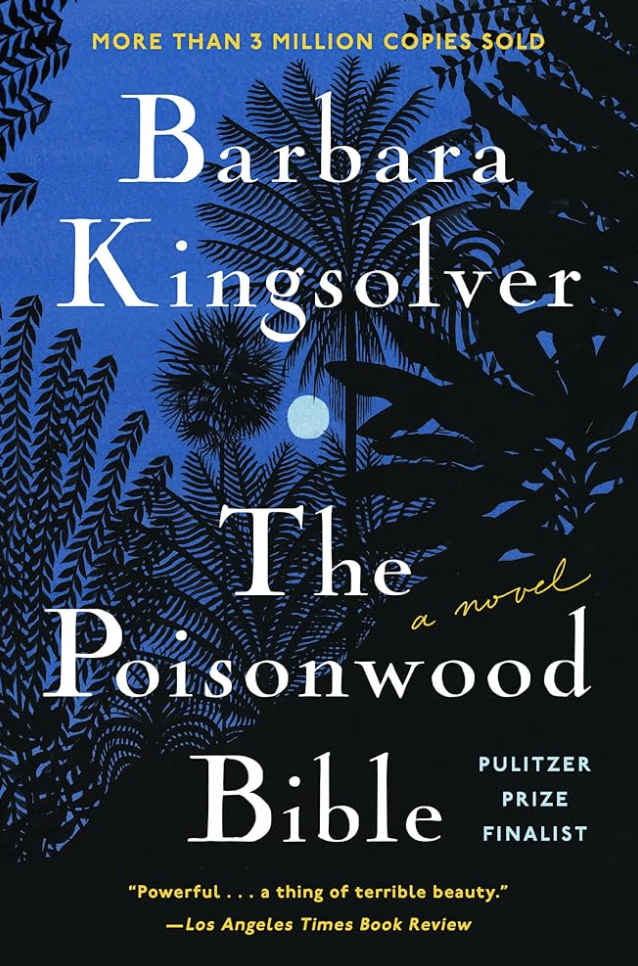
I thought about this when reading The Poisonwood Bible. A mother, Orleanna, did the best that she could, given her circumstances, to prepare for their new life. Like bringing cake mixes for her daughter’s birthdays, only to have the mixes turn to rock in the humidity. Such a symbol of motherhood/parenthood. We do the best we can. The trials that we may face are not the ones we expected. And Nathan, so sure he was right, so focused on his mission and his authority, his divine calling, that he didn’t notice what was happening to the people around him. (Not that my husband was a tyrant or a fanatic!)

The book also made me think about living and trying to parent in an oppressive patriarchal society. A general observation, while male egos and cultures clash, it’s the citizens who pay the price. Nathan’s rigid religious authority collided with local power structures and culture. While he was so wrapped up in his zeal to save souls, trying to live by the laws in The Bible, that he missed the message of The Gospel. And he was so bent on changing the local “heathen” customs, without really looking at or connecting to the people, he was doomed to fail. No one wins when the people in power are fighting to maintain power instead of helping society. When patriarchies rule, all citizens end up paying the price. Even those in charge seem trapped by the need to dominate rather than care.

I guess I’m feeling this more than ever before. It’s what’s happening in the world. For me, The Poisonwood Bible landed as a reminder that paying attention matters and caring about people matters. And the people who notice danger, who quietly adapt, who carry the worry, so others don’t have to, are often invisible. But they’re doing the work that keeps everyone alive.

I think about that first year with the rattlesnakes sometimes. I think about how long I carried that fear alone. And reading this book helped me see that experience more clearly—not as weakness, but as awareness.

And now here is a picture of a Christmas kitten so you won’t be so bummed out.

Pixabay url

V.P Chandler writes westerns and crime fiction. Her most recent publication is found in The Mysterious Bookshop Presents the Best Mystery Stories of the Year 2025.

This post was originally posted on Substack. You can follow V.P. Chandler there.

by Kathy Waller

[The blogger having been rendered incapable of typing with more than five fingers, she repeats a post that appeared on Austin Mystery Writers in 2015.]

*****

. . . it was like taking a vase and setting it down
so hard it shatters . . .

~  Tracy Chevalier

When I taught secondary English, grading essays was my least favorite task. I was happy to read them, but assigning letter grades? I hated that.

I hated judging. I hated trying to determine the difference between a B and an A, or, worse, between a B-plus and an A-minus.

But the worst–the part that made me want to moan like Hamlet’s father’s ghost, “Oh, horrible, oh, horrible, most horrible!”—was listening to students who believed their work merited higher grades: “But I worked so harrrrrrrd.” 

Some had watched classmates complete an entire assignment during a lull in history class and then score A’s. It wasn’t fair.

“Harrrrrrrrrrd” was my signal to say that No, it didn’t seem fair, but that good writing involves more than time sheets and sweat. It’s the words on the page that matter.

Now, to my dismay, I often find myself slipping into student mode. For example, when I submit a chapter to my critique group, or a beta reader, or even a family member, and they find fault, or don’t even mention my genius, I have to restrain myself from wailing, But I worked so harrrrrrrd…

Each time it happens, I repeat to myself the old lecture about time sheets and sweat. I add that whingeing is the hallmark of the amateur.

And I meditate upon Tracy Chevalier.

Chevalier wrote the critically acclaimed historical novel Girl with a Pearl Earring. Her next novel began as a draft written in third person, with small sections in first-person voices of children. The completed manuscript disappointed her.

When I reread the first draft, she says,  I cried at the end. It was boring, dead weight, terrible. Then I looked it over and thought, there’s nothing wrong with the story except the way it’s told.

She found the solution in another contemporary novel:

I had the idea when, just as I was finishing the first draft in third person, I read Barbara Kingsolver’s The Poisonwood Bible, which uses five different voices beautifully. It’s a wonderful book, using multiple voices very successfully, and I thought, “Oh, that’s an interesting technique, I wonder if I should take the kids’ voices I’ve already written and have the three of them tell it.” It just felt right.

The revision was published as Falling Angels, an exquisite novel about a young wife and mother struggling to survive in the rigid, but rapidly changing, social structure of Edwardian England. The book is written in first person, from twelve perspectives, in twelve distinctive voices.

I came across Chevalier’s account when I was just beginning to write fiction and had become obsessed with the work. Writing an entire manuscript, setting it aside, starting all over—it had to be pure drudgery. I couldn’t imagine putting myself through that. 

Later, though, I reread the article and a different passage caught my attention—Chevalier’s description of the rewrite:

I took the draft, and it was like taking a vase and setting it down so hard it shatters, then putting the pieces back together in a different way. I rewrote the whole thing in first person with all these different voices.

That passage doesn’t describe drudgery. Shattering a vase, putting the pieces back together to make something new—that’s a picture of creation, of the excitement and the pleasure and the beauty that accompany it.

I love Tracy Chevalier’s novels and admire her talent. But, on a more personal level, I’m grateful to her for sharing publicly how Falling Angels made its way into print—for reminding me that hard work isn’t synonymous with drudgery, for implying that it’s okay to cry over a bad draft and that perceived failure can turn into success, and for showing that the act of writing itself affords as much pleasure as the spirit is willing to embrace.

And—for tacitly suggesting that no one really needs to hear me whinge about how harrrrrrrrd I work.

It’s the words on the page that matter.

*****

Note: I really do love Chevalier’s novels. In fact, I love Falling Angels so much that during library duty one Saturday morning, I was so intent on finishing the book—just racing toward the climax—that I unlocked the front doors but left the lights in the reading room off, and spent the next ninety minutes parked behind the circulation desk, reading, and hoping no one would walk in and want something. I’m not proud of what I did. It was unprofessional. But patrons were understanding. And I finished the book.

*****

Information about Tracy Chevalier comes from Fiction Writers Review.

*****

Kathy Waller blogs at Telling the Truth, Mainly, and with Austin Mystery Writers. Her stories have been anthologized in Murder on Wheels, Lone Star Lawless, and Day of the Dark, and online in Mysterical-E.

Shattering a Vase

…it was like taking a vase and setting it down so hard it shatters…

~  Tracy Chevalier

When I taught secondary English, grading essays was my least favorite task. I was happy to read them, but assigning letter grades? I hated that.

I hated judging. I hated trying to determine the difference between a B and an A, or, worse, between a B-plus and an A-minus.

But the worst–the part that made me want to moan like the Ghost of Hamlet’s father, “Oh, horrible, oh, horrible, most horrible!”–was listening to students who thought their work merited higher grades: “But I worked so harrrrrrrd.

Some had watched classmates complete an entire assignment during a lull in history class and then score A’s. It wasn’t fair.

“Harrrrrrrrrrd” was my signal to say that no, it didn’t seem fair, but that good writing comes from more than just time sheets and sweat. It’s the words on the page that matter.

Now, to my dismay, I sometimes find myself slipping into student mode. For example, when I submit a chapter to my critique group, or an agent, or a publisher, or a reviewer, or even a family member, and they find fault, or don’t even mention my genius, I have to restrain myself from wailing, But I worked so harrrrrrrd…

Each time it happens, I pull out the old talk about time sheets and sweat. I add that whingeing is the hallmark of the amateur.

And I meditate upon Tracy Chevalier.

Chevalier wrote the critically acclaimed historical novel Girl with a Pearl Earring. Her next (third) novel began as a draft written in third person, with small sections in first-person voices of children. The finished manuscript was a disappointment.

When I reread the first draft, she says,  I cried at the end. It was boring, dead weight, terrible. Then I looked it over and thought, there’s nothing wrong with the story except the way it’s told.

She found the solution in another contemporary novel:

I had the idea when, just as I was finishing the first draft in third person, I read Barbara Kingsolver’s The Poisonwood Bible, which uses five different voices beautifully. It’s a wonderful book, using multiple voices very successfully, and I thought, “Oh, that’s an interesting technique, I wonder if I should take the kids’ voices I’ve already written and have the three of them tell it.” It just felt right.

The revision was published as Falling Angels, an exquisite novel about a young wife and mother struggling to survive in the rigid, but rapidly changing, social structure of Edwardian England. The book is written in first person, from twelve perspectives, in twelve distinctive voices.

I came across Chevalier’s account when I was just beginning to write fiction and became obsessed with the work. Writing an entire manuscript, setting it aside, starting all over—it had to be pure drudgery. I couldn’t imagine putting myself through that. 

Recently, though, I reread the article and a different passage caught my attention—Chevalier’s description of the rewrite:

I took the draft, and it was like taking a vase and setting it down so hard it shatters, then putting the pieces back together in a different way. I rewrote the whole thing in first person with all these different voices.

That passage doesn’t describe drudgery. Shattering a vase, putting the pieces back together to make something new—that’s a picture of creation, of the excitement and the pleasure and the beauty that accompany it.

I love Tracy Chevalier’s novels and admire her talent. But, on a more personal level, I’m grateful to her for sharing publicly how Falling Angels made its way into print, for reminding me that hard work and drudgery aren’t synonymous, for implying it’s okay to cry over a bad draft and that perceived failure can turn into success, and for showing that the act of writing itself affords as much pleasure as the spirit is willing to embrace.

And—for tacitly suggesting that no one really needs to hear me whinge about how harrrrrrrrd I work.

It’s the words on the page that matter.

*****

Note: I do love Chevalier’s novels. In fact, I love Falling Angels so much that during library duty one Saturday morning, I was so intent on finishing the book—just racing toward the climax—that I unlocked the front doors but left the lights in the reading room off, and spent the next ninety minutes parked behind the circulation desk, reading and hoping no one would walk in and want something. I’m not proud of what I did, but patrons didn’t seem to notice anything different, and I finished the book.

Note: The angel pictured above stands in the Oakwood Cemetery in Hendersonville, North Carolina. Carved from Italian marble, she is the angel often referred to in Thomas Wolfe’s Look Homeward, Angel. Wolfe’s childhood home is in Asheville, about twenty miles north of Hendersonville.

*****

Information about Tracy Chevalier comes from Fiction Writers Review.

*****

Posted by Kathy Waller

Kathy

Kathy

Two of Kathy’s stories appear in
Austin Mystery Writers’ crime fiction anthology,
Murder on Wheels.
She blogs at Kathy Waller ~ Telling the Truth, Mainly,
and on the group blog, Writing Wranglers and Warriors.