Serial’s Strange Embrace: A 15-Year-Old Murder Mystery Captivates Millions

Have you been listening to Serial? Each week, millions of people anticipate the next episode of Serial, a podcast-turned-obsession produced by This American Life (TAL), which covers the investigation of a 15-year-old murder case. Serial has done a masterful job of pulling people into a real-life murder mystery, and I am one of those waiting for a new episode each Thursday. serial_logo

Serial is hosted by Sarah Koenig, a journalist and  executive producer working for TAL, who spent a year studying the case of Hae Min Lee, a well-liked Baltimore high school student who was murdered in 1999 at the age of eighteen. Lee’s body was discovered six weeks after she was murdered, buried in a shallow grave in Leakin Park (often pronounced as Linkin Park). Leakin Park has a reputation as a hiding place for the dead. It has been said, “If you’re going to bury a body in Leakin Park, you’re going to find someone else’s.”   It is no place for anyone’s child.

Detectives investigated Hae Min Lee’s murder and her ex-boyfriend, Adnan Syed, found himself at the center of the inquiry. Before long, Adnan Syed, was tried, convicted and sentenced to life in prison. Many believe he was wrongly convicted while others say justice has been served.

The question remains, “Did Adnan Syed kill Hae Min Lee?”

Sarah Koenig’s storytelling skills are impressive and on full display each week. Her recorded telephone conversations with Adnan Syed from prison, as well as interviews with his friends and others who knew him, bring us close to the investigation. Koenig’s analysis helps us realize that she isn’t sure about the truth, either. Each week moves us back and forth on the pendulum swing between guilt and reasonable doubt, even innocence. Each week’s episode has caused controversy, discussion and a broader conversation regarding what should be used to prosecute capital murder cases.

Serial includes a number of discoveries and twists, which I won’t spoil in this post. For those of us who are interested in studying skilled storytelling, consider enrolling in Koenig’s class by listening to this podcast. While many have proclaimed podcasts a medium with little growth potential, Serial has proven otherwise. QuestionsKoenig is clear that she isn’t too far ahead of us in her weekly recordings. They didn’t have the entire season ‘in the can’ before Episode 1 aired, and we can feel the uncertainty as she discusses the case with experts and others involved, including a juror who served on Adnan Syed’s trial.

Koenig reads from Hae Min Lee’s diary and re-traces routes and timelines testified to in court. In her hands, the story unfolds in such a way that even some who feel they know the case are surprised by what she finds. The one thing that has stayed with me throughout my listening journey, apart from the horrific reality that a young woman was murdered and her family forever damaged by living with unfair reality, is that the way in which Adnan Syed was convicted. While I haven’t read the court transcripts, what we have learned so far is concerning. Did Syed commit the crime? Was the evidence used to convict him sufficient?  The issue is being hotly debated at water coolers and cafes across the country.

And with good reason.

Serial achieves a quality of storytelling rarely found in the true crime genre, and the result is a podcast that has broken iTunes records, becoming the fastest downloaded podcast to reach 5 million listeners. It’s a nod to old-style crime radio but with the contemporary twist. Its success has brought new attention to the case as well as some backlash criticism that a murder case should not be used for the public’s entertainment. These are curious waters to navigate but the exploration of true crime stories has been an industry for some time. Serial has simply found a way to connect with listeners in a compelling manner. As mystery writers, while we may be inspired by certain events, our work is fiction. No people or animals are harmed in the process of creating our stories. However, in Serial’s world, we are listening to an investigation involving real lives and real suffering, a viscerally violent foundation upon which this new American obsession rests.

The victim, Hae Min Lee, as reported by friends, was smart, funny and full of promise. She left this world far too soon and the space she has left open in her family’s hearts will never be filled. Yes, Serial is compelling, in large part, because of the real lives affected, because the stakes are high, because so much mystery remains in this case. Let us remember those people at the center of this reality. They are not characters–they are real people carrying this burden, long after each episode has ended.

To learn more about Serial, visit www.serialpodcast.org

Serial logo property of This American Life.

–Laura Oles

Writing, Thinking, Pantsing, and Miracles

Pantsing, when successful, lets you create a story closely resembling the spark that ignited it. ~Janalyn Voigt, Live, Write, Breathe

The first step in starting a blog is finding the perfect name. I wanted to call mine Contrariwise, as an homage to Lewis Carroll and to my ability to locate an argument in nearly any issue I come across.

Contrariwise was already in use, however, several times over, and I couldn’t find another literary allusion that satisfied, so I named it Whiskertips. It was my own invention, an homage to the two whiskered beasts with whom I share living quarters.

The next step is thinking of something to blog about. For most people, determining a theme would be Step #1. Reversing the steps led to a series of posts I like to think of as eclectic. In other words, I wrote about whatever came to mind. I also hosted guest bloggers. Mark Twain and Emily Dickinson appeared often. But after a while, nothing came to mind, and I began to fall back on the beasts. When they IMG_0832.1assumed complete control of content, I withdrew and created another blog. I took its name from Gertrude Stein: To Write Is to Write Is to Write.* In a note in the sidebar, I stated the purpose: I would write about the experience of becoming a writer. I would write about writing.

It seemed like a good idea at the time.

But the best-laid plans of mice and men, etc. In only weeks–days–I had another eclectic blog on my hands. Why? Because I didn’t know anything about writing.

Or, to qualify that, I didn’t know anything writers–or anyone else–would want to read.

I know the basics: grammar, usage, mechanics, various elements of fiction, methods and techniques learned from reading, attending workshops, taking classes, reading articles, books, and blogs. But I had nothing to add.  Other people had gotten there first. And who wants to read another article about where the commas go?

The worst part was that most of the authorities claimed to have the One True Way:

Write fast. Don’t revise as you go. Outline–you have to outline every scene. Use index cards. Use colored pens. Tape butcher paper to the wall. Never share your work before you’ve completed it. Find a critique group. Write 1,000 words a day, and in ninety days you’ll have a completed manuscript. Write every day. Write morning pages. Keep a writing journal. Keep a bible for your manuscript. Query early. Query later. Have a platform. Establish a brand.

All good advice, I was sure. And frustrating, because I couldn’t seem to follow the rules.

Finally, I gave up. The experts were great at explaining how they write, but they weren’t so good at telling me how to write.

I had to struggle for a while, find my own way, develop my own process, set my own rules, and deviate from rules I’d outgrown.

Now, after years of wrangling with the experts, and with myself, I finally have something to say about how I write:

I don’t start with an outline. I start with a character and a line and go from there. I can’t construct a decent plot until I understand the characters, and I can’t understand the characters until I know their backstories. The only way I can know backstories is to write them, not in a separate document, but as part of the manuscript itself. Afterward, I go back and start putting the material in order. I may have to scrap some of the best parts–the darlings–but they go in a Darlings file so I can use them later if I find a place they fit.

This method is called pantsing–as in flying by the seat of your pants. Some plotters look down on pantsers. That used to make me feel like a failure. Then I read Writing Mysteries, a collection of essays edited by Sue Grafton, in which Tony Hillerman tells about his own pantsing. He said it takes longer, but in the end, he gets there. Since reading that, I’ve stopped apologizing for pantsing. What’s good for Tony Hillerman is good enough for me.

Let me make one thing clear: I revise. The condition of my first manuscript dictates that I revise a lot. The end product looks very different from the original.

Because I’m a pantser, the NanoWriMo program of writing a 50,000-word novel in thirty days doesn’t bring out the best in me. I write more slowly, and I can’t pound out a book on someone else’s timetable. For years I registered for NaNo and then wrote perhaps ten words. That’s called losing Nano.  Now I register and write whatever I want on my own timetable. I lose nothing, NaNo loses nothing.

(There’s another reason I don’t do well with NaNoWriMo. I don’t like to talk about it. But if you want to read about it, check Wikipedia under Passive-Aggressive behavior.)

The exception to my pantsing process occurs when a story comes to me already outlined. One such blessed event happened one night just after I’d gotten into bed and turned out the light: a story appeared, beginning, middle and end. I thought it would take about 600 words, but the final version turned out to be nearly 5,000 words. It included a little pantsing.

When I began this post, I knew only two or three things about writing, but now I realize I know more. Having already run on at length, I will leave the rest for another time. After I’ve pointed out one more thing:

Some writers, myself included, know (There’s another one!)–that writing is  a form of thinking, a way to generate ideas, to learn what we already know.

But I also subscribe to Gertrude Stein’s description:

One of the pleasant things that those of us who write or paint do
is to have the daily miracle. It does come.

I depend on the daily miracle. When I write, and keep on writing, it does come.

 *

*The entire quotation is “To write is to write is to write is to write is to write is to write is to write.” I presume it was not already in use because no one wanted it.

*

Posted by Kathy Waller 0kathy-blog

Kathy blogs at To Write Is to Write Is to Write and at  the group blog Writing Wranglers and Warriors.

Find her on Facebook at https://www.facebook.com/kathy.waller68.


Writer Unboxed Un-Conference

Salem house

Just got back from the Writer Unboxed Un-Con a couple of days ago and like many of my peers, I’m having a hard time adjusting to real life again. It was so great! What’s Writer Unboxed? I guess I’ll start at the beginning.

WU is a wonderful blog (www.writerunboxed.com) that’s all about the craft of writing fiction and providing moral support for fellow writers. I’ve been a member of the “family” for a few years now and I can say that it’s been invaluable.

This was the first conference and it was held in Salem, Massachusetts and what a wonderful time of year to be there! The leaves were gorgeous and it was right after Halloween so there was still a magical feeling in the air.

The days were packed with classes and workshops. I literally filled my notebook with notes. I wish I could tell you everything I learned and the insights I discovered, but that would take  pages and pages to do. So instead I’ll share some granules of wisdom and some links so you can delve further on your own.

My first class was Lisa Cron’s Wired for Story. I’m now a groupie. It was about how stories are the most powerful form of communication and our brains are literally wired for story because that’s how information has been passed down for generations. When someone says, “Let me tell you a story…” your brain releases Dopamine and you’re ready to experience the story. A good story is more important than beautiful writing because you’ll get a better reader response. She compared it to a tricked out car with no engine. It’s pretty, but it won’t get you anywhere. And most importantly—story is internal, not external. It’s what happens to your characters. Lisa has a TED talk all about this. I highly recommend it. It’s almost more like learning philosophy and about writing.

Learned about Setting as Character taught by Brunonia Barry and Liz Michalski. Both are from the area so not only was it a good class about describing your setting, they offered some new insights into the area. Most of it was a writing exercise and some of us shared what we wrote.

Velveteen Characters taught by Therese Walsh. Therese is a founder of WU and organized the conference so she is a powerhouse, to say the least. Basically she said that all of your characters are important, even the secondary ones. You should try to give each one a quirk or flaw, it makes them more real and will enhance the story. She suggested for a writing prompt to make 5 assumptions about a character and flip them. See what happens!

Plot vs  and Story taught by Lisa Cron, Brunonia Barry, and Donald Maass. This was a biggie. To sum up copious notes, story is internal and the changes that happen within your characters. Plot is actions, events and things that affect your characters. Also a side-note,  every single scene should have conflict, action, suspense, and a turning point.

Where Story Comes From led by Meg Rosoff. Basically, you are unique so your voice is unique. It was about tapping into the conscious and unconscious mind, to get to those memories, fears, and feelings that are real. If you can convey those feelings, your voice will be unique and you’ll connect with the reader.

Donald Maass’s class on How Good Manuscripts Go Wrong. So many notes! He talked about how to make your characters deeper and more interesting by giving them flaws and obstacles to overcome. Does your MC (main character) do something that no one else can do? Does your MC know something that no one else knows?  And don’t forget to add tension to every scene. Most books don’t have enough tension.

The last day was an all-day long workshop about 21st Century Fiction. It seems that genres are starting to cross over and readers are expecting it. Plot driven books have deeper characters and literary books have more suspense and action. His method was to ask questions which make you think about your characters and the events. Many people, myself included, had “aha!” moments which made us look at things differently. So insightful.

That’s it in a nutshell. I’m including a video of me singing the Un-Con song. It’s embarrassing and the quality isn’t great, but it was fun.


Hawking Books at the TBF

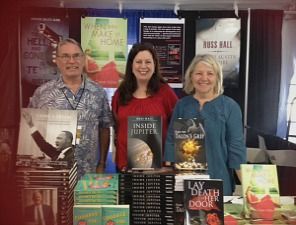
Every year, Texas author Russ Hall rents a booth at the Texas Book Festival, a downtown event that draws more than 40,000 readers from all over Central Texas.  This year, Russ shared his booth with my romance-writer friend Claire Ashby and me.

Russ Hall, Claire Ashby and Elizabeth Buhmann at the 2014 Texas Book Festival

Russ Hall, Claire Ashby and Elizabeth Buhmann at the 2014 Texas Book Festival

Nowadays, whether you are traditionally, indie or self-published, you have to sell your own books. Claire and I learned a lot about that from Russ over the weekend.

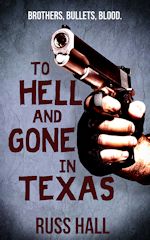
The three of us all have books out with Red Adept Publishing—Claire’s and my first books and Russ’s most recent. We all prepared for the book festival by having posters made of our cover images. The posters are good to have; they’ll come in handy at nearly any local event.

tohell

whenyoulaydeath


A good cover can play a major role in the success of your book. The three of us are happy with ours by Streetlight Graphics, cover designers who subcontract with Red Adept. Consider using them if you are choosing your own cover. And just for laughs, check out these Nine Cover Mistakes to Avoid from Book Bub Unbound.

Hawking to the Crowd

At the book festival every year, Russ shifts into what he calls his extrovert-for-a-day mode. It’s not the most natural state for the average writer, but it’s not that hard to cultivate, either. Russ taught us to greet people and make friendly conversation about the weather (it was HOT in that tent!), the crowds (BIG!), and the festival in general (so much to see).

TBF

Be ready with a quick, catchy description of your book—its genre and its hook. Claire and I struggled on this learning curve. Ask yourself: how would you describe your book in one or two sentences to make it sound like a great read? Practice your pitch!

  • Russ often quoted a line from the Kirkus review when selling his mystery, Goodbye, She Lied: “Cartloads of down-home humor, amusing characters and a hint of romance.”
  • Claire’s book is a “love story about a pregnant woman and a man who lost his leg in Afghanistan.”
  • I learned to throw out the fact that I used to work at the Attorney General’s Office. It gave me and my mystery credibility.

Russ also taught us to make sure people realized we were the authors, not just vendors. It made a difference! We ended up signing every book we sold.

Cover to Title to Blurb

It was fascinating to see the cover-title-blurb progression in action. The cover is the first thing that sells your book to a casually browsing shopper. We could see people’s eyes get caught by a cover, then they would read the title, then pick up the book and turn it over to read the back cover.

Be sure to take bookmarks! Mine included the graphics from the cover, the title and the hook paragraph from my back cover. I found I could easily pull people over by reaching out and offering a bookmark.

bookmark

One woman took the bookmark from me without pausing or even really looking at me. We watched her walk past us, glance down, then slow down, reading. Then she stopped and stood there. She turned around, came back, picked up the book, and read the back cover. Sold!

I went through 200 bookmarks and could have used more. Who knows? Maybe some people went home and read the bookmark later. If they like mysteries, maybe they’ll look it up on Amazon.

Will you have a book out next year? Get your poster and bookmarks and sign up to hawk your wares at next year’s Texas Book Festival! Where a good time is had by all.

THE GARDINER CHRONICLES: PART TWO

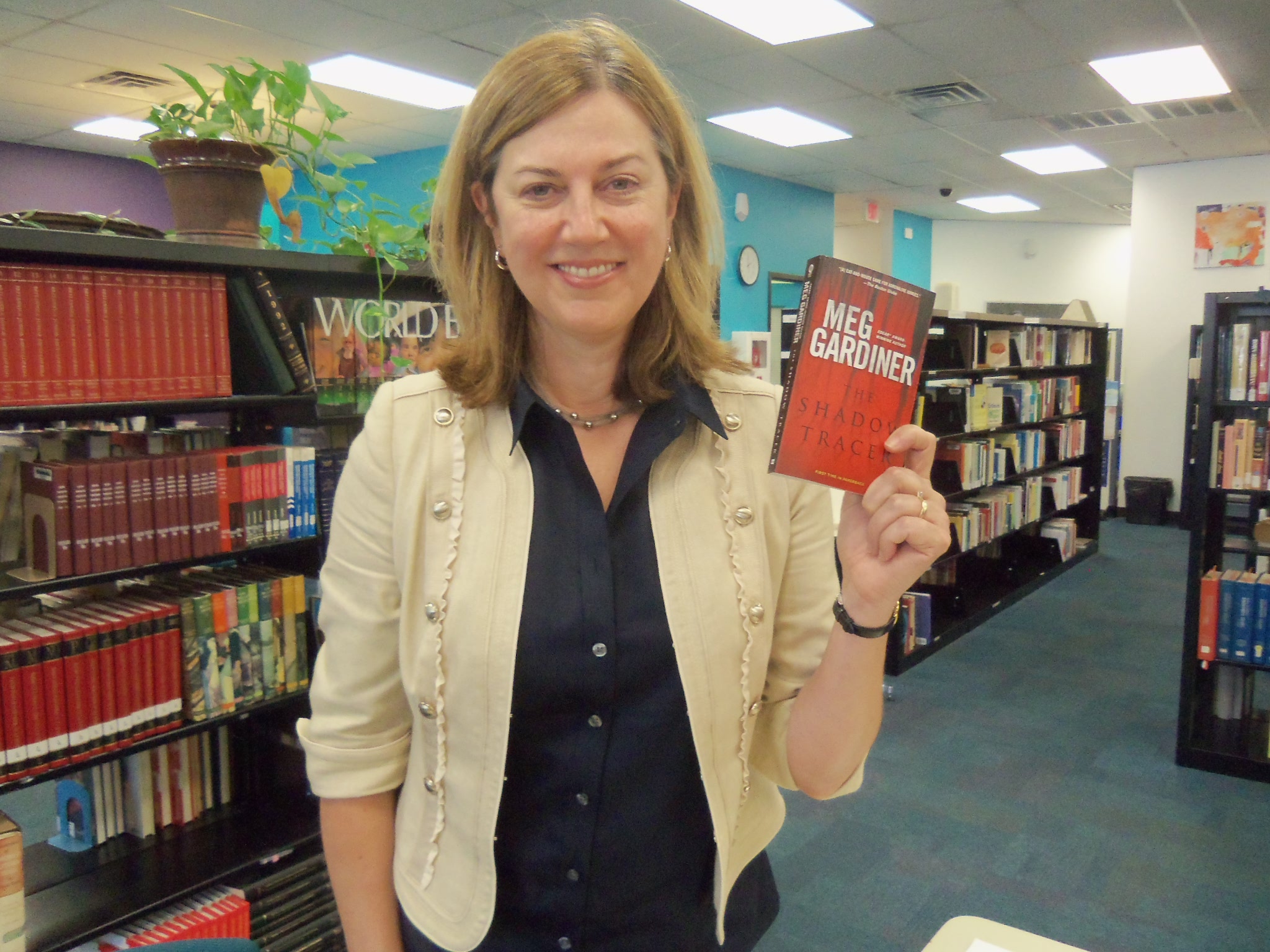
SINC August Meg Gardiner 003Or who let the deus ex machina out, what’s a plot, and is this about cannibalism?

hutto oct. 1 2014 023 (2)By Gale Albright

“Plot is soylent green. It’s made up of people!”
Is Edgar award-winning thriller writer Meg Gardiner talking about cannibalism?

http://en.wikipedia.org/wiki/Soylent_Green

No, she did not advocate turning people into crackers in a malnourished dystopian future. She talked about plotting novels during her August 10 presentation at the Sisters in Crime: Heart of Texas chapter monthly meeting.

“Plot or characters are largely the same thing. The story is all about what the characters do. You should know what the ending is. The seeds of the ending must be sown at the beginning of the book.”

She used Jaws as an example. “The first chapter shows what needs to happen at the end of the story. There’s a set up there. The protagonist must defeat the antagonist.” You know from the beginning that somebody has to do something about that shark—pronto! That shark can’t be washed ashore six months later on a beach in South Carolina and die of indigestion. The protagonist and antagonist must engage in hand to hand combat, or hand to fin, as it were.

According to Gardiner, thrillers have a fairly linear, straightforward plot. There’s an “inciting incident” that throws life out of whack for the protagonist, which in turn causes complications. It sets off a chain of events. The essence of plotting is “thwarting desire.”

The protagonist desires something and the job of the antagonist is to throw a monkey wrench into the works. The antagonist is a critical character who keeps the protagonist from getting what she wants.
You need a strong, active protagonist. If everything happens easily for a protagonist, it’s not a story. She doesn’t need to be Sylvester Stallone, but she’s not going to fold when the going gets tough. The protagonist doesn’t go with the flow, she’s willing to put herself out there and take action.SINC August Meg Gardiner 007

Is the heroine an amateur sleuth? Why does she feel compelled to look for answers? Is the villain a murderer? The villain has strong motivations and feels he is the hero of his own story. They must have compelling characteristics. Gardiner likes Moriarty as a villain as he clashes with Sherlock Holmes. Both men are obviously the heroes of their own stories.

Even if you don’t know who the killer is until the end of the novel, you know there is someone out there doing bad things, perhaps a minion of the main villain. In Gardiner’s Dirty Secrets Club, someone is committing murder by forcing the victims to kill themselves. Forensic psychiatrist Jo Beckett, one of Gardiner’s serial heroines, has to track down the killer.

The story must build bigger and bigger with plot twists and escalating pressure. There is continual revelation and shock. The characters have to make decisions under pressure.

The key to the plot is action. Figure out what the chase is and cut to it. Start with action, not a lot of back story–no dream sequences. The plot has to be emotionally coherent or the reader will feel cheated and put the book down.

To prevent that “sag in middle,” keep the tension up, develop the story, and build in progressive complications with big scenes, time pressure, and a ticking clock of some kind.

The ending must be surprising, yet inevitable. You need some surprise, otherwise the result might be vaguely dissatisfying. Create a dilemma at the ending, forcing the protagonist to choose the lesser of two evils by making a difficult decision.

Always make sure the protagonist is the one who takes action to resolve the issues. The hero/heroine has to take active steps at the end of the novel. Don’t try to pull a deus ex machina out of the bag at the end.

http://en.wikipedia.org/wiki/Deus_ex_machina

What is a deus ex machina, you ask? In ancient Greek plays, an actor playing a god was literally cranked out from the wings onto the stage to resolve the ending of the story. He was sitting in a “god machine” made by ancient Greek stage hands, no doubt. This form of achieving a satisfying ending to the story is frowned upon in modern times. The protagonist must defeat the antagonist with her own smarts and heroism.

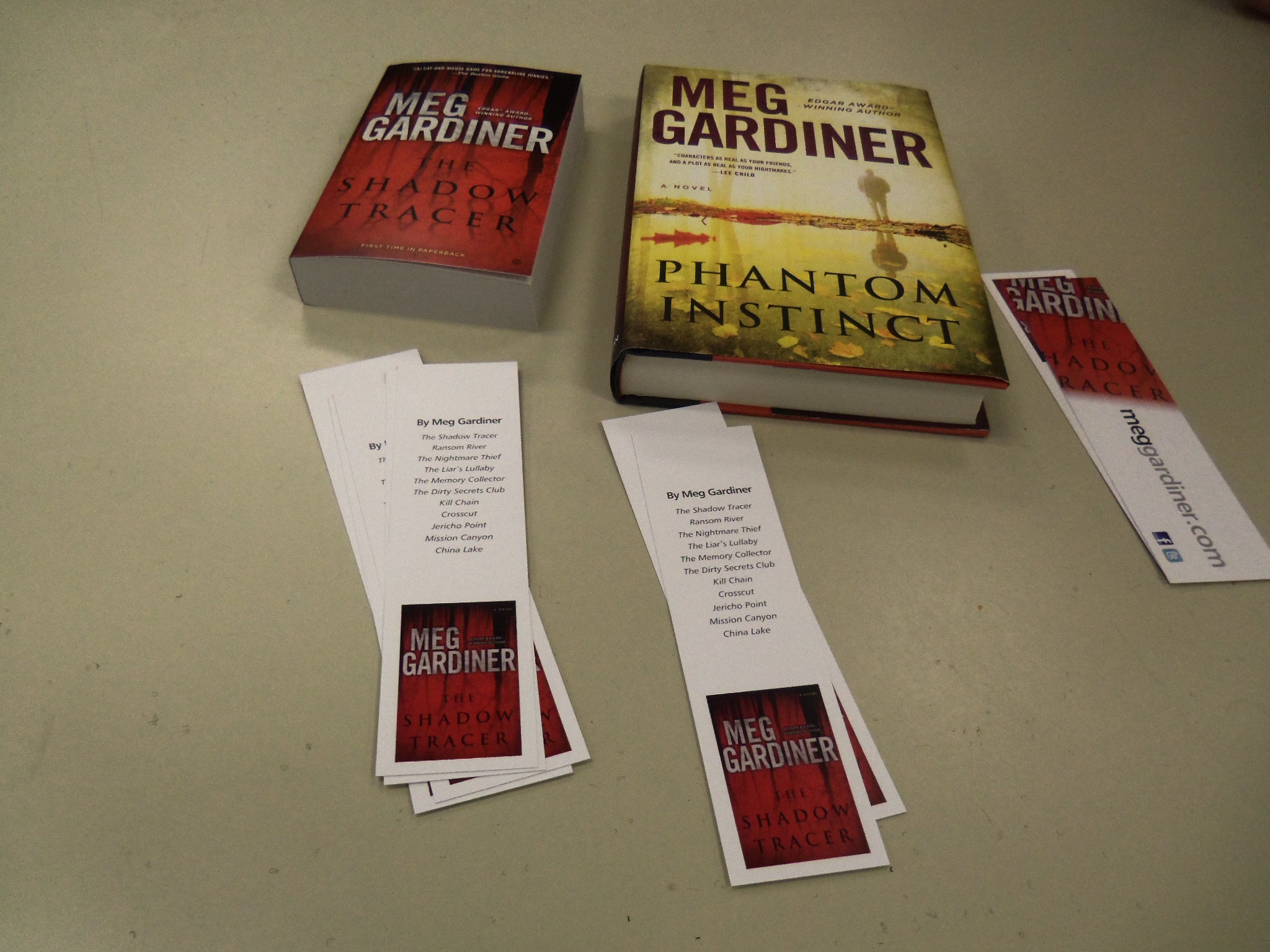
Meg Gardiner is an Edgar award-winning American crime writer who lives in Austin, Texas. Her best-known books are the Evan Delaney novels. In June 2008, she published the first novel in a new series, featuring forensic psychiatrist Jo Beckett. More recently she has published three stand-alone novels: Ransom River (June 2012), The Shadow Tracer (June 2013), and Phantom Instinct (June 2014).SINC August Meg Gardiner 005


Procrastination and the Perfect Writer’s Guide

There’s something alluring about reference books for writers. You know the ones, lining the shelves at your favorite local bookstore. They beckon, encouraging us to come closer, to flip through their pages to discover their secrets. They promise to teach us everything we need to know about creating compelling characters, powerful plots and revealing dialogue. They offer to give us a glimpse into the writing life as experienced by those who have earned some modicum of success. These guides are filled with information, tips, anecdotes and motivation. They are filled with promise.

They get me every time.

StevenKingCoverI’ve always been a bit of a research geek. When I want to learn something new, I tend to go all in, diving into the topic quickly and deeply. Some would claim this fascination serves as a distraction, a way to procrastinate from the hard work of putting words to paper. I’ve read many blog posts cautioning us to abstain from the allure of the writer’s reference book. You must practice the craft, not read about it. “These books are yet another way to put off the actual work. Research isn’t writing.” And I agree with this sentiment.

To a point.

I believe that any activity that lures us away from honing our skills falls in this category. My weakness is weeding out closets. When I’m stuck–or afraid to tackle a project–I tackle a drawer instead. I’m a master at this method of delay. If I’m engaged in de-cluttering the closet, it’s probably because my mind is too cluttered to move my story forward.

It is the writing reference guide that actually draws me back to the page. These books become the bridge that helps me return to the work at hand.

My current favorite is Alexandra Sokoloff’s Screenwriting Tricks for Authors. I keep Anne Lamott’s Bird by Bird, Stephen King’s On Writing and Stephen Pressfield’s War on Art on my desk, close enough to guide me through a tough stretch of writing. They keep me pushing forward when dealing with the messy middle of my manuscript. I confess to sometimes spending too much time searching for that perfect  formula when I should be discovering the path through my own practice. Still, I rationalize this habit as one that encourages me to come back to the work rather than giving up on it entirely. And isn’t that what these books really offer? The hope, the gentle push to continue our efforts. And if they serve as a crutch now and again, well, that’s okay.

I just call it research.

What are your experiences? Which writer’s guides are your favorites, and do they help or hinder your daily word count?

–Laura Oles

Morning Pages: Don’t Speak. Don’t Judge. Don’t Fall Asleep.

Karleen Koen

Karleen Koen

The first day of last summer’s Writer’s League of Texas retreat, author-instructor Karleen Koen told students that every morning before class, we must do Morning Pages: Wake up, don’t speak, take pen and paper–not computer–and, while still drowsy, write “three pages of anything.” Don’t judge. Keep the pen moving. In her course notebook, Karleen listed the following:

Stream of consciousness, complain, whine, just move your hand across the page writing whatever crosses your mind until you get to the end of page three.

Karleen stressed that she didn’t invent Morning Pages. The technique, minus the name, came from the book Becoming a Writer by teacher Dorothea Brande, published in 1934 and reissued in 1981. Author John Gardner, in his foreword to the reprinted edition, states it was “astonishing” that the book had ever gone out of print.

IMG_3540

Becoming a Writer by Dorothea Brande

Ms Brande advises aspiring writers to “rise half an hour, or a full hour, before you customarily rise.” She continues,

Write anything that comes into your head: last night’s dream, if you are able to remember it; the activities of the day before; a conversation, real or imaginary; an examination of conscience. Write any sort of early morning reverie, rapidly and uncritically. (Brande, p. 72)

Julia Cameron, in her bestselling The Artist’s Way, published in 1992, named the process Brande advocated Morning Pages and made them the cornerstone of her Artist’s Way program. Cameron considers them a form of meditation.

Why do Morning Pages? To quiet the internal critic; to tap into the subconscious; to discover what you know; to remember and to capture the present; to build fluency, the ability to “write smoothly and easily when the unconscious is in the ascendant.” (Brande, p. 72) And, as Koen notes, to whine and complain.

When I do Morning Pages, I like to focus on whining and complaining. Words of discontent virtually flow from my pen when I follow Brande’s instruction to rise early. To wit:

The morning after Karleen assigned Morning Pages, my roommate and I woke to my cell phone alarm at seven rather than the previous day’s eight. (I think that was the morning the phone flew from the nightstand and landed on the concrete floor.) I propped myself up on a couple of pillows, gathered the pen and the notebook I’d placed on the nightstand before retiring the night before, and started to write.

While I wrote, my roommate sat on the side of her bed. Instead of picking up her notebook, she spoke. I reminded her we weren’t supposed to talk. She told me she didn’t care what we weren’t supposed to do. After violating the rules once or twice more, she started on her Morning Pages.

Roommate drinking tea and smiling

Roommate drinking tea and smiling

In my usual all-or-nothing fashion (a tiny bit of OCD), I wrote through hand cramp and shifting pillows. Halfway through, I fell asleep. When I woke about a half-hour later, I resumed scribbling.

My roommate had already finished her Pages. She had dressed. She had sat on the porch and drunk a cup of hot tea. She was smiling.

Sometimes it is better to bend the rules.

At break time, I quoted to Karleen the first sentence of my Morning Pages: I don’t like Karleen any more. (I said it in bold font.) She laughed uproariously and asked if I knew how funny I was. I didn’t tell her I was dead serious. Before the end of the day I would like her again, and if I told the truth now, I would have to apologize later, and I just didn’t have the energy.

Since I’m confessing, I might as well admit that, while I was scribbling, I figured out a fool-proof way to make Morning Pages a positive experience: Use a notebook with little tiny pages. They fill up faster.

Looking back, I’m ashamed of the thought, but at the time it seemed a darned good idea.

Anyway. Having griped about that miserable experience, I’ll also admit that Morning Pages work. I’ve done them off and on since 1998, when I heard Julia Cameron speak at the Austin Whole Life Festival. A small group of young men stood outside Palmer Auditorium holding placards and begging attendees to abandon chakras and crystals and choose reason instead, while inside, Cameron shared the most reasonable ideas on stimulating creativity.

So I read The Artist’s Way and, although a 17-cent spiral notebook would have sufficed, I bought a copy of The Artist’s Way Journal. (The Journal had enormous, narrow-ruled pages that took forever to cover, but having the proper tools is important to OCDs.)

Then I wrote. And whined. And complained. As I did, the garbage in my head moved down my arm, through my hand, and onto the page. By the time I got to page three, my mood had lightened. When I turned to other writing, the garbage stayed trapped inside the Journal.

Once the brain has been cleared of debris, words can flow.

That’s my experience. Others have their own reasons for writing those three pages per day. But those who engage in the practice swear by it.

Adequate sleep

Adequate sleep

As I said, I’m not consistent. I’ve done Morning Pages for months at a time, then skipped one day and failed to resume the habit.* Nearly every time I’ve given up,  fatigue has been the cause. A long commute before and after an extra-long day makes rising early unpleasant if not impossible. The same thing goes for getting to bed too late. Morning Pages require adequate sleep. But so does good health. So does good writing of any kind.**

Before leaving the retreat, I bought a special notebook for my return to Morning Pages. The signature on the cover looked like Dickens but turned out to be Darwin. No matter. Darwin and I are friends, too, and I wanted the green one. I’ve not yet made peace with going to bed at a decent hour. I’m trying. But when I stay up into the wee hours working on a blog post, my morning edges toward afternoon.

Oh–I’ve just remembered: A situation unrelated to fatigue once interfered with Morning Pages. It involved the repaving of twenty miles of FM20, a wintry cold house, and a new box of cat litter.

But that’s a story for another post.

Charles Darwin's signature on elegant green notebook

Charles Darwin’s signature on elegant green notebook

###

*Morning Pages is about the only habit I’ve ever managed to break.

** I’m not sure about sleep being necessary for good writing of all kinds. I suspect Hemingway, Faulkner, and Fitzgerald might have stayed up past bedtime. But I bet Willa Cather kept regular hours. And, as people with any discernment at all recognize, Cather is at the very top of the American novelist pecking order.

###

0kathy-blog

Kathy Waller blogs at To Write Is to Write Is to Write (http://kathywaller1.com) and at the group blog Writing Wranglers and Warriors. She’s set aside her novel manuscript for a while to concentrate on writing short stories.

AMW Writing Retreat- AKA Babes in the Woods

I’ll be honest, I’ve never been on a writing retreat. So as the days got closer to October, my excitement grew. What all is involved? What is expected of me?

Like most gals (I think), I thought about accessories. What do I wear? Which made me think about my suitcase. I hate using the same old black blah suitcase so  I went shopping. I’ll also be going to a conference in November so I’ve been thinking about this. I went to JaCque Penney and found exactly what I was looking for.  I love this color of blue.

Suitcase

I also got so excited that I asked a talented friend to make something to “mark” the occasion. She made AMW book markers and magnets. Aren’t they cute? Book markers


(I think we should have more of these for prizes at future AMW events)

Friday finally came around, time to get to the cabin! I gathered my notes, computer, and supplies.

My notes


I got my directions and I was on my way! I arrived in no time at all and was the first to get there. I hunted around for the key, found it and let myself in. It was a gorgeous day so I opened all the windows. Let the magic begin! Cabin

While I waited for the others to arrive I unpacked. I heard a vehicle approaching. Yay! They’re here! Nope, a truck pulling a large BBQ cooker was arriving at the property next door. About ten minutes later I heard another engine. Yay! Nope, another truck pulling a large cooker, followed by a few more trucks.

By the time my cohorts had arrived, five more cookers had passed by. They were planning on some serious BBQ next door.Turns out there was a cook-off planned for the same weekend.

BBQ Sign

That’s okay because nothing was going to stop us!


We visited, relaxed, and had a nice time that first night.

Gale on couchKathy on couch


The next morning we awoke with a sense of business. Time to write! At first this was all I could think about, a keyboard staring back at me.Keyboard

I’m so glad I have an outline to keep me on track. Once I got started, I was in the groove and made some good progress. Throughout the day, we wrote in writing sprints. They were usually about 30 minutes long with breaks in between. During the breaks I’d go outside and enjoy the cool weather and listen to the music from the cook off next door.  Yard (We never did bet brave enough to see if they needed more judges.)


By the time we left on Sunday, all three of us had made quite a bit of progress on our projects. Mine was definitely more than if I had stayed at home. It was nice to share a creative space and have that extra discipline.

I declare the 2014 retreat a success!

Have you ever been on a writing retreat? Please share your ideas and experiences.


Tai Chi and the Writing Life

For me, Tai Chi is the perfect complement for the writing life. A meditative, do-it-anywhere physical discipline that builds strength, flexibility, coordination and balance, Tai Chi is just the right tonic for a profession that involves a lot of solitude and sitting.

Tai Chi

Warning: More than one person, including yours truly, has been sucked into Tai Chi for life by this video.

But the study of Tai Chi also promotes a character and frame of mind that supports the writing life. At Master Gohring’s Tai Chi and Kung Fu, where I’ve studied for five years, we remind ourselves at the end of each class that we follow the Five Hearts: Faith, Respect, Patience, Perseverance and Humility.

The five hearts work for writers, too.

Faith is not about religion; it’s about committing to your choice of discipline. In writing, it’s not indulging doubts about whether you should even try to write.

I take it a step further and strive to keep faith in the book I am working on. It’s hard, when you’re struggling, not to go haring off after another idea entirely. Set aside the questions; have faith that you are meant to write, and meant to write this book.

Respect: In Tai Chi, we respect the masters and teachers and students who have gone before us and from whom we learn. As writers, we respect the craft and the great writers who have gone before us, as well as other writers and other genres than our own.

We respect readers, too, and opinions different from your own. We should even respect our own negative reviewers—or am I going too far? Just kidding. Respect is an attentive attitude, the antidote for carelessness, dismissiveness, and stagnation.

Patience is remembering that you can’t do it all or learn it all in a day, or even a year—or many years. Your first draft is not a masterpiece. Of course not. Patience: give yourself a chance. Tai Chi and writing both take time and work.

Learning sword from a friend

Learning sword from a friend.

Perseverance goes without saying. Setbacks and disappointments are unimportant. Those who quit cannot succeed.

Humility: In Tai Chi, there is always more to learn, more that you don’t know. Same with us. Every book is a fresh challenge.

Affirmations

The five “life skills” are affirmations with accompanying Kung Fu movements. They help build the attitude we strive for in our study of Tai Chi, and they work for writing, too.

The path of self-mastery requires balanced emotions; balanced emotions do not yield to negativity. You don’t lose your motivation or confidence when you get a tough critique, a bad review or rejection, or when someone casually says something devastating about your efforts and goals.

The path of self-mastery requires a courageous heart; a courageous heart shows strength in the face of fear. What are our fears as writers? Failure, scorn, bad reviews, the risk of putting ourselves out there. We resolve to meet fear with strength.

The path of self-mastery requires a focused mind; a focused mind sees no obstacles. This isn’t about putting your head in the sand. An “obstacle” does not prevent you from getting to your goal. It’s just a challenge, a thing in the road, a problem to be solved so you can reach your goal.

The path of self-mastery requires persistent action; persistent action achieves a goal without quitting. See perseverance above! Writing, like Tai Chi, is a discipline.

The path of self-mastery requires a creative spirit; a creative spirit has no self-doubt. For us, this affirmation applies when we are doing the purest part of our work, when we are creating and letting it out. I love these words by Martha Graham:

It is not your business to determine how good it is nor how valuable nor how it compares with other expressions… You do not even have to believe in yourself or your work. You have to keep yourself open and aware to the urges that motivate you. [See the whole passage.]

blacksashsm

Elizabeth Buhmann is the author of murder mystery Lay Death at Her Door and has a black sash in Tai Chi. She also maintains an online Tai Chi Notebook. She studies Tai Chi at Master Gohring’s Tai Chi and Kung Fu in Austin and practices with a group of Chinese friends on the weekends.

The Pomodoro Technique: Writing a Novel 25 Minutes at a Time

OLYMPUS DIGITAL CAMERACan a technique named after a tomato serve as the answer to your time management woes?

For those writers who dream of having several uninterrupted hours to write a novel but find those hours never arrive, maybe it’s time to consider another approach. It’s that fantasy that often keeps us from ever getting started–the common but sometimes detrimental belief that writing a novel will only happen if we have six hours a day of quiet time. I know that particular expectation derailed my own efforts more often than I’d like to admit. Between my work, my husband’s demanding schedule, and three kids who all play sports, the chance that I will have several interrupted hours in a row will only happen if I catch the flu and wind up in bed. This is true for most of us, isn’t it? The fantasy of writing all day colliding with the reality of a jam-packed schedule with the result being a persistent frustration surrounding why we can’t get this novel finished?

Why can’t we get to THE END?

I finally realized that I would need to figure out a method that would best work within the structure of my own life. For me, that meant searching for successful authors who juggled day jobs, kids and other demands. I’m a bit of a time management and organization geek anyway, so I used the opportunity to seek guidance. When I came across the Pomodoro Technique, I felt it might be just the tool to push my project along.

Francisco Cirillo created the Pomodoro Technique in the 1980s and it has since become one of the most popular time management techniques used today. The word ‘pomodoro’ means tomato in Italian and the name came about because Cirillo used a kitchen timer shaped like a tomato when developing the concept. Here’s how it works: you simply write in a 25 minute block of time, called a pomodoro, and then you take a five minute break before starting the next pomodoro. After four completed pomodoros, you then take a 15-20 minute break. To keep your motivation up, mark each pomodoro on your calendar with an X or a circle. As you see these marks add up, they 1) help build momentum for your project and 2) show you just how much work you can do in short blocks of time.

I found this strategy has helped me move my own work forward. In times past, I would discount even a fifteen minute block of time for fear that it wouldn’t make a difference. I realize now that I was wrong. I actually convert my pomodoros into 15-minute blocks because it keeps me from disregarding any small block of time. It often leads to 25 minutes of work, but only expecting 15 minutes means I’m more likely to give it a shot.

This approach has changed my entire mindset when writing fiction. I no longer believe I need an eight-hour day of solitude to be effective (although I still dream about it). It does require some advance preparation on my part–keeping papers together, taking notes regarding the next scene to be written–but I am now working with my editor on my first book while writing my second. I am moving forward with my fiction, and if it happens 25 minutes at a time, that’s just fine with me.

What about you? How do you balance your writing projects with your daily demands?

–Laura Oles