James Michener Didn’t Object

By Kathy Waller

0kathy-blog

Last week, Valerie wrote about why she writes. Here’s my take on that subject:

When I was four years old, I took a pair of scissors and a roll of red, gooey adhesive tape and wrote my name on the inside of the kitchen door. It didn’t occurred to me I shouldn’t, and my parents never said a word. I’m sure they discussed it, but I wasn’t privy to that conversation.  The crooked red letters stayed on the door for years. When they were finally removed, a heavy red stain remained.

When I was eight, my father gave me a ream of legal-sized paper. I produced a newspaper, one copy per issue, focusing on the social activities of dogs, cats, and horses in the neighborhood. I reported on the wedding of Mr. Pat Boone, my fox terrier, and Miss Bootsie, my grandfather’s cranky gray-and-white cat. Miss Bootsie was really Mr. Bootsie, but even then I knew the value of poetic license. Mr. Tommy, my cousin’s orange tabby, married someone, too, but I don’t remember whom or what gender. Or what genus and species for that matter.

For years, I loved writing—the paper, the pens, the ink, the facts, the improved facts, and the outright fiction.

The feeling lasted until high school, when I began taking courses labeled English. Writing became torture. What will I write about, how many words does it have to be, I don’t know anything about that, I don’t have anything to say. Through high school and two college degrees–in English–I produced the required papers but agonized over every word.

There were bright spots: writing the junior class prophecy, which made even the teachers laugh when I read it at the junior-senior banquet; composing a satire on life in the teachers’ lounge, issued serially on an irregular basis–whenever the Muse moved me.

Overall, however, my relationship to writing remained conflicted. I did my best to camouflage the discomfort, though. After all, I taught English.

Things began to change when I told a therapist about my early love affair with words. He responded, “I think you’d better start writing.” He suggested I join the Austin Writers’ League.

“I can’t,” I said. “James Michener belongs to the Austin Writers’ League. I can’t belong to anything James Michener belongs to.”

The next day, I joined. James Michener didn’t object. I started taking informal classes at nearby universities. An instructor invited me to a Saturday-morning writing practice group. The next weekend, I drove fifty miles, parked in front of the café where it met, watched people carry notebooks inside, backed my car out, and drove home. It took another week to build the courage to pick up my notebook to join them and become a regular.

The result of all this effort? Once again, I fell in love with writing. I also fell in love with a member of the writing practice group and, after a decent interval, married him.

In my romance with writing, I didn’t live happily ever after. I don’t have a long list of appealing topics. I don’t have a file of perfect first sentences. I still have to write to find out what I know and what I think. I still find myself writing furiously right up to the deadline. (Or slightly after, as I am now.) Starting any piece is difficult. But once I begin, the words flow.

I wouldn’t exchange that feeling for anything.

In fifteen years, I’ve come from, I can’t join the Austin Writers’ League to I’m working on a novel, attending Austin Mystery Writers critique group, writing short stories for publication in an anthology, blogging, writing every day.

And, contrary to the moans I make when asked how the writing is going, I love every second of it.

Why I Write

By Valerie Chandler

Almost every writer is asked, “Why do you write?” Many writers have lofty answers, but mine is, “Because I have to.” I love telling stories. I have to tell stories. I think it’s something I got from my dad who was a natural-born storyteller. He used this gift in his job as a college professor. He loved to entertain his students.

I wrote my first stories in first grade and I loved it. During my elementary years, every time a teacher said, “Get out a pencil and paper. It’s time to write a story,” I practically jumped out of my chair from excitement while the rest of the class groaned. As I grew older, writing exercises turned from writing stories to writing essays. I felt the school system was conspiring to squash our creativity.

Then in eighth grade Mrs. Cunningham read a story called “The Spanking Machine”. My heart raced. When I was in kindergarten, my older brother teased me that Principal Rockefeller of the elementary school where I would attend the following year, had a spanking machine and she accidentally killed a kid with it.

The story that Mrs. C. read was not about that, but it brought back a vivid memory of my run-in with her spanking machine. I knew that was the story I had to write. (You can read what happened here.)

A few days later, before Mrs. C. returned our stories to us, she said, “You all wrote really good stories, but there is one I’d like to read to you. It’s called ‘The Spanking Machine’.”

The students protested, “You already read that to us!”

“No, this is a different one. A story that one of you wrote.” I couldn’t believe she was going to read it to the whole class! I was nervous and curious as to how they would react. I remember looking around the room, pretending I didn’t know who wrote it, in case they didn’t like it. As the story progressed they leaned forward in their chairs, got nervous as the tension grew, and laughed at the end.

To have an effect like that on someone is fun, intriguing and addictive. The idea that a writer can reach through the words and grab a reader is a powerful and fun feeling, but it’s also a compulsion. I have stories constantly swimming through my head and I want to share them with the world. I hope readers will still lean forward with anticipation when they read my stories.

The Hidden Drama

By Elizabeth Buhmann

ut2I love a really good mystery. There is nothing I would rather read.

What I like is the discovery of a hidden reality—dark and terrible—that underlies appearance. And there is satisfaction in seeing evildoers dragged out in the open and brought to justice.

When you write a mystery novel, you invent not one but two stories. One is the hidden story of a crime. The other is a story of discovery.

You start with the hidden drama. Why might one person kill another? How exactly does it go down? How does the murderer conceal the crime?

A man might be jealous of his lover. He quarrels with her, strangles her, conceals the body, and invents an alibi. That’s what happens, but it’s hidden. Nobody knows about it.

The underlying story could be a novel in itself, but it wouldn’t be a mystery—it would be a crime drama, or a tragedy, perhaps. The mystery is about how the hidden story comes to be exposed.

The plot of the mystery begins with the first public sign of a violent reality that hides beneath the placid surface. Shots are heard, or someone disappears. A body might be found.

The first inkling of the hidden story typically leads to a detective being hired or police being called to a crime scene. The detective/protagonist then makes deductions and discoveries that lead inexorably from the first sign of violence to a full exposure of the hidden drama. Only then can justice be restored.

Somebody once asked me why I write stand-alone mysteries instead of detective stories, which can be developed into a series. It’s because the hidden drama is what intrigues me most–the dark and terrible evil underneath the surface.

Blue Ridge Mountains

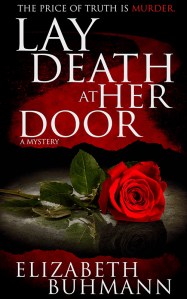
Lay Death at Her Door is set in the Blue Ridge Mountains of Virginia.

My first book, Lay Death at Her Door, is not a detective story, but it still has the heart of a mystery, because it’s all about the laying bare of a hidden life. My main character Kate got herself into a situation which led to a man getting shot and Kate being beaten and raped. To protect herself, Kate lied on the stand, and an innocent man went to prison.

So in my book, an eruption of violence was initially explained away by a false solution. The wrong man took the blame. The first inkling of what really happened comes twenty years after the fact (in chapter one), when the innocent man is exonerated by new evidence.

In another departure from the usual structure of a mystery novel, I chose a main character in the hidden drama as my protagonist, rather than the detective who solves the crime. I wanted to tell the story from the inside, even though it meant my main character would be a dark one, morally complicit, however unwillingly, in the real killer’s crimes.

Mysteries are ultimately about justice. In Kate’s story, there was a very real possibility that the truth would never be revealed. What breaks the case is Kate herself. Her own character is her downfall. This to me is a compelling idea—that evil deeds destroy us from within.

The Halls of Mystery

by Gale Albright

Joan  uh

The April 13 Sisters in Crime Heart of Texas program will feature “The Halls of Mystery” with authors Joan Upton Hall and Russ Hall. They will present mini-workshops on everything you ever wanted to know about writing. Bring your questions! Be ready to listen, take notes, and interact. It should be a lively meeting.

JUH bookcover

Joan and Russ, who have a number of books under their belts, have always been more than happy to help fledgling writers learn the craft of writing. They will share their personal experiences on getting published and keeping the right mental attitude. Both have received Sage Awards from the Barbara Burnett Smith Mentoring Authors Foundation. The award is given to an author who demonstrates an outstanding spirit of service in mentoring, sharing and leading others in the mystery writing community.rx book doctor

A former English teacher, Joan Upton Hall is an author, editor, writing instructor and speaker. Her books run from historical nonfiction to urban fantasy and the paranormal. She offers sample chapters and more on her website. Her books include The Shadow of Excalibur, Dream Shifters, Just Visitin’ Old Texas Jails, and RX for Your Writing Ills. http://joanuptonhall.com/home

Russ Hall

russ hall bk

Russ Hall has had fifteen novels published, including: The Blue-Eyed Indian, Wildcat Did Growl, Island, No Murder Before its Time, Goodbye She Lied, Talon’s Grip, Bones of the Rain, and South Austin Vampire. He has also co-authored (as well as ghost written) numerous non-fiction books. Russ is a frequent mentor and judge for writing organizations. In 1996 he won the Nancy Pickard Mystery Fiction Award for short fiction. http://www.russhall.com/russ hall bk2

“The Halls of Mystery” program starts at 2 p.m., Recycled Reads at 5335 Burnet Road in Austin, TX.


Book Review: Burrows

By Valerie Chandler

Austin Mystery Writer Valerie Chandler

Austin Mystery Writer Valerie Chandler

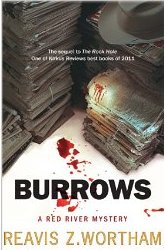
Burrows, the second book of Reavis Z. Wortham’s Red River series, is a page-turner and a satisfying read. In 1964, in North Texas along the Red River, young constable Cody Parker, recently back from Vietnam, has his hands full. An escaped lunatic has already left dead bodies in Nebraska, Kansas, and Oklahoma. So when a body is discovered in the Red River, it looks like the killer is in the area.  To add to Cody’s problems, his young cousins, Pepper and Top, are always underfoot and causing trouble. Cody’s uncle, retired constable Ned Parker, can’t break his habit of following hunches and does some of his own investigating while trying to reassure the town that Cody is fully capable.

Cover of Burrows by Reavis WorthamTheir investigations lead both Cody and Ned to the Cotton Exchange over in the next town, Chisum. They believe the killer is inside a hoarder’s nest crammed three stories high with junk. It’s a masterful feat of engineering, complete with deadly booby traps and a maze of tunnels. Cody and fellow officer, Deputy Big John Washington, volunteer to enter and as soon as they do, the entrance collapses. The only way out is forward and they hope that Cody’s experience as a tunnel rat in Vietnam will get them out alive. Ned and the rest of the town have to wait outside during the ordeal, wondering if the officers are even still alive.

Wortham skillfully captures 1960’s Texas culture and language while also providing a great mystery. He places the reader right in the musty, stinky, death trap, every stifling inch of the way. It was so descriptive, I sometimes had trouble breathing and he made me squirm more than once! He does an excellent job of pacing and adding tension. Just when one problem is overcome, there is another to face. I had to keep turning pages to see what happened next.

Murder as Entertainment

By Elizabeth Buhmann

croppedA well-known contemporary philosopher (and friend) once asked me what I was reading. As usual, I was in the middle of a murder mystery. When I said so, he was aghast!

Murder, he said, was a dreadful crime, a terrible thing. How could I possibly think it was fun to read about it??? He was appalled at my insensitivity.

I saw what he meant, and it gave me pause—but I have to admit, I kept right on reading murder mysteries. I love them. In fact, when it comes to fiction, I’m not entirely happy with a book in which no one gets killed. I don’t like books about war and mayhem, but I do like a nice one-on-one murder.

Cover-Lay-Death-BuhmannWhen I sat down to write my own novel many years later, there was no question what it would be—a murder mystery, of course. But I remembered Bob Solomon’s chiding remark and gave it some fresh thought.

I found that as a writer, although I am not going to give up on murder as entertainment, I do feel an obligation to treat the subject with respect. And for me, this entails a serious exploration of the motives and emotions that could lead one person to kill another.

I don’t write about psychopaths or serial killers (though some very good writers do). I am not interested in extreme abnormal psychology so much as in human emotions we all share. I am drawn to a murder story that gives me a glimpse of how familiar feelings and yearnings could come together in a situation that results in murder.

I chose to write a standalone suspense novel as opposed to a detective story because, from a detective’s point of view, we are at arm’s length from the murder story. In detective fiction, the main story line is all about the discovery of truth. The drama is about an agent of justice and his quest to identify the killer and his or her motive.

Don’t get me wrong—I love detective stories! But I wanted to get closer to the drama that led up to murder, so in Lay Death at Her Door I chose for my protagonist one of the main actors in that drama. Kate Cranbrook didn’t commit the 1986 murder that provides the central mystery of the book. But she was a key player in that story.

Kate witnessed the murder and was herself raped and beaten. Her testimony sent an innocent man to prison for the crime. She knew the truth about what happened, lied to protect herself, and spent the next twenty years living with the knowledge that she’d committed perjury and was an accessory, however unwilling, after the fact of murder.

Kate is also a key player in the story of how the murder is solved. Her own character drives the ultimate unraveling of her secret life and the exposure of the long-hidden truth behind the old murder. My protagonist is not a champion of justice, to put it mildly. She is a deeply flawed character mired in a sordid personal history. But in her, and in the final revelations of the book, I think we glimpse a capacity for darkness that is recognizable to all of us.

Who Was Barbara Burnett Smith?

By Gale Albright

img_1111-1

According to author Bill Crider in his post of February 20, 2005:

Barbara Burnett Smith died in an accident in San Antonio Saturday night. Barbara and her husband were there to rescue a dog, and when they visited Remember the Alibi (bookstore), the dog ran from their car and into the street. It was raining and dark, and apparently Barbara stepped into the street to catch the dog. She was hit by a car and died in the hospital.

I’m still in shock over this. I’ve known Barbara for at least 15 years, and she was one of the nicest people you’d ever hope to meet. She was lovely and perky and a very talented writer. She was also the former daughter-in-law of another fine mystery writer, Thomas B. Dewey, whom she credited with helping her quite a bit when she was starting out.

I don’t really have much more to say, except that the world is a poorer place without Barbara in it. (Bill Crider’s Pop Culture Magazine)

Bill’s comments about Barbara Burnett Smith are similar to everything I’ve heard about her. She was well-known and well-loved in the writing community.

Barbara was a member of several writing groups and served as the president of Sisters in Crime (International 1999-2000). She was a writer of cozy mysteries, including the popular Purple Sage series featuring heroine Jolie Wyatt, an amateur sleuth and radio newscaster in a small Texas town. Shortly before her death, she began a new mystery series with Bead on Trouble, whose main character, Kitzi Camden, was an amateur sleuth and beader. Her second book in the series, Beads of Doubt, was completed by fellow Sisters in Crime member Karen MacInerney.

W.D. Smith III, Barbara’s son, wrote a tribute to her in the May 2011 edition of the Sisters in Crime newsletter, Hotshots:

She always had the drive to be at her best and asked that those around her did the same. After she started writing and got out of the corporate world and took on the training game, she started to change. She wanted to give back to people and hope they had a better time of it than she did, trying to succeed in a man’s world. After a few years in the training game and running a successful business (or at least one that paid the bills), she really started to shine. She saw people for who they were and wanted to help in any way possible. I don’t think she ever watched Oprah but I believe she garnered sound bites from her show. She used a quote from Maya Angelou: “People will not remember what you said to them, but they will remember how you treated them.

On March 13, 2005, A Celebration of Barbara Burnett Smith was hosted by the Heart of Texas Sisters in Crime chapter. The Barbara Burnett Smith Mentoring Authors Foundation was established in her honor to support and provide a mentoring community to help budding writers.

We are now approaching the tenth annual BBS Aspiring Writers project, to be held during May Mystery Month at Recycled Reads, on May 18, 2014, at 2 p.m.

As BBS project coordinator, I’m calling for submissions of the first 500 words of a mystery story or novel by an unpublished writer. After the submission deadline of March 31, writers will be matched with published mystery authors for mentoring. The mentors will introduce their aspiring writers at the Sisters in Crime meeting on May 18.

For more information about submission rules, go to the Events/News section of this blog.


Making the Most of Short Blocks of Time

ImageWe asked Elizabeth Spann Craig if she’d  share some tips for making the most of short blocks of time.  We knew she juggled motherhood and multiple writing deadlines and were curious as to what special tricks she kept in her toolbox.  She was gracious enough to write a blog post that covered this tricky topic.  We learned a great deal and are willing to bet that you will, too!

Tips for Writing in Short Blocks of Time


Mystery People interviewed our own Laura Oles

Our workshop has come and gone. But if you’re interested in knowing more about Austin Mystery Writers, check out this interview. Laura does an excellent job of explaining who we are. A big thanks to  Mystery People from all of us!

http://mysterypeople.wordpress.com/2013/11/08/austin-mystery-writers-to-host-free-writing-workshop/