You know those friends you haven’t seen in so long? The ones you really miss? And that feeling you get when you finally get to share company again? That’s what I’m feeling right now. We’ve been through some things together, seen some stuff, pulled through some tough times.
I should clarify that I’m talking about my imaginary friends.
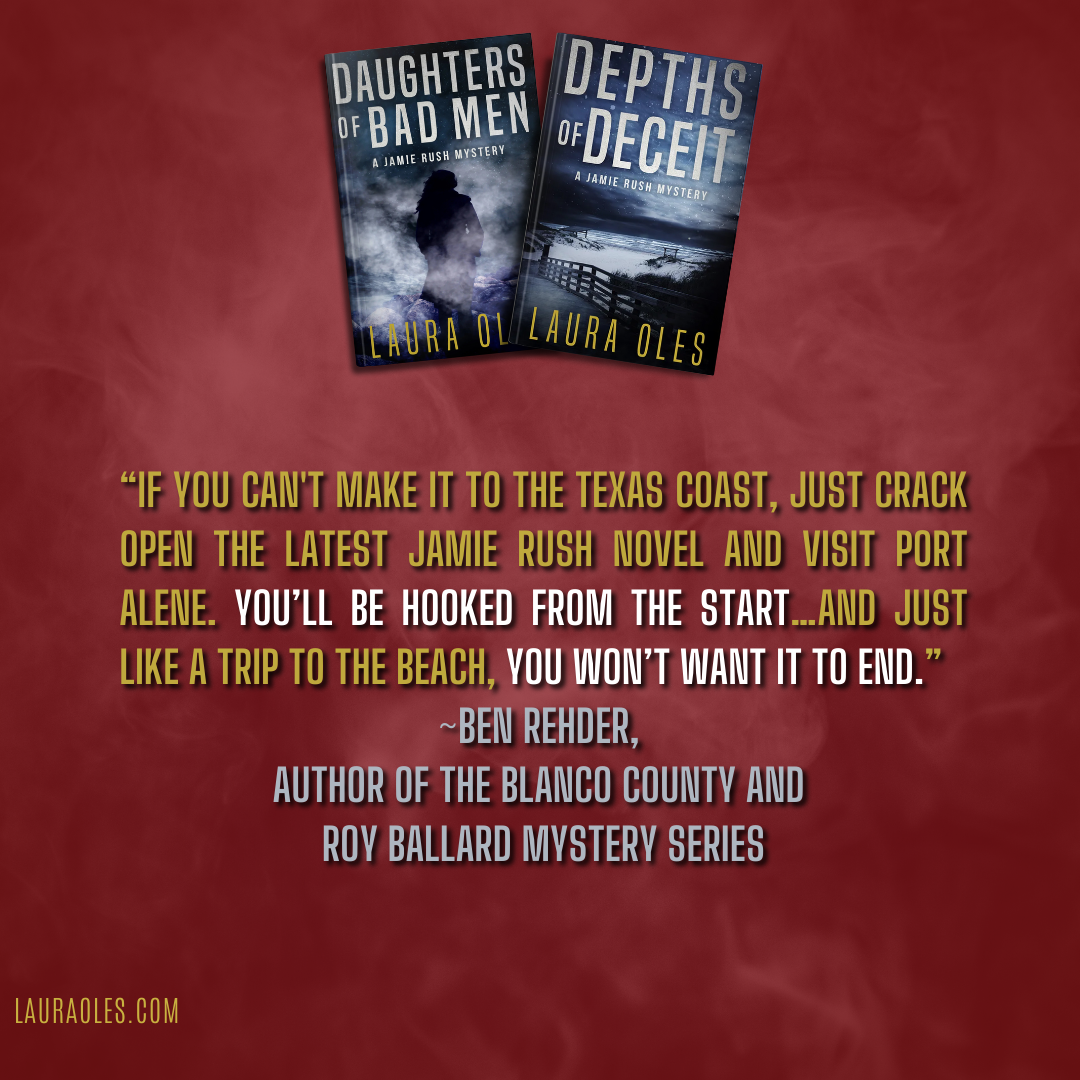
Private investigator Jamie Rush, and her partner, Cookie Hinojosa, are back in Port Alene with a new case, and I’m thrilled to be back in their world. Deuce the wonder bulldog is still charming people wherever he goes (usually at the pub, pier, or beach), and Marty is keeping the drinks flowing at Hemingway’s. Erin’s booking business is hopping, and her clients are saltier than the Gulf Coast.
This new case, though? It’s going to change things in Port Alene forever.
It all started simply enough.
A small request from a family friend.
Two Sisters.
One Deadly Secret.
No Time to Lose.
PI Jamie Rush has her hands full with small-time skip-tracing and surveillance jobs in Port Alene, Texas. The work is steady, though she still struggles to make ends meet. But when her partner, Cookie, brings in a low-paying and potentially time-consuming case, Jamie takes it on out of loyalty.
Cookie’s childhood friend, Renata, needs to find her younger sister, Leah. As Jamie digs into Leah’s past, it becomes clear that the missing woman’s life was shrouded in secrets, the kind that could jeopardize those involved in the case.
To complicate matters, PI Alastair Finn has returned, and he’s willing to reclaim his town by any means necessary. Jamie has never been one to retreat, and Alastair enjoys a good fight. Sparks will fly.
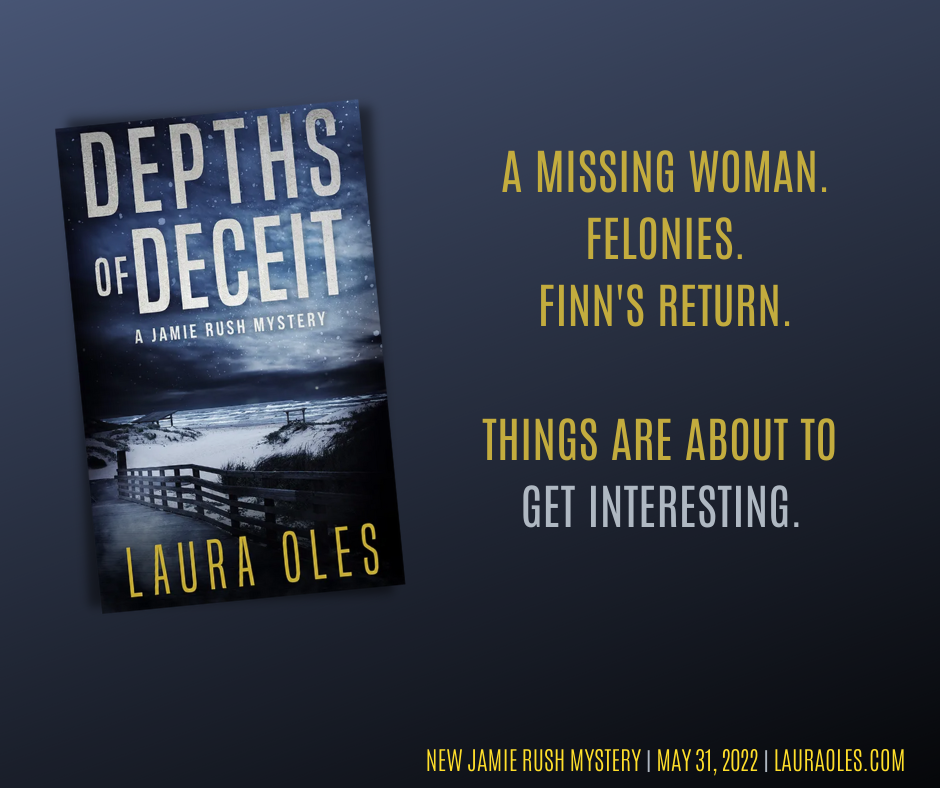
A missing woman. Felonies. Finn’s return. Every twist reminds Jamie that she’s still an outsider in this town. Jamie must prove herself all over again, and the stakes have never been higher.
Pub Day for DEPTHS OF DECEIT is May 31,2022.
If you’d like to spend time with Jamie’s crew, you can pick up a copy for a special pre-order price here:https://amzn.to/3KvSUO
A perfect croissant may have hundreds of layers of dough + butter + dough + butter, made of a packet of dough enclosing a layer of butter, rolled out in a precise rectangle, folded, chilled, rolled, chilled (repeat until you have maybe 600 layers), rolled, then cut into squares which are rolled diagonally and baked in a perfectly hot oven until perfectly brown and the magic has happened. As the butter melts between the many layers, it creates steam which inflates the layers, creating not a single “loaf” of baked dough with a brown crust, but a perfect combination of crunch and tenderness: layers of crunchy brown butteriness, then the airy middle, still wafting yeasty buttery smells toward you. Bite. Let joy be unconfined. What’s your approach? Bite the end off? Peel off the outer layers, flake by triangular flake? Either way, you lay open the mystery of layers. https://www.mic.com/articles/180451/the-science-backed-reasons-why-croissants-always-taste-better-in-paris#:~:text=When%20it%20bakes%2C%20the%20butter,delicious%20flavor%20of%20the%20croissant.
When you bite into a croissant, crisp little layers flying everywhere, with the tastes of yeast, butter, magic, sorting themselves out on your tongue, do you too think of murder mysteries?
It’s the layers. Got to be. Oh, not just croissants. Think of mille feuilles… seven layer dip… your family’s best lasagna…baklava… chocolate mousse layer cake finished with butter cream frosting. Or, at the individual level, consider a perfect taco, precisely the way you like it, the perfect proportion of tortilla to filling to guacamole to sour cream to salsa to [supply your favorite ingredient here].
Layers take work. Think of seven-layer cake. Split the original cake layers, evenly, without bumps and tears. Apply filling. Stack without a disaster (such as uneven layers, sliding in wrong directions). Repeat, repeat, repeat. Carefully ice your beautiful cake. Let no one approach, much less jiggle or wiggle, your cake. Serve with care.
But layers, in the right proportions, create both variety and synthesis. The whole is more than the sum of its parts. Back to your own favorite taco, a compilation of layers. When you decorate your taco to your own satisfaction, you bite into a creation that’s more delicious than any of its components.
A mystery requires characters, setting, plot. Each component requires detail. Characters, for instance: we want to know how the main characters look, some of what they think, whom they love. Maybe just a brushstroke to add what music they prefer, or hobbies, or food. Special tics that make them memorable? Of course. Give us what we need to remember each character. And writers are cagey. The cautious reader will wonder: is this new character critical to the plot, or just part of the setting? Is the kindly cashier at the village grocery just there to make the village feel safe and homey, or is he/she a witness to crime? The next victim? Or the criminal? But when a character demands too much page time, sometimes we readers hit the wall. We don’t need to know what the clerk at the village store is wearing. Stop it, we think. Get on with the story! Give us enough to fire our imaginations—we readers can and will supply more detail!
To digress: maybe this is imaginative work the reader does (without the author’s permission) is why it’s jarring when a favorite mystery we’ve read appears on television. If we’ve already imagined favorite characters, and the television versions don’t resemble what we now think of as their true selves, we’re faced with a difficult choice. Watch? or retain the original versions in our heads, rejecting the televised version? (This happened to me, but maybe not you, with the televised versions of Cormoran Strike and Robin. Thoughts?)
On the other hand, the WWI flashback at the beginning of the recent Death on the Nile (which is not in Agatha Christie’s original) adds to the character of detective Hercule Poirot—adds a new layer which enriches our understanding of not only his observational acuity, but his apparent emotional detachment. I now think of Agatha Christie’s creation in a more kindly light. Actually, I’ve become attached to Branagh’s version, whereas before I found him a little…tiresome.
Back to the question of how much detail is enough: the same warning holds for setting. Just right, please. English village? New York bar? Hill country town? We appreciate memorable details, but not a travelogue. We want enough detail, but not overkill, on characters and settings.
But then comes plot. Mystery readers are puzzle-solvers, clue-collectors, memory banks. They anticipate that—like the detective—they may traipse down the wrong path. Of course that means there’s more’s to learn, that they aren’t yet in possession of all the facts. More clues to come.
One of the artists dies on the Minnick, a scenic Scottish stream much favored as a landscape subject, that lies below a menacing precipice. https://www.mindat.org/feature-2642439.html
No one likes the dead artist. Wimsey can count six suspects––hence, five red herrings. Wimsey must winkle out the true killer. But oh, the alibis. Train schedules! Missing sailors! A stolen bicycle! The famous artist who’s gone missing, face wrapped in gauze, leaving a tight-lipped butler and a baffled maid who saw—well, no spoilers here either.
While clues point to the killer, red herrings baffle and divert the detective. But they can add layers of richness to a plot. Five Red Herrings would be less than a novella, only a short story, without the layers of red herrings which paint (excuse me) a vivid picture of this art colony—tension, distraction, jealousy, romance, hatred. Certainly the story would lack the puzzles demanded by mystery readers. Furthermore, red herrings affect our emotions. For example, we sympathize with Hugh Farren, the artist who, frustrated by his ever-so-prissy wife, hares off into the countryside, making a living by re-painting pub signs. We hope he’s not the killer, this man who sets up his easel outside a pub and explains to open-mouthed watching children how he’s making the pub sign funny on one side, scary on the other. It’s a great scene. Another layer to the mystery. And let’s face it, to persuade her readers to struggle with those complicated train schedules, Sayers has to keep us caring which artist is the killer.
The WWI flashback in Death on the Nile is neither a clue, nor a red herring. Instead, it offers us a layer of Poirot’s character that doesn’t solve the mystery, doesn’t identify the killer, but adds to our understanding of Poirot’s emotions, deepening, in a way, the impact of his solution of the mystery.
Today I’m in Paris, Croissantland, I stopped in an old church where the Greek Orthodox service was being sung. It reminded me of the character Niccolo in Dorothy Dunnett’s eight-volume historical series (yes, it is really a murder mystery). https://www.penguinrandomhouse.com/series/HON/house-of-niccolo-series
Niccolo’s mathematical and musical gifts, including his memory for Greek liturgy, came back to me as I listened to the sung service. Literature can bestow a gift that keeps on giving, a writer’s description of an event, a scene, that returns to the reader the smell of incense, the sound of voices, and the intensity of a moment imagined by the writer, but which becomes part of the reader’s own imagination. Dunnett’s scene isn’t integral to the plot, to the ultimate discovery at the end of the series of the murderer’s identity, but is a layer that adds to the protagonist’s character and the intensity of his psyche.
I just finished Book 8 of Mick Herron’s unputdownable series and am pawing the earth for the next. But I mention it because Slough House (the name of the building where those who flunk out of MI-5 headquarters wind up), though technically Herron’s setting, functions almost as a character. And my fussing about “not too much detail” above? Inapplicable. Herron embarks on oratorios of detail about Slough House, and because its decrepitude, its slovenliness, its lonesomeness, its outdatedness, so reflect (and infect) the struggles of the changing spies in the building, that I say, bring it on! Herron also does star turns with London weather and landscapes. His treatment of setting is masterful––creating layers of texture, smell, sight, emotion, that become integral to the story.
I’m working on Book 8 of my Alice MacDonald Greer Mystery series, so the “perfect croissant” of plot, setting and character occupies my waking moments. Alice, if you’ve met her, is a lawyer who by training and inclination wants every single fact. She hopes never to be blind-sided. She must decide whether fact A helps her defend her client, and whether her client needs a defense to fact B. She knows the compulsive joy of a new case—a new legal pad of notes, a new box of messy documents. She wants to plunge in, deciding what’s a clue, what’s a red herring. She knows that somewhere in the mess is a key fact, the fact that she knows instinctively will win the case for her client. She’s rooting through the layers, reminding many of us of a favorite poem. https://www.poetryfoundation.org/poems/54897/the-layers Or a croissant.
Sounds like a murder mystery, right? Stay tuned.
Helen Currie Foster writes the Alice MacDonald Greer Mystery series north of Dripping Springs, Texas, loosely supervised by three burros. She’s fascinated by human history and by how, uninvited, the past keeps crashing our parties. Her books are available in Kindle, paperback and on Audible, from Amazon, Ingram Spark, and at various independent bookstores. The latest, Ghost Daughter, has been named First Runnerup for Mystery in the 2022 Eric Hoffer Book Awards. https://smile.amazon.com/s?k=ghost+daughter&crid=VHN5P2IYJCLZ&sprefix=ghost+daughte%2Caps%2C151&ref=nb_sb_noss_2
Lucky Ladybug. Lucky penny. Lucky horseshoe. Friday the 13th. Knock on wood. Hundreds of superstitions and rituals flow through our lives, although we smile at the mention of such things, like throwing a pinch of spilled salt over the left shoulder. For an Italian, never put only two coffee beans in a snifter of Sambucca—bad luck.
Superstitions have been around since man stood up on two legs. Often they have been absorbed through family beliefs, traditions, and cultures. Some even began with common sense. I won’t walk under a ladder or open an umbrella in the house, but athletic and artistic pursuits are riddled with ritual and superstition.
Athletes and artists are more disposed to rely on them because the common ground they share is the pressure of constant uncertainty. Despite the advances in education, communication, and science, even without outside forces promoting superstition or rigid ritualistic preparations, one incident, one supposed object of good fortune, can immediately create a sense of security. Many psychologists believe that the dependency on ritualistic practices and superstitions, when observed devoutly, actually helps the individual feel more confident that they’ve done everything to keep the fates on their side.
No athlete, regardless of how gifted or trained, can be sure of the outcome of a contest. No artist, regardless of talent, training, and rehearsal if a performer, can know whether or not a show will be good or well-received. And worse, despite the athletes’ and artists’ best efforts, they have no long–term assurances. Will they be injured? Will they be picked up again after a contract expires? Will they be re-hired for another show or dance company? And added to these stresses is the pressure of the ticking clock. Most athletes and artists have a limited shelf life.
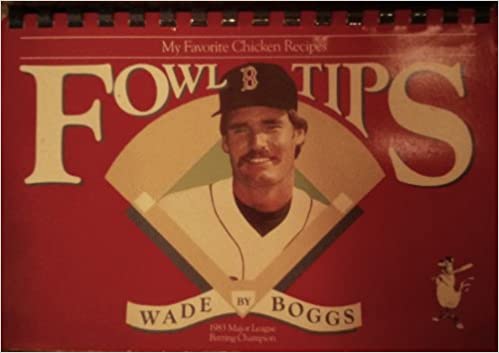
Baseball’s Wade Boggs had a five-hour pregame ritual of obsessive detail and ate nothing but chicken for twenty years. He even wrote Fowl Tips, a book on his favorite chicken recipes. And long ago, baseball legend Babe Ruth always stepped on second base on his way in from the outfield.
Tennis superstar Bjorn Borg’s entire family maintained a complicated routine of pregame habits, and Borg never shaved once a tournament began. During tennis tournaments, one might notice that some players will wear the same outfit every day, especially if they’re winning.
Then there are the superstitions that weave through the arts.
In music, there is the Curse of the Ninth. For a long time, a rumor circulated that any composer who wrote a ninth symphony would die soon after, if not while actually creating a ninth symphonic masterpiece. The suspicion of a curse began with Ludvig Von Beethoven. After completing his ninth, he died at age 56, on March 26, 1827, of post-hepatic cirrhosis of the liver. Antonin Dvorak died not long after finishing his ninth, which he named and gave a different number, but the fates were not fooled. Dvorak died of a stroke at age 62, on May 1, 1904, after completing his New World Symphony, which was, in fact, his ninth. Perhaps the man who thrust this particular superstition into the public eye was Gustav Mahler.
It was well-known amongst Mahler’s colleagues that he was obsessed and paranoid about the issue of death after composing the ninth symphony. He did all he could to circumvent the curse by calling his ninth “Das Lied von der Erde – Song of the Earth, and almost immediately after its completion, he settled into writing his tenth but escaping the curse was not to be. Gustav Mahler died on May 18, 1911. He was 50 years young.
Of course, other composers wrote more than nine and survived. Mozart wrote 48, and he died in 1791. Franz Joseph Haydn wrote 101 and died in 1804, but they lived and composed before Beethoven’s fame.
In the world of opera, while Wagner’s Tristan and Isolde is the earliest to have earned a reputation for trouble, it is Verdi’s La Forza Del Destino that had the most fatalities. The most dramatic of these is the tragic death of Leonard Warren.
On stage at the Metropolitan Opera on March 4, 1960, in the middle of Solenne in quest ora, (Solemn in this hour), Warren collapsed onstage and died in the wings. More than any other opera, La Forza del Destino fills opera singers with superstitious fears. The late, great Luciano Pavarotti, who sang every other opera in the Italian repertoire, refused to sing Forza.
The ballet world has its own list of rituals and superstitions. Never allow another dancer to put their feet in your pointe shoes. Dancers have an assortment of lucky charms and objects ranging from lucky dolls to stuffed animals. Rituals include lining up makeup and hairpins precisely, preparing for a show. And to wish good luck to a ballet dancer, there is only one acceptable word: Merde!
The French word, literally meaning feces, began for practical reasons. Many centuries ago, horses were used backstage to help move sets and backdrops, and of course, the animals had droppings of their own. Dancers would whisper, merde, and point at the steaming lumps to help each other avoid stepping in the mounds. In time, the use of the word expanded because the horse-drawn carriages pulling up in front of the theatres also left calling cards – and the more calling cards, the better, since that meant they’d have a full house.
In modern times, designer Coco Chanel was supposedly informed by a fortune-teller that her lucky number was 5. Hence, Chanel # 5 – her famed fragrance. She also liked to present her new collections on May 5 for good luck.
Before every fashion show, Diane Von Furstenberg taped a gold twenty-dollar piece given to her by her father during WW II in her shoe.
Artist Pablo Picasso kept his hair trimmings and fingernail clippings for fear that he’d be throwing away part of “his essence” if he discarded them. At the same time, Salvatore Dali carried around a little piece of Spanish driftwood to help “ward off evil spirits.”
Charles Dickens always slept facing north and carried a navigational compass with him at all times to ensure his position, while Dr. Seuss kept a collection of hundreds of hats in his secret closet. When he had writer’s block, he’d go to his closet and choose a hat to wear until he felt inspired.
Yoko Ono lit matches and watched the flame extinguish in a dark room to relieve the stress of sound and light. Later this private ritual became public with her performance called Lighting Piece.
In theaters throughout the world, many well-known superstitions reign supreme even today. Here are a few that have retained their power through the years. A bad dress rehearsal means the show will be a hit; Blue should not be worn on stage; The ghost light must always be on when the stage is empty; Mirrors on stage are bad luck; Never whistle backstage; Say break a leg, not good luck; AND NEVER EVER say Macbeth in the theater unless it’s part of the script.
From this intriguing confluence of reason and ritual, science and superstition, come opportunities for creating more drama.
In Book Two of my Housekeeper Mystery Series, Catwalk Dead, Murder in the Rue de L’Histoire Theatre, reason challenges superstition, curses, and rituals. When Mrs. B.’s son moves to Austin and becomes a partner in the Bernardi-Bono Ballet Company and Rue de l” Histoire Theatre, strange things happen. When the ballet company prepares for its world premiere of Macbeth, Mrs. B. and Father Melvyn find themselves entangled in Shakespearean superstition and death.
First, the stage manager disappears. Then his dead body falls from a light bridge. A prop breaks free of its wire during a rehearsal, nearly killing Mrs. B.’s daughter-in-law and injuring a young dancer, and the theater is temporarily shut down for a safety inspection. Still, the dancers and stagehands worry, wondering if it’s the Macbeth curse at work.
As fears, and superstitions grow, can Mrs. B. and Father Melvyn use their powers of reason and deduction in time to unravel the mystery before anyone else dies and the Bernardi-Bono Ballet Company is ruined? Or perhaps there are other factors at work beyond human control.
###
RESOURCES:
Huggett Richard. Supernatural on Stage, Taplinger Publishing Company, New York, NY. 1975
Crawley, Peter. Break a leg Macbeth: why are actors so superstitious?
I said to my critique partner this morning, The whole project is stinky it stinks it’s fatally flawed just nothing no hope.
She said, But Chapter 13 is so good so funny Molly is so funny it’s not stinky.
I said, Yes, the first part of chapter 13 and the last part of chapter 13 are funny and very very good but there’s still no middle of chapter 13 and what there is stinks and anyway the other 47,000 words stink except for a few hundred here and there.
And she said, But the middle could be revised and edited it has promise.
I said, But it won’t work because I have written myself into a hole and can’t get out so I have to trash that part and anyway the whole concept stinks.
And she said, NO you can fix it just keep going because I like Molly she’s so funny.
And that is why I go to critique group every blessed week.
*****
Writing is a solitary activity, but most of writing isn’t writing. It’s rewriting, rewriting, and rewriting. And then it’s revising and revising. And editing editing editing. And rewriting again. And . . .
Sometimes it’s whingeing and complaining and eating peanut butter out of the jar with a spoon and buying larger clothes and telling Molly she’s a heartless ***** who doesn’t deserve one paragraph of her own, much less a whole book.
And it’s feeling like a fraud when you tell people you’re a writer and deciding you’d be happier if you gave up and dedicated yourself to French cookery or tatting or riding a unicycle.
But if you’re lucky, it’s also going to critique group and then going home and writing and writing and writing and . . .
Here’s the way Austin Mystery Writers work: We email first drafts, revised drafts, or final (almost) drafts, depending on where we are in the process.
We read all the week’s submissions, then sit around a table–or on one side of a table in front of a monitor displaying partners in little Zoom squares–and talk about what each member has written.
Criticism here doesn’t mean trashing. It means that each member points out what the writer has done well and what she might have done better. Sometimes we suggest examples of better–the “experts” say that’s not proper, but it works for us–and sometimes we simply say what we think doesn’t work so well without elaborating. Sometimes we disagree; one person doesn’t like a word or sentence or paragraph, while another thinks it’s fine. Sometimes we all chime in and discuss ideas.
Then we say, “Thank you.”
Because we’ve become friends during our association, we can say what we think and appreciate what the others say.
We encourage one another.
We also laugh a lot.
Because of AMW, I’ve published short stories and co-written one novella.
Because of AMW, I’ve become a better writer.
I posted “Why I Go to Critique Group” (one time I titled it “Why I Go to Critique Group and Can’t Afford Not To”) on my personal blog on July 9, 2010, when Gale Albright and I were members of the two-person Just for the Hell of It Writers, which was soon swallowed up by Austin Mystery Writers (a consummation devoutly to be wished).
I periodically pull the piece out and repost it.
Because it’s important.
***
Has anyone noticed that the em dash (—) in my posts looks like an en dash (–)? I can’t help it. Sometimes I find an em dash on a grammar website (like now) and copy and paste into my post, but right now I’m just not in the mood. But I’d like picky readers, like myself, to know that I’m aware of the error and wish the platform would correct it,
***
Kathy Waller posts on her personal blog, Telling the Truth, Mainly, http://kathywaller1.com. She’s published the works pictured above, the first three with Wildside Press, the last, co-written with Manning Wolfe, by Starpath. She has finally decided the ancient pre-published book is not stinky and has hopes of finishing it one day. If her critique partners agree.
Sir Arthur Conan Doyle wrote 60 mystery stories featuring the man who quickly became the favorite fictional super-detective of the late 19th and early 20th centuries, Sherlock Holmes, but in his years as a medical student, Doyle’s first efforts were short stories.
The Mystery of Sasassa Valley was an adventure of two young men and a reported ghost that scares off the natives in South Africa.
In TheAmerican’s Tale, A quarrel between an Englishman, and a ‘Yankee’ in a bar, results in Jefferson Adams, an American in England, telling a strange story set in Montana involving Joe “Alabama” Hawkins, who’d “been captured and killed by a giant Venus flytrap in the gulch.” One might view these as early prequels to the mysteries fomenting in Doyle’s mind.
While most readers have read at least one or two of Doyle’s creations, it is in the first two that we get a real sense of both Holmes and Watson, beginning with A Study in Scarlet. Written in 1887, Doyle was a practicing doctor and botanist, which provided him with in-depth knowledge of plant poisons, anatomy, and physiology.
The story begins with the narrator, Dr. John Watson, an ex-military man returning to London from the British war in Afghanistan, suffering from war wounds and in ill health. Unable to afford the hotel rates, he expresses his hope of finding rooms at a reasonable rate to a casual acquaintance known to the reader as Stanford. The latter then introduces him to Holmes, but first warns Watson that this gentleman, Holmes, also seeking a roommate to share expenses, is somewhat difficult.
The reader meets Holmes for the first time along with Watson, and appropriately, in a laboratory. The two men hit it off immediately and become roommates at 221B Baker Street, where they must accommodate one another’s needs, quirks, and habits.
Holmes’s peculiarities begin to disturb Watson. At first, the doctor is merely curious about some of Holmes’s idiosyncrasies. As he gets to know the crime solver, he’s appalled at Holmes’s ignorance of so many areas of education, politics, the arts, and other subjects in which gentlemen should be educated. Watson is shocked by Holmes’s rationale for why it wasn’t essential. Further, Holmes’s expertise in crimes and criminals is all-consuming, which Watson finds bizarre. Holmes’s peculiarities begin to disturb Watson. At first, the doctor is merely curious about some of Holmes’s characteristics. As he gets to know the crime solver, he’s shocked at Holmes’s ignorance in so many areas of education, politics, the arts, and other subjects in which gentlemen should be educated. Furthermore, Holmes’s expertise in crimes and criminals is all-consuming, which Watson finds bizarre.
The good doctor is frustrated by what he thinks must be trickery for Holmes’s uncanny ability to guess so accurately. It is when Holmes is asked by detectives Lestrade and Gregson to help with a mysterious case, and Watson is invited to go along, that the doctor’s opinions change.
In the Lauriston Garden Mystery, a man is found dead in an empty house. The deceased has no wounds, yet there is a message in blood scrawled on the wall. In time, Holmes dubs this case A Study in Scarlet, reflecting “the scarlet thread of murder running through the colorless skein of life…” Holmes unravels the case, and with each deduction, Watson develops a grudging admiration that evolves into genuine esteem and respect for the detective’s extraordinary powers of observation.
At the end of part one, the murder is solved, but the tale isn’t over. Doyle takes the reader to The United States for the backstory, explaining the details of the case, and why it ends in London.
In the second novel, The Sign of Four, Holmes and his sidekick, Watson, who has become Holmes’s internal voice to the reader, are drawn into a new mystery.
Miss Mary Morstan arrives at Baker Street to ask for Holmes’s help in solving the mystery of her missing father and a mysterious annual and anonymous gift of pearls. But now, she has received a letter asking to meet an unknown person that evening and is afraid to go alone. Holmes, of course, takes the case, and the adventure is on.
In The Sign of Four, the reader can discern many of Doyle’s personal experiences in the military as told through Watson’s narrative, as the detective tracks a hidden treasure and a murderer. In this story, the reader understands John Watson’s life and desires, and Holmes’s drug use is addressed directly.
Doyle wrote two volumes worth of stories about Holmes and Watson, and it’s interesting to know that he often felt he was slogging through the work of continuing the character he’d created. In 1891, he threatened to kill off the now-famous Sherlock Holmes, but his mother, the woman who inspired his imagination, was furious. And, of course, Conan Doyle did no such thing. Instead, he pressed the financial success of his books, urging publishers to pay more for his Holmes stories, which they did.
In his biography, Doyle admits the influence of his mother in his early childhood, “as far as I can remember anything at all, the vivid stories she would tell me stand out so clearly that they obscure the real facts of my life.” And the facts were not happy ones.
Though well respected in the art world, Doyle’s father was an alcoholic with little impact on his son. At the age of nine, Arthur was shipped off to boarding school in England to Hodder Place, then Stonyhurst, a Jesuit prep school, where he was bullied and ridiculed by his peers and feared ruthless corporal punishment by the Jesuits. It was his ability to hide in his fantasies that got him through.
After graduating from Stonyhurst College in 1876, Doyle pursued a medical degree at the University of Edinburgh. There, he met his mentor Dr. Joseph Bell, whose very keen powers of observation inspired the Holmes character.
While struggling to make his name as a writer, he married Louisa Hawkins, with whom he had a son and a daughter. In 1893, Louisa was diagnosed with TB, and after her death, Doyle married Jean Leckie, with whom he had two more sons and another daughter.
In addition to his medical practice, which he gave up when the writing became successful, Conan Doyle took it upon himself to visit South Africa after the Boar war to investigate and defend his nation against charges of war crimes. He wrote a “pamphlet” of 60,000 words entitled The War in South Africa, Its Causes and Conduct, which the Crown found enlightening. In 1902 and 1903, Arthur Conan Doyle was knighted—twice for his service to the Crown.
However, through his adult years, there was the thread of spiritualism, and he believed it was “the most important thing in the world.” Later in his life, he was diagnosed with a heart condition, but that didn’t stop him from making a spiritualism tour through the Netherlands. When he returned home, his chest pains were so severe that he was almost completely bedridden until he died in 1930.
Sir Arthur Conan Doyle collapsed and died in his garden, clutching his heart with one hand and holding a flower in the other. Although his life ended on that July day, his stories have survived and continue to thrill readers with adventures in the world of criminology and crime-solving. Reading his beliefs, remarkable life, and brilliant writings, it is easy to conclude that Doyle, Holmes, and Watson were three dimensions of the same man.
If you keep up with any missing persons notices, especially in Texas, you’re likely to come across the name of an incredible organization, Texas EquuSearch.
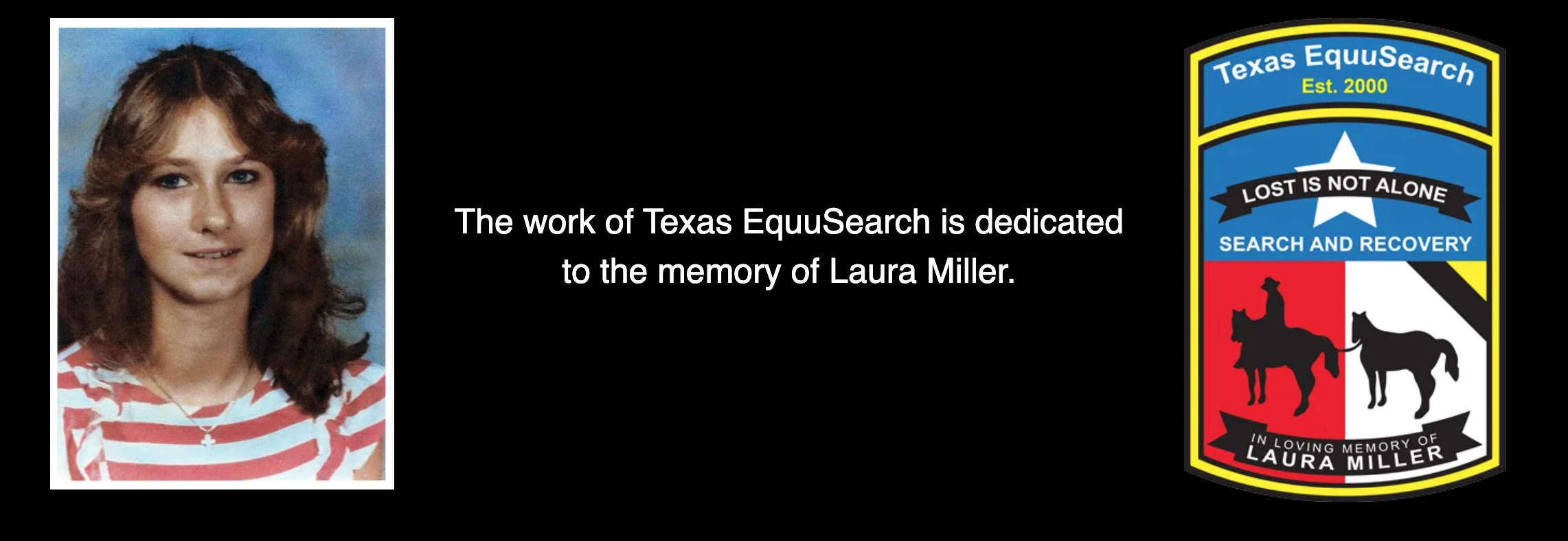
Texas EquuSearch, a 501(c)(3) nonprofit organization, which is funded solely by donations, started in 2000 and has grown to over 1,000 members. They use the best technology available while providing compassion and understanding to the families. They are thorough and professional and get results.
According to their website, their members:
“…come from all walks of life, consisting of business owners, medics, firefighters, housewives, electricians, students, former FBI and law enforcement, current law enforcement, former and current U.S. Marshall, Coast Guard and all walks of military, former and current, on our team. Our resources range from horse and rider teams to foot searchers and ATVs. We conduct water searches using boats, divers and sonar equipment. Additionally, we perform air searches using planes, helicopters and small drone airplanes with highly sophisticated cameras. We have also utilized infrared and night vision cameras, along with ground penetration units in some of our searches. Texas EquuSearch has more resources than most law enforcement agencies, which allows law enforcement to conduct their investigation, while Texas EquuSearch conducts organized searches. This has worked out to be a great working relationship between law enforcement and Texas EquuSearch. This has also resulted in Texas EquuSearch being contacted by law enforcement agencies across the nation to assist them in their missing person cases.”
They have been involved in over 1,800 searches in 42 states and in other countries. They have helped find over 400 missing people, many who would have been deceased if they hadn’t been found, and many of the cases have resulted in criminal convictions. And because so many of the organization’s members are knowledgeable about law enforcement and proper procedures, evidence has never been compromised during any of the searches.
Unfortunately, the reason for the organization has stemmed from tragedy. The daughter of TE director Tim Miller, Laura Miller, was abducted and murdered in 1984, in north Galveston County. Again, from their website,
“To date, there has been no arrest in this case. Additionally, Jane and Janet Doe, who were also found near Laura’s body, have not been identified. Tim Miller continues his fight every day to ensure Laura gets justice. As a result of the death of Laura Miller, Texas EquuSearch was born. Laura Miller’s spirit lives on. Tim Miller has dedicated his life to helping families with missing loved ones. Tim has vowed to never leave a family alone if there is anything he can do to help them. Our motto is “Lost is Not Alone.””
Tim Miller has appeared in countless TV programs, news articles, and spoken at many law enforcement conventions. He has also received the “Point of Light” award by George W. Bush and other notable awards from cities who understand the commitment and dedication he gives to families in need of the organization’s help.
I hope that the Miller family will get their answers, like they’ve done for so many others.
If you would like to know more about the organization, give a donation, or become a member, you can find more information on their website.
I knew so much in college. So much! I was after a solid liberal arts education. I knew biology—I’d dissected the largest dead cat ever delivered to a biology lab, possibly large enough to require a human-size body bag. I scrutinized bones and organs, ears, whatever. Articulated the brute’s vertebrae, sort of. But now…?
And geology! Of course I knew the earth had igneous and volcanic and sedimentary rocks and a solid molten core consisting mostly of iron. Didn’t we all? I was confident I could find north by following two stars in the Big Dipper down to Polaris, in the Little Dipper. But now…?
Human history? We all knew North Americans arrived via a land bridge from Asia around 10,000 years ago, based on dating the Clovis point. But now…?
These Facts of Life, as we understood them…turn out to be wrong. Out the window. Over. So what should a mystery writer do about this?
Biology? Human history? Clovis points? So much we “knew” is out of date or just plain wrong. We’d heard of the double helix, but didn’t know the human genome could be replicated, leading to amazing genetic discoveries. While many of us hoped we’d inherited a gene from some favored forebear in family history, now we know we’re related to practically everyone, including villains and scoundrels. Bracing news. Ongoing analysis of ancient DNA now suggests humans were in North America by at least 16,000 -20,000years ago. So Clovis points were…much later. Think what this suggests about early peoples—all the languages, all the cultures, all the implications. A fabulous update on these debates: Origin, A Genetic History of the Americas, by anthropological geneticist Dr. Jennifer Raff. https://www.amazon.com/Origin-Genetic-Americas-Jennifer-Raff-ebook/dp/B08B6F2YFX/ref=sr_1_2?crid=2I6NFU5M8KMC2&keywords=jennifer+raff&qid=1645458138&sprefix=jennifer+raff%2Caps%2C190&sr=8-2
Based on exciting research at the Gault Site we Central Texans got a head start on this news. Those immigrating forebears got here as soon as they could. https://www.gaultschool.org/
But wait, there’s more. Explorers dismissed tales from indigenous people about a huge tsunami in the 1700s along our northwest coast. Now we’ve heard of—and school districts are planning against–dangers posed by the Cascadian Subduction Zone off that coast. https://www.newyorker.com/magazine/2015/07/20/the-really-big-one
And that reliably solid molten core of our Earth? We now hear that “the inner core of the Earth is not a normal solid but is composed of a solid iron sublattice and liquid-like light elements, which is known as a superionic state,” and that this intermediate state between solid and liquid “widely exists in the interior of planets.” https://scitechdaily.com/scientists-reveal-superionic-secrets-of-earths-inner-core/
Does our wandering pole mean Polaris won’t stay our North Star? (Sigh) Yes. By about 4,000 CE, due to axial procession, we humans will have to shift our North Star gaze to “Gamma Cephei, also called Errai, …a moderately bright star” in the constellation Cepheus. https://earthsky.org/brightest-stars/gamma-cephei-errai-future-north-star/
Does any of this matter to the mystery genre? Yes, of course. Many mystery lovers take refuge from current shocks in historical mysteries, enjoying Rhys Bowen’s period pieces set in London; Susan Elia MacNeal, with her World War II Maggie Hope series; Laurie King’s Russell & Holmes series, set in 1920’s England; and the late Anna Castle’s Francis Bacon mysteries. Arthur Conan Doyle’s characters Sherlock Holmes and Professor Moriarty have inspired writers to try follow-on mysteries. Authors of historical mysteries have an advantage: they know the “known facts” of the epoch they’ve chosen. They know Mary Russell was unaware of penicillin—and so does the reader.
What about mystery science fiction? There, a writer can pick and choose which “facts” of 2022 to carry forward, and which to abandon. The writer can define new “facts” for the setting, without the fear of making a mistake.
But what a conundrum for mystery writers who choose the “present” as setting.
First and foremost, mystery writers cannot forget that mystery lovers relish learning about specific settings. Alexander McCall Smith told the Texas Book Festival that he “starts with the place.” Place is key. That’s one reason mystery reader rejoice when they find an appealing new mystery series, because it deepens our grasp of a setting—distinctive food, landscape, characters. The setting’s part of the experience. I certainly want readers to feel immersed in the Texas Hill Country in my Alice MacDonald Greer Mystery series books, including book 7, Ghost Daughter. https://www.amazon.com/Ghost-Daughter-Alice-MacDonald-Mysteries/dp/1732722919?asin=1732722919&revisionId=&format=4&depth=1
Often mystery writers keep the mystery’s timeframe somewhat vague, omitting overreliance on specific recent events. Mystery lovers are looking for a mystery. That doesn’t mean, of course, that authors won’t deal with tough contemporary issues. They can and do. But readers decidedly want a puzzle, want to use their own minds and life experience with the world and human nature to solve a mystery, involving motive, method and opportunity. Don’t we consider good mysteries “classics” when they can be read and re-read in subsequent decades?
The writer may take a middle road, addressing one or more contemporary issues. In her Guido Brunetti series set in Venice, Donna Leon does not dodge the impacts of climate change (rising sea levels), pollution, and the desperate plight of African and Eastern European immigrants. But her Inspector Brunetti comforts us by his fierce adherence to traditional Venetian values (and cuisine).
But still, all this new knowledge (genomes! Fourth dimension! Cascadian subduction!) is exciting stuff. Now, perhaps a mystery about archeologists disputing whether or not that rock shard is a knife…or just a rock shard?
Helen Currie Foster writes the Alice MacDonald Greer Mystery Series north of Dripping Springs, Texas, supervised by three burros. She’s drawn to the compelling landscape of the Texas Hill Country, and the quirky characters who live there. She’s deeply curious about human prehistory and why, uninvited, the past keeps crashing the party. She’s active with Austin Shakespeare and the Heart of Texas chapter of Sisters in Crime.
The definition of reading readiness is the point
at which a child goes from not reading, to reading.
~ Sight and Sound Reading
But, Gwammy, I can’t wead.*
~ Jenny, five years old, after one week in kindergarten
When I was five, my Great-aunt Ethel gave me an ancient primer. She had found it in an old school building, abandoned when consolidation sent children in my hometown to a school two miles away, and then used only as a polling place. The primer had also been abandoned, and Aunt Ethel, election judge, liberated it and gave it to the youngest member of the family (youngest by about forty years; it was an old town).
My parents read to me almost from day one. The story goes that, as a toddler, I met my father at the door every evening when he got home from work, saying, “‘Ead a book, Daddy.” (Unlike Jenny, I had no pwoblem pwonouncing my ahs; I just dropped them.)
We didn’t have a library nearby, but I plenty of books: a Bumper Book, Little Golden Books, Grimms’ Fairy Tales, Andersen’s Fairy Tales, which I didn’t like, in part because they were dark (“The Little Match Girl”), but mostly because the end papers sported a hairy black thing with an ugly humanish face and enough long, winding legs to qualify it as a spider. Grimms’ tales were more pleasant.
When I received the primer, I already knew the alphabet. In fact, a year before, I’d written my name in red adhesive tape–the gooiest, stickiest adhesive I’ve ever come across–on the inside of the kitchen door. It stayed there for years.
Anyway, armed with the primer–a school book, for reading–I set about teaching myself. While my mother did housework, I trailed behind, spelling out words.
“T-h-e”
“The”
“m-a-n”
“man”
“s-a-i-d”
“said”
I don’t think I taught myself to read. But the next year, when I entered first grade–no kindergarten back then–I was ready. I took right off on the underwhelming adventures of Dick, Jane, and Sally (siblings who never had a decent disagreement) plus Spot and Puff, who came and ran a lot.
In second grade, I got a Little Big Book—Gunsmoke–that had one hundred pages. I read it on Saturday and reported the accomplishment in our Class News at school on Monday. Later I got a literary Little Big Book, Huckleberry Finn.One sentence confused me: a dead man’s leg was stuck out at a strange angel. I was about thirty when I realized angel was really angle. I was also surprised when, in high school, I learned that the Little Big Book had been severely abridged.
Then I discovered comic books. They were more educational than most people think. From Scrooge McDuck, I learned that emeralds come from South America. Unfamiliar with physics, I pronounced Atom Cat as A-Tomcat. Seemed reasonable.
The next year, thanks to a Christmas present from my grandmother, I discovered Nancy Drew. Nancy had a blue convertible and drove around wherever she wanted, and her father never grounded her. I envied Nancy her freedom. I didn’t like her, though; she had a tomboy friend, George, who said, “Hypers, you slay me,” which was fine, but her other friend, Bess, was plump, and Nancy often referred to how much Bess ate. I presume in later editions, Nancy behaved better. But her treatment of Bess didn’t stop me from reading about her. I wrote letters to Joske’s Department Store in San Antonio: “Please send me one copy of The Hidden Staircase and one copy of The Clue in the Jewel Box. Please charge my account.” They each cost two dollars. My mother kindly signed the letters. It was her account.
I soon outgrew Nancy, but, like many other mystery readers and writers, I credit her for getting me hooked. I read a couple of Trixie Beldens–Trixie was sickeningly enthusiastic when her mother made her dust the living room before going out to solve mysteries, but she did manage to sneak out at night. I read some Kathy Martins. Kathy, a nurse, often suspected her (nice guy) brother for whatever (minor) crime had been committed, which I thought strange, but she was more mature and more realistic than other characters. No convertible, no sneaking.
Young Adult novels didn’t exist as a genre until the late sixties, when increased federal money became available to schools, and authors found a new audience. Born too soon, I moved from children’s books into adult fare: Zane Grey, Thomas B. Costain, Charles Dickens, Aldous Huxley, Jane Austen, Harper Lee, Daphne DuMaurier, Rafael Sabatini (Scaramouche: “He was born with a gift of laughter and a sense that the world was mad.”) Noticing that I read the classics, the bookmobile librarian, unasked, brought me a copy of the scandalous Madame Bovary. I was fifteen. He’s still my hero.
On the bookmobile, I rediscovered mysteries in the real thing—Sherlock Holmes. I cried and cried when he and Moriarty went over Reichenbach Falls. Nobody told me he would be back.
But enough about me. The point is that reading was, and is, important to me.
And that this week I’ve been reading A Velocity of Being: Letters to Young Readers, edited by Maria Popova & Claudia Bedrick. The editors compiled 121 letters from “scientists, musicians, artists, philosophers, composers, poets, actors, a 98-year-old Holocaust survivor, Italy’s first woman in space, and many more remarkable humans whose splendor of spirit cannot be contained in the shorthand descriptors we often use to condense a person’s character and cultural contributions.” Each letter is paired with an illustration to “bring it to life visually.”
Many letters describe books as portals to the universe, to other worlds, to adventure, to curiosity and questions, to dreams, to logic and imagination; they’re boats and planes and magic carpets. Contributors write about hating book reports, and being hellions when they were little and refused to listen to Goodnight Moon at bedtime because they wanted dinosaurs, and being called antisocial when they preferred to read instead of play with friends.
But other contributors take the subject to a deeper level:
Author Alain deBotton writes, We wouldn’t need books quite so much if everyone around us understood us well. But they don’t. Even those who love us get us wrong. They claim to know what we need, but forget to ask us properly first. They can’t understand what we feel . . . That’s the moment to turn to books They are friends waiting for us, and they will always speak honestly to us. They are the perfect cure for loneliness. They can be our very closest friends.
Screenwriter Shonda Rhimessays, Reading saved me. When I was twelve, I spent most of my day trying to be invisible. The year before I’d been the new girl in school, and I’d spent a lot of time trying to be accepted. . . . The very desire to bend and twist to fit in–assures your rejection They did not like me. They hated me.
I spent a lot of time alone. I rode the bus alone. I spent weekends alone, I ate lunch alone. Except I was never alone. I always had a book in my hand. If you have a book, you don’t need to bend and twist to fit–you’re there. You are in. . . .
If you have a book in your hand, you can stop being invisible. Because you’re a little more invincible.
Venture capitalist Chris Sacca says that books are dangerous: If you keep reading, you might learn so much that you can take over for the adults and then you kids will be in charge! You all could be the journalists, entrepreneurs, artists, professors, authors, doctors, explorers, scientists, and even the leaders of our countries! Then what would the grown-ups do? Live in a world run by brilliant, interesting, innovative, and compassionate young people. Ugh. No, thank you.
So please stop reading before you become really smart, successful, and happy.
But seriously, books are dangerous. Holocaust survivor Helen Fagin writes about life in the World War II Polish ghetto, where being caught reading by the Nazis meant anything from hard labor to death. But books were smuggled in, read by each person for only one night, and then, for the sake of safety, passed on. She stayed up all one night reading Gone with the Wind. Then she decided the children she secretly taught needed not dry information, but stories. And for one hour each night, she told them the story of Scarlett and Melanie, Rhett and Ashley; and for that hour they “escaped a world of murder.” Then “a knock at the door shattered our dream world.” Years later, she met one of only four of the students who survived. The woman called her “the source of my hopes and my dreams in times of total deprivation and dehumanization.”
Composer Mohammad Fairouz shares a story that I cherish from my upbringing; . . . 1400 years ago in the deserts of Arabia, a meditative prophet named Mohammad had a vision of the Angel Gabriel who came to him with a message: “Read” . . . This was the first word of the Quran.
In the years following the prophet’s death, his followers built an empire where they contributed to every branch of knowledge, from algebra to optics and medicine to music. Countless things we have today would not exist without their contributions: that includes space stations, glasses, aspirin, your iPad.
They were able to do this because they were inspired to seek out the power that comes with being to read. You deserve the same power . . .
Years ago, I knew a young man who had never learned to read. I don’t know why; he just hadn’t. As an adult, he took a literacy class. He said that when he traveled for his work, he was always scared, because he couldn’t read road signs, and he was afraid he would get lost. At the most basic level, reading is power.
And consider: At one time in the American South, it was illegal to teach slaves to read. If they were literate, they might be able to read signs that would help them escape. They might also read some inconvenient truths: “. . . that all men are created equal, that they are endowed by their Creator with certain unalienable Rights, that among these are Life, Liberty and the pursuit of Happiness . . .” Inconvenient for their owners, that is.
“So the research shows that perhaps reading fiction does make people behave better. Certainly some institutions consider the effects of reading to be so significant that they now include modules on literature. At the University of California Irvine, for example, Johanna Shapiro from the Department of Family Medicine firmly believes that reading fiction results in better doctors and has led the establishment of a humanities programme to train medical students.
“It sounds as though it’s time to lose the stereotype of the shy bookworm whose nose is always in a book because they find it difficult to deal with real people. In fact, these bookworms might be better than everyone else at understanding human beings.”
Philosopher and professor Martha Nussbaum gives an example: The great African-American novelist Ralph Ellison said that a novel like his Invisible Man could be “a raft of hope, perception, and entertainment” on which America could “negotiate the snags and whirlpools” that stand between us and the democratic ideal. He’s referring here to Huck Finn and Jim, who got to know one another as full human beings, rather than just as a white man and a black man, when they traveled down the river on a raft together. On the raft, they had to look at one another, listen to one another’s stories. In our divided society, such encounters happen all too seldom in real life, and are fraught with mistrust when they do. Reading can create such encounters in the head, so that the ones that happen in the world are a little less crude, a little less deformed by fear and anger.
Huckleberry Finn has for years made the American Library Association’s list of most often challenged, banned, or restricted books–a novel that can teach us to be better people.
Design writer and educator Steven Heller extends the idea that reading is power and issues a challenge: Books are weapons in humankind’s battle against ignorance. I don’t mean like lasers and drones. I mean that knowledge is strength and the kind of knowledge you get from books is not the same as the quick fix that Googling gets you. What’s more, books can’t be hacked. But they can he censored, which means blocked or forbidden from being published. And this is why they are so valuable to us all. Often in fighting ignorance, the ignorant take books prisoner. If you don’t read books, then those that have been censored over the ages will be lost and forgotten. So kids, don’t let them down. Read them, savor them protect them. Don’t let others make books irrelevant.
*
*Jenny soon learned to wead. And to pwonounce her ahs.
*
I’ve gone on too long. If you’re still with me, thanks for sticking. And one more thing: Despite the title, A Velocity of Being isn’t just for young readers. It’s also for adults who need to be reminded to make reading part of their children’s lives.
While writing this post, Kathy was watching/listening to an old TV series of Dorothy L. Sayers‘ Lord Peter Wimsey mysteries. Bless Youtube and all who post on her. (Opinion: Ian Carmichael was the best Peter Wimsey by far.)
This week I lost a very good friend and an incredible mentor. Anna Castle wrote historical mysteries including two internationally successful series: The Francis Bacon Mysteries and the Professor and Mrs. Moriarity. Her books can be found on her website at https://www.annacastle.com/books/
Anna Castle
Writing a series of any kind requires a great deal of research. Triple that for historical mysteries. The writer has to learn the dialects, the clothes, the food, the politics, the religions, the caste systems, the locations—the list goes on. It takes a special person to get all of that right, and for Anna to do it in two series is off the charts. And while getting all of the “facts” right, Anna also had the task of creating characters that needed to be loved, laughed at, hated, suspected, intriguing, whatever was needed to propel the plot forward. The character must be seen, understood, memorable—well, you get the drift.
And in reading a series, the characters must be people that intrigue the readers so much, they are not just willing to buy the next book in the series, but the writer must create a story where the readers will wait for that next book, hope for it, buy it in advance. The reader becomes bonded to the characters. I as a reader find myself worried about them, excited for them, scared for them, and yes, hate them and love them. To me, they were real people.
And now, Anna’s characters will never live again. The next book won’t happen. There will be no more intrigue for them, romance for them, fear for them. Life for them.
As I write this, I am devastated as I mourn Anna’s passing. No more lunches with her. No more emails. No more hugs. No more bragging or complaining or learning or all those things that dear, dear friends do together.
But also, I will deeply mourn the passage of the characters she put in my head and in my heart.
Unlike sequels, which are straightforward continuations of possibilities that may happen after a novel ends, the prequel tries to imagine and show what happened before the novel’s story began.
A prequel attempts to provide the reader with information about what came first, what impacted the characters’ development, places where the stories occurred, the times in which they happened, and a host of other matters upon which a novel may be built not necessarily included in the story.
It may surprise many that even among classics, there are prequels. While The Adventures of Huckleberry Finn is a sequel to Mark Twain’s Tom Sawyer, in 2017, author John Clinch released Finn, a prequel to both of Twain’s masterpiece novels. Finn is about Huck Finn’s father and the dysfunctional family relations that came before the adventures of Huck Finn began. It immerses the characters in the chaotic, murky waters of antebellum America with all its complexities, the shame of slavery, and racial attitudes of the time that almost destroyed the nation.
In Porto Bello Gold, Arthur D. Howden Smith imagines a pirate story with Captain Flint and Murray stealing treasure and burying it as the Prequel to Robert Louis Stevenson’s Treasure Island.
Then we have Mario Puzo’s contemporary classic, The Godfather, a gripping story of the 1940s underworld in America and Italy. Author Ed Falco wrote a prequel entitled The Family Corleone. In The Family Corleone, Mr. Falco gives us background on many of the characters before Vito Corleone became a Don. Shortening it by at least a third would not have damaged the storyline. If a reader is very familiar with Puzo’s characters, there are few, if any, surprises or new information. Much of what came before was included in Puzo’s novel. In this prequel, the only new information was about Sonny, Don Vito’s first-born son. He’d witnessed his father’s criminal activities early on and decided to follow in his father’s footsteps. This is hardly surprising given how Puzo portrayed Sonny in the original novel. Perhaps a more interesting avenue would have been a fuller portrait of Michael, whose younger years do not prepare the reader for his change of heart after the Don is almost murdered. For more insights and reviews of prequels written by authors other than the creators of the original stories, see the source materials below.
So, where did the interest in prequels start and why? It should come as no surprise that the new mania started when Hollywood became obsessed in the 1970s and 80s after the 1969 success of Butch Cassidy and the Sundance Kid. By 1979, Hollywood released Butch and Sundance, the Early Years, as a prequel. Another Hollywood success, Star Wars, was released in 1977, and its succession of successful movies sparked Star Wars prequels. Still, there are mixed reviews of the values for each of the abovementioned prequels and others, which may make one ask if it’s worth reading them at all.
Before writing a story, most authors have a sense of the characters’ backgrounds, times they live in, and other essential building blocks. As the novel unfolds, critical information is included to advance the plot. However, some characters or events may be more compelling. Who were these characters before the story began? What happened to them? What factors influenced their development into their current selves? These questions create fertile ground for a prequel and give way to the next question. Should prequel materials precede a stand-alone novel or become book one in a series?
Prequels can flesh out backgrounds, locations, personalities, and what came before. The danger is that offering new angles for consideration may also ruin the impact intended because the reader may not come at the story with the same sense of anticipation, feel the intended shocks or enjoy the sense of surprise. Reading a prequel first, even for blockbuster books such as The Godfather, can also turn a reader off. If I’d read The FamilyCorleone, first, I might have passed on Puzo’s masterpiece.
Prequels then should be published judiciously. They did not create interest in a particular story. It is the story that made the prequel possible.










 Austin Mystery Writers