COOKIES, MYSTERIES AND MORE COOKIES

by Francine Paino, a.k.a. F. Della Notte

Cookies. Who doesn’t love them?  Far and away, the American favorite is the Chocolate Chip cookie, a creation of the Wakefields of Massachusetts. (More on that later).  Over 53% of American adults prefer Chocolate Chip to other varieties.  But the most popular cookie worldwide, sold in over 100 countries… drum roll, please, is Oreo!  

The popularity of these cookies made me wonder what other fun facts I could find to entertain and inform, so I set out to investigate the origins of these sweet delights. Did you know Oreo is considered the number one copycat cookie? Two brothers, Joseph and Jacob Loose, battled for dominance over the Oreo. It was first produced by Hydrox. (Remember them? Or have I dated myself?) Then, it was baked and sold by the National Biscuit Company, now known as Na-Bis-Co.  See the link below for more information on the Battle of the Oreo.

With this in mind, one might imagine that the earliest origin of cookies began in a Western European country, perhaps in Great Britain, Ireland, or Scotland. It may have begun in one of the Romance Countries. The first was Italy, followed by France and Spain. In fact, the biggest surprise of all is that the cookie dates back to Persia, in the 7th century C.E.

It all began around 550 B.C.E. in the Persian Empire, conquered many times and most famously by Alexander the Great, who defeated Darius III. These luxurious little cakes were well-known, and as Persia evolved into a diverse nation in the Islamic world, its culture spread.  Sugar, which originated in the lowlands of S.E. Asia, was brought to Persia and cultivated there. It then spread through the eastern Mediterranean and into Europe, and bakers created beautiful cakes and pastries—for the wealthy, of course.

 After the Muslim invasion of Iberia in the 8th century, followed by the Crusades and the developing spice trade, cooking techniques and ingredients began to reflect different civilizations, especially the influence of Arabian cuisine. In fact, one of the most treasured desserts of Italy, the Cannoli originated in Sicily and reflected Arabic recipes – but back to the cookie.

According to culinary historians, the cookie’s origin had a more serious purpose. It was, in fact, a test cake. Small amounts of cake batters were dropped onto baking pans to test the temperatures of the ovens. These little cakes were the first crude thermostats used to determine when the fires, fueled by burning wood, were at the correct heat to cook without wrecking the food, and each region or nation developed its own little cakes for this purpose. Eventually, these little test cakes morphed into the dry, hard-textured cookies we know today, and the renaming of these little cakes first appeared in print in the early 18th century.  

Eventually, the cookie came to America via the British Empire, where they were and still are called biscuits. After the Revolutionary War, the newly minted Americans changed the name to further separate themselves from Great Britain. They chose the Dutch variation Koekje/koek, which evolved into the word cookie, but it wasn’t until 1924 that the most beloved of all American cookies was created: the Chocolate Chip.

Ruth Graves Wakefield, before marrying, was a graduate of the Framingham State Normal School Department of Household Arts (at that time not considered a slur or degradation of women). She worked as a dietician and lectured on food. In 1930 Ruth and hubby Kenneth purchased a Cape-Cod style inn, The Toll House, in Massachusetts. Constructed in 1709, the house was a stop-over for travelers in Colonial times where they paid their road toll, changed horses, and dined. Under the Wakefield’s ownership, the Toll House served traditional Colonial fare, and Ruth’s homemade desserts were quite popular. One day, in 1937, she discovered she didn’t have the baker’s chocolate required for her brown sugar cookies. Instead, she chopped a bar of Nestle’s Semi-Sweet Chocolate into tiny pieces, believing that adding them to the dough and baking would melt them, but the chocolate held its shape and softened to a creamy texture. The new cookie became very popular at the inn, and Ruth’s recipe was published in newspapers throughout New England, skyrocketing the sale of Nestle’s Semi-Sweet Chocolate Bars. Thus was born the Chocolate Chip Cookie. And there you have the basics of the origin of cookies. But what you might ask, has this to do with mysteries besides the secrets of various bakers and recipes?

Cookies, I have found, are not only popular desserts and treats; they play an essential and often intriguing role in many culinary mysteries, especially the cozies.  I logged onto Goodreads and searched mystery books with the word cookie in the title. I was intrigued to find 18+ pages, 20 titles to a page, representing approximately 360  books, excluding cookbooks and children’s books. And that was only on Goodreads. Some of the titles I found brought a smile to my face. In the interests of full disclosure, I haven’t read any of them, but among my favorite titles were A Tale of Two Cookies, And Then There Were Crumbs, Misfortune Cookie, Tough Cookie, and Murder of a Smart Cookie.  

Many authors of cozies and some traditional mysteries weave the art of cooking and baking into their stories. In the Housekeeper Mystery Series, set primarily in Austin, Texas, Mrs. B., a fine cook, keeps the priests of St. Francis de Sales supplied with her home-baked Italian Lemon Drop Cookies (Anginetti), while she and the pastor, Father Melvyn, help solve crimes and find answers.  For cookie enthusiasts, I’m happy to share my favorite Lemon Drop Cookie recipe. See the link below.  

Meanwhile, happy munching and happy reading.   

http://www.thenibble.com/reviews/main/cookies/cookies2/cookie-history2.asp

https://www.cbc.ca/radio/undertheinfluence/the-best-selling-cookie-in-the-world-is-a-copycat-brand-1.7080582#:~:text=Oreo%20was%20priced%20cheaper%2C%20and,Joseph%20had%20the%20bigger%20company.

https://cookingwithgracedotnet.wordpress.com/2013/09/21/anginetti-italian-lemon-drop-cookies/

THE MAGIC OF SUMMER AND HERBS

Francine Paino, a.k.a. F. Della Notte

The long, dreamy days of summer are upon us – some places hotter than others, but summer all the same.  Along with daylight for twelve-plus hours to enjoy beaches, sand, and vacations from work and school, we are blessed with a profusion of herbs to flavor our food and our lives.

In archeology, evidence indicates the use of medicinal plants dates back to the Paleolithic age, approximately 60,000 years ago, and written information dates 5,000 years to the Sumerians, who compiled lists of plants and uses. It is no wonder that herbs flavor our foods and, through the centuries, has been used in medicines, and magic spells. Most people associate herbs in witchcraft with poisons, but even the herbs most commonly used in cooking have fun lore surrounding them, and summer is when we enjoy them in abundance and freshly picked.

There’s nothing sweeter than a bright, lush Basil plant. Its leafy growth gives off an aroma that is slightly sweet, clove-like, and peppery. It’s also described as giving hints of mint and anise. Basil is one of the few herbs that can be enjoyed raw. One of my favorites is the Caprese Salad, where its peppery flavor enhances sliced tomato, mozzarella, and olive oil. 

Basil has far-reaching, ancient folklore. With over 5,000 different varieties, ranging from Thai to Genovese, Basil is one of the most popular herbs in the world. In Hinduism, it is considered sacred. In India, it’s also regarded as holy and used to ward off evil. In Ancient Egypt, Basil was used in the mummification process because of its antibacterial properties. It didn’t, however, protect Lord Carnarvon.

Other than culinary and religious books, I haven’t found any fun fiction involving Basil in stories, other than Basil, the Great Mouse Detective. The same goes for what’s become known as the “pizza herb.”  

Oregano has a piney, peppery, sharp flavor with menthol and lemon undertones. Depending on the conditions in which it’s grown, it can have a warm, slightly sour, and spicy taste, and it lends its flavors to meats and sauces. Personally, this cook favors the Greek Oregano over the Italian—believe it or not!

It is reported that Oregano has been used in magic spells, and brings good fortune and protection. Some believe that growing Oregano near your home can protect you from evil.  Kept near you while sleeping, it may aid in visions and psychic dreams.  – I’ll pass on that one.

In herbal lore, Oregano is said to promote good fortune and was used as an antidote to poisons, treating convulsions and skin irritations. “In Shakespearian time, it was thought to cure overdoses of opium and hemlock.”  Whether or not any of that is true, herbalists still recommend it for its antibacterial properties.

Have you ever munched on Parsley? Try it sometime. Fresh and clean, it’s a good palate cleanser. It’s uplifting, chopped into soups, stews, and sauces, from Tabbouleh to Gremolata. I particularly enjoy its piney taste mixed with ricotta cheese prepared for lasagna. High in vitamins C, A, and K, iron, and folic acid, it has incredible health benefits on the spectrum of ancient uses.

In the spirit world, sprinkling chopped Parsley over your food would  help protect you from low-level spirits. Here’s an exciting find. “Ancient Greeks associated Parsley with Achromous, the Herald of Death, and covered their tombs with wreaths of it.” “Superstition held that only pregnant women or witches could grow Parsley.” Happily, that cultural restriction is long gone. You will find uses for Parsley in any cookbook, from domestic to foreign recipes, and Tamar Myers’s Parsley, Sage, Rosemary and Crime series may entertain you.  

Among my favorite herbs is Rosemary. This herb, with its woodsy flavor and subtle tones of pepper, lemon, and mint, is powerful, both in cooking and in magic. Adding a little is more than enough to enhance the flavors of chicken and roasts. Rosemary’s scent is described as pungent, astringent, somewhat similar to Eucalyptus or camphor. I liken it to pine.

Ancient uses and beliefs were that it strengthened memory. In literature and folklore it was a sign of remembrance and faithfulness. The power of Rosemary doesn’t stop in the cooking pots.

In fiction, it is mentioned in the movie Practical Magic—“plant it outside your front door for good luck.” Hang bundles to keep harmful people, like burglars, from entering. I have Rosemary beside my front door walkway and outside my kitchen door, but I don’t suppose I can leave either door unlocked.

In literature, Rosemary is a popular name, and there is the Jane Louise Curry mystery series, Parsley, Sage, Rosemary, and Thyme. Moving along, the next herb to season our foods and entertain us is Sage.

Stroking the soft, furry Sage leaf reminds me of stroking my cat’s soft, shiny fur. Sage doesn’t smell like any animal I’ve ever petted. It’s complex and multi-layered, with both herbal and earthy notes. Described as warm and woody, it hints of camphor and eucalyptus. I find Sage is especially effective in brightening the flavors of gamey, earthy meats like lamb.

“Sage was recognized as an herbal remedy in ancient Greece and Rome, as well as in Native American and Chinese medicine.” According to the Naturally Modern Witch’s website, Sage impacts balance, business clairvoyance, comfort, concentration, focus, consciousness, gratitude, harmony, insights, mental clarity, money, and wisdom.  That’s a lot of power for one leaf!

I’ve found Sage mentioned in fiction on a list of cozy mystery and witchy books.  Again, we can look to the Amish Mystery Series by Tamar Myers to find Sage referenced in multiple roles.

Thyme. The smell of spring. I have a large pot growing  a verdant Thyme planted outside my kitchen door. One of my pleasures is to cut a bouquet and before storing it in the fridge or freezer, bury my nose in it and inhale its beautiful, fresh, floral scent with hints of Rosemary, lemon, and grass. Close your eyes and breathe in its scent on dark, dreary days, and you’re transported to a summer field with clear blue skies and crisp air. I am happy to report that this morning I opened a plastic bag of Thyme in my veggie compartment, and the fragrance is almost as strong as when I cut it weeks ago.

Thyme’s medicinal properties have been relied upon for thousands of years. In ancient Egypt, its antimicrobial properties made it essential in embalming. The Romans thought it brought strength and courage and used it in bathhouses to purify body and mind. It was relied upon in ancient Greece for its antiseptic powers and was often used to treat battle wounds.

Thyme has a strong herbal flavor, somewhat like lavender or Rosemary, and gives dishes a minty flavor—a little sweet and a little peppery. Its flavoring works for all types of meats and fish, and it’s great in vegetable soups, and stocks. . It can withstand long cooking times, so it can be added early to infuse dishes with its flavor Another interesting fact is that Thyme is often used in Cajun and Creole cooking, because it was easily available to the earliest settlers in Louisiana, who incorporated it into their cooking.

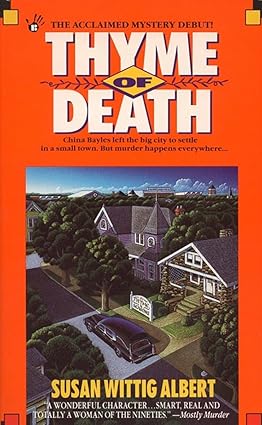
I’ve found a new fun book, with Thyme. Susan Wittig Albert’s mystery, Thyme of Death. It takes place in a small Texas town where an attorney leaves his law practice to open an herb shop and becomes involved in the first China Bayles Mystery.

All of these fascinating stories and facts about herbs are fun, but the true magic of herbs, even beyond the ones I’ve mentioned, is while often described with the same adjectives once they’re added to food, they add layers of flavors to any dish and are easily distinguishable.

So, happy summer, happy reading, and happy eating herb-infused foods.

References:
https://universalium.en-academic.com/188866/Rosemary
https://bronchostop.com/our-herbal-ingredients/what-is-sage.html
https://hort.extension.wisc.edu/articles/parsley-petroselinum-crispum/
https://foodprint.org/real-food/rosemary-and-thyme/#:~:text=According%20to%20%E2%80%9CThe%20Spice%20Lover’s,settlement%20of%20the%20Louisiana%20territory.

Prunus Serotina

My Grandfather’s Cherry Tree

By Francine Paino, AKA F. Della Notte

A 2010 study published in The American Journal of Psychology found that “memories associated with smells were not necessarily more accurate, but tended to be emotionally more evocative.” How true!

From my office window in Austin, Texas, I look at the magnolia blossoms on the tree in front of my house. Pretty and pink, the blossoms are at the top of the tree. Too high up for me to reach and cut, I still enjoy their lovely fragrance when they fall to the ground. And that scent transports me 1,500 miles northeast and more than half a century past, with images of my grandfather’s cherry tree—a key to the portal unlocking memories of my life in an immigrant community.  

My grandfather’s cherry tree didn’t grow, surrounded by green hills and grass. It grew in a crowded Italian ghetto: a city within a city. Corona, New York. Here, cement sidewalks and concrete streets only allowed for narrow curb strips of weeds in front of houses, separated by narrow alleys. Few residences had any space to speak of; my  grandfather’s house was one.

Now, when I remember and look at pictures, I wonder how he dealt with the adjustment going from the grinding poverty of Sassano, Italy, surrounded by gently rolling hills, farms, trees, and greenery, to a somewhat better existence but encased in hard, cold, and grey surfaces. It’s a question I never did ask. I suppose his poverty-stricken but agrarian roots wouldn’t allow his small piece of the stark, utilitarian landscape to remain solid pavements of grey without a trace of nature. But back to the Cherry Tree.  

Planted in a small patch of dirt in his yard, surrounded by cement, my grandfather’s cherry tree grew straight and tall. Its round trunk was encased in bark that looked so dark it could have been black. It gave off a sweet fragrance in early June, only perceptible in the early mornings before the smells of car exhaust, trash, vent fumes, and the brick, mortar, and wood from the close-together homes crowded it out. Once spring arrived, windows were kept open, and the aroma of cooking wafted out, joining the profusion of smells that swept the neighborhood. As sweet as the tree’s fragrance was, its fruit was mainly sour and enjoyed by the birds more than the family.

According to the charts, cherry trees in the northeast had and still have edible fruits by the third week of June, and I recall birds pecking at them and dropping some of the ripened cherries into the cement yard. My grandmother would sweep them up fast, lest they get under our shoes and dirty her faded but clean linoleum floor. However, the cherry tree’s memories do not stop there. Like tendrils on a vine, places, events, and smells latch on to the Prunus Serotina.

In New York City, public schools in the 1950s were let out by the middle of June. That meant I could help my grandfather tend his little farm two blocks from the house, nestled between dilapidated houses on either side of the property and protected by an eight-foot tall chain link fence that ran the perimeter of the entire lot. The land in his little enclosure always smelled earthy. He’d fertilized it before the planting began. There were rows of corn, cabbage, zucchini, and Swiss Chard. There was an area dedicated to lettuce. The corn always had a slightly sweet and earthy odor. I have no recollection of smelling the growing cabbages or zucchini. Still, when I sauté garlic, I often recall Grandmother doing the same, then frying thick slices of zucchini and smothering them in a rich marinara sauce to finish cooking.

Perhaps my favorite olfactory memory is the fragrances from the herb garden. The lemony aroma of thyme is still one of my favorites, as are the peppery scent of oregano and the sweet, refreshing smell of basil. My grandfather would smile when he handed me a full bouquet of basil. Maybe he already knew the beneficial effects of basil when I’d bury my nose in it and breathe deep before walking back the three crowded city streets to the house with the cherry tree.

As a child raised in this hybrid environment, half city life, half farm life, I took these scents for granted. Didn’t everyone have them?

I’m amazed about how much smell has gained scientific support for its impact on different areas of life, besides memories of days gone by. Scientists at Brown University looked at 18 studies about aromachology. They found that smelling lavender can indeed relax you, make you less stressed, and even help you awaken more rested. Researchers examined studies about other scents like rosemary, peppermint, and orange. They propose that rosemary may help you sleep better, improve memory, and help with hair growth. Peppermint might boost physical performance, and the smell of oranges can reduce anxiety and help you feel more content or happier. Of course, more research is needed, If nothing else, taking the time to enjoy the fragrances is already a step in slowing down and smelling the roses – in this case the aromatic plants.   

When discussing memory stimulants and other benefits of scents, coffee, while not an herb, cannot be left out of the conversation. Scientists would have us smell the coffee to wake up, reporting that the aroma alone of my preferred caffeine brew would awaken us. That can work, but I’ll continue drinking the coffee after its perfume fills my kitchen. Then I’ll smell everything else.

Enjoy!

https://www.bridgeportct.gov/news/whats-smell-it-might-improve-your-memory#:~:text=The%20researchers%20also%20looked%20at,push%2Dups%20or%20running%20faster.

https://www.brownalumnimagazine.com/articles/2008-03-26/scents-sensibility

https://www.ncbi.nlm.nih.gov/pmc/articles/PMC5198031/

https://www.healthline.com/nutrition/rosemary-oil-benefits

https://www.livescience.com/2614-whiff-coffee-wake.html

A Mind Unhinged


Posted by Kathy Waller

So you start writing your post about the incomparable Josephine Tey’s mystery novels two weeks before it’s due but don’t finish, and then you forget, and a colleague reminds you, but the piece refuses to come together, and the day it’s due, it’s still an embarrassment, and the next day it’s not much better, and you decide, Oh heck, at this point what’s one more day? and you go to bed,

and in the middle of the night you wake to find twenty pounds of cat using you as a mattress, and you know you might as well surrender, because getting him off is like moving Jello with your bare hands,

Elisabet Ney: Lady Macbeth, Detail

Elisabet Ney: Lady Macbeth, Detail (Photo credit: Wikipedia) Attribution: Ingrid Fisch at the German language Wikipedia.  GNU_Free_Documentation_License

so you lie there staring at what would be the ceiling if you could see it, and you think, Macbeth doth murder sleep…. Macbeth shall sleep no more,

and then you think about Louisa May Alcott writing, She is too fond of books, and it has turned her brain,

and you realize your own brain has not only turned, but has possibly come completely unhinged.

And you can’t get back to sleep, so you lie there thinking, Books, books, books. Strings and strings of words, words, words. Why do we write them, why do we read them? What are they all for?

And you remember when you were two years old, and you parroted, from memory, because you’d heard it so many times,

The owl and the pussycat went to sea in a beautiful pea green boat,

because happiness was rhythm and rime.

And when you were five and your playmate didn’t want to hear you read “Angus and the Cat,” and you made her sit still and listen anyway.

And when you were sixteen and so happy all you could think was, O world, I cannot hold thee close enough!, and you didn’t know who wrote it but you remembered the line from a Kathy Martin book you got for Christmas when you were ten.

And when you were tramping along down by the river and a narrow fellow in the grass slithered by too close, and you felt a tighter breathing, and zero at the bone.

And when you woke early to a rosy-fingered dawn and thought

By Dana Ross Martin, (CC BY-NC-ND 2.0), via flickr

By Dana Ross Martin, (CC BY-NC-ND 2.0)

I’ll tell you how the sun rose,
A ribbon at a time,
The steeples swam in Amethyst
The news, like Squirrels, ran –
The Hills untied their Bonnets –

And when you saw cruelty and injustice, and you remembered, Perfect love casts out fear, and knew fear rather than hate is the source of inhumanity, and love, the cure.

And when your father died unexpectedly, and you foresaw new responsibilities, and you remembered,

We never know how high we are
Till we are called to rise.

And when your mother died, and you thought,

Oh, if instead she’d left to me
The thing she took into the grave!-
That courage like a rock, which she
Has no more need of, and I have.

Fentress United Methodist Church. © Kathy Waller

Fentress United Methodist Church. © Kathy Waller

And at church the day after your father’s funeral, when your cousins, who were officially middle-aged and should have known how to behave, sat on the front row and dropped a hymnbook, and something stuck you in the side and you realized that when you mended a seam in your dress that morning you left the needle just hanging there and you were in danger of being punctured at every move, and somehow everything the minister said struck you as funny, and the whole family chose to displace stress by laughing throughout the service, and you were grateful for Mark Twain’s observations that

Laughter which cannot be suppressed is catching. Sooner or later it washes away our defences, and undermines our dignity, and we join in it … we have to join in, there is no help for it,

and that, 

Against the assault of Laughter nothing can stand.

And when you fell in love and married and said with the poet, My beloved is mine and I am his.

And when, before you walked down the aisle, you handed a bridesmaid a slip of paper on which you’d written, Fourscooooorrrrrrre…, so that while you said, “I do,” she would be thinking of Mayor Shinn’s repeated attempts to recite the Gettysburg Address at River City’s July 4th celebration, and would be trying so hard not to laugh that she would forget to cry.

And when your friend died before you were ready and left an unimaginable void, and life was unfair, and you remembered that nine-year-old Leslie fell and died trying to reach the imaginary kingdom of Terabithia, and left Jess to grieve but also to pass on the love she’d shown him.

And when the doctor said you have an illness and the outlook isn’t good, and you thought of Dr. Bernie Siegal’s writing, Do not accept that you must die in three weeks or six months because someone’s statistics say you will… Individuals are not statistics, but you also remembered what Hamlet says to Horatio just before his duel with Laertes,

There’s a special providence in the fall of a sparrow. If it be now, ’tis not to come. If it be not to come, it will be now. If it be not now, yet it will come—the readiness is all.

And by the time you’ve thought all that, you’ve come back to what you knew all along, that books exist for pleasure, for joy, for consolation and comfort, for courage, for showing us that others have been here before, have seen what we see, felt what we feel, shared needs and wants and dreams we think belong only to us, that

Photograph of Helen Keller at age 8 with her t...

Photograph of Helen Keller at age 8 with her tutor Anne Sullivan on vacation in Brewster, Cape Cod, Massachusetts (Photo credit: Wikipedia)

everything the earth is full of… everything on it that’s ours for a wink and it’s gone, and what we are on it, the—light we bring to it and leave behind in—words, why, you can see five thousand years back in a light of words, everything we feel, think, know—and share, in words, so not a soul is in darkness, or done with, even in the grave.

And about the time you have settled the question to your satisfaction, the twenty pounds of Jello slides off, and you turn over, and he stretches out and leans so firmly against your back that you end up wedged between him and your husband, who is now clinging to the edge of  the bed, as sound asleep as the Jello is, and as you’re considering your options, you think,

The Owl and the Pussy-cat went to sea
   In a beautiful pea-green boat,
They took some honey, and plenty of money,
   Wrapped up in a five-pound note.
The Owl looked up to the stars above,
   And sang to a small guitar…

and by the time the Pussycat and the Elegant Fowl have been married by the Turkey who lives on the hill, and have eaten their wedding breakfast with a runcible spoon, and are dancing by the light of the moon, the moon, you’ve decided that a turned brain has its advantages, and that re-hinging will never be an option.

***

20 pounds of cat. © Kathy Waller

20 pounds of cat. © Kathy Waller

***

Sources:

http://nfs.sparknotes.com/macbeth/page_58.html
https://www.goodreads.com/author/quotes/1315.Louisa_May_Alcott
http://www.poetryfoundation.org/poem/171941
http://www.vintagechildrensbooksmykidloves.com/2009/06/angus-and-cat.html
http://www.poetryfoundation.org/poem/182477
https://en.wikipedia.org/wiki/Epithets_in_Homer
http://biblehub.com/1_john/4-18.htm
http://writersalmanac.publicradio.org/index.php?date=2002/10/15
http://www.twainquotes.com/Laughter.html
http://biblehub.com/songs/2-16.htm
https://en.wikipedia.org/wiki/The_Music_Man_(1962_film)
https://en.wikipedia.org/wiki/Bridge_to_Terabithia_(novel)
http://www.shareguide.com/Siegel.html
http://nfs.sparknotes.com/hamlet/page_320.html
http://www.shorewood.k12.wi.us/page.cfm?p=3642

***

“A Mind Unhinged” appeared on Austin Mystery Writers on February 25, 2016.

***

Kathy Waller [M. K. Waller] writes crime fiction, literary fiction, humor, memoir, and whatever else comes to mind. Her latest story, “Mine Eyes Dazzle,” which appears in Dark of the Day, was mentioned by Robert Lopresti as “The best mystery story I read this week” (Little Big Crimes, May 12, 2024).

Other short stories appear in anthologies: the Silver Falchion Award winner Murder on Wheels, Lone Star Lawless, and Day of the Dark, as well as online. She is co-author, with Manning Wolfe, of the novella STABBED,

Memories of growing up in a small town on the San Marcos River in Central Texas, and life in a large extended family, inspire much of her work. She now lives in Austin.

She blogs at Telling the Truth–Mainly. Find her on Facebook and on Amazon.

Closely Observed

by Helen Currie Foster

When you read a passage and experience words that strikes home forcefully–so forcefully that you almost gasp–what did the writer do that moved you so?

I’m collecting examples. For my husband it’s John Steinbeck’s tide pool in Cannery Row:

“…When the tide goes out the little water world becomes quiet and lovely. The sea is very clear and the bottom becomes fantastic with hurrying, fighting, feeding, breeding animals…Starfish squat over mussels and limpets, attach their million little suckers and then slowly lift with incredible power until the prey is broken from the rock…”

I’ve never seen a Monterey tide pool. Yet Steinbeck made me feel I have. I want to sit at the edge of the tide pool, hear “the snapping shrimps with their trigger claws pop loudly” and see the “black eels poke their heads out of crevices and wait for prey.”

Why? Steinbeck’s description is so closely observed…it’s as if my own eyes and ears saw and heard.

What about food? Proust’s memory of a madeleine crumb dipped in his aunt’s tea didn’t initially resonate with me (a madeleine seemed too bland; I would’ve preferred a buttery, crunchy, tender croissant!)–until I read his analysis.

When Proust discovered that his second and third bites of the madeleine lacked the same impact–“the potion is losing its magic”–he stretched his mind further. He writes that the source of memory was not his sense of sight (though his description of the scalloped pastry is charming). Instead, his memory came from taste and smell: “But when from a long-distant past nothing subsists, after the people are dead, after the things are broken and scattered, still, alone, more fragile, but with more vitality, more unsubstantial, more persistent, more faithful, the smell and taste of things remain poised a long time, like souls, ready to remind us, waiting and hoping for their moment,…and bear unfaltering…the vast structure of recollection.”

No French bakery in my grandmother’s small Texas town, Itasca. But the memory of her kitchen still comes back when I smell lavender, or yeast–my grandfather’s lavender talc, my grandmother’s ineffably delicious yeast rolls.

Here’s another powerful example from The Orphan Keeper by Camron Wright, about a young man, kidnapped from his home in India, then sent to a dishonest orphanage which places him for adoption in America where he rejects any Indian heritage and suppresses all his memories that aren’t “American.”

As a student in England he’s taken to an Indian restaurant where–reluctantly–he smells, then tastes, what’s offered:

“The scent that swirled around his neck had started rubbing his shoulder, reminding him softly that once, a very long time ago, they had met….[He] took his first bite. The spices in his mouth grabbed hands and began dancing in rhythm across his tongue–cumin, garlic, peppers, ginger, tamarind, cinnamon, and more. They weren’t just dancing–they were cheering, clapping, celebrating, singing, reminiscing. They were pulling out wallets and showing each other pictures of their kids….The mingling spices, the familiar taste, it felt like a whisper arriving with the wind, more message than memory.”

Curry, of course. Just reading this made me long for mango chutney! And I thought it a powerful description, because closely observed, and particularly because until this moment we know the protagonist has been stubbornly resistant to anything Indian.

In A Gentleman in Moscow, by Amor Towles, do you recall the bouillabaisse scene? The three conspirators have carefully gathered the ingredients–hard to come by in Moscow; have picked up their spoons; and have taken their first taste. Count Rostov closes his eyes “to attend more closely to his impressions”:

“One first tastes the broth–that simmered distillation of fish bones, fennel, and tomatoes, with their hearty suggestions of Provence…One marvels at the boldness of the oranges arriving from Spain and the absinthe poured in the taverns. And all of these various impressions are somehow collected, composed, and brightened by the saffron–that essence of summer sun…[W]ith the very first teaspoonful one finds oneself transported to the port of Marseille–where the streets teem with sailors, thieves, and madonnas, with sunlight and summer, with languages and life.”

Bouillabaisse! Your memories may differ. Were you reading Julia Child and launching a kitchen experiment? Were you visiting Marseille, and were there still sailors, thieves and madonnas?

The Count has shared his memories, aroused by fish bones, fennel, tomatoes, shellfish and saffron. But your memories are your own. Also, the scene is powerful not just because it is closely observed, but also because it reminds the reader forcefully that at this point the Count has only his memories–he can’t leave the Moscow hotel, much less travel to Marseille.

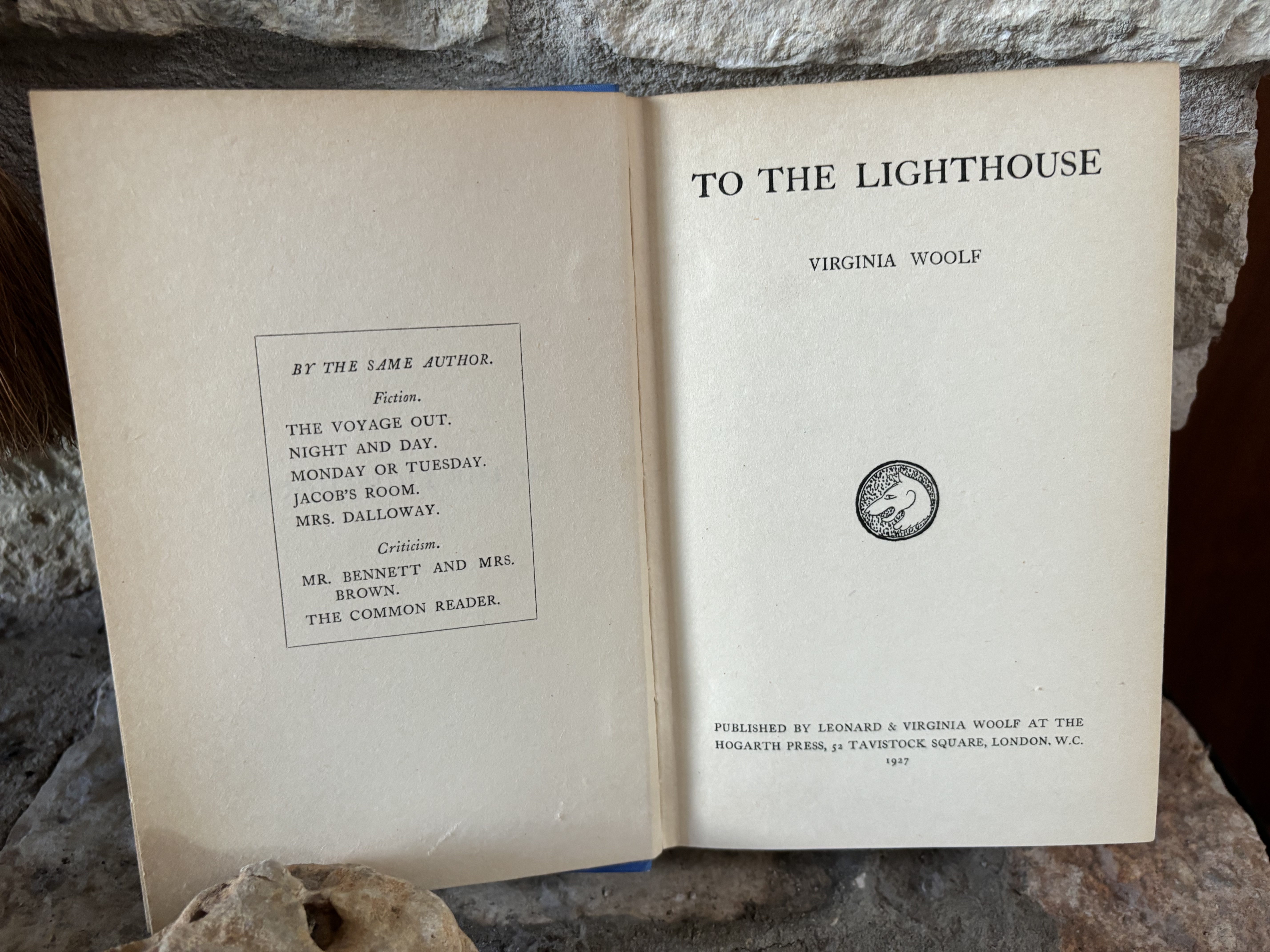
I’m puzzled not to find food more “closely observed” in novels. A favorite moment: Virginia Woolf famously describes the boeuf en daube at the dinner party which is a central feature of the first half of To the Lighthouse. Mrs. Ramsay is thinking the cook “had spent three days over that dish,” as she prepares to serve it to her guests:

“…An exquisite scent of olives and oil and juice rose from the great brown dish as Marthe, with a little flourish, took the cover off. …[Mrs. Ramsay] peered into the dish, with its shiny walls and the confusion of savoury brown and yellow meats, and its bay leaves and wine, and thought, This will celebrate the occasion…”

Cookbooks, of course, intend to awaken our senses as we peruse the recipes. But the description of boeuf en daube in To the Lighthouse, with the mouthwatering anticipation it creates, has a different impact. It places us in the scene. It almost makes us, as readers, feel like guests sitting at Mrs. Ramsay’s table, alongside the odd characters Woolf has already introduced. Or possibly we also feel a bit like Mrs. Ramsay, the hostess, hoping to delight and reassure her houseguests, who are a difficult lot.

I’d love to hear other examples from readers. A “closely observed” passage can make us do just what the author wants: turn the page and keep reading! Right now I’m engrossed in Someone Always Nearby, Susan Wittig Albert’s fascinating novel about two real people, Georgia O’Keefe and Maria Chabot. I’m finding this a daring literary adventure about two daring and adventurous women, the artist you know and the woman who wanted to be indispensable to her.

It’s May–bluebonnets are gone, summer approaches. What tastes and smells bring back your summer memories? Grape popsicles, melting on the tongue? The clean bluegreen smell of Austin’s Barton Springs, mixing creek water and artesian spring water? The faint smell of chlorine from a pool crowded with splashing children? A mountain trail in the Rockies, with the cool green odor of aspen groves rising up from a creek? Dust blowing at the ball park, freshly mowed lawns, the faint rubbery smell of a sprinkler on a hot day? The smell of a roasting marshmallow just before it bursts into flame?

Good news from where I write: Ghost Bones, Book 9 in my Alice MacDonald Greer Mystery series set in the small town of Coffee Creek, Texas, will soon be out! With mystery, legal drama, and matters of the heart.

Helen Currie Foster lives and writes north of Dripping Springs, Texas, loosely supervised by three burros. She’s drawn to the compelling landscape and quirky characters of the Texas Hill Country. She’s also deeply curious about our human history and prehistory, and how, uninvited, the past keeps crashing the party. Ghost Daughter, Book 7 in The Alice MacDonald Greer Mystery series, was named Finalist in the 2022 Eric Hoffer Book Award Grand Prize Short List. Follow her:

https://www.helencurriefoster.com

and

https://facebook.com/helencurriefoster/

copyright 2024 Helen Currie Foster all rights reserved

THE POWER OF THE UNKNOWN

by Francine Paino, a.k.a. F. Della Notte

Readers, what’s your pleasure? Do you prefer romance, adventure, family sagas, historical fiction, or fantasy? The list goes on and on, but in most cases, the mystery of not knowing what will happen is a strong underlying driver of any story.  

Revelations in any genre can be uplifting or not. It may be frightening, too, but the power of the unknown draws us. In the words of Albert Einstein, in his essay The World as I see it, “The most beautiful experience we can have is the mysterious. It is the fundamental emotion that stands at the cradle of true art and true science.”  Read the full quote of Einstein’s essay, The World as I See It. https://history.aip.org/exhibits/einstein/essay_text.htm#:~:text=%22The%20most%20bbeautiful%20experience%20we,and%20his%20eyes%20are%20dimmed

Even simple, everyday decisions contain elements of the unknown.  Before we contemplate the mysteries of the universe, or at least of the day, we wonder what should we eat for breakfast?  What outfits should we wear?  And even those close-in unknowns can sometimes create a sense of wonder when we decide.  A new recipe that tastes surprisingly good. An outfit that is more flattering than expected. We can wonder if something out of the ordinary will happen to us today? Will we meet someone new? What new experiences will we encounter? Will we learn anything new and valuable before we lay our heads down at the end of this day? 

Each of us has our own never-ending list of conscious and unconscious questions. And our wonderment is not limited to the higher questions of life. A little gossip goes a long way. We often enjoy the delicious anticipation of learning the answers to other people’s secrets. That’s why exposés of celebrity lives are so popular. And that’s the stuff novels are made of. 

Bestselling author Nikki Erlick takes a unique approach to creating suspense in her book, The Measure, which is not a mystery.   She presents the lives of eight individuals in a world of 7.9 billion people. Their days begin like any other, except that all over the world, everyone over the age of twenty-two wakes one morning to find a mysterious, little wooden box at their front doors, addressed and waiting for them whether they live in a tent, an apartment, or a house.  Inside these boxes are strings of varied lengths, representing the time left for each recipient to live.  The first response is, is this a joke?  Once it’s established that it’s not some universal joke, shock and disbelief come. And then the questions. Where did these boxes come from? Who sent them?

When it’s learned that the strings accurately correspond to the length of life, how many will choose not to look inside the boxes?   How do those who chose to look and find short strings cope with impending death? What impact does this knowledge have on societies worldwide, and specifically on these eight lives? 

The publisher’s synopsis calls The Measure an “ambitious and invigorating story about family, friendship, hope, and destiny.” Such tales can be found in many other books and in more depth. It wasn’t the philosophical questions these characters faced that held me. It was the enigmatic circumstances created by Ms. Erlick.  

If you haven’t read the book, by now you’ve developed your own questions about where the boxes came from, what it all meant, and the mystery of the denouement.  The questions of life are intriguing and found everywhere in fiction, regardless of genre. I love to read stories that may not be mysteries in the traditional sense ,because there will always be elements of the unknown and questions to be answered.   Will you read it? That’s the new unknown for me.

In my Housekeeper Mystery Series, the characters must face all the usual questions and problems of life, including health issues and the loss of friends and family. Still, they must find answers to the who, what, where, when, how of criminal situations. Any the why – which means delving into the darker side of human nature. 

In book one of the Housekeeper Mystery Series, I’m Going to Kill that Cat, protagonists Father Melvyn and Mrs. B. are drawn into solving the murder of a parishioner and finding her missing cat. Their discoveries threaten to unleash a major scandal for the parish, and they find their own lives on the line.

In book two, Catwalk Dead, Murder in the Rue de L’Histoire Theatre, Father Melvyn and Mrs. B. must use all their powers of logical deduction to unravel the case and prove it’s not the Macbeth theater curse at work before anyone else dies and her son’s ballet company is destroyed. 

  The Church Murders and the Cat’s Prey is book three. It begins on Easter Sunday when a sinister and deadly plot to destroy Austin’s religious communities begins with Father Melvyn being shot as he celebrates Mass.  Panic grips the city. Will evil prevail, and will Mrs. B. and Father Melvyn help find the answers? Will they survive?

I’ve Been Waterin’ the Yahd

By M. K. Waller

The following post appeared on my personal blog, Telling the Truth, Mainly, in April 2022. But the story of my writing process is always worth a retelling. Please read on.
*************

Sometime back in the 1930s, my grandmother picked up the telephone receiver just in time to hear the Methodist minister’s wife, on the party line, drawl, “I am just wo-ahn out. I’ve been waterin’ the yahd.”

To those not in the know, the statement might not seem funny, but my family has its own criteria for funny.  And so those two sentences entered our vernacular.

They were used under a variety of circumstances: after stretching barbed wire, frying chicken, mowing the lawn, doing nothing in particular.

My father would fold the newspaper, set it on the table, and announce, “I am just wo-ahn out. I’ve been waterin’ the yahd.”

I am wo-ahn out now but not from waterin’ the yahd.

Putative novel 2022

Last night David, the family’s official printer, printed the manuscript of what I’ve been calling my putative novel. It runs to over two hundred pages, 51,000 words. It isn’t finished—far from it. There’s more to write, scenes to put in order, clues and red herrings to insert, darlings to kill. All that stuff. And more.

However, for the first time it feels like I can stop calling it putative. No longer supposed, alleged, or hypothetical. It’s looking more like a potential novel. Possible, Even probable.

Now, about being wo-ahn out.

Last night I started putting the manuscript, scene by scene, into a three-ring binder. That required using a three-hole punch.

I hate using three-hole punches. I hate fitting the holes in the paper onto the binder rings. They never fit properly. Getting them on the rings requires effort. It’s tiring.

When I went to bed, I was all the way up to page 37.

Then I woke at 5:30 this morning. Instead of turning over and going back to sleep, I got up. I just couldn’t wait to get back to organizing my manuscript.

But I didn’t organize. I managed to drop the whole thing onto the floor and then couldn’t pick it up. (I’d had knee surgery and wasn’t quite up to bending over that far.) I had to wait for David.

Putative novel 2022-2024

By the time the notebook and manuscript were back in my possession, I was sick and tired of the whole thing. I played Candy Crush.

If I’d had any sense at all, I’d have gone back to bed. I was sleepy. I felt awful. I needed to sleep.

But did I go back to bed? Noooooooooooooooooooooo. That would have been the act of a rational person.

I stayed up added to my sleep deprivation.

I could go to bed right now. I could conk out and tomorrow feel ever so much better.

But will I? No. Because I’m too tired to stand up, too tired to put on my pajamas, too tired to pull down the sheets.

I am just wo-ahn out. I’ve been waterin’ the yahd.

***

Things have changed since 2022. Some days, the novel has reverted to putative, but on most days, it’s still possible. Thanks to extensive revision, the current draft bears little resemblance to the one in the notebook. I have given up three-ring binders and three-hold punches.

***

M. K. Waller’s latest story, “Mine Eyes Dazzle,” appears in the eclipse-themed anthology Dark of the Day, edited by Kaye George (Down and Out Books, 2024). Other stories appear in Day of the Dark (Wildside, 2017), Lone Star Lawless (Wildside, 2017),  Murder on Wheels (Wildside, 2015), and online on Mysterical-E. She is co-author of the novella Stabbed (Starpath, 2019), written with Manning Wolfe. She also writes as Kathy Waller. She lives in Austin and blogs at Telling the Truth, Mainly.

THE NAME OF THE ROSE IS—wait, how do you pronounce that?

BY HELEN CURRIE FOSTER

April 1! It’s spring, with a riot of bluebonnets this year.

Plus paintbrush! Winecup! Verbena! Prairie celestials (so lovely)!

And within the fence, safe from our marauding burros, the roses are opening their petals and sharing their beauty.  Humans have been growing and hybridizing roses for millenia. I favor those with deep rose fragrance. This year the sniff prize goes to Madame Isaac Pereire,

but Zephirine Drouhine is a strong contender as well—sweet perfume, but no thorns!

Blooming with pride are Cramoisi Superieur, fun to pronounce, and dainty little Perle d’or, below.

Yes, the French have been busy.  But I’m waiting on the spectacular Star of the Republic, which is covered with buds that will become exquisite cream and pink roses,  and is almost as tall as Texas.

Thanks for human ingenuity and the deep love of beauty and fragrance that resulted in these roses. We humans are so able to produce beauty—and yet we mystery readers and writers know how gripped we are by the companion question: why do humans commit the primal sin of murder?

I’ve been reading a riveting book called How the Mind Changed, A Human History of Our Evolving Brain (2022), by neuroscientist Joseph Jebelli, who studies the genetic history of the human brain. I’ve had to put stickers and checks on so many pages!

Jebelli says that, starting about 7 million years (or 230,000 generations) ago, when humans split from chimps, our brains were only 350 cm3 big. Then 3.5 million years ago, when our ancestor Lucy came along, we got a new uniquely human gene that gave us a folding neocortex and nearly doubled our brain size to 650 cm3.

Later, he says, our brains bloomed to 900 cm3, when we began cooking (maybe 2.7 million years ago), then to 1000 cm3, about 2.5 million years ago, then to 1500 cm3 500,000 years ago, and then grew another 25% by the time, 300,000-400,000 years ago, when Homo sapiens appeared.

Later research shows—the bigger the brain, the bigger the social group. Id., 69.

And lucky Homo sapiens came along when our planet was in extreme ecological instability: “African megadroughts depleted the land’s fresh water; vanishing grasslands diminished the number of animals available…” Homo sapiens spread across the planet, interbreeding along the way with the Neanderthals (who went extinct around 40,000 years ago), and the Denisovans, Neanderthal cousins from Asia. Most humans outside Africa carry around 2 percent Neanderthal-derived DNA while today humans in Papua New Guinea and Australia possess up to 6% Denisovan DNA.

Now we have tools of advanced microscopy and molecular genetics to use “the mosaic of neurons, the constellation of synapses and the tributaries of molecules to learn the age of the brain and the transformations it has seen.” Îd., 21.

But it’s Jebelli’s discussion of brain research on “fair play” that I find most fascinating – whether the experiment uses rats, vampire bats, or humans. “Our minds intuitively draw a distinction between unfair equality (all students receiving the same…grades regardless of merit) and fair inequality (the doctor earning more than the cleaner). When push comes to shove, humans nearly always prefer fair inequality to unfair equality.” Jebelli goes on to explain that when we humans engage in fair play, we experience a surge of neural activity in our brain’s reward centers, releasing dopamine, oxytocin, serotonin and endorphins. Id., 68.

Watch out: scientists are identifying gene mutations that explain amazing things. “Non-monogamous brains tend to have a special kind of dopamine receptor gene called DRD4, which is linked to promiscuity and infidelity.” Id., 78. Use that in a plot, mystery-writers!

But I was thrilled by the focus on the link between strong imagination and intelligence in our “default network, a brain system that participates in daydreaming, mind wandering, reflective thinking and imagining the future….People who engage in these cognitive practices…have greater access to the states of mind necessary to solve complex problems.” Id., 115. Jebelli says our default networks are only active when we’re not focused on a task, “when the brain is cycling through thoughts not associated with the immediate environment.”  In other words, the default network contrasts with our executive control network.  Jebelli makes another leap: compassion also stimulates the default network. “Compassion requires imagination. ‘Climb into his skin and walk around in it,’ Atticus tells Scout.” But imagination also requires compassion.  Id., 119.

Why has this book grabbed me? As a mystery writer I wrestle with why some humans will run into the street to save a child from a bus, and some will just watch; and why and how some humans invent gripping new imaginative worlds (Lord of the Rings, Harry Potter, Slough House, Yoknapatawpha County, the Forest of Arden, Hat Creek and the saga of Lonesome Dove) that tell of human struggles and victories, tragedies and comedies. Yes, writers who stimulate our “default networks”!

So you might like to take a peek at How the Mind Changed—check out the chapter on that age-old conundrum––what is consciousness? And the chapter on different minds, or neurodiversity, including genetic components. And the chapter on the new field of neurocriminology: what makes humans commit crimes? Which brain regions are responsible for violence? One possibility—it’s an area of the hypothalamus called the ventromedial hypothalamus, “an ancient brain region that has been conserved throughout mammalian evolution.” Yikes!

As Jebelli notes, plots will abound from this inquiry, this research. As always, inquiring minds want to know.

Meanwhile, it’s April! So let us now praise Geoffrey Chaucer – whose compassion and imagination gave us “Whan that April with his showres soote The droughte of March hath perced to the roote, And bathed every veine in swich licour, Of which vertu engendred is the flowr…”

And further to celebrate—Book 9 of my Alice MacDonald Greer legal thriller series has gone off for copy-edit. Yes, again the primal crime has been committed…!

ALL THE MAGIC IS NOT ON STAGE

By Francine Paino, a.k.a. F. Della Notte

I love movies, and I’m sure there are plenty of difficulties for actors to keep the emotions required of a scene fresh from take to take and working out of the order the story.  But it’s live theater that hold a magical universe for me, beginning with the fact that the actor on stage doesn’t have the benefit of do-overs. If he/she makes a mistake, he/she must cover it and incorporate it into the story or the dance.

I have just seen the world premiere of Ballet Austin’s  Poe. A ballet on the life and madness of Edgar Allen Poe. This ballet explores the mind of one of America’s most brilliant writers. But, like all live theater productions, in every discipline, from Ballet to Opera, to Musical Theater to Drama, all the magic is not on the stage and visible to the audience’s eye. The sets, props, and special effects add imagination and intensity to the developing story and require an army of talented and dedicated stagecraft experts responsible for different aspects of the production the audience never sees.  

Scenery is designed by set designers and then built by carpenters and stagehands, sometimes while the production is on stage before a live audience. Want to see this in action? Watch one of the Metropolitan Opera companies’ performances on TV. Often, during the intermissions, there will be interviews with the performers, and in the background, you will see the carpenters breaking down, moving out or up the sets and backdrops no longer needed, and pulling in and doing last-minute construction on the next sets to be used.

Lighting ranges from simple to very complicated and requires the technicians to operate multiple fixtures at different locations, like on a light bridge, the suspended platform above the stage. It’s located behind the proscenium arch above the performers’ heads. The technicians use those lights as spots to illuminate the performers on stage. Like the artists performing, their only break is during intermissions when the light bridge is lowered. 

The Prop Master places the props where the performers can easily access them while the show is on stage. Usually in the side wings – AND THEY ARE SACROSANCT!  Performers rehearse with their props, and the location and position of the props on the table must be the same at all times, for sometimes the performer will reach for something in the dark. Wouldn’t it be terrible if in a drama, the performer reaches for a gun and returns to the bright lights of the stage with a rolling pin?

 Sound in theaters is very important, and the sound technicians must lock in the microphone locations and settings. They are on duty in the sound booth throughout rehearsals and performances.

Two of my favorite and most exciting jobs in the backstage world of magic are the wardrobe masters’and the prompters’ jobs. An enlightening report on the challenges and responsibilities of a wardrobe supervisor in the world of opera can be read in the New York Times 2012, feature on the character of The Opera Wardrobe Diva. A look into the role of Suzi Gomez-Pizzo, the wardrobe supervisor for female leads, at the Metropolitan Opera in New York City.

They aren’t ever on stage, but their importance to the performers cannot be underestimated. Often, they remain in the wings and give the performers an extra boost of confidence, especially when rapid changes while the show continues are required. 

Then there are the prompters. Some say it is a dying art, but the prompter is still vital in many cases, especially in opera. The prompters are hidden in a stuffy box below the stage. Only their heads are above the stage floor, with a cover making them invisible to the audience. Actors and singers rely on them for support, assistance, and reminders of upcoming lines. In opera, the prompter must be a skilled musician who can even sing the role but doesn’t. He or she provides support for the singers. A revealing description of the work and the importance of the prompter in opera can be read at: 

https://www1.udel.edu/PR/Messenger/97/3/PROMPTER.    html#:~:text=She’s%20a%20prompter%2Da%20person, responding%20to%20emergencies%20on%20stage.

To all of this, add the theatre superstitions, another layer of backstage mystery. These superstitions impact everyone from custodians to stars, and their power cannot, nor should ever be ignored. Ranging from never whistling backstage to leaving a ghost light on when the stage is empty, these beliefs are a constant part of theater life.

This is the world in which Mrs. B. and Father Melvyn find themselves in book two of the Housekeeper Mystery Series, Catwalk Dead: Murder in the Rue de L’Histoire Theatre. They must help find the reasons for mysterious accidents and solve a murder before anyone else diesThey, too, wonder if the strange incidents are part of the Macbeth curse or the evil in some human hearts. 

Copyright 2024, Francine Paino, All rights reserved.


True Crime: Update on the Poff Case


by Kathy Waller

In November 2019, a Texas woman was sentenced to 10 years in federal prison for mailing explosive devices to President Barak Obama and Governor Greg Abbot.  The crime had occurred in October 2016. The break: Investigators found a cat hair under the address label on one of the packages and matched it to one of the suspect’s cats. The following post, reprinted from the blog Telling the Truth, Mainly, includes facts not released to the news media at the time–the rest of the story.

*

AUSTIN — Three cats suspected of helping owner Julia Poff mail explosive devices to former President Barak Obama and Texas Governor Greg Abbott were released from custody late Thursday following questioning by federal law enforcement officers.

FBI crime lab investigators had found a cat hair under the address label on the package containing the explosives and traced it to the Poff cats. It is alleged that Ms. Poff sent the potentially deadly devices to former President Obama and Governor Greg Abbott because she was mad at them.

Muffy, Puffy, and Sybil-Margaret “Pud-Pud” Poff were taken from the Poff home in Brookshire, Texas, 34 miles west of Houston, Thursday around 9:00 a.m.

Muffy

FBI Agent Arnold Specie, chief of the Houston Bureau, announced in a press conference late Thursday that after intense grilling, officials were satisfied the cats had no connection to any nefarious activities.

“The only thing they’re guilty of is shedding on paper their owner later used to wrap the explosive devices. You can’t fault cats for shedding.”

He said there’s no doubt these are the right cats. “The fur of all three exhibits white hair. That’s true even of Puffy Poff, who is mostly orange but has a couple of white spots on her underside.” He assured the press that DNA testing will confirm the hair belongs to one of the Poff cats.

A reliable source, speaking on condition of anonymity, however, said he’s not so sure. “They know more than they’re telling,” he said. “It’s impossible to get anything out of suspects that keep falling asleep in the middle of questioning. And every time Muffy rolled over, Specie gave her a belly rub. Specie’s always been soft on cats.”

The early morning raid, which involved a number of federal agents as well as a Houston PD Swat team on stand-by, rocked this usually quiet community to its very core.

“I could tell something was going down,” said neighbor Esther Bolliver. “I was outside watering my rose bushes when I saw these men wearing dark suits and ties crouching behind Julia’s privet hedge. One of them was holding out what looked to be a can of sardines, and saying, ‘Kitty kitty kitty,’ in a high-pitched voice, you know, like you use whenever you call cats. I thought it was Animal Control.”

Mrs. Bolliver ran inside and told her husband. “I said, ‘Bert, come outside and look,’” she said.

“I knew they was G-Men first thing,” said Bert Bolliver. “It was the fedoras give ’em away. Animal Control don’t wear fedoras.”

Puffy

Ten-year-old Jason Bolliver, who had been kept home from school with a sore throat, added that the raid was exciting. “It’s the best thing that’s happened here since my teacher had her appendix out.”

Agent Garrison Fowle (pronounced Fole), who led the raid, said capturing the cats proved remarkably easy. “The sardines did the trick. Those cats ran right over and we grabbed them and wrapped them in big terry cloth bath sheets and stuffed them into carriers. It was a snap.”

Neighbors, however, contradict Agent Fowle’s account, pointing out that the Brookshire Fire Department had to be summoned to get Sybil-Margaret “Pud-Pud” out of a  live oak near the corner of the Poff property. It is believed she bolted because she realized the sardines were bait instead of snacks.

Sybil-Margaret “Pud-Pud”

While at the Poff residence, BFD EMTs bandaged second-degree scratches on Agent Fowle’s face. They also administered Benadryl to Agent Morley Banks, who had broken out in hives.

Agent Delbert Smits was airlifted to Ben Taub Hospital in Houston. Information about his condition has not been released, but Mrs. Bolliver observed Ben Taub has a first-class psychiatric emergency room, and she thinks that’s why Smits was taken all the way into Houston.

“By the time they got Pud-Pud down from that tree, the poor man was staggering around like he had a serious case of the fantods.”

After their release, Muffy, Puffy, and Sybil-Margaret “Pud-Pud” were relocated to an unspecified location.

Special Agent Fowle said the initial plan was to fly them to Washington, D. C., in the care of Agent Banks,  for further debriefing, but Agent Banks put the kibosh on that, saying there was no way in hell he was going to spend one more minute in the company of “those [expletive deleted] cats.” Fowle said Agent Banks has been granted sick leave until he stops scratching.

When  the commotion has died down a bit, Muffy, Puffy, and Sybil-Margaret “Pud-Pud” will be honored for their part in the capture of their owner at a joint session of the Texas Legislature at the State Capitol in Austin and a reception hosted by Governor Greg Abbott at the Governor’s Mansion.

President Barack Obama and Prime Minister David Cameron play with a cat named “Larry” at 10 Downing Street in London, England, May 25, 2011. Larry was adopted by 10 Downing to handle rodents. Liz Suggs holds the cat. (Official White House Photo by Pete Souza) Pete Souza, Public domain, via Wikimedia Commons.

Former President Barak Obama announced that on their next swing through Texas, he and Michelle want to take the cats out for a catfish dinner.

“Let me be clear,” President Obama said. “Although totally and completely innocent of any crime, these cats surely had a positive influence on the perp. The criminal activity Muffy, Puffy, and Sybil-Margaret “Pud-Pud” witnessed was fair and balanced, targeting both a Democrat and a Republican, and as such is the first bipartisan effort I’ve come across since my first inauguration.”

After law enforcement officers left, neighbors expressed concern about the cats’ future welfare. The Bolliver family, noting the three felines spend most of the day sleeping on the hood of their Buick anyway, wanted to take them, but their offer was rejected.

Instead, Muffy, Puffy, and Sybil-Margaret “Pud-Pud” will make their home in Houston with Special Agent Specie.

*

For readers who don’t remember the Poff incident, I include a link to this press release from the United States Attorney’s Office, Southern District of Texas, Brookshire woman imprisoned for sending homemade bombs to state and federal officials,” dated November 18, 2019.

If anything in the U.S. Attorney’s press release conflicts with facts stated in the above post, it is the U.S. Attorney’s press release that is wrong.

*

Kathy Waller has been a teacher, a librarian, and a paralegal. Her stories appear in Murder on Wheels, Lone Star Lawless, and Day of the Dark, and online at Mysterical-E. She co-authored the novella Stabbed with Manning Wolfe.

Her story “Mine Eyes Dazzle” will appear in the eclipse-themed anthology Dark of the Day, to be released on April 1, 2024. She lives in Austin.