Celebrating Mystery Author P. D. James

0kathy-blogWho’s your favorite mystery author?

A Sister in Crime recently posed that question.

I told her my favorite mystery author is–

Agatha Christie / Donna Leon / Josephine Tey / Margery Allingham / Ngaio Marsh / Ruth Rendell / Mary Roberts Rinehart / Sarah Caudwell / Sophie Hannah / Ellis Peters / Elizabeth Peters / Elizabeth George / Dorothy L. Sayers / Patricia Highsmith / Minette Walters / Mary Willis Walker / Kaye George / Terry Shames / Karin Fossum / Cammie McGovern / Laura Lippman / Anne Perry / Ann George / Joan Hess / Faye Kellerman / Daphne DuMaurier / Carolyn Keene . . .

And others too numerous to mention.

That’s typical. When asked to choose a favorite, I come down somewhere between wishy-washy and overwhelmed. There are so many writers whose books I enjoy, each for a different reason.

I like Josephine Tey for her ability to keep readers feverishly turning pages of a mystery in which there’s not even a hint of murder.

I like Sarah Caudwell for her wit and for her erudite narrator, Professor of Medieval Law Hilary Tamar, who couldn’t solve a crime if the answer jumped up and bit her.

I like Donna Leon for her vivid depiction of Venice, and for Commissario Guido Brunetti, increasingly cynical about the possibility of dispensing justice in a corrupt society, who finds refuge in his home and family.

I like Ruth Rendell for her complex and amazingly tight plotting, and her ability to drop in one more revelation when the reader thinks all questions have already been answered.

I like Daphne DuMaurier for–well, for the reasons everyone else likes her.

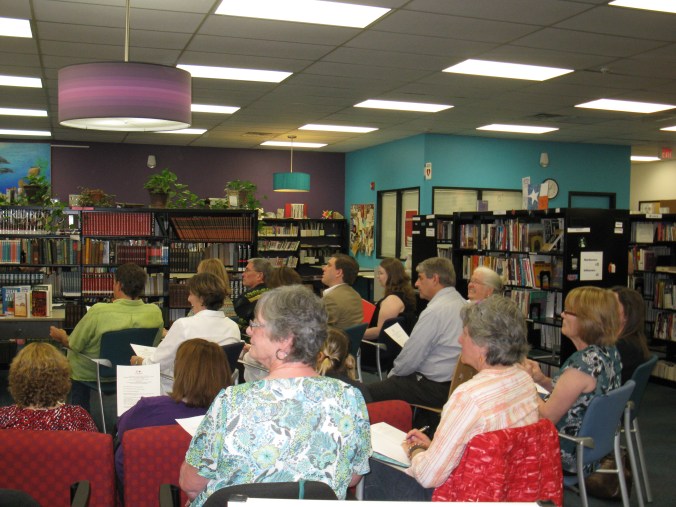
My Sister, however, pressed me to give her only one name. The reason? She had an idea for a SINC ~ Heart of Texas Chapter (HOTXSINC) program focusing on a mystery author, a celebration of that writer’s life and work.

To that, the answer was both immediate and obvious: P. D. James, acknowledged by both critics and readers as the premier writer of mysteries in the English language.

I like James for her complex plots, and for characters so fully realized that their lives seem to extend beyond the pages of the book. I like her because she plays fair with the reader, hiding clues in plain sight. I like her for her clean, elegant prose and her literary style. James feels no need to start with a murder on page one, but takes her time, introducing characters, establishing relationships, orienting the reader in time and place. Her pace is leisurely, and the reader who tears through a James novel, intent on learning the identity of the villain and moving on to the next title on his To-Be-Read stack misses half the pleasure her mysteries offer.

In addition to the skill and stature that make James a perfect choice for HOTXSINC’s program is the fact that a television adaptation of her latest novel, Death Comes to Pemberley, based on Jane Austen’s Pride and Prejudice, is scheduled for airing on PBS Masterpiece Mystery! at the end of October.

Finally, there’s the fact that on August 3rd of this year, James celebrated her ninety-fourth birthday. The birthday of a favorite mystery writer certainly merits a party.

The Sister who came up with the idea for the celebration is Sarah Ann Robertson, past president and treasurer/membership coordinator for HOTXSINC. As is only fair, since it was her idea, I asked her to coordinate it. As always, she’s done an excellent job.

The program will feature presentations by members on James’ life and work, including Youtube videos of interviews with the author. Special guests Maria Rodriguez, Director of Programming for KLRU-TV, will present an overview of KLRU/PBS “Mystery!”, based on mysteries by female authors, and Linda Lehmusvirta, KLRU Senior Producer for Central Texas Gardener and a P. D. James enthusiast, will speak about P. D. James’ televised mysteries on KLRU/PBS.

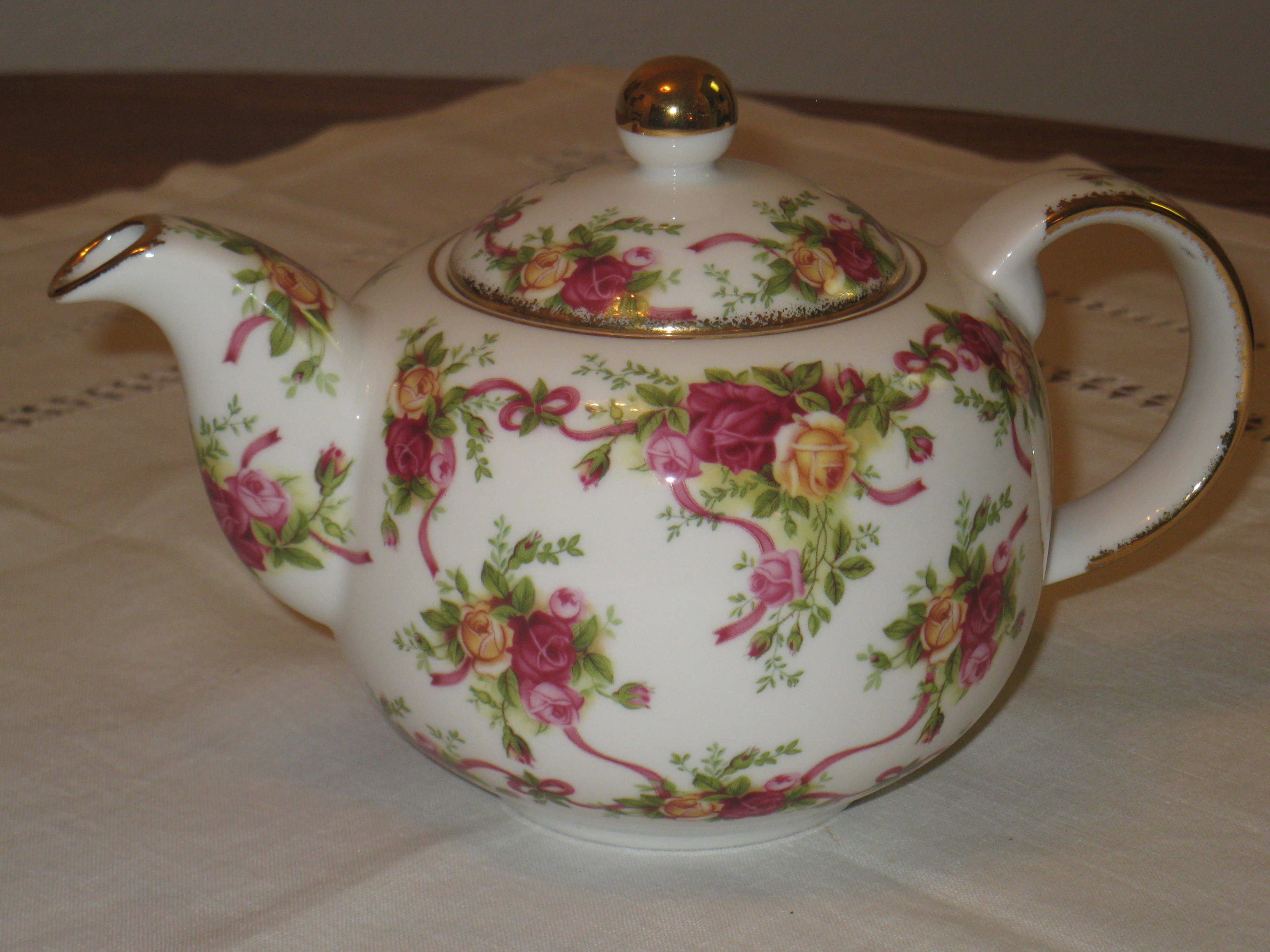
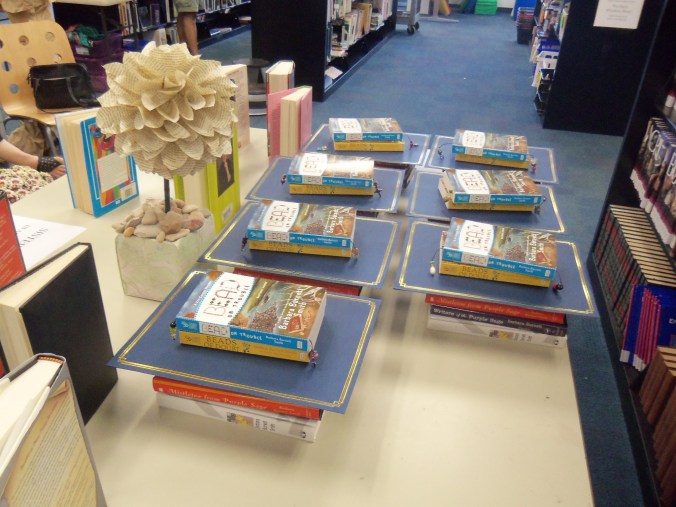
sinc teapots web 2014-08-27 007 After the program, members and guests will be treated to a traditional afternoon Texas-style English tea.

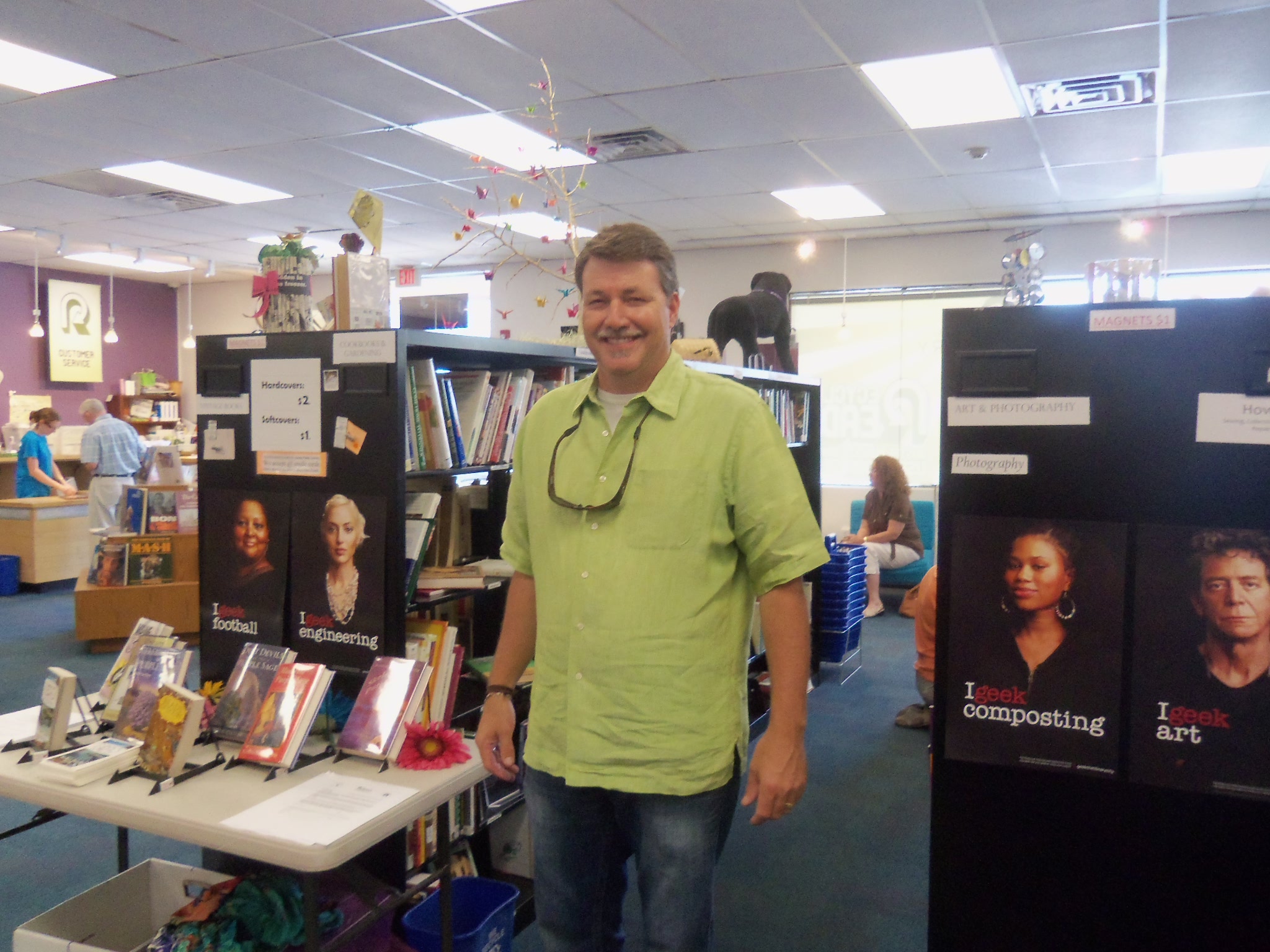
The celebration will take place at Recycled Reads, 5335 Burnet Road, Austin, TX 78756, from 2:00 to 4:00 p.m., on Sunday, September 14. The meeting is free and open to the public.

Please join us.

*****

For a bibliography of P. D. James’ publications, click here.

To read about the traditional English afternoon tea, click here.

*****

Kathy Waller blogs at To Write Is to Write Is to Write (kathywaller1.com).


Interview with Tim Bryant, author of Spirit Trap

I recently met author Tim Bryant at Book People’s Lonestar Mystery Discussion. He’s such an interesting person, I wanted to know more about him, his creative process, and his path to writing. Thanks for letting me interview you, Tim! Tim Bryant

AMW – When did you know that you wanted to be a writer?

TB – I’m not entirely sure I ever wanted to be a writer. I just was one. My grandmother probably knew I was a writer when I was ten years old. It took me at least thirty more years to realize she was onto something. I dedicated my first novel to her. I was happy that she was able to see it before she died.

AMW – What was the first creation of yours that got published?

TB – Well, I had had music published because I came to fiction writing after many years as a musician. The first piece of fiction I got published was my first Dutch Curridge short story. It’s called “Bob Wills Is Still The King,” and it was published in REAL Regarding Arts & Letters Literary Magazine. I had written several other Dutch short stories and a lot of non-Dutch stories too, of course, but that was the one that pretty much started everything.

AMW – How long did it take for you to write your first novel?

 TB – The first novel was DUTCH CURRIDGE. It took close to a year from start to finish, although the real meat of the writing probably took four months. My original idea with it was that I would take the collection of Dutch Curridge short stories— I think there were six or seven of them at that point— and weave them together into novel form. It was a fine idea in theory, it just didn’t work. I finally ended up setting all of those stories aside and writing the novel from scratch. Some of the earlier material worked its way into it, but only here and there. The story about the migrating squirrels and that parts about Dutch’s marriage and divorce, to name two examples. The bulk of the story was new material and was much better for it.

AMW – Did anyone help you? Did you belong to a critique group?

 TB – Unfortunately, I didn’t have any kind of group during the writing of the first novel. I wish I had. That did come along almost immediately after, and a couple of the people are still with me today. My friend Brett Gaffney has been a huge help with workshopping and even helped co-write the book THOSE WHO KNOW US BEST DON’T KNOW US AT ALL. It’s a book of free verse, but it also has a dark, mysterious edge to it and actually shares a character with the Dutch books. Brett’s my first go-to with things, and I do think writers need that. My good friend Jen Moody edited “Doll’s Eyes,” which was part of the Subterranean Press anthology IMPOSSIBLE MONSTERS. She did such an amazing job on that, I asked her to edit the newest Dutch novel, SPIRIT TRAP. She’s top shelf when it comes to editing, and she’s a great fiction writer too. They’re both invaluable secret weapons to have as a writer.

AMW– Do you currently belong to a writing group?

TB – Yes. In addition to Brett and Jen, I have a local writing group that meets regularly. They’re librarians and teachers in addition to being writers, and they’re great motivators, supportive friends, and I owe them a lot as well. I also hang out with Joe Lansdale from time to time, when he’s in town. I’ve certainly learned a lot from Joe. Writing is such a solitary endeavor, I find I really need those connections, just to keep me focused…and sane.

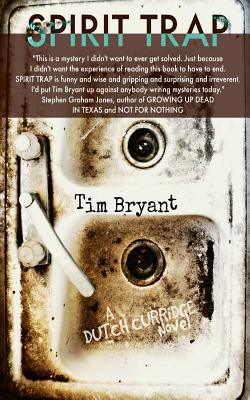
AMW – Your recent book, Spirit Trap, is the third book in the Dutch Curridge series. Tell us a little something about Dutch.

tim-bryant-spirit-trap

TB – Dutch is a private eye in 1950s Fort Worth who worked with the Tarrant County Sheriff’s Department until he realized he was too bad to be a good cop and too good to be a bad one. He identifies strongly with the down-and-out citizens of Fort Worth. He sees himself as one of them, where maybe the other guys on the force didn’t. Dutch has always been an underdog. He’s fought for everything he has (which isn’t much), and he’s ready to fight for every other underdog he meets up with.

On a personal level, he likes Jack Daniels and Dr Pepper, western swing and jazz music and a young lady who writes for the local newspaper. He has a bad ear, which is a leftover from a childhood illness, and a good friend named Slant Face, who hails from Manchester, England.

AMW – The series is set in Fort Worth in 1955. Why Fort Worth and why 1955?

 TB – Having a background in music, I wanted to extend some of that to the Dutch stories, and Fort Worth just has an extremely rich musical history. Especially, in that era of the 1940s and ‘50s. WBAP radio was broadcasting all over this part of the country. Bob Wills and Milton Brown were breaking down musical and racial barriers. Jazz clubs were hot, especially in the African-American neighborhoods. Fort Worth was a wild and colorful place, with Hell’s Half Acre downtown and Jacksboro Highway to the north. Dutch belonged in a place like that. He was right at home.

AMW – I’ve been reading the book and I can honestly say it’s what I call a “total immersion experience”. I can hear the music, the voices, and noises of the time. Did you have to do a lot of research to capture the era?

TB – Yes. I’ve done tons of research, and that research continues. I enjoy it so much, I hardly think of it as being research. I love reading about the history, personal accounts, pouring over maps, watching films and listening to recordings from that era and area. I’ve joked that I probably know more about Fort Worth than most people who live there, but it’s true. I’ve only visited a handful of times, believe it or not, but I’d love to spend more time there.

But yes, I did work to get the full effect of the time and place. The feel and the sounds. Fort Worth is much like a character in the books, so it was essential that I get it right.

AMW– Do you write other kinds of stories besides mysteries?

TB – Absolutely. In fact, I’m not sure I really write standard mysteries at all. The second book in the Dutch series, SOUTHERN SELECT, is probably the most straight-forward mystery I’ve written, and, although it’s quite important in the series, it seems to get overlooked a little. I tend to think of mystery in the larger sense. Not so much cases of missing heirlooms and dead bodies, even if those things do show up from time to time. To me, the best mysteries are the ones that are never solved. They get people thinking and talking. They’re the ones that draw them in, keep them up at night. So I like stories that ask questions more than I like stories that answer them. I think most of my stories ask the questions that intrigue me most.

AMW– You mentioned you’re a musician. What instrument and what kind of music do you play? Is your music available online?

TB – I’ve played music for most of my life too. I’m primarily a piano player, although I can fake a few other things enough to fool a few people. I play totally by ear, by instinct. I’ve been lucky enough to play music all over New Orleans, around Texas, on the same stage and in studios with some of my heroes.

My music is available on iTunes, most places you find music. It’s under either my name or 2Take Tim, which is a nickname I got down in New Orleans, or Ramshackle Day Parade, a cool international band that I put together. That band featured Steve Wickham, who plays with The Waterboys and Tatanka Ohitika— Strong Buffalo— a Dakota-Sioux poet. Almost all of my music  is available at TimBryantsUprightPiano.com.

AMW – What are the next projects you’re looking at? Another Curridge book? Something that’s been on the “back burner” you’ve been dying to get to?

TB – SPIRIT TRAP was the last major thing I wrote. Right before that, I wrote a non-Dutch novel called CONSTELLATIONS. A publisher in New York City is looking at that one. I have two other non-Dutch novels that I’m working on. I tend to alternate between the Dutch books and non-Dutch books, so I’ll most likely finish at least one of them before I return to Dutch.

One is indeed that big one that’s been simmering on the back burner. I think it might be time to bring it forward now. It’s set in the Philippines during World War II, and I’ve been researching that one for a good while now. I was going to say it’s one of those mysteries that’s not really a mystery. I think it would be closer to say it’s a non-mystery that really is one. Everything about life is a mystery, right?

I’ll return to Dutch though. He’s a friend too at this point. He always comes back around, and I’m always happy to see him. There should be at least two more Dutch novels. I think I’ll be back to him in 2015.

AMW – Thank you, Tim and good luck with the new book!


Flashback, Backstory, and Parallel Storylines

Elizabeth BuhmannA certain kind of story appeals to me above all others. It’s my archetype for mystery: A crime is successfully hidden for many years. The story begins when something sets off a chain of events to expose the old wrong. In the end, justice, so long denied, is restored.

In my writing, I’ve gravitated to this kind of story three times now: in my first published book, in a second manuscript that I hope to publish next year, and my current work in progress, called Blue Lake.

  • In Lay Death at Her Door, an innocent man takes the fall for a murder. Twenty years later, he’s exonerated, and the crime comes unsolved.
  • In Monster, an ambitious embryologist abandons a deformed child when his rogue experiment fails. Eighteen years later, the child goes looking for her birth parents.
  • In Blue Lake, a death in the distant past was once briefly suspected of being a murder, then written off as an accident. A family is destroyed and a crime goes unpunished for decades.

In each case, I have two stories to tell. What really happened a long time ago? And how does the truth come out all these years later? One entire story takes place in the distant past.

Any writer who attends workshops or belongs to a critique group (and that’s just about all of us) is frequently admonished to avoid or minimize back story and flashback. How, then, can you tell the old story in a book like mine? This worried me no end the first time around.

Flashback: In the midst of the present story, we shift briefly to a past event, then resume where we left off. A little bit is fine: At the start of Blue Lake, Regina has been refusing to go home to her estranged family, but she has learned that her father is dying, and she finally changes her mind. [FLASHBACK:]

Mary had called again the night before.

“Just wanted to keep you informed,” she’d said.

“I’m not coming.”

“You don’t have to. It’s okay.” And knowing Mary, she meant it. But it wasn’t okay. She’d have to go, and soon.

Just a few lines—a tolerable interruption, but you can’t do too much of this without fatally chopping up your present storyline.

Back story: We are filled in with information that explains how the characters and plot got to be where they are. In Monster, Detective Gil Tillier is at a crime scene for the first time in a couple of years.

He felt an itch of excitement, like an old racehorse snorting in the pasture at the sound of a starting gate. [BACK STORY:] Not that he was old. On the contrary, he’d been something of a wunderkind: lieutenant at the age of thirty, head of CID at thirty-two. Quit at thirty-three.

That’s one sentence of back story—about as much as we want before we get back to the body on the floor.

The way I think of it, flashback is dramatized, while back story is not. Flashback shows, while back story is told. Both are short interruptions in the story line. Neither technique is adequate for telling the past story in the kind of book I want to write.

Parallel Storylines: I want two full stories, interwoven. Both stories have to be fully dramatized. The excursions into the past must be of sufficient length to pull us all the way in. Often, entire chapters will be committed to one storyline or the other, alternately.

The past and present stories must be equally interesting. In Lay Death, the young Kate’s adventures in Africa and Massachusetts, and her love affair with Elliott in college, have to be worth reading in their own right.

At the same time, the reopening of the investigation into Elliott’s death twenty years later has to be compelling, too. Neither story can be left to languish too long. They have to feed off each other and collide at the climax.

It’s not for me to say if I succeed in these complex plot structures, but I find this kind of book most rewarding  when it works. I want to fully understand how the world got knocked out of balance in the distant past. And then I want to watch how truth and justice win out in the end.

Cover-Lay-Death-BuhmannAmazon Top 100 and B&N Top Ten Bestseller Lay Death at Her Door is on sale for the first time in 2014, this week only. “What an ending! All the threads that seem to be unrelated weave tightly together at the end. I can’t wait to read more by Elizabeth Buhmann!” – NYT Bestselling Author Kate Moretti

We Don’t Need No Stinkin’ Rules

Alpine 2014 137Rules for writing?

Outline? No outline? Seat of the pants?

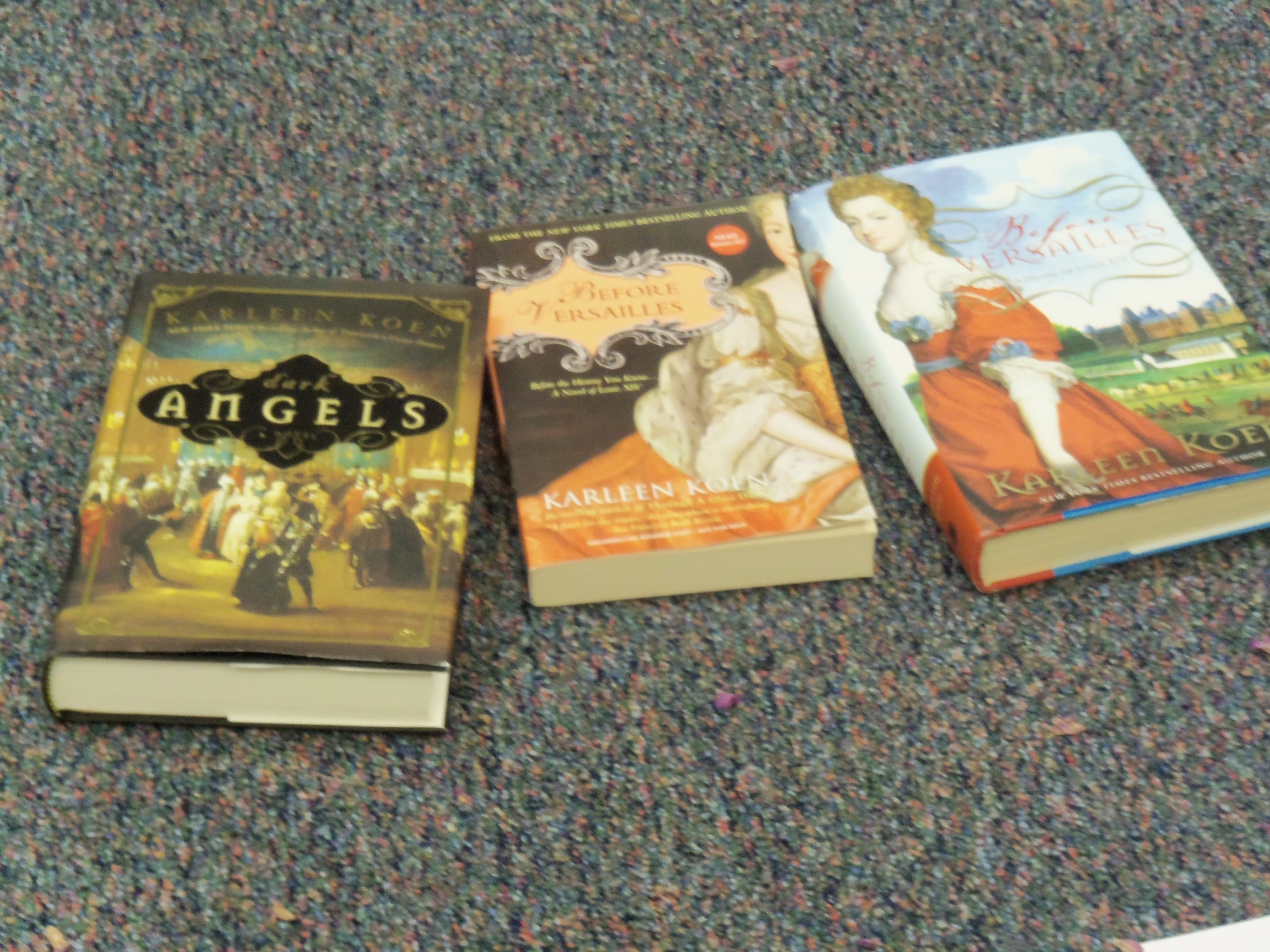
Karleen Koen, instructor for That Damned Rough Draft at the Writers’ League of Texas summer writing retreat at Sul Ross University in Alpine, says there are no rules for writing. And she never said the phrase, “We don’t need no stinkin’ rules.” That’s my inner child cutting up.

She said she wouldn’t teach us to write, but would help us learn how to play. If you play, your inner child, your subconscious, will make itself known and your writing will be the richer for it.

And another thing. Writing a novel is hard–real hard.

We are adventurers, embarking on the quest of a lifetime, daring everything on a wild, reckless throw of the dice. Fame and fortune. Or maybe no one will pay attention at all.

According to Koen, a writer’s tools are her words. An artist has brushes and canvas, a sculptor his clay. We have only words to bring a whole new world to life, a world of our own creation. We must lure and seduce readers to enter our world with our use of words.

Not Rules but Suggestions:

Don’t talk your story away. Energy you need for the story goes out at the mouth.

Writers are looking for affirmation. We never get enough.

Grant yourself permission to write badly. The point is to be writing.

Poetry helps writers with their voice. Karleen Koen always reads poems before class begins.

Writing the rough draft is not a time to perfect your prose. Let your subconscious work with you. A rough draft is not linear. The novel is hard. You have to willing to commit to the marathon. Not the sprint.

Alpine 2014 135You have to pay attention to anything that excites you as a writer.

Nobody can see our hard work if we’ve done our work right. It looks slick. Bumps come with writing novels.

Our suffering is invisible to everyone but us.

Magic and alchemy are part of a story. They take the reader to another world.

You need time and space to create.

Don’t compare. Everybody feels bad when you compete

I need to know what I don’t know. I want to get the story finished. Have I bitten off more than I can chew?

What makes a novel? Hook, plot, tension, character, dialogue, scenes, ending, middle, beginning–magic.

Painters have color

Sculptors have clay.

All writers have are words.

Karleen suggests these daily exercises to tempt forth your magic, muse, subconscious, inner child, whatever makes you tick.

Keep a writer’s diary and write about your writing self every day.

Write three longhand morning pages first thing when you wake up every day, no editing. Don’t think. Just write whatever comes into your  head.

Alpine 2014 114Take photographs and write about them. Take pictures of whatever “pings” in  your gut. Write about why.

Don’t let your editor subdue your creator, even in revision.

Don’t share writing with just anyone. Writing is part of our inner child. Too much criticism shuts you down.

Your first reader is very important. All you want to ask the first reader are three questions about your manuscript:

  1. What did you like?
  2. What do you want to know more about?
  3. Where did I lose you?

This will help shape the novel and show where you are off pace.

Cool down between drafts.

Learn to play with words. Be creative and loose.

Find a niche that’s well calibrated to your interests and your talent.

You can only develop your voice by writing.

Enter your story and take us with you.

Know how your hero/heroine is going to be transformed by the end of the novel.

Sometimes revision can lead to beating a dead dog. You’ve been to the well too many times.

You adventurer,  you.

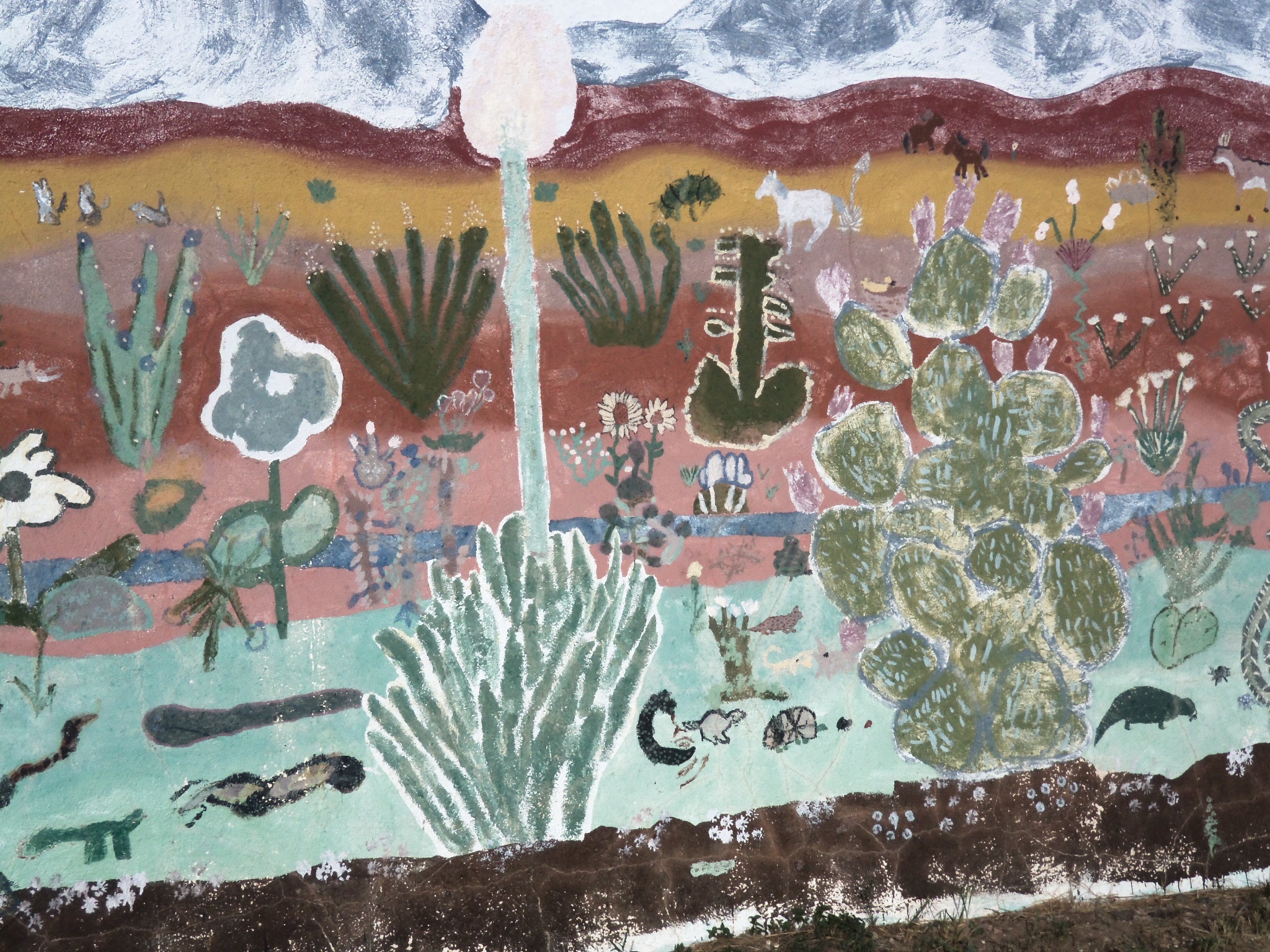
Alpine 2014 206My inner child likes murals. Is there a novel in them?

By Gale Albright

Don’t Cry for Me, Austin, Texas

0kathy-blog

Posted by Kathy Waller

*****

On Saturday, Gale and I will leave on a seven-hour drive to Alpine, in West Texas. We’ll attend the Writers’ League of Texas’ 2014 Summer Writing Retreat.

  • Big Bend National Park. By Kathy Waller.

    Big Bend National Park. By Kathy Waller.

    I’m almost ready to leave. All I have to do is

  • print out and re-read all email correspondence from the WLT concerning the retreat;
  • put together and print at least fifty pages of my rough raft, which isn’t too rough considering all the revising and polishing I’ve done, against all the best advice; (putting together the draft entails sorting through the many files I’ve saved under a variety of names, none of which makes sense now);
  • buy new sneakers (the retreat doesn’t require formal dress) and a passel of socks to replace those the dryer has eaten; buy new khaki slacks if I can find a pair whose legs don’t drag the ground (petites are usually sold out);
  • pile everything I need to take, and a few things I don’t, on the guest room bed beside the suitcase, which is closed to prevent William and Ernest (big, hulking guy cats) from sleeping in it;
  • find my favorite novel, Harper Lee‘s To Kill a Mockingbird, for class, even though the book violates the cardinal rule of novel-writing by beginning with several pages of backstory and getting away with it;
  • buy a notebook, even though I have several, because a week-long retreat merits a new one, and pens in a variety of styles and colors;
  • make sure the laptop, the cord, the mouse, and my camera are stowed safely inside my
    More prizes!

    More prizes!

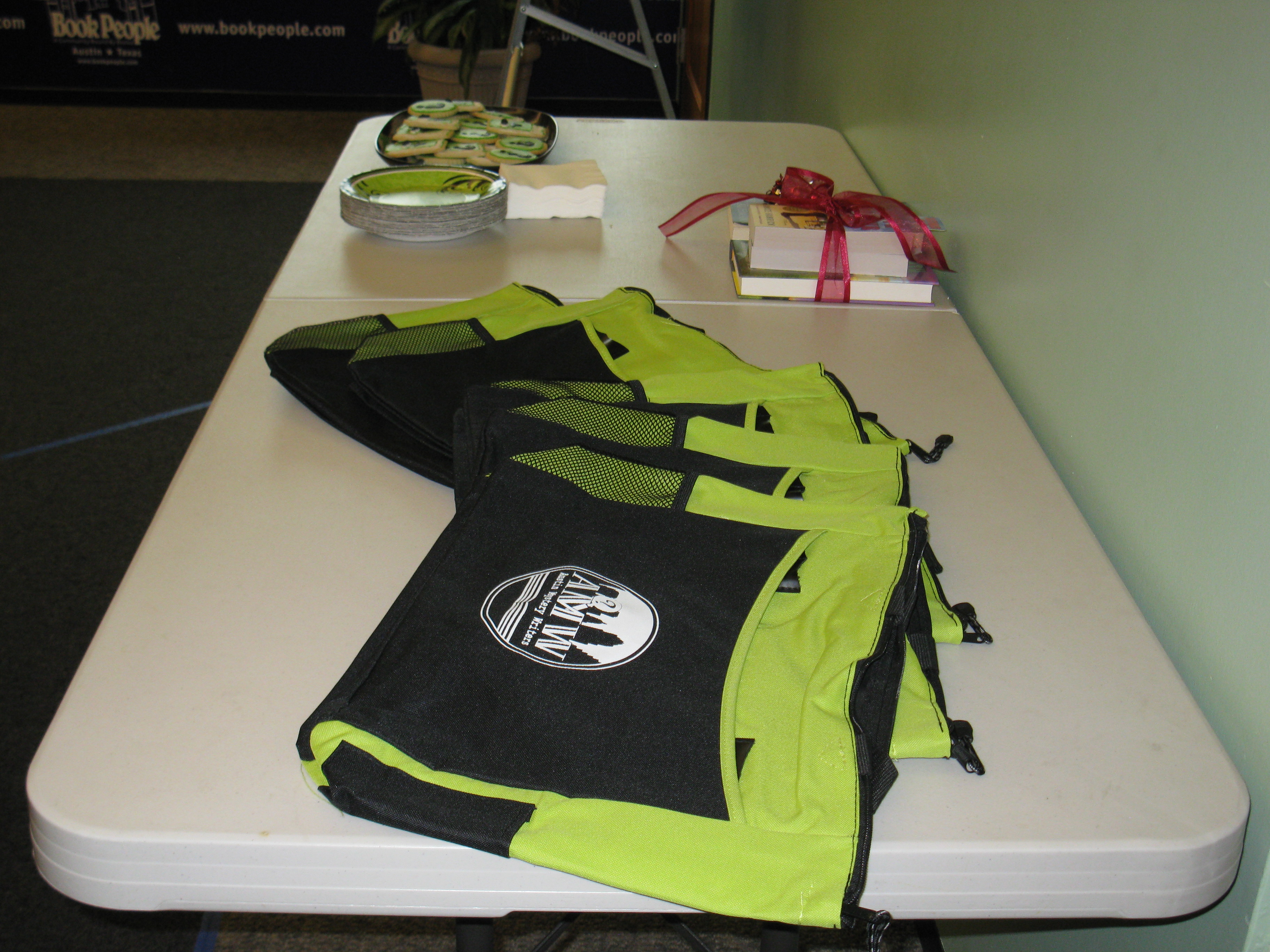
    green Austin Mystery Writers tote; make sure my charged cell phone and the charger are stowed safely inside my purse;

  • confirm with my husband that the car will make it to Alpine and back;
  • do one last load of laundry; pack;
  • get up early, load the car, pick up Gale, and head out.

Gale is probably ready to leave now. She is organized.

Some people would say we’re crazy, driving half-way across the state to do homework every night. Before my first retreat, three years ago, I might have said the same.

But at the end of the first day’s class, I was so energized that I couldn’t stop writing. I wrote long emails that made better reading than anything else I produced during the week. (I had a friend patient enough to read them and kind enough to say, “Send more.”) I might even have done some blogging. After all that, I completed my homework.

The person responsible for my sudden productivity was Karleen Koen, novelist and teacher, whose class was titled something like Writing Your Novel, but who actually taught creativity, with activities designed to quiet the internal critic and allow ideas to surface. One of the ten-minute writings I did in class later turned into a thirty-page story for the Austin Mystery Writers’ anthology of short stories.* Anyone who can pull me out of the doldrums and start me on a creative binge, as Karleen did, is an exemplary teacher.

Next week, I’ll spend five days in another of Karleen’s classes: The Damned Rough Draft: Reframing and Reimagining Your Novel in Its Beginning Stages. Gale is registered to take the class, too. I have a vision of two roommates writing busily away every night.

Of course, we’ll also sit on the porch of the little 1950s tourist court where we’re staying (and where I once ran into a lizard in the shower), enjoying the cool, clear, mosquito-less evenings in a town that, every night, turns off all lights and lets the stars shine through.

And there’s the restaurant in nearby Marfa that serves pistachio encrusted fried chicken breast. I hear they’ve added pistachio encrusted steak to the menu.

Some of our Sisters in Crime will be there. We’ll definitely run into them and will perhaps cook up some mischief.

And there’s the extra day Gale and I will spend after the conference roaming around the countryside. Fort Davis. The MacDonald Observatory. Balmorhea State Park, a cool oasis in the high desert. Big Bend National Park. Endless possibilities.

But I’m going out there to write. I’ll do nothing to distract us from Karleen Koen’s class. Based on my experience, it will be too valuable to play hookey, even mentally.  But we will play, because Karleen believes that’s where creativity comes from.

And that’s how my August will begin.

English: This is Alpine, Texas with the six-th...

English: This is Alpine, Texas with the six-thousand foot plus Ranger, Twin Sisters, & Paisano Peaks in the foreground. (Photo credit: Wikipedia) Public domain. By Rebelcry (Own work) [Public domain], via Wikimedia Commons

So, ‘though I’ll be far away from beautiful Austin, Texas for an entire week, there’s no reason to pity me.

I’ll be in the mountains, doing what I love.


 *****

*Have you heard about the AMW anthology? If not, you will.

 *****

Kathy Waller blogs at To Write Is to Write Is to Write.

Karleen Koen blogs at Karleen Koen–writing life.


From Writer to Author

Are you writing a novel? Hoping someday to be published?

For most of us, writing, revising and polishing a manuscript is the work of many months or even years. But there are a number of things you can start doing right now, while you’re finishing your book, to improve your chances for making the leap from writer to published author.

Books on writingStudy the craft of writing fiction. It’s never-ending. Read books, take classes, attend workshops and conferences, explore the internet.

Here’s a list of some of my favorite books on writing:

  • The Art of War for Writers, by James Scott Bell
  • Characters & Viewpoint, by Orson Scott Card
  • Immediate Fiction, by Jerry Cleaver
  • How to Write a Damn Good Novel, by James N. Frey
  • The Art of Fiction, by John Gardner
  • Writing Mysteries (MWA), Sue Grafton, ed.
  • On Writing, by Stephen King
  • Bird by Bird, by Annie Lamott
  • The First Five Pages, by Noah Lukeman
  • Manuscript Makeover, by Elizabeth Lyon
  • Writing the Breakout Novel (or The Fire in Fiction), by Donald Maass
  • Story, by Robert McKee
  • Don’t Murder Your Mystery, by Chris Riorden
  • Techniques of the Selling Writer, by Dwight Swain
  • Description, by Monica Wood
  • Beginnings, Middles, and Ends, by Nancy Kress

Classes and workshops are available in the Austin area from UT Informal Classes, Writer’s League of Texas, and Sisters in Crime. Margie Lawson offers intense online courses and excellent lectures for download.

A good list of resources for writers can be found on Kimberly Giarratano’s website (Kim is the author if a great YA book called Grunge Gods and Graveyards).

Join the writing community, locally, nationally, and online. It’s worth the investment to join associations like Sisters in Crime, Writer’s League, Romance Writers of America, and the Society of Children’s Book Writers and Illustrators. Make friends at those classes, conferences, workshops!

Find a crit group or critique partner: You need beta-readers who are writers, not just friends and family. But be careful to work only with people who help and support you. Walk away from negativity. Learn to give and receive feedback. Sisters in Crime recently gave a great workshop on etiquette for critique groups–you can read about it in next month’s SinC newsletter, Hotshots.

Enter contests: Writer’s League, Houston Writer’s Guild, Southwest Writers, RWA, and even Amazon all have annual contests. If the judging is good, you’ll win! 😉

Read in and out of your genre, but especially in your genre. Some say you need to read 300 books published in the last five years in your genre! That’s a tall order. I can’t say I’ve done it.

Begin thinking about your brand (Google that!), your website, and (maybe) your blog. I believe that a good photo is an important investment—especially for those of us who are habitually camera-shy. So much of the book business is conducted online. You need a face.

Use social media like Facebook and Twitter to support your writing. Don’t wait until your book comes out to start. Remember that agents and publishers—and eventually your fans—will Google you.

Start preparing now to step out as the next hot best-selling debut AUTHOR!

Elizabeth Buhmann is the author of Lay Death at Her Door.


The One Question that Changed My Approach to Writing

By Laura Oles

wrong or right ethical question

What’s the answer?

While attending a recent Writer’s League of Texas course, Karleen Koen, the talented historical novelist and our instructor, asked a question so simple yet so important, it changed my approach to writing.

“What is the one thing you wish you had known earlier about writing?”

After sitting silently with the question for a few minutes, the answer came to me, and its appearance brought with it contrasting pangs of relief and sadness.

“I wish I had understood earlier the importance of touching my project every day.”

Like many working on a novel (or two), I have several legitimate reasons for not connecting with my work each day. We’re all juggling jobs, kids (who play a maddening number of sports!), community activities and the daily grind of household chores. We have a hundred reasons why we can’t get to our novel in progress, and these are darn good reasons, too.

But…

These excuses offer little comfort when we realize our page count remains in the same stuck location each week. I know– I’ve been there–carrying the disappointment of wanting to create and yet unable to figure out how to fit it into my daily routine. I struggle with this issue and I’m a working writer in the photographic industry, so I do write each day.

I write a lot.

But not fiction.

And therein lies the problem.

I would lump my writing time into the same space, not realizing that fiction writing and nonfiction writing each needed to have a distinct time slot, a specific area in my mind and in my day. My client work always takes priority, because it has to, but I would then fail to figure out how to protect a separate space for fiction.

Jerry Seinfeld, when asked in an interview about he managed to write so much material in a short period of time, stated that it’s not how much you write but how often. I think this advice stretches across all forms of writing. It’s better to touch your project for fifteen minutes than not at all because each tiny effort creates a modicum of momentum, and momentum is a powerful force in getting to THE END.

I can’t profess my mastery of this skill because, although I’ve been far better at fitting in fiction, I still have off days (sometimes several in a row) and it takes me longer to find that groove. Once I find it, I am more resolved to keep going. And then real life intervenes once again.

For me, smaller steps are best. When I have ideas of cranking out 2,000 words in a stretch, I set myself up for failure. Some random event will conspire to cut into my writing time so that finishing 500 words feels like a failure. My goal for the remainder of the year is to be small but consistent in my efforts, and I mark an X on my calendar for each day that I’ve worked on my fiction. Seeing those Xs add up is a cheap trick to help me keep that momentum. I’ll take whatever I can get during those days when kids are going all directions and work is piling up. I remind myself that small steps matter, they all add up to a finished draft. I know because I’ve done it.

What about you? How do you make time to write when daily life seems destined to keep you from creating?

Where Do You Find Hope?

0kathy-blog*

*

*

Posted by Kathy Waller

*****

This isn’t a kindergarten for amateur writers. I’m sorry, Mr Kipling, but you just don’t know how to use the English language.” ~ Rejection from the editor of the San Francisco Examiner to Rudyard Kipling

*****

What makes a successful writer?

Aside from a working knowledge of the language and a certain amount of talent, answers generally include persistence, organization, initiative, professionalism, practice, vision, confidence, tolerance for criticism and rejection, vision, confidence, self-discipline, resilience, motivation, creativity, empathy, patience, courage, flexibility . . . Well, it’s a long list.

But Ralph Keyes, in The Writers’ Book of Hope, says aspiring writers need two basic things: a knowledge of how the publishing industry works, and hope.

Publishing has changed considerably since Keyes’ book was published just over ten years ago, and the Internet has made it easier to find what beginning writers want to know.

Hope is a different matter. There’s plenty of pessimism and discouragement out there. Where does a writer seeking publication acquire hope?

In my experience, much of it comes from other writers.

Last month I spent a Saturday morning in a class sponsored by the Writers’ League of Texas and taught by novelist Karleen Koen. I first met Karleen three years ago, when she taught at the WLT Summer Writing Retreat, and I’ll see her again at the WLT retreat this August. Last month’s class was a “sneak peek” at the August class: “The Damned Rough Draft: Reframing and Reimagining Your Novel in Its Beginning Stages.”

I’m not the only one of Karleen’s students who keeps coming back for one more course. She’s a good teacher. What she knows, she shares. She also acknowledges both the highs and the lows of her own writing life. (The title of this year’s class–“The Damned Rough Draft”–is evidence of her empathy with students.)

Karleen doesn’t promise the people sitting in her classes will become novelists, but she makes the possibility come alive. She is generous. She offers hope.

Who are other hope-givers?

Members of Austin Mystery Writers, and similar groups, who read and critique thirty to fifty pages every week. Beta readers, who go through entire manuscripts–hundreds of pages–to offer criticism. Strangers who read blog posts and Like or Reblog or Tweet or leave comments. All readers who tell the truth–both positive and negative–in a way that says, “I believe in you. Keep writing.”

It’s your turn now, writers: Who gives you hope?

Writing to Music

I think the writing process fascinates writers and non-writers alike. There seem to more questions asked of writers about it than anything else. “Where do you get your ideas? Do you have a writing schedule? Do you have a special workspace?”

When writers congregate over the communal coffeepot, we talk about these things too.

One of the questions I like to ask is, “Do you listen to music when you write?”

I asked file3551243435174this on Facebook and Twitter the other day and here are some of the responses I got. I was curious to see what the answers would be, and if they were similar for writers within the same genre.


Mystery/Thriller –

Gale Albright – I don’t listen to anything if I can help it. I prefer quiet when I’m writing. I am writing EVA in a definite time period, the Great Depression in East Texas in the early thirties. I have thought that maybe I should get some music (probably from the library) of popular songs played on the radio during the Depression, plus old-time church music, etc. I could listen to set the mood. I don’t know if I could write with it on. I haven’t done it, so I could try it as an experiment.

Steve Freeman – Not usually. If I do, though, it has to be instrumental or it’s too disruptive. I usually listen to Hans Zimmer.


Fiction:

Brianna Soloski – I have a play list of songs I never get tired of hearing. As for type…Billy Joel, Carly Rae, Jepsen, Train, and more.


Romance:

Michelle Hughes: If it wasn’t summer I would. Right now I get to listen to screaming. LOL


History

Jeff Kerr – No


Historical Fiction –

Jeri Westerson – Yup. I like to listen to medieval music or soundtracks to medieval-themed movies while I write… Some of the worst movies have produced some great soundtracks.

Kim Bullock – I have to have silence. This is not always easy to come by.


Fantasy/Sci-fi –

Tonia Marie Harris – I listen to certain music when I’m writing or revising. For my current book, I’ve found myself listening to … post-industrial like Tool or Portishead, but I like classical pieces like Lakme’s The Flower Duet….Living in a tiny house with three kids, three animals, and babysitting full-time, playing music on low helps me focus, rather than detract from my work.

Vaughn Roycroft – Three words. Dead Can Dance.

JC Cassels – I listen when percolating. I use music to set the mood… I bought some royalty free soundtrack music that I listen to while plotting. It helps with pacing the action scenes.

Marta Pelrine-Bacon – Often, but not always. I listen to music appropriate for what I’m writing as if the scene is a movie.


Freelance/Essays/Other –

Katherine Wolbrink- Never. I find it way too distracting. But I have the attention span of a toddler, so…

Patrick Thunstrom – …I listen to trance, techno, metal, or some form of rock, with the occasional foray into classical. I have a “get pumped” list that is fun.

Joel B. Matuszczak – I write about things that happened to me, so I often listen to the music that I listened to during whatever phase of my life that I’m writing about. My taste in music, like the rest of my life, has changed a lot over the years…

Roberta Schirado – Instrumental jazz. The beat seems to focus my attention.

Kit Frazier – Yes, and sometimes I have a movie playing in the background…


I used to listen to movie soundtracks while writing. I found I couldn’t listen to anything with lyrics, especially if I was writing dialogue. I even created a personalized station on Pandora I named, Music for Writing. It’s composed of movie/video game soundtracks. Most are by Hans Zimmer (I love HZ!). It’s great for setting the mood when I’m thinking and plotting tension and action. When I’m thinking about my Texas historical fiction, I listen to the soundtrack to Lonesome Dove. It works for me every time.  But once I sit down to write, I have to turn it all off. I’ve found I need to focus on the words and I already have too many other things swirling around my head.

So there you have it, a totally unscientific survey of a few writers and their music/writing habits. My conclusions?  I guess it depends more on the individual’s personality and not the genre. That and, I feel old because I don’t know who some of these groups are or even the type of music!

Thank you to my writing friends who answered my questions and let me use their answers.

VP Chandler

A Good Time Was Had by All

IMG_3022By Gale Albright

There was much happiness on display at the tenth annual Barbara Burnett Smith Aspiring Writers Event (BBSAWE) on May 18 at Recycled Reads in Austin. People were talking, laughing, eating, exchanging e-mail addresses and phone numbers, eating, reading out loud, giving gifts, taking pictures–did I say eating?

The BBSAWE was created in the spring of 2005, after the tragic death of Ms. Smith, who was a published cozy mystery author. She was past president (International 1999-2000) of Sisters in Crime and was known for her helpfulness to other writers. Dynamic, energetic, and talented, her loss was greatly mourned by her family and the Austin writing community. To honor her memory, the Barbara Burnett Smith Mentoring Authors Foundation was dedicated in her honor to support and provide a mentoring community for aspiring mystery writers.

Every year Sisters in Crime: Heart of Texas chapter calls for submissions of the first 500 words of a mystery story or novel from unpublished authors. The aspiring writers are then matched up with published mystery authors for mentoring.

This tenth BBSAWE was a joyous occasion. Six mentors and seven aspiring writers were introduced to the audience. The writers read aloud the synopses and first 500 words of their submissions. We were treated to a diverse and imaginative display of literary talent.

W.D. Smith, son of Barbara Burnett Smith and head of her foundation, presented certificates to mentors and aspiring writers, as well as copies of his mother’s mystery novels. Russ Hall, prolific mystery writer and all-around Sisters in Crime volunteer, spoke about mentoring, calling on his long-term experience at the job.

“In life, you will realize there is a role for everyone you meet. Some will test you, some will use you, some will love you, and some will teach you. But the ones who are truly important are the ones who bring out the best in you. They are the rare and amazing people who remind you why it’s worth it. I’m not telling you it’s going to be easy. I’m telling you it’s going to be worth it.”bbs photos 006 IMG_2971 Sinc tx cookies sinc tx hearts

After readings were completed and gifts awarded, we adjourned to enjoy a bountiful feast of fresh fruit, raw vegetables with dip, lovely finger sandwiches and wraps, crackers, cheese, and hand-crafted desserts.

It was inspiring to see people socializing after the program, doing the aforementioned laughing, talking, conferring, and eating. Writers were networking and making plans to start critique groups.

The event took several months of work and planning to put together, but to echo Russ Hall, it was worth it. I’m looking forward to the eleventh annual BBSAWE.

Following is a list of mentors, aspiring writers and their biographies:

Elizabeth Buhmann mentored Sue Cleveland and Dixie Evatt for Shrouded.

Elizabeth Buhmann is originally from Virginia and lived several years abroad while growing up. She graduated magna cum laude from SmithCollege, Northampton, Massachusetts, and has a PhD in Philosophy from the University of Pittsburgh. For twenty years she worked for the Texas Attorney General as a researcher and writer on criminal justice and crime victim issues. Her first novel, Lay Death at Her Door, (Red Adept Publishing) reached the Amazon Top 100 bestseller list (paid Kindle) in 2013. She is currently working on her new mystery, A Monster in the Garden. Elizabeth now lives in Austin, Texas, with her husband, dog and two chickens. She is an avid gardener, loves murder mysteries, and has a black sash in Tai Chi.

Sue Cleveland was born in a hunting lodge in England. She is a widely traveled writer and award-winning artist. A member of SCBWI, Mystery Writers of America, Sisters in Crime and Writers’ League of Texas, Sue is eagerly awaiting the publication of her short story, “Decoy,” in Minerva Rising Literary Journal. She hopes to find a home for several manuscripts: Shrouded, which she wrote with Dixie Evatt, and two middle-grade mysteries.

Dixie Evatt has more than 35 years professional experience in news reporting and public relations, including experience in political and government affairs. Dr. Evatt also taught at Syracuse University, Baylor University and The University of Texas at Austin. Her academic publications include a book about communication practices of small enterprises called Thinking Big. Staying Small. Although they’ve yet to be published, she and her writing partner, Sue Cleveland, have completed two mysteries and are working on a third. One takes place in Egypt, one in Italy and another in the Southwest. They make it a point to travel to each location for research.

 Susan Rogers Cooper mentored Lindsay Carlson for The Origami Murders.

Susan Rogers Cooper has been a published mystery writer since 1988 and has had a total of 26 books published.  She’s garnered rave reviews and was nominated for an Edgar.  Her newest E.J. Pugh mystery, Gone in a Flash, is available now, and a new Milt Kovak will be out in the fall, entitled Countdown.  Her back list is now being uploaded to e-books.

Lindsay Carlson currently splits her time between being a legal drug dealer (aka pharmacist) and a writer.  In her “free time,” she feeds her fortune cookie addiction and collects books to add to her to-read pile, which currently is taller than she is.

Helen Ginger mentored Shelby O’Neill for Truth or Dare.

Helen Ginger is an author, freelance editor, and book consultant. Her first fiction book, Angel Sometimes, won a USA Best Book Award and her new mystery, Dismembering the Past, is coming out soon. Actively involved in the writing community, Helen was the Executive Director of the Writers’ League of Texas from 2003-2005. Currently, she serves as a Committee Chair for the Texas Book Festival. In February of 2012, Helen took over as the Coordinator of Story Circle Network’s Editorial Services.

Shelby O’Neill is a writer and editor who lives in Austin, Texas, with her husband and their two pets. Her first novel is currently a quarter-finalist in the Amazon Breakthrough Novel Award contest, and she is hard at work on her second book, a teen cyber-stalking mystery.

Jan Grape mentored Jane Shaughness for The Invisible Detective.

Former owner of Mysteries & More bookstore in Austin, Texas, Anthony and Macavity Award-winner Jan Grape’s first mystery novel Austin City Blue was nominated for best first novel at Bouchercon 2002. Dark Blue Death is the second in her Zoe Barrow mystery series set in Austin about a female police officer. Found Dead in Texas is Jan’s first short story collection.  She wrote a stand-alone called What Doesn’t Kill You and co-edited two anthologies with R. Barry Flowers, American Crime Writers League, Murder Here Murder There and Murder Past Murder Present and has a short story in each.  She is currently finalizing her books for Kindle and Nook.

Jane Shaughness retired from the University of Texas at Austin in 2013 where she had worked for almost thirty years in the areas of student affairs, architecture, and most recently, compliance and ethics. Last fall, after giving herself six months of “free” time in which she entirely overscheduled herself with volunteer work, Jane began to work seriously on her mystery novel. In addition to writing fiction, Jane enjoys writing for her blog “55 AND COUNTING . . .” where she highlights free events in Austin of interest to the literary autodidact. Jane lives in Hyde Park with her husband, her two dogs, Jake and Champion, and her cat Pumpkin.

Russ Hall mentored Alex Ferraro for Ramona.

Russ Hall is author of more than a dozen books and co-author of numerous other books, as well as short stories and articles. He has been an editor for major publishing companies, ranging from Harper & Row (now HarperCollins), Simon & Schuster, to Pearson. He lives in Lago Vista, where he hikes, fishes, and tends a herd of deer that visit daily to peep in the office window and help with the writing.

Alex Ferraro was born in Denver, Colorado. At the age of five, he stole a horse and rode to Texas, where he has lived ever since. In 2011, he graduated from The University of Texas at Austin with a dual degree in business and drinking. When he isn’t writing or watching entirely too much TV, he performs standup comedy in and around Austin. He also co-hosts a podcast about writing called Do the Write Thing, which can be found on iTunes and at WriteThingPodcast.com

Caroline Shearer mentored Eileen Dew for Invisible in Austin.

Caroline A. Shearer is the creator of Absolute Love Publishing. A bestselling author, Caroline’s popular books include, Dead End Date, the first book in the Adventures of a Lightworker metaphysical mystery series. In addition to her own projects, she founded Spirited Press, an assisted self-publishing imprint that operates under the umbrella of Absolute Love Publishing. Spirited Press supports authors in sharing their own messages with the world.

Eileen Dew is a former English teacher who writes about mother-daughter relationships which are unique and yet the same, regardless of the time or the location.
bbs photos 010