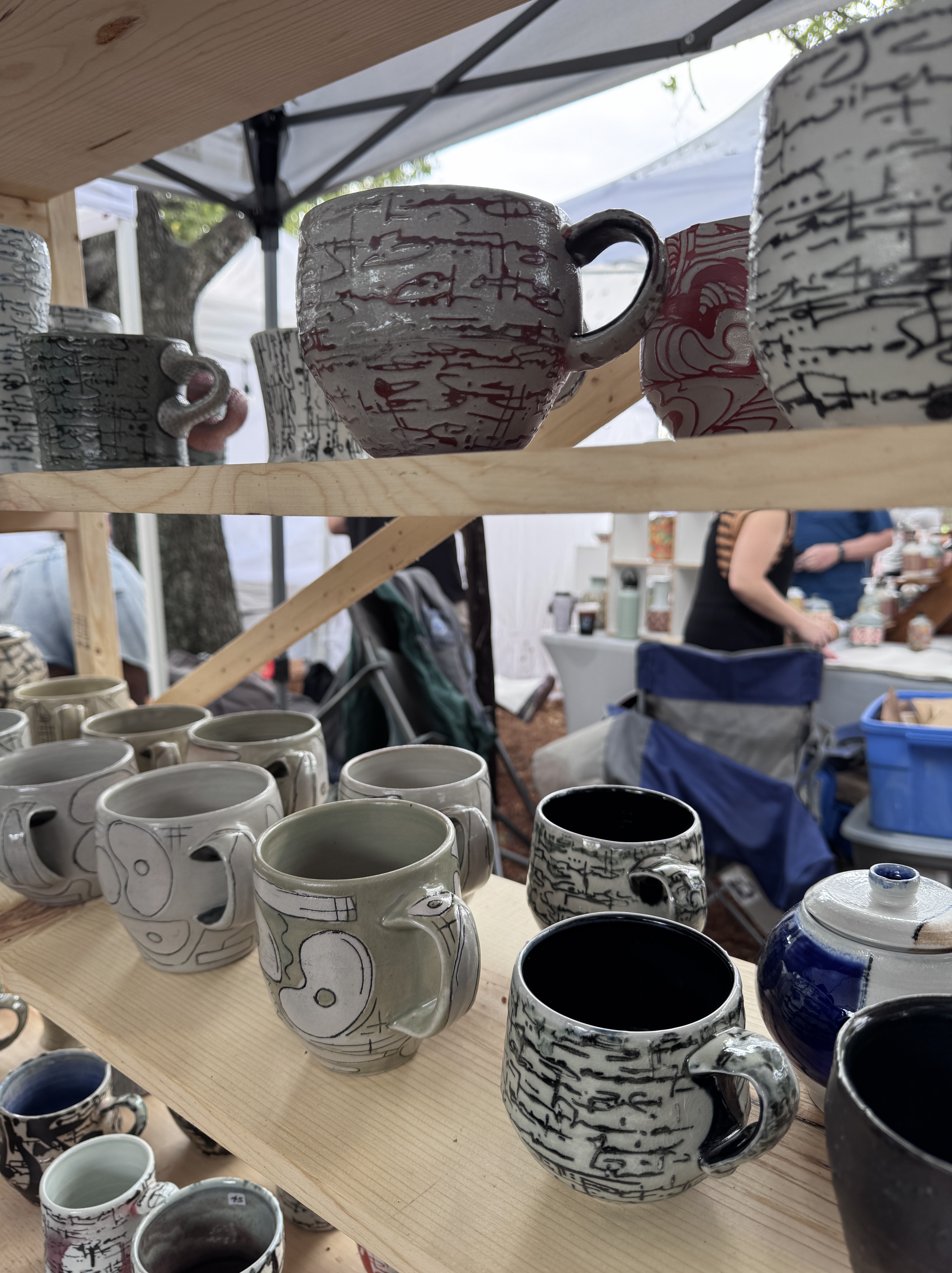
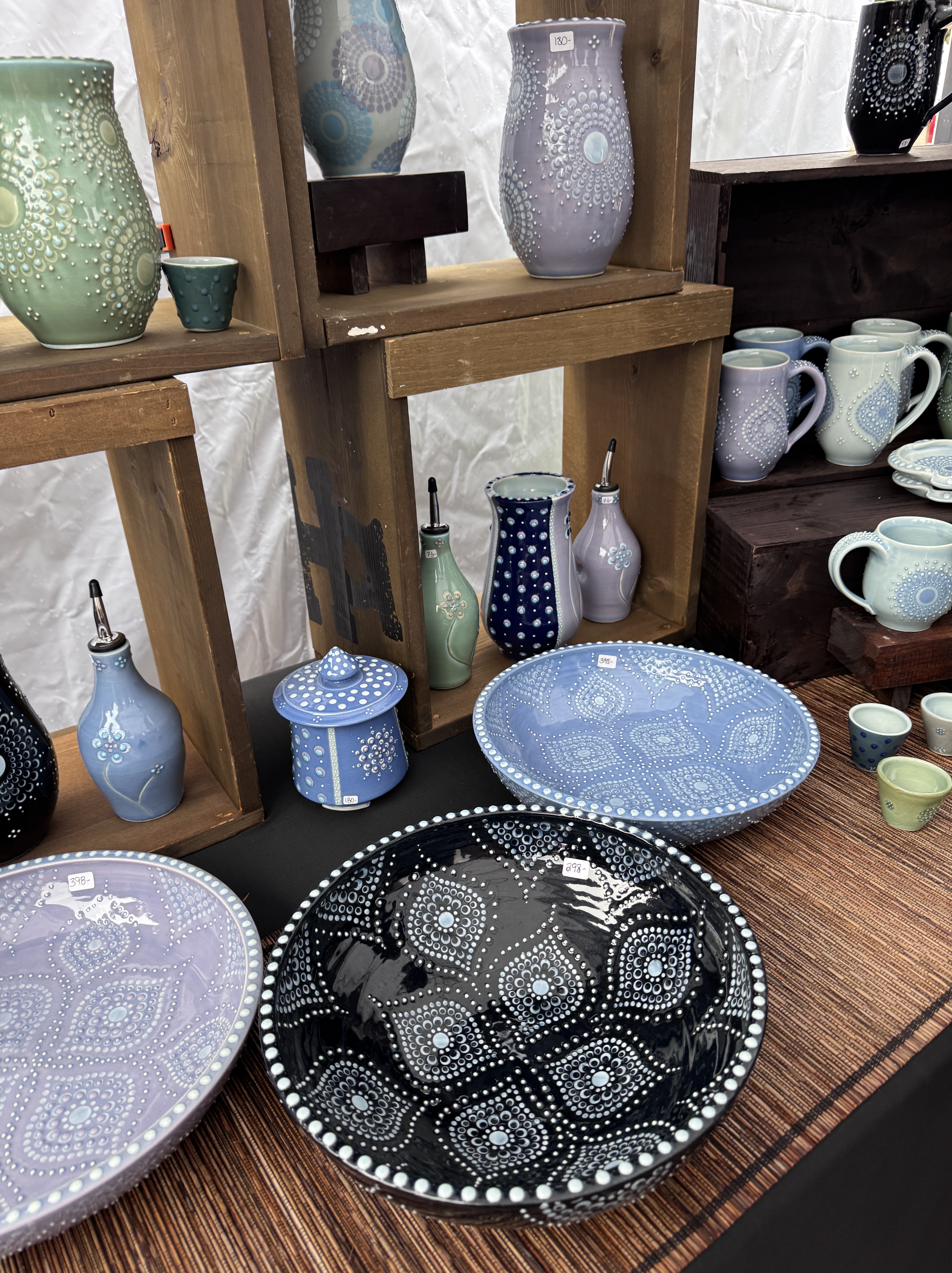
I recently spent a Saturday in Gruene—a historic district of New Braunfels known largely for Gruene Hall, a dance hall famous for hosting iconic musical talents including Lyle Lovett, Lucinda Williams and Willie Nelson. Gruene regularly hosts artist events and attracts people who appreciate art in its many forms. Recently, Gruene hosted the 33rd Annual Texas Clay Festival, an event showcasing the work of 80 talented potters and clay artists.
As I took my time admiring each booth’s offerings, I was moved by the sheer diversity of design and how many ways a single piece of clay could be transformed into something beautiful, something useful, something unique. It felt as though each artist revealed their specific personality through their offerings. For someone who the phrase, “throwing a bowl” means something entirely different, I enjoyed learning about how they practiced their craft. One artist’s style—employing technique and tools similar to Ukranian Pysanky egg etching—caught my eye. I stopped, we chatted, and I fell in love with her work. I’m writing this post while drinking coffee from one of her stunning mugs. Her art continues to brighten my day, and this experience reminds me that art in all its forms, offers an experience.
I’m sometimes drawn to art because of the story behind the piece and the story of the person creating it. For me, those things are all intertwined, connected. Art touches us in a way that’s not easily quantified but deeply resonate. It’s distinctly personal, particularly human.
AI tools have now entered the chat. It can feel discouraging for artists to create in this new era of AI and LLM tools, all claiming to write/design/create better than we can. But can they, really?
I don’t think so.
I can’t imagine those creations will connect with people in the same way. Human created art moves us, stirs something in us, stays with us. AI will likely improve certain aspects of science, automation, engineering, and medicine—which is not something I discount– but art? We need less RAM and more soul.
AI has exacted a particular kind of pressure on those who create for a living. I am one of many authors whose novels and short stories were found in LibGen, a database of pirated works that was used to train Meta’s LLM. I was neither asked nor compensated, and while Anthropic is in the middle of a settlement suit related to their own behaviors, I have little faith that these companies will do better in the future. They’ve shown us who they are. I’m taking Maya Angelou’s advice on this one.
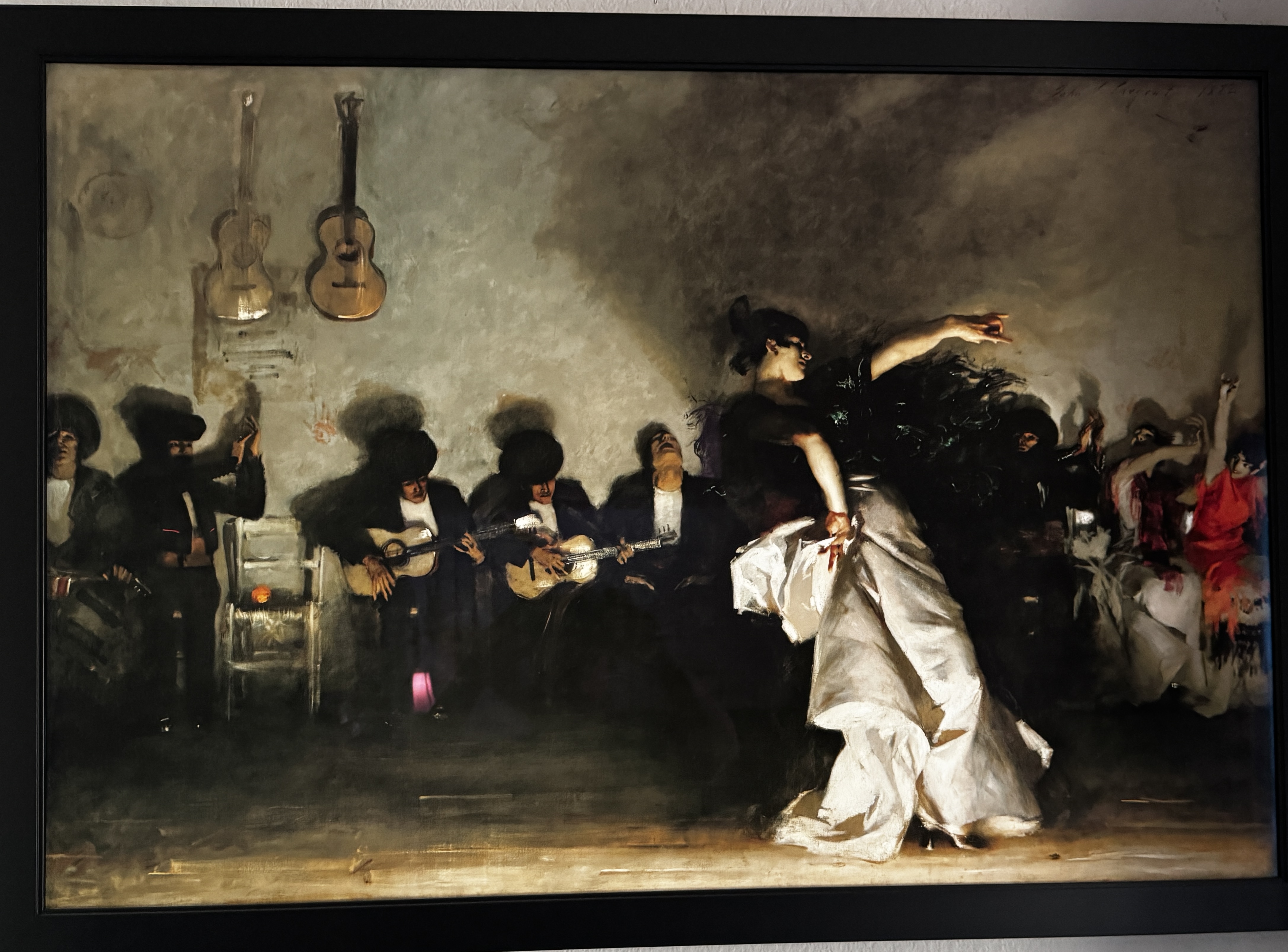
You know those authors whose distinct voice shines in their work (Sara Gran and Tana French)? The musician whose sound and lyrics move you to hit ‘replay’ countless times (Stevie Nicks, Prince, Tom Petty)? The painting that moves you? I still remember the first time I saw Sargent’s El Jaleo at the Isabella Stuart Gardner Museum in Boston. I was deeply drawn to its movement, beauty and scale. Which artists move you and why? And if you’re an artist, what compels you to continue? Whatever it is, keep it close and tend to it often because what you create might be a gift to others.
I’m still writing because it’s what I’ve always done. I don’t know how to stop, nor do I want to. I see the world in stories, and there are still so many characters and places I need to explore. I simply can’t imagine doing anything else. For me, writing a novel is like following a winding trail, filled with side quests and new discoveries. My process is sometimes messy, often imperfect and completely human.
And one more thing—I’ve used the em dash for longer than I can remember and probably more than is recommended. Em dashes aren’t a sign of using LLMs—we were here first. =)
Laura Oles is the award-winning author of the Jamie Rush mystery series. Her work has appeared in crime fiction anthologies, consumer magazines and business publications. Her debut mystery, Daughters of Bad Men, was an Agatha nominee, a Claymore Award finalist, and a Writers’ League of Texas Award finalist. Depths of Deceit, her second novel, was named Best Mystery by Indies Today.She loves road trips, bookstores and any outdoor activity that doesn’t involve running.She lives in the Texas Hill Country with her family.
It’s fall in Paris. The rows of chestnuts flanking the Seine are turning golden-brown; gingko trees sport their distinctive yellow leaves, preparing to fling down, on one afternoon they keep secret, all their leaves at once.
Fall fashion? Long hair for women, slim tan trench coats at mid-calf, midi-length swishy skirts. Anyone can wear jeans and sneakers (male, female, old, young) with a blazer-cut jacket. In the markets, apples from the Garonne (Pixie Pommes!), quantities of mushrooms, cashmere scarves. Kids scurry to school at eight while their older siblings stride down Rue de l’Universite toward Science Po.
I’m forever grateful to Madame, our wondrous French teacher at McCallum High in Austin. On the first trip to Paris over fifty years ago, fresh off the early train, my husband and I stopped at a café where I opened my mouth in fear and trembling to order in French—deux cafes et deux croissants.
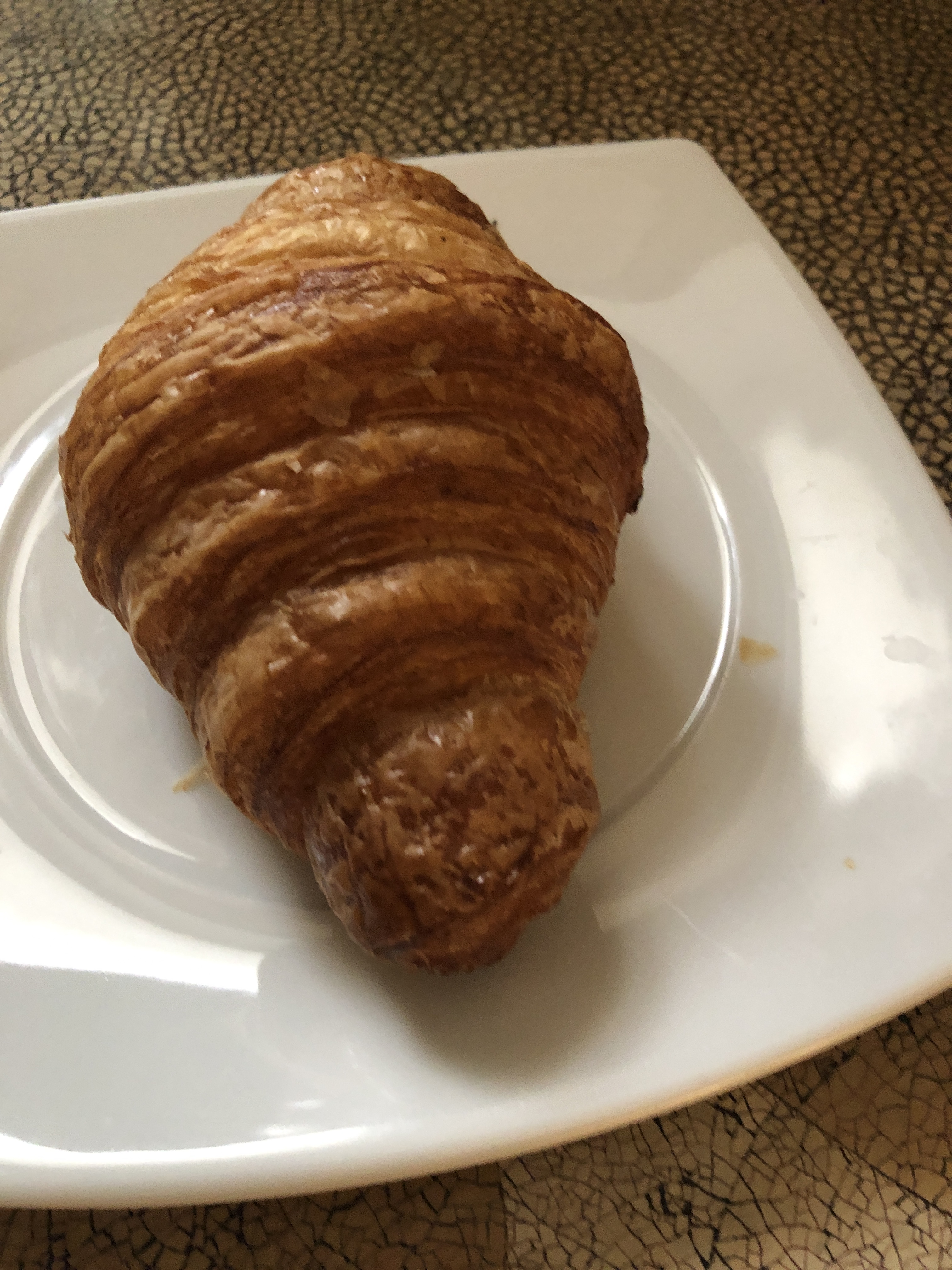
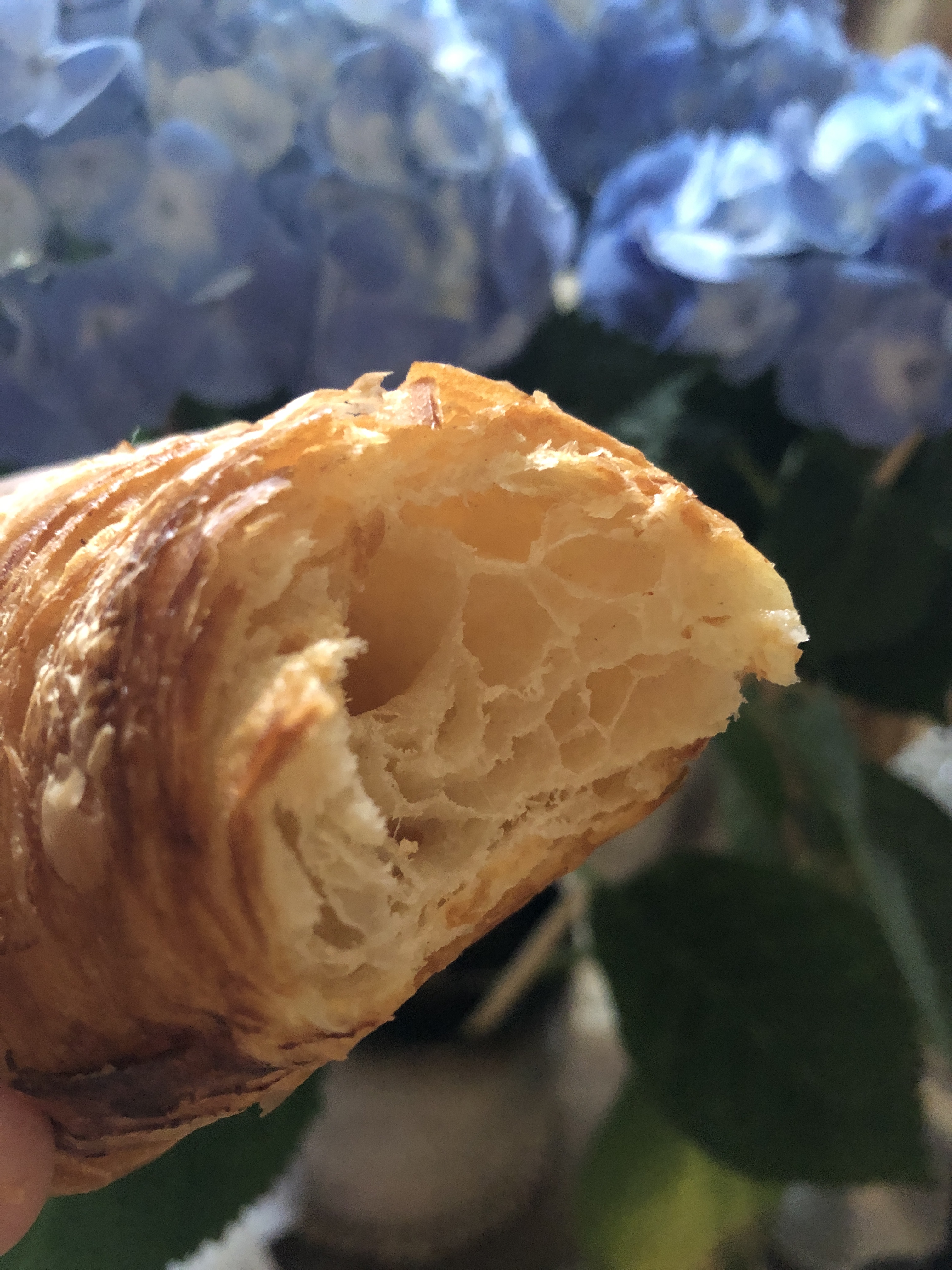
To my shock the proprietor didn’t blink. And the result was magic—our first taste of croissant.
Long past high school I still say “Merci, Madame!” A Parisienne, she had (I believe) a PhD. She maintained perfect class discipline—even with smarty seniors. When anyone asks, how did you learn French? I say, “Madame! She made us sing songs!” https://www.youtube.com/watch?v=96JRl7bER3g&list=RD96JRl7bER3g&start_radio=1
As to “à la Claire Fontaine” I suspect she omitted the first two verses—at least I don’t remember singing about bathing beneath a tree! But this song and the rest we still remember, decades later.
Sur le Pont d’Avignon…Frère Jacques…Alouette, gentille alouette, je te plumerai (le nez, le cou, et la tete, et le dos, etc.). At Christmas, Il est né, le divin enfant. Twisting your tongue around the pretty French words leaves you with life skills.
(She didn’t teach us La Marseillaise. But I still get chills when, in Casablanca, Victor Laszlo leads the crowd at Rick’s in singing it.)
And another beloved teacher taught both Latin and English. She could order grown seniors to race to the blackboard to diagram sentences, and insisted we use proper punctuation.
What was it about those favorite teachers? They made us learn. They brooked no foolishness. They could tell when we faked preparation. They thrust us into difficult novels, demanding paintings, complex unfamiliar music. Hitherto hidden histories. Concepts we hadn’t invented or come upon by ourselves.
Maybe we did learn. Maybe—that learning is worthwhile.
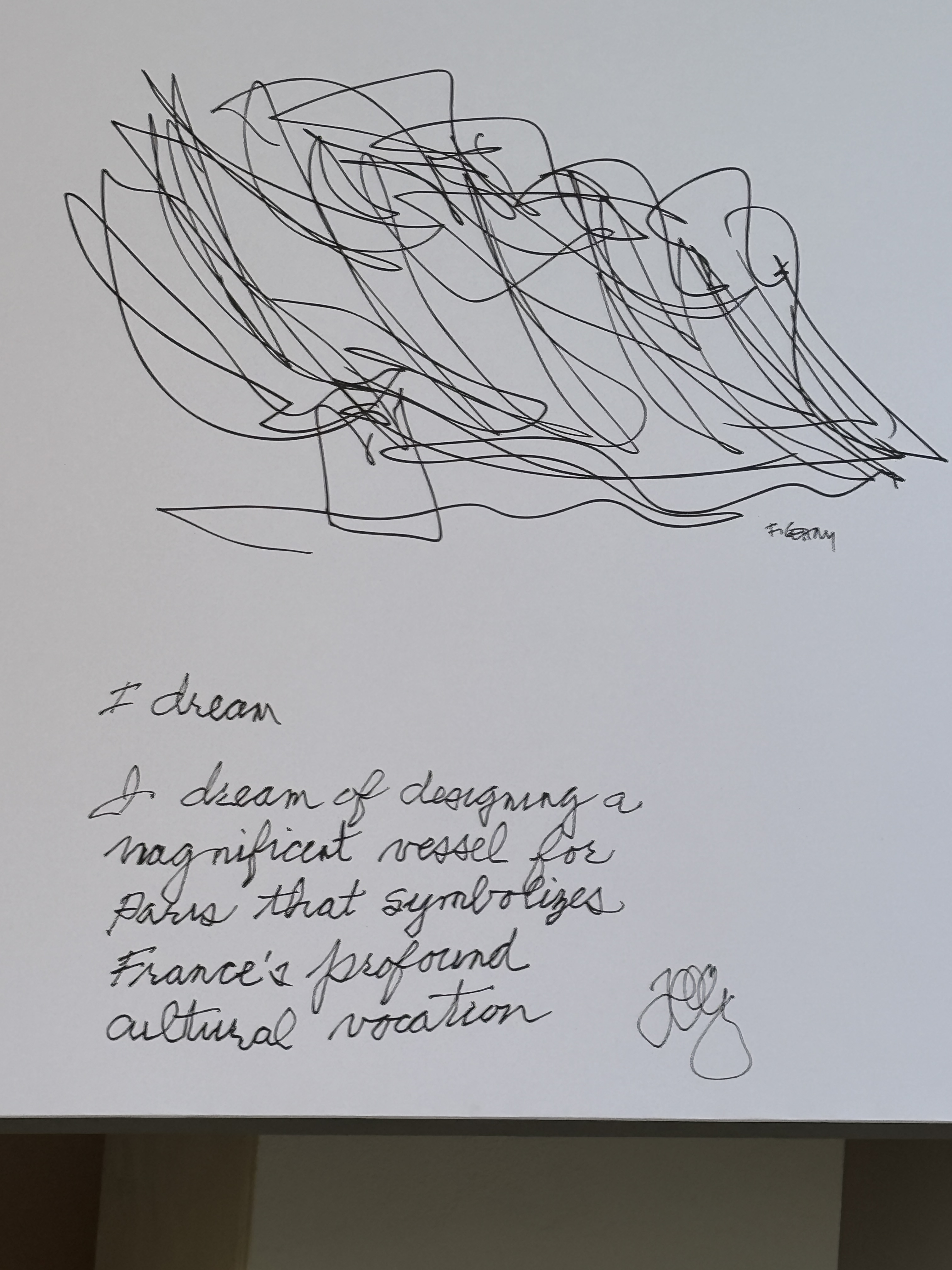
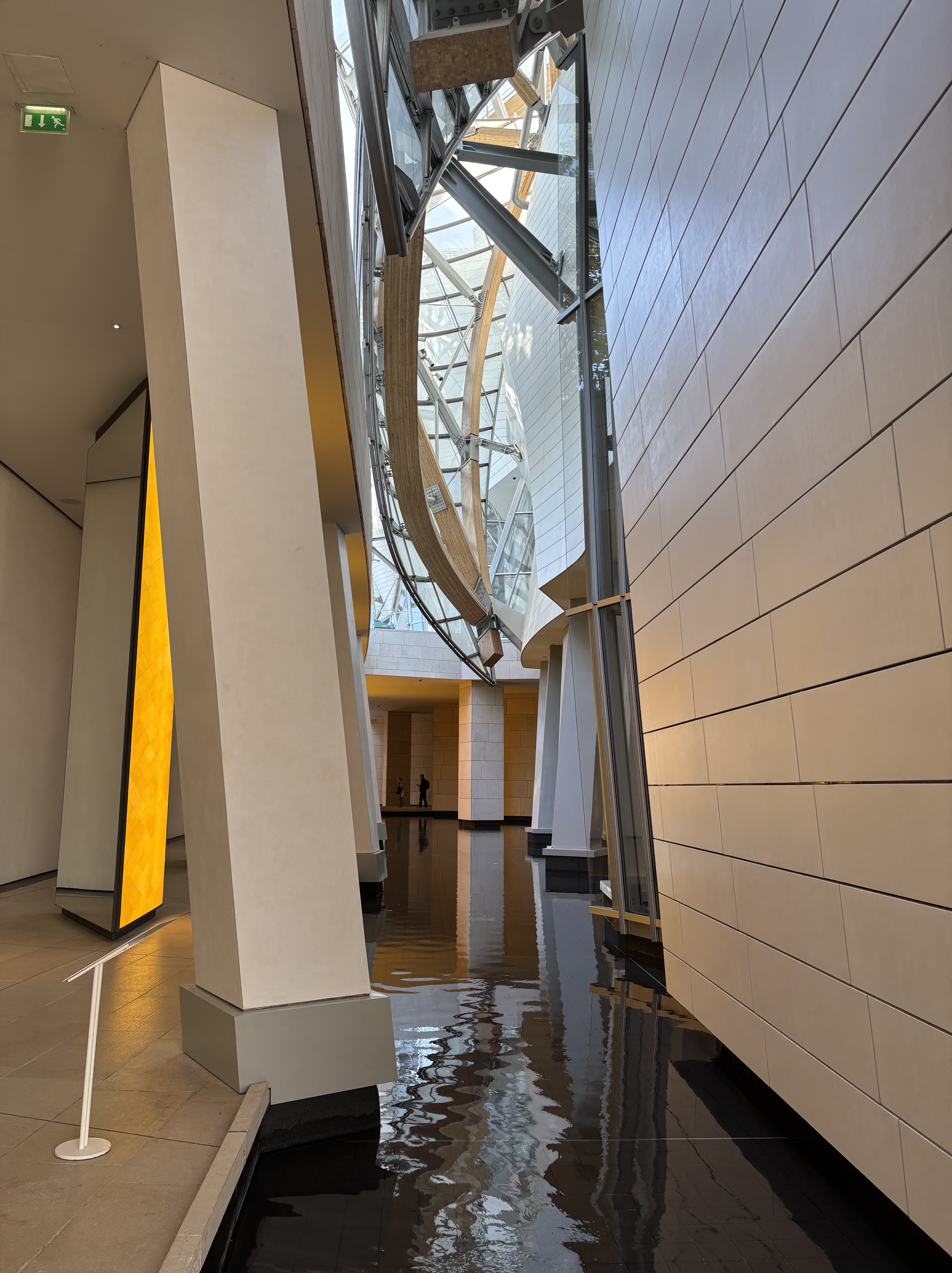
Yesterday we visited La Fondation Louis Vuitton to visit what architect Frank Gehry dreamed of as an iceberg with sails.
Curves, lines, water, wood… magical in their power.
The building invites you to wander and wonder. What imagination, what creativity, what a vision! I listened to the rippling water traveling down the slope—the sound took over. Couldn’t hear traffic, or talking. Just the water–in the middle of a vast city. Being there takes you back to Roman stonework (rectangles, arches, roads in straight lines), and then to the power of curved sails, moved by wind and water. People working there seemed quietly confident that visitors should and would be (but not literally) blown away.
READING: I’m very much enjoying Susan Wittig Albert’s Thyme, Place & Story website where she is now serializing the first China Bayles book–A Bitter Taste of Garlic. Many of us are fans of this series, and would be delighted to visit China’s herb shop in a town not far from Austin…!
I just finished Mick Herron’s Down Cemetery Road. I found it much scarier than the Slow Horses novels…but still wanted to know the ending. It was published over 20 years ago and apparently will be streaming in October.
On the flight over I was reading Graham Robb’s France, including some tales of Paris that were scarier than Down Cemetery Road. Like being the butt of your buddies’ jokes and winding up as a prisoner in Fenestrelle, a political prison during the Napoleonic era. https://fr.wikipedia.org/wiki/Forteresse_de_Fenestrelle
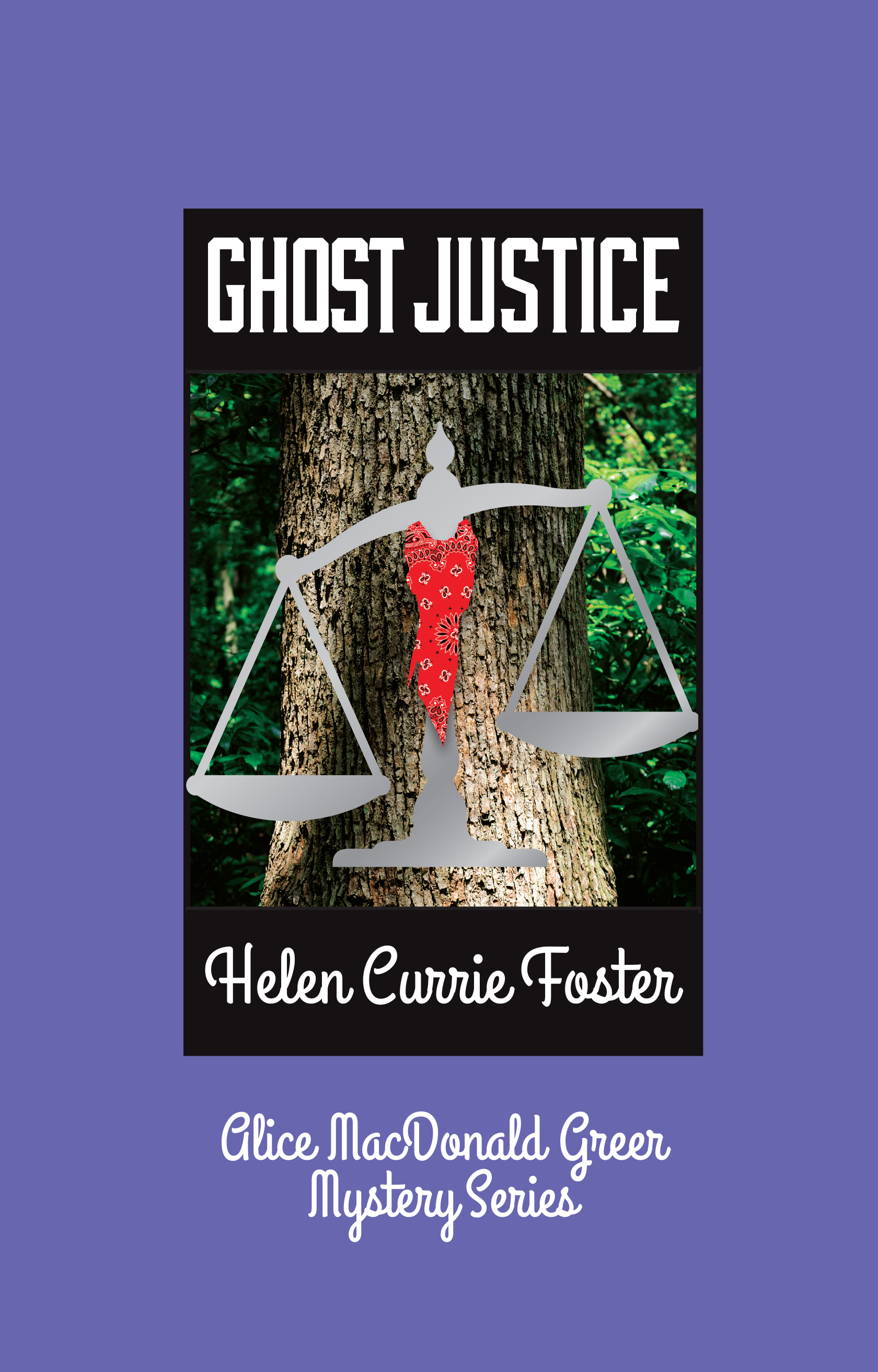
Meanwhile, at home, Ghost Justice is now out! Book 10 in my Alice MacDonald Greer Mystery Series set in the Hill Country. Available at BookPeople on Lamar Blvd. in Austin https://bookpeople.com/ and on Amazon. https://amzn.to/4pk8WQO
Hope you’ll enjoy it!
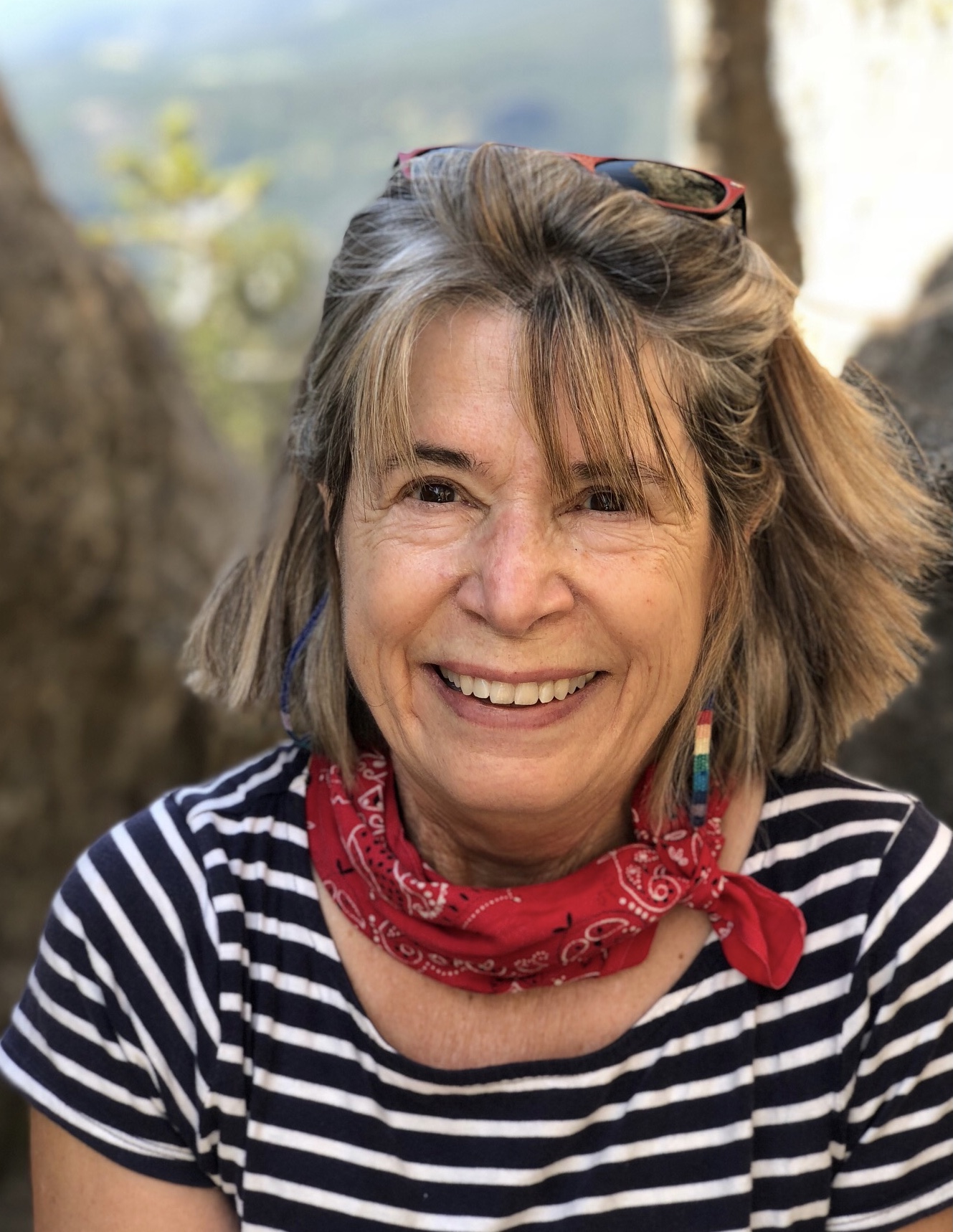
Helen Currie Foster lives and writes the Alice MacDonald Greer Mystery Series north of Dripping Springs, loosely supervised by three burros. She’s drawn to the compelling landscape and quirky characters of the Texas Hill Country. She’s also deeply curious about our human history and prehistory and how, uninvited, the past keeps crashing the party. Follow her at http://www.helencurriefoster.com.
Ideas for stories are often triggered by research into family members, alive or deceased, strangers and their stories and the histories of different cities, countries, and states. The information may never appear in a book, but it gives the writer a more profound sense of historical events that color the author’s senses. And of course, the older the city, town, or state, the deeper the hidden gems that may be found.
My short story, “The Runaway Pin Boy,” was inspired by my immigrant uncle, circa 1926, who ran away from home and worked as a pin boy in the New York City Bowery until his father (my grandfather) found him. What was life like for pin boys, often called pin monkeys? The research took me from the Bowery in New York City, where it began, to the development of the sport and bowling alleys across the nation.
Then, of course, there was the period of prohibition, another explosive, compelling time in history, giving birth to the private, secret clubs called speakeasies. Lest we think speakeasies were exclusively in big cities like New York, Austin, Texas, had its own. Some are still in operation, such as the well-known Prohibition ATX on Anderson Mill Road, which is jazzy and more modern-looking than its forerunner. The Midnight Cowboy, an old brothel masquerading as a massage parlor, is now one of the oldest speakeasies in Austin.
The unlikely combination of a ballet dancer, an old Victorian house in Austin, and the myth of Confederate gold inspired much of Two Wolves Dancing. None of the American Civil War’s hidden treasures, however, have been found or confirmed to exist, including the gold Jefferson Davis supposedly hid when fleeing the Union in 1863. There is still an ongoing dispute about what happened to gold bars that vanished near Dents Run, Pennsylvania, on their way to the U.S. Mint. There is one find that may keep treasure hunting for Confederate gold alive for generations to come: The Great Kentucky Hoard. In 2023, an anonymous person using a metal detector discovered 700 Civil War-era gold coins buried in a cornfield in Kentucky. The hoard was confirmed and the coins authenticated by numismatic authorities.
As a native New Yorker who used the New York City subway system extensively, it was the stories of the hidden subway tunnels that triggered my imagination once again. While a myth of an immense hidden treasure from the turn of the 20th century does not exist in the subways of New York, there is one gem: The Subway Garnet.
In 1885, while excavating for a sewer line beneath West 35th Street, a worker dug up a massive, red-brown garnet weighing almost 10 pounds. Initially, the rock was used as a doorstop by the Department of Public Works until its identity and its value were eventually recognized by a geologist. Now, it is housed at the American Museum of Natural History.
The secrets, legends, and urban myths of the subway system are old and many. There’s the story of the pneumatic subway, constructed in the 1860s by inventor Alfred Ely Beach, beneath Broadway. Eventually, the project was abandoned and the entrance sealed. Decades later, when building the modern subway, excavators broke through and found the abandoned railcar.
The abandoned City Hall station, opened in 1904, was considered the crown jewel of the first subway line. It was closed in 1945 due to its sharp curve and low ridership, but myths of its secrets persist. Today, riders on the Number 6 train can sometimes catch a glimpse of the ornate station as the train turns around. Then there’s Track 61.
Now abandoned, Track 61 lies beneath Grand Central Terminal, running to the Waldorf Astoria Hotel. President Franklin D. Roosevelt’s custom five-car train platformed there, allowing him to enter and exit the hotel discreetly, keeping his paralysis out of public view.
And what would Urban legends and myths be without the Mole People: Dwellers who created shantytowns in abandoned tunnels. And ghost stories are a must, and so are ghost trains. Rumors persist of a phantom train that can sometimes be seen in the Astor Place station. One theory suggests the ghost train is the private car, called the Mineola, of August Belmont Jr., the financier of the first subway line, who used it to transport guests to his racetrack. Ghostly pets also have their place in the underground. Due to its connection with FDR and his dog, Fala, legends claim that the terrier’s ghost still haunts Track 61, where the dog used to accompany its master.
And so with all of these histories, stories, and myths in a nation that hasn’t been in existence for quite 250 years, how much more can we imagine from ancient empires?
In book four of the Housekeeper Mystery Series, Mrs. B., and her boss, Father Melvyn decide to take a group to Rome Italy, to study the lives of the early Roman Christians, and find themselves in the middle of a theft and murder surrounding the discovery of an ancient cross that might have belonged to Miltiades, the first bishop of Rome, in the 4th century, when Christianity was illegal and punishable by death. The legend: a special cross, was made by Emperor Constantine, in 312 A.D. after his victory at the Milvian Bridge. He had a vision of the symbol of the cross, accompanied by the words, “In this sign you will conquer,” and he did. This was the turning point for Christianity, and the beginning of the myth that a gold cross studded with gems was gifted to Miltiades, to be passed down to each succeeding prelate. But the cross disappeared and didn’t resurface in Rome until Mrs. B. and Father Melvyn arrived. The question is, why, and who would kill for this cross?
To find the answers, watch for Murder in the Cat’s Eye coming by the end of 2025.
Meanwhile, happy historical explorations and happy reading.
I’m working on a mystery novel—I’ve been working on it for years, but am now seeing the light at the end of the tunnel—and am faced with dilemmas too numerous to whine about in only one post, so I’ll move along.
I will instead write about the one pleasure of the writing life: creating and naming characters.
My novel is set in a little town very like my own hometown. I don’t base my plot on real events, and I don’t use real people as characters—with one exception: Steve Dauchy.
Not Steve, but close
Note: One of my readers, Dr. Cullen Dauchy, knows more about Steve than I do, especially about his early life, and I hope he’ll feel free to correct any errors.
Steve Dauchy was a career blood donor at Katy Veterinary Clinicin Katy, Texas. On retirement he moved to Fentress, where he lived with his veterinarian-owner’s parents, Joe and Norma Dauchy. Joe and Norma lived next door to me; in local terms, next door meant that my house was on one corner, then there was a half-acre “patch” of pecan and peach trees and grass and weeds, then a street, and then on the next corner, the Dauchy yard and their house. The point being that when Steve visited me, he didn’t just stroll across a driveway.
Joe was my dad’s first cousin, so I guess that makes Steve and me second cousins. I have a lot of cousins on that side of the family, although most are human.
Steve is a family name, with a story behind it. As I understand it, back in the ’20s or ’30s, my Great-uncle Cull (Joseph Cullen Dauchy, Sr.), enjoyed listening to a radio program about a Greek character who frequently spoke of “my cat Steve and her little cattens.” Uncle Cull was so amused by the phrase that he named a cat—probably one of the barn cats—Steve. And for the next forty or so years, he always had a cat named Steve.
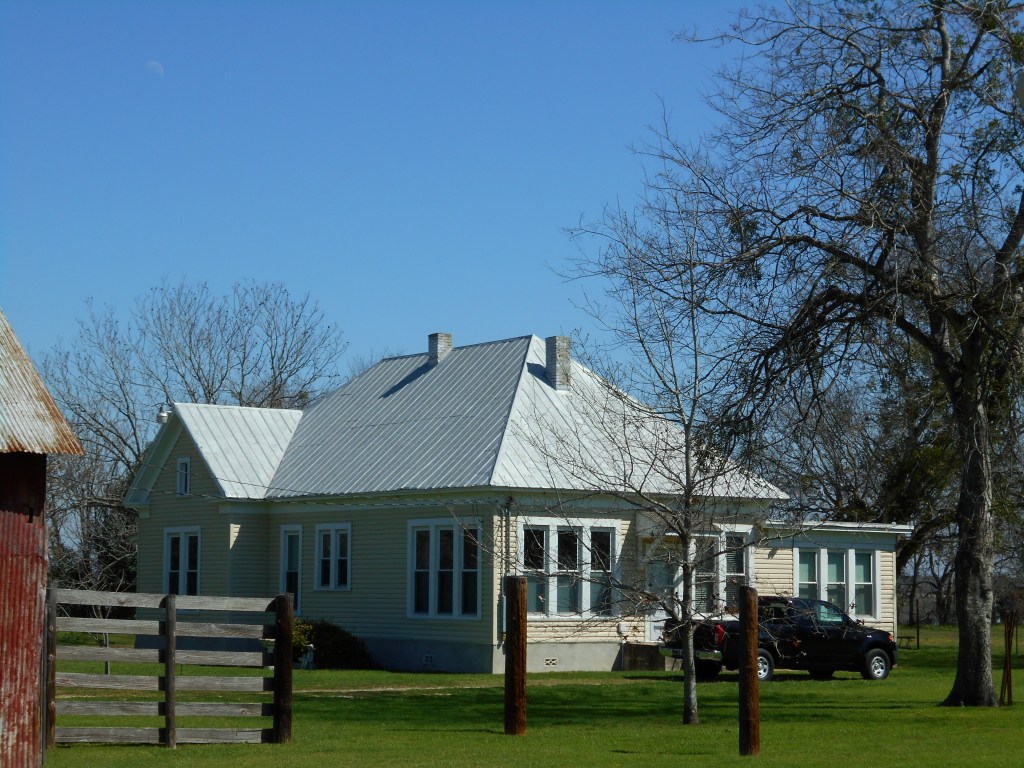
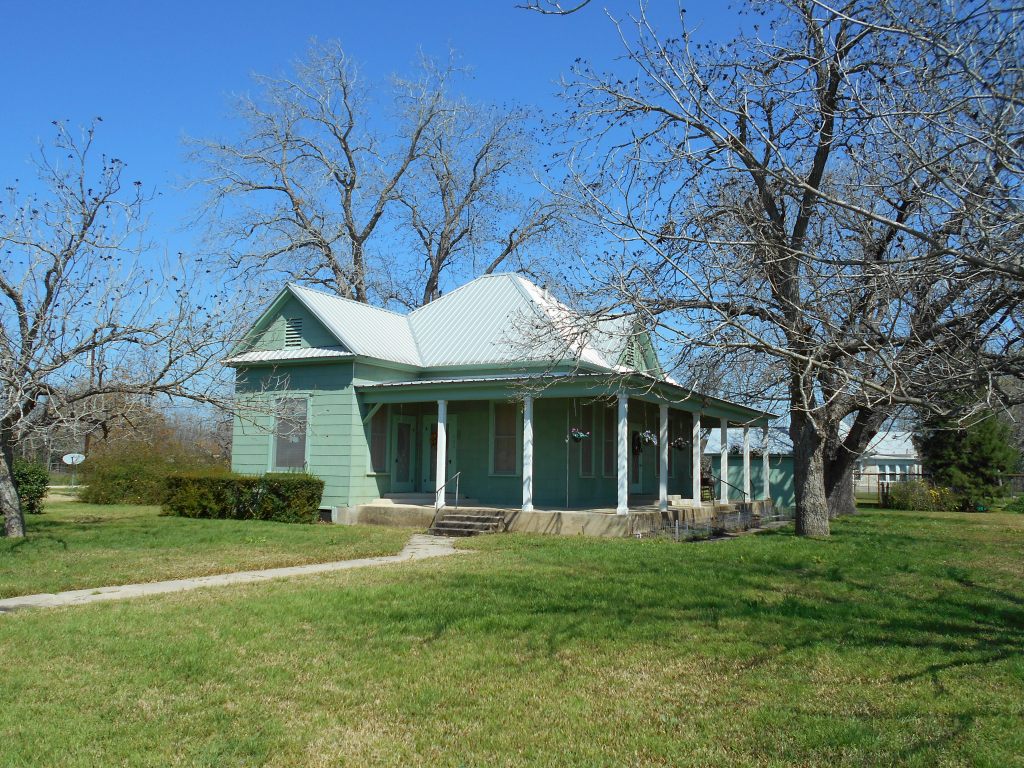
Uncle Cull and Aunt Myrtle Dauchy’s house, home of the first Steves
So when the clinic cat became part of the Uncle Cull’s son and daughter-in-law’s family, he became the latest in a long line of Steves.
How to describe Steve? He was a fine figure of a cat: a big tabby, deep orange, with an expression of perpetual boredom. His reaction to nearly everything translated as, “Meh.” I’ve heard that’s common among clinic cats.
Once when Steve was standing on my front porch, the neighbor’s Great Dane got loose and charged over. I was frantic, shouting at the dog, shouting at Steve. But when the dog hit the porch, Steve just looked up at him. Dog turned around and trotted home.
Some would say Steve was brave, and I’m sure he was. But I believe his grace under pressure had its roots elsewhere.
First, he had experience. He knew dogs. In his former employment, he’d observed the breed: big, little, yappy, whining, growling, howling, cringing, confined to carriers, restrained by leashes, sporting harnesses and rhinestone collars, hair wild and matted, sculpted ‘dos and toenails glistening pink from the OPI Neon Collection. He’d seen them all. He was not impressed.
Facing down a Great Dane, however, took more than experience. There was something in Steve’s character, an inborn trait that marked him for greatness: his overarching sense of entitlement. He was never in the wrong place at the wrong time. My porch was his porch. The world was his sardine.
Except for the kitchen counter. Steve thought kitchen counters were for sleeping, but Joe and Norma’s maid didn’t. Consequently, he stayed outside a lot. He took ostracism in stride and used his freedom to range far and wide. Far and wide meant my yard.
Steve’s house
At that time I had three indoor cats—Christabel, Chloe, and Alice B. Toeclaws—and a raft of outdoor cats. The outdoor cats started as strays, but I made the mistake of naming them, which meant I had to feed them, which meant they were mine. Chief among them was Bunny, a black cat who had arrived as a teenager with his gray-tabby mother, Edith.
One day Bunny, Edith, and I were out picking up pecans when Steve wandered over to pay his respects, or, more likely, to allow us to pay our respects to him. Bunny perked up, put on his dangerous expression, and walked out to meet the interloper. It was like watching the opening face-off in Gunsmoke.
But instead of scrapping, they stopped and sat down, face to face, only inches apart. Each raised his right paw above his head and held it there a moment. Next, simultaneously, they bopped each other on the top of the head about ten times. Then they toppled over onto their sides, got up, and walked away.
That happened every time they met. Maybe it was just a cat thing, a neighborly greeting, something like a Masonic handshake. But I’ve wondered if it might have had religious significance. Bunny was a Presbyterian, and Steve was a Methodist, and both had strong Baptist roots, and although none of those denominations is big on ritual, who knows what a feline sect might entail?
Steve had a Macavity-like talent for making himself invisible. Occasionally when I opened my front door, he slipped past and hid in a chair at the dining room table, veiled by the tablecloth. When he was ready to leave, he would hunt me down—Surprise!—and lead me to the door. Once, during an extended stay, he used the litter box. Christabel, Chloe, and Alice B. Toeclaws were not amused.
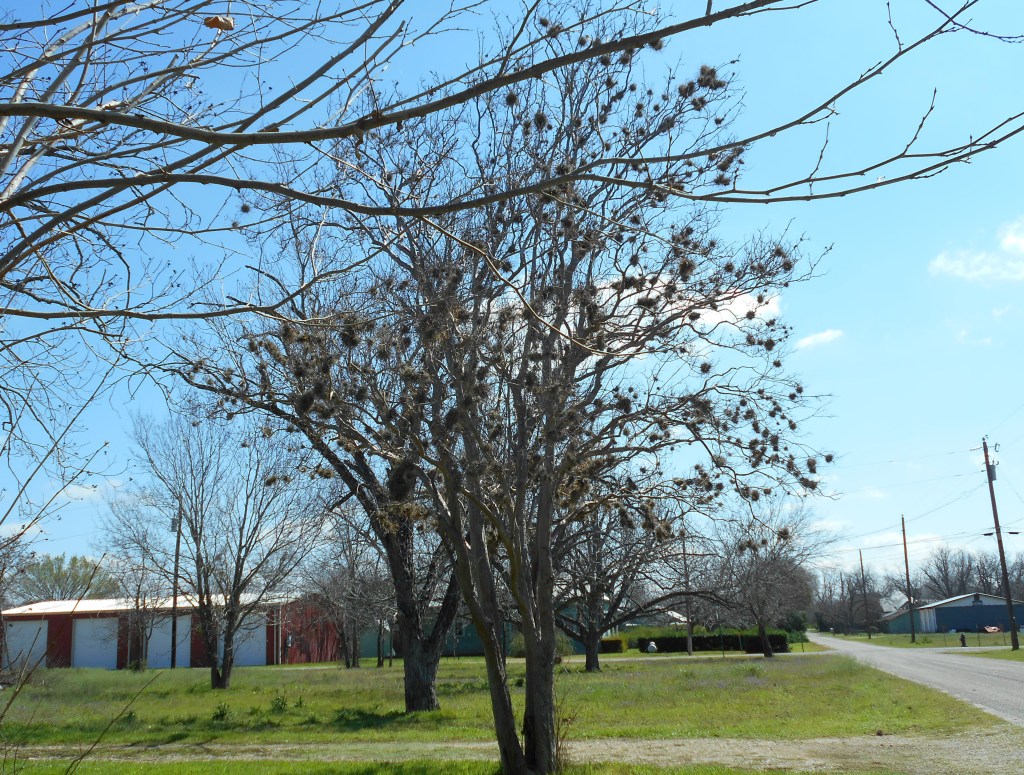
Distance Steve traveled between his house and mine. His house is way over there behind the trees.
Invisibility could work against him, though. Backing out of the driveway one morning, I saw in the rearview mirror a flash streaking across the yard. I got out and looked around but found nothing and so decided I’d imagined it. When I got home from work, I made a thorough search and located Steve under my house, just out of reach. I called, coaxed, cajoled. He stared. It was clear: he’d been behind the car when I backed out, I’d hit him, and he was either too hurt to move or too disgusted to give me the time of day.
It took a long time and a can of sardines to get him out. I delivered him to the veterinarian in Lockhart; she advised leaving him for observation. A couple of days later, I picked him up. Everything was in working order, she said, cracked pelvis, nothing to do but let him get over it.
“Ordinarily,” said the vet, “I would have examined him and sent him home with you the first day. I could tell he was okay. But you told me his owner’s son is a vet, and I was afraid I’d get it wrong.”
Although he was an indoor-outdoor cat, Steve managed plenty of indoor time at his own house, too, especially in winter, and when the maid wasn’t there. One cold day, the family smelled something burning. They found Steve snoozing atop the propane space heater in the kitchen. His tail hung down the side, in front of the vent. The burning smell was the hair on his tail singeing. They moved him to a safer location. I presume he woke up during relocation.
At night, he had his own bedroom, a little garden shed in the back yard. He slept on the seat of the lawnmower, snuggled down on a cushion. Except when he didn’t.
One extremely cold night, I was piled up in bed under an extra blanket and three cats. About two a.m., I woke up to turn over—sleeping under three cats requires you to wake up to turn over—and in the process, reached down and touched one of the cats. It was not my cat.
I cannot describe the wave of fear that swept over me. It sounds ridiculous now, but finding myself in the dark with an unidentified beast, and unable to jump and run without first extricating myself from bedding and forty pounds of cat—I lay there paralyzed.
Unnecessarily, of course. The extra cat was Steve. He’s sneaked in and, considering the weather forecast, decided that sleeping with a human and three other cats in a bed would be superior to hunkering down on a lawnmower.
Steve’s full name was, of course, Steve Dauchy. In my book, he will be Steve MacCaskill. MacCaskill was the name of a family who lived next door to my Aunt Bettie and Uncle Maurice. Their children were friends of my father and his brothers and their many cousins. They were a happy family.
“My family had to plan everything,” my dad’s cousin Lucyle Dauchy Meadows (Steve’s aunt) told me, “but the MacCaskills were spontaneous. If they decided they wanted to go to a movie, they just got into the car and went to a movie.” When Lucyle and the other girls helped their friend Mary Burns MacCaskill tidy her room before the Home Demonstration Agent came to examine it, one of the first things they did was to remove the alligator from the bathtub.
I heard so many delightful stories about the MacCaskill family that I decided they were too good to be true. Then, at Aunt Bettie’s 100th birthday party, my mother introduced me to Mary Burns MacCaskill, who had traveled from Ohio for the party.
So as an homage to that family, I’ve named my main character Molly MacCaskill. And when choosing a pet for Molly, I couldn’t choose a finer beast than Steve.
*
Note: Cullen Dauchy no longer owns Katy Veterinary Clinic, but he did when Steve worked there, and the clinic was Steve’s first home, so I’m leaving the link.
And I’m so glad the Home Demonstration agent didn’t inspect bedrooms when I was a girl. I didn’t have an alligator, but she might have thought I had something worse.
***
This post first appeared in Ink-Stained Wretches in 2021.
***
Kathy Waller blogs at Telling the Truth, Mainly. She has published short stories, and a novella co-written with Manning Wolfe. She is perpetually working on a novel.
When people talk about Bouchercon, especially in New Orleans, they usually share stories of late nights, legendary meals, bustling crowds, powdery beignets, and lots of alcohol.
That wasn’t my week.
But the funny thing is—I still accomplished exactly what I went to do.
My panel, Wide Open Spaces, with Craig Johnson, Bruce Borgos, Jeff Ayers, George Wilhite, and moderated by the lovely Sylissa Franklin was a highlight. The conversation flowed, and the audience was engaged. I made them laugh a few times and even got a gasp. So, mission accomplished. I walked away feeling like I’d contributed something worthwhile.
I also got to meet Clay Stafford in person and thank him for publishing my short story, Under The Blackjack Tree, in Killer Nashville Magazine. (The story that was chosen by John Grisham and Otto Penzler for The Best Mystery Stories of the Year 2025, which is still surreal to me. (Coming out next week!) Stafford’s keynote, The Story That Saved Me, was “cry for crime writers and readers to remember why stories of darkness and redemption still matter—and why telling the truth on the page can save us, too.” Honestly, it was one of the most inspiring talks I’ve heard in a long while. Glad I went.
Another highlight was finally meeting Otto Penzler in person. I thanked him for the opportunity, and he graciously signed my copy of the anthology. A small moment, but one I’ll carry with me.
At the end of most days, I met up with Laura Oles in the hotel/lounge bar. (It was so noisy all of the time!) We compared notes at the end of the day—who we’d seen, what panels had sparked ideas. She was on a terrific panel herself, Dialogue Matters: Slang, Concise, or Verbose? The group dug into how dialogue can reveal character and control pacing, which is something that I’m always working on.
I also loved being in the audience for Sweet Tea with a Splash of Crime: The Southern Influence, with Ace Atkins, S.A. Cosby, and other writers who captured both the grit and taste of Southern literature, and where it’s headed. Another standout was Killing Your Darlings, with Penzler and Donald Maass, which was a sharp reminder that ego doesn’t belong in the editing room if the goal is to make the story better.
And one of my favorite unexpected moments? Donald Maass allowed me to join him for lunch one afternoon. We had a thoughtful conversation about Writer Unboxed, an organization we’re both part of, about writing in general, and drawing inspiration from real life,. It was simple but memorable, the kind of connection that lingers long after the conference ends.
So no, this wasn’t a Bouchercon of big parties or long nights on Bourbon Street. But it was a Bouchercon where I hit my goals, connected with people who matter to me, and left with a few new insights and ideas. Sometimes the quieter wins are the ones that last.
It’s September! New school year! New shoes, after a hot barefoot summer! New outfit, for the first day of school! And then––new classes! New subjects, new teachers, new tools! New friends! New lockers, new classrooms, new hallways…. New season—new teammates, new coach, new plays.
Remember all that? Your first day back at school? Back to college, back to university? Do you remember the excitement, the nervousness, the anticipation?
September 1 was Labor Day. And now there will be apples, apple pie and apple crisp. There will be chrysanthemums, spilling out of baskets. Even in central Texas, leaves will change color—as Maxwell Anderson’s lyrics have it, “When the autumn weather turns the leaves to flame.” Here in the Hill Country, sumac and Spanish oak turn red, sweet gum turns yellow. No, not the glory of the maples, but a change in the landscape. Because finally, after the dog days of summer, that’s what September brings: something new.
It’s time to pull up the tired summer flowers and thank them for their service. Time to dig some holes and plant new trees, and order some bulbs. I’ll be planting the Mexican plum seedlings a friend gave me, and ordering narcissus bulbs for indoor blooming.
Then the Hill Country brings its own fall excitement. Dove season began September 1 and a down-the-road neighbor, disturbed by shotgun pellets clattering onto her roof, had to call the sheriff, and have officers explain to a clueless (thoughtless? lawless?) neighbor that it’s contrary to law to allow your ammunition to cross your own fence line. Also unneighborly. But hmm, that could find its way into a future book plot….
Our Hill Country holds surprises. One is the way water hides in the Hill Country—down in secret seeps and creeks, around curves and hollows. And what odd creatures live out here! For example, this fall we’ve seen again the rare and secretive rock squirrel. (We’ve seen a solitary rock squirrel only once every few years.) We’ve heard the great horned owls that call at night, up and down the creek, and the herons who call, flying down the valley. The buzzards drone, annoyingly, from the tops of telephone poles. We treasure glimpses of the shy, gorgeous painted buntings who appear briefly at the bird feeder, then flit away. Porcupines visit. Roadrunners dart across the road.
And the dog days are over. (This year they were July 3-11, and these hot sultry days have borne their name from ancient times ostensibly because it’s when Sirius, the Dog Star that accompanies Orion, rises with the sun.) https://www.almanac.com/content/what-are-dog-days-summer
But during the dog days I took refuge at night, binge-reading two mystery series that were new to me, by British author Peter Grainger: the DC Smith Investigation series and the Kings Lake Investigation. http://bit.ly/4gmPsad
These wry British procedurals are set on the coast of Norfolk, providing a cool and rainy ocean-side backdrop for the appealing characters. At least I could read about rain and cool breezes. But the books offered not only a respite from ridiculous heat, but a welcome respite from writing. I’ve been in the last weeks of finishing Ghost Justice—Book 10 in my Alice MacDonald Mystery Series, set here in the Texas Hill Country. For me that process includes waking in the wee hours with my mind on plot additions and subtractions, dialogue, characters. For such moments—when the characters wake me up at night voicing their further demands (yes, they seem to come to life and require conversation and attention)––I find mysteries provide absorbing distraction.
Helen Currie Foster lives and writes the Alice MacDonald Greer Mystery series north of Dripping Springs, Texas, loosely supervised by three burros. She’s drawn to the compelling landscape and quirky characters of the Texas Hill Country. She’s also deeply curious about our human history and how, uninvited, the past keeps crashing th eparty. Follow her at http://www.helencurriefoster.com.
According to BondVet.com, cats are among themost intelligent creatures on the planet. Scientists believe that cats are uniquely smart when compared to dogs and other animals, which makes it understandable that, like their human counterparts, cats have witching hours. (PetMed.) During those episodes, which generally take place at dusk or dawn, felines may suddenly have bursts of extra energy and display athletic and agile abilities.
In addition to watching my cat, Miss Millie, run, jump and stare at objects or minuscule insects that I either can’t see or don’t exist, I learned that she, to my amazement, could leap four feet up from one piece of furniture to a higher surface. (Now her middle-aged spread has reduced her airtime). And yes, I did measure the distance!
Millie has given us a few spooky behavior episodes of the midnight crazies too. She jumps on my bed at 3 a.m., stands on my chest, pokes her cold, wet nose against mine, and stares into my closed eyes, willing me to open them. On one occasion, she then ran repeatedly to the back door and shoved her head under the window covering to stare out at the back deck. Perhaps at real live prey beyond her reach. How frustrating for her, and no, I didn’t open the door and let her out! Fortunately, those episodes are few and far between since she then settles down and takes intermittent naps during the day—a luxury I don’t have. To be clear, my Millie cares not a whit for what the experts say. Her most frequent witching hour occurs almost daily between three and four in the afternoon – my time to sit and read. It’s also her way of showing who’s the boss. Hey, human, forget the book. Look at me. She runs, jumps, pounces on invisible prey (invisible to me), and she will often roll onto her back at my feet and stare up at me with shiny eyes that challenge. Try and stop me.
Suggested ways to manage these activities include creating climbing areas – but she already climbs on everything. Create hiding spots and exploration zones. Miss Millie knows every inch of this house. I think she knows spots I have not yet discovered, and she can squeeze herself into narrow spaces between furniture and the walls that amaze me. I know she has bones, but sometimes I wonder if they become cartilaginous.
Especially fascinating is how she rules, or should I say communicates. If I’m at my computer in the late afternoon, we have a problem. According to her time clock, I should be in the kitchen at that hour, taking out food groups to prepare for dinner. So, to move me, she jumps on my lap, proceeds to purr, and opens and closes her paws on my legs, kneading them as one kneads bread dough. And if I don’t acquiesce fast enough, she nips my forearms. I have even warned that I’d send her to the cat-sausage factory if she doesn’t stop, but Millie is immune to my empty threats.
“Maybe she just wants some attention and affection,” said my husband. Sounds reasonable, right? Wrong. Miss Millie will have none of that. She turns her head, stares into my eyes, gives a warning growl, nips my forearm, then jumps down and runs to the kitchen as if to say, Get out in that kitchen and rattle those pots and pans. (Weren’t they words to a song in the 1960s?)
And so, my cat is a fine example of the extraordinary intelligence, determination, and intuition and communication of a cat – and one who demonstrates clearly who’s the boss.
Miss Millie is the personality prototype for LaLa in the Housekeeper Mystery Series. At this time, LaLa is waiting for Father Melvyn’s and Mrs. B.’s return from Italy, but her active participation is minimal in Murder in the Cat’s Eye,A Roman Antiquities Mystery.
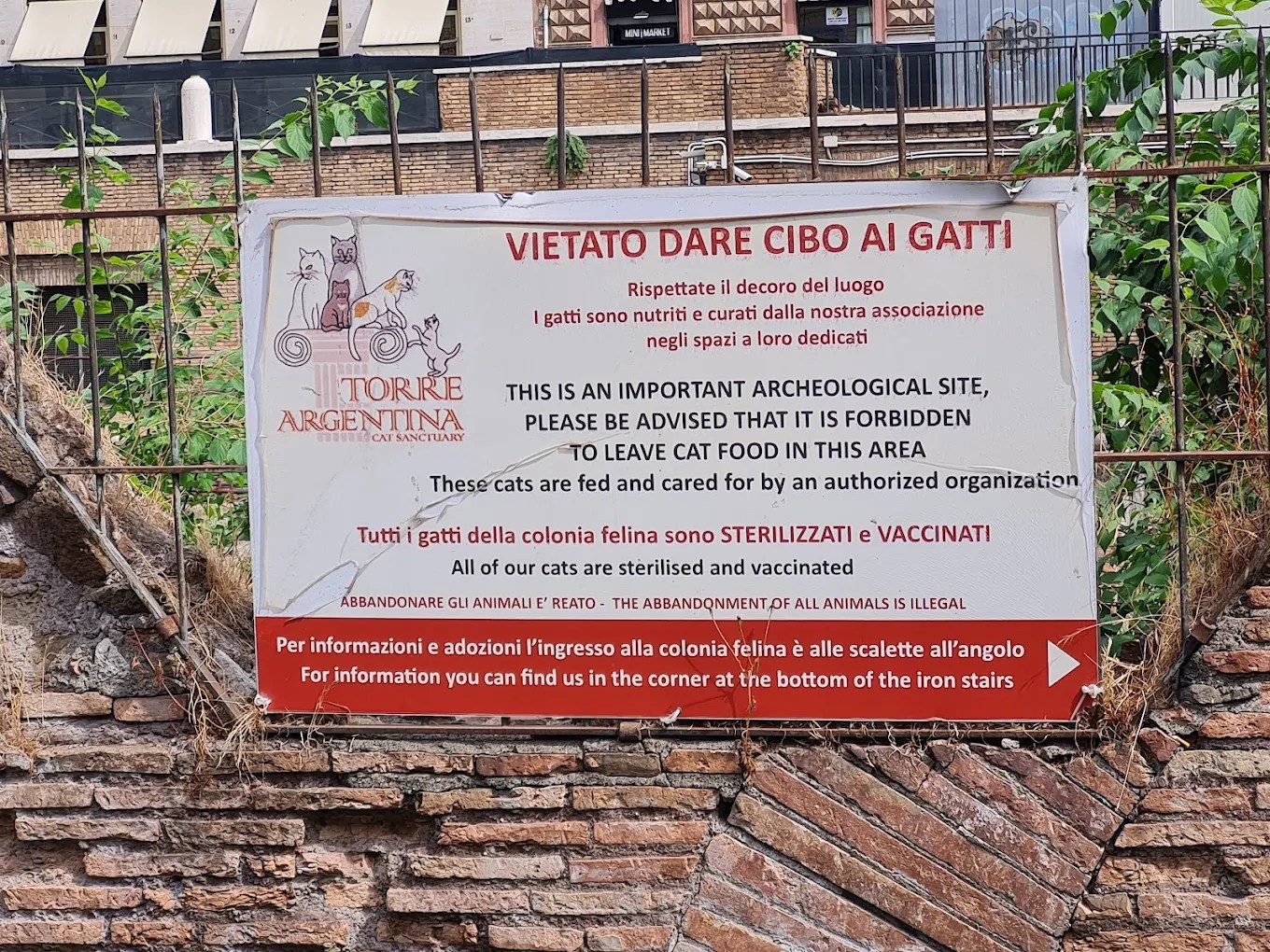
In the eternal city, there is a particular cat sanctuary worthy of mention. Torre Argentina (no relation to the South American country) is located in the ancient ruins where Julius Caesar’s assassination took place. The cat sanctuary was established in 1929 and provides shelter for stray and abandoned cats. It’s run by volunteers who provide care, spay and neuter services, and find homes for approximately 150 cats living within the ruins. Visitors may tour if in Rome, and through their remote adoption program, meet the cats and view their habitat. Makes one wonder what their witching hour looks like among the ghosts of ancient Rome.
In Murder in the Cat’s Eye, A Roman Antiquities Mystery, we meet two precious and precocious felines, Romo and Remo, named for the mythical founders of Rome, Romulus and Remus. Watch for them and Murder in the Cat’s Eye in the fall.
Where small-timers are concerned, the rule seems to have fallen by the wayside, and that’s a shame. It stimulated creativity.
***
The backstory:
I wrote the following review to answer a “challenge.” I intended to post it at the end of September 2009. But in the process of writing, I got all tangled up in words and couldn’t finish even the first sentence.
I intended to post it at the end of October. I still couldn’t write it.
Finally, after telling myself I didn’t care, I managed to write it after the October deadline.*
In the middle of the “process,” I considered posting the following review: “I like Nancy Peacock’s A Broom of One’s Own very very very very very much.”
But the challenge specified a four-sentence review, and that was only one, and I didn’t want to repeat it three times.
So there’s the background.
I must also add this disclaimer: I bought my copy of A Broom of One’s Own myself, with my own money. No one told, asked, or paid me to write this review. No one told, asked, or paid me to say I like the book. No one told, asked, or paid me to like it. No one offered me tickets to Rio or a week’s lodging in Venice, more’s the pity. I decided to read the book, to like it, and to write this review all by myself, at the invitation of Story Circle Book Review Challenge. Nobody paid them either. Amen.
*********************************************
The review:
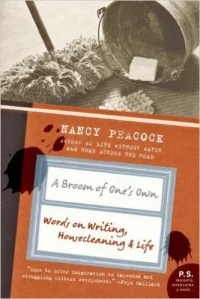
I like Nancy Peacock’s A Broom of One’s Own: Words About Writing, Housecleaning & Life so much that it’s taken me over two months and two missed deadlines to untangle my thoughts and write this four-sentence review, an irony Peacock, author of two critically acclaimed novels, would no doubt address were I in one of her writing classes.
She would probably tell me that there is no perfect writing life; that her job as a part-time house cleaner, begun when full-time writing wouldn’t pay the bills, afforded time, solitude, and the “foundation of regular work” she needed; that engaging in physical labor allowed her unconscious mind to “kick into gear,” so she became not the writer but the “receiver” of her stories.
She’d probably say that writing is hard; that sitting at a desk doesn’t automatically bring brilliance; that writers have to work with what they have; that “if I don’t have the pages I hate I will never have the pages I love”; that there are a million “saner” things to do and a “million good reasons to quit” and that the only good reason to continue is, “This is what I want.”
So, having composed at least two dozen subordinated, coordinated, appositived, participial-phrase-stuffed first sentences and discarding them before completion; having practically memorized the text searching for the perfect quotation to end with; and having once again stayed awake into the night, racing another deadline well past the due date, I am completing this review—because I value Nancy Peacock’s advice; and because I love A Broom of One’s Own; and because I consider it the equal of Anne Lamott’s Bird by Bird; and because I want other readers to know about it; and because this is what I want.
*Not caring is often the key to cracking writer’s block. Nancy Peacock probably would say that, too.
If your idea of the perfect vacation getaway includes time on the beach, a bookstore visit and a coffee shop stop, then I have the perfect place for you. Coffee Waves is one of my regular stops when visiting the island, and on a recent weekend trip, I pulled into the parking lot and found my dream come true—a new bookstore!
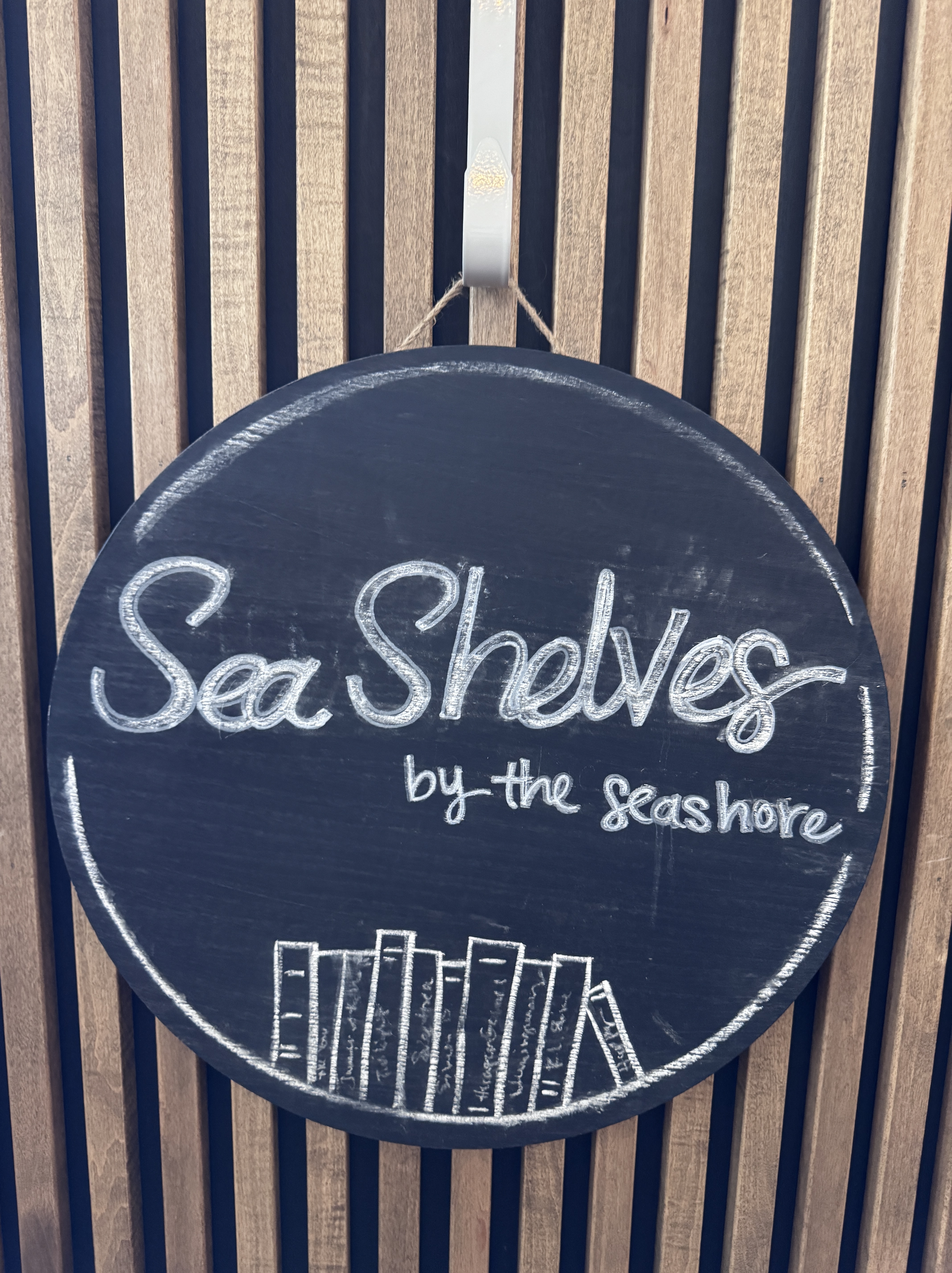
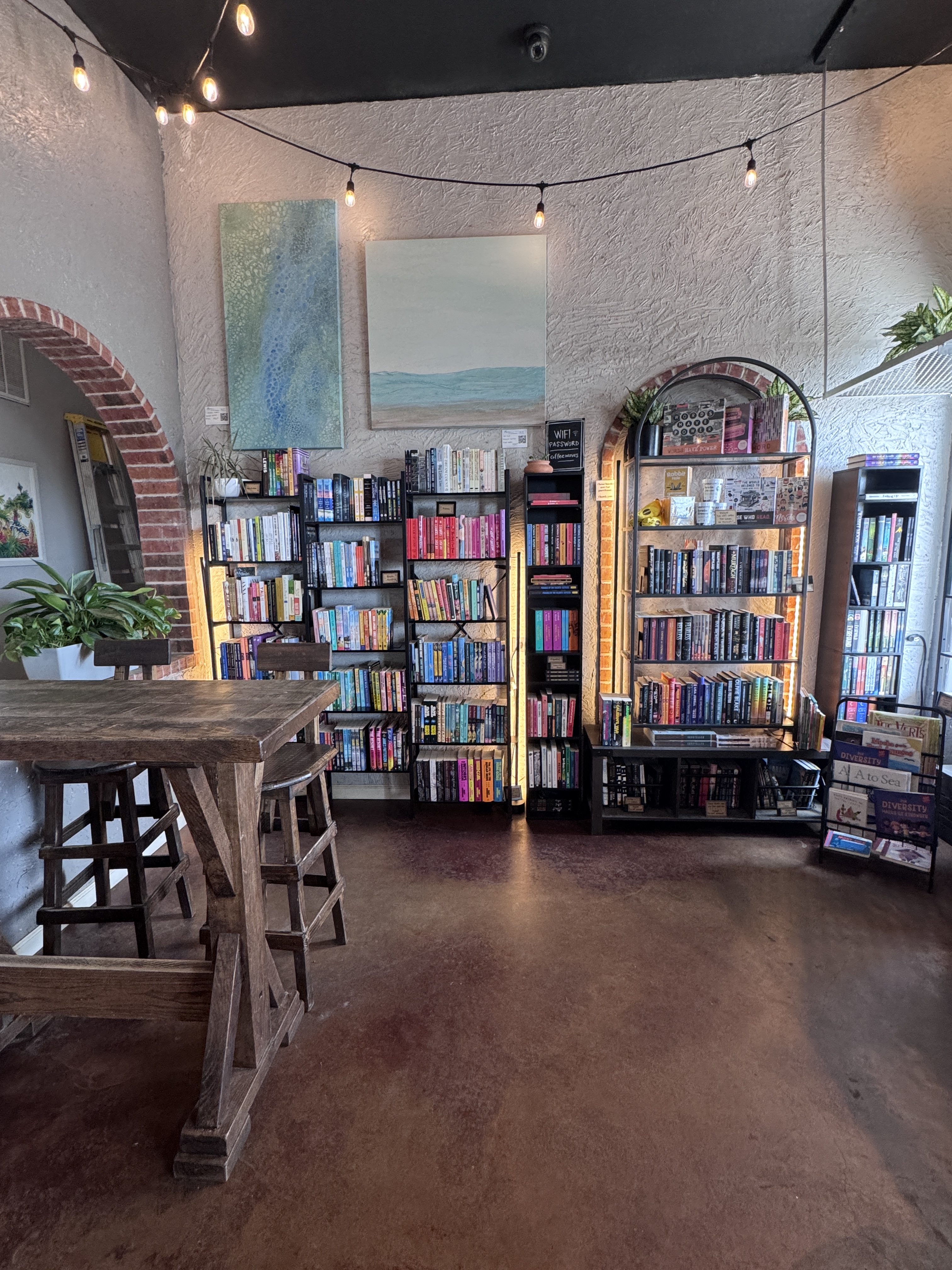
I’ve long believed that Coffee Waves was the perfect place to host a bookstore. The shop has a substantial nook with welcoming open arches and enough room to browse, sip and read. This area is now home to Sea Shelves by the Seashore. As I took time to scan the shelves, I was impressed with the varied selection and thoughtful choices offered. I felt the selection reflected a love of books and a mission to offer a wide range of options to readers of all ages. It was also a lovely surprise to find my Jamie Rush novels on the shelf!
I had the good fortune to meet the owner, Myra Barreiro, on a recent visit and enjoyed getting to know her. I wanted to learn more about her background and her journey in bringing Sea Shelves to life. When I invited her to share her story with Austin Mystery Writers, she was gracious with her time. Below is our conversation:
LO: Hi Myra! Thank you so much for speaking with us. Please share a bit about yourself.
MB: Hi! My name is Myra. I have lived in Port Aransas for four years but have been visiting for 13. I grew up in Mineral Wells, Texas. In the time between graduating high school and opening my own bookstore, I have served 4 years in the United States Army as an Intelligence Analyst, worked for Lockheed Martin for 7 years (also as an Intelligence Analyst), graduated from Sam Houston State University with a Bachelor’s degree of Science in Public Health, and–most recently–helped manage and run two local shops for several years in Port Aransas. I have two extremely smart and handsome boys, a dog named Kahlua, and a black cat named Michael B. Kitty… that’s what I call him, but he has several names.
LO: Many people dream of one day opening a bookstore. What made you decide to bring this idea to reality?
MB: It’s funny how opening a bookstore seems to be a dream for many. I am very happy to have had the chance to turn my dream into a reality. So, as mentioned before, I was helping to manage two local shops, and had been doing so for a while, but it was time for me to move on and create something for myself, something I thought this community desperately needed. I had been dreaming about opening a bookstore on the island for several years, and stepping away from my previous position allowed me to move forward with that dream.
LO: I’ve always thought the back lounge area of Coffee Waves was the perfect location for a bookstore or reading area. How did this relationship come about and how long did it take?
MB: When I decided I was going to make this bookstore dream happen, finding the perfect location was pretty high up on my list of priorities. I drove all around the island looking for properties or buildings, units with potential. I asked realtor friends if they had any info on empty commercial spaces, but nothing piqued my interest. There were spaces, but they were either already under contract or not in the right location, weren’t the right size, and out of my price range. I started to think my dream would remain just that, a dream. I almost gave up until I started thinking on a smaller scale. I had a crazy idea to maybe ask other businesses if they wouldn’t mind letting me take up a bit of their space. Set up shop in an existing shop. I wondered if that was a thing, so I did a search on the internet and sure enough, it was something that was happening all over. I took some notes. Wrote out pros and cons and key things to bring up while talking to businesses to get them onboard with the idea. After researching a bit more, I started a list of potential businesses that might be willing to let me move forward with the idea of putting a bookstore inside of their existing shop.
Naturally, Coffee Waves was at the top of my list. Who doesn’t love a good book with a cup of coffee? And they have that overflow seating area?? It seemed like the perfect place to make it happen. I came in and asked if I could schedule a meeting with someone to discuss the idea. We scheduled a meeting, met up, and I pitched my idea. I said, “I don’t want to take away from your seating, I just want to occupy your wall space.” They mulled it over for about a week and decided to give me the green light! I was so unbelievably elated until I realized I had about 2 weeks to get this dream up and running before the chaos of Spring Break! I immediately placed an order for shelving and my first book order and haven’t stopped since.
LO: You’ve done a wonderful job of curating both titles and genres. Can you share a bit more about how you choose what to carry?
MB: I receive recommendations every now and then of specific titles or authors, but the curation of titles has been mostly research. When I initially thought of opening a bookstore, I wanted to focus solely on beach, island, small fishing town, and vacation themed reads, but not everyone is into that and I wanted to give people options, so I started researching. What were people reading in 2024? What are they looking forward to reading in 2025? Best-selling genres? What are the top favorites and must-read titles of all time? Favorite classics? What’s trending on BookTok? I took my findings and curated what you’ve seen in the bookstore and continue to add to it every week.
LO: What do you love to read? And has opening Sea Shelves impacted your reading in any way?
MB: My favorite genres are psychological thrillers, mystery, and horror. I’m drawn to scary stories with twist endings and stories that make you think.
If opening the store has had any impact on my reading, I would have to say that I am now more willing to read and am interested in reading genres outside of my favorites. Thrillers will probably always be my favorite, but I’ve come to appreciate and enjoy reading other genres as well. I have over 1200 titles on the sea shelves and would love to get through them all. Maybe one day I will(:
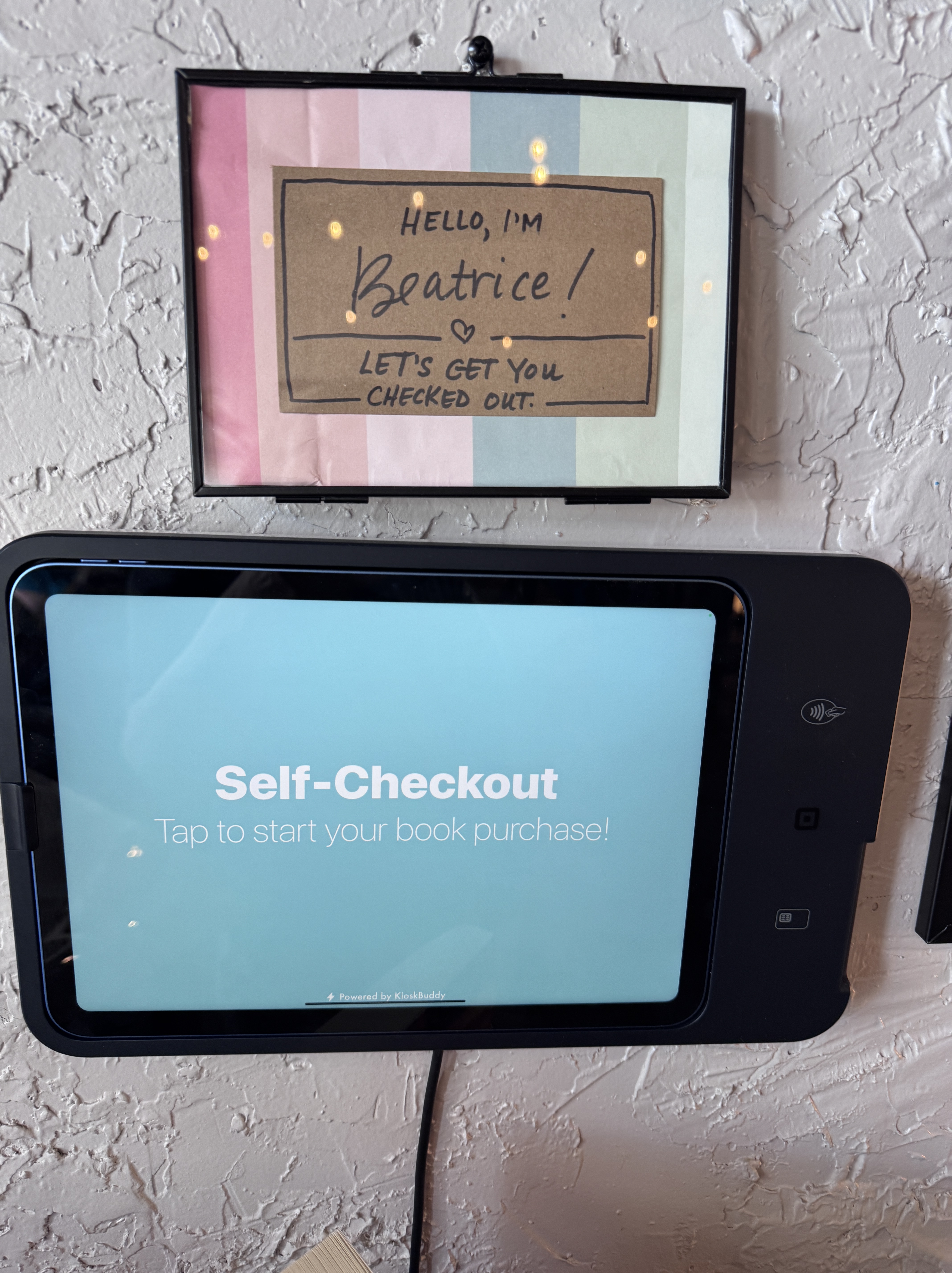
LO: I met Beatrice when purchasing a book during my last visit. Please tell us about her.
Meet Beatrice!
MB: I’m jealous she had the chance to meet you before I did.
Beatrice is amazing. Hardest working employee I have. She’s great. Since not taking away from the coffee shop’s seating was a big selling point in setting up the bookstore here, the books are out and exposed during the coffee shop’s business hours, 7 a.m. to 9 p.m. As much as I’d love to be at the bookstore all day, I have other responsibilities outside of the shop that need my attention, and sometimes I just need to step away for a quick lunch or to run a quick errand. That’s where Beatrice comes in. She holds it down while I’m away. It was an easy decision to set up a self-checkout option, giving customers the ability to make a purchase even if I was not physically present. Customers seem to love having the option to checkout with Beatrice, and I think giving her a name makes the experience a little more personable for them. Definitely a great addition to the bookstore.
LO: Anything else you’d like to share?
MB: I would just like to say that this entire experience of opening a bookstore has been a roller coaster ride and a dream come true. I encourage anyone who has the same dream to go for it if they are ever presented with the opportunity. Taking the first step will be scary but definitely worth it.
I would also like to thank Coffee Waves Port Aransas for giving me a chance to live out my dream in their space, and Laura Oles for this interview and giving me the opportunity to share my story.
LO: Thanks so much, Myra, for sharing how Sea Shelves started as a dream and became a reality. I know Sea Shelves is quickly becoming a favorite of locals and visitors.
***
Some readers may know that my mystery series is set in a fictional version of Port Aransas. Maybe Jamie and Cookie will make a stop into Sea Shelves one day? Jamie’s always on the lookout for an Elmore Leonard novel, and I know she’d love this place.
Laura Oles is the award-winning author of the Jamie Rush mystery series. Her work has appeared in crime fiction anthologies, consumer magazines and business publications. Her debut mystery, Daughters of Bad Men, was an Agatha nominee, a Claymore Award finalist, and a Writers’ League of Texas Award finalist. Depths of Deceit, her second novel, was named Best Mystery by Indies Today. She loves road trips, bookstores and any outdoor activity that doesn’t involve running.She lives in the Texas Hill Country with her family. (https://lauraoles.com)
Have you ever researched something—like a purse, a computer, or even a car—only to suddenly notice it everywhere, even though you hadn’t before? Inspiration for stories works the same way.
One of the most common questions authors hear is: “Where do you get your ideas?” The answer: pretty much everywhere—news articles, books, movies, history, snippets of conversation, personal experiences… inspiration can spark from the smallest detail.
I’m currently writing a historical novella, and inspiration is coming from all directions. I feel like a goalie in a soccer match—I’m fully immersed.
Story Settings and Characters
My protagonist is a young woman named Martha. She’s married to Tom, who has moved her far from home—and life isn’t unfolding as she expected. (Isn’t that always the case? But is it simply the way things are, or is something nefarious at work?) They’re building a cabin in the East Texas woods around 1830. I imagined they’d arrived at the tail end of the Old 300, grabbing land wherever they could. (Although the story could take place anywhere from 1820 to 1880, west of Virginia in pine country, I discovered that pines aren’t as widespread as I once thought—which is why research matters.)
As I write, Martha is revealing herself to me—like she exists on another plane and there’s a conduit between us through something I call “the ether,” a metaphysical space. (Is that a real thing? I don’t know—dammit, Jim, I’m a writer, not a metaphysicist!) Her voice is growing stronger. Her past and current life are becoming clearer. When she speaks, it feels like she’s speaking directly at me. I think most writers go through this—and when it happens, it’s exhilarating. To me, it means the character will have depth and feel real.
And, as in the past, there have been “signs” that I’m on the right track with characters and story. Sometimes these signs are even eerie. In the first chapter, when it was new and amorphous, I was writing a dream sequence to explain her inner thoughts, worries, and where she’s from. I imagined she came from a large family, and she had had a brown and white dog named “Peaches”.
A few days later I was on Facebook and came across this picture. It caught my attention because a cabin is a major feature of the story, and I took a screenshot for inspiration to look at details. Later I read the description. Look at what I circled. That’s right! I wasn’t too surprised by the date. But the dog in the picture was name “Peaches”! And it looks brown and white to me. It gave me inspiration that I’m on the right track with the story and characters.
Another time, while writing my (currently unpublished) novel Gilt Ridden, I created a character in West Texas, educated and obsessed with gold, known locally as “The Professor,” living in a dugout. Years later, I came across a local-history book about Stonewall County describing a man known as “The Professor” who lived in a dugout and searched for gold. I hadn’t known he existed—but the parallels were uncanny. At first, I worried that people would think that I borrowed someone’s real story. But then it comforted me. I took it as a sign that I had created a realistic character from imaginary circumstances.
So when you’re writing—or working on any project—block out the world and tune in to the voice or idea coming from the ether. Who knows what will be revealed?
Bonus Content
I’ve been obsessed with one song lately. It’s been playing in my head nonstop for a week. I didn’t know much about it until I watched the YouTube video. The character is pregnant and contemplating life choices, just like Martha! Now it’s really stuck in my head. Hope you enjoy it:
Sara Bareilles – “She Used to Be Mine” (from Waitress)














 Austin Mystery Writers