If you keep up with any missing persons notices, especially in Texas, you’re likely to come across the name of an incredible organization, Texas EquuSearch.
Texas EquuSearch, a 501(c)(3) nonprofit organization, which is funded solely by donations, started in 2000 and has grown to over 1,000 members. They use the best technology available while providing compassion and understanding to the families. They are thorough and professional and get results.
According to their website, their members:
“…come from all walks of life, consisting of business owners, medics, firefighters, housewives, electricians, students, former FBI and law enforcement, current law enforcement, former and current U.S. Marshall, Coast Guard and all walks of military, former and current, on our team. Our resources range from horse and rider teams to foot searchers and ATVs. We conduct water searches using boats, divers and sonar equipment. Additionally, we perform air searches using planes, helicopters and small drone airplanes with highly sophisticated cameras. We have also utilized infrared and night vision cameras, along with ground penetration units in some of our searches. Texas EquuSearch has more resources than most law enforcement agencies, which allows law enforcement to conduct their investigation, while Texas EquuSearch conducts organized searches. This has worked out to be a great working relationship between law enforcement and Texas EquuSearch. This has also resulted in Texas EquuSearch being contacted by law enforcement agencies across the nation to assist them in their missing person cases.”
They have been involved in over 1,800 searches in 42 states and in other countries. They have helped find over 400 missing people, many who would have been deceased if they hadn’t been found, and many of the cases have resulted in criminal convictions. And because so many of the organization’s members are knowledgeable about law enforcement and proper procedures, evidence has never been compromised during any of the searches.
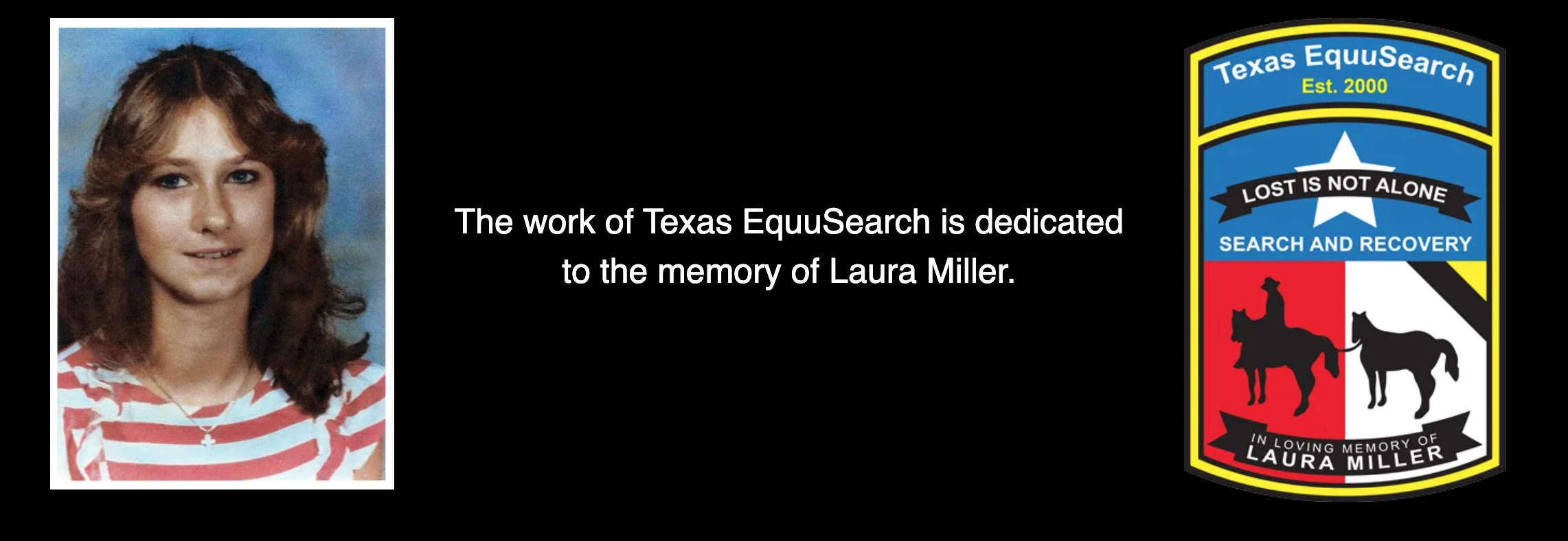
Unfortunately, the reason for the organization has stemmed from tragedy. The daughter of TE director Tim Miller, Laura Miller, was abducted and murdered in 1984, in north Galveston County. Again, from their website,
“To date, there has been no arrest in this case. Additionally, Jane and Janet Doe, who were also found near Laura’s body, have not been identified. Tim Miller continues his fight every day to ensure Laura gets justice. As a result of the death of Laura Miller, Texas EquuSearch was born. Laura Miller’s spirit lives on. Tim Miller has dedicated his life to helping families with missing loved ones. Tim has vowed to never leave a family alone if there is anything he can do to help them. Our motto is “Lost is Not Alone.””
Tim Miller has appeared in countless TV programs, news articles, and spoken at many law enforcement conventions. He has also received the “Point of Light” award by George W. Bush and other notable awards from cities who understand the commitment and dedication he gives to families in need of the organization’s help.
I hope that the Miller family will get their answers, like they’ve done for so many others.
If you would like to know more about the organization, give a donation, or become a member, you can find more information on their website.
I knew so much in college. So much! I was after a solid liberal arts education. I knew biology—I’d dissected the largest dead cat ever delivered to a biology lab, possibly large enough to require a human-size body bag. I scrutinized bones and organs, ears, whatever. Articulated the brute’s vertebrae, sort of. But now…?
And geology! Of course I knew the earth had igneous and volcanic and sedimentary rocks and a solid molten core consisting mostly of iron. Didn’t we all? I was confident I could find north by following two stars in the Big Dipper down to Polaris, in the Little Dipper. But now…?
Human history? We all knew North Americans arrived via a land bridge from Asia around 10,000 years ago, based on dating the Clovis point. But now…?
These Facts of Life, as we understood them…turn out to be wrong. Out the window. Over. So what should a mystery writer do about this?
Biology? Human history? Clovis points? So much we “knew” is out of date or just plain wrong. We’d heard of the double helix, but didn’t know the human genome could be replicated, leading to amazing genetic discoveries. While many of us hoped we’d inherited a gene from some favored forebear in family history, now we know we’re related to practically everyone, including villains and scoundrels. Bracing news. Ongoing analysis of ancient DNA now suggests humans were in North America by at least 16,000 -20,000years ago. So Clovis points were…much later. Think what this suggests about early peoples—all the languages, all the cultures, all the implications. A fabulous update on these debates: Origin, A Genetic History of the Americas, by anthropological geneticist Dr. Jennifer Raff. https://www.amazon.com/Origin-Genetic-Americas-Jennifer-Raff-ebook/dp/B08B6F2YFX/ref=sr_1_2?crid=2I6NFU5M8KMC2&keywords=jennifer+raff&qid=1645458138&sprefix=jennifer+raff%2Caps%2C190&sr=8-2
Based on exciting research at the Gault Site we Central Texans got a head start on this news. Those immigrating forebears got here as soon as they could. https://www.gaultschool.org/
But wait, there’s more. Explorers dismissed tales from indigenous people about a huge tsunami in the 1700s along our northwest coast. Now we’ve heard of—and school districts are planning against–dangers posed by the Cascadian Subduction Zone off that coast. https://www.newyorker.com/magazine/2015/07/20/the-really-big-one
And that reliably solid molten core of our Earth? We now hear that “the inner core of the Earth is not a normal solid but is composed of a solid iron sublattice and liquid-like light elements, which is known as a superionic state,” and that this intermediate state between solid and liquid “widely exists in the interior of planets.” https://scitechdaily.com/scientists-reveal-superionic-secrets-of-earths-inner-core/
Does our wandering pole mean Polaris won’t stay our North Star? (Sigh) Yes. By about 4,000 CE, due to axial procession, we humans will have to shift our North Star gaze to “Gamma Cephei, also called Errai, …a moderately bright star” in the constellation Cepheus. https://earthsky.org/brightest-stars/gamma-cephei-errai-future-north-star/
Does any of this matter to the mystery genre? Yes, of course. Many mystery lovers take refuge from current shocks in historical mysteries, enjoying Rhys Bowen’s period pieces set in London; Susan Elia MacNeal, with her World War II Maggie Hope series; Laurie King’s Russell & Holmes series, set in 1920’s England; and the late Anna Castle’s Francis Bacon mysteries. Arthur Conan Doyle’s characters Sherlock Holmes and Professor Moriarty have inspired writers to try follow-on mysteries. Authors of historical mysteries have an advantage: they know the “known facts” of the epoch they’ve chosen. They know Mary Russell was unaware of penicillin—and so does the reader.
What about mystery science fiction? There, a writer can pick and choose which “facts” of 2022 to carry forward, and which to abandon. The writer can define new “facts” for the setting, without the fear of making a mistake.
But what a conundrum for mystery writers who choose the “present” as setting.
First and foremost, mystery writers cannot forget that mystery lovers relish learning about specific settings. Alexander McCall Smith told the Texas Book Festival that he “starts with the place.” Place is key. That’s one reason mystery reader rejoice when they find an appealing new mystery series, because it deepens our grasp of a setting—distinctive food, landscape, characters. The setting’s part of the experience. I certainly want readers to feel immersed in the Texas Hill Country in my Alice MacDonald Greer Mystery series books, including book 7, Ghost Daughter. https://www.amazon.com/Ghost-Daughter-Alice-MacDonald-Mysteries/dp/1732722919?asin=1732722919&revisionId=&format=4&depth=1
Often mystery writers keep the mystery’s timeframe somewhat vague, omitting overreliance on specific recent events. Mystery lovers are looking for a mystery. That doesn’t mean, of course, that authors won’t deal with tough contemporary issues. They can and do. But readers decidedly want a puzzle, want to use their own minds and life experience with the world and human nature to solve a mystery, involving motive, method and opportunity. Don’t we consider good mysteries “classics” when they can be read and re-read in subsequent decades?
The writer may take a middle road, addressing one or more contemporary issues. In her Guido Brunetti series set in Venice, Donna Leon does not dodge the impacts of climate change (rising sea levels), pollution, and the desperate plight of African and Eastern European immigrants. But her Inspector Brunetti comforts us by his fierce adherence to traditional Venetian values (and cuisine).
But still, all this new knowledge (genomes! Fourth dimension! Cascadian subduction!) is exciting stuff. Now, perhaps a mystery about archeologists disputing whether or not that rock shard is a knife…or just a rock shard?
Helen Currie Foster writes the Alice MacDonald Greer Mystery Series north of Dripping Springs, Texas, supervised by three burros. She’s drawn to the compelling landscape of the Texas Hill Country, and the quirky characters who live there. She’s deeply curious about human prehistory and why, uninvited, the past keeps crashing the party. She’s active with Austin Shakespeare and the Heart of Texas chapter of Sisters in Crime.
The definition of reading readiness is the point
at which a child goes from not reading, to reading.
~ Sight and Sound Reading
But, Gwammy, I can’t wead.*
~ Jenny, five years old, after one week in kindergarten
When I was five, my Great-aunt Ethel gave me an ancient primer. She had found it in an old school building, abandoned when consolidation sent children in my hometown to a school two miles away, and then used only as a polling place. The primer had also been abandoned, and Aunt Ethel, election judge, liberated it and gave it to the youngest member of the family (youngest by about forty years; it was an old town).
My parents read to me almost from day one. The story goes that, as a toddler, I met my father at the door every evening when he got home from work, saying, “‘Ead a book, Daddy.” (Unlike Jenny, I had no pwoblem pwonouncing my ahs; I just dropped them.)
We didn’t have a library nearby, but I plenty of books: a Bumper Book, Little Golden Books, Grimms’ Fairy Tales, Andersen’s Fairy Tales, which I didn’t like, in part because they were dark (“The Little Match Girl”), but mostly because the end papers sported a hairy black thing with an ugly humanish face and enough long, winding legs to qualify it as a spider. Grimms’ tales were more pleasant.
When I received the primer, I already knew the alphabet. In fact, a year before, I’d written my name in red adhesive tape–the gooiest, stickiest adhesive I’ve ever come across–on the inside of the kitchen door. It stayed there for years.
Anyway, armed with the primer–a school book, for reading–I set about teaching myself. While my mother did housework, I trailed behind, spelling out words.
“T-h-e”
“The”
“m-a-n”
“man”
“s-a-i-d”
“said”
I don’t think I taught myself to read. But the next year, when I entered first grade–no kindergarten back then–I was ready. I took right off on the underwhelming adventures of Dick, Jane, and Sally (siblings who never had a decent disagreement) plus Spot and Puff, who came and ran a lot.
In second grade, I got a Little Big Book—Gunsmoke–that had one hundred pages. I read it on Saturday and reported the accomplishment in our Class News at school on Monday. Later I got a literary Little Big Book, Huckleberry Finn.One sentence confused me: a dead man’s leg was stuck out at a strange angel. I was about thirty when I realized angel was really angle. I was also surprised when, in high school, I learned that the Little Big Book had been severely abridged.
Then I discovered comic books. They were more educational than most people think. From Scrooge McDuck, I learned that emeralds come from South America. Unfamiliar with physics, I pronounced Atom Cat as A-Tomcat. Seemed reasonable.
The next year, thanks to a Christmas present from my grandmother, I discovered Nancy Drew. Nancy had a blue convertible and drove around wherever she wanted, and her father never grounded her. I envied Nancy her freedom. I didn’t like her, though; she had a tomboy friend, George, who said, “Hypers, you slay me,” which was fine, but her other friend, Bess, was plump, and Nancy often referred to how much Bess ate. I presume in later editions, Nancy behaved better. But her treatment of Bess didn’t stop me from reading about her. I wrote letters to Joske’s Department Store in San Antonio: “Please send me one copy of The Hidden Staircase and one copy of The Clue in the Jewel Box. Please charge my account.” They each cost two dollars. My mother kindly signed the letters. It was her account.
I soon outgrew Nancy, but, like many other mystery readers and writers, I credit her for getting me hooked. I read a couple of Trixie Beldens–Trixie was sickeningly enthusiastic when her mother made her dust the living room before going out to solve mysteries, but she did manage to sneak out at night. I read some Kathy Martins. Kathy, a nurse, often suspected her (nice guy) brother for whatever (minor) crime had been committed, which I thought strange, but she was more mature and more realistic than other characters. No convertible, no sneaking.
Young Adult novels didn’t exist as a genre until the late sixties, when increased federal money became available to schools, and authors found a new audience. Born too soon, I moved from children’s books into adult fare: Zane Grey, Thomas B. Costain, Charles Dickens, Aldous Huxley, Jane Austen, Harper Lee, Daphne DuMaurier, Rafael Sabatini (Scaramouche: “He was born with a gift of laughter and a sense that the world was mad.”) Noticing that I read the classics, the bookmobile librarian, unasked, brought me a copy of the scandalous Madame Bovary. I was fifteen. He’s still my hero.
On the bookmobile, I rediscovered mysteries in the real thing—Sherlock Holmes. I cried and cried when he and Moriarty went over Reichenbach Falls. Nobody told me he would be back.
But enough about me. The point is that reading was, and is, important to me.
And that this week I’ve been reading A Velocity of Being: Letters to Young Readers, edited by Maria Popova & Claudia Bedrick. The editors compiled 121 letters from “scientists, musicians, artists, philosophers, composers, poets, actors, a 98-year-old Holocaust survivor, Italy’s first woman in space, and many more remarkable humans whose splendor of spirit cannot be contained in the shorthand descriptors we often use to condense a person’s character and cultural contributions.” Each letter is paired with an illustration to “bring it to life visually.”
Many letters describe books as portals to the universe, to other worlds, to adventure, to curiosity and questions, to dreams, to logic and imagination; they’re boats and planes and magic carpets. Contributors write about hating book reports, and being hellions when they were little and refused to listen to Goodnight Moon at bedtime because they wanted dinosaurs, and being called antisocial when they preferred to read instead of play with friends.
But other contributors take the subject to a deeper level:
Author Alain deBotton writes, We wouldn’t need books quite so much if everyone around us understood us well. But they don’t. Even those who love us get us wrong. They claim to know what we need, but forget to ask us properly first. They can’t understand what we feel . . . That’s the moment to turn to books They are friends waiting for us, and they will always speak honestly to us. They are the perfect cure for loneliness. They can be our very closest friends.
Screenwriter Shonda Rhimessays, Reading saved me. When I was twelve, I spent most of my day trying to be invisible. The year before I’d been the new girl in school, and I’d spent a lot of time trying to be accepted. . . . The very desire to bend and twist to fit in–assures your rejection They did not like me. They hated me.
I spent a lot of time alone. I rode the bus alone. I spent weekends alone, I ate lunch alone. Except I was never alone. I always had a book in my hand. If you have a book, you don’t need to bend and twist to fit–you’re there. You are in. . . .
If you have a book in your hand, you can stop being invisible. Because you’re a little more invincible.
Venture capitalist Chris Sacca says that books are dangerous: If you keep reading, you might learn so much that you can take over for the adults and then you kids will be in charge! You all could be the journalists, entrepreneurs, artists, professors, authors, doctors, explorers, scientists, and even the leaders of our countries! Then what would the grown-ups do? Live in a world run by brilliant, interesting, innovative, and compassionate young people. Ugh. No, thank you.
So please stop reading before you become really smart, successful, and happy.
But seriously, books are dangerous. Holocaust survivor Helen Fagin writes about life in the World War II Polish ghetto, where being caught reading by the Nazis meant anything from hard labor to death. But books were smuggled in, read by each person for only one night, and then, for the sake of safety, passed on. She stayed up all one night reading Gone with the Wind. Then she decided the children she secretly taught needed not dry information, but stories. And for one hour each night, she told them the story of Scarlett and Melanie, Rhett and Ashley; and for that hour they “escaped a world of murder.” Then “a knock at the door shattered our dream world.” Years later, she met one of only four of the students who survived. The woman called her “the source of my hopes and my dreams in times of total deprivation and dehumanization.”
Composer Mohammad Fairouz shares a story that I cherish from my upbringing; . . . 1400 years ago in the deserts of Arabia, a meditative prophet named Mohammad had a vision of the Angel Gabriel who came to him with a message: “Read” . . . This was the first word of the Quran.
In the years following the prophet’s death, his followers built an empire where they contributed to every branch of knowledge, from algebra to optics and medicine to music. Countless things we have today would not exist without their contributions: that includes space stations, glasses, aspirin, your iPad.
They were able to do this because they were inspired to seek out the power that comes with being to read. You deserve the same power . . .
Years ago, I knew a young man who had never learned to read. I don’t know why; he just hadn’t. As an adult, he took a literacy class. He said that when he traveled for his work, he was always scared, because he couldn’t read road signs, and he was afraid he would get lost. At the most basic level, reading is power.
And consider: At one time in the American South, it was illegal to teach slaves to read. If they were literate, they might be able to read signs that would help them escape. They might also read some inconvenient truths: “. . . that all men are created equal, that they are endowed by their Creator with certain unalienable Rights, that among these are Life, Liberty and the pursuit of Happiness . . .” Inconvenient for their owners, that is.
“So the research shows that perhaps reading fiction does make people behave better. Certainly some institutions consider the effects of reading to be so significant that they now include modules on literature. At the University of California Irvine, for example, Johanna Shapiro from the Department of Family Medicine firmly believes that reading fiction results in better doctors and has led the establishment of a humanities programme to train medical students.
“It sounds as though it’s time to lose the stereotype of the shy bookworm whose nose is always in a book because they find it difficult to deal with real people. In fact, these bookworms might be better than everyone else at understanding human beings.”
Philosopher and professor Martha Nussbaum gives an example: The great African-American novelist Ralph Ellison said that a novel like his Invisible Man could be “a raft of hope, perception, and entertainment” on which America could “negotiate the snags and whirlpools” that stand between us and the democratic ideal. He’s referring here to Huck Finn and Jim, who got to know one another as full human beings, rather than just as a white man and a black man, when they traveled down the river on a raft together. On the raft, they had to look at one another, listen to one another’s stories. In our divided society, such encounters happen all too seldom in real life, and are fraught with mistrust when they do. Reading can create such encounters in the head, so that the ones that happen in the world are a little less crude, a little less deformed by fear and anger.
Huckleberry Finn has for years made the American Library Association’s list of most often challenged, banned, or restricted books–a novel that can teach us to be better people.
Design writer and educator Steven Heller extends the idea that reading is power and issues a challenge: Books are weapons in humankind’s battle against ignorance. I don’t mean like lasers and drones. I mean that knowledge is strength and the kind of knowledge you get from books is not the same as the quick fix that Googling gets you. What’s more, books can’t be hacked. But they can he censored, which means blocked or forbidden from being published. And this is why they are so valuable to us all. Often in fighting ignorance, the ignorant take books prisoner. If you don’t read books, then those that have been censored over the ages will be lost and forgotten. So kids, don’t let them down. Read them, savor them protect them. Don’t let others make books irrelevant.
*
*Jenny soon learned to wead. And to pwonounce her ahs.
*
I’ve gone on too long. If you’re still with me, thanks for sticking. And one more thing: Despite the title, A Velocity of Being isn’t just for young readers. It’s also for adults who need to be reminded to make reading part of their children’s lives.
While writing this post, Kathy was watching/listening to an old TV series of Dorothy L. Sayers‘ Lord Peter Wimsey mysteries. Bless Youtube and all who post on her. (Opinion: Ian Carmichael was the best Peter Wimsey by far.)
This week I lost a very good friend and an incredible mentor. Anna Castle wrote historical mysteries including two internationally successful series: The Francis Bacon Mysteries and the Professor and Mrs. Moriarity. Her books can be found on her website at https://www.annacastle.com/books/
Anna Castle
Writing a series of any kind requires a great deal of research. Triple that for historical mysteries. The writer has to learn the dialects, the clothes, the food, the politics, the religions, the caste systems, the locations—the list goes on. It takes a special person to get all of that right, and for Anna to do it in two series is off the charts. And while getting all of the “facts” right, Anna also had the task of creating characters that needed to be loved, laughed at, hated, suspected, intriguing, whatever was needed to propel the plot forward. The character must be seen, understood, memorable—well, you get the drift.
And in reading a series, the characters must be people that intrigue the readers so much, they are not just willing to buy the next book in the series, but the writer must create a story where the readers will wait for that next book, hope for it, buy it in advance. The reader becomes bonded to the characters. I as a reader find myself worried about them, excited for them, scared for them, and yes, hate them and love them. To me, they were real people.
And now, Anna’s characters will never live again. The next book won’t happen. There will be no more intrigue for them, romance for them, fear for them. Life for them.
As I write this, I am devastated as I mourn Anna’s passing. No more lunches with her. No more emails. No more hugs. No more bragging or complaining or learning or all those things that dear, dear friends do together.
But also, I will deeply mourn the passage of the characters she put in my head and in my heart.
Unlike sequels, which are straightforward continuations of possibilities that may happen after a novel ends, the prequel tries to imagine and show what happened before the novel’s story began.
A prequel attempts to provide the reader with information about what came first, what impacted the characters’ development, places where the stories occurred, the times in which they happened, and a host of other matters upon which a novel may be built not necessarily included in the story.
It may surprise many that even among classics, there are prequels. While The Adventures of Huckleberry Finn is a sequel to Mark Twain’s Tom Sawyer, in 2017, author John Clinch released Finn, a prequel to both of Twain’s masterpiece novels. Finn is about Huck Finn’s father and the dysfunctional family relations that came before the adventures of Huck Finn began. It immerses the characters in the chaotic, murky waters of antebellum America with all its complexities, the shame of slavery, and racial attitudes of the time that almost destroyed the nation.
In Porto Bello Gold, Arthur D. Howden Smith imagines a pirate story with Captain Flint and Murray stealing treasure and burying it as the Prequel to Robert Louis Stevenson’s Treasure Island.
Then we have Mario Puzo’s contemporary classic, The Godfather, a gripping story of the 1940s underworld in America and Italy. Author Ed Falco wrote a prequel entitled The Family Corleone. In The Family Corleone, Mr. Falco gives us background on many of the characters before Vito Corleone became a Don. Shortening it by at least a third would not have damaged the storyline. If a reader is very familiar with Puzo’s characters, there are few, if any, surprises or new information. Much of what came before was included in Puzo’s novel. In this prequel, the only new information was about Sonny, Don Vito’s first-born son. He’d witnessed his father’s criminal activities early on and decided to follow in his father’s footsteps. This is hardly surprising given how Puzo portrayed Sonny in the original novel. Perhaps a more interesting avenue would have been a fuller portrait of Michael, whose younger years do not prepare the reader for his change of heart after the Don is almost murdered. For more insights and reviews of prequels written by authors other than the creators of the original stories, see the source materials below.
So, where did the interest in prequels start and why? It should come as no surprise that the new mania started when Hollywood became obsessed in the 1970s and 80s after the 1969 success of Butch Cassidy and the Sundance Kid. By 1979, Hollywood released Butch and Sundance, the Early Years, as a prequel. Another Hollywood success, Star Wars, was released in 1977, and its succession of successful movies sparked Star Wars prequels. Still, there are mixed reviews of the values for each of the abovementioned prequels and others, which may make one ask if it’s worth reading them at all.
Before writing a story, most authors have a sense of the characters’ backgrounds, times they live in, and other essential building blocks. As the novel unfolds, critical information is included to advance the plot. However, some characters or events may be more compelling. Who were these characters before the story began? What happened to them? What factors influenced their development into their current selves? These questions create fertile ground for a prequel and give way to the next question. Should prequel materials precede a stand-alone novel or become book one in a series?
Prequels can flesh out backgrounds, locations, personalities, and what came before. The danger is that offering new angles for consideration may also ruin the impact intended because the reader may not come at the story with the same sense of anticipation, feel the intended shocks or enjoy the sense of surprise. Reading a prequel first, even for blockbuster books such as The Godfather, can also turn a reader off. If I’d read The FamilyCorleone, first, I might have passed on Puzo’s masterpiece.
Prequels then should be published judiciously. They did not create interest in a particular story. It is the story that made the prequel possible.
In the Dordogne, in southern France, I heard the echo of the iron cover banging into place to close the entrance to the Pech Merle cave to prevent damage from outside air. Down the clanging iron stairs we went, along chilly stone tunnels, and then—the horses! Oh, the spotted horses, so real you could almost hear them breathe. They’ve been carbon-dated to 25,000 BCE. I’ve waited in line to see the famous Font de Gaume at Les Eyzies, also in the Dordogne, and hiked, shivering, to see the pictures deep in the Pyrenees cave at Niaux. I long to visit them all. Sometimes my companions balk.
Confronted by such artistry, such deft depictions, simultaneously spare and rich, like Chinese scroll landscapes or Picasso’s early drawings, haven’t you wondered about the artists? Why were they so deep in these dark, perilous caves? What was their life—or death—outside?
Today, with climatic violence the new normal, and new discoveries daily about human prehistory (including 23 and Me’s calculation of our personal percentages of Neanderthal ancestry), I’m more and more curious every day about our long-ago ancestors. The real question, of course: what is it to be human?
Welcome to “The Dawn of Everything: A New History of Humanity,” a tome by two Brits—David Graeber, the late professor of anthropology at London School of Economics, and David Wengrow, professor at the Institute of Archaeology, University College London. “The Dawn of Everything”? Sounds ferociously ambitious—overarching, maybe overreaching. But my best friend from high school—Dr. Megan Biesele, distinguished anthropologist—said “let’s read and discuss.” Easy for her to say: the tome is 526 pages long, with 83 pages of notes and a 62-page bibliography. https://www.amazon.com/Dawn-Everything-New-History-Humanity/dp/0374157359
Graeber and Wengrow boldly challenge our “received understanding” of an original state of innocence and equality, followed by the invention of agriculture and higher population levels and creation of cities leading inevitably to the rise of hierarchy and inequality. They employ often hilarious section headings. Example: “How the conventional narrative of human history is not only wrong, but quite needlessly dull.” (At 21.) (For a shorter version, see their Fall 202 article: https://www.laphamsquarterly.org/democracy/hiding-plain-sight.)
“The Dawn” asserts that the ideas of individual liberty and political equality we cherish today weren’t an outgrowth of the European enlightenment, but inspired by Native American critiques of their European invaders. The relevant heading: “In which we consider what the inhabitants of New France made of their European invaders, especially in matters of generosity, sociability, material wealth, crime, punishment and liberty.” (At 37.) One French evangelist sent to the Algonkian Mi’kmaq wrote, “They consider themselves better than the French: ‘For,’ they say, ‘you are always fighting and quarrelling among yourselves; we live peaceably. You are envious and are all the time slandering each other; you are thieves and deceivers; you are covetous, and are neither generous nor kind; as for us, if we have a morsel of bread we share it with our neighbour.” This missionary was irritated that the Mi’kmaq would constantly assert they were richer than the French, who had more possessions, because they themselves had “ease, comfort and time.” Such records by missionary priests were compiled in 71 volumes of Jesuit Relations (1633-1673).
I’d never heard of the Wendat tribe’s philosopher statesman Kandiaronk, reportedly a highly skillful debater, who during the 1690’s was invited to participate in a sort of salon, where he shared his devastating moral and intellectual critique of European society. Kandiaronk sounds amazing: one priest described him as “always animated, full of wit, and generally unanswerable.” His arguments were included in Dialogues (1703), publishedby an impoverished French aristocrat named Louis-Armand de Lom d’Arce. Kandiaronk held that European-style punitive law, like the religious doctrine of eternal damnation, wasn’t required by innate human corruption but by a society that encouraged selfish and acquisitive behavior. Nor had I heard that Kandiaronk’s critiques were adopted by French Enlightenment figures during the 1700’s. I hadn’t realized that substantial origins of the French “enlightenment” were…North American.
“The Dawn” discusses the Huron concept called Ondinnonk, a secret desire of the soul manifested by a dream: “Hurons believe that our souls have other desires, which are, as it were, inborn and concealed…They believe that our soul makes these natural desires known by means of dreams…Accordingly when these desires are accomplished, it is satisfied; but, on the contrary, if it be not granted what it desires, it becomes angry, and not only does not give its body the good and the happiness that it wished to procure for it, but often it also revolts against the body, causing various diseases, and even death…” Apparently tribe members spent time communally trying to decipher the meaning of others’ dreams and, sometimes, trying to help each other realize their dreams. (At 23-4, 454-5, 486, 608 n74.)
After this startling introduction to an unknown genius (I mean, I’d have loved to learn about Kandiaronk back in 10th grade…or any grade, really—and apparently his ideas can be found: https://books.google.com/books/about/Native_American_Speakers_of_the_Eastern.html?id=Fu1yAAAAMAAJ), Graeber and Wengrow provide extensive examples of our incorrect assumptions. They argue that the notion that humans inevitably moved from hunting and foraging to static agricultural lives (with inevitable hierarchy and inequality) isn’t borne out by current archeology. They point to many cultures which rejected “big ag,” opting instead to keep hunting and foraging, making occasional gardens, and spending winters in river lowlands, moving to highlands in the summer with their flocks. (This made me think of the French Pyrenees, where the “transhumance” –taking livestock to the hills—still happens.) They argue that cities weren’t inevitably hierarchical, and that many arose with populations that—even if they had kings—made their decisions collectively, not hierarchically.
“The Dawn” is unsettling. Are we “stuck” today in ideas that are not in fact “inevitable” aspects of human social organizations? Are we less creative, socially speaking, than our forebears? Well, I’ve only made it to page 486. I’ll let you know how this turns out. If I’m intellectually “stuck,” I hope not to stay that way.
But back to the caves and the art on those seeping limestone walls. My strong impression is that we frequently underestimate those who traveled before us. We assume that the ways of today’s world manifests “progress” over our past. Surely that’s true: we did manage at least temporarily to get rid of smallpox…one small victory. But apparently there’s a great deal we’ve lost, forgotten, or never known…I mean, what is the meaning of the White Shaman picture? Did the artists ride the spotted horses painted in Pech Merle? Or just admire the herds from a distance?
“The Dawn of Everything” offers fodder for that most delightful and enduring attribute of our species: curiosity. I’m still chewing on these ideas. One topic is the surprising variety of ways that societies treat—or eschew—wealth. Another that nags at me is the Wendat condemnation of our punitive habits. Dialogues reported that rather than punish culprits, “the Wendat insisted the culprit’s entire lineage or clan pay compensation. This made it everyone’s responsibility to keep their kindred under control.” Wow. Just one of the things I’ll be thinking about…
I found Braiding Sweetgrass so touching, especially the chapter called Allegiance to Gratitude, describing the children in the Onondaga Nation school reciting the traditional Haudenosaunee “Thanksgiving Address,” the Words That Come Before All Else. Most sections of this Address end, “Now our minds are one.” Maybe this is a living example of a communal tradition that molds a society. I recommend this book.
Helen Currie Foster lives and writes the Alice MacDonald Greer Mystery series north of Dripping Springs, supervised by three burros. She remains fascinated by human prehistory and how, uninvited, our pasts keep crashing the party. Her latest is Book 7, Ghost Daughter. “An appealing sleuth headlines a solid thriller with panache” —Kirkus Reviews
PBS television presented a new musical production by Grammy, Emmy, and Tony Award winner John Mauceri: The Nutcracker and the Mouse King, written in 1816. Mauceri conducts the Royal Scottish National Orchestra, with Tony Award- winning Alan Cumming narrating this original tale in three parts.
The story written by E.T.A. Hoffman, is about a young girl who saves a prince, contrary to Cinderella, Sleeping Beauty, and Snow White, where the prince rescues the girl. Perhaps Hoffman’s inspiration for this particular flight of fancy was the popularity of embellished nutcrackers, which appeared in Germany in the early 1800s.
The Nutcracker’s story began with a young boy who had to stay at home alone every day while his parents went to work. The little boy was lonely and afraid, so his father carved him a special toy, a nutcracker in the form of a soldier with big sharp teeth and fierce-looking eyes and told him that this unique nutcracker would protect him while his parents were gone. It did the trick. The boy loved and enjoyed that nutcracker and felt secure by its presence, so his father continued to carve new ones for him. When the boy grew up, he married and had a son to whom he gave all the nutcrackers made by his father.
Over time in early 19th century Germany, the lure of decorative nutcrackers grew and so did a legend. They came to represent power, strength, and the protection of families from danger and evil spirits. Nutcrackers were given as gifts and keepsakes to bring good luck.
E.T.A. Hoffman was a prolific writer of gothic tales, fantasy, and the supernatural – most of them dark including segments of his Nutcracker and the Mouse King. It was Alexander Dumas, the 19th-century French author who translated Hoffman’s work in 1845, propelling it beyond the written word. Mauceri explains that Dumas, the grandson of the French aristocrat and African Haitian slave, was drawn to the story because Hoffman concluded the tale with the girl growing up to become the queen of a land of tolerance and imagination. It was the Dumas version that Peter Illich Tchaikovsky adopted in 1892, when he composed the score.
While this production does not target children, it is appropriate for those youngsters who can sit still for a narrative without pictures or characters to hold their interest. Cumming reads the narrative with emotion and even injects moments of humor without straying from the story.
The orchestra gives a stirring performance. Bold and rousing where appropriate, mysterious, sensual, and nerve-wracking also when appropriate. In addition to the lush Tchaikovsky score, compositions from Tchaikovsky’s tone poems and orchestral suites, are included in this score.
Mauceri’s reimagined Nutcracker and the Mouse King fill the mind’s eye with characters, places, and emotions generated by the performances of artists of the highest caliber. If you didn’t experience this fantastic flight of fancy and imagination, you could see it by accessing https://www.pbs.org/video/the-nutcracker-and-the-mouse-king-meabwt/
And now, in the true spirit of the season, love, kindness, respect, and caring, I wish all a Merry Christmas.
After a year immersed in reading new releases by talented authors, I’ve taken a step back and retreated to the comfort of reading (and watching) some of my all-time favorite series characters. When life gets stressful, curling up in a corner for a few minutes at night with a beloved character is one of my favorite ways of tuning out the chaos of the day.
Here are a few of my favorite series characters:
BOOKS:
Lisa Lutz
Isabel (Izzy) Spellman: Isabel Spellman has been described as “the love child of Dirty Harry and Harriet the Spy,” which is one of the many reasons I love this character. As a licensed investigator in her family’s firm, she’s extremely capable and sharp, even as she navigates the pitfalls that come from working with her dysfunctional family. Her cleverness has an edge that keeps me turning the pages, and her sarcasm always sticks the landing.
V I Warshawski: I’m drawn to a strong and complex female protagonist, and VI absolutely fills this role. She doesn’t apologize for who she is and how she makes her way in the world. VI is skilled in a street fight, appreciates Torgiano red wine and doesn’t suffer fools. What’s not to love?
Tess Monaghan: I discovered Tess during a time when my career required a great deal of travel. I picked up Baltimore Blues and never looked back. Tess’s investigative journalism background and her balance of strength and compassion compelled me to continue with the series. Laura Lippman gives us such a layered and authentic view of Baltimore through Tess’s eyes. And Tess ventured to go where few female detectives have dared—motherhood.
TELEVISION:
Sergeant Catherine Cawood/Happy Valley: The first five minutes of Happy Valley remains, for me, one of the best openings I’ve ever seen in a series pilot. Sgt. Catherine Cawood is a dedicated police community officer working for the West Yorkshire Police Department. Her personal life is enormously complicated, and a particular case consumes her (with damn good reason). Sgt. Cawood comes across as fully human, with a wit sharp enough to slice iron, and offers zero apologies for who she is and the choices she makes.
Deputy U.S. Marshal Mary Shannon/In Plain Sight: Mary Shannon is U.S. Marshal working for the Federal Witness Protection program. She’s a skilled investigator with a highly tuned (and hard-earned) understanding of human nature. Her complicated family backstory (her father is on the FBI’s most wanted list) informs her views on her cases and charges, but she’s first and foremost an outstanding hunter and protector. And her banter with her partner Marshall is pure gold.
Jim Rockford/The Rockford Files:. When I think about private detectives on television, my mind always goes to Jim Rockford. Maybe because he kept me company in my childhood. An ex-con who served time in San Quentin and then was later pardoned, he ran his investigative business out of a mobile home in LA and preferred fishing to most other pursuits. His father never felt being a PI was a real job, and the fact he was often getting shorted by clients didn’t help his end of the argument. Jim Rockford was fallible times, skilled at working cold cases but not always coming out on top in a brawl. He rarely used his gun. He was human, and I find that particularly appealing. And that theme song is pretty catchy, too.
Who is your favorite go-to series character? And why?
If you haven’t read Richard Osman’s The Thursday Murder Club, or his latest, The Man Who Died Twice, fear not—no spoilers here. Oh, maybe a couple of teases, but that’s my theme today: curiosity as a driver of mystery novels.
George Saunders, in A Swim in a Pond in the Rain, his boldly subtitled “master class on writing, reading and life,” recounts his experience submitting a short story to Bill Buford, fiction editor of The New Yorker. After receiving some “painful edits,” Saunders asked Buford what he liked about the story: “Well, I read a line. And I like it…enough to read the next.”
Saunders gives a short answer to why we keep reading: “Because we want to.” And why do we want to? “That’s the million-dollar question. What makes a reader keep reading.”
Back to The Thursday Murder Club. We meet the varied characters of an upscale home for the elderly in scenic Kent who meet weekly to solve murders—old and new. Some characters seem ordinary, like the new club member, Joyce, whose journal depicts her as sprightly and slightly ditzy. Some, like Elizabeth, are veiled in mystery. Is Bogdan just a dumb Polack? We begin to wonder what’s he hiding. Then we begin to wonder what each character’s hiding. We also desperately want to know who’s buried—no, who else is buried––in the nuns’ graveyard on the hill. We read in the bathtub. We sneak our Kindle into the examining room and finish another chapter before the nurse arrives. Same with The Man Who Died Twice: we keep reading the next line! Before beginning, I asked myself, how can Orman’s second book be as compelling as Thursday? Just hide and watch. For each character—whether detective or potential villain—a slow (but never too slow) reveal will move you, the reader, to keep reading the next sentence.
In my blog Curiouser and Curiouser I mentioned astrophysicist Mario Livio’s book, WHY: What Makes Us Curious.https://www.amazon.com/Why-What-Makes-Us-Curious-ebook/dp/B01M7WV0LV/ref=sr_1_4?qid=1638133468&refinements=p_27%3AMario+Livio&s=books&sr=1-4 Livio begins by discussing Kate Chopin’s “The Story of an Hour,” a very short 19th century tale of a woman who has just received news of her husband’s death. Livio cites Chopin’s “singular ability to generate curiosity with almost every single line of prose.” He says she inspires “empathic curiosity,” driving the reader incessantly to ask “why?” and to try to understand the desires and thoughts of the protagonist. Chopin also uses the element of surprise—“a sure stratagem to kindle curiosity through heightened arousal and attention.”
The physiological basis for such heightened curiosity? When we encounter the unexpected, our brains assume we may need to take action. “This results in a rapid activation of the sympathetic nervous system” as we focus on the key issue, says Livio. He notes that when we’re surprised and have a fear response, both fast and slow brain pathways are activated. On the fast track, our thalamus sends sensory signals to the amygdala which directs our emotional response. But on the slow track, our thalamus sends signals to our cerebral cortex before going to the amygdala—allowing a “more thoughtful” response.
And don’t mystery readers have highly developed cerebral cortexes? Of course they do. For starters, though, we request a protagonist who engages us, so our empathic curiosity can push us to the next sentence. Perhaps we need to care at least a little for the protagonist in order to want to know what happens next. All the great tales combine empathic curiosity and surprise. Will Kim and his lama find the River of the Arrow? Will Mr. Darcy ever propose a second time to Elizabeth Bennet? Will Gus and Call survive the cattle drive to Montana? Will Frodo make it to the Cracks of Doom? Will George Smiley figure out the mole’s identity? We want to know what happens next. Mystery readers beg their authors: make us want to know!
Livio highlights some remarkably curious humans. One is Leonardo da Vinci (described by art historian Kenneth Clark as “the most relentlessly curious man in history”). A look at Leonardo’s Notebooks shows as just one example of his curiosity his study of human physiology [186] and anatomy—skeleton, musculature, circulation.
Leonardo provides detailed drawings and descriptions of human limbs, and then moves on to how they work: “The walking of man is always after the universal manner of walking in animals with 4 legs, inasmuch as just as they move their feet crosswise after the manner of a horse in trotting, so man moves his 4 limbs crosswise; that is, if he puts forward his right foot in walking he puts forward, with it, his left arm and vice versa, invariably.” We come to believe Leonardo was not just trying for painterly accuracy: he wanted to know how bodies work (as well as why candle flame moves as it does, how screws and tempered springs work, how to depict perspective…).
It goes almost without saying that mystery readers are notoriously curious. We love to plunge into new or unique settings—Alaska (Dana Stabenow), Southside Chicago (Sara Paretzky), Scotland (Ian Rankin), the south of France (Martin Walker), the Four Corners (Tony and now Anne Hillerman)…and don’t forget Texas, big cities and small towns, the coast, the border, the Hill Country. We’re delighted with new worlds—paranormal mysteries. We’re curious about alibis—any holes? What exactly did the medical examiner say? Which facts point to a motive—or lack thereof?
Another example of a “relentlessly curious” human is astrophysicist Richard Feynman: “Feynman’s genius and achievements in…physics are legendary…He became known to the general public as a member of the panel that investigated the space shuttle Challenger disaster…When asked to identify what he thought was the key motivator for scientific discovery, Feynman replied, ‘It has to do with curiosity. It has to do with wondering what makes something do something.’” [10]
“What makes something do something.” And what makes someone do something. The stuff of mystery.
Livio considers the drive for knowledge a deeply human characteristic, with curiosity a powerful force not just for childhood cognitive development, but for intellectual and creative expression later in life. [9] He says “perceptual curiosity” motivates visual inspection—for instance, when we see something novel, puzzling, or an extreme outlier. Opposite “perceptual curiosity” is “epistemic curiosity”—sheer desire for knowledge, which Thomas Hobbes called “lust of the mind” because it only leaves you wanting more.
Well, isn’t that your basic mystery reader? The best mysteries leave us momentarily satisfied—we want to read each next line until we get to the very last line—but still wanting more. Where’s the next book?
Helen Currie Foster writes the Alice MacDonald Mystery Series, and lives north of Dripping Springs, supervised by three burros. Find the series at BookPeople, Amazon or IngramSpark and at various libraries. The books (Ghost Cave, Ghost Dog, Ghost Letter, Ghost Dagger, Ghost Next Door, Ghost Cat, and Ghost Daughter)include “Ghost” in their titles because an old sin, old love, or old death still hangs around…resulting in a new murder. Ghost Cat won “Semifinalist” for Mystery in the Next Generation Indie Book Awards. Kirkus says of Ghost Daughter, “An appealing character headlines a solid thriller with panache.”
The summer I was six, my cousin of the same age was visiting our spinster great-aunt and bachelor uncle who lived up the street. Uncle called one evening. Cousin was being a major pain. It was a weeknight, and the only amusement our miniscule town afforded, a roller skating rink, was open only on weekends. Great-aunt and uncle weren’t accustomed to dealing with children of the painful variety, so he did what he often did when desperate. He appealed to my mother: You’ve got to do something.
A veteran of dealing with a juvenile pain, she proposed the perfect solution. They loaded both of us into the car and took us fifteen miles to the drive-in movie.
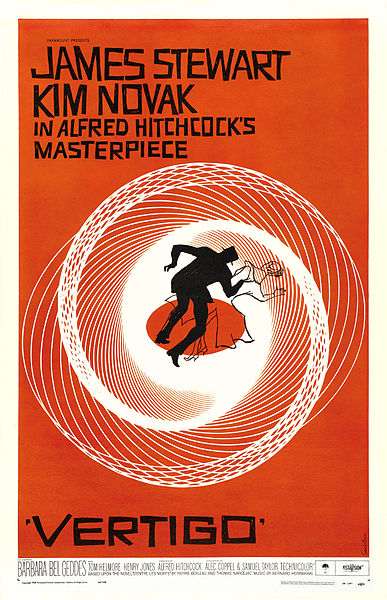
A synopsis of the novel from which the movie was adapted appears on Wikipedia:
A prosperous shipbuilder hires a former detective who suffers from vertigo to tail his wife Madeleine who is acting strangely. The detective falls in love with the shipbuilder’s wife but is unable to stop her committing suicide by jumping from a tower. Haunted by her death, he sees a woman who bears a strong resemblance to the dead woman, however, his attempts to get closer to this doppelgänger ultimately result in tragedy.
In these enlightened times, many, if not most, parents would be horrified at anyone’s allowing a first-grader to see such a nightmare-inducing movie. I, however, spent every afternoon glued to the Afternoon Movie. I guess my mother assumed that if I could handle Don Ameche trying to get rid of his wife, Claudette Colbert, by drugging her hot chocolate and then piping in repeated suggestions that she jump off her bedroom balcony, Hitchcock wouldn’t upset me.
And I’ve always been grateful to her, because that night at the drive-in, I fell in love. I watched Hitchcock’s television programs and all the movies I could manage. They were wonderful, and if they starred Cary Grant–Francine Paino wrote about one of those, North by Northwest, last week–that was icing on the cake.
Now Netflix, Prime, Roku, and other streaming services have allowed me to watch many of them again.
But this post isn’t a celebration of Hitchcock. It’s about two stories adapted for his television show. Watching them as an adult, I saw something I hadn’t seen years (and years) ago. I enjoyed both, but one had something extra.
The first is “The Second Wife,” in which a mail-order bride comes to believe that her husband plans to kill her. At the outset, he seems insensitive, unconcerned about her needs; when she says the laundry room in the basement is uncomfortably cold, he complains about the cost of installing a heater. She also hears
stories: he took his first wife to visit her people at Christmas and she died and was buried there–or that’s what he claims.
Gossip fuels the second wife’s fears, and when the husband announces plans to take her home for Christmas, she acquires a gun. Before they leave, however, he insists she go down to the basement. She takes the gun and descends the stairs. He’ll follow in a moment.
The viewer feels her fear: The husband will kill the second wife, as he killed the first.
But there’s a literary catch. In a letter, Anton Chekhov stated one of his principles for writing fiction: “One must never place a loaded rifle on the stage if it isn’t going to go off. It’s wrong to make promises you don’t mean to keep.”
The wife has a gun. And this is Hitchcock; he keeps his promises.
The wife shoots and kills her husband, then realizes he’d only wanted to show her her Christmas present–the heating system he’d had installed in the laundry room.
A tragic ending, but satisfying in its irony.
The second story, “Night of the Owl,” however, has something extra, something unexpected.
A couple have reared an adopted daughter, now a teenager, a bright student, a well-adjusted, happy girl. But the parents have carefully guarded a secret: the girl’s father murdered her mother, then killed himself in prison. When a prison chaplain and his accomplice appear and blackmail the couple, then come back for more, the father considers his options: murder the blackmailer, or tell his daughter about her past. Both are unthinkable. Then one of the blackmailers is murdered. Evidence points to the father.
How can the plot be resolved? Did the father commit murder? He escapes being charged but can’t escape telling his daughter about her birth parents.
In “The Second Wife,” the resolution is either/or, and the viewer can almost certainly predict which it will be.
But the ending of “The Night of the Owl” isn’t predictable. Will the girl become hysterical? Fall into depression? Reject her adoptive parents? Run away? Harm herself?
Told the truth about the murder/suicide in her background, she expresses empathy. How unhappy her parents must have been, she says–what sad lives they must have lived.
I didn’t see that coming. A Hitchcock program with a happy ending. And an exceptional character.
Critics (professional and amateur) point to problems with both programs. Fair enough. I didn’t watch for flaws. In fact, I didn’t watch for anything but the pleasure of seeing programs I’d first watched as a child. I just happened to see something more.
And to quote Osgood Fielding III, “Nobody’s perfect.”
Joe E. Brown appears as Osgood Fielding III in Some Like It Hot. He has the best line in one of the best, and funniest, movies ever made.
Research turned up this biographical item: “An ardent opponent of the Nazi regime, in 1939 Brown testified before the House Immigration Committee in support of a bill that would allow 20,000 German-Jewish refugee children into the United States. He would later adopt two German-Jewish refugee girls himself, naming them Mary Katherine Ann (born 1930) and Kathryn Francis (born 1934).”
*
Images are taken from Wikipedia. Both are in the public domain.








 Austin Mystery Writers