by Gale Albright

Aunt Marjorie Nell was a big fan of mine.
That’s why I figure she may have embellished stories about my alleged brilliance when I was a tot. She taught me to read when I was just three years old, because I told her “I want to read like you do, Jaumie.”
She was thirteen years old when I was born and she spent every minute away from school taking care of me. She was the only one I allowed to wash my hair (without squalling), and apparently, teach me to read.
I don’t know if I was really that young when I learned to read. I think Aunt Marjorie gave me too much credit, but I learned early and fast. I loved words. All kinds of words. I talked them, sang them, heard them on the radio. I found them in conversations and I found them in books.
Books were magic. Books were love. Books meant I was sitting on Jaumie’s lap while she read to me with her gentle East Texas twang. They took me to magic, foreign places while I was cuddled and safe with my biggest fan.
When I got big enough to read books by myself, I rode my bicycle to the Carnegie Library in Tyler, Texas. I loved the smell of the library. There was a sun-dappled holiness about the place. People spoke in hushed whispers as light streamed through the windows, illuminating the ivy plants perched on the windowsills.
Books—their touch, their smell, their heft–meant I was immersed a safe, happy place where you could fly to the moon; go on adventures with Freddy, the talking pig; witness the struggles of Black Beauty; go on the run with Tom Canty down the mean streets of Tudor London; and travel with Doctor Dolittle.
Fast-forward about a million years or Time Marches On.
My lifetime love affair with books turned me into a true Luddite, scoffing at electronic readers, literally clasping hard copies of books to my heaving bosom, filled with the sweetness of self-righteous indignation. I swore, repeatedly, that never would any &%$*# electronic reading device darken my door (you get my drift).
Until I listened to Mindy Reed speak about containers versus content.
Ms. Reed was the featured speaker at the June 8 Sisters in Crime: Heart of Texas program on current publishing trends. The meeting place was Recycled Reads, a part of the Austin Public Library. Recycled Reads keeps books and other materials out of landfills once libraries have weeded them from their shelves. It is part of Austin’s Zero Waste Initiative.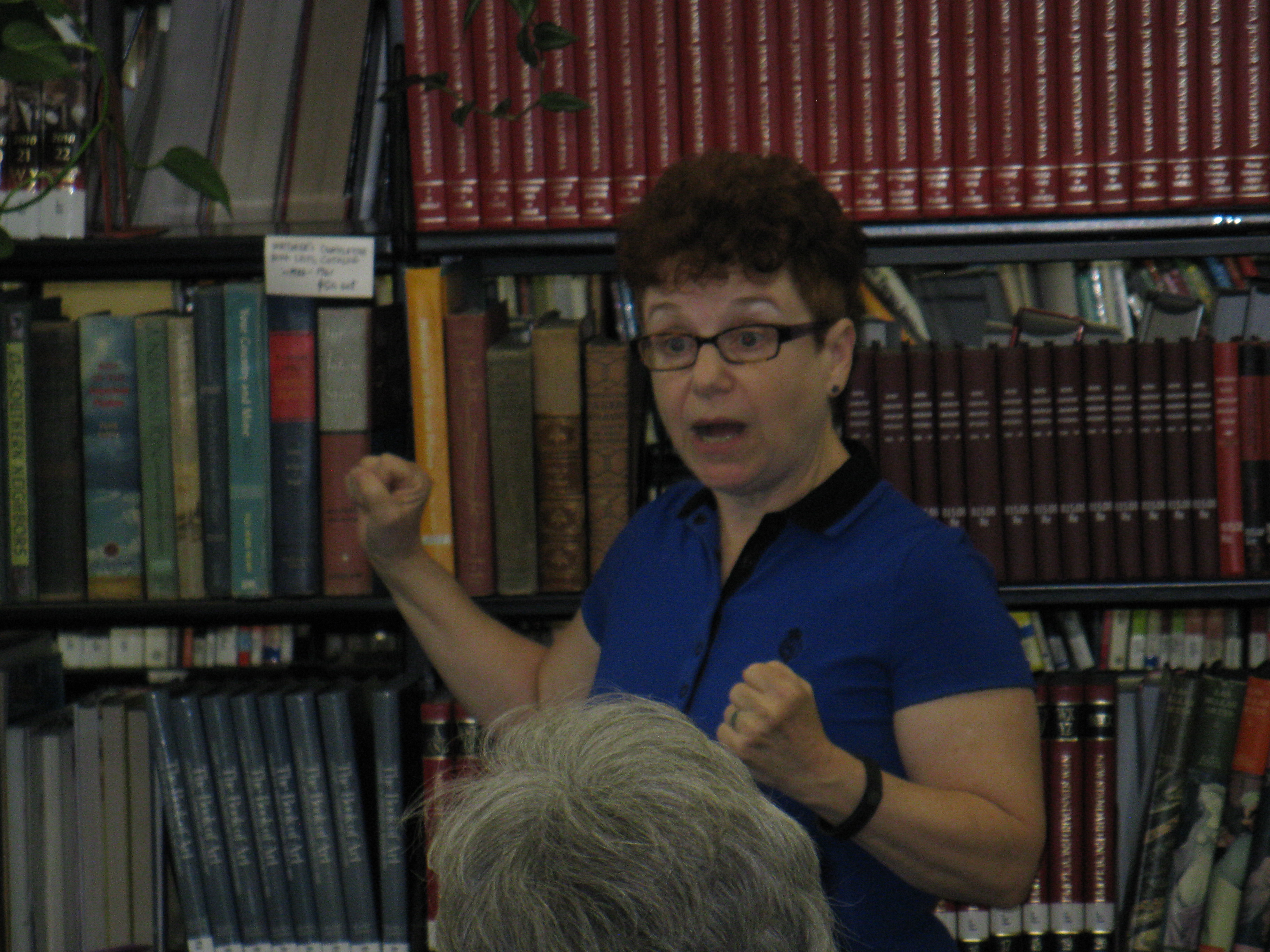
Ms. Reed, Recycled Reads manager, librarian, editor, and co-proprietor of The Authors’ Assistant, said readers have had a “romance with the book. There’s a romantic connection with books–we love them. But you can’t love all of the many donations of bestsellers that go out of style.”
The store recycles between twelve and fifteen tons of material a month. It has recycled 865 tons in the six years since its inception. How, you may ask, do we get so many recycled books?
According to Ms. Read, look to the New York Times bestseller list. Publishers strong-arm book stores to pre-order books. The list is based on the numbers of pre-orders sent out to stores. Some are sold. Many others are remaindered, resulting in a colossal waste of resources. These publishing practices make a negative impact on the environment. It is a bad, old-fashioned distribution mode for books
Ms. Read pointed to a display of plastic cups, glasses, coffee cups, etc. assembled on a table in front of the audience. “If you are thirsty, you want water. You don’t care if you get it from a fountain, bottle, or glass. They all contain water that will quench your thirst. Think of that when you talk about the rise of the digital age in publishing. Does all of that need to be put in this type of container? It’s about content as opposed to container.”
I do have a romance with the book. The sight, feel, and smell of books trigger endorphins, for all I know. I associate them with escape, peace, and happiness.
E-readers don’t exercise that special magic, but they do have what kept me coming back to books all those years ago. The stories. Or, as Mindy said, content versus container.
I thought I would never give in, but I have decided (one of these days soon) to buy an e-reader. Can e-books help save the planet by making less waste for us to pour into landfills? Yes. Is that important? Yes.
I don’t feel romantic about e-readers, but, when you’re thirsty, do you care if you drink your water from a crystal goblet, bucket, dipper, or paper cup? The first priority is to get some water. Or some words.
If using e-readers will help save the planet, I can do my part by giving back some love to the universe instead of extra trash.




 Austin Mystery Writers