Where small-timers are concerned, the rule seems to have fallen by the wayside, and that’s a shame. It stimulated creativity.
***
The backstory:
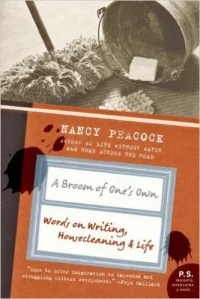
I wrote the following review to answer a “challenge.” I intended to post it at the end of September 2009. But in the process of writing, I got all tangled up in words and couldn’t finish even the first sentence.
I intended to post it at the end of October. I still couldn’t write it.
Finally, after telling myself I didn’t care, I managed to write it after the October deadline.*
In the middle of the “process,” I considered posting the following review: “I like Nancy Peacock’s A Broom of One’s Own very very very very very much.”
But the challenge specified a four-sentence review, and that was only one, and I didn’t want to repeat it three times.
So there’s the background.
I must also add this disclaimer: I bought my copy of A Broom of One’s Own myself, with my own money. No one told, asked, or paid me to write this review. No one told, asked, or paid me to say I like the book. No one told, asked, or paid me to like it. No one offered me tickets to Rio or a week’s lodging in Venice, more’s the pity. I decided to read the book, to like it, and to write this review all by myself, at the invitation of Story Circle Book Review Challenge. Nobody paid them either. Amen.
*********************************************
The review:
I like Nancy Peacock’s A Broom of One’s Own: Words About Writing, Housecleaning & Life so much that it’s taken me over two months and two missed deadlines to untangle my thoughts and write this four-sentence review, an irony Peacock, author of two critically acclaimed novels, would no doubt address were I in one of her writing classes.
She would probably tell me that there is no perfect writing life; that her job as a part-time house cleaner, begun when full-time writing wouldn’t pay the bills, afforded time, solitude, and the “foundation of regular work” she needed; that engaging in physical labor allowed her unconscious mind to “kick into gear,” so she became not the writer but the “receiver” of her stories.
She’d probably say that writing is hard; that sitting at a desk doesn’t automatically bring brilliance; that writers have to work with what they have; that “if I don’t have the pages I hate I will never have the pages I love”; that there are a million “saner” things to do and a “million good reasons to quit” and that the only good reason to continue is, “This is what I want.”
So, having composed at least two dozen subordinated, coordinated, appositived, participial-phrase-stuffed first sentences and discarding them before completion; having practically memorized the text searching for the perfect quotation to end with; and having once again stayed awake into the night, racing another deadline well past the due date, I am completing this review—because I value Nancy Peacock’s advice; and because I love A Broom of One’s Own; and because I consider it the equal of Anne Lamott’s Bird by Bird; and because I want other readers to know about it; and because this is what I want.
*Not caring is often the key to cracking writer’s block. Nancy Peacock probably would say that, too.
Now and then, when I sneak a book off the shelf, glancing around to be sure no one notices it’s a children’s book…or pick up an old LeCarré…I’m grateful for the joy of rereading.
Rather like upcoming Thanksgiving dinners! Think of their literary content! Suspense, of course–is that turkey really done? Imminent peril–are the drippings sufficient for decent gravy? Strong characters–the usual suspects are arriving at the table! Ethical challenges–no comments on the burnt marshmallow topping on the yams. And, hopefully, enough whipped cream for a happy ending!
Of course an invitee may decide to bring Something New. (I refer to an aunt’s “Pumpkin Chiffon” creation, still infamous years later. I mean, it wasn’t pumpkin pie and never would be.) In the face of such unwonted (unwanted) novelty we draw back: we don’t want something new: we want…reassurance.
So many good books are out now, deserving our attention–Lawrence Wright’s Mr. Texas, Paulette Jiles’s Chenneville, Paul Woodruff’s Living Toward Virtue, and my dear friend Dr. Megan Biesele’s amazing memoir about her anthropological adventures in the Kalahari, Once Upon a Time Is Now. https://amzn.to/3MSVL7y
But sometimes I return to the old faves, craving (especially these days)…reassurance.
What sort of reassurance? How about vindication for a beloved character in trouble? See the end of William Faulkner’s Intruder in the Dust (1948), a murder mystery where Lucas Beauchamp with his gold toothpick is saved from lynching with the help of two teens and an old lady. It’s a precursor to Harper Lee’s To Kill a Mockingbird (which has a sadder ending).
Children’s books require vindication of the hero. Lucy receives that in The Lion, the Witch and the Wardrobe, when her older siblings finally follow her through the back of the wardrobe into Narnia and discover her amazing story is true.
As a Le Carré follower, I remain thrilled by A Legacy of Spies (2017). And yes, like many of his spy thrillers, it’s a murder mystery. Our first-person narrator is “young Peter Guillam” who won our hearts earlier as the man that master spy George Smiley could always count on. White-haired, a bit deaf, and back home on the Breton coast, he’s no longer protected by the now-retired Smiley, and Britain’s foreign service (the “Circus”) has hauled Guillam to England and arrested him. The Circus is plotting an unconscionable rewrite of agency history, with Guillam cast as the villain.
But this old dog still knows old tricks, and, yes, is vindicated! We rejoice, reassured, when Peter Guillam once again is strolling the Breton coast, with a furious Smiley about to descend with a vengeance on the Circus.
Other great rereads for reassurance: Patrick O’Brian’s Aubrey-Maturin sea novels. The last pages of The Commodore (Book 17) provide classic vindication for our surgeon-spy, Stephen Maturin. After many perils, barely surviving yellow fever, and finally encountering his beloved potto https://en.wikipedia.org/wiki/Potto, Maturin learns of the death of a most vicious but hitherto unnamed enemy, who has plotted Maturin’s downfall, even his murder, for years (through many volumes). Just pages later Maturin experiences the wild joy of an unexpected reunion with his lost Diana. O’Brian’s unsurpassed powerful brevity can create the sudden turns and arouse the fierce emotions that satisfy a happy (re)reader.
My housemate reports that his rereads include The Cruel Sea by Nicholas Monserrat, Cannery Row, Pride and Prejudice, certain sections of Moby Dick, and more.
This Thanksgiving I give thanks for books, new and old. Do you remember learning to read? I do. Early one morning, age five, I opened a new book titled Children’s Book of Knowledge. The long strings of separate curly letters abruptly morphed into words. Like a bolt of lightning! I could read! Words became magnetic: I couldn’t keep my eyes away. I read everything–stray magazines, newspapers, the Cheerios box. I was now independent. No waiting for grown-ups to dispense information: I could simply read for myself! (With a library book stashed inside my desk at East Elementary–unfortunately confiscated by the teacher.)
Reading sets us free, gives us resources, gives us respite, gives us independence..and reassurance. Happy Thanksgiving!
I’m working on the ninth novel in the Alice MacDonald Greer Mystery series set in Coffee Creek, Texas, in the Hill Country. You can be sure the inhabitants insist on cornbread dressing and pumpkin pie with whipped cream. The burros will hope for leftovers.
In My Reading Life, a grand book about reading and writing, author Pat Conroy says, “The most powerful words in English are ‘tell me a story…’” bit.ly/3PpSoHF
Yes! And don’t we know stories demand––require––insist on characters? Fairy tales––Jack in the Beanstalk, Hansel and Gretel. Epics––The Fellowship of the Ring, Star Wars.
I love the beginning of Emily Wilson’s recent translation of The Odyssey: bit.ly/43Bdjvi
Tell me about a complicated man,
Muse, tell me how he wandered and was lost
When he had wrecked the holy town of Troy…
…Now, goddess, child of Zeus,
Tell the old story for our modern times.
Find the beginning.
So, how do writers create memorable characters? What works to create character? And why do we care? Isn’t it because character drives narrative?
Recall Shakespeare’s famous terse description in Julius Caesar: “Yon Cassius hath a lean and hungry look…” Those ambiguous words reach beyond the man’s shape or facial expression to hint at driving ambition…the very subject which drives the play’s narrative.
How does Jane Austen create character? Looking back, I am surprised by the lack of physical description. She doesn’t tell us what Mr. or Mrs. Bennet, or the five daughters, look like. We’re given a few visual breadcrumbs, told that Bingley and Darcy are “handsome” and that Bingley “wore a blue coat and rode a black horse.” But her characters, with their personalities, their actions, largely come to life in our minds otherwise: by conversation.
Elizabeth overhears Mr. Darcy describing her as “tolerable but not handsome enough to tempt me”—a criticism she later recounts to friends, “for she had a lively, playful disposition.” Okay, there’s one aspect of Elizabeth—lively and playful. Yet after telling friends that Elizabeth “had hardly a good feature in her face,” Darcy “began to find it was rendered uncommonly intelligent by the beautiful expression of her dark eyes.” So she’s also intelligent! Elizabeth tells her sister Jane, “you are a great deal too apt…to like people in general. You never see a fault in any body.” Elizabeth is not just “playful” and “intelligent,” but a critical observer.
Using dialogue––what Elizabeth and Darcy say––Austen shows us how Elizabeth—and ultimately Darcy––think. In a world focused on superficiality—class, wealth, appearance, social skills and niceties––Austen makes us care about two characters who are too smart, too critical, too thoughtful, not to keep thinking and––ultimately––change their minds. Their characteristics (both pride and prejudice!) drive the narrative.
But hey, what about those dark eyes? Mr. Darcy disturbs the haughty Miss Bingley by saying he’s meditating on “the very great pleasure which a pair of fine eyes in the face of a pretty woman can bestow.” As all Austen readers know, that specific detail––“[A] pair of fine eyes”––will also powerfully move the plot.
Texas’s Larry McMurtry shows us how conflict between characters drives narrative. In his Lonesome Dove, the first character we meet is Augustus, sitting on the porch at the Hat Creek Cattle Company, in “the smidgin of shade he had to work with.” He has retrieved his jug from the springhouse and, as is his custom, he’s drinking Tennessee mash whiskey, which makes him feel “feel nicely misty inside.”
We’re in Augustus’s point of view when we meet his counterpoint, the other key character, his stubborn partner Captain Woodrow Call. Augustus, when he hears the whir of a nervous rattler in the corner of the springhouse, believes “in giving creatures a little time to think.” He doesn’t shoot the snake; he waits until the rattler has “calmed down” and crawled out a hole. He contrasts his own behavior to Call’s:
Call had no respect whatsoever for snakes, or for anyone who stood aside for snakes. He treated rattlers like gnats, disposing of them with one stroke of whatever tool he had in hand. “A man that slows down for snakes might as well walk,” he often said.
As Call and their diffident hand, PeaEye, arrive at the porch, Augustus notes that while he himself stands four inches taller than Call, and Pea Eye three inches taller, there’s no way to convince Pea Eye that Call is the short man: “Call had him buffaloed.” Augustus knows that if a man means to hold his own with Call, that man must keep in mind that Call isn’t as big as he seemed. Thus Augustus begins many a day by remarking, “You know, Call, you ain’t really no giant.”
McMurtry doesn’t give us a detailed physical description of Augustus or Call. Instead, we hear them banter. We see Call’s impact on others, and how Augustus works to maintain his own status vis à vis Call. Right off the bat McMurtry makes us feel the sheer force of two characters, two magnetic and conflicting personalities, and their relationship, as we’re launched into this epic tale. Their characters, the combined magnetism and conflict, drive us to Montana…and back…
We first meet Sir Arthur Conan Doyle’s character Sherlock Holmes in A Study in Scarlet, when Holmes is introduced to the narrator, Dr. Watson, as a potential roommate. Watson walks into the lab: “There was only one student in the room, who was bending over a distant table absorbed in his work. At the sound of our steps he glanced round and sprang to his feet with a cry of pleasure. ‘I’ve found it! I’ve found it,’ he shouted to my companion, running towards us with a test-tube in his hand.” Then he shakes hands with Watson: “You have been in Afghanistan, I perceive.” Watson is astonished. bit.ly/3N0U4Ep
We get no actual physical description of Holmes until Chapter Two. Instead, we confront Holmes’s vigor, curiosity, perspicacity, confidence in his own powers. Similarly, in “A Scandal in Bohemia,” Watson first describes Holmes’s “immense faculties and extraordinary powers of observation” in deciphering clues. Then, looking up from the street, Watson sees the detective’s silhouette on the window-shade: “I saw his tall, spare figure pass twice…He was pacing the room swiftly, eagerly, with his head sunk upon his chest and his hands clasped behind him.” Watson instantly knows, “He was at work again.”
The author engraves that image of Holmes, pacing eagerly, on our imaginations. We can’t wait to see Holmes in action: that’s what we’re reading for.
Herman Melville deprives the reader as well as Ishmael, the narrator of Moby Dick, of even one glance at Captain Ahab until Chapter 28, when Ishmael is well out to sea on the whaling ship Pequod. Ahab finally appears on deck and stands erect, holding on by a shroud, his bone peg-leg planted in the auger hole drilled on deck for that purpose:
There was an infinity of firmest fortitude, a determinate, unsurrenderable wilfulness, in the fixed and fearless, forward dedication of that glance. Not a word he spoke; nor did his officers say aught to him; though…they plainly showed the uneasy, if not painful, consciousness of being under a troubled master eye…moody stricken Ahab stood before them with a crucifixion in his face; in all the nameless regal overbearing dignity of some mighty woe.
The word “character” comes from the Greek root for “engraving tool.” https://www.merriam-webster.com/dictionary/character If ever character was engraved on a person’s body, Melville’s description of Ahab and his impact on his shipmates qualifies. The uneasy silence of the officers! The crucifixion in Ahab’s face! His unsurrenderable wilfulness, fixed and fearless!
If that’s not enough foreshadowing, in Chapter 36, Ahab demands the entire crew to assemble and then hammers a gold piece to the mast for the first man who sees the white whale which took off Ahab’s leg—Moby Dick. Starbuck objects: he signed on to hunt whales, not to take vengeance on a mere animal, which he calls blasphemous. But Ahab makes the rest of the crew swear: “Death to Moby Dick!” Melville creates a character whose physical description conveys tragic history and deep emotion, and whose forceful actions persuade the crew to follow him. We know there’s no stopping Ahab now. And we haven’t yet met the whale.
Pat Conroy also tells us, in My Reading Life, of the day his beloved high school English teacher, Greg Norris, took sixteen-year old Conroy to visit the poet Archibald Rutledge. Rutledge “suggested that I make the close observation of nature part of my life’s work and that I learn the actual names of things,” because “specifics always proved fruitful to the validity of any narrative”:
“A Cherokee rose, not just a rose. A swallowtail butterfly, not just a butterfly. That kind of thing,” he said. “Get the details right. Always the details.”
Always a great reminder for mystery writers. My character Alice, in the Alice MacDonald Greer Mystery series––stays on me to get the details right. https://bit.ly/3qC2fzI
So–tell me a story! Show me the character! Get the details! And we’re off!
About Helen Currie Foster
I live north of Dripping Springs, Texas, supervised by three burros. I’m deeply curious, more every day, about human history and prehistory and how, uninvited, the past keeps crashing the party. I’ve loved the Texas Hill Country since my first sight of it as a teenager. Artesian springs, Cretaceous fossils, rocky landscapes hiding bluegreen water in the valleys. After law school (where I grew fascinated with water and dirt) I practiced environmental law and regulatory litigation for thirty years––then the character Alice suddenly appeared in my life. I’m active with Austin Shakespeare and Heart of Texas Sisters in Crime. And I’m grateful to the readers who enjoy the Alice MacDonald Greer Mystery series!
What’s your favorite place to read? A certain chair? The one with a lamp that shines on your book, not in your eyes? Perhaps a ferryboat seat, where you glance up at the horizon, then down at your book? On a plane, or train?
When I was young our house had an elm tree in the back yard which was not only climbable, but offered two branches that stuck out at the perfect angle for a lounging pre-adolescent. Even better—the lounger was invisible from the house. I could scramble up, arrange myself, open my book—and be left unfound, undisturbed, for some time.
A later joy was climbing on the New Haven RR in Boston after final exams (Chaucer, Shakespeare), armed with the latest James Bond and the very biggest Hershey bar with almonds, and being rocked south for miles along the coastline. Uninterrupted.
And I confess to rereading books. I further confess to rereading children’s books. Maybe a more accurate word is: revisiting. At least every two years, I pick up Kipling’s Kim, finding my way to the part where Kim guides his Tibetan lama, who seeks a sacred river, on a pilgrimage into the high deodar forests of the Himalayas. I can almost smell the trees. There Kim steals the Russian spies’ notes––his own initiation into the Great Game. Even more satisfying? The long afternoon where, exhausted, he is “taken apart” by Eastern massage and finally stumbles out, recovered, to find his lama at the brink of—well, no spoilers.
Why this gravitational pull of favorite children’s books?
Maybe because the best children’s books feature enterprise, surprise, disguise. And—most important––the discovery of identity.
Consider The Sword in the Stone, where Merlin transforms Wart into various animals (badger, owl, fish) who teach him survival techniques (“put your back into it!”). And magic! Giants! Griffins! The Queen of Air and Darkness! (See volume below–griffin looming behind tree.) One favorite moment? When Merlin transforms Wart to a raptor—a small merlin––who must sit for desperate minutes during his formal initiation, near the maddened and perilous Peregrine. Why does Wart need Merlin’s special tutelage? Because of his identity, which he and we will finally discover.
Others I still pull off the shelf: The Wind in the Willows, especially Mole’s tearful return home, where he recognizes his true self.
Also Susan Cooper’s The Dark Is Rising. Maurice Sendak’s Nutshell Library – memorizing all the poems. I sneak back to Harry Potter—a feast of enterprise, surprise, disguise, and Harry’s search for his own identity. Occasionally I return to Lord of the Rings––especially the battle for Gondor. You’ll note I missed out on Jack London and many others. But there’s always The Lion, the Witch and the Wardrobe—remember that wondrous moment when Lucy slips through the back of the wardrobe, past all the mothballed coats…into magic? Into the snowy landscape where she meets Mr. Tumnus the faun? Into the realm where––as Lucy later discovers––she is Queen Lucy?
You have your favorites. So do our collective children and grandchildren. Bookstore shelves still offer children tales of enterprise, surprise, disguise—and characters discovering their own identities.
And fortunately, children’s books needn’t follow the 1930 Detection Club’s 10 Rules for Writing a Mystery. Rule #2: “All supernatural or preternatural agencies are ruled out as a matter of course.” Following Rule #2 would let out magic, of course, and its enormous space for imagination. (If you, like me, crave an occasional touch of magic for grown-ups, try Remarkably Bright Creatures by Shelby Van Pelt. amzn.to/44iIoVj)
As a mystery writer/reader I usually write about mystery. But thinking lately about the bibliophile’s favorites—favorite reading spots, favorite chairs, favorite characters––has sent me down a different path. Why reread? Wait––why revisit?
What is it about the end of Kim, or the plight of Frodo and Samwise in Shelob’s lair, or Harry Potter’s first moment on his broom, learning how good he is at Quidditch––that whispers, “read it again!”
I reread mysteries too. Have you reread a Dorothy Sayers, a Ngaio Marsh, a Sherlock Holmes? Or John le Carré? How many times have you read Tinker, Tailer, Soldier, Spy, or Smiley’s People? (Come on, spy thrillers are part of the mystery-thriller-spy novel genre.) And why do we reread le Carré? One character in particular: George Smiley.
Smiley first appears on page 1 of chapter 1, titled “A Brief History of George Smiley,” in Call for the Dead, le Carré’s first book, published in 1961. Smiley’s marriage to the aristocratic Lady Ann Sercomb has ended when she abandoned him, and he’s described as follows: “Short, fat and of a quiet disposition, he appeared to spend a lot of money on really bad clothes, which hung about his squat frame like skin on a shrunken toad.”
We learn of his deep love of 17th century German literature, his success at Oxford, his recruitment by MI-6, his dangerous service abroad as a spy in WWII. Not a commanding figure, no. But le Carré allows us to glimpse his sharp mind, his penetration, his ability to absorb all he hears. Smiley’s work as an intelligence officer provides him “with what he had once loved best in life: academic excursions into the mystery of human behaviour, disciplined by the practical application of his own deductions.”
Smiley appears next in A Murder of Quality (1962), where Smiley’s solution to the murder rests on a scathing critique of the snobbishness of British public schools (le Carré despised his own experience at such a school).
By the time we reach Tinker, Tailor, Soldier, Spy (1974), Smiley has been put out to grass at MI-6 under the new regime headed by Bill Haydon, who has seduced Smiley’s wife Ann and taken over London Station after causing the bitter dismissal of Control as its head.
In Tinker, Tailor, Smiley is plucked out of retirement to interview a somewhat dubious British agent who claims the Russians may have placed a mole inside MI-6. Here’s Smiley, listening to the agent’s tale:
“He sat leaning back with his short legs bent, head forward, and plump hands linked across his generous stomach. His hooded eyes had closed behind the thick lenses. His only fidget was to polish his glasses on the silk lining of his tie, and when he did this, his eyes had a soaked, naked look that was embarrassing to those who caught him at it.”
Le Carré’s letter to Sir Alec Guinness (3 March 1978) appears in A Private Spy / The Letters of John le Carré, at 213. He tells Sir Alec:
“Apart from plumpness, you have all the other physical qualities: a mildness of manner, stretched taut, when you wish it, by an unearthly stillness and an electrifying watchfulness. In the best sense, you are uncomfortable company, as I suspect Smiley is. An audience wishes––when you wish it––to take you into its protection. It feels responsible for you, it worries about you. I don’t know what you call that kind of empathy, but it is very rare, & Smiley and Guinness have it: when either of you gets his feet wet, I can’t help shivering.”
I love that “as I suspect Smiley is.” Does the author’s own speculation about George Smiley explain, in part, why we readers become so attached to this character? What drives us to Smiley’s side? Is it his apparent ineffectualness, his vulnerability, his stillness, his watchfulness, entwined with our certainty that he will somehow keep going?
Not until 1979 in Smiley’s People does Smiley achieve final vindication, catching the Russian master-spy who conceived the long set of steps that led to Haydon’s seduction and Control’s fall. At the climax, we (along with Smiley and his fellow spy Peter Guillam) await the possible arrival of the Russian in cold war Berlin, at the crossing point from East Germany. Will the spy make it across the bridge? Guillam asks what cover the Russian will use:
Smiley sat opposite him across the little plastic table, a cup of cold coffee at his elbow. He looked somehow very small inside his overcoat.
“’Something humble,” Smiley said. “Something that fits in. Those who cross here are mostly old-age pensioners, I gather.’ He was smoking one of Guillam’s cigarettes and it seemed to take all his attention.”
At book’s end, we are waiting with Smiley. It’s cold there by the Berlin bridge. I expect Smiley’s feet are wet. Like the author, “I can’t help shivering.” When we know a character’s vulnerabilities, we begin to perceive true identity.
For Smiley, for all the characters created by their authors with such vividness and such vulnerability that we seem to feel what they feel, for such characters–I reread. Yes, the better word is revisit: I go back just to be sure the characters are still there, still available, still waiting quietly on the shelf. And, yes, just as good as I thought they were.
I’d love to hear your favorites (reading spots, children’s books) and the favorite characters you…revisit.
*****
Author: Helen Currie Foster
I live north of Dripping Springs, Texas, supervised by three burros. I’m deeply curious, more every day, about human history and prehistory and how, uninvited, the past keeps crashing the party. I’ve loved the Texas Hill Country since my first sight of it as a teenager. Artesian springs, Cretaceous fossils, rocky landscapes hiding bluegreen water in the valleys. After law school (where I grew fascinated with water and dirt) I practiced environmental law and regulatory litigation for thirty years––then the character Alice suddenly appeared in my life. I’m active with Austin Shakespeare and Heart of Texas Sisters in Crime. And I’m grateful to the readers who enjoy the Alice MacDonald Greer Mystery series!
The definition of reading readiness is the point
at which a child goes from not reading, to reading.
~ Sight and Sound Reading
But, Gwammy, I can’t wead.*
~ Jenny, five years old, after one week in kindergarten
When I was five, my Great-aunt Ethel gave me an ancient primer. She had found it in an old school building, abandoned when consolidation sent children in my hometown to a school two miles away, and then used only as a polling place. The primer had also been abandoned, and Aunt Ethel, election judge, liberated it and gave it to the youngest member of the family (youngest by about forty years; it was an old town).
My parents read to me almost from day one. The story goes that, as a toddler, I met my father at the door every evening when he got home from work, saying, “‘Ead a book, Daddy.” (Unlike Jenny, I had no pwoblem pwonouncing my ahs; I just dropped them.)
We didn’t have a library nearby, but I plenty of books: a Bumper Book, Little Golden Books, Grimms’ Fairy Tales, Andersen’s Fairy Tales, which I didn’t like, in part because they were dark (“The Little Match Girl”), but mostly because the end papers sported a hairy black thing with an ugly humanish face and enough long, winding legs to qualify it as a spider. Grimms’ tales were more pleasant.
When I received the primer, I already knew the alphabet. In fact, a year before, I’d written my name in red adhesive tape–the gooiest, stickiest adhesive I’ve ever come across–on the inside of the kitchen door. It stayed there for years.
Anyway, armed with the primer–a school book, for reading–I set about teaching myself. While my mother did housework, I trailed behind, spelling out words.
“T-h-e”
“The”
“m-a-n”
“man”
“s-a-i-d”
“said”
I don’t think I taught myself to read. But the next year, when I entered first grade–no kindergarten back then–I was ready. I took right off on the underwhelming adventures of Dick, Jane, and Sally (siblings who never had a decent disagreement) plus Spot and Puff, who came and ran a lot.
In second grade, I got a Little Big Book—Gunsmoke–that had one hundred pages. I read it on Saturday and reported the accomplishment in our Class News at school on Monday. Later I got a literary Little Big Book, Huckleberry Finn.One sentence confused me: a dead man’s leg was stuck out at a strange angel. I was about thirty when I realized angel was really angle. I was also surprised when, in high school, I learned that the Little Big Book had been severely abridged.
Then I discovered comic books. They were more educational than most people think. From Scrooge McDuck, I learned that emeralds come from South America. Unfamiliar with physics, I pronounced Atom Cat as A-Tomcat. Seemed reasonable.
The next year, thanks to a Christmas present from my grandmother, I discovered Nancy Drew. Nancy had a blue convertible and drove around wherever she wanted, and her father never grounded her. I envied Nancy her freedom. I didn’t like her, though; she had a tomboy friend, George, who said, “Hypers, you slay me,” which was fine, but her other friend, Bess, was plump, and Nancy often referred to how much Bess ate. I presume in later editions, Nancy behaved better. But her treatment of Bess didn’t stop me from reading about her. I wrote letters to Joske’s Department Store in San Antonio: “Please send me one copy of The Hidden Staircase and one copy of The Clue in the Jewel Box. Please charge my account.” They each cost two dollars. My mother kindly signed the letters. It was her account.
I soon outgrew Nancy, but, like many other mystery readers and writers, I credit her for getting me hooked. I read a couple of Trixie Beldens–Trixie was sickeningly enthusiastic when her mother made her dust the living room before going out to solve mysteries, but she did manage to sneak out at night. I read some Kathy Martins. Kathy, a nurse, often suspected her (nice guy) brother for whatever (minor) crime had been committed, which I thought strange, but she was more mature and more realistic than other characters. No convertible, no sneaking.
Young Adult novels didn’t exist as a genre until the late sixties, when increased federal money became available to schools, and authors found a new audience. Born too soon, I moved from children’s books into adult fare: Zane Grey, Thomas B. Costain, Charles Dickens, Aldous Huxley, Jane Austen, Harper Lee, Daphne DuMaurier, Rafael Sabatini (Scaramouche: “He was born with a gift of laughter and a sense that the world was mad.”) Noticing that I read the classics, the bookmobile librarian, unasked, brought me a copy of the scandalous Madame Bovary. I was fifteen. He’s still my hero.
On the bookmobile, I rediscovered mysteries in the real thing—Sherlock Holmes. I cried and cried when he and Moriarty went over Reichenbach Falls. Nobody told me he would be back.
But enough about me. The point is that reading was, and is, important to me.
And that this week I’ve been reading A Velocity of Being: Letters to Young Readers, edited by Maria Popova & Claudia Bedrick. The editors compiled 121 letters from “scientists, musicians, artists, philosophers, composers, poets, actors, a 98-year-old Holocaust survivor, Italy’s first woman in space, and many more remarkable humans whose splendor of spirit cannot be contained in the shorthand descriptors we often use to condense a person’s character and cultural contributions.” Each letter is paired with an illustration to “bring it to life visually.”
Many letters describe books as portals to the universe, to other worlds, to adventure, to curiosity and questions, to dreams, to logic and imagination; they’re boats and planes and magic carpets. Contributors write about hating book reports, and being hellions when they were little and refused to listen to Goodnight Moon at bedtime because they wanted dinosaurs, and being called antisocial when they preferred to read instead of play with friends.
But other contributors take the subject to a deeper level:
Author Alain deBotton writes, We wouldn’t need books quite so much if everyone around us understood us well. But they don’t. Even those who love us get us wrong. They claim to know what we need, but forget to ask us properly first. They can’t understand what we feel . . . That’s the moment to turn to books They are friends waiting for us, and they will always speak honestly to us. They are the perfect cure for loneliness. They can be our very closest friends.
Screenwriter Shonda Rhimessays, Reading saved me. When I was twelve, I spent most of my day trying to be invisible. The year before I’d been the new girl in school, and I’d spent a lot of time trying to be accepted. . . . The very desire to bend and twist to fit in–assures your rejection They did not like me. They hated me.
I spent a lot of time alone. I rode the bus alone. I spent weekends alone, I ate lunch alone. Except I was never alone. I always had a book in my hand. If you have a book, you don’t need to bend and twist to fit–you’re there. You are in. . . .
If you have a book in your hand, you can stop being invisible. Because you’re a little more invincible.
Venture capitalist Chris Sacca says that books are dangerous: If you keep reading, you might learn so much that you can take over for the adults and then you kids will be in charge! You all could be the journalists, entrepreneurs, artists, professors, authors, doctors, explorers, scientists, and even the leaders of our countries! Then what would the grown-ups do? Live in a world run by brilliant, interesting, innovative, and compassionate young people. Ugh. No, thank you.
So please stop reading before you become really smart, successful, and happy.
But seriously, books are dangerous. Holocaust survivor Helen Fagin writes about life in the World War II Polish ghetto, where being caught reading by the Nazis meant anything from hard labor to death. But books were smuggled in, read by each person for only one night, and then, for the sake of safety, passed on. She stayed up all one night reading Gone with the Wind. Then she decided the children she secretly taught needed not dry information, but stories. And for one hour each night, she told them the story of Scarlett and Melanie, Rhett and Ashley; and for that hour they “escaped a world of murder.” Then “a knock at the door shattered our dream world.” Years later, she met one of only four of the students who survived. The woman called her “the source of my hopes and my dreams in times of total deprivation and dehumanization.”
Composer Mohammad Fairouz shares a story that I cherish from my upbringing; . . . 1400 years ago in the deserts of Arabia, a meditative prophet named Mohammad had a vision of the Angel Gabriel who came to him with a message: “Read” . . . This was the first word of the Quran.
In the years following the prophet’s death, his followers built an empire where they contributed to every branch of knowledge, from algebra to optics and medicine to music. Countless things we have today would not exist without their contributions: that includes space stations, glasses, aspirin, your iPad.
They were able to do this because they were inspired to seek out the power that comes with being to read. You deserve the same power . . .
Years ago, I knew a young man who had never learned to read. I don’t know why; he just hadn’t. As an adult, he took a literacy class. He said that when he traveled for his work, he was always scared, because he couldn’t read road signs, and he was afraid he would get lost. At the most basic level, reading is power.
And consider: At one time in the American South, it was illegal to teach slaves to read. If they were literate, they might be able to read signs that would help them escape. They might also read some inconvenient truths: “. . . that all men are created equal, that they are endowed by their Creator with certain unalienable Rights, that among these are Life, Liberty and the pursuit of Happiness . . .” Inconvenient for their owners, that is.
“So the research shows that perhaps reading fiction does make people behave better. Certainly some institutions consider the effects of reading to be so significant that they now include modules on literature. At the University of California Irvine, for example, Johanna Shapiro from the Department of Family Medicine firmly believes that reading fiction results in better doctors and has led the establishment of a humanities programme to train medical students.
“It sounds as though it’s time to lose the stereotype of the shy bookworm whose nose is always in a book because they find it difficult to deal with real people. In fact, these bookworms might be better than everyone else at understanding human beings.”
Philosopher and professor Martha Nussbaum gives an example: The great African-American novelist Ralph Ellison said that a novel like his Invisible Man could be “a raft of hope, perception, and entertainment” on which America could “negotiate the snags and whirlpools” that stand between us and the democratic ideal. He’s referring here to Huck Finn and Jim, who got to know one another as full human beings, rather than just as a white man and a black man, when they traveled down the river on a raft together. On the raft, they had to look at one another, listen to one another’s stories. In our divided society, such encounters happen all too seldom in real life, and are fraught with mistrust when they do. Reading can create such encounters in the head, so that the ones that happen in the world are a little less crude, a little less deformed by fear and anger.
Huckleberry Finn has for years made the American Library Association’s list of most often challenged, banned, or restricted books–a novel that can teach us to be better people.
Design writer and educator Steven Heller extends the idea that reading is power and issues a challenge: Books are weapons in humankind’s battle against ignorance. I don’t mean like lasers and drones. I mean that knowledge is strength and the kind of knowledge you get from books is not the same as the quick fix that Googling gets you. What’s more, books can’t be hacked. But they can he censored, which means blocked or forbidden from being published. And this is why they are so valuable to us all. Often in fighting ignorance, the ignorant take books prisoner. If you don’t read books, then those that have been censored over the ages will be lost and forgotten. So kids, don’t let them down. Read them, savor them protect them. Don’t let others make books irrelevant.
*
*Jenny soon learned to wead. And to pwonounce her ahs.
*
I’ve gone on too long. If you’re still with me, thanks for sticking. And one more thing: Despite the title, A Velocity of Being isn’t just for young readers. It’s also for adults who need to be reminded to make reading part of their children’s lives.
While writing this post, Kathy was watching/listening to an old TV series of Dorothy L. Sayers‘ Lord Peter Wimsey mysteries. Bless Youtube and all who post on her. (Opinion: Ian Carmichael was the best Peter Wimsey by far.)
In the back of the closet I recently unearthed my mother’s old Caswell Massey “Gardenia” bubble bath. The resulting bath held astonishing comfort and nostalgia. It smelled like her house.
Mystery writers can use smell to reinforce not only setting and character, but powerful plots. Here are strong examples from the first chapter of Lethal White, the fourth in Robert Galbraith’s Cormoran Strike series. Chapter one begins with the wedding of Strike’s former co-detective Robin Ellacott and her long-time (but insufferable) fiancé Matthew Cunliffe, arguing while the wedding photographer tries to get some decent shots. Strike has fired Robin, partly from fear she’ll be killed. Without her job, Robin’s miserable. Matthew’s furious because of the joy he saw on Robin’s face when Strike arrived for the ceremony, heavily bandaged from capturing a killer. And now, arguing with Matthew, how does Robin feel? “The sweet, ticklish smell of hot grass filled her nostrils as the sun beat down on her uncovered shoulders.” The hot smell matches Robin’s itchy misery as she second-guesses her marriage to Matthew.
The country hotel setting smells beautiful, in stark contrast to Strike’s emotions: “For a while he lurked at the end of the bar, nursing a pint…and then repaired to the terrace, where he had stood apart from the other smokers and contemplated the dappled evening, breathing in the sweet meadow smell beneath a coral sky.” Sweet meadow smell; miserable situation.
Robin finally reaches Strike on the stairs as he’s leaving: “They were holding each other tightly before they knew what had happened, Robin’s chin on Strike’s shoulder, his face in her hair. He smelled of sweat, beer, and surgical spirits, she, of roses and the faint perfume that he had missed when she was no longer in the office.” The scene is almost shocking in its sensory overload. We feel their powerful attraction. Galbraith (J. K. Rowling) brilliantly gives us not only the protagonists, but the pain of their predicament, using scent to remind us of Strike’s injury (surgical spirits) and the fact that he has missed her perfume because she’s no longer in the office.
We already know that Chet, the heroic detective dog of Spencer Quinn’s Chet and Bernie series, is a dog of admirable olfactory sensitivity. He feels sorry for his human partner, Bernie (who labors under the misapprehension that he, not Chet, is the detective), because Chet knows human limitations, olfactorily speaking.
Chet and Bernie search for lost young campers in Spencer Quinn’sThe Dog Who Knew Too Much. Chet’s nose moves the plot along: “I smelled ashes, plus chocolate, the way it smells when hot chocolate gets burned in the pot, and….the remains of a not-too-long-ago campfire. I knew fire pits, of course, went over and took some closer sniffs. Burned hot chocolate, yes. There’d also been Spam and something eggy. I stuck my nose just about right into the ashes. They were cold.” Oh, the advantages of a detective dog as protagonist.
Well, Chet, don’t underrate us. Research shows we humans can detect at least a trillion odors! Bill Bryson,The Body, at 90.
Furthermore, as Chet the dog already knows, we humans each have our own unique scent: “It’s like a fingerprint,” says Johan Lundström, a neuroscientist at the Karolinska Institute in Sweden, in “The Sense of Smell in Humans is More Powerful Than We Think, ”by Marta Zaraska–an interesting article.
Didn’t we already know we can identify the scent of the loved one? Mothers can recognize their newborns by smell (and vice versa). Bryson says olfactory information goes directly to our olfactory cortex, next to the hippocampus, where memories are shaped, which is why some neuroscientists think certain smells evoke memories. Oh, didn’t Proust mention that? Scent brings back the dead, if only for a second. In myGhost Cat,after the death of his wife Holly, Russ confesses that when he walks in the house, he lifts his eyes and inhales: “I always hope for a little whiff of Holly.”
However––some odors fly under our radar. We may feel, but can’t always articulate, how certain smells arouse our emotions. We say fear is contagious but we haven’t known how. Zaraska cites research showing when we smell body odor from a stressed person, we ourselves become more vigilant. When we smell body odor of a close relative, per Zaraska, we can recognize family, and our dorsomedial-prefontal cortext can light up. Maybe some of this we’ve known without really knowing it.
Plus, we apparently have sensory radar for genetic information. For mating! A woman inhaling body odor of a potential mate senses how genetically related the two are––by sniffing a gene family that links body scent and the immune system, called the “major histocompatibility complex” or “MHC.” This capacity is useful: we like our mates to be related enough––but not too much. My protagonist Alice, lawyer and amateur sleuth in the Alice MacDonald Greer Mystery series, is well aware how much she likes the way her love interest Ben Kinsear smells––he “smells good”––but she hasn’t put words to the smell the way Chet the dog has. He defines his own smell as “the most familiar smell in the world: old leather, salt and pepper, mink coats, and just a soupcon of tomato; and to be honest, a healthy dash of something male and funky. My smell: yes, sir.”
Could you define your own smell? With aromatic detail? Probably not. A loved one might be able to.
Smell can deepen a scene, define character, highlight plot. Ann Cleeves, inDead Water(her Shetland series) describes the reception desk in the hotel, a key setting, as “all dark wood, with the smell of beeswax.” The sweet smell, the dark venue.
Elly Griffiths in The Crossing Placesshows us her protagonist, archeologist Ruth Galloway: “Climbing the danksmelling staircase to her office, she thinks about her first lecture: First Principles in Excavation.” Danksmelling…excavation. Her job.
Louise Penny, in A Better Man,uses smell to reinforce the humiliating demotion of her protagonist, Quebec Inspector Armand Gamache. A former subordinate now bosses him. A giant ice storm with crashing ice flows and high water threatens Quebec. Worried the Champlain bridge will break, on the way to a police meeting, Gamache gets splattered with mud trying to see whether the dam will hold.
“I see some of the crap thrown at you today on Twitter has stuck,” said the senior officer from the RCMP, gesturing at Gamache’s clothing.
Gamache smiled. “Fortunately, it won’t stain.”
“But it does smell,” said the Mountie, with a wry smile. “Helluva first day back on the job, Armand.”
A great metaphor for the smelly attacks on Gamache that have led to his demotion.
In A Cinnabar Sky’s opening scene, Billy Kring uses smell to build dread and suspense around the locked trunk his protagonist Hunter Kincaid and her companion Buddy are about to pry open. Buddy says, “Now the smell is more like a really bad swamp, right?” When they pop the trunk, it’s “like an abandoned slaughterhouse gone fetid and rotten in the summer heat.”
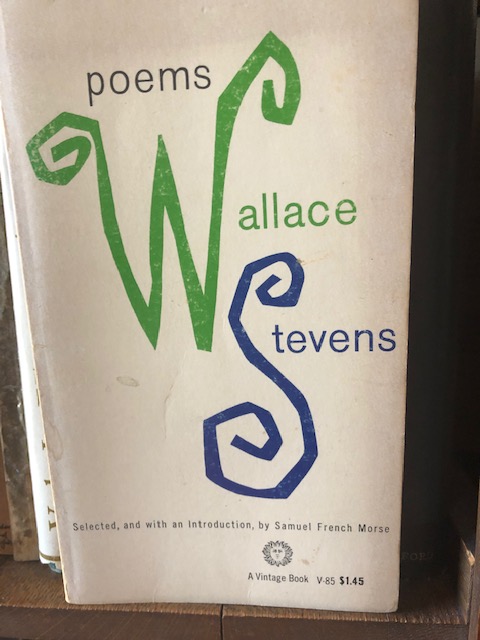
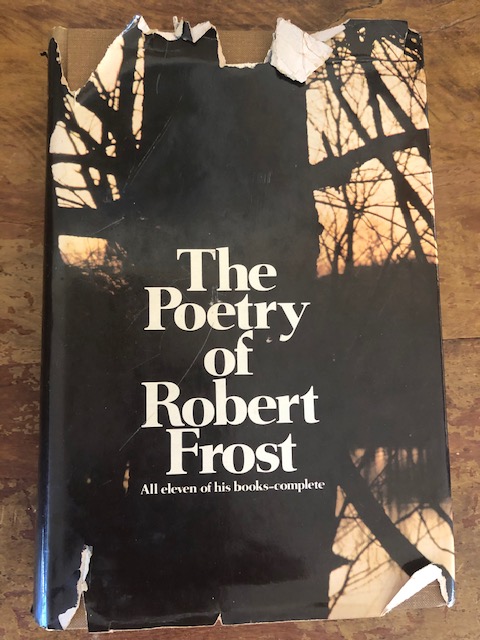
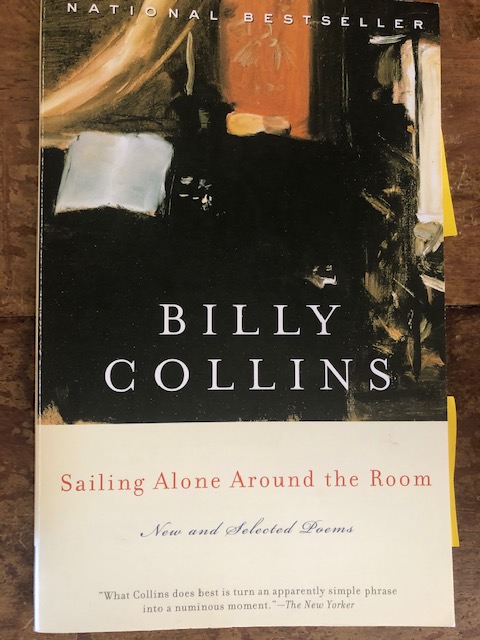
The “smells” article sent me to poetry. Back to the bookshelves. Poets, in their compressed genre, seem to convey scent by evocative words, words that already define a smell, name a smell. Wallace Stevens has only to say, “coffee and oranges in a sunny chair” in Sunday Morning and we smell them. Shakespeare has only to write “The rose looks fair, but fairer we it deem/For that sweet odor which doth in it live” in Sonnet 54. He doesn’t have to define the “sweet odor”: he knows we know it. Coffee? Oranges? Cigar smoke? The word itself gives us the smell. Robert Frost, In Neglect: “I smell the earth, I smell the bruised plant…” We do too. Billy Collins, Canada: “O Canada, as the anthem goes,/scene of my boyhood summers,/you are the pack of Sweet Caporals on the table…” The smell of sneaked cigarettes of youth.
Wallace Stevens did try more extensive fragrant description in Approaching Carolina: “Tilting up his nose/he inhaled the rancid rosin, burly smells/Of dampened lumber, emanations blown/From warehouse doors, the gustiness of ropes,/Decays of sacks, and all the arrant stinks…” We sure know what he means. But is this too much? I wonder if he wondered.
In the upcoming Ghost Daughter, seventh in my series, Alice quizzes a young friend about a new boyfriend. Alice blurts, “So he smells good?” She realizes her own standards for a lifetime companion involve “someone who smelled right…” Probably you’ve all had that experience. Maybe that’s how humans perceive certain under-the-radar scents, as “right” or “not right,” as “good” or “threatening.” Based on Zaraska’s article I suppose “good” may mean “right” in terms of the mysterious “major histocompatibility complex.” Not sure that’s how I want to describe it, though.
“Giving up smoking is the easiest thing in the world. I know because I’ve done it thousands of times.”
~ Mark Twain (or possibly W. C. Fields, or . . . )
*
It seemed a valuable medical course, and I recommended it to a lady. She had run down and down and down, and had at last reached a point where medicines no longer had any helpful effect upon her. I said I knew I could put her upon her feet in a week. It brightened her up, it filled her with hope, and she said she would do everything I told her to do. So I said she must stop swearing and drinking, and smoking and eating for four days, and then she would be all right again. And it would have happened just so, I know it; but she said she could not stop swearing, and smoking, and drinking, because she had never done those things. So there it was. She had neglected her habits, and hadn’t any. Now that they would have come good, there were none in stock. She had nothing to fall back on. She was a sinking vessel, with no freight in her to throw over lighten ship withal. Why, even one or two little bad habits could have saved her, but she was just a moral pauper. ~ Mark Twain, Following the Equator
*
So I decide to write about New Years’ Resolutions, and some I’ve made and why I don’t make them any more, and of course, to write about that, I must quote Mark Twain’s remark about smoking, and while searching for the quotation I wonder whether Mark Twain really said it, so I check other [more reliable] sources and learn that he probably didn’t, and now I’m so fired up about errors in attribution–and errors in everything else–flying around the globe even as I type, that I’m too emotionally jangled to settle down and write about resolutions.
Isn’t that just the way?
Well, whatever. Back to resolutions.
I don’t smoke, never have, so I can’t give it up–well, when I was ten, I did try to smoke a section of mustang grapevine, which my grandfather had warned me would make my tongue sore, but I was afraid of holding a lighted match so close to And another time, three cousins and I–we were eleven or twelve years old–lit one of their mother’s Winstons and each took one puff. Then we decided we’d done something entirely too daring, and their mother was probably already on her way home from town, less than a mile away, so we put the cigarette out, placed the butt on a piece of shingle one of them dug up from somewhere, carried it with great ceremony and a lot of giggling to their burn barrel, and disposed of it.
I guess that means I have smoked but resolved to give it up. One resolution kept.
I am not, however, a moral pauper. I have not neglected my habits. I have plenty of freight I could throw overboard. And I’ve tried, how I’ve tried. But what I intend as jetsam floats back and attaches like barnacles, as it were, to my hull.
I’ve never lost ten, twenty, thirty-five, forty, or any set number of pounds; or completed grad school papers (or blog posts) with more than a few hours to spare; or abstained from chocolate; or organized my purse, office, car, house, or self; or left my keys, reading glasses, or shoes where I could find them; or reached any other goal listed on a December 31st contract.
I know I’m not alone. A proper Victorian girl, Louisa May Alcott was taught to strive for self-improvement but had difficulty following through. At ten years of age, she wrote in her journal “A Sample of Our Lessons”:
‘What virtues do you wish more of?’ asks Mr.L. I answer:— Patience, Love, Silence, Obedience, Generosity, Perseverance, Industry, Respect, Self-denial. ‘What vices less of?’ Idleness, Wilfulness, Vanity, Impatience, Impudence, Pride, Selfishnes, Activity, Love of cats.
Alcott is famous for her industry, perseverance, and generosity, but also for wilfulness, impatience, and activity–and thank goodness she retained those “negative” characteristics. American literature would be in a sad state without them.*
Does breaking resolutions bother me? It used to. I have a broad streak of Puritanism. I want to do better. To get it right. When the Methodist minister inquired about me one Sunday morning and my mother told him I was at home trying to finish a grad school paper before slamming into the deadline, he asked, “Is she a perfectionist?” My mother said yes. “I thought so,” he said.
But that was then, and this is 2021. I’ve been at this resolution thing for a long time. A woman at my age and weight** knows how things work.
Contracts can be renegotiated. And when I’m the only party, I’m allowed to set new terms to suit myself. Or to say, “So what?”
We spend January walking through our lives, room by room, drawing up a list of work to be done, cracks to be patched. Maybe this year, to balance the list, we ought to walk through the rooms of our lives … not looking for flaws, but for potential.
I like that. I think Alcott would have liked it, too. In fact, maybe that’s what she did all those years. She saw her own potential, got down to business, and didn’t let up.
That’s the trouble with potential–once you’ve found it, you have to do something about it. Like work.
I suppose the trick is to learn to love the work. Alcott and Twain must have loved what they did. Even when they hated it, they loved it.
Well. What got me thinking about resolutions that I don’t believe in making?
Anthony Trollope. I binge-watched the miniseries adaptation of his The Way We Live Now a couple of weeks ago, for the fourth time. And then I watched the adaptation of Dr. Thorne. And I’m looking for the adaptation of The Pallisers series–I believe it’s seventeen episodes, and I’ve seen it at least three times, but I’d love to watch it again. And The Barchester Chronicles, which is so funny, and I’ve watched it so many times, I’ve practically memorized the dialogue . . .
I love Trollope. I decided to marry my husband when he told me he’d read many of Trollope’s novels. He hadn’t asked me to marry him, but I decided. If he’d read Dickens, I might not have been so impressed. But any man who’d read that many of Trollope’s novels just because he wanted to had to be a man of substance.
If you look at the reviews of The Warden on Amazon, for example, you find, “boring… boring… boring… boring… long and boring…” And, “I couldn’t get into it.” (Good grief, people, it’s a Victorian novel. What did you expect?)
But that is a matter of taste. Some of us think his novels delightful. Satirical. At times, drop-dead funny. The Eustace Diamonds, in The Pallisers series, is a murder mystery.
Trollope wrote forty-seven novels, plus short stories, plus a ton of travel books. He set a writing goal for each day. When he finished one book, he immediately began another. In an autobiography published posthumously, he admitted to writing for money rather than for a Muse. (The admission led to a decrease in sales, because writing for money was considered crass. I don’t know what readers thought Dickens was writing for.)
And Trollope was a civil servant, worked for the British postal service, where he invented the mailbox.
Now. My dirty little secret is that I’ve never read The Warden. I’ve read its sequel, Barchester Towers. But that’s the only Trollopian novel I’ve read. I have, like many writers of high school book reports, seen the movies.
So I made a resolution: In 2021, I’m going to read all the novels of Anthony Trollope.
If I read one novel a week, I’ll finish with two weeks to spare. My Kindle initially said I could read The Warden in 3 hours and 53 minutes, but a few pages later, it said I could be finished in 4 hours and 15 minutes. Beats me.
In the two weeks left over, I plan to read Brian Doyle’s Martin Marten, which was recommended by a former student, and something by Ann Patchett.
Furthermore, after looking for potential, I’ve resolved to finish writing my own novel. It’s been in the works for a while. Bits and pieces are stored in approximately 3, 508 files on my hard drive (and in the cloud).
I worked on it today, revising an ancient scene for the umpteenth time, and was stuck on whether an Afghan hound named Katie Couric should wear eau de lavender or eau de peppermint when I remembered I had to write this post.
By this time tomorrow I expect to have that issue solved and to have moved on to the next, which will probably involve a goat and a climbing rose.
I don’t write as fast as Trollope.
***
* I’m sure that if Louisa May Alcott stopped loving cats, she had to do it thousands of times.
** The phrase “A woman at my age and weight” is an allusion to Christopher Morley’s Parnassus on Wheels, a little book in which a thirty-nine-year-old woman gets tired of taking care of her bachelor brother and takes off with the owner of a horse-drawn bookstore who made a door-to-door stop by the farm and invites her to come along. When the brother catches up with them, he blesses her out:
“Look here, Helen,” said Andrew, “do you think I propose to have my sister careering around the State with a strolling vagabond? Upon my soul you ought to have better sense–and at your age and weight!…” ~ Christopher Morley,Parnassus on Wheels
I read Parnassus about fifty years ago and thought that phrase funny, and have waited all this time for an opportunity to use it.
***I know Ellen Goodman said this because it read it myself in her column in The Austin American-Statesman. She was one of my favorite columnists.
Kathy Waller’s stories appear in Austin Mystery Writers’ Murder on Wheels and Lone Star Lawless, and in Kaye George’s Day of the Dark. She is co-author with Manning Wolfe of the novella Stabbed. She blogs at Telling the Truth, Mainly.
Today we have a guest author, honorary AMW member, Scott Montgomery. He’s well-known in the Mystery community and is a book seller at Book People in Austin. His most recent work appears in The Eyes of Texas: Private Eyes From The Panhandle To The Piney Woods anthology, which was nominated for a 2020 Anthony award. Available at Book People here.
When the pandemic hit, it affected the book world like the rest of society. Authors who had books out in the spring and early part of the summer got word of their work lost to book stores being down, publishers strategizing, and the plain fact people had other things on their minds. As a bookseller there were novels I was excited to promote. Two authors whose books I loved were scheduled to do an event on the first day we shut down. To hopefully get the word out some more, here are five books released during that period, you should go back and find.
1. A Familiar Dark by Amy Engel
If you are looking for a sunny novel to take you away from current troubles, look down the list. If you have the fortitude and interest for a truly bleak rural noir, grab this immediately. Engel follows a single mothers’ quest for answers and revenge when her twelve year old daughter is murdered along with her best friend and she struggles not to become like the person she most feared, her drug dealing mother. The story gets darker and darker, yet more empathetic, as each character’s secrets get revealed and it hits its gut punch of a climax.
2. Poison Flood by Jordan Farmer
This book has one of the best protagonists of the year, Hollis Brass, a hunchback musician who ghostwrites songs for his first love who has now become a popular American performer. To finance his own recordings, he meets up with the rebellious son of his Appalachian town’s chemical plant, to sell some of his music memorabilia. A storm breaks out, setting of a chain of events that lead to a chemical leak from the plant and a murder Hollis witnesses. Hollis deftly moves through this story, populating his book with broken characters in battle with thier angles and demons. The writer reaches out with understanding, sorrow, and hope for them all.
3. That Left At Albuquerque by Scott Phillips
Scott Phillips was in the middle of his book tour after a hiatus from writing when the pandemic hit. He deserves new fans with his take on Southern California lowlifes trying to live the high one. When a drug deal he arranged blows up in his face, scheming lawyer Douglas needs money quick. He hatches an art fraud scam involving some very shaky folks including both his wife and mistress, a flaky forger, and an aging tv producer with fond memories of his casting couch days. Pillips matched a rich plot with even richer characters, poking at social mores and social climbing that occurs as people chase after their American dream by any means necessary. Scott Phillips once again finds that perfect apex where noir and comedy meet.
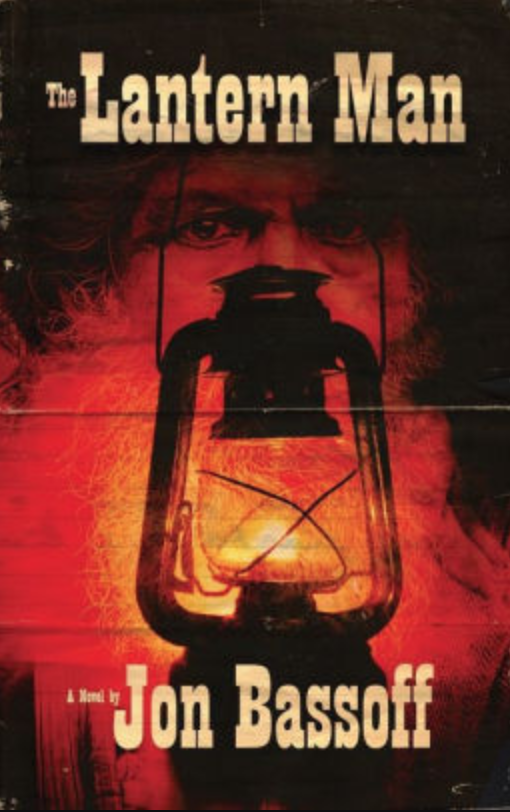
4. The Lantern Man by Jon Basoff
Jon Basoff created the most unique and ambitious thriller of the year of a dtective reopening arson-suicide case committed by Lizzy Grenier connected to the relationship with her other two siblings. Basoff tells much of the story through Lizzy’s journal, newspaper clippings, and photos, creating a meditation on family, media, and the elusiveness of truth.
5. Lost River by J. Todd Scott
This book creates an epic out of a dark violent day that entwines the lives of a Kentucky lawman, DEA agent, and EMT around a southern drug ring, weaving through a population of desperate characters pushed to the edge. Scott, a practicing DEA agent, gives a ground eye view of the opioid crisis. I put this up there with Don Winslow’s Cartel Trilogy at capturing the war on drugs.
No matter what they tell you, Texas isn’t all cowboys and cactus and bullets and brush.
Texas is also BOOKS, and this weekend there’s proof: Today, the Texas Book Festival opened on the grounds of the State Capitol in Austin. Exhibitor tents and food trucks line N. Congress Avenue from Colorado Street, on the west side of the Capitol, clear down to 8th Street. An international slate of authors—John Grisham, Malcolm Gladwell, Sarah Bird, Elizabeth Crook, Alexander McCall Smith, and Terry Tempest Williams among them— are speaking, signing books, and appearing on panels. There are books for display and for sale.
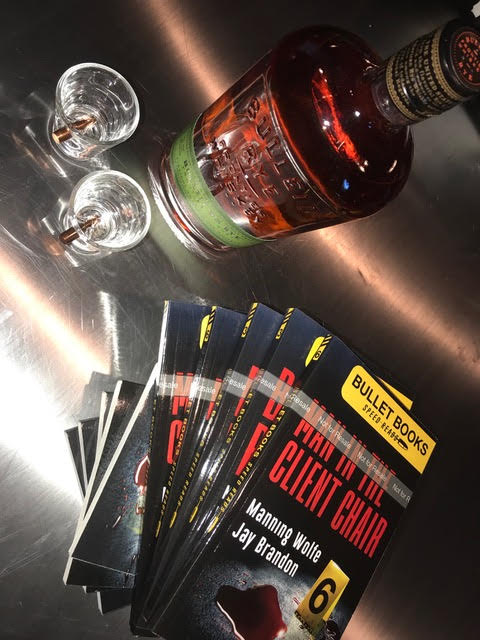
BULLET BOOKS is the brainchild of Manning Wolfe, author of the Merrit Bridges, Lady Lawyer series. Each Bullet Book is co-authored by Manning and another writer of crime fiction. The books are short, designed to be read in two to three hours—the length of a plane or train ride, or an afternoon spent lying under an umbrella on the beach.
Twelve Bullet Books are being introduced. They range from mystery to suspense to thriller. Among the characters are spies, lawyers, terrorists, gun runners, trash collectors, and teachers. Settings range from courtrooms, to classrooms, to comedy clubs, to embassies. There’s something for mystery lover.
A trailer for each book appears on the website. Here’s a look at the trailer for Bullet Book #1, Bill Rogers’ KILLER SET DROP THE MIC:
Trailers for the other books can be viewed on the Bullet Books website (links below). Follow the link to Youtube if you’d rather watch there.
By the way, Bullet Books Speed Reads will meet an even wider audience next weekend at Bouchercon, the largest annual international convention of mystery readers and writers, which will take place in Dallas, October 31-November 3. Billy Kring, Laura Oles, Kay Kendall, Jay Brandon, Bill Rodgers, Manning Wolfe will participate in a Co-Authoring Panel, October 31 at 2:30 p.m.
Eleven Bullet Books authors will attend the convention. They’ll sign on November 2 at 3:30 p.m
If you’re anywhere near Austin this weekend, stop by the Capitol and see a side of Texas that doesn’t get nearly enough press.
And be sure to visit the Starpath booth and let Manning Wolfe and the other authors introduce you to Bullet Books Speed Reads.