George Wier was nice enough to agree to an interview. Thank you, George! 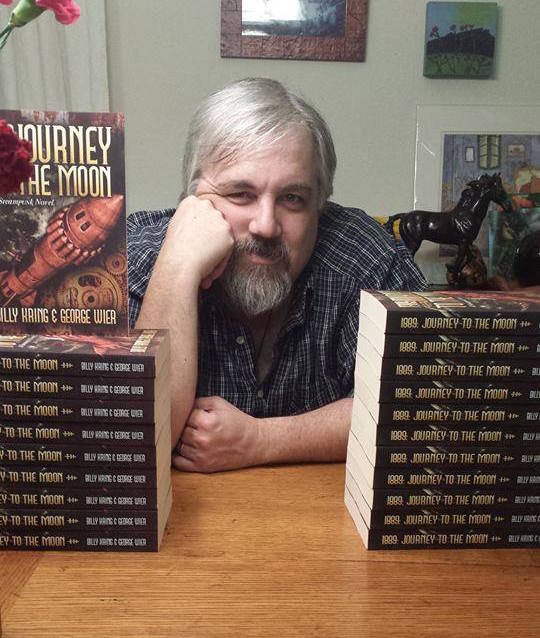
(He’s a personal friend of mine so he knew I’d give him grief if he didn’t. 😉 )
I know that you’re not originally from Austin. How did you get here?
I moved to Austin in 2002 from College Station. One day I took a look at the world around me and realized that most of my friends and all of my family had moved away. Also, after thirty years of living in Bryan-College Station, I knew everyone and everything that I wanted to know. In a word, I was bored. I called an old friend who lived in Austin and told him about my dilemma, and without even the hint of hesitation, he offered a spare room in his apartment and told me to load up my meager possessions and come on. I left the next day. This was about September or October, not far from my 37th birthday. I was essentially–and with malice aforethought–wiping out an old existence and beginning a new one. I was time to do that. It was one of the best decisions I ever made. Apart from rooting for the old home team (the Aggies) I took to Austin like a duck to water. I’m home now.
Have you always been a writer? Was there a book that inspired you to write?
Yes, I have always been a writer, ever since I could read. My first inspiration was comic books and film. My first actual attempt at a complete narrative was essentially a skit that was somehow a cross between a story and a script, and was actually inspired by Monty Python. I couldn’t do humor well, though, and sight gags were not my thing. The earliest, clearest influences on my writing came from science fiction, particularly Frank Herbert’s Dune books. I loved those. There is one story idea from those early days that I will attempt sometime in the near future. It’s about an outpost at the fringe of human expansion into the universe, and will be sort of a cross between Castaway and the Star Trek universe. We’ll see, though, if I ever get that done. My hopper is pretty much loaded up at the moment.
Along about 1976 or ’77, I was given a collection of Doc Savage paperbacks by my best friend’s sister. Her name was Peggy Dale Taylor. The Doc Savage books she gave me were the 1960s and ’70s Bantam paperback reprints of the old Street and Smith Doc Savage series written under the pen name of Kenneth Robeson, but mostly actually penned by Lester Dent, who though originally from Missouri, was a member of the Explorer’s Club in New York. Dent wrote about a quasi-private investigator, quasi-superhero named Clark Savage, Jr., and his five aides, who traveled the world righting wrongs and punishing evildoers. They sparked the imagination of this young teenager and would later very largely influence my Bill Travis Mystery series. The difference, however, between Doc Savage and Bill Travis is that Bill is based in Texas and rarely crosses the state line, he doesn’t have a lot of gadgets to help him out, and his small collection of friends are more from the “friends in low places” crowd, and less from the “cream of the crop”. I’ve written ten Bill Travis books, and there are at least eleven more to go before I round out the series, including three prequels. And by the time I’m at the end of that long runway, I should–hope springs eternal–know how to write.
Tell us about the different genres you write. Does the genre influence how you approach or plot your book?
Mostly, I write MY genre. I’m not sure what that is. For instance, the Bill Travis books, though billed as mystery, occasionally cross over the line into the fantastic, or you might call it Science Fiction. The first book, The Last Call, is straight action-adventure. The second book, Capitol Offense, while it has elements of action-adventure, is at least half mystery with some elements of political intrigue. The third book, Longnecks and Twisted Hearts, quite definitely crosses the line into science fiction, yet remains mostly a murder mystery. Books four and five, The Devil to Pay and Death On the Pedernales, are both pretty much straight mysteries. Book Six, Slow Falling, has so much science fiction that it should probably be classified as such, yet it’s my favorite of all of them. And so on through the series. By the time we get to book ten, Ghost of the Karankawa, Bill Travis meets Bigfoot. So, there you go.
Genre doesn’t so much influence me. The story does, however. It’s going to ultimately be whatever it is. I don’t write from outline, or at least in those few instances when I have and “knew” what was coming in later chapters, the outline might be a simple sentence of what was to happen in that chapter. About the only time I do that however, is either when I’m skipping around in the book and writing it in a non-linear fashion or when I’m collaborating and my co-author needs to fill in what I skipped over. In the latter instance, it’s at least courteous for me to provide some clues as to what, in general, I think should happen here and there in the story. I guess that’s about it on that.
As a side-note, I don’t like to read a lot of books in the genre in which I’m going to be doing any extensive writing (i.e., mysteries) because I don’t like to be unduly influenced by other writers. People tell me that my writing style is similar to John D. McDonald. I must confess, I’ve never read a John D. McDonald book. I hear that they’re wonderful, and at the top of the mystery genre, so I always take that as a high compliment and accept it as gracefully as I can. But, I’ll only read a mystery if it’s written by a friend and this friend needs an endorsement or a general leg up. That’s about it.
What is the secret to your success?
Writing is like anything else. Most of the battle is won by showing up. You have to sit down and write. You have to write a lot. You have to produce, bang out copy, write like there’s no tomorrow (there really isn’t, after all, there is only today!), plan and scheme and push the envelope. However, I think what you’re asking me is for some formula. Okay, I’ll give it to you. Here are my “secrets” to success (it’s interesting to me that there are no real secrets. The nature of the universe is that we all think that there’s some great secret hidden back of the curtain of reality, and that if we could only somehow penetrate that curtain, why, we’d HAVE IT and we’d simply do that magical little formula and the world would lie at our feet. The secret of the universe is nothing. This is also the definition of a mystery. A mystery is: the answer was not given. That’s all a mystery is. The mystery of the universe is a big fat zero. We don’t do well, as a species, with zero. Nothing is difficult to confront. If you don’t believe me, try walking through an unfamiliar house full of furniture in the pitch blackness. You move slowly, at best, because you’re pretty sure you’re going to hit something hard and kill your shins, or fall down and break your neck. So, in our minds, that darkness, that big zero, is really “something”. (Let me tell you, it’s not!):
I have, this lifetime, sifted through quite a bit of data on success. I’ve narrowed my findings to ten basic points:
1. Work toward your goal every single day.
2. Do not let the sun set without accomplishing something towards it.
3. Hold on to any wins you achieve along the way and disregard the losses.
4.Don’t allow anyone to evaluate or invalidate your goals, your dreams, and particularly your abilities.
5. Thinking about a thing is not the same as doing a thing. Success is only ever accomplished through action. The dream, however, must give your actions purpose and life.
6. Treat your goals as if they are living beings, and grant them life.
7. All other rules apply with regard to your goals, particularly the Golden Rule.
8. Study, learn and become the top person on the planet in your field. Knowing WHY is of immense value. Knowing HOW will guarantee prosperity. Knowing both HOW and WHY is everything.
9. If you get mad at someone or something that stands in your way, you have granted them or it immense power. Become unflappable. In any situation you are the expert. You are the source. Unquestionably. Success is hidden in the minutiae. It’s the small things that, brought together, create the whole.
10. Fortune and fame are illusions, and at best are fleeting. Don’t seek these. Instead, seek happiness. You will ultimately find that it resides within you.
I’ve found that most writers have other talents. What are your other talents?
Well, that’s a loaded question. I like to think I’m adept at everything I do, and typically overinflate my abilities, at the very least to myself. However, I like to draw (with a mechanical pencil), I paint, I play violin and I play country fiddle, and I do other things I’m not supposed to do.
Some of George’s pictures



Do you have any advice particularly for mystery writers?
The main piece of advice, I suppose, is what I said above about not reading too much in that genre. But really, you might like to read mysteries and want to write them as well. Really, it’s a personal preference on my part not to do so. I also write a little science fiction, for instance, and I am so well-read in that genre, and will continue to be so, that it’s impractical for me to even think about not reading science fiction. So, whatever your write, whether it’s mystery or romance or whatever, you should write what my friend Joe Lansdale calls “your own genre”. Your writing is YOUR genre. Write what you want to write, and how you want to write it. And, write what you, yourself, would most want to read. That’s the simple one. Do that, and you’ve got it made.
Tell us something cool about Austin that we probably don’t know.
The one thing I like about Austin is that it’s full of secrets. There are so many little-known, out-of-the-way and off-the-beaten-path little hidey-hole restaurants, coffee bars, music venues, acting and dancing troupes, and etc. I love finding those. It’s my goal to find all of them! Sallie and I venture forth at least once weekly looking for that offbeat place that we’ve never heard of before. And I have the knack for smelling them out.
How can we find more information about you and your books?
The best place is my website, www.georgewier.com (which takes you directly to the www.billtravismysteries.comsite). Both of these sites have now been combined into one. Also, I have a wordpress blog at http://georgewier.wordpress.com. Other than that, you can follow me on Twitter at @BillTravisWrite and on Facebook at George Wier-Author. Also, I encourage everyone to communicate directly with me. I usually answer my own emails, and I typically do this quickly. So, please communicate with me. I know that people get punished in this world for the two great crimes: being there and communicating. But, that’s the only way to ever get anywhere. So, yes, get in touch with me and ask if you can’t find the answer. Or just email me to say “Hey!” I’ll say “hey” back at you.
What are you working on now?
Hmm. The question should be “what are you NOT working on now?” I’m working on Bill Travis #11, Desperate Crimes. Also, I’m right at the end of yet another mystery standalone entitled Errant Knight. It’ll be forthcoming in a few weeks as an ebook and a trade paperback. I will have another book coming out from Cinco Puntos Press in January of 2016 entitled Murder In Elysium. Also, I’m collaborating at the moment with Billy Kring (another fantastic mystery author) on the steampunk series The Far Journey Chronicles. Billy and I have completed and published 1889: Journey to the Moon, and have finished and are in the process of editing 1899: Journey to Mars. We have also begun 1904: Journey Into Time. There will be a minimum of four books in that series, with the last one planned: 1909: Journey to Atlantis. Aside from that, I’ve got a few other projects going that I pay attention to, catch as catch can. But I have far more than that planned, including a collaborative series with science fiction great (and friend), T.R. Harris, of San Diego, California. I guess that’s it.
Thanks for the interview. You’ve given me a lot to think about and now I’m pumped up! I can’t wait to get back to my writing!





 Austin Mystery Writers