THE PULL OF EMPTY SPACES

by Helen Currie Foster~October 17,2023

Last week, trudging up a rocky trail to an abandoned abbey high above an Italian valley in the Sabine Hills, I heard another walker ask this: after the Romans defeated the Sabines, were any Sabine ruins left?

“Yes,” said the guide. “A temple to the goddess of empty spaces.”

The goddess of empty spaces? Her name?

“Vacuna.”

Even in fourth year Latin at McCallum High, our beloved teacher, Miss Bertha Casey, never mentioned Vacuna.

The walker’s question—any Sabine ruins?—had never occurred to me.

Questions by others can open empty pages in our own minds.

Vacuna’s authority remains a mystery—appropriate, if she was, among other powers, in charge of empty spaces. Or moments of rest, of vacancy, of relaxation. One writer says, “Vacuna was the Sabine goddess of water, nature, forests and fertility, but she was also the goddess of rest.” https://worldhistory.us/ancient-history/vacuna-the-hidden-goddess-veiled-in-the-mist-of-history.phphttps://www.romeandart.eu/en/art-nimphs-floating-island.htmlhttps://en.wikipedia.org/wiki/Vacuna

From this hill to the next hill stretched a vast empty space.

Well, not exactly empty––the air seemed visible, with sunlight glinting on bits of dust and mist. But the enormous not-exactly-empty openness fired imagination. The land below contains houses, farms, fences, vineyards—all presumably considered to belong to someone. But watching the air shimmer above the valley I wondered—does that openness belong to Vacuna? To anyone looking out across the valley?

Wait—it didn’t belong to anyone. Not to a hang-glider, nor a kite-flier, nor a drone.  Long after they’d folded their toys and gone home, empty space would still be there, stirring imagination, raising questions, dreams, ideas.

How do you respond to the words “blank page”? To a new notebook? To a waiting empty screen—a “new document” in Word? Your pencil is sharp. Your fingers are poised. What will you write, draw, scribble on that blank page? The very sight of the words “blank page” makes you pause, doesn’t it, making you wonder what you might write? Blank pages prick the imagination.

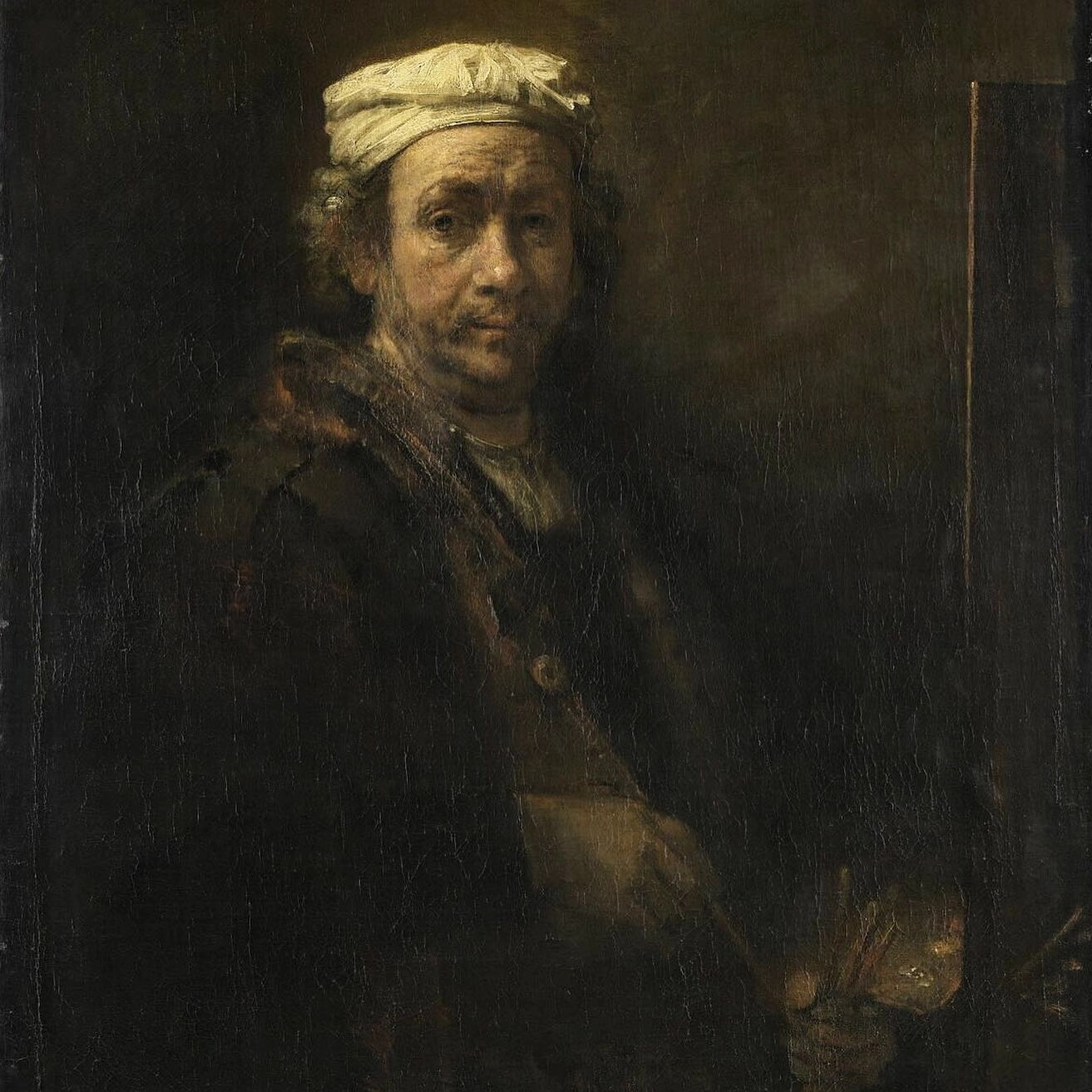
Or you’re an artist, brush in one hand, a vivid palette of colors in the other, confronting a blank canvas. The choices! Red? Violet? Ochre? Viridian? Think of Rembrandt’s self-portrait, as the artist lifts his brush, staring directly at us while coyly hiding the canvas. For us, his canvas is blank. What’s the artist thinking? What do we imagine he’s painting? Of course the tricky master has already painted the canvas we’re looking at, and he included his staring eyes, his ruthless assessment of himself, every wrinkle, every wart.
https://www.louvre.fr/en/what-s-on/life-at-the-museum/a-masterpiece-of-the-louvre And you? What would you paint?

I think of Lily Briscoe in Virginia Woolf’s To the Lighthouse, fiercely concentrating on finishing the portrait she began years ago. We can’t see her painting, but we feel the intensity of her decision-making as to precisely why, where, and how she’ll move her brush for the last stroke.

“Blank canvas”? Emptiness…better, openness; availability; possibility. Imagination calls.

I spend hours revisiting mysteries, reveling in the craftsmanship of the greats, and the enormous creativity that blossoms from the first page, where the canvas is empty before the reader. This week I’ve revisited “Fred Vargas” (writing name) – the French archeologist whose mysteries about her Pyrennean police commissaire, Jean Baptiste Adamsberg, lead the unsuspecting reader into wild leaps of imaginative plotting. https://fr.wikipedia.org/wiki/Fred_Vargas In An Uncertain Place, for instance, when Adamsberg goes to London for an international police conference, his English counterpart, Inspector Radstock, drags him to Highgate Cemetery where someone has left at the entrance 18 pairs of shoes with human feet in them. https://highgatecemetery.org/ The feet have been chopped off dead bodies awaiting burial in funeral parlors. Oh, wait—that’s 17 pairs plus one solo shoe with a solo foot. Adamsberg returns to France, still mulling this weirdness, and confronts a grisly murder where the corpse has been chopped into confetti, with special attention to the big toes and hands and feet. Why? And is the wild-eyed twenty-something who invaded Adamsberg’s Paris house really his undreamed-of son? The plot turns on Serbian vampire stories and the rumor that when Victorian artist/poet Dante Gabriel Rossetti exhumed his dead wife Elizabeth Siddal seven years after her death—ostensibly to retrieve his manuscript volume Poems—she was still rosy and pink. https://nonfictioness.com/victorian/the-exhumation-of-elizabeth-siddal/

From a blank page, to dead poets, to vampires and tombs in Serbia, to…well, check it out! Let me know if you actually identify the murderer before the end. Adamsberg’s one of my favorite characters. Still don’t know why he wears two watches and can’t tell time.

How do fiction writers fill the blank page? By that mysterious process—imagination. In the October 16, 2023 New York Times, Italian physicist Carlo Rovelli asks how we can learn about black holes—places we can neither travel to nor see. His answer? “To travel to places that we cannot reach physically, we need more than technology, logic or mathematics. We need imagination.”

Per Merriam Webster, “The meaning of IMAGINATION is the act or power of forming a mental image of something not present to the senses or never before wholly perceived in reality.” J.K. Rowling: “Though I personally will defend the value of bedtime stories to my last gasp, I have learned to value imagination in a much broader sense. Imagination is not only the uniquely human capacity to envision that which is not, and therefore the fount of all invention and innovation. In its arguably most transformative and revelatory capacity, it is the power that enables us to empathise with humans whose experiences we have never shared.” https://news.harvard.edu/gazette/story/2008/06/text-of-j-k-rowling-speech/

Our genre requires imagination. Mystery writers need a vivid, tangible setting, especially for the murder. My mind has taken me to a rock-art painted cave atop a bluff high above an old ranch, to a music recording studio, to a dining room where a horse rears. We need characters. Protagonist! Murder victim! Suspects! Subsidiary characters who adds color, flavor, depth—like Eddie LaFarge, the retired pro football center who limped into the Central Garage in my imaginary town of Coffee Creek.

And I find something unexpected has happened to me, writing the Alice MacDonald Greer murder mystery series. In the middle of the night, my characters now feel as real as relatives. I watch them driving, kissing, feeding the burros, worrying. Sometimes they pause for a moment, imagining what they’ll do next.

Thank you, Vacuna, goddess of empty spaces.

Those croissants? We’re recovering in Paris from hiking, where these, from the Maison Julien patisserie on Rue Cler, may be the best ever. Letting melting butter create those empty spaces between the layers? Genius.

Helen Currie Foster writes the Alice MacDonald Greer Mystery series (now working on the 9th) north of Dripping Springs, Texas, in the Hill Countrloosely supervised by three burros. She’s active in Austin Shakespeare and the Hays County Master Naturalists and very much enjoys talking to book groups. The 7th mystery, Ghost Daughter, published June 15, 2021, was named The Eric Hoffer Award 2022 Mystery/Crime Category First Runner-up, and also 2022 National Indie Excellence Award Finalist, Mystery.

When the Character Steps off the Page…

by Helen Currie Foster

You go to a play, you’re reading the program, you’re waiting for the curtain to go up. It does. And onstage a character comes alive. You not only believe in that character—suddenly you feel that character is real.

After the play, in the lobby, out comes a chattering group of actors, one of whom is—the character you believed in! But it’s merely…another human being!

This happens to me over and over at Austin Shakespeare productions. I remember sitting riveted, watching Othello preparing to smother Desdemona, his face just a few feet from the front row of the Rollins Theatre. “No, no!” I wanted to scream. Minutes later, still quaking from the death scene, I watched the actors come back out for their traditional after-talk with the audience. I watched brokenhearted Othello plop down in a folding chair and grin at us––morphed from Othello into actor Mark Pouhé. At Free Shakespeare outdoors in Austin’s Zilker Park I held my breath, watching young Romeo climb the balcony to talk with Juliet, enchanted––like Juliet––by every word he uttered. Then at intermission, still in costume, actors came out and climbed the hillside, shaking buckets for donations, including…Romeo! Jarring to think he’d time-traveled from sixteenth century Verona to an Austin hillside. https://www.austinshakespeare.org/

You may be thinking, “I know all about that––it’s just the ‘willing suspension of disbelief.’ Coleridge, right? Maybe you’ve just got an aggravated case!”

https://en.wikipedia.org/wiki/Samuel_Taylor_Coleridge

But the question is—how exactly can actors do that? Maybe because Shakespeare has made Othello and Romeo so active, so appealing, so fascinating, so human, so alive in their loves and hates, that we believe in them, and we must hear their story. Others call such fixations our willing contract with actors, in exchange for being entertained––so long as the illusion is not spoiled. See The Actor’s Edge Online, https://www.youtube.com/watch?v=zdGM7QzFJhM

As always, Shakespeare says it best. In the Prologue to Henry V, his Chorus begs the audience to use their own imaginations to make the small wooden stage come alive with the war between the “two mighty monarchies,” England and France:

“Think, when we talk of horses, that you see them/

Printing their proud hoofs I’ th’ receiving earth./

For ‘tis your thoughts that now must deck our kings,/

Carry them here and there, jumping o’er times,

Turning the accomplishment of many years/

Into an hour-glass…” Henry V, Prologue.

That’s genius.

Coleridge himself recalled his agreement with Wordsworth as follows: that while Wordsworth would write poems about the charm of everyday things,

“It was agreed, that my endeavours should be directed to persons and characters supernatural, or at least romantic, yet so as to transfer from our inward nature a human interest and a semblance of truth sufficient to procure for these shadows of imagination that willing suspension of disbelief for the moment, which constitutes poetic faith.” (Emphasis added.)

https://en.wikipedia.org/wiki/Suspension_of_disbelief [Also spoken of as “the concept that to become emotionally involved in a narrative, audiences must react as if the characters are real…”] https://www.oxfordreference.com/display/10.1093/acref/9780199568758.001.0001/acref-9780199568758-e-267

By buying a theatre ticket, or a movie ticket, we’re inviting an agreement like the one between the child who begs, “Tell me a story!” and the adult who responds, “Once upon a time…” In those two phrases, the contract is made. The child agrees—likely longs––to suspend disbelief, and the storyteller promises a world where the unexpected (even the unbelievable) can happen. Talking animals…bears with beds and chairs…

You and I happily suspend our disbelief when the characters become real to us, even though the events may be beyond “belief.” Harry Potter! Indiana Jones and the Dial of DestinyLord of the RingsStar Wars!

What does this have to do with mysteries? At least the protagonist in any mystery must come alive for us. If you’re a Louise Penny fan, you appreciate how Gamache smiles at his wife, how he strokes his dog. As for Donna Leon’s Inspector Brunetti, I know him well; I’ve followed him upstairs to his Venetian apartment so many times, practically huffing with him on that last staircase. I’ve watched him choose a panini to have with coffee in his favorite coffee bar—indeed, I can practically smell the espresso. I’ve stood with him in the police boat as it bounces across the lagoon to a murder scene. He’s become so familiar, so…well, real to me. V.I. Warshawski in the Sara Paretzky novels? I know the emotion she feels when she touches her mother’s cherished wine glasses, I feel my blood pressure rise with hers over injustice. And Robert Galbraith’s team, Robin and Cormoran? I ache with the pain of Cormoran Strike’s prosthetic as he runs, trying to catch a suspect; I feel Robin’s fear as she opens a door to a dark hallway. I peer over Joyce’s shoulder as she writes in her journal in Richard Osman’s The Thursday Murder Club series.

A story (play, movie, mystery novel) demands a setting in which the protagonist comes alive for us. We’ve suspended disbelief when our favorite mystery characters no longer exist merely as ink on a page, as lines in a Kindle. Coleridge’s goal was to create “a human interest and a semblance of truth sufficient to procure for these shadows of imagination that willing suspension of disbelief for the moment.” We’re interested in what happens—a “semblance of truth”––to a character who arouses our “human interest.” The author, actor, director, has made us feel in league with our favorite characters. We’ve become collaborators with them, sharing their adventures, their frustrations, their fears. Suspending disbelief may be why we’re so anxious when our protagonists face danger, why we’re indignant when they’re treated badly, why we’re so relieved when they’re vindicated.

Of course a mystery plot may challenge imagination. The perfectly timed rescues in Daniel Silva’s spy thrillers…and the magnificent art restoration skills of his hero, Gabriel? The exquisitely choreographed capture and totally successful interrogation of Grigoriev in John Le Carré’s Smiley’s People?

Or the clever solutions deftly reached by ex(?)-spy Elizabeth and her friend Joyce at a foreign agent’s swimming pool suspended high above London, in The Bullet that Missed? https://amzn.to/45NxJlE

Knowing how reality usually works, we worry how plans go awry, how colleagues disappoint, how villains can foil. We shake our heads, fearfully anticipating that the plan will fail, and our character’s bluff will be called. But we’re still hoping, and holding our breath every second. And we keep turning the page.

Tell Me a Story!

By Helen Currie Foster

In My Reading Life, a grand book about reading and writing, author Pat Conroy says, “The most powerful words in English are ‘tell me a story…’” bit.ly/3PpSoHF

Yes! And don’t we know stories demand––require––insist on characters? Fairy tales––Jack in the Beanstalk, Hansel and Gretel. Epics––The Fellowship of the Ring, Star Wars. 

I love the beginning of Emily Wilson’s recent translation of The Odysseybit.ly/43Bdjvi

Tell me about a complicated man,

Muse, tell me how he wandered and was lost

When he had wrecked the holy town of Troy…

…Now, goddess, child of Zeus,

Tell the old story for our modern times.

Find the beginning.

So, how do writers create memorable characters? What works to create character? And why do we care? Isn’t it because character drives narrative?

Recall Shakespeare’s famous terse description in Julius Caesar: “Yon Cassius hath a lean and hungry look…” Those ambiguous words reach beyond the man’s shape or facial expression to hint at driving ambition…the very subject which drives the play’s narrative.

Or take Pride and Prejudice, published in 1813, and still one of the most loved novels in the English language. https://www.independent.co.uk/arts-entertainment/books/features/austen-power-200-years-of-pride-and-prejudice-8454448.html

How does Jane Austen create character? Looking back, I am surprised by the lack of physical description. She doesn’t tell us what Mr. or Mrs. Bennet, or the five daughters, look like. We’re given a few visual breadcrumbs, told that Bingley and Darcy are “handsome” and that Bingley “wore a blue coat and rode a black horse.” But her characters, with their personalities, their actions, largely come to life in our minds otherwise: by conversation.

Elizabeth overhears Mr. Darcy describing her as “tolerable but not handsome enough to tempt me”—a criticism she later recounts to friends, “for she had a lively, playful disposition.” Okay, there’s one aspect of Elizabeth—lively and playful. Yet after telling friends that Elizabeth “had hardly a good feature in her face,” Darcy “began to find it was rendered uncommonly intelligent by the beautiful expression of her dark eyes.” So she’s also intelligent! Elizabeth tells her sister Jane, “you are a great deal too apt…to like people in general. You never see a fault in any body.” Elizabeth is not just “playful” and “intelligent,” but a critical observer.

Using dialogue––what Elizabeth and Darcy say––Austen shows us how Elizabethand ultimately Darcy––think. In a world focused on superficiality—class, wealth, appearance, social skills and niceties––Austen makes us care about two characters who are too smart, too critical, too thoughtful, not to keep thinking and––ultimately––change their minds. Their characteristics (both pride and prejudice!) drive the narrative.

But hey, what about those dark eyes? Mr. Darcy disturbs the haughty Miss Bingley by saying he’s meditating on “the very great pleasure which a pair of fine eyes in the face of a pretty woman can bestow.” As all Austen readers know, that specific detail––“[A] pair of fine eyes”––will also powerfully move the plot.

Texas’s Larry McMurtry shows us how conflict between characters drives narrative. In his Lonesome Dove, the first character we meet is Augustus, sitting on the porch at the Hat Creek Cattle Company, in “the smidgin of shade he had to work with.” He has retrieved his jug from the springhouse and, as is his custom, he’s drinking Tennessee mash whiskey, which makes him feel “feel nicely misty inside.”

We’re in Augustus’s point of view when we meet his counterpoint, the other key character, his stubborn partner Captain Woodrow Call. Augustus, when he hears the whir of a nervous rattler in the corner of the springhouse, believes “in giving creatures a little time to think.” He doesn’t shoot the snake; he waits until the rattler has “calmed down” and crawled out a hole. He contrasts his own behavior to Call’s:

Call had no respect whatsoever for snakes, or for anyone who stood aside for snakes. He treated rattlers like gnats, disposing of them with one stroke of whatever tool he had in hand. “A man that slows down for snakes might as well walk,” he often said.

As  Call and their diffident hand, PeaEye, arrive at the porch, Augustus notes that while he himself stands four inches taller than Call, and Pea Eye three inches taller, there’s no way to convince Pea Eye that Call is the short man: “Call had him buffaloed.” Augustus knows that if a man means to hold his own with Call, that man must keep in mind that Call isn’t as big as he seemed. Thus Augustus begins many a day by remarking, “You know, Call, you ain’t really no giant.”

McMurtry doesn’t give us a detailed physical description of Augustus or Call. Instead, we hear them banter. We see Call’s impact on others, and how Augustus works to maintain his own status vis à vis Call. Right off the bat McMurtry makes us feel the sheer force of two characters, two magnetic and conflicting personalities, and their relationship, as we’re launched into this epic tale. Their characters, the combined magnetism and conflict, drive us to Montana…and back…

We first meet Sir Arthur Conan Doyle’s character Sherlock Holmes in A Study in Scarlet, when Holmes is introduced to the narrator, Dr. Watson, as a potential roommate. Watson walks into the lab: “There was only one student in the room, who was bending over a distant table absorbed in his work. At the sound of our steps he glanced round and sprang to his feet with a cry of pleasure. ‘I’ve found it! I’ve found it,’ he shouted to my companion, running towards us with a  test-tube in his hand.” Then he shakes hands with Watson: “You have been in Afghanistan, I perceive.” Watson is astonished. bit.ly/3N0U4Ep

We get no actual physical description of Holmes until Chapter Two. Instead, we confront Holmes’s vigor, curiosity, perspicacity, confidence in his own powers. Similarly, in “A Scandal in Bohemia,” Watson first describes Holmes’s “immense faculties and extraordinary powers of observation” in deciphering clues. Then, looking up from the street, Watson sees the detective’s silhouette on the window-shade: “I saw his tall, spare figure pass twice…He was pacing the room swiftly, eagerly, with his head sunk upon his chest and his hands clasped behind him.” Watson instantly knows, “He was at work again.”

The author engraves that image of Holmes, pacing eagerly, on our imaginations. We can’t wait to see Holmes in action: that’s what we’re reading for.

Herman Melville deprives the reader as well as Ishmael, the narrator of Moby Dick, of even one glance at Captain Ahab until Chapter 28, when Ishmael is well out to sea on the whaling ship Pequod. Ahab finally appears on deck and stands erect, holding on by a shroud, his bone peg-leg planted in the auger hole drilled on deck for that purpose:

There was an infinity of firmest fortitude, a determinate, unsurrenderable wilfulness, in the fixed and fearless, forward dedication of that glance. Not a word he spoke; nor did his officers say aught to him; though…they plainly showed the uneasy, if not painful, consciousness of being under a troubled master eye…moody stricken Ahab stood before them with a crucifixion in his face; in all the nameless regal overbearing dignity of some mighty woe.

The word “character” comes from the Greek root for “engraving tool.” https://www.merriam-webster.com/dictionary/character If ever character was engraved on a person’s body, Melville’s description of Ahab and his impact on his shipmates qualifies. The uneasy silence of the officers! The crucifixion in Ahab’s face! His unsurrenderable wilfulness, fixed and fearless!

If that’s not enough foreshadowing, in Chapter 36, Ahab demands the entire crew to assemble and then hammers a gold piece to the mast for the first man who sees the white whale which took off Ahab’s leg—Moby Dick. Starbuck objects: he signed on to hunt whales, not to take vengeance on a mere animal, which he calls blasphemous. But Ahab makes the rest of the crew swear: “Death to Moby Dick!” Melville creates a character whose physical description conveys tragic history and deep emotion, and whose forceful actions persuade the crew to follow him. We know there’s no stopping Ahab now. And we haven’t yet met the whale.

Pat Conroy also tells us, in My Reading Life, of the day his beloved high school English teacher, Greg Norris, took sixteen-year old Conroy to visit the poet Archibald Rutledge. Rutledge “suggested that I make the close observation of nature part of my life’s work and that I learn the actual names of things,” because “specifics always proved fruitful to the validity of any narrative”:

“A Cherokee rose, not just a rose. A swallowtail butterfly, not just a butterfly. That kind of thing,” he said. “Get the details right. Always the details.”

https://en.wikipedia.org/wiki/Rosa_laevigata

Always a great reminder for mystery writers. My character Alice, in the Alice MacDonald Greer Mystery series––stays on me to get the details right. https://bit.ly/3qC2fzI

So–tell me a story! Show me the character! Get the details! And we’re off!

About Helen Currie Foster

I live north of Dripping Springs, Texas, supervised by three burros. I’m deeply curious, more every day, about human history and prehistory and how, uninvited, the past keeps crashing the party. I’ve loved the Texas Hill Country since my first sight of it as a teenager. Artesian springs, Cretaceous fossils, rocky landscapes hiding bluegreen water in the valleys. After law school (where I grew fascinated with water and dirt) I practiced environmental law and regulatory litigation for thirty years––then the character Alice suddenly appeared in my life. I’m active with Austin Shakespeare and Heart of Texas Sisters in Crime. And I’m grateful to the readers who enjoy the Alice MacDonald Greer Mystery series!

Why They’re Favorites…? On Rereading

BY HELEN CURRIE FOSTER

What’s your favorite place to read? A certain chair? The one with a lamp that shines on your book, not in your eyes? Perhaps a ferryboat seat, where you glance up at the horizon, then down at your book? On a plane, or train?

When I was young our house had an elm tree in the back yard which was not only climbable, but offered two branches that stuck out at the perfect angle for a lounging pre-adolescent. Even better—the lounger was invisible from the house. I could scramble up, arrange myself, open my book—and be left unfound, undisturbed, for some time.

A later joy was climbing on the New Haven RR in Boston after final exams (Chaucer, Shakespeare), armed with the latest James Bond and the very biggest Hershey bar with almonds, and being rocked south for miles along the coastline. Uninterrupted.

And I confess to rereading books. I further confess to rereading children’s books. Maybe a more accurate word is: revisiting. At least every two years, I pick up Kipling’s Kim, finding my way to the part where Kim guides his Tibetan lama, who seeks a sacred river, on a pilgrimage into the high deodar forests of the Himalayas. I can almost smell the trees. There Kim steals the Russian spies’ notes––his own initiation into the Great Game. Even more satisfying? The long afternoon where, exhausted, he is “taken apart” by Eastern massage and finally stumbles out, recovered, to find his lama at the brink of—well, no spoilers.

Why this gravitational pull of favorite children’s books?

Maybe because the best children’s books feature enterprise, surprise, disguise. And—most important––the discovery of identity.

Consider The Sword in the Stone, where Merlin transforms Wart into various animals (badger, owl, fish) who teach him survival techniques (“put your back into it!”). And magic! Giants! Griffins! The Queen of Air and Darkness! (See volume below–griffin looming behind tree.) One favorite moment? When Merlin transforms Wart to a raptor—a small merlin––who must sit for desperate minutes during his formal initiation, near the maddened and perilous Peregrine. Why does Wart need Merlin’s special tutelage? Because of his identity, which he and we will finally discover.

Others I still pull off the shelf: The Wind in the Willows, especially Mole’s tearful return home, where he recognizes his true self.

Also Susan Cooper’s The Dark Is Rising. Maurice Sendak’s Nutshell Library – memorizing all the poems. I sneak back to Harry Potter—a feast of enterprise, surprise, disguise, and Harry’s search for his own identity. Occasionally I return to Lord of the Rings––especially the battle for Gondor. You’ll note I missed out on Jack London and many others. But there’s always The Lion, the Witch and the Wardrobe—remember that wondrous moment when Lucy slips through the back of the wardrobepast all the mothballed coats…into magic? Into the snowy landscape where she meets Mr. Tumnus the faun? Into the realm where––as Lucy later discovers––she is Queen Lucy?

You have your favorites. So do our collective children and grandchildren. Bookstore shelves still offer children tales of enterprise, surprise, disguise—and characters discovering their own identities.

And fortunately, children’s books needn’t follow the 1930 Detection Club’s 10 Rules for Writing a Mystery. Rule #2: “All supernatural or preternatural agencies are ruled out as a matter of course.” Following Rule #2 would let out magic, of course, and its enormous space for imagination. (If you, like me, crave an occasional touch of magic for grown-ups, try Remarkably Bright Creatures by Shelby Van Pelt. amzn.to/44iIoVj)

As a mystery writer/reader I usually write about mystery. But thinking lately about the bibliophile’s favorites—favorite reading spots, favorite chairs, favorite characters––has sent me down a different path. Why reread? Wait––why revisit?

What is it about the end of Kimor the plight of Frodo and Samwise in Shelob’s lair, or Harry Potter’s first moment on his broom, learning how good he is at Quidditch––that whispers, “read it again!”

I reread mysteries too. Have you reread a Dorothy Sayers, a Ngaio Marsh, a Sherlock Holmes? Or John le Carré? How many times have you read Tinker, Tailer, Soldier, Spy, or Smiley’s People? (Come on, spy thrillers are part of the mystery-thriller-spy novel genre.) And why do we reread le Carré? One character in particular: George Smiley.

Smiley first appears on page 1 of chapter 1, titled “A Brief History of George Smiley,” in Call for the Dead, le Carré’s first book, published in 1961. Smiley’s marriage to the aristocratic Lady Ann Sercomb has ended when she abandoned him, and he’s described as follows: “Short, fat and of a quiet disposition, he appeared to spend a lot of money on really bad clothes, which hung about his squat frame like skin on a shrunken toad.”

We learn of his deep love of 17th century German literature, his success at Oxford, his recruitment by MI-6, his dangerous service abroad as a spy in WWII. Not a commanding figure, no. But le Carré allows us to glimpse his sharp mind, his penetration, his ability to absorb all he hears. Smiley’s work as an intelligence officer provides him “with what he had once loved best in life: academic excursions into the mystery of human behaviour, disciplined by the practical application of his own deductions.”

Smiley appears next in A Murder of Quality (1962), where Smiley’s solution to the murder rests on a scathing critique of the snobbishness of British public schools (le Carré despised his own experience at such a school).

By the time we reach Tinker, Tailor, Soldier, Spy (1974), Smiley has been put out to grass at MI-6 under the new regime headed by Bill Haydon, who has seduced Smiley’s wife Ann and taken over London Station after causing the bitter dismissal of Control as its head.

In Tinker, Tailor, Smiley is plucked out of retirement to interview a somewhat dubious British agent who claims the Russians may have placed a mole inside MI-6. Here’s Smiley, listening to the agent’s tale:

“He sat leaning back with his short legs bent, head forward, and plump hands linked across his generous stomach. His hooded eyes had closed behind the thick lenses. His only fidget was to polish his glasses on the silk lining of his tie, and when he did this, his eyes had a soaked, naked look that was embarrassing to those who caught him at it.”

Smiley’s investigation marches ahead. The BBC wants to make a series of Tinker, Tailor. And John le Carré has an actor in mind: Alec Guinness. https://www.theguardian.com/tv-and-radio/2019/sep/05/tinker-tailor-soldier-spy-40-years-on-alec-guinness

Le Carré’s letter to Sir Alec Guinness (3 March 1978) appears in A Private Spy / The Letters of John le Carré, at 213. He tells Sir Alec:

“Apart from plumpness, you have all the other physical qualities: a mildness of manner, stretched taut, when you wish it, by an unearthly stillness and an electrifying watchfulness. In the best sense, you are uncomfortable company, as I suspect Smiley is. An audience wishes––when you wish it––to take you into its protection. It feels responsible for you, it worries about you. I don’t know what you call that kind of empathy, but it is very rare, & Smiley and Guinness have it: when either of you gets his feet wet, I can’t help shivering.”

I love that “as I suspect Smiley is.” Does the author’s own speculation about George Smiley explain, in part, why we readers become so attached to this character? What drives us to Smiley’s side? Is it his apparent ineffectualness, his vulnerability, his stillness, his watchfulness, entwined with our certainty that he will somehow keep going?

Not until 1979 in Smiley’s People does Smiley achieve final vindication, catching the Russian master-spy who conceived the long set of steps that led to Haydon’s seduction and Control’s fall. At the climax, we (along with Smiley and his fellow spy Peter Guillam) await the possible arrival of the Russian in cold war Berlin, at the crossing point from East Germany. Will the spy make it across the bridge? Guillam asks what cover the Russian will use:

Smiley sat opposite him across the little plastic table, a cup of cold coffee at his elbow. He looked somehow very small inside his overcoat.

“’Something humble,” Smiley said. “Something that fits in. Those who cross here are mostly old-age pensioners, I gather.’ He was smoking one of Guillam’s cigarettes and it seemed to take all his attention.”

At book’s end, we are waiting with Smiley. It’s cold there by the Berlin bridge. I expect Smiley’s feet are wet. Like the author, “I can’t help shivering.” When we know a character’s vulnerabilities, we begin to perceive true identity.

For Smiley, for all the characters created by their authors with such vividness and such vulnerability that we seem to feel what they feel, for such characters–I reread. Yes, the better word is revisit: I go back just to be sure the characters are still there, still available, still waiting quietly on the shelf. And, yes, just as good as I thought they were.

I’d love to hear your favorites (reading spots, children’s books) and the favorite characters you…revisit.

*****

Author: Helen Currie Foster

I live north of Dripping Springs, Texas, supervised by three burros. I’m deeply curious, more every day, about human history and prehistory and how, uninvited, the past keeps crashing the party. I’ve loved the Texas Hill Country since my first sight of it as a teenager. Artesian springs, Cretaceous fossils, rocky landscapes hiding bluegreen water in the valleys. After law school (where I grew fascinated with water and dirt) I practiced environmental law and regulatory litigation for thirty years––then the character Alice suddenly appeared in my life. I’m active with Austin Shakespeare and Heart of Texas Sisters in Crime. And I’m grateful to the readers who enjoy the Alice MacDonald Greer Mystery series! 

March Madness?!

by Helen Currie Foster

“MARCH MADNESS”? In the Texas Hill Country, “March Madness” doesn’t only mean NCAA basketball. Its alternate form: Demented Spring Gardening. Too early, you say? Well, according to the snakes, spring’s already here.

Of course it’s not officially spring yet. Just three weeks ago, here north of Dripping Springs, Texas, the entire landscape—every tree, every leaf–was shrouded in solid ice. But this week, well before the equinox, beneath the oaks you’ll spot the amazing heartbreakingly beautiful fuchsia of the redbuds.

And roses! The tender yellow flowers of the Lady Banksia rose are cascading from the oak tree that serves as her trellis.

On other branches you can see the first luxurious pink buds of Souvenir de Malmaison, named for Empress Josephine’s rose garden, beginning to open.

In the garden the ineffably fragrant Zephirine Drouhin is performing her slow tease, loosening the green sepals, delicately unveiling her bright pink petals.

I’ve already planted two new and reputedly very fragrant roses––Madame Plantier, and Cramoisi Superieur. (What a name!) And I replanted Buff Beauty, which produces buff and yellow and apricot blooms. Still waiting for two more—Savannah and Sweet Mademoiselle, both promising strong fragrance. Seriously, a rose without fragrance? Isn’t it disappointing to lean forward into a rose, inhale…and…nothing? As Shakespeare points out in Sonnet 56:

The rose looks fair, but fairer we it deem

For that sweet odour which doth in it live.

But for sheer fragrant spring bravado, tinged with peril, what about the ridiculous grape Kool-Aid smell of Texas mountain laurel? Intoxicating and loopy. The plant—sophora secundifolia–– isn’t called “Texas mescal bean” for nothing. https://www.wildflower.org/plants/result.php?id_plant=sose3: “The brilliant red seeds contain the highly poisonous alkaloid cytisine (or sophorine) – this substance is related to nicotine and is widely cited as a narcotic and hallucinogen.”


Poets give us strong language for the power of spring. From Dylan Thomas: “The force that through the green fuse drives the flower…”  https://poets.org/poem/force-through-green-fuse-drives-flower

From “in-Just” by e.e. cummings:

in Just-

spring          when the world is mud-

luscious the little

lame balloonman

whistles          far          and wee

“Mud-luscious!” Cummings captures the joys of digging, planting, splashing—of being a child in spring. https://www.poetryfoundation.org/poems/47247/in-just

“A Light exists in Spring” by Emily Dickinson was new to me. I treasure her recognition, her human diagnosis, of that first moment when we notice the magical presence of spring. It begins:

A Light exists in Spring
Not present on the Year
At any other period —
When March is scarcely here

A Color stands abroad
On Solitary Fields
That Science cannot overtake
But Human Nature feels.

bit.ly/420VlSC

More symptoms of March Madness? The powerful, even uncontrollable, urge to fill your cart full of geraniums, dirt, mulch, annuals, perennials, unknown roses, tomato plants, new trees… Trudging a quarter mile from the local native plants emporium to your car, lugging a red wagon full of blue sage, lantana, and other plants hopefully accurate in describing themselves as “deer-resistant”… Other symptoms include impassioned online review of rose varieties, frantic ripping open of seed packets and daily watering of small unlabeled pots, then staring at tiny emerging seedlings and wondering—what are you? Is that the fennel or the Aji Crystal Pepper or the Mexican plum?

I’d never heard of Mexican plum until a friend gave me a jar of her amazing Mexican plum jam. She described the trees as small, with fragrant white blossoms. So I ordered seeds. The very small print on the seed packet required “stratification” in the refrigerator. Well, I tried. Every morning I peer at the still-empty pots of dirt… little plants, where are you? Can you live in the Hill Country?

Also—perhaps prematurely—we dragged hay bales into the garden and embarked on the great Haybale Tomato experiment:

Supposedly, according to our favorite local well-driller, this approach produces for one local rancher “the most beautiful tomatoes in the Hill Country.” Our donkeys kept sticking their muzzles through the fence, trying to eat the bales. Watch this space. https://www.youtube.com/watch?v=z2jjIHgmypM

Gardens can be perilous. Think of Eden. But how many murder mysteries are set in gardens, or involve garden poisons? If you haven’t already become a fan of Reginald Hill, you might try Deadheads. Dalziel and Pascoe solve virtually every murder presented to them in their Yorkshire police headquarters. In this one, roses abound, beginning on the first page. And rose culture. And… murder. bit.ly/3Fgce23

Texas author Susan Wittig Albert knows her way around poisonous plants, in Texas or elsewhere. I just finished her Hemlock, Book 28 in her China Bayles series. This mystery—impressively researched, and fast-moving–takes the reader to the Blue Ridge mountains and theft of a rare botanical book, with deft historical backstory.  https://susanalbert.com/hemlock-book-28/

For more on Texas mountain laurel, its power and peril – see Ghost Dog, Book 2 in my Alice MacDonald Greer Mystery series. bit.ly/3YIotv5

The weather report threatens another cold snap this week—even (gasp!) a possible freeze. But right now it’s 74 degrees. Geraniums to plant. Blue sage. Tomatoes to water. Yes, it’s hubris, exposing these tender plants so early to the vagaries of Hill Country weather, but—I can’t help it. I just saw a big bud on Star of the Republic! I swear it wasn’t there yesterday. March Madness reigns!

***

Find Helen Currie Foster on Facebook or at http://www.helencurriefoster.com. The eight books of the Alice MacDonald Greer Mystery series, including the most recent, Ghosted, amzn.to/3YrJBXf, are available at Austin’s BookPeople as well as on Amazon (Kindle and Paperback).

Waking or Sleeping?

by Helen Currie Foster

This week out here on the creek I was iced in, with no power.

I was sitting by the fireplace wrapped in a blanket, when I came upon an unfamiliar word: HYPNOGAGIA. “Hypnagogia is the transition between wakefulness and sleep. During this state, it’s common to experience visual, audio, or other types of hallucinations. It’s also common to experience muscle jerks and sleep paralysis.” https://bit.ly/3YhrbZ6

Some people purposefully try to induce to hypnagogia to stimulate creativity. Id. According to Allison Eck, Harvard Gazette (Autumn 2022), hypnagogia is “widely thought of as a sweet spot for creativity.” https://hms.harvard.edu/magazine/sleep/behind-veil-hypnagogic-sleep. Eck describes the experience of scientist August Kekulé in the mid 1800’s during his search for the structure of the compound benzene, as he dozed before his fireplace in Ghent. “[A]s he dozed, images hinting at its structure appeared in his mind’s eye. He later wrote that he saw dancing atoms beaded together along an invisible string, ‘twisting in snake-like motion.’ The atoms morphed into an ouroboros” (another new word for me: a snake eating its own tail). Kekulé realized benzene’s structure was a ring  of carbon atoms, each attached to a hydrogen atom.

Scientists and innovators like Einstein and Edison, and writers like Vladimir Nabokov, “have transited this cerebral pathway in search of solutions to problems.” Id.

Have you experienced hypnagogia? I think I have, a few times, in mystery-writing, most recently in my newest, Ghosted. https://www.amazon.com/Ghosted-Alice-MacDonald-Greer-Mysteries/dp/1732722927/ref=tmm_pap_swatch_0?_encoding=UTF8&qid=1675707798&sr=8-1

On each occasion I’ve gone to bed with my mind on a plot problem, or a scene that needs to take shape. Preliminary requirements appear to include being ensconced under the covers, on my left side, envisioning a possible scene as I slide into sleep—then watching the scene begin to unfold. I try to remind my brain to remember this solution. While most dreams fly away with sunrise, these solutions have come back in the morning. If I could make this happen whenever I want (so far, no dice), a book would get finished so much faster!

This occasional experience may be “lucid dreaming,” the state of being aware that you’re dreaming. “When you wake up from a lucid dream, you actually have a more positive mood in the morning,” writes researcher Michelle Carr, Department of Psychiatry at the University of Rochester, in Aeon. https://aeon.co/essays/in-sleep-the-body-is-a-channel-to-communicate-with-the-dreaming-mind. Carr describes herself as a dream scientist: “I want to uncover ways to repair nightmares and, in their place, engineer dreams for healing.”

Hypnogagia is a big topic these days. A team of engineers and scientists at the MIT Media Lab developed a glove-like tool to help decipher dreams. Researchers are testing whether the glove may allow people to manipulate their hypnagogic experiences, which could help sufferers from PTSD and nightmare disorders feel a stronger sense of control.  Again, as Eck puts it, “…[A]t the very least, drawing attention to our hypnagogic personas may bring us newfound ideas that we can act on when we wake.”  Id.

Charles Dickens, inveterate insomniac, walked the streets of London at night and used dream states in his books, including, famously, A Christmas Carol. https://www.frontiersin.org/articles/10.3389/fpsyg.2021.700882/full

Could we term it “lucid dreaming” when Scrooge is shown visions—then decides to change the dreadful outcomes by his future actions? He begs the Ghost of Christmas Yet to Come, “Assure me that I yet may change these shadows you have shown me, by an altered life?” He promises, “I will honour Christmas in my heart, and try to keep it all the year. I will live in the Past, the Present, and the Future…” Then Scrooge sees the phantom’s hood and dress collapse into his bedpost, scrambles out of bed, repeating that last sentence––and heads out to buy the prize Christmas turkey for the Cratchits.

Vladimir Nabokov kept a dream diary, and in his autobiography, Speak, Memory, wrote about the procession of  what he called “hypnagogic mirages,” images he would see ‘just before falling asleep,” often accompanied by “a neutral, detached, anonymous voice which I catch…”

He emphasizes he is still aware during “the visions that pass before my closed eyes. They come and go, without the drowsy observer’s participation, but are essentially different from dream pictures for he is still master of his senses” (emphasis added). Lucid dreaming? https://www.loa.org/books/8-novels-memoirs-1941-1951?gclid=Cj0KCQiA54KfBhCKARIsAJzSrdotSuqt8CbUDCbTtegLG4hvxHker5ZZVuIwntp0lTzrNsY0PD5UeA8aAmQyEALw_wcB

Tolstoy’s notes show he envisioned characters in such visions. For a deeper dive, see https://ciaotest.cc.columbia.edu/olj/socsci/socsci_99pev01.html

(Side note––in Speak, Memory Nabokov also describes his synesthesia, where each letter of the alphabet appeared in its own color—depending on the language. In English a long “a” was the tint of weathered wood, but in French was polished ebony. Other letters were green, blue, yellow and so on. He also could not bear the sound of music. An unusual brain!) https://www.google.com/search?gs_ssp=eJzj4tLP1TcwTjMxr8gxYPQSKMtJTMnMzSxSyEtMys_OLwMAiy0J6w&q=vladimir+nabokov&oq=vladimir+n&aqs=chrome.1.69i57j46i131i433i512j0i512l2j46i512j0i512l3j46i512.8717j0j15&sourceid=chrome&ie=UTF-8

We mystery writers can mine hypnagogic moments for ideas on character and scenes––but the genre suggests a limit.

A good mystery offers the reader the chance to solve a puzzle. As set forth in the original rules of London’s Detection Club, “The detective must not light on any clues which are not instantly produced for the inspection of the reader.” Nor can the detective solve by “an unaccountable intuition.” https://murder-mayhem.com/the-detection-club-rules

Meeting of the Detection Club in 1936.

 Indeed, is there anything more irritating to a mystery reader than the tardy mention of a clue? No! Mystery readers are entitled to all clues, as soon as that clue is found, and clues are facts. The mystery writer offers a collaboration to the reader, in which the detective and reader are on the same page—fact-wise. We readers want evidence. A character’s dreams may offer insight into a character—but not evidence.

Besides—while most of us are at least mildly interested in our own dreams, unless we’re also therapists we’re not usually too interested in the dreams of others. Do you remember your interest level the last time someone began describing a dream to you? I confess my eyes can begin to glaze. Of course it’s hard to convey dreams with the color and speed and power the dreamer experienced. But in the world of mysteries, we are greedy for facts. In Martin Walker’s “Bruno, Chief of Police” series, set in a small town in the French Dordogne, Bruno’s activities are fascinating––his cooking, his love life, his detection––and while we know he had a difficult military service in Bosnia, the author doesn’t dwell on Bruno’s dreams about those days. Instead he provides us with what we want: Bruno’s memories. Those contain facts, at least Bruno’s versions of facts, for which the reader is grateful. http://www.brunochiefofpolice.com/

So I’m cautious. In my Alice MacDonald Greer Mystery series, at least so far, Alice doesn’t share her dreams. For one thing, as observed in the New Yorker, “As for writing about them, even Henry James, who’s seldom accused of playing to the cheap seats, had a rule: ‘Tell a dream, lose a reader.’” Dan Piepenbring, “The Enthralling, Anxious World of Vladimir Nabokov’s Dreams” (February 8, 2018). https://www.newyorker.com/books/page-turner/what-vladimir-nabokov-saw-in-his-dreams

The ice has melted! And Ghosted is out! Book 8 in the series is available now in paperback and also on Kindle via pre-order delivery on February 10, on Amazon. Also coming soon to Austin’s BookPeople!

Follow me at www.helencurriefoster.com.

https://www.facebook.com/helencurriefoster

https://www.instagram.com/helencurriefoster/

***

Author: Helen Currie Foster

I live north of Dripping Springs, Texas, supervised by three burros. I’m deeply curious, more every day, about human history and prehistory and how, uninvited, the past keeps crashing the party. I’ve loved the Texas Hill Country since my first sight of it as a teenager. Artesian springs, Cretaceous fossils, rocky landscapes hiding bluegreen water in the valleys. After law school (where I grew fascinated with water and dirt) I practiced environmental law and regulatory litigation for thirty years––then the character Alice suddenly appeared in my life. I’m active with Austin Shakespeare and Heart of Texas Sisters in Crime. And I’m grateful to the readers who enjoy the Alice MacDonald Greer Mystery series!

View all posts by Helen Currie Foster

The Power Of The Question Mark

By Helen Currie Foster

Why do we mystery readers read the next line? Turn to the next page?

Some writers have the knack of persuading us–for example, Tony Hillerman. His mysteries feature Navajo police Joe Leaphorn, Jim Chee and Bernadette Manuelito. Never forget that Hillerman was a journalist before he wrote mysteries. I’m betting he excelled at attention-catching ledes that made you read his news articles. An early example of his getting us to turn to the next page occurs in The Dark Wind (1982), page 1:

“The Flute Clan boy was the first to see it. He stopped and stared. ‘Someone lost a boot,’ he said. Even from where he stood, at least fifteen yards farther down the trail, Albert Lomatewa could see that nobody had lost the boot. The boot had been placed, not dropped. It rested upright, squarely in the middle of the path, its pointed toe aimed toward them…”

Come on, you’ll turn the page, right?

For me, the same holds true for poetry. Untangling a new poem demands commitment. I confess the combination of the title and first lines can draw me right in. Masters of such trickery include Robert Frost and Billy Collins. Take for instance Frost’s “Mending Wall,” from North of Boston (1914): “Something there is that doesn’t love a wall…” Well, I want to know what. Or “After Apple Picking”: “My long two-pointed ladder’s sticking through a tree/ Toward heaven still…” I won’t leave that ladder quite yet.

Billy Collins simply uses a one-two punch: first his title, then the first lines, and you’re hooked. From Aimless Love (2013), titled “Hell”: “I have a feeling that it is much worse/ Than shopping for a mattress at a mall…”

When that combination–title plus opening lines–arouses my curiosity, it’s because I feel I’m experiencing along with the poet. Where’s the poet going? I’ll follow to find out (and Collins’s self-deprecating humor keeps me reading).

Okay, we’re curious animals. We’ve been asking “WHY?” at least since we were two. Theories abound. Is it because we’re responding to our outside world? Or is it innate–instinctual? Genetic? Do we get a dopamine rush from capturing new information? “Drive theory” calls curiosity a naturally-occurring urge we have to satisfy–a reason we read mysteries and work crossword puzzles. Alternatively, “incongruity theory” suggests we tend to see the world as orderly and predictable, but we become curious when an external event doesn’t fit our perceived order. Do mystery readers experience curiosity falling within each category? We want to find missing information (Clues!)–drive theory. And maybe we want a satisfying conclusion (justice served, the murderer punished, motives revealed) –incongruity theory.

Scientists are currently wildly curious (sorry) about human and animal curiosity.https://science.howstuffworks.com/life/evolution/curiosity.htm.

https://www.psypost.org/2022/o7/new-psychology-research-reveals-a-dark-side-of-curiosity-63583

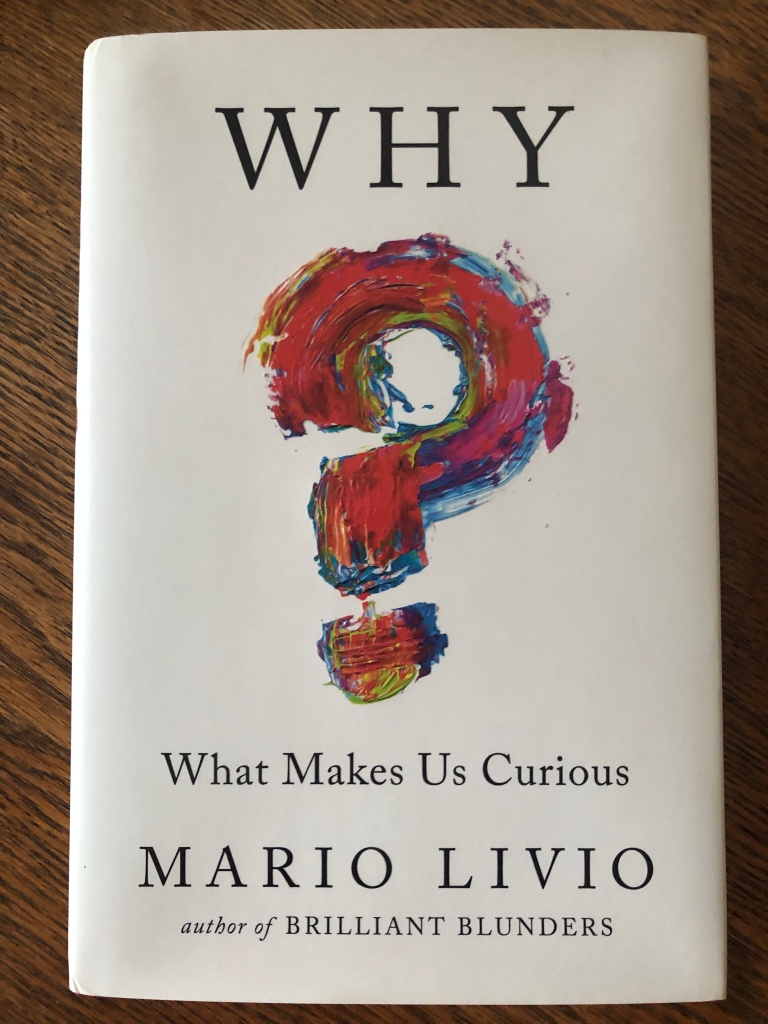
I suspect readers are like Leonardo da Vinci. Mario Livio asks, in Why: What Makes Us Curious (2017), what distinguished Leonardo from his predecessor anatomists, hydraulicists, botanists? “Leonardo had an unquenchable curiosity which he attempted to satisfy directly through his own observations rather than by relying on statements by figures of authority.”

Just like mystery readers. We insist on discovering each clue for ourselves. Woe betide the writer who cheats us–hides a clue, or packs the last chapter with explanations we had no chance to discover directly through our own observations. Not only cheatsy, but contrary to a key provision in the original Detection Club rules. https://murder-mayhem.com/the-detection-club-rules. A violation of our beloved genre!

We need for the sleuth to ask the right questions. An Austin detective recently gave an absolutely riveting presentation to our Heart of Texas Sisters in Crime chapter, describing how to conduct an interview of a potential suspect (not under arrest) who’s been asked to talk to the police. He said the interviewer needs to be likable–should give the suspect no reason to dislike him. The initial greeting should create a sense of reciprocity but also mention the sleuth’s authority. The detective begins the interview in a calm, low voice, giving the suspect autonomy and building rapport: “Is it okay if I call you Alec?” “Tell me a little bit about yourself.” He elicits the suspect’s story, then goes over it, watching for nonverbal indications of uncomfortable areas (the suspect changes posture, etc.). He watches for signs of deception–easy to detect if the suspect lies, harder to detect if the suspect fails to answer the question completely or directly, or restates the question to avoid having to answer the actual query, During the interview, the sleuth must keep a neutral face even if the suspect confesses something disgusting or shocking: “The second the suspect senses judgment on your part, they won’t talk to you.”

The mystery sleuth–professional or amateur–must recognize key questions. Take Anthony Horowitz’s Moonflower Murders–a follow-on to his Magpie Murders, featuring a contemporary murder mystery again wrapped around an earlier mystery involving the fictional detective Atticus Pund. Protagonist Susan Ryeland asks: why did the waiter at the posh club drop the plates? And why did her boss’s assistant quit her job at the publishing company? I’ll leave you to find out. Ryeland’s dogged pursuit of the answers to these key questions nearly gets her killed. But she solves the murder.

For an entirely different creative use of the question mark, with a twist: study (or just enjoy) Richard Osman. His often comic Thursday Murder Club mysteries revolve around a group of retirees in a comfortable retirement village. The club’s purpose? Solving cold cases. The disparate characters contribute varied personalities and talents–a Zen-focused psychiatrist (Ibrahim), a vivacious widowed nurse (Joyce), a burly ex-union organizer (Ron), and the mysterious former spy (Elizabeth. 

Osman brings these characters to life not by a predictable prosy description, but by the questions they ask and answer. In the club meeting on page 1 of The Man Who Died Twice, Joyce asks, “Do you think a dog might be good company?…I thought I might either get a dog or join Instagram.” Ibrahim: “I would advise against it.” The day’s topic is murder; but with such a Q and A, we begin to grasp the nature of this somewhat wacky group. We’re allowed to read Joyce’s diary, in which she comes across as convivial, a bit ditsy, and quite shrewd.

Osman extends this technique to other characters. When drug dealer Connie introduces herself to Chris and Donna, police officers who hope to engage in a sting and arrest her, we get this:

“What’s your eye shadow?” Connie asks Donna.

“Pat McGrath, Gold Standard,” says Donna.

“It’s lush,” says Connie.

Connie’s a murderous drug dealer. But hey! She’s also into fashion. And Donna? Same. 

Osman also uses those hanging questions as hooks. At the end of chapter 17, we’re eavesdropping on Joyce’s diary. The daily entry ends, “I wonder if anyone else is awake?” Now turn the page to chapter 18: “Ryan Baird is awake. He is currently playing Call of Duty online. He is spraying machine gun fire at full volume while his neighbors bang on the walls.”

You’ll be glad to know Ryan will get his, but the clever Q and A hooks us into the next chapter and expands Ryan’s character.

Osman’s Q and A also deepens the relationship between two unlikely friends, Joyce and Elizabeth:

“What do you and I talk about, Joyce?” asks Elizabeth.

Joyce thinks. “It’s been mainly murder, hasn’t it? Since we met?”

Thank you, Richard Osman. This is fun.

Just in case you’re wondering whether you (or your friends and relatives) ask enough questions, or ask the right or wrong questions, or have no clue how to keep a conversation going, or (heaven help us) don’t know how to ask questions of a group, here are 450 suggestions. Unfortunately, this collection didn’t include a list of “ideal questions for solving a murder.” https://www.scienceofpeople.com/questionos-to-ask-people

But, like Leonardo, we readers will discover those questions “directly through [our] own observations.”

My next book in the Alice MacDonald Greer Mystery series, Ghosted, will be out soon. Toward the end the protagonist, Alice, asks a key question. Watch for it! Happy Holidays!

Helen Currie Foster writes the Alice MacDonald Greer Mystery series, set in the Texas Hill Country. She lives north of Dripping Springs, loosely supervised by three burros. She’s active with Austin Shakespeare, Heart of Texas Sisters in Crime, and the Hays County Master Naturalists (still trying to learn those native grasses). Her most recent book, Ghost Daughter, was named Eric Hoffer Book Award Grand Prize Short List Finalist, as well as Finalist in the 2022 Next Generation Indie Book Awards, and Finalist in the 16th Annual National Indie Excellence Awards.

Back In The Saddle Again

VP Chandler

by V.P. Chandler

The world has been a crazy place since the emergence of Covid-19. Although it’s still out there, I’ve begun to venture forth into the world and attend author events. It feels wonderful to get back into the world of books and speaking with other writers! I think the last event I went to was the Bullet Books event in February of 2020 at the Bosslight Bookstore in Nacogdoches. (Fellow AMW writers Kathy Waller, Helen Currie Foster, and Laura Oles are also Bullet Books authors.)

My first foray back into the public realm was a Noir At The Bar event in Dallas back in June. Of course, it was outside and still blazing hot even though it started at 7. But I had such a great time listening to the other authors that it was worth it! Not a dud in the bunch. We laughed at some stories and were creeped out by others. I read a short piece that I wrote a few years ago, Tutusuana. (“Tutusuana” is a Comanche word that’s explained in the story.) It was nice to see old friends and finally meet online friends in person. Loved the experience. I highly recommend The Wild Detectives bookstore/bar. This is a jewel in the Bishop Arts district in Dallas.

Now we travel to Book People. Yesterday, August 21, I went to my first Book People event since pre-Covid. Mark Pryor has a new book Die Around Sundown. This is the first book in a new series so of course I had to be there to cheer him on! I’m excited to read this book. It’s an historical mystery set in Nazi-occupied France. I enjoyed the book talk and, again, seeing friends in person that I haven’t seen in a while.

This Wednesday I plan to go to an author event at my local library. I haven’t met Michael Miller but since I live in a small town, I want to attend events and provide support. He’s a long-time university professor, presently at Texas State. And he is also a Presbyterian minister, serving La Iglesia Presbiteriana Mexicana for the last ten years in San Marcos. His book is The Two Deaths of Father Romero: A Novel of the Borderlands. Sounds interesting!

Then the next day I’ll be back at Book People, if the roads aren’t flooded. (We’ve been in a severe drought this summer, as much of the world has been too. I’m looking forward to the rain, but I hope it’s a slow, soaking rain and not a deluge.)

It’s going to be epic. Two of the authors are NYT best selling authors. All of the panelists are Texas mystery authors with stories set in Texas. You know I’m gonna love that.  https://www.bookpeople.com/event/mystery-author-panel

Note: AMW member Helen Currie Foster will be on the panel too.

What a busy week! Looks like I have a lot of reading in my future. A few more books to add to my TBR (To Be Read) pile. My shelves are sagging. I better get busy, or build more shelves!

The Flavor of the Place

by Helen Currie Foster

August 8, 2022

Our family’s favorite mystery quote (bolded below) appears in Strong Poison, by Dorothy Sayers, where detective Lord Peter Wimsey first meets novelist Harriet Vane. Vane’s on trial for murder, accused of systematically poisoning her former lover with arsenic.

Wimsey suspects the lover’s uncle, Norman Urquhart, but the uncle assures the police that he served a blameless dinner to his nephew. Wimsey sends the all-competent Bunter (his manservant and WWI batman), to winkle out secrets from Urquhart’s cook, Mrs. Pettican, and the housemaid.

Bunter ingratiates himself by means of crumpets:

“At half-past four…he was seated in the kitchen of Mr. Urquhart’s house, toasting crumpets. He had been trained to a great pitch of dexterity in the preparation of crumpets, and if he was somewhat lavish in the matter of butter, that hurt nobody except Mr. Urquhart. It was natural that the conversation should turn to the subject of murder. Nothing goes so well with a hot fire and buttered crumpets as a wet day without and a good dose of comfortable horrors within. The heavier the lashing of the rain and the ghastlier the details, the better the flavour seems to be.” 

What a setting! I’ve never tasted a crumpet, but can feel the heat of the fire and inhale the smells of toasting and melting butter. And in contrast to (or fueled by) this warmth, this delicious comfort, the cook reminds us of the victim’s death: “A dreadful wicked woman she must ‘a’ been,” said Mrs. Pettican, “—‘ev another crumpet, do, Mr. Bunter—a-torturin’ of the poor soul that long-winded way. Bashin’ on the ‘ed or the ‘asty use of a carvin’ knife when roused I can understand, but the ‘orrors of slow poisonin’ is the work of a fiend in ‘uman form, in my opinion.”

So in our kitchen at buttery moments some family member will mutter, “If he was somewhat lavish in the matter of butter…” But this week I wondered, “What are crumpets?” I mean, with Bunter toasting them over a (presumably coal) fire, then lavishing butter on them, they sound wonderful, especially for teatime in a firelit kitchen, on a cold wet afternoon, discussing the horrors of slow poisoning.

Compelled by curiosity I found a recipe. https://www.daringgourmet.com/traditional-english-crumpets/ Huh. I’d imagined English muffins. No. Instead, the goal is a tender disc, yeasty but also leavened with baking soda, creating bubbled holes to absorb melted butter, jam, and other decorations. Problem: locating crumpet rings. Yes, I’ve ordered some.

Sayers wasn’t writing a culinary cozy, despite the crumpets and an intense discussion on the following page between Mrs. Pettican and Bunter about casseroled chicken. A scene beginning with toasting crumpets produces a triumph of setting and character, a comic but dread-inspiring description of the victim’s death, and clever clue placement. Sayers does not describe either the smell of the toasting, or the taste of the crumpets, but surely you, dear reader, imagined those? Didn’t you feel yourself right there in the kitchen, with the rainy day outside, the gossipy discussion of the lover’s death agonies, and a vivid depiction of Bunter’s character? Courteous, yet firm, he deftly extracts critical information not reflected in the police report—and yes, a clue you doubtless spotted. Maybe Vane will escape the hangman’s noose after all. 

As Proust famously pointed out, smells can stimulate memories. https://www.penguin.co.uk/articles/2020/07/more-than-cake-unravelling-the-mysteries-of-proust-s-madeleine Smells can also trigger emotional reactions: “Your olfactory bulb runs from your nose to the base of your brain and has direct connections to your amygdala (the area of the brain responsible for processing emotion) and to your hippocampus (an area linked to memory and cognition). Neuroscientists have suggested that this close physical connection between the regions of the brain linked to memory, emotion, and our sense of smell may explain why our brain learns to associate smells with certain emotional memories.” https://www.scientificamerican.com/article/why-do-smells-trigger-memories1/

Despite the strong impact of smells on humans, writers’ references to smell often seem sparse. Part of the problem is the sheer difficulty of describing certain smells. Imagine trying to describe the smell of a beloved house. It’s a mysterious mix, isn’t it? If I try to describe my mother’s house, I can’t do it with just one word. Part of the remembered smell is a faint perfume—maybe a bath powder she used, like Caswell Massey’s Gardenia. But there are other ingredients as well—contributions from oak furniture, cotton sheets, old Christmas cards on a closet shelf… See, I can’t accurately describe the smell itself; I have to name things.

My grandmother’s house in Hill County delivered a similar mixture, varying by seasons. In summer, it smelled of cantaloupe from her garden; at Christmas, of a decorated cedar tree. But always the substrate included a hard-to-describe mixture of our grandfather’s Yardley English Lavender talc, kept on the kitchen shelf where he shaved; of the garbage chute in the kitchen; of oil and electric discharges from his ham radio rig; of the ancient living room piano (wires, wood, felt). How describe the totality of that smell, that amalgam of odors, so instantly recognizable to me, but unknown to you? And how describe it without a bunch of nouns? 

Poets apparently run into that problem. I set out to locate poems incorporating odor and fragrance, grabbing poetry volumes from the shelves. Yeats? Gorgeous references to sight and sound, as in “The Lake Isle of Innisfree”: “Nine bean-rows will I have there, a hive for the honeybee, /And live alone in the bee-loud glade…” The poem is rich in sight, in sound, but not smell. We don’t smell the clay and wattles or honey.

Same for Wendell Berry’s A Small Porch—a volume of ideas, images, light and air. But I didn’t find smell. Nor did I find smell references in Chaucer or a number of Renaissance English poets, except that Michael Drayton gives us a wonderful line in “To the Virginian Voyage” referring to the much-anticipated Virginia landfall of seaborne English explorers: “When as the luscious smell/of that delicious land…” Of course Shakespeare mentions the “sweet odour” of roses (as in Sonnet 54): “Of their sweet deaths are sweetest odours made.” 

Indeed, I had trouble finding references to smell in most of the poetry books I opened. There were some. In “Aimless Love,” “gazing down affectionately at the soap,” Billy Collins writes, “I could feel myself falling again/as I felt its turning in my wet hands/and caught the scent of lavender and stone.”

Marianne Moore, in “Enough,” from O To Be a Dragon, gives us this: “The crested moss-rose casts a spell; its bud of solid green, as well, /and the Old Pink Moss—with fragrant wings/ imparting balsam scent that clings…” Many readers will recognize balsam. Another from Moore’s “In the Public Garden”: “O yes, and snowdrops in the snow that smell like violets.”

Also readers may know the smell of violets. Charles Wright, in “Dog Creek Mainline,” gives more challenging references: “Dog Creek: cat track and bird splay,/Spindrift and windfall; woodrot; Odor of muscadine…” If you’ve played around wild grapevine you know the odor of muscadine––maybe woodrot too. 

Try the experiment yourself. Pull some poetry off the shelf. Don’t most poems rely on sight and sound, and rarely odor? Because a particular smell can be very hard to describe.

https://bit.ly/3dhCTQO. Per Rodrigo Suarez at the Queensland Brain Institute: 

“The way the brain deals with smells is very different to how it deals with other senses, such as seeing and hearing. For example, we can identify the different instruments playing in a band, or the different shapes and colours in a painting. But it is very hard for us to tell the individual parts of a smell mixture.” He goes on: “We can sense the smell of “orange” or “coffee” as a single thing, but have trouble identifying the many different parts that make up those smells individually. However, it is possible to get better at this with practice. Professional wine-tasters or perfume-makers can detect more parts of a smell mixture than most people.”

Our difficulty in describing smell is not that we humans can’t detect odors—we can, says Greg Miller, Science (November 11, 2014): “We humans have about 400 different types of receptors for detecting odorant molecules. That’s on the low end for mammals, but it’s enough, at least in theory, to allow us to distinguish a trillion different odors, one team of neuroscientists calculated earlier this year (although there’s been some controversy about that estimate).”

But, per Miller, we describe odors differently from sights and sounds: “When people—English speaking people, anyway—describe odors, what they are actually doing much of the time is describing the source of the odor. Orange-y. Smokey-. Skunk-y. This seems natural enough, but it’s fundamentally different from how we describe other sensory experiences. Words like “white” and “round” describe visual features of an object, not the object itself. It could be a baseball, or it could be the Moon. In the same way, a tone can be “high-pitched” whether it comes from a bird or a teakettle.” https://bit.ly/3JFFobV

Some studies suggest that our language is inadequate to the task of describing smell. Another suggestion is that other languages than English may be better at conveying odor.

But determined mystery writers find a way, because odor can make important contributions to a setting. In 1937, in Rex Stout’s fourth Nero Wolfe mystery, The Red Box, the detective lectures his cook, Fritz Brenner: “Do you know shish kebab? I have had it in Turkey. Marinate thin slices of tender lamb for several hours in red wine and spices. Here, I’ll put it down: thyme, mace, peppercorns, garlic…” https://amzn.to/3PahvKz

Can’t you smell those spices? And doesn’t that passage help round out (pun) our vision of Nero Wolfe, gourmet, gourmand, brilliant detective? We’re planted in the kitchen of Wolfe’s New York brownstone, the primary setting for all the mysteries. These few lines convey Wolfe’s insistence on sophisticated cuisine, and reflect the rigor he demands of every employee under his roof, including Fritz the cook; Theodore Horstmann, the keeper of his orchid greenhouse; and our narrator, his foot soldier, Archie Goodwin. A shish kebab recipe helps define the setting and Wolfe’s character as well.

Ngaio Marsh begins Night at the Vulcan (1951) with Martyn Tarne, a young New Zealand actress desperately seeking an acting role in London. One night, out of food and money, with no place to stay, she enters the Vulcan Theatre which has advertised for a dresser: “She was at the back of the stalls, standing on thick carpet at the top of the ramp facing the centre aisle…The deadened air smelt of naphthalene and plush.” The empty theatre lacks an eager audience, waiting for the curtain to go up. Instead Marsh gives us the “deadened air” of a closed theatre, where the plush seats are empty, and the air smells of naphthalene—chemical dry cleaning. Martyn starts to work: “As soon as she crossed the threshold of the star dressing-room she smelt greasepaint. The dressing-shelf was bare, the room untenanted, but the smell of cosmetics mingled with the faint reek of gas.” I don’t know the smell of greasepaint, but Martyn does; she’s in a setting she understands.

Mick Herron’s unputdownable Slough House series uses odor to create the key setting––the decrepit building which serves as center stage. Book 2, Dead Lions, describes entry to the building as follows: “No one enters Slough House by the front door; instead, via a shabby alleyway, its inmates let themselves into a grubby yard with mildewed walls….” Yecch, mildew. The building houses the “slow horses” who flunked out of MI-5’s headquarters in posh Regent’s Park, and are now under the tutelage of former Cold Warrior Jackson Lamb, a terrifying mentor. “Jackson Lamb’s lair,” the office on the building’s top floor, is described thus: “The air is heavy with a dog’s olfactory daydream: takeaway food, illicit cigarettes, day-old farts and stale beer, but there will be no time to catalogue this because Jackson Lamb can move surprisingly swiftly for a man of his bulk….” No question that odor is part of the setting. Lamb is an olfactory terrorist. https://amzn.to/3ppQsAJ

The century-old Beer Barn, a beloved road house in Coffee Creek, is where townspeople gather in my Ghost series. That includes lawyer and protagonist Alice Greer. Naturally the smell of beer is key. In Book 3, Ghost Letter, Alice invites a political reporter to the Beer Barn for lunch: “As they pushed through the Beer Barn’s tall swinging doors the fragrant haze enveloped them—incense compounded of hickory smoke from the wood-fired grill, chiles toasted on an iron comal, and thousands of bubbles popping in bottles and glasses, releasing the yeasty magic of beer to the air.”

Smells may be hard to define, but including the smell of a setting can enrich a mystery’s impact. Or, as Mrs. Pettican says, “Have another crumpet, do!” 

Helen Currie Foster lives and writes north of Dripping Springs, Texas, loosely supervised by three burros jostling for roles in the Alice MacDonald Greer Mystery series, set in the unique landscape of the Texas Hill Country. So far all three burros have made an appearance, though insisting on aliases. Book 8 is on its way…

Music to Our Ears!

by Helen Currie Foster

On April 2 I drove with my writing compadre D.L.S. Evatt (aka Dixie) to Houston to sign books at Murder by the Book. That renowned bookstore has sold mysteries for 42 years. Huzzah!

We’d launched our books–my Ghost Daughter, Book 7 in the series, and her Bloodlines and Fencelines–at our Honky-Tonk Book Launch on December 5, 2021, at venerable Sam’s Town Point, a South Austin treasure for decades. The owner, Ramsay Midwood, declared it was the “first book launch” for Sam’s. Before the band––Floyd Domino’s All-Stars––began playing, Austin Shakespeare’s Ann Ciccolella interviewed us. Her first question: “why have a book launch at a honky-tonk?”

Dixie and Helen

Why? For all the right reasons—great beer signs, dance floor, pool table, and music. But the main reason: murder mysteries set in small Texas towns must have a place where townspeople meet, where news is exchanged and gossip is passed along, where people see friends and frenemies and fall in love, where the past isn’t forgotten but the present is very much in play.

For Alice Greer, the lawyer protagonist in my Ghost series, the century-old Beer Barn is that place. Artisanal beers, excellent Tex-Mex food, the requisite dance floor—and the mix of music that says “Texas Hill Country.” In Dixie’s Bloodlines and Fencelines, that place is Sara’s General Store.

Of course setting is crucial in mysteries. For a small town setting, a “town crossroads” becomes a useful dramatic tool, providing a place where the mystery’s protagonist runs into various characters and hears (and evaluates) their stories, slowly unraveling the truth of a murder. Have you ever lived or visited relatives in a small town? You may have identified potential locations that would work well in a mystery. In Itasca, Texas, home of my maternal grandparents (and the Itasca Wampus Cats), it might’ve been the church fellowship hall, or the one café that served breakfast and lunch, or (I keep returning to this thought) the frigid meat locker downtown where, like many families, my grandmother kept her side of beef, back before home freezers. I still remember the sharp cold vapor of the meat locker. Imagination stirs…

At any rate, Sam’s Town Point was perfect for a book launch. When we scouted Sam’s, Dixie took a look around and said, “There are stories in these floorboards.” So we wrote a song, “Stories in the Floorboards,” which premiered last month at our book event at the Austin Woman’s Club, sung by songwriter/actress Helyn Rain Messenger.

We asked John McDougall at Murder by the Book if he knew of other authors who’d written or commissioned a song for their book launch. He said, yes, Harlan Coben and Jeffrey Deaver had done so, and Lee Childs had commissioned an entire album. Well!

The notion of an album set me thinking of John Rebus, the crusty Edinburgh cop made famous by author Ian Rankin. Rebus, acerbic and brilliant, likes his music. In Black and Blue, he sticks a tape in his car cassette player – Robert Wyatt, Rock Bottom, then Deep Purple, Into the Fire.” That title matches the heat of the fix he’s in at that point. (Later in the series, the cassette player becomes a CD player.) But at home, he still relies on the hi-fi.In Rather Be the Devil, set in his ways, now retired and older than dirt, Rebus knows he has an ominous shadow on his lung as he enters his apartment: “A glow from the hi-fi system that told him he hadn’t switched it off. Last album played: Solid Air. Felt like that was what he was walking through…” https://www.amazon.com/s?k=rather+be+the+devil+by+ian+rankin&crid=11GFHLFGLRGUT&sprefix=%2Caps%2C135&ref=nb_sb_ss_recent_1_0_recent

Rebus has stuck to his old technology. And now he’s ahead of the curve. Vinyl sales are up: “Left for dead with the advent of CDs in the 1980s, vinyl records are now the music industry’s most popular and highest-grossing physical format, with fans choosing it for collectibility, sound quality or simply the tactile experience of music in an age of digital ephemerality. After growing steadily for more than a decade, LP sales exploded during the pandemic.In the first six months of this year, 17 million vinyl records were sold in the United States, generating $467 million in retail revenue, nearly double the amount from the same period in 2020, according to the Recording Industry Association of America.”

https://www.nytimes.com/svc/oembed/html/?url=https%3A%2F%2Fwww.nytimes.com%2F2021%2F10%2F21%2Farts%2Fmusic%2Fvinyl-records-delays.html

Moreover, it’s not retirees pushing this trend: “And while you might think it’s nostalgic Boomers or Gen Xers behind the renaissance of records, in fact surveys show it’s millennial consumers driving the rising trend in vinyl sales.” https://www.themanual.com/culture/why-vinyl-is-coming-back/

Why? For some, vinyls are the new collectible. But maybe it’s about the additional experience involved in listening to a favorite chunk of music. Rebus, for instance, is not listening to streamed music, not asking Alexa to play music that “sounds like” some musician. No, he’s taking a number of steps, both mental and physical, before he begins to experience the music he’s after. He’s choosing an album, seeing the familiar cover again, sliding the fragile (yet powerful) disc from its jacket, and placing it on the turntable. The album represents an entire experience, not just one cover song. Then he’s lifting the arm, carefully lowering the needle, hearing the introductory hum and scratch and—there it is again, the music that lives in his memory and is playing out again right now, in his living room. He’s making music.

Moreover, he’s activating memories, and perhaps comparing the memories of the music with his present situation, as Rebus does here, thinking the song title—John Martyn’s “Solid Air”—“felt like … what he was walking through.” (A compelling description. https://www.youtube.com/watch?v=UikPQOaJpfU)

Writers use music in mysteries to add depth to the protagonist’s character. Inspector Morse, alone in his flat, listens to opera. Lord Peter Wimsey plays Bach on his baby grand; Sherlock Holmes plays the violin and attends opera. Rebus relies on the music of his time, has the albums, still has t-shirts from concerts he attended. Detectives need a listening ear, need to be able to discern the sound of a lie, hear the tremble in a frightened voice. What the sleuth chooses to listen to can almost make us feel we’re hearing background music. Music becomes the continuo, the bass line that we feel beating like a heart as a book comes to life.

Because—even if we don’t know the specific notes Holmes is fingering on his violin, or which Bach fugue Wimsey is toying with, or which Wagnerian album Morse has put on his hi-fi, or precisely what “Solid Air” sounds like, we do have a huge memory vault of similar music that bubbles up as we read a mystery. We may not quite create the same soundtrack the author had in mind, but our brains engage.

Book 5 of my series, Ghost Next Door, involves a murder at the Coffee Creek city park, the night before Coffee Creek’s first barbecue competition. My protagonist, lawyer Alice Greer, is part of the happy crowd under the stars, listening to keyboard geniuses playing varieties of boogie-woogie, a genre which may have begun in the lumber camps of East Texas and still flourishes in Austin. Early in the evening Alice hears “Right Place, Wrong Time,” presaging what happens next. https://www.youtube.com/watch?v=hf15HrUZ5Wk. The following night she and her romantic interest, Ben Kinsear, attend the Pianorama at the Beer Barn (Alice’s favorite client). Six piano players are trading licks, winding up with Freddie Slack’s “Down the Road A Piece,” with its rippling magic trick at the end, https://www.youtube.com/watch?v=OX8TPanPKzU, and ending with Slack’s haunting theme song, “Strange Cargo.” https://www.youtube.com/watch?v=tQM46xi031M

The crowd demands an encore, Alice listens as the theme grows “more complex, begins to create dreams, memories, ambitions.” The music reflects Alice’s emotions.

Music memory involves several different parts of our brain. “Different types of music-related memory appear to involve different brain regions, for instance when lyrics of a song are remembered, or autobiographical events are recalled associated with a particular piece of music.” https://academic.oup.com/brain/article/138/8/2438/330016

And it may be for that reason that music stays in our brains longer than many other memories. https://kids.frontiersin.org/articles/10.3389/frym.2017.00005#:~:text=Our%20brains%20possess%20a%20remarkable,might%20know%20it%20by%20heart.

You already know this. Your personal music catalog—music from your past, your present, your childhood, your teenage years, and the new piece of music you just listened to—is with you, quietly ticking away in your brain, available and waiting. And there’s always more to add.

So, you could check out the line-up at Sam’s Town Point. Go Hear Floyd Domino’s All-Stars. Keep filling the music catalog…

https://www.samstownpointatx.com/

Helen Currie Foster writes the Alice MacDonald Greer “Ghost” series, north of Dripping Springs, Texas, supervised by three burros. She’s fascinated by dirt and water law, as well as human history, and the way the past, uninvited, keeps crashing the party.

Ghost Daughter, Book 7, was named Semifinalist for the BookLife Prize for Mystery/Thriller (“an intriguing and complex narrative”). Book 8 is underway.

blog reference