It’s fall in Paris. The rows of chestnuts flanking the Seine are turning golden-brown; gingko trees sport their distinctive yellow leaves, preparing to fling down, on one afternoon they keep secret, all their leaves at once.
Fall fashion? Long hair for women, slim tan trench coats at mid-calf, midi-length swishy skirts. Anyone can wear jeans and sneakers (male, female, old, young) with a blazer-cut jacket. In the markets, apples from the Garonne (Pixie Pommes!), quantities of mushrooms, cashmere scarves. Kids scurry to school at eight while their older siblings stride down Rue de l’Universite toward Science Po.
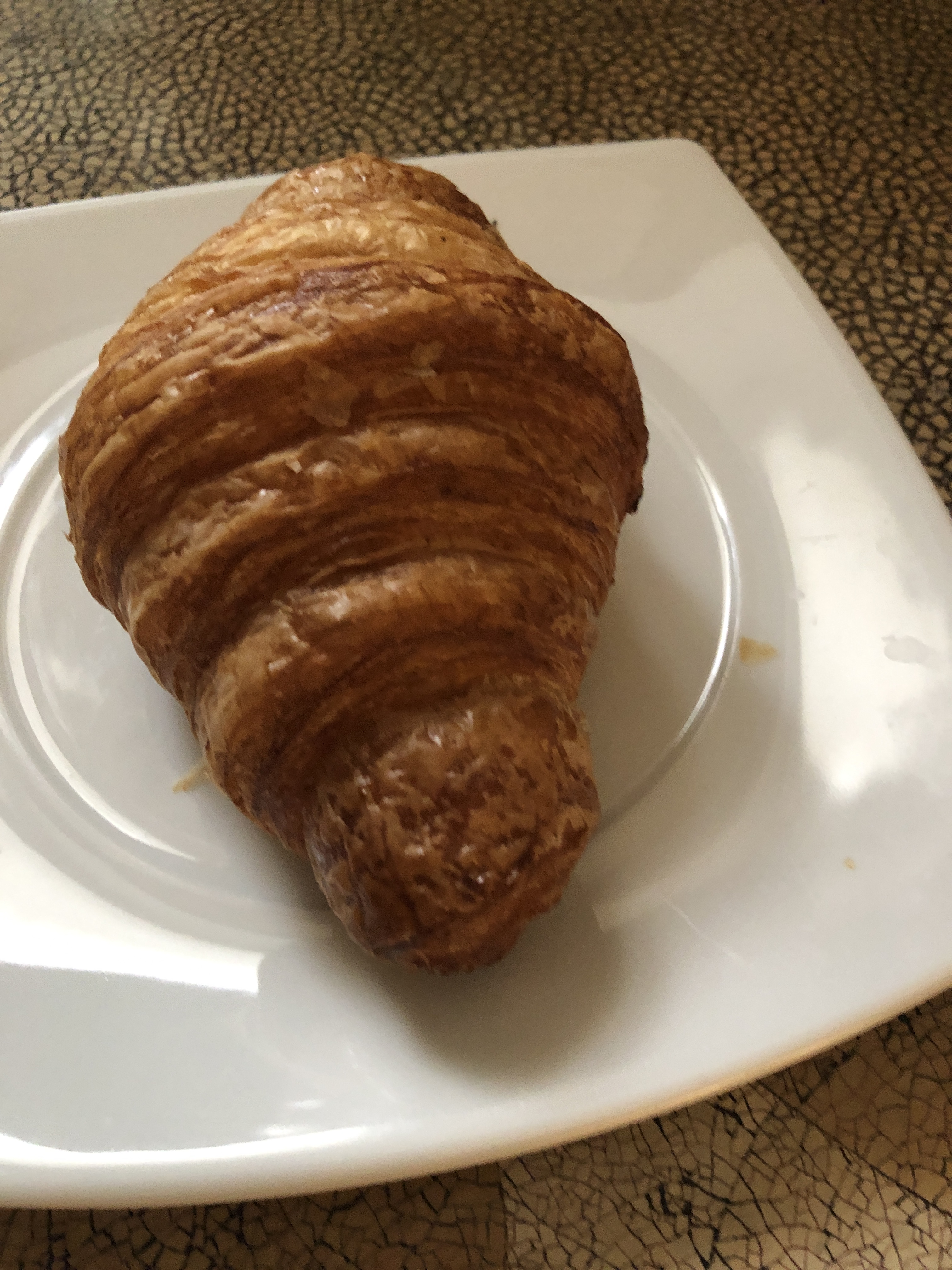
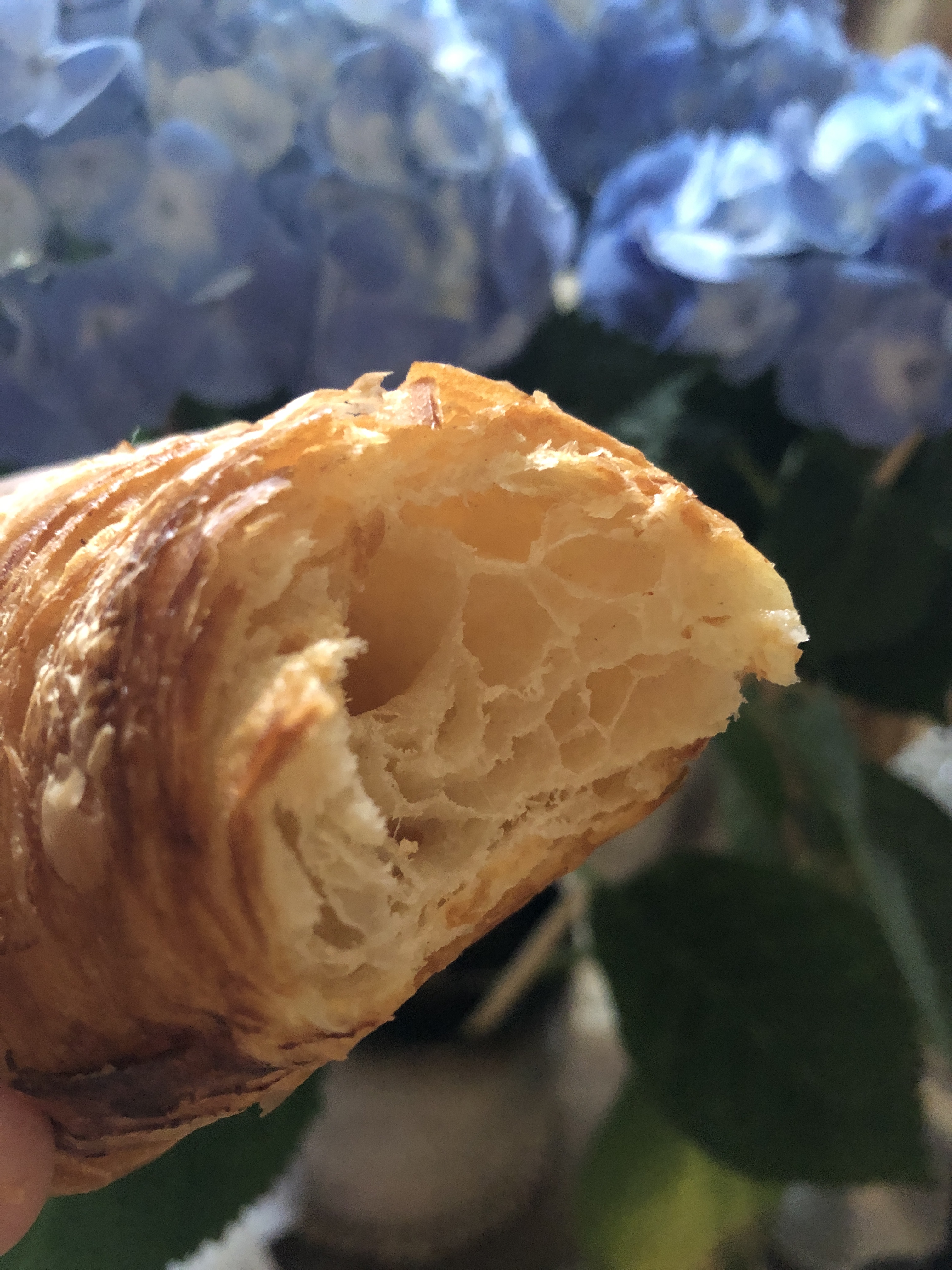
I’m forever grateful to Madame, our wondrous French teacher at McCallum High in Austin. On the first trip to Paris over fifty years ago, fresh off the early train, my husband and I stopped at a café where I opened my mouth in fear and trembling to order in French—deux cafes et deux croissants.
To my shock the proprietor didn’t blink. And the result was magic—our first taste of croissant.
Long past high school I still say “Merci, Madame!” A Parisienne, she had (I believe) a PhD. She maintained perfect class discipline—even with smarty seniors. When anyone asks, how did you learn French? I say, “Madame! She made us sing songs!” https://www.youtube.com/watch?v=96JRl7bER3g&list=RD96JRl7bER3g&start_radio=1
As to “à la Claire Fontaine” I suspect she omitted the first two verses—at least I don’t remember singing about bathing beneath a tree! But this song and the rest we still remember, decades later.
Sur le Pont d’Avignon…Frère Jacques…Alouette, gentille alouette, je te plumerai (le nez, le cou, et la tete, et le dos, etc.). At Christmas, Il est né, le divin enfant. Twisting your tongue around the pretty French words leaves you with life skills.
(She didn’t teach us La Marseillaise. But I still get chills when, in Casablanca, Victor Laszlo leads the crowd at Rick’s in singing it.)
And another beloved teacher taught both Latin and English. She could order grown seniors to race to the blackboard to diagram sentences, and insisted we use proper punctuation.
What was it about those favorite teachers? They made us learn. They brooked no foolishness. They could tell when we faked preparation. They thrust us into difficult novels, demanding paintings, complex unfamiliar music. Hitherto hidden histories. Concepts we hadn’t invented or come upon by ourselves.
Maybe we did learn. Maybe—that learning is worthwhile.
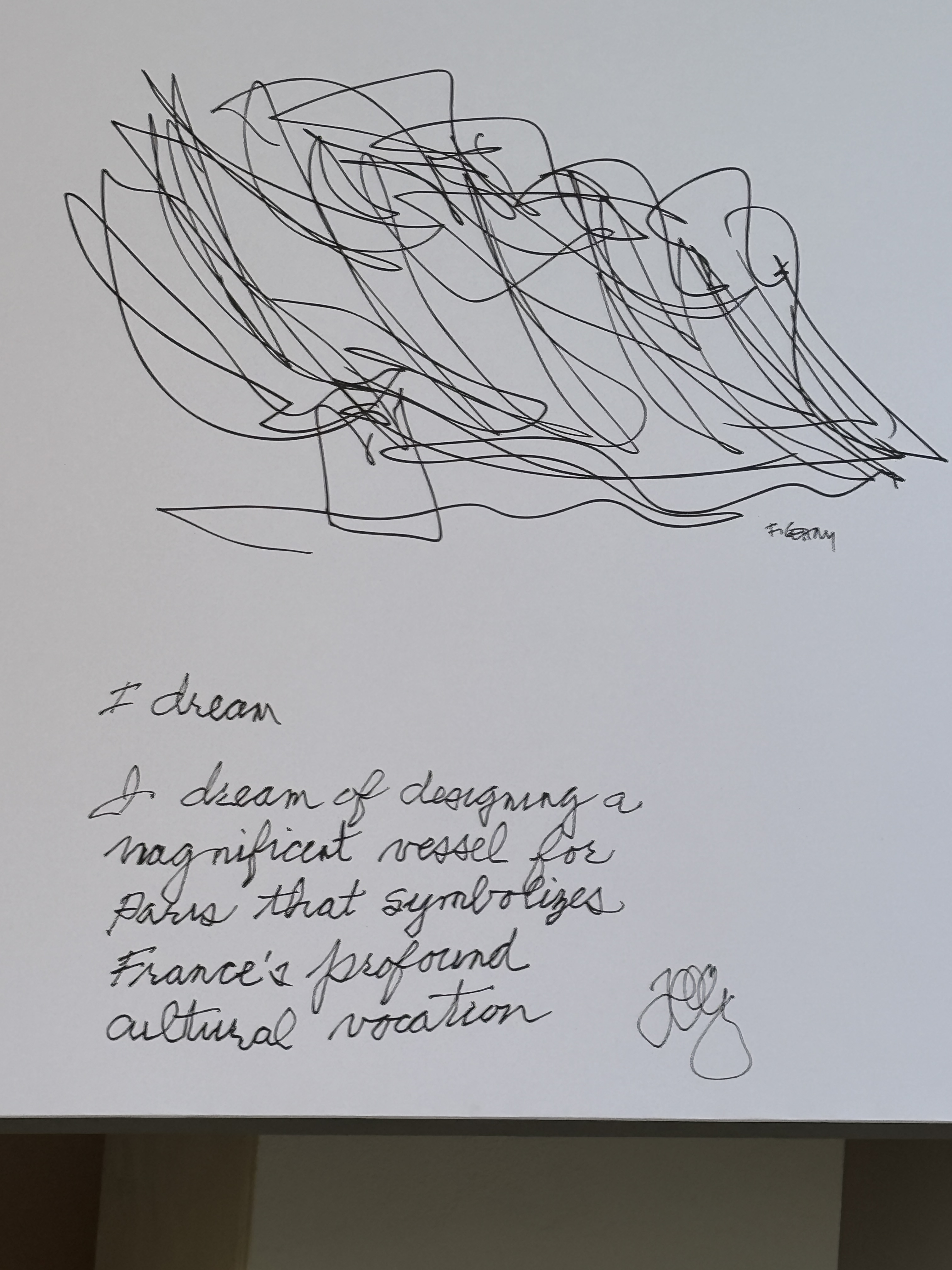
Yesterday we visited La Fondation Louis Vuitton to visit what architect Frank Gehry dreamed of as an iceberg with sails.
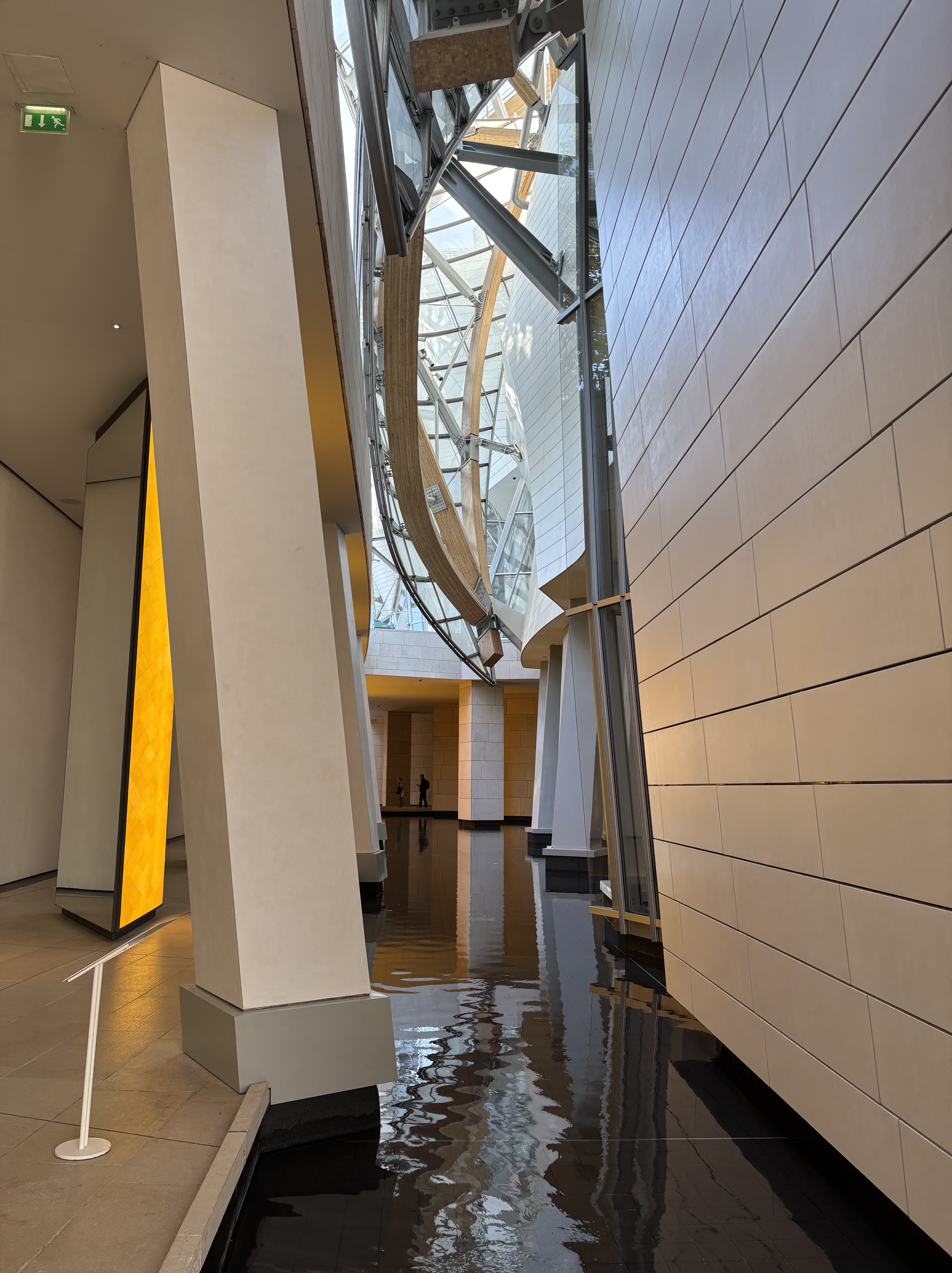
Curves, lines, water, wood… magical in their power.
The building invites you to wander and wonder. What imagination, what creativity, what a vision! I listened to the rippling water traveling down the slope—the sound took over. Couldn’t hear traffic, or talking. Just the water–in the middle of a vast city. Being there takes you back to Roman stonework (rectangles, arches, roads in straight lines), and then to the power of curved sails, moved by wind and water. People working there seemed quietly confident that visitors should and would be (but not literally) blown away.
READING: I’m very much enjoying Susan Wittig Albert’s Thyme, Place & Story website where she is now serializing the first China Bayles book–A Bitter Taste of Garlic. Many of us are fans of this series, and would be delighted to visit China’s herb shop in a town not far from Austin…!
I just finished Mick Herron’s Down Cemetery Road. I found it much scarier than the Slow Horses novels…but still wanted to know the ending. It was published over 20 years ago and apparently will be streaming in October.
On the flight over I was reading Graham Robb’s France, including some tales of Paris that were scarier than Down Cemetery Road. Like being the butt of your buddies’ jokes and winding up as a prisoner in Fenestrelle, a political prison during the Napoleonic era. https://fr.wikipedia.org/wiki/Forteresse_de_Fenestrelle
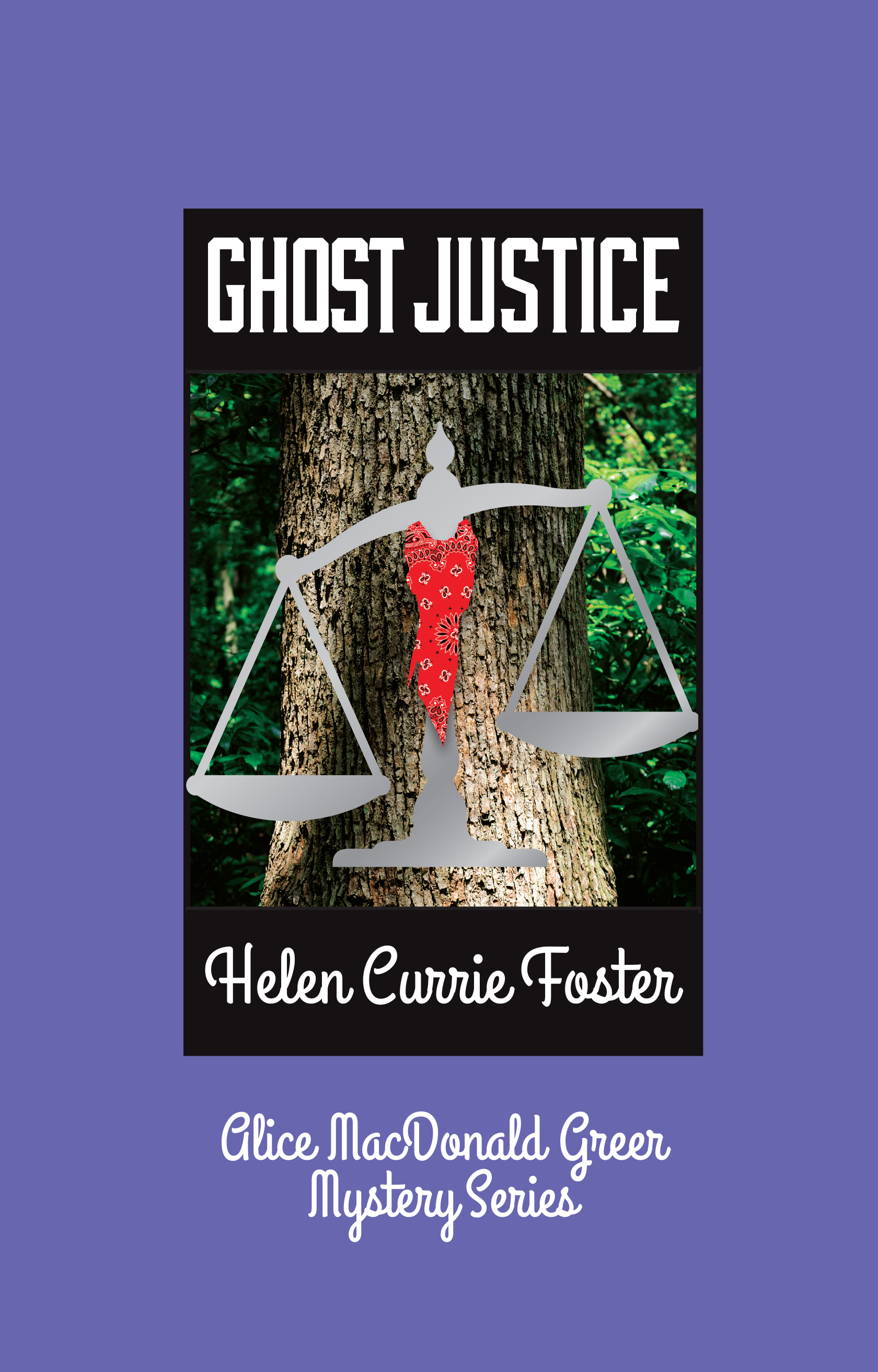
Meanwhile, at home, Ghost Justice is now out! Book 10 in my Alice MacDonald Greer Mystery Series set in the Hill Country. Available at BookPeople on Lamar Blvd. in Austin https://bookpeople.com/ and on Amazon. https://amzn.to/4pk8WQO
Hope you’ll enjoy it!
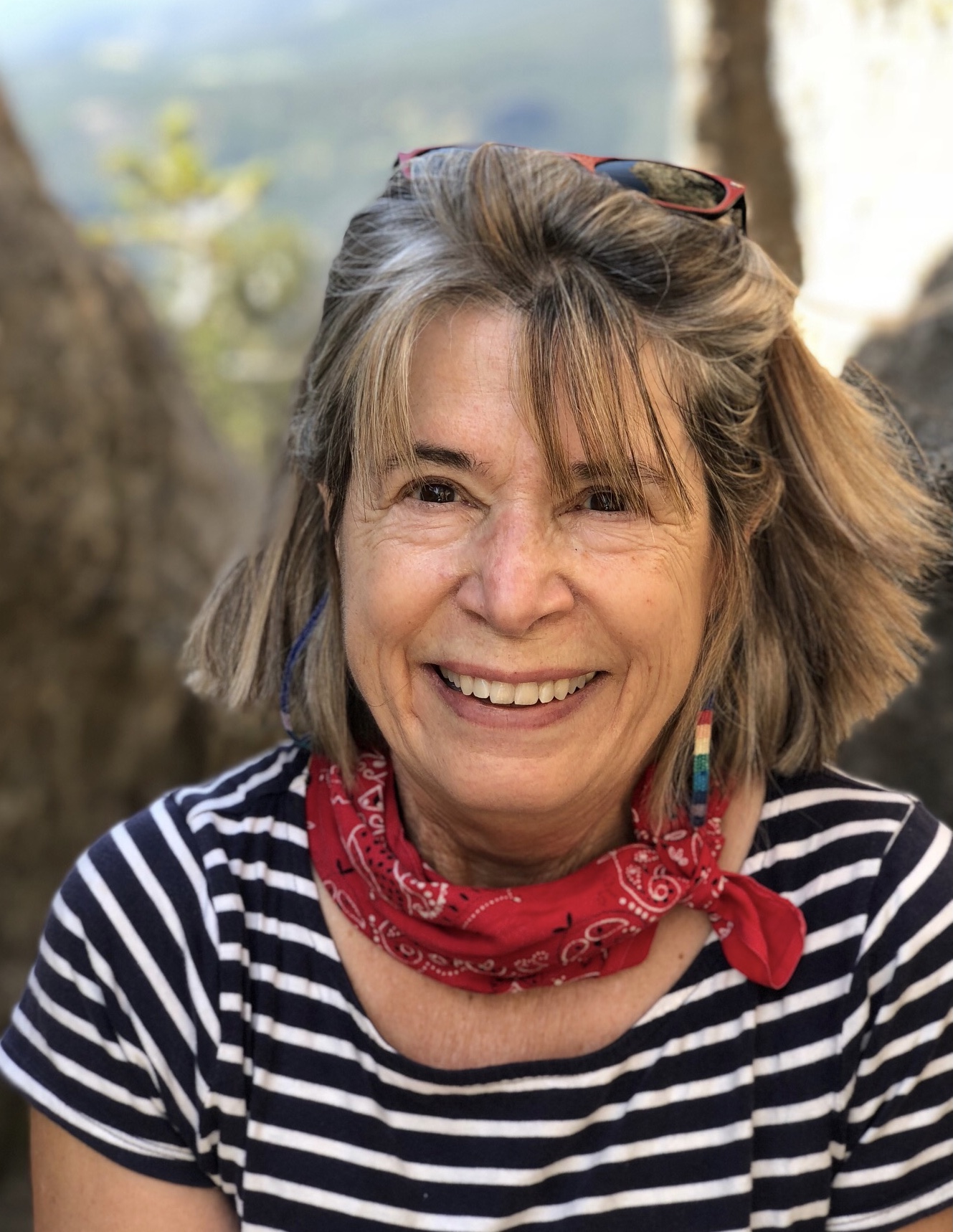
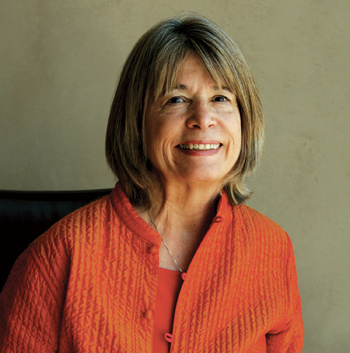
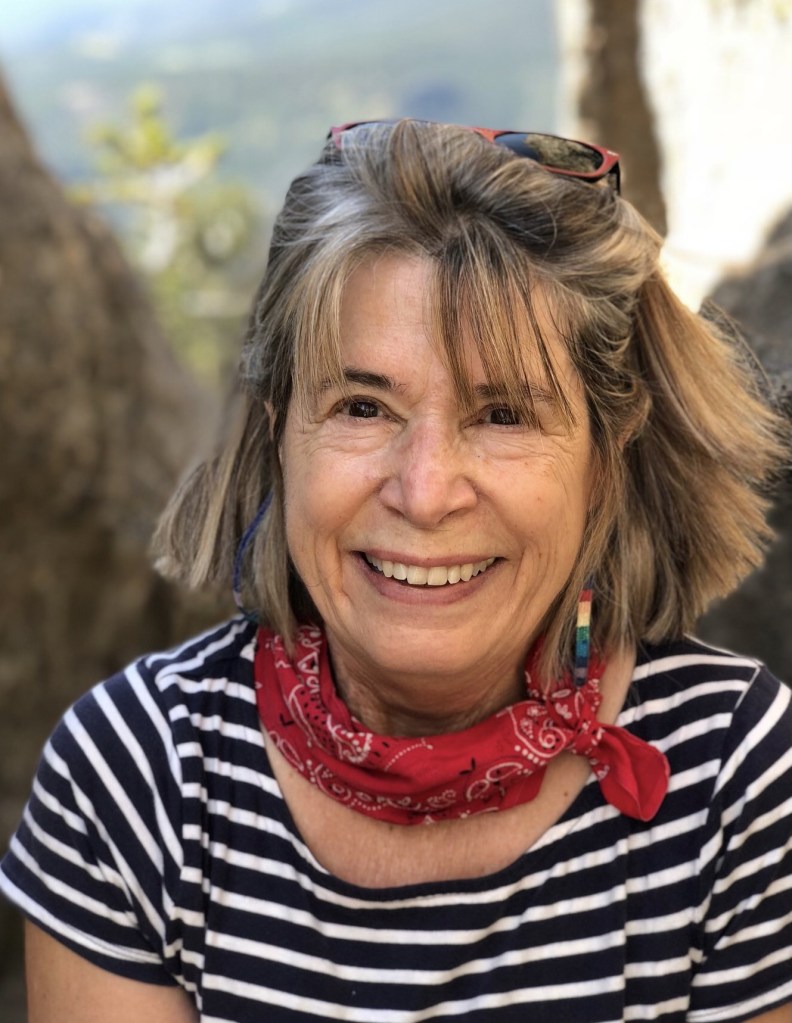
Helen Currie Foster lives and writes the Alice MacDonald Greer Mystery Series north of Dripping Springs, loosely supervised by three burros. She’s drawn to the compelling landscape and quirky characters of the Texas Hill Country. She’s also deeply curious about our human history and prehistory and how, uninvited, the past keeps crashing the party. Follow her at http://www.helencurriefoster.com.
Just before a trip I get anxious: is there enough stored in my Kindle to keep me happy? You constant readers know that feeling. Did you upload enough for the waiting room at the airport? For the plane? For a sleepless first night, jet-lagging? Enough to keep you happy even if weak (or no) wi-fi at the (tent, cabin, hotel, boat, campsite, rental) precludes another download? Yes, there’ll be news–but I am escaping!
We’re on a family trip to France, with children and grandchildren. I loaded up the Kindle diligently beforehand. Of course there are way too many wonderful things to do besides read…
Still, my heart sang when we entered the rental in the French mountains and spied—A BOOKCASE!
Moreover, the shelves held mysteries! Ian McEwan, Patricia Cornwell, Elizabeth George, Janet Evanovich, V.I. Warshawski, Alexander McCall Smith…
Also serious nonfiction and titles from Kazuo Ishiguro, Dostoevsky, Graham Greene, Julian Barnes and more. Then I spotted Kinky Friedman’s Frequent Flyer and thought—eclectic tastes! Perhaps some were left behind by guests. Still, the shelves made me want to meet the owners. The welcoming bookshelves and, to boot, a choice of comfortable corners where a tired tourist can flop, prop up the well-used feet, and read…what more can one ask?
(Sidebar—when you see a Talking Head on your screen, with a bookshelf behind—do you wonder if the books really belong to the Head? Or are they just a prop intended to impress? Maybe we’ll see some interviewer pose a question: “How did you like Crimes Against Humanity?” Blank stare.)
If you’re familiar with Dunnett’s stunning two historical fiction series, The Lymond Chronicles and The House of Niccolo, you already know she delivered powerful (and powerfully surprising) plots, magnetic characters, and vivid reconstructions of the 15th and 16th centuries. Using (for all that detail) an omniscient narrator.
But in her spare time she also wrote the Dolly mystery series, involving an astoundingly talented portrait painter named Johnson Johnson (yes, two), who happens to turn up in scenic locations in his yacht, the Dolly, on secret missions for the British ministry of defense. I’ve reread three of those on this trip—one set in Ibiza, one in Morocco, one in Canada. Unlike the Niccolo or Lymond historical series, Dunnett’s heroines in these first-person mysteries are in their late teens or twenties and trying to make their way in the world (as an au pair, a cook, an executive assistant, etc.). Naturally they find themselves in dangerous situations while trying to identify a murderer, and Dunnett gives each her own first-person voice—each interestingly different.
Clearly Dunnett didn’t merely set foot in these locales: she absorbed them. The action’s fast-moving, but she paints a landscape with details that place you right in the square where the villains are about to—well, here’s an example from Moroccan Traffic, in the Atlas Mountains, where Wendy, a young executive assistant, watches as Johnson and the engaging inventor Mo pursue two ruthless adversaries up perilous cliffs:
…where they had set their faces to climb was the flank of the mountain; the boulder slope rising to cliffs and ridges and rock bands interlaid with tongues of snow, and scree-fields, and stony pockets of pasture. And further up, behind escarpment and terrace, the burning forepeaks of the range.
I had seen it all from the road. Somewhere there, already entrenched, already waiting, were Gerry and Sullivan, ex-SAS marksmen.
You can also tell that Dunnett (as well as her character Johnson) was a painter:
All around us the hills, limp as blankets, glowed in soft reds, their milky hollows the colour of amethyst. The snow on Sirwa was tinged golden pink, and cast china blue shadows which were technically impermanent. A man walked by the road, a black goat like a scarf around his neck.
And from Roman Nights – the young heroine, an astronomer, battles spy dealings in Italy including the Aragonese Castle on Ischia in the Bay of Naples:
On a plateau the cathedral reared its three roofless sides like a kind of dismembered Versailles, white and flaking; the walls furnished with crumbling cherubs and statues, with rococo arches and pillars and architraves.
Dunnett gives her astronomer heroine plenty of tongue-in chic wit:
Johnson and Lenny sailed out of Amalfi, in a pure, warm air blowing about eight on the bloody Beaufort scale, and the rain lashing down. After becoming exceedingly well acquainted with the water filling the Gulf of Salerno, we fled into a fishing harbour called San Marco and spent the night offshore in a cat’s cradle of other boats’ cables.
Thank you, Dorothy Dunnett, for stupendous scholarship and for witty mysteries in places so believably described. What a gift to the traveler! Sorry, gotta go—I’m deep into Tropical Issue, set in Madeira, where I’ve never been—but it sure looks great in this prose…
What gifts they are to humans—to write, to read!
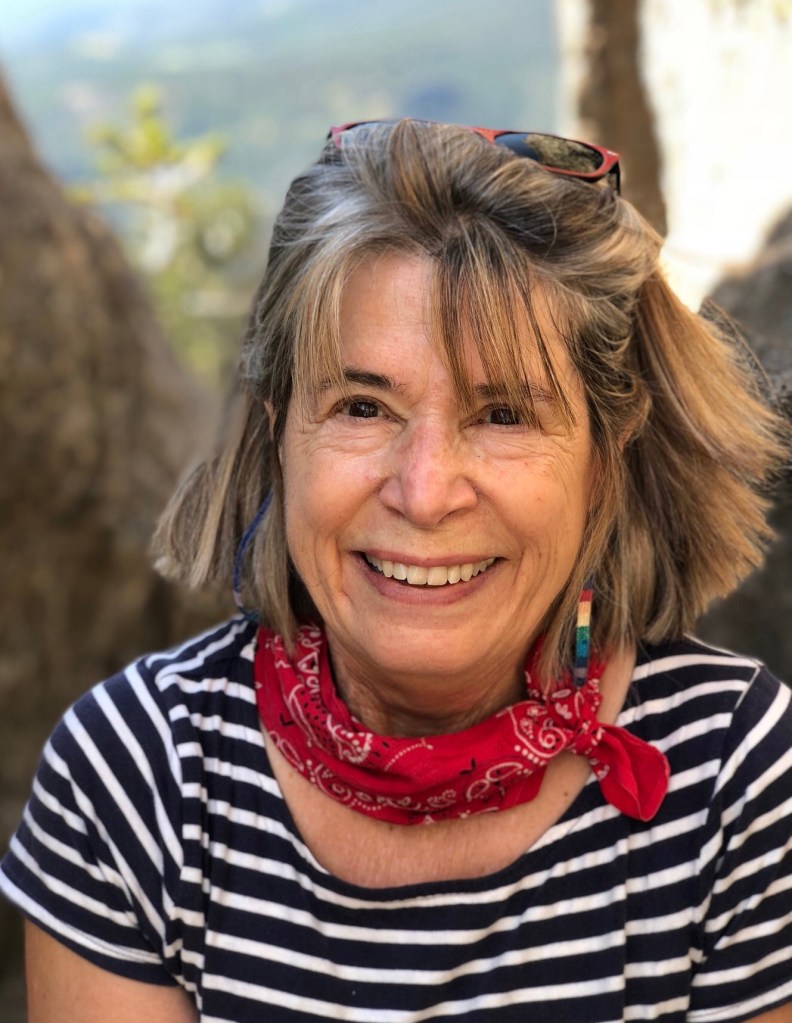
Award-winning writer Helen Currie Foster lives and writes in the iconic Texas hill country, supervised by three inquisitive and persistent burros. After practicing law for more than thirty years, she found the Alice MacDonald Greer Mysteries had suddenly appeared in her life. Book 10 in the series, Ghost Justice, is expected to debut in August 2025. Helen is continually fascinated by human history and how, uninvited, the past keeps invading our parties. Follow her on Facebook and Amazon, and in Austin at BookPeople.
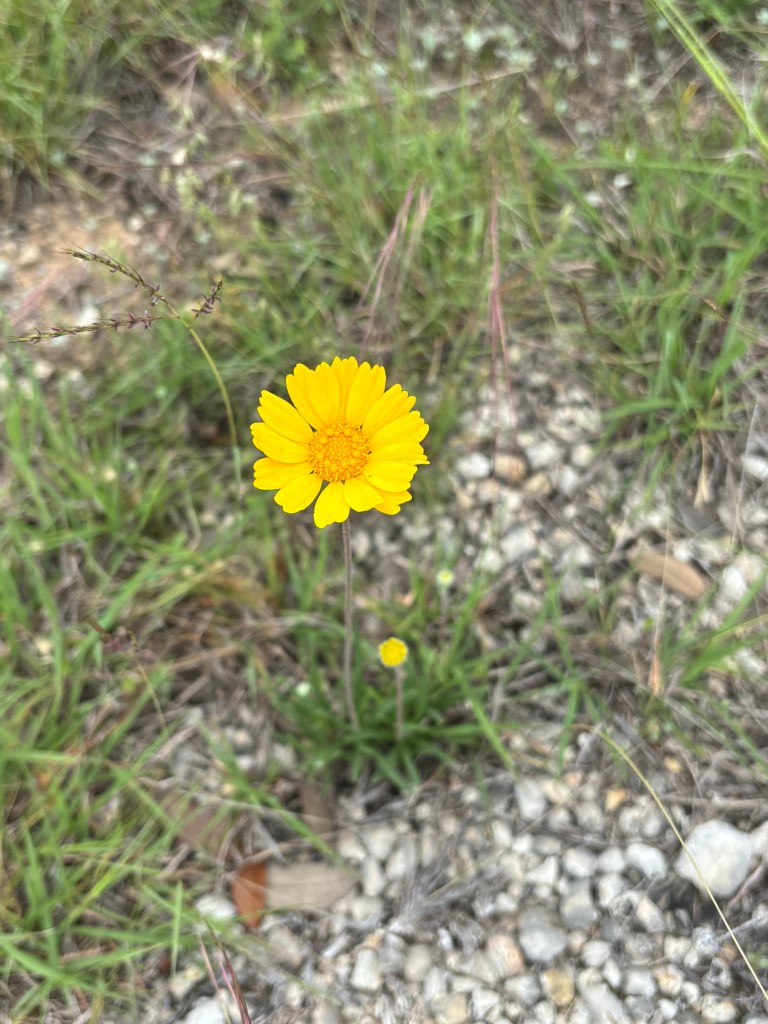
Not enough rain fell this year to allow the brilliant cerulean fields of Hill Country bluebonnets we usually expect, but the hardy lupines are busy making seedpods. “Maybe next year,” they say. Now instead we have the bright yellow coreopsis lanceolata, nodding their heads with any breeze,
the wine-cups with their indescribable color—a member of the mallow family, not quite fuchsia, not maroon, just—heart-stopping,
the milkweed flower globes beloved of monarch butter-flies, and others. Heaven includes a few prairie celestials, magically opening in early in the afternoon, then vanishing by dusk.
Also, “Sweet Mademoiselle,” planted a couple of years ago, and who has never bloomed, produced her first rose!
Meanwhile, the ever-interloping cactus hope to assuage my fury at them (remember those secretly spreading roots and the huge basal “plates” that help the Cactus Conspiracy spread?) by popping open their yellow flowers. I am not fooled. I’ll continue to battle them with shovel and hoe. And a picker-upper.
See? Perfectly possible. It’s still wild out here in the Hill Country, even as suburbs press upon us. At dusk I often find myself glancing at the edge of the drop-off behind the house, wondering if I’ll see a pair of ears. You can say mountain lion, puma, cougar…they’re secretive, strong, and active in the spring.
But the big cat I once saw on Bell Springs Road west of here was likely a large bobcat. I was alone, driving home from the post office. Up ahead a golden vision, spotted, walked slowly to the edge of the asphalt. I stopped. The cat stood, gazed at me, and after a breathless (for me) interval, gracefully turned and vanished through a fence into thick cedar. A magical moment. Every time I drive that road, I hold my breath, longing for one more sighting of something looking like this:
ANCIENT BONES? I wrote about old bones in my Ghost Bones (2024)—and now have learned that our Hays County police deal with ancient bones more often than you’d think. One resident recently called to report she’d found a skull in her firepit. The skull, with its lower jaw present, was obviously fairly old, but in an unexplained death Hays County is not permitted to send a body to the Travis County Medical Examiner without including the name of the person whose skull it is. (Hays County doesn’t have its own medical examiner.) So this skull traveled instead to Texas State anthropologists who reported, after testing, that the skull apparently belonged to a long, long-ago teenager who’d gone through hard times, as was evident from the “enamel lines” (a bit like tree rings) in the teeth.
But how it wound up in that firepit? So far as I know, that’s still a mystery. We forget—until reminded by a skull in a firepit—how long humans have roamed these hills, drawn by hunger and thirst to spring water and the hunt for food.
We also forget the age and history of this landscape. Some trees have sheltered native Americans, deer, and buffalo. The Columbus Live Oak near the Colorado River in Columbus is estimated to be over 500 years old. Others may be as old as 1,000 years.
I revere the live oak in our front yard as if it were a beloved ancient relative and a symbol of stability and the power of trees. If anything were to happen to it—woe! I tried to estimate its age—using the calculator instruction to measure girth in inches at 4.5 feet, divide by pi, then multiply by a “growth factor” of 4, which gave me 127 years old. Perhaps this tree was a sapling in 1900, before either World War, before the Viet Nam war, before our current fraught politics. On a nearby hill there’s an ancient patch of even bigger live oaks. Perhaps those particular oaks depend on the odd little ribbon of wet white clay that lies about five feet underground and has been there—who knows how long. But the feeling of walking in beneath these old live oaks can confer a sense of being in the protection of one’s elders.
So, welcome to the Hill Country in spring—southeasterly winds from the Gulf, blowing the flowers back and forth; reasonably moderate temperatures; fields and trees as green as green, as far as you can see. At the bird feeder, more color! Purple house finch, yellow-throated vireo, lesser goldfinch with brilliant gold breasts, vermilion cardinals, black-crested titmouse, white-winged dove—and the shy and tiny, but utterly gorgeous, painted bunting. (Reportedly it loves millet.) They provide not just color but music, from the titmouse, the tiny but high-volume Carolina wren, plaintive doves, whistling cardinals, and, at night, chuck-will’s-widow.
Not for long, of course. In winter ice can wreak havoc on trees and people. Summer sun? Scorching. Autumn? Nothing like the colors of New England, but hey—the sumac turns red. So welcome, Spring, with your bluebonnets and live oaks, with bird music and color, and with your reminder of the power and beauty of nature!
***
Progress report: madly working on Book 10 of the Alice MacDonald Greer Mystery series, set in the Hill Country. Have ordered “Forest Bathing” by Dr. Qing Li. Would enjoy hearing what you all are reading too, and any reports of “forest bathing”!
Helen Currie Foster lives and writes the Alice MacDonald Greer Mystery series north of Dripping Springs, Texas, loosely supervised by three burros. She’s drawn to the compelling landscape and quirky characters of the Texas Hill Country. She remains deeply curious about our human history and how, uninvited, the past keeps crashing the party.
An excess of animal spirits”–springtime! Really? Molly Ivins was right as usual when she wrote, “Texas–land of wretched excess!” We’ve had ridiculous lows, unseen for decades. Early daffodils and hyacinths came, shivered, and shriveled in the unholy cold winds roaring across the plains. But we’ve also had the earliest 90 degrees in decades! Wretched excess indeed!
Just two days until the vernal equinox on March 19, and spring. What makes us wander outside, searching for the first bluebonnet, the first violet? What makes us huddle outside the garden store, searching through the little plants shivering in the breeze, fingering seed packets, carrying home small pots of basil and blue salvia even though the weather’s far too untrustworthy for planting? What is this proto-agricultural spirit that makes us lug home the potting soil, hoe the garden bed? More sunlight? Cabin fever? Some early human gene? We, the Animal Kingdom, working with the Plant Kingdom?
I’m rereading Barry Cunliffe’sEurope Between the Oceans: 9000 BC-AD 1000, a book I value not just for the stunning photographs of prehistoric sites and art, but for describing a history of human inventiveness. Cunliffe, Oxford Professor Emeritus of Archeology since 2007 (many books), says “massive transformation” occurred in Europe between 1300-800 BC. Population growth required developing more crops than wheat and barley, including lentils, peas and—“the celtic bean (Vicia faba).”
Immediately I ordered a giant pack of fava bean seeds.
Then I read the label: they’re mostly a winter crop–but this year I’m desperate. With last year’s blistering hot drought, I wound up with only one pot of cherry tomatoes on the porch and a dozen wilting jalapeno plants in the garden. Cunliffe’s reference to Vicia faba fired my imagination—envisioning myself harvesting large fuzzy green pods, containing delectable beans, and adding a little vinaigrette…olive oil (since 4000 BC) and vinegar (3000 BC). Using an ancient bean and ancient vinaigrette recipe! Possibly those beans were harvested, and the vinaigrette shaken, by some long-ago ancestor 3000 years ago, making me wonder if we have genetic preferences, genetic recipe roots? After all, we of the Animal Kingdom depend on the Plant Kingdom (oxygen, vinaigrette, and wine!).
Mysteries offer escape—a protagonist we like, an intriguing plot, a vivid setting. Like plants, favorite old mysteries offer much when we revisit. Mystery writers? They’re good to “talk to.” This morning I discovered on the shelf my dad’s 1934 Modern Library edition of Dashiell Hammett’s The Maltese Falcon, with a brief bio and the “new introduction” by Hammett.
I didn’t know Hammett had worked as an operative for Pinkerton’s Detective Agency before he started writing! “Drifting through a miscellany of ill-paid jobs, he found a temporary solution to his economic problem by shadowing real malefactors with what might be called conspicuous success.” Then came the World War: “He won a sergeantcy and lost his health.”
Hammett can remember where he got his characters. Here’s a snippet of what he says about The Maltese Falcon:
“Dundy’s prototype I worked with in a North Carolina railroad yard; Cairo’s I picked up on a forgery charge in Pasco, Washington, in 1920; Polhous’s was a former captain of detectives…Effie’s once asked me to go into the narcotic smuggling business with her in San Diego…”
Hammett then muses about his own protagonist. “Spade had no original. He is a dream man in the sense that he is what most of the private detectives I worked with would like to have been and what quite a few of them in their cockier moments thought they approached. For your private detective does not—or did not ten years ago when he was my colleague—want to be an erudite solver of riddles in the Sherlock Holmes manner; he wants to be a hard and shifty fellow, able to take care of himself in any situation, able to get the best of anybody he comes in contact with, whether criminal, innocent by-stander or client.”
What a great description, and didn’t Humphrey Bogart nail it?
It strikes me that this new character of his upended the vision of the members of the London 1930 Detectives Club—Hammett gave the wide-eyed mystery audience a protagonist who is not a secret member of the aristocracy (Albert Campion) or a perfect gentleman (Roderick Alleyn) or a hyper-particular French veteran drinking tea and waxing his moustache (Hercule Poirot)…but a “hard and shifty fellow…able to get the best of anybody.” Welcome to the New World’s new-style mystery protagonists, the children of Hammett, Raymond Chandler, Sara Paretzky and others…including that hybrid protagonist, Mary Russell, in Laurie King’s Mary Russell and Sherlock Holmes series.
For Mary Russell and Sherlock Holmes, the scent of honey is a repeat theme (her Holmes is a beekeeper). I like her Holmes, I like her Russell, and just finished her Garment of Shadows(2012). King has chosen a fascinating and ambitious setting: the 1920’s, with Spain and France fighting for control of Morocco, each coveting its crucial strategic location at Gibraltar, while various Moroccan groups—Berber and otherwise—fight for independence. King uses first person point of view for Mary Russell, who’s suffering from acute amnesia—forgetting her childhood and even her marriage––but uses third person POV for Holmes’s chapters. Those shifts sometimes confused me. But her depth of history and geography, and her vivid descriptions of the magical city of Fez with its souk, bring the setting alive. Mary Russell herself has become quite a protagonist, with linguistic skills—including Arabic––and the imagination and drive to devise a daring escape from a horrible prison. I’d like to learn knife-throwing like Mary Russell (she keeps one in her boot) but the likelihood seems dim.
Writer/theologian Bruce Reyes-Chow mentioned how, when stuck, he’d “talk through ideas with myself, my plants…” I intend to follow his lead. On our deck sit five jasmine plants we’ve toted around since the seventies. I think they sometimes do communicate with me—“I’m dry-y-y-y!” But from now on, when I’m stuck on a plot, I’ll go consult them. Every spring, those jasmine produce tiny white flowers with an unmatchable scent. In search of even more scent, this year I’ve planted another mix of old and new. Rose de Recht is a fragrant pink heirloom damask, Fragrant Blush promises pink perfume, and Star of the Republic is tough, like her name, but delicate pink with exquisite fragrance.
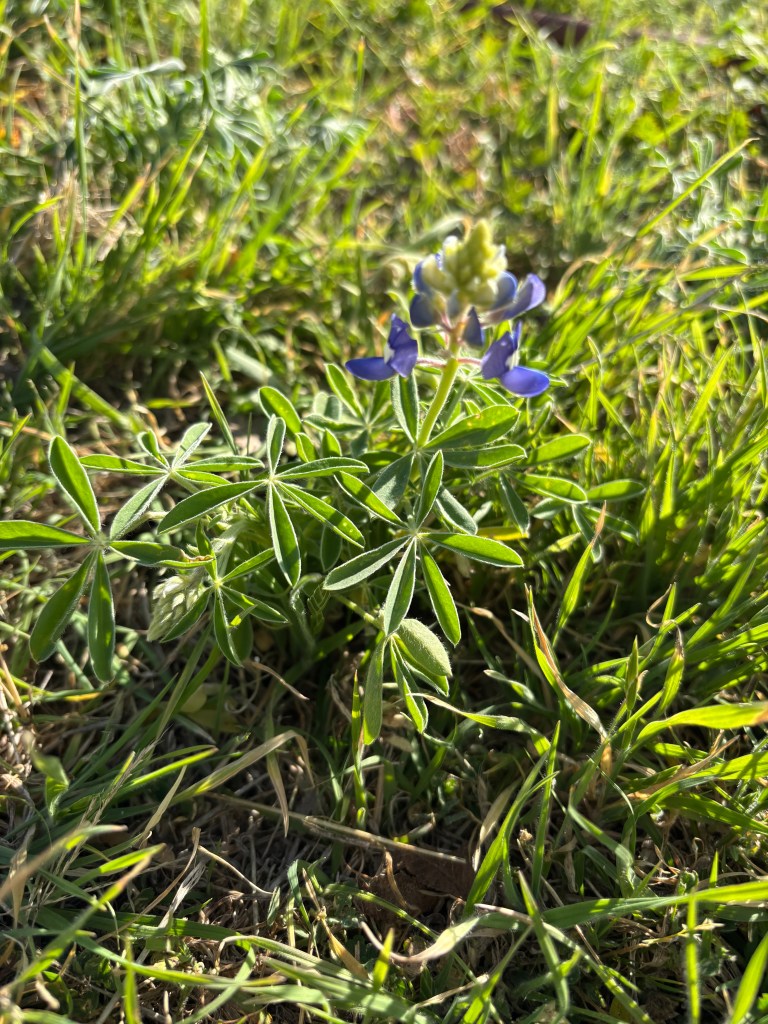
And now suddenly the redbuds, with their irresistible yet evanescent fuchsia buds, are blooming. I’ve seen our first bluebonnet,
and the first purple prairie verbena. The live oaks know it’s almost the equinox—they’ve flung down their old leaves (aided by the fierce winds) and are preparing their catkins and baby leaves. The cedar elms have put out tiny chartreuse leaves just in the last two days.
So it’s spring! Grab that trowel! And after all your work, you deserve to loll on the couch at night with a good mystery. I’m halfway through the tenth book in my Hill Country murder mystery series. This one raises a question I find intriguing and difficult. Can justice be served when, unauthorized to pronounce justice, we take justice into our own hands? Is that still justice? I’m discussing it with the plants. More to come….
Here are Helen, Noreen Cedeno, and Juanita Houston at the Texas Book Festival!–Heart of Texas Sisters in Crime
***
Award-winning Helen Currie Foster lives and writes the Alice MacDonald Greer Mystery series (9 volumes so far) north of Dripping Springs, Texas, loosely supervised by three burros. She’s working on Book 10. She’s drawn to the compelling landscape and quirky characters of the Texas Hill Country. She’s also deeply curious about our human history and how, uninvited, the past keeps crashing the party.
New reads! If, like me, you desperately miss John le Carré, consider A Spy Alone, the 2023 debut spy thriller by Charles Beaumont, a field operative veteran of Britain’s MI-6. https://bit.ly/3ZzHjHs His premise is fascinating: we know of the “Cambridge Five” who spied for Russia from the 1930’s to 1950’s—Kim Philby, Guy Burgess, Donald Maclean, Anthony Blunt and John Cairncross. https://en.wikipedia.org/wiki/Cambridge_Five But has there ever been, or could there be, a spy ring linked to Oxford? Beaumont’s protagonist Simon Sharman feels real, right from the first page:
“It is their shoes that give them away. As a lifelong fieldman, Simon Sharman hasn’t forgotten the lesson: walkers might change their jackets, pull on a pair of glasses, even a wig. But nobody changes their shoes on a job. Look at their shoes.“
I was hooked. Warning: Beaumont’s book is contemporary, well-written, tense, and may interfere with sleep.
Two other recent reads: old adventure and a new “adult fantasy.” I’d never heard of The Long Ships by Frans G. Bengtsson (1954).
Set from 980 to 1010 A.D., the book recounts the wide-ranging adventures of Norseman Red Orm Tostesson, and the collision between Christian priests (the “shaven men”) and the Norse culture of Skania at the south tip of Sweden. Now I know what it meant to go “a-viking”—to go sea-raiding! 500 pages, with Red, a very engaging Norseman. Great maps, too.
The Lost Bookshop, by Evie Woods (2024),offers time travel between the 1920’s and 30’s in Britain, and the present; a search for a lost Brontë manuscript; a disappearing attic; and disappearing and reappearing characters. I confess I flipped through big chunks, relieved when true love finally won out after two women, generations apart, survive appalling treatment. The disappearing attic reminded me of Susan Cooper’s Over Sea, Under Stone, and of course the wardrobe into Narnia in The Lion, the Witch and the Wardrobe. I’m always up for secret doors.
I’m rereading a fascinating and fairly demanding study by Graham Robb, who has probably bicycled and walked further in Britain and France than most humans:
In The Search for Middle Earth: Mapping the Lost World of the Celts (2013), he describes how the Keltoi, or Celts, developed a system of surveying based on a midline transected by the lines of the summer and winter solstice to estimate travel distances and times—a feat not replicated for centuries. He maps the Heraklean Way, the path from southwestern Iberia that runs northeast across the Pyrenees to the Alps along the diagonal of the solstice sun, which Hannibal took when he invaded Italia. He describes Druid schooling (20 years to learn) and maps out protohistoric forts which turn out to lie along survey lines. He provides amazing maps. Two ongoing lessons from Robb’s devoted research: the winners write history; and humans tend to underestimate the accomplishments of earlier civilizations.
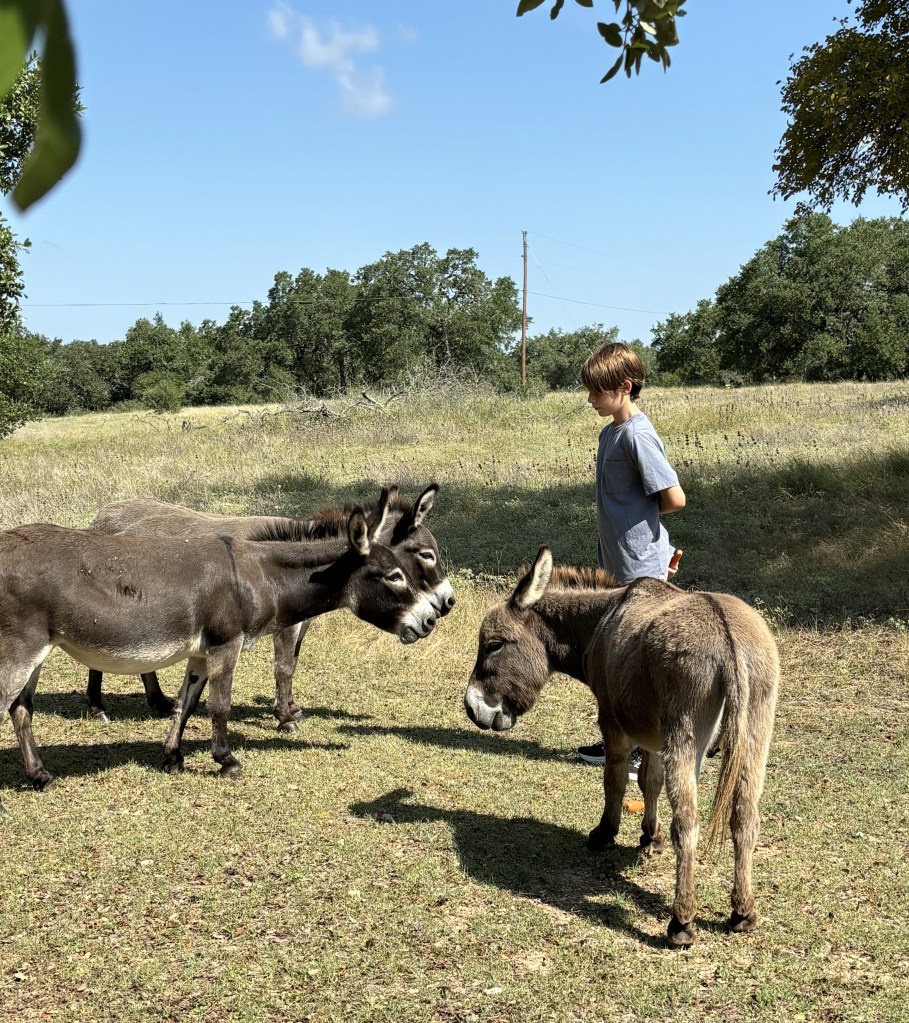
Several of you asked about the three burros, given the recent cold snap. Thank you, they’re well. Their hair’s not waterproof so in cold rain they gather on the south side of the stable, under the roof, safe from rain and the north wind. They were relieved to see green grass again after the drought broke, but they’re also eating—and rolling in––green hay. And mud!
Yet despite hay, they gather outside the gate every morning and afternoon for carrots. They consider this part of their deal.
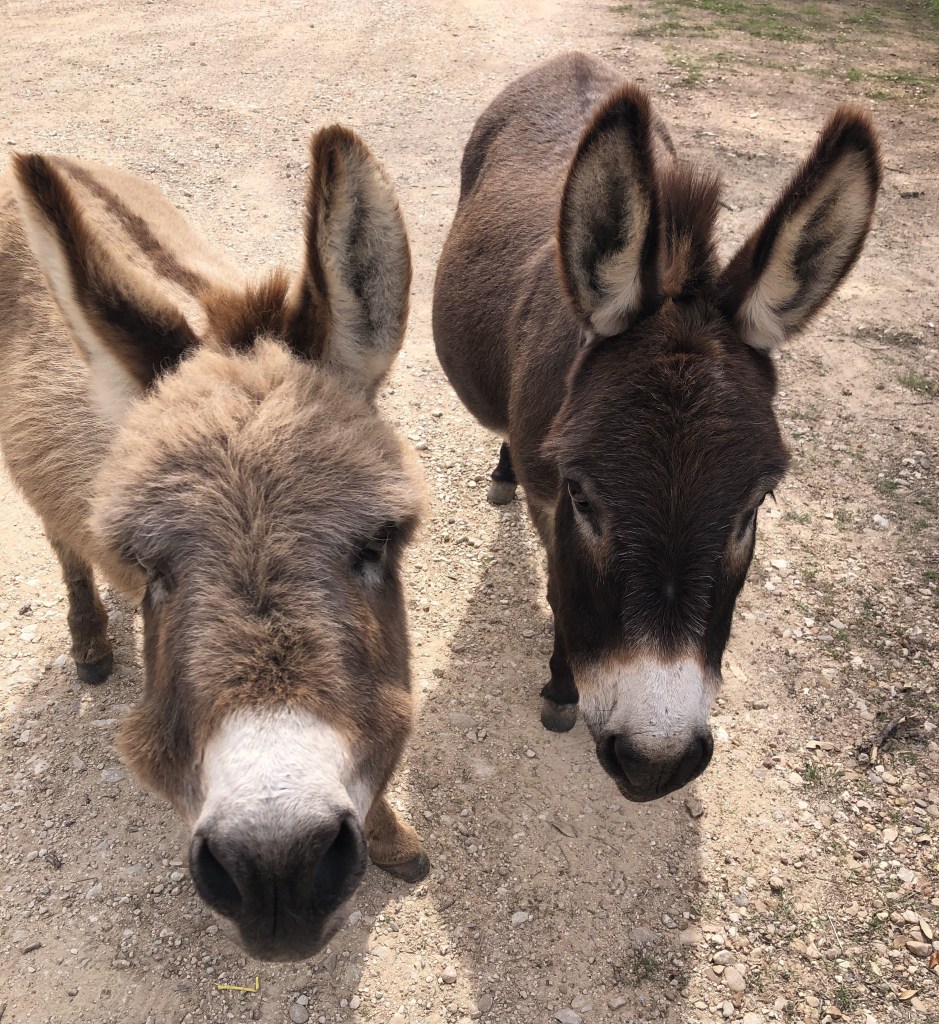
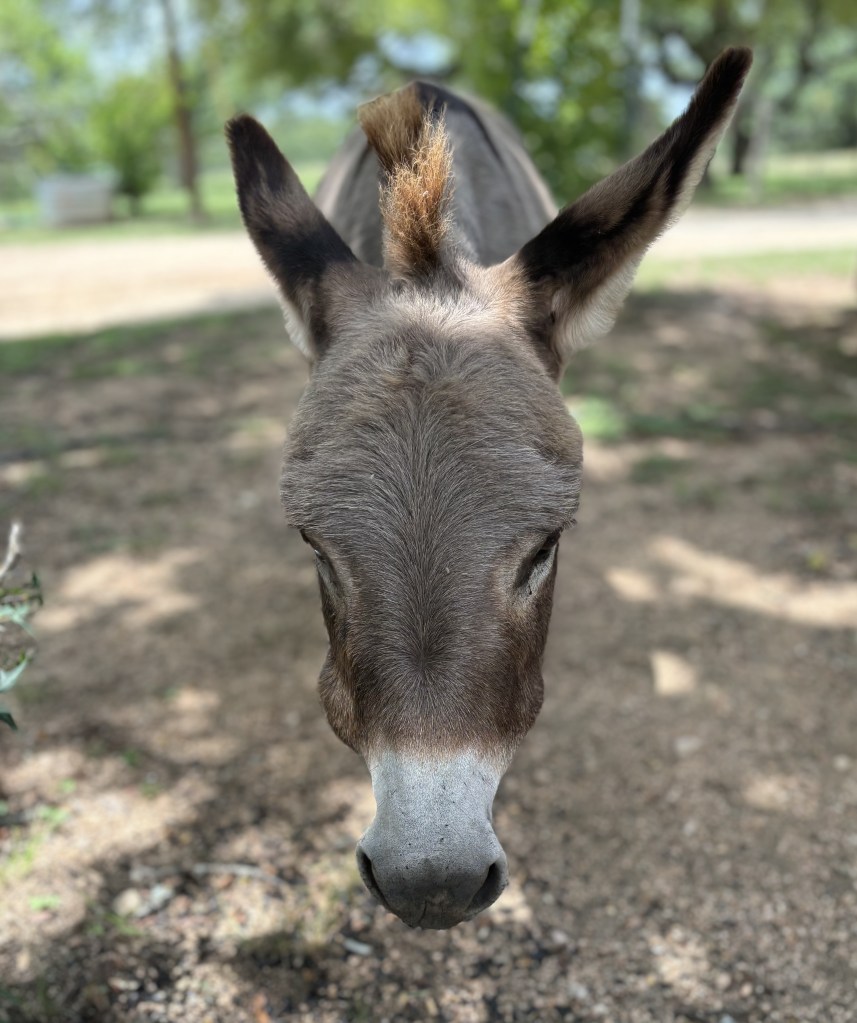
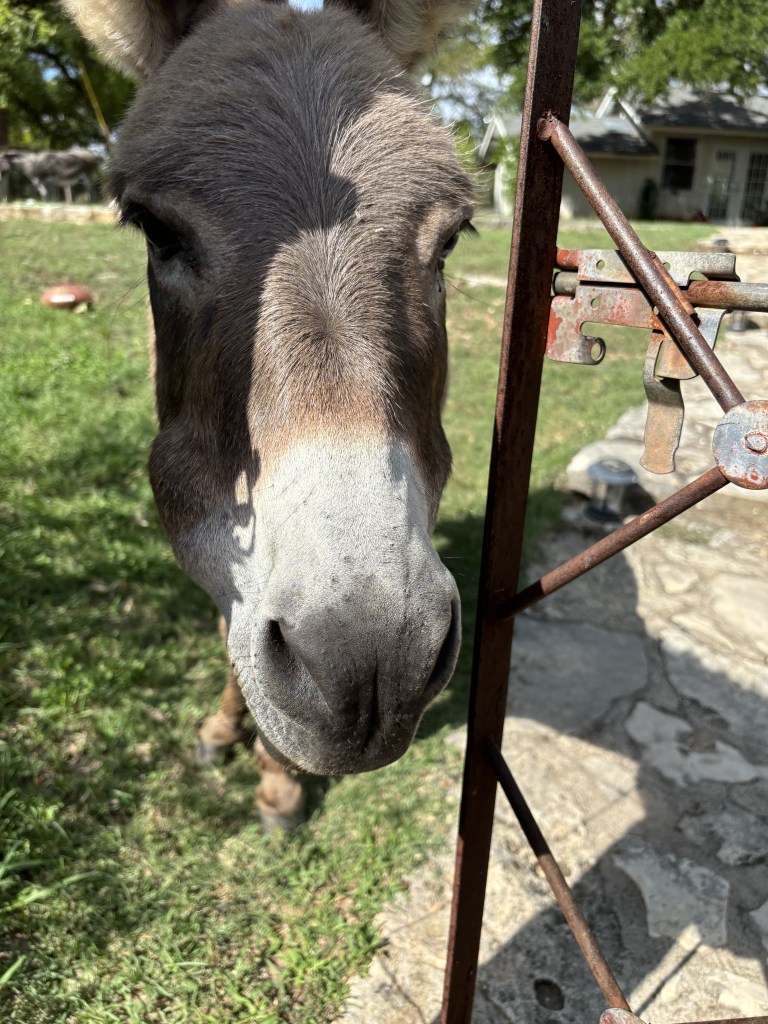
Burros are curious. They amble over to watch us garden and hang up laundry. They need company. They graze near each other. They may live into their 40’s. Sebastian, the short stubby knock-kneed male who invited himself to live here, may be 35 or more. Amanda (who insists I tell you she’s registered, with papers)may be 20. Her daughter Caroline is 12. Sebastian deems it his duty to bray loudly when any person or car appears at the end of the driveway, and to welcome the sun every morning with a stunningly loud bray. Now both Amanda and Caroline have begun to bray occasionally.
Only donkeys can bray. Unlike horses or zebras, donkeys begin a bray on the inhale and continue braying on the exhale. They have great hearing—supposedly they can hear another donkey bray 60 miles away.
They especially detest canids and will attack, dance on and kick dogs, coyotes, bobcats, foxes. A spooked horse will run away: donkeys stand together until they decide what they’re going to do. This morning, leaving for the post office, I saw the three donkeys standing together, knees locked, ears cocked, eyes fixed on two trespassing dogs who’d strayed across the cattleguard and into the donkeys’ domain.
The dogs immediately acknowledged their gross error of judgment, raced frantically away and never returned.
If donkeys could read (wait—maybe they can, but have trouble turning the pages), I predict they’d prefer mysteries. They enjoy puzzles (like how to lift the chain and invade the fenced garden).
Humans and donkeys. We are both curious animals.
Helen Currie Foster lives and writes the Alice MacDonald Greer Mystery Series north of Dripping Springs, Texas, loosely supervised by three burros. She’s drawn to the compelling landscape and quirky characters of the Texas Hill Country. She’s also deeply curious about our human history and how, uninvited, the past keeps crashing the party! Currently she’s working on Book 10. Her protagonist, Alice, gets into legal drama, and matters of the heart. Alice does have a treehouse…
When you read a passage and experience words that strikes home forcefully–so forcefully that you almost gasp–what did the writer do that moved you so?
I’m collecting examples. For my husband it’s John Steinbeck’s tide pool in Cannery Row:
“…When the tide goes out the little water world becomes quiet and lovely. The sea is very clear and the bottom becomes fantastic with hurrying, fighting, feeding, breeding animals…Starfish squat over mussels and limpets, attach their million little suckers and then slowly lift with incredible power until the prey is broken from the rock…”
I’ve never seen a Monterey tide pool. Yet Steinbeck made me feel I have. I want to sit at the edge of the tide pool, hear “the snapping shrimps with their trigger claws pop loudly” and see the “black eels poke their heads out of crevices and wait for prey.”
Why? Steinbeck’s description is so closely observed…it’s as if my own eyes and ears saw and heard.
What about food? Proust’s memory of a madeleine crumb dipped in his aunt’s tea didn’t initially resonate with me (a madeleine seemed too bland; I would’ve preferred a buttery, crunchy, tender croissant!)–until I read his analysis.
When Proust discovered that his second and third bites of the madeleine lacked the same impact–“the potion is losing its magic”–he stretched his mind further. He writes that the source of memory was not his sense of sight (though his description of the scalloped pastry is charming). Instead, his memory came from taste and smell: “But when from a long-distant past nothing subsists, after the people are dead, after the things are broken and scattered, still, alone, more fragile, but with more vitality, more unsubstantial, more persistent, more faithful, the smell and taste of things remain poised a long time, like souls, ready to remind us, waiting and hoping for their moment,…and bear unfaltering…the vast structure of recollection.”
No French bakery in my grandmother’s small Texas town, Itasca. But the memory of her kitchen still comes back when I smell lavender, or yeast–my grandfather’s lavender talc, my grandmother’s ineffably delicious yeast rolls.
Here’s another powerful example from The Orphan Keeper by Camron Wright, about a young man, kidnapped from his home in India, then sent to a dishonest orphanage which places him for adoption in America where he rejects any Indian heritage and suppresses all his memories that aren’t “American.”
As a student in England he’s taken to an Indian restaurant where–reluctantly–he smells, then tastes, what’s offered:
“The scent that swirled around his neck had started rubbing his shoulder, reminding him softly that once, a very long time ago, they had met….[He] took his first bite. The spices in his mouth grabbed hands and began dancing in rhythm across his tongue–cumin, garlic, peppers, ginger, tamarind, cinnamon, and more. They weren’t just dancing–they were cheering, clapping, celebrating, singing, reminiscing. They were pulling out wallets and showing each other pictures of their kids….The mingling spices, the familiar taste, it felt like a whisper arriving with the wind, more message than memory.”
Curry, of course. Just reading this made me long for mango chutney! And I thought it a powerful description, because closely observed, and particularly because until this moment we know the protagonist has been stubbornly resistant to anything Indian.
In A Gentleman in Moscow, by Amor Towles, do you recall the bouillabaisse scene? The three conspirators have carefully gathered the ingredients–hard to come by in Moscow; have picked up their spoons; and have taken their first taste. Count Rostov closes his eyes “to attend more closely to his impressions”:
“One first tastes the broth–that simmered distillation of fish bones, fennel, and tomatoes, with their hearty suggestions of Provence…One marvels at the boldness of the oranges arriving from Spain and the absinthe poured in the taverns. And all of these various impressions are somehow collected, composed, and brightened by the saffron–that essence of summer sun…[W]ith the very first teaspoonful one finds oneself transported to the port of Marseille–where the streets teem with sailors, thieves, and madonnas, with sunlight and summer, with languages and life.”
Bouillabaisse! Your memories may differ. Were you reading Julia Child and launching a kitchen experiment? Were you visiting Marseille, and were there still sailors, thieves and madonnas?
The Count has shared his memories, aroused by fish bones, fennel, tomatoes, shellfish and saffron. But your memories are your own. Also, the scene is powerful not just because it is closely observed, but also because it reminds the reader forcefully that at this point the Count has only his memories–he can’t leave the Moscow hotel, much less travel to Marseille.
I’m puzzled not to find food more “closely observed” in novels. A favorite moment: Virginia Woolf famously describes the boeuf en daube at the dinner party which is a central feature of the first half of To the Lighthouse. Mrs. Ramsay is thinking the cook “had spent three days over that dish,” as she prepares to serve it to her guests:
“…An exquisite scent of olives and oil and juice rose from the great brown dish as Marthe, with a little flourish, took the cover off. …[Mrs. Ramsay] peered into the dish, with its shiny walls and the confusion of savoury brown and yellow meats, and its bay leaves and wine, and thought, This will celebrate the occasion…”
Cookbooks, of course, intend to awaken our senses as we peruse the recipes. But the description of boeuf en daube in To the Lighthouse, with the mouthwatering anticipation it creates, has a different impact. It places us in the scene. It almost makes us, as readers, feel like guests sitting at Mrs. Ramsay’s table, alongside the odd characters Woolf has already introduced. Or possibly we also feel a bit like Mrs. Ramsay, the hostess, hoping to delight and reassure her houseguests, who are a difficult lot.
I’d love to hear other examples from readers. A “closely observed” passage can make us do just what the author wants: turn the page and keep reading! Right now I’m engrossed in Someone Always Nearby, Susan Wittig Albert’s fascinating novel about two real people, Georgia O’Keefe and Maria Chabot. I’m finding this a daring literary adventure about two daring and adventurous women, the artist you know and the woman who wanted to be indispensable to her.
It’s May–bluebonnets are gone, summer approaches. What tastes and smells bring back your summer memories? Grape popsicles, melting on the tongue? The clean bluegreen smell of Austin’s Barton Springs, mixing creek water and artesian spring water? The faint smell of chlorine from a pool crowded with splashing children? A mountain trail in the Rockies, with the cool green odor of aspen groves rising up from a creek? Dust blowing at the ball park, freshly mowed lawns, the faint rubbery smell of a sprinkler on a hot day? The smell of a roasting marshmallow just before it bursts into flame?
Good news from where I write: Ghost Bones, Book 9 in my Alice MacDonald Greer Mystery series set in the small town of Coffee Creek, Texas, will soon be out! With mystery, legal drama, and matters of the heart.
Helen Currie Foster lives and writes north of Dripping Springs, Texas, loosely supervised by three burros. She’s drawn to the compelling landscape and quirky characters of the Texas Hill Country. She’s also deeply curious about our human history and prehistory, and how, uninvited, the past keeps crashing the party. Ghost Daughter, Book 7 in The Alice MacDonald Greer Mystery series, was named Finalist in the 2022 Eric Hoffer Book Award Grand Prize Short List. Follow her:
April 1! It’s spring, with a riot of bluebonnets this year.
Plus paintbrush! Winecup! Verbena! Prairie celestials (so lovely)!
And within the fence, safe from our marauding burros, the roses are opening their petals and sharing their beauty. Humans have been growing and hybridizing roses for millenia. I favor those with deep rose fragrance. This year the sniff prize goes to Madame Isaac Pereire,
but Zephirine Drouhine is a strong contender as well—sweet perfume, but no thorns!
Blooming with pride are Cramoisi Superieur, fun to pronounce, and dainty little Perle d’or, below.
Yes, the French have been busy. But I’m waiting on the spectacular Star of the Republic, which is covered with buds that will become exquisite cream and pink roses, and is almost as tall as Texas.
Thanks for human ingenuity and the deep love of beauty and fragrance that resulted in these roses. We humans are so able to produce beauty—and yet we mystery readers and writers know how gripped we are by the companion question: why do humans commit the primal sin of murder?
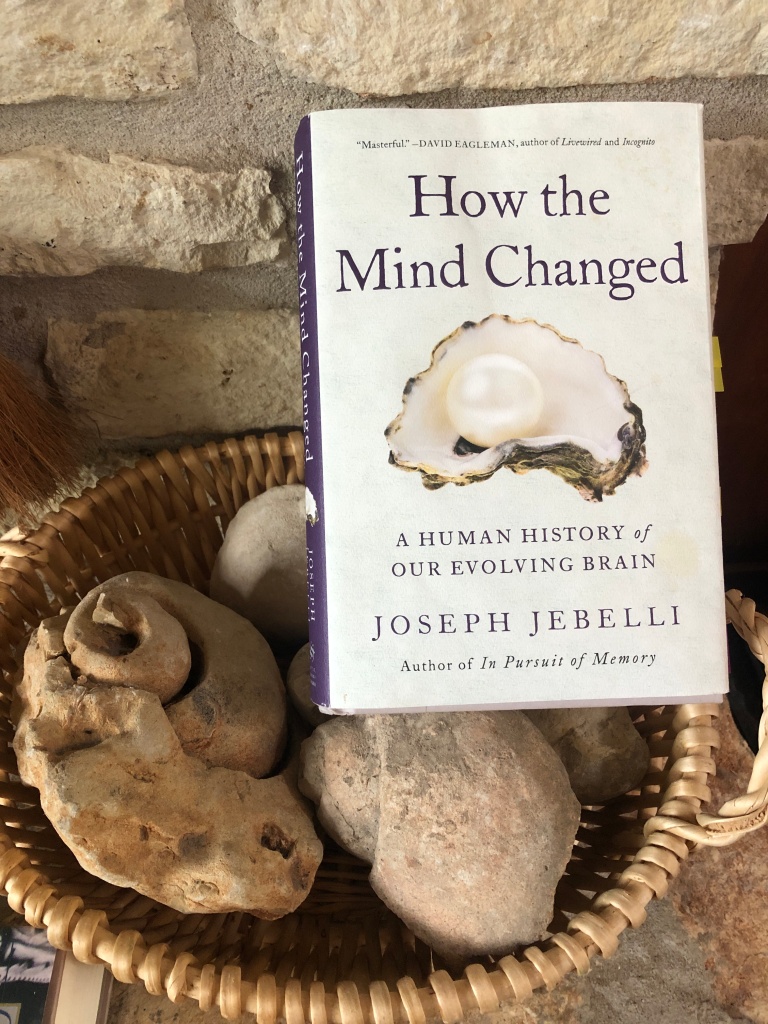
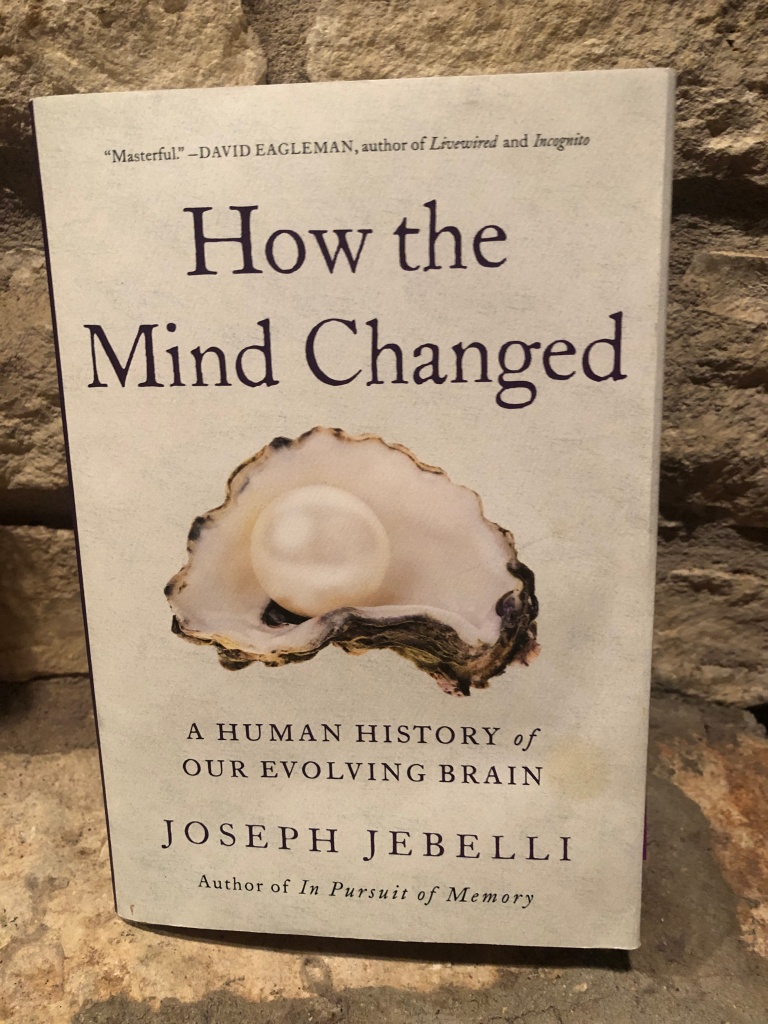
I’ve been reading a riveting book called How the Mind Changed, A Human History of Our Evolving Brain (2022), by neuroscientist Joseph Jebelli, who studies the genetic history of the human brain. I’ve had to put stickers and checks on so many pages!
Jebelli says that, starting about 7 million years (or 230,000 generations) ago, when humans split from chimps, our brains were only 350 cm3 big. Then 3.5 million years ago, when our ancestor Lucy came along, we got a new uniquely human gene that gave us a folding neocortex and nearly doubled our brain size to 650 cm3.
Later, he says, our brains bloomed to 900 cm3, when we began cooking (maybe 2.7 million years ago), then to 1000 cm3, about 2.5 million years ago, then to 1500 cm3 500,000 years ago, and then grew another 25% by the time, 300,000-400,000 years ago, when Homo sapiens appeared.
Later research shows—the bigger the brain, the bigger the social group. Id., 69.
And lucky Homo sapiens came along when our planet was in extreme ecological instability: “African megadroughts depleted the land’s fresh water; vanishing grasslands diminished the number of animals available…” Homo sapiens spread across the planet, interbreeding along the way with the Neanderthals (who went extinct around 40,000 years ago), and the Denisovans, Neanderthal cousins from Asia. Most humans outside Africa carry around 2 percent Neanderthal-derived DNA while today humans in Papua New Guinea and Australia possess up to 6% Denisovan DNA.
Now we have tools of advanced microscopy and molecular genetics to use “the mosaic of neurons, the constellation of synapses and the tributaries of molecules to learn the age of the brain and the transformations it has seen.” Îd., 21.
But it’s Jebelli’s discussion of brain research on “fair play” that I find most fascinating – whether the experiment uses rats, vampire bats, or humans. “Our minds intuitively draw a distinction between unfair equality (all students receiving the same…grades regardless of merit) and fair inequality (the doctor earning more than the cleaner). When push comes to shove, humans nearly always prefer fair inequality to unfair equality.” Jebelli goes on to explain that when we humans engage in fair play, we experience a surge of neural activity in our brain’s reward centers, releasing dopamine, oxytocin, serotonin and endorphins. Id., 68.
Watch out: scientists are identifying gene mutations that explain amazing things. “Non-monogamous brains tend to have a special kind of dopamine receptor gene called DRD4, which is linked to promiscuity and infidelity.” Id., 78. Use that in a plot, mystery-writers!
But I was thrilled by the focus on the link between strong imagination and intelligence in our “default network, a brain system that participates in daydreaming, mind wandering, reflective thinking and imagining the future….People who engage in these cognitive practices…have greater access to the states of mind necessary to solve complex problems.” Id., 115. Jebelli says our default networks are only active when we’re not focused on a task, “when the brain is cycling through thoughts not associated with the immediate environment.” In other words, the default network contrasts with our executive control network. Jebelli makes another leap: compassion also stimulates the default network. “Compassion requires imagination. ‘Climb into his skin and walk around in it,’ Atticus tells Scout.” But imagination also requires compassion. Id., 119.
Why has this book grabbed me? As a mystery writer I wrestle with why some humans will run into the street to save a child from a bus, and some will just watch; and why and how some humans invent gripping new imaginative worlds (Lord of the Rings, Harry Potter, Slough House, Yoknapatawpha County, the Forest of Arden, Hat Creek and the saga of Lonesome Dove) that tell of human struggles and victories, tragedies and comedies. Yes, writers who stimulate our “default networks”!
So you might like to take a peek at How the Mind Changed—check out the chapter on that age-old conundrum––what is consciousness? And the chapter on different minds, or neurodiversity, including genetic components. And the chapter on the new field of neurocriminology: what makes humans commit crimes? Which brain regions are responsible for violence? One possibility—it’s an area of the hypothalamus called the ventromedial hypothalamus, “an ancient brain region that has been conserved throughout mammalian evolution.” Yikes!
As Jebelli notes, plots will abound from this inquiry, this research. As always, inquiring minds want to know.
Meanwhile, it’s April! So let us now praise Geoffrey Chaucer – whose compassion and imagination gave us “Whan that April with his showres soote The droughte of March hath perced to the roote, And bathed every veine in swich licour, Of which vertu engendred is the flowr…”
And further to celebrate—Book 9 of my Alice MacDonald Greer legal thriller series has gone off for copy-edit. Yes, again the primal crime has been committed…!
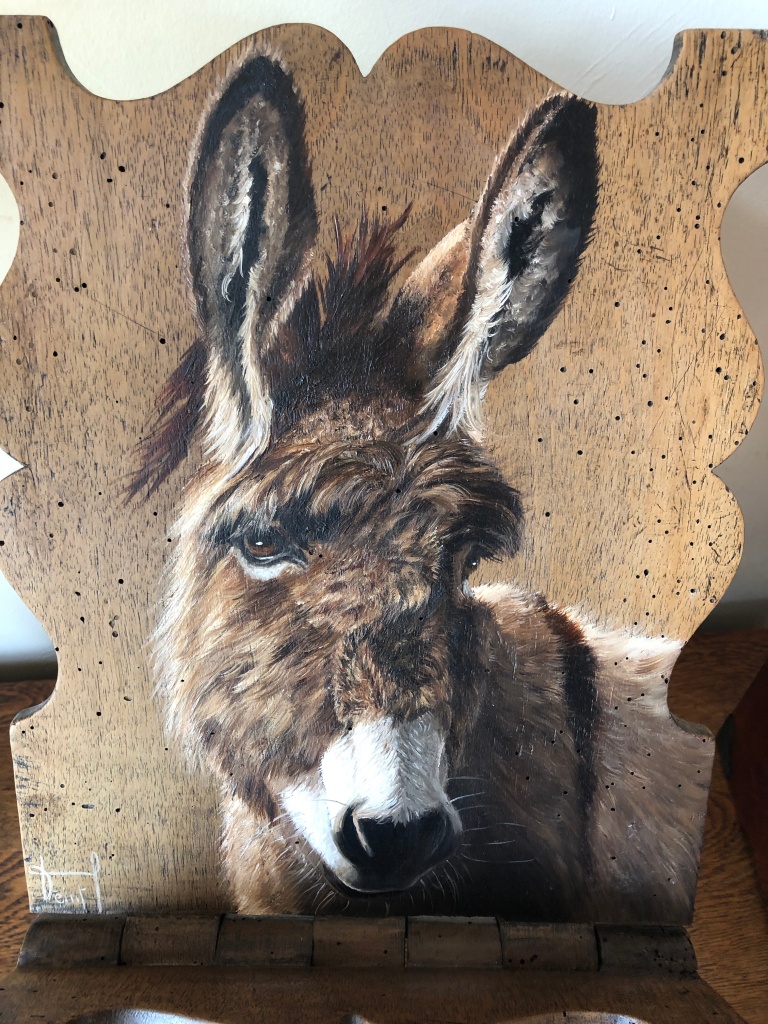
The three burros who live with Alice MacDonald Greer, lawyer/amateur sleuth protagonist of my Texas Hill Country legal thrillers, bear a strong resemblance to the three burros who rule our patch of the Hill Country.
We manage our small piece of the planet for native grasses and birds under the county Wildlife Management Program. Today I received our spring box of blue grama and buffalo grass seed, for re-seeding bare patches with native grass. (More below on bare patches.)
The burro idea sprang full-blown into life at a wedding on the banks of the Blanco River years ago, when we were enchanted to see docile and well-behaved burros with panniers on their backs full of cold bottles of water and beer, being led to the guests by docile and well-behaved teenagers. Immediately I envisioned myself trekking up and down our fields leading a burro bearing panniers of grass seed which can be (believe it or not) heavy. As a bonus we knew the burros could help keep down tall dry grass–a concern during fire season.
So just before Christmas we bought two smallish burros from the wedding venue, with certificates attesting to their conformation, heritage, and names (Amanda and Caroline, mother and daughter). Both were elegant, with classically lovely faces, straight legs, and dainty hooves.
This is the youngest, Caroline.
Per Random House Unabridged, “burro” is “a small donkey, especially one used as a pack animal in the Southwestern U.S.” (We use donkey interchangeably.) Let me say for the record that the “pack animal” concept went nowhere with Amanda and Caroline–they were deeply insulted at the idea of any burden on their backs. They made it crystal clear that they had not signed on to work. Still–they were decorative, and they ate down the grass.
Sebastian (left) and Amanda
But on Christmas morning when we looked across the pasture, my spouse asked, his voice disturbed: “How many donkeys do you see?” …Three.
The newcomer was shorter, pudgier, and male–well, an “altered” boy. Knock-kneed, chipmunk-cheeked, he seemed to keep a chewable cud in each cheek. He’d climbed through a fence to visit. We found his owner and bought him. Given his appearance (and the snootiness of Amanda and Caroline) we gave him a new and more dignified name: Sebastian.
While Amanda and Caroline are ladies of leisure, Sebastian has taken on two jobs. First, he’s our designated greeter. He brays a loud greeting as you drive through the gate. He brays again to salute the dawn (or pre-dawn).
Second, Sebastian has declared himself the official guard-donkey. In particular, he’s hell on canines. Pre-donkeys there were cows on the property–and coyotes. But no coyote dares invade Sebastian’s turf. He’d be happy to kick a coyote into the next county. Donkeys are shockingly fast on their feet and could easily catch a coyote. Earlier this year I found Sebastian standing triumphant and motionless in the middle of the dirt road, ears back, head up, posture stubborn, hooves planted–a picture of victory. Visible in the dirt? Tracks of a mama coyote with one pup, who’d erroneously strayed into forbidden territory. The tracks indicated a frantic exit. As he stood in the road, surveying his domaine, Sebastian was announcing, “I’m walkin’ here.”
Random House Unabridged includes a definition of “donkey” as “a stupid, silly or obstinate person.” Donkeys are not stupid. They are curious, persistent, intelligent, and acute of hearing. Are they silly? Well…Amanda and Caroline are aloof and standoffish, but Sebastian wants to play. With a bucket between his teeth, he’ll run over and whop Amanda on the hindquarters with it, then stand there. He so wants her to join in his favorite game, which is apparently called “I’ve got the bucket, now you come bite the bucket and yank it away, then you can hit me with it, then I will chase you, and then…?!?!?” So far, the girls steadfastly refuse to cooperate. When whopped with the bucket, Amanda chooses to bite Sebastian instead of biting the bucket. Maybe that’s a different game?
Obstinate? Oh, yes. They are persistent in searching for ways to get past the gate into the yard and eat the roses. They’re also very hard to stop when they want to go somewhere, and very hard to move when they intend to stay put.
Re-seeding bare patches? These three donkeys pick a spot, then take turns rolling on their backs until the grass gives up and a circular bare spot remains. Then, after rain, they race to the soggy bare spot and roll on their backs until they’re thoroughly muddy. Hence my constant race to re-seed bare patches.
Donkeys model companionship. Indeed, they need it. Despite their occasional spats, Sebastian, Amanda and Caroline spend their days and nights together, never more than about 100 feet apart.
Writers have to take breaks, or go nuts. I’m in that boat right now, because I’m almost but not quite finished with Book 9 in the Alice MacDonald Greer Mystery series. As is well known, writers in such circumstances can be subject to breakdowns–small rages, or tears, or snappishness, or overdosing on Cheezits.
I can recommend burro therapy. As I stand next to Sebastian, stroking his neck, and he leans back against me, I feel my heartrate slow and my breathing relax. Maybe that’s how burros feel too? Maybe this is their secret advantage, a resource that helps explain their long presence on the planet? Here’s how Alice puts it in Ghost Cat:
“Donkey hugs meant leaning into their sides, stroking their necks. The donkeys instantly settled, leaning back against her. The weird thing, Alice thought, was how the donkeys settled her. They weren’t dogs, loyal and needy, or cats, neutral and non-needy. Donkeys were ancient residents of the planet, tough, independent, curious herd animals with their own inner life.”
And in Ghosted: “Finding herself needing a little burro therapy, …Alice stood in her driveway surrounded by the three. At the moment she was brushing Big Boy. He leaned against her; the warmth felt good in the late morning chill. Those eyelashes, those soft ears, Alice thought. No wonder Titania fell in love with Bottom.”
Indeed, Queen Titania, seeing Bottom with his head magically changed to an ass’s head, says,
“I pray thee, gentle mortal, sing again.
Mine ear is much enamour’d of thy note;
So is mine eye enthralled to thy shape;
And thy fair virtue’s force perforce doth move me
On the first view to say, to sweat, I love thee.”
A Midsummer Night’s Dream, Act III, Scene II.
So if you’re in need of burro therapy, fellow writers, come on out. Bring some carrots!
***
Copyright 2024, Helen Currie Foster, All rights reserved.
***
Author: Helen Currie Foster
I live north of Dripping Springs, Texas, loosely supervised by three burros. I’m deeply curious, more every day, about human history and prehistory and how, uninvited, the past keeps crashing the party. I’ve loved the Texas Hill Country since my first sight of it as a teenager. Artesian springs, Cretaceous fossils, rocky landscapes hiding bluegreen water in the valleys. After law school (where I grew fascinated with water and dirt) I practiced environmental law and regulatory litigation for thirty years––then the character Alice suddenly appeared in my life. I’m active with Austin Shakespeare and Heart of Texas Sisters in Crime. And I’m grateful to the readers who enjoy the Alice MacDonald Greer Mystery series!
“But at my back I always hear time’s wingèd chariot drawing near…” (Andrew Marvell, 1621-1678)
Today in pre-dawn darkness, the house quiet except for the murmuring furnace, my characters were already at me, barking orders: “More! More smells, tastes, experiences! More about me! Tell people what I’m thinking, what I’m experiencing, what I’m worrying about!”
They’re right. Readers want to know their favorite mystery protagonists. Why? Because readers are in league with them, walking in their shoes. Readers know that stepping into a protagonist’s sensory experience—smells, food, experiences, relationships—will springboard them into the setting, help them to be in the picture, ready to seize on every clue.
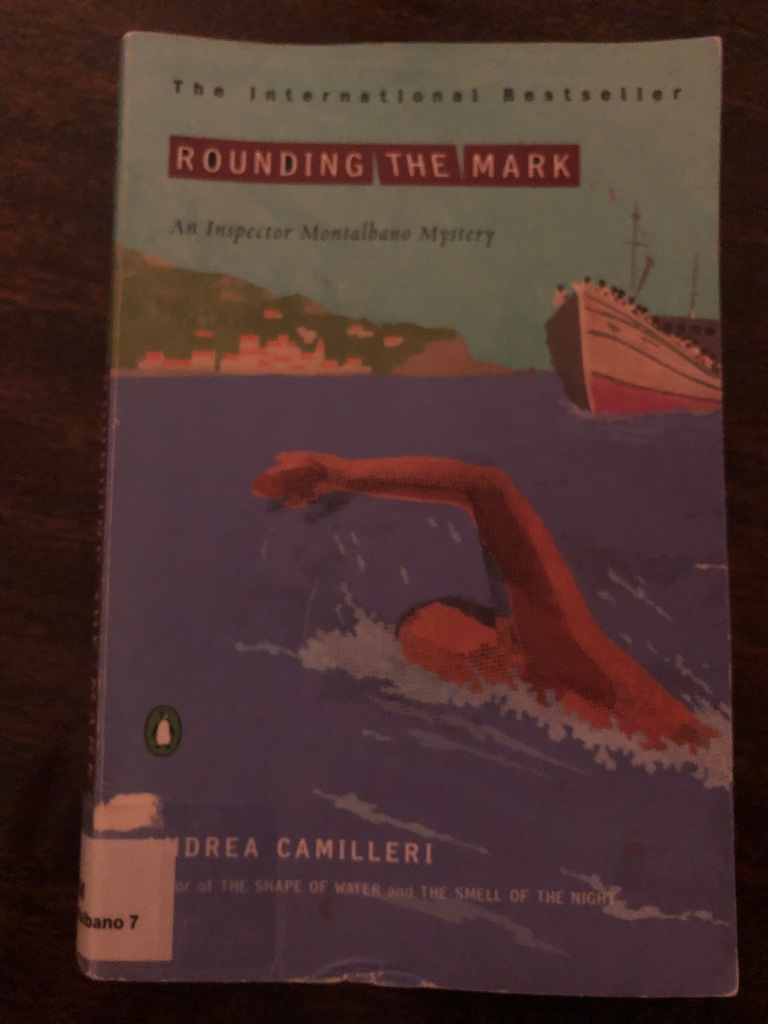
Resolution 1. Tastes! Flavors! Food! As Rounding the Mark, Book 7 of Andrea Camilleri’s long-running series, begins, Inspector Montalbano of little Vigáta, Sicily, can’t sleep:
“Stinking, treacherous night. Thrashing and turning, twisting and drifting off one minute, jolting awake and then lying back down—and it wasn’t from having scarfed down too much octopus a strascinasali or sardines a beccafino the evening before. No, he didn’t even have that satisfaction.”
Fortunately the recipes are described in the Notes at the book’s end. In Sicily, where seafood reigns supreme, Montalbano refers to small octopi, boiled and dressed in olive oil and lemon juice, and then sardines, stuffed and rolled up with sauteed breadcrumbs, pine nuts, sultana raisins, and anchovies. When Montalbano returns home from the police station he always races to his refrigerator to see what his housekeeper, Adelina, has left for him. In Book 16, Treasure Hunt, Montalbano “howled like a wolf with joy” when he finds “eggplant parmesan, done up just right, enough for four.”
Can’t you just smell this dish? Montalbano consumes the entire panful: “the sauce was a wonder to taste.” (50). We see how he delights in his food, how very particular he is. (And throughout the series Adelina keeps cooking – pasta in squid ink, involtini of small fish, pasta ‘Ncasciata…) https://www.foodandwine.com/pasta-ncasciata-sicilian-baked-pasta-7093847
Here’s Montalbano in Rounding the Mark after discovering a new restaurant:
“The antipasto of salted octopus tasted as though it were made of condensed sea and melted the moment it entered his mouth…And the mixed grill of mullet, sea bass and gilthead had that heavenly taste the inspector feared he had lost forever….After a long and perilous journey of the sea, Odysseus had finally found his long lost Ithaca. “(73)
Camilleri (died 2019) was writing mystery, murder, crime—but he included as major players in the setting Sicilian food, awareness of this ancient Mediterranean island culture, and echoes of classic myth.
We can only imagine Montalbano shaking his head at the food situation of private detective Cormoran Strike, protagonist of The Running Grave, seventh in the series by “Robert Galbraith” (aka J.K. Rowling). To protect his knee, Strike, a military police veteran who lost his lower leg in Afghanistan, must lose weight; he’s now lost “three stone” or about 42 pounds. “Usually he’d have grabbed a takeaway on the way home” but now, “without much enthusiasm,” he’s fixing broccoli and salmon in the tiny flat above his seedy London office.
Does the author need to describe these flavors? Aren’t “broccoli” and “salmon” redolent enough by themselves, especially broccoli? Later, as the plot roars into action, Strike’s off his diet, overcome by “the lure of sweet and sour chicken and fried rice” (767) and demanding that his partner Robin Ellacott stop at a 24-hour McDonald’s on London’s Strand (848) where, as they walk to the office, he’s eating “large mouthfuls of burger” and starting on two bags of fries. He’s back to his usual food habits––pub food, fast food––yet his mind’s on the recent attack, “as though he’d only just felt the heat of the bullet searing his cheek.” At chapter’s end, as they discuss the case, “Strike ate a solitary cold chip lingering at the bottom of a greasy bag.” There’s an urgency to his desperate hunger, to the need for enough energy to stick with an exhausting case—and don’t we all know about that solitary cold french fry in the bottom of the bag? Can’t you see him fishing it out? For Strike, food fills a need, but he’s not immersed in the culinary experience. He’s focused on his case.
What keeps Strike working as a private investigator? Challenge, curiosity, tenacity, terror—but not great cuisine. Food-wise, Montalbano’s habits differ sharply from Strike’s. But for each man, eating habits vividly highlight both personal life and setting.
Resolution 2: Human Scent! Other scents matter to both Strike and Montalbano. In the first chapter of The Ink Black Heart, Cormoran Strike has tried to find a perfect perfume for Robin’s 30th birthday. When she sprays on the new perfume, “he…detected roses and an undertone of musk, which made him think of sun-warmed skin.”
Similarly, in Treasure Hunt, when Montalbano and his compadre, the daring Ingrid, are outside on his veranda, “The night now smelled of brine, mint, whisky, and apricot, which was exactly what Ingrid’s skin smelled like. It was a blend not even a prize parfumeur could have invented.” (175)
Reportedly one writing instructor has suggested that authors “include smell on every page.” These two mystery writers don’t obey that injunction (do you know any who do?). But why is scent so critical for us? Apparently the amygdala (a paired structure, with one in each temporal lobe) “developed from our most primitive sense—the sense of smell.” Joseph Jebelli, How the Mind Changed (Little, Brown, Spark, 2022, at 30). It’s near the olfactory nerve which is why scents connect strongly to emotions and memories. https://my.clevelandclinic.org/health/body/24894-amygdala
What scents spark your own memories? If a book mentions honeysuckle on a summer day, I might remember my grandparents’ front porch in Itasca, Texas, and how we learned as kids to suck nectar from a honeysuckle blossom. What pops up for you when a book mentions lavender? Or clean sheets? Baby powder? Or iodine, rubbing alcohol, band-aids? Marshmallows toasting on a stick? Pine straw underfoot? The first ocean breeze when you hit the beach? Does a book feel richer to you when your own memories are awakened?
What about the scent of January? Today’s the coldest day of 2024 so far, here in the Hill Country. Inside – hot tea: mint, chamomile, green, or maybe ginger slices, with honey and lemon. Outside, cedar burning in a neighbor’s brush pile.
Resolution 3: Character’s thoughts (and feelings)! In Treasure Hunt Camilleri includes a hilarious italicized interchange between Montalbano (called “Montalbano One”) and “Montalbano Two” where Montalbano Two criticizes Montalbano One’s case-handling as showing signs of deterioration, of “losing his cool,” highlighting Montalbano’s own concerns about aging. (18-19)
Camilleri also uses other techniques to put us in Montalbano’s head. Here’s one from Rounding the Mark, where, again, Montalbano’s worrying about getting older:
“As he was shaving, the scenes of the previous evening on the wharf ran through his head again. Little by little, as he reviewed them with a cold eye, he began to feel uneasy…. There was something that didn’t jibe….He stubbornly played the scenes over in his head, trying to bring them more into focus. No dice. He lost heart. This was surely a sign of aging. He used to be able to find the flaw, the jarring note…without fail.” (61)
Camilleri lets his character feel. When a small boy is kidnapped from north Africa by sex traffickers and escapes on the pier in Sicily, Montalbano returns him to his “mother,” not understanding she isn’t his “mother” at all. When the little boy is killed Montalbano visits the morgue:
“He lifted the sheet with one hand…and froze. A chill ran down his spine. It all came back to him at once: the look the little boy had given him as his mother ran up to take him back….he hadn’t understood that look. Now…he did. The little eyes were imploring him. They were telling him for pity’s sake, let me go, let me escape. And now…he felt bitterly guilty…He was slipping. It was hard to admit, but true… “(84)
In contrast, Cormoran Strike is more inscrutable, more unwilling to reveal his emotions, perhaps even to himself. Galbraith describes Strike as a “mentally resilient man” who tries but sometimes fails to control emotion. One of his tools “was a habit of compartmentalization that rarely failed him, but right now, it wasn’t working. Emotions he didn’t want…and memories he generally suppressed were closing in on him…” As a consequence he was “brooding so deeply that he barely registered the passing Tube stations and realized, almost too late, that he was already” at his stop. (105) In one scene after visiting his sister Strike starts home feeling very angry at his dead mother, who died of an overdose when he was nineteen. Galbraith then uses italics for Strike’s mental attack on her: “If you hadn’t been what you were, maybe I wouldn’t be what I am. Maybe I’m reaping what you sowed, so don’t you f*king laugh at the army, or me, you with your paedophile mates and the squatters and the junkies…” (106) These passages show the reader Strike’s painful upbringing and may partially explain his need (and ability) to compartmentalize—both, ironically, key to his later success.
Strike drinks, smokes, has sex, but almost in the same way as he gulps down fast food. Food seems temporarily satisfying, but not a life pleasure. Early on we become aware that the strongest sensation Strike is described as experiencing is the pain of his stump, and the relief he experiences when he removes his prosthetic. In his compartmentalization of his emotions, has he replicated this binary condition? (No spoilers here!)
Resolution Four: The Weather! Camilleri and Galbraith’s characters don’t always focus on weather, but here in the Texas Hill Country we must take notice. It’s too cold (like today), too hot (pretty soon), too wet (spring rain bombs and dangerous low-water crossings), or too dry (like last summer’s dreadful drought). Blessings on March, which will bring bluebonnets and the ethereal prairie celestial, then wine cups, with the pink of redbud and Mexican buckeye to rejoice the eye. But weather’s definitely a factor in upcoming Book 9 of the Alice MacDonald Greer Mystery series. Watch for it—coming soon!
Now and then, when I sneak a book off the shelf, glancing around to be sure no one notices it’s a children’s book…or pick up an old LeCarré…I’m grateful for the joy of rereading.
Rather like upcoming Thanksgiving dinners! Think of their literary content! Suspense, of course–is that turkey really done? Imminent peril–are the drippings sufficient for decent gravy? Strong characters–the usual suspects are arriving at the table! Ethical challenges–no comments on the burnt marshmallow topping on the yams. And, hopefully, enough whipped cream for a happy ending!
Of course an invitee may decide to bring Something New. (I refer to an aunt’s “Pumpkin Chiffon” creation, still infamous years later. I mean, it wasn’t pumpkin pie and never would be.) In the face of such unwonted (unwanted) novelty we draw back: we don’t want something new: we want…reassurance.
So many good books are out now, deserving our attention–Lawrence Wright’s Mr. Texas, Paulette Jiles’s Chenneville, Paul Woodruff’s Living Toward Virtue, and my dear friend Dr. Megan Biesele’s amazing memoir about her anthropological adventures in the Kalahari, Once Upon a Time Is Now. https://amzn.to/3MSVL7y
But sometimes I return to the old faves, craving (especially these days)…reassurance.
What sort of reassurance? How about vindication for a beloved character in trouble? See the end of William Faulkner’s Intruder in the Dust (1948), a murder mystery where Lucas Beauchamp with his gold toothpick is saved from lynching with the help of two teens and an old lady. It’s a precursor to Harper Lee’s To Kill a Mockingbird (which has a sadder ending).
Children’s books require vindication of the hero. Lucy receives that in The Lion, the Witch and the Wardrobe, when her older siblings finally follow her through the back of the wardrobe into Narnia and discover her amazing story is true.
As a Le Carré follower, I remain thrilled by A Legacy of Spies (2017). And yes, like many of his spy thrillers, it’s a murder mystery. Our first-person narrator is “young Peter Guillam” who won our hearts earlier as the man that master spy George Smiley could always count on. White-haired, a bit deaf, and back home on the Breton coast, he’s no longer protected by the now-retired Smiley, and Britain’s foreign service (the “Circus”) has hauled Guillam to England and arrested him. The Circus is plotting an unconscionable rewrite of agency history, with Guillam cast as the villain.
But this old dog still knows old tricks, and, yes, is vindicated! We rejoice, reassured, when Peter Guillam once again is strolling the Breton coast, with a furious Smiley about to descend with a vengeance on the Circus.
Other great rereads for reassurance: Patrick O’Brian’s Aubrey-Maturin sea novels. The last pages of The Commodore (Book 17) provide classic vindication for our surgeon-spy, Stephen Maturin. After many perils, barely surviving yellow fever, and finally encountering his beloved potto https://en.wikipedia.org/wiki/Potto, Maturin learns of the death of a most vicious but hitherto unnamed enemy, who has plotted Maturin’s downfall, even his murder, for years (through many volumes). Just pages later Maturin experiences the wild joy of an unexpected reunion with his lost Diana. O’Brian’s unsurpassed powerful brevity can create the sudden turns and arouse the fierce emotions that satisfy a happy (re)reader.
My housemate reports that his rereads include The Cruel Sea by Nicholas Monserrat, Cannery Row, Pride and Prejudice, certain sections of Moby Dick, and more.
This Thanksgiving I give thanks for books, new and old. Do you remember learning to read? I do. Early one morning, age five, I opened a new book titled Children’s Book of Knowledge. The long strings of separate curly letters abruptly morphed into words. Like a bolt of lightning! I could read! Words became magnetic: I couldn’t keep my eyes away. I read everything–stray magazines, newspapers, the Cheerios box. I was now independent. No waiting for grown-ups to dispense information: I could simply read for myself! (With a library book stashed inside my desk at East Elementary–unfortunately confiscated by the teacher.)
Reading sets us free, gives us resources, gives us respite, gives us independence..and reassurance. Happy Thanksgiving!
I’m working on the ninth novel in the Alice MacDonald Greer Mystery series set in Coffee Creek, Texas, in the Hill Country. You can be sure the inhabitants insist on cornbread dressing and pumpkin pie with whipped cream. The burros will hope for leftovers.




















 Austin Mystery Writers