By Helen Currie Foster
Those of you out here in the Hill Country know that when drought turns the landscape to a flammable crisp, we’re often warned to prepare to leave home fast—meaning, decide what precious items we can’t live without, and pack those items in a box or laundry tub, ready to grab at a moment’s notice.
The Bastrop fire erupted east of Austin on September, 4, 2011, wasn’t distinguished for 55 days, and destroyed 1600 homes while burning over 32,000 acres.
From Dripping Springs we could see smoke plumes from Bastrop. I began filling a laundry basket. Which pictures? Old ones—ancestors. Old handsewn quilts. And also—a very few books.
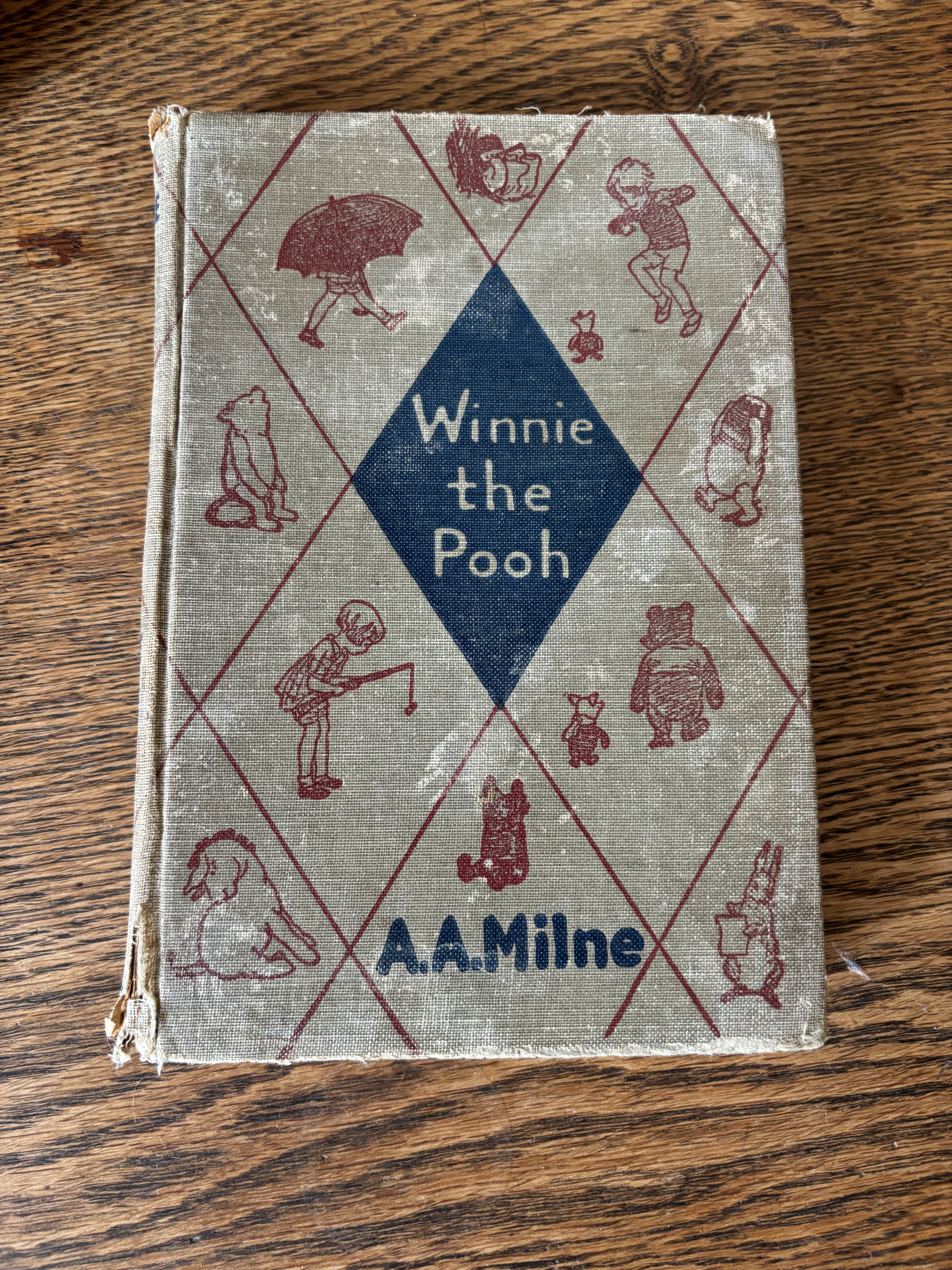
The original family copy of Winnie the Pooh (1949); a tattered paperback (1972!) of Tolkien’s The Fellowship of the Ring; some slim volumes of poetry. Then I realized we needed documents: passports! Birth certificates! Wills! Deeds!
With smoke rising in the east, I worried about overfilling the laundry basket, or omitting something key. I stared around the kitchen. Most kitchen utensils could be replaced, but not the following—so they went in the basket:
*An ancient cast iron frying pan, well-seasoned, the perfect size. Maybe the same variety that settlers carried west. Indestructible, and a good weapon in time of need.
*My grandmother’s ancient aluminum cake pan, nearly a century old. The top fits perfectly on the bottom and the bottom turns up around the edges of the top, so a cake can ride comfortably on a car floorboard.
When disaster threatens, we make choices. Our decisions––what we treasure enough to carry along––are so personal, so unique. Would you grab your fanciest clothes? Or your favorite jeans, perfectly broken in? Maybe an “old blue shirt that suits me just fine,” as Guy Clark sang in his “Stuff That Works”? https://genius.com/Guy-clark-stuff-that-works-lyrics
His distinctive voice, relaxed, restful, singing this great song, calls to mind the memory of that “old blue shirt” (long-sleeved, pale blue, washed a million times) he wore at concerts.
But in an emergency, what about your writing?
Writers can avoid the tragedy that befell Ernest Hemingway in 1922 when his first wife, Hadley Richardson, carefully packed his early writings in a small trunk to deliver to him in Switzerland. That trunk was stolen from the train at the Gare de Lyon and never seen again. Hadley had also included the carbons, perhaps anticipating her husband would be able to present an original to a publisher and still keep a copy. She reportedly wept for years. https://lostmanuscripts.com/2010/07/31/hemingways-lost-suitcase/
Today, in contrast, confronted by fire or other threat of loss, writers have options to protect that great human accomplishment—writing.
According to linguist Dr. Ingrid Piller, writing was invented independently at least three times: Sumerian cuneiform in Mesopotamia (ca. 3400 BCE), Chinese characters in China (ca. 1200 BCE) and Mayan glyphs in Mesoamerica (ca. 300 BCE). Of these, only the Chinese script is an unbroken living tradition.
But during this long history of writing, we’ve lost a heartbreaking trove of manuscripts, many by writers we wish we could have met. https://en.wikipedia.org/wiki/List_of_lost_literary_works
Sappho? (630-570 BC) Her lyric poetry, made to be sung with music, was so accomplished she was called in her time “The Tenth Muse.” But beyond fragments, we have only her Ode to Aphrodite.
Ctesibus? I’d never heard of (much less tried to pronounce the name of) this Greek inventor, a barber’s son born in Alexandria in 300 BC. He wrote on pneumatics, and invented the water organ and an improved water clock (which became our most accurate clock until Huygens invented the pendulum clock in 1656). But Ctesibus’s Memorabilia? Gone.
Aeschylus (525-455 BC) wrote 90 or so plays—only six survive. Promethus the Fire-Bringer? Lost. Sophocles (497-406 BC) wrote close to 120 plays of which only seven (Oedipus, Antigone) survive in complete form—even though Sophocles competed over 50 years in the Athens dramatic competitions (and won 24 of 30!).
Euripides (480-406 BC) wrote over 90 plays; only 18 survive complete.
Sometimes the powerful have ordered destruction. Only four Mayan codices survive: most were burned by Spanish priests in the 16th century. Many Inca Quipus were burned by Spanish priests in 1583, on orders from the Third Council of Lima. In China, a work by Confucius, The Classic of Music, was lost during the Han Dynasty with all copies reportedly destroyed on orders of the emperor during “the burning of books and burying of scholars” in 213 and 212 BC.
Europe was also unhealthy for literature. Three works by Chaucer are missing. Only two plays remain of the Coventry Mystery Play cycle—an event Shakespeare likely attended before the plays were repressed in 1579. No copies remain of Shakespeare’s Love’s Labour’s Won, written in 1598 and published in 1603. Of Monteverdi’s 18 operas, only three survive. Seven of Moliere’s plays are lost.
An author’s family might destroy the work. That happened to the brilliant Lady Mary Worley Montagu—her family destroyed her journals because they thought she’d included too much satire. Lord Byron’s executors destroyed two volumes of his Memoirs. Family destroyed four of Lewis Carroll’s journals.
Gerard Manley Hopkins burned all his early poetry when he entered the priesthood. Margaret Fuller’s manuscript on the history of 1849 Rome was lost in a shipwreck in 1850—as was she. Mary Shelley’s Lodore disappeared when she sent it by mail to the publisher: it had to be completely rewritten. Thomas Carlyle sent his first draft of The French Revolution to John Stuart Mill, whose maid mistakenly burned it. Carlyle had to start over.
In the twentieth century we lost a number of Scott Joplin’s compositions. Anne Frank’s diary from December 1942 to December 1943 was never found. An unpublished novel by Sylvia Plath disappeared before 1970.
But all is not lost. Hope remains. We continue to find new fragments of ancient works.
The book club I belong to liked very much Janet Soskice’s The Sisters of Sinai. (bit.ly/4i2tquC) Soskice recounts the adventures of Victorian-era British twins, Agnes Smith Lewis and Margaret Gibson, who braved the deserts of Sinai in the 1890’s to find, in St. Catherine’s Monastery, a palimpsest. (A palimpsest is a manuscript, parchment, or writing surface from which a later writer has scraped or washed the original text in order to use the surface for a new document—often leaving faint visible traces of the original.) Below the surface covered by a later-added manuscript on female saints, Agnes spotted a hidden 2d-3d century Aramaic copy of the four gospels. You can find her 1894 publication, A Translation of the Four Gospels, online at Amazon. bit.ly/4igo5AT
These days, writers—hoping no internet disaster occurs––can save drafts on computers, or on iCloud Drive (that mysterious place!).
A creature from the last century, I keep an ongoing paper copy while writing. There’s some physical satisfaction in scribbling notes to self on the paper pages of a manuscript. But there’s also a sense of power in the rapid editing the computer permits. Delete! Insert!
Currently I’m still on our human adventure of writing––in the throes of finishing Ghost Music, Book 11 in my mystery series set in the Texas Hill Country.
Keep writing!

Helen Currie Foster lives and writes north of Dripping Springs, Texas, loosely supervised by three burros. She remains deeply curious about human history and how, uninvited, the ghost of the past keeps crashing the party. Find her on Facebook or at www.helen.currie.foster.com. The Alice MacDonald Mystery Series is available online or in Austin at BookPeople.







 One of my favorite possessions is a vintage Webster’s dictionary, published 1956 – when I was 10 years old. All 11-plus pounds of the five-inch-thick book teeter on a top shelf in my office. I can no longer safely lift it and the pages are laid out in three columns of typeface so tiny that my aging eyes strain to make out the words.
 brassy girlfriend of an uncouth tycoon. Her character tries to overcome her limited education and rudimentary vocabulary by reading, among other texts, Alexis de Tocqueville’s Democracy in America. In one of the more humorous scenes, she struggles to make meaning of the archaic text and is advised to simply check the dictionary if she encounters any words she doesn’t understand. The increasingly frustrated Holliday would no more than read a sentence before she is up again, consulting a dictionary. Word by word. Trip by trip. Written today, the scene would surely lose its charm since she would likely be reading Tocqueville on a Kindle where all you must do is press and hold a finger on a word for the meaning to flash before you.
 Like Holliday with a Kindle, writers don’t have the need for shelves full of reference books since language prompts are everywhere from the demons in autocorrect to the drop-down menus in word processing programs that produce synonyms.