People don’t stand or sit like stone statues, unless there’s a reason. They move, breathe, and respond to situations with emotions, internally and externally, and so they should in stories. Thus, the author must find words to bring the reader into the character’s heart and mind. Writers spend hours thinking about what their characters are feeling. How do we show the reader those emotions? Eyes are one of the most popular tools to convey feelings.
Yes, those spherical bodies of different shapes, colors, and densities are called the windows of the soul. Thousands of pages have been dedicated to the power of the eyes. There are hundreds, of eye expressions, including wild, frightened, gooey, flinty, evil and the list goes on. Each one of those words or phrases evokes a sense of the person’s feelings. For a writer, those eyes may be a windows of the story. But wait— Are they enough? How else may we show a character’s emotions?
Body language is one. He slouched, lowering his eyes. That may indicate disappointment to the reader. She flung her long blond hair back over her shoulder and lifted her chin. Conceit? Defiance? It could be either, depending on the scene. However, there is another often overlooked part of the body that exhibits emotions: hand gestures.
Hand gestures may emphasize words, or be used in place of words. Communication experts have recently added hand gestures to the lexicon of terms revealing emotions and thoughts.
An NIH, National Library of Medicine, 2014 article on gestures’ roles in speaking, learning, and creating language concludes, “gestures provide both researchers and learners with an ever-present tool for understanding how we talk and think,” and hand gestures are used in many cultures and societies.
In Around the World in 42 Gestures, we travel with examples of hand motions and their meanings and learn reasons to familiarize ourselves with them when visiting foreign lands. While polyglots speak many languages, for the majority, some prep time learning a few regional hand gestures would be easier and more effective than trying to master language skills. With hand gestures, one can say a lot with one move instead of struggling through vocabulary, grammar, and pronunciation combinations, and it would be wise to understand if a positive Western gesture isn’t welcome in a foreign land. For example, the gesture we use—crossed fingers to wish good luck, in Vietnam is an anatomically-themed insult.
Tapping your forehead with bunched fingers in Peru means, “I don’t get it. I’m not smart enough, and in France, touching your index finger below the eye indicates, “I don’t believe you.” Moving on to Spain, passing your forefinger and middle finger (V formation) down your face from your eyes indicates, “I’m broke.” Moving east to Russia, pulling your left hand behind your head and scratching your right ear, says, “This is getting too complicated.” Indeed, that is the right gesture for such a sentiment.
Coming back west, we end our short tour in Italy, a country one cannot visit, in reality or in fiction, without understanding the loaded meanings of at least some of the gestures so common in Italian culture.
Italians are universally known to incorporate hand movements with words and often in place of them. The Italian Language Center identifies roughly 250 hand gestures that are part of Italian conversations. Why so many?
“Theories suggest that the iconic hand gestures result from a long history of Italy being invaded by many nations that imposed their languages, cultures, and mannerisms. From the Ancient Greek colonization along the Mediterranean coast to subsequent invasions by the Carolingians, Normans, Visigoths, Arabs, and Germans, these hand gestures developed as a means of communication among people with no common language – and have stuck around ever since. The hand gestures may have sprung up to ease communication.”
Although many of these motions vary by region, among the most common and generally understood by all are bunching all five fingers on one hand and bringing them to the lips in a symbolic kiss, which expresses appreciation for any masterpiece, even in cooking.
There is one Italian gesture, however, one should use sparingly, if at all. Holding four fingers together and swiping them outward from under the chin can mean, “I don’t give a damn,” but it also has a ruder meaning. As a visitor to Italy, I think it’s best not to test that one.
In book four of the Housekeeper Mystery Series, Murder in the Cat’s Eye, Father Melvyn and Mrs. B. take a group of eccentric parishioners to Rome to learn about the lives of the earliest Christians. In this adventure, the reader will encounter the quirks of the travel group that could land them in the hoosegow, a series of crimes that engulf the unsuspecting travelers from Austin, Texas, an Italian detective, and several characters who are not what they seem. It will serve the reader well to understand the hand motions that are part of Italian communications. Perhaps this book will require a glossary of gestures.
Coffee is a staple of life all around the world. Something I can understand and agree with. In “Coffee Facts and Statistics,” Lark Allen offers fascinating stats on the American Coffee habit.
A once famous bishop said, “Americans may not consider themselves ‘addicted’ to coffee, but the average American is physically, biologically, psychologically, and neurologically unable to do anything worthwhile before he has a cup of coffee. And that goes for prayer, too.” The Venerable Fulton J. Sheen.
What is coffee, anyway? A scientific answer can be found in The New Rules of Coffee: A Modern Guide for Everyone, where authors Jordan Michelman and Zachary Carlson go into lengthy detail about different types, brands, and varieties of coffees. They point out, “Like wine grapes, arabica or robusta plants have their own typicity and genetic diversity.” After more botany details than one might want to read, they conclude, ‘… you’re talking about a piece of fruit with seeds inside.’ Just like wine grapes. Yes? And like wine, coffee has an ancient history.
There is much speculation about the origins of coffee. Still, all agree that coffee originated in the high-altitude forests of Ethiopia, Sudan, and Kenya and goes back to a time when North America was yet unknown to the extant world. My favorite possibility/story/myth about the discovery of coffee is the legend of Kaldi, first told by Antoine Faustus Nairon, a Maronite who became a Roman professor of Oriental languages. His treatise is considered one of the first ever written on coffee, in 1671, Rome.
The legend takes us to Abyssinia (now Ethiopia), where a goat herder named Kaldi noticed that his unfriendly goats changed after eating berries from a particular tree that grew in the forest high up on the Abyssinian plateau. They became lively and more pleasant and couldn’t sleep at night. Kaldi decided to eat the berries and found himself filled with energy. Not knowing what to do, Kaldi brought some to the Islamic abbot of a nearby Sufi monastery. The abbot brewed the berries into a drink and found that it kept him awake throughout the long, required hours of night prayers. The abbot informed other monks who tried the brew made from these berries, and word spread rapidly eastward and reached the Arabian Peninsula, then spread throughout the world. Before coming to the United States, coffee found its greatest fans in European cities.
America’s love affair with coffee is estimated to have begun as early as 1607, when John Smith, founder of Jamestown, Virginia, introduced it to the colonists. Here are other fun facts, supplied by A.I., about coffee’s rise to power in the U.S. Tracing coffee in the United States, one can find specific dates and activities. In 1670, Dorothy Jones became the first person to sell coffee in Boston, Massachusetts, and in 1697, the Dutch opened the first coffee house in New York. In 1713 a Dutch merchant presented a coffee tree to King Louis XIV of France. George Washington recorded in his diary in 1760 that he attended a ball where coffee was served. Coffee grew in popularity after the 1773 Boston Tea Party. Understandable, I’d say. One of the most interesting activities around coffee took place during the American Civil War, 1861-1865. Coffee was a standard issue ration for the Union and Confederate armies. The soldiers on both sides often ran out of food and supplies, including coffee and tobacco. Union and Confederate soldiers occasionally exchanged northern coffee for southern tobacco along the quieter fronts.
Today, in the U.S., we no longer worry about north and south for our coffee supply. We may buy it in coffee shops such as Starbucks and sometimes sit down, but we most often take it away. In Europe, however, the takeaway culture hasn’t taken over. In Italy and France, it is customary to drink a small, strong shot of espresso standing at the bar. This is considered a quick, social interaction, with many people opting to savor it at the bar while chatting with the barista or friends.
Some key points about European coffee bar customs: Espresso is the norm. Most European coffee cultures center around espresso as the standard coffee order, with variations like “lungo” (longer shot) or “ristretto” (shorter, stronger shot) available depending on what one prefers. Standing at the bar to drink it is common, and it’s paid for before receiving the drink. Morning coffee is different. While espresso is enjoyed throughout the day, milk-based drinks like cappuccino or café au lait are often considered more of a breakfast item.
Country-specific nuances: In Italy: “Un caffè” means a single espresso, and it’s considered a faux pas to order a cappuccino after lunch. In France, “Café” refers to a standard espresso, and a “café au lait” is a coffee with a more significant portion of milk. In Spain, the term ‘solo’ is received as a request for espresso coffee served in a small glass.
Here in the United States, we drink our coffees sitting, on the go, in large or small containers or cups. Most Americans prefer their coffee with at least some milk and often with sugar or artificial sweeteners.
I love my coffee any time of the day, but in the late afternoon, I bow to caffeine’s power to keep me awake at night, so I cheat and switch to decaf.
Thus, it is no surprise that the protagonists in the Housekeeper Mystery Series, Father Melvyn Kronkey, is an unusual Irishman who prefers coffee to tea, a habit instilled in him by his trusty right hand, Mrs. B. Over many a cup of coffee, they use wit, intellect and intuition to reason out motives and solve crimes.
In book four, Murder in the Cat’s Eye, now underway on the pages and in Italy, Father Melvyn, and Mrs. B. take a group of parishioners to Rome to study the lives of ancient Christians, living in a harsh, pagan society, and how they flourished after being outlawed, and punished by gruesome deaths. But will Father Melvyn and Mrs. B. only deal with the ancient world, or will they find themselves embroiled in current crimes, death, and destruction in a strange country? Watch for it in late spring or early summer.
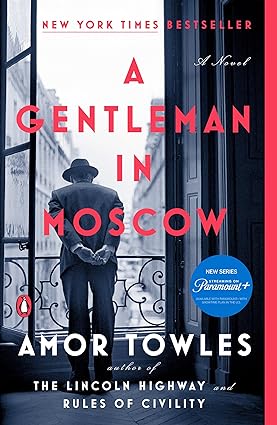
Ever since I read A Gentleman in Moscow (2016) I’ve considered Amor Towles’ writing style to be nearly perfect. So when my niece told me Towles was making an appearance at the Empire Theatre in San Antonio, I booked it. He was there to support the San Antonio Book Festival and to talk about his latest book, Table for Two. It’s a collection of six short stories plus a novella. Unlike some of his other stories, these all take place in the current Millennium.
Over the evening I learned a interesting things about Towles.
I learned that he is what we used to label in the news business, an “easy interview.” Austin’s own Stephen Harrigan (Big Wonderful Thing, 2019) was on the stage with Towles as moderator but he didn’t get to ask many of the questions on his notepad. Towles was in a talkative mood so needed little prompting.
I learned that Towles took up writing full time only after success in his first career at a small Wall Street investment firm.
I learned that once he gets a project in mind, he begins to fill notebook after notebook with hand-written outlines, ideas, scenes, characters. It may take years. He says this process frees his imagination and subconscious to go where beautiful language and the characters’ inner lives take him.
There was more but of the many memorable things I learned about this accomplished author, what I remember best, and took to heart, was his description of his research process. He said that when writing he intentionally postpones what he calls “applied research” until near the end. During this time he is also reading novels written by others that are set in the same historical period as the book he’s working on. His novel is almost written before he begins deep research.
That’s why he waited until A Gentleman in Moscow was almost finished before traveling to Moscow and checking into the Hotel Metropol, the exclusive hotel where his story about Count Alexander Ilyich Rostov is set.
Towles advised that details gleaned from this kind of active research should be written into the story much the way one might design the stage for Anton Chekhov’s The Cherry Orchard (1903). Of course Towles would choose this particular play as a point of reference because, like his own novel set in Russia, Chekhov’s tragicomedy also deals with a period of decline for the Russian aristocracy.
He said that when the curtain rises for the play the audience might see only the suggestion of a cherry orchard through large windows as if were rendered by an impressionist such as Claude Monet or Mary Cassatt. The windows might be framed by plywood bookcases painted to resemble mahogany. In the center of the room there would be a table set with a porcelain tea service.
When an author is ready to fold research into the story, Towles said it should be presented with similar layers of reality. Some details are just suggested in the background. Some, like the bookcases, give the scene the appearance of reality but need not be too detailed. Then there are aspects of research that can’t be given short shrift. For these, the author must adhere to absolute authenticity. The audience needs to hear the chair move across the floor and the teacup rattle in the saucer. The challenge for me is where all of the information that I’ve accumulated in my own research belongs – in the window or on the table?
Charles McNulty, theater critic for the Los Angeles Times, said in a June 6, 2022, review of a local revival of The Cherry Orchard, “Big things occur in Chekhov. Houses are lost, guns occasionally go off, and people die. But the focus is on muddling through.”
Much the same might be said about A Gentleman in Moscow and the subtle use of active research by Towles so that his story isn’t swallowed up in the details.
Image of Anton Chekov via Wikipedia. Public domain.
Image of stage of The Cherry Orchard via Wikipedia. Public domain.
***
A former political reporter in Austin, Dixie also taught writing at Syracuse University. When she teamed up with Sue Cleveland to write fiction, they sold a screenplay to a Hollywood producer. Although the movie was never made, the seed money financed ThirtyNineStars, their publishing company. Through it they published two award-winning thrillers (Shrouded and Digging up the Dead) under the pen name, Meredith Lee. Dixie’s first solo mystery was Bloodlines & Fencelines, set in a tiny Texas town near Austin. Kirkus reviews described the book as, “A twisty whodunit that’s crafted with care and saturated with down-home Southern charm.” She is working on second mystery in the series. www.dlsevatt.com
New reads! If, like me, you desperately miss John le Carré, consider A Spy Alone, the 2023 debut spy thriller by Charles Beaumont, a field operative veteran of Britain’s MI-6. https://bit.ly/3ZzHjHs His premise is fascinating: we know of the “Cambridge Five” who spied for Russia from the 1930’s to 1950’s—Kim Philby, Guy Burgess, Donald Maclean, Anthony Blunt and John Cairncross. https://en.wikipedia.org/wiki/Cambridge_Five But has there ever been, or could there be, a spy ring linked to Oxford? Beaumont’s protagonist Simon Sharman feels real, right from the first page:
“It is their shoes that give them away. As a lifelong fieldman, Simon Sharman hasn’t forgotten the lesson: walkers might change their jackets, pull on a pair of glasses, even a wig. But nobody changes their shoes on a job. Look at their shoes.“
I was hooked. Warning: Beaumont’s book is contemporary, well-written, tense, and may interfere with sleep.
Two other recent reads: old adventure and a new “adult fantasy.” I’d never heard of The Long Ships by Frans G. Bengtsson (1954).
Set from 980 to 1010 A.D., the book recounts the wide-ranging adventures of Norseman Red Orm Tostesson, and the collision between Christian priests (the “shaven men”) and the Norse culture of Skania at the south tip of Sweden. Now I know what it meant to go “a-viking”—to go sea-raiding! 500 pages, with Red, a very engaging Norseman. Great maps, too.
The Lost Bookshop, by Evie Woods (2024),offers time travel between the 1920’s and 30’s in Britain, and the present; a search for a lost Brontë manuscript; a disappearing attic; and disappearing and reappearing characters. I confess I flipped through big chunks, relieved when true love finally won out after two women, generations apart, survive appalling treatment. The disappearing attic reminded me of Susan Cooper’s Over Sea, Under Stone, and of course the wardrobe into Narnia in The Lion, the Witch and the Wardrobe. I’m always up for secret doors.
I’m rereading a fascinating and fairly demanding study by Graham Robb, who has probably bicycled and walked further in Britain and France than most humans:
In The Search for Middle Earth: Mapping the Lost World of the Celts (2013), he describes how the Keltoi, or Celts, developed a system of surveying based on a midline transected by the lines of the summer and winter solstice to estimate travel distances and times—a feat not replicated for centuries. He maps the Heraklean Way, the path from southwestern Iberia that runs northeast across the Pyrenees to the Alps along the diagonal of the solstice sun, which Hannibal took when he invaded Italia. He describes Druid schooling (20 years to learn) and maps out protohistoric forts which turn out to lie along survey lines. He provides amazing maps. Two ongoing lessons from Robb’s devoted research: the winners write history; and humans tend to underestimate the accomplishments of earlier civilizations.
Several of you asked about the three burros, given the recent cold snap. Thank you, they’re well. Their hair’s not waterproof so in cold rain they gather on the south side of the stable, under the roof, safe from rain and the north wind. They were relieved to see green grass again after the drought broke, but they’re also eating—and rolling in––green hay. And mud!
Yet despite hay, they gather outside the gate every morning and afternoon for carrots. They consider this part of their deal.
Burros are curious. They amble over to watch us garden and hang up laundry. They need company. They graze near each other. They may live into their 40’s. Sebastian, the short stubby knock-kneed male who invited himself to live here, may be 35 or more. Amanda (who insists I tell you she’s registered, with papers)may be 20. Her daughter Caroline is 12. Sebastian deems it his duty to bray loudly when any person or car appears at the end of the driveway, and to welcome the sun every morning with a stunningly loud bray. Now both Amanda and Caroline have begun to bray occasionally.
Only donkeys can bray. Unlike horses or zebras, donkeys begin a bray on the inhale and continue braying on the exhale. They have great hearing—supposedly they can hear another donkey bray 60 miles away.
They especially detest canids and will attack, dance on and kick dogs, coyotes, bobcats, foxes. A spooked horse will run away: donkeys stand together until they decide what they’re going to do. This morning, leaving for the post office, I saw the three donkeys standing together, knees locked, ears cocked, eyes fixed on two trespassing dogs who’d strayed across the cattleguard and into the donkeys’ domain.
The dogs immediately acknowledged their gross error of judgment, raced frantically away and never returned.
If donkeys could read (wait—maybe they can, but have trouble turning the pages), I predict they’d prefer mysteries. They enjoy puzzles (like how to lift the chain and invade the fenced garden).
Humans and donkeys. We are both curious animals.
Helen Currie Foster lives and writes the Alice MacDonald Greer Mystery Series north of Dripping Springs, Texas, loosely supervised by three burros. She’s drawn to the compelling landscape and quirky characters of the Texas Hill Country. She’s also deeply curious about our human history and how, uninvited, the past keeps crashing the party! Currently she’s working on Book 10. Her protagonist, Alice, gets into legal drama, and matters of the heart. Alice does have a treehouse…
Thanksgiving fell at the end of November this year, making Christmas feel like tomorrow instead of a few weeks away. The urgency to get everything done makes it more challenging to stay in the true spirit of what Christmas is supposed to mean. Add to that the extreme commercialism that, despite our best efforts, most of us fall into at least a little, and spirituality falls to the wayside. Enter the curmudgeons who think it’s all crass, and we have a diverse group to interest. My offering? Instead of the commercialized pap on TV with Christmas movie after movie adding to the wreckage of the true spirit of Christmas, I prefer good mysteries with a holiday theme. Here are a few of my favorites – and not so favorite, but judge for yourselves. Of course, the list leads with the gold standard in Christmas stories. A CHRISTMAS CAROL, by Charles Dickens. It’s not a mystery in the truest sense of the genre, but the first time one reads it, one must wonder if Scrooge will have that epiphany. And after that, no matter how well we know the story, we cannot help but take the voyage with poor old cranky, miserable Ebenezer as he evolves from a miser and a wretched human being into a man who becomes revered by all. Even if we don’t reread the book, according to the Internet Movie Base, there are over 100 films to choose from. After our re-acquaintance with Scrooge, many other worthy stories with a holiday theme are available. My favorite contemporary is THE SPY WHO CAME FOR CHRISTMAS by David Morrell. This five-star mystery is set in Santa Fe, New Mexico. Morrell combines the artsy community and the beauty of Santa Fe with an outstanding spy mystery that will keep you turning the pages and holding your breath. Excellent storytelling and scene setting. Another five-star mystery is HERCULE POIROT’S CHRISTMAS by Agatha Christie. Hercule’s holiday turns out to be anything but restful and merry. He’s a guest at Gorston Hall, where family intrigues and secrets are revealed and are deadly. DANCING WITH DEATH, by Joan Coggin, written in 1947, is interesting and fun most of the time. The middle is a bit verbose, but still an entertaining read. It takes place during the aftermath of the Second World War. Despite the ongoing rationing and shortages, Duds Lethbridge dreams of celebrating Christmas with an old-fashioned house party, the way it was before the war. She invites several friends and family to stay for the week to relieve the continued dreariness, hoping to recreate the prewar Christmas spirit, but nothing stays the same. Within a short time, Duds regrets having started this. New Year’s Day approaches, and Duds looks forward to being rid of her houseguests, but one of them turns up dead, and it’s believed to be suicide. In a panic, Duds sends for her dear friend and amateur detective Lady Lupin, but things get progressively worse. Everyone has a motive for wanting this guest dead. In the end, the mystery is solved, but Duds and her guests will remember this Christmas celebration forever – for all the wrong reasons. MURDER ON THE CHRISTMAS EXPRESS, by Alexandra Benedict. A fun book for the season. Not the quality of Murder on the Orient Express, but it examines relationships in the setting of a train derailment and crime. Keeping within the confines of mysteries, for curmudgeons and sunshiners alike, If you are not in the mood to read a full-length novel, or just don’t have time, here are a couple of Christmas-themed short stories. THE TRINITY CAT, by Ellis Peters. Edith Pargeter, writing as Ellis Peters, first published The Trinity Cat in 1976. Sadly, crimes don’t stop because it’s Christmas, and we do well to remember that victims are not numbers, they are relatives and friends, people we know and love, even in fiction. In the Trinity Cat, beloved old Miss Patience Thompson is found murdered on Christmas morning. There are no clues to help Sgt. Moon solve the crime, until the town’s local black furry, no-name feline and local resident, called Trinity Cat, inserts himself into the mystery. Can he help, or is he just another mouser looking for number one? THAT’S THE TICKET. In this Mary Higgins Clark Christmas story, Wilma and Ernie Bean of New Jersey have hit the jackpot. On Christmas Eve, they’re holding the winning lottery numbers. Wilma, who is in Philadelphia visiting her sister, doesn’t know, but hubby Ernie does, and he can’t control himself. Pinning the tickets to his undershirt to keep them safe, he hits the bars in celebration, envisioning how he intends to surprise Wilma when she returns home the next day. He didn’t mean to tell anyone, but liquor loosened his tongue, and a barfly named Loretta loosened the pin holding the tickets. After hearing Ernie’s story, Loretta volunteers to drive the inebriated man home. She relieves him of his tickets after he passes out on the bed. The next day, hungover and terrified, Ernie asks a neighbor to pick Wilma up at the train station, and at home, it doesn’t take Wilma long to find out what happened. The only question remaining is whether or not this will be the worst Christmas of their lives or whether or not Wilma can con the con artist and get the tickets back from the thieving Loretta? So, whichever side of the Christmas sentiments you fall under, enjoy some good reads to relieve the stress of the holiday. I wish you all a Merry Christmas, and a Happy, Healthy New Year, and may all your readings in 2025 be satisfying and fun!
For Thanksgiving Week, I’m sharing a story made from things I’m thankful for: a hometown the size of a broom closet; long, hot summers that started on June 1 and stretched clear to Labor Day; a visiting teenager who spent every spare minute reading Gone With the Wind; bobby socks and garter belts and petticoats; an ornery Presbyterian great-aunt and her ornery Baptist mare; front porches where quiet kids learned a lot; Army surplus bunk beds; a grandfather who said stop signs cause wrecks. I don’t know whether he believed it, but he said it.
Flannery O’Connor said, “Anyone who survives a southern childhood has enough material to last a lifetime.”
I survived. So do the memories.
(“Stop Signs” won first place for short story in the 2000 North Texas Professional Writers Association Contest. It isn’t a murder mystery, but only because one of the characters restrains herself.)
***
Stop Signs, Part I
My grandfather thinks stop signs cause wrecks. That’s what he told Mama when they put up stop signs at Farm Road 20. If you go on across, you’ll be okay, but if you stop, you won’t be able to build up enough speed, and a car will come along and hit you for sure.
Mama didn’t argue. She says when she married into the Coburn family, she learned to pick her battles. The rest of the time, she’s just polite.
Nobody was just being polite that day on Aunt Eula’s front porch. Dr. Larrimore was there, and they were talking about the new phone system we’re getting. We’ve always just turned the crank and told Ernest who we want to talk to, but now we’ll have to dial a number. Dr. Larrimore said it’ll never work—people will get the O and the zero mixed up. They also agreed that man will never go to the moon because it isn’t in the Bible. Mama said the new phone system isn’t in the Bible either. I don’t know whether to be more concerned about getting the O and the zero mixed up or about having a doctor who gets them confused.
I know Aunt Eula wasn’t just being polite because she doesn’t bother with that kind of thing. She is Daddy’s oldest aunt, and, like Grandaddy, is tall and straight and white-haired. Unlike Granddaddy, she is proud and haughty. She belongs to both the Daughters of the Republic of Texas and the United Daughters of the Confederacy. She likes the United Daughters best. Mama says that’s because she’s an unreconstructed rebel.
Aunt Eula has a beautiful sorrel mare named Lady, who is my Mr. Boots’ mother. She bought her when the San Marcos Baptist Academy sold off its stables. I used to ride her before Mr. Boots was saddle broke. Mostly I chased her around the pasture trying to catch her. Once when I finally got hold of her and got the bit in her mouth and led her into the yard to saddle her, she sidled up to a big pecan tree and walked round and round it, while I followed, trying to get the saddle across. She’s never tried to unseat me, probably because by the time we get started, she’s worn out.
Daddy says Lady’s uncooperative because those Baptist Academy kids didn’t know how to ride and let her build up some bad habits. Mama says it’s because she belongs to Aunt Eula, and animals always resemble their owners. I say it’s because she’s a Baptist set down here in a nest of Presbyterians, and she’s testing the doctrine of Free Will against that of Predestination.
My cousin Ruth must be a Baptist, too, because she’s been using her Free Will ever since she arrived last month to spend the summer.
Ruth is thirteen, two years older than I am, and she used to be my dearest friend in the whole world. I could hardly wait till she got here. I had the summer all planned out. I would ride Mr. Boots and she would ride Lady, when she could catch her, and we would explore all the places over on York Creek that Mama won’t let me go to by myself. We’d share a bedroom and talk all night just like sisters.
But when we picked Ruth up at the train in San Marcos, I hardly recognized her. She was wearing a dress with about five petticoats, and high heels, and nylon hose. She was carrying a copy of Gone With the Wind.
We got into the back seat of the car. I held her book while she spent about five minutes arranging her petticoats.
“Do you like this book?” I said. “I read it last spring.”
She raised her eyebrows. “I’m surprised Aunt Virginia let you. It was written for adults.”
“I guess you haven’t heard,” I said. “I’m advanced. I’m a third of the way through the high school reading list.”
She smiled. “You’ll probably want to read this one again when you’re older. I imagine you missed a lot.”
I let that pass and tried again. “Why aren’t you wearing loafers and bobby sox?”
She said, “They’re not appropriate for the train.”
I said, “Why?” and she said, “They just aren’t,” and I said, “Who told you that?” and she said, “You’ll understand when you’re older.”
“You told me wearing a garter belt was like sitting on rubber bands.”
“I’ve grown up a lot since I said that.” Then she crossed her legs at the ankle and folded her hands over her white straw clutch purse, and by the time we got to Martindale, I was nauseated, and it wasn’t motion sickness that was causing it.
At home, Daddy carried Ruth’s suitcases into my room, and Ruth said she would sleep on the top bunk.
“That’s where I’m going to sleep,” I said.
Ruth knows better than to boss me outright—I got that settled when I was five—so she tried bribery instead.
“Look, if you let me sleep on the top, you can lie on the bottom and kick me while I’m sleeping.”
“It’s tempting,” I said, “but my legs aren’t that long. It looks like yours are, though. Exactly how tall are you now?”
She smiled. “Mother says I’m going to be statuesque.” And then Princess Grace floated out to see if Mama needed help in the kitchen.
The next day, I was up at six o’clock as usual, ready to saddle Mr. Boots, but Ruth didn’t drag out of bed until nine. Then, instead of saddling up and heading to York Creek, she insisted on walking downtown to say hello to all of my relatives. When she saw Aunt Eula and Aunt Babs sitting on the front porch, nothing would do but we must stop and visit. The first thing out of her mouth, Ruth asked Aunt Babs to teach her to crochet. Aunt Babs lit up like a chandelier and ran inside to get a hook and some yarn so they could start right away.
While she was gone, Ruth told Aunt Eula that she was reading Gone With the Wind and asked about the United Daughters. That got Aunt Eula started. Before they were finished, she and Ruth had rebuilt Tara on the banks of the San Marcos River and were ready to move in. Aunt Eula told Ruth the next time she came, she could look at Great-great-grandpa’s Civil War sword and medals. When we finally left, I heard Aunt Eula tell Aunt Babs that Virginia’s niece was turning into a lovely young lady even if she wasn’t a Coburn.
Ruth spent all the next day chain stitching with her nose in a book. That night, she kept the light on a half-hour past my bedtime. I finally leaned over the side of the top bunk and asked her, very politely, to turn out the light.
“I can’t,” she said. “I’m putting my hair in pin curls.”
“Anybody who spends that much time on a ducktail must have a bird brain,” I said, and she took one of her statuesque legs and kicked the underside of my mattress, and I yelled, and Mama came and moved Ruth into the front bedroom, where she had her own double bed and a good breeze and our grandmother’s piano, and she played her transistor radio all night long.
And that wasn’t all she did up there at night. I know because one night when I thought she might be asleep, I tiptoed in to turn off the radio—I’d had about as much “Purple People Eater” as anyone should have to endure—and Ruth was sitting on the side of the bed in the dark, talking to Junie Franklin through the window screen. He was sitting out in the yard on Uncle Robert’s Palomino. I was shocked. If Mama knew what was going on, she would be very disappointed.
TO BE CONTINUED
***
Frank Waller [“Dad”] and Kathy Waller, ca. 1962
More about the man who said stop signs cause wrecks at “Dad” on the blog Whiskertips.
Thrilled to announce that one of my short stories has been published by Killer Nashville Magazine! Killer Nashville Magazine is a magazine that publishes stories in any genre that incorporate elements of mystery, thriller, or suspense.
This story means a lot to me because the seed of the idea is based on my family and family experiences. Look at my author notes at the end for the explanation.
O villain, villain, smiling damned villain. . . That one may smile, and smile and be a villain. — William Shakespeare
Lately I’ve felt as if I have a sesame seed stuck between my molars. Except instead of an annoying seed, it’s an idea I can’t let go of. It started when a group of fellow writers were talking about overuse of certain pat descriptors to express emotions. “Smiled” is a common culprit. Now I’m haunted when I read my copy. Why are my characters always smiling? What kind of smile is it? Nervous smile, a smile to mask confusion, fake smile, cold-as-ice smile, snide smile, crooked smile, challenging smile, weak smile, infectious smile or just a plain old vanilla grin?
I can’t unsee the way I fall back on dull and overused expressions such as “she smiled,” instead of taking the time to ask myself, what underlying emotion is the character feeling? How can I describe that emotion so the reader understands it in a precise and fresh way? How can I eliminate all that superfluous smiling that goes on in my copy and instead home in on the intended emotion? In other words, when my characters smile, what emotion am I trying to communicate? Unless writing a picture book an author has only words to create an image in the reader’s mind.
My new-found fixation on smiling is now creeping into not only my writing but also into books I’m reading. Sometimes a smile is understood without the word being used as in The Frozen River by Ariel Lawhon. “Good humor stretches out from the corners of Ephraim’s eyes in the form of crow’s feet, and I realize he has lightened my mood on purpose.” Sometimes the smile is expressed unambiguously as in My Brilliant Friend by Elena Ferrante. “She made a half smile of contempt that meant: Marcello Solara makes me sick.” Or this from Vera Wong’s Unsolicited Advice for Murderers by Jesse Q. Sutanto. “They are sort of smiling, but the smiles are heavy and apologetic. . .these aren’t the kind of smiles you give when you have good news to share. They’re the kinds of smiles that know they’re about to ruin someone’s life.”
The scholar Paul Ekman has identified 18 common types of smiles with disparate meanings: the fixed polite smile (I really don’t know what to say); the embarrassed smile (I don’t know anyone); the tight-lipped relieved smile (oops, that was a close call); the exhausted smile (happiness after a long race); the sadistic smile (it particularly exudes evil); the exasperated smile (annoyance); the compliant smile (it will be over soon); the diplomatic smile (a “professional” smile); the ecstatic smile (life is wonderful); the exaggerated smile (imitation of joy, a little forced); the worried smile (the situation is really awkward); the contemptuous smile (one is secretly a bit spiteful); the ironic smile (welcome to sarcasm); the fake smile (to hide an emotion of weakness); the delighted smile (in front of a baby); the warm smile (that of a mother encouraging her child); the meditative smile (Buddha-like, filled with compassion); and the amorous smile (I adore you).
Ekman’s work was the basis of the American crime drama Lie to Me, in which an expert in facial expressions, tone of voice and body language uses his skills to help law enforcement uncover the truth.
We have Charles Darwin in his 1872 book (Expressions of the Emotions: Man and Animals) to thank for one of the earliest scientific studies of human emotions. What is important for writers is that he also offered analysis of the body language — facial movements, gestures, sounds, and the physiological changes — that go with different emotions.
Conrad Veidt in character as Gwynplaine from the American film The Man Who Laughs (1928).
William Shakespeare wrote more than two hundred years earlier than Darwin, about the trap of the hidden meanings behind a smile. For instance, Hamlet confronts the lie hidden in a devious smile when he realizes his stepfather, King Claudius, murdered his father, saying “O villain, villain, smiling damned villain. . .That one may smile, and smile and be a villain.” The notion of a misleading smile is something Shakespeare first visited in Act 4 of Julius Caesar, when Octavius says, “And some that smile have in their hearts, I fear. . . millions of mischiefs.”
Fortunately there are any number of guidebooks to help writers navigate this tricky smile business. Among them are S.A. Soule’s The Writer’s Guide to Character Expressions and Emotions; Valerie Howard’s Character Reactions from Head to Toe; Kathy Steinemann’s The Writer’s Lexicon: Body Parts, Action and Expressions; and The Emotion Thesaurus by Becca Puglisi and Angela Ackerman. Jordan McCollum’s three-part posting on the subject of avoiding overused “gesture crutches” is also helpful.
These sources may also help writers avoid a second trap: overdoing tired descriptors to convey emotions. The conversation with other writers that set in motion my fixation on smiles was triggered by an article in which Mark Twain praised his friend, William Dean Howells. Twain minced no words about what he saw as overuse of empty stage directions to convey meaning while praising Howells as a master in the use of body language to describe thoughts and emotions without the need to be repetitive. “Some authors overdo the stage directions, they elaborate them quite beyond necessity; they spend so much time and take up so much room in telling us how a person said a thing and how he looked and acted when he said it that we get tired and vexed and wish he hadn’t said it at all,” Twain observed. He said directions such as “laughed” are worked to the bone when the author has given the character nothing to laugh about.
The lesson? Be clear about what kind of smile you intend but also give the character something to smile about.
***
A former political reporter in Austin, Dixie also taught writing at Syracuse University. When she teamed up with Sue Cleveland to write fiction, they sold a screenplay to a Hollywood producer. Although the movie was never made, the seed money financed ThirtyNineStars, their publishing company. Through it they published two award-winning thrillers (Shrouded and Digging up the Dead) under the pen name, Meredith Lee. Dixie’s first solo mystery was Bloodlines & Fencelines, set in a tiny Texas town near Austin. Kirkus reviews described the book as, “A twisty whodunit that’s crafted with care and saturated with down-home Southern charm.” She is working on second mystery in the series. www.dlsevatt.com
Image of Tim Roth at the 2015 San Diego Comic Con International in San Diego, California. The Hateful Eight panel by Gage Skidmore, CC BY-SA 3.0 , via Wikimedia Commons
Image of actor Conrad Veidt in character as Gwynplaine from the American film The Man Who Laughs (1928). Universal Pictures, Public domain, via Wikimedia Commons
Image of book cover, Charles Darwin, Public domain, via Wikimedia Commons
The mystery is solved! In my search for what I recalled as “the “Blitzkuchen” once served at Schwamkrug’s outside New Braunfels, in the Texas Hill Country, I had the name wrong. It’s a blitz torte, not a blitz kuchen! Several readers sent recipes from German cookbooks indicating that “Blitzkuchen” is a quick cake, usually one layer only. My memory, though? A tall two-layer confection, baked with meringue and almond flakes on top and between the layers! And in my memory, more meringue on the outside, plus some moistness in the filling.
Online I found Oma Gerhild’s “Oma’s Blitz Torte Recipe ––Lightning Cake.” https://www.quick-german-recipes.com/german-blitz-torte-recipe.html Each almond-flavored layer is baked with meringue and sliced almonds on top of the batter. The recipe offers either custard filling or whipped cream filling. I opted to finish off with whipped cream with powdered sugar and vanilla, not just inside, but around the cake (and in blobs all around the kitchen).
FINALLY! First, that lovely almond taste. Plus, everyone at the table now wore an attractive little white mustache of whipped cream. You don’t get that with a madeleine and a cup of tea, do you, M. Proust?
As October runs into November, Texas Hill Country towns are celebrating Oktoberfest, or, in New Braunfels, Wurstfest. Normally by now our trees would show some fall color––nothing like New England, of course. The cypresses by Lake Austin are turning bronze. Out here north of Dripping Springs, the possum haws are showing their red berries. The cedar elms turned bright yellow, then slowly lost their leaves. The live oaks, thankfully, stay green.
But this year? Drought brings bad news for trees. Cypress-lined creeks are dry…the cypresses’ arched roots groping into the earth for water. Downhill at our place Barton Creek is dry, and I mean dry, with only occasional small pools. Up on the limestone plateau the leaves on some smaller saplings just turned brown and fluttered to the ground, with the tree already looking dead. We’re watering, but in Stage 2 drought restrictions. Will our wells run dry? Have we drained the Trinity aquifers that lie hundreds of feet below?
So, to general geopolitical angst, I’ve added…tree worry.
Trees in books play such a role in our imaginations. After reading Johann David Wyss’s Swiss Family Robinson (1812)—where the shipwrecked family builds a tree-house on their desert island––I always wanted to live in a tree-house! https://en.wikipedia.org/wiki/The_Swiss_Family_Robinson We’re drawn to forests, home of the trees—scary, but sometimes the safest place. In The Sword in the Stone by T. H. White (1939), first of the four volumes that make up The Once and Future King, the Wart (the young Arthur, under Merlin’s tutelage) and Kay meet Little John who tells them about Robin Wood (explaining why it’s not “Robin Hood” and why he lives in the woods (or “‘oods”):
“They’m free pleaces, the ‘oods, and fine pleaces. Let thee sleep in ‘em, come summer, come winter, withouten brick nor thatch, and huntin’ ‘em for thy commons lest thee starve; and smell to ‘em with the good earth in the springtime; and number of ‘em as they brings forward their comely bright leaves, according to order…”
There the boys, the future King and Sir Kay, approach “the monarch of the forest. It was a lime tree as great as that which used to grow at Moor Park in Herefordshire, no less than one hundred feet in height and seventeen feet in girth, a yard above the ground….” Headquarters for Robin Wood and Maid Marian! And there begins a great and perilous adventure for Kay and Wart, who break into the castle of Morgan le Fay, Queen of Air and Darkness—to rescue prisoners paralyzed by magic. (Speaking of paralyzed victims of witches—note how C.S. Lewis later describes turned-to-stone courtyard figures in his first foray into fantasy, The Lion, the Witch and the Wardrobe (1950).)
One writer, Elisabeth Brewer, notes that “The Sword in the Stone shows a passion for trees that White shared with Tolkien. https://bit.ly/3Ceqk. How about the Ents we meet in Fangorn Forest, in J. R. R. Tolkien’s Middle-Earth? Trees that walk…and tend other trees. Not all trees are benign––including the wicked old willow which captures Frodo and friends (rescued by Tom Bombadil).
I’m reading a fascinating graphic (yes, graphic!) book about Tolkien and his close friend C.S. Lewis: The Mythmakers: The Remarkable Fellowship of C.S. Lewis and J.R.R. Tolkien, by John Hendrix. https://bit.ly/4hqiyFr
Tolkien and Lewis met in 1929 in Oxford, where they were, famously, members of a writers’ group, the Inklings, and shared many hours at The Eagle and Child. That’s not all they shared. In 1916, both men experienced horrific warfare on the Western Front in France. Young and just married, Tolkien fought in the trenches, then contracted life-threatening trench fever. At nineteen, Lewis was wounded by shrapnel (from friendly fire) on the Somme, and carried shrapnel in his body the rest of his life. Hendrix’s wonderful book uncovers the sort of salvation two disillusioned veterans found in the healing power of imagination, including Norse mythology and the European fairy tale. Tolkien knew of Yggdrasil, the sacred ash tree central to Norse mythology. https://en.wikipedia.org/wiki/Yggdrasil; https://dc.swosu.edu/cgi/viewcontent.cgi?article=2130&context=mythlore
And how the worlds created by Lewis and Tolkien fired our imaginations! The fantasy world of C.S. Lewis’s Narnia emerged when The Lion, the Witch and the Wardrobe was published (1950). Tolkien’s The Hobbit, or There and Back Again, was first published in 1937 but became a pop-culture phenomenon only in 1960’s, when the paperback edition became available. https://time.com/4941811/hobbit-anniversary-1937-reviews/
Both Lewis and Tolkien had copies of The Sword in the Stone early on. Indeed, in 1939 it was a Book-of-the-Month Club selection. T. H. White 1964 obituary, https://nyti.ms/4hlasht. Curiously, Hendrix’s book on Tolkien and Lewis doesn’t mention T. H. White, perhaps because Hendrix focuses on the impact of war; T.H. White 1906-1964) was born too late to serve in World War I. Nor was he an Oxonian. While C.S. Lewis reportedly disparaged The Sword in the Stone in 1940, he later invited T. H. White to the Inklings if he ever visited Oxford. https://bit.ly/4f4wcww (“Dickieson post”). Perhaps Hendrix doesn’t mention T. H. White because unlike Tolkien and Lewis, though he creates a fantasy world, White grounds The Once and Future King firmly in England.
But Elisabeth Brewer commented in T.H. White’s The Once and Future King that The Sword in the Stone shows a passion for trees that White shared with Tolkien. (Dickieson post.)
What about powerful trees in more recent books? Consider the Whomping Willow, in J. K. Rowling’s Harry Potter and the Wizard of Azkaban? https://bit.ly/4f1koex Magic—but terrorizing—it reveals the secret passage which ultimately allows Harry and friends to discover––well, remember? Indeed, Harry reminds us of T. H. White’s Wart, both with an earnest determination to do right, and a magical tutor.
Maybe children are especially open to tree power because they still climb trees. My dad swooped us off to grad school in Atlanta, and then to Charlotte, before we moved back to Texas. In the southeast I discovered the power of pine trees. We children built an admirable and secret treehouse in the woods, where we surveyed the world from on high. No parents came near to scold or warn: deep in the trees we ruled our own domain. Later in Carolina at eleven, I could climb the neighbors’ big back yard pine all the way to the top. The tree swayed slowly back and forth, but I could see the entire neighborhood and beyond. Tree power.
The way live oaks vary their leaves makes identification tough. On the Edwards Plateau, the species passes into the “shrubby Texas Live Oak”—shorter with smaller trunks: “…[I]ntermediate forms occur between the variety and the species and the distinctions are often difficult,” per Robert Vines, Trees, Shrubs and Woody Vines of the Southwest (1960). Well, thanks.
Now, in drought, with grass turned grayish tan, with dirt powder-dry beneath our feet, we treasure the blessed green of live oaks, often home to swings and hammocks, and providing wide shade to houses, pastures, and somnolent cattle.
Trees inspire us. We know Shakespeare’s song: “Under the greenwood tree, who loves to lie with me…” (As You Like It). The first poem in Wendell Berry’s A Timbered Choir begins, “I go among trees and sit still.”
Mary Oliver’s “Honey Locust” begins,
“Who can tell how lovely in June is the
honey locust tree, or why
A tree should be so sweet and live
in this world?”
Robert Frost knows his trees: The Road Not Taken, Stopping by Woods on a Snowy Evening, Tree at My Window, Spring Pools, so many. Of course, his Birches:
“When I see birches bend to left and right
Across the lines of straighter darker trees,
I like to think some boy’s been swinging them…”
Frost makes it easy to imagine “some boy” swinging the birches—or Frost imagining that, as he marched through a yellow wood.
And then e.e. cummings, My Father Moved Through Dooms of Love—I like this verse:
“My father moved through theys of we,
Singing each new leaf out of each tree
(and every child was sure that spring
Danced when she heard my father sing)”
And Gerard Manley Hopkins, Spring and Fall:
“Margaret, are you grieving
Over Goldengrove unleaving?”
Yes, trees: later in the poem we find when “worlds of wanwood leafmeal lie.”
The forecast calls for rain. Please cross your fingers.
Helen Currie Foster lives and writes the Alice MacDonald Greer Mystery Series north of Dripping Springs, Texas, loosely supervised by three burros. She’s drawn to the compelling landscape and quirky characters of the Texas Hill Country. She’s also deeply curious about our human history and how, uninvited, the past keeps crashing the party. Currently she’s working on Book 10. Her protagonist, Alice, gets into legal drama, and matters of the heart. And yes, Alice does have a treehouse.
Texas has over 15,300 wind turbines, representing 28.6% of Texas energy generation. These turbines have surpassed the state’s nuclear production in 2014 and coal-fired production in 2020. Windfarms dot the landscape from north to south, with the majority of the windfarms operating in South Texas, along the Gulf Coast, south of Galveston, and in the mountain passes and ridge tops of the Trans-Pecos in western Texas.
Driving north and south from Corpus Christi to Austin on route 181 gave me a birds-eye view of them in action—in some places up close and almost personal. All the turbines I saw were of a three-blade variety, although there are some designs with two blades or circular blades. The three-blade type has the most blades turning like Don Quixote’s imaginary opponent where they all turn in tandem, locked into the same rhythm, going round and round, in the same positions.
Other turbines, however, mimic dance. Each blade moves independently of the other two, almost like the arm movements called port de bras in ballet, where one arm may move at a time. Over and over, the first blade arrives at a designated proximity to the next before the second blade moves. Then, that blade moves to a preordained location to the next before the third blade moves. And the process repeats, over and over. Mesmerized, I watched this dance of the windmill blades, but couldn’t select a piece of music in my head to accompany the movement. Instead, I turned to research. Why do some turbines move this way, unlike others in the same field where all the blades on each unit move at the same time? Here is the answer I found.
According to information on the National grid, it is normal for a wind turbine to have its blades not moving simultaneously. They are affected by wind speeds and direction variations, which cause “slight differences in the force acting on each blade, resulting in a non-perfectly synchronized movement.” However, the site warns, “If the blades are significantly out of sync or not rotating, it could indicate a potential issue requiring maintenance.”
And so, the blades do create the wind. It is the wind that turns the blades. Even a slight breeze of seven mph will move them. If the wind exceeds 56 mph, they are programmed to stop to avoid damage. Maximum efficiency is roughly 18 mph. The energy created by the blades is then sent through a gearbox to a generator. That’s where it’s converted to electrical power and sent to an onsite transformer, which “matches the voltage to the national grid system.” The electricity then moves along the transmission network to a substation, which links the transmission to a distribution system that sends it on and powers homes, businesses, and other users. A wonderfully efficient method of creating and harvesting wind power, but one cannot discuss wind turbines without including the danger they represent to birds.
It’s interesting that the national grid information and Climate Change enthusiasts dismiss the question of damage to birdlife, stating that more birds are killed by feral cats. Happily, the American Bird Conservatory takes a more balanced approach.
While it is true that feral cats kill more birds than wind turbines, the percentages of cats vs turbines are unequal, and so are the numbers that can be killed at once. Also, cats are not deadly to all species, as are the wind turbines, which are a direct danger to species approaching extinction, like the Marbled Murrelets, the Gold Eagles, and the Condors. Still, there is no malice either in the cats or the turbines. The Conservatory is also working on Bird-Smart Wind Energy. For more information, see the ABC link below.
So, while humans thrash about, mourn the loss of wildlife, and celebrate the growing potential for wind energy, these strange, soulless creatures possess an odd beauty and a consistency that can be haunting. I find them beautiful but unsettling, like strange beasts without thought or feeling. Although my fascination with wind turbines hasn’t yet resulted in a story, plenty are out there already.
On Amazon, novels involving wind turbines are led by C.J. Box’s Cold Wind, a Joe Picket murder mystery. The one that captured my attention is War of the Wind, by Victoria Williamson, a story for young readers involving a boy named Max, who wears hearing aids that pick up odd sounds from a new wind farm off the coast. He suspects a sinister scientist is using wind turbines to experiment on the islanders, whose behaviors are becoming bizarre. Max enlists the help of his classmates to shut down the government’s secret test before it spins out of control. The story sounds intriguing, and I’ve ordered it for my grandchildren, but I’ll read it first.
Wind turbines are here to stay and an important part of our efforts to provide more and cleaner energy. It’s a subject that enters everyone’s life and conversation, and perhaps wind turbines will appear in another Housekeeper Mystery Series. . but not yet.
At this time, Mrs. B. and Father Melvyn are sorting out crimes and murders with local and international repercussions while they prepare for their tour of ancient Christianity in Rome, Italy.
Coming soon: The Catastrophist and the Killing God War.
Https://comptroller.texas.gov/economy/economic-data/energy/2023/wind-snap.php#:~:text=There%20are%20239%20wind%2Drelated,coal%2Dfired%20generation%20in%202020.In 2023, wind represented 28.6 percent of Texas energy generation, second to natural gas (41.8 percent).